Who this is for: Pharma and biotech IP counsel, portfolio managers, R&D leads, generic drug strategy teams, business development executives, and institutional investors evaluating pipeline assets or deal targets.
1. The $200 Billion Misread: Why Tool Choice Is a Capital Allocation Decision
The pharmaceutical patent system exists to solve one problem: persuading private capital to fund drug development when the cost of failure is catastrophic and the timeline to revenue spans decades. The solution, a government-granted monopoly of roughly 20 years from the filing date, creates an artificial but necessary period of market exclusivity. During that window, the innovator company sets the price, captures the revenue, and theoretically recoups its R&D investment. Every other actor in the market, from generic manufacturers to biosimilar developers to business development teams evaluating licensing deals, organizes their strategy around the precise contours and duration of that monopoly.
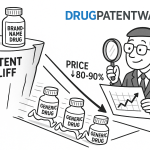
The numbers explain why precision matters. The industry faces an estimated $200 billion in branded drug revenue at risk from patent expiries over the next five years. A single blockbuster drug losing exclusivity can shed 80-90% of its revenue within 12 months of the first generic entry. For the generic side of the equation, being the first filer on an Abbreviated New Drug Application (ANDA) with a Paragraph IV certification grants a 180-day period of market exclusivity, a window that routinely delivers hundreds of millions in profits. The difference between filing first and filing second is entirely a function of how well a company reads the patent landscape.
Against this backdrop, the choice of a patent search tool is not an IT procurement decision. It is a capital allocation decision. A tool that misreports a patent’s expiration date, fails to surface a blocking Markush claim, or provides no mechanism for biologic sequence searching can cause a company to commit $200 million to an R&D program that was doomed from day one, or miss a generic entry window worth $500 million in first-mover revenue. The cost of the wrong tool does not show up on a software invoice. It shows up in a clinical write-off, a lost litigation, or a conference call where management has to explain to investors why a competitor beat them to market.
Google Patents, with its 120 million-plus indexed publications and a user interface that works exactly like a Google web search, occupies a peculiar position in this landscape. It has genuine utility for casual exploration and academic prior art surveys. It has no utility, and carries active legal risk, for any task on which a pharmaceutical company is betting real money. This guide explains precisely why that is, at the level of technical specificity required by anyone whose job depends on getting it right.
Key Takeaways: Section 1
The pharmaceutical patent system creates concentrated, time-limited value. Accurate reading of patent timelines and claim scope directly controls capital allocation decisions across R&D investment, generic launch timing, and M&A deal pricing. The tool a company uses to read the landscape is not a minor operational preference; it determines whether those decisions are grounded in fact.
2. What Google Patents Actually Does Well (And Why That Makes It Dangerous)
The Database Is Real and Large
Google Patents indexes over 120 million patent publications from more than 100 patent offices, including the USPTO, EPO, CNIPA (China), JPO (Japan), and CIPO (Canada). For a patent attorney doing preliminary landscaping, a chemist doing a quick novelty check on a known compound, or an R&D scientist trying to understand what a competitor has claimed in a new therapeutic area, that coverage is genuinely useful. The tool returns results fast, the interface is clean, and the integration with Google Scholar means non-patent literature (NPL) is one checkbox away.
The NPL integration deserves specific mention because it addresses a real gap in pure patent databases. Novelty in patent law is destroyed by any prior public disclosure, including journal articles, conference posters, and book chapters. Google Patents’ use of CPC (Cooperative Patent Classification) codes to tag NPL documents alongside patent documents in search results allows a researcher to survey both domains simultaneously. For a quick patentability screen on a relatively simple invention, that is a legitimately useful feature.
The Interface Creates Misplaced Trust
The problem is the user experience itself. Google has spent 25 years building a brand synonymous with comprehensive, accurate information retrieval. When a user types a query into Google Patents and receives 10,000 results in 0.3 seconds, the instinctive response is the same as with a regular Google search: the relevant results are probably here somewhere. That instinct is appropriate for finding a restaurant or checking a news story. It is dangerous for pharmaceutical IP.
A standard Google web search succeeds because the completeness of the index is not a life-or-death variable. If Google misses one webpage, the user finds a substitute. In pharmaceutical patent searching, a single missed patent can invalidate a drug candidate, block market entry, or trigger a $2.54 billion infringement judgment, the figure from the Idenix Pharmaceuticals v. Gilead Sciences case in which Gilead was found to have infringed patents covering hepatitis C nucleotide compounds. The platform gives no visual indication that it has missed anything. It returns its results with the same clean confidence whether it found everything or whether it missed the one document that matters most.
The demographic most at risk is not the naive user who knows nothing about patent searching. It is the sophisticated user who knows enough to run a search but not enough to understand the specific technical limitations of the platform. A chemist who understands chemical nomenclature might construct a multi-term text search that feels comprehensive and surfaces dozens of relevant patents, without realizing that the most dangerous blocking document, a broad Markush claim filed by a competitor, contains none of the text terms used in the search.
Key Takeaways: Section 2
Google Patents has real value for preliminary, non-binding landscape surveys. Its danger lies in the brand-trust transfer effect: users apply the same confidence to its results that they apply to a standard web search, without adjusting for the platform’s documented incompleteness in the specific areas that matter for pharmaceutical IP.
3. The Data Integrity Problem: Lag, Gaps, and a Legal Status Google Itself Won’t Stand Behind
The Update Lag Problem: When ‘Current’ Means Six Weeks Ago
Professional patent databases build their business on data freshness. They operate direct data feeds from national patent offices, updating indexes daily and, in some cases, within hours of official publication. Google Patents operates on a different model, and the consequences are documented in multiple independent analyses.
The lag between official USPTO publication and Google Patents indexing runs from several weeks to approximately two months under normal conditions. For a Paragraph IV filer mapping a generic launch timeline, that lag is material. A new continuation patent filed by a brand-name manufacturer, one that extends protection on a key formulation by three to five years, might not appear in Google’s index until weeks after it becomes publicly searchable on the USPTO’s own Patent Center. A generic company relying exclusively on Google Patents misses that filing during its most actionable intelligence window.
This lag compounds the 18-month statutory blackout period that already exists in the patent system. Under U.S. law (35 U.S.C. § 122(b)) and the corresponding provisions of the Patent Cooperation Treaty (PCT), most patent applications remain confidential for the first 18 months after their earliest claimed priority date. That period already creates a significant zone of uncertainty during which a competitor’s R&D activities are invisible to the market. Adding a further six-to-eight-week Google indexing lag on top of the statutory 18-month window extends the blind spot unnecessarily for anyone relying on Google as their primary data source.
Jurisdictional Coverage: The ‘Over 100 Offices’ Claim in Practice
Google’s claim that it indexes documents from “over 100 patent offices” is technically accurate and practically misleading. The company’s own support documentation includes the explicit disclaimer that it “cannot guarantee complete coverage” of all documents from those offices. For the pharmaceutical industry, the three most commercially critical jurisdictions outside the U.S. are China, Japan, and India, all three of which have documented coverage gaps in Google’s index.
China’s CNIPA is particularly important. Chinese pharmaceutical patent filings have grown significantly over the past decade, and the CNIPA database now contains material that is commercially relevant to any company operating in or targeting the Chinese market. Partial CNIPA indexing in Google Patents means that a researcher conducting a freedom-to-operate analysis for China is working with an incomplete picture. The same applies to Japanese filings through the JPO and Indian filings through the IP India database, where coverage inconsistencies have been reported by professional searchers.
The machine translation layer introduces a second-order problem. Google’s automated translation of non-English patent documents is adequate for general reading comprehension. It is not adequate for interpreting patent claims, where single words carry legal weight. A claim that recites a compound “consisting of” a specific set of elements has a materially different legal scope than one that recites “comprising” those same elements. The former is a closed claim; the latter is open-ended and covers formulations with additional components. A machine translation that renders one as the other has changed the legal meaning of the document entirely.
Legal Status Data: The Disclaimer Google Buries in the Page
The most operationally dangerous feature of Google Patents is not a search limitation. It is a data quality problem that Google acknowledges in its own platform. On individual patent pages, Google includes the following language: “The legal status is an assumption and is not a legal conclusion. Google has not performed a legal analysis and makes no representation as to the accuracy of the status listed.”
Read that carefully. Google is telling professional users, on the face of the product, that the single most important data point for any patent assessment, whether the patent is in force, abandoned, or expired, is an “assumption.” The company does not verify it. The company does not warrant it. The company does not update it in real time.
In practice, the legal status field on Google Patents is frequently wrong in ways that matter for strategic decisions. A patent may be listed as “Active” after the owner has failed to pay the required 3.5-year, 7.5-year, or 11.5-year maintenance fees to the USPTO, causing it to lapse. The patent may appear active while a post-grant review (PGR) or inter partes review (IPR) proceeding at the Patent Trial and Appeal Board (PTAB) has invalidated its key claims. A patent may have a terminal disclaimer on file, an instrument that links its expiration to an earlier patent in the same family, shortening its effective protection period, and Google’s system may not reflect that linkage accurately.
The authoritative source for all of this information is the USPTO’s Patent Center, which provides real-time access to the complete prosecution history, or “file wrapper,” of any U.S. patent or application. The file wrapper contains every office action, every applicant response, every fee payment, every terminal disclaimer, every reexamination or IPR filing, and every subsequent development in the patent’s legal life. Google Patents does not reliably integrate this data. Relying on its legal status field over the official USPTO Patent Center file wrapper is the equivalent of checking a Wikipedia article instead of the primary source.
Key Takeaways: Section 3
Google Patents has a documented indexing lag of weeks to months, incomplete and unguaranteed coverage in commercially critical Asian markets, machine translation that cannot reliably interpret legal claim language, and a legal status field that Google itself disclaims as an unverified assumption. Each of these problems, individually, is enough to disqualify the tool for any mission-critical pharmaceutical IP work. Together, they create a systematically distorted picture of the patent landscape.
4. The Technical Search Failure: Chemical Structures, Markush Claims, and Biological Sequences
Keyword Search and the Pharmaceutical Naming Problem
The fundamental mismatch between Google Patents’ search architecture and pharmaceutical IP needs starts with chemistry. A new chemical entity (NCE) does not have a single name. It has a systematic IUPAC name, a company development code (e.g., “LY2157299”), a WHO International Nonproprietary Name (INN) assigned during clinical development, and ultimately a brand name. Patents filed early in development, when the compound is most competitively sensitive, use the IUPAC name or internal codes. A keyword search for the brand name will not find those early filings.
This is not a theoretical problem. Atorvastatin, the active ingredient in Lipitor and one of the best-selling drugs in history, was described in patents under its systematic chemical name, its Parke-Davis development code, and various structural descriptions before the INN was assigned. A keyword search for “atorvastatin” against early-stage patents in the statin class would miss a substantial portion of the relevant prior art and blocking claims. Professional searchers address this by using CAS registry numbers, which are assigned to specific chemical structures regardless of the name used to describe them, and by executing structure-based searches that find compounds by their molecular architecture, not their name.
Google Patents cannot do either of those things.
The Chemistry Search Feature: What It Actually Does
Google Patents includes a feature marketed as a “Chemistry Search,” which creates an impression that structural searching is possible. The feature is a text search that recognizes specific chemical identifiers: IUPAC names, trade names, and text-based structural representations including SMILES (Simplified Molecular-Input Line-Entry System) strings and InChI (International Chemical Identifier) keys.
A SMILES or InChI search is useful only if the researcher already knows the exact identifier for the molecule of interest. It offers no mechanism for exploring structurally similar or related compounds, which is the entire purpose of a chemical patent search. The ability to find a patent by pasting in a SMILES string for a known compound is equivalent to finding a book by typing in its exact title; it confirms what you already know and does nothing to find what you don’t.
Professional chemical information systems like CAS SciFinder and the STN platform are built around graphical structure search engines. A chemist draws a query structure or substructure using a molecular editor, and the system searches across hundreds of millions of compounds to find exact matches, substructure matches (any compound containing the drawn fragment), and similarity matches (compounds sharing a defined percentage of structural features). The MARPAT database, operated by CAS, extends this capability to Markush structures, the most strategically important type of chemical patent claim. None of this exists in Google Patents.
Markush Structures: The Single Biggest Technical Deficiency
Markush claims, named after Eugene Markush whose 1924 patent first used the format, are the primary instrument of competitive protection in small-molecule pharmaceutical patents. A Markush claim describes a generic chemical scaffold with one or more variable positions, denoted R1, R2, Rn, where each variable can be selected from a defined list of chemical groups. The claim protects not just the specific compound the inventor synthesized but the entire family of structurally related compounds that could be made by substituting any combination of the listed groups at the variable positions.
The combinatorial math of Markush claims is the reason they are so commercially powerful. A patent with four variable positions, each permitting selection from ten chemical groups, theoretically covers 10,000 distinct compounds under a single claim. Pharmaceutical patents routinely have Markush claims covering millions or billions of compounds. Eli Lilly’s foundational patents on its CGRP receptor antagonist franchise, for example, used Markush structures that covered an enormous chemical space around the core scaffold, making it extremely difficult for competitors to develop a structurally related compound without falling within the scope of the claims.
For a company developing a new drug candidate, the most critical freedom-to-operate question is whether the candidate structure falls within the scope of a competitor’s Markush claim. Answering that question requires:
Parsing the Markush formula to enumerate the variable positions and their permitted substituents.
Determining whether the candidate structure can be expressed as a valid combination of those substituents.
Confirming whether the candidate is literally covered by the claim or whether it falls within its doctrine of equivalents.
Google Patents has zero capability to perform any part of this analysis. The Markush formula is a graphical construct that cannot be searched with keywords. The specific compound of interest is almost never explicitly named in the patent text; it exists only as one possible instantiation of the general formula. A Google search will return nothing, creating a false negative that a company may interpret as clearance. The MARPAT database from CAS, and the Markush search module in systems like PatSnap and Questel, exist specifically to perform this analysis at scale.
Relying on Google Patents for freedom-to-operate on a small-molecule drug is not a conservative approach or a preliminary screen. It is an answer of “I don’t know” disguised as an answer of “clear.”
Biologic Sequence Searching: A Completely Different Problem
The pharmaceutical industry’s center of gravity has shifted decisively toward biologics, large-molecule drugs defined by their amino acid or nucleotide sequences. Monoclonal antibodies, bispecific antibodies, ADCs, mRNA therapeutics, gene therapy vectors, CAR-T constructs, and fusion proteins now account for the majority of new drug approvals and an even larger share of pipeline value. Patent protection for these drugs is defined by claims that recite specific sequences or functionally equivalent variants, not by chemical structures.
Searching for potential sequence-based patent conflicts requires BLAST (Basic Local Alignment Search Tool) or comparable algorithms that can compare a query sequence against databases of millions of patented sequences and quantify the degree of similarity. This is not a task that any keyword-based text search can approximate. Biologic sequence data in patents appears in dedicated sequence listing annexes, formatted under WIPO Standard ST.25 or the newer ST.26, that are designed for machine-readable processing, not text search.
Google Patents has no sequence search capability. A researcher cannot input the CDR sequences of their therapeutic antibody and use Google Patents to identify patents that claim similar binding regions. For biosimilar developers, this is a critical gap: the interchangeability pathway under the Biologics Price Competition and Innovation Act (BPCIA) depends on a thorough understanding of the reference product’s sequence-based patent estate, and that understanding requires tools like GENESEQ from Clarivate, Aptean GenomeQuest, or the patent sequence databases accessible through NCBI’s BLAST server (with the explicit NCBI caveat that its resources are for research purposes only, not for legal freedom-to-operate conclusions).
The NCBI itself states that its patent sequence database is “not to be considered a definitive search for legal purposes.” If the free public research tool comes with that disclaimer, the standard for a commercial biopharma FTO analysis should be proportionally higher, not lower.
Key Takeaways: Section 4
Google Patents uses keyword search only. It cannot search by chemical structure, substructure, or similarity. It cannot interpret or search Markush claims, the primary protection mechanism for small-molecule drugs. It has no sequence search capability for biologics. These are not missing features on a roadmap; they are architectural limitations of a text-search system applied to a domain that communicates in chemistry and biology. Any FTO analysis for a small molecule or biologic that relies on Google Patents as its primary search tool has not been conducted.
5. IP Valuation as a Core Asset: What Distorted Patent Data Does to Deal Pricing
How Patent Portfolios Are Valued in M&A
When a large pharma company acquires a biotech or licenses a clinical-stage asset, the IP estate is not incidental to the valuation; it is the primary driver of it. A drug candidate with robust patent protection extending 15 years has a fundamentally different net present value (NPV) than an identical clinical candidate whose lead compound patent expires in four years. The delta between those two scenarios, adjusted for probability of technical and regulatory success, is what separates a $5 billion acquisition from a $1 billion one.
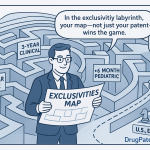
Standard pharma M&A due diligence uses a layered IP valuation methodology. The first layer establishes the “naked patent term,” the years of protection remaining under the primary composition-of-matter patent. The second layer adds regulatory exclusivities: five-year New Chemical Entity (NCE) exclusivity, three-year New Clinical Investigation exclusivity, seven-year Orphan Drug exclusivity, and 12-year Biologics exclusivity under the BPCIA. The third layer assesses the secondary patent estate, formulation patents, method-of-use patents, manufacturing process patents, and any late-stage continuation filings that could extend the effective exclusivity window beyond the primary compound patent.
A deal team using Google Patents to map that third layer is operating with systematically distorted data. The indexing lag means recent continuation filings may not appear. The incomplete jurisdictional coverage means the EU and Asian components of the secondary estate are unreliable. The flawed legal status data means abandoned or invalidated patents may be counted as active protection, and vice versa. The inability to perform Markush searching means the team cannot accurately assess the claim scope of the primary composition-of-matter patent, which determines how easily a competitor could design around it.
Case Study: The Evergreening Valuation Problem
Evergreening refers to the practice of building a “patent thicket” around a successful drug by filing multiple secondary patents covering reformulations, dosing regimens, metabolites, enantiomers, polymorphs, and delivery systems, each with a later expiration date than the original compound patent. The FDA Orange Book for a mature blockbuster drug like AbbVie’s adalimumab (Humira) or Bristol Myers Squibb’s apixaban (Eliquis) may list dozens of patents with staggered expiration dates.
For a deal team valuing a company whose revenue depends on one of these drugs, the evergreening structure is the difference between a cliff and a slope. A compound patent expiring in 2027 might be accompanied by formulation patents running to 2032 and method-of-use patents extending to 2034. Whether those secondary patents would survive a Paragraph IV challenge, and therefore how much of the protection they represent in practice, is a legal judgment that requires accurate claim-level data. Google Patents’ inability to deliver accurate legal status for the full patent family, particularly across non-U.S. jurisdictions, means that a valuation built on its data may be mispricing the asset by years of effective exclusivity.
Paragraph IV Filings as Leading Indicators
One specific area where IP data quality drives investment alpha is the tracking of Paragraph IV ANDA certifications. When a generic manufacturer files an ANDA with a Paragraph IV certification, it is asserting that either the listed Orange Book patents are invalid or the generic product does not infringe them. That filing is a public declaration of the filer’s view of patent vulnerability, and it triggers a 45-day window in which the brand-name manufacturer can sue, automatically imposing a 30-month stay on FDA approval of the generic.
For investors, a Paragraph IV filing is a material event. It represents the market’s best assessment, from a party with financial skin in the game, that a specific patent or set of patents can be challenged. A portfolio manager who wants to track these filings as they occur needs data that is current. Google Patents’ documentation lag means it cannot serve as a reliable alert system for Paragraph IV activity.
Investment Strategy: Patent Intelligence for Portfolio Managers
Patent expiration data, when layered with regulatory exclusivity data and Paragraph IV litigation status, gives portfolio managers a probabilistic loss-of-exclusivity (LOE) model for any drug. The key metrics are:
The primary compound patent expiration date (source: USPTO Patent Center, confirmed against the Orange Book).
All listed Orange Book patents and their claimed subject matter (formulation, method of use, etc.).
Any regulatory exclusivity end dates layered on top of the patent terms.
The number and identity of Paragraph IV filers, which signals market confidence that specific patents are vulnerable.
The outcome history of PTAB IPR proceedings against comparable secondary patents in the same therapeutic class.
A position in a pharma company whose blockbuster drug faces a 2027 patent cliff has very different risk characteristics if there are eight Paragraph IV filers lined up versus none. Building that model requires reliable, real-time data. Tools like DrugPatentWatch integrate all of these data layers, connecting Orange Book listings, patent expiration dates, litigation records, and regulatory exclusivity periods into a single analytical framework.
Key Takeaways: Section 5
Patent portfolio quality is the primary driver of valuation in pharmaceutical M&A and licensing. Distorted patent data, whether from indexing lags, incomplete jurisdiction coverage, or flawed legal status, corrupts the NPV models that underpin deal pricing. Evergreening structures and Paragraph IV activity are particularly sensitive to data quality, and the tools used to map them must be accurate, current, and legally verified.
6. The Legal Exposure: Willful Infringement, Treble Damages, and Your Search History
How the Willful Infringement Standard Works
Under 35 U.S.C. § 284, a court that finds patent infringement may, in its discretion, award damages “up to three times the amount found or assessed.” The Halo Electronics v. Pulse Electronics decision (2016) from the U.S. Supreme Court clarified the standard for when treble damages are appropriate: the conduct must be “egregious,” characterized by “wanton, malicious, bad-faith, deliberate, consciously wrongful” behavior. Willful blindness, knowingly shielding yourself from information that would establish knowledge, satisfies that standard.
This is where the act of conducting a patent search becomes legally significant. A patent search is an attempt to understand the IP landscape. The decision to conduct the search is, at law, an acknowledgment that patent clearance is relevant and that the searcher has a duty to find what is there. The question that follows in litigation is: did the searcher use a tool adequate to the task?
The Discoverable Search Record
Google Patents is a public platform operated by one of the world’s largest data companies. Search queries, IP addresses, timestamps, and page-view histories are data that Google generates and retains. In litigation, a discovery request for documents relating to the defendant’s patent search activities is routine. The scope of that discovery can include records from Google showing what searches were conducted, when, and what results were viewed.
This creates a specific and underappreciated risk. A company that conducts a patent clearance search on Google Patents and proceeds with a product launch generates a discoverable record that it performed a clearance search. If the search failed to find a relevant blocking patent (because of the Markush blindness, the data lag, or the jurisdictional gap), the plaintiff’s counsel can argue that the company was on constructive notice of the patent owner’s activity in the field, had an opportunity to conduct an adequate search, chose to use an inadequate free tool, and proceeded anyway. That argument, under the Halo standard, is a reasonable basis for seeking enhanced damages.
Contrast this with the position of a company that commissions a professional freedom-to-operate opinion from a patent law firm using SciFinder, MARPAT, GENESEQ, and Derwent DWPI. The existence of a professional FTO opinion, even one that turns out to be incorrect, is the primary defense against a willful infringement finding. Courts have consistently held that acting in good-faith reliance on a competent professional opinion negates willfulness. The standard of care for that professional opinion includes the use of industry-standard, professional-grade tools. It does not include Google Patents as a primary source.
The In-House Counsel Perspective
IP counsel at major pharma companies have documented the internal policy response to this risk. Several large organizations have instituted formal prohibitions on using Google Patents for any research that touches Paragraph IV strategy, FTO analysis, freedom-to-operate opinions, or pre-litigation patent analysis. The rationale is not that Google Patents is useless in all contexts; it is that its use creates a discoverable record that is hard to manage in litigation and does nothing to reduce the risk of infringement.
The risk calculus for a small biotech or mid-size pharma is different but the conclusion is the same. A startup that uses Google Patents to conduct its Series B FTO analysis and licenses a drug candidate to a large pharma partner who subsequently faces infringement litigation may find that the quality of the original FTO search becomes a negotiating point in the indemnification dispute.
Key Takeaways: Section 6
Using Google Patents for patent clearance searches creates a discoverable digital record of an inadequate due diligence effort. Under the Halo willfulness standard, that record can support a treble damages award in infringement litigation. The professional standard of care for FTO analysis explicitly requires professional-grade tools. A free tool’s appeal is not a defense to willful infringement.
7. Freedom-to-Operate Analysis: Why a Google Patents FTO Is Professionally Indefensible
What a Credible FTO Opinion Requires
A freedom-to-operate analysis answers the question: can we make, use, sell, offer for sale, or import product X in market Y without infringing any valid, in-force patent claim? The analysis has four required components: an exhaustive search across all relevant commercial markets; verified, real-time legal status for every patent identified; claim-level analysis covering all claim types, including Markush claims and sequence claims where relevant; and a written legal opinion from a qualified patent attorney that documents the search methodology and reaches a conclusion on infringement risk.
Each of those components has specific tool requirements. An exhaustive search across major pharma markets requires databases with verified coverage in the U.S. (USPTO), Europe (EPO, national offices), Japan (JPO), China (CNIPA), India, Canada, and the key South American markets. Legal status verification requires direct integration with official patent office file wrapper systems. Markush claim analysis requires MARPAT or an equivalent system. Sequence claim analysis requires GENESEQ or an equivalent biological sequence search platform.
Google Patents satisfies none of those requirements at the standard required for a professional FTO opinion. No qualified patent attorney would sign an FTO opinion based solely on a Google Patents search; the malpractice exposure would be immediate and obvious.
The FTO Opinion as a Financial Asset
A well-documented FTO opinion is not just a legal compliance exercise; it is a financial asset. In M&A and licensing transactions, the acquirer’s due diligence team will review the target’s FTO opinions as part of their IP assessment. An FTO opinion prepared by a reputable firm using professional tools, with documented search methodologies and clear identification of any blocking patents and the rationale for non-infringement, adds material value to the deal. It reduces the acquirer’s residual IP risk and supports a higher valuation.
An FTO based on Google Patents, if it surfaces at all during due diligence, is a red flag. It signals that the target either did not understand the limitations of the tool or chose not to spend the money on professional analysis. Either interpretation is a discount factor in the deal negotiation.
Key Takeaways: Section 7
A Google Patents FTO is professionally indefensible. No qualified attorney will sign it. No acquirer in a serious M&A process will accept it. The cost of a professional FTO analysis, typically $10,000-$50,000 for a standard small-molecule drug in the U.S., is immaterial relative to the cost of the development programs it protects. In that context, using a free tool is not cost management; it is a false economy with catastrophic downside risk.
8. The Evergreening Roadmap: How Innovator Companies Construct Patent Thickets Google Cannot Map
The Anatomy of a Patent Thicket
Innovator pharmaceutical companies do not rely on a single compound patent to protect their commercial assets. They construct layered patent estates, commonly called patent thickets, that create multiple overlapping barriers to generic or biosimilar entry. Each layer targets a different legally protectable aspect of the drug:
The compound patent, typically a broad composition-of-matter claim filed during early R&D and often the first to expire, protects the specific chemical structure of the active ingredient. Pharmaceutical companies often file these early, and the 20-year term from filing date runs down significantly during clinical development. By the time a drug receives FDA approval, seven to ten years of patent term may already have been consumed.
Formulation patents cover specific dosage forms, excipient combinations, controlled-release mechanisms, or delivery technologies. A drug reformulated from immediate-release to extended-release, or from tablet to transdermal patch, can support new formulation patents with later expiration dates. AstraZeneca’s omeprazole (Prilosec) to esomeprazole (Nexium) transition is the textbook example, where the switch to the S-enantiomer generated a new compound patent.
Method-of-use patents cover specific therapeutic indications, dosing regimens, patient populations, or combination use claims. A drug approved for one indication may acquire method-of-use patents covering new indications as clinical data develops. These patents can be listed in the Orange Book if they relate to an approved indication, forcing Paragraph IV certification from generic filers.
Metabolite patents cover active metabolites of the parent compound. Polymorph patents cover specific crystal forms of the active ingredient. Salt form patents cover specific pharmaceutically acceptable salts. Each of these can generate patent protection with a later filing date than the original compound patent, extending the effective exclusivity window beyond the original term.
Why Google Patents Cannot Map a Patent Thicket
Accurately mapping a patent thicket requires, at minimum: real-time legal status for every patent in the family; Markush searching capability to assess whether competitor compounds fall within formulation claims; complete jurisdiction coverage to identify counterpart applications filed in key markets; and reliable consolidation of patent families so that the U.S., EP, JP, and CN filings for the same invention are grouped as a single strategic unit rather than appearing as separate documents.
Google Patents handles none of these requirements reliably. Its Derwent DWPI equivalent, which consolidates international filings from the same priority application into a single patent family record with a human-written value-added abstract, is not available in Google’s system. A searcher in Google Patents who identifies a U.S. compound patent may not readily find the EP counterpart, the JP counterpart, or the CN counterpart, all of which may have different claim scopes due to variations in prosecution history in each jurisdiction.
For a generic or biosimilar developer, incomplete patent thicket mapping is a direct financial risk. If a company’s patent clearance analysis misses a formulation patent or method-of-use patent covering its target product, it may file an ANDA without the required Paragraph IV certification for that patent, triggering both a litigation risk and a regulatory deficiency.
Evergreening Technology Roadmap: What Professional IP Teams Track
A professional pharmaceutical IP team tracking a blockbuster drug for competitive intelligence purposes monitors the following, in sequence:
The primary compound patent expiry, as confirmed against the USPTO Patent Center file wrapper including any Patent Term Extension (PTE) granted under 35 U.S.C. § 156 for time consumed in regulatory review. PTEs can add up to five years to the patent term for a drug delayed by FDA review; this data is not reliably current in Google Patents.
Active Orange Book listings for every dosage form and strength of the reference product, with verification that each listed patent actually covers the approved product as labeled, a point that the FTC has contested aggressively, filing more than 300 challenges to what it characterizes as improper Orange Book listings for diabetes, weight loss, asthma, and COPD drugs.
Pending continuation and continuation-in-part (CIP) applications in the same patent family that have not yet published, which represent future blocking patents that may issue with later expiration dates.
Inter partes review (IPR) petitions filed at the PTAB against any patent in the estate, which may invalidate claims and accelerate the generic entry window.
Non-Orange-Book patents in the same family that could support district court infringement actions even if they do not appear in ANDA certification requirements.
Key Takeaways: Section 8
Patent thickets are strategically designed to create overlapping layers of protection that are difficult and expensive to navigate. Mapping them accurately requires real-time legal status data, full family consolidation across jurisdictions, Markush search capability, and integration with regulatory exclusivity data. Google Patents lacks the tools for all of these requirements. The consequence is that generic and biosimilar developers working from Google Patents cannot accurately identify the complete barrier set they need to overcome.
9. The Biologic IP Landscape: A Domain Where Google Patents Is Structurally Irrelevant
The Scale of the Biologic Patent Problem
Biologic drugs, including monoclonal antibodies, antibody-drug conjugates, bi- and tri-specific antibodies, checkpoint inhibitors, gene therapies, and mRNA platforms, now represent the majority of new drug approvals and an even larger share of pipeline value at major pharma companies. Their patent estates are correspondingly complex and dense.
AbbVie’s adalimumab (Humira), before biosimilar interchangeability designations began driving substitution, was protected by a portfolio exceeding 250 patents, with the last barriers to unrestricted generic entry not resolved until 2023 in the U.S. and somewhat earlier in Europe. Roche’s trastuzumab (Herceptin) had a sequence-based patent estate covering both the original antibody and related biosimilar interchangeability challenges. Regeneron’s dupilumab (Dupixent) has been actively building a secondary patent thicket around its IL-4 and IL-13 mechanism, including formulation patents and administration device patents.
For a biosimilar developer targeting any of these assets, the IP clearance question is fundamentally a biologic sequence question. Does the biosimilar’s amino acid sequence, CDR regions, glycosylation profile, or structural epitope fall within the scope of any in-force patent claim covering the reference product? That question cannot be answered by keyword search. It requires BLAST-based sequence similarity analysis against curated patent sequence databases.
The BPCIA Patent Dance and Its IP Intelligence Requirements
The Biologics Price Competition and Innovation Act (BPCIA) created a specific patent dispute resolution mechanism for biologic drugs, commonly called the “patent dance.” The biosimilar applicant provides its FDA application and manufacturing process information to the reference product sponsor, which then identifies patents it believes would be infringed. The parties negotiate a list of patents to litigate in the first wave, with additional patents available for a second wave of litigation.
The patent dance has specific information requirements that depend on complete and accurate knowledge of the reference product’s entire patent estate. A biosimilar developer going into the patent dance with an incomplete patent landscape analysis is negotiating at a disadvantage; it may agree to litigate patents it would have preferred to challenge by IPR, or fail to identify vulnerable patents in the second wave. Biosimilar interchangeability designations, which allow pharmacist-level substitution without prescriber intervention and represent the most commercially valuable form of biosimilar approval, require clinical demonstration of equivalent safety and efficacy. Whether that clinical work is worthwhile depends on accurately assessing whether the resulting product would face immediate IP barriers to formulary placement. That assessment requires current, complete biologic sequence and claim analysis.
Sequence Patent Claiming Strategies and Why They Matter
Biologic patent claims cover territory along multiple axes. Sequence claims, which recite specific amino acid or nucleotide sequences, represent the strongest and narrowest form of protection, but they are supplemented by functional claims (covering antibodies that bind a specific epitope with defined affinity characteristics), structural claims (covering specific CDR configurations or variable domain architectures), and composition claims (covering the antibody in combination with specific excipients or formulated at defined concentrations).
A biosimilar developer must search across all of these claim types to assess its clearance. Sequence claims require BLAST-based searching. Functional claims require an understanding of the reference product’s epitope and binding profile. Structural claims require knowledge of the antibody’s three-dimensional architecture. Composition claims require chemical formulation analysis. Google Patents can do none of these searches and cannot even accurately represent the sequence data in a searchable format.
Key Takeaways: Section 9
For biologic drugs, which represent the majority of current commercial value and pipeline investment in large-cap pharma, Google Patents is not just an inadequate tool. It is an irrelevant one. Biosimilar interchangeability analysis, BPCIA patent dance strategy, and sequence-based FTO work require specialized platforms that Google Patents was never designed to support.
10. The Professional Toolkit: Matching the Right Database to the Right Question
CAS SciFinder and the MARPAT Database
CAS SciFinder, operated by the Chemical Abstracts Service division of the American Chemical Society, is the gold standard for chemical patent searching and the only system that includes MARPAT, the industry’s definitive Markush structure search database. The platform’s key advantage is not just its search capability but the quality of its underlying data. CAS employs PhD-level scientists who manually index and curate chemical substances, reactions, and biological sequences from patent documents and journals worldwide, assigning CAS Registry Numbers and ensuring that structural data is accurately represented.
MARPAT, as a specific module, contains indexed Markush structures from chemical patents. A researcher draws a query structure and specifies whether to search for exact matches, substructures, or compounds falling within a Markush range. The system then searches against millions of indexed Markush formulas and returns a ranked results list showing which patents claim chemical space that overlaps with the query structure. This is the definitive methodology for small-molecule FTO analysis, patentability searching in complex chemical space, and competitive landscaping around a scaffold of interest.
SciFinder’s STN platform provides additional depth for large-scale professional searches, including direct access to chemical reaction databases and advanced patent analysis tools used by patent law firms for litigation support.
Derwent World Patents Index: Family Consolidation and Value-Added Abstracts
Clarivate’s Derwent World Patents Index (DWPI) addresses a specific problem that limits the utility of any raw patent database: the fragmentation of patent families across jurisdictions. The same invention is typically filed simultaneously in multiple patent offices under the Paris Convention or PCT procedure, generating separate patent documents in the U.S., Europe, Japan, China, and elsewhere. Without family consolidation, a searcher who identifies a U.S. filing may unknowingly analyze the same invention multiple times in different languages, and may miss counterpart claims in other jurisdictions with broader or narrower scope.
DWPI consolidates these filings into single patent family records and adds human-written, value-added English abstracts that summarize the commercial novelty and utility of the invention in plain language, cutting through the boilerplate language that characterizes legal patent prose. For competitive intelligence work and patent landscaping across large technology areas, DWPI significantly reduces analysis time while improving accuracy.
GENESEQ and Aptean GenomeQuest: Biologic Sequence Search
For biologic drug FTO and competitive intelligence, the two leading platforms are GENESEQ from Clarivate and Aptean GenomeQuest. GENESEQ is the largest and most complete database of patent-extracted biological sequences, containing sequences extracted from patents in all major jurisdictions and searchable using BLAST and Smith-Waterman algorithms. A researcher inputs a query sequence, specifies the search algorithm and similarity threshold, and receives a ranked list of patents that claim sequences with defined percentage identity to the query.
Aptean GenomeQuest covers similar territory with additional analytical tools for sequence family clustering and commercial landscape analysis. For biosimilar developers building their patent dance strategy, and for innovator companies assessing the strength of their biologic sequence claims, these platforms provide the only credible basis for a professional freedom-to-operate conclusion.
DrugPatentWatch: From Technical Data to Strategic Intelligence
The tools described above answer technical questions. DrugPatentWatch answers commercial and strategic ones. The platform integrates patent data with FDA regulatory data, Orange Book listings, litigation records, clinical trial registrations, and drug approval histories to provide a unified view of a drug’s complete commercial IP lifecycle.
The specific capabilities that generate strategic value include: Orange Book integration that shows not just patent expiration dates but the relationship between those dates and regulatory exclusivity end dates, producing an accurate prediction of the loss-of-exclusivity (LOE) date; Paragraph IV litigation tracking that shows which generics have challenged which Orange Book patents, with what outcomes; patent expiration alerting for upcoming LOE events in specific therapeutic areas; and portfolio analysis tools that allow business development teams to assess an acquisition target’s IP estate against the relevant competitive landscape.
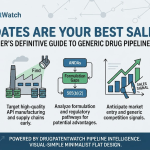
For a generic drug manufacturer, DrugPatentWatch provides the intelligence needed to identify the best ANDA filing opportunities before competitors do. For an innovator company, it provides the competitive monitoring needed to track patent challenges and anticipate market entry timelines. For an institutional investor, it provides the data foundation for building probabilistic LOE models that underpin pharma equity analysis.
The Orange Book: Essential but Incomplete
The FDA’s Orange Book (Approved Drug Products with Therapeutic Equivalence Evaluations) is a required stop in any pharmaceutical patent analysis, but it is not a substitute for a comprehensive patent search. The Orange Book lists patents that the brand-name manufacturer has submitted to FDA as covering either the drug substance, drug product, or method of use for an approved NDA.
The critical limitation is that Orange Book listing is not mandatory for all potentially relevant patents; it covers only the specific categories defined by statute and FDA regulation. Process patents, manufacturing patents, packaging patents, metabolite patents, and many method-of-use patents not tied to an approved indication are not listed in the Orange Book but may still be assertable against a generic entrant in district court. A generic developer who checks only the Orange Book and finds three listed patents is not seeing the complete picture. The FTC has made this problem more visible by challenging what it characterizes as improper Orange Book listings, patents submitted by brand-name manufacturers that the FTC argues do not legitimately claim the approved product. As of 2024, the FTC had contested more than 300 listings across diabetes, obesity, asthma, and COPD drug categories.
Key Takeaways: Section 10
No single platform provides all of the capabilities required for professional pharmaceutical IP work. CAS SciFinder with MARPAT covers small-molecule chemical structure and Markush searching. DWPI covers patent family consolidation and competitive landscaping. GENESEQ or GenomeQuest covers biologic sequence searching. DrugPatentWatch covers commercial IP intelligence integrating patent, regulatory, and litigation data. The Orange Book is a required but insufficient source. Professional IP work uses a combination of these platforms, matched to the specific questions at hand.
11. Investment Strategy: Using Pharmaceutical Patent Intelligence to Generate Alpha
Building a Loss-of-Exclusivity Model
The most direct application of patent intelligence in portfolio management is the construction of LOE (loss-of-exclusivity) models for branded pharmaceutical products. A rigorous LOE model requires data from multiple sources:
The primary compound patent expiry, including any PTE or Supplementary Protection Certificate (SPC) in European markets. The SPC mechanism, which can extend protection by up to five years in EU member states, is frequently underestimated in models built on U.S. data alone.
Regulatory exclusivity end dates, which may extend beyond the patent term. The 12-year BPCIA biologics exclusivity is the most significant example; a biologic drug with a composition-of-matter patent expiring in 2026 but a biologics exclusivity period running to 2030 does not face biosimilar competition at the patent cliff.
Orange Book patent inventory, with attention to any formulation or method-of-use patents that would force a Paragraph IV certification from generic filers, potentially triggering a 30-month stay and delaying generic entry even after compound patent expiry.
Paragraph IV certification history: the number of filers, the identity of the first filer (who holds the 180-day exclusivity), and the litigation outcomes to date. A drug with a first Paragraph IV filer who has already won the litigation has a near-certain and dated generic entry. A drug with no Paragraph IV filers, despite an approaching patent cliff, may signal that the secondary patent estate is strong enough to deter challengers.
PTAB IPR petition activity against Orange Book patents. A successful IPR that invalidates a key formulation patent can accelerate LOE by years and is a lead indicator worth tracking in real time.
Identifying Patent Cliff Catalysts
For event-driven investors, specific patent-related events function as catalysts for rapid repricing of pharma equities. The key events to monitor are: first Paragraph IV filing on a major drug (signals market confidence in patent vulnerability, typically negative for the brand-name company); successful Paragraph IV litigation outcome for a generic challenger (accelerates LOE, sharply negative for the brand); PTAB institution decision on an IPR petition (signals credible challenge); PTAB final written decision invalidating Orange Book patents; and SPC expiry in major EU markets, which typically precedes U.S. LOE and sets the international revenue decline trajectory.
A systematic monitoring program for these events, built on DrugPatentWatch’s litigation and patent expiry tracking tools rather than on Google Patents’ static and lagged data, gives investors a lead time advantage over the broader market.
White Space Analysis for Pipeline Positioning
Patent landscaping for white space analysis, identifying therapeutic areas with high clinical unmet need and relatively low patent density, is a standard tool in R&D strategy and venture-stage biotech investing. The methodology requires complete and accurate coverage of the relevant patent space, including both granted patents and published applications, across all major jurisdictions.
White space analysis conducted on Google Patents produces results that are systematically biased toward underestimating patent density. The indexing lag means that recent applications, which are the most strategically relevant for identifying crowded areas, are underrepresented. The jurisdictional gaps mean that non-U.S. filings, which may represent the most active areas of recent R&D, are missed. The result is a white space map that appears to show more clear territory than actually exists, potentially directing R&D investment toward areas that are already heavily patented in jurisdictions Google’s index does not fully cover.
Key Takeaways: Section 11
Patent intelligence generates investment alpha through LOE modeling, Paragraph IV catalyst tracking, and white space analysis. All three applications require current, complete, and legally verified patent data. Tools that provide that data, including DrugPatentWatch for integrated commercial intelligence and professional patent databases for technical analysis, support more accurate models and earlier identification of market-moving events.
12. Comparison: Google Patents vs. Professional Pharma IP Platforms
The table below compares capabilities across dimensions that matter for pharmaceutical IP decisions.
Capability
Google Patents
CAS SciFinder / MARPAT
Derwent DWPI
GENESEQ / GenomeQuest
DrugPatentWatch
Data update frequency
Weeks-to-months lag
Daily from official sources
Daily from official sources
Regular, curated updates
Daily; real-time LOE alerts
Legal status accuracy
Disclaimed; unverified assumption
Linked to official registries
Linked to official registries
N/A for sequence claims
Integrated with USPTO, Orange Book
Graphical structure search
None
Full structure, substructure, similarity
N/A
N/A
N/A
Markush claim search
None
MARPAT: full Markush search
Limited
N/A
N/A
Biologic sequence search
None
Limited
N/A
BLAST-based, curated
N/A
Patent family consolidation
None
Partial
Full, human-curated
N/A
Full for U.S. families
Non-patent literature
Google Scholar integration
Comprehensive, curated
Limited
Limited
N/A
Orange Book integration
None
None
None
None
Full integration
Paragraph IV tracking
None
None
None
None
Complete, real-time
Regulatory exclusivity data
None
None
None
None
Full integration
SPC / international exclusivity
None
None
Limited
None
Partial
FTO opinion support
Inadequate; professional malpractice risk
Appropriate with qualified attorney
Appropriate with qualified attorney
Appropriate with qualified attorney
Appropriate for commercial assessment
Willful infringement risk
High; inadequate diligence record
Low; documents professional standard of care
Low
Low
Low
Cost
Free
Enterprise license, ~$10K-$100K/year
Enterprise license
Enterprise license
Tiered; starts at ~$1K/month
Key Takeaways: Section 12
Professional pharmaceutical IP platforms cost money. The cost is immaterial compared to the programs they protect. A single unsuccessful ANDA filing that could have been avoided with a proper Markush search wastes more money than a decade of SciFinder subscriptions. A single willful infringement verdict at treble damages wipes out any conceivable subscription cost savings. The comparison is not free versus paid; it is certainty versus a gamble.
13. Frequently Asked Questions
Q: Is there any situation where Google Patents is an appropriate tool for pharmaceutical IP work?
Yes. Google Patents is appropriate for preliminary technology landscape surveys where the goal is to get a directional sense of activity in a new therapeutic area, for quickly pulling up the full text of a known patent by its number, and for academic research where the standard of rigor is descriptive rather than legally defensible. As soon as any finding will influence a business decision, an investment, a licensing agreement, a go/no-go on an R&D program, or a regulatory filing, it needs to be confirmed with professional tools.
Q: Our startup has no budget for enterprise databases. What is the minimum credible search for a seed-stage FTO?
The minimum credible approach for a cash-constrained startup is to allocate budget for a targeted professional search on the highest-risk question, which is almost always the Markush landscape around the lead compound scaffold, rather than running a broad Google Patents sweep. A one-day Markush search by a specialized firm using MARPAT costs far less than the enterprise license and answers the specific question that Google Patents cannot. Supplement with WIPO PATENTSCOPE and the EPO’s Espacenet for broader keyword searching, both of which offer better coverage and more accurate legal status than Google Patents for free. Retain qualified IP counsel to interpret results and sign any opinion.
Q: How does the Paragraph IV first-filer 180-day exclusivity actually work, and why does timing matter?
When multiple generic manufacturers file ANDAs with Paragraph IV certifications on the same drug, the first filer to submit its application earns the 180-day exclusivity period. During that window, the FDA will not approve other generic applications for that drug, giving the first filer a duopoly with the brand-name product. For a major drug, the revenue captured during those 180 days can reach hundreds of millions of dollars. The difference between being first and being second is entirely a function of when the filer identified the window of opportunity, which requires current and complete patent data. A generic company relying on Google Patents’ lagged index to time its ANDA filing is at a structural information disadvantage relative to competitors using real-time patent monitoring tools.
Q: What is biosimilar interchangeability, and how does patent data quality affect the pathway?
Biosimilar interchangeability is an FDA designation that permits pharmacists to substitute a biosimilar for the reference biologic at the point of dispensing without prescriber intervention, the same substitution that happens automatically with small-molecule generics. Achieving interchangeability requires additional clinical data demonstrating that alternating between the reference product and the biosimilar does not produce greater safety or efficacy risk than using the reference product alone. The commercial value of interchangeability is substantial: substitution rates for interchangeable biologics are significantly higher than for non-interchangeable biosimilars. The patent clearance work required before committing to the interchangeability clinical program requires current, complete, sequence-level patent analysis for the reference product’s full estate. An incomplete picture at this stage can mean investing $50-100 million in clinical work for a product that faces a sequence-based patent barrier that was not identified.
Q: How do PTAB IPR proceedings affect patent expiration timelines, and can I track them on Google Patents?
An inter partes review at the Patent Trial and Appeal Board is a post-grant proceeding that allows any party to challenge the validity of an issued patent based on prior art. A successful IPR that results in cancellation of all challenged claims effectively eliminates that patent’s protection immediately, accelerating the LOE timeline for any drug that patent covers. PTAB institution decisions and final written decisions are high-value catalysts for both investors and generic developers. Google Patents does not provide real-time tracking of PTAB proceedings or flag which Orange Book patents are currently under IPR challenge. Professional platforms including DrugPatentWatch and PTAB-specific monitoring tools from Docket Alarm provide this coverage. For any drug with approaching patent expiry and active IPR proceedings, the final written decision date is the actual LOE accelerant, and tracking it requires a current, professionally maintained data source.
For verified drug patent expiration dates, Orange Book status, Paragraph IV litigation tracking, and loss-of-exclusivity modeling, see DrugPatentWatch.com.