How to turn patent data into competitive advantage — from prior art to pipeline defense to biosimilar market entry
Why Patent Intelligence Is Now a Core R&D Function
The Shift from Legal Checkbox to Strategic Asset
For most of the twentieth century, pharmaceutical IP teams operated at the back of the house. Patent counsel reviewed claims, filed applications, and managed prosecution. R&D scientists worked upstream, largely disconnected from the IP function until a project was ready for filing. That model is broken.
The cost of bringing a new molecular entity (NME) to market now runs between $1.3 billion and $2.6 billion when accounting for capital costs and failed programs, according to the most cited estimates from the Tufts Center for the Study of Drug Development. With clinical attrition rates still hovering near 90% from Phase I through approval, every dollar of R&D capital deployed in a direction that is legally untenable or commercially blocked represents a compounding loss. Patent intelligence — the systematic gathering, analysis, and application of IP data to business decisions — is the earliest and cheapest form of risk mitigation available to a drug development organization.
But the case for integrating patent intelligence is not purely defensive. Patent data is, in aggregate, the world’s most comprehensive database of technological innovation. The WIPO database alone contains over 100 million documents, each of which discloses technical information, often in greater specificity than the corresponding scientific publication, because the applicant is legally motivated to teach the invention broadly enough to support wide claims. A company that reads this data systematically gains a forward-looking view of competitor R&D that no market research firm can replicate.
Companies that have built this capability do not use it occasionally. They treat patent surveillance as a continuous process, structured the same way they structure clinical data monitoring: with defined workflows, dedicated personnel, and regular reporting cycles to decision-makers.
What Patent Intelligence Actually Covers
The phrase ‘patent intelligence’ encompasses five distinct activities, each with a different purpose and audience.
Prior art search informs whether an invention is patentable by examining what is already known. Freedom to Operate (FTO) analysis determines whether a product can be commercialized without infringing third-party rights. Patent landscape analysis maps the full competitive terrain in a technology domain. Lifecycle management strategy uses IP tools to extend or defend market exclusivity. Competitive patent surveillance tracks competitor filing activity to anticipate pipeline moves.
Most organizations are competent at the first two. The last three, which yield the largest strategic dividends, are where the capability gap is widest.
The Financial Scale of the Problem
AbbVie’s humira (adalimumab) is the canonical example of what a mature patent strategy accomplishes. The drug’s core composition-of-matter patent expired in the United States in December 2016. Through a methodical program of follow-on filings covering formulation, manufacturing process, dosing regimen, and method-of-use claims, AbbVie built a portfolio of over 130 U.S. patents and over 250 patents globally. This thicket delayed effective biosimilar competition in the U.S. market until 2023, a full seven years after the primary patent’s expiration, protecting approximately $200 billion in cumulative U.S. sales. Whether one views that outcome as legitimate lifecycle management or abusive ‘evergreening’ is a policy question. As a pure demonstration of what systematic IP strategy can accomplish financially, it has no equal in the modern pharmaceutical era.
On the other side of that ledger, Teva, Mylan, and a consortium of other biosimilar developers spent years and hundreds of millions of dollars litigating AbbVie’s secondary patents. The cost of navigating a sophisticated patent thicket is not abstract. It is measured in legal fees, development write-offs, and delayed market entry.
Understanding patent intelligence at the level this playbook covers means understanding both sides of that dynamic.
Key Takeaways: Patent Intelligence as a Core Function
Patent intelligence operates across five distinct activities: prior art search, FTO analysis, landscape mapping, lifecycle management strategy, and competitive surveillance. Each requires different skills and different data sources.
Patent data is the most comprehensive forward-looking database of competitor R&D available. Scientific publications routinely lag patent filings by 18 months to several years.
The financial stakes of inadequate IP strategy are quantifiable. Delayed biosimilar entry, blocked market access, and invalidated primary patents all translate directly to P&L impact.
Embedding IP analysis into R&D workflows from program initiation, rather than at the filing gate, is the single highest-leverage organizational change an IP-naive company can make.
Prior Art and Patentability: The Legal Rules Every R&D Lead Must Know
Defining Prior Art: It Goes Well Beyond Existing Patents
The term ‘prior art’ is used loosely and often incorrectly in research organizations. Scientists frequently equate it with published patents. Patent attorneys know it is far broader. For an R&D lead making resource allocation decisions, the relevant definition is this: prior art is any public disclosure of the invention’s key features, in any form, anywhere in the world, before the effective filing date of the patent application.
That definition captures issued patents and published patent applications. It also captures peer-reviewed journal articles, conference abstracts, doctoral theses, product brochures, public demonstrations, and sold or commercially offered products. A traditional medicinal use documented in ethnobotanical literature from the nineteenth century can constitute prior art. A slide deck presented at a scientific conference without a non-disclosure agreement can constitute prior art. A laboratory notebook page that was somehow made publicly accessible can constitute prior art.
The practical implication for research organizations is that the habit of publishing early and asking IP questions later is a patent destruction mechanism. U.S. law provides a one-year grace period from an inventor’s own disclosure under 35 U.S.C. § 102(b)(1), but most other major jurisdictions, including Europe, Japan, and China, operate on an absolute novelty standard with no such grace period. A talk at an international conference without prior filing is a patent forfeiture in those markets.
Non-Patent Literature as Prior Art: The Underappreciated Risk
The most expensive prior art surprises in pharmaceutical development tend to come not from competing patents but from scientific literature that a team did not search. A synthesis route published in a foreign-language journal, a biological sequence characterized in a university thesis, a formulation technique described in a regulatory submission that was subsequently made public: these are the documents that surface during patent prosecution or, far more painfully, during litigation, invalidating claims that a company has spent years building commercial strategy around.
A complete prior art landscape search must systematically cover PubMed and MEDLINE for biomedical literature, CAS SciFinder and Reaxys for chemical data, the BIOSIS Previews database for life sciences, and relevant gray literature sources including regulatory agency public dockets and conference proceedings archives.
The Three Patentability Standards That Drive R&D Strategy
Novelty Under 35 U.S.C. § 102: The Binary Gate
Novelty is a binary determination. If a single prior art reference discloses every element of a claimed invention, the claim is anticipated and lacks novelty. No degree of unexpectedness or commercial value saves it. This standard is unambiguous in principle, though the claim language used to define the scope of ‘every element’ creates significant room for strategic maneuvering.
The pharmaceutical application of novelty doctrine is most acute in the context of polymorphs and salts. A compound’s free base may be disclosed in prior art, while a specific crystalline polymorph with superior stability characteristics is genuinely novel. The claim must be drafted narrowly enough to distinguish the prior art without surrendering so much scope that it becomes commercially irrelevant. That is the craft of pharmaceutical patent prosecution.
Utility Under 35 U.S.C. § 101: The Threshold Most Programs Clear
Utility is the easiest patentability hurdle in the pharmaceutical context. An in vitro IC50 value against a therapeutically relevant target is sufficient to establish specific, substantial, and credible utility. The USPTO rarely raises utility rejections against drug candidates that show any biological activity.
Where utility becomes genuinely contested is at the frontier of chemical biology, specifically for probe compounds, tool molecules, and research reagents where the connection to a therapeutic application is speculative. For purposes of IP strategy in a drug development program, utility should be treated as a given once any meaningful pharmacological data exists.
Non-Obviousness Under 35 U.S.C. § 103: The Strategic Core
Non-obviousness is where pharmaceutical patent strategy is won or lost. The standard asks whether the claimed invention, viewed as a whole, would have been obvious to a person having ordinary skill in the art (PHOSITA) at the time the invention was made, given the full body of relevant prior art.
The PHOSITA standard is not the world’s leading expert in the field. It is a skilled practitioner with knowledge of the field’s standard methods and access to its published literature. This hypothetical person is more capable than a layperson but does not possess the insight of the specific inventor.
An examiner making an obviousness rejection must identify one or more prior art references and establish both a motivation to combine their teachings and a reasonable expectation of success in doing so. The ‘reasonable expectation of success’ element is the most litigated in pharmaceutical cases, because the unpredictability of biological systems frequently makes what seems combinable in theory difficult or impossible to execute in practice.
Defending Against Obviousness: Secondary Considerations
Objective evidence of non-obviousness — also called secondary considerations — is frequently dispositive in pharmaceutical patent prosecution and litigation. The categories of secondary considerations include unexpected results, long-felt but unmet need, failure of others, commercial success, and skepticism of experts. Each requires specific evidentiary support.
Unexpected results is the most commonly deployed secondary consideration in pharmaceutical prosecution. To be effective, the unexpected result must be both quantitatively surprising relative to what the prior art would have predicted and tied directly to the claimed invention’s structural or functional features. A compound that inhibits a target at 10 nM when the prior art suggested 500 nM might constitute an unexpected result. A compound that achieves the same efficacy as the prior art compound but in a different salt form does not.
Long-felt but unmet need requires establishing that the problem the invention solves was recognized in the prior art and that skilled practitioners had attempted to solve it without success. This requires documentary evidence: literature references identifying the problem, and patent prosecution histories or abandoned programs showing failed attempts.
Non-Obviousness as an R&D Design Principle
A sophisticated pharmaceutical R&D program does not merely accept non-obviousness as a legal standard to satisfy. It engineers for it. The discovery chemistry team’s mandate should include generating data that will serve as unexpected results evidence. Formulation programs should be designed not only to achieve bioavailability targets but to produce performance data that exceeds what the literature would predict. Process chemistry innovations should be characterized fully enough that the yield, purity, or selectivity improvements are quantifiable against prior art benchmarks.
This is not a legal exercise imposed on science. It is the integration of IP strategy into the scientific design process, and it produces better patents, fewer successful challenges, and longer periods of market exclusivity.
Key Takeaways: Prior Art and Patentability
Prior art is not limited to patents. Peer-reviewed literature, conference presentations, regulatory filings, and commercial products all qualify, and failures to search non-patent literature are among the most common and costly IP mistakes in pharmaceutical development.
The grace period under U.S. law does not exist in most other major jurisdictions. Filing before any public disclosure is the only safe practice for companies pursuing international protection.
Non-obviousness is the strategic center of pharmaceutical patent law. R&D teams that generate quantified, reproducible evidence of unexpected results during discovery and development create far more defensible patents than those who address non-obviousness retroactively during prosecution.
The Searcher’s Playbook: Multi-Layer Prior Art Discovery
Why Keyword Search Alone Fails in Pharmaceuticals
The default approach to prior art searching — typing synonyms for the active ingredient into a patent database — captures a fraction of the relevant prior art universe in pharmaceutical and biotech applications. Chemical compounds can be described by IUPAC systematic names, generic names, trade names, internal lab codes, registry numbers, and structural representations. Biological sequences can be described by nucleotide sequence, protein sequence, function, immunological profile, or binding characteristics. A keyword search strategy that does not account for this terminological diversity will consistently miss critical documents.
The Three-Layer Search Architecture
A professionally executed prior art search combines keyword searching, classification searching, and citation analysis in an iterative loop. No single layer is sufficient alone; their combination produces the comprehensive coverage required for a high-stakes FTO or patentability opinion.
Keyword searching starts with a brainstorm of all terms that describe the invention across three dimensions: what it does (therapeutic mechanism, biological target, clinical indication), what it is made of (chemical class, structural scaffold, formulation components, biological modality), and how it is made or used (synthetic route, administration route, dosing regimen, manufacturing process). For each dimension, the searcher must identify synonyms, acronyms, trade names, and common shorthand. Boolean operators (AND, OR, NOT) and proximity operators (NEAR/n, ADJ/n) connect these terms and control search specificity.
Classification searching uses the Cooperative Patent Classification (CPC) system, a joint taxonomy maintained by the USPTO and European Patent Office, to retrieve all patents in a relevant technical class regardless of the specific terminology they use. A classification-based sweep is particularly effective for identifying older patents that use different vocabulary than current scientific literature. The typical workflow is to begin with keyword searching, identify the CPC codes assigned to the most relevant documents, and then run a classification-only search to retrieve all documents in that class for manual review.
Citation analysis follows naturally once a set of highly relevant ‘seed’ documents has been identified. Backward citation searching examines the references listed within a seed patent, tracing the foundational prior art on which the invention built. Forward citation searching identifies all later patents that cite the seed document, revealing how the technology evolved and who the subsequent innovators are. A complete forward citation sweep can reveal a competitor’s entire patent portfolio in a technology area more efficiently than any other search method.
Non-Patent Literature Search: Mandatory, Not Optional
Peer-reviewed journals, conference proceedings, academic theses, and regulatory-agency public databases must be searched systematically in any pharmaceutical prior art investigation. The scientific publication record frequently predates the patent record by years, particularly for target identification and early-stage mechanism-of-action research. A claim to a method of treating a disease by inhibiting a specific kinase can be invalidated by a journal article from five years earlier that demonstrates the kinase’s role in disease pathology and suggests its inhibition as a therapeutic approach, even if no specific inhibitor was disclosed.
Key resources for pharmaceutical non-patent literature search include PubMed and MEDLINE (over 35 million biomedical citations), SciFinder and Reaxys (chemical literature and reaction databases), Embase (pharmacological and clinical literature), BIOSIS Previews (life sciences), Web of Science (multidisciplinary with citation tracking), and Google Scholar (broad but non-systematic coverage).
Regulatory-agency public databases are an underutilized source. FDA’s drugs@FDA database, EMA’s European Public Assessment Reports, and the FDA’s 505(b)(2) review documents contain formulation details and clinical data that can constitute prior art to formulation patents and method-of-use patents.
Chemical Structure and Markush Searching
The Markush Problem
Pharmaceutical patents routinely claim not a single compound but a family of compounds defined by a generic structural template, known as a Markush structure. A Markush claim specifies a constant scaffold with variable substituents, where each position can be any of a defined list of groups. A single Markush claim can cover millions of specific compounds. Keyword searching against compound names cannot retrieve these claims because many of the covered compounds have no names — they exist only as chemical structures within the scope of the generic template.
Structure-based searching requires drawing the query molecule and running it against databases where chemical structures are computationally indexed. Query types include exact structure search, substructure search (finds all molecules containing the query as a subcomponent), superstructure search (finds all molecules for which the query is a subcomponent), and similarity search (finds molecules structurally similar to the query by a defined threshold).
Commercial Databases for Structure Search
CAS SciFinder, accessible through the Chemical Abstracts Service, is the reference standard for pharmaceutical structure searching. CAS employs hundreds of expert chemists who read patents and journal articles, manually extract every disclosed structure including those embedded in figures, tables, and complex Markush representations, and index them as searchable entities. The result is a registry of over 200 million substances with links to both patent and literature documents.
SureChEMBL, operated by the European Bioinformatics Institute, provides free structure-searchable access to patent chemistry extracted using automated methods. Its coverage is broader in volume than manually curated databases but less complete for complex Markush structures. It is an appropriate starting point for preliminary searches and an insufficient substitute for CAS in high-stakes analysis.
Reaxys and Elsevier’s Embase Chemistry similarly provide structure-searchable access to reaction and compound data from scientific literature, complementing the patent-focused coverage of CAS.
Biological Sequence Searching
Why Text Search Fails for Biologics
An antibody is not described by a single compound name. Its binding properties depend on its variable domain sequences, specifically the six Complementarity Determining Regions (CDRs) embedded within the variable heavy and light chains. A patent claiming ‘an antibody that binds human IL-6 with an affinity of less than 1 nM’ cannot be evaluated for infringement or prior art relevance without sequencing the antibody and comparing it to sequences disclosed in existing patents.
Sequence search requires alignment algorithms — the standard tool is BLAST (Basic Local Alignment Search Tool) and its specialized variants — run against databases that index patent-disclosed sequences. The critical constraint is that free public sequence databases (GenBank, UniProt) contain sequences from scientific literature but have incomplete patent sequence coverage, particularly for older filings and filings from certain patent offices.
Commercial Platforms for Patent Sequence Searching
Derwent SequenceBase from Clarivate is the reference standard for patent sequence intelligence in the life sciences. It indexes DNA, RNA, and protein sequences from over 58 global patent authorities, with human editorial curation for sequences that automated extraction would miss (sequences embedded in figures, sequence listings with non-standard formatting, sequences disclosed only in claims). The platform’s GENESEQ database provides curated abstracts describing each sequence’s novelty and utility, enabling rapid triage of large result sets.
PatSnap Bio integrates sequence search with patent, clinical trial, and competitive intelligence data in a single environment, allowing analysts to move from a sequence search result directly to the assignee’s full portfolio, their corresponding clinical programs, and their regulatory filings without switching platforms.
For antibody-specific programs, specialized tools including AbYsis and SAbDab provide structural and sequence data specifically for antibody variable domains, complementing the broader patent sequence databases.
Formulation and Method-of-Use Searching: The Secondary Patent Problem
An FTO analysis that evaluates only the active pharmaceutical ingredient is incomplete. Secondary patents on formulation, delivery system, manufacturing process, and therapeutic use are the primary tools of pharmaceutical lifecycle management and the primary obstacle to generic and biosimilar market entry.
Formulation prior art search requires decomposing the drug product into its excipient components and dosage form characteristics. Relevant excipients including solubility enhancers (cyclodextrins, PVP-VA copolymers, TPGS), stabilizers (BHT, ascorbic acid, edta), controlled-release polymers (HPMC, Eudragit grades, ethylcellulose), and penetration enhancers (surfactants, fatty acids) each require separate search strings. Concentration ranges and their ratios to the API are frequently claimed elements. The ‘Background’ and ‘Examples’ sections of formulation patents are the most informative for understanding claim scope, because they document the technical problems the formulation addresses and the experimental comparisons that support non-obviousness.
Method-of-use searching requires identifying all disclosed and potential therapeutic indications for the API and searching for patents claiming each combination. Drug repurposing activity has intensified this challenge, because a compound with an expired primary patent may have active method-of-use patents for indications that were discovered years after the original approval, and these patents can be just as commercially blocking as the original composition-of-matter patent.
Key Takeaways: Prior Art Search
A three-layer search architecture combining keyword, classification, and citation analysis is the professional standard for pharmaceutical prior art investigations. Each layer captures prior art the others miss.
Chemical structure and Markush searching require dedicated databases and algorithms. Text-based synonym searching against compound names misses the majority of relevant chemical prior art, particularly for structurally defined compound families.
Biological sequence searching for biologics programs requires curated patent sequence databases. Free public resources like GenBank have material gaps in patent sequence coverage.
Non-patent literature, regulatory-agency public documents, and conference proceedings must be included in any complete search. These sources frequently contain prior art that invalidates pharmaceutical patent claims.
Freedom to Operate Analysis: Early, Iterative, and Offensive
FTO vs. Patentability: Two Different Questions
Patentability analysis asks whether you can get a patent. FTO analysis asks whether you can launch without infringing someone else’s patent. These are legally distinct questions that require different search strategies, different analytical frameworks, and different outputs.
A drug can be simultaneously non-patentable (because it is disclosed in prior art) and free to operate (because no valid, in-force patent claims it in the relevant jurisdiction). Conversely, a drug can be novel enough to be patentable while still blocked by a broader pioneer patent. A new crystalline polymorph of a known compound might satisfy the novelty and non-obviousness standards for its own patent while still falling within the scope of a broader composition-of-matter claim to the compound in all its forms.
An FTO analysis is not a patentability search dressed up with a different name. It is a separate investigation targeting a different set of patents with a different analytical question: do third-party claims read on my product?
The Timing Imperative
The single costliest FTO mistake is deferral. Waiting until a candidate has completed Phase II before commissioning an FTO analysis is a structural risk management failure. At that point, a design-around is expensive (reformulation, process changes, new synthesis routes), a license negotiation happens from a position of weakness, and a challenge to patent validity requires time that an imminent commercial launch timeline may not accommodate.
FTO analysis should be initiated when the candidate’s core features are defined: the API structure (including salt form and intended polymorph), the intended formulation type and route of administration, the target indication, and the proposed manufacturing approach. For most small-molecule programs, this information is available by the candidate selection stage, well before IND filing. For biologics, the sequence and binding profile are known at the point of lead candidate selection.
The FTO analysis at this stage will not be final. It will be a risk-stratified assessment that identifies which patent families require monitoring and which require immediate analytical depth. That initial assessment informs the research program’s design: which excipients to avoid, which manufacturing approaches to explore as alternatives, and which patent families might be challenged.
FTO must then be updated at each major development milestone: IND, end of Phase I, NDA/BLA filing, and pre-launch. New patents publish continuously. The 18-month confidentiality period between a PCT filing and its international publication means that a competitor’s blocking patent can be invisible to FTO analysis for a year and a half after it was filed.
Geographic Scoping: Where the Money Is
FTO is jurisdictionally specific. A patent granted by the USPTO provides no protection in Europe, Japan, or China. Every jurisdiction where a product will be manufactured, sold, or offered for sale requires a separate FTO assessment against patents granted in that jurisdiction.
For most pharmaceutical programs, priority FTO jurisdictions include the United States (the largest single pharmaceutical market), the five major EU markets (Germany, France, Italy, Spain, and the UK assessed separately post-Brexit), Japan, and China. Secondary assessments cover Canada, Australia, Brazil, South Korea, and other markets based on the product’s commercial profile.
The practical approach for resource-constrained programs is to execute a rigorous U.S. FTO first, using its results to inform the scope of international analysis. U.S. patents and European patents are frequently co-filed from the same PCT application, so a complete U.S. analysis will identify most of the relevant patent families globally. Jurisdiction-specific legal status then needs to be verified individually.
Claim Analysis: The Only Metric That Matters
The most consequential analytical error in FTO work is the ‘looks similar’ fallacy. A patent that discusses technology resembling your product in its abstract or specification does not necessarily have claims that are infringed by your product. The legal scope of a patent is defined by its claims, not its description.
Each potentially blocking patent must be analyzed at the claim level, beginning with independent claims (which define the broadest scope of protection) and extending to dependent claims (which narrow that scope by adding additional limitations). The analysis requires constructing a claim chart: a table that reproduces each claim element in one column and maps each element to the corresponding feature of the product under analysis in the adjacent column.
For literal infringement to exist, every element of the claim must be present in the product. A product that omits even one element of a claim does not literally infringe that claim. This ‘all-elements rule’ is the fundamental analytical principle of FTO work.
The doctrine of equivalents extends the analysis beyond literal infringement. Even if a product does not literally meet every claim element, it can infringe if it performs substantially the same function in substantially the same way to achieve substantially the same result. The doctrine of equivalents is more fact-specific and more contested than literal infringement, but it must be addressed in any complete FTO analysis.
Risk Stratification and Mitigation Options
Once a claim-level analysis is complete, identified patents should be classified into risk tiers. High-risk patents have claims that clearly read on a core product feature with no apparent design-around available. Medium-risk patents involve claim language that is ambiguous on its face or depends on claim construction disputes that could be decided either way. Low-risk patents are tangentially related or have claims that do not read on any product feature upon careful analysis.
High-risk patents trigger one of four responses.
Licensing or acquisition is the most direct path. Approaching the patent holder before a commercial launch is announced provides more negotiating leverage than approaching after launch. Royalty rates in pharmaceutical licensing vary enormously by product type, market size, and exclusivity period, but a license obtained before launch is almost always less expensive than litigation or a compelled license post-launch.
Validity challenge is appropriate where the FTO analysis surfaces prior art that the original examiner did not consider. In the United States, Inter Partes Review (IPR) at the Patent Trial and Appeal Board is the primary administrative challenge mechanism. IPR petitions must be filed within one year of service of a complaint alleging infringement of the challenged patent. IPR success rates at institution have historically exceeded 60%, and of instituted trials, a substantial proportion results in cancellation of at least some challenged claims.
Design-around means modifying the product to remove the infringing element while preserving its therapeutic profile. This requires the claim chart from the FTO analysis: it defines precisely which features must be avoided and which alternatives might be available. A design-around that is implemented early in development is far less disruptive than one that requires late-stage reformulation.
Waiting for expiration is appropriate only when the blocking patent’s remaining term is short relative to the product’s development timeline, the product has no alternative market entry strategy, and the commercial logic supports delaying launch by the remaining patent term.
The FTO opinion, a formal written assessment by qualified patent counsel, is not legally required but is practically essential. In U.S. willful infringement litigation, courts can award enhanced damages up to three times actual damages. A well-reasoned opinion of counsel obtained before launch, demonstrating that the company investigated potential infringement and concluded in good faith that no infringement exists or that relevant patents were invalid, is a significant shield against enhanced damages awards.
FTO as Offensive Intelligence
Every comprehensive FTO analysis produces, as a byproduct, a near-complete map of a competitor’s patent position in the relevant technology area. Claim charts built to assess infringement risk can be immediately repurposed to assess where a competitor’s protection is strongest, where it is thinnest, and where it might be challenged. An FTO that identifies a blocking patent also identifies whether that patent has any prior art weaknesses that could support an IPR petition. This is offensive intelligence from a defensive process.
Key Takeaways: Freedom to Operate Analysis
FTO analysis and patentability search address different questions. A product can be novel and non-obvious (patentable) while still infringing third-party patents (not free to operate), and the converse is equally possible.
The timing of FTO analysis is its most critical variable. Initiating FTO at candidate selection rather than at NDA filing provides the flexibility to design around blocking patents, negotiate licenses from a position of strength, and challenge invalid patents before litigation is served.
Claim-level analysis is the only valid FTO methodology. Patent descriptions that appear relevant may not have claims that read on the product. Claims that appear narrow on first reading may have broad scope under construction.
The 18-month PCT publication delay creates a blind spot. Patents filed by competitors up to 18 months before the date of an FTO search may not be publicly visible. Periodic updates are mandatory.
Patent Landscape Analysis: Reading the Competitive Terrain
From Microscope to Telescope
FTO analysis is a microscope: it produces high-resolution detail on specific infringement risks. Patent Landscape Analysis (PLA) is a telescope: it maps the entire innovation ecosystem in a technology domain, revealing competitive positioning, R&D trends, and strategic opportunity across thousands of documents simultaneously.
A PLA is the primary intelligence tool for R&D strategy decisions at the program and portfolio level. It answers questions that neither a targeted patent search nor market research can address: Who owns the foundational patents in this target class? Which companies filed more than 20 patents in this space in the last three years? Is the filing rate in this technology area rising or declining? Are there major players who appear to be pivoting away from a technology area, potentially leaving their portfolio under-defended?
The PLA Process: From Raw Data to Actionable Intelligence
A defensible PLA follows a structured methodology regardless of the technology domain.
Scope definition is the first and most consequential step. A scope that is too broad produces an unwieldy dataset; one that is too narrow misses context. For a therapeutic target-based landscape, the appropriate scope typically covers the target itself, all known binding mechanisms (orthosteric, allosteric, covalent, degrader-based), all disclosed chemical classes of ligands, and the primary disease indications. Secondary scope considerations include adjacent targets in the same pathway and competing therapeutic modalities (small molecule vs. antibody vs. peptide vs. gene therapy).
Data collection uses the multi-layer search architecture described in the prior art section, executed across all major global patent databases. Professional PLA work targets a comprehensive, deduplicated dataset that represents the full published patent activity in the defined scope.
Data cleaning and normalization is a technical prerequisite for accurate analysis. Patent databases list assignees inconsistently: ‘Pfizer Inc.,’ ‘Pfizer Products Inc.,’ ‘Pfizer Limited,’ ‘Warner-Lambert Company’ (a former Pfizer subsidiary), and various international affiliates may all appear as distinct assignees despite belonging to the same corporate hierarchy. Without normalization, any analysis of top patent holders by volume is systematically wrong. Commercial platforms have invested significantly in this normalization, but manual verification of high-stakes conclusions remains necessary.
Technical taxonomy construction requires subject matter expertise. Categorizing thousands of patents into a meaningful technical framework — for example, categorizing ADC patents by antibody target, linker type, payload class, and conjugation chemistry — requires that a domain scientist review and code a significant portion of the dataset, or that an automated AI-assisted classification be validated against expert review. The taxonomy drives all subsequent analysis and visualization, so errors in categorization propagate through the entire report.
Analysis and visualization layers are built on the normalized, categorized dataset. The core visualizations in a pharmaceutical PLA include temporal filing trend charts, geographic patent density maps, assignee-by-technology-subclass matrices, citation network diagrams, and topographic or clustering maps.
Visualization Types and Their Strategic Applications
Temporal filing trend charts plot patent application volume over time for the defined technology domain. A consistent upward trend from 2015 to the present indicates a growing field with sustained R&D investment and increasing competitive intensity. A plateau or decline from a prior peak may indicate technical obstacles, market saturation, or a generational shift in therapeutic modality. For example, small-molecule kinase inhibitor filings have plateaued across many target classes as the field has matured, while targeted protein degrader (TPD) filings have grown steeply from a near-zero baseline in 2015 to several hundred per year by 2024.
Geographic density maps display patent filing volume by jurisdiction. For pharmaceutical programs targeting global markets, this reveals which competitors are filing protection broadly versus concentrating their portfolio in a single jurisdiction. A company that files heavily in the U.S. and China but not in Europe may be signaling different commercial priorities or may face patentability obstacles in certain markets.
Assignee-technology matrices show which companies hold significant positions in which technical sub-categories of the defined scope. These matrices immediately reveal dominant players in specific niches, companies with broad but shallow coverage across many sub-categories, and sub-categories where no major player has established a dominant position.
Citation network diagrams map the knowledge flow between patents by drawing connections between citing and cited documents. Patents that are heavily cited by others — high in-degree nodes in the citation network — are foundational inventions whose scope and validity are central to the competitive landscape. Identifying these ‘hub’ patents and assessing their validity is a high-priority task for any strategic IP team.
Topographic or clustering maps group patents by conceptual similarity using computational text mining. The result is a visual terrain where dense ‘peaks’ represent heavily patented sub-areas and open ‘valleys’ represent white spaces with sparse coverage. These maps are the primary tool for white space identification.
Key Takeaways: Patent Landscape Analysis
PLA operates at the portfolio and program level, above the question of any single patent’s infringement risk. Its primary output is competitive intelligence: who is doing what, where, and at what investment level.
Accurate assignee normalization is the most critical data quality step in any PLA. Without it, all competitive ranking analyses are systematically misleading.
Temporal trend analysis can reveal technology lifecycle stage (emerging, growing, maturing, declining) and shifts in investment across therapeutic modalities within a target class.
PLA is most valuable as a living intelligence system updated quarterly, not as a one-time report. Filing rates, competitor entries, and technology trends change continuously.
Lifecycle Management and Evergreening: The IP Tactics That Extend Market Exclusivity
The Patent Cliff and the Response
The ‘patent cliff’ describes the revenue decline that follows the expiration of a blockbuster drug’s primary composition-of-matter patent and the entry of generic or biosimilar competitors. The cliff is not a surprise event. It is a scheduled risk that can be seen years in advance on every IP team’s patent expiration calendar. The question is not whether the cliff is coming; it is how much runway has been built before arrival.
Pharmaceutical lifecycle management is the set of IP, regulatory, and commercial strategies used to extend the productive period of a drug franchise beyond the primary patent’s expiration. It is also called ‘evergreening’ by critics who argue that many of its tactics extend monopoly pricing without adding commensurate clinical value. Both framings contain truth. The tactics are legally available, regularly used, and effectively challenged when they are abusive.
The Lifecycle Management Toolkit
Polymorph and Salt Form Patents
An active pharmaceutical ingredient exists in multiple physical forms: amorphous solids, crystalline forms (polymorphs), solvates, hydrates, co-crystals, and ionic forms (salts). Different forms have different physical properties — melting point, solubility, hygroscopicity, bioavailability — that affect pharmaceutical performance. A patent claiming a specific polymorph with superior dissolution characteristics relative to other known forms can survive long after the base compound’s composition-of-matter patent has expired.
The legal standard for polymorph patents is contested. Courts and patent offices in different jurisdictions apply the novelty and non-obviousness standards differently to polymorphs. The European Patent Office has historically been skeptical of polymorph patents where the improved properties (such as stability or processability) are routine characteristics of a well-crystallized form rather than unexpected outcomes of the specific polymorph. U.S. courts have been more accommodating. India’s Section 3(d), introduced in the Patents Act and tested in the 2013 Supreme Court Novartis case over imatinib’s beta-crystalline polymorph, explicitly restricts patents on new forms of known substances unless they demonstrate significantly enhanced therapeutic efficacy — a materially different standard from U.S. law.
Formulation and Delivery System Patents
The step from a drug substance to a drug product requires formulation: the selection and combination of excipients that determine how the API is released, absorbed, and distributed. Patents on formulation innovations are among the most commercially durable of the secondary patent categories, because they protect the product as it is actually manufactured and sold.
Extended-release formulations are the canonical example. A twice-daily immediate-release formulation of a small molecule loses primary patent protection. A once-daily extended-release formulation, if it has genuine non-obvious performance advantages (different peak-to-trough ratio, improved tolerability, reduced food effects), can sustain a separate patent estate. The extended-release Adderall XR franchise extended commercial life of mixed amphetamine salts well beyond the immediate-release product’s exclusivity period using this mechanism.
Pediatric formulations represent a distinct category with regulatory exclusivity layered on top of patent protection. The FDA’s pediatric exclusivity provision grants six additional months of market exclusivity to innovators who conduct FDA-requested pediatric studies, independent of patent term. This incentive has driven a significant expansion of formulation-level IP in drugs used in pediatric populations.
Method-of-Use Patents and Dosing Regimen Claims
A patent on the use of a known compound to treat a disease for which it was not originally patented is a method-of-use patent. These are most valuable in drug repositioning contexts, where a known drug shows activity in a new indication, and in dose optimization contexts, where clinical development reveals an optimal dosing regimen, patient selection criterion, or combination therapy that was not described in the original approval.
Dosing regimen patents have been controversial. A patent claiming ‘a method of treating X comprising administering compound Y in an amount of Z mg/kg every 14 days’ can effectively block a generic from substituting for the branded product even after the API patent expires, because the generic’s label must include the patented dosing regimen if it is the approved therapeutic use. Carve-out labeling (the ‘skinny label’) allows generics to seek approval for non-patented uses while omitting patented indications, but the FDA’s evolving interpretation of skinny labeling has made this strategy legally uncertain.
Pediatric Exclusivity and Orphan Drug Designation
Regulatory exclusivity mechanisms exist independently of the patent system and can overlap with or supplement patent-derived exclusivity.
Orphan drug designation, available under the Orphan Drug Act for drugs targeting diseases affecting fewer than 200,000 U.S. patients, grants seven years of market exclusivity from approval, independent of patent status. For rare disease drugs with small addressable markets, this regulatory exclusivity is frequently the primary commercial moat, because the clinical economics of the indication may not support extensive patent litigation.
Pediatric exclusivity adds six months to the term of existing patent protection and exclusivity periods (including the five-year new chemical entity exclusivity and the three-year new clinical investigation exclusivity). It applies when a sponsor completes FDA-requested pediatric studies under Written Request. This six-month extension sounds modest, but for a drug generating $2 billion annually, it is worth $1 billion.
For portfolio managers and institutional investors, a drug franchise’s lifecycle management depth is a critical valuation input. A thorough analysis of the secondary patent estate requires examining: how many patent families cover the commercial formulation (not just the API), what is the geographic coverage of those families, what is the remaining term of the most valuable secondary patents, and whether secondary patents have been tested in litigation and survived.
The most durable lifecycle management positions combine multiple layers — a formulation patent with five years remaining, an extended-release delivery patent with three years remaining, a dosing regimen patent with six years remaining, and a manufacturing process patent — in a way that means no single patent’s expiration opens the door to full generic substitution.
AstraZeneca’s Nexium (esomeprazole) is the textbook example. The S-enantiomer of omeprazole was patented separately after the racemate’s primary patent expired, with AstraZeneca arguing clinical superiority of the pure enantiomer. U.S. courts upheld the enantiomer patent, extending commercial exclusivity, though the case remains a canonical example in the policy debate about evergreening.
Key Takeaways: Lifecycle Management
Lifecycle management begins at program initiation, not at primary patent expiration. The secondary patent estate must be filed and prosecuted while the R&D program is generating the underlying technical data.
Polymorph, formulation, delivery, method-of-use, and dosing regimen patents each serve different commercial functions and face different legal standards in different jurisdictions.
Regulatory exclusivity mechanisms (orphan drug, pediatric exclusivity, NDA exclusivity) operate independently of the patent system and can provide commercial protection even when patent coverage is thin.
For investors, the depth and geographic coverage of a drug’s secondary patent estate is a key variable in projecting the revenue impact of generic or biosimilar entry.
Biosimilar and Generic Market Entry: The Patent Cliff Playbook
The Hatch-Waxman Framework and Paragraph IV Strategy
The Hatch-Waxman Act (Drug Price Competition and Patent Term Restoration Act) is the statutory foundation for generic drug market entry in the United States. Under its framework, generic applicants file an Abbreviated New Drug Application (ANDA) that relies on the reference listed drug’s (RLD) safety and efficacy data, rather than conducting independent clinical trials. The ANDA must certify the status of each Orange Book-listed patent.
A Paragraph IV certification states that the ANDA applicant believes the listed patent is invalid, unenforceable, or will not be infringed by the generic product. Filing a Paragraph IV certification is an act of patent infringement under Hatch-Waxman, which triggers the innovator’s right to file suit within 45 days to obtain an automatic 30-month stay of ANDA approval. This stay gives the innovator time to litigate the patent challenge before the generic enters the market.
The first ANDA applicant to file a Paragraph IV certification against each listed patent is awarded 180 days of market exclusivity upon approval, during which the FDA cannot approve subsequent generic competitors. This 180-day exclusivity has become an economic asset in its own right; it is frequently monetized through pay-for-delay settlements (also called reverse payment settlements), where the innovator pays the generic challenger to delay market entry while the generic retains its exclusivity period.
Pay-for-delay settlements, while legally settled as potentially anticompetitive following the Supreme Court’s 2013 FTC v. Actavis decision, remain common. The analysis of whether a settlement violates antitrust law now depends on a ‘rule of reason’ evaluation of the payment’s size relative to the litigation’s value and the associated market effects.
The Biologics Price Competition and Innovation Act (BPCIA) and the Patent Dance
The regulatory pathway for biosimilar market entry in the United States is established by the Biologics Price Competition and Innovation Act (BPCIA), enacted as part of the Affordable Care Act in 2010. The BPCIA framework differs from Hatch-Waxman in significant ways that affect patent strategy for both innovators and biosimilar developers.
The BPCIA’s ‘patent dance’ is a structured information exchange between the reference product sponsor (the innovator) and the biosimilar applicant following the FDA’s acceptance of the biosimilar application for filing. The biosimilar applicant provides its application to the innovator. The innovator identifies patents it believes are infringed. The parties negotiate which patents to litigate immediately and which to reserve for later litigation if the biosimilar is approved and commercialized.
The patent dance is optional in practice, following the Supreme Court’s 2017 decision in Sandoz v. Amgen, which held that a biosimilar applicant is not required to provide the application to the reference product sponsor. But the decision to forgo the dance has strategic consequences: the innovator can seek a preliminary injunction at launch based on patents it would have included in the dance. The practical result is that most sophisticated biosimilar developers engage in at least a modified form of the information exchange.
Biosimilar interchangeability designation, which allows pharmacists to substitute the biosimilar for the reference product without physician intervention (analogous to automatic substitution for small-molecule generics), requires additional clinical demonstration of equivalent safety and efficacy in switching studies. As of 2024, only a handful of biosimilars have achieved interchangeability designation, but the regulatory pathway is established and the commercial value of interchangeability for high-volume self-administered products like insulin analogs is substantial.
Patent Cliff Forecasting for Portfolio Managers
Quantifying the patent cliff risk for a branded pharmaceutical product requires integrating patent term data with regulatory exclusivity data and jurisdiction-specific generic/biosimilar market dynamics.
The relevant data sources are: Orange Book listings (for U.S. small molecules), the Purple Book (for U.S. biologics), the European Patent Register (for EU patent status), national patent office databases for other key markets, and FDA Paragraph IV certification history (available through FDA’s ANDA database and commercial platforms including DrugPatentWatch).
The analytical output should distinguish between: the primary patent expiration date (composition-of-matter, when applicable), the date of the last-expiring Orange Book-listed patent, the regulatory exclusivity expiration date (whichever is later among NDA exclusivity, orphan designation, pediatric exclusivity), and the ‘effective protection date’ — the analyst’s estimate of when a generic or biosimilar can realistically reach market accounting for regulatory approval timelines and litigation outcomes.
The spread between the primary patent expiration and the effective protection date is the measure of lifecycle management success. For AbbVie’s Humira, this spread in the U.S. market was approximately seven years. For many other products, it is zero.
Key Takeaways: Generic and Biosimilar Market Entry
Paragraph IV ANDA filing is the primary mechanism for U.S. generic market entry and requires evaluating innovator patent validity and non-infringement. Understanding the Orange Book listing for a target product is prerequisite analysis for any generic entrant.
The BPCIA patent dance is optional but strategically consequential. Biosimilar developers who skip the dance lose the structured litigation timeline but avoid providing their application to the innovator. The optimal strategy is case-specific.
Biosimilar interchangeability designation provides significant commercial advantage for self-administered products by enabling automatic pharmacist substitution. It requires additional switching study data.
Patent cliff forecasting requires integrating patent, regulatory exclusivity, and market entry timeline data. Commercial platforms including DrugPatentWatch provide Orange Book integration and ANDA filing history that significantly accelerate this analysis.
White Space Analysis: Finding Defensible Innovation Gaps
What White Space Analysis Is and Is Not
A patent white space is a region of a technology landscape where patent density is low relative to the surrounding areas. On a topographic patent map, white spaces are the valleys between peaks of dense patenting activity. On an assignee-technology matrix, they are empty cells where no major organization holds significant patent positions.
The identification of a white space is an analytical output, not a strategic conclusion. A white space can represent a genuine, overlooked innovation opportunity. It can also represent a scientific dead end that has been abandoned after failed experiments, a market too small to support commercial development, a regulatory barrier that makes the area non-viable, or a technical obstacle that has not yet been overcome. Treating white space identification as equivalent to opportunity identification is the most common analytical error in patent landscape work.
Validating a White Space: The Multi-Source Integration Requirement
A white space identified in patent data requires validation across at minimum three additional data sources before it rises to the level of a credible strategic opportunity.
Scientific literature analysis determines whether the white space reflects a scientifically unexplored area or an area that has been explored in the academic literature without generating patentable innovations. A gap in patent filings in an area with active academic publication suggests that the technical challenge is known but that a commercially viable solution has not yet been found — a high-value opportunity if the company can close the technical gap.
Clinical trial database analysis (ClinicalTrials.gov, EU Clinical Trials Register, ICTRP) reveals whether companies are pursuing experimental programs in the white space without yet publishing patents (due to the 18-month publication delay) or whether prior clinical failures explain the patent desert.
Market and disease burden data determines whether the white space corresponds to an unmet need with a commercially viable patient population and reimbursement pathway, or to an indication where the disease burden is insufficient to support drug development economics.
Internal capability assessment determines whether the company has the scientific expertise, manufacturing capabilities, and clinical development experience to pursue the opportunity, or whether a partnership or acquisition is required.
Only when a white space passes all four validation filters does it merit allocation of significant R&D resources.
Case Study: KRAS G12C as a Validated White Space (2013-2016)
KRAS mutations are present in approximately 25% of all human cancers and were long considered ‘undruggable’ because of the protein’s smooth surface, lack of a clear binding pocket for small molecules, and high affinity for GTP that made competitive inhibition impractical. For decades, the KRAS patent landscape showed intense activity around downstream pathway components (RAF, MEK, ERK) but a near-complete white space at the level of direct KRAS binding.
The scientific breakthrough that validated this white space was the identification of a cryptic binding pocket (the S-II pocket) that becomes accessible when KRAS adopts the GDP-bound state and that can be targeted selectively by covalent inhibitors acting on the mutant cysteine in the G12C variant. Kevan Shokat’s laboratory published this mechanism in 2013. Amgen’s patent filings on what would become sotorasib (Lumakras) began shortly after.
Between 2013 and 2016, the patent filing landscape around direct KRAS G12C inhibition was sparse. Companies that conducted white space analysis and cross-referenced it with the Shokat laboratory’s publications during that window had a three-to-four-year head start on building a patent position. By 2019, the space was crowded with filings from Amgen, Mirati Therapeutics, Revolution Medicines, and dozens of others.
The KRAS G12C story illustrates the core dynamic of validated white space analysis: the gap existed for scientific reasons (technical difficulty), was resolved by a specific mechanistic insight, and the window for early IP positioning was narrow. The companies that acted earliest built the strongest patent positions.
Key Takeaways: White Space Analysis
Patent white spaces require multi-source validation before being treated as strategic opportunities. Scientific feasibility, clinical precedent, market viability, and internal capabilities must all be assessed.
White spaces that correspond to areas with active scientific publication but no patent filings are higher-value targets than spaces with neither publication nor patent activity, which more often reflect genuine scientific dead ends.
The window between white space validation and competitive crowding can be short, particularly in high-visibility areas. The KRAS G12C analogy suggests that a two-to-four-year first-mover advantage is available in validated spaces, but execution speed is critical.
The Analyst’s Toolkit: Platform Comparison and Selection Guide
Free Databases: Foundational, Not Sufficient
The major patent office databases — USPTO Patent Public Search, EPO’s Espacenet (over 140 million documents), WIPO Patentscope — are the starting point for any patent search and are non-negotiable components of the analyst’s toolkit. They provide free access to the full text of patents from the world’s major patent offices, with search capabilities adequate for targeted document retrieval and preliminary research.
Their limitations are equally non-negotiable to understand. Assignee data is presented as filed, without normalization, making it unusable for portfolio-level competitive analysis. Analytical and visualization tools are minimal to absent. Chemical structure and biological sequence search is not available or is limited to basic functionality. Integration with regulatory data, clinical trial data, or litigation records does not exist.
For any analysis beyond document retrieval, commercial platforms are required.
Commercial Platform Landscape
DrugPatentWatch is built specifically for biopharmaceutical business intelligence rather than for patent counsel or IP prosecution work. Its core differentiating feature is the depth of data integration: patent data is linked to FDA Orange Book listings, NDA and ANDA filings, clinical trial records, patent litigation history, and drug pricing and sales data in a single query environment. A patent expiration search on DrugPatentWatch returns not just the expiration date but the corresponding regulatory exclusivity data, the history of Paragraph IV challenges filed against the listed patents, and the generic applicants’ approval status. For business development, portfolio management, and competitive intelligence professionals, this integration eliminates the multi-database workflow that otherwise characterizes this analysis.
Clarivate Derwent Innovation is the reference standard for patent data quality in the life sciences. The Derwent World Patents Index (DWPI), which underpins the platform, employs a team of scientific editors who rewrite patent titles and abstracts into standardized technical summaries and apply a proprietary classification and indexing system. This human curation dramatically improves the precision of keyword and classification searching in technical domains where patent language is intentionally complex or obfuscatory. Derwent SequenceBase, the companion platform for biological sequence searching, provides the most comprehensive and editorially curated patent sequence database available, covering over 58 patent authorities with human-validated coverage of sequences that automated extraction misses.
Questel Orbit Intelligence provides comprehensive global patent coverage with dedicated life sciences modules including advanced chemistry and biosequence search capabilities. Orbit’s landscape analytics and visualization tools are among the most mature in the market, supporting the full PLA workflow from data collection through final report generation. Questel’s IP management software integrates with Orbit, making it attractive for organizations that want a unified platform across prosecution, portfolio management, and landscape analysis.
PatSnap has built its market position on a highly intuitive user interface and strong AI integration. Its Eureka platform for R&D intelligence connects patent, scientific literature, clinical, and competitive data in a way designed for scientists and R&D leaders rather than IP professionals. PatSnap’s AI-driven features — semantic search, automated claim analysis, landscape mapping — are among the most developed in the commercial market as of 2024-2025, making it an increasingly attractive platform for organizations looking to scale patent intelligence beyond specialized IP teams.
IQVIA ARK Patent Intelligence serves the market access and pharmaceutical commercial strategy audience rather than the IP prosecution audience. Its strength is the integration of patent and regulatory exclusivity data with prescribing data, market access analytics, and launch timing forecasts, making it particularly valuable for brand teams, payers, and market access specialists assessing the commercial implications of patent expirations.
Platform Selection Criteria
For IP and R&D strategy functions, the decision between commercial platforms should consider five factors: the depth of regulatory data integration (critical for pharmaceutical programs), the quality and completeness of chemical structure and sequence search capabilities (critical for small-molecule and biologics programs respectively), the maturity of landscape analytics and visualization tools, the quality of assignee normalization and corporate hierarchy data, and the availability of litigation monitoring and Paragraph IV alert functionality.
No single platform excels on all five dimensions for all use cases. Organizations managing a diverse portfolio of small-molecule and biologic programs often maintain subscriptions to multiple platforms that complement each other’s strengths.
Key Takeaways: Platform Selection
Free patent databases are essential for document retrieval but are inadequate for competitive analysis, landscape mapping, or any investigation requiring normalized data.
DrugPatentWatch’s integration of patent, regulatory, clinical, and litigation data makes it the most efficient platform for pharmaceutical commercial intelligence and patent cliff analysis.
Clarivate Derwent’s editorially curated data is the reference standard for search quality in complex technical domains and for biological sequence searching.
PatSnap’s AI-driven interface and R&D intelligence integration position it as the leading platform for organizations scaling patent intelligence to scientist-facing workflows.
Platform selection depends on use case. IP prosecution teams, landscape analysts, business development professionals, and commercial strategy teams have materially different platform needs.
AI in Patent Intelligence: Capabilities, Risks, and the Human Ceiling
What AI Actually Does in Patent Analysis
Artificial intelligence has been deployed in patent intelligence platforms since at least 2015, initially for classification automation and now across nearly every function in the analysis workflow. The specific technologies involved are natural language processing (NLP) for text extraction and semantic understanding, machine learning (ML) for classification, prediction, and anomaly detection, and large language model (LLM) architectures for semantic search and document summarization.
NLP enables the extraction of structured entities from unstructured patent text: drug names, target proteins, disease indications, company names, and the relationships between them. A patent that describes ‘a method of treating non-small cell lung cancer comprising administering an EGFR inhibitor’ can be automatically tagged with the entities ‘NSCLC,’ ‘EGFR,’ and ‘kinase inhibitor’ without manual review. At scale, this entity extraction converts a dataset of 10,000 patent documents into a structured database that supports quantitative competitive analysis.
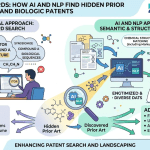
Semantic search, the most commercially mature AI application in patent intelligence, changes the way searches are formulated and executed. Traditional keyword search retrieves documents containing specified terms. Semantic search retrieves documents that are conceptually related to a query, regardless of the specific vocabulary used. A semantic query for ‘sustained-release oral formulation using membrane-coating technology’ will retrieve patents about controlled-release coatings even if they use the terms ‘extended-release,’ ‘film-coated,’ ‘semipermeable membrane,’ or ‘Eudragit’ rather than the searcher’s specific phrasing.
The practical impact of semantic search is significant. The recall rate of relevant documents, which in traditional keyword searches can be below 60% even with careful synonym expansion, improves materially with semantic approaches. More importantly, the precision of results improves, reducing the volume of irrelevant documents that must be manually reviewed.
ML-based automated classification accelerates the categorization phase of patent landscape analysis. Given a defined taxonomy and a training set of manually classified patents, an ML model can classify thousands of documents in minutes. The accuracy of automated classification depends heavily on the quality of the training data and the specificity of the taxonomy. For mature technology domains with large training datasets, classification accuracy can exceed 85%. For emerging technologies where the taxonomy is not yet well-defined and training data is sparse, human review remains the primary tool.
LLM-based summarization generates human-readable summaries of patent documents, collapsing a 50-page patent specification into a paragraph that captures the core invention, key claims, and distinguishing features. This capability meaningfully accelerates the initial triage phase of landscape analysis. Its limitation is accuracy: LLMs regularly generate plausible-sounding but factually incorrect summaries, particularly for highly technical content where the model’s training data may be inadequate.
The Confidentiality Risk: A Critical Operational Constraint
The use of public, third-party AI tools in patent intelligence work creates a legal risk that is widely underappreciated. If an R&D team submits an invention disclosure to a public LLM service — even through a seeming API integration — and that disclosure contains information about an unpublished invention, the submission may constitute prior art that destroys the invention’s novelty.
This is not a theoretical risk. The terms of service of many public AI tools grant the provider broad rights to use submitted data for model training. Even services that claim not to use submitted data for training cannot provide the legal certainty required for patent prosecution purposes. The only safe operating principle is: no unpublished invention information enters any AI tool that does not operate under a documented confidentiality agreement and data isolation guarantee.
Enterprise-grade patent intelligence platforms that integrate AI (Clarivate, PatSnap, Questel in their enterprise deployments) operate under strict data security agreements that address this concern. Ad hoc use of public generative AI for patent drafting or analysis of unpublished inventions is categorically different and categorically riskier.
Where Human Expertise Remains Irreplaceable
AI does not determine whether prior art is legally relevant to a specific claim limitation. It does not assess whether a design-around successfully avoids infringement under the doctrine of equivalents. It does not evaluate the credibility of expert testimony in a litigation context. It does not weigh the strategic considerations that determine whether to challenge a patent, license it, or design around it. It does not recognize that a competitor’s filing pattern, viewed in context with their organizational moves and pipeline announcements, signals a pivot into your core technology area.
The tasks that AI performs well — retrieval, classification, summarization, pattern recognition across large datasets — are tasks that can be automated because they have clear inputs and measurable outputs. The tasks that remain exclusively human are those that require judgment: strategic context, legal interpretation, credibility assessment, and synthesis across data types that AI cannot ingest.
The practical organizational implication is that AI investment in patent intelligence should be prioritized where volume is the primary constraint. Classification of a 5,000-document landscape dataset, generation of initial summaries for triage, and pattern analysis across a competitor’s filing history are high-value AI applications. Claim-level infringement analysis, validity opinion writing, and strategic recommendations to the executive committee remain human-in-the-loop functions.
Key Takeaways: AI in Patent Intelligence
Semantic search materially improves the recall and precision of prior art searches relative to keyword-only approaches. It is the highest-impact AI application currently deployed in commercial patent intelligence platforms.
LLM-based summarization accelerates document triage but requires human validation. Factual errors in AI-generated patent summaries are common enough that unsupervised deployment creates legal risk.
Using public AI tools to analyze unpublished invention disclosures is a patent-destruction risk. Enterprise-grade platforms with documented data isolation agreements are the only appropriate environment for AI-assisted analysis of confidential R&D information.
Human expertise remains irreplaceable for claim-level infringement analysis, validity opinions, strategic interpretation, and executive-level recommendations. AI handles volume; humans handle judgment.
IP Valuation: Patents as Balance Sheet Assets
Why Patent Portfolios Have Quantifiable Financial Value
Patents are intangible assets that appear on corporate balance sheets at acquisition cost (when acquired from external parties) or at zero (when internally developed, under most accounting standards). This accounting treatment systematically understates the economic value of strong pharmaceutical patent portfolios. The practical valuation gap creates both risk — for acquirers who may overpay or underpay — and opportunity, for financial analysts who can correctly assess IP quality where market pricing does not.
Patent portfolio valuation methodology draws on three primary frameworks, each applicable in different circumstances.
The Three Valuation Frameworks
The income approach, the most conceptually appropriate for pharmaceutical patents, estimates the net present value of future cash flows attributable to the patent’s exclusivity. This requires projecting the revenue stream protected by the patent, the discount rate reflecting clinical and commercial risk, and the remaining patent term including potential extensions (patent term extension under 35 U.S.C. § 156, pediatric exclusivity). For a drug generating $3 billion annually in U.S. sales with four years remaining on its last-expiring blocking patent, a 70% market retention assumption in year one of generic entry, and a 15% cost of capital, the NPV of the remaining exclusivity is calculable and comparable across portfolio assets.
The market approach benchmarks the portfolio against comparable patent transactions. Pharmaceutical patent license royalty rates have been empirically studied across many arm’s-length transactions. The industry average royalty rate for pharmaceutical patents is approximately 5-7% of net sales, with significant variance by therapeutic area, stage of development, and exclusivity strength. Patent sale transactions, including those completed in the context of company acquisitions, provide comparable data for portfolio-level market approach analysis.
The cost approach estimates the cost of recreating the patent’s protected position, either through development of an equivalent drug or through purchase of a competing patent. This approach is typically a floor on value, not a ceiling, because it does not capture the value of market exclusivity relative to the cost of achieving it.
Key Metrics for Patent Portfolio Quality Assessment
For analysts without access to full income approach modeling, several proxy metrics are useful for comparative portfolio quality assessment.
Remaining term of the last-expiring blocking patent, adjusted for regulatory exclusivity, is the single most important variable for revenue projection purposes. The adjustment requires determining the date from which regulatory exclusivity is measured and whether patent term extension has been or can be obtained.
Patent citation count measures how frequently a patent is cited by subsequent patents. Highly cited patents are more likely to be foundational inventions with broad claims rather than narrow improvement patents. Citation count is not definitive, but portfolios with high citation density relative to competitors’ portfolios have historically shown stronger commercial durability.
Geographic coverage breadth indicates the investment the patent holder has made in protecting a technology internationally. A composition-of-matter patent filed only in the United States and Europe provides materially less value protection than one filed across 40 jurisdictions, because it leaves significant markets open to generic or biosimilar competition.
Litigation history is a dual-edged indicator. Patents that have been challenged in Paragraph IV litigation or IPR and survived validity challenges have been validated by adversarial scrutiny. Patents that have never been challenged may be less relevant commercially (because no competitor found them worth challenging) or may represent dormant risks that will be challenged at launch.
Drug-Specific IP Valuation Case Example: AbbVie/Humira
AbbVie’s Humira biosimilar transition provides a case study in the relationship between patent portfolio depth and long-term IP asset value.
Humira’s adalimumab composition-of-matter patents began expiring in 2016. AbbVie’s secondary patent estate, covering formulations, manufacturing processes, methods of administration, and dosing regimens, extended effective U.S. market exclusivity through January 2023. AbbVie negotiated license agreements with all major U.S. biosimilar developers rather than litigating to final judgment, with each license granting a specific entry date in exchange for royalty payments. This settlement strategy converted a litigation exposure into a structured royalty income stream, generating an estimated $1.5-2 billion in licensing revenue while preventing at-risk biosimilar launches.
The financial valuation of AbbVie’s secondary patent estate, measured by the royalty income it generated and the U.S. revenue it protected from 2017 to 2023, exceeds $100 billion in protected gross sales. The patent portfolio, at no point in AbbVie’s income statement or balance sheet, is reported at anything approaching that figure.
For analysts modeling pharma IP value, this gap between accounting treatment and economic value is the central analytical challenge.
Investment Strategy for Analysts and Portfolio Managers
Patent Data as a Leading Indicator
Patent filings are public information that precedes clinical trial registration by an average of two to three years and precedes commercial product launch by an average of eight to twelve years. For investment analysts, this timeline creates a significant analytical opportunity: patent data can signal where companies are investing R&D resources before those investments appear in financial filings, press releases, or clinical trial registrations.
A company that has filed 15 patents on PROTAC-based degraders targeting an oncology target over the past three years has made a substantial, documented commitment to that program, even if it has not yet announced a development candidate. Reading patent filing trends as a proxy for R&D priority is a form of competitive intelligence that is publicly available, legally obtained, and systematically underused by most investment analysts.
Patent Cliff Risk Quantification
Patent cliff analysis is the most direct application of patent data to investment return modeling. The core analytical task is to determine, for each major asset in a company’s portfolio, the date after which generic or biosimilar competition can realistically enter and the magnitude of revenue impact when that competition arrives.
The input variables for this analysis include: the expiration date of each Orange Book- or Purple Book-listed patent for the product, the regulatory exclusivity expiration date, the history of Paragraph IV challenges and their outcomes, the number and development stage of potential generic or biosimilar applicants, and jurisdiction-specific market dynamics (how quickly generic substitution penetrates in the U.S., EU, and Japan respectively).
Generic penetration in the U.S. small-molecule market is rapid and deep: the first generic typically captures 80-90% of unit volume within 12 months of launch. Biosimilar penetration is slower, more variable by product category and market, and highly dependent on interchangeability designation and formulary management by payers.
Competitive Intelligence Applications
Patent filing surveillance can be structured to provide quarterly intelligence on competitor pipeline activity. The workflow involves establishing patent alert services for competitor assignees (either by specific company name or by corporate family), reviewing new publications monthly, and tagging new filings by technology area, biological target, and development stage indicated by claim scope.
A company filing composition-of-matter patents on a new chemical scaffold targeting a novel kinase is at early discovery stage. The same company filing formulation and dosing regimen patents on a compound that appeared in its composition-of-matter portfolio two years ago has advanced that compound to late-stage development or commercial preparation. This progression is readable from patent data alone, providing a development stage proxy that no other public data source offers.
Companies that have recently ceased filing in a technology area have either completed their development program (positive signal: they are now in clinical development or have licensed the technology) or have abandoned the area (negative signal). Distinguishing between these interpretations requires cross-referencing clinical trial registrations and the company’s disclosed pipeline.
M&A and Licensing Due Diligence
Patent portfolio quality is a primary determinant of acquisition value for pharmaceutical and biotech companies where a single asset drives the majority of the enterprise value. Due diligence requires assessing: the strength and scope of the patent estate protecting the lead asset, the geographic coverage, the estimated remaining exclusivity term, the vulnerability of individual patents to challenge, and the existence of third-party patents that could limit the acquiring company’s commercial freedom.
The most common valuation error in biotech M&A patent due diligence is overweighting the primary composition-of-matter patent and underweighting the secondary estate. A company whose lead asset has a strong composition-of-matter patent expiring in three years but a thin secondary estate is a fundamentally different acquisition target from one with the same primary patent but a 15-patent secondary portfolio covering formulation, delivery, and dosing regimen.
Key Takeaways
By Section
Patent Intelligence as a Core Function: Patent data is the most forward-looking competitive intelligence dataset available in the biopharmaceutical industry. Companies that systematically integrate patent analysis into R&D decision-making from program initiation operate with a structural advantage over those that treat it as a late-stage legal function.
Prior Art and Patentability: Non-patent literature must be searched comprehensively. The non-obviousness standard, not novelty, is the strategic center of pharmaceutical patent law, and R&D programs should be designed to generate the unexpected results and long-felt need evidence that makes non-obviousness arguments defensible.
Prior Art Search Execution: The professional standard is a three-layer search combining keyword, CPC classification, and citation analysis, extended to non-patent literature. Chemical structure and Markush search and biological sequence search require dedicated commercial platforms that free databases cannot replicate.
FTO Analysis: Early, iterative FTO analysis is the highest-leverage IP risk management practice available to drug developers. The timing of FTO at candidate selection rather than at NDA filing is the most impactful single procedural change an organization can make.
Patent Landscape Analysis: PLA operates as competitive surveillance at the portfolio and program level. Temporal trend analysis, geographic mapping, and assignee-technology matrix analysis each answer distinct strategic questions. The value of PLA is maximized when it is updated continuously rather than produced as a one-time report.
Lifecycle Management: The secondary patent estate — polymorph, formulation, delivery, method-of-use, dosing regimen patents — is the primary tool for extending commercial exclusivity beyond the primary patent’s expiration. Building this estate requires starting early and generating the technical data that supports non-obviousness arguments for each layer.
Generic and Biosimilar Entry: Paragraph IV certification analysis and BPCIA patent dance strategy require integrating patent data with regulatory exclusivity data, Paragraph IV history, and competitor development status. Commercial platforms that provide this integration materially reduce the analytical burden.
White Space Analysis: White space identification from patent data requires validation across scientific literature, clinical trial databases, and market data before it constitutes a strategic opportunity. The window between white space validation and competitive crowding is typically two to four years in high-value areas.
Platform Selection: No single commercial platform excels across all pharmaceutical patent intelligence use cases. DrugPatentWatch is optimized for regulatory and commercial integration. Clarivate Derwent is the reference standard for data quality and sequence search. PatSnap leads on AI integration and R&D-facing workflow design.
AI Capabilities and Limits: Semantic search and automated classification are the highest-impact, most commercially mature AI applications in patent intelligence. LLM-based summarization requires human validation. Public AI tools must not be used with unpublished invention information.
IP Valuation: Patent portfolio value is systematically understated in accounting records. The income approach is the most conceptually appropriate valuation methodology. Remaining exclusivity term, citation count, geographic coverage, and litigation history are the four primary patent quality proxy metrics.
Investment Strategy: Patent filing data is a leading indicator of R&D investment, pipeline stage, and competitive intent that precedes public announcement by two to four years. Patent cliff analysis is the most direct application of patent data to revenue forecasting.
Frequently Asked Questions {#faq}
What is a Paragraph IV filing, and why does it matter to investors?
A Paragraph IV certification is a formal statement by a generic drug applicant, submitted as part of an ANDA to the FDA, that one or more patents listed in the Orange Book for the reference listed drug are invalid, unenforceable, or will not be infringed by the generic product. Filing a Paragraph IV triggers the innovator’s right to sue for infringement within 45 days, which automatically stays generic approval for 30 months or until a court judgment on the patent’s validity or infringement, whichever occurs first. For investors, a Paragraph IV filing is a material event. It signals that a competitor believes it can enter the market before the innovator’s patents expire and is willing to litigate to do so. The first filer is eligible for 180 days of generic market exclusivity, creating an additional economic incentive. Monitoring Paragraph IV filings through FDA databases or platforms like DrugPatentWatch is a standard practice in pharma equity research.
How does evergreening work in practice, and where does it cross a legal line?
Evergreening refers to the practice of filing secondary patents on modifications of a known drug, including new formulations, polymorphs, dosing regimens, and manufacturing processes, to extend effective market exclusivity beyond the primary patent’s expiration. The practice is legally available in all major markets. Where it crosses legal or regulatory lines depends on jurisdiction and the specific tactic. India’s Patents Act Section 3(d) explicitly restricts secondary patents on known substances unless enhanced therapeutic efficacy is demonstrated. In the United States, antitrust law constrains patent enforcement strategies (not the filing itself) through cases like FTC v. Actavis on reverse payment settlements. In Europe, the European Commission has investigated pharmaceutical evergreening strategies as potential abuses of dominant market positions. The legal line is defined not by the act of filing secondary patents but by how those patents are used in conjunction with regulatory and commercial strategies.
What is the difference between patent term extension and regulatory exclusivity?
Patent term extension (PTE) under 35 U.S.C. § 156 compensates patent holders for time lost during FDA review by extending the patent term by up to five years, capped at a total remaining patent life (including extension) of 14 years from FDA approval. PTE applies only to one patent per approved drug and requires an application to the USPTO. Regulatory exclusivity is a separate, statutory protection granted directly by the FDA that prevents approval of generic or biosimilar applications for a defined period, regardless of patent status. Forms of regulatory exclusivity include five-year new chemical entity exclusivity, three-year new clinical investigation exclusivity, seven-year orphan drug exclusivity, and pediatric exclusivity. A drug can simultaneously have both patent protection and regulatory exclusivity, and the effective market protection date is whichever is later.
What makes a ‘strong’ pharmaceutical patent from an IP valuation perspective?
Strength is a function of claim scope, validity, and enforceability. A strong patent has claims broad enough to block commercially relevant competitive products, not just the specific embodiment described in the examples. It was granted by an examiner who had access to the material prior art and considered it, reducing the probability of successful invalidity challenge. It has been asserted or at least evaluated in litigation, providing evidence of its durability under adversarial scrutiny. It covers the jurisdictions where the commercial product is manufactured and sold. On these dimensions, composition-of-matter patents on new molecular entities score highest when they were genuinely pioneering (no close prior art) and when the underlying science has generated unexpected results data that supports non-obviousness. Formulation and dosing regimen patents are inherently narrower in scope and more vulnerable to design-around, but they contribute to a layered exclusivity position when stacked with other secondary patents.
How should an R&D team prioritize which FTO risks to address first?
Risk prioritization in FTO analysis should follow two axes: proximity of the blocking patent’s claims to a core, non-substitutable feature of the product, and remaining term of the patent relative to the product’s development timeline. A patent with broad claims that directly read on the drug’s API and six years remaining is a higher priority than one with narrow formulation claims and two years remaining, even if both are technically infringed. Within the high-priority tier, the three decision points are: whether a design-around is technically feasible without compromising efficacy or safety, whether the patent has identifiable validity vulnerabilities (overlooked prior art, inadequate written description), and whether the patent holder has a commercial interest in licensing rather than litigating. These three factors determine the optimal mitigation path and should drive the team’s engagement strategy with patent counsel.
This analysis does not constitute legal advice. Patent claim interpretation and FTO analysis require qualified patent counsel in the relevant jurisdiction. Market entry timing projections involve significant assumptions and should be treated as analytical estimates, not legal determinations.
Data sources: DrugPatentWatch, USPTO, EPO Espacenet, WIPO Patentscope, FDA Orange Book, FDA Purple Book, ClinicalTrials.gov, Clarivate Derwent, IQVIA ARK.