A field-by-field breakdown of 15 structural flaws that put pharmaceutical IP strategy at risk
There is a particular kind of confidence that comes from a clean, fast search result. You type a query into Google Patents, the results load in under a second, and suddenly you are staring at what appears to be a comprehensive overview of the intellectual property landscape for your drug candidate. The interface is clean. The breadth of coverage is impressive — the platform claims more than 120 million patent publications from over 100 patent offices worldwide [1]. And the price tag is zero.
That combination is hard to argue with, and in many industries, you probably would not need to. For a mechanical engineer checking whether a widget design is novel, or a graduate student getting a feel for a field, Google Patents works well enough. But the pharmaceutical industry is not most industries. Drug patents are not widgets. The intellectual property protecting a blockbuster biologic is not a single document sitting cleanly in a database — it is a web of overlapping claims, regulatory exclusivities, post-grant proceedings, family members across a dozen jurisdictions, and sequence-level biological data that no keyword search can touch.
Relying on Google Patents for that kind of analysis does not just introduce uncertainty. It manufactures a false sense of certainty, which is considerably more dangerous.
This article works through 15 specific, structural reasons why Google Patents fails pharmaceutical IP professionals — not as a catalog of minor inconveniences, but as a risk assessment that drug companies, generic manufacturers, biotech startups, and their legal counsel should read before the next FTO search is commissioned. Each section draws on documented platform behavior, legal doctrine, and real-world consequences to show exactly where the gaps are and why they matter commercially.
The alternative is not mystery. Specialized platforms like DrugPatentWatch exist precisely because general-purpose tools leave the most consequential gaps exactly where pharmaceutical strategy is most sensitive. But before getting to what good looks like, it is worth understanding, in full, why the default option is not just inadequate — it is a liability.
Part I: The Data Problem — When the Foundation Is Cracked
Reason 1: Jurisdictional Coverage That Is Wide but Thin
Google’s claim of covering 100+ patent offices is technically accurate and practically misleading. Width of coverage is not the same as depth of coverage, and the distinction matters enormously in pharmaceutical patent work.
Drug development is a global enterprise. A company that clears its IP position only in the US and EU while ignoring China, India, Japan, and Brazil is not conducting an FTO analysis — it is conducting a partial risk assessment and calling it complete. Google itself acknowledges this directly. The platform’s official documentation states that it ‘cannot guarantee complete coverage’ of all documents from the offices it indexes [1]. That is not boilerplate legal hedging. It is an accurate description of real gaps.
Multiple analyses of Google Patents’ coverage have confirmed that key pharmaceutical markets suffer from incomplete indexing [2, 3]. China and India, two jurisdictions of enormous commercial significance to any company thinking about biosimilar manufacturing, parallel imports, or emerging-market launches, frequently appear in the database with missing documents, abstract-only entries, or significant delays between official publication and indexing. Japan has historically shown similar problems.
The consequence of an abstract-only entry deserves particular emphasis. Patent claims — not the abstract, not the description — are the legally operative part of a patent. They define the scope of protection. An abstract tells you roughly what the invention is about. The claims tell you precisely what you cannot do. If your FTO search returns an abstract for a Japanese patent and nothing more, you have no idea whether its claims are narrow enough to design around or broad enough to block your entire drug class.
A pharmaceutical patent attorney described a scenario that has become almost routine in practices that rely on multiple databases: a clean Google Patents search in a key therapeutic area, followed by the discovery of a blocking Chinese prior art document on a specialized platform, documents that Google simply had not indexed [2]. The search was not wrong. It was incomplete. And in patent work, incomplete and wrong produce the same outcome.
The practical implication: every Google Patents search conducted for a commercial pharmaceutical purpose requires independent cross-checking against jurisdiction-specific databases, direct patent office records, and curated professional platforms. At that point, the efficiency argument for using Google Patents has already collapsed.
Reason 2: Update Lag Creates a Window of Vulnerability
Patent information is time-sensitive in a way that most data is not. A competitor’s new application can change your FTO picture, alter your patentability assessment, or signal a strategic shift in their R&D program. You need to know about it as soon as it is public.
Google Patents does not provide that. The lag between official publication by a patent office and indexing in Google’s database has been measured at several weeks to more than two months [3, 4]. That is not a rounding error in a field where companies sometimes spend more per week on a Phase III trial than they would spend in a year on professional database subscriptions.
The 18-month confidential period that all patent applications serve before publication is a known risk that every IP professional accounts for. What is less well understood — and more insidious — is the lag that extends that darkness artificially after publication. Applications become public on their official publication date. The information is available at the patent office. The window of vulnerability created by Google’s delay is not a feature of the patent system; it is a feature of Google’s indexing infrastructure, and it is an entirely unnecessary risk for a company using the platform for commercial intelligence.
Consider a concrete scenario. A generic pharmaceutical company is evaluating whether to file an ANDA for a drug with an approaching Orange Book patent expiration. They run a Google Patents search on the filing date, find nothing that changes their calculus, and begin the costly process of ANDA preparation. Three weeks later, the brand company’s new continuation application finally appears in Google’s index — a continuation that was published weeks earlier and contains broader claims than the original patent, covering the very formulation the generic company plans to use.
The application was not hidden. It was public. The generic company simply could not see it because their search tool was weeks behind reality. The cost of that gap is not just the wasted development work — it is the strategic decision made with incomplete information at a critical juncture.
Professional platforms that connect directly to patent office data feeds index new publications within hours or days [5]. That gap between days and weeks is not a minor quality improvement. It determines whether a company is working from the current map or last month’s map.
Reason 3: Incomplete and Inaccurate Data Within the Records That Do Exist
Data problems in Google Patents do not stop at what is missing. The records that are present frequently contain errors and gaps that undermine any analysis built on them.
The most widely documented issue involves patent families. A patent family is the collection of related applications and grants filed across multiple jurisdictions based on a single original priority filing. For pharmaceutical IP analysis, family data is not a convenience feature — it is essential. A company that identifies a blocking US patent and then designs around it has not achieved FTO if the same invention, with equivalent claims, is also granted in the EU, Japan, and China, and they have not seen those family members.
User testing of Google Patents’ family groupings has consistently revealed serious fragmentation. In one documented comparison, a search for a major pharmaceutical patent family returned two results on Google Patents and 31 distinct documents on The Lens, a non-profit alternative [3]. Those two numbers represent the same underlying innovation. The 29 missing documents were not obscure or trivial — they were the family members that define the global scope of protection. A company designing its market entry strategy around Google’s two results is operating on roughly 6% of the relevant information.
Bibliographic data quality presents its own problems. Assignee names are frequently incorrect or inconsistently normalized, making it difficult to track corporate portfolios across mergers, acquisitions, and name changes. Priority claim chains, which establish the effective filing date of an invention and determine what counts as prior art against it, are sometimes missing or incorrectly recorded. These are not cosmetic errors. A wrong priority date can change whether a piece of prior art is relevant; an incorrect assignee can cause a competitor’s entire portfolio to be attributed to the wrong entity.
Post-grant proceedings — inter partes reviews, post-grant reviews, ex parte re-examinations — represent another category of data that Google Patents handles poorly. A patent facing an IPR at the Patent Trial and Appeal Board is a patent under active challenge. If the challenge succeeds, the patent’s claims can be narrowed or eliminated entirely. If Google Patents does not reflect that proceeding, a company might invest significant legal resources designing around or licensing a patent that would have been invalidated if they had simply waited for the PTAB outcome.
Reason 4: Legal Status Is the Most Critical Data Point and the Least Reliable One
An FTO analysis has one central question: which patents are active, in-force, and enforceable against us in the markets where we want to operate? Every other aspect of the analysis flows from that question. And it is precisely on that question — active legal status — that Google Patents is least trustworthy.
The platform is well-documented to show stale, incorrect, or simply missing legal status information [2, 3, 4]. A patent that lapsed because its owner failed to pay maintenance fees might still be listed as active. A patent invalidated through IPR might show no record of the proceeding. These are not edge cases. They are systematic failures arising from Google’s passive data aggregation model.
The financial consequences run in both directions. A startup that licenses a patent shown as active on Google Patents, without checking the actual USPTO status records, might discover the patent had already lapsed — that they negotiated and paid for a license to something in the public domain. In the other direction, a company might see a patent listed as abandoned and make a product launch decision, only to face infringement litigation because the owner successfully revived the patent through a petition the company never knew about.
The complexity multiplies when you factor in Patent Term Adjustment and Patent Term Extension. PTA compensates for delays caused by the USPTO during examination — a drug patent can gain months or years of additional term depending on prosecution history. PTE compensates for time lost during FDA regulatory review, allowing the patent owner to restore up to five years of patent life. For a drug generating $5 billion in annual sales, a single additional day of patent term is worth roughly $13.7 million in protected revenue. Getting the expiration date wrong by six months is not an accounting error — it is a strategic catastrophe.
Both PTA and PTE calculations are complex, and Google Patents does not reliably display them [6, 7]. The platform might show a nominal expiration date — the 20-year term from filing — without any adjustment for prosecution delays or regulatory review time. A company that reads that date as the drug’s actual expiration is working with the wrong number, and in this industry, the wrong number by even one year can restructure the entire competitive timeline.
DrugPatentWatch addresses this directly. Its core value proposition includes accurate patent term calculations that account for PTA and PTE, giving analysts the actual, commercially meaningful expiration date rather than the unadjusted nominal term [8]. When the platform shows you a patent expiring on a specific date, that date reflects the real legal position — not a calculation you have to run yourself with the hope that you have not missed an adjustment.
Part II: The Search Problem — Generalist Algorithms in a Specialist’s World
Reason 5: Keywords Alone Cannot Map the Chemical Universe
Chemistry and keyword search are a fundamentally poor match, and nowhere is that more apparent than in pharmaceutical patent analysis.
A drug patent rarely refers to its subject matter by a single, consistent name. The active ingredient in Pfizer’s Paxlovid, nirmatrelvir, appears in the literature and patent record under its brand name, its generic name, its internal project code (PF-07321332), its IUPAC chemical name (a 64-character string that no one memorizes), and potentially as a member of a broader chemical class defined by a Markush structure [9]. A keyword search for ‘Paxlovid’ misses everything that uses any other descriptor. A keyword search for ‘nirmatrelvir’ misses the project code, the IUPAC name, and all Markush claims. No combination of keywords can fully substitute for the structural identity of the molecule.
This problem scales. The pharmaceutical patent literature contains millions of compounds. Every major drug program generates synonyms and codes that accumulate over years of development. Older compounds have CAS numbers, IUPAC names, common names, and dozens of proprietary designations from different manufacturers in different countries. Google Patents searches across text, which means it can only find what is written — and what is written varies enormously across documents, filing dates, jurisdictions, and authors.
The result is an inevitable tradeoff between false negatives and false positives. A narrow keyword query misses critical patents that used different terminology. A broad query drowns the analyst in thousands of irrelevant results that happen to share a word with the compound of interest. Neither outcome is acceptable for a formal IP clearance exercise.
Professional pharmaceutical databases solve this with chemical ontologies — structured maps of the relationships between compound names, synonyms, identifiers, and chemical classes. A search for ‘sitagliptin’ in a properly constructed pharmaceutical database automatically extends to Januvia, to its IUPAC name, to its CAS number, and to related structures. The ontology does the work of connecting terms that a keyword engine treats as completely different strings.
This is not a problem you can solve by being a more skillful Google Patents user. The knowledge mapping is either in the system or it is not. In Google Patents, it is not.
Reason 6: No Chemical Structure Search — The Most Consequential Gap
Pharmaceutical innovation centers on molecules. The core question in small-molecule drug IP is almost always about structure: does this molecule, or this class of molecules, fall within the scope of an existing patent claim? Answering that question requires searching chemical structures — not text, not names, but the actual molecular architecture.
Google Patents has no chemical structure search capability [2, 3]. None. Not a basic exact-structure search, not a substructure search, not the ability to query against Markush claims that define entire families of related compounds.
This matters enormously for Markush claims. A Markush structure is a claiming strategy that defines not one specific molecule, but a generic formula with variable substituents. The claim might cover a core scaffold where R1 can be any of dozens of functional groups, R2 can be any of dozens of others, and X can be any of several heteroatoms. The resulting chemical space might contain millions of distinct compounds, all covered by a single patent claim. The only way to determine whether your specific drug candidate falls within that space is to search the structure against the Markush definition — a computation that requires dedicated cheminformatics tools.
A company that runs a keyword search, finds nothing, and concludes there are no blocking patents has not cleared their molecule. They have confirmed that no patent documents mention the same keywords they happened to choose. Those are not the same thing.
The risk of missing Markush claims is not theoretical. Patent thickets protecting major drug classes are frequently built on broad Markush claims filed early in the research program, followed by narrower continuation claims as lead compounds emerge. A keyword search might easily clear the narrow claims while completely missing the broad genus claim that covers all of them.
Specialized platforms handle this through integrated chemical structure search engines — tools that allow an analyst to draw or import a molecular structure, run it against millions of patent claims including Markush definitions, and identify any overlap. This is the technical foundation of a competent small-molecule FTO search. Without it, the analysis is structurally incomplete regardless of how well the keyword search is executed.
Reason 7: Biologic Sequence Search Is Absent, and Biologics Are Half the Market
Small-molecule drugs have a molecular structure problem. Biologics have a sequence problem. And it is the same fundamental issue: the invention is defined by something that cannot be represented as text.
A monoclonal antibody is defined, at its core, by the amino acid sequences of its complementarity-determining regions — the six CDRs that determine its binding specificity. These sequences are what make one antibody different from another and what define the scope of patent protection. A patent claiming an antibody ‘comprising’ specific CDR sequences covers all variants that share those sequences. A patent claiming an antibody with broad functional characteristics (e.g., ‘an antibody that binds PD-L1 with an affinity below 5 nM’) might cover an enormous range of structures, including yours.
The only way to determine whether your antibody candidate infringes existing sequence claims is to run its sequence against the patent literature using bioinformatic tools — BLAST searches, motif searches, sequence alignment algorithms [10, 11]. Google Patents provides none of these capabilities.
This is not a minor technical limitation for biologics work. It is a complete inability to answer the most basic question in biologics FTO. A company developing a biosimilar to a major monoclonal antibody cannot use Google Patents to assess whether their candidate structure infringes any of the sequence claims in the brand’s patent portfolio. A company developing a novel therapeutic antibody cannot use Google Patents to determine whether their molecule is novel relative to the existing sequence patent literature.
The biologics sector has grown to represent the majority of pharmaceutical R&D investment and a large proportion of revenue for major pharma companies [12]. Cell and gene therapies, therapeutic proteins, antibody-drug conjugates — all of these product categories rely on sequence-level patent protection. The inability to search sequences is not a niche limitation. It disqualifies Google Patents from serious use in the most important segment of the current drug development market.
Specialized platforms and dedicated bioinformatics databases — tools like WIPO’s PatentScope sequence search, Questel’s sequence search capabilities, and the integrated sequence functions in major professional IP databases — exist specifically to fill this gap [10]. They are not optional for biologics work. They are the work.
Reason 8: Machine Translation Is Not a Substitute for Legal-Quality Language Analysis
Google Patents offers automatic machine translation for foreign-language patent documents, and the translation quality has improved meaningfully as the underlying AI has improved. For a rough sense of what a document is about, it can be useful. For any analysis that will inform a business decision, it is not.
Patent documents are legal instruments. Every word in a patent claim is there deliberately, and courts have spent decades developing rules for how to interpret those words. The difference between ‘comprising’ and ‘consisting of’ in a claim’s transitional phrase is not a nuance of technical English — it is a bright legal line. ‘Comprising’ is open-ended; a product that contains everything recited in the claim plus additional elements still infringes. ‘Consisting of’ is closed; a product with any element not recited in the claim does not infringe. A machine translation algorithm trained on general text has no mechanism for preserving these legally defined distinctions when rendering them from German, Japanese, or Chinese.
The consequences of a translation error at the claim level can be severe. An analyst reading a poorly translated Japanese patent claim might conclude that the claim’s scope is narrow enough to design around, when the original language actually covers the company’s product broadly. The clinical and commercial program proceeds on a false clearance. The error does not surface until the company is far enough along that changing course is genuinely painful.
Beyond claims language, description sections in non-English patents frequently contain the enabling disclosure that determines whether a claim is valid — whether it is actually supported by the specification. Incorrect translation of that disclosure can cause an analyst to miss key prior art or to misunderstand the scope of what is actually disclosed.
This is not an argument for ignoring non-English patents. It is an argument for treating machine-translated documents as leads, not conclusions — and for commissioning professional human translation of any document that might be legally significant. That is a workflow that Google Patents’ convenient instant translation actively undermines, because it gives the appearance of thoroughness without the substance.
Reason 9: Prior Art Coverage Is Incomplete, and Non-Patent Literature Is Where Drug Inventions Live
A comprehensive prior art search for a pharmaceutical invention has to cover two categories of literature: patents and non-patent literature (NPL). For most technology fields, patents dominate the prior art landscape. For drug discovery and development, NPL is at least equally important and often more so.
The scientific basis for a new drug — its mechanism of action, its target biology, the initial lead compounds, the early pharmacology data — almost always appears first in academic publications, conference abstracts, PhD dissertations, regulatory submissions, and technical reports, not in patent applications. A patent application typically arrives months or years after the foundational science has been published. If your prior art search does not cover NPL systematically, you are searching less than half the relevant literature.
Google Patents integrates with Google Scholar to provide some NPL access. This integration is genuinely useful as far as it goes, but it is neither as comprehensive nor as professionally curated as the NPL collections maintained by specialized patent intelligence providers [13]. Major professional databases license access to specific NPL sources selected for their relevance to patent examination in pharmaceutical and biotechnology fields. They include sources that Google Scholar’s indexing may not reach — niche chemistry journals, regulatory agency publications, unpublished dissertations, technical standards documents.
The deeper issue is that no search tool can do the legal work of assessing prior art. Finding a document is one thing. Determining whether it constitutes prior art under the applicable legal standard — whether it is ‘enabling,’ whether it was publicly available before the relevant date, whether its disclosure anticipates the claims or renders them obvious — requires legal judgment that no algorithm provides.
One doctrine that deserves specific mention is inherent anticipation. Under this doctrine, a prior art reference can invalidate a patent claim even if it does not explicitly describe every element of the claim, as long as those elements are an inherent and inevitable result of what the reference does describe [14]. This is exactly the kind of subtle legal analysis that distinguishes a competent professional search from a Google Patents keyword query. The tool can surface documents. It cannot tell you which ones are legally significant as prior art, or why.
Part III: The Intelligence Problem — Data Without Analysis
Reason 10: No Analytical Tools Mean No Landscape, Only a List
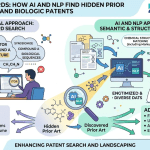
Raw search results are not intelligence. A list of 4,000 patents matching a keyword query tells you nothing by itself. It does not tell you who the major players are, where R&D is concentrated, how the technology has evolved, or where the unexplored opportunities might be. Turning that list into strategic insight requires analytical tools, and Google Patents has none.
Professional patent intelligence platforms have developed sophisticated analytical and visualization capabilities specifically for this purpose [15, 16, 17]. A patent landscape — a visual, structured map of the IP in a given technology area — can answer questions that no list of results can address:
Which companies hold the most patents in this space, and how has their relative position changed over the past decade?
Where are the geographic concentrations of filing activity, and what does that suggest about commercial strategy?
Which biological targets or chemical scaffolds are most densely covered, and which are relatively open?
Where are the ‘white spaces’ — areas of scientific interest with low patent density that might represent unexploited opportunity?
These questions are not academic. They are the substance of R&D prioritization meetings, business development discussions, and portfolio strategy decisions at every major pharmaceutical company. The answers come from analytical tools applied to large datasets — heatmaps, cluster analyses, filing trend charts, geographic distribution maps — and Google Patents provides exactly none of that infrastructure.
The practical consequence is that users are forced into manual analysis using spreadsheet exports. This is not just inefficient; it is analytically inferior. A machine learning algorithm applied to 10,000 patent documents can identify clusters and trends that no human analyst working through a spreadsheet will find. The insights that drive competitive strategy in the pharmaceutical industry increasingly require computational tools applied to large patent datasets. Google Patents, by design, is a document retrieval tool, not an intelligence platform.
Reason 11: Citation Analysis Is Shallow, Limiting Portfolio Valuation
Not all patents are equal. Some are foundational, cited hundreds of times by subsequent inventors and litigated repeatedly because they define entire technology categories. Others are filed to bulk up portfolio numbers and never cited by anyone. The difference between these two types of patents is invisible in a simple list of results but critical in any serious valuation exercise.
Citation analysis is the tool for making that distinction visible. Forward citations — the number and quality of subsequent patents that cite a given patent — are a widely accepted proxy for a patent’s technological and commercial significance [15]. A patent that has been cited 500 times in the past decade is a patent that hundreds of subsequent inventors found relevant and important. A patent that has never been cited is likely trivial regardless of what it claims.
Google Patents provides basic citation links — you can click through to citing and cited documents. It does not provide any analytical framework for working with citation networks. It cannot show you a citation tree, rank patents in a results set by forward citation frequency, calculate citation velocity (how quickly citations are accumulating on a new patent), or identify the foundational nodes in a citation network.
This matters most in M&A and investment due diligence. Portfolio size is a meaningless metric for patent valuation. A portfolio of 200 highly cited, broadly claimed patents protecting core technology is worth vastly more than a portfolio of 2,000 narrowly claimed patents that no one ever cited. An acquirer relying on Google Patents for due diligence would have no reliable mechanism for distinguishing these cases. They could overpay for a portfolio of worthless filings or miss the hidden value in a small, powerful portfolio. <blockquote> ‘Patent landscape analysis provides a basis for understanding innovation activity, including which organizations are working in the area, what technologies and industries are being targeted, how technical problems are being solved, and how long it takes for innovations to reach the market.’ — IP Checkups, Patent Landscape Report methodology documentation [18] </blockquote>
Reason 12: No Monitoring or Alerts — The Permanent Reactive Posture
Patent intelligence is not a quarterly exercise. It is a continuous function. New applications are published weekly. Legal statuses change daily. Competitors file continuation applications that expand the scope of existing families, or abandon claims that previously blocked you. Without automated monitoring, your understanding of the competitive IP landscape ages from the moment your last search was completed.
Google Patents has no monitoring or alert functionality [3, 4]. There is no mechanism to tell the system ‘notify me when Company X files a new application in this technology class’ or ‘alert me if the legal status of US9xxxxxxx changes.’ This means every insight derived from Google Patents has an immediate expiration date.
Professional platforms have made monitoring a core feature precisely because the intelligence value of a static snapshot degrades so quickly [5]. A competitive intelligence team at a major pharmaceutical company might monitor dozens of parameters simultaneously: competitor filing activity in specific technology areas, legal status changes on high-risk patents blocking pipeline compounds, new PTAB filings against patents they are considering challenging, and publication of new applications by academic institutions that might be potential licensing partners.
The absence of monitoring from Google Patents creates a systemic problem that goes beyond inconvenience. It conditions organizations to think about patent intelligence as an episodic task — something you do when a specific question arises — rather than a continuous function. That episodic mindset is exactly wrong for an industry where the competitive landscape can shift materially in a week and where the consequences of surprise are measured in hundreds of millions of dollars.
Reason 13: No Integration with Regulatory Data — A Siloed View of the Most Connected Dataset in Pharma
A drug patent does not exist in isolation from its product. It is embedded in a regulatory framework that determines when and how it can be commercialized, when exclusivity begins and ends, and what procedural rights competitors have in challenging it. Understanding a drug’s IP position means understanding its patents, its FDA exclusivities, its Orange Book or Purple Book listings, and any pending or completed litigation — all at once, as an integrated picture.
Google Patents provides none of that integration [2, 3, 8]. It is a patent document retrieval system, and it makes no connection to the regulatory and commercial data that gives those documents their commercial meaning.
The FDA Orange Book is the central reference document for small-molecule drug patent strategy. When the FDA approves a new drug application, the sponsor lists the patents covering that drug in the Orange Book. Generic applicants must certify their relationship to each listed patent as a condition of ANDA filing, and a Paragraph IV certification — challenging a listed patent’s validity or claiming non-infringement — triggers the 30-month stay mechanism that governs the generic entry timeline. Understanding which patents are listed, how they are coded (product claim, method of use claim, formulation claim), and what exclusivities accompany them is the starting point for any generic strategy.
The Purple Book performs an analogous function for biologics, listing reference products, biosimilar approvals, and the interchangeability designations that affect biosimilar substitution at the pharmacy level.
None of this data is available in Google Patents. A generic company strategist trying to identify the most vulnerable Orange Book patents protecting a high-value drug cannot do that work in Google Patents. They need a platform that connects patent data to Orange Book listings, exclusivity periods, and filing history — the data structure that defines the actual commercial opportunity.
DrugPatentWatch is built precisely around this integration. Its architecture connects patent information directly to FDA regulatory data, creating the integrated view of a drug’s IP and exclusivity position that commercial strategy requires [8]. A single query can reveal a drug’s patents, their expiration dates with PTE adjustments, the regulatory exclusivities running alongside them, and the litigation history of its Orange Book listings — the complete picture that determines Loss of Exclusivity timing. That kind of integrated intelligence is structurally unavailable in Google Patents regardless of how skilled the user is.
The final point about what Google Patents lacks is less glamorous than structure search or sequence databases, but it matters practically for every organization running ongoing pharmaceutical IP programs: the platform has no enterprise-grade workflow or collaboration features.
Patent analysis in a pharmaceutical company is not a solo exercise. An FTO search involves IP counsel working alongside R&D scientists and commercial strategists. A portfolio review requires coordination between in-house patent teams and outside counsel. A competitive intelligence program generates outputs that need to be shared, organized, reviewed, and archived across multiple teams and over extended time periods.
Google Patents provides essentially none of the infrastructure for this kind of work [3]. There are no project folders to organize patents by program. There are no annotation tools to flag documents and record analysis. There is no team workspace where multiple users can view shared search results. There are no structured export formats designed for downstream analysis. There are no access controls to manage who sees what within an organization.
Professional platforms are built with these workflows in mind [5, 15]. Project-based organization allows teams to maintain clean, documented search histories for each drug program — critical for establishing the good-faith basis required for an FTO opinion. Annotation and tagging tools allow analysts to record their reasoning within the platform, creating an auditable analysis trail. Structured export formats allow results to flow into standard tools without manual reformatting.
The practical cost of these missing features is borne in inefficiency and risk. Teams working without proper project management tools fall back on shared spreadsheets and email threads — fragmented, version-unstable, difficult to audit. Institutional knowledge is lost when team members transition. Analysis that should be documented in a systematic record exists instead in someone’s inbox. These are not abstract organizational concerns; they are the kind of process failures that create vulnerabilities during patent litigation, when opposing counsel asks for documentation of the search methodology and the answer is ‘we sent around a spreadsheet.’
Reason 15: Free Platforms and Confidentiality Do Not Mix
The fifteenth limitation is less about what Google Patents cannot find and more about what it might expose.
Pharmaceutical R&D strategy is a trade secret. The specific molecule a company is developing, the target they are pursuing, the competitive gaps they have identified — this information has enormous commercial value and correspondingly serious protection under trade secret law and internal confidentiality programs. When a researcher enters a detailed query into a free, public search engine — including specific chemical structure information, target names, or novel compound descriptors — they are transmitting that information to Google’s servers.
Google has a privacy policy. It is not, however, a confidentiality agreement, and the business model of a free consumer service is different from that of a paid enterprise software provider whose business depends on earning and maintaining client trust. The risk that search query data could be logged, aggregated, or inadvertently exposed is not zero [3].
Some legal commentators have raised a more specific concern: that entering the technical details of an unpatented invention into a public platform could constitute a form of public disclosure, potentially affecting novelty [19]. This concern is more theoretical than established, but ‘more theoretical than established’ is a risk tolerance level that most pharmaceutical IP counsel would not accept for a program representing hundreds of millions in development investment.
The risk compounds with third-party AI tools. Some external AI systems used for patent analysis incorporate user inputs into training data or transmit queries to external models without guaranteed confidentiality protections. A researcher using Google Patents in conjunction with a public AI assistant for summarization or analysis may be broadcasting trade secrets through two channels simultaneously.
Paid enterprise platforms address this as a basic commercial requirement. Their business model depends on being trusted with clients’ most sensitive strategic information. They negotiate data processing agreements, maintain documented security controls, and operate under terms of service that treat client data as confidential. That framework is simply not available on a free platform, regardless of how good the patent data might be.
Part IV: What Professional Analysis Actually Looks Like
The Three Core Workflows That Google Patents Cannot Support
Having worked through the 15 specific failures, it is worth being concrete about what professional pharmaceutical IP analysis requires and why specialized tools are necessary rather than optional.
Three workflows define the core of pharmaceutical patent practice: Freedom to Operate analysis, patent landscaping for competitive intelligence, and portfolio monitoring for both offense and defense. Each requires capabilities that Google Patents structurally cannot provide.
Freedom to Operate Analysis
An FTO analysis asks whether a company can commercialize a product in a specific jurisdiction without infringing valid, enforceable third-party patents. The operative word is ‘valid, enforceable’ — an FTO is not about all patents, only active ones, and it requires verified legal status data.
A professional FTO for a small-molecule drug candidate requires, at minimum: a keyword search using a comprehensive synonym and code strategy; a structural search against the compound’s exact structure and all structurally similar analogues; a Markush analysis to identify any genus claims that cover the compound; a verified legal status check on every patent identified; a geographic scope analysis to confirm which jurisdictions the identified patents cover; and integration with Orange Book data to identify all patents formally listed against approved drugs in the same class.
None of steps three, four, or six are possible in Google Patents. Step three requires chemical structure search. Step four requires reliable legal status data. Step six requires Orange Book integration. A Google Patents search can contribute to steps one, two, and five in a preliminary way, but it cannot complete them reliably due to keyword limitations and data gaps.
This means a Google Patents FTO is, definitionally, an incomplete FTO. It misses structural threats, relies on unreliable legal status data, and operates without the regulatory context that makes patent claims commercially meaningful. An FTO opinion built on Google Patents alone would not withstand scrutiny in litigation. The platform can serve as one input in a multi-source search, but it cannot anchor an opinion.
The financial stakes of a flawed FTO are concrete. Patent litigation through trial costs a median of roughly $5.5 million [20]. Major infringement verdicts reach into the billions — the $2.5 billion verdict Merck won against Gilead in the remdesivir litigation being one prominent example. Against those numbers, the subscription cost of professional patent databases is not an expense. It is a small fraction of the insurance premium against a catastrophic risk.
Patent Landscaping for Competitive Intelligence
Patent landscaping transforms patent data from a compliance exercise into a strategic tool. A properly constructed landscape answers questions that are genuinely relevant to R&D direction, business development, and investment allocation.
Which companies are the most active filers in KRAS inhibitor space over the past five years, and where are they concentrating their filings geographically? Is patenting activity in RNA therapeutics expanding or consolidating? Which academic institutions hold foundational sequence patents in CRISPR gene editing that any company entering the space will need to negotiate with? Where are the unexploited structural analogues in a given target class that competitors have not claimed?
These questions require analytical infrastructure — clustering algorithms, trend visualization, citation network mapping, and geographic heat mapping — applied to complete, accurate datasets. The analysis is impossible on Google Patents for two independent reasons: the data is incomplete, and there are no analytical tools to work with even the data that does exist.
DrugPatentWatch’s landscaping capabilities address both problems. Its integrated database, combining patent data with clinical trial records and FDA approval information, allows analysts to map not just what companies are patenting but what they are actually developing and what is reaching the market. That multi-layer view — patents plus pipeline plus approvals — gives a substantially more accurate picture of competitor strategy than a patent-only analysis ever could [8].
Portfolio Monitoring
A pharmaceutical company’s patent portfolio is not a static asset. It is a living document that requires continuous maintenance and surveillance. Patents require periodic maintenance fee payments or they lapse. Continuation applications can extend and expand family protection years after the original filing. PTAB proceedings can challenge and narrow claims that previously seemed ironclad. Competitor portfolios evolve in ways that create new threats or eliminate old ones.
Monitoring all of this manually — periodic searches, legal status checks, litigation tracking — is expensive and error-prone. Automated monitoring, with alerts configured to specific patents, companies, or technology classes, is the only scalable solution for an organization managing a meaningful portfolio.
Google Patents does not offer monitoring. It cannot. Specialized platforms not only offer monitoring but build it around pharmaceutical-specific parameters: Orange Book listing changes, PTAB petition filings, biosimilar application publications under the Purple Book, and continuation application publications that expand the scope of competitor families.
The Biologics Case: Why the Stakes Are Higher Here Than Anywhere
Biologics deserve specific attention because they represent both the most commercially significant segment of the current pharmaceutical market and the area where Google Patents’ limitations are most severe.
The patent protection for a major biologic — say, an established anti-TNF monoclonal antibody — is not a single document. It is a patent thicket: a collection of dozens or hundreds of overlapping patents covering the primary molecule structure, formulation compositions, manufacturing process parameters, specific dosing regimens, methods of use for individual indications, delivery device designs, and purification methods. Humira, the world’s historically top-selling drug, accumulated more than 100 patents organized into this kind of defensive architecture before significant biosimilar competition finally entered the US market [21].
For a biosimilar manufacturer attempting to enter this market, each layer of the thicket represents a distinct legal question. The core biologic sequence patents are the most important and the first to be addressed, but a biosimilar that clears the primary sequence claims might still face infringement risk from formulation patents or manufacturing process patents if it uses similar methods or excipients.
Working through this analysis requires:
Sequence search to assess the core biologic claims
Structural analysis of any small-molecule components (excipients, conjugated warheads in ADCs)
Comprehensive Orange Book and Purple Book review to identify all listed patents
BPCIA litigation tracking to understand which patents have been successfully challenged by prior biosimilar applicants
Google Patents can address none of these requirements. It has no sequence search, no reliable Purple Book integration, and no structured BPCIA litigation database. A biosimilar company attempting to develop its patent challenge strategy using Google Patents is not just working with incomplete information. It is missing the most important categories of information entirely.
The BPCIA ‘patent dance’ — the structured disclosure and litigation process through which biosimilar applicants and reference product sponsors exchange patent information and resolve infringement disputes — is itself a specialized area of pharmaceutical patent practice with its own case law and strategic considerations [22, 23]. Tracking the outcomes of patent dance proceedings across prior biosimilar applicants is essential intelligence for any new market entrant. That tracking requires a platform that has organized and structured this litigation data — a feature available in platforms built for pharmaceutical IP and unavailable in Google Patents.
Part V: The Professional Toolset — What Good Actually Looks Like
How Specialized Platforms Address the 15 Failures
The critique of Google Patents is not a critique of patent searching in general or of free tools in principle. The critique is specific: a generalist tool built for web search, extended to cover patent documents, is inadequate for the specialized requirements of pharmaceutical IP analysis. The solution is equally specific: use tools designed for the job.
The table below maps the 15 failures against the capabilities that professional pharmaceutical patent platforms provide. The comparison is not between Google Patents and a hypothetical perfect system — it is between Google Patents and the actual capabilities of professional platforms like DrugPatentWatch, PatSnap, Orbit Intelligence, Derwent Innovation, and CAS SciFinder.
Failure Area
Google Patents
Professional Platform
Commercial Impact of the Gap
Jurisdictional coverage
Incomplete, especially China, India, Japan
Curated full-text for commercially critical markets
False FTO clearance in key markets
Data timeliness
Weeks to months lag
Hours to days via direct office feeds
Decisions made on outdated information
Legal status accuracy
Unreliable, PTA/PTE often missing
Verified status including term adjustments
Wrong expiration dates, wasted legal strategy
Patent family completeness
Severely fragmented
Complete family tracking across jurisdictions
Missing global scope of competitor protection
Chemical structure search
Not available
Exact, substructure, and Markush search
Cannot assess small-molecule FTO or novelty
Biologic sequence search
Not available
BLAST, motif, CDR-level sequence search
Cannot assess biologic FTO or novelty
NPL coverage
Google Scholar integration only
Licensed, curated NPL collections
Missing foundational scientific prior art
Machine translation quality
Superficial accuracy, no legal nuance
Human expert translation for critical documents
Misread claim scope of foreign patents
Orange/Purple Book integration
None
Seamless link to FDA regulatory data
Cannot determine true LOE; siloed analysis
PTAB/litigation integration
None
Structured proceedings database
Blind to ongoing challenges that could invalidate patents
The cumulative picture is a platform that can retrieve patent documents in English-speaking markets for well-indexed jurisdictions, for patents whose legal status has not recently changed, using keyword queries that happen to match the document’s terminology, without the ability to analyze what those documents mean commercially or legally. That is a narrow use case that covers a fraction of what pharmaceutical IP professionals actually need.
Making the Business Case
The pharmaceutical industry is not prone to sentimentality about tools, but it is prone to anchoring on cost. ‘Google Patents is free’ is the kind of argument that wins procurement discussions without anyone asking what the tool actually does. The response requires reframing the cost comparison.
The right comparison is not ‘zero versus a subscription fee.’ It is ‘the subscription fee versus the expected cost of decisions made with inadequate information.’ Those expected costs include:
An FTO false negative leading to infringement litigation: median patent litigation cost through trial is approximately $5.5 million, with major verdicts reaching into the billions [20]
A generic ANDA strategy built on an incorrect understanding of Orange Book exclusivities: potentially years of delay and misdirected development resources
A biosimilar launch that does not account for manufacturing process patents: product launch blocked pending reformulation
A licensing negotiation where the buyer does not know a key patent has already lapsed: negotiating and paying for something in the public domain
An M&A deal that overpays for a portfolio because the acquirer could not assess citation quality: returns destroyed by a flawed valuation
Any one of these scenarios, occurring with meaningful probability, justifies the subscription cost of a professional platform many times over. The question is not whether the professional tool is worth the money. The question is how many catastrophic scenarios a company is willing to accept as the cost of saving on a subscription.
Conclusion: The Tool Matches the Stakes, or It Does Not
Google Patents is an impressive achievement of public information access. It has genuinely democratized access to patent documents that were once available only to specialists with expensive subscriptions and deep institutional knowledge. For a casual user — a student, an inventor curious about the prior art in a general area, a journalist trying to understand the basics of a drug company’s IP strategy — it provides real value.
For the pharmaceutical IP professional responsible for advising on a clinical candidate, assessing a potential acquisition target’s portfolio, monitoring the PTAB for challenges to a key compound patent, or determining whether a biosimilar can enter the market next year, Google Patents is the wrong tool. Not marginally inadequate — structurally wrong. It cannot do sequence search. It cannot do structure search. It does not integrate regulatory data. It does not have reliable legal status. It does not have monitoring. It produces lists, not intelligence.
The 15 failures documented here are not bugs that Google will fix in the next update. They reflect a fundamental design decision: Google Patents is a document index, not a pharmaceutical intelligence platform. Closing the gap between those two things is not a matter of adding features to an existing tool. It requires a completely different architecture — one built from the ground up for the specific, complex needs of life science IP analysis.
Platforms like DrugPatentWatch are built on exactly that architecture. They exist because the problem is real, the stakes are measurable, and the cost of getting it wrong is too high to accept in exchange for a zero-dollar subscription.
The most expensive tool in pharmaceutical IP is the wrong one.
Key Takeaways
Google Patents’ claim of global coverage masks significant gaps in commercially critical markets, particularly China, India, and Japan, where data is incomplete or significantly delayed.
Update lags of weeks to months mean Google Patents users are working from an outdated picture of the IP landscape, creating a ‘window of vulnerability’ for critical decisions.
The complete absence of chemical structure search and biologic sequence search disqualifies the platform from any formal FTO analysis involving small-molecule drugs or biologics.
Legal status data on Google Patents is unreliable and frequently outdated, rendering it unsuitable for determining which patents are actually active and enforceable.
Without integration between patent data and FDA Orange Book or Purple Book information, Google Patents cannot support the regulatory-linked analysis that pharmaceutical commercialization strategy requires.
Professional platforms like DrugPatentWatch are not luxury alternatives to free tools — they are the minimum viable infrastructure for decisions where the cost of error runs into millions or billions of dollars.
FAQ
Q1: Is there any scenario where Google Patents is the right tool for pharmaceutical patent work?
Yes, two. First, as a document retrieval tool when you already have a specific patent number and need to read the document text quickly. Second, as a very preliminary orientation search at the earliest stage of a research program, when the goal is getting a rough directional sense of a field rather than conducting a formal clearance or competitive analysis. In both cases, it functions well as one input in a multi-source workflow. It should never be the primary or sole source for any analysis that will drive a business decision, provide the basis for an FTO opinion, support an M&A valuation, or inform a litigation strategy.
Q2: How does the ‘patent thicket’ strategy used by biologic manufacturers make Google Patents especially problematic for biosimilar entrants?
A patent thicket involves layering multiple overlapping patents across every protectable aspect of a biologic product — sequence, formulation, manufacturing process, specific indications, delivery device. Analyzing a thicket requires, at minimum, sequence search capabilities (which Google Patents lacks entirely), reliable patent family mapping (which it frequently gets wrong), Purple Book integration to identify listed patents (which it does not provide), and BPCIA litigation tracking to understand which patents have already been challenged successfully by earlier biosimilar applicants (which it has no structured mechanism for). A biosimilar company relying on Google Patents to map a thicket would be missing the most important analytical capabilities at every layer of the analysis.
Q3: What is the most underappreciated risk of using Google Patents for an FTO search?
Probably the Markush claim problem. Most pharmaceutical IP professionals understand, at least abstractly, that Google Patents lacks structure search. Fewer appreciate how severely this affects FTO analysis in practice. A Markush claim can cover millions of structurally distinct compounds under a single patent claim. The only way to determine whether your specific compound falls within that claim’s scope is a computational structure search against the Markush definition. Without it, you are not just missing one patent — you are systematically blind to an entire claiming strategy that is central to pharmaceutical patent practice. A clean keyword FTO on Google Patents provides no assurance that the compound is free of Markush infringement risk.
Q4: Can a skilled patent professional compensate for Google Patents’ limitations through careful manual cross-referencing?
Partially, but not fully, and at enormous cost in time and error rate. A skilled professional can cross-reference Google Patents results against the USPTO’s public records, Espacenet, WIPO PatentScope, and jurisdiction-specific databases to partially close the coverage and legal status gaps. They cannot perform chemical structure search or biologic sequence search regardless of how much manual effort they invest, because those capabilities require specialized software that does not exist in the Google Patents ecosystem. They can partially compensate for the lack of Orange Book integration by manually checking the FDA’s database, but they lose the analytical connections that a properly integrated system provides automatically. The result is an enormously labor-intensive process that is still structurally incomplete — not a substitute for professional tools, but a much more expensive and less reliable approximation of them.
Q5: How does the lack of Orange Book integration in Google Patents specifically affect a generic drug company’s Paragraph IV strategy?
A Paragraph IV certification — challenging a listed Orange Book patent’s validity or claiming non-infringement — is the primary mechanism through which generic companies achieve early market entry. The strategic decision about which patents to challenge and how is based on a careful analysis of each listed patent’s claims, prosecution history, legal status, and vulnerability to invalidity arguments. That analysis requires seeing which patents are actually listed for a drug (not all patents covering a drug are Orange Book listed), understanding the patent use codes that indicate whether a patent claims the product itself, a formulation, or a method of use (which affects the scope of required certification), and knowing the regulatory exclusivity periods that run alongside the patents. None of this context is available in Google Patents. A generic strategy team using Google Patents alone might identify the right patents to challenge but misread their strategic importance, miss the regulatory exclusivities that make challenging them moot, or overlook additional listed patents that would independently block entry. DrugPatentWatch’s integrated architecture, connecting patents to Orange Book listings, exclusivity periods, and filing history, provides the complete picture that Paragraph IV strategy requires.
References
[1] Google. (2025). Coverage — Google Help. https://support.google.com/faqs/answer/7049585?hl=en
[2] DrugPatentWatch. (2025). Google patents: Why it’s a risky tool for finding drug patents. https://www.drugpatentwatch.com/blog/google-patents-why-its-a-risky-tool-for-finding-drug-patents/
[3] DrugPatentWatch. (2025). Using Google Patents to find drug patents? Here’s 15 reasons why you shouldn’t. https://www.drugpatentwatch.com/blog/using-google-patents-to-find-drug-patents-heres-15-reasons-why-you-shouldnt/
[4] PatentScan AI. (2024). Limitations of Google Patents Advanced Search for invalidation: What IP professionals need to know. https://dev.to/patentscanai/limitations-of-google-patents-advanced-search-for-invalidation-what-ip-professionals-need-to-know-3ep2
[6] Baker Botts. (2025, January). Maximizing patent term in the United States: Patent term adjustment, patent term extension, and the evolving law of obviousness-type double patenting. https://www.bakerbotts.com/thought-leadership/publications/2025/january/maximizing-patent-term-in-the-united-states
[7] Fish & Richardson. (n.d.). Introduction to Patent Term Extensions (PTE). https://www.fr.com/insights/ip-law-essentials/intro-patent-term-extension/
[8] DrugPatentWatch. (2025). A business professional’s guide to drug patent searching. https://www.drugpatentwatch.com/blog/the-basics-of-drug-patent-searching/
[9] GreyB. (2025). How to do chemical Markush structure search patent? https://www.greyb.com/blog/chemical-structure-search-patent/
[10] Questel. (2025). A guide to bio sequence patent searching. https://www.questel.com/resourcehub/a-guide-to-bio-sequence-patent-searching/
[11] CAS. (2024). Tips for stronger IP searches during biologics R&D. https://www.cas.org/tips-stronger-ip-searches-during-biologics-rd
[12] PatentPC. (2024). Navigating the complexities of biologic drug patents. https://patentpc.com/blog/navigating-complexities-biologic-drug-patents
[14] National Center for Biotechnology Information. (2015). Inherent anticipation in the pharmaceutical and biotechnology industries. PMC4526724. https://pmc.ncbi.nlm.nih.gov/articles/PMC4526724/
[15] TT Consultants. (2024). The importance of patent landscape analysis to business strategy. https://ttconsultants.com/the-importance-of-patent-landscape-analysis-to-business-strategy/
[16] XLSCOUT. (2024). The risks of using free patent search tools. https://xlscout.ai/the-risks-of-using-free-patent-search-tools/
[17] DrugPatentWatch. (2025). Revolutionizing patent landscaping: Combining human supervision and AI in identifying tech clusters for pharmaceutical and biotechnology innovation. https://www.drugpatentwatch.com/blog/revolutionizing-patent-landscaping-a-human-supervised-ai-approach-to-identify-tech-clusters/
[18] National Center for Biotechnology Information. (2023). Patent landscape analysis — Contributing to the identification of technology trends and informing research and innovation funding policy. PMC10034625. https://pmc.ncbi.nlm.nih.gov/articles/PMC10034625/
[19] FPA Patents. (2024). Navigating the opportunities and risks of patenting AI-designed drugs: Part 3 — Potential obstacles. https://www.fpapatents.com/news-insights/insights/navigating-the-opportunities-and-risks-of-patenting-ai-designed-drugs-part-3-potential-obstacles/
[20] DrugPatentWatch. (2025). Managing drug patent litigation costs. https://www.drugpatentwatch.com/blog/managing-drug-patent-litigation-costs/
[21] DrugPatentWatch. (2025). Revolutionizing the fight against biologic drug patent thickets. https://www.drugpatentwatch.com/blog/revolutionizing-the-fight-against-biologic-drug-patent-thickets/
[22] Winston & Strawn. (n.d.). What is the patent dance? Winston & Strawn Law Glossary. https://www.winston.com/en/legal-glossary/patent-dance
[23] Center for Biosimilars. (2024). Patent dance insights: A Q&A on reducing legal battles in the biosimilar landscape. https://www.centerforbiosimilars.com/view/patent-dance-insights-a-q-a-on-reducing-legal-battles-in-the-biosimilar-landscape