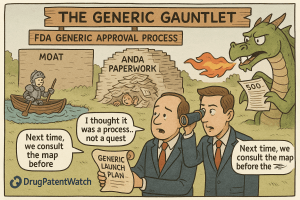
Generic drug approval is, at its core, a race with rules. The company that reads the rules fastest and most precisely wins. That means understanding the Abbreviated New Drug Application lifecycle, the 80-125% bioequivalence window, the architecture of a Paragraph IV filing, and the IP valuation implications of every patent that stands between a generic’s launch date and its projected revenue curve.
This guide covers all of it: the FDA pathway, the EMA pathway, bioequivalence science, evergreening tactics and how to beat them, Quality by Design implementation, supply chain resilience, and the intelligence infrastructure that separates market leaders from late entrants.
I. The Market Case: Why Generics Are a $655B Opportunity
Generic drugs fill roughly 90% of all U.S. prescriptions but account for only about 22% of total drug spending. That gap, repeated across every major market, is the business case. It is not an accident of policy. It is the direct output of a regulatory framework purpose-built to compress the cost of access once a molecule’s innovation period expires.
The global generic market was valued at approximately $435.3 billion in 2023. Analysts project growth to $655.8 billion by 2028, a CAGR of 8.5%. Separate analysis from Precedence Research points to $728.64 billion by 2034, implying a CAGR of 5.04%. The spread between these projections matters to portfolio managers: the higher-end figure assumes accelerated biosimilar penetration and faster regulatory harmonization across Asia-Pacific markets, while the lower-end figure discounts those factors and assumes continued pricing pressure in commodity oral solid dosage markets.
The drivers are straightforward. A dense cluster of blockbuster brand patents expires between now and 2030, including several in the biologics space where biosimilar competition has historically been slow to materialize. Governments from Germany to India are running mandatory substitution programs. U.S. pharmacy benefit managers are enforcing generic-first dispensing rules. Every one of those dynamics creates a pull.
The counterforce is equally clear: intense price erosion in commodity solid oral dosage forms, persistent cGMP failures at certain overseas manufacturing sites, and an increasingly complex patent thicket around recently approved drugs. Navigating that tension is what this guide addresses.
Key Takeaways: The Market
The $655B market forecast rests on patent expirations, government substitution mandates, and biosimilar uptake, not just volume growth. Companies that treat the generic market as a commodity business compete on margin alone and get squeezed. Companies that target complex generics and first-to-file exclusivities compete on differentiation and earn disproportionate returns. The strategic question is not whether to be in generics. It is which generics, when, and with what IP posture.
II. The U.S. FDA ANDA Pathway: Step-by-Step Breakdown
The Hatch-Waxman Framework: What It Actually Does
The Drug Price Competition and Patent Term Restoration Act of 1984, universally called Hatch-Waxman, created the ANDA mechanism. Before 1984, a generic manufacturer had to run its own full clinical trial program to get approval, which meant that most generics simply were not economically viable. Hatch-Waxman changed the economics entirely: a generic applicant can reference the FDA’s prior safety and efficacy findings for the Reference Listed Drug (RLD) and prove only that its version delivers equivalent systemic exposure.
The trade-off built into the law is deliberate. Generic manufacturers get an abbreviated pathway. Innovators get patent term restoration (up to five years) to compensate for time lost during FDA review, plus a suite of regulatory exclusivities. The result is a system with two equally adversarial participants who both need each other: without patent protection, there is no incentive to discover new drugs; without the ANDA pathway, those drugs remain unaffordable once the innovation period ends.
For generic manufacturers, the practical implication is that the ANDA pathway is never truly frictionless. It is abbreviated in terms of clinical data requirements, but not in terms of legal exposure. Every ANDA that challenges a listed patent is also the opening move in what may become multi-year patent litigation.
Pre-ANDA Research and Formulation Development
Before a single page of an ANDA is drafted, a generic company must build a formulation that replicates the RLD’s pharmacokinetic profile within the 80-125% bioequivalence window. That work typically takes 18 to 36 months for a standard oral solid dosage form and considerably longer for complex delivery systems.
The RLD selection is a legal as well as scientific decision. The Reference Listed Drug is the specific FDA-approved drug product that the ANDA must reference. If multiple strengths exist, the applicant may be able to file biowaivers for additional strengths based on data from the primary strength, which is a significant cost lever. The FDA’s product-specific guidances (PSGs) detail the recommended bioequivalence methodology for most drugs in the queue, and reviewing the PSG before formulation work starts is non-negotiable.
Formulation work runs in parallel with a thorough patent search. Every patent in the Orange Book tied to the RLD must be addressed in the ANDA. This analysis shapes which Paragraph certification to file for each listed patent: Paragraph I (patent expired), Paragraph II (no patent listed), Paragraph III (patent will expire before commercial marketing begins), or Paragraph IV (patent is invalid, unenforceable, or will not be infringed). The IP analysis is not a legal department exercise done at the end; it drives formulation choices from day one.
The ANDA Submission: Structure and Common Failure Points
An ANDA submitted to FDA’s Center for Drug Evaluation and Research (CDER) is a comprehensive electronic dossier. It must include: detailed manufacturing process description, quality control specifications and test methods, labeling identical to the RLD (with only permissible differences), bioequivalence data, and patent certifications for all Orange Book-listed patents.
FDA conducts a filing review within 60 days of receipt. If the application is refuse-to-file (RTF), the clock has not started. If accepted, CDER begins the substantive review across multiple disciplines: pharmaceutical quality, clinical pharmacology (bioequivalence), and labeling. The standard review goal under the Generic Drug User Fee Amendments (GDUFA) is 10 months from the date of submission for original applications.
The two most common reasons for Complete Response Letters (CRLs) are bioequivalence deficiencies and manufacturing/cGMP concerns. A CRL resets the clock and requires a full resubmission. Companies that budget for a single submission cycle and then receive a CRL face both a financial shortfall and a market entry delay that can eliminate the competitive advantage of a first-to-file position.
Pre-submission meetings with FDA, where available, reduce CRL risk significantly. For complex generics, the FDA’s complex drug substances and complex drug products program encourages early dialogue specifically to clarify bioequivalence methodology before the applicant commits to a study design.
FDA Review Timeline and the Priority Pathway
The 10-month GDUFA review goal applies to standard ANDA submissions. Priority review, which FDA designates for products that address a drug shortage or lack an approved generic, targets a 6-month timeline. For companies monitoring the FDA drug shortage list, the priority designation is a real commercial opportunity: faster approval, thinner competition, and often better price sustainability.
Discipline Review Letters (DRLs) and Information Requests (IRs) are issued during the review and do not officially toll the clock, but each response cycle consumes real time. A well-prepared original submission that anticipates FDA’s questions, with complete dissolution profiles, well-characterized comparative data, and a robust analytical method validation package, avoids most IRs.
Key Takeaways: The ANDA Pathway
The ANDA pathway is abbreviated in clinical data, not in complexity. A first-rate submission from a company with strong cGMP standing and a clean bioequivalence dataset can reach approval in 10-12 months. A poorly prepared submission from a site with outstanding FDA observations can take three to four years. The quality of the regulatory operation, not the science alone, is what determines speed to market.
III. Bioequivalence: The Science, the Statistics, and the Failure Modes
Defining the 80-125% Window
Bioequivalence means that a generic drug delivers the same amount of active ingredient into systemic circulation at the same rate as the RLD. The regulatory measure is pharmacokinetic: AUC (area under the plasma concentration-time curve, reflecting total exposure) and Cmax (maximum plasma concentration, reflecting rate of absorption). A generic is bioequivalent if the 90% confidence interval for the geometric mean ratio of AUC and Cmax (generic divided by reference) falls entirely within 80.00% to 125.00%.
The 80-125% criterion is not arbitrary. It reflects the log-normal distribution of pharmacokinetic parameters in human populations and a long-standing regulatory determination that differences in exposure within that band produce no clinically meaningful difference in therapeutic effect for most drugs. The criterion came from clinical pharmacology work done in the 1970s and early 1980s and has been validated repeatedly in post-marketing studies. Certara has documented the statistical derivation at length; the short version is that the confidence interval requirement is more demanding than the 80-125% window itself implies, because the confidence interval must fit entirely inside the window, not merely include it.
In Vivo Study Design: Two-Period Crossover and Its Variants
Standard bioequivalence studies use a two-period, two-sequence crossover design in healthy adult volunteers. Each subject receives the test and reference formulations in randomized order, with a washout period between administrations long enough to eliminate carry-over effects (typically five half-lives of the drug). Blood samples are collected at pre-specified time points, plasma concentrations are measured, and PK parameters are calculated.
The sample size is determined by the expected intra-subject variability of the drug and the required statistical power, typically 80-90%. For drugs with low variability, 24-36 subjects may suffice. For highly variable drugs (HVDs), where the within-subject CV exceeds 30%, more subjects are needed to demonstrate bioequivalence within the standard window. The FDA and EMA both allow reference-scaled average bioequivalence (RSABE) for HVDs: the acceptance limits are widened proportionally to the reference drug’s variability, subject to a cap. For Cmax specifically, the EMA allows widening to 70.0-143.0% if scientifically justified, while AUC must remain within 80-125%.
Biowaiver Conditions: When In Vivo Studies Are Not Required
A biowaiver eliminates the requirement for an in vivo bioequivalence study. The BCS (Biopharmaceutics Classification System) biowaiver is the most widely applied mechanism. Under BCS, drugs are classified by their aqueous solubility and intestinal permeability:
BCS Class I: high solubility, high permeability. In vivo biowaiver available for immediate-release solid oral dosage forms.
BCS Class III: high solubility, low permeability. BCS biowaiver is available but subject to stricter inactive ingredient requirements, as the formulation can influence permeability.
BCS Class II and IV: low solubility. No BCS biowaiver; in vivo data required.
A biowaiver for additional strengths (proportional composition, similar dissolution) can be supported with in vitro dissolution data alone if the primary strength has passed an in vivo study. The FDA’s PSGs specify which approach applies to which drug. The ICH M13B guideline, finalized in 2024, provides updated guidance specifically on bioequivalence for immediate-release solid oral dosage forms, including biowaiver criteria.
The commercial value of a well-justified biowaiver: a single in vivo crossover study typically costs $500,000 to $2 million including site costs, subject fees, and bioanalytical work. A biowaiver for three additional strengths of the same drug saves that expenditure three times over while trimming months from the development timeline.
Key Takeaways: Bioequivalence
The 80-125% window is demanding in practice because the confidence interval must fit inside it, not merely touch it. Highly variable drugs require RSABE design. BCS Class I and III drugs with qualifying formulations can avoid in vivo studies entirely through a biowaiver. For any generic development program, running a feasibility assessment against applicable biowaiver criteria before committing to an in vivo study is a basic economic discipline.
IV. cGMP and Quality Infrastructure: What FDA Inspectors Actually Look For
cGMP as a Legal Minimum, Not a Quality Target
Current Good Manufacturing Practices define the minimum acceptable standard for pharmaceutical manufacturing. Compliance is a legal requirement: a product manufactured in violation of cGMP is automatically deemed adulterated under the Federal Food, Drug, and Cosmetic Act, regardless of whether end-product testing shows any defect. Companies that treat cGMP compliance as a ceiling rather than a floor are managing to the wrong metric.
The FDA conducts pre-approval inspections (PAIs) of manufacturing sites named in an ANDA before granting approval. If a PAI results in an Official Action Indicated (OAI) classification, the application will not receive approval until the deficiencies are resolved. Post-approval, FDA conducts routine surveillance inspections and for-cause inspections triggered by complaints, recalls, or adverse event reports.
The FDA’s Most-Cited Manufacturing Deficiencies
The FDA publishes inspection observations (Form 483 observations) and Warning Letters publicly. The most common themes across recent cycles:
Data integrity failures rank at the top. These include deleted or overwritten raw analytical data, backdated records, and audit trail manipulation. FDA treats data integrity violations as the most serious category of cGMP deficiency because they undermine the entire quality system’s evidentiary basis. Warning Letters from 2022-2025 to manufacturers in India and China have cited data integrity as the primary concern in a significant number of cases.
Inadequate investigation of out-of-specification (OOS) results is the second most-cited category. Regulations require a documented root cause investigation of any OOS result before the result can be invalidated. Companies that routinely blame OOS results on laboratory error without genuine investigation, or that conduct investigations with predetermined conclusions, accumulate 483 observations across multiple inspection cycles.
Process validation failures, particularly ongoing process verification data that shows unacceptable variability in critical process parameters (CPPs) across commercial batches, appear frequently in Warning Letters for solid dosage form manufacturers.
Aseptic processing deficiencies, including inadequate environmental monitoring, gown qualification failures, and interventions during filling operations, are the dominant theme for injectable manufacturers.
ICH Q7 for API Manufacturers
The ICH Q7 guideline sets GMP standards for Active Pharmaceutical Ingredients. It covers the full API manufacturing chain: starting material definition and control, synthesis steps, purification, recovery, packaging, and labeling. The starting material definition is commercially significant: the earlier in the synthesis a company designates its API starting material, the fewer steps fall under GMP scrutiny, which reduces documentation burden. FDA has issued guidance clarifying its expectations on starting material designation, particularly for complex synthetic routes where there may be legitimate scientific disagreement about where GMP controls should begin.
For generic manufacturers sourcing APIs externally, ICH Q7 compliance at the API supplier is contractually required, and qualification audit programs are a standard cost of doing business. A supply disruption caused by an API supplier receiving an FDA import alert has cascading effects: the manufacturer cannot release finished product, customer commitments are missed, and if the drug is in shortage, the regulatory and reputational consequences are significant.
IP Valuation Lens: Manufacturing Quality as an Asset
A manufacturing site’s FDA regulatory standing is a balance sheet item that most standard IP valuations ignore. Consider: a finished dose facility with a clean inspection history and no outstanding observations has a higher probability of receiving ANDA approval without delay, a lower probability of product recall, and a lower probability of import ban. Quantifying that probability differential in DCF terms produces a meaningful positive delta on site valuation. Conversely, a site under an import alert is operationally impaired in the U.S. market until the agency lifts the alert, which can take 18-36 months. The NPV impact of that impairment, applied to any drug approved at that site, can run to hundreds of millions of dollars for high-volume generics.
Key Takeaways: cGMP and Quality
Data integrity is FDA’s primary enforcement focus and carries the most severe consequences. A site with outstanding data integrity observations in an existing Warning Letter will not receive new ANDA approvals at that site until the Warning Letter is resolved. The financial cost of cGMP failures, measured in delayed approvals, import alerts, and recalls, consistently exceeds the cost of building a genuinely strong quality system. Manufacturing quality is an IP-adjacent asset that belongs in any rigorous portfolio valuation.
V. The EU EMA Pathway: MAA Procedures, Exclusivities, and Strategy
The Marketing Authorization Application for Generic Medicines
In the EU, a generic medicine applicant submits a Marketing Authorization Application (MAA) to demonstrate that the proposed generic is the same as the approved reference product: same active substance(s), same dosage form, same route of administration, same strength, and bioequivalent pharmacokinetics. The MAA must be filed after the data exclusivity period on the reference product has expired.
The EU operates a ‘8+2+1’ framework: eight years of data exclusivity (during which the MAA can be submitted but not approved), plus two years of market protection (during which the generic may not be placed on the market even if approved), plus a possible one-year extension if the reference product received a new indication with significant clinical benefit during the first eight years. This produces an effective market exclusivity of up to 11 years for reference products with strong clinical development programs.
Centralized, Decentralized, Mutual Recognition, and National Procedures
The EU offers four distinct routes for generic MAAs, each with different timelines, costs, and geographic scope:
The Centralized Procedure, managed by EMA, produces a single marketing authorization valid across all 27 EU member states. It is mandatory for biologics and optional for generics whose reference product was centrally authorized. The Centralized Procedure clock runs 210 days from validation, with clock stops for questions. The commercial benefit is simultaneous access to all EU markets; the operational challenge is that a single deficiency identified by one National Competent Authority (NCA) rapporteur can delay approval across the entire region.
The Decentralized Procedure (DCP) allows simultaneous submission to multiple member states where the product has not yet been authorized. One state acts as Reference Member State (RMS) and the others as Concerned Member States (CMS). If the CMS disagrees with the RMS assessment and the dispute cannot be resolved, the application goes to an arbitration procedure.
The Mutual Recognition Procedure (MRP) starts with a national authorization from the RMS and then seeks recognition by selected CMS. It is used when the product is already authorized in at least one member state.
National Procedures produce single-country authorizations, used when the commercial target is one market only.
The choice among these four procedures is a commercial and regulatory strategy decision, not merely a procedural one. A generic targeting Germany, France, Italy, Spain, and Poland will almost always use DCP or MRP rather than paying the higher Centralized Procedure fees for markets the applicant does not intend to enter. Conversely, a complex generic with a strong regulatory package may benefit from the Centralized Procedure’s single scientific assessment to avoid inconsistent outcomes across five parallel national reviews.
EMA Bioequivalence Requirements
EMA’s bioequivalence standards align closely with FDA’s: 90% CI within 80-125% for AUC and Cmax. The RSABE approach for highly variable drugs, allowing Cmax widening to 70.0-143.0% if the within-subject CV of the reference exceeds 30%, is accepted by EMA under its 2010 guideline. AUC must remain within 80-125% regardless of variability.
EMA permits biowaivers on the same general BCS principles as FDA, though the regulatory documents differ in specifics. EMA’s 2010 guideline on bioequivalence and the ICH M13 series provide the operative rules. For companies filing in both jurisdictions, study design must satisfy both agencies’ requirements simultaneously, or separate studies must be run, which is a significant cost argument for designing globally consistent BE protocols from the start.
Key Takeaways: EU EMA Pathway
The 8+2+1 exclusivity framework means the generic launch window in the EU is later than in the U.S. for most products. Companies filing in both markets should map the EU exclusivity expiry against the U.S. patent expiry to understand which jurisdiction offers the earlier commercial opportunity. The four EU procedures vary substantially in cost, timeline, and geographic scope; procedure selection is a portfolio strategy decision, not a filing formality.
VI. Patent Landscape Mechanics: Orange Book, Effective Patent Life, and IP Valuation
The Orange Book as a Strategic Intelligence Source
The FDA’s Orange Book, formally titled ‘Approved Drug Products with Therapeutic Equivalence Evaluations,’ lists all FDA-approved drug products and, for each, the patents claimed by the NDA holder as covering: the active ingredient (substance patents), the formulation or composition (product patents), and specific approved methods of use (method-of-use patents, which are separate from substance and product patents and can create carve-out opportunities).
For generic companies, the Orange Book is the starting point for IP due diligence on any target. Every patent listed requires a certification in the ANDA: Paragraph I through IV. Getting a certification wrong, whether by mis-analyzing an infringement question or filing a Paragraph III when a Paragraph IV challenge is legally viable, can cost the company 180-day exclusivity eligibility or expose it to injunction risk at launch.
The Orange Book can be gamed by NDA holders. A well-documented line of litigation and FTC enforcement actions concerns improper Orange Book listings: patents listed that do not actually claim the approved drug product, or method-of-use patents listed for indications broader than what is actually approved. FDA has a delisting petition process, and generic companies have used it successfully. The FDA Reauthorization Act of 2022 gave FDA new authority to remove improperly listed patents, which reduces one layer of barrier to entry for generics.
Effective Patent Life vs. Statutory Term
A U.S. utility patent grants 20 years from the filing date. For a pharmaceutical compound, the filing date is typically early in preclinical development, often 10-15 years before FDA approval. By the time the drug reaches the market, the remaining patent life may be as short as 5-8 years.
Hatch-Waxman provides a partial remedy through patent term restoration (PTR), which compensates innovators for regulatory review time. The maximum restoration is five years, and the restored term cannot extend more than 14 years past approval. PTR analysis is a standard part of any IP portfolio audit for brand-name companies and a standard part of the patent expiry modeling done by generic business development teams.
The ‘effective patent life,’ meaning the patent term remaining after FDA approval, is the metric generic companies actually use to calculate when they can enter the market. A drug with a 20-year patent from 2005, a 2015 FDA approval, and no PTR has 10 years of remaining patent life from approval. One with PTR of three years has 10 years from the non-PTR expiry, but the PTR adds those three years back, extending the exclusivity clock.
IP Valuation: Drug-Specific Asset Analysis
For pharma IP teams and portfolio managers, drug patents are not generic assets. Each patent must be valued individually based on its likelihood of surviving a Paragraph IV challenge, the number of other patents that would remain even if that specific patent fell, the commercial value of the exclusivity that patent protects, and the cost of defending it.
Consider a blockbuster with $3B in annual U.S. net revenue, four Orange Book-listed patents expiring in 2027, 2028, 2029, and 2031, and three pending Paragraph IV challenges from first-to-file generic applicants. The 2031 patent is the last line of defense. If the 2031 patent has a 60% probability of surviving litigation (based on its specification quality, prior art landscape, and the specific invalidity arguments the generic filers have articulated in their notice letters), the expected value of that patent as an IP asset is approximately 0.60 x NPV of revenues from 2027-2031. If it has a 30% probability of survival, the expected value drops by half, and the brand company’s stock price should reflect that.
Generic companies do the same calculation from the other side. If there is a 70% probability that the 2031 patent falls, the expected value of winning the Paragraph IV challenge is 0.70 x NPV of 180-day exclusive revenues. That expected value is what drives business development decisions to invest in the litigation.
Key Takeaways: Patent Mechanics and IP Valuation
The Orange Book is both a legal document and an intelligence resource. Every listing must be analyzed for validity and enforceability, not assumed to be a reliable barrier. Effective patent life is the commercially relevant metric, not statutory term. Drug patents are heterogeneous assets; their value depends on litigation probability, competitive structure, and the revenue profile they protect.
VII. Regulatory Exclusivities as IP Assets: NCE, ODE, Pediatric, 180-Day
New Chemical Entity Exclusivity: The Five-Year Shield
NCE exclusivity grants five years of protection against ANDA acceptance for any drug containing an active moiety not previously approved by FDA. ‘Active moiety’ is defined precisely in regulation: it is the molecule or ion responsible for the drug’s pharmacological action, excluding appended portions of the molecule (esters, salts, etc.). A new salt of a previously approved active moiety does not qualify for NCE exclusivity, though it may receive three-year exclusivity if it required new clinical data.
For generic filers, the practical effect of NCE exclusivity is that an ANDA with a Paragraph IV certification can be submitted no earlier than four years after the reference product’s approval date (the ‘NCE-1’ window), and it cannot be approved until the five-year period expires. This creates a defined filing window for first-to-file competitors. Companies tracking a new drug approval that grants NCE exclusivity should be preparing their ANDA for submission at precisely the four-year mark to maximize the chance of first-to-file status.
Orphan Drug Exclusivity: Seven Years for Rare Disease Indications
Orphan Drug Exclusivity (ODE) grants seven years of market protection for the specific orphan indication. The protection is indication-specific, not product-wide: a generic can be approved for a non-orphan indication of the same drug during the ODE period, provided it does not use the orphan indication in its labeling. This creates a carve-out opportunity that skilled generic applicants have exploited.
The IP valuation angle on ODE: for companies developing treatments for rare diseases with limited generic competition and high per-patient pricing, ODE represents a substantial asset. A drug with $500M in annual orphan indication revenue protected by seven years of ODE, no patents, and no generic competition has an expected revenue stream of approximately $3.5B in protected revenue (ignoring time value). That ODE, as a regulatory asset, is worth more in many cases than any individual patent.
Pediatric Exclusivity: Six Months Attached to Everything
The Best Pharmaceuticals for Children Act grants an additional six months of market exclusivity as an incentive for conducting pediatric studies under an FDA Written Request. This six months attaches to, and runs concurrent with, the expiration of any existing patents and exclusivities listed in the Orange Book. If the drug has an NCE exclusivity expiring December 2027 and a substance patent expiring March 2029, successfully completing a pediatric written request moves both dates six months later: NCE exclusivity to June 2028, patent expiry to September 2029.
Generic companies must track pediatric exclusivity as a systematic component of patent expiry modeling. FDA publishes a list of granted pediatric exclusivities. Missing a six-month pediatric extension in a revenue forecast can produce a material underestimate of the brand’s protected revenue period.
180-Day Generic Drug Exclusivity: The First-to-File Prize
The 180-day generic exclusivity is the most commercially valuable regulatory asset in the ANDA framework. It is available only to the first applicant(s) that file a substantially complete ANDA with a Paragraph IV certification against a listed patent. During those 180 days, FDA cannot grant effective approval to any other generic applicant for the same drug product.
First-to-file generics typically price their products at 15-25% below the brand at launch, compared to 80-90% discounts seen when six or more generics compete. The revenue difference is dramatic. A drug with $2B in annual brand revenue can generate $200-300M in generic revenue during the 180-day exclusivity period for a single first-filer, compared to $15-20M per year per generic in a fully competitive market.
Forfeiture provisions create execution risk. If a first-filer fails to commercially market the generic within 75 days of the date it is eligible to be marketed (accounting for patent expiration and any court decisions), it forfeits the exclusivity. Pay-for-delay agreements, if structured improperly, can also trigger forfeiture. First-filers must maintain the ANDA, maintain the manufacturing site’s approval status, and have product ready to ship at exactly the right moment.
Portfolio managers valuing generic companies should model exclusivity-driven revenue separately from base-case generic revenue. A pipeline that includes three Paragraph IV challenges with reasonable litigation probability creates a materially different expected revenue profile than one populated entirely with Paragraph II or III filings against already-expired patents. The expected value calculation is: (probability of winning litigation) x (NPV of 180-day exclusivity revenues) minus (litigation cost). Companies with a track record of successful Paragraph IV challenges, and legal teams with demonstrated capability in this area, carry a strategic premium that pure financial metrics will miss.
Key Takeaways: Regulatory Exclusivities
NCE, ODE, Pediatric, and 180-day exclusivities are IP assets, not merely regulatory milestones. Each can be valued in NPV terms. Generic companies’ pipeline value depends critically on which exclusivities they are chasing and their probability of securing them. Analysts and IP teams must build explicit exclusivity timelines, including all pediatric extensions and possible ODE carve-outs, into every competitive intelligence model.
VIII. Paragraph IV Certification: Filing Strategy, Litigation, and the 30-Month Clock
What a Paragraph IV Filing Actually Asserts
A Paragraph IV certification is a legal statement in an ANDA that a listed patent is invalid, unenforceable, or will not be infringed by the manufacture, use, or sale of the proposed generic. Under the Hatch-Waxman Act, this certification constitutes a constructive act of patent infringement, which is a legal fiction designed to trigger litigation before the generic product reaches market.
Within 20 days of filing, the ANDA applicant must send a detailed notice letter to both the NDA holder and the patent owner. The notice letter must include a detailed factual and legal basis for the Paragraph IV certification: the specific legal and factual bases for the applicant’s belief that the patent is invalid or will not be infringed. A vague or incomplete notice letter can expose the applicant to claims that it failed to provide adequate notice, which creates additional litigation risk.
The 30-Month Stay: Mechanics and Strategic Implications
Upon receiving the notice letter, the NDA holder and patent owner have 45 days to sue for patent infringement. If they file suit within that window, an automatic 30-month stay goes into effect: FDA cannot grant final approval to the ANDA during those 30 months. The 30-month clock can be shortened if the court issues a final judgment before the 30 months expire, either finding the patent invalid, unenforceable, or not infringed (in which case FDA can approve immediately) or finding infringement (in which case the stay effectively becomes an injunction).
Empirical analysis (published in PMC, 2021) found that 30-month stays frequently expire before the case resolves, meaning the stay itself is often not the primary determinant of generic entry timing. The real determinants are subsequent injunctions, additional patents, and settlement agreements. Generic companies that win the 30-month stay race, meaning the stay expires and no permanent injunction is in place, can in some cases launch ‘at risk’ and face treble damages if the patent is subsequently found infringed.
At-risk launches are high-stakes decisions. A blockbuster generic that captures $1-2B in revenue during a brief at-risk window while litigation continues can be commercially transformative, even if the ultimate infringement finding requires disgorgement. The calculus depends on the strength of the invalidity arguments and the speed of the courts.
First-to-File Litigation: Success Rates and Case Selection
Research documents an approximately 76% success rate for first-to-file Paragraph IV challenges at the district court level. That figure overstates the certainty: it includes many cases where the brand company chose not to sue (in which case the 30-month stay never triggers and the generic gets approval automatically), and it includes cases where the parties settled on terms favorable to the generic. The raw win rate at trial, without settlements, is lower.
Case selection matters. The most successful Paragraph IV strategies focus on: patents with narrow claims that are unlikely to cover the specific formulation or process used by the generic; patents with significant prior art exposure that supports an obviousness argument; process patents where the generic uses a substantially different synthetic route; and method-of-use patents where a skinny-label carve-out of the patented indication is commercially viable.
The Bayer/Yasmin example from the source article is illustrative: the Federal Circuit upheld an invalidity finding on obviousness grounds, clearing generic drospirenone-containing oral contraceptives for market. Bayer’s patent was vulnerable because the core chemical entity was well-characterized in prior art, and the specific formulation claims were not defensible once the prior art was fully developed.
Key Takeaways: Paragraph IV Strategy
A Paragraph IV filing is the opening move in what may become two to five years of litigation and the most commercially important regulatory-legal event in the generic business. Companies must assess litigation probability honestly: filing weak challenges wastes resources and can produce bad precedents. Filing strong challenges against genuinely vulnerable patents is the highest-return activity in generic pharmaceutical development.
IX. Evergreening, REMS Abuse, and Pay-for-Delay: Brand Defense Tactics Decoded
Evergreening: The Technology Roadmap of Patent Extension
Evergreening is not a single tactic. It is a systematic IP strategy that brand companies deploy across a multi-year timeline, typically beginning three to five years before the primary compound patent expires. The goal is to replace the expiring patent with a cluster of new patents that collectively extend market exclusivity, increase litigation cost for generic challengers, and sometimes force a product reformulation that requires new regulatory submissions from generic filers.
A complete evergreening technology roadmap typically proceeds as follows:
Phase 1 (6-10 years before primary patent expiry): File formulation patents covering specific excipients, particle size distributions, polymorphic forms, and controlled-release mechanisms. These patents are often weak, but they create filing obligations for generic competitors.
Phase 2 (4-7 years before primary patent expiry): File method-of-use patents covering new indications, patient subpopulations, or dosing regimens. These are typically listed in the Orange Book and require certification. They may be design-around opportunities for a skilled generic applicant willing to file a skinny label.
Phase 3 (2-5 years before primary patent expiry): Launch a line extension: a new dosage form (once-daily versus twice-daily), a new delivery system (tablet to transdermal), or a fixed-dose combination. The reformulated product gets a new approval, potentially new clinical data, and a new set of listed patents. If the original product is simultaneously withdrawn from the market, generic companies who formulated to the original must re-formulate or wait. This is ‘product hopping.’
Phase 4 (1-3 years before primary patent expiry): Maximize pediatric exclusivity by completing written requests, which adds six months to every listed patent and exclusivity.
For generic companies, the counter-strategy requires monitoring each of these phases in real time. A company that first learns about Phase 3 reformulation patents when the brand launches the new formulation is already behind.
REMS as a Barrier: The CREATES Act Framework
Risk Evaluation and Mitigation Strategies exist to manage genuine safety risks in drugs with serious adverse event profiles (REMS-required drugs include, for example, opioids under mandatory prescriber training programs, and certain oncology agents with restricted distribution networks). The FDA mandates REMS under authority granted by the FDA Amendments Act of 2007.
Some brand manufacturers have used REMS requirements to deny generic developers access to the RLD samples needed to conduct bioequivalence studies, citing restricted distribution as the justification. Without RLD samples, an ANDA cannot be filed. The FDA documented this practice in detail and estimated it added years to generic development timelines for affected drugs.
The CREATES Act, signed in 2019, created a private right of action: a generic company denied access to RLD samples can sue the NDA holder in federal court for a court order compelling sample provision. Several suits have been filed and settled, with brand companies providing samples rather than litigating the underlying access question. The CREATES Act has reduced but not eliminated this tactic. Generic IP teams should monitor any REMS-restricted reference product for sample access status and initiate the CREATES process without hesitation if access is denied.
Pay-for-Delay: Where Antitrust and IP Law Collide
Pay-for-delay settlements, formally called reverse payment agreements, involve an NDA holder paying a generic Paragraph IV challenger to delay market entry, typically as part of a settlement of the underlying patent lawsuit. The payment may be cash, but it has also taken the form of co-promotion rights, supply agreements, or side deals with commercial value.
The Supreme Court’s 2013 FTC v. Actavis decision established that reverse payment agreements are subject to rule-of-reason antitrust analysis, rejecting the argument that a settlement within the scope of the patent is automatically lawful. Post-Actavis, the FTC has continued to challenge agreements where the size of the payment is large enough to suggest the brand company is paying primarily to avoid competition rather than to resolve genuine patent risk.
For generic companies, pay-for-delay is a short-term revenue gain with material long-term risk. Companies that accept large reverse payments face FTC investigation, class-action litigation from consumers and payors, and reputational costs with PBMs and state attorneys general who are increasingly active in this space. The risk-adjusted value of a reverse payment deal is lower than it appears on the face of the settlement terms.
Key Takeaways: Brand Defense and Counter-Strategies
Evergreening is systematic and multi-phase, not opportunistic. Generic companies that monitor patent filings continuously, including pre-grant publications, can anticipate each phase and prepare both a patent challenge strategy and a formulation contingency. REMS-based sample denial is addressable under the CREATES Act. Pay-for-delay is legally viable but FTC-scrutinized and should be evaluated on risk-adjusted terms, not face value.
X. Complex Generics: Technology Roadmap for Injectables, Inhalers, and Topicals
Why Complex Generics Command Better Margins
Complex generics, as FDA defines them, include drug products with complex active ingredients (peptides, polymeric compounds, complex mixtures), complex formulations (liposomes, microspheres), complex routes of administration (locally-acting GI drugs, inhalation products), or complex drug-device combinations. They face higher development costs, longer timelines, and more bioequivalence methodology uncertainty. In return, they face far fewer competitors at launch and sustain prices 30-50% below brand rather than the 80-90% discount typical of commodity oral solid generics.
Complex Injectable Roadmap
Injectables present bioequivalence challenges that standard plasma-level PK studies cannot resolve. For depot injectables, liposomal formulations, and microsphere products, the FDA requires characterization of: particle size distribution (volume-weighted, by laser diffraction and dynamic light scattering), encapsulation efficiency, in vitro drug release rate under physiologically relevant conditions, and for some products, in vivo PK studies that demonstrate both rate and extent of release match the RLD.
For nanotechnology-based formulations (liposomes, lipid nanoparticles), FDA’s 2018 guidance on complex drug substances and the agency’s subsequent product-specific guidances require comprehensive physicochemical characterization across multiple test conditions. The analytical method development for these products alone requires 12-18 months in a well-equipped laboratory.
The technology roadmap for a complex injectable generic typically runs 5-8 years from project initiation to ANDA filing: approximately 18-24 months for formulation development and characterization, 12-18 months for process scale-up and validation, 18-24 months for in vivo bioequivalence studies (where required), and 12-18 months for ANDA preparation and pre-submission interactions with FDA.
Inhaled Drug Delivery: The Complex Generic Challenge
Orally inhaled and nasal drug products (OINDPs), including metered-dose inhalers (MDIs), dry powder inhalers (DPIs), and nasal sprays, are among the most technically demanding generic development projects. Bioequivalence for these products requires demonstration of equivalence at multiple levels: in vitro device performance (aerodynamic particle size distribution using cascade impaction), in vivo pharmacokinetic equivalence (where applicable), and for locally-acting agents like inhaled corticosteroids, pharmacodynamic equivalence (typically a lung deposition study or clinical endpoint bioequivalence study).
For products like fluticasone propionate/salmeterol (Advair) dry powder inhaler, FDA spent years developing a bioequivalence methodology before any generic could be approved. The first generic inhaled fluticasone/salmeterol combination received approval in 2019, seven years after the primary patents expired, because the bioequivalence methodology was contested and complex. Generic developers who understand this pattern should engage with FDA’s Complex Innovative Trial Design program and seek product-specific guidance early.
IP Valuation Lens: Complex Generic Pipeline
A pipeline of five complex generic projects with a combined development cost of $150M and a combined expected revenue (first-year, 180-day exclusivity or equivalent competitive position) of $400M represents substantially higher expected value per dollar invested than a pipeline of 20 standard oral solid dose projects with equivalent total development cost. The IPO and M&A market has recognized this: acquirers consistently pay premium multiples for generic companies with credible complex product pipelines, because the future competition is structurally limited.
Key Takeaways: Complex Generics
Complex generics demand longer timelines, more sophisticated analytics, and deeper FDA engagement than standard generics. They reward that investment with thinner competition and better price stability. Any generic company’s R&D portfolio should contain a meaningful proportion of complex products if it is competing for above-market returns.
XI. Quality by Design: Implementation Roadmap
Quality by Design (QbD) is a systematic approach to pharmaceutical development that builds quality into the product through understanding and controlling formulation and manufacturing variables, rather than testing for quality at the end of the batch.
The QbD Implementation Sequence
A complete QbD program proceeds through a defined sequence. The starting point is definition of the Quality Target Product Profile (QTPP): what are the quality attributes of the finished product that are necessary for its intended performance? From the QTPP, Critical Quality Attributes (CQAs) are derived: the physical, chemical, biological, or microbiological properties of the drug product that must be within an appropriate limit to ensure product quality.
Once CQAs are identified, the team conducts a risk assessment to link CQAs to process parameters and material attributes. This produces a list of Critical Process Parameters (CPPs) and Critical Material Attributes (CMAs): the variables in manufacturing and in incoming materials that have the greatest potential to affect CQAs. Design of Experiments (DoE) studies then characterize the relationship between CPPs/CMAs and CQAs across a defined Design Space.
The Design Space is the key deliverable of QbD: a multidimensional combination of process parameters and material attributes within which the company can operate and be assured that the product meets its CQAs. Movement within the Design Space is not considered a regulatory change requiring prior approval, which gives manufacturers operational flexibility without regulatory filings every time a process parameter is adjusted within the established range.
QbD’s Regulatory Dividend
FDA and EMA have both embraced QbD as the preferred approach for pharmaceutical development. ANDAs submitted with full QbD documentation, including a defined Design Space and a Control Strategy that links process monitoring to CQA acceptance criteria, receive more favorable review outcomes: fewer Information Requests on process validation questions, faster post-approval change approvals, and in some cases faster initial review timelines. The regulatory investment in QbD documentation is an upfront cost that returns dividends in reduced review friction and lifecycle management flexibility.
XII. Supply Chain Architecture for Generic Manufacturers
The API Concentration Risk
More than 70% of APIs used in U.S. drug products are manufactured outside the United States, with India and China accounting for a disproportionate share. This geographic concentration is a documented public health risk and a quantifiable business risk. When FDA issued import alerts to major Indian API manufacturers in 2018-2020 following data integrity findings, the supply disruption extended to the finished dose manufacturers that sourced from those sites, affecting multiple drug shortages.
Multi-Source Architecture
A robust supply chain for a generic manufacturer requires: at least two qualified API suppliers in different geographic regions for each high-priority product, dual-qualified contract manufacturing organizations (CMOs) for finished dose where own manufacturing capacity is insufficient, an inventory management policy that maintains strategic safety stock for long-lead-time APIs, and a supplier audit program with risk-based frequency (higher-risk sites audited annually, lower-risk sites every two years).
Real-time visibility across the supply network requires electronic batch record integration, API lot traceability from supplier to patient, and temperature/humidity monitoring for cold-chain products. Companies that invested in these capabilities before the COVID-19 pandemic disruption in 2020 were able to maintain supply continuity that translated directly into market share gains at customer level.
XIII. Pharmacovigilance as Competitive Infrastructure
Post-market safety monitoring is legally required and commercially strategic. For generic manufacturers, pharmacovigilance has a dimension that does not apply to innovators: the existence of multiple manufacturers for the same active ingredient complicates adverse event attribution. When a patient reports a serious adverse event with a generic drug, the specific manufacturer is not always identified in the report. This underreporting and mis-attribution issue means that passive surveillance systems, which rely on voluntary MedWatch reports, systematically undercount adverse events attributable to specific generic products.
Active pharmacovigilance, which uses electronic health record data and insurance claims data to monitor real-world outcomes, provides signal detection that passive surveillance misses. Companies that invest in active surveillance are better positioned to detect safety signals early, respond proactively, and avoid the regulatory and reputational consequences of a late-detected safety issue. They are also building a data asset that can support lifecycle management: real-world evidence of safety and effectiveness in patient populations underrepresented in the original bioequivalence studies.
XIV. Patent and Regulatory Intelligence: Turning Data into Market Position
Patent Monitoring as an Early Warning System
Patent applications become publicly available approximately 18 months after filing. This creates a structured window for competitive intelligence. A company that systematically monitors new patent filings in its therapeutic areas of interest can detect a brand company’s Phase 1 or Phase 2 evergreening activity years before the patents are granted, giving it time to prepare either a formulation design-around or a pre-grant opposition strategy in European Patent Office proceedings.
Patent monitoring programs at sophisticated generic companies cover: new patent applications from NDA holders and their corporate parents, continuation and continuation-in-part applications that may extend patent families, PCT applications filed by relevant innovators in the relevant therapeutic areas, and post-grant proceedings at the USPTO (IPR, PGR) that might invalidate relevant patents.
Regulatory Intelligence: The Guidance Document Tracker
Regulatory guidance documents from FDA and EMA change the rules of the game for specific product types. A new product-specific guidance that changes the recommended bioequivalence methodology for an existing target can render a partly-completed development program invalid, or alternatively open a competitive opportunity if a competitor is further down a now-obsolete methodology path.
Companies that track Federal Register notices, FDA website updates, and EMA consultation documents in real time can anticipate regulatory changes and adjust their programs before competitors do. This is not a monitoring function that can be delegated to a once-quarterly literature review; it requires a dedicated function with the analytical capability to interpret new guidance in the context of active development programs.
DrugPatentWatch as Infrastructure
Platforms like DrugPatentWatch aggregate the patent, exclusivity, litigation, and regulatory intelligence that previously required multiple disparate sources. The platform covers Orange Book listings and changes, ANDA tentative and final approvals, Paragraph IV certifications and associated litigation status, patent expiry timelines including pediatric extensions, and royalty and settlement terms from publicly available sources.
For business development teams evaluating new generic targets, the ROI on systematic intelligence infrastructure is straightforward: a missed first-to-file opportunity on a drug with 180-day exclusivity and $2B in annual brand revenue is worth $200-300M in lost generic revenue. The cost of the intelligence infrastructure that would have identified that opportunity is a fraction of 1% of that figure.
XV. Advanced Manufacturing Technologies: The Continuous Manufacturing Roadmap
Why Continuous Manufacturing Changes the Economics
Traditional batch manufacturing produces drug product in discrete batches, each of which must be tested, released, and documented separately. Continuous manufacturing runs product through the entire manufacturing process without stopping: granulation, blending, tablet compression, and coating all occur in a connected, real-time monitored sequence. The benefits are: smaller equipment footprint, reduced cycle time (hours instead of days), real-time release testing that eliminates end-product hold times, and a continuous quality monitoring stream that provides far more process data than batch sampling.
FDA has actively supported the adoption of continuous manufacturing. The first continuous manufacturing approval for a finished solid oral dosage form was granted for Janssen’s Prezista (darunavir) in 2016. Since then, multiple innovator and generic products have received approval on continuous manufacturing platforms. FDA’s guidance on continuous manufacturing for solid dosage forms (finalized 2019, updated 2022) provides a regulatory framework that enables generic companies to implement continuous manufacturing in their ANDAs.
Process Analytical Technology Integration
Process Analytical Technology (PAT) is the analytical infrastructure that makes real-time process monitoring possible. PAT tools include: near-infrared (NIR) spectroscopy for real-time blend uniformity and tablet content uniformity, Raman spectroscopy for polymorphic form monitoring, acoustic emission for detecting mixing endpoint, and automated vision systems for tablet quality inspection.
Integrating PAT into a continuous manufacturing platform requires both analytical expertise and manufacturing systems integration. The data streams from PAT instruments must feed into a process control system that can make real-time adjustments to CPPs (blending time, granulation liquid addition rate, compaction force) to keep CQAs within specifications. This is genuinely complex systems engineering, not merely analytical chemistry.
XVI. AI and Machine Learning in Generic Drug Development
Where AI Actually Adds Value Today
Predictive bioequivalence modeling uses machine learning to estimate whether a proposed formulation will pass a bioequivalence study based on physicochemical properties of the drug, formulation composition, and dissolution profile. These models, trained on historical bioequivalence datasets, can identify formulations with high failure probability before expensive clinical studies are run, redirecting development resources.
Formulation optimization using AI-driven DoE, where the model proposes experiment designs based on prior results and suggests the most informative next experiment, reduces the number of formulation trials needed to reach the Design Space. Machine learning models that predict tablet hardness, dissolution rate, and content uniformity from raw material properties and process parameters allow manufacturers to set tighter process controls and reduce batch failures.
Regulatory text analysis tools parse FDA guidance documents, Warning Letters, and product-specific guidance changes to identify relevant updates and flag potential impacts on active development programs. This is a genuine labor efficiency gain in regulatory intelligence operations.
FDA’s own AI programs include automated review tools within CDER that assist reviewers in identifying completeness issues in ANDA submissions and flagging potential data integrity concerns in bioequivalence datasets. Understanding how FDA uses these tools is relevant to sponsors preparing submissions.
XVII. Investment Strategy for Institutional Analysts and Portfolio Managers
Valuing a Generic Pipeline: The Key Variables
A generic drug pipeline valuation requires explicit modeling of six variables: regulatory approval probability (which depends on the complexity of the product, the quality of the manufacturing site, and the depth of the regulatory track record), patent litigation outcome probability (derived from a legal analysis of each Paragraph IV challenge in the pipeline), time to market (which determines the discount rate applied to future revenues), competitive intensity at launch (number of expected competitors, which determines price at launch), market exclusivity duration (whether any 180-day or other exclusivity is available), and manufacturing cost structure.
Companies with complex generic pipelines, strong cGMP records, and experienced Paragraph IV legal teams command higher pipeline multiples than commodity oral solid generics businesses for two structural reasons: complex products face fewer competitors and sustain better prices, and Paragraph IV exclusivity creates episodic, high-margin revenue that disproportionately rewards the best-positioned filers.
Monitoring for Generic Entry Events
Institutional investors tracking pharmaceutical companies need to monitor: Orange Book patent expiry dates for drugs in the coverage universe, ANDA tentative approvals from FDA (which signal that a generic is approved subject only to patent expiry or litigation outcome), Paragraph IV certification notices filed against drugs in the portfolio, and 30-month stay expirations (which are publicly tracked and create defined decision points in litigation risk).
DrugPatentWatch and the FDA’s online ANDA databases provide the raw data; the analytical work is translating that data into NPV impacts on brand company revenue. A brand that loses 80% of U.S. revenue within 12 months of generic entry, which is typical for large-volume primary care drugs, has a revenue cliff that is a first-order financial event. Analysts who model that cliff precisely, incorporating the probability and timing of each generic entrant, produce more accurate price targets than those who model it as a binary event at the nominal patent expiry date.
Red Flags and Value Destroyers
Short-term value destruction in generic pharma comes from: FDA import alerts or Warning Letters at key manufacturing sites, unexpected Paragraph IV challenges to high-revenue brand drugs (for innovator companies), CRL receipt on priority ANDA filings, unexpected competition from authorized generics (where the brand launches its own generic through a third party, negating first-filer exclusivity value), and pay-for-delay settlements that collapse under FTC challenge.
Long-term value destruction comes from: failure to invest in complex generic capabilities, cGMP culture problems that produce recurring 483 observations, over-reliance on a single API supplier, and litigation strategies that accumulate bad precedents.
Key Takeaways: Investment Strategy
Generic company valuation is fundamentally a real-options model, not a DCF of current revenues. The options are: first-to-file exclusivities, complex generic pipeline progression, and Paragraph IV litigation outcomes. Investors who value only current revenues miss the most important drivers of future returns. The intelligence infrastructure, regulatory standing, and legal capability of a generic company are durable assets that compound over time.
Appendix: Key Technical Terms Reference
ANDA (Abbreviated New Drug Application): The FDA application pathway for generic drugs, established under Hatch-Waxman.
AUC (Area Under the Curve): Total systemic drug exposure over time, used as the primary pharmacokinetic measure of bioequivalence extent.
BCS (Biopharmaceutics Classification System): Classifies drugs by solubility and permeability; determines biowaiver eligibility.
Biosimilar interchangeability: FDA designation indicating a biosimilar may be substituted for the reference biologic without prescriber intervention, distinct from standard biosimilar approval.
Cmax: Peak plasma drug concentration, used as the primary pharmacokinetic measure of bioequivalence rate.
CML (Critical Material Attribute): An input material property that affects a Critical Quality Attribute of the drug product.
CPP (Critical Process Parameter): A process parameter whose variability affects a Critical Quality Attribute.
CQA (Critical Quality Attribute): A physical, chemical, biological, or microbiological property of the drug product that must be within defined limits to ensure product quality.
Design Space: Established multidimensional combination of input variables within which product quality is assured; movement within Design Space is not a regulatory change.
Effective Patent Life: Remaining patent term after FDA approval of the drug product.
NCE Exclusivity: Five-year market protection for drugs containing a previously unapproved active moiety.
ODE (Orphan Drug Exclusivity): Seven-year market protection for drugs approved for rare disease indications.
Orange Book: FDA’s ‘Approved Drug Products with Therapeutic Equivalence Evaluations,’ listing approved drugs and associated patents and exclusivities.
Paragraph IV Certification: Legal assertion in an ANDA that an Orange Book-listed patent is invalid, unenforceable, or will not be infringed.
Patent term restoration (PTR): Hatch-Waxman provision allowing recovery of regulatory review time, up to five years.
PAT (Process Analytical Technology): Real-time process monitoring tools used in continuous and batch manufacturing.
PSG (Product-Specific Guidance): FDA guidance detailing recommended bioequivalence methodology for a specific drug.
QbD (Quality by Design): Systematic development approach that builds quality into the product design and manufacturing process.
REMS (Risk Evaluation and Mitigation Strategy): FDA-mandated safety program for drugs with serious risks.
RLD (Reference Listed Drug): The specific FDA-approved drug product that a generic ANDA references.
RSABE (Reference-Scaled Average Bioequivalence): Statistical approach for highly variable drugs; acceptance limits widen proportionally to reference drug variability.
180-day Generic Drug Exclusivity: Market exclusivity available to the first ANDA filer with a Paragraph IV certification; prevents FDA from approving other generics for 180 days.
This guide is intended for pharmaceutical IP teams, portfolio managers, R&D leads, and institutional investors. It does not constitute legal advice. Patent litigation outcomes, regulatory approval timelines, and market projections involve inherent uncertainty.