Part I: Why This Matters — The Stakes of Drug Patent Intelligence
The Numbers Behind a Bad Search
The Tufts Center for the Study of Drug Development estimates the average capitalized cost to bring a new prescription drug to market at $2.6 billion, accounting for clinical failures, capital costs, and the roughly 12% success rate from Phase I to approval. A single composition of matter patent can be the sole legal mechanism protecting that entire investment.
AbbVie’s Humira generated approximately $200 billion in cumulative revenue during its period of patent protection. The $200 billion in revenue currently at risk from patent expiries across the industry over the next five years is not an abstraction — it is the dollar figure attached to the quality of patent intelligence that IP teams, portfolio managers, and R&D leads rely on every day.
When that intelligence comes from Google Patents, the gap between what users believe they are seeing and what is actually true is large enough to route a company into litigation it did not see coming, or cause it to abandon an R&D program because of a blocking patent that was already expired, reassigned to a willing licensor, or successfully challenged at the Patent Trial and Appeal Board (PTAB).
The Core Argument
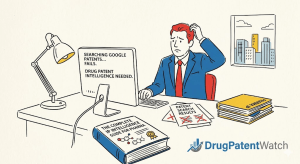
Google Patents is a document retrieval engine built by a data and advertising company for its own purposes. It was not designed to answer the questions that pharma IP professionals must answer: Which patents are actually listed in the FDA’s Orange Book against this drug? What is the true Loss of Exclusivity (LOE) date when regulatory exclusivities are factored in? Has this patent been challenged via a Paragraph IV certification? Who actually owns this patent after the subsidiary restructuring that happened 18 months ago?
Those questions require an integrated pharmaceutical intelligence platform. Google Patents cannot answer them. The sections below explain precisely why, with specific reference to the technical modalities, data pipelines, and legal frameworks that define pharmaceutical IP work.
Key Takeaways — Part I
The $2.6 billion cost to develop a drug means a single missed patent in an FTO analysis can trigger a lawsuit whose legal costs alone exceed the entire annual subscription fee of a professional intelligence platform by an order of magnitude. The economic argument for using a free generalist tool does not survive contact with actual litigation economics.
Part II: What Google Patents Actually Is (and What It Was Built For)
Origins and Design Philosophy
Google Patents launched in 2006, built on the same infrastructure as Google Books, with the explicit goal of making patent documents universally accessible. It indexes over 120 million publications from more than 100 patent offices, including the USPTO, EPO, WIPO, CNIPA (China), JPO (Japan), CIPO (Canada), DPMA (Germany), and the UK IPO, among others. It integrates non-patent literature (NPL) from Google Scholar and Google Books, and machine-classifies those NPL documents using the Cooperative Patent Classification (CPC) system.
That is a genuine technical achievement. For a hobbyist inventor doing a preliminary landscape scan, a law professor teaching a patent course, or a startup doing a first-pass novelty check, it is a powerful free resource.
What Google Actually Does With Patent Data
The more revealing insight is what Google does with the patent corpus beyond the public-facing search interface. Google makes the full patent dataset — including full text, bibliographic data, and machine-generated semantic embedding vectors — available via its BigQuery cloud platform for large-scale statistical analysis. The patent corpus is one of the most structurally dense, technically rich, and voluminous collections of human knowledge in existence. It is an ideal training set for natural language processing models, semantic search algorithms, and classification systems, all of which are core to Google’s primary revenue-generating businesses.
This is not speculation. Google’s own engineering blog posts describe using patent data to train and evaluate machine learning models. The BigQuery patent dataset is explicitly marketed to data scientists and AI researchers. When you search Google Patents, you are using the public-facing layer of an infrastructure built primarily to serve Google’s AI and advertising interests.
The design requirements for a world-class AI training corpus differ sharply from the requirements for a legal due-diligence database. For AI training, scale dominates precision. An error rate of 1-2% in legal status data is irrelevant for training a language model. It is catastrophic for an FTO analysis.
Key Takeaways — Part II
Google Patents is infrastructure built for data science and mass-market accessibility. The quality standards sufficient for those purposes are far below what pharmaceutical IP work requires. The platform’s design incentives and Google’s commercial interests are structurally misaligned with the needs of the pharma IP community.
Part III: The Anatomy of a Pharmaceutical Patent Fortress
Why ‘A Drug Has a Patent’ Is the Wrong Mental Model
The most persistent misconception among non-IP professionals — including many executives who make decisions based on patent intelligence — is that a drug has a patent. In reality, a commercially successful drug has a portfolio of patents, each protecting a different dimension of the product, each with its own expiration date and litigation history. Understanding that portfolio requires a taxonomy.
Composition of Matter Patents (API/Compound Patents)
The composition of matter patent — also called the active pharmaceutical ingredient (API) or compound patent — covers the core chemical entity itself. Its strength is doctrinal: if the molecule is present, the patent applies regardless of formulation, manufacturing process, or indication. For investors and generic companies alike, the expiration date of the composition of matter patent is the primary LOE signal. It is the ‘gold standard’ of pharmaceutical IP protection and commands the highest royalty rates in licensing negotiations.
IP Valuation note: Composition of matter patents in small-molecule drugs typically command royalty rates of 5-15% of net sales in licensing deals, versus 2-5% for formulation or process patents. For biological drugs, composition of matter equivalents (covering specific antibody sequences or protein structures) can anchor valuations in the hundreds of millions. When a composition of matter patent is the primary asset in an M&A transaction, its remaining term and litigation vulnerability are the two most material due-diligence variables.
Formulation Patents
Formulation patents cover specific dosage forms: extended-release tablets, transdermal patches, nanoparticle formulations, liposomal encapsulations, fixed-dose combinations. Their strategic role in lifecycle management is well-documented. Eli Lilly’s development of a once-weekly fluoxetine formulation after Prozac’s core compound patent expired is the textbook example. AstraZeneca’s extended-release omeprazole (Nexium) followed the expiry of the immediate-release omeprazole (Prilosec) compound patent and generated tens of billions in additional revenue.
A comprehensive FTO analysis on a generic drug product must assess every formulation patent in the Orange Book listing, not just the compound patent. Google Patents cannot tell you which formulation patents are Orange Book-listed, and it cannot run a substructure search to identify formulation patents that cover related excipient combinations.
Process Patents
Manufacturing process patents protect the specific synthetic routes, fermentation conditions, purification methods, or analytical procedures used to produce a drug. For generic companies, process patents are a practical barrier even when the compound is off-patent: a generic must either design around the process or challenge it. For biologics manufacturers, process patents covering cell line development, glycosylation profiles, and fill-finish procedures can persist well beyond the reference biologic’s composition of matter protection.
Method-of-Use Patents
Method-of-use patents cover the application of a compound to treat a specific disease or condition. They do not cover the molecule itself. A generic company can launch the compound off-patent and include a ‘skinny label’ that omits the patented indication — a strategy that has generated substantial litigation. The boundaries of what constitutes induced infringement of a method-of-use patent through skinny labeling have been litigated extensively, including at the Federal Circuit level in cases like GlaxoSmithKline v. Teva.
Dosage Regimen Patents
Dosage regimen patents cover specific administration protocols: a particular dose, a specific dosing interval, or a loading-dose/maintenance-dose sequence. These are among the most aggressively challenged patent types, and the litigation surrounding Janssen’s Invega Sustenna (paliperidone palmitate) illustrates how technically complex these claims can be. The Invega Sustenna patents covered specific dosage regimens for the long-acting injectable formulation, and the litigation involved multiple Paragraph IV challenges, appeal rounds, and arguments about whether prescribing information directing physicians to use a specific regimen constituted induced infringement.
Metabolite Patents
A less commonly discussed layer involves patents on the active metabolites of a drug compound. If a prodrug is off-patent but its active metabolite is still patented, the entry of a bioequivalent generic may still infringe the metabolite patent. Searching for metabolite patents requires understanding the biotransformation pathway of the parent compound — a task that requires chemical structure searching, not keyword searching.
The Patent Thicket and Evergreening
The deliberate, systematic layering of these patent types — compound, formulation, process, method-of-use, dosage regimen, metabolite — across a drug’s commercial lifecycle is the practice known as evergreening. The FTC has challenged this practice aggressively, filing challenges to over 400 patents it identified as improperly listed in the Orange Book since 2023, targeting drugs including EpiPen, Flovent, Symbicort, and weight-loss medications. But the legal validity of a given evergreening strategy depends entirely on the specific claims, the prosecution history, and the regulatory context — none of which Google Patents can synthesize for you.
Key Takeaways — Part III
A drug’s IP fortress has at minimum five distinct patent layers, each with independent legal status, expiration dates, and litigation risk. An FTO analysis or competitive intelligence effort that fails to identify and analyze all relevant layers — using the appropriate search modalities — is structurally incomplete. Google Patents cannot perform the chemical structure and biologic sequence searches needed to find many of these patents, and it cannot tell you which ones are Orange Book-listed.
Part IV: IP Valuation — Patents as Balance-Sheet Assets, Not Just Legal Documents
The Shift from Legal to Financial Asset Management
Over the past 15 years, pharmaceutical IP strategy has evolved from a predominantly legal function — securing and defending patents — to a financial asset management discipline. Patents are now explicitly valued on balance sheets, securitized in royalty transactions, and modeled as cash-flow-generating assets with definable risk profiles. Royalty Pharma, the world’s largest buyer of biopharmaceutical royalties, built a market capitalization exceeding $15 billion on the premise that drug royalty streams can be valued, priced, and traded like financial instruments.
This shift makes the quality of patent intelligence a direct input into financial modeling. A flawed patent expiration date produces a flawed LOE model. A flawed LOE model produces a flawed net present value (NPV) calculation for a drug in-licensing deal. A flawed NPV leads to an incorrect bid price. The error propagates from a database inaccuracy to a transaction price millions of dollars off the mark.
How a Composition of Matter Patent Gets Valued
The valuation of a core compound patent follows a discounted cash flow framework anchored in several inputs: the drug’s current net sales, the projected revenue trajectory through the patent’s expiration, the probability that the patent survives a Paragraph IV challenge (which requires assessing its prosecution history, prior art exposure, and claim breadth), the remaining patent term adjusted for any Patent Term Extension (PTE) or Patent Term Restoration under Hatch-Waxman, and the expected post-LOE revenue erosion rate based on the competitive landscape for generics or biosimilars.
A Patent Term Extension under 35 U.S.C. 156 can add up to five years to a drug patent’s term to compensate for FDA review time. Accurately modeling the extended expiration date requires knowing both the patent’s nominal expiration date and the precise NDA or BLA approval date, then applying the PTE calculation correctly. This is data that Google Patents does not surface or integrate. It requires linking the patent record to the FDA regulatory history — which is precisely what specialized platforms do.
Royalty Rate Benchmarks by Patent Type
Royalty rates in pharmaceutical licensing vary by patent type, compound class, development stage, and therapeutic area. Composition of matter patents for small molecules in large indications (oncology, metabolic disease) typically command 8-15% of net sales in the end-stage. Early-stage platform technology licenses, where the patent covers a delivery mechanism rather than a specific molecule, typically run 2-5%. Biologics composition of matter patents — covering a specific antibody sequence or protein structure — have commanded royalty rates of 10-20% in some high-profile deals, reflecting the difficulty and cost of developing the biologic reference product. These benchmarks are inputs to bid-no-bid decisions, and they are only meaningful if the underlying patent data — expiration dates, litigation status, Orange Book listing status — is accurate.
IP Valuation in M&A Due Diligence
When a large pharmaceutical company acquires a smaller biotech, the target’s patent portfolio is the primary asset being acquired. Due-diligence teams need to answer specific questions under time pressure: What is the composition of matter patent term and does the prosecution history reveal any claim amendments that narrow its scope? Are there continuation applications pending that could extend coverage? Has any third party filed an Inter Partes Review (IPR) at PTAB against these patents? Are there freedom-to-operate issues for the manufacturing process that the acquirer would inherit?
Answering any of these questions using Google Patents would be professional malpractice. The legal status data is unreliable, PTAB proceedings are not fully integrated, continuation relationships are incompletely mapped, and there is no ability to assess FTO via structure search. M&A due diligence requires professional-grade databases with real-time legal status, integrated PTAB and litigation records, and corporate tree mapping that correctly attributes all subsidiary filings to the parent entity.
Key Takeaways — Part IV
Patent IP is now a financial asset class, valued using DCF models that require accurate expiration dates, litigation risk assessments, PTE calculations, and Orange Book linkage. Google Patents provides none of these integrated financial or regulatory inputs. Any asset valuation model built on Google Patents data carries embedded errors that compound through the entire financial model.
Investment Strategy Note
For portfolio managers with positions in pharma companies approaching LOE cliffs: the critical variable is not just the nominal patent expiration date but the full exclusivity stack — patent term, any PTE, Orange Book-listed patent count, Paragraph IV challenge status, and remaining regulatory exclusivities. An integrated platform that surfaces all of these variables simultaneously allows you to model true LOE risk with precision that a Google Patents search cannot approach.
Part V: The Four Systemic Data Failures of Google Patents
Failure 1: Data Lag
Google Patents is not updated in real time. Independent analyses confirm update lags ranging from several weeks to multiple months between official patent office publication and Google indexing. This lag is not disclosed prominently. Users searching Google Patents today may be working with a database that, for some jurisdictions and document types, reflects the state of the world 60-90 days ago.
The practical consequence is direct: a company conducting an FTO analysis on a compound that entered Phase II clinical trials 18 months ago — triggering its 18-month publication delay — may now face newly published blocking art that appears in the USPTO’s database but not yet in Google’s index. The FTO analysis, completed with apparent thoroughness, has a gap that corresponds precisely to the most recently published, most strategically relevant patents.
Failure 2: Inaccurate and Disclaimed Legal Status
Google itself states that it cannot guarantee the accuracy of legal status data. This is not a standard legal disclaimer; it reflects a genuine and documented operational limitation. Patents that have lapsed for non-payment of maintenance fees may appear as ‘active’ in Google Patents for months after the lapse. Patents invalidated at PTAB via IPR or Post-Grant Review (PGR) may not reflect the invalidation for an extended period. Assignments and ownership transfers are not tracked in real time.
A startup that licenses a patent based on Google Patents data showing it as in-force, without independently verifying legal status at the USPTO’s Patent Center or via a specialized platform, could discover post-execution that the patent had already lapsed. The licensing fee and the legal costs associated with the transaction cannot be recovered.
For generic drug companies evaluating whether to file an ANDA with a Paragraph IV certification, an incorrect legal status read is not just a financial error — it affects the litigation strategy timeline, the 30-month stay calculation, and the first-filer exclusivity window under Hatch-Waxman.
Failure 3: Jurisdictional Coverage Gaps
The claim of indexing over 100 patent offices is technically accurate and strategically misleading. For many of those offices, Google Patents provides only partial coverage. Full-text availability for foreign-language patents is inconsistent. For China, Japan, Korea, and India — four critical pharmaceutical markets — coverage is incomplete, and the available machine translations of claims are unreliable for legal analysis.
A patent claim’s scope is determined by the precise language of each limitation. Machine translation at the word level frequently fails to capture the technical nuance of pharmaceutical chemistry and biology terminology. A Chinese patent claiming a compound with a specific substituent at a ring position can be mistranslated in a way that fundamentally alters the apparent scope of the claim. An analyst relying on that translation for an FTO conclusion is not doing FTO analysis; they are doing a vibe check.
Failure 4: Inconsistent and Uncleaned Assignee Data
Large pharmaceutical companies file patents through parent entities, subsidiaries, acquired companies, and research partnerships. Pfizer files under ‘Pfizer Inc.,’ ‘Pfizer Products Inc.,’ ‘Warner-Lambert Company,’ and ‘Wyeth LLC,’ among others. A search for ‘Pfizer’ in Google Patents misses all patents filed under subsidiary or legacy entity names unless the user already knows to search for each variant explicitly.
Professional databases build and maintain corporate tree structures that map all subsidiary and acquired-entity filings to the parent company, enabling a complete portfolio view with a single search. This is not a convenience feature — it is the difference between a complete competitive intelligence picture and a dangerously incomplete one. If a company is assessing the patent risk profile of a competitor in preparation for an in-licensing negotiation or a product launch, missing 20% of the competitor’s relevant portfolio because of assignee normalization failures is a serious analytical error.
Key Takeaways — Part V
All four of Google Patents’ data failures are systemic, not occasional. They are inherent to a mass-scale, automated data pipeline that is not calibrated for the precision required by pharmaceutical IP analysis. The errors are not randomly distributed — they concentrate in the most legally critical data points: legal status, ownership, recent publications, and foreign claim language.
Part VI: The Two Technical Blind Spots That Disqualify Google Patents for Pharma
Blind Spot 1: No Chemical Structure Search
For small-molecule drugs, the invention is the molecule. Composition of matter patents legally define the invention using structural representations — two-dimensional connection tables, Markush structures covering entire chemical classes — not by brand names or INN designations. A patent attorney drafting a composition of matter claim deliberately avoids using the drug’s common name to prevent claim scope from being limited to that specific compound name. The patent covers the molecule as a structure, not as a word.
Google Patents has no chemical structure search capability. A user cannot draw a molecule in a structure editor and search for patents covering that structure or any substructure containing it. This means Google Patents is blind to the most legally and commercially relevant search modality for small-molecule drugs.
The professional tools that do this correctly include CAS SciFinder, Clarivate’s Derwent Chemistry Resource (which integrates with Derwent World Patents Index), Minesoft’s ChemX, and Questel’s Orbit Chemistry platform. Each allows exact structure search, substructure search (finding any patent that contains the query structure as part of a larger molecule), and similarity search (finding structurally analogous compounds that may have overlapping activity). Without substructure search, a company cannot determine whether a competitor’s Markush claim covers its development candidate — the single most important FTO question for a small-molecule drug program.
The Gilead-Merck sofosbuvir litigation, which resulted in a $2.54 billion damages award, turned on precisely this kind of structural analysis: whether Gilead’s compound fell within the scope of claims that covered a class of nucleotide prodrugs. No keyword search would reliably identify all patents in that class. Only structure-based searching, combined with expert claim interpretation, could map the relevant patent landscape.
Blind Spot 2: No Biologic Sequence Search
Biologic drugs — monoclonal antibodies, fusion proteins, therapeutic enzymes, gene therapy vectors, mRNA therapeutics — are defined by their molecular sequences. An antibody’s specificity and therapeutic activity derive from the amino acid sequences of its Complementarity-Determining Regions (CDRs). A gene therapy’s function is encoded in its nucleotide sequence. These are the inventions that patents protect, and these inventions are expressed in sequence listings, not in words.
WIPO’s ST.26 standard now requires that sequence listings in patent applications be submitted in XML format, enabling computational searching. Over 80% of biopharmaceutical patents include sequence listings. An FTO analysis for a new therapeutic antibody must include a sequence search — typically using BLAST or a similar alignment algorithm — against all patented sequences to identify any granted claims covering antibodies with similar or identical CDR sequences.
Google Patents has no sequence search capability. It cannot accept a query amino acid or nucleotide sequence and search for patents claiming similar sequences. This makes it categorically useless for biologics FTO work. WIPO’s PATENTSCOPE offers a free dedicated sequence search tool (PatSeq). Specialized commercial platforms integrate sequence search with full patent family data and legal status. Google Patents offers nothing equivalent.
Given that the biologics market is growing faster than small-molecule pharmaceuticals, and given that biosimilar development is one of the most patent-intensive activities in the industry, this blind spot alone disqualifies Google Patents for a large and increasing share of pharmaceutical IP work.
Key Takeaways — Part VI
Two search modalities — chemical structure search and biologic sequence search — are non-negotiable for pharmaceutical patent analysis. Google Patents supports neither. An FTO opinion, patentability assessment, or competitive landscape analysis that does not use structure and sequence searching is structurally incomplete, regardless of how thorough the keyword component is.
Part VII: The Regulatory Overlay — Orange Book, Purple Book, and Data Exclusivity
The Hatch-Waxman Framework and Orange Book Listings
The Drug Price Competition and Patent Term Restoration Act of 1984 (Hatch-Waxman Act) created the regulatory-patent linkage system that governs generic drug entry in the United States. Under this system, brand-name companies must list in the Orange Book — formally the ‘Approved Drug Products with Therapeutic Equivalence Evaluations’ — all patents they assert cover the approved drug product or its FDA-approved method of use. When a generic company files an ANDA, it must certify with respect to each Orange Book-listed patent.
A Paragraph IV certification — the challenge certification asserting that a listed patent is invalid, unenforceable, or will not be infringed — triggers automatic 30-month litigation stay of ANDA approval. The first generic filer with a Paragraph IV certification that survives litigation earns 180 days of market exclusivity under Hatch-Waxman, a provision worth hundreds of millions of dollars for drugs with large markets.
The Orange Book is the strategic map of pharmaceutical patent protection in the United States. Google Patents has no integration with it. You cannot search Google Patents and learn which of the returned patent results are Orange Book-listed for a specific drug. You cannot determine the Paragraph IV litigation history associated with a given patent. You cannot see whether any generic ANDA filer has already challenged that patent and either settled or won. A specialized platform that integrates Orange Book data with patent and litigation records gives you all of that simultaneously.
The Purple Book and Biologic Exclusivity
The Biologics Price Competition and Innovation Act (BPCIA) created an analogous system for biologic drugs. The Purple Book lists the reference biologic products and their FDA-approved biosimilars and interchangeable biosimilars. Unlike the Orange Book, the Purple Book does not list specific patents; instead, the patent exchange process under BPCIA occurs in a multi-step negotiation between the reference biologic sponsor and the biosimilar applicant, governed by a confidential ‘patent dance.’
Biosimilar interchangeability — the designation that a biosimilar can be substituted for the reference biologic at the pharmacy level without prescriber intervention — carries significant commercial value and requires additional clinical demonstration beyond basic biosimilarity. The patents most relevant to interchangeability challenges often cover manufacturing processes, formulation conditions, and analytical methods, not just the primary sequence. Identifying these patents requires structure and sequence searching combined with regulatory knowledge that Google Patents cannot provide.
FDA Regulatory Exclusivities: The Non-Patent Protection Layer
The FDA grants market exclusivities that operate independently of patent status:
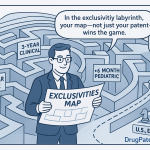
New Chemical Entity (NCE) exclusivity: five years from approval during which the FDA cannot accept an ANDA that relies on the brand’s safety and efficacy data. This is separate from any patent protection.
New Clinical Investigation exclusivity: three years for approved changes to an existing drug (new formulation, new indication, new dosing regimen) supported by new clinical trials.
Orphan Drug exclusivity: seven years of market exclusivity for drugs treating rare diseases (fewer than 200,000 affected individuals in the United States).
Pediatric exclusivity: six months added to existing patent terms and exclusivities in exchange for conducting FDA-requested pediatric studies.
Qualified Infectious Disease Product (QIDP) exclusivity: five additional years of exclusivity for drugs designated as addressing serious or life-threatening infections.
A complete LOE analysis must model the expiration of the longest-running applicable exclusivity, whether patent or regulatory, across all relevant markets. Google Patents shows you patents. It shows you nothing about regulatory exclusivities. An LOE model that ignores regulatory exclusivities can underestimate a drug’s effective market protection by years.
Key Takeaways — Part VII
The regulatory exclusivity framework — Orange Book listings, Paragraph IV certifications, Purple Book biologics data, NCE exclusivity, orphan drug exclusivity, pediatric exclusivity — is inseparable from pharmaceutical patent analysis. A patent without its regulatory context is an incomplete picture of a drug’s market protection. Google Patents provides the patent document. It provides none of the context.
Part VIII: Evergreening Roadmap — How Lifecycle IP Strategy Works in Practice
The Lifecycle IP Technology Roadmap
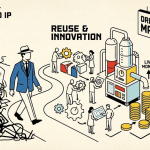
Evergreening is the practice of filing additional patents to extend the period of market exclusivity beyond the expiration of the original compound patent. It is the subject of extensive regulatory scrutiny, FTC enforcement action, and academic literature. It is also standard practice among branded pharmaceutical companies. Understanding its mechanics is essential for competitive intelligence, M&A due diligence, and LOE forecasting.
The typical lifecycle IP roadmap for a small-molecule drug proceeds as follows:
Phase 1, years 0-3 from first synthesis: The compound patent is filed, typically as a broad composition of matter claim covering the compound and close structural analogs. A Markush claim may cover thousands of compounds. The patent is filed well before clinical development begins, starting the 20-year patent clock.
Phase 2, years 3-8, IND through Phase II: Process patents are filed as the manufacturing route is optimized. Polymorph and crystal form patents are filed if a specific crystalline form is identified with superior stability or bioavailability properties. Salt form patents cover specific counterion combinations.
Phase 3, years 8-12, Phase III through NDA filing: Formulation patents are filed as the commercial dosage form is developed. Extended-release or modified-release formulation patents are particularly valuable because they support a line extension that can be substituted for the original product. Combination patents are filed if the drug will be marketed with a complementary agent.
Phase 4, years 10-15, post-approval: Method-of-use patents are filed for new indications identified through post-marketing research. Dosage regimen patents are filed for specific administration protocols identified as clinically superior.
Phase 5, years 15-20, late lifecycle: Metabolite patents may be pursued for active metabolites. Patient population patents may cover specific biomarker-defined subpopulations for whom the drug shows particular efficacy.
Case Study: The Humira Patent Estate
AbbVie’s Humira (adalimumab) is the most extensively studied example of lifecycle IP strategy. The drug launched in 2002. Its original compound patent expired in the United States in 2016. Yet biosimilar entry was delayed until 2023 — a seven-year gap attributed to a patent estate that, at its peak, included over 130 patents covering formulations, manufacturing processes, dosing regimens, and methods of use.
AbbVie settled Paragraph IV challenges with all major biosimilar manufacturers through agreements that delayed biosimilar entry to staggered dates beginning January 2023, with immediate entry only in Europe where the patent situation was resolved earlier. The financial value of that seven-year delay, at Humira’s peak revenue of approximately $21 billion annually, is on the order of $80-100 billion in protected revenue. That value derived entirely from strategic IP filing and litigation management, not from extended composition of matter protection.
No analysis of the Humira competitive landscape that relied solely on the original adalimumab compound patent would have correctly forecast the LOE date. Understanding the full fortress required identifying and assessing every one of those 130+ patents — a task requiring complete portfolio mapping, Orange Book linkage, and litigation history integration that Google Patents cannot support.
Case Study: AstraZeneca’s Nexium (Esomeprazole)
When Prilosec’s (omeprazole) compound patent expired, AstraZeneca developed Nexium by separating the two enantiomers of the racemic omeprazole mixture. Esomeprazole, the S-enantiomer, showed marginally superior acid suppression in clinical studies. AstraZeneca patented it as a new composition of matter. Regulatory approval of Nexium gave it a new patent estate and NCE exclusivity.
Generic manufacturers challenged the Nexium patents. The core legal argument was that the S-enantiomer was not sufficiently inventive given the prior art on omeprazole. AstraZeneca prevailed in some jurisdictions and not others. The litigation illustrates that enantiomer patents are a classic evergreening mechanism, and identifying them requires structure searching — specifically, searching for stereoisomeric variants of a known compound.
What Complete Competitive Intelligence Requires
Competitive lifecycle IP intelligence requires, for any drug of interest: a complete family map of all related patent applications filed globally, with legal status and expiration dates; a substructure search identifying all patents covering structurally related compounds that could affect FTO for development candidates; Orange Book and Purple Book linkage identifying which patents are actively listed; PTAB and district court litigation history for each listed patent; regulatory exclusivity tracking for NCE, orphan, pediatric, and QIDP exclusivities; and any post-grant proceedings — IPR, PGR, ex parte reexamination — that have been filed against key patents.
Google Patents can locate individual patent documents. It cannot build this picture.
Key Takeaways — Part VIII
Evergreening is a systematic, multi-phase IP strategy that can extend a drug’s effective market exclusivity by a decade beyond the compound patent expiration. Correctly modeling LOE for any major pharmaceutical asset requires mapping the entire patent estate across all filing types, not just identifying the compound patent. Structure searching, Orange Book integration, and litigation history are all required. Google Patents provides none of these.
Part IX: Freedom-to-Operate Analysis — Why Incomplete Data Destroys FTO Validity
What FTO Analysis Actually Is
A freedom-to-operate analysis is a legal opinion that assesses whether a specific commercial product, as it will actually be manufactured and sold, would infringe the valid, in-force claims of any existing patent held by a third party. The key qualifiers are specific (not generic or hypothetical), valid (the patent is actually enforceable), and in-force (the patent has not expired, lapsed, or been invalidated).
FTO analysis is not a patentability search. It is not a literature review. It is a structured legal opinion with direct commercial consequences. A company that launches a product without a clean FTO opinion, or with an FTO opinion based on a flawed search, faces a range of outcomes ranging from a demand letter from a patent holder to a request for injunctive relief that halts the product launch.
Why Google Patents Fails the FTO Standard
The FTO standard requires finding all potentially relevant in-force patents. Google Patents’ data lag means recently published patents may not be indexed. Its inaccurate legal status means patents shown as active may have lapsed, and patents shown as expired may have had term extensions that are not reflected. Its lack of structure and sequence search means entire categories of relevant patents are invisible to the search. Its jurisdictional gaps mean the FTO is only as global as the data, which is incomplete.
Each of these failures independently compromises the validity of an FTO opinion. Together, they make an FTO built exclusively on Google Patents data professionally indefensible. A patent attorney who issues an FTO opinion based solely on a Google Patents search, without supplementing with professional databases and official patent office records, is creating significant malpractice exposure.
The 30-Month Stay and Its Financial Significance
For generic drug companies, the Paragraph IV certification process and the associated 30-month stay make accurate patent identification a financial calculation with precise dollar values. A generic company considering filing an ANDA with a Paragraph IV certification against a drug generating $3 billion in annual US sales needs to know: exactly which patents are Orange Book-listed (because only those trigger the stay), what their expiration dates are, what their litigation history is (because a patent that has already been unsuccessfully challenged by another generic company may be more defensible), and what their claim breadth is relative to the proposed ANDA product.
Getting any of these facts wrong affects the go/no-go decision, the litigation budget, and the timing of the potential market entry. An incorrect expiration date assessment that is based on Google Patents’ legal status data — without independent verification at the USPTO and cross-referencing with any PTE applications — can cascade into a completely misjudged litigation timeline.
Key Takeaways — Part IX
FTO analysis requires finding all relevant in-force patents using the full range of search modalities — keyword, structure, sequence, classification — with accurate legal status and complete jurisdictional coverage. Google Patents satisfies none of these requirements completely. Any FTO opinion that relies primarily on Google Patents data lacks a defensible evidentiary foundation.
Part X: Biosimilar Interchangeability and the Patent Thicket Problem
The Biosimilar Market: Scale and Complexity
The global biosimilar market reached approximately $35 billion in 2024 and is projected to exceed $100 billion by 2030. The reference biologics whose patent protection is eroding include some of the most commercially significant drugs in history: adalimumab (Humira), pembrolizumab (Keytruda), ustekinumab (Stelara), natalizumab (Tysabri), and the entire class of insulin analogs. Each of these molecules carries a patent estate substantially more complex than a typical small-molecule drug.
The BPCIA Patent Dance
The BPCIA requires biosimilar applicants to engage in a structured patent exchange process with the reference product sponsor. The biosimilar applicant must provide its Biologics License Application and detailed manufacturing information to the sponsor. The sponsor identifies patents it believes are infringed and would be willing to assert. The applicant responds with contentions about validity and non-infringement. The parties then negotiate a list of patents to litigate immediately versus a list to be litigated later.
This process — the ‘patent dance’ — involves confidential information sharing and a negotiated litigation sequence that is invisible to Google Patents users. The patents identified in the dance may not have been publicly listed anywhere prior to the exchange. Understanding the likely scope of a biosimilar’s patent risk before entering the dance requires a comprehensive analysis of all known patents in the reference sponsor’s portfolio — which requires complete assignee normalization, sequence searching, and process patent analysis.
The Interchangeability Designation
A biosimilar designated as interchangeable can be substituted for the reference biologic at the pharmacy level without the prescriber’s intervention, in states that have enacted pharmacy substitution laws. The first biosimilar to achieve interchangeability for a given reference product earns 12 months of exclusivity against other interchangeable biosimilars — a provision analogous to Hatch-Waxman first-filer exclusivity.
The patents most relevant to an interchangeability challenge include those covering specific formulation conditions (buffer composition, excipient concentrations, pH ranges) that affect stability and bioequivalence, as well as analytical method patents covering the characterization assays used to demonstrate biosimilarity. These are exactly the types of patents that require chemical structure searching to identify comprehensively.
Key Takeaways — Part X
Biosimilar development is the most patent-intensive activity in pharmaceutical IP, combining sequence-level composition claims, complex manufacturing process patents, formulation patents, and regulatory exclusivities. The BPCIA patent dance creates confidential IP risk that must be anticipated through comprehensive pre-filing portfolio analysis. Google Patents, without sequence search or complete corporate tree mapping, cannot support this analysis.
Part XI: The Real Cost — Litigation Economics and the ‘Free Tool’ Fallacy
The Litigation Cost Baseline
Data from the American Intellectual Property Law Association (AIPLA) establishes the following median cost benchmarks for US patent litigation:
For disputes where more than $25 million is at risk — the threshold virtually every pharmaceutical patent suit exceeds — median total cost through discovery runs to approximately $3 million. Median total cost through trial and appeal runs $5.5 million or more. These are direct legal costs: attorney fees, expert witnesses, e-discovery, court costs. They exclude the indirect costs of executive time diversion, R&D disruption, and the impact on investor confidence and stock price.
Pharmaceutical patent litigation routinely involves stakes far exceeding $25 million. The Gilead-Merck sofosbuvir verdict was $2.54 billion. Damage awards of $100-500 million in pharmaceutical patent cases are not exceptional.
The ‘Penny-Wise, Pound-Foolish’ Math
A professional pharmaceutical patent intelligence platform subscription — at the level of DrugPatentWatch, Clarivate’s Derwent suite, or similar — runs in the range of tens of thousands to a few hundred thousand dollars annually for enterprise access, depending on the scope and number of users.
The median cost to defend a single high-stakes pharmaceutical patent case through trial is $5.5 million. A single case.
A company that skips a professional subscription to save $50,000-$200,000 annually, conducts its FTO work on Google Patents, and misses a relevant blocking patent faces litigation costs that exceed the cumulative savings from a decade of professional subscriptions in the first few months of discovery.
The expected value calculation is not ambiguous. The risk-adjusted cost of relying on inadequate tools substantially exceeds the cost of proper tools, by multiple orders of magnitude for any company with a meaningful commercial pipeline.
The Opportunity Cost: Missed Generic Entry Windows
For generic companies, the financial analysis runs the other direction. First-filer Hatch-Waxman exclusivity for a drug with $2 billion in annual US sales is worth approximately $400-600 million in incremental revenue over the 180-day exclusivity period. Missing a first-filer window because of an incomplete patent analysis — failing to identify the correct set of Orange Book-listed patents to challenge, or failing to recognize that a key blocking patent has already lapsed — is an opportunity cost of that magnitude.
Accurate, timely patent intelligence is not just risk management for innovator companies. It is revenue opportunity for generic companies. The same analytical rigor applies to both sides of the market.
Case Vignettes: What Flawed Intelligence Actually Costs
The Gilead-Merck dispute originated in part from Gilead’s acquisition of Pharmasset in 2011. Pharmasset’s sofosbuvir compound was Gilead’s core HCV asset. The patent landscape analysis conducted during that acquisition — for which Gilead paid $11 billion — should have identified Merck’s earlier-filed patents covering the nucleotide prodrug class. The verdict suggests it did not fully account for the claim scope of Merck’s patents. A structure-based search of the nucleotide prodrug patent landscape would have identified those patents as a risk to be assessed.
AstraZeneca’s Seroquel (quetiapine) extended-release formulation patents were challenged by multiple generic companies after the compound patent expired. The formulation litigation delayed generic entry for years. Generic companies that did not accurately model the formulation patent estate when planning their ANDA timing found their market entry delayed — and their projected revenues from first-filer exclusivity diminished — by the litigation they had not anticipated.
Key Takeaways — Part XI
The economics of pharmaceutical patent litigation make professional IP intelligence tools mandatory, not optional, for any company with a commercial pipeline. The cost differential between adequate and inadequate tools — measured in subscription fees — is trivially small compared to the cost of a single avoidable litigation or missed market entry window.
Investment Strategy Note
For institutional investors evaluating pharma and generic company stocks: the quality and completeness of a company’s IP intelligence infrastructure is a material factor in its litigation risk profile and its ability to accurately forecast LOE events. Companies that rely on free or inadequate tools for IP analysis carry unpriced litigation risk. Patent-related stock price shocks — both positive and negative — consistently follow LOE events that the market had not correctly modeled. Better IP intelligence produces better LOE forecasts, which produce better-priced stocks.
Part XII: Google’s Conflicting Interests — Data Science, Ad Revenue, and a Weaker Patent System
Google’s Primary Business Model and Patent Data
Google’s revenue is overwhelmingly dependent on digital advertising, which requires processing vast quantities of data to train the algorithms that serve targeted ads. Patent documents are among the highest-quality, most structured, and most technically dense corpora available for AI training. Google’s BigQuery Patent Research dataset, which includes full text, bibliographic data, semantic embeddings, and CPC classifications, is explicitly marketed to data scientists as a training and analysis resource.
Google’s incentive in building Google Patents is therefore not to serve pharmaceutical IP professionals. It is to acquire and maintain a comprehensive patent corpus that serves its AI and data science operations. The public search interface is a useful byproduct that generates user engagement and brand goodwill. The primary value of the dataset flows internally to Google’s core business.
Google’s Documented Stance on Patent Strength
Google has advocated extensively for a weaker US patent system, particularly regarding software and business method patents. The company was a significant supporter of the America Invents Act of 2011, which created PTAB and its IPR mechanism. PTAB has been broadly criticized by pharmaceutical and biotech companies as making it substantially easier and cheaper to challenge drug patents than the prior district court system — the ‘death squad for patents’ critique associated with some Federal Circuit jurisprudence.
Google’s acquisition of the Motorola Mobility patent portfolio for $12.5 billion in 2012 was explicitly defensive — a shield against litigation from Apple and Microsoft, not a platform for patent monetization. This reflects a strategic orientation toward patent stockpiling for defensive purposes, not toward the strong enforcement and valuation model that defines pharmaceutical IP strategy.
A company whose political and commercial interests align with weakening patent protection is not a natural provider of the intelligence infrastructure that pharmaceutical innovators rely on to protect multi-billion-dollar investments. The mismatch is structural.
The Android Example and IP Philosophy
Android’s success as an open-source mobile operating system depended on the availability of a platform not encumbered by broad software patents. Google’s orientation toward open-source software and the free flow of information through its search engine — both cornerstones of its market position — are philosophically and commercially aligned with a patent system that is easier to challenge and harder to enforce.
The pharmaceutical business model depends on the opposite: a small number of highly specific, strongly protected, long-duration patents that are very difficult to challenge. Pharma companies need tools that help them build, assess, and defend these patents. Google’s interests are not aligned with that goal.
Key Takeaways — Part XII
Google’s commercial and political interests are structurally misaligned with the needs of pharmaceutical patent holders and the generic companies that must accurately assess patent risk before filing ANDAs. The deficiencies in Google Patents are the predictable output of a tool designed for different purposes by an organization with different incentives.
Part XIII: The Intelligence Platform Standard — What Professional Tools Actually Deliver
Data Architecture: Integration vs. Document Retrieval
The distinction between a search engine and an intelligence platform is not primarily about feature count. It is about data architecture. Google Patents stores patent documents and retrieves them based on query matching. A professional pharmaceutical intelligence platform stores patent data, regulatory data, litigation data, clinical trial data, and commercial data in an integrated schema, linked by common identifiers — drug name, INN, NDA/BLA number, patent number — so that a query about a drug returns the complete picture across all of these dimensions simultaneously.
DrugPatentWatch, for example, links patent records to their FDA Orange Book and Purple Book listings, to ANDA and BLA filings from generic and biosimilar manufacturers, to PTAB proceeding records, to district court litigation case records, and to FDA approval and exclusivity data. A user searching for a drug gets a patent expiration calendar, not just a list of patent documents.
Update Frequency and Data Pipeline Integrity
Professional platforms update from primary sources — the USPTO, EPO, WIPO, national patent offices, and the FDA — on daily or near-daily cycles. Legal status data is verified against official records, not just indexed from automated feeds. Ownership and assignment data is cross-referenced with USPTO assignment records and maintained with human-curated corporate tree structures.
The practical difference: when a PTAB final written decision invalidates a key patent on a Tuesday morning, a professional platform reflects that decision within 24-48 hours. Google Patents may not reflect it for weeks, if it reflects it accurately at all.
Chemical Structure and Biologic Sequence Search
CAS SciFinder provides the most comprehensive chemical structure database, integrating both patent and journal literature. Derwent Chemistry Resource integrates with Derwent World Patents Index for combined structure-patent analysis. Minesoft ChemX and Questel Orbit Chemistry provide patent-specific structure searching. All of these tools allow exact, substructure, and similarity searching using professional structure editors.
For biologic sequences, WIPO’s PatSeq and the European Bioinformatics Institute’s (EBI) SureChEMBL provide public sequence search against patent filings. Commercial platforms integrate sequence search with full patent family data and legal status, enabling a biosimilar development team to identify all in-force patents claiming sequences similar to their therapeutic protein candidate in a single workflow.
Automated Competitive Monitoring
Professional platforms allow users to set automated alerts on specific drugs, companies, patent families, and technology classifications. When a competitor files a new patent application claiming a compound in your therapeutic area, the system flags it within days of publication — not weeks or months later. When the legal status of a key blocking patent changes — a maintenance fee lapse, a PTAB institution decision, a district court verdict — the system notifies the relevant stakeholders immediately.
This converts competitive patent monitoring from a periodic manual exercise into a continuous, automated process that scales to the entire pipeline and competitor landscape simultaneously.
Human Curation: What Automation Cannot Replace
The professional database advantage is not purely technical. Expert curation — human review of data quality, manual extraction of chemical structures and sequences from patent drawings and specifications, expert indexing of CPC and therapeutic classifications, and maintenance of corporate entity trees — is what separates reliable intelligence from raw data.
Pharmaceutical patent specifications frequently include structural data in drawings that optical character recognition and machine learning cannot reliably parse. An expert indexer who reads the specification and manually enters the correct structure into the database produces a record that a downstream structure search can reliably find. An automated system that fails to correctly parse a hand-drawn structural formula produces a gap in the database that users cannot see and cannot compensate for.
This is the human capital investment that distinguishes professional platforms from automated aggregation services. It is not glamorous, but it is what makes the data reliable enough to base multi-million-dollar decisions on.
Key Takeaways — Part XIII
Professional pharmaceutical patent intelligence platforms differ from Google Patents in architecture, not just features. They integrate patent, regulatory, litigation, and clinical data into a unified schema. They update from primary sources on daily cycles. They support chemical structure and biologic sequence searching. They deliver human-curated data quality. The aggregate effect is the difference between document retrieval and business intelligence.
Part XIV: Investment Strategy — Using Patent Intelligence for Portfolio Decisions
LOE Modeling as a Core Investment Signal
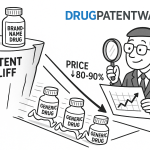
For pharmaceutical portfolio managers and equity analysts, the Loss of Exclusivity date is the single most consequential event in a drug’s commercial lifecycle. The revenue decline following LOE — historically 80-90% within 12-18 months for small molecules facing multiple generic entrants — makes accurate LOE forecasting a prerequisite for valuing pharmaceutical assets. Getting the LOE date wrong by one or two years can move a discounted cash flow valuation by 20-30% for a mid-sized drug.
The inputs to a correct LOE model include: the nominal expiration date of the most valuable Orange Book-listed patents, any PTE extending those patents, the Paragraph IV challenge landscape (are there Hatch-Waxman challenges pending that could accelerate generic entry?), the regulatory exclusivity stack (NCE, orphan, pediatric), and the first-filer exclusivity situation for the first generic entrant. All of these inputs require integrated patent-regulatory intelligence, not a Google Patents search.
Paragraph IV Pipeline as a Leading Indicator
The Paragraph IV certification pipeline is one of the most useful leading indicators for generic entry timing. When a generic company files an ANDA with a Paragraph IV certification against a specific Orange Book patent and notifies the patent holder, a 45-day window opens during which the patent holder can file suit and trigger the 30-month stay. Tracking this pipeline — which patents are being challenged, by which generic companies, and with what litigation outcomes — provides advance intelligence on expected LOE events two to four years before they materialize.
A professional platform that integrates ANDA filing data with Orange Book listings and litigation history makes this Paragraph IV pipeline visible. Google Patents makes none of it visible.
Biosimilar Entry Forecasting
For biologic drugs, biosimilar entry timing is more complex than small-molecule generic entry and requires tracking the Purple Book listing, the patent dance negotiation status (where disclosable), BPCIA litigation case histories for similar molecules, and the FDA’s biosimilar approval timeline. The interchangeability designation adds another layer — only interchangeable biosimilars can be substituted at the pharmacy, creating a tiered competitive dynamic.
For portfolio managers with positions in reference biologic companies, tracking which biosimilar manufacturers have filed BLAs, where they are in the BPCIA patent process, and what the court has ruled in related litigation is material non-public-adjacent intelligence that can be assembled entirely from public sources — if you have the right platform.
Patent Cliff Timing and M&A Arbitrage
Some of the most profitable pharmaceutical M&A transactions exploit the gap between a drug’s perceived LOE date and its actual LOE date, fully modeled with patent estates and regulatory exclusivities. A drug that the market assumes will face generic entry in year X, but whose complete patent and exclusivity analysis reveals actual protection through year X+3, is undervalued relative to its real cash flow duration. The arbitrage opportunity exists because most market participants are doing LOE modeling with incomplete tools.
Conversely, drugs protected by patent estates that are highly vulnerable to PTAB challenge — because the key patents have prior art exposure, claim breadth issues, or have already been flagged by the FTC for improper Orange Book listing — may be overvalued relative to their actual LOE risk. Expert patent intelligence that can assess PTAB invalidity risk for Orange Book-listed patents is a material edge for short-side pharmaceutical analysis.
Key Takeaways — Part XIV
Accurate pharmaceutical asset valuation requires complete LOE modeling, which in turn requires integrated patent-regulatory intelligence. The quality of that intelligence is a direct determinant of portfolio decision quality. Platforms that integrate patent data with Orange Book listings, Paragraph IV pipeline data, PTAB proceedings, and regulatory exclusivity tracking provide a systematic analytical edge over market participants using inadequate tools.
Part XV: Key Takeaways by Section
The Core Problem
Google Patents is a document retrieval engine built for mass-market accessibility and Google’s own data science operations. Its design requirements, data quality standards, and organizational incentives are all misaligned with pharmaceutical IP analysis. Its deficiencies — data lag, legal status inaccuracy, jurisdictional gaps, assignee inconsistency, no structure search, no sequence search, no regulatory integration — are systemic and inherent to its architecture. They are not bugs that Google is working to fix; they are the predictable outputs of a tool built for different purposes.
The Specific Technical Failures
No chemical structure search means the tool cannot identify Markush-claim patents that cover a development candidate’s structure without naming it. No biologic sequence search means the tool is categorically useless for biologics FTO work. No Orange Book integration means it cannot distinguish between which patents are actively blocking generic entry and which are merely tangentially related. No corporate tree mapping means it cannot show a competitor’s complete portfolio. Weeks-to-months data lag means any FTO analysis is outdated before it is completed.
The Financial Argument
The median cost of defending a high-stakes pharmaceutical patent case through trial and appeal exceeds $5 million. First-filer Hatch-Waxman exclusivity for a major drug is worth hundreds of millions of dollars. Professional platform subscriptions cost a fraction of either figure. The risk-adjusted economics of relying on inadequate tools are straightforwardly negative for any company with a meaningful pipeline.
The Strategic Conclusion
The shift from document retrieval to integrated intelligence is not a technology upgrade; it is a change in analytical philosophy. Patent data alone — a list of documents — is insufficient for the decisions that pharmaceutical companies must make. Patent data integrated with regulatory status, litigation history, commercial data, and correctly attributed to the right corporate entities is the foundation for competitive strategy, LOE forecasting, M&A due diligence, and FTO clearance. Google Patents provides the former. Professional platforms provide the latter.
Part XVI: Decision Framework — When Google Patents Is Acceptable vs. Dangerous
Acceptable Uses
Google Patents is an appropriate tool for preliminary, non-consequential tasks where the cost of error is low and the purpose is orientation rather than decision-making. These include: initial scoping of a technology area before commissioning a professional search, academic research where the goal is illustration rather than legal opinion, inventor education about the patent system and how to read patent documents, and identifying a known specific patent by number or inventor name for reference purposes.
Dangerous Uses
Google Patents is not an appropriate tool, and relying on it creates material professional and financial risk, for any of the following:
Freedom-to-operate analysis for a product approaching development or commercial launch. Any FTO opinion based primarily on Google Patents data is professionally indefensible due to structural search limitations and data integrity failures.
Paragraph IV challenge assessment for generic or biosimilar drug development. The Orange Book linkage, complete patent family mapping, and accurate legal status required for this analysis are not available on Google Patents.
Competitive pipeline intelligence for R&D strategy decisions. Missing patents because of assignee normalization failures or data lags produces a systematically incomplete competitive picture.
M&A due diligence for pharmaceutical asset acquisitions. IP asset valuation and litigation risk assessment require complete portfolio mapping, PTAB history, assignment verification, and regulatory integration.
LOE modeling for investment decisions. Regulatory exclusivity data, Paragraph IV pipeline data, and PTE-adjusted expiration dates are all outside Google Patents’ data scope.
The Minimum Adequate Standard
Any pharmaceutical IP analysis intended to support a business decision should use, at minimum: a professional patent database with verified legal status and daily updates, a chemical structure or biologic sequence search tool appropriate to the compound class, direct verification of legal status for key patents at the relevant patent office’s official database, and integration of FDA Orange Book or Purple Book data for US market assessments.
Google Patents may supplement this workflow as a free cross-check for document retrieval. It cannot replace any component of it.
Appendix: Data Comparison Table — Google Patents vs. Professional Pharmaceutical Intelligence Platforms
Capability
Google Patents
Professional Platform (e.g., DrugPatentWatch + Derwent)
Data update frequency
Weeks to months lag
Daily updates from primary sources
Legal status accuracy
Disclaimed; often inaccurate
Verified; integrated with PTAB and assignment records
US jurisdictional coverage
Indexed; full-text generally available
Complete with PTE and maintenance fee status
Foreign jurisdictional coverage
Partial; full-text gaps in CN, JP, IN
Defined guaranteed coverage; professional translation
Chemical structure search
None
Exact, substructure, and similarity search
Biologic sequence search
None
BLAST-based sequence search with patent family linkage
Orange Book / Purple Book integration
None
Deep integration with exclusivity and ANDA/BLA filing data
PTAB/IPR/PGR proceedings
Limited link-out
Fully integrated; petition and final decision records
Assignee / corporate tree normalization
None
Human-curated entity mapping to parent companies
Automated competitive monitoring
None
Customizable alerts for filings, status changes, litigation
This analysis is provided for educational and strategic purposes and does not constitute legal advice. Pharmaceutical patent analysis for commercial decisions should involve qualified IP counsel using professional-grade intelligence platforms.