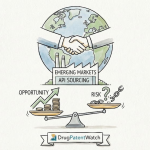
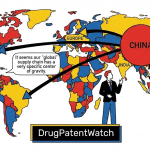
China’s drug companies licensed out $56.7 billion in innovative-drug assets to global pharma in the first four months of 2026 alone, a 132% jump over the same period in 2025 [1]. India’s originator licensing activity does not appear in the same league of data providers that track this figure. That asymmetry is not a marketing problem. It traces to two different patent systems, two different R&D funding bases, and, as of 2021, two structurally different generic-entry regimes that most coverage of the “India vs. China” pharma rivalry never gets into.
Key Takeaways
China’s innovative-drug out-licensing deals reached $135.7 billion across 157 transactions in 2025, and had already hit $56.7 billion across 44 deals by April 2026 — a 132% year-over-year increase [1][2].
China built a Hatch-Waxman-style patent linkage system in 2021, complete with an NMPA-run “Orange Book” equivalent, a 12-month first-generic exclusivity period, and a patent term extension mechanism — a generic-entry infrastructure India’s Patents Act does not replicate [3][4].
India’s three approved Bulk Drug Parks carry a combined central grant-in-aid of ₹3,000 crore (~$360 million), with the Himachal Pradesh park alone projected to draw ₹8,000–10,000 crore in private investment [5][6].
A 2025 review of 85 FDA warning letters found Indian sites cited for data-integrity failures at a 60% rate, versus 21% for China and 10% for the US — a gap that undercuts India’s “highest plant count” narrative [7].
Five of the ten largest GLP-1 and cardiometabolic licensing deals signed with Chinese originators since late 2023 exceed $1.5 billion in potential value, a deal-size bracket in which no Indian originator asset currently competes [8][9][10][11].
What This Analysis Adds to the India-China Pharma Debate
Most coverage of the India-China pharmaceutical rivalry stops at market-size comparisons and R&D-spending ratios. Those numbers matter, but they describe outputs, not the legal machinery producing them. This analysis goes further in four directions: it maps China’s 2021 patent linkage system against the US Hatch-Waxman framework India’s own generics industry grew up exploiting; it prices the specific licensing deals driving China’s 2026 headline numbers; it quantifies India’s Bulk Drug Park and PLI programs down to the individual park and rupee figure; and it isolates the FDA inspection data that separates a facility count from a compliance record.
China’s Patent Linkage System: The “Orange Book” India’s Industry Never Had to Face
India’s generics industry was built inside a legal environment that, until 2005, did not recognize product patents on pharmaceuticals at all. China took the opposite path in 2021: it built a patent-linkage system modeled directly on the US Drug Price Competition and Patent Term Restoration Act of 1984 — the Hatch-Waxman Act — the same law that created the Paragraph IV process Indian generics majors like Dr. Reddy’s and Sun Pharma have used for decades to win first-to-file exclusivity in the US market.
On July 4, 2021, China’s National Medical Products Administration (NMPA) and the China National Intellectual Property Administration (CNIPA) jointly issued the Implementing Measures for the Early Resolution Mechanism for Drug Patent Disputes, under measures that took effect immediately [3]. The framework closely tracks the American model: it generally follows the patent linkage structure of the 1984 Hatch-Waxman Act, aiming to balance incentives for drug developers against public access to lower-cost generics [3].
How China’s Patent Information Registration Platform Works
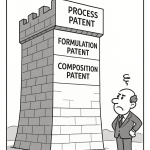
The core of the system is a registry that does for China what the Orange Book does for the US. Under the Measures, the NMPA establishes and maintains the Patent Information Registration Platform for Marketed Drugs, containing information similar to the Orange Book [3]. Registration is not optional for originators: drug marketing approval holders in China must register their relevant patent information on the platform within 30 days of the drug marketing registration certificate grant, and again whenever the registered patent information changes [4]. Only certain patent classes qualify — active-ingredient patents, pharmaceutical-composition patents, medical-use patents, biological-sequence patents, and specific traditional Chinese medicine patents are listed; process patents are excluded from the registry [3].
The Four-Type Non-Infringement Declaration
Generic applicants in China must file one of four non-infringement declarations at the time of their marketing application. A Type IV declaration — asserting the generic doesn’t infringe the listed patent or that the patent is invalid — is the functional equivalent of a US Paragraph IV certification, and it triggers the dispute-resolution clock. Under a Type IV declaration, the NMPA must make a public announcement within 10 working days of accepting the generic application, and the applicant must submit its declaration and basis to the marketing authorization holder, who then has 45 days to file a lawsuit or seek CNIPA administrative adjudication [4].
Stay Period: 9 Months in China vs. 30 Months in the US
This is where the Chinese system diverges sharply from Hatch-Waxman, and it is the single most consequential difference for anyone modeling generic-entry timing in the two markets. The NMPA sets a stay period of nine months from the date a court or CNIPA accepts the opposition, during which technical examination of the generic drug continues rather than pausing — and biological preparations and traditional Chinese medicines are excluded from this stay period entirely [3]. By contrast, a US ANDA sponsor who draws a Paragraph IV lawsuit within 45 days faces an automatic 30-month stay of FDA approval. A stay one-third as long, combined with continued technical review during the stay, materially shortens the worst-case timeline for a first-generic entrant in China relative to the US model India’s exporters know intimately.
First-Generic Exclusivity: 12 Months, Not 180 Days
For the first generic applicant that successfully challenges a patent and obtains market approval, the NMPA grants a 12-month exclusivity period [3] — longer than the US’s 180-day first-filer exclusivity, and a direct incentive for domestic Chinese generics makers to challenge patents rather than wait them out, a dynamic India’s Paragraph IV-focused originator strategy has not had to compete against inside China until now.
Feature
United States (Hatch-Waxman)
China (2021 Patent Linkage Measures)
India
Patent registry
FDA Orange Book
NMPA Patent Information Registration Platform
No equivalent originator-patent registry tied to marketing approval
Generic certification type
Paragraph I-IV certification
Type I-IV non-infringement declaration
No formal pre-launch certification requirement
Dispute window after notice
45 days to sue (triggers stay)
45 days to sue or seek CNIPA adjudication
N/A — post-grant opposition and infringement suits follow ordinary Patents Act procedure
Automatic stay of approval
30 months
9 months (technical review continues)
No automatic regulatory stay tied to patent litigation
First-challenger exclusivity
180 days
12 months
No statutory first-filer marketing exclusivity
Compulsory licensing provision
Limited (march-in rights, rarely used)
Available under specified conditions
Broad compulsory-licensing provisions under the Patents Act, 1970 as amended
Patent Term Extension: China Adopts, India Has None
Alongside patent linkage, China’s Fourth Amendment to its Patent Law introduced a patent term extension (PTE) mechanism for new drugs, compensating originators for regulatory review time — conceptually similar to the US PTE system under 35 U.S.C. § 156, and to the Supplementary Protection Certificate (SPC) regimes used across the EU. India has no comparable statutory PTE or SPC mechanism; a granted Indian product patent runs its standard 20-year term from filing with no extension for regulatory delay. For originators weighing where to file first in Asia, this is now a measurable difference in effective patent life, not just a difference in market size.
Pricing China’s 2026 Licensing Boom: The Deals Behind the Headline Numbers
The $56.7 billion figure circulating in early 2026 is an aggregate. Behind it sit individual deals that show exactly which drug classes are commanding premium valuations — and none of them originate from India.
How Big Is China’s Out-Licensing Boom, Exactly?
The value of licensing deals signed by companies in the greater China region rose nearly tenfold from 2021 to an unprecedented $137.7 billion in 2025, according to data provider Pharmcube [1], with a slightly different full-year 2025 figure of $135.7 billion cited by China’s own drug regulator [2]. BofA Securities’ head of Asia Pacific M&A, Tom Barsha, told Reuters the total value of these licensing-out deals is on track to double again over the next 18-24 months [1], while Macquarie Capital’s Tony Ren offered a more cautious estimate of 40%-50% growth for the year [1]. Early-2026 data already supports the aggressive end of that range: Q1 2026 out-licensing activity hit a record $60 billion, a 73% jump from the same period a year earlier and nearly half of the entire $135.7 billion signed throughout 2025, per an NMPA statement [2].
The GLP-1 and Cardiometabolic Deal Table
Obesity and cardiometabolic assets are the single hottest category in China’s out-licensing pipeline, mirroring the global commercial race triggered by Novo Nordisk’s and Eli Lilly’s GLP-1 franchises. The following deals, all announced since November 2023, illustrate deal-structure norms — modest upfronts paired with large milestone stacks — that Indian originator assets have not yet reached.
Up to $5.725B in sales milestones + 19.9% Hengrui equity in Hercules
[10]
Dec 2024
Hansoh Pharmaceutical
Merck & Co.
HS-10535 (oral GLP-1 agonist)
$112M
Up to $1.9B in milestones (~$2B total)
[8]
Mar 2025
Jiangsu Hengrui
Merck & Co.
HRS-5346 (oral Lp(a) inhibitor)
Undisclosed
Up to ~$2B
[11]
Mar 2025
United Biotechnology
Novo Nordisk
Triple agonist (GLP-1/GIP/glucagon)
$200M
Up to $1.8B in milestones
[12]
Analysis: The upfront-to-milestone ratio across these five deals averages roughly 6-8%, meaning licensees are paying for optionality on regulatory and commercial success rather than for proven assets — a structure only available to originators with molecules far enough along to interest global pharma’s business-development teams. This is Claude-generated analysis derived from the cited deal terms, not a reported industry statistic.
Beyond Metabolic Disease: Oncology and Cell Therapy
BeiGene struck a global licensing deal with CSPC Zhongqi Pharmaceutical Technology worth up to $1.5 billion in December 2024 for a Phase I MAT2A inhibitor, SYH-2039, targeted at solid tumors [13]. AstraZeneca separately committed to roughly $8 billion in deals with Harbour BioMed and Syneron Bio, plus a $2.5 billion R&D center in Beijing and a vaccine joint venture with Shenzhen Kangtai Biological Products in a single announcement in March 2025 [14] — a scale of single-country R&D commitment that has no Indian parallel in the current market.
India’s Counter-Strategy: Pricing the Bulk Drug Parks and PLI Schemes
India’s policy response to API dependency is concrete and funded, even if it operates on a different order of magnitude than China’s licensing boom. The original 2020 Cabinet approval set out two parallel programs: a Promotion of Bulk Drug Parks scheme supporting common infrastructure in three parks with a budget allocation of roughly $400 million over five years, and a Production-Linked Incentive Scheme for critical KSMs, drug intermediates, and APIs with a budget of $920 million over eight years, expected to generate incremental sales of $6.1 billion [5].
Where the Three Bulk Drug Parks Actually Stand in 2026
The three parks have named locations, acreage, and funding splits. The Himachal Pradesh park sits on 1,402.44 acres at Haroli in Una district with 90% central funding support; the Gujarat park occupies 2,015.02 acres at Jambusar in Bharuch district with 70% central assistance and is considered India’s first bulk drug park initiative; the Andhra Pradesh park spans 2,000.45 acres across K.P. Puram and Kodhada in East Godavari district [6]. As of mid-2026, the Himachal Pradesh site had concrete progress to show: the government approved a ₹1,000 crore grant-in-aid for common infrastructure at the Una park, including a Common Effluent Treatment Plant with Zero Liquid Discharge rated at 5 million liters per day, budgeted at ₹244.43 crore — and as of June 30, 2026, the state had utilized ₹116 crore of the central grant toward that infrastructure [15]. The park’s approved Detailed Project Report projects 15,000 to 20,000 direct jobs and ₹8,000-10,000 crore in expected private investment [15].
Is the PLI Scheme for Bulk Drugs Actually Reducing Import Dependence?
There is measurable, if modest, progress. India had saved ₹1,362 crore in pharmaceutical raw-material imports by March 2025 under the PLI Scheme for Bulk Drugs [16], and separately, the scheme has already brought 26 critical items into domestic production while a broader Pharmaceuticals PLI scheme has generated over ₹26,000 crore in domestic sales and 191 new APIs [17]. Put in dollar terms, ₹1,362 crore is roughly $160 million — a real but incremental dent against a bulk-drug import bill built on 70-80% China dependency, and nowhere near the scale needed to offset a single quarter of China’s licensing-deal flow.
Program
Original Budget (2020)
Duration
Measured Result as of 2026
Source
Promotion of Bulk Drug Parks
~$400M (later cited as ₹3,000 crore)
5 years
3 parks approved (HP, Gujarat, AP); HP park has utilized ₹116 crore of its ₹1,000 crore central grant
[5][6][15]
PLI Scheme for Bulk Drugs (KSMs/APIs)
$920M
8 years
26 critical items in domestic production; ₹1,362 crore import-bill reduction by March 2025
[5][16][17]
PLI Scheme for Pharmaceuticals (broader)
₹15,000 crore
6 years
Over ₹26,000 crore in domestic sales generated; 191 new APIs
[17][18]
The Quality Gap in Numbers: What the 2025 FDA Warning Letter Data Actually Shows
India’s “highest number of FDA-approved plants outside the US” statistic is frequently cited as evidence of manufacturing strength. A facility count, however, says nothing about ongoing compliance — and a granular 2025 analysis of FDA enforcement action puts real numbers behind the qualitative “quality perception problem” that broader industry commentary gestures at without measuring.
How Many FDA Warning Letters Did India and China Receive in 2025?
A review of 85 US FDA warning letters issued to drug product manufacturers and posted between January 1 and December 9, 2025 found that 59% went to US facilities, followed by sites in China, India, Canada, and Turkey [7]. The more revealing figure is not the raw count but the nature of the violations: while 15% of all warning letters reviewed cited data-integrity concerns, those concerns were not evenly distributed — Indian sites received warning letters with associated data-integrity issues at a 60% rate, far surpassing the 21% rate for China and the 10% rate for the US [7]. The FDA recommended engaging a GMP consultant in 87% of the letters reviewed [7], underscoring that these were not isolated lapses.
Historical Trend: Has the Warning-Letter Gap Narrowed?
It has not closed in any consistent direction over the past decade. In 2014, of 19 warning letters issued by the FDA’s office of manufacturing and product quality, seven went to Indian companies (37%) and five to China [19]. By the 2018-to-August-2019 period, the FDA had published 75 warning letters to pharmaceutical manufacturers, with 19 going to India and 18 to China — a combined 49% of all letters issued [20]. The 2025 data showing a 60% India-specific data-integrity citation rate, against just 21% for China, suggests the quality-perception gap between the two countries has, if anything, widened even as both remain top targets of FDA enforcement.
What Share of the US Drug Supply Actually Comes from India and China?
The stakes of this compliance gap are magnified by dependency. Congressional correspondence to the FDA noted that approximately 32% of generic drugs and 45% of active pharmaceutical ingredients used in the US originate from India and China combined [21], while one analysis found the FDA inspected only about 6% of roughly 2,800 foreign manufacturing facilities, with just 3% of Indian manufacturers inspected in the period reviewed [21] — meaning the true compliance picture across India’s full facility base is thinner than either the warning-letter counts or the plant-count marketing figures suggest on their own.
Key Pharmaceutical Patent and Regulatory Terms Used in This Analysis
Orange Book
The FDA’s official publication listing approved drug products along with their patent and regulatory exclusivity information, used to determine when generic competition can legally begin in the United States.
Paragraph IV Certification
A certification filed by a generic (ANDA) applicant in the US asserting that a listed patent is invalid, unenforceable, or will not be infringed by the generic product — the trigger for potential 180-day first-filer exclusivity and, if the patent holder sues within 45 days, an automatic 30-month stay of FDA approval.
China’s Patent Information Registration Platform
The NMPA-maintained registry created under China’s 2021 patent linkage measures, functionally analogous to the US Orange Book, on which marketing authorization holders must register qualifying patents within 30 days of drug approval [3][4].
Patent Term Extension (PTE) / Supplementary Protection Certificate (SPC)
Mechanisms in the US and EU (and, since 2021, in China) that extend a drug patent’s effective term to compensate for time consumed by regulatory review. India’s Patents Act contains no equivalent provision.
Compulsory Licensing
A statutory mechanism allowing a government to authorize a third party to produce a patented product without the patent holder’s consent, typically under defined public-health or pricing conditions. India’s Patents Act retains broad compulsory-licensing provisions; China’s system also permits compulsory licensing under specified conditions.
505(b)(2) Pathway
A US FDA approval pathway for new drug applications that rely in part on data the applicant did not generate itself, commonly used for reformulations and new indications of already-approved active ingredients — a route increasingly relevant to Indian firms pursuing complex generics and fixed-dose combinations.
What This Means for Different Stakeholders
For IP and Patent Strategy Teams
China’s 9-month stay period and 12-month first-challenger exclusivity, compared to the US’s 30-month stay and 180-day exclusivity, changes the economics of filing a Type IV declaration versus a Paragraph IV certification. A generic or biosimilar strategy tuned purely to US Hatch-Waxman timelines will misprice the China opportunity.
For BD and Licensing Teams
The deal data above shows global originators are willing to pay modest upfronts (roughly 5-10% of total deal value) for Chinese preclinical-to-Phase-2 metabolic and oncology assets, with the bulk of value backloaded into sales milestones. Comparable-stage Indian originator assets are not yet appearing in deals of this size, which is itself a data point worth tracking for anyone benchmarking Indian biotech valuations.
For Supply Chain and Sourcing Teams
India’s Bulk Drug Park and PLI progress is real but incremental — a ₹1,362 crore (~$160 million) reduction in the import bill against a dependency built on 70-80% of API/KSM volume sourced from China is not yet a structural shift. Sourcing teams modeling multi-year diversification timelines should treat 2026-2028 India-origin API capacity as supplementary, not a replacement, for existing Chinese supply relationships.
For Quality and Regulatory Affairs Teams
The 60% data-integrity citation rate among 2025 Indian warning letters is a specific, trackable risk category distinct from general cGMP deviations. Firms auditing Indian contract manufacturers should weight data-integrity controls — audit trails, electronic records, chromatography data systems — more heavily than facility certification status alone.
Methodology
This analysis draws on primary regulatory sources (NMPA and CNIPA implementing measures, FDA congressional testimony) and secondary industry data providers (Pharmcube deal-value tracking as reported by Reuters and the South China Morning Post, and an independently published 2025 warning-letter review) for figures not available directly from a government portal. Deal values reflect publicly disclosed upfront and milestone terms as of each announcement date; milestone totals represent maximum potential payouts contingent on development, regulatory, and sales triggers, not guaranteed payments. Warning-letter statistics reflect one independent analyst review of letters posted between January 1 and December 9, 2025, and may not capture the full FDA enforcement record for the year. Currency conversions from Indian rupees use approximate 2025-2026 exchange rates (~₹83-85/USD) and are rounded for readability. All figures are attributed to their original source; where this analysis performs its own calculation (such as the upfront-to-milestone ratio in the GLP-1 deal table), that is explicitly labeled as analysis rather than reported data.
“The total value of these licensing-out deals is on track to double again over the next 18-24 months.” — Tom Barsha, Head of Asia Pacific M&A, BofA Securities [1]
FAQ
Does China have an equivalent to the FDA’s Orange Book?
Yes. Since July 2021, China’s NMPA has maintained the Patent Information Registration Platform for Marketed Drugs, which lists patents tied to approved drug products in a manner the system’s own architects describe as analogous to the Orange Book [3][4].
How long is the generic-approval stay period in China compared to the US?
China’s stay period is nine months from the date a patent dispute is accepted by a court or CNIPA, during which technical review of the generic continues. The US stay period triggered by a timely Paragraph IV lawsuit is 30 months [3].
Does India have a patent linkage system like the US or China?
No. India’s Patents Act does not include a Hatch-Waxman-style linkage mechanism tying patent status to marketing approval, and it retains broad compulsory-licensing provisions that neither the US nor China’s systems replicate at the same scope.
How much has China’s biotech out-licensing market grown since 2021?
Deal value rose nearly tenfold from 2021 to 2025, reaching $137.7 billion (per Pharmcube data reported by Reuters) or $135.7 billion (per NMPA figures) for full-year 2025, with $56.7 billion already signed in the first four months of 2026 [1][2].
What is India’s Bulk Drug Park program and how far along is it?
It is a three-park infrastructure initiative in Himachal Pradesh, Gujarat, and Andhra Pradesh, carrying a combined ₹3,000 crore central grant. As of mid-2026, the most advanced site (Himachal Pradesh) had utilized roughly ₹116 crore of its ₹1,000 crore allocated grant [6][15].
Which category of drugs is driving China’s largest licensing deals right now?
GLP-1 and other cardiometabolic/obesity assets, based on deal volume and size since late 2023, followed by oncology and cell-therapy platforms such as CAR-T [8][9][10][11][12][13].
Is India’s or China’s manufacturing base cited more often in FDA warning letters?
In the most detailed 2025 dataset available, 59% of 85 warning letters went to US facilities, with China, India, Canada, and Turkey following in an unspecified order — but among the letters that did cite data-integrity problems, Indian sites were cited at nearly three times the rate of Chinese sites (60% vs. 21%) [7].
Does China offer patent term extension for new drugs?
Yes, introduced alongside the 2021 patent linkage reforms as part of the Fourth Amendment to China’s Patent Law. India’s Patents Act has no equivalent extension mechanism.
What share of the US API and generic-drug supply comes from India and China?
Congressional testimony cited approximately 32% of generic drugs and 45% of APIs used in the US as originating from India and China combined, based on figures presented to the FDA [21].
How does China’s first-generic exclusivity period compare to the US 180-day rule?
China grants 12 months of exclusivity to the first generic applicant that successfully challenges a patent and wins approval, four months longer than the US 180-day period [3].
References
Wu, K., & Silver, A. (2026, February 13). Analysis-China biotech licensing boom to hit record in 2026 as pipeline swells. Reuters. https://finance.yahoo.com/news/analysis-china-biotech-licensing-boom-092338804.html
South China Morning Post. (2026, March 29). China biotech deals hit record as innovative drugs draw interest of multinationals. https://www.scmp.com/business/china-business/article/3348295/china-biotech-deals-hit-record-innovative-drugs-draw-interest-multinationals
Quinn Emanuel Urquhart & Sullivan. (2021, December 22). Life Sciences Litigation Update – December 2021: China Establishes Patent Linkage System. https://www.quinnemanuel.com/the-firm/publications/life-sciences-litigation-update-december-2021/
Law.asia / Pang Dongcheng, Sanyou Intellectual Property Agency. Comparing drug patent linkage in China and the US. https://law.asia/comparing-drug-patent-linkage-in-china-and-the-us/
India Business & Trade (indbiz.gov.in). (2020, March 21). Cabinet approves schemes to promote drug parks. https://indbiz.gov.in/cabinet-approves-schemes-to-promote-drug-parks
Vajiram & Ravi. Bulk Drug Park, Development, Features, Structure, Impact. https://vajiramandravi.com/current-affairs/?p=80312
Pazhayattil, A. B., Ingram, M., & Bhimavarapu, K. R. (2025, December 15). What 2025 FDA Warning Letters Tell Us About GMP Compliance. Pharmaceutical Online. https://www.pharmaceuticalonline.com/doc/what-fda-warning-letters-tell-us-about-gmp-compliance-0001
Landenberger, L. (2024, December 18). Merck strikes a $2B GLP-1 deal with Hansoh. BioWorld. https://www.bioworld.com/articles/715448-merck-strikes-a-2b-glp-1-deal-with-hansoh
Fortune / Bloomberg (Langreth, R.). (2024, December 18). Merck snags Chinese obesity drug in nearly $2 billion deal. https://fortune.com/asia/2024/12/18/merck-snags-chinese-obesity-drug-in-nearly-2-billion-deal/
PatSnap Synapse. (2024, May 20). Hefty $6 Billion Deal: Hengrui Licenses GLP-1 Portfolio to Hercules. https://synapse.patsnap.com/news-detail/df0edbe8-1b20-327a-9e79-f49d1b70303c-hefty-6-billion-deal-hengrui-licenses-glp-1-portfolio-to-hercules
Yicai Global. China’s Hengrui Rises After Granting Merck Heart Drug Rights in Up to USD2 Billion Deal. https://yicaiglobal.com/news/hengrui-jumps-after-granting-msd-global-rights-to-investigational-cardiovascular-drug
BioWorld (Landenberger, L.). (2025, March 24). In a $2B deal, Novo licenses obesity drug from China’s United Bio. https://www.bioworld.com/articles/topic/214?page=60
BioWorld (Sami, T.). (2024, December 17). Beigene, CSPC strike $1.5B deal for phase I MAT2A inhibitor. https://www.bioworld.com/articles/topic/395?page=46
BioWorld (Sami, T.). (2025, March 24). Astrazeneca invests in China: $8B in deals, $2.5B in R&D center. https://www.bioworld.com/articles/topic/214?page=60
News dalla rete ITA. (2026, August 4). The Government of India has approved a grant-in-aid of ₹1000 crore under the scheme “Promotion of Bulk Drug Parks.” https://www.ice.it/it/news/notizie-dal-mondo/307127
India Sea Trade News. (2026, May 26). India cuts pharma import bill by ₹1,362 crore under bulk drug PLI scheme. https://indiaseatradenews.com/india-cuts-pharma-import-bill-by-₹1362-crore-under-bulk-drug-pli-scheme/
Procurement Resource. News and Articles: Chemical and pharmaceutical manufacturing under Make in India. https://www.procurementresource.com/news-and-articles/chemical-and-pharmaceutical-manufacturing
BioVoice News. We continue to boost manufacturing capacity in pharma sector: Govt. https://biovoicenews.com/tag/bulk-drugs/
Sharma, E. K. (2015, February 3). USFDA’s warning letters reason to worry for Indian drug makers. Business Today. https://www.businesstoday.in/story/usfda-warning-letters-worry-for-indian-drug-makers/1/215074.html
Outsourcing-Pharma.com. (2019, August 30). Analysis finds bulk of warnings delivered to Indian and Chinese drugmakers. https://www.outsourcing-pharma.com/Article/2019/08/30/Safety-warnings-focus-on-Indian-and-Chinese-manufacturers
GMP Compliance Association. (2025, November 12-13). FDA criticised over inadequate GMP Inspections in India and China. https://www.gmp-compliance.org/gmp-news/fda-criticised-over-inadequate-gmp-inspections-in-india-and-china