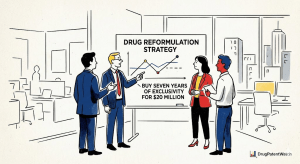
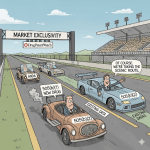
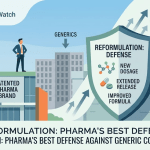
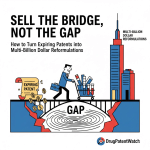
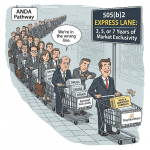
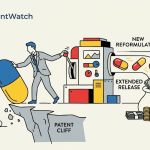
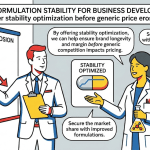
Pharmaceutical manufacturers face a revenue contraction of 62% from their top-selling assets by 2030.1 Blockbuster drugs representing $236 billion in annual global revenue approach patent expiration in the next five years, creating a survival crisis for brand originators.1 This environment makes the four-year pre-loss of exclusivity (LOE) window the most important period for business development. Formulation vendors use this time to pitch modified-release reformulations as a mechanism to transform a sudden patent cliff into a managed revenue slope.2 By utilizing the 505(b)(2) regulatory pathway, a company can obtain three to seven years of new market exclusivity for an investment of $8 million to $20 million.3
The Financial Gravity of Exclusivity Loss
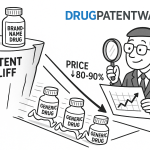
Revenue for a branded drug usually drops by 80% to 90% within 12 months of generic entry.5 This decline is not a suggestion; it is a historical certainty for small-molecule drugs.1 The mechanics of this collapse are systemic. FDA research shows that one generic competitor reduces the wholesale price of a drug by 39%. When four competitors enter, the price falls by 79%.5 Most brands lose 84% of their unit share within the first year of competition.6
Impact of Generic Competition
Price Reduction
Unit Share Loss
1 Generic Competitor
39% 5
–
4 Generic Competitors
79% 5
–
1 Year Post-LOE
90% 1
84% 6
Small molecules face a literal cliff because pharmacists can substitute generics at the point of sale without a new prescription.7 Biologics face a slope because biosimilars cost $100 million to $250 million to develop and require seven to eight years to reach the market.1 For the small-molecule originator, the only defense is to move the patient base to a new, patent-protected formulation before the substitution laws take effect.7
The 4-Year Strategic Sweet Spot
Business development teams pitch reformulations four years before LOE because it aligns with the 505(b)(2) development clock.4 A typical 505(b)(2) program takes three to eight years to commercialize.4 Starting four years out allows the manufacturer to launch the new version at least one year before the original patent expires.3
Launching 12 months before LOE allows the sales force to convert the market. This lead time is necessary to change prescribing habits and move patients to the once-daily or improved version.3 If a company waits until two years before LOE to start development, they will launch into a market already saturated with cheap generics, which makes patient acquisition expensive and difficult.6
Development Phase
Timeline
Primary Objective
Candidate ID
Year -5
Identify RLD vulnerabilities 8
Formulation Dev
Year -4
Create modified-release prototype 4
Bridging Studies
Year -3
Conduct PK/BE clinical trials 4
FDA Review
Year -2
10-12 month NDA review 9
Market Launch
Year -1
Convert patients before generic entry 3
The 505(b)(2) Regulatory Arbitrage
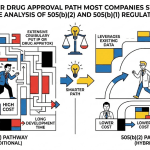
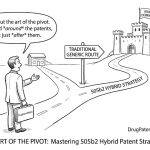
The 505(b)(2) pathway is a hybrid between a full New Drug Application and a generic Abbreviated New Drug Application.10 It allows a sponsor to rely on the safety and efficacy data of an existing approved drug.4 This reliance is the core of the business model for formulation vendors. They “borrow” the originator’s billion-dollar data set to support a version with a better release profile.4
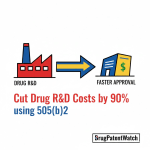
Development for an NME costs $2.6 billion and takes 15 years.4 A 505(b)(2) project costs between $8 million and $200 million and takes less than half the time.4 The clinical burden is reduced because the FDA does not require a sponsor to repeat Phase 1 and Phase 2 trials if the active ingredient is already known.12 Instead, the sponsor conducts bridging studies to show how the new formulation relates to the reference listed drug.8
Pathway Comparison
505(b)(1) NDA
505(b)(2) NDA
505(j) ANDA
Innovation Level
High (New Molecule)
Moderate (Modified)
None (Duplicate) 12
Cost
$1B – $2.6B
$8M – $200M
$1M – $5M 4
Timeline
10 – 15 Years
3 – 8 Years
1 – 3 Years 4
Exclusivity
5 – 7 Years
3 – 7 Years
180 Days 4
Data Ownership
Owns data
Relies on RLD
Relies on RLD 4
Success in the 505(b)(2) pathway often results in a three-year period of Hatch-Waxman exclusivity if the application contains new clinical investigations essential for approval.12 If the formulation involves a new salt or prodrug that the FDA considers a new chemical entity, it can receive five years of exclusivity.10
The Science of Modified Release
Modified-release formulations use specialized drug delivery systems to control the rate and location of drug release in the body.13 Immediate-release versions often require dosing three times a day, which leads to poor compliance.14 Patients with chronic conditions like ADHD or depression often forget doses, leading to breakthrough symptoms.15
Formulation vendors pitch several technologies to solve this problem:
Matrix Tablets: These use polymers to create a structure that controls the API release over 12 to 24 hours.16
Osmotic-release Oral Systems (OROS): These use osmotic pressure to push the drug through a laser-drilled hole at a constant rate.14
Lipid-Based Formulations (LBF): These improve the solubility of drugs and allow for softgel delivery systems that improve bioavailability.16
Multi-particulates: These involve coated beads or pellets inside a capsule, allowing for multiple release profiles in a single dose.16
These technologies do not just improve convenience; they improve safety. In the case of bupropion, sustained-release formulations carry a lower risk of seizures compared to immediate-release versions because they avoid the high plasma peaks that trigger neurological side effects.18
Building the Intellectual Property Fortress
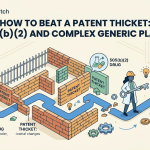
The modern drug monopoly is not built on a single patent but on a patent thicket.20 A thicket is a web of overlapping patents designed to force generic competitors to litigate dozens of claims simultaneously.21 Top-grossing drugs often have over 125 patent applications and 71 granted patents per product.21
Patent Type
Role in Thicket
Timing of Filing
Primary Patent
Covers the active molecule
Early discovery 20
Formulation Patent
Covers modified-release tech
4-6 years pre-LOE 21
Method of Use
Covers new indications
Post-approval 21
Process Patent
Covers manufacturing steps
Throughout lifecycle 21
Approximately 72% of patents for the best-selling U.S. drugs are filed after the FDA has already approved the drug.21 This drip-feed strategy ensures that as the primary composition of matter patent expires, a new layer of protection is ready to take its place.9 Formulation vendors enable this by creating novel crystalline forms, specific salt variations, or unique delivery devices that allow for new patent filings.1
CDMO Dynamics and Platform Selection
Contract Development and Manufacturing Organizations (CDMOs) provide the specialized equipment and expertise that most originators do not have in-house.22 Large pharma companies often rely on vendors like Catalent or Evonik to transform their APIs into complex modified-release products.24
Catalent uses Physiological Based Pharmacokinetic (PBPK) modeling to determine if a molecule is a good candidate for extended release.16 Their platform includes matrix tablets, multi-layer tablets, and laser-drilled osmotic systems.16 They have launched over 50 products across the U.S., Europe, and Asia, making them a preferred partner for global lifecycle strategies.16
Evonik specializes in polymeric and lipid-based parenteral systems.24 Their RESOMER platform uses bioresorbable excipients to create extended-release formulations that deliver drugs over weeks or months.24 For originators, this allows for the creation of long-acting injectables that offer a “manufacturing moat”—a barrier to competition because the production process is so complex it is difficult to replicate.24
CDMO Capability
Tech Platform
Strategic Benefit
Oral Solids
OROS / Matrix
Once-daily dosing 14
Softgels
Lipid-based (LBF)
Solubility enhancement 17
Parenterals
Polymeric Microparticles
Monthly dosing 24
Complex Inhalers
Device engineering
Secondary patent wall 21
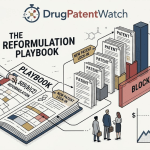
The Business Development Playbook
Pitching a reformulation to a skeptical originator requires a focus on ROI rather than just science. Vendors use DrugPatentWatch to identify drugs that are four years away from LOE and have high revenue exposure.1 The pitch emphasizes that the cost of reformulation is a fraction of the revenue that will be lost to generic competition.
Successful pitches focus on three value drivers:
Patient Adherence: Data from the Wellbutrin XL launch showed that once-daily dosing improved persistence by 9% compared to twice-daily dosing.27
Payer Access: New reformulations can qualify for unique J-codes, which prevent them from being categorized as commodity generics.4
Competitive Signal: A 505(b)(2) filing four years before LOE signals to generic companies that the brand intends to defend its market, which can discourage some competitors from filing Paragraph IV challenges.28
Predictive Intelligence and DrugPatentWatch
Business development teams use DrugPatentWatch to visualize the “white space” in a drug’s patent landscape.1 By analyzing the patent thicket, teams can determine if the current formulation patents are weak or if they can design a new salt form to bypass existing protections.1
The platform allows for real-time monitoring of Paragraph IV filings. If five generic companies file against a patent on the same day, it is a signal that the incumbent’s patent is ripe for challenge.1 For a formulation vendor, this is the trigger to pitch a new, more defensible MR version to the originator.1
Savvy analysts also use the data to calculate “diligence deductions”.1 If an innovator delayed during the FDA review, teams can identify opportunities to deduct that time from the patent extension, which moves the LOE date earlier and makes a reformulation pitch more urgent.1
The Reimbursement Battleground
The commercial success of a modified-release product depends on its J-code.4 In 2022, CMS shifted policy to allow 505(b)(2) drugs that are not therapeutically equivalent to the reference drug to receive their own unique J-codes.4 This allows originators to maintain brand-level pricing while the old IR version becomes a low-margin generic.4
“The commercial viability of a 505(b)(2) product is no longer determined solely by its clinical profile; it is determined by its J-code.” 4
However, payers are resistant to granting premium pricing for reformulations that offer no clear clinical benefit.29 This is why vendors must incorporate real-world evidence into their pitches. They must show that the modified-release version reduces total healthcare costs by decreasing hospital visits or improving long-term patient stability.8
Case Studies in Lifecycle Management
The history of bupropion (Wellbutrin) shows how a brand can maintain market presence through multiple reformulations. The original IR version required three daily doses.18 The SR version moved to twice-daily dosing, and the XL version moved to once-daily dosing.18 Wellbutrin XL was eventually approved for seasonal affective disorder, providing a new indication and further protecting the brand.30
The methylphenidate (Concerta) case study illustrates the “manufacturing moat.” The OROS technology used in Concerta is difficult for generic companies to copy. When generics did enter the market, many were not “AB-rated” (therapeutically equivalent), which allowed the brand to retain a higher market share than typical small-molecule drugs.31
Drug Case Study
Innovation
Outcome
Wellbutrin XL
Once-daily dosing
Better adherence than SR 27
Concerta
OROS technology
High patient satisfaction (97%) 14
Namenda XR
Soft switch to XR
Extended market control 7
Bendeka
Rapid-infusion chemo
Market capture before generics 4
Fixed-Dose Combinations
FDCs are a sophisticated lifecycle management strategy where two existing drugs are combined into a single dose.29 This is regulated as a new drug product under 505(b)(2).29 An FDC can add nearly 12 years of exclusivity beyond the individual generic components.29
The clinical imperative for FDCs is often multimodal therapy—using two different mechanisms of action to treat a condition like chronic pain.29 The commercial rationale is to transform two low-cost generic APIs into a high-margin branded asset.29 Total investment for an FDC ranges from $15 million to $75 million, but the return is driven by the fact that it is a sole-source product with no direct generic substitutes.29
Legal Risks: Paragraph IV and Antitrust
The 30-month stay is a tactical delay used by originators.21 When a generic filer challenges a patent (Paragraph IV certification), the originator has 45 days to sue.9 This triggers an automatic 30-month stay on FDA approval of the generic, effectively granting the brand an extra 2.5 years of monopoly even if the patent is weak.9
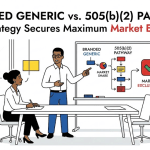
However, the “hard switch”—withdrawing the IR version to force patients onto the MR version—is high risk.7 In the Namenda case, courts ruled that Forest Laboratories’ plan to remove Namenda IR from the market was anticompetitive because it eliminated consumer choice and blocked generic substitution.7
Business development teams must advise originators to pursue a “soft switch.” This involves launching the modified-release version early and using rebates and marketing to persuade doctors to switch while the original product is still available.7 This allows the brand to defend its market share without triggering FTC intervention.7
The IRA Effect
The Inflation Reduction Act (IRA) has changed the definition of LOE.1 Medicare can now negotiate prices for top-selling small molecules after nine years and biologics after 13 years.1 For many drugs, the “negotiation date” acts as a de facto loss of exclusivity for pricing power, even if the patents remain valid.1
This makes the four-year window even more critical. Business development teams must calculate the ROI of a reformulation based on the negotiated price rather than the launch price.1 If a drug is likely to be selected for negotiation, a manufacturer must launch its modified-release version well before that date to preserve its revenue base.1
IRA Impact
Small Molecule
Biologic
Negotiation Eligibility
9 Years post-launch
13 Years post-launch 1
Pricing Power
De facto LOE
Managed erosion 1
Strategy
Pivot to MR earlier
Move to SC formulations 21
Key Takeaways
The revenue collapse following patent expiration is a manageable event if addressed four years in advance. By utilizing the 505(b)(2) pathway, formulation vendors allow originators to create improved modified-release products that offer clinical benefits and new market exclusivity. The cost of these programs is low—typically $8 million to $20 million—relative to the billions at risk during the patent cliff. CDMOs like Catalent and Evonik provide the technical infrastructure to build “manufacturing moats” through complex technologies like OROS or lipid nanoparticles. Success requires a sophisticated use of intelligence from DrugPatentWatch to time the launch and a careful “soft switch” strategy to avoid antitrust litigation.
FAQ
Why is 4 years before LOE the optimal time to start a reformulation project?
The 505(b)(2) regulatory pathway and CMC scale-up usually require three to eight years. Starting four years before patent expiration ensures the new product is approved and launched at least 12 months before generic entry, allowing time for market conversion.
What is the “J-code trap” and how do reformulations avoid it?
When multiple generics enter the market, they are often grouped under a single reimbursement code, leading to price wars. A 505(b)(2) drug that is not therapeutically equivalent to the reference drug can receive a unique J-code, maintaining branded pricing.
How does modified-release technology improve patient compliance?
By extending the release of the active ingredient, these formulations reduce dosing frequency from several times a day to once a day. This reduces the “peaks and valleys” in blood plasma levels, leading to fewer side effects and better adherence.
What are the primary risks of the 505(b)(2) pathway?
CMC issues are the leading cause of failure, appearing in 75% of all Complete Response Letters. Additionally, while the pathway is faster than a full NDA, it still requires bridging studies that must meet FDA standards for safety and efficacy.
Is it legal for a brand to switch patients to a new formulation just before LOE?
Yes, as long as it is a “soft switch.” This means the company uses marketing and rebates to persuade doctors to prescribe the new version while keeping the old version available. Forced “hard switches” can trigger antitrust lawsuits.
Effect of switching drug formulations from immediate-release to extended-release OROS methylphenidate : a chart review of Spanish adults with attention-deficit hyperactivity disorder – PubMed, accessed February 26, 2026, https://pubmed.ncbi.nlm.nih.gov/18547128/
Study Details | NCT00302406 | Naturalistic Substitution of Concerta in Adult Subject With ADHD Receiving Immediate Release Methylphenidate | ClinicalTrials.gov, accessed February 26, 2026, https://clinicaltrials.gov/study/NCT00302406
Medication changes after switching from CONCERTA® brand methylphenidate HCl to a generic long-acting formulation: A retrospective database study – PMC, accessed February 26, 2026, https://pmc.ncbi.nlm.nih.gov/articles/PMC5831385/