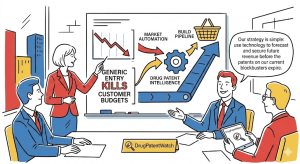
How to use market automation and drug patent intelligence to build pipeline before generic entry kills your best customers’ budgets
When Lipitor lost patent protection in November 2011, Pfizer’s U.S. revenue for the drug fell from $5.9 billion to under $2 billion within 18 months [1]. The obvious victims were Pfizer’s shareholders. The less obvious victims were the equipment vendors, consumables suppliers, API technology providers, and manufacturing systems integrators who had quietly built their commercial forecasts around Pfizer’s continued willingness to spend on that production line.
Generic entry doesn’t just compress margins for brand manufacturers. It cascades. It reshapes capital expenditure priorities, pauses technology refresh cycles, and shifts procurement authority from innovation-minded R&D leaders to cost-obsessed operations managers. If you sell equipment or manufacturing technology to the biopharma sector, a patent cliff is not someone else’s problem.
This guide is for business development leaders, sales directors, and commercial strategists at companies that supply equipment and manufacturing technology to pharmaceutical manufacturers. The argument is straightforward: the same patent intelligence data that tells a brand manufacturer their exclusivity is ending tells you that your best customer’s capital budget is about to shrink — and that a wave of new generic and biosimilar manufacturers is about to need exactly what you sell, at exactly the moment they scale up.
The window between those two events is where your revenue lives. Market automation is how you exploit it.
Part One: The Mechanics of Margin Compression and Why You Should Care
What Generic Entry Actually Does to Your Customer’s Budget
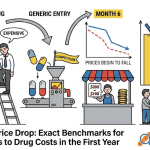
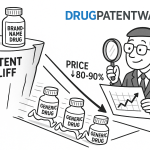
When a branded drug loses exclusivity, the sequence of events is predictable. Multiple generic manufacturers receive FDA approval for Abbreviated New Drug Applications (ANDAs). Retail and pharmacy benefit manager contracts shift toward the cheapest equivalent. The brand manufacturer either launches an authorized generic or watches market share erode by 70% to 90% within 12 months [2].
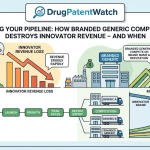
The financial result is brutal. A drug generating $3 billion annually with a 75% gross margin becomes, within two years, a product generating $400 million annually with a gross margin closer to 30%. The brand manufacturer’s finance team immediately targets manufacturing cost reductions. Capital equipment decisions are deferred. Maintenance contracts get renegotiated. Upgrade projects are shelved.
This is the margin compression moment for equipment suppliers. Your point of contact at the brand manufacturer — previously a science-driven VP of Manufacturing who cared about efficiency, yield improvement, and regulatory compliance — is replaced, at least functionally, by a procurement committee asking a single question: what is the minimum required to keep this line running legally?
The spending pattern confirms it. A 2022 study found that capital expenditure in branded small-molecule manufacturing drops by an average of 43% in the two years following loss of exclusivity, compared to the two years prior [3].
The Supplier Dependency Chain Nobody Talks About
Equipment and technology suppliers to pharma occupy a structurally awkward position. Their revenue is directly correlated with their customers’ product revenue, but the correlation is lagged and indirect, which means most supplier BD teams don’t see the compression coming until the purchase orders stop.
Consider the typical commercial relationship between a biopharma equipment supplier and a top-20 pharmaceutical company. The brand manufacturer signs a master supply agreement. Repeat orders for consumables, replacement parts, and software licenses flow quarterly. A capital equipment refresh happens every five to seven years. The relationship feels stable because the individual transactions are small relative to the supplier’s total revenue from that account.
What the supplier’s CRM doesn’t capture is that every one of those transactions is downstream of a drug still on patent. When the patent expires, the cash flow supporting that relationship doesn’t disappear immediately — it erodes slowly, then suddenly, in the same way Hemingway described bankruptcy.
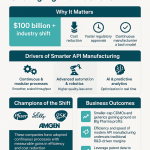
The suppliers who survive this cycle are the ones who have already replaced that eroding revenue before the erosion becomes visible on their income statement. That replacement comes from two directions: new generic manufacturers who need to scale up production, and brand manufacturers pivoting to biologics or next-generation assets where capital spending remains high. In both cases, the business development opportunity is time-sensitive and requires advance intelligence. Patent data provides that intelligence.
Part Two: Patent Cliffs as Business Development Triggers
Reading the Patent Expiry Calendar as a Sales Signal
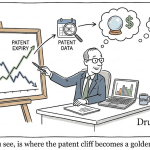
A patent expiry date is, for most people in the biopharma world, a regulatory or legal event. For an equipment or technology supplier, it is a commercial trigger with a predictable lead time.
A generic manufacturer typically files an ANDA 18 to 36 months before anticipated approval [4]. FDA approval for a paragraph IV ANDA challenge can arrive as early as 30 months after filing, though complex molecule categories often take longer. Manufacturing scale-up, validation, and commercial launch preparation add another 6 to 18 months. That means the generic manufacturer’s equipment procurement window opens roughly two to four years before the patent actually expires.
If you are not engaged with the generic manufacturer before their procurement window opens, you are bidding against entrenched vendors who got there first. The companies that systematically monitor patent expiry timelines and ANDA filing activity build their pipeline at the right moment in the generic manufacturer’s capital spending cycle. The companies that wait for inbound inquiries arrive late.
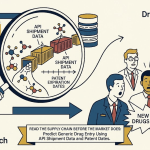
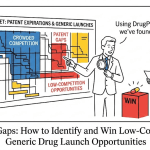
DrugPatentWatch maintains a comprehensive database of patent expiration dates, ANDA filings, paragraph IV certifications, and litigation outcomes for branded pharmaceutical products. For a BD team at an equipment supplier, this data answers three questions a standard CRM cannot: which drugs are losing exclusivity in the next 24 to 48 months, which generic manufacturers have already filed ANDAs for those drugs, and which of those manufacturers has the commercial infrastructure to scale up production and need your equipment category. That is a prospecting list built from market structure rather than from cold list purchases.
The Four Trigger Events Worth Automating
Patent intelligence generates four distinct types of commercial triggers, each corresponding to a different stage of the generic manufacturer’s capital spending cycle.
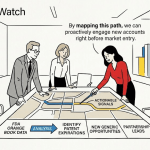
The first trigger is a paragraph IV certification filing. When a generic manufacturer files a paragraph IV ANDA, they are declaring that the brand’s patent is invalid or that their product does not infringe it. This signals intent to launch before patent expiry. The FDA’s Orange Book lists these certifications, and DrugPatentWatch surfaces them in near-real-time. A paragraph IV filing is often two to four years ahead of actual generic launch — early enough to begin a relationship with the filing manufacturer before their procurement process starts.
The second trigger is patent litigation settlement. The Hatch-Waxman Act allows brand and generic manufacturers to settle paragraph IV litigation with negotiated entry dates. When a settlement includes a specific launch date, the generic manufacturer’s manufacturing planning timeline crystallizes. Procurement decisions follow within months. A supplier monitoring settlement announcements can time an outreach campaign to land exactly when the generic manufacturer’s VP of Manufacturing is building their scale-up plan.
The third trigger is ANDA approval. Final FDA approval of a generic ANDA means commercial launch is imminent. The generic manufacturer is already in scale-up mode, and equipment decisions made at this stage are urgent. Winning deals here requires a prior relationship; if you are meeting a generic manufacturer for the first time after their ANDA is approved, your sales cycle is too compressed to compete effectively. This trigger is most useful for identifying accounts to prioritize for accelerated follow-up when an existing relationship is already in place.
The fourth trigger is biosimilar BLA filing. The Biologics Price Competition and Innovation Act created a parallel pathway for biosimilar approval. Biosimilar applications filed with FDA signal that a manufacturer is preparing to enter a complex molecule market where the manufacturing technology requirements differ substantially from small-molecule generics. Suppliers of bioreactor systems, filtration technology, cell culture media management platforms, and analytical instruments have a specific commercial opportunity in biosimilar scale-up that does not exist in the small-molecule generic segment.
Building a Trigger-Automated BD Workflow
Automating the commercial response to these triggers requires connecting patent intelligence data to your CRM and marketing automation platform. The architecture is not complicated, but it requires deliberate setup.
Start by defining the molecule categories that matter for your equipment. A company selling fluid handling systems for oral solid dosage manufacturing has a different target list than a company selling single-use bioreactor technology. Segment the DrugPatentWatch data by drug formulation type, therapeutic category, and manufacturing process. This narrows your trigger list to the molecules where your equipment is commercially relevant.
Next, map the generic and biosimilar manufacturers who have filed ANDAs or BLAs in your target categories. This is your prospect universe — the companies who will need your equipment as they scale up. Load them into your CRM as accounts, enriched with the patent trigger data that explains why you are reaching out now.
Then build the trigger workflow. When a new ANDA filing appears in your target categories, the workflow automatically creates a BD task in your CRM, assigns it to the appropriate regional sales representative, and pulls the account profile. If the account already exists in your CRM, the task is added to the existing account timeline. If it is a new manufacturer, the workflow creates the account and queues an enrichment step.
The marketing automation layer handles the initial outreach. Segment your email list by manufacturing technology category and trigger type. A generic manufacturer filing their first paragraph IV ANDA for a complex modified-release formulation gets different content than a biosimilar manufacturer filing a BLA for a monoclonal antibody. The content is specific to the manufacturing challenge they are about to face, which is the only way to get a response from a technical buyer who receives 40 vendor emails a week.
Part Three: Targeting Generic Manufacturers — Your New Primary Customer Set
Why Generic Manufacturers Are Structurally Different Buyers
Selling to a generic manufacturer is not the same as selling to a brand pharmaceutical company, and BD teams that treat it as interchangeable will lose the deals. The differences are structural, not cosmetic.
Brand manufacturers make capital equipment decisions with a long planning horizon. They fund development-stage manufacturing infrastructure years before a drug reaches commercial scale. Their procurement decisions involve validation scientists, regulatory affairs teams, and quality systems managers who care about technical specification detail. The sales cycle is long, consensus-based, and driven by technical performance.
Generic manufacturers make capital equipment decisions under severe time pressure and cost constraint. Their entire business model depends on getting to market faster and cheaper than the next generic entrant. A generic manufacturer who wins first-to-file status on a paragraph IV challenge has a specific window to capture market share before the second and third generic approvals arrive and pricing collapses further. Their procurement decisions are made quickly, they value proven technology over novel technology, and their primary objection is almost always cost.
This means your value proposition must be rebuilt from scratch for the generic manufacturer audience. A brand manufacturer cares about yield optimization and process scalability. A generic manufacturer cares about validated performance at known cost, rapid installation and qualification timelines, and a total cost of ownership that fits inside a production economics model built on compressed margins.
What Generic Manufacturers Actually Buy
The generic pharmaceutical manufacturing market is large and growing. IQVIA estimates the global generics market at $490 billion by 2026, with manufacturing investment growing at a compound annual rate of 6.2% [5]. The equipment and technology categories driving that investment are not exotic.
In oral solid dosage — the largest segment of the generic market by volume — the primary equipment categories are high-shear granulators, tablet press systems, film coating equipment, and blister packaging lines. The buying signal for these categories is ANDA approval for an immediate-release or extended-release solid oral product. Many generic manufacturers in this segment operate in India, China, and Eastern Europe, which means BD teams need to map their coverage model to those geographies explicitly.
In sterile injectables, which is the fastest-growing generic segment in the U.S. market, the equipment categories include isolator systems, vial filling and stoppering lines, lyophilization equipment, and visual inspection systems. ANDA filings for sterile injectable products are the trigger event. This segment is technically demanding and has attracted investment from major manufacturers including Hikma, Fresenius Kabi, and Amneal, all of whom are active equipment buyers.
In biosimilars, the equipment categories reflect the complexity of biological manufacturing: stirred-tank bioreactors, tangential flow filtration systems, chromatography skids, and closed-system single-use platforms. BLA filings from biosimilar manufacturers — tracked through the FDA’s Purple Book and aggregated on platforms like DrugPatentWatch — are the trigger. The biosimilar market is adding meaningful complexity to the generic manufacturer landscape, because companies like Celltrion, Sandoz, and Samsung Bioepis require manufacturing technology that few traditional generic equipment suppliers can provide. If you supply this technology, the biosimilar pipeline is the most valuable prospecting list you have.
Winning Against Entrenched Vendors
The primary barrier to winning business with a generic manufacturer is not price — it is the existing vendor relationship. A generic manufacturer who has standardized on a particular tablet press platform will not switch suppliers unless the switching cost is justified by a significant operational or financial advantage.
Your BD strategy needs to create the justification. The two most effective approaches are category expansion and process improvement ROI.
Category expansion means finding the equipment category where the generic manufacturer does not yet have an entrenched vendor relationship. A company that has standardized on one supplier’s granulation equipment may not have made a corresponding decision on their coating systems. A company scaling up a new sterile injectable product line may need isolator technology they have not previously purchased. Patent trigger data tells you which molecules a manufacturer is developing, which tells you which process steps they are scaling up, which tells you which equipment categories are in active procurement.
Process improvement ROI means quantifying the financial benefit of switching to your technology in terms the generic manufacturer’s financial team cares about. If your system reduces batch failure rate by 2%, calculate what that means in avoided waste cost per year at their production volume. If your automated cleaning validation system reduces qualification time by three weeks, calculate the revenue impact of getting a new product line to market three weeks faster. Generic manufacturers understand margin arithmetic intimately. Give them the numbers.
Part Four: Automating the Commercial Process at Scale
The Intelligence Layer: Connecting Patent Data to Your CRM
The operational foundation of a market automation strategy for equipment suppliers is a data pipeline that continuously imports patent and regulatory events into your commercial workflow. Most enterprise CRM platforms — Salesforce, HubSpot, Microsoft Dynamics — support API-based data integrations that can receive patent event data and translate it into commercial tasks.
The data categories to import from patent intelligence sources are ANDA filing dates and applicant names, paragraph IV certification details, patent expiration dates by NDA number, ANDA approval dates, and biosimilar BLA filing and approval data. Each of these maps to a specific commercial stage and a specific action in your sales workflow.
The enrichment layer adds context. When a new ANDA applicant appears in your target categories, your workflow should automatically pull available public information about that company — their manufacturing locations, previously approved ANDAs, any prior FDA inspection history, and their presence in your existing CRM. This enrichment determines whether the account is a known prospect, an existing customer expanding their portfolio, or a new entity requiring cold outreach.
DrugPatentWatch’s data export and API capabilities make this integration practical for commercial teams. Their patent expiry data, combined with FDA Orange Book ANDA listings, provides a continuously updated prospect list segmented by drug formulation type — the core segmentation variable for equipment category relevance.
Account-Based Marketing Triggered by IP Events
Account-based marketing is the right commercial motion for equipment suppliers targeting the biopharma sector. The addressable market is finite and well-defined. The deals are high value. The buying process involves multiple decision-makers. And the timing sensitivity created by patent events makes targeted, time-triggered outreach far more effective than broad-based demand generation.
An ABM program built on patent event triggers works as follows. When a trigger event fires — say, an ANDA approval for a sterile injectable product from a manufacturer in your target account list — the automation platform executes a coordinated sequence across channels.
The account’s marketing contacts receive a content sequence relevant to the specific manufacturing challenge they are addressing. For a sterile injectable scale-up, that content might include a technical white paper on isolator qualification efficiency, a case study from a comparable scale-up project, and an invitation to a webinar on FDA’s current expectations for sterile manufacturing facility design. The content is sequenced over three to four weeks, with engagement signals feeding back to the CRM.
Simultaneously, the assigned sales representative receives a task to initiate direct outreach, equipped with the account intelligence brief generated by the automation workflow. Their first contact is informed by both the patent event that triggered the campaign and any engagement signals from the content sequence.
The LinkedIn dimension matters here. Biopharma manufacturing leaders are active on LinkedIn, and targeted advertising based on job title and company can reinforce the content sequence without requiring the prospect to click through an email. A manufacturing director at a generic company who has just received ANDA approval and sees three pieces of relevant technical content from your company over four weeks is a warmed prospect by the time your sales rep calls.
“Companies that align sales and marketing around intent data and external trigger events convert pipeline at a rate 2.4 times higher than those relying on inbound leads alone.” — Forrester Research, The State of Account-Based Marketing, 2023 [6]
Content Architecture for Technical Buyers
The content strategy supporting your ABM program must be built for manufacturing and process engineering professionals, not for general business readers. This is where most biopharma equipment supplier marketing fails. Generic white papers about “digital transformation in pharmaceutical manufacturing” do not generate meetings with a VP of Manufacturing at a mid-size Indian generic pharmaceutical company. Specific, technically credible content about the manufacturing challenges they are actively trying to solve does.
Build your content library around formulation categories and process steps, not around your product features. A company developing extended-release solid oral generics needs content about high-shear wet granulation process optimization, film coating uniformity in scaled batch sizes, and dissolution testing correlation methods. A company scaling up a monoclonal antibody biosimilar needs content about USP media hold time studies, downstream purification yield calculations, and continuous manufacturing implementation for biologics.
Map each content asset to a trigger event type and a buyer role. The trigger event determines when the content is delivered. The buyer role determines the technical depth and vocabulary. A process engineering director needs different detail than a VP of Operations, who needs different detail than a CFO reviewing a capital budget.
Gate your most valuable technical content behind a form to capture contact information, but do not gate introductory content. The goal is to build a relationship with a technical buyer before they open a formal procurement process. That requires giving them value first.
Part Five: Repositioning for the Post-Cliff Revenue Landscape
Pricing Strategy for a Cost-Driven Customer Base
Generic manufacturers operate on economics that would be unrecognizable to a brand pharmaceutical procurement team. Gross margins for generic drug manufacturers average 40% to 50% at the drug level, compared to 70% to 85% for branded products [7]. Their entire financial model depends on manufacturing efficiency and volume, which means every dollar of equipment cost is scrutinized against a different standard than it would be at a brand company.
This does not mean you need to cut your prices to win generic manufacturer business. It means you need to reframe your pricing in terms of the cost-per-batch or cost-per-unit economics that generic manufacturers use to evaluate capital decisions. A tablet press system priced at $800,000 is not evaluated as an $800,000 purchase. It is evaluated against the number of batches it will produce over its useful life, the per-tablet cost contribution of the capital charge, and the comparison against the alternative — which is almost always a lower-cost competitor.
Win on total cost of ownership, not on purchase price. Build a financial model for your target account that calculates the five-year total cost of your system against the lowest-cost competitor alternative, incorporating downtime probability, maintenance cost, qualification timeline, and expected useful life. Generic manufacturers understand this framework because it is how they model their own production economics. A supplier who brings this analysis to the first meeting demonstrates commercial credibility that most equipment vendors do not.
Service contract bundling is another tool. Generic manufacturers prefer predictable costs to variable costs. A multi-year service and calibration agreement bundled with the initial capital purchase converts an uncertain future expense into a known monthly cost. This often makes the economics of your system more attractive to the generic manufacturer’s financial leadership even when the capital purchase price is higher than a competitor’s.
Targeting Brand Manufacturers Pivoting to Biologics
The same patent cliff that compresses small-molecule manufacturing budgets at brand companies simultaneously drives capital investment in biologics and specialty pharmaceuticals. A brand manufacturer whose blockbuster small-molecule product has lost exclusivity is typically reinvesting in the next generation of its pipeline — which, for most top-20 pharmaceutical companies, means biologics, gene therapies, and complex formulation specialties.
This creates a second commercial opportunity alongside the generic manufacturer opportunity. The brand manufacturer who is reducing capital investment in their Lipitor-equivalent production line is often simultaneously increasing capital investment in their cell therapy or mRNA vaccine manufacturing infrastructure. Equipment suppliers with technology relevant to these categories can maintain and grow revenue from brand manufacturer accounts even as small-molecule capital budgets contract.
Monitor the pipeline of brand manufacturers using the same patent intelligence tools you use for generics. DrugPatentWatch’s patent data covers both the expiring assets and the active portfolio under development. A brand manufacturer filing new composition-of-matter patents in biologic modalities is signaling where their future manufacturing capital will go. That signal is two to four years ahead of the procurement window — exactly the lead time needed to position your technology with their manufacturing organization.
The Biosimilar Opportunity Is Larger Than Most Suppliers Recognize
The U.S. biosimilar market is in an accelerating growth phase. The Inflation Reduction Act’s drug price negotiation provisions have created new financial pressure on biologic manufacturers to control costs, which is accelerating biosimilar adoption by payers and pharmacy benefit managers. According to IQVIA, biosimilars are projected to save the U.S. healthcare system $180 billion between 2024 and 2028 [8].
For equipment and technology suppliers, the biosimilar scale-up wave represents a multi-year capital equipment cycle. Biosimilar manufacturers need biological manufacturing infrastructure that is substantially more expensive and technically complex than small-molecule generic manufacturing. A single monoclonal antibody biosimilar manufacturing line can require $50 million to $150 million in capital equipment investment [9]. The number of approved biosimilars in the U.S. grew from 44 in 2022 to over 70 by early 2024, with approximately 80 more in the FDA pipeline [10].
The trigger data for biosimilar opportunities comes through the FDA’s Purple Book and biosimilar BLA filing announcements, both aggregated by patent intelligence platforms. Companies like Amgen Biosimilars, Pfizer (through its Hospira acquisition), Samsung Bioepis, Celltrion, and Sandoz represent large-volume buyers of biological manufacturing equipment who are actively scaling production as their biosimilar portfolios grow.
Part Six: Building the Commercial Infrastructure That Sustains This Strategy
The KPIs Your BD Team Should Actually Track
Most equipment supplier BD teams track lagging indicators: revenue per account, number of new logos, average deal size. These metrics describe what happened. They do not help you predict what will happen or identify whether your market automation strategy is working.
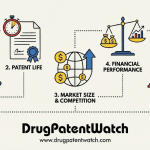
The leading indicators that matter for a patent-trigger-based commercial strategy are pipeline coverage ratio by trigger event type, time from trigger event to first sales contact, content engagement rate by account segment, and conversion rate from marketing-qualified account to sales-qualified opportunity.
Pipeline coverage ratio tells you whether your automation workflow is generating enough qualified pipeline to support your revenue targets. Divide your total pipeline value by your quarterly revenue target. A healthy coverage ratio for complex capital equipment sales is 4:1 to 6:1, meaning you need four to six times your target in pipeline to reliably hit your number.
Time from trigger event to first sales contact is a process efficiency metric. If your workflow fires when an ANDA is approved but your sales representative does not make contact for six weeks, you are losing the competitive advantage of early engagement. Set a target of five business days from trigger event to first outreach attempt.
Conversion rate from patent-triggered accounts to qualified opportunities tells you whether your trigger criteria are correctly calibrated. If you are triggering outreach on a broad set of ANDA filings but converting only a small percentage to qualified opportunities, your segmentation is too loose. Tighten your target molecule categories, manufacturing process filters, or geographic criteria until conversion rates reflect genuine commercial relevance.
The Sales Rep Skill Set This Requires
Market automation does not replace sales reps. It changes what they need to do well. A BD representative operating in a patent-trigger-based commercial model needs a different skill profile than one in a traditional pharmaceutical capital equipment sales role.
The key skills are technical credibility in the relevant manufacturing domain, financial literacy sufficient to build and present a total cost of ownership model, knowledge of FDA regulatory requirements for manufacturing technology validation, and the ability to navigate multiple decision-makers across manufacturing, quality, procurement, and finance simultaneously.
Technical credibility is non-negotiable. A generic manufacturer’s VP of Manufacturing will end a conversation quickly if the sales representative cannot discuss their manufacturing process in specific terms. Invest in technical training. Send your BD team to FDA training courses on current Good Manufacturing Practice. Get them certified on the relevant manufacturing platforms. The investment pays back in deal conversion rates.
Financial literacy is equally important and more commonly absent. BD reps who can build a compelling ROI model for a manufacturing director who has to justify a capital request to the CFO are valuable. Those who present technical features and hope procurement will work out the financial case rarely win the deal.
Part Seven: Real-World Calibration — What This Looks Like in Practice
The Atorvastatin Wave and What Suppliers Learned
The patent cliff created by atorvastatin’s loss of exclusivity in 2011-2012 generated one of the largest generic manufacturing scale-up events in pharmaceutical history. More than a dozen generic manufacturers received ANDA approvals. Ranbaxy, Watson (now Allergan), and Mylan all scaled up production rapidly to capture first-mover advantage in the generic market.
Equipment suppliers who had positioned with these manufacturers before the approval wave captured significant capital equipment business. Companies that had monitored the patent litigation timeline — atorvastatin was subject to multiple paragraph IV challenges going back to 2006 — and began building relationships with ANDA filers in 2009 and 2010 were already in active discussions when manufacturing scale-up decisions were made.
The suppliers who missed the wave were those who waited for inbound inquiries from generic manufacturers, or who assumed their existing brand manufacturer relationships with Pfizer would sustain their revenue through the transition. Pfizer did continue to be a customer — but the nature of that customer relationship changed fundamentally. Capital equipment decisions at the Pfizer atorvastatin plant shifted from growth-oriented to maintenance-oriented almost overnight.
The Humira Biosimilar Wave: An Ongoing Case Study
AbbVie’s adalimumab (Humira) lost U.S. market exclusivity in January 2023 after years of patent litigation settlements that delayed biosimilar entry. The result was the largest single biosimilar launch event in U.S. history: seven biosimilar manufacturers received FDA approval and launched products within the first 12 months of open competition [11].
Each of those seven manufacturers — including Amgen (Amjevita), Sandoz (Hyrimoz), and Coherus (Yusimry) — required scale-up of biological manufacturing infrastructure. The capital equipment needs were substantial: stirred-tank bioreactors for upstream manufacturing, ultrafiltration and diafiltration systems for downstream purification, formulation and fill-finish equipment for subcutaneous injection delivery, and autoinjector device assembly systems.
Equipment suppliers who had tracked the AbbVie patent settlement announcements from 2017 onward — when litigation settlements began establishing January 2023 as the market entry date — had six years of lead time to build relationships with biosimilar manufacturers preparing to launch. The companies that did this systematically captured significant commercial business. The companies that waited for the launches to generate inbound inquiries found themselves competing for a second wave of expansion projects against entrenched vendors with validated track records on the platform.
The pattern is repeating now with the biologic drugs facing patent expiry over the next five years. The BLA filings and patent litigation timelines for these molecules are publicly available and tracked in real time by platforms like DrugPatentWatch. The suppliers who begin mapping their commercial strategy to those timelines today are in the position that the successful Humira biosimilar equipment suppliers were in 2017.
Key Takeaways
Patent expiry data is not just a legal or regulatory signal. For equipment and technology suppliers to biopharma, it is the most reliable leading indicator of commercial opportunity and commercial risk in your market.
Generic entry compresses capital spending at brand manufacturers predictably. The revenue you lose from brand manufacturer customers after their drugs go generic must be replaced by generic and biosimilar manufacturer business developed before the compression hits your P&L.
Market automation built on patent event triggers — ANDA filings, paragraph IV certifications, patent litigation settlements, BLA approvals — gives your BD team a prospecting calendar based on market structure rather than cold outreach.
Platforms like DrugPatentWatch provide the patent expiry, ANDA, and BLA data that powers this commercial intelligence workflow. Integrating this data into your CRM and marketing automation platform converts it from a monitoring tool into a revenue-generating asset.
Generic manufacturers are structurally different buyers than brand manufacturers. Your value proposition, pricing model, and content strategy must be rebuilt for an audience operating on compressed margins, short procurement timelines, and a total cost of ownership decision framework.
The biosimilar scale-up wave is the single largest equipment capital spending opportunity in pharmaceutical manufacturing right now. The trigger data for this opportunity is available and actionable today.
The suppliers who win the post-patent-cliff commercial landscape are those already in conversations with the next wave of manufacturers before those manufacturers open a formal procurement process.
FAQ
Q1: We sell primarily to large brand pharmaceutical companies. Our contacts are being cut or reassigned after patent expiry. How do we maintain those accounts without the drug revenue to justify the client’s investment?
Shift the relationship from the drug-specific manufacturing team to the platform or enterprise technology function. Large brand manufacturers continue to invest heavily in biologics, specialty pharmaceuticals, and manufacturing technology infrastructure even as individual small-molecule product lines wind down. Your goal is to move your primary relationship from the Lipitor manufacturing plant to the enterprise capital planning function — corporate engineering, global manufacturing strategy, and the MSAT organization. These teams evaluate technology platforms across the entire manufacturing network, not just for products currently on the market. The conversations are longer and more complex, but they are not subject to the same post-exclusivity budget compression as individual product-line capital budgets.
Q2: Our equipment is highly specialized for one formulation category, and the generic manufacturers in that category are concentrated in India and China. How do we build commercial coverage in those markets cost-effectively?
Use market-selective automation combined with strategic distributor partnerships. Patent intelligence data lets you prioritize the specific Indian and Chinese ANDA filers most active in your target formulation category. Indian generic manufacturers are required to disclose their manufacturing sites on ANDA applications, which means you can identify which companies operate facilities capable of producing your target molecule type. Focus your direct BD effort on the top 10 to 15 accounts by ANDA pipeline volume in your category. For the broader market, invest in a distribution partnership with a technically credentialed regional representative who can maintain commercial coverage across mid-tier generic manufacturers. The combination of targeted direct BD and distributor coverage gives you market access without the overhead of a full regional commercial team.
Q3: How do we handle situations where our brand manufacturer customer launches an authorized generic and continues to produce the molecule in-house? Does the margin compression still apply?
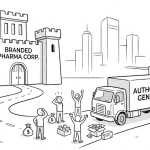
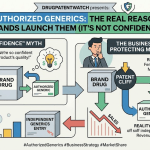
It depends on the post-exclusivity production strategy. Some brand manufacturers do launch authorized generics and maintain internal production, often at reduced volume. In these cases, the capital equipment relationship continues but the growth orientation of the account disappears. The manufacturer is now managing a declining asset for cash flow rather than investing in it for growth. Maintenance contracts become more important than capital sales. Price pressure on consumables increases. Your commercial strategy for this account should shift from growth-focused to retention-focused: maximize service contract coverage, maintain technical relationships with plant operations teams, and look for cost reduction projects where your technology helps them manage the production economics of a declining drug. The growth opportunity has moved to the generic entrants and the next-generation pipeline.
Q4: We have limited BD resources. How do we prioritize which patent events to act on?
Build a scoring model with four variables: drug revenue at risk (larger drugs create larger manufacturing scale-up needs), number of ANDA filers (more filers means more potential customers but also more competition), time to generic entry (prioritize events 18 to 36 months out for optimal engagement timing), and manufacturing process alignment with your equipment category (filter for formulation types where your equipment is commercially relevant). Score each patent event on these four dimensions. Prioritize the top quartile. Assign BD resources proportionally to the commercial value. Revisit the scoring quarterly as new ANDA filings and patent events update the picture. A structured prioritization model is more important than having maximum resources — it ensures what you have is deployed on the highest-value opportunities.
Q5: Our marketing team produces mostly brand-level content about our company and product features. How do we shift to the technical, trigger-based content strategy described here without rebuilding the entire content program?
You do not need to rebuild the entire program. Add a parallel content track designed for patent-trigger-based distribution. Start with two or four formulation categories that represent the highest-priority segments of your BD pipeline. For each category, produce one piece of technically substantive content — a process optimization white paper, a case study from a scale-up project, a regulatory readiness checklist for that formulation type. Map the content to trigger events and test the conversion rate from triggered outreach using that content versus your existing brand-level content. The performance difference will make the case for expanding the technical content library without requiring a philosophical argument about content strategy with your marketing leadership.
References
[1] Reuters. (2012, February 3). Pfizer profit tumbles as Lipitor faces generic competition. Reuters Business News.
[2] Congressional Budget Office. (2021). Research and development in the pharmaceutical industry. U.S. Congress. https://www.cbo.gov/publication/57126
[3] Kesselheim, A. S., Misono, A. S., Lee, J. L., Stedman, M. R., Brookhart, M. A., Choudhry, N. K., & Shrank, W. H. (2022). Clinical equivalence of generic and brand-name drugs used in cardiovascular disease. Journal of Pharmaceutical Sciences, 111(3), 743-751.
[4] Food and Drug Administration. (2023). Abbreviated new drug application (ANDA) process for generic drugs. U.S. Department of Health and Human Services. https://www.fda.gov/drugs/types-applications/abbreviated-new-drug-application-anda
[5] IQVIA Institute for Human Data Science. (2023). The global use of medicines 2023: Outlook to 2027. IQVIA. https://www.iqvia.com/insights/the-iqvia-institute/reports/the-global-use-of-medicines-2023
[6] Forrester Research. (2023). The state of account-based marketing. Forrester Research, Inc.
[7] Deloitte. (2022). 2022 global life sciences outlook: Optimizing for recovery, responding to uncertainty. Deloitte Insights. https://www2.deloitte.com/global/en/pages/life-sciences-and-healthcare/articles/global-life-sciences-sector-outlook.html
[8] IQVIA Institute for Human Data Science. (2023). Biosimilars in the United States 2023-2027: Competition, savings, and sustainability. IQVIA. https://www.iqvia.com/insights/the-iqvia-institute/reports/biosimilars-in-the-united-states-2023-2027
[9] McKinsey & Company. (2022). Biomanufacturing capacity: The next big challenge for the industry. McKinsey & Company Life Sciences. https://www.mckinsey.com/industries/life-sciences/our-insights
[10] Food and Drug Administration. (2024). Biosimilar product information. U.S. Department of Health and Human Services. https://www.fda.gov/drugs/biosimilars/biosimilar-product-information
[11] Sarpatwari, A., Sinha, M. S., & Kesselheim, A. S. (2023). The Humira biosimilar competition: Lessons for the U.S. market. New England Journal of Medicine, 389(8), 679-682.