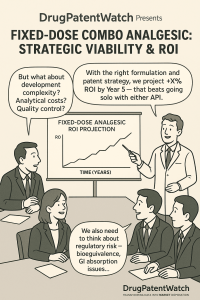
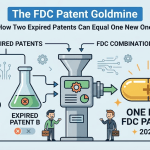
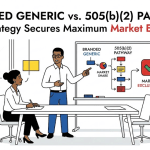
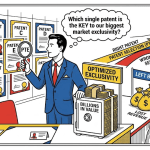
Two off-patent molecules. A single tablet. A decade of exclusivity and margins that rival any branded biologic. That is the commercial logic behind fixed-dose combination (FDC) analgesic development — and the reason pharma licensing teams, specialty investors, and strategy consultants are paying closer attention to what was once dismissed as a commodity segment.
This analysis covers the full investment arc: candidate selection, formulation risk, the FDA’s 505(b)(2) pathway and its Combination Rule, patent prosecution strategy, market access mechanics, and the financial model that either justifies capital deployment or kills the deal. The model drug is a tramadol/diclofenac FDC — a combination that is already used clinically in markets outside the U.S. and carries enough published efficacy data to anchor a credible FDA submission.
Why a Fixed-Dose Combination Analgesic Can Generate Branded Margins from Generic Inputs
Generic tramadol costs less than a penny per tablet at wholesale acquisition cost. Generic diclofenac is comparable. Combined into a single proprietary tablet with a defensible patent estate and FDA market exclusivity, the same two molecules can support a Wholesale Acquisition Cost of $8 to $15 per unit — a margin profile that resembles a mid-tier branded product, not a commodity.
The mechanism for that transformation is intellectual property, not chemistry. An FDC of two previously approved drugs is a new drug product under FDA regulations. It is not a generic. It cannot be approved via an Abbreviated New Drug Application (ANDA). It requires a 505(b)(2) New Drug Application, which, if clinical studies are conducted as part of the approval package, confers three years of regulatory exclusivity on the approved product. Simultaneously, a well-designed patent strategy built on novel formulation claims, synergistic dosing ratios, or method-of-use claims can extend that protection window to ten years or more.
Historical analysis of FDCs approved between 1980 and 2012 found a median of 9.7 years of combined patent and market exclusivity beyond that of the individual generic components. That number is the entire financial thesis in a single data point.
What Multimodal Analgesia Actually Means for Patent Strategy
How Combining Tramadol and Diclofenac Creates IP-Defensible Synergy
Multimodal analgesia is the clinical practice of targeting multiple points in the pain pathway simultaneously. Tramadol acts centrally: it is a weak agonist at the mu-opioid receptor and inhibits synaptic reuptake of both serotonin and norepinephrine in descending pain modulatory circuits. Diclofenac acts peripherally and centrally: it inhibits cyclooxygenase-1 and cyclooxygenase-2 at the site of tissue injury, reducing prostaglandin synthesis and the resulting sensitization of peripheral nociceptors.
These are non-redundant mechanisms. Combining them does not mean doubling one effect — it means attacking pain from two structurally distinct points in the cascade. That mechanistic orthogonality is both the clinical rationale and the core of the non-obviousness argument that the patent prosecution team needs to make to the USPTO.
The patentability argument for a drug combination runs through 35 U.S.C. § 103 — the obviousness standard. Combining two known analgesics could be characterized as obvious to a person skilled in the art, which is precisely the rejection a patent examiner will raise. The counterargument requires clinical or preclinical data showing that the FDC produces an unexpected result: analgesic synergy at doses lower than would be predicted by the additive effects of each component, or a safety profile improvement — particularly an opioid-sparing effect — that was not predictable from the pharmacology of either drug alone. The clinical development program must be designed to generate that data explicitly.
Why Opioid-Sparing Claims May Be the Strongest Basis for FDC Patent Protection
In the current regulatory and political environment around opioid prescribing, a demonstrated opioid-sparing effect is not just a safety claim — it is a commercial and policy narrative. A factorial clinical trial that shows the tramadol/diclofenac FDC achieves equivalent or superior pain control at half the tramadol dose of tramadol monotherapy has two simultaneous applications: it satisfies the FDA’s Combination Rule under 21 CFR § 300.50, and it creates empirical support for a patent claim on a specific dose ratio tied to a dose-sparing therapeutic outcome.
Method-of-use patents built around opioid dose reduction are among the most defensible FDC patent claims available. They are tied to clinical outcomes data, not just formulation novelty, which means a challenger must attack both the patent and the clinical evidence simultaneously. That is a materially more difficult litigation position than challenging a standard formulation patent.
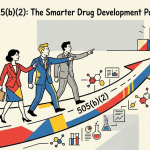
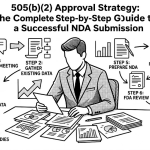
The 505(b)(2) Pathway: What It Is and What It Actually Costs
How 505(b)(2) Compares to Full NDA and ANDA Filing — and Why the Distinction Matters for Investors
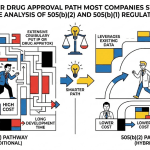
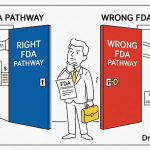
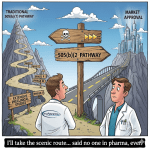
The Hatch-Waxman Act created a three-lane regulatory highway. A 505(b)(1) NDA requires the sponsor to develop all safety and efficacy data from scratch — a $1 billion to $2.6 billion undertaking over 10 to 15 years. A 505(j) ANDA requires only bioequivalence demonstration to a reference listed drug — a $1 million to $5 million process over two to four years. The 505(b)(2) sits between them, allowing a sponsor to rely on the FDA’s prior findings of safety and effectiveness for a listed drug while conducting targeted new studies that bridge to the modified product.
For an FDC of tramadol and diclofenac, this means the sponsor does not need to re-establish the toxicology, pharmacokinetics, or mechanism of action of either individual drug. That body of evidence is already in the public domain and recognized by the FDA. The development program focuses exclusively on what is new: the combination, the specific dose ratio, the tablet formulation, and the clinical evidence that each component contributes to the overall analgesic effect.
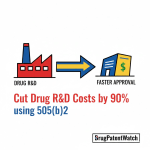
The practical cost consequence of this distinction is significant. A full 505(b)(2) FDC program, including the factorial clinical trial required by the Combination Rule, runs $15 million to $75 million — roughly 2% to 7% of an NME development budget. The timeline is three to five years versus ten to fifteen. That compression in capital and time is what makes the FDC model financially viable for smaller sponsors, specialty pharma companies, and venture-backed development platforms.
Feature
505(b)(1) NDA
505(b)(2) NDA
505(j) ANDA
Data origin
Fully self-generated
Hybrid: FDA prior findings + new bridging studies
Bioequivalence to reference listed drug
Typical cost
$1B–$2.6B
$15M–$75M
$1M–$5M
Typical timeline
10–15 years
3–5 years
2–4 years
Market exclusivity
5 years (NCE)
3 years (new clinical studies)
180 days (first Paragraph IV filer)
Relevant for FDCs
No
Yes
No
What the FDA’s Combination Rule (21 CFR § 300.50) Actually Requires
The FDA does not approve drug combinations on the basis of convenience. 21 CFR § 300.50 requires that each component make a contribution to the claimed therapeutic effect. For a tramadol/diclofenac FDC, that requirement mandates a clinical trial with a factorial design: at minimum four arms — placebo, tramadol alone, diclofenac alone, and the FDC — in a patient population with quantifiable acute pain.
Post-surgical pain models, specifically third molar extraction or laparoscopic procedures, are the standard acute pain model for this type of trial because they produce reliable, measurable pain scores on validated instruments and have a natural endpoint without ethical complications of withholding treatment indefinitely. The primary endpoint is typically the sum of pain intensity differences over four to six hours (SPID), and the trial must show that the FDC arm is statistically superior to both monotherapy arms on that primary endpoint.
An analysis of previously approved 505(b)(2) FDC products found that two-thirds required at least one Phase 2 or 3 clinical study for approval, and a significant subset required more than four. That is not a reformulation exercise — it is a clinical development program, and budgets should reflect that reality.
Why the Pre-IND Meeting Is the Single Most Important Investment Decision Gate
Before a dollar of clinical trial expenditure is committed, the sponsor must secure FDA alignment on the scope of the required clinical program. The pre-IND meeting is that alignment mechanism. The sponsor presents a briefing document outlining the proposed product, the clinical rationale, the CMC plan, and the factorial trial design. The FDA’s written feedback from this meeting defines whether the project is financially viable.
If the FDA concurs that a single well-designed factorial trial is sufficient to satisfy the Combination Rule, the total development cost stays within the $20 million to $40 million range — a range where the NPV analysis is clearly positive at achievable market prices. If the FDA requires multiple pivotal trials or a larger, more complex program, costs can escalate to $60 million or beyond, compressing returns to the point where the investment may no longer clear a standard pharma hurdle rate of 15% to 20%.
The pre-IND meeting should be treated as a go/no-go gate, not a formality. Committing to the full development program before receiving FDA feedback is the most common and most expensive strategic error in the 505(b)(2) space.
Key Patent Expiry Dates and IP Architecture for the Tramadol/Diclofenac FDC
Why Both Components’ Patent Status Defines the Competitive Threat Timeline
Tramadol was first approved in the U.S. in 1995 under the brand name Ultram. Its original compound patents have long expired. Generic tramadol has been available since the early 2000s, and the API is manufactured at scale by suppliers in India and China at commodity prices. Diclofenac has been off patent even longer — Voltaren was approved in the U.S. in 1988, and generic diclofenac sodium tablets have been available in multiple strengths for decades.
This patent status is the reason the FDC strategy is viable: there is no blocking composition-of-matter patent from the originator to navigate. No Paragraph IV filing is required against an existing Orange Book-listed patent. The sponsor is not contesting anyone’s intellectual property — they are creating new intellectual property by demonstrating that the combination, in a specific ratio and formulation, achieves clinical results that could not be predicted from the monotherapy data.
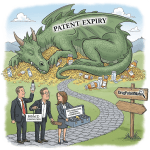
The IP risk runs in the other direction. If the sponsor’s own patent applications are rejected or invalidated, the FDC’s protection period collapses to the three-year regulatory exclusivity window. In that scenario, a competitor could develop a generic FDC at the end of year three, submit a 505(j) ANDA using the sponsor’s approved FDC as the reference listed drug, and enter the market. That is not a catastrophic outcome — three years of high-margin branded sales on a $20 million to $40 million investment still generates a positive return — but it substantially changes the investment calculus.
How Patent Prosecution Strategy Affects FDC Market Exclusivity Duration
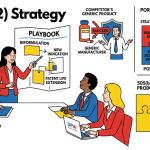
A properly constructed FDC patent portfolio includes multiple layers. The first and broadest layer covers the combination itself: a patent claiming the combination of tramadol and diclofenac in a specific weight ratio range shown to produce synergistic analgesia. The second layer covers the specific formulation — the bilayer tablet architecture, the excipient system, or any modified-release technology incorporated to improve pharmacokinetic performance. The third layer covers the method of use: treating acute moderate-to-severe pain, achieving opioid dose reduction, or reducing NSAID-related gastrointestinal adverse events by combining the two agents.
Each layer is a separate patent, filed on separate timelines, with separate expiry dates. A well-executed portfolio creates overlapping protection: even if the combination patent is successfully challenged via inter partes review, the formulation patent and the method-of-use patent remain. Invalidating all three requires three separate successful challenges — a materially more expensive litigation posture for a generic entrant.
Historical data shows that FDC products with layered patent portfolios achieve an average of 11.5 years of combined exclusivity. Products with only the three-year regulatory exclusivity and a single broad patent achieve closer to 7.7 years. The difference in NPV at standard discount rates, assuming peak annual revenues of $100 million to $200 million, is $200 million to $400 million.
What Makes FDC Generic Entry Difficult — and When It Becomes Inevitable
Why Generic FDC Entry Requires a 505(b)(2), Not a 505(j) ANDA
This is one of the most misunderstood aspects of FDC competitive dynamics. A generic competitor seeking to copy the approved tramadol/diclofenac FDC cannot simply file a 505(j) ANDA demonstrating bioequivalence if the reference listed drug (the innovator’s FDC) was not originally approved solely on the basis of bioequivalence data. Because the innovator’s 505(b)(2) approval required new clinical studies — the factorial trial — any generic seeking to use that product as its reference listed drug must also conduct bioequivalence studies that demonstrate equivalent delivery of both active ingredients from a single tablet.
More importantly, if the innovator holds valid Orange Book-listed patents, the generic must file a Paragraph IV certification asserting either that the patent is invalid or that its product does not infringe. That certification triggers a 30-month stay of ANDA approval, buying the innovator additional time even if litigation ultimately resolves in the generic’s favor. The combination of regulatory exclusivity, Orange Book-listed patents, and the 30-month stay creates a staggered defense structure that extends effective market protection significantly beyond the nominal patent expiry date.
How Paragraph IV Challenges Could Affect the FDC’s Revenue Timeline
A Paragraph IV challenge against the FDC’s patents is the primary IP risk scenario. A generic manufacturer — likely one of the large Indian API-to-dose form players such as Sun Pharmaceutical, Zydus Lifesciences, or Dr. Reddy’s, which have established 505(b)(2) and ANDA filing capabilities in the U.S. — would need to identify a strategy for designing around the formulation patent or invalidating the combination patent on prior art grounds.
The prior art risk is real. The tramadol/diclofenac FDC is not a novel scientific concept — it is already marketed in India under brands including Ultracet-D and similar trade names. Published clinical literature from Indian academic hospitals documents the combination’s efficacy and safety. A competent patent challenger will cite this literature as prior art in an inter partes review petition at the USPTO, arguing that the combination was described in published scientific literature before the innovator’s priority date.
The defense against this prior art argument requires claims that are specific enough to avoid the prior art while broad enough to prevent design-arounds. This is a narrow target and requires experienced pharmaceutical patent counsel with specific FDC prosecution experience. The cost of patent prosecution and subsequent defense litigation is typically $1 million to $5 million for a well-resourced response, but full district court patent litigation can reach $20 million to $40 million in legal fees before resolution.
Revenue at Risk: What the Financial Model Actually Shows
Why the “1+1 = 1.6” Payer Pricing Rule Dominates the Sensitivity Analysis
The most important variable in the FDC revenue model is not units sold or market penetration rate — it is the net price realized from payers after rebates, chargebacks, and formulary placement concessions. IQVIA analysis of payer behavior for FDC products where both components are available as generics shows that payers benchmark the FDC’s effective cost against the combined NADAC of the two generic components and typically allow pricing at roughly 1.6 times the cost of one monotherapy — not the sum of both.
At current NADAC levels, generic tramadol 50 mg costs approximately $0.12 to $0.18 per tablet, and generic diclofenac sodium 50 mg costs approximately $0.08 to $0.14 per tablet. The combined generic cost to acquire both pills is roughly $0.20 to $0.32 per dose. A payer applying the “1.6x one monotherapy” benchmark would allow a net effective price of approximately $0.19 to $0.29 per tablet — barely above generic cost and nowhere near the $8 to $15 WAC required for financial viability.
This is not a theoretical concern. It is the most common commercial failure mode for 505(b)(2) FDC products, and it is why the clinical development program must generate data that shifts the payer negotiation away from cost comparisons and toward value comparisons. The reimbursement argument cannot rest on convenience. It must rest on demonstrated clinical differentiation: superior pain control scores at equal or lower doses, a measurable reduction in opioid-related adverse events, or a health economic model showing that reduced adverse events generate downstream cost savings that offset the higher acquisition cost.
10-Year Revenue Projection: Base Case and Downside Scenarios
The base case financial model assumes the following inputs: total development cost of $35 million; COGS of $0.10 per tablet; SG&A of $15 million per year during peak commercial period; net price per tablet of $4.50 after payer discounts; and peak annual sales volume of 55 million tablets achieved in year 6 post-launch.
Under these assumptions, peak annual gross revenue is approximately $247.5 million. After a 40% payer discount to net price, net revenue at peak is approximately $148.5 million. COGS at peak volume is $5.5 million. Gross margin is approximately 96%. SG&A of $15 million yields peak EBITDA of approximately $128.5 million.
The 10-year cumulative cash flow, after deducting the $35 million development investment, is approximately $650 million to $750 million on a nominal basis. Discounted at a 15% rate, the NPV is approximately $180 million to $240 million. IRR under this scenario is approximately 30% to 35%.
The downside scenario assumes a net price of $2.00 per tablet (payer resistance benchmark applies), peak volume of 30 million tablets, and development cost of $60 million. Under these assumptions, the 10-year NPV is approximately $25 million to $45 million, and IRR drops to approximately 12% to 15% — at or below a typical pharma hurdle rate.
The swing between base case and downside is driven almost entirely by the achieved net price, which reinforces why payer strategy and clinical data design are not commercial functions to develop after approval — they must be built into the clinical program from day one.
Scenario
Net Price/Tablet
Peak Volume (M)
Dev Cost
10-Year NPV
IRR
Base case
$4.50
55M
$35M
$180M–$240M
30%–35%
Conservative
$3.00
40M
$45M
$80M–$110M
20%–24%
Downside
$2.00
30M
$60M
$25M–$45M
12%–15%
Formulation Risk: Why CDMO Selection and Bilayer Tablet Architecture Matter
What Makes FDC Tablet Manufacturing Technically Harder Than Single-API Generics
Manufacturing a bilayer tablet containing tramadol and diclofenac introduces technical challenges that are absent from single-API generic manufacturing. The two drugs have different physicochemical properties: tramadol hydrochloride is water-soluble with moderate hygroscopicity, while diclofenac sodium is a BCS Class II drug with low solubility and high permeability. Combining them in a single tablet requires managing differences in particle size distribution, bulk density, flow properties, and moisture sensitivity simultaneously.
Content uniformity is the primary process control concern. Tramadol is typically dosed at 37.5 mg to 50 mg per tablet, while a therapeutically relevant diclofenac dose is 50 mg. The mass ratio is manageable, but if the two APIs are granulated together rather than separately, the risk of blend segregation during tablet compression can cause dose variability that fails USP content uniformity specifications — a critical quality attribute and a common reason FDC development programs fail at the technology transfer stage.
The bilayer tablet architecture is the preferred technical solution. Each API occupies a discrete physical layer within the tablet, pressed in sequence on a bilayer tablet press. This architecture keeps the two APIs physically separated until dissolution, eliminating direct contact degradation pathways and simplifying content uniformity validation to a layer-specific problem rather than a whole-tablet blend problem. The trade-off is manufacturing complexity: bilayer tablet presses are more expensive to operate, require more rigorous process validation, and have lower throughput than standard single-layer presses.
Why Bioequivalence Failure Is the Most Expensive Development Risk
The FDA requires that the FDC tablet deliver both drugs to the systemic circulation in a bioequivalent manner to co-administration of the two individual reference products. For tramadol, the reference is the approved immediate-release tramadol HCl tablet. For diclofenac, the reference is the approved diclofenac sodium tablet.
Bioequivalence requires that the 90% confidence interval for the geometric mean ratio of AUC and Cmax for both drugs fall within 80% to 125% of the reference values. Failure to meet this criterion — which can occur if the formulation unexpectedly affects the dissolution or absorption of one of the APIs — triggers a reformulation cycle and repeat bioequivalence study, adding $2 million to $5 million in cost and 12 to 18 months to the timeline.
Diclofenac bioequivalence is historically the more difficult of the two to achieve in FDC contexts because its low aqueous solubility makes dissolution highly sensitive to excipient selection and pH conditions in the gastrointestinal tract. Any excipient in the tramadol layer that alters local GI pH — for example, a basic filler that raises pH above the optimal range for diclofenac dissolution — can suppress diclofenac bioavailability and produce a BE failure.
Pre-formulation studies that include pH-dissolution profiling for the combined tablet under GI-relevant conditions are essential before finalizing the formulation. This work costs $200,000 to $500,000 and can prevent a $5 million reformulation cycle downstream. It belongs in the pre-IND investment package, not as an afterthought after clinical trial design is locked.
Which CDMOs Have Relevant FDC Oral Solid Dosage Expertise
The CDMO selection criteria for this program include demonstrated bilayer tablet manufacturing capability, analytical method development for simultaneous API quantification, GMP-grade clinical trial material supply, and an established track record with 505(b)(2) CMC submissions. CDMOs with documented FDC oral solid dosage capability include Recipharm, Piramal Pharma Solutions, Lonza, and Catalent’s oral drug delivery division.
For clinical-stage material, a development-focused CDMO is more appropriate than a high-volume commercial manufacturer. The development CDMO should be able to produce clinical batches of 5,000 to 50,000 tablets, conduct accelerated stability studies under ICH conditions (40°C/75% RH for six months as surrogate for 24-month shelf life), and prepare the CMC section of the IND and subsequent NDA in collaboration with the regulatory team.
Market Access: How to Win Formulary Placement Against Generic Co-Prescribing
Why “Pill Burden Reduction” Is Not Enough to Win Formulary Coverage
Payers know that prescribing tramadol and diclofenac as two separate generics is clinically effective, costs less than $0.50 per day, and requires no prior authorization. Any argument for formulary placement of the branded FDC that rests on convenience will be met with a preferred generic tier placement at best — and non-formulary status at worst.
The value-based access argument requires three data points from the clinical program. First, pain control superiority: the FDC must demonstrate statistically and clinically significant superiority over at least one monotherapy arm on the primary pain endpoint, establishing that the combination is not pharmacologically equivalent to either drug alone. Second, an opioid dose reduction: the FDC should show that equivalent pain control can be achieved with 25% to 50% less tramadol than tramadol monotherapy — a claim that maps directly onto opioid prescribing guidelines and state-level opioid management programs that are increasingly relevant in formulary negotiations. Third, a safety signal: documentation of fewer tramadol-related adverse events (nausea, dizziness, constipation) in the FDC arm compared to tramadol monotherapy at an equianalgesic dose.
Each of these data points has a corresponding payer counterpart. Formulary committees at large PBMs and health plan pharmacy directors are increasingly focused on outcomes-based evidence. A dossier that presents a head-to-head comparison between the FDC and the loose-dose generic combination — not just versus placebo — is significantly more persuasive in formulary negotiations than standard NDA trial data.
How the NDC and HCPCS Code Structure Affects Hospital and Pharmacy Reimbursement
A 505(b)(2) product is not therapeutically equivalent to its reference listed drugs and will not receive an AB-rated substitution code in the FDA’s Orange Book. This means pharmacies cannot automatically substitute the branded FDC when a clinician prescribes generic tramadol plus generic diclofenac. The FDC must be prescribed specifically by brand name or NDC.
In hospital formulary systems — the electronic health record’s charge master and pharmacy dispensing system — this distinction creates a billing risk. If hospital pharmacy staff or EHR-integrated ordering systems route the FDC claim through the generic NDC codes for tramadol and diclofenac rather than the FDC’s unique NDC, the claim will either underpay (at generic rates) or be denied. This is not a hypothetical: it is a documented problem across multiple 505(b)(2) launches and one of the primary reasons specialty pharmacy-distributed 505(b)(2) products show a gap between prescription volume and actual revenue.
Proactive engagement with the four largest group purchasing organizations (GPOs) — Vizient, Premier, HealthTrust, and Intalere — prior to launch, combined with EHR configuration support for the top 50 health systems by acute pain admission volume, is a prerequisite for institutional channel revenue realization, not an optional post-launch activity.
Competitive Landscape: Which Companies Could Build or Buy This Asset
Which Specialty Pharma and 505(b)(2) Platforms Are Best Positioned to Develop an FDC Analgesic
The company profile best suited to develop a tramadol/diclofenac FDC is a specialty pharma platform with existing CNS or pain portfolio infrastructure, 505(b)(2) regulatory capability in-house, and a payer access team with formulary contracting experience in the acute pain segment. Large generic manufacturers with branded specialty divisions — Teva’s specialty business, Hikma Pharmaceuticals’ U.S. specialty unit, Assertio Holdings, or Scilex Holding Company — have the regulatory and commercial infrastructure for this type of asset.
A venture-backed development company without an existing commercial infrastructure could develop the asset to NDA approval and then either license it to a specialty pharma commercial partner or sell the approved product outright. The value at approval — before commercial launch — is typically 3x to 5x the development cost, implying an asset value of $60 million to $175 million at NDA approval based on the development cost range in this analysis. Post-launch, royalty-bearing licensing to a specialty pharma company with an existing acute pain sales force captures ongoing revenue without commercial build cost.
Why Indian Generics Companies Are the Most Likely Generic FDC Entrants
The tramadol/diclofenac FDC is not a novel combination in global markets. It is already manufactured and sold in India under multiple brand names by multiple manufacturers, including Troikaa Pharmaceuticals, which markets Divon (tramadol 37.5 mg / diclofenac 50 mg in a bilayer tablet) and has conducted the clinical studies underlying its Indian approval. This means that when the U.S. FDC’s patents enter their vulnerability window — either through successful Paragraph IV challenge or through natural expiry — Indian manufacturers with existing process knowledge and scale will be positioned to enter the U.S. market with a 505(j) ANDA relatively quickly.
The competitive clock starts ticking from the day the innovator files for U.S. approval, not from the date of first commercial sale. Generic manufacturers track Orange Book listings in real time, and a new FDC listing will trigger patent landscape assessments by at least five to ten generic manufacturers within 30 days of FDA approval.
Investor Questions: How to Evaluate This Asset Class
What Investors Are Watching in 505(b)(2) FDC Pain Assets
The primary diligence variables for institutional investors evaluating a 505(b)(2) FDC analgesic are, in order of importance: the pre-IND meeting outcome and FDA’s written concurrence on trial scope; the patent prosecution status and freedom-to-operate opinion; the market access strategy and preliminary payer feedback; the CDMO partner’s track record with bilayer tablet bioequivalence submissions; and the clinical team’s experience with factorial trial design in acute pain models.
A written record of FDA concurrence with a single pivotal factorial trial design is the single document that converts this from a speculative venture into a calculable risk-adjusted investment. Without it, the development cost range is $15 million to $75 million and the IRR range is 12% to 35% — too wide to model with conviction. With it, the cost range narrows to $25 million to $45 million and the IRR range tightens to 22% to 30%.
How Paragraph IV Litigation Risk Should Be Valued in a 505(b)(2) FDC
Patent challenge risk at the FDC level is different from Paragraph IV risk at a branded NME. The innovator’s FDC patents are new, relatively narrow combination and formulation patents filed without the benefit of decades of prior art around a novel compound. The prior art for a tramadol/diclofenac combination is extensive: Indian clinical literature, global pharmacology papers, and in-market products in regulated markets outside the U.S. all constitute relevant prior art.
A realistic patent risk assessment should assume that the combination patent faces a high probability (60% to 70%) of inter partes review challenge within two years of Orange Book listing, and that the formulation patent and method-of-use patent carry lower but non-trivial challenge risk (20% to 35% each). A layered portfolio in which all three patents must be invalidated to open the market creates a compounded defense that holds with meaningful probability even if the combination patent falls.
Portfolio managers should model the revenue timeline under three patent scenarios: full protection to 10 years post-launch (base case), combination patent falls at year 4 with formulation and method patents holding to year 8 (conservative case), and all patents fall at year 3 leaving only regulatory exclusivity (stress case). The weighted average of these scenarios, probability-adjusted, gives a more accurate NPV than the pure base case.
Key Takeaways for Capital Allocation Decisions
The tramadol/diclofenac FDC is a tractable, well-defined investment with a clear value creation path and identifiable failure modes. Development cost is bounded between $15 million and $75 million, with the pre-IND meeting reducing uncertainty to a $20 million to $45 million range. The IP strategy is executable using established prosecution techniques for FDC combination patents. The clinical program, while requiring a properly designed factorial trial, builds on a substantial body of published efficacy and safety literature that reduces scientific risk.
The commercial challenge is real and should not be minimized: selling a branded pill at $4 to $8 per tablet when the two constituent generics cost $0.30 combined requires clinical data that justifies a fundamentally different reimbursement category. That data must be designed into the trial, not extracted from it after the fact.
For investors with a 5- to 7-year return horizon and a tolerance for regulatory binary risk, the risk-adjusted return profile is attractive. For those seeking shorter timelines or lower binary risk, the asset is better suited as a post-IND, post-pre-IND acquisition — paying a premium to eliminate the regulatory uncertainty while retaining the commercial and IP upside.
Regulatory Timeline: What Happens Between Pre-IND and First Commercial Sale
How the FDA’s PDUFA Review Clock Applies to 505(b)(2) FDC Submissions
A persistent misconception in the 505(b)(2) space is that the FDA reviews these applications faster than standard NDAs. It does not. The Prescription Drug User Fee Act (PDUFA) review clock is the same: 10 months for standard review, 6 months for priority review. The time savings in a 505(b)(2) program come from the reduced scope of preclinical and clinical work, not from any abbreviated FDA review period.
For a tramadol/diclofenac FDC with no significant safety issues identified in the factorial trial and a clean CMC package, standard review is the expected classification. The FDA will conduct a complete review of the NDA, including the CMC section (which must demonstrate that the manufacturing process consistently produces a tablet meeting all quality specifications), the clinical section (which must show that the factorial trial was conducted per the agreed protocol and that the primary endpoint was met), and the labeling section (which includes the indication, dose, warnings, and the Medication Guide required for Schedule IV controlled substances, as tramadol is classified).
Total timeline from project inception to first commercial sale: 3 to 5 years, assuming no clinical hold on the IND, no Complete Response Letter from the FDA requiring additional data, and no manufacturing inspection failures at the CDMO site.
How a Schedule IV Designation Affects the FDC’s Regulatory and Commercial Path
Tramadol is classified as a Schedule IV controlled substance under the Controlled Substances Act. This classification affects the FDC on multiple levels. Manufacturing requires a DEA Schedule IV registration for the CDMO. Distribution requires a DEA-registered wholesaler. Prescribers must be DEA-registered to prescribe the product. Pharmacies must maintain Schedule IV inventory controls.
These requirements add operational complexity but are not commercially limiting — tramadol is already widely prescribed by primary care physicians, emergency medicine physicians, and orthopedic surgeons, all of whom hold DEA registrations. The key commercial implication of the Schedule IV classification is labeling: the FDC will carry the full tramadol prescribing information, including the boxed warning regarding addiction, abuse, and misuse, the warning about life-threatening respiratory depression, and the precautions regarding concomitant use with central nervous system depressants.
Paradoxically, this boxed warning can be leveraged commercially. A product positioned as “the same controlled-substance risk as tramadol, but at a lower tramadol dose due to the diclofenac dose-sparing effect” turns the Schedule IV classification from a liability into a clinical differentiation point. This framing works in formulary negotiations with payers operating under state opioid prescribing mandates and with health systems that have adopted internal opioid dose reduction programs.
Manufacturing Moat Analysis: How Formulation Complexity Slows Generic Entry
Why Bilayer FDC Manufacturing Creates a Temporary But Real Generic Entry Barrier
The time required for a generic manufacturer to develop a bioequivalent bilayer tablet formulation, conduct BE studies, and prepare an ANDA is typically 24 to 36 months from the decision to file. This is longer than the 18 to 24 months required for a standard single-API generic. The additional time reflects the need to separately optimize each layer’s composition, validate the bilayer press process, and run a two-drug simultaneous bioequivalence study that demonstrates BE for both tramadol and diclofenac from a single tablet versus the FDC reference product.
This timeline advantage is not a primary defense — it is a buffer. It provides 12 to 18 additional months of exclusivity relative to what a simpler formulation would allow, even after patents are invalidated or expire. For a product generating $100 million to $200 million in annual net revenue, each additional quarter of exclusivity is worth $25 million to $50 million. The bilayer formulation complexity is not just a technical choice — it is a commercial decision with a quantifiable economic value.
Common Questions from Pharma IP and Investment Teams
Can the FDC receive five years of exclusivity instead of three? Three years is the standard for a 505(b)(2) product approved based on new clinical investigations that do not involve a new chemical entity. Five years applies to new chemical entities — compounds not previously approved by the FDA in any form. Tramadol and diclofenac are both previously approved; they are not new chemical entities. The FDC will receive three years of regulatory exclusivity. Patent protection beyond that three-year period depends entirely on the patent portfolio.
Can a competitor develop a different tramadol/diclofenac FDC ratio and avoid the innovator’s patents? Potentially, if they file a Paragraph IV certification or design around the specific dose ratio claims. This is the primary patent design-around risk for FDC combination products. The innovator’s patent claims must be written broadly enough to cover a range of therapeutically relevant dose ratios, not just the exact ratio tested in the clinical trial. A patent claiming “a tramadol:diclofenac weight ratio of between 0.5:1 and 1.5:1” is harder to design around than a patent claiming exactly the 37.5 mg:50 mg ratio. Patent prosecution strategy should reflect this from the first filing.
What happens to the FDC’s commercial position if the FDA approves a new non-opioid analgesic in the same indication? A new non-opioid analgesic — such as a suzetrigine (Vertex’s Nav1.8 inhibitor, approved in January 2025 as Journavx for acute pain) or a subsequent entrant in that class — could erode prescribing for opioid-containing combinations over time in markets where non-opioid equivalence can be demonstrated. This is a medium-term pipeline replacement risk, but it is unlikely to materially affect the FDC’s commercial trajectory within its initial 5-year exclusivity period, as formulary adoption of novel mechanisms is typically slow.
Is there a license or royalty obligation on the existing tramadol or diclofenac compound patents? No. Both compounds are long off-patent with no active compound patents. There are no royalty obligations to originator companies — Grünenthal (tramadol originator) or Novartis/Ciba-Geigy (diclofenac originator) — associated with using these APIs in a new formulation. Any royalty obligation would only arise if the FDC incorporates a proprietary drug delivery technology licensed from a third party.
How does the opioid regulatory environment affect prescribing uptake of a tramadol-containing FDC? State-level opioid prescribing restrictions vary significantly. Several states impose morphine milligram equivalent (MME) daily limits or mandatory prescription drug monitoring program (PDMP) checks for all Schedule II-IV opioid prescriptions. Tramadol, as a Schedule IV drug, is generally subject to fewer restrictions than Schedule II opioids like oxycodone or hydrocodone. The FDC’s opioid dose-sparing narrative, if supported by clinical data, is aligned with the policy direction of these programs rather than running against it.
Investment Strategy: How to Structure Capital Deployment in a 505(b)(2) FDC
The capital-efficient structure for a 505(b)(2) FDC investment is a phased model with defined go/no-go gates tied to regulatory milestones rather than calendar timelines.
Phase 1 ($2 million to $5 million): Pre-formulation studies, API compatibility assessment, freedom-to-operate analysis, pre-IND briefing document preparation, and regulatory consultancy engagement. Deliverable: FDA written concurrence on clinical trial scope from the pre-IND meeting. Go/no-go decision based on FDA feedback.
Phase 2 ($15 million to $30 million): IND filing, factorial clinical trial execution, bioequivalence study, CMC development with CDMO partner, patent filing. Deliverable: clean clinical trial data package meeting primary endpoint, BE success, NDA filing. Go/no-go decision based on trial results.
Phase 3 ($5 million to $10 million): NDA review period activities, commercial preparation, payer access dossier development, GPO engagement, NDC and HCPCS code registration. Deliverable: FDA approval and first commercial sale.
This structure allows an investor to exit after Phase 1 with minimal capital at risk — the Phase 1 deliverable is the pre-IND feedback document, and a favorable FDA response converts the Phase 2 investment from speculative to structured risk. An investor entering at Phase 2 post-positive pre-IND feedback pays a premium over Phase 1 entry cost but acquires a materially de-risked position.
Licensing the approved product to a specialty pharma commercial partner post-approval, rather than building a commercial organization, is the highest-IRR exit for a development-focused investor. A licensing deal structure for a 505(b)(2) pain product at approval typically includes an upfront payment of 2x to 4x development cost, plus tiered royalties of 15% to 25% of net sales over the exclusivity period. On a $35 million development cost, this implies a $70 million to $140 million upfront plus $15 million to $25 million in annual royalties at peak sales — a total return well in excess of the base case NPV calculated above.
Data sources and analytical frameworks referenced throughout this analysis include published IQVIA FDC pricing research, FDA guidance on 505(b)(2) applications and the Combination Rule under 21 CFR § 300.50, peer-reviewed pharmacology literature on tramadol/diclofenac clinical performance, USPTO patent prosecution standards for drug combination claims, PDAC and CMS reimbursement coding guidance, and WHO essential medicines production cost benchmarks. Patent valuation methodology follows standard pharmaceutical IP lifecycle analysis used in institutional equity research.