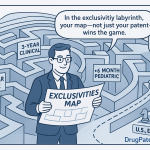
The patent cliff is measurable, foreseeable, and still consistently underestimated. Between 2025 and 2030, the U.S. pharmaceutical market will surrender more than $230 billion in branded drug revenue to generic and biosimilar competition. Global estimates extend that figure past $300 billion. The drugs generating this exposure are not obscure or declining — they are the world’s best-selling medicines. Keytruda. Eliquis. Opdivo. Ibrance. Xarelto. Each carries a loss of exclusivity date that functions less like a business event and more like a controlled detonation: the timing is known, the blast radius is estimated, and the industry has years to respond. Whether it does so intelligently depends on the quality of IP, regulatory, and commercial intelligence being applied.
This article is built for teams that operate inside that response: pharma IP counsel modeling secondary patent positions, portfolio managers marking assets to forward curves, generic manufacturers racing for first-filer status, institutional investors sizing revenue at risk, and licensing teams evaluating out-licensing windows before LOE destroys leverage. The analysis covers the mechanics of loss of exclusivity, the litigation architecture that determines when competition actually arrives, the formulation strategies that extend exclusivity past nominal patent expiry, and the specific commercial dynamics that govern how quickly a branded franchise collapses once the first generic or biosimilar is on the market.
What a Patent Cliff Actually Means for Revenue — and Why the Timing Prediction Is Hard
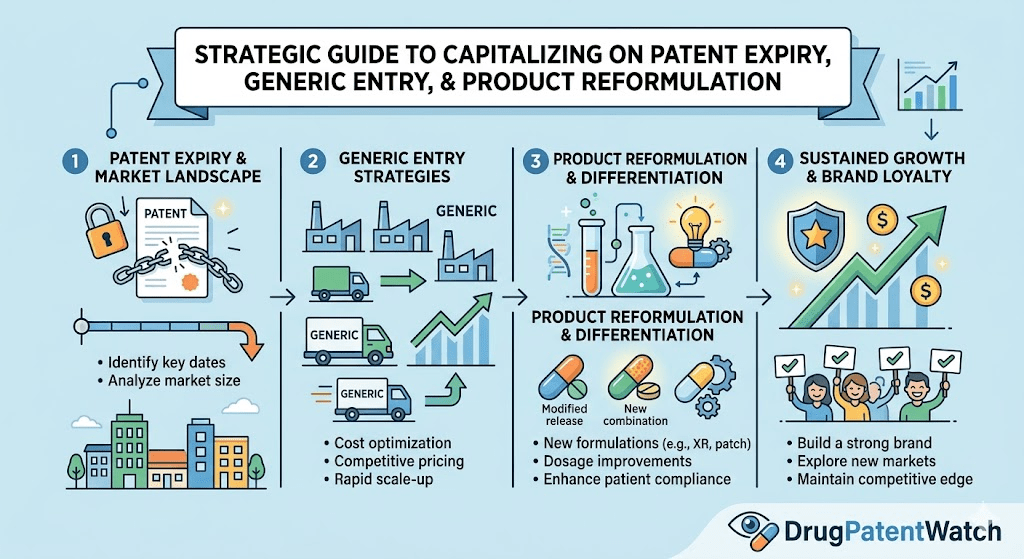
The phrase ‘patent cliff’ implies a clean vertical drop. The commercial reality is messier. A composition-of-matter patent expiry opens the door to generic competition, but actual revenue erosion depends on how many generics enter, how quickly payers mandate substitution, what secondary patents remain in force, whether an authorized generic is already competing during the 180-day first-filer exclusivity window, and how aggressively the brand manufacturer has executed a reformulation-based patient migration strategy.
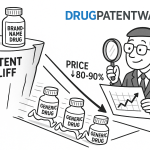
When a single generic enters a market after a primary patent expires, the FDA’s own data shows that the branded product’s wholesale price falls by an average of 39%. With four generic competitors, that price decline reaches 79%. Pfizer’s experience with Lipitor (atorvastatin) after its November 2011 patent expiry illustrates the speed: annual revenue fell from roughly $13 billion to under $3 billion within two years, driven by rapid payer-mandated substitution and Ranbaxy’s launch of the first generic under 180-day exclusivity. The commercial case for forecasting, monitoring, and defending against generic entry is not theoretical. A single expiry event can wipe out a decade of R&D returns in 24 months.
The difficulty in modeling the exact timing of revenue erosion lies in several variables that are not determined by the patent expiry date alone. The date a composition-of-matter patent expires sets the earliest point at which a generic applicant can legally launch without infringing that specific patent — but the Orange Book may list additional formulation, method-of-use, or polymorph patents that a generic applicant must either design around or challenge through a Paragraph IV certification. The number of active Paragraph IV challenges, the litigation posture of the brand, whether the brand has an authorized generic ready to deploy, and the ANDA review timeline at the FDA all shift the actual generic entry date by months or years in either direction.
Key Patent Expiry Dates: Which Drugs Face the Largest Revenue Cliff Through 2030
The table below reflects current known primary patent and exclusivity positions. All revenue figures are approximate 2024 annualized sales. Effective exclusivity dates may differ from nominal patent expiry depending on jurisdiction, secondary patent litigation, and regulatory exclusivity stacking.
Drug (INN)
Brand
Company
Primary Indication
Approximate 2024 Revenue
U.S. LOE Window
Molecule Type
Apixaban
Eliquis
BMS / Pfizer
Anticoagulation
$20B+ combined
2026–2028
Small molecule
Rivaroxaban
Xarelto
J&J / Bayer
Anticoagulation
~$6B U.S.
2026
Small molecule
Sitagliptin
Januvia
Merck
Diabetes
~$2B
2026
Small molecule
Lenvatinib
Lenvima
Merck / Eisai
Oncology
~$1.5B
2025–2026
Small molecule
Palbociclib
Ibrance
Pfizer
Breast cancer
~$5B
2027
Small molecule
Enzalutamide
Xtandi
Pfizer / Astellas
Prostate cancer
~$6B combined
2027
Small molecule
Olaparib
Lynparza
AstraZeneca / MSD
Oncology
~$2.6B
2027
Small molecule
Nivolumab
Opdivo
BMS
Oncology
~$9B
2028
Biologic
Pembrolizumab
Keytruda
Merck
Oncology
$29.5B
2028
Biologic
Keytruda’s 2028 primary patent expiry is the single most consequential loss of exclusivity event on the pharmaceutical calendar for the rest of this decade. One composition-of-matter patent. One expiry. Roughly $29.5 billion in 2024 revenue at risk. Merck’s subcutaneous formulation, Keytruda Qlex — approved by the FDA on September 19, 2025 — is the company’s primary reformulation defense, though no formulation patent provides indefinite protection against biosimilar entry. At least three biosimilar developers were reported to be in active clinical or regulatory development programs targeting pembrolizumab as of early 2026.
BMS faces what analysts have called the steepest proportional cliff among large-cap peers: Eliquis and Opdivo together account for roughly 45% of total BMS revenues, and both face LOE in a concentrated 2026–2028 window. The company’s identified growth gap between expiring revenue and new product revenue has been estimated at $38 billion.
Why Keytruda’s Patent Expiry Matters for Merck Investors — and What the Subcutaneous Reformulation Actually Buys
Merck’s defense of the pembrolizumab franchise illustrates how a company with significant resources and advance warning can slow, but not stop, the revenue erosion that follows loss of exclusivity on a biologic.
The IV formulation of Keytruda carries core composition-of-matter patent protection running to 2028. The FDA approval of Keytruda Qlex, a subcutaneous formulation combining pembrolizumab with berahyaluronidase alfa-pmph (a recombinant human hyaluronidase that enables subcutaneous delivery of large biologics), creates a differentiated product with its own patent estate. If Merck can migrate a meaningful share of prescribers from IV to subcutaneous administration before 2028, the generic/biosimilar competition entering the IV market in 2028 attacks a smaller installed base.
The commercial logic is standard lifecycle management: create a clinically differentiated successor product, build a new patent estate around it, transition prescribers before the original goes off-patent, then allow the original to be commoditized by biosimilars while defending revenue in the new protected formulation. The same logic governed AbbVie’s transition of adalimumab patients toward citrate-free and high-concentration versions of Humira, and Purdue Pharma’s shift from original OxyContin to the polyethylene oxide-based abuse-deterrent reformulation. Execution risk is real — subcutaneous acceptance varies by cancer type, infusion center economics, and payer formulary decisions — but the strategy gives Merck multiple years to shift the prescribing base before the IV-targeting biosimilars arrive.
For investors, the practical question is not whether biosimilar entry will occur after 2028 but what fraction of Keytruda’s revenue will be in the protected subcutaneous formulation when it does. A pessimistic scenario with low subcutaneous conversion still assumes 80% revenue erosion on the IV franchise. The NPV impact depends on discount rate assumptions and the speed of biosimilar uptake in oncology, which has historically been slower than in immunology or supportive care.
How Eliquis (Apixaban) Patent Litigation Determined Generic Entry Timing
The Eliquis patent story is a case study in how secondary patent litigation can shift an effective LOE date by years relative to the nominal composition-of-matter expiry.
The primary composition-of-matter patent on apixaban was set to expire in 2023. Generic applicants filed Paragraph IV certifications targeting that primary patent. BMS and Pfizer initiated 30-month stay litigation under Hatch-Waxman, buying automatic exclusivity through the 2024–2025 period while the cases moved through the courts. Secondary patents covering specific formulations and manufacturing processes were listed in the Orange Book, each providing additional litigation hooks. The net effect: apixaban’s effective U.S. LOE dates for different generic companies fall across a span from 2026 to 2028 depending on the specific settlement terms each Paragraph IV filer negotiated.
This pattern — primary CoM patent, Paragraph IV challenge, 30-month stay, settlement with staged entry dates — is the standard course of Hatch-Waxman litigation for major small-molecule drugs. The settlement dates that different generic manufacturers accept reflect their individual assessments of litigation strength, the risk of losing a Paragraph IV challenge and being left behind while other filers negotiate earlier entry dates, and the value of their first-filer 180-day exclusivity position versus the certainty of a negotiated licensed entry date.
For institutional investors, the Eliquis timeline means the revenue cliff is not a cliff at all but a stepped decline spread across three years. Each step — each new authorized generic or full generic entrant — compresses net pricing further. Payers move formulary positioning. CVS and Express Scripts shift preferred tiers. The wholesale acquisition cost may not fall as sharply as the net realized price after rebate concessions.
How the Hatch-Waxman 30-Month Stay Works — and Why Brand Companies Need Secondary Patents to Trigger It
The mechanics of the Hatch-Waxman Act’s 30-month stay provision are a critical piece of the IP defense toolkit that is often discussed superficially in investor materials but poorly understood in its operational detail.
When a generic company files an ANDA with a Paragraph IV certification asserting that an Orange Book-listed patent is invalid, unenforceable, or not infringed, the brand manufacturer receives formal notification of that certification. If the NDA holder files an infringement suit within 45 days of receiving that notice, the FDA is statutorily prohibited from granting final approval to the ANDA for 30 months, or until a district court ruling on the patent, whichever comes first. The 30-month stay is, in practical terms, an automatic 2.5-year extension of exclusivity during the litigation window.
The leverage this creates for brand companies depends entirely on having at least one patent listed in the Orange Book that survives long enough past the primary CoM expiry to be litigated. An originator company whose entire patent estate expires with the primary composition-of-matter patent has no Paragraph IV hook and no 30-month stay. This is why the construction of secondary patent estates — formulation patents, polymorph patents, new indication patents, manufacturing process patents — is not incidental to commercial strategy but is the mechanism through which commercial strategy is executed. Without listable Orange Book patents extending beyond the NCE exclusivity period, the brand loses the ability to trigger the 30-month stay and the entire Hatch-Waxman litigation framework that can delay generic entry by years.
The FTC’s ongoing scrutiny of Orange Book patent listings, culminating in a series of 2023–2025 challenges to patents that it viewed as improperly listed, is directly relevant to companies with aggressive secondary patent estates. Devices, inhaler components, and system patents that are not properly tied to the approved drug formulation have been challenged successfully. The Federal Circuit’s 2025 ruling on Teva’s inhaler patents tightened the standard for which patents qualify for Orange Book listing, which has downstream consequences for brand companies modeling their 30-month stay availability.
What Makes a Patent Thicket — and Why AbbVie’s Humira Strategy Lasted So Long
AbbVie’s defense of adalimumab (Humira) through a patent thicket of more than 130 secondary patents is the most studied example of IP lifecycle management in pharmaceutical history. The original composition-of-matter patent on adalimumab expired in 2016. Yet no biosimilar entered the U.S. market until Amgen’s Amjevita launched in January 2023. That seven-year delay was not the result of biosimilar development failures. It was the result of a systematic program of secondary patent filings that created an IP position deep enough to force every biosimilar developer into either a litigation campaign or a settlement.
The secondary patents AbbVie accumulated covered citrate-free formulations (reducing injection site pain), high-concentration presentations, manufacturing cell lines, dosing regimens, prefilled syringes, and specific patient populations. Some of these patents were filed after Humira was already generating billions in annual revenue — a filing strategy that exploited the legal principle that improvement patents can be valid and enforceable regardless of when they are filed relative to the original drug’s commercialization. Each additional patent required biosimilar developers to either design around it, challenge it in inter partes review proceedings, or negotiate a settlement that included a licensed market entry date.
AbbVie ultimately settled with every major biosimilar developer, granting staggered U.S. entry dates beginning in 2023 in exchange for royalty payments and other licensing terms. The settlements preserved meaningful revenue for AbbVie through the transition period while allowing it to benefit from higher-than-off-patent pricing as the first wave of biosimilars entered a market that was, by then, already preparing to migrate patients to Skyrizi (risankizumab) and Rinvoq (upadacitinib). Humira’s revenue declined from $21.2 billion in 2022 to significantly lower levels post-2023 biosimilar entry, but AbbVie had already established Skyrizi and Rinvoq as viable replacement assets for the immunology franchise.
How Biosimilar Entry Differs from Small-Molecule Generic Competition — and Why the Revenue Cliff Is Shallower
Biosimilar market dynamics are structurally different from the small-molecule generic market in ways that matter for revenue modeling.
For a small-molecule drug, the FDA ANDA pathway requires bioequivalence demonstration — a pharmacokinetic equivalence study showing that the generic delivers the same active ingredient exposure as the reference listed drug. The process is relatively standardized, and the resulting generic is, for formulary purposes, substitutable by pharmacists without prescriber intervention in most states. When a major tablet or capsule goes off-patent and multiple generics enter simultaneously, payer substitution is rapid and price competition is immediate.
Biosimilar development is technically far more demanding. A monoclonal antibody is manufactured through live cell culture processes that are inherently variable. The biosimilar manufacturer must demonstrate that their version has no clinically meaningful differences in safety, purity, and potency — not just pharmacokinetic equivalence, but a full analytical, clinical, and immunogenicity package. The FDA’s interchangeability designation, which allows pharmacist-level automatic substitution, requires an additional switching study demonstrating that patients can move between the reference biologic and the biosimilar without increased risk. Interchangeability designation has been achieved for only a subset of approved biosimilars.
The practical consequences: biosimilar uptake in the first year after reference product LOE has historically been 30%–70% of volume rather than the 80%–90% share shift seen in competitive small-molecule markets. In therapeutic areas where prescribers have strong preferences, where the patient population is relatively small, or where the reference manufacturer has executed effective patient-switching programs ahead of biosimilar entry, uptake can be even slower. This is why biosimilar LOE events require different revenue erosion curves in financial models than small-molecule LOEs, and why sell-side analysts who apply flat 80% haircuts to biologic revenues in year one of biosimilar entry consistently mismodel the trajectory.
The 180-Day First-Filer Exclusivity: Why Paragraph IV Certification Is an Information Race
The 180-day marketing exclusivity granted to the first ANDA applicant with a Paragraph IV certification is the primary profit mechanism in generic pharmaceuticals. For a drug with $5 billion in annual U.S. sales, a 180-day duopoly with the brand — even at a 30%–40% price discount — can generate $500 million or more in gross profit for the first-filer. The commercial incentive to be first is large enough to justify $5–50 million in ANDA preparation, bioequivalence studies, and patent litigation costs, sometimes multiples of that for complex molecules.
The strategic value of first-filer status transforms Paragraph IV certification into an information race. Generic companies monitor Orange Book patent listings, conduct freedom-to-operate analysis on listed patents, build formulation and process IP positions that allow them to certify non-infringement, and file as early as possible to establish first-filer status. A second filer on the same day as the first filer shares in the 180-day exclusivity. A filer who is even a single day late obtains a standard ANDA without first-filer exclusivity.
The brand company’s countermeasure to first-filer exclusivity is the authorized generic. An authorized generic is a version of the branded drug manufactured under the original NDA and marketed by the brand company itself, or by a licensed third party, during the 180-day exclusivity window. Since the authorized generic does not require an ANDA, it is not bound by the exclusivity restriction that prevents FDA from approving other ANDAs during the 180-day period. The FTC’s 2011 study found that first-filer revenues fell by approximately 40–52% when an authorized generic competed during the 180-day window. Ranbaxy’s first-filer economics on Lipitor were substantially structured around a negotiated authorized generic arrangement with Pfizer — Pfizer launched its own authorized generic, partially offsetting Ranbaxy’s exclusivity value while preserving Pfizer’s ability to participate in the generic market during the transition.
Why Reformulation Is the Highest-Return LOE Defense Available — and How to Execute It
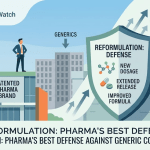
Reformulation is, by a considerable margin, the most capital-efficient defensive strategy against loss of exclusivity for a commercial-stage pharmaceutical company. The logic is direct: create a patent-protected successor product that offers a genuine clinical benefit, migrate the prescribing base before the original product goes generic, and allow the original to be commoditized by generic competition while defending revenue in the reformulation.
The cost of a reformulation program via the FDA’s 505(b)(2) pathway — which allows the manufacturer to reference the safety and efficacy data of the original drug while providing new clinical data for the specific modification — typically runs $8–20 million for standard extended-release or fixed-dose combination development. That figure is low relative to any blockbuster’s annual revenue but high enough that the decision requires advance planning. The 505(b)(2) regulatory and CMC process typically requires three to eight years. The optimal time to initiate a reformulation program is approximately four years before the primary patent expires, which allows for a product approval and launch at least 12 months before generic entry — providing time for market conversion.
The conversion time matters enormously. Physicians and payers need a clinical reason to prescribe the new formulation rather than the soon-to-be-commoditized original. Extended-release formulations that reduce daily dosing from twice-daily to once-daily have a credible patient compliance argument. Abuse-deterrent reformulations have public health arguments. Fixed-dose combinations with complementary agents have convenience and adherence arguments. The weakest reformulations — those that offer no meaningful clinical distinction from the original — face antitrust scrutiny under the ‘product hopping’ doctrine and may be the subject of FTC enforcement or private litigation if branded manufacturers use REMS programs or other mechanisms to impede generic substitution.
How Pfizer’s Lipitor Reformulation Attempts Played Out
Pfizer pursued two parallel reformulation strategies ahead of Lipitor’s November 2011 patent expiry. First, the company attempted to develop an OTC low-dose atorvastatin product, which would have required FDA approval via a different regulatory pathway and could have been marketed to patients seeking statin therapy without a prescription. The OTC program ultimately did not succeed in generating regulatory approval before Lipitor’s patent expired. Second, Pfizer developed a fixed-dose combination of atorvastatin with amlodipine, the calcium channel blocker in Norvasc, which was approved as Caduet. Caduet carved out a niche in patients requiring both a statin and an antihypertensive, but it did not capture a large enough share of the Lipitor prescribing base to meaningfully offset the revenue loss from atorvastatin’s genericization.
The lesson for commercial teams: reformulation success requires prescriber conversion to be substantially complete before generic entry, which requires a meaningful clinical differentiation story, enough time for the new formulation to achieve preferred formulary status, and a ‘soft switch’ strategy — actively transitioning patients to the new formulation well before the generic arrives. A reformulation approved six months before the primary patent expires has insufficient runway.
The OxyContin Polyethylene Oxide Reformulation as a Functional Technology Case
Purdue Pharma’s 2010 reformulation of OxyContin using high-molecular-weight polyethylene oxide as the abuse-deterrent matrix is the clearest example of a functional excipient serving as core technology — not as a processing aid but as the feature that defines the product’s commercial and regulatory positioning.
The original OxyContin controlled-release formulation could be defeated by crushing. The PEO-based reformulation creates a hard, nearly non-crushable tablet that, when attempts are made to dissolve it in water or ethanol for injection, hydrates into a viscous gel that cannot be drawn into a syringe. The FDA granted abuse-deterrent labeling to the reformulated OxyContin and later declined to grant that labeling to generic oxycodone ER products that did not use equivalent abuse-deterrent technology. This regulatory asymmetry — branded abuse-deterrent product with approved label claim, generic equivalents denied the same labeling — is the formulation-based moat that a well-executed 505(b)(2) program can construct.
Evergreening in Practice: How Secondary Patents Extend Effective Exclusivity Past Nominal Patent Expiry
Evergreening is not a unified strategy but a set of distinct legal maneuvers, each with different technical requirements, patent validity risks, and commercial lifetimes.
Polymorph patents cover specific crystalline forms of an active pharmaceutical ingredient. Atorvastatin calcium’s Form I polymorph was the subject of extensive litigation between Pfizer and generic manufacturers, who had to develop formulations using alternative polymorphic forms or demonstrate that their process produced Form I through a non-infringing manufacturing route. Polymorph patents are frequently challenged in inter partes review proceedings at the USPTO, where the non-obviousness bar for crystal form changes is often successfully attacked.
Enantiomer patents protect single-enantiomer versions of a racemic mixture. Citalopram (Celexa) was followed by escitalopram (Lexapro), the active S-enantiomer, with a separate patent estate. The migration from citalopram to escitalopram before citalopram’s patent expiry represents a textbook enantiomeric switch that extended Forest Laboratories’ exclusivity by years.
Method-of-use patents cover specific therapeutic applications of a drug. These patents do not prevent a generic manufacturer from filing an ANDA for the original approved indication, but they can prevent the generic from carving in the patented use to their label, and they can create prescriber-level inertia if the patented indication is the primary reason for prescribing. In oncology, where pembrolizumab and nivolumab have accumulated dozens of approved indications, method-of-use patents covering specific tumor types or combination regimens create a web of claims that any biosimilar developer must map against its intended label.
Fixed-dose combination patents require a generic applicant to develop a product containing both active ingredients in the correct ratio, validated for bioequivalence to both. Depending on whether the combination API is itself separately patented, the generic entry pathway can be substantially more complex than for a single-entity product.
What the FDA Paragraph IV Certification Process Looks Like From the Brand Side — and How Litigation Timing Affects Revenue Models
From the brand company’s perspective, a Paragraph IV notification letter is a litigation trigger. The company has 45 days to file a patent infringement suit and secure the 30-month stay. After the stay, the litigation proceeds through discovery, claim construction (Markman hearing), and trial or summary judgment on infringement and validity.
Brand companies win approximately 40%–50% of Paragraph IV litigations that go to a merits decision, though this figure varies significantly by patent type. Composition-of-matter patents tend to survive challenges at higher rates than formulation or method-of-use patents, which are more frequently found obvious or anticipated. The relatively high invalidation rate on secondary patents is the reason patent thickets work by volume: a brand does not need every secondary patent to survive litigation. It needs enough patents to create litigation risk, negotiation leverage, and delay. A generic challenger who must litigate 8–12 patents simultaneously faces a cost and timeline burden that may be greater than the present value of the first-filer exclusivity they would receive even if they won.
The interaction between multiple Paragraph IV filers and multiple settling parties creates secondary dynamics that are not intuitive. If six of eight generic filers settle on licensed entry dates of 2026, the two remaining litigants face a tactical shift: their potential win in litigation would produce a court-ordered earlier entry date, but the commercial value of winning — destroying the 2026 licensed entry date that competing settlers have already locked in — is complicated. At the same time, the collateral estoppel doctrine means that if one of those two remaining litigants wins a final judgment of patent invalidity, that judgment can bind the brand in subsequent litigation with other defendants. The downstream effects of a first-mover patent invalidation can cascade through all remaining pending ANDAs.
Revenue at Risk: How to Model the Financial Impact of Generic Entry
Standard revenue at risk modeling follows a sequential structure. Begin with peak pre-LOE revenue. Apply a generic market share curve driven by entrant count and timing. Model the authorized generic scenario as a binary — either deployed or not — and weight it by the brand company’s historical AG behavior. Apply therapy-area-specific erosion rates based on payer substitution patterns, formulary tier dynamics, and physician brand loyalty.
Several therapy-specific adjustments are consistently undermodeled in sell-side analysis. In anticoagulation (Eliquis, Xarelto), payer substitution pressure is high because the drugs are high-volume primary care prescriptions without significant physician brand attachment. In oncology (Keytruda, Opdivo, Ibrance), prescriber inertia is stronger and biosimilar uptake is historically slower. In chronic metabolic disease (Januvia, Jardiance), therapy class competition — GLP-1 receptor agonists displacing DPP-4 inhibitors — may accelerate market share erosion independent of generic entry, because patients may be switching from sitagliptin to semaglutide or tirzepatide for efficacy reasons before the sitagliptin generic even launches.
Pipeline replacement risk is the variable most often omitted from revenue-at-risk models. For Merck, the question is not only what happens to the $29.5 billion Keytruda franchise after 2028 — it is whether Winrevair (sotatercept, for pulmonary arterial hypertension) and other late-stage assets can generate enough new revenue to compensate. The gap between expiring revenue and new product revenue is the commercial viability test that determines whether a company can maintain its dividend, R&D budget, and market cap through the LOE window.
How the FDA’s Tentative Approval Process Signals Generic Entry Timing
A Tentative Approval is the FDA’s confirmation that a generic ANDA has met all scientific, manufacturing, and quality requirements for approval, with final marketing authorization withheld solely because of unexpired patents or active regulatory exclusivities. The TA is the single most actionable pre-launch signal available in the generic pharmaceutical intelligence landscape.
A TA removes all scientific and manufacturing uncertainty. It means the generic company has a validated formulation, approved manufacturing process, and passing bioequivalence. The only thing preventing them from launching is the legal and exclusivity clock. When that clock runs out — when the last relevant patent expires, when a settlement date is reached, when a court rules in the generic’s favor — they are ready to launch, not still in development.
For commercial planning teams tracking a specific molecule, the issuance of TAs to multiple applicants is a forward indicator of competitive intensity at first generic entry. If five companies have TAs in hand for a drug with a 2028 LOE date, the first day of competition is likely to be intensely competitive, with rapid price erosion driven by five players simultaneously seeking formulary access. If only one company has a TA, the initial entry may be a soft launch with more controlled pricing before subsequent competitors complete their ANDA reviews.
The FDA’s ANDA backlog has historically introduced unpredictability into the TA-to-launch timeline, though regulatory user fee programs and FDA’s Generic Drug User Fee Act (GDUFA) commitments have brought median ANDA review times from over 40 months in the early 2010s to under 12 months for standard ANDAs in recent years. This compression of review timelines means that a Paragraph IV filing and active litigation no longer provide the multi-year competitive cushion they once did simply from FDA processing delays.
The patent wars around semaglutide (Ozempic, Wegovy), tirzepatide (Mounjaro, Zepbound), and the broader GLP-1 receptor agonist class represent a different kind of competitive moat than the traditional patent thicket. These are peptide-based drugs manufactured through chemical synthesis or recombinant methods — not large biologic proteins like monoclonal antibodies, but structurally complex enough that the manufacturing process itself represents a barrier to generic entry independent of the patent estate.
Semaglutide’s primary patent position extends through the late 2020s in the U.S. The FDA approved a compounded semaglutide market during the shortage period, which created a legal and regulatory contested space that Novo Nordisk actively litigated. The broader question — what happens when semaglutide’s primary patents expire and generic manufacturers attempt to produce and market semaglutide tablets or injections — depends heavily on both the patent landscape and the manufacturing feasibility. Peptide synthesis at commercial scale, with consistent purity and the correct stereochemistry, is technically demanding. The number of contract manufacturers capable of supporting a competitive generic semaglutide supply chain at launch is currently limited.
Tirzepatide, Eli Lilly’s dual GIP/GLP-1 agonist, has a primary patent estate running into the early 2030s, providing a longer runway before generic entry considerations become commercially pressing. But the manufacturing complexity argument applies equally. In both cases, the effective competitive moat is a combination of patent protection and manufacturing difficulty — a two-layer defense that raises the barrier for generic entry even if individual patents are successfully challenged.
505(b)(2) Strategy: How Innovators Build Reformulation Patent Estates That Survive Paragraph IV Challenges
A 505(b)(2) NDA approval generates its own regulatory exclusivity — three years for a new clinical investigation, or five years for a new chemical entity if the reformulation involves a previously unapproved active moiety. More importantly, the formulation patents supporting the new product can be listed in the Orange Book and used to trigger 30-month stays against ANDA or competing 505(b)(2) applicants.
The originator’s expectation should be that a successful reformulation will face Paragraph IV challenges to its formulation patents, not just the original compound patents. ANDA filers will target the new product’s Orange Book-listed patents with the same rigor they applied to the original. Formulation patents are statistically more vulnerable to invalidity findings than composition-of-matter patents, particularly when the formulation involves combinations of known excipients in standard ratios, or when extended-release technology using established polymers is claimed without unexpected results.
Building a defensible 505(b)(2) patent estate requires claiming the formulation with sufficient specificity to cover the commercial product while filing continuation patents that cover process, use, and product-by-process claims around the core formulation. The OxyContin polyethylene oxide patent estate, which Purdue Pharma prosecuted with enough coverage to defeat multiple generic challenges, is a reference case for how formulation patent prosecution can produce a durable commercial barrier. Generic manufacturers who attempted to replicate the abuse-deterrent properties through alternative polymers were unable to secure FDA’s abuse-deterrent labeling, which meant their label explicitly disclaimed the deterrent properties that Purdue claimed — a commercial disadvantage that depressed their market share even after launch.
How Generic Companies Use Skinny Labels to Launch Before Method-of-Use Patent Expiry
A generic manufacturer does not need to carve out every approved indication from its label — only those covered by method-of-use patents listed in the Orange Book. If a method-of-use patent covers a specific indication that can be excised from the label without undermining the core indication for which bioequivalence was demonstrated, the generic can pursue a ‘skinny label’ strategy: file an ANDA for the non-patented indication, obtain approval with a label that excludes the patented method, and launch into the non-patented use.
The skinny label strategy has become increasingly important in oncology, where drugs accumulate new indications over their commercial life. A drug originally approved for one cancer type that subsequently obtains approvals for five additional types may have method-of-use patents covering two of those five additional indications. A generic applicant can file a skinny label ANDA for the original indication plus the three unpatented additional indications, launch when the primary patent expires, and leave the method-of-use-patented indications to the brand. The brand company’s countermeasure is to pursue induced infringement claims arguing that the generic’s label effectively induces prescribers to prescribe the drug for the patented indication even if not explicitly stated — a theory that has produced inconsistent results in the courts.
What Happens Financially After Loss of Exclusivity — The Standard Revenue Erosion Pattern
The revenue erosion curve after generic or biosimilar entry follows a characteristic pattern whose shape varies by therapy area, entrant count, and originator response, but whose general contours are predictable enough to support structured financial modeling.
For small-molecule oral drugs with three or more generic entrants, the following trajectory is typical: months one through six see the first-filer exclusivity period, during which the branded product retains 50%–70% of unit volume but begins losing price. Formulary positioning changes occur as pharmacy benefit managers renegotiate rebates. Months six through 18 see multiple generic entrants post-exclusivity, rapid price compression, and accelerated branded market share loss. Eighteen months to three years post-LOE, the branded product stabilizes at a sharply reduced volume — typically 10%–20% of pre-LOE levels — serving patients with specific clinical or compliance reasons to continue the branded version.
For biologics with biosimilar competition, the curve is shallower. Year one erosion is 30%–50% of volume. Year two through three erosion accumulates as payers adopt step-edit requirements and interchangeable biosimilars gain automatic substitution rights. Full equilibrium in biologic markets historically takes three to five years rather than one to two.
The practical revenue impact by drug type is material for earnings modeling. A branded small-molecule losing exclusivity in Q1 of a given year will show year-on-year revenue decline in that segment of 50%–70% by Q4. A branded biologic will show 20%–40% decline in year one of biosimilar entry. A branded biologic in a specialty indication (cancer, rare disease) with no interchangeable biosimilar may show minimal decline in year one and gradual erosion thereafter.
Which Competitors Could Benefit from Keytruda LOE in 2028
Merck’s current dominance of the PD-1 checkpoint inhibitor market in oncology will face its most direct structural challenge when the pembrolizumab patent estate begins to thin in 2028. The direct beneficiaries fall into two categories: biosimilar developers targeting pembrolizumab itself, and branded competitors already on the market.
On the biosimilar side, Samsung Bioepis, Celltrion, and other experienced biosimilar manufacturers with established PD-1 antibody manufacturing capabilities were among the developers reportedly tracking pembrolizumab development programs in the 2024–2025 period. Biosimilar pembrolizumab would need to demonstrate analytical similarity and equivalence in PK bridging studies, and interchangeability designation would require an additional switching study. Given the size of the market, the development investment is straightforwardly justified.
On the branded competitor side, BMS’s nivolumab (Opdivo) benefits indirectly from any erosion of Keytruda’s formulary dominance in tumor types where both agents are approved. AstraZeneca’s durvalumab (Imfinzi) and Roche/Genentech’s atezolizumab (Tecentriq) are alternatives in specific indications. In the combination context, where pembrolizumab is approved with dozens of chemotherapy or targeted therapy partners, the biosimilar landscape complicates but does not eliminate combination demand, because the combination partner may be separately protected.
Common Investor Questions About the Patent Cliff
Q: Does a drug lose all revenue protection on the day its primary patent expires?
No. The composition-of-matter patent is the most fundamental protection but not the only one. Secondary patents, regulatory exclusivities (NCE, orphan drug, pediatric exclusivity, biologics’ 12-year exclusivity), and the Hatch-Waxman 30-month stay can all extend effective market exclusivity beyond the primary patent date. The question for investors is not when the primary patent expires but when the first generic or biosimilar achieves full commercial scale, which is a function of litigation outcomes, settlement terms, and FDA approval status.
Q: How do authorized generics affect first-filer economics?
An authorized generic launched by the brand during the first-filer’s 180-day exclusivity period reduces the first-filer’s revenue by approximately 40–52%, according to the FTC’s 2011 analysis. This has a direct effect on generic manufacturer ROI calculations and affects their willingness to litigate versus settle. For brand companies, the AG decision is a balance: deploying an AG captures revenue during the exclusivity window but potentially reduces the settlement value they can extract from first-filers who will accept earlier entry in exchange for no-AG commitments.
Q: What is the difference between Orange Book patent expiry and effective exclusivity?
Orange Book patent expiry is the nominal date on which a listed patent expires. Effective exclusivity is the date on which the first generic can legally and commercially launch at scale. The gap between the two is determined by litigation outcomes, settlement terms, remaining regulatory exclusivities, and manufacturing readiness. For some drugs, effective exclusivity extends years past the last Orange Book patent expiry date. For others — where all patents are successfully challenged or where no patents are listed beyond the NCE exclusivity period — effective exclusivity ends on or before the nominal date.
Q: How quickly does price fall after generic entry?
FDA data shows a 39% average wholesale price decline with one generic competitor and a 79% decline with four competitors. These figures reflect wholesale acquisition cost; net realized price after rebate adjustments can differ. In highly competitive generic markets with six or more entrants, WAC can decline more than 90% within 24 months of first entry.
Q: What happens to a biosimilar’s prospects if the reference product is reformulated?
A biosimilar approved to reference the IV formulation of a biologic is not automatically biosimilar to a new subcutaneous formulation. If the brand migrates patients to a subcutaneous version before IV biosimilars launch, the biosimilar enters a shrinking market. Biosimilar developers must either develop separate biosimilar programs for the new formulation (requiring new analytical and clinical work) or compete for the remaining IV patient population. This dynamic is directly relevant to Merck’s Keytruda Qlex subcutaneous strategy.
What Investors Are Watching Through 2030
The near-term investor focus is concentrated on a handful of overlapping data points. The pace of Keytruda Qlex subcutaneous adoption ahead of 2028 is Merck’s primary defense variable and the most closely watched lifecycle management execution in the industry right now. BMS’s ability to close its $38 billion growth gap — through Revlimid replacement, new molecular entities in oncology and immunology, or M&A — determines whether the company’s stock recovers from what analysts already describe as the steepest proportional patent cliff among large-cap peers.
AbbVie’s post-Humira trajectory is the template others are studying. The company successfully transitioned its immunology franchise from adalimumab to risankizumab (Skyrizi) and upadacitinib (Rinvoq) through a combination of clinical differentiation, commercial conversion programs, and patient support infrastructure that shifted prescribers before biosimilar entry eroded the base. Revenue diversification ahead of LOE, not reactive pipeline acquisition after it, is what preserved AbbVie’s commercial position.
For portfolio managers, the IRA’s drug price negotiation mechanism introduces a new variable that interacts with patent status. CMS’s selection of drugs for negotiation has prioritized high-spend, no-competition products — primarily those with long exclusivity periods and no generic or biosimilar competitors. A drug whose primary patent is set to expire in three years and for which multiple Paragraph IV filings have been made presents a different negotiation risk profile than a drug with a clean 10-year exclusivity runway. The IRA’s negotiated prices apply for the period up to LOE, after which market competition takes over. For drugs approaching LOE, the negotiation window may be short enough that the financial impact is limited, but the precedent effect on drug pricing during the last years of exclusivity is real.
Key Takeaways
The patent cliff reaching peak intensity through 2025–2030 is the largest single-period revenue exposure event in pharmaceutical history by most estimates, with $230–$300 billion in U.S. branded revenue at risk across a four-year window. The exposure is concentrated in a small number of assets: Keytruda, Eliquis, Opdivo, Ibrance, Xtandi, and Xarelto together account for a disproportionate share of total at-risk revenue.
Nominal patent expiry dates are starting points for analysis, not conclusions. Effective exclusivity dates are determined by the Orange Book secondary patent estate, Paragraph IV litigation outcomes, settlement terms, and the deployment of 30-month stays. Biosimilar entry for large biologics follows shallower and slower erosion curves than small-molecule generics, but biosimilar competition is structurally inevitable once composition-of-matter protection ends.
Reformulation via the 505(b)(2) pathway remains the highest-return LOE defense for commercial-stage companies with sufficient lead time, typically requiring initiation at least four years before primary patent expiry. The 505(b)(2) approval generates independent regulatory exclusivity and new Orange Book-listable patents that can trigger additional 30-month stays against subsequent generic challengers.
The 180-day first-filer exclusivity under Hatch-Waxman is the primary profit mechanism in generic pharmaceuticals and converts Paragraph IV certification into a competitive intelligence operation. Brand companies counter with authorized generics, 30-month stay litigation, settlement terms that stage entry dates, and reformulation-based patient migration programs. The interaction between these tactics determines the actual revenue timeline with more precision than nominal patent expiry dates alone.
For investors, the questions that matter are whether pipeline assets can fill the revenue gap created by the LOE window, whether lifecycle management programs are far enough advanced to migrate patients before the original formulations commoditize, and whether the settlement terms extracted from generic challengers provide sufficient runway for commercial transition. The companies that manage this transition well are the ones that started their reformulation programs four years ago.
Analysis based on publicly available patent, regulatory, and commercial data. Patent expiry dates, revenue figures, and litigation timelines are subject to change based on court decisions, settlements, and regulatory actions. This article does not constitute investment advice.