The pharmaceutical industry has long operated under a unique social contract: invest billions in high-risk research and development (R&D), and in return, enjoy a period of market exclusivity allowing for unrestricted pricing power. For decades, this model held firm. A manufacturer could determine a Wholesale Acquisition Cost (WAC) based largely on demand elasticity and comparative clinical value, secure in the knowledge that the patent system would provide a fortress against competition and that payers, fragmented and legally constrained, would largely accept the price.
That era is dead.
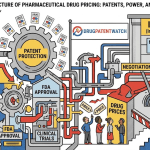
We have entered a period of structural dislocation where the mechanics of value capture are being rewritten by three converging forces: the unprecedented intervention of the U.S. federal government through the Inflation Reduction Act (IRA), the consolidation of Pharmacy Benefit Managers (PBMs) into vertically integrated healthcare gatekeepers, and the weaponization of intellectual property data by generic and biosimilar challengers. The traditional correlation between clinical efficacy and commercial success is fracturing. Today, a drug’s profitability is determined less by its molecule and more by its pricing architecture—its ability to navigate the “gross-to-net” bubble, withstand government price setting, and utilize defensive patent strategies to preserve exclusivity.
For the pharmaceutical executive, the general counsel, or the life sciences investor, the strategic imperative has shifted from simple “market access” to complex “market domination.” Domination in 2025 does not mean merely having the best drug; it means constructing a pricing model that can survive the attrition of mandatory rebates, the ceiling of the “Maximum Fair Price” (MFP), and the exclusionary tactics of intermediaries.
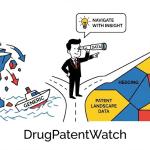
This report decodes these opaque mechanisms. It moves beyond the surface-level rhetoric of “lowering drug costs” to analyze the granular economic realities driving the industry. From the actuarial implications of the IRA’s “non-FAMP” ceiling to the rise of the “Netflix” subscription model for antibiotics, we examine the data to reveal how smart capital is adapting. Central to this analysis is the role of competitive intelligence; utilizing platforms like DrugPatentWatch to transform static patent data into dynamic strategic foresight is no longer optional—it is the baseline for survival.
The Regulatory Leviathan: The Inflation Reduction Act and the Mechanics of Price Setting
The passage of the Inflation Reduction Act (IRA) represents the most significant alteration to the U.S. pharmaceutical market since the Hatch-Waxman Act of 1984. By granting the Centers for Medicare & Medicaid Services (CMS) the authority to negotiate prices directly with manufacturers, the legislation has effectively nationalized the pricing curve for the industry’s most successful assets. This is not negotiation in the commercial sense; it is the imposition of a statutory price ceiling, backed by an excise tax so punitive—up to 1900% of daily revenues—that it functions as a mandatory directive.1
The Architecture of Negotiation
The strategic implications of the IRA are found in its selection criteria and its timing. The law targets “high-spend” drugs that have enjoyed market exclusivity for extended periods without generic or biosimilar competition: seven years for small molecule drugs and eleven years for biologics.1
This distinction creates a profound distortion in R&D incentives, known as the “pill penalty.” Because small molecules (typically oral solids) face negotiation four years earlier than large molecule biologics (typically injectables), the Net Present Value (NPV) of a small molecule program is structurally lower. Investors and portfolio managers are reacting rationally by shifting capital allocation toward biologics, which offer a longer runway of free pricing before the government cap descends. Evidence suggests a decline in small molecule trial initiations as the market prices in this legislative risk.4
The Non-FAMP Ceiling and the “Maximum Fair Price”
The term “negotiation” implies a meeting of minds, but the IRA prescribes a rigid ceiling for the “Maximum Fair Price” (MFP). This ceiling is calculated as a percentage of the Non-Federal Average Manufacturer Price (non-FAMP)—a pricing benchmark previously used primarily by the Department of Veterans Affairs and the Department of Defense.6
The non-FAMP is a wholesaler price metric that excludes federal sales but includes commercial discounts. By tying Medicare reimbursement to the non-FAMP, the IRA effectively imports the aggressive discounting dynamics of the commercial sector into the Medicare program, and then applies a further statutory discount (ranging from 25% to 60% depending on the drug’s vintage).
Table 1: The First Cycle of Negotiation (2026 Implementation)
The first cycle of negotiation, concluded in August 2024 with prices effective January 1, 2026, targeted ten drugs representing over $50 billion in gross Medicare Part D spending. The selection reveals the government’s strategy: target high-volume chronic care medications where volume accumulation drives total spend, regardless of the individual unit price.7
Selected Drug
Indication
Manufacturer
Gross Part D Spend (2022-2023)
Strategic Implication
Eliquis
Anticoagulant
BMS / Pfizer
$16.5 Billion
High-volume chronic use creates a massive target; negotiation establishes a class-wide price anchor.
Jardiance
Diabetes/HF
Boehringer Ingelheim / Lilly
$7.1 Billion
SGLT2 inhibitors face pressure; overlap with Farxiga creates competitive compression.
Xarelto
Anticoagulant
Janssen
$6.0 Billion
Direct competitor to Eliquis; simultaneous negotiation prevents patient shifting to avoid caps.
Januvia
Diabetes
Merck
$4.1 Billion
Mature product near patent cliff; IRA acts as an accelerant to revenue decline.
Farxiga
Diabetes/HF
AstraZeneca
$3.3 Billion
Demonstrates CMS intent to cap entire therapeutic classes simultaneously.
Entresto
Heart Failure
Novartis
$2.9 Billion
Critical growth driver for Novartis; negotiation disrupts the cardiovascular franchise lifecycle.
Enbrel
Autoimmune
Amgen
$2.8 Billion
Long-standing biologic; negotiation serves as a pseudo-biosimilar entry mechanism.
Imbruvica
Oncology
AbbVie / Janssen
$2.7 Billion
Signals that oncology—traditionally protected by “protected class” status—is vulnerable.
Stelara
Autoimmune
Janssen
$2.6 Billion
Negotiation precedes biosimilar entry, lowering the baseline for future biosimilar pricing.
Fiasp/NovoLog
Diabetes
Novo Nordisk
$2.6 Billion
Insulin pricing was already politically capped; IRA formalizes the structural decline.
The Second Wave: The GLP-1 Confrontation
If the first cycle was a warning shot, the second cycle (for 2027 implementation) is a direct assault on the pharmaceutical industry’s primary growth engine: the GLP-1 receptor agonists for diabetes and obesity. On January 17, 2025, CMS selected Ozempic, Wegovy, and Rybelsus (all Novo Nordisk) for negotiation.1
This move is critical. These drugs are not merely treatments; they are cultural phenomena with immense commercial demand. By selecting them, CMS is signaling that high consumer demand will not protect a drug from price controls; in fact, it ensures selection. For Novo Nordisk, and inevitably Eli Lilly (whose Zepbound will follow), the negotiation introduces a “reference anchor.” Even though the MFP applies technically only to Medicare, private payers and PBMs will leverage this public government price to demand deeper rebates in the commercial market. If the government declares Wegovy is “worth” $400, it becomes exceedingly difficult to charge a commercial plan $1,000.11
Industry Insight: “Net unit pricing of semaglutide and tirzepatide in the obesity-labeled Wegovy and Zepbound are approximately 1.5–2.8-times higher than the price for the same molecules in the brands Ozempic and Mounjaro… Current pricing levels are buttressed by a system that unreasonably delays generic competition.” — PMC Article 12403326.12
Strategic Response: Litigation and Data Defense
The industry has responded with a barrage of litigation, arguing that the IRA violates the Takings Clause of the Fifth Amendment and the compelled speech doctrine of the First Amendment.6 However, executives cannot rely on the courts to save the P&L. The practical response has been a massive pivot in data strategy.
Because the IRA allows for price adjustments based on “unmet medical need” and “comparative effectiveness,” companies are now building evidence dossiers years in advance. They are not just proving a drug is safe and effective for the FDA; they are generating health economic outcomes data to prove it is financially efficient for CMS. This requires a seamless integration of R&D and Market Access teams—silos that previously operated independently.13
The Intermediary Squeeze: Pharmacy Benefit Managers and the Gross-to-Net Bubble
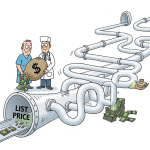
While the government applies pressure from the top, the pharmaceutical value chain is being hollowed out from the middle by Pharmacy Benefit Managers (PBMs). These entities, originally designed to process claims, have evolved into vertical monopolies that control patient access. The result is the “gross-to-net bubble”—a pricing distortion where list prices (WAC) skyrocket to fund rebates, while net prices (what manufacturers actually earn) remain flat or decline.
Anatomy of a $356 Billion Distortion
In 2024, the gross-to-net bubble reached an estimated $356 billion.14 This figure represents the total value of rebates, discounts, and fees paid by manufacturers to PBMs and supply chain intermediaries.
The mechanism is perverse. PBMs often retain a portion of the rebate or charge administrative fees calculated as a percentage of the WAC. Consequently, PBMs have a financial incentive to prioritize drugs with higher list prices and higher rebates over drugs with lower list prices and no rebates. This is the “rebate wall.” A biosimilar launching with a 50% lower list price but no rebate is often blocked from the formulary because it generates less revenue for the PBM than the expensive incumbent.16
Vertical Integration: The Closed Loop
The market is dominated by three entities—CVS Caremark (CVS Health), Express Scripts (Cigna), and Optum Rx (UnitedHealth Group)—which collectively manage 80% of U.S. prescriptions.18 This consolidation has morphed into vertical integration. CVS is not just a PBM; it is a pharmacy (CVS Pharmacy), an insurer (Aetna), and now, a manufacturer (Cordavis).
This integration allows the PBM to operationalize “exclusionary contracting.” By threatening to exclude a manufacturer’s blockbuster drug from the national formulary (cutting off access to 100 million lives), the PBM can extort massive rebates. For 2025, these entities have excluded hundreds of products, effectively forcing manufacturers to pay a toll for market access.18
The Private Label Pivot: Cordavis and Quallent
The most sophisticated evolution in 2024-2025 is the rise of the “Private Label” PBM model. Realizing that the gross-to-net bubble is under political scrutiny (from the FTC and Congress), PBMs have found a new way to capture value: becoming the manufacturer.
Case Study: CVS Cordavis
In 2024, CVS Health launched Cordavis, a subsidiary that co-manufactures a biosimilar of Humira (adalimumab) in partnership with AbbVie.19 CVS Caremark then removed the branded Humira from its major commercial formularies and replaced it with the Cordavis version.
This is a masterstroke of vertical value capture. CVS collects the manufacturing margin (via Cordavis) and the dispensing margin (via CVS Pharmacy) and controls the formulary decision (via CVS Caremark). The revenue that used to flow to AbbVie as brand premium now flows to CVS as manufacturing revenue. For AbbVie, it is a defensive concession: better to split the revenue with CVS via Cordavis than to lose the volume entirely to a third-party competitor.20
Express Scripts followed suit with Quallent, its own private label distributor, ensuring that the margin stays in-house.21 The implication for other manufacturers is chilling: you are no longer competing just against other pharma companies; you are competing against your customer.
Intellectual Property as Competitive Terrain: The Art of the Patent Defense
In this hostile environment, Intellectual Property (IP) is the only reliable shield. However, the days of relying on a single composition-of-matter patent are over. Today’s IP strategy involves constructing “patent thickets,” executing “product hops,” and utilizing “authorized generics” to manage the decline of an asset.
The Patent Thicket: Building the Fortress
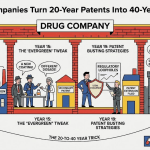
A patent thicket involves filing overlapping patents on every aspect of a drug: its chemical synthesis, its formulation (e.g., extended release, citrate-free), its delivery device (e.g., auto-injector pen), and its methods of use for specific indications. This forces a generic challenger to win not just one lawsuit, but dozens.
Critics label this “evergreening,” but it is a rational response to the high cost of capital. By extending exclusivity, companies can amortize the $2.23 billion cost of development over a longer period.22 The goal is to create a “freedom to operate” minefield that delays generic entry by years, if not decades.
Product Hopping: The Strategic Switch
As a patent cliff approaches, manufacturers often deploy “product hopping.” This involves introducing a slightly modified version of the drug—such as a once-daily formulation to replace a twice-daily one—and shifting patients to the new product before the generic launches for the old one.23
Hard Switch: The manufacturer withdraws the old drug from the market entirely, forcing patients to switch to the new, patent-protected version.
Soft Switch: The manufacturer stops marketing the old drug and offers aggressive rebates or copay assistance to move patients to the new one.
This strategy is effective but legally risky. The FTC is increasingly scrutinizing “hard switches” as anticompetitive conduct, viewing the withdrawal of a viable product solely to block generics as a violation of antitrust law.23
The Authorized Generic (AG): Tactical Market Splitting
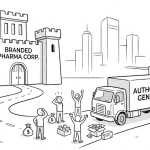
When generic entry is unavoidable, the “Authorized Generic” is the incumbent’s most powerful tactical weapon. An AG is the brand company’s own drug, manufactured on the same lines, but sold under a generic label. Because it is approved under the original NDA, it does not need a separate Abbreviated New Drug Application (ANDA).25
Crucially, an AG can be launched during the 180-day exclusivity period awarded to the first independent generic filer (the “first-to-file”). This 180-day window is the primary financial incentive for generic companies to challenge patents. By launching an AG, the brand company floods the market, splitting the volume and crashing the price immediately. Data indicates that an AG launch reduces the first-to-file generic’s revenue by 40-52% during this critical window.27
Leveraging DrugPatentWatch for Strategic Intelligence
To navigate this terrain, relying on the FDA’s Orange Book is insufficient. The Orange Book lists approved drugs and patents, but it lacks the dynamic context required for strategy. Competitive intelligence teams must utilize specialized platforms like DrugPatentWatch to anticipate these moves.
Strategic Workflow with DrugPatentWatch:
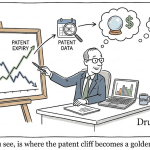
Exclusivity Stacking Analysis: A user can map the “exclusivity stack” of a competitor. The platform visualizes not just the primary patent, but the secondary patents (formulation, method of use) that extend protection. This reveals whether a “patent cliff” is a steep drop or a gentle slope.29
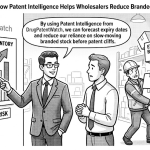
Litigation Forecasting: By tracking Paragraph IV certifications and court dockets, DrugPatentWatch serves as an early warning system. A sudden cluster of patent challenges against a key asset is a leading indicator of generic interest and potential settlement talks. This allows business development teams to model “at-risk” revenue years before a generic actually launches.31
505(b)(2) Opportunity Scouting: For companies looking to enter a market without the risk of novel drug discovery, DrugPatentWatch helps identify drugs with expiring patents that are suitable for the 505(b)(2) pathway—reformulating an existing drug (e.g., turning an IV drug into a nasal spray) to gain new exclusivity.32
Case Study: The Humira Singularity
No asset illustrates the convergence of these forces—IP defense, PBM power, and biosimilar strategy—more perfectly than Humira (adalimumab). AbbVie’s management of this asset is the definitive case study in modern pharmaceutical dominance.
The Fortress Strategy (2016-2023)
Humira’s primary composition of matter patent expired in 2016. In a free market, competition would have arrived immediately. Instead, AbbVie constructed a thicket of over 100 patents covering formulations and manufacturing processes. Through litigation and settlements, they successfully delayed biosimilar entry in the U.S. until 2023—a seven-year extension that generated over $100 billion in additional revenue.34
The PBM Firewall (2023)
When biosimilars finally launched in 2023, the industry anticipated a price collapse. It didn’t happen. Despite nine competitors launching, Humira retained over 97% market share throughout 2023.35
The reason was the rebate wall. AbbVie signaled to PBMs that if they moved Humira to a non-preferred tier, the massive volume-based rebates would vanish. PBMs, addicted to these rebates, kept the high-priced Humira on the formulary and blocked the lower-priced biosimilars. This demonstrated that in the U.S. system, price competition can actually be a disadvantage if it reduces the rebate stream to the intermediary.
The Private Label Shift (2024-2025)
The endgame arrived not through open competition, but through vertical integration. In April 2024, CVS Caremark removed branded Humira from its major formularies—but only to replace it with its own co-branded version, Cordavis Humira.19
This broke the dam. AbbVie retained the manufacturing volume (supplying Cordavis), but lost the brand premium. CVS captured the margin. By 2025, other PBMs followed, effectively converting the world’s biggest drug into a private-label commodity. The lesson for the industry is stark: you can delay the cliff with patents, but eventually, the channel (the PBM) will consume the margin.
Beyond the Unit: Alternative Pricing Architectures
As the “unit price” model breaks down under the weight of the IRA and PBMs, the industry is experimenting with models that decouple revenue from the volume of pills dispensed.
The “Netflix” Subscription Model
In a subscription model, a payer pays a flat annual fee for unlimited access to a therapy. This creates certainty for the payer (fixed budget) and the manufacturer (guaranteed revenue), while removing the marginal cost barrier to treatment.
Louisiana’s Hepatitis C Success:
Louisiana faced a crisis with Hepatitis C. The cure (Direct Acting Antivirals) existed but was too expensive to provide to the state’s Medicaid and prison populations. In 2019, the state struck a “Netflix” deal with Asegua (a subsidiary of Gilead). The state paid a fixed subscription fee, and in return, received unlimited access to the drug for five years.38
Result: Treatment rates skyrocketed. Prescription fills increased by 534%.39 The state eliminated the disease in key populations without bankrupting its budget, and Gilead secured a monopoly in the state.
UK’s Antimicrobial Resistance (AMR) Model:
The UK National Health Service (NHS) applied this to antibiotics. New antibiotics are commercially unviable because they must be held in reserve for “superbugs,” meaning sales volume is intentionally low. The NHS created a subscription model where companies like Pfizer and Shionogi receive up to £10 million annually as a “availability fee,” regardless of how many doses are used.40 This decouples profit from volume, incentivizing the development of drugs that society needs but the market fails to reward.
Value-Based Contracting (VBP)
VBP links payment to clinical results. This is essential for cell and gene therapies with astronomical headline prices.
Zolgensma (Novartis):
With a price tag of $2.1 million for a one-time gene therapy for Spinal Muscular Atrophy (SMA), Zolgensma was financially toxic to payers. Novartis structured a VBP model with two key features:
Pay-over-time: The cost is amortized over five years.
Outcomes-based risk: If the patient dies or requires permanent ventilation (indicating the drug failed), the future payments are waived.42 This structure converts a massive capex risk into an manageable operational expense for the payer.
The Role of Artificial Intelligence in Pricing
The complexity of these models—managing rebates, statutory ceilings, international reference prices, and value-based outcomes—exceeds human processing capacity. Artificial Intelligence (AI) has moved from a buzzword to an operational necessity in pricing strategy.
Algorithmic Price Optimization
Companies like Model N and Prospection are deploying AI to optimize global pricing governance.
Model N utilizes AI to manage “revenue leakage.” By analyzing millions of contract lines, it ensures that a discount given to a small hospital group doesn’t accidentally trigger a “Best Price” violation for Medicaid, which could cost the company millions in statutory rebates.44
Prospection uses AI to analyze longitudinal patient data. It can identify exactly where patients drop off therapy, allowing manufacturers to intervene. More importantly, it models “International Reference Pricing” (IRP) ripples. The AI can simulate: “If we lower the price in Germany by 5%, how will that impact our reference price in Japan, Canada, and Saudi Arabia?”.46
This predictive capability allows firms to sequence their global launches to maximize the “price corridor,” launching in high-price markets first and delaying low-price markets to protect the global average.
Financial Implications: R&D, ROI, and the Bifurcation of Capital
Ultimately, pricing determines the viability of innovation. The current environment is creating a sharp bifurcation in the industry.
The Rising Cost of Complexity
The average cost to develop a new drug has risen to $2.23 billion in 2024, driven by longer timelines and higher failure rates in complex disease areas.22 Yet, paradoxically, the industry’s Internal Rate of Return (IRR) rose to 5.9% in 2024.48
The GLP-1 Distortion
This rise in ROI is almost entirely driven by the GLP-1 class (obesity). When these blockbuster assets are removed, the rest of the industry faces declining returns. This is driving a “capital flight” toward metabolic disease and biologics (which have 13 years of IRA exemption) and away from small molecule treatments for acute conditions (which have only 9 years).4 The “pill penalty” of the IRA is actively reshaping the pipeline, incentivizing injectables over pills—a case of regulatory policy driving scientific direction.
Conclusion: The Strategic Architect
The pharmaceutical market of 2025 is unforgiving to the naive. The “market domination” referenced in this report is not achieved solely through scientific breakthrough. It is achieved by the Strategic Architect—the leader who can synthesize regulatory navigation, IP defense, and innovative contracting into a cohesive whole.
The winners will be those who:
Master the IRA: By accelerating commercial uptake in the first 7 years to maximize revenue before the negotiation ceiling hits.
Bypass the PBM: By utilizing private-label partnerships or direct-to-patient subscription models.
Weaponize Intelligence: By using DrugPatentWatch to foresee patent cliffs and litigation risks before they become public crises.
Decouple from Volume: By embracing subscription and value-based models that align revenue with public health value rather than pill counts.
In this new era, pricing is not a number; it is a strategy. And it is the most important strategy you have.
Key Takeaways
The IRA “Pill Penalty” Reshapes R&D: Small molecule drugs face price negotiation 4 years earlier than biologics (9 years vs. 13 years post-approval). This actuarial reality is driving capital away from oral medications and toward injectables/biologics, fundamentally altering the future drug pipeline.
The PBM “Private Label” Endgame: The Humira case study proves that biosimilar competition fails when PBMs control the channel. The future is “private label” intermediaries (Cordavis, Quallent) where PBMs co-opt the manufacturing margin. Manufacturers must partner with or bypass these gatekeepers.
Subscription Models Solve the Volume Paradox: The “Netflix” model (Louisiana Hep C, UK Antibiotics) successfully decouples revenue from volume. This is the only viable commercial model for “public health” assets like antibiotics or curative gene therapies where volume is low or capped.
Authorized Generics are the Ultimate Defense: Launching an Authorized Generic (AG) during a challenger’s 180-day exclusivity window creates a ” scorched earth” scenario, reducing challenger revenue by ~50%. This tactic, tracked via DrugPatentWatch, is the primary tool for managing the patent cliff.
The $356 Billion Bubble is Leaking: The gross-to-net bubble has hit its peak. Regulatory scrutiny and the removal of the Medicaid rebate cap are forcing list prices down, signaling a slow but painful transition to a net-price market.
FAQ: Strategic Insights
Q1: How does the “Authorized Generic” strategy specifically defeat the 180-day exclusivity period for first-to-file generics?
A1: When a generic company wins a patent challenge, they are granted 180 days of market exclusivity where no other independent generic can launch. However, an Authorized Generic (AG) is not a “new” generic; it is the brand company’s own approved drug with a different label. Therefore, it is legally permitted to launch during that 180-day window. This splits the market volume, typically cutting the challenger’s potential revenue by half, discouraging future challenges and preserving the brand’s revenue stream.25
Q2: Why didn’t the launch of 9+ Humira biosimilars in 2023 immediately crash the price?
A2: The PBM rebate wall. PBMs earn significant revenue from the rebates paid on the high list price of branded Humira. Switching to a low-cost biosimilar would have eliminated that revenue stream for the PBM. It wasn’t until CVS Caremark implemented a “private label” strategy (Cordavis)—allowing them to capture the economics of the biosimilar itself—that the market shifted. PBMs prioritize their own margin over the lowest net cost to the patient.35
Q3: What is the “Non-FAMP” ceiling in the Inflation Reduction Act, and why does it matter?
A3: The IRA states that the negotiated “Maximum Fair Price” cannot exceed a certain percentage (40-75% depending on drug age) of the Non-Federal Average Manufacturer Price (non-FAMP). Non-FAMP is a wholesaler price metric previously used only by the VA. By tying Medicare pricing to this benchmark, the IRA imports deep commercial and federal discounts into the Medicare program, effectively setting a hard price ceiling well below commercial rates.6
Q4: Can Artificial Intelligence really predict drug pricing outcomes?
A4: Yes, specifically regarding global ripple effects. Platforms like Model N and Prospection use AI to model “International Reference Pricing” (IRP). They can simulate scenarios like: “If we launch in Germany at €100, how will that impact our reference price in Japan and Canada next year?” This allows companies to optimize their global launch sequence to protect the average price.44
Q5: What is the “Gross-to-Net Bubble” and why is it estimated at $356 billion?
A5: The gross-to-net bubble is the difference between the list price (WAC) of drugs and the net price manufacturers actually receive. The $356 billion represents the total value of rebates, discounts, and fees paid to intermediaries (PBMs, wholesalers) in 2024. This money funds the PBM system but often results in higher out-of-pocket costs for patients, whose coinsurance is often based on the inflated list price rather than the net price.14
The Inflation Reduction Act and Drug Development: Potential Early Signals of Impact on Post-Approval Clinical Trials – PMC – PubMed Central, accessed January 18, 2026, https://pmc.ncbi.nlm.nih.gov/articles/PMC12181196/
Medicare Drug Price Negotiation Under the Inflation Reduction Act: Industry Responses and Potential Effects | Congress.gov, accessed January 18, 2026, https://www.congress.gov/crs-product/R47872
Affordable access to GLP-1 obesity medications: strategies to guide market action and policy solutions in the US – PMC – NIH, accessed January 18, 2026, https://pmc.ncbi.nlm.nih.gov/articles/PMC12403326/