Section 1: What an Authorized Generic Actually Is (And Why Definitions Matter for Deal Modeling)
1.1 The Core Definition
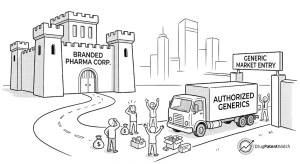
An authorized generic (AG) is a branded drug marketed without its brand name. The active ingredient, formulation, dosage form, strength, route of administration, and manufacturing process are identical to the reference listed drug (RLD). The only practical difference visible to the pharmacy buyer is the label. The FDA’s definition is explicit: an AG is a listed drug sold by the NDA holder or its agent under a different labeling, including a different trade name.
That definition carries significant financial and legal weight. Because an AG is sold under the original New Drug Application rather than through an Abbreviated New Drug Application filed by an independent generic manufacturer, it bypasses the ANDA review entirely. It does not require a separate bioequivalence study. It does not go through FDA’s standard ANDA review queue. It is not listed in the Orange Book as a separate product. And it can be launched the day a brand company decides to launch it, with no FDA approval timeline standing between the decision and the market.
That absence of regulatory friction is the AG’s primary strategic attribute.
1.2 Why Precise Definitions Matter for Financial Modeling
Generic manufacturers, payer analysts, and portfolio managers routinely underestimate the AG threat in their revenue forecasting models because they conflate AG launch timing with ANDA approval timing. These are entirely different clocks.
An ANDA approval for a first-filing Paragraph IV challenger typically requires 30 months of litigation plus 18 to 36 months of FDA review queue time from filing to tentative approval. An AG has none of that lag. A brand company with an AG partner already contracted can put product on shelves within days of a court decision or patent expiration. The financial implications of this timing difference are quantifiable: the FTC’s 2011 report documented that 73.9% of authorized generics launched within 30 days of the first traditional generic’s market entry. That is not a coincidence. It reflects pre-planned logistics, pre-signed distribution agreements, and pre-positioned inventory.
Any revenue forecast for a first-filing generic that treats “Day 1 of exclusivity” as a period of limited competition is almost certainly wrong for any drug where the brand has an economic motive to deploy an AG.
Key Takeaways: Section 1
An AG is sold under the original NDA, bypasses ANDA review entirely, and faces no FDA approval queue. It can enter a market on any timeline the brand company chooses.
73.9% of AGs launched within 30 days of the first traditional generic’s market entry. That is pre-planned execution, not reactive competition.
Financial models that treat a first-filer’s 180-day exclusivity window as low-competition are systematically wrong for any drug where the brand has an AG deployed or contracted.
Section 2: The Regulatory Mechanics: NDA, ANDA, Orange Book Listing, and the Pathway Gap
2.1 The NDA vs. ANDA Pathway: A Structural Advantage
The Hatch-Waxman Act of 1984 created the ANDA pathway as a mechanism to encourage generic entry while preserving innovator incentives. The Act’s core provision, the 180-day first-filer exclusivity for successful Paragraph IV patent challengers, was designed to compensate generic manufacturers for the risk and cost of patent litigation. That incentive structure only works if the 180-day exclusivity period is meaningfully exclusive.
An authorized generic systematically undermines that exclusivity. The AG enters the market using the original NDA, a document that predates the entire Hatch-Waxman framework and sits outside its competitive architecture. The 180-day exclusivity blocks the FDA from granting ANDA approvals to other traditional generic manufacturers during that window. It does not and cannot block the NDA holder from selling its own product, in any formulation or under any label, including no brand name at all. The AG is legally invisible to the Hatch-Waxman exclusivity provision.
That legal invisibility is not an accident or oversight. Courts have uniformly held that the 180-day exclusivity statute does not restrict brand manufacturers from selling their own product. The AG is simply the brand company exercising its preexisting NDA rights. What Hatch-Waxman created as a reward for patent challenges becomes, in the presence of an AG, a 180-day period during which the brand company competes directly with the challenger it incentivized.
2.2 Orange Book Non-Listing and Its Consequences
Because AGs are not filed through the ANDA pathway, they are not listed in the FDA Orange Book as separate pharmaceutical equivalents. This has four practical consequences that affect how payers, pharmacists, and competitors interact with the product.
Formulary placement for AGs is governed by the brand’s NDA, not by generic substitution rules tied to Orange Book therapeutic equivalence ratings. A pharmacist cannot automatically substitute an AG for the brand in the same way an AB-rated generic can be substituted, in states where that distinction matters for dispensing rules. Payers must separately contract for AG coverage rather than relying on generic substitution defaults. This creates friction that can work in either direction: it can slow AG uptake in pharmacy dispensing, or it can allow the brand to negotiate AG pricing outside the formulary rebate structures that apply to traditional generics.
Second, the non-listing means that the AG does not carry an FDA therapeutic equivalence code. For health systems, PBMs, and formulary committees that track Orange Book ratings as the standard for substitution decisions, an AG occupying formulary space is a different category of product than an AB-rated generic. This distinction becomes material when the AG is priced at a level that does not generate sufficient system-wide savings relative to a traditional generic that would generate standard rebate flows.
Third, Orange Book non-listing means the AG is invisible to the standard patent challenge analysis that generic manufacturers perform when evaluating ANDA filings. A generic manufacturer scanning the Orange Book for a drug’s listed patents to determine Paragraph IV certification strategy will not see the AG as a competitive factor in the patent landscape. That invisibility can cause generic manufacturers to underestimate the competitive pressure they will face on Day 1 of their exclusivity window.
Fourth, and most important for IP valuation purposes: the AG’s market presence does not affect the validity or scope of the listed patents in the Orange Book. A first-filer generic’s Paragraph IV challenge remains a challenge to the NDA holder’s patents. The AG’s commercial success or failure during the 180-day period does not create any patent law consequences for those patents. The IP valuation of the NDA holder’s patent thicket is entirely separate from the AG’s commercial performance.
2.3 FDA Quarterly AG Reporting and What It Reveals
The FDA requires NDA holders to notify the agency when they market a drug as an authorized generic under their approved NDA. The FDA publishes this information quarterly in its List of Authorized Generic Drugs. That list is a primary intelligence source for generic manufacturers, PBMs, and portfolio analysts trying to map the competitive landscape for a given drug’s post-exclusivity period.
The quarterly list does not disclose AG pricing, distribution agreements, or planned launch timing. It confirms only that the NDA holder has reported marketing an AG at some point. For competitive intelligence purposes, the list is therefore confirmatory rather than predictive. By the time a drug appears on the quarterly AG list, the first-filer generic has almost certainly already encountered the AG in the market.
The more analytically useful intelligence comes from tracking NDA holder licensing activity, distribution partnerships between brand companies and large generic manufacturers, and supply agreement filings in 10-K or 10-Q reports with the SEC. AstraZeneca’s agreement with Ranbaxy for an AG of Nexium, and Pfizer’s AG agreements for multiple products through its Greenstone subsidiary, were both disclosed in advance through these channels. Analysts who tracked subsidiary filings and distribution contract disclosures had AG launch timing data months before the FDA quarterly list confirmed it.
Key Takeaways: Section 2
The Hatch-Waxman 180-day exclusivity blocks ANDA-based competitors but cannot restrict an NDA holder from selling its own product. The AG is legally outside the exclusivity provision.
Orange Book non-listing insulates AGs from standard formulary substitution rules, creates rebate structure asymmetries, and makes AGs invisible in standard patent challenge analyses.
FDA quarterly AG reporting is confirmatory, not predictive. The actionable AG intelligence comes from monitoring NDA holder licensing activity, subsidiary structures, and distribution contract disclosures in SEC filings.
Section 3: The Entacapone Case Study: Comtan, Stalevo, and Novartis’s AG Playbook
3.1 Entacapone: Drug Profile and IP Estate
Entacapone is a catechol-O-methyltransferase (COMT) inhibitor used as an adjunct therapy to levodopa/carbidopa in Parkinson’s disease patients experiencing motor fluctuations. It received FDA approval in October 1999 under the brand name Comtan, developed by Orion Corporation and commercialized in the U.S. by Novartis. In 2003, Novartis received approval for Stalevo, a fixed-dose combination tablet packaging entacapone with levodopa and carbidopa in a single pill, providing a formulation-based line extension that extended the commercial life of the COMT inhibitor franchise.
The IP estate supporting entacapone covered the compound itself, specific synthesis routes, the COMT inhibition method of use, and formulation patents covering the Stalevo combination tablet. That combination of composition-of-matter, process, method-of-use, and formulation patents created a multi-layer thicket typical of a well-managed post-approval patent program. The Stalevo formulation patents were particularly important: they provided independent Orange Book listings and associated 30-month stay rights against any ANDA filer seeking to produce the combination product, extending effective exclusivity beyond the entacapone compound patent alone.
3.2 The Generic Challenge Timeline
Multiple generic manufacturers filed ANDAs against Comtan and Stalevo products with Paragraph IV certifications challenging the listed patents. This triggered the standard Hatch-Waxman litigation sequence: Novartis filed patent infringement suits within the 45-day window, triggering 30-month stays on FDA approval of the ANDAs. The litigation proceeded through the federal district courts, with the patent disputes covering claims related to the crystalline form of entacapone and the specific formulation parameters of the Stalevo combination.
As the litigation approached resolution and the 30-month stay periods drew toward expiration, Novartis faced the standard strategic question confronting any brand manufacturer in this position: commit to fighting generic entry through continued litigation, negotiate a settlement that includes a defined future generic entry date, or deploy an AG to compete with the first-filer during its exclusivity window.
3.3 Novartis’s AG Deployment and Its Market Effect
Novartis deployed an authorized generic for entacapone timed to coincide with generic entry. The AG’s market presence during the first-filer’s 180-day exclusivity window followed the pattern documented across the AG literature: immediate price competition from Day 1 of the exclusivity period, forcing the first-filer generic to discount more aggressively than it would have in the AG’s absence.
The entacapone case illustrates a specific dynamic relevant to moderate-revenue products, drugs generating annual U.S. sales in the $200 million to $500 million range rather than blockbuster territory. For these mid-tier products, the economics of the 180-day exclusivity window are more finely balanced. A first-filer generic anticipating $80 million to $150 million in exclusivity-window revenue from a drug in this category must weigh the cost of ANDA preparation (typically $2 million to $8 million for a solid oral formulation) plus patent litigation costs (an additional $5 million to $20 million per suit, per defendant) against the expected revenue net of AG competition.
When Novartis deployed an AG for entacapone, the first-filer’s revenue calculation shifted. The market split between the first-filer generic and the AG during the exclusivity window meant that the first-filer captured roughly 50% of generic volume rather than the 90%+ share it would have captured absent AG competition. For a mid-tier drug, that volume reduction can compress the litigation-to-revenue ratio to the point where the expected net present value of a Paragraph IV challenge against similar Novartis products becomes marginal for smaller generic manufacturers.
3.4 The Stalevo Formulation Patent Strategy: IP Valuation Implications
The Stalevo combination tablet deserves separate analysis as an IP asset, because it represents a textbook application of the formulation extension strategy that is central to pharmaceutical life cycle management.
When the entacapone compound patent faced generic challenge, the Stalevo combination provided an alternative commercial vessel for the COMT inhibitor franchise. Patients stabilized on Stalevo, who experienced the convenience of a single pill versus the two-pill Comtan-plus-levodopa regimen, were less likely to switch to a generic entacapone-plus-separate-levodopa combination. The formulation patent protecting Stalevo’s specific tablet architecture provided independent exclusivity that was not coterminous with the Comtan compound patent.
For IP valuation purposes, the Stalevo formulation patents had a distinct asset value from the Comtan composition-of-matter patent. An analyst valuing Novartis’s entacapone IP estate in 2005 (several years before the Comtan compound patent expiration) would correctly assign a higher rNPV to the Stalevo IP position because it represented a later-expiring, patient-behavior-reinforced exclusivity layer. The franchise value was not just the sum of each patent’s individual market protection. It included the switching-cost barrier created by the combination formulation, where patients on Stalevo who converted to a two-pill generic regimen faced a real, if modest, adherence disruption.
Novartis’s AG deployment for entacapone, read alongside the Stalevo formulation strategy, tells a consistent story: the brand managed the COMT inhibitor franchise through multiple IP layers simultaneously, using the AG to limit the revenue upside of Paragraph IV challengers while protecting the higher-margin Stalevo business through formulation patents that generic challengers had to address separately.
3.5 The Comtan-to-Stalevo Transition: A Life Cycle Management Roadmap
The Comtan-to-Stalevo transition is one of the cleaner examples of a formulation-based life cycle management pivot. The commercial logic followed four steps that are directly applicable as a planning template for other single-agent drugs with combination potential.
The first step is identifying a clinically rational combination partner. Entacapone was always co-administered with levodopa in clinical practice, making a fixed-dose combination not just commercially convenient but genuinely useful for patients. A combination that lacks clinical rationale generates prescriber resistance and fails. One with clear clinical rationale generates prescriber preference that persists after generic entry into the individual components.
The second step is prosecuting a strong formulation patent well before compound patent expiration. Novartis filed the Stalevo combination patents while Comtan was still in its exclusivity period, ensuring Orange Book listing and 30-month stay rights were in place before any ANDA filer could target the combination product.
The third step is transitioning patients proactively. Marketing efforts that convert Comtan patients to Stalevo several years before the Comtan compound patent expires reduce the population of patients vulnerable to substitution at LOE. Patients who have been on Stalevo for years have established clinical profiles on the combination and are materially less likely to be switched to a two-pill generic regimen.
The fourth step is deploying the AG on the outgoing formulation (Comtan/entacapone) as a defensive measure to limit the revenue upside of patent challengers, while the higher-margin combination (Stalevo) remains protected by its own patent thicket. The AG absorbs the competitive impact of the Paragraph IV entrants on the older formulation without compromising the premium product’s commercial trajectory.
Key Takeaways: Section 3
The entacapone case demonstrates that AGs on mid-tier products (under $500 million in annual U.S. sales) can tip the litigation NPV calculus for smaller generic manufacturers, deterring challenges on subsequent products in the brand’s portfolio.
The Comtan-to-Stalevo formulation transition is a four-step life cycle management template applicable to any single-agent drug with a rational combination partner.
For IP valuation purposes, a combination formulation patent has distinct asset value from the underlying compound patent. Analysts who value only the composition-of-matter patent miss the switching-cost premium embedded in a well-executed formulation extension.
Investment Strategy: Reading Multi-Layer IP Estates in Post-LOE Planning
When a brand company holds both a compound patent and a combination formulation patent for the same active ingredient, model their revenue contributions separately. The compound patent’s LOE date is the headline event that triggers price compression in the original formulation market. The combination formulation patent’s LOE date is the event that governs when the higher-margin combination product faces generic competition.
In the entacapone case, an analyst who modeled only the Comtan LOE date would have underestimated Novartis’s entacapone franchise value by several years of Stalevo exclusivity premium. Check the Orange Book for all listed products under the same NDA family, and run separate LOE analyses for each formulation. The combination product with the later patent expiry is frequently the more valuable IP asset.
Section 4: The EpiPen Case Study: Mylan’s AG as a Rebate Bypass Instrument
4.1 The EpiPen Price Increase and the AG Response
Mylan acquired the EpiPen franchise from Pfizer’s Meridian Medical Technologies subsidiary in 2007. Over the following nine years, Mylan raised the list price of a two-pack EpiPen from approximately $100 to $608, a 600% increase. The price trajectory became a public controversy in 2016, attracting congressional hearings and a letter from then-Senator Amy Klobuchar demanding an explanation.
Mylan’s response included the launch of an authorized generic version of EpiPen at approximately $300 per two-pack, positioned as the company’s answer to affordability concerns. The AG price was lower than the brand list price but still three times the pre-2007 level. It did not represent a genuine return to historical pricing. It represented a price tier positioned to appear competitive while maintaining a significant premium over what independent generic entry would have generated.
The AG’s timing relative to the public controversy was itself analytically significant. Mylan did not launch the AG in response to competitive pressure from a Paragraph IV filer. It launched the AG in response to political and reputational pressure. That is a different strategic context than the standard AG deployment scenario, and it produced different market dynamics.
4.2 The Rebate Bypass Mechanism
The EpiPen case exposed a rebate architecture problem that extends well beyond the specific drug. Mylan had secured formulary placement for EpiPen as the exclusive or preferred product in its class on numerous PBM formularies by offering large rebates to PBMs and health plans. Those rebates, paid on the branded EpiPen, were calculated as a percentage of the brand’s Wholesale Acquisition Cost (WAC). As the WAC rose, the absolute rebate value rose with it, creating a financial incentive for PBMs to maintain EpiPen’s preferred formulary status even as the list price increased. Patients with high deductibles or co-insurance structures paid based on the list price, not the net price after rebates. The rebates flowed to PBMs and health plans. The patient paid the inflated list price directly.
The authorized generic did not participate in the same rebate structure. The AG was marketed at a lower list price with minimal rebate obligations to PBMs. This meant that placing the AG on formulary generated less rebate revenue for the PBM than maintaining the brand. For a PBM whose economics depend on capturing a spread between the list price it negotiates with manufacturers and the amount it reimburses pharmacies, a low-list, low-rebate product like the EpiPen AG was financially less attractive than the high-list, high-rebate brand, regardless of the patient’s out-of-pocket exposure.
Mylan’s critics argued that the AG was structured to provide political cover, creating the appearance of a lower-cost option while leaving the underlying rebate architecture intact in a way that preserved PBM incentives to favor the branded product. Whether that was the deliberate design or an emergent property of the existing rebate system, the functional outcome was the same: the AG’s list price was lower but the overall system savings were materially less than what a traditional generic competitor with full rebate participation would have generated.
4.3 IP Valuation of the EpiPen Franchise
The EpiPen’s device-dominated IP estate makes it an atypical pharmaceutical IP valuation case. The active ingredient, epinephrine, is not patent-protected. The commercial value of the EpiPen franchise rested on three non-compound IP layers: the auto-injector device patents, the training and usability trade dress, and the formulary placement relationships built over years of exclusive dealing.
Device patents on the auto-injector mechanism provided meaningful exclusivity, but they did not block a generic manufacturer from designing an alternative auto-injector delivering the same epinephrine dose. Teva pursued this route with a generic auto-injector approved by FDA in 2018. The delay in Teva’s market entry was not primarily patent-driven. It was driven by manufacturing quality concerns at the contract manufacturer Pfizer used to produce the device, leading to multiple FDA warnings and recalls that delayed the Teva product’s commercial availability for years.
For IP analysts, the EpiPen case illustrates that commercial exclusivity can persist well beyond the life of any individual patent when the primary barrier to entry is manufacturing complexity rather than IP protection. An IP valuation model that focuses only on patent expiry dates will miss this form of exclusivity entirely. The correct valuation frame asks: what is the total barrier to entry, combining IP, manufacturing complexity, formulary position, and prescriber familiarity? Patent expiry removes one component of that barrier. The others remain.
Key Takeaways: Section 4
The EpiPen AG was not launched in response to Paragraph IV competition. It was launched in response to political pressure. The resulting pricing did not reflect genuine competitive dynamics, and the AG’s list price remained three times the historical pre-increase level.
The rebate architecture of the EpiPen market created PBM incentives that favored the high-list-price brand over the low-list-price AG, insulating the brand’s formulary position from the AG’s nominal price advantage.
Device-patent-based exclusivity, combined with manufacturing complexity barriers, can sustain commercial exclusivity independent of compound patent protection. IP valuation for device-drug combinations requires a multi-barrier analysis, not just a patent thicket review.
Section 5: Authorized Generic IP Valuation: How to Price the Weapon Before It Fires
5.1 The AG as an IP Asset vs. an IP Weapon
An authorized generic is not a patent. It is not an NDA exclusivity period. It is not a regulatory data protection grant. What it is: a commercial option embedded in the NDA holder’s existing intellectual property position. The NDA holder has the right to sell its drug under any labeling that the NDA supports, including no brand name. That right has no incremental IP cost. It was acquired through the original NDA approval process and has been maintained through ongoing post-market surveillance and manufacturing compliance. The AG option is, in financial terms, a call option on the first-filer’s exclusivity revenue, with a strike price of zero and an expiry date coterminous with the NDA’s commercial life.
5.2 Valuing the AG Option
Valuing the AG as a financial option requires three inputs: the expected revenue of the first-filer generic during the 180-day exclusivity window without AG competition, the AG’s expected market share capture during that window, and the brand’s marginal cost of deploying the AG.
The first input is relatively straightforward to estimate. Using IQVIA MIDAS data, a brand drug generating $1 billion in annual U.S. net sales will have a generic market generating approximately $400 million to $600 million in its first 180 days, depending on the price discount at which the first-filer enters and the rate of brand-to-generic switching. The first-filer’s revenue capture in the absence of an AG is typically 80% to 90% of total generic-channel volume during exclusivity.
The second input draws directly from FTC and peer-reviewed AG literature. AG market share during the 180-day period averages approximately 50% of total generic volume, leaving the first-filer with roughly half the volume it would have captured alone. On a $500 million first-filer revenue estimate, the AG captures approximately $250 million of that opportunity, reducing the first-filer to $250 million. The FTC documented this more precisely: first-filer revenues are 40% to 52% lower during the exclusivity period when an AG is present.
The third input is where most brand company analyses significantly underestimate the AG’s value. The marginal cost of deploying an AG that the brand manufactures itself is primarily the cost of relabeling and the distribution margin. The brand already makes the drug, already has FDA-compliant manufacturing for it, and already has the NDA. The incremental cost of not putting a brand name on the label is close to zero. If the brand uses a licensed AG partner (a large generic manufacturer that will distribute the AG under its own label), the economics shift slightly: the brand receives a wholesale transfer price from the AG partner rather than capturing full retail margin. But even that transfer price, net of the brand’s manufacturing cost, generates revenue on volume that would otherwise go entirely to the first-filer generic.
5.3 The AG’s Effect on Downstream Patent Challenge Incentives
The most strategically significant aspect of AG valuation is its effect on future Paragraph IV filings. This is a second-order benefit that most brand company valuations treat as qualitative rather than quantitative, but it is modelable.
The expected value of a Paragraph IV challenge for a generic manufacturer is: (probability of winning the patent litigation) times (expected revenue during 180-day exclusivity if successful) minus (ANDA and litigation costs). An AG that reduces the 180-day revenue by 40% to 52% reduces the expected value of a patent challenge proportionally. For a drug generating $500 million annually, the differential between a challenge in a world with AG deployment versus without is approximately $100 million to $130 million in reduced expected present value for potential challengers.
That $100 million to $130 million reduction in challenger expected value is the real option premium embedded in a brand company’s AG deployment capability. It is not a cost. It is a deterrent with a quantifiable market value, measurable as the reduction in patent challenge probability times the net present value of the additional exclusivity months the brand retains as a result of fewer challenges.
For drugs in the $500 million to $2 billion annual revenue range, the AG deterrent value, capitalized over the expected reduction in Paragraph IV filing activity it produces, can exceed $500 million in present value. That is an IP asset that sits entirely off-balance-sheet and outside standard patent valuation frameworks. Analysts who value a brand’s IP estate using only the Orange Book patent expiry dates and standard LOE revenue models are omitting this deterrent value component.
Key Takeaways: Section 5
An AG is a financial call option embedded in the NDA, with zero incremental IP acquisition cost and a strike price equal to the marginal cost of relabeling or the partner distribution discount.
FTC data supports modeling AG market share at approximately 50% of generic channel volume during the first-filer’s 180-day exclusivity, reducing first-filer revenue by 40-52%.
The AG deterrent value, its ability to reduce future Paragraph IV filing probability, is a quantifiable off-balance-sheet IP asset worth several hundred million dollars for drugs in the $500 million to $2 billion annual revenue range.
Investment Strategy: Pricing the AG Option Into Brand IP Valuations
Standard pharmaceutical IP valuation models discount revenue at the LOE date and apply a standard generic erosion curve. They almost never model the probability-reducing effect of the brand’s AG capability on future patent challenges. To capture this, add a ‘deterrence premium’ to the brand’s exclusivity duration in your LOE model. For a drug with aggressive AG deployment history at the brand company, reduce the annual Paragraph IV filing probability by 20% to 30% relative to base rate. This extends the expected exclusivity duration by 6 to 18 months on average, generating a significant NPV premium that current consensus models systematically miss.
Section 6: The 180-Day Exclusivity Erosion: FTC Data, Revenue Math, and What First-Filers Actually Lose
6.1 The FTC’s Quantitative Record
The Federal Trade Commission’s 2011 report on authorized generics remains the most comprehensive public dataset on AG impact. The report analyzed AG launches across multiple drug categories and produced revenue impact estimates that remain the benchmark for competitive analysis. The core findings: AG competition reduces first-filing generic revenues by 40% to 52% during the 180-day exclusivity period, and by 53% to 62% during the subsequent 30-month post-exclusivity window.
More recent data from studies covering 2016 to 2023 shows on-invoice prices paid by pharmacies for new generics were 13% to 18% lower when an authorized generic was present. This range is consistent with, though somewhat higher than, the FTC’s 7% to 14% wholesale price reduction finding from the earlier dataset, suggesting that AG competitive pressure has intensified over time rather than diminished, possibly reflecting improvements in branded companies’ AG logistics and distribution speed.
6.2 The Revenue Math for a Representative First-Filer
Working through the math for a representative mid-tier drug makes the stakes concrete. A brand drug generating $800 million in annual U.S. net sales, with a generic gross-to-net discount of 25% at launch, generates a generic market of approximately $600 million in its first full year of competition. During the 180-day first-filer exclusivity window, the total market generates roughly $300 million in generic-channel revenue (half-year approximation before full competition develops).
In the absence of an AG, the first-filer captures 85% to 90% of that $300 million, yielding $255 million to $270 million in gross revenue during exclusivity. Against ANDA costs of $5 million to $10 million and litigation costs of $15 million to $25 million, the net economic return on a successful Paragraph IV challenge is approximately $220 million to $250 million in the first 180 days alone, before any post-exclusivity revenue is counted. That is a compelling expected return for the generic manufacturer.
With an AG present, the first-filer captures approximately 50% of generic-channel volume. Its $300 million revenue pool now yields $150 million rather than $270 million. The $100 million to $120 million gap must still be offset against the same $20 million to $35 million in development and litigation costs. The return is still positive, but the margin for error has shrunk considerably. For a smaller generic manufacturer running a tighter balance sheet, the economics now require more conservative probability weighting of the patent challenge outcome.
For drugs below $300 million in annual net sales, the AG can make the Paragraph IV challenge financially marginal. The FTC’s finding that AG deployment deters generic entry on lower-revenue products is precisely this math playing out across the generic industry’s capital allocation decisions.
6.3 The Long-Term Competition Suppression Effect
The 30-month post-exclusivity revenue data, showing a 53% to 62% long-term revenue reduction for first-filers in markets with AG competition, reflects a second mechanism beyond simple volume splitting. A first-filer generic that earns lower exclusivity-window revenues has less capital to invest in marketing, formulary access, and distribution infrastructure for the post-exclusivity period. This reduces its competitive effectiveness against subsequent generic entrants and against the AG itself in the long-term market.
The AG, meanwhile, benefits from the brand’s pre-existing distribution network, payer relationships, and patient familiarity. It enters the long-term generic market with structural advantages that an independent generic manufacturer cannot replicate quickly. Over the 30-month post-exclusivity window, the AG’s 30% market share (the documented stabilized share) reflects both its initial distribution advantage and the first-filer’s capital-constrained competitive posture.
Key Takeaways: Section 6
FTC data: AG presence reduces first-filer revenues 40-52% during 180-day exclusivity and 53-62% over the subsequent 30 months.
For a representative $800 million brand drug, an AG reduces the first-filer’s exclusivity-window return from roughly $250 million to roughly $150 million, before accounting for development and litigation costs.
The long-term revenue suppression effect partially reflects the first-filer’s reduced capital for post-exclusivity competition, not just volume splitting. The AG’s pre-existing distribution advantage compounds over time.
Section 7: No-AG Agreements: The Pay-for-Delay Successor and Post-Actavis Settlement Architecture
7.1 The FTC’s Discovery: No-AG Commitments as Currency
The FTC’s investigation into pharmaceutical patent settlements between 2004 and 2010 uncovered a systematic practice: branded companies were including commitments not to launch authorized generics as components of patent litigation settlements with first-filer generic manufacturers. Between FY 2004 and FY 2010, approximately 25% of first-filer patent settlements involving drugs with total market value exceeding $23 billion included no-AG commitments. In FY 2010 alone, 15 such settlements were identified.
The FTC’s analysis documented average delays in generic competition of 37.9 months from the original settlement date attributable to these agreements, representing substantial periods of extended brand exclusivity that would not have occurred through the patent process alone.
The no-AG agreement functions as a form of implicit payment. Under a standard reverse payment settlement, the brand pays the generic challenger cash to delay entry. Post-FTC v. Actavis (2013), which held that cash reverse payments can violate antitrust law when they exceed saved litigation costs, brand companies faced legal risk in continuing explicit cash transfers. The no-AG commitment offered an alternative: instead of paying the generic challenger cash, the brand commits not to compete with an AG during the challenger’s 180-day exclusivity window. This commitment has direct economic value to the challenger, quantifiable as the revenue increase from operating without AG competition, which the FTC estimated at 40% to 52% more revenue during exclusivity.
7.2 The Post-Actavis Legal Architecture
The Supreme Court’s FTC v. Actavis decision in 2013 established that reverse payment settlements can constitute antitrust violations under a rule-of-reason analysis when the payment exceeds the value of saved litigation costs. The decision’s scope, however, was explicitly limited to cash or cash-equivalent payments. No-AG agreements as non-cash value transfers were not directly addressed.
Courts have since split on whether no-AG commitments constitute reverse payments subject to Actavis scrutiny. The Third Circuit in In re Lamictal Direct Purchaser Antitrust Litigation (2015) held that no-AG agreements can constitute ‘large and unjustified’ reverse payments under Actavis, reasoning that the economic value transferred through a no-AG commitment is as real as a cash transfer. Other circuits have not reached the same conclusion, creating a circuit split that pharmaceutical companies have navigated by structuring settlements with different terms depending on the jurisdiction of the underlying patent litigation.
For deal architects and legal teams structuring settlements today, the Third Circuit framework means that no-AG agreements in cases litigated in Delaware or New Jersey (common venues for Hatch-Waxman patent litigation due to the state-of-incorporation considerations for many pharmaceutical companies) face elevated antitrust scrutiny. The practical consequence: settlements increasingly include entry date agreements as the primary currency rather than explicit no-AG commitments, with the entry date itself set to maximize the challenger’s post-settlement exclusivity economics.
7.3 The Recent Trend: Declining No-AG Agreement Frequency
Recent research covering the 2017 to 2023 period documents a statistically significant decline in the frequency of no-AG agreements in patent settlements. The RAPS study published in 2025 examining AG delays found this decline attributable to a combination of increased antitrust scrutiny post-Actavis, growing awareness among brand companies that no-AG commitments create litigation risk, and a shift in brand strategy toward deploying AGs commercially rather than foregoing them in settlements.
The decline in no-AG agreements does not mean AG competitive pressure on first-filers has diminished. It means the AG pressure is now being delivered through actual market competition rather than through its absence as a negotiating chip. For generic manufacturers, this is arguably a worse outcome: facing an AG in the market is at least a clean competitive situation where the product’s price and distribution quality determine market share. A no-AG agreement, while eliminating AG competition, requires the generic manufacturer to make a binding entry date commitment that constrains its launch timing flexibility.
Key Takeaways: Section 7
No-AG agreements functioned as implicit reverse payments valued at 40-52% of the challenger’s exclusivity-window revenue. The Third Circuit has held they can trigger Actavis antitrust scrutiny, creating a circuit-specific settlement architecture.
The documented decline in no-AG agreements post-2017 reflects antitrust risk aversion at brand companies, not reduced AG deployment. The AG pressure has shifted from absence (as a settlement chip) to presence (as a market competitor).
For generic manufacturers evaluating settlement terms, a no-AG commitment has a calculable economic value. Any settlement analysis must quantify the no-AG premium explicitly as part of the total settlement consideration to assess antitrust exposure under the Actavis rule-of-reason standard.
Section 8: The Fighting Brand Strategy: Economic Theory Meets Pharmaceutical Market Reality
8.1 The Economics of Simultaneous Premium and Fighting Brand Deployment
The ‘fighting brand’ strategy, formalized in the economics literature, describes an incumbent’s simultaneous deployment of a high-price premium product and a low-price fighting product designed to compete against new market entrants on price while protecting the premium product’s positioning. The strategy works when two conditions hold: first, that the entrant competes primarily on price; and second, that the incumbent can credibly commit to maintaining the fighting brand long enough to deter entry or erode the entrant’s market share.
Both conditions hold in pharmaceutical markets at patent expiration. The traditional generic competes exclusively on price, offering an equivalent product at a lower cost. The brand’s fighting brand, the AG, can credibly commit to long-term market presence because it operates under the same NDA, uses the same manufacturing infrastructure, and has the brand’s distribution network behind it. The fighting brand commitment is credible in a way that a new entrant’s low-price commitment to a product it has not yet manufactured might not be.
8.2 Two-Tier Pricing and the Market Segmentation Logic
A brand company deploying an AG while maintaining the original brand creates a two-tier market. Patients with comprehensive insurance who face low or flat-rate copayments regardless of generic substitution may remain on the brand. Patients with high-deductible plans or co-insurance exposure who pay a percentage of drug cost have a financial incentive to switch to either the AG or the first-filer generic. The AG captures price-sensitive patients who might otherwise switch to the first-filer generic.
The two-tier structure allows the brand company to capture revenue across multiple consumer segments simultaneously. Brand revenue declines less sharply because some patients remain on the premium product. AG revenue partially offsets brand volume losses. Total brand-plus-AG revenue is higher than brand revenue alone in a world of pure generic entry, and higher than AG revenue alone in a world where the brand company surrendered the premium market entirely.
8.3 The Entry Delay Signal
The fighting brand strategy in pharmaceuticals carries an additional competitive signaling dimension not present in most consumer goods markets. When a brand deploys an AG aggressively on a major product, it signals to the entire generic industry that any future patent challenge against any of the brand’s products will face immediate AG competition. This signal affects the capital allocation decisions of generic manufacturers evaluating which drugs to challenge through Paragraph IV filings.
Generic manufacturers track brand companies’ historical AG deployment behavior when evaluating challenge candidates. A brand company with a documented history of rapid, high-volume AG deployment against first-filers is a more dangerous target than one that has historically allowed the first-filer’s exclusivity window to run uncontested. The former commands a higher litigation risk premium in the challenger’s NPV model, raising the revenue threshold above which a Paragraph IV challenge becomes economically rational.
Key Takeaways: Section 8
The fighting brand strategy requires two conditions that pharmaceutical markets reliably satisfy: the entrant competes purely on price, and the incumbent can credibly commit to maintaining the fighting brand long-term.
Two-tier brand-plus-AG pricing captures revenue from both price-insensitive (brand-loyal) and price-sensitive (generic-seeking) patients simultaneously, generating higher total revenue than either strategy alone.
Aggressive historical AG deployment creates a reputation effect that reduces the probability of future Paragraph IV challenges across the brand’s entire portfolio, not just on the specific drug where the AG was deployed.
Section 9: Life Cycle Management Roadmap: Where AGs Fit in the Full Post-Patent Playbook
9.1 The Seven-Stage LCM Toolkit
Life cycle management (LCM) in pharmaceuticals encompasses the full set of IP, regulatory, formulation, and market strategies available to a brand company seeking to extend the commercial life of a drug beyond its primary patent expiration. The AG is one tool within a larger toolkit that, when deployed strategically in sequence, can extend effective commercial exclusivity by years beyond the nominal composition-of-matter patent expiry.
The full LCM toolkit, in approximate strategic sequence from earliest to latest in the drug’s life cycle, runs as follows.
New chemical entity (NCE) exclusivity provides 5 years of FDA-mandated protection from the date of first approval, independent of any patent. During this period, the FDA will not accept ANDAs referencing the NCE’s clinical data, regardless of what patents are listed in the Orange Book. This provides a floor of exclusivity even for a poorly prosecuted patent portfolio.
Pediatric exclusivity adds 6 months to all existing patents and exclusivities when the brand company completes FDA-requested pediatric studies. The 6 months applies to Orange Book-listed patents, so for a drug with multiple late-expiring formulation or method-of-use patents, pediatric exclusivity can meaningfully extend the final years of protection.
Orphan drug exclusivity provides 7 years of exclusivity for any drug approved for a rare disease or condition affecting fewer than 200,000 U.S. patients. Orphan designation can be pursued for a new indication of an existing drug, making it applicable to indication-expansion strategies.
Patent thicket prosecution, covering polymorphic forms, salts, formulations, methods of use, and manufacturing processes, creates the multi-layer IP structure that forces generic challengers to address each layer independently in separate Paragraph IV proceedings or through design-around development.
Formulation line extensions, as illustrated by the Comtan-to-Stalevo transition, create new Orange Book-listed products with independent patent protection, generating patient-stickiness effects that survive generic entry into the base compound.
Authorized generic deployment, the focus of this analysis, provides the brand with competitive participation in the generic market during and after the first-filer’s exclusivity window.
505(b)(2) reformulations, extended-release versions, new delivery systems (transdermal, injectable depot), and new administration routes qualify for new clinical data periods and independent patent filing opportunities, creating entirely new product generations with fresh exclusivity timelines.
9.2 Where AGs Fit in the Sequence
The AG is deployed at the junction between the end of branded exclusivity and the beginning of multi-generic competition. It is not the first LCM tool deployed, and it is rarely the last. Its role in the sequence is specifically to manage the 180-day first-filer exclusivity window, limit the generic challenger’s return on its patent challenge investment, and capture a portion of the generic market that would otherwise go entirely to independent competitors.
The AG works best when it is one element of a broader LCM sequence. A brand company that arrives at patent expiration with only an AG option available has typically underinvested in the earlier-stage LCM tools: polymorph patents were not prosecuted, formulation extensions were not developed, pediatric studies were not conducted to capture the 6-month extension. The AG in that scenario must carry the entire post-LOE commercial defense, which it is not designed to do. It limits the first-filer’s upside but does not prevent the eventual multi-generic market from fully eroding brand revenue.
A brand company that arrives at patent expiration with a layered LCM portfolio, an extended-release formulation under its own patent protection, pediatric exclusivity on the original formulation, and an AG partner contracted for Day 1 deployment, has a fundamentally different post-LOE commercial profile. The extended-release formulation captures patients switched before LOE. The pediatric exclusivity adds months to the entire existing patent portfolio. The AG limits the first-filer’s exclusivity economics. Together, they create a post-LOE revenue curve that is shallower and longer than any single element would produce.
Key Takeaways: Section 9
The AG occupies a specific niche in the LCM toolkit: limiting first-filer exclusivity economics and capturing generic-market volume. It does not substitute for the earlier-stage LCM strategies that define the depth and duration of post-LOE revenue.
A brand with a layered LCM portfolio (formulation extension, pediatric exclusivity, AG deployment) produces a materially different post-LOE revenue curve than one relying on the AG alone.
The optimal AG deployment decision depends on the full LCM position. Deploying an AG on a product with a thin patent thicket and no formulation extension provides different ROI than deploying one as part of a multi-layer post-LOE strategy.
Section 10: AMP, Best Price, and Medicaid Rebate Architecture: The Hidden Financial Complexity
10.1 The Baseline AMP Inheritance Rule
AGs that share the brand’s NDA inherit the brand’s Baseline Average Manufacturer Price (AMP). The Baseline AMP is the starting point for calculating the inflation rebate component of Medicaid’s Unit Rebate Amount (URA). When the AMP Cap on the URA was removed, this relationship became more consequential: a drug with a history of price increases that has accumulated significant inflation rebate liability carries that liability forward into the AG’s rebate structure.
For brand companies evaluating the economics of an AG partnership with a secondary manufacturer, the Baseline AMP inheritance means the AG’s WAC must be set in relation to the brand’s historical pricing trajectory, not just the current market price. An AG priced well below the brand’s WAC will not reset the Baseline AMP, but it will affect the Best Price calculation in ways that directly impact the brand’s Medicaid rebate obligations.
10.2 The AMP Exclusion Rule: What AG Sales Don’t Change
A regulatory change effective October 1, 2019, established that AG sales, whether sold directly by the primary NDA holder or transferred to a licensed secondary manufacturer, are excluded from the primary manufacturer’s AMP calculation for the brand product. The practical implication: an NDA holder launching an AG at a price substantially below the brand’s WAC cannot use the AG’s lower price to reduce the brand’s AMP and thereby lower its Medicaid inflation rebate obligations.
This exclusion rule prevents a specific category of manipulation: deploying a very low-priced AG to reduce the brand’s effective AMP and cap its inflation rebate liability while maintaining the brand’s WAC at a high level in the commercial market. Before the 2019 rule, this strategy was theoretically available. After the rule, the brand’s AMP calculation for Medicaid rebate purposes is insulated from AG pricing decisions, which are treated as a separate commercial channel.
For brand companies evaluating an AG strategy, this means the AG cannot be used as an AMP management tool. The AG’s financial contribution to the brand is therefore entirely on the revenue side (capturing generic market share) rather than on the rebate side (reducing Medicaid obligations). This simplifies the financial model but also eliminates a category of indirect financial benefit that some brand companies previously treated as a secondary motivation for AG deployment.
10.3 Best Price: Where the AG Directly Impacts Brand Rebate Obligations
The AG does directly affect the brand’s Best Price calculation, and this is the most complex and consequential financial interaction in the AG-Medicaid rebate relationship.
Under Medicaid rebate rules, Best Price is the lowest price at which the brand company (or its authorized distributors) makes the drug available to any eligible entity. If the NDA holder markets the AG directly at a price lower than the brand’s Best Price, that AG price becomes the new Best Price for the brand. This increases the brand’s base Medicaid rebate, calculated as 23.1% of AMP or the AMP-minus-Best-Price difference, whichever is greater.
If the NDA holder licenses the AG to an unaffiliated secondary manufacturer, the transfer price at which the NDA holder sells the AG to the secondary manufacturer is included in the Best Price calculation. In practice, that transfer price will almost always be lower than the brand’s existing Best Price, setting a new, lower Best Price that increases the brand’s Medicaid rebate obligation.
The regulatory guidance specifies that arm’s length transactions between the primary NDA holder and an affiliated secondary manufacturer, or between an NDA holder and an unaffiliated licensee, must be carefully documented to avoid Best Price manipulation concerns. The Centers for Medicare and Medicaid Services (CMS) has historically scrutinized transactions where the transfer price appears artificially set to minimize Best Price exposure rather than reflecting genuine market value.
For financial analysts modeling the total economics of an AG deployment decision, the Best Price impact is often the largest single offset to AG revenue. A brand drug with $2 billion in annual Medicaid-covered revenue faces a Medicaid rebate obligation increase on every unit sold under the brand whenever the AG transfer price sets a new Best Price. That increased rebate flows on the entire brand volume, not just on AG units. The math can work against the AG strategy for drugs with heavy Medicaid utilization, where the increased rebate obligation on the full brand volume exceeds the revenue gain from AG market capture.
Key Takeaways: Section 10
The AMP exclusion rule (effective October 1, 2019) prevents AG pricing from reducing the brand’s Medicaid inflation rebate liability. AGs cannot be used as AMP management instruments.
The Best Price rule creates a direct financial link between AG transfer pricing and the brand’s Medicaid base rebate. The AG transfer price will almost always set a new Best Price, increasing brand rebate obligations on all Medicaid-covered volume.
For drugs with high Medicaid utilization, the Best Price impact of AG deployment can exceed the AG’s revenue contribution, making the net financial case for an AG launch negative unless modeled explicitly across both the commercial and government pricing channels.
Investment Strategy: Modeling AMP and Best Price in AG Deployment Decisions
When evaluating a brand company’s AG deployment decision for investment purposes, identify the drug’s Medicaid utilization share. A drug with more than 30% Medicaid volume has significant Best Price exposure from AG deployment. Model the AG transfer price scenario explicitly: at what transfer price does the increased Medicaid rebate obligation exceed the AG’s gross revenue contribution? That break-even transfer price is the constraint on how aggressively the brand can price the AG. Brands with very high Medicaid utilization may rationally choose not to deploy AGs, or to set AG prices just above the existing Best Price to avoid resetting it, accepting lower AG market share in exchange for contained rebate exposure.
Section 11: PBM Formulary Strategy and the Rebate Bypass Problem
11.1 How PBMs Interact With AGs
Pharmacy Benefit Managers manage formularies, negotiate rebates, and determine the reimbursement differential between brand and generic drugs for most commercially insured patients in the United States. Their economic model depends on capturing rebates from manufacturers, which are paid as a percentage of WAC or as flat fees tied to formulary placement tier. A drug must generate meaningful rebate revenue for a PBM to have a financial incentive to place it favorably on the formulary.
Authorized generics disrupt this model in a specific way. Because AGs are sold at a lower price point than the brand, the absolute rebate value they generate (even at the same percentage rate as the brand) is lower. A PBM negotiating formulary placement for a branded drug at $200 per month with a 30% rebate captures $60 per patient per month. The same PBM considering the AG at $100 per month with a 30% rebate captures $30. The AG generates the same competitive benefit for patients in terms of out-of-pocket cost reduction, but half the rebate revenue for the PBM.
This rebate asymmetry creates a structural incentive for PBMs to continue favoring high-list-price brands on formularies even when an AG or traditional generic is available. The EpiPen case made this mechanism visible at scale, but it operates across the entire drug market wherever high-list-price brands maintain large rebate programs with PBMs.
11.2 Spread Pricing and the AG’s Role
Spread pricing is the practice where a PBM charges the health plan more for a drug than it reimburses the pharmacy. The spread is the PBM’s margin. For traditional generics, spread pricing is a well-documented practice in the Medicaid managed care market, where generic drug prices can be highly variable. For AGs, which typically have more stable and controlled pricing than independent generics (because they are sold through the brand company’s established distribution channels), spread pricing opportunities for PBMs are limited.
This means that AGs may actually provide less financial opportunity for PBMs than traditional generics, even though they are lower-priced than the brand. An independent generic manufacturer selling through the wholesale channel at variable prices creates more spread pricing opportunity than a brand company’s AG sold through a controlled distribution arrangement at a stable price. PBMs therefore have a nuanced relationship with AGs: they are lower-cost alternatives to brands, but they provide less margin opportunity than competitive independent generics.
11.3 The True Net Price Problem
The interaction of PBM rebates, spread pricing, and AG pricing creates a ‘true net price’ problem that makes it difficult to determine whether an AG actually delivers lower net cost to the overall system than either the brand or an independent generic.
The brand’s high list price generates large rebates that flow to PBMs and health plans. Patients on high-deductible plans pay the list price. The AG’s lower list price reduces patient out-of-pocket costs for price-exposed patients but generates lower rebates, potentially leading PBMs to place it less favorably on the formulary. Independent generics may generate the lowest list price but are subject to the most aggressive spread pricing by PBMs, meaning the gap between what the health plan pays and what the pharmacy receives can be wider.
For a payer trying to genuinely minimize total drug spend inclusive of all rebates, spreads, and patient cost-sharing, the optimal formulary decision requires modeling all three price channels simultaneously. An AG that appears cheaper on list price may not minimize net system cost if it displaces an independent generic that would have generated more favorable spread-adjusted economics.
Key Takeaways: Section 11
PBMs have a structural financial incentive to favor high-list-price brands with large rebate programs over low-list-price AGs that generate proportionally lower absolute rebates. The AG’s nominal price advantage can be offset by PBM formulary placement decisions.
AGs offer less spread pricing opportunity than independent generics due to their controlled distribution and stable pricing, reducing their attractiveness to PBMs seeking margin from the generic channel.
True net cost analysis for formulary decisions involving AGs requires modeling all three channels (brand rebate, AG list price, independent generic spread) simultaneously. List price comparison alone produces misleading formulary recommendations.
Section 12: The Patent Cliff Context: $300 Billion at Risk Through 2030 and the AG Response
12.1 The Scale of the Patent Cliff
The pharmaceutical industry faces the largest patent cliff in its history through the end of this decade. Deloitte’s 2025 Life Sciences Outlook estimated that more than $300 billion in branded drug sales face loss of exclusivity through 2030. The concentration of this cliff in a small number of very large products (Keytruda, Eliquis, Jardiance, Ozempic’s competitors, and multiple oncology biologics) means that a handful of individual LOE events will determine the revenue trajectory for the entire top 20 branded pharmaceutical companies.
For branded companies facing this cliff, the strategic question is not whether to use AGs but how to sequence them across a portfolio where multiple products face simultaneous LOE pressure. A brand company with four major products going off-patent in a 24-month window must allocate AG management resources (legal, regulatory, supply chain) across all four, while also managing the Medicaid Best Price implications of each AG deployment independently.
12.2 Small Molecule vs. Biologic Cliff Dynamics
The patent cliff is not uniform across therapeutic modalities. Small molecules face the more immediate generic entry threat through the ANDA/Paragraph IV pathway. Biologics face a structurally different entry process through the BPCIA 351(k) biosimilar pathway, which includes the patent dance process, the 12-year reference product exclusivity period, and the interchangeability designation requirement for pharmacy-level substitution.
Authorized generics have no direct analog in the biologic space. A biosimilar is not the reference product; by definition, it is manufactured by a different process and must independently demonstrate biosimilarity. The reference product sponsor cannot simply relabel its own biologic as an ‘authorized biosimilar.’ The closest analog in biologics is an authorized biosimilar partner arrangement where the reference product sponsor licenses a biosimilar manufacturer to produce a version of the biologic under the reference product’s BLA, but this is structurally different from a simple AG relabeling and requires regulatory engagement that the small molecule AG does not.
For investors and IP teams managing through the 2025-2030 patent cliff, this distinction matters: the AG playbook applies primarily to the small-molecule cliff. The biologic cliff requires different defensive tools, primarily the patent thicket depth and formulation switch strategies that extend the period before biosimilar interchangeability designation makes pharmacy substitution routine.
12.3 AG Deployment Across a Multi-Product Cliff Portfolio
For brand companies facing simultaneous LOE events, AG deployment must be coordinated across the portfolio to manage three simultaneous constraints: manufacturing capacity (each AG requires relabeling and distribution logistics), Medicaid Best Price (each AG sets new Best Price obligations on its respective brand), and deterrence signaling (deploying AGs across multiple products simultaneously reinforces the brand’s reputation as an aggressive AG deployer).
The deterrence signaling benefit argues for deploying AGs broadly and rapidly rather than selectively. A brand company that deploys AGs on only some of its LOE products signals that it will selectively defend; a company that deploys on all products signals that no challenge goes unpunished.
The Best Price constraint, however, argues for a more selective approach. Products with high Medicaid utilization may have negative AG economics once the Best Price impact on brand rebates is accounted for. Deploying an AG on a Medicaid-heavy drug to generate deterrence signaling, at the cost of increased rebate obligations that exceed the AG’s revenue contribution, is a strategy that improves the overall portfolio’s patent challenge deterrence at a per-product financial cost.
Key Takeaways: Section 12
The $300 billion patent cliff through 2030 creates unprecedented AG deployment demand, requiring brand companies to coordinate AG strategy across multiple simultaneous LOE events with competing resource and financial constraints.
Authorized generics have no direct analog in the biologic market. The defensive tools for the biologic cliff (patent thicket depth, formulation switches, BPCIA patent dance strategy) are distinct from the small-molecule AG playbook.
Portfolio-level AG deployment requires explicitly trading off deterrence signaling benefits (arguing for broad deployment) against per-product Best Price economics (arguing for selective deployment on drugs with low Medicaid utilization).
Section 13: Generic Manufacturer Strategy: How to Model, Price, and Respond to an AG Threat
13.1 Identifying AG-Prone Drugs Before Filing
A generic manufacturer considering a Paragraph IV challenge should assess the AG threat as part of the initial go/no-go filing decision, not as an afterthought. Several indicators correlate with higher AG deployment probability.
First, brand revenue scale and strategic importance. A drug generating more than $500 million in annual U.S. net sales is economically important enough to justify the brand’s AG deployment logistics. A drug below $100 million may not be worth the AG infrastructure investment.
Second, brand company AG deployment history. A brand company with a documented history of rapid, broad AG deployment (verifiable through the FDA quarterly AG list and competitor revenue disclosures) will almost certainly deploy against future challenges. A brand company that has never deployed an AG on a major product is a lower AG-deployment risk on current challenges, though this track record should not be treated as a guarantee.
Third, subsidiary and distribution infrastructure. Brand companies with dedicated generic subsidiaries (Pfizer’s Greenstone, Novartis’s use of Sandoz infrastructure for select AG deployments) can execute AG launches faster and at lower marginal cost than those without. The presence of a generic subsidiary is a strong AG deployment predictor.
Fourth, Medicaid utilization share. As discussed, high-Medicaid products have complex Best Price economics that can make AG deployment financially unattractive. A drug with 50% or more Medicaid utilization is a less likely AG deployment candidate than one with primarily commercial insurance utilization.
13.2 Pricing Strategy in the Presence of an AG
A first-filer generic that expects to face AG competition from Day 1 of its exclusivity window should price its initial launch with the AG market share split built into the revenue model. Pricing at the standard 20% to 25% discount to brand WAC in a no-AG scenario captures 80% to 90% of the early market. Pricing at the same level in an AG scenario captures only 50% of a market that is also priced lower, because the AG’s presence forces the entire generic market price down.
The optimal response for a first-filer expecting AG competition is to price more aggressively on launch, at 30% to 40% below brand WAC rather than 20% to 25%, accepting lower per-unit margin in exchange for higher volume share relative to the AG. This strategy trades margin for share in the early market, with the expectation that higher volume share during the exclusivity window translates to stronger pharmacy and payer relationships for the post-exclusivity period when independent generics enter.
13.3 Settlement Valuation in the Presence of an AG Threat
When evaluating a settlement offer from the brand company during Paragraph IV litigation, a generic manufacturer must quantify the value of any no-AG commitment in the settlement as part of the total settlement value. As established, an AG presence reduces exclusivity-window revenue by 40% to 52%. For a drug where exclusivity-window revenue is projected at $200 million without an AG, the no-AG commitment is worth $80 million to $104 million in present value to the challenger. Any settlement analysis that does not explicitly quantify the no-AG value is incomplete.
Post-Actavis, a settlement that includes a no-AG commitment plus an early entry date must be analyzed for antitrust risk. The combined value of the no-AG commitment and the early entry date should be compared against the estimated saved litigation costs. If the combined value exceeds saved litigation costs materially, the settlement may be subject to Third Circuit scrutiny under the Actavis rule-of-reason framework.
Key Takeaways: Section 13
The four AG deployment predictors are: brand revenue above $500 million, documented AG deployment history, presence of a generic subsidiary or established AG distribution infrastructure, and low Medicaid utilization share.
First-filer pricing strategy should build the AG market share split into the initial price point. Pricing 30-40% below brand WAC (rather than the standard 20-25%) trades margin for volume share in an AG-contested market.
No-AG commitment value in settlement negotiations should be explicitly quantified as 40-52% of projected exclusivity-window revenue. Settlements where this value exceeds saved litigation costs face Actavis antitrust scrutiny.
Section 14: Antitrust Exposure: Predatory Pricing Doctrine, Brooke Group, and the Pharmaceutical Gap
14.1 The Brooke Group Test and Its Pharmaceutical Limitations
The Supreme Court’s Brooke Group Ltd. v. Brown & Williamson Tobacco Corp. (1993) established the two-part test for predatory pricing under Section 2 of the Sherman Act: the defendant must have priced below its own relevant costs, and there must be a dangerous probability that the defendant will recoup its losses through supra-competitive pricing after the predatory period ends.
Applied to AGs, the Brooke Group test creates an almost insurmountable burden for plaintiffs. Because the brand company’s marginal cost of producing an AG is essentially the same as producing the brand (same manufacturing process, same API, same facilities), an AG priced at the generic market level is almost certainly priced above the brand company’s marginal cost. The brand is not losing money on each AG unit sold. It is simply earning less margin than it would on the brand.
The predatory pricing argument for AGs therefore requires a different theory: the relevant predation is priced not below the brand’s costs but below the entrant’s costs. The generic manufacturer faces ANDA costs, patent litigation costs, and the fixed costs of establishing distribution and pharmacy relationships that the brand’s AG does not incur. If the AG is priced below the level at which the generic can recover these entry costs, it is predatory in effect even if it is above the brand’s marginal cost.
The Stanford Law Review analysis cited in the source article argues for a reformulated ‘entrant cost’ predatory pricing standard for pharmaceutical markets, specifically because the Brooke Group test’s reliance on the defendant’s own costs fails to capture the market dynamics where the harm falls on the entrant, not on the incumbent. Whether courts will adopt this reformulated standard is uncertain; no federal appellate court has explicitly adopted it as of 2026.
14.2 The No-AG Mechanism as Anticompetitive Coordination
The no-AG agreement in patent settlements presents a cleaner antitrust theory than predatory pricing. A no-AG agreement is an explicit coordination between the brand company and the first-filer generic to restrict competition during the exclusivity window. The brand agrees not to deploy its most powerful competitive weapon; the generic agrees to delay entry or accept specific launch terms. Both parties benefit from the reduced competitive intensity at the expense of consumers and health plans.
Post-Actavis, the no-AG agreement’s antitrust status depends on whether it constitutes a ‘payment’ from the brand to the generic in exchange for delayed entry. The Third Circuit’s analysis in In re Lamictal treats the no-AG commitment as economically equivalent to a cash payment of equal value. Under this analysis, the no-AG commitment value must be justified against saved litigation costs; if it exceeds saved costs, the settlement raises the same antitrust concerns as an explicit reverse payment.
14.3 FTC Oversight Posture and Recent Enforcement Trends
The FTC’s Pharmaceutical Competition and Innovation Division maintains active surveillance of pharmaceutical patent settlements, including settlements with no-AG provisions. Under the Federal Trade Commission Act, settlement agreements in which pharmaceutical companies are parties in patent infringement cases must be submitted to the FTC for review within 30 days of execution. This filing requirement gives the FTC visibility into every new settlement before any potentially anticompetitive effects materialize in the market.
The FTC’s enforcement posture on no-AG agreements has evolved post-Actavis. The Commission has been more willing to challenge settlements where the combined value of non-cash benefits (including no-AG commitments, manufacturing agreements, supply agreements, and co-promotion arrangements) appears to function as a payment exceeding saved litigation costs. Recent consent orders in pharmaceutical settlement cases have required divestiture of the AG deployment right in some cases, suggesting that the FTC treats the AG option as an asset subject to antitrust remedy in settlements where it functions as currency.
Key Takeaways: Section 14
The Brooke Group predatory pricing test is inadequate for pharmaceutical AG cases because it measures predation relative to the brand’s own costs, not the entrant’s entry costs. Courts have not yet adopted the entrant-cost reformulation that legal scholars argue is more appropriate.
No-AG agreements post-Actavis must be analyzed under the Third Circuit framework where the no-AG commitment value is treated as equivalent to a cash reverse payment. Settlements where this value exceeds saved litigation costs face Sherman Act Section 1 scrutiny.
The FTC’s 30-day settlement filing requirement gives the Commission visibility into AG-related deal terms before market effects materialize. Recent consent orders have included AG deployment right divestitures as antitrust remedies.
Section 15: The IRA’s Structural Effect on AG Deployment Strategy
15.1 How Medicare Price Negotiation Changes the AG Economics
The Inflation Reduction Act of 2022 introduced government price negotiation for the top-spending Medicare Part D and Part B drugs, with small molecules becoming negotiation-eligible 9 years after FDA approval and biologics at 13 years. For any drug selected for Medicare price negotiation, the government-negotiated price (the Maximum Fair Price, or MFP) becomes the ceiling for Medicare-covered dispensing. Brand manufacturers may not sell to Medicare beneficiaries at prices above the MFP.
For AG deployment strategy, the IRA creates a new variable that was absent from the pre-2022 framework: the relationship between the AG’s market price and the MFP for the parent brand. If a drug is selected for negotiation, and the MFP is set at, say, 65% of the brand’s pre-negotiation WAC, the AG must be priced relative to that new effective ceiling to remain competitive in the Medicare channel. An AG priced above the MFP does not compete for Medicare-covered patients. An AG priced below the MFP competes, but at a price that reflects the government’s assessment of the drug’s fair value, which may generate a new Best Price that increases the brand’s Medicaid rebate obligation as analyzed in Section 10.
15.2 The IRA’s Effect on the 180-Day Exclusivity Window for Generic Challengers
The IRA’s price negotiation mechanism also alters the economic calculus for Paragraph IV challengers. For small molecules negotiation-eligible at year 9, the revenue curve that generic challengers model when evaluating a patent challenge now includes a mandatory price compression event in year 9 to 11 post-approval. For a drug approved in 2020, the MFP takes effect around 2029-2031. Any Paragraph IV challenger targeting this drug through a filing in 2024 to 2026 must model the post-negotiation revenue environment when projecting long-term generic market revenues.
If the MFP is set at a level that approximates the generic market price anyway (generic markets typically settle at 70% to 90% below brand WAC in competitive multi-generic markets), the IRA’s effect on generic revenue projections is marginal. But for drugs where the MFP is set significantly above the competitive generic floor, meaning the government’s negotiated price is still well above what full generic competition would produce, the IRA effectively subsidizes the generic market price by establishing a government-mandated floor above the competitive level.
This creates an unusual dynamic: the IRA, designed to reduce drug prices for Medicare beneficiaries, may in some cases reduce the financial incentive for aggressive generic competition by establishing a high MFP that leaves the generic market less competitive than it would be in the absence of the negotiation.
15.3 Indication-Specific AG Strategy in the IRA Era
The IRA’s drug selection process targets drugs by their Medicare spending, not by indication. A drug approved for five indications may have 80% of its Medicare spending concentrated in two of them. The MFP, once negotiated, applies to the drug product regardless of which indication it is dispensed for.
This creates an indication-specific AG deployment opportunity that did not exist before the IRA. If the high-spending indications are the ones closest to LOE (and therefore most likely to face generic challenge), the MFP’s price compression in those indications reduces the incentive for Paragraph IV challenges targeted at those indications. An AG deployed to defend the remaining commercial exclusivity in lower-spending, non-MFP-pressured indications may therefore have a different financial profile than an AG deployed across the entire product.
For IP teams advising on AG deployment in the IRA era, indication-specific analysis is now a required component of the AG financial model.
Key Takeaways: Section 15
IRA Maximum Fair Price (MFP) negotiations create a government-determined price ceiling in the Medicare channel that interacts with AG pricing strategy. AGs priced above the MFP do not compete for Medicare-covered patients; AGs priced below the MFP may reset Best Price for Medicaid rebate purposes.
For generic challengers, the IRA’s mandatory price compression at year 9 (small molecules) or year 13 (biologics) must be incorporated into the long-term revenue model for any Paragraph IV challenge. Challenges where the MFP approximates the eventual generic floor are less affected than those where the MFP is set well above the competitive generic market.
Indication-specific AG deployment strategy is a new analytical requirement in the IRA era. The MFP applies across all indications of a drug; the AG’s competitive value may be concentrated in indications with different spending profiles than those driving the negotiation selection.
Section 16: Investment Strategy: How Analysts Should Read an AG Launch Announcement
16.1 The Five-Signal Framework for AG Announcements
When a pharmaceutical company announces an AG launch, or when intelligence suggests an AG is imminent, five signals determine the financial interpretation.
The first is timing relative to the first-filer generic’s entry date. An AG launching Day 1 of the 180-day exclusivity window signals maximum competitive intent and has the largest first-filer revenue impact (40-52% reduction). An AG launching after the exclusivity window closes is a competitive play for long-term market share but has no impact on the first-filer’s exclusivity-window economics.
The second is the channel through which the AG is distributed. A self-distributed AG (brand company selling through its own distribution network) commands pricing stability and high formulary access. An AG licensed to a large generic distributor (Teva, Mylan/Viatris, Sandoz) gets immediate access to the generic formulary tier but with less pricing control. The distribution channel determines the AG’s effective market penetration speed.
The third is the Medicaid utilization share of the underlying drug. High-Medicaid utilization means the Best Price impact of the AG transfer price may generate increased rebate obligations that partially or fully offset AG revenue. The brand company with high Medicaid exposure has a weaker net financial case for AG deployment than the market may assume from the announcement alone.
The fourth is whether the brand company has a generic subsidiary. Pfizer’s Greenstone, AstraZeneca’s historical use of external partners for specific AG deals, and Novartis/Sandoz’s structural adjacency all represent different cost and execution profiles. A brand company without a generic subsidiary infrastructure has higher AG execution costs and is less likely to deploy across multiple products simultaneously.
The fifth is the indication-specific revenue distribution in the IRA era. For drugs selected for Medicare price negotiation, or within two years of likely selection, the AG’s Medicare-channel economics must be modeled against the MFP independently of the commercial channel.
16.2 Red Flags and Positive Signals in AG Announcements
A brand company announcing an AG on a Medicaid-heavy drug with no pre-existing distribution infrastructure and a thin patent thicket is signaling competitive intent without necessarily having the financial or operational capability to execute it profitably. This announcement may be primarily a deterrence signal to potential Paragraph IV filers rather than a commercially viable product launch.
A brand company with a documented AG deployment history, a generic subsidiary, a drug with low Medicaid utilization, and a multi-layer LCM portfolio is announcing a financially credible AG deployment that will materially reduce the first-filer’s exclusivity economics and should be modeled accordingly in any revenue forecast for the generic challenger.
The no-AG announcement in a patent settlement is the inverse signal. When a brand and first-filer announce a settlement with an early entry date and no mention of AG plans, check the settlement filing with the FTC for explicit no-AG language. A no-AG commitment in a settlement reduces generic entry risk for the challenger and improves its exclusivity-window revenue forecast, but it also signals potential antitrust scrutiny risk that could disrupt the settlement timeline.
Key Takeaways: Section 16
The five analytical signals for an AG launch announcement are: entry timing relative to the first-filer exclusivity window, distribution channel, Medicaid utilization share, generic subsidiary infrastructure, and IRA/MFP exposure.
High-Medicaid drugs with announced AGs require explicit Best Price modeling. The net financial case for the brand company may be weaker than the announcement implies, reducing the AG’s expected commercial persistence.
FTC settlement filings should be checked for no-AG language as a standard step in any generic competitor revenue forecast. A no-AG commitment improves the first-filer’s exclusivity economics and carries independent antitrust scrutiny risk.
Section 17: Patient Access and Adherence: What the Pricing Data Actually Shows
17.1 The System-Level Savings Gap
Generic and biosimilar drugs generated $408 billion in savings for U.S. patients and the health system in 2022. Generics and biosimilars account for 90% of all U.S. prescriptions filled while representing 17.5% of total prescription drug spending. These numbers establish the baseline: a well-functioning generic market produces dramatic price compression. The question for authorized generics is whether they accelerate or decelerate the pace at which drug markets reach that compressed state.
The evidence suggests AGs accelerate early-stage price reduction but may slow the ultimate depth of compression. AG presence reduces prices 13% to 18% during the first-filer exclusivity window relative to no-AG scenarios. That is a real, measurable benefit for patients in that window. The average generic copay was $6.16 in 2022, compared to $56.12 for brands, with 93% of generic prescriptions dispensed for less than $20. AG competition contributes to keeping those numbers low in the early post-LOE period.
The longer-term question is whether AG presence reduces the number of independent generic entrants who ultimately compete in the market, because Paragraph IV challenge deterrence reduces the number of successful challenges that generate additional competitors. The data on this is less settled. The FTC’s research documents the revenue impact on first-filers; it does not comprehensively document the second-order effect on the total number of eventual generic entrants per drug. The mechanism is theoretically sound, but the empirical evidence is limited by the difficulty of constructing a counterfactual: how many additional Paragraph IV challenges would have been filed on specific drugs if no AG had been present?
17.2 Patient Adherence and the Consistency Advantage
AGs are physically identical to the brand. Same tablet size, same color, same inactive ingredients, same imprint in many cases. For patients transitioning from brand to generic after LOE, an AG eliminates the visual discontinuity that some patients experience when switching to a traditional generic with a different appearance. That visual discontinuity has documented adherence consequences in conditions where patients manage multiple medications and use visual characteristics to distinguish between them.
The adherence benefit of AG consistency is most relevant in therapeutic areas where polypharmacy is common and patient confusion about pill appearance is a documented adherence barrier: elderly patients managing cardiovascular, neurological, and metabolic conditions simultaneously. For these patients, a transition to a generic that looks identical to the brand they have been taking for years reduces the cognitive burden of medication management.
Whether this adherence benefit justifies a price premium over independent generics is a separate question. The AG’s consistency advantage is real but does not require the AG to be the only generic available. It requires that the AG be available as an option for patients or prescribers who prioritize consistency over maximum price reduction.
17.3 Out-of-Pocket Costs: The Insurance Design Variable
The benefit a patient actually realizes from an AG’s lower list price depends entirely on how their insurance plan is designed. For patients in health plans with flat-dollar generic copays (the most common commercial insurance structure), the difference between the brand’s list price and the AG’s list price is irrelevant to their out-of-pocket cost. Both the AG and any traditional generic fall into the same copay tier. The patient pays $10 or $15 regardless of whether the generic costs the plan $30 or $90 per prescription.
For patients in high-deductible health plans who pay a percentage of drug cost until they reach their deductible, the AG’s list price difference from the brand directly affects out-of-pocket exposure. For Medicaid enrollees, cost-sharing is minimal regardless of drug price. The population that most directly benefits from AG price reductions on list price is commercially insured patients in deductible phase, which represents a meaningful but minority share of the total patient population for most drugs.
This insurance-design dependency means that population-level out-of-pocket savings from AGs are distributed unevenly. Analysts or policymakers who evaluate AGs solely through the lens of list price reductions will overstate the out-of-pocket benefit to most patients and understate the system-level complexity created by the PBM rebate bypass dynamics discussed in Section 11.
Key Takeaways: Section 17
AGs reduce prices 13-18% in the early post-LOE window, generating real and measurable savings. The long-term effect on the total number of generic competitors per drug, and therefore on ultimate price compression depth, is theoretically negative but empirically less established.
The AG consistency advantage (identical appearance to brand) has documented adherence benefits in polypharmacy populations. It is a real, though not decisive, differentiator from traditional generics.
Out-of-pocket savings from AG price reductions accrue primarily to commercially insured patients in deductible phase. Flat-copay insured patients and Medicaid enrollees see minimal direct benefit from AG list price improvements.
Section 18: Reference Data Tables
Table 1: AG vs. Traditional Generic: Regulatory and Commercial Comparison
Characteristic
Authorized Generic
Traditional Generic
Regulatory pathway
Original NDA
ANDA (505(j))
FDA review required
None beyond NDA
Full ANDA review + bioequivalence
Orange Book listing
Not listed
Listed with TE rating
Launch timing
Any time, no FDA queue
Subject to ANDA approval and patent stay
Hatch-Waxman 180-day exclusivity barrier
Not applicable (outside the statute)
Cannot launch until exclusivity expires
Medicaid Best Price impact
AG transfer price sets brand’s Best Price
Own AMP calculation, independent
PBM rebate participation
Typically minimal
Varies by therapeutic category
Physical identity to brand
Identical (same NDA, same manufacturing)
Equivalent but may differ in appearance
First-filer revenue impact
Reduces 40-52% during exclusivity
No impact
Table 2: AG Market Impact Data Summary
Metric
Value
Source / Period
AG launch timing (% within 30 days of first-filer entry)
73.9%
FTC 2011 Report
Retail price reduction from AG presence during 180-day exclusivity
4-8%
FTC 2011 Report
Wholesale price reduction from AG presence during 180-day exclusivity
7-14%
FTC 2011 Report
On-invoice price reduction from AG presence
13-18%
RAPS/2016-2023 Data
First-filer revenue reduction during 180-day exclusivity
40-52%
FTC 2011 Report
First-filer revenue reduction in subsequent 30-month window
53-62%
FTC 2011 Report
AG market share during 180-day exclusivity
~50% of generic volume
FTC 2011 Report
AG stabilized market share post-exclusivity
~30%
FTC 2011 Report
Patent settlements with no-AG commitments (2004-2010)
25% of first-filer settlements
FTC 2011 Report
Market value of drugs covered by no-AG settlements (2004-2010)
>$23 billion
FTC 2011 Report
Average delay from no-AG agreements
37.9 months
FTC 2011 Report
Table 3: Price Erosion Curve by Generic Competitor Count
Number of Generic Competitors
Approximate Price as % of Brand WAC
Time Context
0 (brand only)
100%
Pre-LOE
1 first-filer only, no AG
~75-80%
Early exclusivity window
1 first-filer + 1 AG
~65-70%
With AG during exclusivity
3-5 total generics
40-60%
Post-exclusivity, early multi-generic
10+ total generics
10-25%
3+ years post-LOE, mature market
Table 4: AG Deployment Decision Matrix by Drug Profile
Drug Profile
AG Deployment ROI
Primary Constraint
Recommended Action
High revenue (>$1B), low Medicaid (<20%), branded subsidiary exists
Very high
None significant
Deploy on Day 1 of first-filer entry
High revenue (>$1B), high Medicaid (>40%), generic subsidiary exists
Moderate
Best Price impact on Medicaid rebates
Model Best Price break-even; price AG just above existing Best Price
Mid-tier ($200-500M), low Medicaid, no subsidiary
Moderate
AG logistics cost, no existing distribution
Contract with established generic distributor; deploy if NPV positive
Mid-tier ($200-500M), high Medicaid, no subsidiary
Low to negative
Best Price impact plus logistics cost
Use no-AG settlement agreement instead; avoid deployment
Small market (<$100M)
Very low
AG economics negative vs. logistics cost
Do not deploy; consider no-AG as settlement currency
IRA MFP-selected drug
Requires indication-specific analysis
MFP ceiling in Medicare channel
Model AG pricing relative to MFP; assess non-Medicare channel AG viability
Table 5: LCM Tool Effectiveness by Stage
LCM Tool
Stage of Deployment
Primary Benefit
IP Expiry Profile
NCE data exclusivity
At first approval
Blocks ANDA filing for 5 years regardless of patents
Layers exclusivity; each layer requires independent Paragraph IV challenge
Variable; can extend 10-20 years beyond compound patent
Pediatric exclusivity
3-5 years before compound patent expiry
Adds 6 months to all listed patents and exclusivities
+6 months on all existing Orange Book listings
Orphan drug designation (new indication)
Any time for qualifying indication
7 years exclusivity for orphan indication
7 years from orphan indication approval
Formulation extension (combination, extended-release, new route)
3-7 years before compound patent expiry
New Orange Book listings; patient-switching before LOE
Independent filing date; typically 12-20 years from formulation patent filing
Authorized generic
At or immediately before first-filer generic entry
Captures 50% of generic market volume; reduces first-filer exclusivity economics
Not a patent; persists as long as NDA is commercially active
505(b)(2) new generation formulation
Any stage
New clinical data + new patent filing opportunity; full new product line
New 5-year NCE or 3-year clinical investigation exclusivity plus new patent thicket
Data sources include FTC Report on Authorized Generic Drugs (2011), RAPS/Health Affairs AG studies (2025), ASPE Drug Competition Series, AccessibleMeds 2023 U.S. Generic and Biosimilar Savings Report, Stanford Law Review predatory pricing analysis (72 Stan. L. Rev. 791), Deloitte 2025 Life Sciences Outlook, and Rubaiyat Alam / Conti Working Paper on Entry Delays and Fighting Brands. All financial benchmarks and market data are as of the most recently available public sources at the time of writing (March 2026).