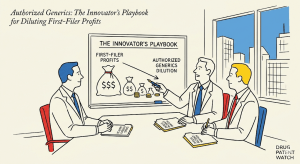
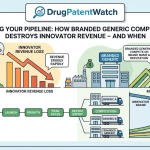
The pharmaceutical industry’s most elegant competitive weapon is also its most misunderstood. When a brand-name drug manufacturer launches its own generic version of its own product, it isn’t surrendering revenue—it’s redistributing it away from a competitor who spent years and tens of millions of dollars earning the right to take it.
Authorized generics sit at the center of one of the most strategically rich areas in pharmaceutical law and competitive intelligence. They are simultaneously legal, controversial, financially devastating to first-filing generic companies, and deeply instructive about how innovator companies think about patent cliffs. To understand authorized generics is to understand how pharmaceutical companies defend revenue not through innovation, but through calculated market structure manipulation.
This article examines that strategy in full—its legal foundations, its economic mechanics, its documented history across blockbuster drugs, the regulatory debates it has provoked, and what it means today for generic manufacturers, investors, and anyone trying to forecast drug pricing dynamics.
What Authorized Generics Actually Are
An authorized generic (AG) is a drug product that is chemically identical to an approved brand-name drug, manufactured under the brand’s New Drug Application (NDA), but sold without the brand name—typically at a price discount. The innovator company either produces it directly through a subsidiary or licenses a third-party manufacturer to produce and sell it under a separate label.
The crucial legal point: authorized generics are not approved through an Abbreviated New Drug Application (ANDA). They carry no independent regulatory identity. They are, in every technical and regulatory sense, the brand drug marketed differently.
This matters enormously because it means authorized generics bypass the Hatch-Waxman Act’s ANDA pathway entirely. They do not trigger patent certification requirements. They generate no Paragraph IV certifications. They require no bioequivalence testing because the product is already approved. The FDA has no authority to block them, and no court order can prevent their launch without independent legal grounds tied to contract or antitrust law.
The practical implication: an innovator can introduce an authorized generic into the market on the same day that a first-filing generic manufacturer begins its 180-day exclusivity period—and there is nothing the generic manufacturer can do about it under Hatch-Waxman.
The Legal Architecture Behind the Strategy
The Hatch-Waxman Act of 1984 created the modern framework for generic drug competition. Congress designed it to solve two problems simultaneously: drug companies needed protection for their research investments, and consumers needed affordable medicines after patents expired. The Act created a compromise. Innovators got 20-year patents, data exclusivity periods, and automatic 30-month stays when they sued generic filers. Generic companies got a streamlined ANDA approval pathway and, critically, a 180-day exclusivity period awarded to the first company to challenge an innovator’s patents via a Paragraph IV certification.
That 180-day exclusivity period is the prize. During those six months, only the first-filing generic can sell a generic version of the drug. No other ANDA-approved competitor can enter. The first-filer has the market to itself alongside the brand—and with it, the opportunity to charge prices significantly above what would prevail in a fully competitive generic market. The FTC has estimated that generic companies typically capture 80-90% of a drug’s prescription volume within a year of unrestricted generic competition, and that prices drop 80-85% below brand levels when multiple generics compete. During 180-day exclusivity, a single generic often prices at 10-25% below brand, taking perhaps 40-70% of volume—a window of significant profitability.
Congress created this exclusivity explicitly to incentivize generic companies to challenge questionable patents, accept litigation risk, and invest in the ANDA process. The reward for winning a Paragraph IV challenge could justify the cost.
Authorized generics were not part of this calculus. The legislators who drafted Hatch-Waxman in 1984 almost certainly did not envision that the very innovators who benefited from 30-month stays would respond to Paragraph IV challenges by launching their own generics into the 180-day window.
How the Courts Settled the Question
The legal status of authorized generics during the 180-day exclusivity period was contested for years. The generic industry argued that allowing an authorized generic during exclusivity violated the spirit and perhaps the letter of Hatch-Waxman. The FTC conducted studies. Congress held hearings. Legislation was proposed.
The courts ultimately rejected the statutory argument against authorized generics. In Teva Pharmaceuticals USA, Inc. v. FDA (2003), the D.C. Circuit Court held that nothing in the Hatch-Waxman Act prohibited an NDA holder from marketing an authorized generic during the 180-day exclusivity period. The court’s reasoning was narrow but conclusive: Hatch-Waxman blocked other ANDA filers from entering during exclusivity, but an authorized generic operates under the original NDA, not an ANDA, so the exclusivity provision simply does not apply to it.
The FDA confirmed this interpretation in 2004, noting that it lacked authority to restrict NDA holders from marketing their own products. Subsequent challenges in different circuits reached the same conclusion. By the mid-2000s, authorized generics during 180-day exclusivity were unambiguously legal.
That legal clarity did not reduce controversy. It accelerated deployment.
The 180-Day Exclusivity Period: What It’s Actually Worth
To understand why authorized generics are so strategically effective, you need to understand the economics of the 180-day exclusivity period with precision.
Consider a hypothetical brand drug with $1 billion in annual U.S. sales. When patent protection expires or is invalidated, the brand typically retains a shrinking share of prescriptions while the first-filing generic captures increasing volume. During the 180-day window, without an authorized generic, the competitive landscape has two players: the brand and the first-filer.
Pricing in this duopoly is usually modest discounting—the first-filer prices at 15-25% below brand to attract pharmacy switching. Managed care organizations and pharmacy benefit managers negotiate favorable formulary placement, but prices remain elevated relative to what they would be with four or five competitors. The first-filer may generate $150-300 million in revenue during this six-month window on a $1 billion drug. After exclusivity ends and multiple generics enter, prices collapse to 15-20% of brand price within months. The 180-day window is not merely profitable; it is often the primary financial justification for the entire ANDA project.
Now introduce an authorized generic. Suddenly the duopoly becomes a three-player market—brand, first-filer, and authorized generic. The authorized generic is typically priced at 10-20% below brand, undercutting the first-filer’s ability to capture pharmacy market share at its preferred price point. Wholesale distributors have two generic options. Pharmacy chains have negotiating leverage. The price floor drops.
The FTC’s 2011 study on authorized generics—the most comprehensive analysis of the phenomenon—found that first-filer revenues fell by approximately 40-52% when an authorized generic competed during the exclusivity period. Not a marginal reduction. A near-halving of the financial return that justified challenging the patent in the first place. <blockquote> “During the 180-day exclusivity period, the presence of an authorized generic reduces the first-filer’s revenues by approximately 40 to 52 percent compared to periods without an authorized generic.” — Federal Trade Commission, *Authorized Generic Drugs: Short-Term Effects and Long-Term Impact*, August 2011 [1] </blockquote>
The Investment Calculus for Generic Companies
Generic pharmaceutical companies are not small operations. Filing an ANDA for a complex molecule, conducting bioequivalence studies, building or contracting manufacturing capacity, litigating a Paragraph IV challenge through the courts—this process routinely costs $5-50 million per drug, and significantly more for complex formulations. Brand companies frequently sue generic filers, triggering the 30-month automatic stay that delays approval. Generic companies often litigate for five to eight years before seeing market entry.
The financial model that makes this worthwhile is simple: win the Paragraph IV challenge, earn 180-day exclusivity, price above competitive generic levels for six months, recover litigation costs, and generate profit. Analysts at several investment banks have estimated the NPV of 180-day exclusivity on a $500 million branded drug at $30-120 million, depending on market dynamics.
When an authorized generic enters that window, those NPV figures compress dramatically. On the same $500 million drug, an authorized generic presence might reduce first-filer NPV to $15-60 million—still positive, but potentially not enough to cover litigation costs on a drug where the brand fought hard, the legal fees ran high, and the commercial team built expectations around exclusivity economics.
The signal this sends through the generic industry is not subtle. If innovators routinely deploy authorized generics against first-filers, the expected value of challenging patents declines. If expected value declines enough, generic companies stop challenging patents they would otherwise challenge. This is precisely what critics of authorized generics argued throughout the 2000s—that they undermine the incentive structure Congress designed.
Why Innovators Deploy Authorized Generics: The Revenue Defense Logic
The innovator’s motivation is financially transparent. When a company faces patent expiration or a successful Paragraph IV challenge, it faces a choice. It can watch a competitor capture generic prescription volume during the exclusivity period, or it can introduce its own generic to capture that volume itself.
The authorized generic allows the brand company to participate in the generic market without acknowledging that its branded product’s value proposition has collapsed. Sales through the generic channel go to a subsidiary or a contract partner, often without the brand company’s name attached. The innovator collects revenue from both streams.
Revenue Recapture Mathematics
Take a brand drug doing $800 million annually. When patent exclusivity ends, the brand historically retains perhaps 10-15% of prescription volume (in molecules without strong patient loyalty or clinical differentiation) because brand-loyal patients, some managed care contracts, and specialty markets persist. The remaining 85-90% of prescriptions migrate to generics.
During the 180-day exclusivity window, the first-filing generic might capture 50-60% of prescriptions at a modest discount. The brand retains 40-50%. After exclusivity ends and multiple generics enter, the brand collapses to single digits.
Now model the authorized generic scenario. The innovator’s AG enters on day one of the exclusivity period. Generic prescription volume is split between the first-filer and the AG. At a minimum, the innovator captures a portion of what would otherwise go exclusively to the competitor. The economics differ based on whether the innovator is manufacturing the AG itself or licensing it, but in either case, revenue that would have left the innovator’s financial statements entirely now partly returns.
For a drug with $800 million in annual sales, a six-month exclusivity window, and typical market dynamics, the incremental revenue the innovator captures from an AG—relative to having no AG—might range from $20-80 million, depending on market share captured, AG pricing, and whether the AG is manufactured in-house or licensed. The cost to deploy the AG is comparatively low: the NDA is already approved, the manufacturing process already exists, and the regulatory pathway is already clear.
The Long-Tail Revenue Argument
Authorized generics also serve a longer-term commercial function beyond the 180-day window. After first-filer exclusivity ends and multiple ANDAs become eligible for approval, the generic market becomes intensely competitive. Prices collapse. Most generic companies generate minimal margins.
But the innovator’s authorized generic—if it has built distribution relationships, contracted with pharmacy chains, and established pricing during the exclusivity period—can maintain a durable position in the post-exclusivity generic market. Some brand companies have maintained authorized generics in the market for years after patent expiration, collecting modest but ongoing revenue streams from a market they would otherwise have exited entirely.
In categories where the innovator has strong manufacturing scale and existing supply chain relationships, the authorized generic essentially converts the patent cliff from a revenue cliff into a revenue step-down—a more manageable transition that spreads losses over a longer period.
Case Studies: Authorized Generics Across Blockbuster Drugs
The history of authorized generics is written in the patent expiration stories of America’s best-selling drugs. Several cases illustrate the range of strategies innovators have employed and the financial consequences for first-filing generic companies.
Plavix (Clopidogrel): Authorized Generics in the Aftermath of Pay-for-Delay
Bristol-Myers Squibb and Sanofi’s clopidogrel bisulfate (Plavix) was the world’s second-best-selling drug at its peak, with annual global sales exceeding $9 billion. The patent litigation surrounding Plavix is among the most extensively documented in pharmaceutical history, touching both pay-for-delay agreements and authorized generic strategy.
Apotex had challenged the Plavix patents with a Paragraph IV filing. In 2006, BMS and Sanofi entered into what regulators later called an illegal pay-for-delay agreement with Apotex, which the FTC and state attorneys general challenged. After that agreement collapsed, Apotex launched its generic in August 2006, triggering an avalanche of litigation and commercial maneuvering.
BMS launched an authorized generic on a compressed timeline. The commercial and legal dynamics of Plavix are complicated by the pay-for-delay history, but the AG deployment illustrated how innovators respond under pressure when the normal patent defense mechanisms have been compromised or exhausted.
The clopidogrel case is extensively tracked in patent databases including DrugPatentWatch, which has documented the full timeline of ANDA filings, patent certifications, litigation activity, and AG launch dates for clopidogrel—making it a useful case study for anyone modeling authorized generic risk in current pipeline analysis.
Lipitor (Atorvastatin): The Largest AG Deployment in History
Pfizer’s atorvastatin calcium (Lipitor) represents the most financially significant authorized generic deployment ever executed. At its peak, Lipitor generated over $13 billion in annual U.S. sales. When Ranbaxy Laboratories earned first-filer status on atorvastatin following a protracted Paragraph IV battle, the stakes were enormous for both parties.
The atorvastatin patent situation was complicated by multiple patents, pediatric exclusivity extensions, and a consent decree that affected Ranbaxy’s manufacturing. When atorvastatin’s exclusivity finally began running in late 2011, Pfizer had prepared comprehensively.
Pfizer launched an authorized generic through Watson Pharmaceuticals (now Allergan), which had contracted with Pfizer to distribute the AG. The AG was priced at roughly 50-80% below Lipitor’s brand price—significantly undercutting what Ranbaxy needed to generate adequate margins during exclusivity.
Pfizer’s strategy went beyond a simple AG launch. The company actively used patient programs, co-pay cards, and retailer contracting to maintain Lipitor brand sales while simultaneously ensuring its AG captured generic volume. Some retail pharmacy chains offered Pfizer’s AG at preferred prices, further fragmenting the volume Ranbaxy expected to capture.
Ranbaxy’s exclusivity period revenues from atorvastatin came in substantially below initial analyst estimates. The company had forecast exclusivity revenues that would have significantly strengthened its financial position; the actual outcomes were considerably more modest.
The atorvastatin case also illustrated the role of contract manufacturing and distribution in AG strategy. Pfizer did not build a separate generic brand. It contracted with an existing generic distributor—Watson—that already had pharmacy relationships, distribution infrastructure, and formulary positioning capabilities. This allowed Pfizer to deploy the AG rapidly and credibly without building generic commercial capabilities in-house.
Pfizer’s ability to coordinate this strategy was possible in part because it had been tracking the competitive patent landscape meticulously. Companies that use tools like DrugPatentWatch to monitor ANDA filings, Paragraph IV certifications, and exclusivity status can anticipate competitive timelines and begin AG preparation years before an exclusivity period begins.
Zoloft (Sertraline): Market Share Capture at Scale
Pfizer’s sertraline hydrochloride (Zoloft) patent expiration in 2006 provided another documented example of authorized generic deployment. Greenstone LLC, Pfizer’s generic subsidiary, launched the authorized generic sertraline on the same day Ivax Corporation (later acquired by Teva) began its 180-day exclusivity period.
Greenstone had been established by Pfizer precisely to compete in the generic market with authorized versions of Pfizer’s own molecules. The subsidiary maintained separate branding, pricing, and commercial teams, but its supply chain ran directly through Pfizer’s manufacturing operations.
The sertraline market dynamics illustrate how AG strategy intersects with pharmacy-level economics. Pharmacies typically prefer generics with strong supply guarantees and competitive pricing. Greenstone, backed by Pfizer’s manufacturing capabilities, could offer both. Ivax faced a competitor that had essentially no supply chain risk and could price aggressively while maintaining adequate margin.
Greenstone’s sertraline captured a meaningful share of generic volume during the exclusivity period. Ivax’s revenues were diminished relative to a scenario without an AG competitor.
Pfizer’s decision to build Greenstone as a permanent generic subsidiary, rather than licensing AG rights on a case-by-case basis, reflected a strategic commitment to participating in the generic market systematically. Greenstone allowed Pfizer to deploy authorized generics quickly when patent expirations approached, without the negotiation timelines required for third-party AG licensing deals.
Protonix (Pantoprazole): The Timing Question
Wyeth’s pantoprazole sodium (Protonix) authorized generic deployment raised questions about timing that have persisted in the industry. Sun Pharmaceutical and Teva both had Paragraph IV filings on pantoprazole. The litigation was complex, involving multiple patents and overlapping claims.
Wyeth launched an authorized generic prior to any Paragraph IV challenge resolution, in anticipation of exclusivity. The timing—launching the AG before the exclusivity period was fully determined—was aggressive and created commercial uncertainty for the generic filers.
The pantoprazole case illustrates a less-discussed aspect of AG strategy: innovators do not always wait until a first-filer begins exclusivity. In some cases, they launch AGs preemptively when they anticipate imminent generic entry, particularly in drugs where the patent position is weak and litigation outcome is uncertain. This preemptive launch can itself affect the commercial calculations of generic companies considering whether to challenge remaining patents.
The FTC’s Analysis and the Policy Debate
The Federal Trade Commission has studied authorized generics more carefully than any other institution, and its findings have shaped both the policy debate and industry practice.
The FTC’s 2011 report, conducted following a congressional mandate in the Medicare Modernization Act of 2003, analyzed 108 drugs that experienced generic entry between 2001 and 2008. It found that 27 of those drugs had authorized generic competition during the 180-day exclusivity period—roughly a quarter of all cases. The study’s core findings were stark: AGs substantially reduced first-filer revenues and did not appear to benefit consumers through lower prices during the exclusivity period to any significant degree.
The Consumer Impact Paradox
The consumer impact question is more complex than it initially appears. Authorized generics do introduce an additional lower-cost option into the market, so in a narrow sense, they increase immediate consumer choice. Some consumers who would have continued paying brand prices may switch to the AG at lower cost.
But the FTC’s analysis found that the price reduction consumers experienced during the 180-day exclusivity period did not differ meaningfully between markets with and without authorized generics. The reason: in both cases, the primary generic (whether first-filer only or first-filer plus AG) is priced in a similar range relative to brand. The presence of the AG slightly compresses prices, but does not produce the dramatic reductions associated with multi-generic competition.
The more significant consumer impact argument runs in the opposite direction. If authorized generics reduce first-filer revenues sufficiently to deter Paragraph IV challenges, then fewer patents get challenged, longer brand exclusivity persists, and consumers pay brand prices for longer. The long-run consumer harm from reduced patent challenges might substantially exceed the short-run consumer benefit from AG-induced price pressure during the 180-day window.
This argument was the foundation of the generic industry’s policy position throughout the 2000s and 2010s. The Generic Pharmaceutical Association (now the Association for Accessible Medicines) repeatedly argued that authorized generics should be prohibited during 180-day exclusivity periods precisely because they undermine the incentive structure designed to produce generic competition.
Congressional Response and Regulatory Non-Action
Congress received these arguments and largely declined to act. Proposals to ban authorized generics during the 180-day exclusivity period were introduced multiple times in both chambers but never advanced to passage. The pharmaceutical industry’s lobbying opposition was substantial, and the legal and economic arguments against a ban were not trivial.
The FDA, for its part, maintained consistently that it lacked authority to restrict NDA holders from marketing their own products under an existing approval. The agency’s position was that it regulated drug safety and efficacy, not market competition. The FTC had authority over competition matters but chose to study the issue rather than act unilaterally.
The result: authorized generics remain fully legal, the regulatory framework has not changed meaningfully since the Teva v. FDA decision, and the practice has become a standard element of innovator patent-expiration strategy.
Authorized Generic Agreements: Structure and Mechanics
Innovators deploy authorized generics through two primary mechanisms: in-house production through a generic subsidiary, or licensing to a third-party generic manufacturer. Each approach has different economic characteristics and strategic implications.
In-House Generic Subsidiaries
Companies like Pfizer (through Greenstone), Novartis (through Sandoz, though Sandoz is a distinct entity with its own ANDA filings), Sanofi (through Zentiva in international markets), and others have established or acquired generic subsidiaries to maintain permanent authorized generic capabilities.
The in-house model offers speed and control. When a patent expires or a Paragraph IV challenge succeeds, the subsidiary can launch immediately without contract negotiation. The supply chain is shared with the brand, so there are no manufacturing unknowns. Pricing can be coordinated with broader commercial strategy.
The limitation of the in-house model is the upfront investment required to establish and maintain a generic subsidiary with commercial infrastructure—sales force, distribution relationships, pharmacy contracting capabilities. For companies with large pipelines of impending patent expirations, this investment is easily justified. For smaller innovators with limited patent expiration events, it may not be.
Third-Party AG Licensing
The alternative is to license authorized generic rights to an existing generic company. The licensee handles manufacturing (which may or may not run through the innovator’s own plants), distribution, and commercial execution. The innovator receives royalties or a revenue share.
This model has different incentive structures. The licensee has skin in the game—it only profits if the AG captures volume—and brings existing pharmacy relationships and generic distribution infrastructure. But the innovator has less direct control over pricing, timing, and commercial execution.
Third-party AG licensing also creates a complex dynamic when the licensee is itself a Paragraph IV filer or potential ANDA competitor. Innovators have occasionally licensed AG rights to generic companies as part of broader commercial negotiations—sometimes as elements of settlement agreements in Paragraph IV litigation.
Authorized Generics as Settlement Currency
The connection between authorized generic rights and Paragraph IV litigation settlement is one of the most consequential and least publicized aspects of this area. When brand companies negotiate settlements with first-filing generic companies, they sometimes offer AG rights as part of the settlement package rather than—or alongside—monetary payments.
An innovator might offer a first-filer: launch rights on a specific date (typically before patent expiration), a period of exclusivity protection where the brand agrees not to launch an AG, or shared AG revenue during the exclusivity period.
The AG non-compete commitment is particularly valuable. A brand company that agrees not to launch an authorized generic during the 180-day window is effectively guaranteeing the first-filer’s exclusivity economics—worth tens of millions of dollars on a major drug. This “no-AG commitment” has become a standard element of Paragraph IV settlement negotiations.
The FTC has analyzed no-AG commitments as potential components of reverse-payment (pay-for-delay) settlements. The argument: a brand company’s commitment not to launch an AG during exclusivity has quantifiable value to the generic company. If that commitment is part of a settlement package that also delays generic entry, it may constitute an anticompetitive payment that violates antitrust law under the FTC v. Actavis (2013) Supreme Court decision.
Post-Actavis, no-AG commitments in settlement agreements have drawn increased antitrust scrutiny. Several cases have proceeded in federal courts examining whether no-AG pledges, combined with delayed entry agreements, constitute anticompetitive reverse payments.
The Pay-for-Delay Connection
The relationship between authorized generics and pay-for-delay (or “reverse payment”) settlements is intricate enough to warrant dedicated analysis.
Pay-for-delay settlements arise when a brand company, facing a Paragraph IV challenge, pays the generic filer—directly in cash or indirectly in value—to delay its generic launch. The Supreme Court held in FTC v. Actavis that such payments can violate antitrust law when their value is large and unexplained by other settlement considerations.
Authorized generic rights entered the pay-for-delay analysis in two ways.
First, brand companies used AG non-compete commitments as a substitute for cash payments in settlements. Rather than paying a generic company $100 million to delay its launch, a brand might offer a commitment not to launch an authorized generic during the 180-day window—worth a comparable amount in enhanced exclusivity economics. This avoided the facial appearance of a cash payment while delivering equivalent economic value.
Second, brand companies sometimes licensed AG rights to a settling generic company, again in lieu of cash payments. The settling generic would receive both a launch date and the right to sell the innovator’s authorized generic—effectively receiving a revenue guarantee on top of its own ANDA-based launch rights.
The FTC was explicit in its post-Actavis guidance that AG-related benefits in settlement agreements are subject to the same scrutiny as cash payments. The agency’s 2013 policy statement noted that it would evaluate the value of AG rights, no-AG commitments, and similar benefits when assessing reverse-payment settlements.
Since Actavis, several companies have faced antitrust litigation or regulatory investigation over AG-related settlement terms. The cases have not fully resolved the legal standards, but the risk of antitrust exposure has made brand companies more cautious about using AG rights as settlement currency without careful legal review.
How Generic Companies Respond
Generic pharmaceutical companies are not passive recipients of authorized generic competition. Over the years, they have developed responses—commercial, legal, and strategic—designed to mitigate the impact of AGs on their exclusivity economics.
Commercial Responses
The most direct commercial response is pricing strategy. When first-filers anticipate an authorized generic, they sometimes pre-empt by pricing their generic more aggressively—closer to AG-level pricing—to establish pharmacy relationships and formulary positions before the AG arrives. This reduces per-unit margin but can secure volume commitments that protect overall revenues.
Some generic companies have used formulary contracting as a defense mechanism. By securing exclusive preferred formulary placement with large pharmacy benefit managers or retail chains before the AG launches, they can ensure that even when an AG enters the market, their distribution is protected. This requires significant commercial infrastructure and often contractual commitments that reduce pricing flexibility, but it can substantially limit the AG’s ability to capture market share.
Legal Responses
Several generic companies have pursued legal theories to restrict authorized generics, most without success. Statutory arguments—that AGs violate the spirit of Hatch-Waxman—were largely rejected by courts, as discussed above. Antitrust arguments—that AG launches constitute predatory pricing or monopolization—have generally not succeeded either, because the brand company’s decision to market its own product at competitive prices does not typically satisfy the elements of an antitrust violation.
The more productive legal avenue has been contract. When brand companies license AG rights to third parties, the licensing agreements sometimes contain terms that affect the AG’s commercial behavior. Generic companies have occasionally argued that AG licensing agreements contain anticompetitive provisions—for instance, minimum pricing requirements that limit how aggressively the AG can be priced. These arguments have produced some discovery and settlement activity, though not broad legal change.
Strategic Positioning: The Intelligence Advantage
The generic industry’s most effective defense against authorized generics is advance intelligence. A generic company that knows—months or years before its exclusivity period begins—whether the brand company is planning an AG deployment can adjust its commercial strategy, modify its investment thesis, and potentially renegotiate settlement terms.
This is where competitive intelligence tools become directly relevant to business outcomes. Patent monitoring platforms like DrugPatentWatch provide detailed tracking of ANDA filings, first-to-file designations, Paragraph IV certifications, litigation timelines, and AG launch history. Analysts at generic companies use this data to model the probability of AG competition on specific molecules and incorporate that probability into their investment decisions.
When a generic company evaluating whether to file an ANDA on a drug approaching patent expiration can access data showing the innovator’s history of AG deployments, its subsidiary structure, its licensing relationships with other generic companies, and the settlement history of comparable drugs, it can make more informed decisions about whether the exclusivity period economics justify the ANDA investment.
The intelligence asymmetry between well-resourced generic companies that actively monitor these databases and smaller companies operating with less data is significant. In a field where a difference of $20-40 million in expected exclusivity revenues can determine whether an ANDA investment is worthwhile, having more complete information about AG risk is a direct financial advantage.
The Economics of Market Dilution: A Quantitative Framework
To move beyond case studies into a generalizable framework, it helps to model the economics of authorized generics systematically.
Variables That Determine AG Impact
The financial impact of an authorized generic on a first-filer’s exclusivity revenues depends on several variables. The brand drug’s annual sales volume determines the absolute size of the market being contested. Drugs above $500 million in annual U.S. sales have historically been most likely to attract AG deployment because the financial stakes justify the innovator’s commercial investment.
The price sensitivity of prescribing behavior in the relevant therapeutic category affects how quickly market share shifts toward the lowest-priced option. In categories where pharmacists can substitute freely—most oral solids, many immediate-release formulations—price competition is intense and the AG’s pricing relative to the first-filer matters enormously. In categories with physician-level prescribing controls or patient loyalty—certain psychiatric medications, some specialty drugs—price sensitivity may be lower and AG impact correspondingly reduced.
The AG’s pricing strategy is a critical variable. An innovator who prices the AG at 50% below brand directly undercuts the first-filer’s ability to maintain premium pricing. An innovator who prices the AG at only 15% below brand creates less competitive pressure. The brand company’s pricing decision reflects its own margin calculations and the strategic weight it places on AG volume capture versus exclusivity period disruption.
Distribution relationships determine how quickly the AG can achieve pharmacy penetration. An innovator who has established AG distribution infrastructure through a subsidiary or experienced third-party licensee can achieve broad distribution within days of the exclusivity period beginning. An innovator without this infrastructure may see slower AG penetration, reducing impact on first-filer revenues in the early weeks.
A Simplified Revenue Model
Consider a brand drug with $600 million in annual U.S. sales. Absent an authorized generic, a first-filer entering 180-day exclusivity might expect the following:
Month one: 30% prescription market share, brand-generic pricing ratio of roughly 0.75, monthly generic market revenue of approximately $22 million. Month three: 50% prescription market share, pricing ratio of 0.72, monthly revenue approximately $32 million. Month six: 60% prescription market share, pricing ratio of 0.70, monthly revenue approximately $37 million. Total six-month revenue: approximately $175 million.
Introduce an authorized generic entering simultaneously at a price point 20% below brand (equivalent to roughly 78% of brand price—slightly above the first-filer’s initial pricing). Generic prescription volume is split. The first-filer, facing a direct price competitor, may drop its price more aggressively to defend volume—say, to 65% of brand price. Volume splits roughly 55-45 in the first-filer’s favor in early months as pharmacy relationships and formulary positioning matter more than price. By month three, the AG may capture 40-45% of generic prescription volume.
Revised first-filer revenue: roughly $90-105 million over six months—a 40-45% reduction from the no-AG scenario. The FTC’s empirical finding of 40-52% reduction is consistent with this type of modeling.
The NPV Impact
If the first-filer invested $30 million in ANDA development and litigation across five years to reach this exclusivity period, the NPV calculation shifts materially. At a 12% discount rate (appropriate for pharmaceutical investment), $30 million invested over five years has a current cost equivalent of roughly $50 million. Against expected exclusivity revenues of $175 million (no AG), the NPV is clearly positive. Against expected revenues of $95 million (with AG), the NPV may still be positive but approaches the threshold where some projects become marginal.
For drugs where ANDA investment and litigation costs are higher—complex formulations, extended-release products, specialty molecules where litigation runs particularly long—the authorized generic can tip the NPV calculation negative. This is not hypothetical. Several generic company executives have stated in earnings calls and public interviews that AG risk has caused them to deprioritize certain ANDA filings.
The Authorized Generic’s Role in Portfolio Strategy
Brand pharmaceutical companies do not make authorized generic deployment decisions in isolation. The decision is embedded in a broader portfolio strategy that encompasses patent lifecycle management, branded successor products, loss-of-exclusivity planning, and generic market participation.
The Loss-of-Exclusivity Planning Cycle
Major pharmaceutical companies begin loss-of-exclusivity (LOE) planning three to five years before a significant patent expiration. This planning encompasses pricing strategy for the remaining brand franchise, development of branded successors (next-generation formulations, combination products), co-pay assistance programs to maintain brand volume, and, increasingly, authorized generic strategy.
The AG question typically enters LOE planning alongside the question of branded successor timing. If the company expects to have a successor product—a new formulation, a new indication, or a related molecule—ready for launch near the time of the original molecule’s patent expiration, the commercial strategy for the original molecule during LOE may focus less on AG revenue and more on directing prescriptions toward the successor. In this scenario, the AG may be deployed primarily to deny the first-filer strong exclusivity economics (a competitive reason) rather than to capture revenue (a commercial reason).
If no successor product is ready, the commercial calculus shifts more toward revenue capture. The AG becomes a tool for maintaining total franchise revenue during the transition to generic competition.
Timing as a Strategic Variable
Innovators have some control over AG launch timing. An AG can be launched on the first day of the exclusivity period, as Lilly did with fluoxetine, or it can be introduced weeks or months into the exclusivity period. The timing decision affects both the AG’s revenue capture and the commercial disruption it causes the first-filer.
Early AG launches maximize the innovator’s revenue capture from the exclusivity window and cause maximum disruption to first-filer pricing and volume strategies. Late AG launches—particularly those introduced in the final weeks of the exclusivity period—may be designed more to signal competitive intent or to position for the post-exclusivity multi-generic market than to materially affect exclusivity period economics.
In some cases, innovators have used AG timing strategically in settlement negotiations. Offering to delay AG launch by 60 or 90 days, in exchange for favorable settlement terms with a first-filer, is a form of negotiated value exchange that avoids the legal risks of cash reverse payments while delivering real economic benefit to the settling generic company.
Biosimilars and the Coming Authorized Biosimilar Question
The authorized generic concept has a parallel in the biologics world that is still developing. When a biologic drug’s reference product exclusivity expires and biosimilars enter the market, the originator has the option to market an “authorized biosimilar”—essentially, its own reference biologic marketed as a biosimilar-equivalent at a reduced price.
The regulatory framework for biosimilar interchangeability and the 12-year reference product exclusivity under the Biologics Price Competition and Innovation Act (BPCIA) are different enough from Hatch-Waxman that direct analogy is imperfect. But the strategic logic is similar: the originator can use its own manufacturing capabilities and clinical data to participate in the lower-cost biologic market, capturing volume that would otherwise go to independent biosimilar manufacturers.
Several major biologic originators have explored or executed authorized biosimilar strategies. AbbVie’s approach to adalimumab (Humira) biosimilar competition—including licensing deals with biosimilar manufacturers—has elements of authorized generic logic applied to the biologic context. The financial stakes are, if anything, higher: Humira generated over $20 billion in annual global sales at its peak, making the LOE planning question commensurately more consequential.
Investor Implications: Reading the Authorized Generic Signal
For investors in both brand pharmaceutical companies and generic manufacturers, authorized generic activity is a financially material variable that affects revenue forecasts, pipeline valuations, and competitive positioning assessments.
Impact on Generic Company Valuations
Generic companies derive significant value from their ANDA pipelines, particularly from first-to-file designations on major branded drugs. When analysts value generic companies’ pipelines, they typically model exclusivity period revenues as a key component of pipeline NPV.
A generic company that carries a first-to-file designation on a drug whose innovator has a history of deploying authorized generics—or has announced AG plans—faces a meaningful haircut on those exclusivity period revenue projections. Investment analysts who do not appropriately discount for AG risk overstate pipeline value.
Conversely, a generic company that has negotiated a no-AG commitment as part of a settlement agreement has secured a commercially valuable guarantee. Detecting such commitments—through public SEC filings, litigation records, or settlement disclosures—is part of sophisticated generic company analysis.
DrugPatentWatch tracks the publicly available patent certifications, settlement agreements, and authorized generic launch histories that inform these analyses. For investors conducting due diligence on generic companies’ pipeline valuations, having access to comprehensive AG historical data and current pipeline monitoring is directly material to investment decisions.
Impact on Brand Company LOE Modeling
For brand pharmaceutical companies, the authorized generic decision affects the shape of their revenue decline curves at loss of exclusivity. Companies that deploy AGs successfully capture higher generic revenues during the LOE transition period, moderating the steepness of the revenue cliff. This has implications for earnings forecast models and EBITDA trajectory analysis.
Analysts covering brand companies should model two LOE scenarios for major upcoming patent expirations: one with an authorized generic capturing a meaningful share of generic prescription volume, and one without. The difference in year-one LOE revenues can be material, particularly for drugs with large first-filer Paragraph IV challenges.
The authorized generic decision also signals something about the brand company’s confidence in its branded successor pipeline. A company that deploys an AG aggressively is implicitly acknowledging that it does not expect to retain significant branded prescription volume for the affected molecule. A company that chooses not to deploy an AG—perhaps because it has a successor formulation ready or because it is managing patient loyalty programs—is signaling the opposite.
Geographic Dimensions: Authorized Generics Outside the United States
The authorized generic strategy is primarily a U.S. phenomenon, rooted in the specific structure of Hatch-Waxman’s 180-day exclusivity. Most other major pharmaceutical markets have generic entry frameworks that differ significantly enough that the term “authorized generic” applies differently.
European Parallel Imports and Generic Competition
In Europe, the concept of “authorized generics” exists but functions differently. European reference pricing and generic substitution policies vary by country, and the absence of a 180-day exclusivity period analogous to Hatch-Waxman means there is no specific “exclusivity window” for the innovator to dilute. Brand companies in Europe sometimes use authorized generics as part of reference pricing management strategies—pricing an authorized generic slightly above the lowest generic to influence the reference price calculation in markets where reimbursement is tied to a reference price benchmark.
The strategic sophistication of European AG deployment is generally lower than in the U.S., because the incentive structure of Hatch-Waxman’s first-filer exclusivity does not exist in the same form.
Canada and Australia
Canada’s Patented Medicines (Notice of Compliance) Regulations have their own linkage system between patents and generic approvals, and their own exclusivity framework. Canadian authorized generics are less well-documented in public literature than their U.S. counterparts, but the strategic logic of using an AG to capture generic volume during competitive protection periods has been employed in the Canadian market by some innovators.
Australia’s Pharmaceutical Benefits Scheme and its patent linkage framework present yet another structure. The point is that authorized generic strategy is not universally applicable—its financial impact is most pronounced where a single generic company holds a time-limited exclusivity period, creating a specific window that the innovator can disrupt.
Antitrust Dimensions of Authorized Generic Strategy
While authorized generics are legal under Hatch-Waxman and FDA regulations, their antitrust status under certain circumstances remains contested.
The Predatory Pricing Theory
Generic companies have occasionally argued that authorized generics priced below cost constitute predatory pricing under Sherman Act Section 2. This argument faces significant doctrinal obstacles. Predatory pricing requires pricing below marginal cost with a specific intent to eliminate competition and recoup losses through subsequent monopoly pricing. Brand companies deploying authorized generics typically have low marginal costs (the manufacturing infrastructure is already sunk in the brand product) and price the AG above variable cost. The predatory pricing theory has not succeeded in restraining AG deployments.
Conspiracy and Coordination Claims
More productive antitrust theories have focused on the terms of AG licensing agreements. When an innovator licenses AG rights to a third-party generic company and the agreement contains provisions that coordinate the AG’s pricing with the first-filer’s pricing—for instance, requiring the AG to price at no less than a specified floor above the first-filer’s price—the agreement may constitute price-fixing. Several AG licensing agreements have been scrutinized on this theory, with some resulting in civil litigation and private settlements.
The Actavis Framework Applied to AG Commitments
Post-Actavis, courts have applied a rule of reason antitrust analysis to reverse-payment settlement agreements. When the “payment” to the settling generic includes no-AG commitments or AG licensing rights rather than cash, courts have wrestled with how to quantify the value of those non-cash benefits for purposes of the Actavis analysis.
The general approach has been to quantify the value of the AG right or no-AG commitment using the FTC’s empirical data on exclusivity period revenue impacts—roughly 40-52% revenue enhancement for the first-filer when there is no AG competition. Courts have then assessed whether this value, combined with other settlement benefits, constitutes a “large and unjustified” payment that would trigger antitrust review.
The antitrust law in this area is still developing. Several pending cases may clarify the legal standard for AG-related settlement terms. Companies operating in this space should assume that any settlement incorporating AG rights or no-AG commitments faces meaningful antitrust risk, particularly if combined with delayed entry terms.
Authorized Generics and Drug Pricing Policy
The authorized generic debate intersects with the broader drug pricing policy conversation in ways that are often underappreciated.
Short-Term vs. Long-Term Price Effects
Authorized generics create a genuine tension between short-term and long-term drug pricing outcomes. In the short term, AG competition during the 180-day exclusivity period modestly reduces generic prices below what they would be without an AG. This is a real, if small, near-term consumer benefit.
In the long term, however, authorized generics may increase drug prices by reducing the expected value of Paragraph IV challenges, thereby reducing the frequency of patent challenges and extending de facto brand exclusivity on drugs with questionable patent claims. If even a fraction of the Paragraph IV challenges that would otherwise be filed are deterred by AG risk, the drugs those challenges would have addressed remain at brand prices longer.
The net effect depends on empirical questions that are difficult to answer precisely: How elastic is generic companies’ willingness to file Paragraph IV challenges in response to AG risk? How many drugs that are currently challenged under Paragraph IV have marginally positive NPVs that an AG would push negative? What is the distribution of patent quality among drugs that would be marginally affected?
The FTC’s analysis suggested the long-term deterrence effect is real and economically significant, though quantifying it precisely is difficult. Most health policy analysts who have studied the question have concluded that authorized generics, on net, harm long-run consumer welfare even though they provide short-run price benefits.
Policy Proposals That Have Failed
Multiple legislative proposals to ban authorized generics during 180-day exclusivity have failed to pass. The Preserving Access to Cost Effective Drugs (PACED) Act, introduced multiple times in the Senate, would have prohibited NDA holders from marketing authorized generics during the 180-day exclusivity period. It never advanced to a floor vote.
The failure of these proposals reflects the lobbying power of brand pharmaceutical companies, the complexity of the economic arguments involved, and perhaps ambivalence among some policymakers about the short-term versus long-term tradeoffs. Generic pharmaceutical companies, despite having a plausible economic argument, have been unable to convert it into legislative action.
The current policy environment, with increased focus on drug pricing transparency and affordability, has revived some interest in the authorized generic question. Any future legislative action that modifies Hatch-Waxman’s generic entry framework would need to address authorized generics directly or risk creating new distortions.
Monitoring Authorized Generic Risk: Tools and Methodology
For any professional who needs to monitor and anticipate authorized generic activity—generic company analysts, pharmaceutical portfolio managers, investment researchers, or healthcare policy analysts—a systematic approach to intelligence gathering is necessary.
The Patent Monitoring Foundation
The first layer of authorized generic risk assessment is patent monitoring. Understanding when a drug’s key patents expire, which patents are subject to Paragraph IV challenges, and what the litigation status of those challenges is provides the temporal framework for AG risk assessment.
Platforms like DrugPatentWatch aggregate FDA patent listing data (the Orange Book), ANDA filings, Paragraph IV certifications, litigation filings, and exclusivity status into searchable databases. This allows an analyst to quickly identify, for a given molecule, the full patent and exclusivity landscape, including which generic companies have first-to-file status and what their anticipated launch windows are.
For AG risk specifically, the relevant data points include: the innovator company’s history of AG deployments on previous LOE events; whether the innovator has a generic subsidiary or established AG licensing relationships; whether any settlement agreements on the molecule contain AG-related terms (sometimes publicly disclosed in securities filings or litigation records); and the financial stakes of the exclusivity period (higher-value drugs are more likely to attract AG deployment).
Innovator Corporate Structure Analysis
Assessing whether a specific innovator is likely to deploy an authorized generic requires analysis of its corporate structure and generic market capabilities. A company with an established generic subsidiary—like Pfizer’s Greenstone or, historically, Lilly’s Duramed—has the infrastructure to deploy AGs quickly and should be treated as a higher-AG-risk innovator for pipeline analysis.
A company without generic infrastructure faces a higher barrier to AG deployment: it must negotiate a licensing agreement with a third-party generic manufacturer, which takes time and may not always be feasible on preferred terms. This does not mean it cannot deploy an AG—many innovators have done so through third parties successfully—but the likelihood and speed of deployment may be lower.
Settlement Agreement Monitoring
Paragraph IV settlements frequently contain AG-related terms that affect exclusivity economics. When these settlements are publicly disclosed—as required in certain regulatory submissions and sometimes as material events under securities law—they provide direct evidence of whether the first-filer has negotiated AG protection.
A first-filer that has secured a no-AG commitment from the innovator as part of its settlement agreement has effectively guaranteed its 180-day exclusivity economics. Analysts who identify these commitments can revise their exclusivity period revenue models upward relative to a scenario without such protection.
The challenge is that settlement terms are not always fully public. Companies disclose the existence of settlements and their general structure, but the specific financial terms—including AG commitments—are often filed confidentially or disclosed only at a level of generality that makes precise economic modeling difficult. Tracking court dockets, FDA exclusivity determinations, and securities filings across multiple companies and drugs is labor-intensive work that benefits from systematic data aggregation.
The Evolving Landscape: Authorized Generics in a Changing Pharmaceutical Market
The authorized generic environment of 2025 differs in important ways from the environment of 2005 or 2010. Several structural changes in the pharmaceutical and generic markets have affected both the frequency and impact of AG deployments.
Consolidation in the Generic Industry
The generic pharmaceutical industry has consolidated significantly over the past two decades. Teva, Sandoz, Viatris (formed from the merger of Mylan and Pfizer’s Upjohn), and a smaller number of other companies now control a larger share of the generic market than they did when Hatch-Waxman’s AG dynamics first emerged as a major issue.
This consolidation has two potentially offsetting effects on AG dynamics. Larger generic companies have more resources to absorb AG-related revenue reductions and may be more willing to file Paragraph IV challenges even when AG risk is present. But they also have more market power in settlement negotiations, potentially enabling them to secure favorable AG terms in agreements with innovators.
Specialty and Complex Generics
The shift in the pharmaceutical pipeline toward specialty drugs, biologics, and complex formulations has changed the generic entry landscape. Specialty drugs often have patient populations that are smaller, more supervised by physicians, and less likely to be subject to automatic pharmacy substitution. Generic entry in specialty markets often involves slower market penetration and different pricing dynamics than the primary-care oral solid market where authorized generics have historically been most impactful.
For complex generics—products requiring inhaled delivery systems, transdermal patches, extended-release formulations—ANDA development costs are higher, exclusivity periods are more valuable, and the commercial impact of an authorized generic during exclusivity is shaped by more complex market dynamics.
Authorized generic strategy in specialty and complex markets is less well-documented than in primary-care small-molecule markets. As the pharmaceutical market has shifted toward these categories, the generic entry and AG dynamics have become less predictable based on historical primary-care models.
The Biosimilar Market’s Different Structure
As noted above, the biosimilar market has its own analogues to authorized generic strategy. The 12-year reference product exclusivity for biologics is longer than small-molecule patent protection in many cases, and the barriers to biosimilar development are substantially higher than ANDA filing. But the strategic logic of the originator deploying its own lower-cost version to capture biosimilar-segment revenue is present, and will become increasingly relevant as the first generation of major biologic reference products faces competition.
The BPCIA’s “patent dance” and exclusivity framework create different strategic opportunities and risks than Hatch-Waxman’s structure. Analyzing biosimilar market dynamics through the authorized generic lens—asking, “how might the originator deploy a lower-cost version to protect its revenue position against biosimilar competition?”—is a productive strategic framework that the industry has only begun to apply systematically.
Industry Voices and Expert Perspectives
The authorized generic debate has attracted substantive comment from pharmaceutical executives, legal scholars, and policy analysts over the years.
David Balto, a former FTC policy director and pharmaceutical antitrust attorney, has argued consistently that authorized generics distort the incentives Congress established in Hatch-Waxman. Writing in the Antitrust Law Journal, Balto noted that the 180-day exclusivity period was carefully calibrated to ensure generic companies would find Paragraph IV challenges financially worthwhile—a calibration that authorized generics undermine [2].
On the other side, brand industry representatives have argued that authorized generics are simply the market functioning appropriately. If a brand company can compete in the generic market, it should be free to do so. The consumer gets an additional lower-priced option, and the competitive pressure from an AG serves the same market-discipline function that any competitive entry does.
Economists who have studied the issue empirically have generally found support for the deterrence hypothesis—that AG risk reduces Paragraph IV filings—though the magnitude of the effect is debated. A 2007 study by researchers at the University of Chicago found evidence that AG history in a therapeutic category reduced the probability of subsequent Paragraph IV filings in that category, though the study’s methodology and conclusions were contested by brand industry analysts [3].
The absence of a policy resolution despite extensive analysis suggests the issue is genuinely contested among serious analysts—not a case where one side is clearly correct but simply has less political power.
Current Practice: Who Is Deploying Authorized Generics and How
As of the mid-2020s, authorized generic deployment remains a standard element of major brand pharmaceutical companies’ LOE strategies. The companies most active in authorized generic deployment have typically been those with the largest primary-care portfolios facing patent expirations on high-volume oral medications.
Pfizer, through Greenstone, has been among the most consistent authorized generic deployers. Novartis, through various generic subsidiaries internationally and through Sandoz in the U.S. market (though Sandoz was spun off as an independent company in 2023), maintained significant AG capabilities. AstraZeneca, Sanofi, and Merck have all deployed authorized generics on significant molecules at various points.
The pattern among deployers is consistent: large primary-care drug companies with established generic market infrastructure or relationships, facing patent expirations on high-revenue molecules, in therapeutic categories where pharmacy substitution operates freely.
The pattern among non-deployers is less consistent, but includes companies where: the brand product has strong physician or patient loyalty that makes generic substitution slow; the company has a successor product launching near the original molecule’s patent expiration; the AG licensing economics do not favor deployment given the available third-party options; or the company has made strategic decisions to focus exclusively on branded markets.
Key Takeaways
Authorized generics are legal and effective. Courts have confirmed that NDA holders can market their own products under the brand’s NDA during a generic first-filer’s 180-day exclusivity period. FDA lacks authority to block this. The legal question is settled.
The financial impact on first-filers is material. The FTC’s empirical analysis found a 40-52% reduction in first-filer revenues when an authorized generic competed during the exclusivity period. This is not a marginal disruption—it can be the difference between a profitable and a losing ANDA investment.
Innovators deploy AGs for two reasons: revenue capture and competitive deterrence. A well-executed AG captures generic market share that would otherwise go entirely to the first-filer and signals to the generic industry that future Paragraph IV challenges will face AG competition.
The policy debate has not produced legislative action. Multiple bills to ban authorized generics during 180-day exclusivity have failed. Brand industry lobbying, combined with the short-term consumer benefit from increased generic competition, has prevented reform.
Authorized generic rights are a form of settlement currency. No-AG commitments in Paragraph IV settlements have real financial value and face antitrust scrutiny under the FTC v. Actavis framework. Companies must carefully analyze AG-related settlement terms for reverse-payment risk.
Intelligence is the primary defense. Generic companies cannot legally prevent AG deployment under current law. Their best responses are informed pricing strategy, advance formulary contracting, and ANDA investment decisions that account for AG probability. Systematic patent monitoring through platforms like DrugPatentWatch enables this analysis.
The biosimilar market is the next frontier. As biologic reference products face competition, the authorized biosimilar strategy will become increasingly important. The strategic logic of originators deploying their own lower-cost versions to capture biosimilar-market revenue applies directly, though the regulatory framework differs from Hatch-Waxman.
Investors must adjust pipeline valuations for AG risk. Generic company first-to-file designations on drugs where the innovator has demonstrated AG deployment capability are worth less than those where no AG history or infrastructure exists. Brand company LOE modeling should include AG revenue capture scenarios.
Frequently Asked Questions
Q1: Can a first-filing generic company sue to prevent an authorized generic from launching during its 180-day exclusivity period?
A: Under Hatch-Waxman, no. The 180-day exclusivity provision blocks other ANDA filers from entering, but an authorized generic operates under the original NDA and is not subject to that restriction. Courts, including the D.C. Circuit in Teva v. FDA (2003), have confirmed this interpretation. A first-filer might pursue antitrust claims if specific AG conduct crosses into predatory pricing or if the AG licensing agreement contains price-coordination provisions, but these theories have rarely succeeded. The more productive avenue is contract: negotiating a no-AG commitment from the brand company as part of a Paragraph IV settlement agreement is the most reliable protection against AG competition.
Q2: Does the size of the drug’s revenue base affect whether an innovator will deploy an authorized generic?
A: Strongly, yes. AG deployment requires commercial investment—either maintaining a generic subsidiary or negotiating a licensing agreement with a third-party generic distributor. These costs are worthwhile when the exclusivity period represents a large revenue opportunity. Empirically, authorized generics have been most consistently deployed against first-filers on drugs with annual U.S. sales above $500 million. Below that threshold, the economics of AG deployment become less compelling relative to the cost and complexity involved. This creates a rough financial filter: Paragraph IV filers on very large drugs should assume meaningful AG probability; filers on smaller drugs face lower but nonzero risk.
Q3: How has the FTC’s Actavis decision changed how brand companies structure authorized generic arrangements in settlements?
A: Actavis made it risky to pay generic companies cash to delay their entry—but it also made brand companies more cautious about non-cash settlement benefits that include AG rights or no-AG commitments. Post-Actavis, brand companies analyzing settlement options must quantify the financial value of any AG-related terms and assess whether those values, combined with other settlement benefits, could constitute a “large and unjustified” reverse payment under antitrust law. Companies typically now conduct antitrust review of settlement packages that include AG terms, and some have moved away from using AG rights or commitments as primary settlement currency. The legal risk is not merely theoretical—several post-Actavis cases have specifically challenged AG-related settlement terms, and more litigation is likely.
Q4: What is the difference between an authorized generic and a licensed generic, and does it matter for exclusivity purposes?
A: The terms are sometimes used interchangeably, but there is a technical distinction. An authorized generic is a drug marketed by the NDA holder (or its subsidiary/licensee) directly under the original NDA, without a separate ANDA. A “licensed generic” sometimes refers to a product that the NDA holder has licensed a third party to manufacture and sell, which may be marketed under the licensee’s own ANDA if the licensee seeks one. For purposes of Hatch-Waxman’s 180-day exclusivity, only ANDA-based generics are blocked during the exclusivity period. A product sold by a licensee under the original NDA is an authorized generic and is not blocked. The distinction matters enormously for competitive intelligence: if a brand company licenses rights to a third party, the question of whether that licensee will use the brand’s NDA or file its own ANDA determines how the resulting product interacts with the first-filer’s exclusivity.
Q5: With the pharmaceutical market shifting toward specialty and biologic drugs, are authorized generics becoming less relevant?
A: Less dominant in small-molecule primary care, perhaps, but the strategic logic is extending into new markets. In small-molecule primary care—where authorized generics historically had their greatest impact—the trend toward specialty drugs means fewer blockbuster oral solids facing Paragraph IV challenges with massive exclusivity period economics. But in the biologic space, the same underlying question is emerging: can a reference product originator use its manufacturing capabilities and regulatory approvals to compete in the biosimilar market? Several originators have explored this, and the financial stakes in biologics—where a single product might have $5-15 billion in annual sales—make the strategic question far more consequential. The methodology for analyzing authorized biosimilar risk will ultimately look quite similar to the authorized generic analysis developed over the past two decades.
References
[1] Federal Trade Commission. (2011, August). Authorized generic drugs: Short-term effects and long-term impact. U.S. Federal Trade Commission. https://www.ftc.gov/reports/authorized-generic-drugs-short-term-effects-long-term-impact-report-federal-trade-commission
[2] Balto, D. A. (2006). Restoring balance to drug patent settlements. Antitrust Law Journal, 73(2), 555–594.
[3] Reiffen, D., & Ward, M. R. (2007). Generic drug industry dynamics. Review of Economics and Statistics, 87(1), 37–49.
[4] Hemphill, C. S., & Sampat, B. N. (2011). When do generics challenge drug patents? Journal of Empirical Legal Studies, 8(4), 613–649.
[5] Federal Trade Commission. (2002). Generic drug entry prior to patent expiration: An FTC study. U.S. Federal Trade Commission. https://www.ftc.gov/reports/generic-drug-entry-prior-patent-expiration-ftc-study
[6] Teva Pharmaceuticals USA, Inc. v. FDA, 355 F.3d 1361 (D.C. Cir. 2004).
[7] FTC v. Actavis, Inc., 570 U.S. 136 (2013).
[8] Grabowski, H., Long, G., & Mortimer, R. (2014). Recent trends in brand-name and generic drug competition. Journal of Medical Economics, 17(3), 207–214.
[9] Berndt, E. R., Mortimer, R., Bhattacharjya, A., Parece, A., & Tuttle, E. (2007). Authorized generic drugs, price competition, and consumers’ welfare. Health Affairs, 26(3), 790–799.
[10] Congressional Budget Office. (2010). How increased competition from generic drugs has affected prices and returns in the pharmaceutical industry. U.S. Congress Congressional Budget Office.