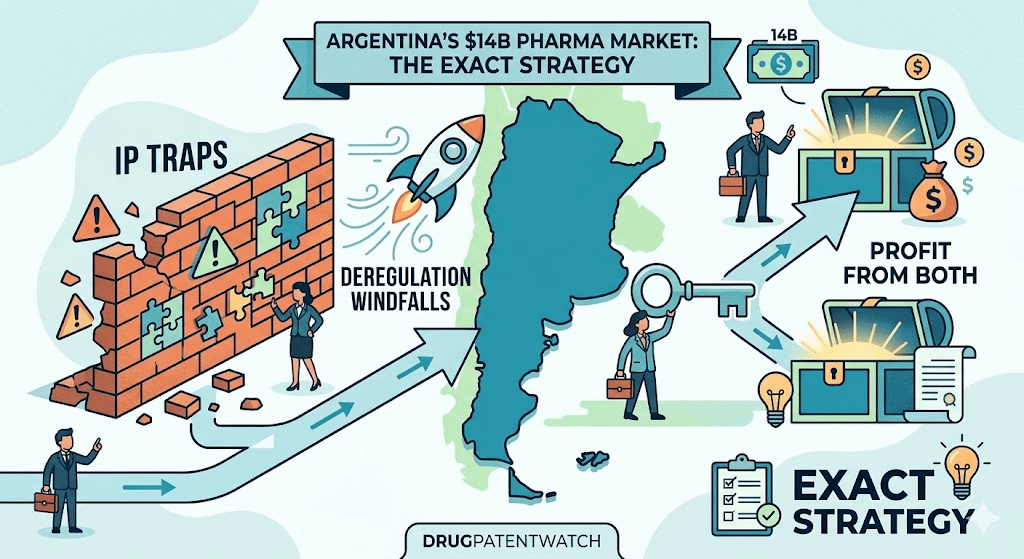
Argentina’s pharmaceutical market is a $7.3 billion commercial arena projected to reach $14.2 billion by 2030 — and it is being rewritten in real time by the most aggressive deregulatory decree in the country’s modern history. For IP strategists, portfolio managers, and commercial directors, that combination demands a specific, technically grounded playbook. This article is it.
What follows is a comprehensive analysis of every decision layer that determines success or failure in Argentina: ANMAT’s approval architecture and the reliance shortcuts embedded inside it, the 2012 patentability guidelines that are quietly destroying innovator IP portfolios, the three-tier payer system that punishes anyone treating it as a single negotiation, and the hyperinflation calculus that makes payment velocity more important than list price. It also benchmarks Argentina against Brazil and Mexico to give regional executives the comparative frame they need to allocate resources correctly.
Argentina’s Pharmaceutical Market Size, Composition, and the Data That Actually Matter
The market’s headline number — $7.3 billion in 2023 with a 4.4% CAGR to 2030 — understates both the opportunity and the volatility. Prescription drugs account for 88.5% of total sales. Within that segment, patented drugs hold a 63.8% share and generics 24.7%. OTC represents the remaining 11.5%. Those figures will shift materially over the next three years as Decree 70/2023 restructures the commercial dynamics for off-patent products.
Biologics and biosimilars are the fastest-growing product category. Argentina has one of Latin America’s most active domestic biosimilar development industries, with companies like mAbxience (a joint venture backed by Grupo Insud and Chemo) producing monoclonal antibodies at scale. This is not a market where biologics competition arrives only from foreign entrants. Local manufacturers have the technical capability to contest the category, and ANMAT’s EMA-aligned biosimilar framework gives them a credible pathway to do so.
The market’s competitive structure is unlike most major markets. Multinational corporations — Bayer, Pfizer, Sanofi, Novartis, Roche, Merck — compete against a cohort of deeply capitalized domestic laboratories. Roemmers, Bagó, Elea, and Gador are not generic commodity producers. They are vertically integrated, marketing-heavy enterprises with distribution networks, brand equity in key physician segments, and political relationships that took decades to build. The former Novartis Argentina country president noted publicly that you have to go far down the IMS rankings to find a multinational in the top tier. That observation still holds, though the deregulatory reforms are beginning to erode the structural advantages the domestic industry relied on.
What Decree 70/2023 Does to Competitive Dynamics for Every Drug Category
President Javier Milei’s Decree of Necessity and Urgency 70/2023, issued December 20, 2023, is not a single reform. It is four simultaneous structural interventions that hit the pharmaceutical market from different angles.
How Generic-Only Prescribing Ends the Branded Generic Business Model
The decree mandates that all prescriptions carry only the International Nonproprietary Name of the medication — no brand name permitted. Pharmacists must then dispense the lowest-cost bioequivalent available unless the patient explicitly requests otherwise. This single provision destroys the foundational logic of the Argentine branded generic: the decades-old commercial model in which a domestic laboratory captured value not by being cheapest, but by investing heavily in physician detailing to create brand preference for an off-patent molecule. When the prescription no longer mentions a brand, that detailing investment has no commercial conversion mechanism. Competitive advantage shifts entirely to price, manufacturing cost, supply chain reliability, and pharmacy-level relationships.
Companies like Roemmers and Bagó, which built dominant positions partly through marketing muscle, now need to compete on the variables that favor the most cost-efficient manufacturers. That is a structural reorganization of where value accumulates in the Argentine market.
How OTC Liberalization Creates New Retail Channels — and New Quality Risks
Pre-decree, over-the-counter medication sales were restricted to licensed pharmacies under Pharmacy Law 17,565. The decree eliminates that restriction. OTC drugs can now be sold in supermarkets, kiosks, and convenience stores. The distribution opportunity is obvious. The complications are less discussed: cold chain integrity outside pharmacy environments, counterfeit risk through informal retail, and the difficulty of maintaining pharmacovigilance data quality when products move through channels with no dispensing professional on site.
For consumer health divisions of MNCs — particularly companies like Bayer Consumer Health, Sanofi Consumer Healthcare, and GSK Consumer Healthcare — this opens a material channel expansion opportunity. The constraint is building a distribution infrastructure that can serve high-volume retail at a competitive cost structure.
How Pharmacy Ownership Deregulation Enables Capital-Backed Chain Expansion
Prior to the decree, provincial laws and Pharmacy Law 17,565 restricted pharmacy ownership to licensed pharmacists, functionally preventing corporate consolidation. The decree allows any legally recognized entity — including corporations — to own and operate pharmacies. Provincial governments retain the right to opt out of this provision, and the major industrial province of Buenos Aires has not yet fully aligned, creating a patchwork implementation.
Where the rule applies, it opens Argentina to the pharmacy chain consolidation that has already reshaped Brazil, Mexico, and Chile. Farmacias del Ahorro (Mexico) and Droga Raia Drogasil (Brazil) provide the template: scale-driven purchasing power, private label product development, and data-driven inventory management. Institutional investors and private equity should treat this as the earliest stage of a consolidation cycle.
How Public Tender Deregulation Unlocks Procurement Revenue for MNCs
The previous regime under Law 18,875, known as the ‘Compre Argentino’ act, granted domestic manufacturers a categorical preference in public procurement bids. The decree repeals it. Foreign and domestic laboratories now compete on equal footing for public tenders, which represent a substantial revenue stream across national, provincial, and municipal hospital systems. For multinational companies with off-patent or loss-of-exclusivity products priced competitively, this is a direct market opening.
Regulatory Change
Immediate Commercial Impact
Beneficiary Profile
Generic-only prescribing (INN mandate)
Destroys brand value for off-patent drugs; pharmacy becomes the decision point
ANMAT’s Architecture: Why This Regulator Is More Predictable Than the Country It Operates In
The Administración Nacional de Medicamentos, Alimentos y Tecnología Médica (ANMAT) was established by Executive Decree 1490/92 with a structural feature that has defined its character ever since: it is “autarchic.” In Argentine administrative law, autarchy means operational and financial independence from the central government’s day-to-day direction. ANMAT controls its own budget, sets its own technical standards, and makes its own approval decisions without requiring ministerial sign-off on each one.
This is not a minor legal detail. In a country where presidential decrees have rewritten entire industry frameworks overnight and where economic ministries have at various points imposed price controls, import restrictions, and currency regulations on the pharmaceutical sector, ANMAT’s insulation has provided a reliable core of scientific consistency. Its decisions have been predictable even when the surrounding political economy has not. That predictability is a commercial asset for companies trying to build registration timelines into financial models.
How ANMAT’s International Status Creates the Reliance Shortcut That Determines Your Time-to-Market
ANMAT’s designation as a Regional Reference National Regulatory Authority by PAHO/WHO is not ceremonial. It reflects decades of deliberate alignment with the standards of the FDA, EMA, and other members of the International Coalition of Medicines Regulatory Authorities (ICMRA). ANMAT is also a member of the International Council for Harmonisation (ICH) and the Pharmaceutical Inspection Co-operation Scheme (PIC/S), and it maintains formal data-sharing and confidentiality agreements with the FDA.
This standing enables the reliance architecture that is ANMAT’s most commercially consequential feature. Because the agency’s processes align with FDA and EMA standards, it can treat prior approvals from those agencies as rigorous, trust-verified reviews rather than foreign documents requiring full independent replication. That trust is the engine behind the Article 4 pathway and the reason it delivers approvals in roughly 10 months rather than three-plus years.
Why the Biologics Division’s Structure Tells You Exactly What ANMAT Will Scrutinize
ANMAT’s Office of Evaluation and Control of Biologicals and Radiopharmaceuticals integrates three functions under one roof: facility quality assurance, the national biologicals control laboratory, and product evaluation and marketing authorization. This is not organizational happenstance. It reflects the agency’s view that a biologic’s clinical data package and its manufacturing quality controls are inseparable for regulatory purposes. A company submitting a biosimilar or biologic dossier that meets the clinical comparability threshold but has gaps in batch consistency data, GMP documentation, or quality system records will face delays from the same team reviewing the clinical package. There is no sequencing benefit to submitting clinical data first and resolving manufacturing issues later.
The Article 4 vs. Article 5 Decision: The Approval Pathway Gap That Shapes Your Entire Launch Sequence
The foundational regulation governing drug registration pathways is Decree 150/1992. Its Annex I/II system is the most commercially important structural feature of the Argentine regulatory process.
What the Article 4 Fast-Track Requires — and Where Companies Lose the Advantage
Article 4 applies to drugs already approved and actively marketed in an Annex I country — the United States, Japan, and EU member states. The critical document is the Certificate of Pharmaceutical Product issued by the Annex I regulatory authority. That certificate must confirm active commercialization, not merely approval. A drug approved by the FDA but not yet commercially launched in the U.S. does not qualify. ANMAT’s review under Article 4 takes approximately 10 months, and the agency may in many cases rely so substantially on the Annex I dossier that it does not request the full technical package separately.
The most common mistake companies make in this pathway is timing the Argentine submission to the FDA or EMA approval date rather than the commercial launch date. An ANMAT submission filed before the product is selling in the reference market will not qualify for Article 4 and will either be reviewed under the slower Article 5 standard or will sit pending while the company waits for the CPP with marketed-status language. Either outcome adds months to the Argentina launch date.
What the Article 5 Full Review Means Financially — and When It Cannot Be Avoided
Article 5 covers products manufactured in Argentina without a registered equivalent, products from Annex II countries not marketed in any Annex I market, and products from countries outside both annexes. The stated timeline is not less than three years. For compounds developed regionally, manufactured in emerging markets, or by companies that do not have a US or EU commercial footprint, this pathway is unavoidable and must be priced into any economic model of the Argentine opportunity. A three-year regulatory cost plus local manufacturing setup costs against a $7.3 billion market with weak IP protection produces a very different investment case than a 10-month Article 4 approval.
Argentina’s Biosimilar Regulatory Framework: Why the EMA Model Matters for Market Entry Timing
ANMAT published its biosimilar-specific regulations in three instruments: Provision No. 7075/11 for general biological medicines, Provision No. 3397/12 for monoclonal antibodies and recombinant DNA products, and Provision No. 7729/11 for the abbreviated biosimilar pathway. The abbreviated pathway explicitly models the European Medicines Agency’s comparability exercise approach. Applicants must demonstrate high similarity in quality, safety, and efficacy against a designated reference medicine.
This EMA-aligned standard has made Argentina one of the technically credible biosimilar regulatory frameworks in Latin America — a leader by regional standards, as documented in academic literature on LATAM regulatory approaches. It has also attracted domestic investment in biological manufacturing. mAbxience’s bevacizumab biosimilar and trastuzumab programs are emblematic. South Korean manufacturers including Celltrion and Samsung Bioepis have evaluated or entered the market. Indian companies including Cipla and Dr. Reddy’s treat Argentina as a regional hub.
Which Biosimilar Categories Face the Most Competitive Pressure in Argentina
Oncology biologics — trastuzumab, rituximab, bevacizumab — have the most developed biosimilar competitive landscape. Immunology and inflammation products in the adalimumab, etanercept, and infliximab class are the next tier. Insulin analogs have a distinct competitive structure given the breadth of domestic manufacturing capacity. Erythropoietin and filgrastim have been off-patent long enough that they are essentially commoditized. Novel biosimilars in ophthalmology (ranibizumab, aflibercept analogs) and bone health (denosumab) are earlier in the competitive cycle and represent a more favorable entry window.
Argentina’s Clinical Trial Environment: What the Approval Timelines Mean for R&D Site Selection
ANMAT regulates all Phase I, II, and III clinical trials directly. A protocol must receive ethics committee approval before ANMAT submission — there is no concurrent pathway. Once an ethics committee approval is in hand, the standard ANMAT review timeline under Provision 4008-2017 is 70 working days. For trials already approved by an Annex I-equivalent regulatory authority, that timeline compresses to 55 working days.
Argentina’s patient enrollment advantages are real. It has a large, concentrated urban population with high medical infrastructure density in Buenos Aires, Córdoba, and Rosario. Investigator quality is consistently rated highly by FDA and EMA auditors. Patient compliance rates are strong by emerging market standards. These structural advantages, combined with the accelerated timeline for internationally pre-approved protocols, make Argentina a competitive site selection option for global Phase II and Phase III programs, particularly in oncology, cardiovascular disease, rheumatology, and metabolic disorders.
The risk factor for clinical operations is operational continuity during economic disruptions. Currency restrictions have at various points complicated the transfer of sponsor payments to investigators and sites. Comprehensive financial hedging arrangements and multi-currency payment clauses are standard practice for experienced CROs operating in the country.
Argentina’s IP System: Why the 10% Patent Grant Rate Is the Number Every Drug Licensing Team Must Understand
Argentina’s patent office, the Instituto Nacional de la Propiedad Industrial (INPI), grants pharmaceutical patents at a 10% rate. The comparable rate for non-pharmaceutical fields is 46%. That five-fold gap is not accidental. It is the direct output of a deliberate regulatory policy encoded in the 2012 Patentability Guidelines.
What the 2012 Guidelines Actually Block — and Why a Standard Lifecycle Management Strategy Fails Here
The 2012 Joint Resolutions (Nos. 118/12, 546/12, and 107/12), issued by INPI alongside the Ministries of Health and Industry, established explicit subject matter exclusions targeting the pharmaceutical follow-on patent categories that constitute most of a typical innovator’s lifecycle management portfolio. The guidelines define the following as non-patentable in Argentina:
New uses and second medical indications, including Swiss-type claims. Polymorphs. New formulations and compositions. New dosage forms. Salts, esters, ethers, and derivative compounds of known molecules. Active metabolites. Pro-drugs.
This list covers the substantial majority of secondary patents that a multinational pharmaceutical company would file in the US or EU as part of a standard lifecycle management strategy. An extended-release formulation, a more bioavailable salt form, a pediatric dose, a new indication in a different therapeutic area — none of these can be expected to receive patent protection in Argentina under current guidelines. The entire intellectual property defense for an innovative product in Argentina must therefore concentrate on the core new chemical entity patent.
How INPI’s Prosecution Timeline Compounds the IP Problem
Argentina is not a member of the Patent Cooperation Treaty. There is no PCT national phase entry mechanism. Companies must file directly at INPI, typically claiming Paris Convention priority from a first filing in another jurisdiction. The examination pendency at INPI averages 5 to 7 years. A product that receives FDA approval, launches in the US, and enters Argentina via the Article 4 pathway within 12 to 18 months of its US launch may still not have a granted Argentine patent when generic competition becomes technically possible. The core NCE patent protection window is narrower in practice than the nominal patent term suggests, because the clock does not stop while INPI examines the application.
For companies that need to monitor this distinct national-level patent prosecution in parallel with global portfolio management, intelligence tools that track INPI application status, examination history, and administrative challenge filings independently of PCT data streams provide an essential operational capability.
What Argentina’s Courts Have Said About Pharmaceutical Patent Validity — And Why Litigation Strategy Must Be Financial, Not Legal
Patent validity and infringement disputes go to the Federal Courts, not to INPI. First-instance decisions take three to five years. Appeals to the Federal Court of Appeals add one to two years. Total litigation timelines of five to seven years before a final decision are common.
In polymorph cases brought by Pfizer and Bayer, the Federal Courts have deferred substantially to INPI’s technical judgments. The rulings held that the petitioners’ evidence was insufficient to overturn the examiner’s finding of no inventive step, consistent with the 2012 Guidelines. This establishes a high bar for challenging an INPI rejection through the judiciary.
The strategic calculus for litigation in Argentina is therefore commercial, not legal. The question is not ‘can we win this case.’ It is whether the commercial value of the delay created by five to seven years of litigation exceeds the legal costs of that litigation. For a blockbuster product generating significant Argentine revenues, the answer may be yes. For a product with mid-tier volumes, the math typically does not work. Each decision requires explicit financial modeling of the litigation delay premium against the total legal cost, discounted at an appropriate rate given Argentina’s cash flow environment.
Data Exclusivity in Argentina: How Law 24.766 Fails Innovators and Why the Gap Has Persisted
Argentina does not have a formal regulatory data protection or data exclusivity system for pharmaceuticals. The US grants five years of data exclusivity to new chemical entities, with a further three years for new clinical investigations supporting label changes. The EU grants eight years. Mexico, under its USMCA obligations, provides five years. Argentina provides none.
The legal basis for any data protection claim in Argentina is Law 24.766, which prohibits the “unfair commercial use” of undisclosed information. This provision protects the clinical data package from being physically copied or disclosed to third parties. It does not explicitly prevent ANMAT from referencing or relying on the safety and efficacy profile established by the innovator’s previously submitted data when reviewing a subsequent generic or biosimilar application that demonstrates bioequivalence or biosimilarity. The distinction between “copying data” and “relying on the regulatory record created by data” has never been definitively resolved in Argentine law, and the operational practice has generally favored the latter interpretation, which benefits generic entrants.
The implications for innovator commercial strategy are concrete. When the core NCE patent expires in Argentina, there is no regulatory data protection buffer before generic entry. The patent expiry date and the generic entry risk date are effectively the same date, absent a successful injunction through the Federal Courts. Commercial lifecycle strategies that assume even a 12-to-18-month data exclusivity runway after patent expiry need to be rebuilt from the ground up for the Argentine context.
The Three-Tier Payer Landscape: Why Obras Sociales Are the Real Market Access Target
Argentina’s healthcare finance system divides into three segments with distinct funding, decision-making, and formulary structures. Treating any Argentine market access strategy as a single, unified negotiation is a category error.
The public system covers approximately 43% of the population through national, provincial, and municipal facilities financed by general taxation. Product access in this tier is largely determined by provincial hospital procurement processes and the national formulary managed by the Health Ministry. Pricing pressure is severe and payment cycles are long. For innovative high-cost medicines, the public system often cannot pay list price, creating access gaps that create compliance and reputational risks for manufacturers.
The social security system, the Obras Sociales, covers roughly 48% of the population. These are more than 300 independent trade union health insurance funds, financed by mandatory payroll contributions — typically 6% from employers and 3% from employees. Each Obra Social is its own institution with independent governance, its own formulary decision-making process, and its own financial position. The Obra Social of the banking sector (OSECAC), the construction sector (UOCRA), and the teachers’ union (OSPLAD) operate at very different scales and with different budget capacities. Securing access with the ten largest Obras Sociales represents a disproportionate share of the commercially relevant covered lives in Argentina.
Private health insurance, the Prepagas, covers approximately 15% of the population through premium-financed plans from companies like Swiss Medical Group, Galeno, OSDE (which straddles the Obra Social and private categories), and Medicus. There is significant overlap with the Obra Social system, as individuals may redirect mandatory payroll contributions to a Prepaga, making the coverage categories less mutually exclusive than the percentages suggest.
How the Programa Médico Obligatorio Defines the Floor for Reimbursement Negotiations
The PMO is the legally mandated minimum benefits basket that all three payer segments must cover. For most outpatient prescription drugs, the standard reimbursement rate is 40% of cost. Coverage rises to 100% for oncology, chronic renal insufficiency, HIV/AIDS, cystic fibrosis, and all inpatient medications. Inclusion in the 100% coverage categories is not automatic; it requires a specific regulatory and policy process. For a high-cost innovative medicine targeting a chronic or oncology indication, PMO inclusion at the 100% level is the access threshold that determines commercial viability in the covered population.
What SURGE Reimbursement Means for High-Cost Drug Access — and Where the System Breaks Down
The Unique Reimbursement System for Disease Management (SURGE), administered by the Superintendence of Health Services (SSS), provides a central solidarity mechanism for exceptionally high-cost treatments — primarily orphan drugs, rare disease therapies, and certain biologics. Payers that have covered a SURGE-listed product can apply to the SSS for reimbursement from this central fund, reducing the per-capita financial exposure that would otherwise make the product commercially inaccessible in smaller Obras Sociales.
The system’s structural failure is that SURGE reimbursement rates are not updated on a schedule that tracks inflation. In a 65-to-100% annual inflation environment, a SURGE rate set in January can cover less than half of the actual acquisition cost by December. The gap falls on the payer, who must choose between absorbing a loss, denying access, or negotiating a confidential rebate structure with the manufacturer that effectively brings the product cost down to the SURGE rate. All three outcomes are common in practice. For manufacturers, this creates a three-way scenario analysis that must be modeled explicitly: maintain list price and accept access restrictions, offer confidential rebates to maintain access at lower net pricing, or engage in the SSS process to update SURGE rates, which is slow and uncertain.
Hyperinflation and the Argentine P&L: Why Days Sales Outstanding Is More Important Than List Price
Argentina has experienced annual inflation rates above 50% continuously since 2018, with periods exceeding 100% annually. In 2021, while general inflation was severe, pharmaceutical drug prices increased 65.9% — higher than headline CPI, reflecting manufacturers’ attempts to maintain real margins. Even with deregulated pricing, the real-terms value of a peso-denominated receivable degrades every day it remains uncollected.
The practical consequence for pharmaceutical commercial strategy is that pricing decisions and collection terms are inseparable. A product priced at 1,000 pesos with a 180-day collection cycle has a different real economic value than the same product priced at 900 pesos with a 30-day cycle. At 100% annual inflation, the 900-peso product with immediate collection is worth approximately 75% more in US dollar terms than the thousand-peso product collected at six months, even before accounting for the risk that the debtor’s financial position deteriorates during the waiting period.
This reality requires several specific structural adjustments to standard commercial models. Contracts with Obras Sociales and Prepagas should specify payment cycles of 30 to 45 days maximum, with explicit daily interest penalties for late payment denominated in a stable reference currency. Where the commercial relationship permits, US dollar invoicing or ARS pricing indexed to the official exchange rate provides a hedge against the inflationary erosion between invoice date and collection date. Financial planning models must treat DSO as a core economic variable and run sensitivity scenarios across at least three DSO assumptions, not simply apply the market average.
The pricing freedom granted by the deregulation is therefore not an unqualified benefit. A company that sets an aggressive list price but cannot collect that price in a timely manner is simply deferring realized revenue into a currency-risk environment. The companies that succeed commercially in Argentina over the medium term will be those that build contractual structures as rigorously as they build pricing models.
Argentina vs. Brazil vs. Mexico: The IP and Regulatory Comparison That Determines Resource Allocation
Regional executives responsible for Latin America allocate regulatory, legal, and commercial resources across markets that look superficially similar but have fundamentally different IP and regulatory risk profiles.
Factor
Argentina (ANMAT)
Brazil (ANVISA)
Mexico (COFEPRIS)
Standard approval timeline
10-12 months (Article 4 reliance); 3+ years (Article 5 full review)
Median 795 days (2013-2016 cohort)
12-18 months; faster via reliance pathways
Reliance model
Formalized, Annex I/II system, strong deference to FDA/EMA
Less pure — ANVISA conducts more independent review, often requests local data
Strong; formal equivalency pathways for FDA/EMA/Health Canada approvals
Patent linkage
None
None (prior ANVISA patent consent requirement removed in 2021)
Weak — Law 24.766 trade secret protection only, no explicit RDP
None — explicitly excluded for human use products
5 years for new chemical entities under USMCA
Primary IP challenge
2012 Patentability Guidelines; 10% pharmaceutical patent grant rate
INPI backlog; extreme pendency for patent prosecution
Counterfeiting and enforcement gaps; weak judicial IP enforcement
The table produces a clear strategic ranking. Mexico offers the strongest and most predictable IP protection of the three. A product launched in Mexico with a core NCE patent, formal patent linkage, and five-year data exclusivity has an IP-backed commercial window that allows meaningful recovery of development costs. Brazil presents the deepest regulatory friction through ANVISA’s independent review requirements, which add unpredictability to approval timelines even with reliance mechanisms nominally in place. Argentina sits in a specific position: the fastest and most predictable regulatory pathway in the region, with the weakest IP environment. It is the market where you get to market efficiently and then compete against generics quickly.
For regional resource allocation, this means Argentina should receive heavy investment in the commercial and supply chain capabilities that determine generic-era competitiveness, Brazil requires deep regulatory affairs resourcing to manage ANVISA’s review process, and Mexico warrants aggressive IP monitoring and patent linkage management to protect against early generic entry.
What Investors Are Watching in the Argentine Pharma Market
Investors with Argentine pharmaceutical exposure should track four specific signals, each of which moves the risk/return calculation materially.
The first is the durability of Decree 70/2023. The decree is a DNU — a Decree of Necessity and Urgency — which carries constitutional legal risk if Congress refuses to ratify it or a future administration reverses it. The commercial disruption it creates in the branded generic market is already generating political pressure from domestic manufacturers and pharmacy associations. Monitoring the legislative record and political dynamics around the decree is a leading indicator of whether the commercial model reset is permanent or temporary.
The second is the evolution of SURGE reimbursement rates. If the government updates SURGE rates on a more frequent, inflation-indexed basis, the market access situation for high-cost biologics improves substantially. If SURGE rates continue to erode in real terms, the market for innovative medicines in the covered population contracts, regardless of PMO inclusion.
The third is any official signal about the 2012 Patentability Guidelines. The current administration has stated views broadly favorable to deregulation and innovation. There is a coherent argument that guidelines designed to benefit domestic generic manufacturers at the expense of IP protection are inconsistent with an investment-attracting reform agenda. Any formal review process, judicial challenge, or ministerial statement regarding the guidelines is a leading indicator of IP environment change.
The fourth is PCT membership. Argentina is one of the few significant pharmaceutical markets outside the PCT system. Accession would reduce filing costs and complexity for innovator companies and is a structural market access improvement that could attract additional innovative drug launches without requiring treaty renegotiation.
Key Patent and Regulatory Filing Dates: What Determines Your Competitive Window
Unlike the US or EU, Argentina does not have a publicly accessible, integrated patent-drug linkage database equivalent to the FDA Orange Book or the European Patent Register correlated to EMA approvals. This creates an intelligence gap that directly benefits generic manufacturers and disadvantages innovators trying to assess their exposure.
The practical consequence is that monitoring Argentine IP status requires tracking INPI application status independently of global patent databases, which typically do not capture national-phase-only filings in non-PCT countries. Given the 5-to-7-year prosecution pendency at INPI, a drug that received FDA approval in 2020 and was submitted to INPI under Paris Convention priority in 2019 may still have a pending, unresolved patent application as of 2025. That application’s status, whether it has been rejected under the 2012 Guidelines, is under appeal, or remains in examination, determines the legal landscape for potential generic entry.
For products approaching the core NCE patent expiry in major markets — particularly products facing loss of exclusivity in the US between 2025 and 2030 — the Argentine IP status requires explicit due diligence. A product with a US patent expiring in 2027 that never received an Argentine patent is in a different competitive position than one that secured an Argentine grant, even though both face generic competition. Products with Argentine patents that were litigated to completion have a defined exclusivity window. Products with pending applications and uncertain prosecution outcomes have an ambiguous window requiring active monitoring.
How Biosimilar Launch Timing Works Under ANMAT’s Framework
A biosimilar applicant under Provision 7729/11 must conduct a full comparability exercise — analytical, functional, non-clinical, and clinical components — against the designated reference biological medicine. The reference product must be one authorized and marketed in Argentina by ANMAT, not merely by the FDA or EMA. This requirement means that for a biologic that is relatively new to the Argentine market, a biosimilar applicant may need to wait for the reference product’s Argentine commercialization history before a complete dossier can be submitted.
The typical biosimilar approval timeline at ANMAT is 24 months, consistent with the general timeline for biologics registration. Given ANMAT’s EMA-model framework and the agency’s biological review experience, this timeline is achievable for well-prepared applicants. The risk factor is the manufacturing quality documentation review, which is handled by the integrated biologics office and represents the most common source of major objection letters requiring supplemental submissions.
Post-approval, biosimilar interchangeability is not automatically granted by the Argentine framework. Substitution at the pharmacy level for biological medicines is subject to prescriber and patient consent in ways that do not apply to small-molecule generics. This distinction matters commercially: the INN prescribing mandate under Decree 70/2023 creates strong automatic substitution pressure for small-molecule generics, but the same pressure does not apply identically to biological medicines, preserving somewhat more commercial value for the reference biologic in the post-biosimilar-entry period.
How the FDA and EMA Affect Argentina’s Approval Timeline
ANMAT’s Article 4 pathway is explicitly dependent on prior FDA or EMA action. Any delay, clinical hold, complete response letter, or labeling dispute in the US or EU approval process directly delays the Argentine launch clock. A drug that receives FDA approval with labeling restrictions not present in the original global package — say, a REMS requirement or a boxed warning added during review — must address whether that label modification changes the Argentine dossier requirements. ANMAT will review the CPP and the locally approved labeling in the Annex I country, and material differences between the reference market label and the proposed Argentine label require explanation.
EMA decisions, particularly for biologics reviewed under the centralized procedure, carry significant weight in ANMAT’s review. A European Public Assessment Report that includes clinical reservations, Risk Management Plan requirements, or post-marketing commitment obligations will be scrutinized by ANMAT’s review team. Companies should not assume that the Argentine label will mirror the FDA label automatically; they should review the EMA assessment as well, since ANMAT has access to both and may incorporate requirements from either.
Why Manufacturing Complexity Matters for the Argentine Biosimilar Market
The manufacturing barrier for biological medicines is the primary constraint on competitive entry, not the regulatory pathway. Argentina has domestic biological manufacturing capacity — notably at mAbxience in Buenos Aires province, at the state-owned laboratory SINERGIUM Biotech, and at Laboratorio Bagó’s biological division. But the capital requirements, technical expertise, and quality systems needed to manufacture a monoclonal antibody to EMA-equivalent standards are barriers that most domestic generic manufacturers cannot clear.
This manufacturing moat is structurally more durable than any patent protection available under Argentina’s IP framework. A small-molecule generic can be manufactured by dozens of Argentine domestic manufacturers from API sourced from India or China. A trastuzumab biosimilar requires mammalian cell culture, downstream purification, and quality control infrastructure that relatively few organizations in Argentina can credibly operate. For innovator biologics facing a coming loss-of-exclusivity period, this manufacturing barrier provides a practical competitive protection even in the absence of meaningful patent coverage.
The flip side is that international biosimilar manufacturers — Korean, Indian, and European — targeting Argentina must either establish or contract local manufacturing, import under the ANMAT GMP inspection regime, or qualify their foreign facility to ANMAT’s standards, which requires a facility inspection. ANMAT has conducted joint inspections with the EMA through its PIC/S membership. A facility already inspected and cleared by an EMA member national authority is not guaranteed automatic ANMAT GMP clearance, but the prior inspection record substantially accelerates ANMAT’s own assessment.
What Happens After Loss of Exclusivity: The Argentine Generic Entry Scenario
When a core NCE patent expires in Argentina — whether by running its term or by failing to secure a grant in the first instance — the transition to generic competition is faster than in the US or EU for two structural reasons. First, there is no patent linkage system requiring ANMAT to clear patent status before approving a generic application. A generic manufacturer can submit a bioequivalence-based ANDA equivalent to ANMAT at any time and receive approval based purely on pharmaceutical equivalence, without waiting for patent resolution. ANMAT’s lack of a patent linkage mechanism means the approval timeline and the patent litigation timeline run on parallel, independent tracks. Second, the absence of data exclusivity means there is no regulatory buffer between patent expiry and generic market authorization, as noted above.
In practice, domestic Argentine generic manufacturers often file against patented products before patent expiry, positioning for day-one generic launch the moment the patent expires or is found invalid. For products where INPI never granted a patent — the most common outcome under the 2012 Guidelines — generic entry can be sought from the day of ANMAT marketing authorization, subject only to any ongoing patent application prosecution, which does not legally block approval.
The commercial consequence is a compressed innovator exclusivity window. Modeled conservatively, an innovative product launched in Argentina under Article 4 can expect branded commercial exclusivity only for the period between its Argentine launch and the first generic entry. Depending on the product’s filing history at INPI and the interest of domestic manufacturers, that window may be three to five years, not the eight to twelve years an innovator might expect in a market with patent linkage and data exclusivity.
Revenue at Risk: Estimating the Argentina Exposure for an Innovative Drug Portfolio
A simplified framework for estimating Argentine IP-related revenue exposure starts with three variables: current Argentine revenues, the probability of generic entry before the global patent term expires, and the expected market share erosion rate post-entry.
For a product with weak or no Argentine patent coverage, the probability of generic entry at or near Argentine patent expiry should be set at 80 to 90% within 12 months, given domestic manufacturer capabilities and the INN prescribing mandate. Market share erosion after generic entry tends to be rapid in the cost-sensitive Argentine market — 40 to 60% unit volume loss in the first 12 months post-entry is common for oral solid dosage forms with multiple generic entrants. For biologics, the erosion rate is slower, consistent with the interchangeability constraints and manufacturing barriers discussed above, more on the order of 15 to 30% in year one.
For a product earning, say, $30 million annually in Argentina with no patent protection and multiple domestic generic manufacturers capable of entry, the at-risk revenue on a three-year discounted basis is material — particularly when discounted at the rates appropriate for an Argentine peso-denominated cash flow. Portfolio managers holding positions in companies with significant Argentine exposure should model these scenarios explicitly against the company’s disclosed regional revenue data.
Common Investor Questions
Is the Milei deregulation durable enough to underwrite a long-term investment thesis?
The commercial provisions — INN prescribing, OTC liberalization — are already operational and generating competitive pressure. Reversing them would require either congressional action or a future presidential decree, both of which face political friction given the demonstrated consumer price benefit of lower-cost drug access. The more vulnerable provisions are the pharmacy ownership liberalization, which faces provincial resistance, and the public tender equalization, which domestic manufacturers will lobby to restore. The core commercial logic of the deregulation is durable enough to incorporate into a three-to-five-year model, but the full implementation scenario carries more risk than the core scenario.
Can a company with only FDA and EMA approvals build a viable Argentine strategy?
Yes, and the Article 4 pathway is the mechanism. The timing requirement — active commercialization in an Annex I market before ANMAT submission — means that the Argentine registration should be filed within weeks of the US or EU commercial launch date, with the dossier preparation completed in parallel during the approval and launch preparation period in the reference market.
How should a licensing deal for an Argentine territory be structured given the IP environment?
License economics for Argentine rights need to account explicitly for the short effective exclusivity window. Royalty rates tied to revenues that will erode faster and earlier than in a patent-linked market should be set lower as a baseline, with step-down provisions at defined exclusivity-loss triggers. Alternatively, licensees can be given a first right to convert to a generic-competitive manufacturing arrangement post-exclusivity, preserving commercial continuity within the same licensing relationship.
What is the realistic biosimilar development and approval timeline for a company targeting the Argentine market?
A well-prepared applicant starting a biosimilar development program targeting ANMAT’s EMA-model comparability framework should budget three to five years from program initiation to approval, assuming a competent manufacturing facility and clean analytical comparability package. The ANMAT review itself is 24 months. The pre-submission comparability exercise and clinical work drive the front-end timeline.
Investment Strategy
For innovator pharmaceutical companies: Argentina deserves a presence, but the commercial model must be calibrated to the actual exclusivity window available. List price maximization is the wrong objective function. Cash flow velocity, supply chain cost efficiency, and active Obras Sociales engagement are the variables that drive actual returns. Invest in Article 4 submission infrastructure to ensure that the Argentine launch occurs within six to nine months of the US or EU commercial launch, not two to three years later. Model INPI prosecution explicitly and do not assume that global patent filings translate to Argentine coverage.
For generic and biosimilar manufacturers: The INN prescribing mandate has structurally improved the Argentine generic opportunity. The public tender deregulation has opened a previously restricted procurement market. The Article 4 structure means that innovator products reaching Argentina arrive already post-global launch, with an INPI patent status that is often unresolved or unfavorable to the innovator. Systematic monitoring of INPI application outcomes for products in your development queue is a direct commercial intelligence function.
For regional private equity and healthcare investors: The pharmacy ownership deregulation creates a consolidation opportunity that has played out in Brazil and Mexico over the prior decade. Argentine pharmacy retail remains highly fragmented. The enabling legislation is in place. The capital and operational model from regional precedents is proven. The timing question is primarily about provincial adoption velocity and the pace of economic stabilization, which determines consumer purchasing power and insurance coverage rates.
For clinical stage and specialty pharma companies seeking R&D cost optimization: Argentina’s 55-to-70 working day clinical trial authorization timeline, combined with its high-quality investigator base and strong enrollment rates, makes it a cost-competitive site selection option for trials with prior Annex I-equivalent regulatory approval. The operational risk — primarily around sponsor payment transfer and site financial management during economic volatility — is manageable through experienced CRO partnerships with established Argentine infrastructure.
Key Takeaways
Argentina is a fast-follower market by regulatory design and a short-exclusivity market by IP policy design. Those two structural facts determine almost everything else about how to compete here.
The Article 4 reliance pathway delivers one of the fastest approval timelines for internationally approved drugs in Latin America. The 2012 Patentability Guidelines and the absence of regulatory data protection mean that the commercial exclusivity window after approval is among the shortest in the region.
Decree 70/2023 has restructured commercial competition for off-patent products by eliminating branded generic pricing power and opening pharmacy retail to capital-backed consolidation. The commercial advantage has shifted to low-cost manufacturers with efficient supply chains and direct pharmacy relationships.
The Obras Sociales are the dominant payer segment and require individual engagement strategies, not a single national market access plan. SURGE reimbursement rates are inflation-structurally inadequate, requiring manufacturers to model net pricing scenarios that incorporate confidential rebates and collection-timing assumptions.
Hyperinflation makes DSO the single most financially sensitive variable in the Argentine P&L. An accurate commercial model treats payment velocity as a pricing variable, not an assumption.
The Argentine pharmaceutical market rewards companies that arrive fast, price strategically for a compressed exclusivity window, compete on supply chain efficiency, and engage payers with contractual structures built for an inflationary environment. It penalizes companies that apply their standard global playbook without modification.
Frequently Asked Questions
What is the fastest possible approval pathway for a drug in Argentina?
The Article 4 abbreviated pathway, available for products already approved and actively marketed in an Annex I country (US, Japan, EU member states). ANMAT’s review under this pathway takes approximately 10 months. The prerequisite is a Certificate of Pharmaceutical Product from the reference country authority that explicitly confirms active commercial marketing in that market.
How does Argentina’s patent system compare to the US Paragraph IV litigation process?
There is no Paragraph IV equivalent in Argentina. The US Hatch-Waxman Act’s Paragraph IV mechanism allows a generic applicant to challenge a listed patent through the ANDA filing, triggering a defined litigation process with a 30-month stay. Argentina has no patent linkage system. ANMAT approves generic applications based on bioequivalence data without checking for existing patents. Patent disputes are handled entirely through the Federal Courts on a separate track, and no approval stay is triggered by a pending patent challenge.
Does Argentina have biosimilar interchangeability designation?
No. ANMAT’s biosimilar framework, modeled on the EMA approach, grants marketing authorization for a biosimilar following a successful comparability exercise. It does not include an automatic interchangeability designation equivalent to the FDA’s interchangeable biosimilar status. Pharmacist substitution of biological medicines is subject to more restrictive conditions than for small-molecule generics.
What is the correct sequence for an Article 4 ANMAT submission?
FDA or EMA approval. Commercial launch in the Annex I market. Obtain a Certificate of Pharmaceutical Product that confirms marketed status. Submit to ANMAT immediately after obtaining the CPP. Preparing the Argentine dossier in parallel with the Annex I approval process — but holding the submission until the CPP is in hand — maximizes both preparation efficiency and pathway eligibility.
What triggers an ANMAT post-market pharmacovigilance obligation in Argentina?
ANMAT Disposition 2438/2000 requires that severe or unexpected adverse drug reactions occurring within Argentina be reported within 10 days. A comprehensive pharmacovigilance plan is a mandatory component of the initial registration dossier, not an obligation that begins only after post-market data accumulates. Medical device adverse events fall under Technovigilance, governed by Provision 9688/2019, with reporting through a dedicated digital platform.
How should pharmaceutical companies approach the 2012 Patentability Guidelines going forward?
Treat secondary patent protection as unlikely to be granted and plan commercial timelines accordingly. Do not incorporate polymorph, formulation, new use, or dosage form patent grants into Argentine market exclusivity projections. The only reliable IP protection available for a new pharmaceutical product in Argentina is the core new chemical entity patent. Maintain active INPI prosecution monitoring to know the status of all pending applications and be prepared to accelerate court challenges if the commercial value of delay justifies the litigation cost.
This analysis reflects publicly available regulatory, legal, and market data as of mid-2025. Specific regulatory requirements and patent status should be confirmed with qualified Argentine regulatory counsel and IP specialists before any commercial or legal decision.