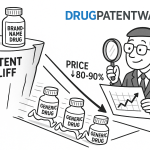
The pharmaceutical industry loses about 80% of a brand’s revenue within twelve months of generic entry. For a blockbuster generating $2 billion a year, that collapse is not a business problem. It is an existential event. The Rx-to-OTC switch has been the most underused tool in the lifecycle management toolkit, not because it does not work, but because companies consistently start planning it three years too late.
AstraZeneca knew Prilosec was running out of time when it simultaneously pushed esomeprazole (Nexium) through the NDA process and licensed omeprazole to Procter & Gamble for an OTC switch in 2003. The two moves together extracted maximum value from a molecule that would otherwise have dropped off a cliff. What most observers miss is how early those decisions were made. The Nexium chiral switch required years of chemistry, clinical trials, and patent prosecution. The OTC partnership required consumer behavior studies, label comprehension work, and retail distribution negotiations. None of that happens in two years. None of it happens in five years, either, if you start from scratch.
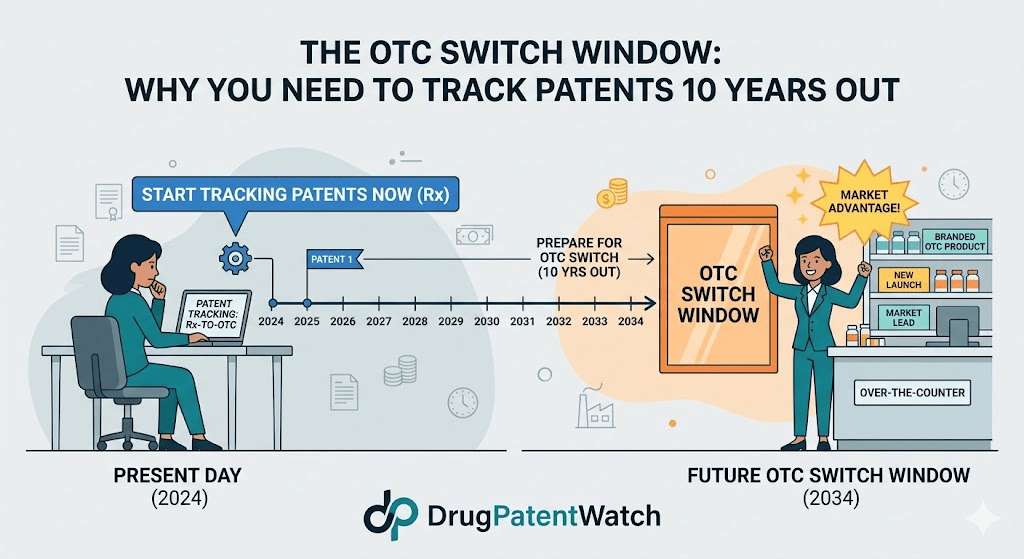
This article makes a single, specific argument: the OTC switch window is determined by the patent stack, not by the commercialization calendar, and you need to be reading that stack at least ten years before loss of exclusivity (LOE) to execute the strategy properly. The 2025 ACNU rule from FDA has added a new dimension to this calculus. So has the 2026 patent cliff, which puts more blockbuster revenue at risk than any prior expiration cycle. The companies tracking their own patent data — and their competitors’ — will execute. The ones who are not will find themselves with a decent molecule, an expired patent, and a generic manufacturer shipping the first truckload to CVS before the OTC NDA is even in review.
What Is an OTC Switch and Why Does Timing Define Its Value?
An Rx-to-OTC switch converts an FDA-approved prescription drug to nonprescription (OTC) status, allowing consumers to purchase it directly without a physician’s involvement. The FDA has two primary pathways: the full switch, which converts all approved uses to nonprescription status, and the partial switch, which converts only specific indications or strengths.
Since the late 1970s, more than 100 Rx products have been switched to OTC in the U.S., creating some of the most recognized consumer health brands in retail pharmacy. [1] Prilosec OTC, Claritin, Zyrtec, Allegra, Flonase, Pepcid AC, Zantac (in its pre-recall incarnation), Nicorette, Monistat, and Plan B all trace their OTC existence to an Rx origin. Each of these switches generated substantial brand equity in the consumer market at a time when the prescription franchise was under competitive pressure.
Timing is the variable that separates the successful switches from the expensive failures. The OTC switch generates three years of new clinical investigation exclusivity under the Hatch-Waxman framework — but only if it requires new clinical studies. [2] That three-year clock starts at FDA approval of the OTC NDA supplement. The brand company that files the OTC NDA before LOE has three years of protected OTC market to build consumer brand recognition before store-brand generics arrive on the shelf. The brand company that files the OTC NDA after LOE starts that three-year clock in a market already crowded with unbranded generics priced at 30 cents on the dollar.
The math is obvious. What is less obvious is how far back the planning must begin.
How Long Does an OTC Switch Actually Take?
The short answer: longer than almost every brand team assumes.
An OTC switch application to FDA requires, at minimum, a label comprehension study, an actual use trial, and a self-selection study. Each of those generates data FDA uses to confirm that a consumer population, without physician involvement, can read the label, choose the drug appropriately for their condition, and use it safely. These are not quick studies. Label comprehension work alone takes twelve to eighteen months from protocol design to FDA-ready data package. Actual use trials, which enroll real consumers using the drug in real-world settings, typically run twelve to eighteen months of enrollment plus data analysis. A self-selection study adds another twelve months.
Run them sequentially — the way most teams do when they start planning late — and you are four to five years from study design to NDA filing, before accounting for FDA review time, which currently averages twelve months for priority applications and up to eighteen months for standard review. Add the time needed to stand up OTC manufacturing (different packaging lines, different labeling systems, consumer-grade quality controls), select and contract with a retail distribution partner, and build the consumer marketing capability the brand team does not have, and the minimum realistic lead time from decision to OTC launch is seven to eight years.
Ten years of lead time is not conservative planning. It is basic competence.
The Claritin Case: What Forced OTC Looked Like
Not every OTC switch is voluntary. The loratadine switch offers a warning about what happens when external stakeholders make the switch decision for you.
In 1998, WellPoint Health Networks — now Anthem/Elevance — filed a citizen petition with FDA requesting that the agency mandate the Rx-to-OTC switch of second-generation antihistamines including loratadine (Claritin), cetirizine (Zyrtec), and fexofenadine (Allegra). WellPoint’s argument was direct: these drugs had safety profiles entirely appropriate for self-administration, and their prescription-only status was generating hundreds of millions of dollars in unnecessary prescription spending that health plans were absorbing through formulary coverage. [3]
Schering-Plough, which marketed Claritin, had generated $3 billion in annual revenue from the prescription product. The last thing it wanted was OTC status that would eliminate formulary coverage, drive consumers to lower-priced store brands, and collapse the reimbursed revenue base before the company had a successor product ready. Schering-Plough’s response to WellPoint’s petition was to argue the drug was too complex for self-administration — an argument that, for a once-daily antihistamine treating runny noses, did not survive scrutiny.
Loratadine’s composition-of-matter patent expired in 2002. Johnson & Johnson, which had licensed the OTC rights, launched Claritin OTC later that year. [4] Schering-Plough lost the prescription franchise and the OTC franchise in rapid succession. The switch happened, but on external stakeholders’ terms and timelines, not on terms the innovator controlled. The company had no successor molecule with meaningful clinical differentiation from loratadine already in late-stage development when the patent cliff hit.
The lesson is simple: if your drug’s safety profile is good enough for OTC, external parties will eventually make that argument to FDA whether or not you want them to. Planning the switch on your own timeline, before that argument is made by a health plan or a consumer advocacy group, is the only way to extract maximum value from it.
The Patent Stack: Why Reading One Patent Is Not Enough
The single most common mistake in OTC switch planning is treating the composition-of-matter patent expiration as the LOE date. It is not, and the confusion costs brand teams both money and time.
Every branded drug product has a patent stack: a layered set of intellectual property protections covering different aspects of the compound, formulation, manufacturing process, method of use, and delivery system. Each layer has a different expiration date. The LOE date that matters commercially — the date generic manufacturers can actually enter the market — depends on the entire stack, not just the foundational patent.
How to Read the OTC Switch Patent Stack: Four Layers That Matter
The composition-of-matter (COM) patent covers the active pharmaceutical ingredient itself. Filed during preclinical development, it typically expires twenty years from its earliest filing date. Patent Term Extension (PTE) under 35 U.S.C. 156 can restore up to five years of patent life lost during FDA regulatory review, capped at fourteen years of post-approval protection. This is the foundational IP layer; once it falls, the molecule is in the public domain. [5]
The formulation patent covers the specific drug product: the salt form, the dosage form, the excipient combination, the release mechanism. An extended-release formulation, a new salt, or an abuse-deterrent matrix can generate a formulation patent with an expiration date years beyond the COM patent. AstraZeneca’s Nexium carries formulation patents separate from the esomeprazole composition patents, as does virtually every major branded product that has gone through active lifecycle management.
The method-of-use patent covers specific indications. These are listed in the FDA Orange Book with patent use codes, alphanumeric identifiers in the format ‘U-‘ followed by a number. Method-of-use patents matter for OTC switch strategy because an OTC switch for a specific indication — say, allergic rhinitis at a lower dose, rather than the full prescription indication — may not implicate the method-of-use patents covering the broader prescription indication. This creates a situation where the OTC product can be protected by method-of-use IP even after the COM patent expires, if the switch is structured correctly.
The OTC-specific patent is the one most brand teams overlook entirely. When an OTC switch requires new clinical studies — and the three-year exclusivity rule requires that it does — those studies can generate new data supporting new patent applications. Consumer selection studies, specific OTC dosing regimens, and OTC-specific packaging systems are all potentially patentable. A brand team that waits until the COM patent is expiring to think about OTC patents is leaving years of protection on the table.
Orange Book Strategy for OTC Products: What Gets Listed and What Triggers Paragraph IV Challenges
The FDA’s Orange Book — formally, Approved Drug Products with Therapeutic Equivalence Evaluations — lists both prescription drug products and OTC drug products that required an NDA. [6] When an OTC NDA is approved, the sponsor can list patents in the Orange Book just as it would for a prescription NDA. Any generic ANDA applicant that wants to reference the OTC NDA must certify to those patents.
A Paragraph IV certification is the ANDA applicant’s assertion that the listed patent is invalid, unenforceable, or will not be infringed. It triggers a 45-day window for the brand company to file a patent infringement suit, which, if filed, automatically imposes a 30-month stay on FDA approval of the ANDA. For OTC products with short three-year exclusivity windows, this 30-month stay is worth significant money: it can extend the protected period by two and a half years if the litigation timeline runs to its maximum.
Tools like DrugPatentWatch track OTC Orange Book listings, Paragraph IV certifications against OTC products, and the litigation history associated with those certifications. Any brand team planning an OTC switch needs to be monitoring these databases not just for its own products but for competing OTC switches in the same therapeutic category. A competitor’s Paragraph IV loss on an OTC patent tells you something important about how defensible your own OTC IP strategy is going to be.
FDA Exclusivity vs. Patent Protection: The Two-Track System for OTC Planning
These are legally distinct systems, and conflating them is the second most common mistake in OTC switch planning.
Patents are property rights granted by the U.S. Patent and Trademark Office. They run for twenty years from the filing date, subject to PTE. The FDA does not verify the validity of patents listed in the Orange Book; it publishes what companies submit, creating a system where brand manufacturers can list patents that might not survive a validity challenge. [7] The consequences for invalid listing are real — 21 U.S.C. 355(c)(3)(D)(ii) creates a civil cause of action — but the listing standards remain relatively permissive.
Exclusivities are marketing rights granted by FDA based on the nature of the approval. They are not property rights; they are administrative periods during which FDA will not approve a competing application. For OTC switch planning, the relevant exclusivity is the three-year new clinical investigation exclusivity. It attaches when an NDA supplement for a new condition of use, including an Rx-to-OTC switch, required new clinical investigations conducted by or for the applicant and essential to the approval. [8]
The three-year exclusivity runs from the date of OTC NDA approval. It does not prevent ANDA applicants from filing; it only prevents FDA from approving those applications for three years. Critically, the exclusivity protects the specific change approved — in this case, the OTC status — but does not protect the underlying active ingredient. A generic can still seek approval of a prescription product referencing the original Rx NDA.
What the Three-Year OTC Exclusivity Actually Does — and Does Not — Protect
The three-year exclusivity for an OTC switch is narrower than most brand teams realize. It protects the OTC-approved change: the new labeling, the specific OTC indication, the consumer-facing product. It does not establish a moat around the molecule. Generic manufacturers who are already in the prescription market continue operating there. And once the three-year exclusivity expires, store-brand OTC generics can reference the OTC NDA and enter the retail market.
The commercial window the three-year exclusivity creates is a brand-building window. The brand company that has spent that three years establishing consumer recognition, building retail shelf presence, negotiating category captain status with major pharmacy chains, and embedding the brand name in consumer advertising has a durable advantage that does not disappear when the exclusivity expires. Prilosec OTC retained meaningful market share years after store-brand omeprazole flooded the OTC section, because P&G built consumer trust in those first three years. [9]
That brand-building cannot be compressed into twelve months. It requires the full three years of the exclusivity window, which means the brand needs to be on shelf, in advertising, and supported by trade promotion on day one of OTC approval. That retail readiness requires at least two to three years of commercial preparation before FDA approval.
The 10-Year Planning Horizon: A Year-by-Year Framework
What does a ten-year OTC switch planning timeline actually look like? The following framework maps the work required from decade out to market launch.
Years 10-8 Before LOE: Patent Landscape Assessment and Strategic Viability
The work at this stage is analytical. The brand team needs to know three things: what the full patent stack looks like (COM patents, formulation patents, method-of-use patents, and any PTE), what the realistic LOE date is accounting for Paragraph IV litigation risk, and whether the drug’s therapeutic profile supports OTC switch eligibility.
An OTC-viable drug needs self-diagnosable indications, a well-established safety profile at consumer-appropriate doses, and a label that can convey sufficient information for safe self-selection. Drugs requiring diagnostic testing before treatment — most oncology agents, most biologics — fail the self-selection screen immediately. Drugs with narrow therapeutic windows, significant drug-drug interactions, or serious side effects requiring monitoring are more complex but not automatically excluded; the 2025 ACNU rule now creates a pathway for some of these.
The patent landscape analysis at this stage should go beyond the Orange Book. USPTO patent databases, continuation patent applications pending for the molecule, formulation work being done in the lab, and any recent OTC-related patent applications filed by the brand company or competitors should all be in scope. DrugPatentWatch’s platform aggregates Orange Book data, patent prosecution history, and Paragraph IV filing records, providing the kind of multi-layer visibility that individual patent searches cannot. A brand team using only the Orange Book for its patent landscape assessment is flying with one instrument.
Years 8-6 Before LOE: Consumer Research and Clinical Study Design
This is when the clinical work has to start, or it will not be done in time. The FDA’s OTC switch review package requires three consumer behavior studies:
A label comprehension study to confirm that consumers can read and understand the OTC Drug Facts label.
A self-selection study to confirm that consumers can determine, without physician input, whether the drug is appropriate for their condition.
An actual use trial to confirm that consumers use the drug correctly in real-world conditions.
Each study needs protocol design, FDA interaction (an End-of-Phase 2 meeting equivalent for the OTC program is advisable), enrollment, data collection, and analysis. These are not small programs. Label comprehension studies typically enroll 300-500 respondents across demographically representative samples. Actual use trials enroll real patients in open-label, uncontrolled settings for the drug’s anticipated OTC use duration. If the drug requires a new dose, a new indication, or a modified delivery form for OTC use, those changes need additional work.
Starting this work at Year 8 before LOE is not conservative. It barely provides enough time to run the studies sequentially, analyze results, and incorporate FDA feedback before the NDA filing deadline.
Years 6-4 Before LOE: NDA Preparation and FDA Alignment
The NDA package for an OTC switch through a supplemental NDA (sNDA) or a new 505(b)(2) application includes the full consumer behavior study data, proposed Drug Facts labeling, safety data supporting the OTC indication, and any chemistry, manufacturing, and controls (CMC) updates for the OTC dosage form. If the OTC product uses a different strength or formulation than the prescription product, additional bridging studies may be required.
FDA interaction during this period is not optional. Pre-NDA meetings, advisory committee preparation if FDA decides to convene one (OTC switches for sensitive therapeutic categories routinely receive advisory committee review), and response to FDA information requests all take time that does not appear in optimistic planning schedules.
Years 4-2 Before LOE: Manufacturing, Retail, and Commercial Build
OTC manufacturing is different from Rx manufacturing in ways that matter commercially. Consumer packaging — blisters, cartons, unit-of-use formats — requires different equipment, different labeling lines, and different quality controls than the prescription dispensing bottles and blister cards that Rx manufacturing produces. Retail distribution requires relationships with pharmacy category buyers at CVS, Walgreens, Walmart, and Amazon that most Rx brand teams do not have. Consumer marketing — television, digital performance, in-store promotional programs — requires talent, agency relationships, and media spend that most Rx brand organizations have not budgeted.
Companies that have executed successful OTC switches either built dedicated consumer healthcare divisions or partnered with established OTC companies for commercialization. [10] The partnership model sacrifices margin for execution: the consumer partner takes a royalty or revenue share in exchange for providing the retail infrastructure and marketing capability. J&J’s consumer health division, Bayer Consumer Health, and Haleon (the GSK/Pfizer consumer health spinout) all exist partly as vehicles to commercialize exactly this kind of switch. Building these relationships takes time that should not be compressed into the eighteen months before OTC launch.
Year 2 to Launch: FDA Review, Retail Sell-In, and Launch Readiness
FDA’s standard OTC NDA review runs twelve to eighteen months. During this period, the commercial team should be in active conversations with major pharmacy chains, the OTC patent strategy should be finalized and Orange Book listing plans confirmed, and the consumer media plan should be ready to execute on approval day. Waiting for FDA approval before starting retail sell-in conversations is a mistake; major pharmacy buyers need six to twelve months of lead time for planogram placement and shelf allocation decisions.
The ACNU Rule: How FDA’s 2025 Regulatory Change Expands the OTC Switch Universe
For most of its history, FDA’s OTC switch framework rested on a single principle: a drug could be marketed OTC only if the label itself provided all the information a consumer needed to use it safely. This excluded an enormous category of drugs — particularly treatments for chronic conditions — where appropriate use required some form of clinical screening or ongoing monitoring that no drug label could replicate.
On December 23, 2024, FDA issued the final rule for Nonprescription Drug Products with an Additional Condition for Nonprescription Use (ACNU). The rule took effect May 27, 2025, after two postponements. [11] It changes the fundamental structure of OTC eligibility.
What the ACNU Rule Allows That the Old Framework Did Not
Under the ACNU framework, a drug can be marketed nonprescription even if label information alone is insufficient for safe self-selection — provided the sponsor implements an approved additional condition to fill the gap. That additional condition could be a structured questionnaire completed at point of sale, a digital screening tool, a pharmacist consultation protocol, or another mechanism demonstrating that consumers are appropriately screened before accessing the drug.
Critically, the ACNU rule allows the same drug, with the same active ingredient, to be simultaneously marketed as a prescription product and as a nonprescription product with ACNU. [12] This is a structural change from the prior framework, which required a full or partial switch where the prescription use was reclassified to nonprescription. An ACNU product retains its prescription NDA while also having an OTC ACNU NDA, targeting different populations through different channels with different clinical safeguards.
The therapeutic categories most directly opened by the ACNU rule are chronic condition treatments: hyperlipidemia, hypertension, type 2 diabetes, asthma, depression. [13] These are drug classes where the safety profile supports consumer access but where dosing decisions or treatment initiation traditionally required clinical involvement. A structured digital questionnaire at a pharmacy kiosk can potentially provide the clinical screening function that justified prescription-only status, without requiring a physician visit.
ACNU vs. Traditional Rx-to-OTC Switch: Key Differences for Patent Strategy
Dimension
Traditional Rx-to-OTC Switch
ACNU Pathway
Dual marketing status
No — full or partial switch converts the indication
Yes — Rx and OTC status coexist for the same molecule
Regulatory vehicle
sNDA to existing prescription NDA, or new NDA
New NDA required demonstrating ACNU effectiveness
Consumer studies required
Label comprehension, self-selection, actual use
Above, plus studies validating the additional condition itself
3-year exclusivity eligibility
Yes, if new clinical studies required
Yes, applying to the ACNU NDA approval
Target therapeutic categories
Self-diagnosable, acute or episodic conditions
Chronic conditions requiring screening
Patent strategy implications
OTC-specific patents on formulation, labeling, dose
Additional patents on the ACNU mechanism itself (the screening tool)
The ACNU patent opportunity is one the industry has not fully processed yet. The additional condition — the screening tool, the digital questionnaire, the pharmacist protocol — is potentially patentable technology. A brand company that develops a proprietary digital screening system as part of its ACNU application and patents that system has intellectual property coverage that competitors cannot simply copy when they file their own ACNU applications for competing molecules. The ACNU mechanism is its own IP layer, on top of the drug IP stack.
Which Drug Classes Are Most Likely to Use the ACNU Pathway?
The clearest near-term candidates are cardiovascular and metabolic drugs with established safety data, strong patient recognition of their own conditions, and digital self-assessment tools that can replicate basic clinical screening. Statins — already available OTC in the UK — are the most discussed potential category. Oral contraceptives set a precedent with Opill’s 2023 approval. GLP-1 receptor agonists, once more of the compound patent stack has expired, will eventually face the ACNU question for weight management indications where consumer self-identification is straightforward.
The pharmaceutical companies sitting on statins, certain antihypertensives, and specific diabetes medications should be mapping the ACNU pathway against their patent stacks right now. The ACNU NDA generates its own exclusivity, its own Orange Book listing, and its own patent opportunities. A company that files an ACNU application for a drug still under COM patent protection — combining prescription revenue protection with an ACNU pipeline in development — is building an LOE strategy that activates years before the cliff arrives.
The 2026-2030 Patent Cliff: Which LOE Events Create OTC Switch Windows?
Between 2025 and 2030, an estimated $200 billion to $400 billion in branded pharmaceutical revenue will lose exclusivity protection. [14] The U.S. market alone is projected to see more than $230 billion in revenue exposed to generic entry during this window. The drugs at the leading edge of this cliff include some of the most commercially significant molecules of the past two decades — and several have OTC switch potential that has not been publicly articulated by their manufacturers.
“The coming patent cliff is already acting as a primary catalyst for industry consolidation. The sheer magnitude of the revenue gap — a $30 billion hole for a single company — is forcing strategic responses that would have seemed premature five years ago.” — DrugPatentWatch analysis, Q1 2026 [15]
Eliquis (Apixaban) LOE 2026: Does the Anticoagulant Market Have OTC Potential?
Bristol-Myers Squibb and Pfizer’s apixaban (Eliquis) generated more than $13 billion for BMS alone in 2024. Generic entry is expected in 2026 following expiration of key patents — BMS and Pfizer secured a critical court win in August 2020 delaying generic competitors until that date. [16] Apixaban is a factor Xa inhibitor used for stroke prevention in atrial fibrillation and DVT/PE treatment.
OTC switch eligibility for apixaban is low. Atrial fibrillation requires ECG-based diagnosis that consumers cannot self-perform. DVT requires imaging. The indications requiring those diagnostics cannot be reframed as self-selectable without clinical infrastructure the ACNU pathway cannot fully replicate. Apixaban is not an OTC switch candidate in any near-term sense. Its LOE event generates generic margin opportunities, not a switch play.
Januvia (Sitagliptin) LOE 2026: Could a DPP-4 Inhibitor Go OTC Under ACNU?
Merck’s sitagliptin (Januvia) generated $2.255 billion in 2025 revenue before its key patents expire in 2026. [17] DPP-4 inhibitors are oral diabetes drugs with favorable safety profiles compared to earlier oral antidiabetic agents. They do not cause hypoglycemia at therapeutic doses, do not require dose titration based on renal function monitoring in most patients, and have well-established consumer recognition in a disease category where patients actively monitor their own condition.
The ACNU pathway is plausible for sitagliptin — not for immediate use given the 2026 LOE timeline, but as a model for future DPP-4 inhibitor OTC applications. A digital screening questionnaire confirming type 2 diabetes diagnosis, HbA1c baseline, and renal function history could theoretically satisfy the ACNU ‘additional condition’ standard. Merck did not file an ACNU application for sitagliptin, which — given the 2025 ACNU effective date and the 2026 LOE — confirms the ten-year planning argument. The ACNU pathway existed conceptually from FDA’s 2012 preliminary announcements, but Merck did not build its sitagliptin LOE strategy around it.
Keytruda (Pembrolizumab) LOE 2028-2032: No OTC Play, But Adjacent IP Lessons
Merck’s pembrolizumab (Keytruda) — a $29 billion annual revenue product — faces compound patent expiry in December 2028 in the U.S., with biosimilar competition following. [18] As a biologic, Keytruda has no OTC pathway; biologic drugs are ineligible for OTC switch. The Keytruda LOE is relevant to this discussion for a different reason: it illustrates how a company can identify a patent cliff coming a decade out and build an IP response strategy well in advance. Merck has been pursuing new indications, new formulations, and new combination regimens for pembrolizumab precisely to create new patent layers that survive the compound patent’s expiration. The same logic applies to small molecules with OTC potential — the ten-year window is when you file the supporting work that generates the new IP stack.
AstraZeneca’s Prilosec-Nexium Architecture: The Textbook for What OTC + Patent Stacking Looks Like
No case study in pharmaceutical lifecycle management is cited more often, and analyzed less carefully, than AstraZeneca’s handling of omeprazole. The Prilosec-to-Nexium transition is typically described as a ‘chiral switch’ — and it was — but the OTC component of the strategy was equally important and is often treated as an afterthought.
Omeprazole (Prilosec) was a racemic mixture of two enantiomers. AstraZeneca developed and patented esomeprazole (Nexium), the S-enantiomer, which has longer half-life and higher bioavailability than the racemic mixture. AstraZeneca launched Nexium in 2001, two years before omeprazole’s U.S. patent expired. AstraZeneca supported the launch with a patent thicket of over 40 patents and a $500 million marketing campaign promoting Nexium’s clinical advantages. [19]
Simultaneously, AstraZeneca licensed omeprazole OTC rights to Procter & Gamble. P&G launched Prilosec OTC in 2003, the same year generic omeprazole entered the prescription market. The OTC launch moved Prilosec from a prescription PPI in a crowded generic market to the first OTC PPI in a new consumer category. P&G built Prilosec OTC into the dominant OTC heartburn brand through advertising and retail execution during the three-year OTC exclusivity window. [20]
The combined strategy generated extraordinary value: Nexium’s peak annual sales reached $5.6 billion before its own patents began to fall, while Prilosec OTC maintained meaningful retail market share years after store-brand omeprazole arrived. AstraZeneca and P&G extracted nearly a decade of additional revenue from a molecule whose prescription franchise would otherwise have collapsed in 2003.
Why the Prilosec Strategy Required Decisions Made in the Early 1990s
Prilosec received U.S. NDA approval in 1989. The composition-of-matter patents were filed in the early 1980s. By the early 1990s, AstraZeneca’s IP team could model the LOE timeline with reasonable precision. Nexium’s chemistry began as early as the late 1980s. The esomeprazole IND was filed in the early 1990s. The full clinical program, NDA review, and commercial launch of Nexium in 2001 required approximately ten years of development time from the initial chemistry decision. The OTC switch work — consumer behavior studies, partnership structuring with P&G, OTC NDA preparation — took years alongside Nexium’s development. None of this was improvised in the final years before Prilosec’s patent expired.
The decisions that made the strategy work were made when Prilosec was at its commercial peak, when the brand team had no urgency and no immediate competitive threat. That is the planning environment in which the OTC switch decision should be made: not during a crisis, but from a position of commercial strength, with a ten-year planning horizon visible in the patent data.
Citizen Petitions and Forced Switches: When External Stakeholders Drive Your OTC Timeline
The WellPoint/Claritin episode is not the only instance of external parties driving Rx-to-OTC switches against innovator preferences. The mechanism — FDA’s citizen petition process — creates a formal pathway for any interested party, including health insurers, pharmacy benefit managers, generic manufacturers, and consumer advocacy groups, to request that FDA require or facilitate an OTC switch.
Generic manufacturers have their own incentive to petition for OTC switches: a successful OTC switch of the reference listed drug can sometimes accelerate their own generic ANDA approval process. Under the FDA’s 2025 MaPP 5200.11, when a reference listed drug undergoes a full Rx-to-OTC switch, ANDA holders referencing that original Rx NDA can submit a supplement rather than a new ANDA to update their labeling to reflect the OTC status. [21] The MaPP sets FDA timelines for notifying ANDA holders and tracking their responses.
How PBMs and Health Plans Are Accelerating OTC Switch Pressure in 2025-2026
The pressure for OTC switches has structural drivers beyond individual actors. Medicare Part D’s $2,000 out-of-pocket cap implemented in 2025 has shifted more financial risk to manufacturers and health plans for high-cost specialty drugs. [22] That same pressure is driving payers to push for OTC conversion of drugs that could be purchased out-of-pocket at lower prices, removing them from formulary coverage obligations entirely.
The Trump administration’s April 2025 Executive Order “Lowering Drug Prices Once Again by Putting Americans First” explicitly required FDA to issue recommendations improving the process for reclassifying prescription drugs as OTC. [23] That Executive Order led directly to the Congressional mandate in OMUFA II (the OTC monograph user fee reauthorization signed into law November 12, 2025) requiring FDA to issue guidance improving the Rx-to-OTC switch application process. FDA announced plans for a public meeting on increasing OTC access in 2026.
The regulatory environment is shifting toward more OTC access, faster. Companies that have not already mapped their patent stacks against OTC eligibility criteria are now operating in an environment where the OTC switch can be forced upon them by federal policy, payer petitions, or Congressional action — without the brand-building runway they need to make it commercially successful.
OTC Switch Patent Strategy vs. Biosimilar Defense: Different Problems, Same Ten-Year Rule
The ten-year planning horizon applies differently to small-molecule OTC candidates and biologic biosimilar defense scenarios, but the underlying principle — read the patent stack a decade out — is the same.
Biosimilar development timelines are long — a biosimilar sponsor typically requires eight to twelve years from development initiation to FDA approval — but the originator biologic company’s responses (new indications, new delivery devices, new formulations) can be developed in parallel with the biologic’s commercial life. The originator does not need to start from scratch when planning its response to biosimilar entry; the clinical infrastructure already exists.
Small-molecule OTC switch planning requires building entirely new organizational capabilities — consumer research, retail distribution, consumer marketing — that do not exist within a typical Rx pharmaceutical company. Those capabilities take years to build or partner for. The clinical programs are also new, starting from scratch with consumer behavior studies that the Rx development program never conducted. This structural difference means the OTC switch requires earlier decision-making than most lifecycle management alternatives.
Keytruda vs. Eliquis: Two LOE Events, Two Different Planning Approaches
Merck’s pembrolizumab (Keytruda) faces a 2028 LOE with a biosimilar competition pathway that is well-mapped and public. Merck has been explicit in its annual reports about the sequence: government pricing pressure under the Inflation Reduction Act beginning January 2028, then compound patent expiry in December 2028, then progressive biosimilar entry. Merck’s response has been new combination regimens, subcutaneous formulations with new delivery device patents, and accelerated pipeline development to replace Keytruda revenue with successor products. [24] The strategy required decisions made years in advance, visible in Merck’s development pipeline from 2022 onward.
BMS’s Eliquis (apixaban) has a 2026 LOE facing generic small-molecule competition. BMS and Pfizer have been managing the LOE with cost restructuring programs explicitly linked to anticipated Eliquis revenue decline. Neither company has pursued an OTC switch for apixaban, for the clinical reasons described earlier. The comparison illustrates that not every LOE event is an OTC switch candidate — the clinical profile determines that — but every LOE event requires the same analytical discipline in reading the patent stack and mapping the response options early.
How Generic Manufacturers Use OTC Switch Data: Reading the Competitive Intelligence
Generic manufacturers are sophisticated readers of brand company OTC switch activity. An OTC NDA filing by the brand company is a public event, visible in FDA records. The Paragraph IV certifications that follow OTC approval are also public. Generic manufacturers read these filings to assess which OTC switches are worth challenging and which can simply be referenced for ANDA approval after the three-year exclusivity expires.
Paragraph IV Certifications Against OTC Products: How Challengers Attack OTC Patents
A generic manufacturer that wants to launch an OTC private-label product before the brand’s OTC patents expire must file a Paragraph IV certification asserting that those patents are invalid or will not be infringed. The brand company then has 45 days to file a patent infringement suit, triggering a 30-month stay of ANDA approval. Generic manufacturers attacking OTC patents typically challenge them on the grounds of obviousness — arguing that the OTC dosing, formulation, or labeling was an obvious modification of the existing Rx product that does not merit separate patent protection.
These challenges are not always successful. The Narcan (naloxone) nasal spray OTC switch generated an Orange Book listing with five patents, as Opiant Pharmaceuticals announced in June 2017 following the NARCAN® patent listing. [25] The formulation patents covering the intranasal naloxone formulation have faced generic challenges, but the complexity of the nasal spray delivery system created a patent thicket that has slowed generic OTC naloxone entry relative to what a simple molecule switch would have generated.
What Authorized Generics Mean for OTC Switch Strategy
Brand manufacturers can launch their own OTC ‘authorized generic’ — an OTC private-label product manufactured from the same formulation as the branded OTC, sold under a store-brand label — at any point, including on the first day the OTC three-year exclusivity expires. This authorized generic strategy allows the brand company to capture margin in the private-label segment it would otherwise cede entirely to third-party generic manufacturers. It also allows the brand company to participate in the volume segment of the OTC market — the Walmart Great Value or CVS Health private label — while maintaining the branded product for the premium segment.
J&J’s consumer health division, Haleon, and Bayer Consumer Health all use authorized generic strategies for their major OTC categories. For a brand team planning an OTC switch, the authorized generic option should be part of the commercial planning from the start, not an afterthought after the exclusivity expires.
How to Use DrugPatentWatch for OTC Switch Patent Intelligence
Reading OTC switch patent strategy in real time requires a data platform that aggregates Orange Book listings, patent prosecution histories, Paragraph IV certifications, and FDA exclusivity codes in a format that supports scenario analysis and competitive monitoring. DrugPatentWatch provides exactly this capability, and it is the tool most frequently referenced by pharmaceutical IP teams, institutional investors, and competitive intelligence analysts when mapping LOE timelines against OTC switch potential.
The platform’s Orange Book integration allows users to search OTC-listed drug products by active ingredient, NDA number, therapeutic category, or expiration date. For OTC switch planning, the most relevant function is the ability to map the full patent stack for a product — COM patents, formulation patents, method-of-use patents with their use codes, pediatric exclusivities, and OTC-specific exclusivity codes — and model the effective LOE date that accounts for each layer.
Building a 10-Year OTC Patent Monitor in DrugPatentWatch: A Step-by-Step Approach
An effective OTC patent monitoring program using DrugPatentWatch starts with a competitive product screen: identify every product in your therapeutic category with an NDA approval date more than five years ago and COM patent expiration within the next fifteen years. That screen generates the candidate list for OTC switch analysis.
For each candidate, pull the complete Orange Book entry: all listed patents with their expiration dates (accounting for PTE), all exclusivity codes, and all Paragraph IV certifications filed against the product. Then search USPTO patent databases for continuation applications filed by the NDA holder in the past three years — these indicate active IP prosecution that may generate new Orange Book-listable patents before LOE. Review FDA FOIA records for any OTC-related meetings or pre-NDA correspondence that might indicate a switch is in planning.
Set up alerts in DrugPatentWatch for Paragraph IV filings against your own products and competitors’ products in your category. A Paragraph IV certification against a competitor’s formulation patent tells you what generic manufacturers believe is weak in that patent stack — intelligence directly applicable to your own patent strategy.
Reading Competitor OTC Switch Signals Before They Are Announced
Companies rarely announce OTC switch plans until the NDA is filed. But the preparatory signals are visible in the data if you know where to look. An NDA holder that files a new patent application claiming an OTC-specific dosing regimen or consumer packaging system is signaling OTC switch work in progress. An NDA holder that begins publishing label comprehension study results in peer-reviewed journals or presenting them at CHPA (Consumer Healthcare Products Association) conferences is further along in the OTC pipeline than any press release has suggested. DrugPatentWatch’s tracking of patent prosecution and FDA correspondence history helps identify these signals months before the formal NDA filing.
The Commercial Reality of OTC Pricing: What Happens to Revenue After the Switch
The OTC switch is not primarily a revenue maximization strategy. It is a revenue retention strategy, and the economics need to be understood clearly before committing to the path.
Rx Revenue vs. OTC Revenue: The Price Collapse Explained
A branded prescription drug pricing at $200 per month in the pharmacy, with 90% of that covered by insurance, generates net revenues to the manufacturer in the range of $100-150 per prescription (after rebates and chargebacks). The OTC version of the same drug, in a 30-count package at retail, prices at $18-25. The consumer pays out-of-pocket. The manufacturer receives no rebate revenue, no managed care contracting revenue, and no GPO volume commitments.
Volume increases in OTC markets can partially offset the price decline — the OTC addressable market is orders of magnitude larger than the prescription market for drugs treating common conditions — but the per-unit economics are structurally different. Prilosec’s prescription franchise generated nearly $3 billion annually in the late 1990s. Prilosec OTC has generated between $100-300 million annually in the years following generic OTC competition. [26] The OTC switch did not replace the prescription revenue; it preserved a brand revenue stream that would otherwise have gone to zero.
For brand teams evaluating an OTC switch, the correct financial question is not ‘what will OTC revenue be?’ but ‘what will the OTC brand be worth versus the value of prescription revenue that drops to near-zero on LOE day?’ The OTC option is better than the counterfactual. It is rarely better than the prescription product at peak.
The U.S. OTC Drug Market: Size, Growth, and Competitive Dynamics
The U.S. OTC drug market was estimated at $43.4 billion in 2023, with the consumer health segment projected to grow at approximately 4% CAGR through 2026. [27] Major branded OTC positions in allergy, antacid, analgesic, and dermatology categories generate hundreds of millions in annual retail sales even in categories where generic private-label alternatives exist at lower price points. Brand equity, consumer trust, and marketing investment sustain branded premiums that range from 50% to 300% above store-brand prices in mature OTC categories.
The first mover in an OTC category captures the brand equity premium that subsequent entrants cannot easily erode. Prilosec OTC was first. Claritin was first in the non-drowsy antihistamine OTC category. Flonase, which made its OTC switch in 2014 after the fluticasone propionate Rx patents expired, dominated the OTC nasal corticosteroid category in its first years. First-mover status in an OTC category does not last forever — Flonase’s OTC share has declined as Nasacort (triamcinolone), Rhinocort (budesonide), and generic equivalents entered the shelf — but it creates three to five years of category leadership that no subsequent entrant can replicate.
Manufacturing and Regulatory Compliance Requirements for OTC Switch: What Changes at the Factory
The regulatory compliance requirements for OTC drug manufacturing differ from prescription drug manufacturing in ways that brand teams underestimate. FDA’s 21 CFR Part 211 current Good Manufacturing Practice (cGMP) requirements apply to both, but the OTC-specific requirements for labeling, packaging, and consumer-facing format generate new compliance obligations.
OTC Drug Facts Labeling Compliance: The Labeling Work That Starts Years Before Launch
The OTC Drug Facts label format is specified by FDA regulation at 21 CFR 201.66. It requires specific formatting, font sizes, and content presentation in a standard order: active ingredient, purpose, uses, warnings, directions, other information, and inactive ingredients. The Drug Facts label must be validated through label comprehension studies confirming that the consumer population can read, understand, and act on the information it contains.
Label development and validation is iterative. Initial label drafts go through consumer testing. FDA review generates comments requiring label changes. Revised labels go through additional testing. The process from initial draft to FDA-accepted Drug Facts label takes twelve to twenty-four months in routine cases and longer when FDA has category-specific concerns. Starting label development only after the NDA consumer studies are complete adds those months to a timeline already constrained by the ten-year window.
Supply Chain Readiness for OTC Distribution: Retail vs. Rx Distribution Requirements
Pharmaceutical prescription distribution moves through wholesalers (McKesson, AmerisourceBergen, Cardinal Health) to pharmacies dispensing individual prescriptions. OTC distribution moves through retail distribution centers to pharmacy shelves alongside consumer health products. The logistics, forecasting, and inventory management for OTC distribution are operationally distinct from prescription distribution. A brand company without OTC distribution infrastructure needs one to two years of lead time to establish the retailer relationships, distribution agreements, and logistics capabilities required for a national OTC launch.
Stability data is an additional constraint specific to OTC packaging. OTC products typically use consumer packaging formats — blisters, cartons, unit-of-use packs — that may have different moisture and oxygen transmission rates than the HDPE bottles used in prescription dispensing. Stability studies for the OTC packaging format must demonstrate that the drug product retains potency and safety through the full intended shelf life under consumer storage conditions, which may include non-climate-controlled environments unlike the pharmacy dispensing setting. Research has shown that highly hygroscopic medications in high-barrier blister packaging demonstrate 15 to 30 percent longer stability periods compared to HDPE bottles without desiccants. [28] These studies take eighteen to twenty-four months to generate data sufficient for NDA submission.
What Happens to Prescription Revenue During and After an OTC Switch?
An OTC switch does not automatically eliminate prescription revenue. A partial switch, which converts only specific strengths or indications to OTC status while leaving others prescription-only, allows the brand to maintain two revenue streams simultaneously. Even a full switch may preserve some prescription revenue during the transition period, as physicians continue writing prescriptions for higher-dose versions, specific populations (pediatric patients, institutionalized patients) or chronic users covered by insurance who prefer reimbursed prescriptions over out-of-pocket OTC purchases.
The ‘Switched-Out’ Prescription Problem: When OTC Eliminates Insurance Coverage
One consistently underestimated risk in the OTC switch is the formulary coverage removal. Once a drug is OTC, health plans and PBMs routinely remove it from formulary coverage, arguing that the drug is available at retail without a prescription and therefore does not require insurance benefit coverage. The formulary removal eliminates the reimbursed prescription revenue base that supported the brand’s managed care contracting strategy.
This formulary removal risk is greatest for patients who used the drug chronically and relied on insurance coverage to manage out-of-pocket costs. An antihistamine user who paid $10 per month in prescription copay faces a different financial calculus than a consumer paying $18 retail for an OTC package. For some patient populations, the OTC switch effectively reduces access rather than increasing it, because the out-of-pocket cost is higher without insurance coverage than the insurance copay was.
Brand teams planning an OTC switch must model formulary removal timing and impact on prescription volume. The period between OTC launch and complete formulary removal is typically six to eighteen months, during which both Rx and OTC revenues are maintained. After formulary removal, the Rx revenue stream drops sharply. Modeling this transition accurately requires payer contracting intelligence and formulary cycle knowledge that many brand teams do not have in-house.
International OTC Switch Strategy: How EU and UK Timelines Differ from FDA’s
The U.S. Rx-to-OTC switch framework operates under FDA’s authority. European OTC switches operate through national medicine agency processes in each EU member state, with some harmonization through the European Medicines Agency. The UK’s MHRA, operating independently since Brexit, has its own reclassification standards. The global OTC switch landscape requires understanding multiple regulatory timelines that do not necessarily align.
UK Pharmacy-Only Classification: The ‘P’ Category and What It Means for IP Strategy
The UK and several EU markets have a ‘pharmacy-only’ or ‘P’ category that sits between prescription-only and full OTC status. A P-category product can be purchased without a prescription, but only from a pharmacy, where a pharmacist dispenses it after a brief consultation. This classification is functionally similar to the ACNU concept the U.S. finalized in 2024 — additional oversight beyond label reading but less than full physician prescription.
Statins are already available in P-category status in the UK, where patients can purchase low-dose simvastatin from a pharmacist after a brief consultation. This UK precedent has informed the U.S. debate about OTC statin access for years. For pharmaceutical companies evaluating ACNU applications for cardiometabolic drugs, the UK pharmacy-only experience — including safety and utilization data from years of nonprescription statin dispensing — provides real-world evidence to support ACNU filings with FDA.
The international OTC switch creates independent patent strategy considerations in each jurisdiction. EU patents, UK patents, and U.S. patents each expire on different dates, are subject to different Supplementary Protection Certificate (SPC) mechanisms, and face different generic entry timelines. An SPC in an EU member state can extend an active ingredient’s patent protection by up to five years beyond the basic patent expiry, and an additional six months if a pediatric investigation plan has been completed. A company executing an OTC switch strategy in the U.S. while defending its prescription franchise in Europe needs a globally coordinated patent strategy, not separate national analyses running in parallel without cross-referencing.
Japan and Emerging Markets: Where OTC Switch Regulatory Divergence Creates Strategic Opportunities
Japan’s Pharmaceuticals and Medical Devices Agency (PMDA) operates its own OTC reclassification framework, known as the ‘switched OTC’ pathway, which requires demonstrating consumer understanding and safety for nonprescription use under the Japanese regulatory environment. Japan’s OTC market is structured differently from the U.S. — a significant portion of OTC sales run through pharmacists and registered sellers in drug stores — giving a switched OTC product access to both fully open retail and pharmacist-counseled channels simultaneously.
Emerging market OTC strategy presents different IP dynamics. In many markets with less robust patent enforcement infrastructure, composition-of-matter patents provide less practical protection against unauthorized copying than in the U.S. or EU. OTC brand equity — the consumer recognition of the branded OTC product — can be a more durable competitive moat than the patent stack in markets where patent litigation is slow, expensive, or systematically disadvantageous for foreign patent holders. For companies with global OTC switch aspirations, brand investment strategy varies significantly by jurisdiction, which requires market-specific commercial planning built into the ten-year program design.
OTC Switch Litigation Risk: Paragraph IV Challenges, 30-Month Stays, and Defense Playbooks
The OTC switch does not end litigation risk; it creates a new litigation landscape. An OTC NDA generates new Orange Book-listed patents. Those patents face Paragraph IV certifications from generic ANDA applicants who want to launch store-brand OTC products before the brand’s OTC patent protection expires. The litigation strategy for defending OTC patents is materially different from defending Rx drug patents, and brand teams that assume the Hatch-Waxman playbook carries over unchanged will face surprises.
How Paragraph IV Litigation Against OTC Products Differs from Rx Patent Litigation
In Rx patent litigation under Hatch-Waxman, the 30-month stay is one of the most valuable procedural tools available to the brand company. Filing suit within 45 days of receiving a Paragraph IV notice letter automatically stays FDA approval of the ANDA for 30 months, giving the brand time to resolve the litigation before generic entry occurs. The same mechanism applies to OTC ANDA applicants challenging OTC-listed patents.
The difference in OTC litigation is the underlying economic structure. An Rx patent litigation defendant — a generic manufacturer preparing to launch a prescription product — faces the threat of losing a drug franchise worth hundreds of millions of dollars if the patent litigation goes against it. An OTC generic challenger is typically seeking approval for a retail private-label product priced at $6-8 for a 24-count package. The litigation economics are asymmetric: the brand company has far more at stake per unit than the generic challenger, which can afford to pursue multiple Paragraph IV challenges knowing that a single win generates open-market OTC generic entry.
This asymmetry means OTC patent portfolios need to be structured differently from Rx patent portfolios. An OTC brand with a single Orange Book-listed patent is genuinely vulnerable to a single Paragraph IV challenge. An OTC brand with multiple Orange Book-listed patents — covering the active ingredient in its OTC salt form, the specific OTC formulation, the OTC consumer packaging system, and the OTC method of use — requires the challenger to succeed on every patent or face continued litigation on surviving claims. Patent thickets, controversial as a policy matter in the Rx context, are the structural defense in the OTC context.
Settlement Dynamics in OTC Patent Litigation: What Consent Decrees and License Agreements Look Like
OTC patent litigation settlements between brand companies and generic ANDA applicants take forms that differ from typical Rx pay-for-delay settlements, which drew regulatory scrutiny following the FTC v. Actavis decision in 2013. In OTC settlements, the brand company typically grants the generic challenger a license to launch an authorized OTC generic at a specified date, often before the last OTC patent expiry. The authorized generic launches at a price point the brand company sets, generating royalty revenue that partially compensates for the market share the authorized generic takes from the branded product.
An authorized OTC generic license — where the generic challenger launches under a brand license rather than a fully independent formulation — allows the brand company to participate in the volume segment of the OTC market while the settlement date gives the brand enough time to cement category leadership before private-label competition intensifies. This structure requires the OTC patent litigation to settle before trial, which in turn requires that the brand’s patent position be strong enough to make trial a genuine risk for the generic challenger. Weak patents do not generate favorable settlements; they generate either early surrender or costly losses at trial that accelerate generic entry.
The 180-Day Generic Exclusivity Interaction with OTC Switches: A Structural Complication
The 180-day first-filer exclusivity for ANDA applicants under Hatch-Waxman creates a structural complication for OTC switch timing. If a generic ANDA applicant files a Paragraph IV certification against Rx NDA patents while the brand company is planning an OTC switch, the first filer may earn 180-day generic exclusivity on the Rx product. That exclusivity does not extend to the OTC product — the 180-day period applies to the ANDA applicant’s right to market the Rx generic, not the OTC product. But the litigation generated by the Paragraph IV certification, and the commercial dynamics of the Rx generic launch, directly affect the prescription revenue the brand is managing while executing the OTC switch transition.
A brand team that is simultaneously managing a Paragraph IV lawsuit on its Rx patents and executing an OTC switch program is dealing with two separate but interacting legal and commercial situations. The patent litigation team and the OTC switch team need to communicate about settlement timing, authorized generic strategy, and LOE modeling. Companies that run these as separate workstreams without coordination have made expensive mistakes — settling Rx patent litigation on terms that inadvertently foreclosed OTC patent strategy, for example, or structuring OTC NDA filings in ways that created prior art problems for pending Rx patent claims.
Financial Impact Analysis: Modeling the ROI of an OTC Switch Decision Made 10 Years Out
The return on investment from an OTC switch depends entirely on when the decision is made relative to LOE. A brand team that starts the OTC switch process ten years before LOE has time to run the consumer studies, build OTC-specific IP, execute the commercial build, and capture the full three-year exclusivity window. A brand team that starts three years before LOE can run the studies if everything goes perfectly, but cannot build the commercial infrastructure needed to capture the exclusivity value, and is unlikely to have OTC-specific patents ready to list in the Orange Book.
Revenue Modeling Scenarios: OTC Switch Timing vs. Generic Entry Timing
Consider a hypothetical drug generating $1 billion in annual U.S. prescription revenue, with a LOE date in 2033. In this scenario, the brand team has three choices at the time of the patent analysis, which occurs in 2026 (seven years before LOE): launch an OTC switch program now, defer the OTC switch decision to 2029, or abandon the OTC switch entirely and plan for generic competition to eliminate branded revenue after 2033.
In the first scenario, with a 2026 OTC program launch, the brand can target a 2030-2031 OTC NDA approval — leaving three years before LOE for the OTC commercial build. The three-year OTC exclusivity runs from 2031 to 2034, one year past LOE. The brand captures OTC exclusivity revenue that partially offsets the prescription revenue decline beginning in 2033.
In the second scenario, a 2029 program launch targets a 2033-2034 OTC NDA approval — after LOE. The OTC product enters a market where generic alternatives are already on prescription formularies and, potentially, beginning to seek their own OTC ANDA approvals. The brand’s OTC exclusivity window starts after the category is already competitive.
In the third scenario, the brand earns full prescription revenue through 2033, then drops to near-zero post-generic entry. Over the ten-year period from 2026 to 2036, total branded revenue in scenario one exceeds scenario three by the value of the OTC exclusivity window minus the cost of OTC program execution — a net positive if the OTC program is executed competently.
The Hidden Cost of Late OTC Switch Decisions: What ‘Too Late’ Actually Means
Late OTC switch decisions carry costs beyond the opportunity cost of missed exclusivity. The clinical development programs required for OTC NDA approval do not get cheaper when run on compressed timelines; they get more expensive. Studies that can be designed carefully and executed methodically over three years at $15-20 million can cost $30-40 million or more when run on compressed one-year timelines with premium CRO capacity and FDA expedited review requests. Manufacturing readiness work similarly runs on premium costs when compressed. The total program cost for an OTC switch planned and executed well over seven to eight years is substantially lower than the same program executed poorly over three to four years.
Cutting Edge Information’s industry survey found that more than 30% of pharmaceutical companies do not begin planning counter-generic strategies until six years after a drug’s launch — leaving only a few years of patent life remaining when planning begins. [29] At that point, as the survey noted, ‘quicker but less effective strategies, such as counter-promotion and patent litigation, are often the only options left to brand teams.’ The OTC switch requires more lead time than either of those alternatives and is categorically unavailable to teams that start planning in the final years before expiry.
What This Means for Competitive Intelligence Teams and Institutional Investors
The OTC switch planning horizon is commercially visible ten years before launch if you know where to look. Patent prosecution activity, consumer behavior study registrations, CHPA conference presentations, FDA FOIA correspondence, and NDA holder statements in annual reports are all signals that an OTC switch is in planning or execution. Monitoring these signals systematically generates competitive intelligence and investment thesis clarity well before a company announces its OTC strategy publicly.
How Investors Should Read OTC Switch Signals in Pharmaceutical Patent Data
An NDA holder that begins filing continuation patents on OTC-specific dosing or consumer packaging systems three to five years before COM patent expiry is signaling serious OTC switch intent. That signal is worth tracking because it implies the company has calculated that the OTC switch is value-positive — a judgment that carries information about management’s assessment of the product’s consumer market potential and the strength of the prescription franchise at LOE.
Conversely, an NDA holder approaching LOE with no OTC-related patent prosecution activity, no consumer study registrations, and no CHPA conference presence is implicitly signaling that it does not consider the OTC switch viable or has decided not to pursue it. For drugs whose therapeutic profile would support an OTC switch, the absence of OTC planning activity close to LOE is a negative signal about management’s LOE strategy sophistication — or about the drug’s consumer market potential.
Institutional investors running pharmaceutical IP analysis should incorporate OTC switch potential into LOE event modeling, particularly for drugs in the allergy, gastrointestinal, dermatology, cardiovascular, and women’s health categories where OTC switches have historically been most common. The ACNU rule expands this universe to include some chronic disease categories. Incorporating DrugPatentWatch data on OTC patent listings, exclusivity codes, and Paragraph IV certification history provides the granular IP intelligence that annual report disclosures do not.
Regulatory Forecast: What FDA’s 2026 Public Meeting on OTC Access Means for Patent Strategy
FDA announced in late 2025 its intent to hold a public meeting in 2026 on increasing access to nonprescription drugs. [30] The meeting follows the OMUFA II Congressional mandate, the ACNU final rule, and the Trump administration’s drug pricing Executive Order — a convergence of political and regulatory pressure for broader OTC access that is without recent precedent.
Could FDA Mandate OTC Switches for Certain Drug Classes?
FDA does not currently have clear statutory authority to mandate an Rx-to-OTC switch against an NDA holder’s will. The citizen petition process creates a formal mechanism for interested parties to request FDA action, but FDA’s response to such petitions has historically been slow and unpredictable. The political environment in 2025-2026 — executive orders on drug pricing, Congressional reauthorization mandates, public meetings specifically focused on OTC access — shifts the regulatory risk calculus for brand companies with drugs that are plausible OTC switch candidates.
A company that has already executed its OTC switch is in a fundamentally different regulatory risk position than one that has not. If FDA moves toward more aggressive facilitation of OTC switches — through guidance, through the citizen petition process, or through new statutory authority Congress might grant — the companies that have already filed OTC NDAs have extracted the commercial value from the switch on their own terms. The companies that have not filed are exposed to the risk of a switch happening without the brand-building window, without OTC-specific patents, and without commercial infrastructure already in place.
The Executive Order Effect: How Drug Pricing Policy Accelerates OTC Switch Timelines
The April 2025 Executive Order required FDA to identify administrative and legislative recommendations to improve the Rx-to-OTC reclassification process by October 2025. [31] FDA’s development of guidance under OMUFA II Section 6507 is expected to be informed by those recommendations. The guidance, when issued, will likely lower procedural barriers to OTC NDA filing and reduce FDA review timelines for switch applications.
Reduced FDA review times make the OTC switch more attractive financially — shorter time from NDA filing to OTC approval means less foregone prescription revenue during the review period and an earlier start to the three-year exclusivity clock. But reduced review times do not reduce the clinical development timeline. The consumer behavior studies still take years. The manufacturing and commercial build still takes years. FDA process improvements at the end of the pipeline do not change the need for ten-year planning at the beginning.
Building the 10-Year OTC Patent Tracking System: A Practical Checklist
The following checklist provides a structured framework for pharmaceutical IP teams, brand strategists, and competitive intelligence analysts building a ten-year OTC switch monitoring program.
Annual OTC Patent Landscape Review: What to Monitor and When to Act
COM patent expiration modeling. Every product in the portfolio and competitive set with a COM patent expiring within fifteen years should have a complete patent stack analysis updated annually. Use DrugPatentWatch’s Orange Book integration to verify current Orange Book listings and identify any new patents added since the last review.
PTE status. Confirm whether PTE applications have been filed or granted for products approaching LOE. PTE can add up to five years to the effective LOE date, directly changing the OTC switch planning timeline.
Paragraph IV filings. Any new Paragraph IV certification against a product in your portfolio or competitive set is a signal that generic manufacturers believe LOE is near. A Paragraph IV filing against a formulation patent specifically can indicate that the generic manufacturer is challenging the secondary patent layer that might otherwise extend protection beyond the COM patent expiry.
Competitor OTC patent prosecution. Monitor USPTO patent applications from competitor NDA holders for OTC-specific subject matter. New applications claiming OTC dosing regimens, consumer packaging systems, or self-selection criteria indicate active OTC switch development.
Consumer behavior study registrations. ClinicalTrials.gov registrations for label comprehension studies, actual use trials, or self-selection studies provide public signals of active OTC switch programs, typically twelve to thirty-six months before NDA filing.
CHPA and FDA advisory committee activity. CHPA annual meetings and FDA non-prescription drug advisory committee agendas frequently signal which molecules are in active OTC switch discussion, providing twelve to twenty-four months of advance notice before NDA filings.
OTC Switch Go / No-Go Decision Criteria: The Five Questions
Before committing the clinical and commercial investment required for an OTC switch program, five questions need clear answers:
First, is the drug’s primary indication self-diagnosable by the target consumer population without clinical testing? If the answer requires a laboratory test, an imaging study, or specialist evaluation, the traditional OTC pathway is blocked. The ACNU pathway may still be viable if the additional condition can substitute for clinical screening.
Second, does the drug’s safety profile support consumer self-administration without physician monitoring? Narrow therapeutic index drugs, drugs with serious drug-drug interaction profiles, and drugs requiring laboratory monitoring for safety are difficult OTC switch candidates.
Third, is the OTC addressable market large enough to generate meaningful revenue at consumer price points? A drug treating a condition affecting 50 million U.S. adults has a very different OTC market size than a drug treating a condition affecting 500,000. The volume math matters.
Fourth, does the company have or can it build the organizational capability to compete in the OTC consumer market? Consumer marketing, retail distribution, and trade promotion are not competencies that exist in most Rx pharmaceutical organizations. The build-or-partner question needs an answer before the clinical program begins.
Fifth, what is the timing relationship between the OTC exclusivity window and the generic LOE date? If the OTC NDA can be approved before generic entry, the brand has the three-year exclusivity window to establish category leadership. If generic entry precedes OTC approval, the launch environment is already competitive before the exclusivity clock starts.
Key Takeaways
The OTC switch is a ten-year planning exercise, not a three-year crisis response. The clinical development programs, commercial infrastructure build, and IP strategy required for a successful OTC switch cannot be executed on shorter timelines without serious quality and cost penalties.
The full patent stack determines the OTC switch window, not just the COM patent expiration. Formulation patents, method-of-use patents, PTE, and pediatric exclusivity all affect the effective LOE date that defines when OTC switch value extraction begins and ends.
FDA’s ACNU rule, effective May 2025, expands the OTC switch universe to include chronic disease categories — cardiometabolic, respiratory, mental health — that were previously ineligible under the traditional framework. The ACNU pathway also generates its own IP opportunities on the screening mechanism.
The three-year OTC exclusivity is a brand-building window, not a revenue guarantee. The brand that is first on shelf, supported by consumer advertising from day one, and embedded in pharmacy category strategy captures first-mover advantages that persist after generics arrive. This requires commercial infrastructure built before OTC NDA approval, not after.
External stakeholders — health plans, PBMs, generic manufacturers, and now federal policymakers — can and do push for OTC switches on timelines the brand company does not control. Planning the switch before external pressure arrives is the only way to execute on your own commercial terms.
The 2026-2030 patent cliff puts more blockbuster small-molecule revenue at risk than any prior expiration cycle. The drugs in that cohort with OTC-viable therapeutic profiles whose brand companies have not yet filed OTC NDAs represent a commercial value gap — and an opportunity for competitors, consumer health companies, and generic manufacturers to capture.
DrugPatentWatch and systematic Orange Book monitoring provide the real-time patent intelligence needed to track OTC switch signals in your own portfolio and competitive set. Building that monitoring program around a fifteen-year patent horizon gives the planning team the lead time the strategy requires.
The math on timing is unforgiving. The company that starts OTC switch planning in 2026 for a 2033 LOE drug can execute well. The company that starts in 2029 is already behind the commercial infrastructure clock.
FAQ: OTC Switch Patent Strategy
Q1: How long does an FDA OTC switch application take to review?
FDA’s standard review timeline for an OTC switch NDA or sNDA is twelve to eighteen months under standard review. Priority review designation, available when the switch addresses an unmet medical need, can accelerate the timeline to six to ten months. The total time from initiating consumer behavior studies to OTC approval is typically four to seven years, depending on whether studies run sequentially or in parallel and whether FDA raises major deficiencies requiring study amendments.
Q2: Does an Rx-to-OTC switch always generate three years of exclusivity?
No. The three-year new clinical investigation exclusivity applies only when the OTC switch required new clinical investigations conducted by or for the applicant and essential to the approval. If the OTC switch is granted based entirely on existing Rx safety data, without new consumer behavior studies, no new exclusivity attaches. In practice, FDA almost always requires label comprehension, self-selection, and actual use studies for a switch, so three-year exclusivity is the norm — but it is not automatic.
Q3: Can a drug be both prescription and OTC at the same time?
Historically, no. A traditional Rx-to-OTC switch converted the indication fully or partially from prescription to nonprescription status. The ACNU final rule, effective May 2025, changed this by allowing a drug to be simultaneously marketed as a prescription product and as a nonprescription product with an additional condition for nonprescription use. The same active ingredient can coexist in both channels with different approved conditions of use.
Q4: What is a citizen petition for OTC switch and who can file one?
A citizen petition is a formal request to FDA to take a specific action, available to any interested party under 21 CFR 10.30. Health plans, PBMs, generic manufacturers, consumer advocacy groups, and individual citizens can file citizen petitions requesting that FDA initiate or facilitate an Rx-to-OTC switch. WellPoint’s 1998 petition requesting the switch of second-generation antihistamines is the most commercially significant historical example. FDA is required to respond to citizen petitions, though it can and does deny them.
Q5: How does Patent Term Extension (PTE) affect OTC switch timing?
PTE under 35 U.S.C. 156 can restore up to five years of patent life lost during FDA regulatory review, capped at fourteen years of post-approval protection. A drug with a PTE-extended COM patent has a later effective LOE date than its nominal patent expiry suggests. For OTC switch planning, this matters because the OTC exclusivity window is most valuable when the OTC NDA is approved before generic entry on the Rx side. PTE that pushes Rx LOE later correspondingly pushes the optimal OTC NDA filing date later — which is good news for companies that discovered their OTC switch option after the ideal ten-year planning horizon.
Q6: What therapeutic categories are most likely to see OTC switches in the next five years?
Based on the 2026-2030 LOE cohort, ACNU viability analysis, and FDA’s stated public health priorities, the most likely near-term OTC switch categories are: cardiometabolic drugs (statins for low-risk patients, certain antihypertensives under ACNU screening), women’s health (building on the Opill precedent), allergy and respiratory (continued category expansion as new molecules hit LOE), and behavioral health (FDA has expressed interest in expanding OTC mental health treatment access). GLP-1 receptor agonists are a longer-term candidate for ACNU consideration once the compound patent stack begins to expire in the early 2030s.
Q7: What happens to generic ANDA approvals when an RLD switches to OTC?
Under FDA’s 2025 MaPP 5200.11, when a reference listed drug undergoes a full Rx-to-OTC switch, existing ANDA holders referencing that NDA can submit a supplement to their ANDA to update labeling to reflect the OTC status, rather than filing a new ANDA. FDA notifies ANDA holders of the switch and tracks whether they submit the required supplement or withdraw their applications. FDA does not treat the OTC-switched product as a different listed drug from the original Rx NDA.
Q8: How do OTC switch patents differ from prescription drug patents in Orange Book listing eligibility?
The Orange Book listing standards are the same for OTC NDAs as for prescription NDAs: patents claiming the active ingredient, drug product (formulation), or method of use of the approved drug can be listed. OTC-specific patents — those claiming the OTC formulation, the specific OTC dosing regimen, or OTC consumer packaging systems — are listable if they claim the approved OTC product. Method-of-use patents for the OTC indication are listable with appropriate use codes. The key difference from Rx listing is that the OTC patent use codes are specific to the nonprescription indication, not the full prescription indication spectrum.
Q9: What is the commercial impact of formulary removal after an OTC switch?
Health plans and PBMs typically remove a drug from formulary coverage within six to eighteen months of its OTC approval, on the grounds that it is available without a prescription at retail. For patients who previously relied on insurance coverage to manage their cost, formulary removal can increase out-of-pocket costs and reduce adherence. The prescription revenue stream drops sharply after formulary removal. Brand teams must model this revenue transition in their OTC switch financial analysis, particularly for drugs used chronically by patients with price sensitivity.
Q10: How should a pharmaceutical company use competitive patent intelligence to identify OTC switch opportunities before competitors do?
The most effective approach combines four data sources: Orange Book monitoring for OTC-specific patent listings by competitors, USPTO application database monitoring for continuation patents with OTC-relevant claim language, ClinicalTrials.gov monitoring for label comprehension and self-selection study registrations, and conference monitoring for CHPA and FDA advisory committee presentations on OTC switch science. Systematic monitoring of these sources through platforms like DrugPatentWatch provides twelve to thirty-six months of advance notice before a competitor’s OTC NDA filing — enough time to assess whether the same molecule (in a different therapeutic area or dosage form) or a competing molecule offers a strategic response opportunity.
References
GBI Research. (2012). Medications Made Available to All — OTC Status Boosts Global Drug Sales. BioSpace. https://www.biospace.com/b-gbi-research-b-release-medications-made-available-to-all-otc-status-boosts-global-drug-sales
DrugPatentWatch. (2025, November 3). A C-Suite Playbook for Navigating the Pharmaceutical Patent Cliff. https://www.drugpatentwatch.com/blog/a-c-suite-playbook-for-navigating-the-pharmaceutical-patent-cliff/
DrugPatentWatch. (2026, March 22). Drug Patent Expiration: The Complete Strategic Guide to Loss of Exclusivity, Lifecycle Management, and the $400 Billion Cliff. https://www.drugpatentwatch.com/blog/the-impact-of-drug-patent-expiration-financial-implications-lifecycle-strategies-and-market-transformations/
DrugPatentWatch. (2024, July 31). How Innovator Pharma Companies Outmaneuver Generic Rivals: The Complete Tactical Playbook for Lifecycle Management, Patent Strategy, and Post-Exclusivity Market Defense. https://www.drugpatentwatch.com/blog/13-proven-tactics-to-outmaneuver-generic-drug-rivals/
DrugPatentWatch. (2026, March 19). The Complete Expert Guide to FDA Orange Book and Purple Book Patent Research: IP Strategy, Exclusivity Mechanics, and Market Entry Intelligence. https://www.drugpatentwatch.com/blog/drug-patent-research-expert-tips-for-using-the-fda-orange-and-purple-books/
FDA. Orange Book Data Files. https://www.fda.gov/drugs/drug-approvals-and-databases/orange-book-data-files
DrugPatentWatch. (2026, February 28). Win the Patent Cliff: How to Track Patent Expiry and Exclusivity Windows Using the FDA Orange Book. https://www.drugpatentwatch.com/blog/win-the-patent-cliff-how-to-track-patent-expiry-and-exclusivity-windows-using-the-fda-orange-book/
DrugPatentWatch. (2025, November 3). A C-Suite Playbook for Navigating the Pharmaceutical Patent Cliff. https://www.drugpatentwatch.com/blog/a-c-suite-playbook-for-navigating-the-pharmaceutical-patent-cliff/
DrugPatentWatch. (2024, July 31). How Innovator Pharma Companies Outmaneuver Generic Rivals. https://www.drugpatentwatch.com/blog/13-proven-tactics-to-outmaneuver-generic-drug-rivals/
DrugPatentWatch. (2024, July 31). How Innovator Pharma Companies Outmaneuver Generic Rivals. https://www.drugpatentwatch.com/blog/13-proven-tactics-to-outmaneuver-generic-drug-rivals/
Avalere Health. (2025, June 20). ACNU Provides a New FDA Approval Pathway for Prescription-to-OTC Drugs. https://advisory.avalerehealth.com/insights/acnu-provides-a-new-fda-approval-pathway-for-prescription-to-otc-drugs
DLA Piper. (2025, January 17). FDA Issues ACNU Final Rule Establishing New Requirements for Nonprescription Drugs with an Additional Condition for Nonprescription Use. https://www.dlapiper.com/en-us/insights/publications/2025/01/fda-finalizes-rule-establishing-new-requirements-for-nonprescription-drugs
Hogan Lovells. (2022). FDA May Permit Rx-to-OTC Switch Using Additional Conditions Beyond Traditional Labeling. https://www.hoganlovells.com/en/publications/fda-may-permit-rx-to-otc-switch-using-additional-conditions-beyond-traditional-labeling
Drug Discovery News. (2026, February 24). Blockbuster Drugs Face a Massive Patent Cliff in 2026. https://www.drugdiscoverynews.com/blockbuster-drugs-face-a-massive-patent-cliff-in-2026-17019
DrugPatentWatch. (2026, Q1). The Patent Cliff Playbook: Pharmaceutical IP Valuation, Generic Entry Timing, and Biosimilar Strategy. https://www.drugpatentwatch.com/blog/patent-expirations-seizing-opportunities-in-the-generic-drug-market/
BioSpace. (2025). 5 Pharma Powerhouses Facing Massive Patent Cliffs — And What They’re Doing About It. https://www.biospace.com/business/5-pharma-powerhouses-facing-massive-patent-cliffs-and-what-theyre-doing-about-it
Philippidis, A. (2025). Top 20 Drugs Heading for the Patent Cliff, 2026-2029. Genetic Engineering & Biotechnology News. https://www.genengnews.com/topics/drug-discovery/top-20-drugs-heading-for-the-patent-cliff-2026-2029/
Labiotech.eu. (2026, March 23). The Next Pharma Patent Cliff: How 2026-2032 Will Reshape Revenue. https://www.labiotech.eu/best-biotech/pharma-patent-cliff/
DrugPatentWatch. (2025, November 3). A C-Suite Playbook for Navigating the Pharmaceutical Patent Cliff. https://www.drugpatentwatch.com/blog/a-c-suite-playbook-for-navigating-the-pharmaceutical-patent-cliff/
DrugPatentWatch. (2024, July 31). How Innovator Pharma Companies Outmaneuver Generic Rivals. https://www.drugpatentwatch.com/blog/13-proven-tactics-to-outmaneuver-generic-drug-rivals/
The FDA Law Blog. (2025, December 11). Here’s Looking at You, OTC Drugs: FDA Requests Information to Plan for Public Meeting on Increasing Access to Nonprescription Drugs and Issues New MaPP on OTC Switches and Generics. https://www.thefdalawblog.com/2025/12/heres-looking-at-you-otc-drugs-fda-requests-information-to-plan-for-public-meeting-on-increasing-access-to-nonprescription-drugs-and-issues-new-mapp-on-otc-switches-and-generics/
DrugPatentWatch. (2026, February 2). The Data-Driven Guide to Winning the 2026 Patent Cliff. https://www.drugpatentwatch.com/blog/the-data-driven-guide-to-winning-the-2026-patent-cliff/
Hogan Lovells. (2025, December 11). FDA to Publish Guidance to Improve the Rx to OTC Switch Application Process. https://www.hoganlovells.com/en/publications/fda-to-publish-guidance-to-improve-the-rx
Labiotech.eu. (2026, March 23). The Next Pharma Patent Cliff: How 2026-2032 Will Reshape Revenue. https://www.labiotech.eu/best-biotech/pharma-patent-cliff/
Opiant Pharmaceuticals. (2017, June 27). Opiant Pharmaceuticals Announces FDA Orange Book Listing for New NARCAN Nasal Spray Patent. SEC Filing Exhibit 99.1. https://www.sec.gov/Archives/edgar/data/1385508/000114420417034223/v469724_ex99-1.htm
Song, C. H., & Han, J. W. (2016). Patent cliff and strategic switch: exploring strategic design possibilities in the pharmaceutical industry. SpringerPlus, 5(1), 692. https://pmc.ncbi.nlm.nih.gov/articles/PMC4899342/
Skadden, Arps, Slate, Meagher & Flom LLP. (2025, January). The Commercial Potential — and Practical Challenges — of Marketing OTC Drugs With ‘Additional Conditions for Nonprescription Use’. https://www.skadden.com/insights/publications/2025/01/the-commercial-potential
DrugPatentWatch. (2026, February 27). Sell More Packaging Before Patents Die: Target Drug Companies Shifting to OTC Post-LOE. https://www.drugpatentwatch.com/blog/sell-more-packaging-before-patents-die-target-drug-companies-shifting-to-otc-post-loe/
Cutting Edge Information. (2007, October 18). Cutting Edge Information Claims 34% of Drug Companies Craft Counter-Generics Plans at Product Launch. GlobeNewswire. https://www.globenewswire.com/news-release/2007/10/18/1181503/0/en/Cutting-Edge-Information-Claims-34-of-Drug-Companies-Craft-Counter-Generics-Plans-at-Product-Launch.html
The FDA Law Blog. (2025, December 11). Here’s Looking at You, OTC Drugs. https://www.thefdalawblog.com/2025/12/heres-looking-at-you-otc-drugs-fda-requests-information-to-plan-for-public-meeting-on-increasing-access-to-nonprescription-drugs-and-issues-new-mapp-on-otc-switches-and-generics/
Hogan Lovells. (2025, December 11). FDA to Publish Guidance to Improve the Rx to OTC Switch Application Process. https://www.hoganlovells.com/en/publications/fda-to-publish-guidance-to-improve-the-rx
Mohapatra, S., et al. (2025). Rx-to-OTC Switch, Market Exclusivity, and Consumer Welfare: A Study of the US Anti-Ulcer Drug Markets. The RAND Journal of Economics. https://onlinelibrary.wiley.com/doi/10.1111/1756-2171.70034