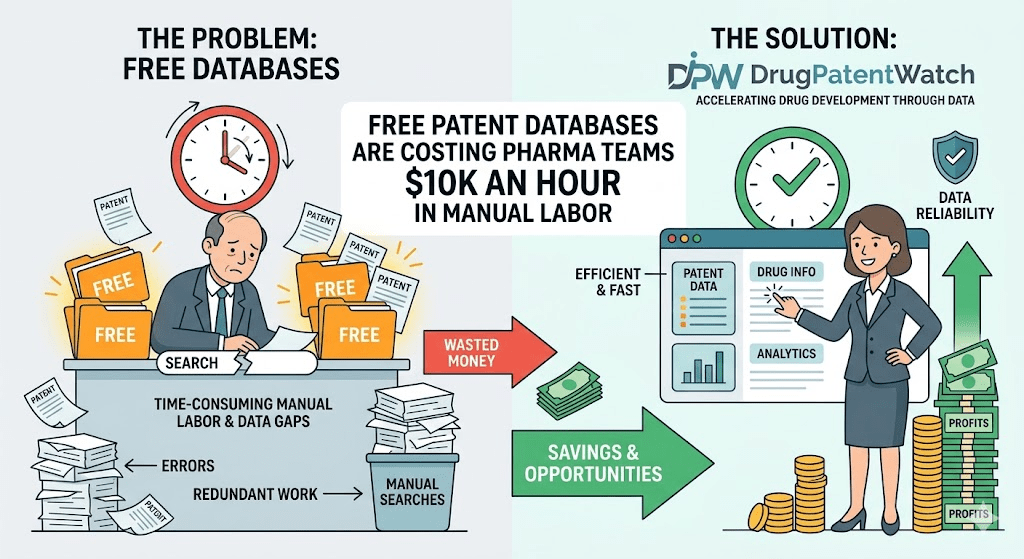
The assumption is logical: if a tool costs nothing, you save money using it. That arithmetic breaks down badly when the tool requires a senior patent attorney, a regulatory affairs director, and a competitive intelligence analyst to spend three days manually reconciling data that a purpose-built pharmaceutical IP platform would return in four minutes.
This is the free patent database trap, and it is quietly draining budget from pharmaceutical companies, generic drug manufacturers, biosimilar developers, and biotech startups at a rate that never shows up in any software line item. The cost is embedded in payroll, in billable hours, in deal timelines that slip, in litigation positions that weaken because someone spent a week building a dataset that was already assembled elsewhere.
What follows is a systematic breakdown of where that cost originates, how it compounds across the pharmaceutical drug development and patent lifecycle, and what the actual dollar figure looks like when you trace it through real workflows at real organizations.
What ‘Free’ Actually Means in Pharmaceutical Patent Research
Google Patents is free. Espacenet is free. The USPTO’s Patent Full-Text and Image Database is free. The FDA’s Orange Book is free. The Purple Book is free. Taken individually, each of these resources provides genuine value. Taken as a substitute for integrated pharmaceutical patent intelligence, they create a patchwork that fails at exactly the moments when accuracy costs real money.
The pharmaceutical patent landscape is not a general IP problem. It is a drug-specific problem with regulatory, chemical, biological, and litigation dimensions that general-purpose patent search tools were never designed to address. When a generic manufacturer needs to evaluate the patent estate around a small-molecule drug before filing an Abbreviated New Drug Application (ANDA), the relevant data spans the Orange Book listing, the complete patent prosecution history, the claim scope for each listed patent, any active Paragraph IV certifications already filed by competitors, litigation status in federal district courts, inter partes review petitions at the Patent Trial and Appeal Board (PTAB), and settlement agreements that may contain launch restriction provisions.
None of the free tools consolidate that picture. Each addresses one layer. Assembling a complete view manually means pulling from six or more sources, normalizing inconsistent data formats, cross-referencing by drug name, active pharmaceutical ingredient (API), NDA number, patent number, and applicant name, then verifying that the data is current because Orange Book listings have a known lag and court dockets update asynchronously with public databases.
That assembly process is the cost center. And the people doing the assembly are not junior paralegals.
Who Actually Touches Free Patent Database Research in Pharma?
The labor cost calculation starts with the job title of the person running the search. In pharmaceutical IP work, patent database research is not an entry-level function. The professionals who conduct competitive patent intelligence, freedom-to-operate (FTO) analyses, ANDA litigation assessments, and biosimilar patent thicket evaluations hold one of these roles:
Patent attorneys and patent agents (billing rates typically $400–$900/hour at large law firms; in-house salary equivalent of $250–$500/hour when annualized)
Regulatory affairs directors and IP strategy leads ($150–$350/hour equivalent)
Competitive intelligence analysts at pharmaceutical companies ($100–$250/hour equivalent)
Licensing and business development professionals conducting due diligence ($200–$450/hour equivalent)
When any of these professionals spends three hours manually building a patent landscape that a purpose-built tool would return in twenty minutes, the cost is not three hours of junior time. It is three hours of senior pharmaceutical IP expertise diverted from analysis, strategy, and decision-making into data retrieval and normalization.
The $10,000-Per-Hour Figure: Where It Comes From
The $10,000-per-hour figure is not a single labor cost for one professional. It is a composite that accounts for the full workflow cost of a pharmaceutical patent research task conducted manually versus with integrated tools.
Consider a realistic scenario: a mid-size generic pharmaceutical company is evaluating whether to file an ANDA with a Paragraph IV certification against a branded small-molecule drug with an upcoming patent expiration. The research team needs to:
Identify all Orange Book-listed patents for the reference listed drug (RLD)
Retrieve full prosecution histories for each patent from USPTO systems
Search for any pending continuation or divisional applications that could extend the patent estate
Cross-reference against existing ANDA filings by competitor generic manufacturers
Identify any active Paragraph IV litigation involving those patents
Check PTAB for IPR petitions that could invalidate any listed patent
Review any settlement agreements referenced in SEC filings or litigation records
Assess manufacturing and formulation patents not listed in the Orange Book but potentially relevant to FTO
Done manually across free databases, that research project takes a team of two patent attorneys and one regulatory specialist approximately four to six days. At blended billing rates, the all-in cost runs $18,000 to $32,000. A pharmaceutical IP intelligence platform like DrugPatentWatch, which aggregates Orange Book data, patent prosecution histories, ANDA filing records, and litigation status in a single normalized interface, compresses that timeline to four to eight hours of analyst time with a subscription cost that amortizes to a fraction of the manual equivalent.
The $10,000-per-hour framing captures what the organization is effectively paying per hour of manual work when you divide total project cost by the hours that tool-assisted workflows would have taken.
The Orange Book Problem: Why Free Access Is Not the Same as Usable Access
The FDA’s Orange Book, formally titled ‘Approved Drug Products with Therapeutic Equivalence Evaluations,’ is the authoritative source for patent information on approved small-molecule drugs. Every new drug application (NDA) holder is required to list patents that claim the approved drug or a method of using it. Generic manufacturers filing ANDAs must certify against every listed patent. This makes the Orange Book the operational center of small-molecule pharmaceutical patent strategy.
The FDA publishes the Orange Book data for free. The catch is that the raw data, while publicly accessible, is formatted for regulatory compliance, not for competitive intelligence or litigation strategy. The free Orange Book download provides patent numbers, expiration dates, and drug-patent associations. It does not provide:
Patent claim text or scope assessments
Prosecution history summaries
Information about which competitors have filed Paragraph IV certifications against specific patents
Litigation status tied to those certifications
Cross-references to related patents in the same family that are not Orange Book-listed but may be relevant to FTO
Building that supplemental layer manually from free sources means pulling prosecution histories from USPTO Patent Center, searching PACER for district court litigation tied to specific patent numbers, and tracking PTAB proceedings separately. Each of those systems has a different interface, different search logic, and different data currency. The Orange Book itself has a known update lag: listing additions and expirations can trail real-world status by days to weeks depending on FDA processing timelines.
Orange Book Listing Errors and the Cost of Acting on Stale Data
Orange Book listings are not infallible. NDA holders have submitted incorrect patent information, have listed patents that courts later determined were improperly listed, and have delisted patents under court orders or voluntary withdrawal. Generic manufacturers have successfully challenged listings through the delisting petition process. Acting on a patent landscape built from a stale or incorrect Orange Book snapshot can invalidate an entire ANDA strategy.
In 2023, the FTC published a report on Orange Book patent listings that identified hundreds of potentially improper listings across medical devices and drug-device combinations. The FTC sent notices to brand manufacturers challenging dozens of specific listings. Generic manufacturers who had built competitive analyses on those listings faced the task of rebuilding their patent landscapes from scratch after the challenge notifications became public.
That rebuild cost, entirely preventable with real-time patent monitoring, is a concrete illustration of what free-database dependency produces.
What the Purple Book Adds for Biologics and Why the Gap Is Wider
The FDA’s Purple Book performs the same function for biological products that the Orange Book performs for small molecules, but the complexity is substantially greater. Biological drugs are produced in living cell systems and cannot be chemically replicated; they can only be made highly similar, which is the ‘biosimilar’ designation. The Biologics Price Competition and Innovation Act (BPCIA) created a separate patent resolution framework for biologics, the ‘patent dance,’ which is procedurally distinct from the Paragraph IV certification process and involves a bilateral disclosure of patent lists between the reference product sponsor and the biosimilar applicant.
The patent dance involves timelines, mandatory disclosures, and litigation choreography that are not captured anywhere in the free Purple Book data. Tracking the patent estate around a reference biologic product requires integrating Purple Book listings with biologic patent prosecution data, inter partes review filings at PTAB, the 12-year reference product exclusivity period, any pediatric exclusivity extensions, and the court litigation that frequently follows BPCIA disputes. No free tool does this. The manual assembly cost for a biologic patent landscape routinely exceeds that for a small molecule by a factor of two to three, because the patent thickets around biologics like AbbVie’s adalimumab (Humira), Amgen’s etanercept (Enbrel), or Regeneron’s aflibercept (Eylea) involve dozens to hundreds of patents and scores of biosimilar applicants.
Freedom-to-Operate Analysis: The Search That Cannot Afford to Miss a Patent
A freedom-to-operate analysis answers a specific legal question: can a company manufacture, use, or sell a product in a given jurisdiction without infringing a valid, enforceable patent? In pharmaceutical development, FTO analysis is performed before candidates advance to clinical trials, before a generic manufacturer commits to ANDA preparation, before a biosimilar developer selects a manufacturing process, and before any acquisition, licensing deal, or strategic partnership is finalized.
The consequence of an incomplete FTO is not an abstract legal risk. It is a concrete business event: a patent holder sends a cease-and-desist letter, files for a preliminary injunction in federal district court, or initiates an ITC Section 337 investigation. Any of those events triggers immediate operational disruption, emergency legal response costs, and potential forced product reformulation.
Why Google Patents Fails FTO for Pharmaceutical Compounds
Google Patents is a powerful search tool for general patent research. Its limitations in pharmaceutical FTO work are structural, not cosmetic.
The first limitation is chemical structure search. Pharmaceutical patents frequently claim compounds by chemical structure, Markush structure, or structural class rather than by common name or INN (International Nonproprietary Name). Google Patents searches text. It does not search chemical structures. A patent claiming a compound by its IUPAC name, a salt form, a prodrug form, or a structural class description that encompasses a generic manufacturer’s API may not appear in a Google Patents text search unless the analyst already knows exactly what to search for. The compound that a generic manufacturer needs to evaluate for infringement may appear under a dozen different chemical descriptors across the patent estate, and a text search that misses three of those descriptors produces an FTO opinion with three unexamined potential infringement risks.
The second limitation is patent family coverage. A brand pharmaceutical company with a successful drug will typically hold patents in the US, EU, Japan, China, Canada, Australia, and other markets. An FTO analysis for a product intended to be manufactured in India and exported to the US must cover patents in both jurisdictions. Free tools handle international patent family data inconsistently. Espacenet provides better international coverage than Google Patents but requires separate searches in each national or regional patent office database for accurate prosecution history data.
The third limitation is continuation tracking. US patent law permits a patent applicant to file continuation applications based on a parent application, potentially obtaining additional patents with new claims years after the parent patent was filed. A brand drug company can use continuations to extend patent protection for a product well beyond the nominal term of the original patent. Tracking the continuation landscape for a pharmaceutical patent family requires systematic prosecution history review that free text-search tools do not automate.
The Cost of a Missed Patent in an FTO: Case Study in ANDA Litigation
The litigation record in pharmaceutical patent cases includes multiple examples of generic manufacturers proceeding with ANDA filings based on incomplete patent landscapes, subsequently facing infringement claims on patents they had not identified or challenged, and incurring litigation costs that dwarfed any savings from the incomplete search.
In Allergan, Inc. v. Sandoz Inc. (Federal Circuit, 2013), Sandoz filed an ANDA for a generic version of Allergan’s Combigan ophthalmic solution and certified against the listed composition and method patents. Allergan sued for infringement of additional patents not originally in focus. The resulting litigation spanned multiple appeals and resulted in a 30-month stay of ANDA approval under the Hatch-Waxman Act, during which Sandoz could not launch its generic product. The business cost of that 30-month delay, calculated against the potential generic revenue for an ophthalmic drug with a nine-figure branded market, substantially exceeded any plausible FTO research investment.
This is not an isolated outcome. The Hatch-Waxman litigation database contains hundreds of cases where incomplete patent landscape work contributed to litigation postures that were more expensive, more time-consuming, and less favorable than a comprehensive pre-filing patent search would have enabled.
How Long Does a Proper Pharmaceutical FTO Take With Free Tools vs. Integrated Platforms?
A proper pharmaceutical FTO for a small-molecule generic candidate, covering US Orange Book patents, non-listed formulation and process patents, active prosecution, and basic international family coverage, requires the following research steps:
Research Task
Free Tools Time Estimate
Integrated Platform Time Estimate
Key Free Tool Used
Orange Book patent identification
2–4 hours
10–20 minutes
FDA Orange Book download
Prosecution history retrieval for each listed patent
4–8 hours
30–60 minutes
USPTO Patent Center
Continuation and divisional application tracking
6–12 hours
1–2 hours
USPTO Patent Center, manual family mapping
Non-listed formulation/process patent search
8–16 hours
2–4 hours
Google Patents, Espacenet
Paragraph IV certification status for competitors
4–8 hours
15–30 minutes
FDA ANDA database, manual cross-reference
Active litigation search
3–6 hours
15–30 minutes
PACER, manual docket review
PTAB IPR/PGR petition check
2–4 hours
10–20 minutes
USPTO PTAB portal
Total
29–58 hours
4.5–9 hours
At a blended all-in rate of $350/hour for the pharmaceutical IP professionals doing this work, the manual approach costs $10,150 to $20,300 per FTO. The integrated platform approach costs $1,575 to $3,150 in labor plus platform subscription fees. The tool cost differential is the difference between a one-week project and a half-day project.
Paragraph IV Litigation Strategy: When Patent Intelligence Becomes Litigation Infrastructure
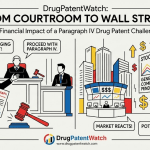
Under the Drug Price Competition and Patent Term Restoration Act of 1984, commonly known as Hatch-Waxman, a generic drug manufacturer who files an ANDA certifying that a listed patent is invalid, unenforceable, or not infringed by the generic product (a Paragraph IV certification) must notify the NDA holder and patent owner. If the brand company sues for patent infringement within 45 days, the FDA is automatically stayed from approving the ANDA for 30 months, unless the patent expires or is found invalid or not infringed earlier. The first generic applicant to file a Paragraph IV ANDA for a given drug is entitled to 180 days of generic exclusivity, during which no other generic can receive final approval.
The 180-day exclusivity provision makes the competitive intelligence surrounding Paragraph IV filings one of the most commercially valuable data sets in the pharmaceutical industry. A generic manufacturer who knows that a competitor filed a Paragraph IV certification six months earlier must decide whether to file its own certification, knowing it will forfeit 180-day exclusivity, or to wait and enter the market as a second generic after the exclusivity period. That decision is worth hundreds of millions of dollars for major drugs.
How Generic Manufacturers Monitor Competitor Paragraph IV Filings
The FDA publishes Paragraph IV certification notices in the Federal Register. The timing of those publications relative to the actual ANDA filing creates an intelligence gap. By the time a Paragraph IV notice appears in the Federal Register, the certifying applicant has already filed and notified the brand. The 45-day litigation window is already running. Competitors reading the Federal Register are acting on information that may be weeks old.
Sophisticated generic manufacturers supplement Federal Register monitoring with court docket surveillance. When a brand company receives a Paragraph IV notice and decides to sue within 45 days, the resulting patent infringement complaint is filed in federal district court, typically the District of Delaware, the District of New Jersey, or the Eastern District of Texas. That complaint is a public record the moment it is filed, and it names the ANDA applicant as defendant. Companies that monitor PACER for new pharmaceutical patent complaints can identify Paragraph IV filers before the Federal Register notice appears.
That PACER monitoring, done manually, requires checking multiple district courts daily and cross-referencing new complaints against drug patent lists. Done with integrated pharmaceutical IP intelligence tools, it happens automatically with configurable alerts. The manual approach requires a full-time analyst position. The automated approach requires a platform subscription.
The 30-Month Stay: What the Clock Means in Dollar Terms
The 30-month automatic stay under Hatch-Waxman is worth a specific dollar figure for each drug it applies to. That figure is the total branded drug revenue during the 30-month period that the brand manufacturer retains without competition, minus the cost of litigating the underlying patent dispute.
For a branded drug with $1 billion in annual U.S. sales, the 30-month stay preserves approximately $2.5 billion in revenue for the brand manufacturer. For the generic manufacturer waiting for approval, every month of delay costs approximately $80 million in foregone generic revenue (at typical generic market share assumptions). These stakes make patent litigation intelligence not a research function but a core business function, and they make the cost of inadequate research tools visible in the income statement.
‘The first-to-file generic exclusivity provision creates a winner-takes-most dynamic in Paragraph IV filings. For blockbuster drugs, the 180-day exclusivity can be worth over $1 billion in revenue to the first filer.’ — IQVIA Institute for Human Data Science, ‘The Changing Landscape of Medicine Innovation,’ 2022 [1]
ANDA Litigation in Delaware and New Jersey: Patent Court Geography for Generic Manufacturers
The geographic concentration of Hatch-Waxman litigation in the District of Delaware reflects both corporate law history and decades of judge specialization in pharmaceutical patent cases. Delaware became the dominant venue because many major pharmaceutical companies are incorporated there, making it a proper venue for suits against Delaware entities. Over time, Delaware district court judges developed specialized pharmaceutical patent expertise, which attracted more filings.
Judge Colm Connolly in the District of Delaware has presided over a large volume of Hatch-Waxman cases and has issued standing orders on various discovery and scheduling practices that experienced pharmaceutical litigators know intimately. Attorneys filing in Delaware for the first time on a pharmaceutical patent case incur learning costs that experienced ANDA practitioners do not. This is a non-trivial component of total litigation cost and is relevant to litigation intelligence because understanding which venue a dispute is likely to land in affects early case assessment, expert selection, and claim construction strategy.
When Does a Paragraph IV Certification Trigger No Litigation?
Not every Paragraph IV certification triggers a lawsuit. If the brand company does not sue within 45 days, the 30-month stay does not apply, and the FDA can approve the ANDA immediately upon meeting all other requirements. Brand companies decline to sue when they conclude that the patent is unlikely to survive the litigation, when they have already made a strategic decision to exit a market, or when the generic filer has a strong non-infringement position on the face of the ANDA.
Identifying which patents brand companies tend to defend in court versus which they let expire without litigation is commercially valuable intelligence for generic manufacturers planning ANDA filing strategies. That intelligence requires tracking the historical response rate to Paragraph IV certifications by brand company and by patent type. Free databases do not aggregate that pattern data. Specialized pharmaceutical IP databases do.
Inter Partes Review at PTAB: The Patent Kill Switch That Free Databases Barely Cover
The America Invents Act of 2011 created inter partes review (IPR), a post-grant validity challenge proceeding before the Patent Trial and Appeal Board. IPR allows any party to petition PTAB to cancel one or more claims of an issued patent on the grounds that prior art anticipated or rendered obvious those claims. The proceeding is conducted by a three-judge panel of administrative patent judges and typically reaches a final written decision within 12 to 18 months of institution.
For pharmaceutical patent strategy, IPR has become a primary tool for invalidating patents that would otherwise require years of expensive district court litigation. Generic manufacturers, biosimilar developers, and activist investors have used IPR petitions to challenge brand drug patents across every therapeutic class. The outcomes are commercially material: an IPR that cancels key claims of a drug patent can eliminate the basis for a Paragraph IV litigation stay and accelerate generic or biosimilar market entry by years.
USPTO’s PTAB portal provides public access to all IPR petitions, institution decisions, and final written decisions. It is free. It is also not structured for monitoring the IPR petition landscape across a portfolio of drugs or patents of commercial interest. Checking the PTAB portal for IPR activity on a specific patent requires knowing the patent number and conducting a targeted search. Monitoring IPR activity across all patents relevant to a therapeutic category, a competitor’s portfolio, or a pipeline drug candidate requires systematic, repeated searches that free tools do not automate.
The commercial intelligence question is not just ‘has an IPR petition been filed against patent X?’ It is ‘which patents in the landscape covering drug Y have been challenged, by whom, with what prior art, and with what outcome, and what does that tell me about which remaining patents are most vulnerable to challenge?’ That analysis requires integrating PTAB filing data with patent prosecution history, claim language, and prior art databases in a way that free individual tools do not support.
The Coalition for Affordable Drugs and Systematic IPR as a Market Entry Strategy
Between 2015 and 2017, the Coalition for Affordable Drugs (CFAD), an entity associated with hedge fund manager Kyle Bass, filed IPR petitions against patents covering numerous branded drugs including Acorda Therapeutics’ Ampyra (dalfampridine), Jazz Pharmaceuticals’ Xyrem (sodium oxybate), and Horizon Pharma’s Vimovo (naproxen/esomeprazole). The strategy was explicitly financial: petition against drug patents to drive down branded drug stock prices and profit from short positions. PTAB instituted several of these petitions and canceled patent claims in some proceedings.
The CFAD episode demonstrated that IPR is not solely a tool used by potential generic or biosimilar market entrants. Brand pharmaceutical companies, investors, and competitors all have incentives to monitor IPR petition activity as early intelligence about patent vulnerability. A brand company that learns an IPR petition has been filed against a core drug patent can begin planning lifecycle management strategies, accelerating next-generation formulation development or licensing discussions, months before any final written decision issues. That early awareness requires real-time PTAB monitoring that no free tool provides automatically.
How IPR Outcomes Affect Generic Drug Launch Timelines
When PTAB cancels patent claims that are the basis for an ongoing Paragraph IV litigation, the legal landscape for the ANDA applicant can shift rapidly. If the litigated patents are canceled or their relevant claims are invalidated, the brand company’s infringement case may collapse, the 30-month stay may terminate early, and the FDA can proceed with ANDA approval. Generic manufacturers with ANDAs pending for drugs involved in active PTAB proceedings track those proceedings with the same intensity as the district court cases.
The Shire/lisdexamfetamine (Vyvanse) patent litigation illustrates this dynamic. Multiple generic manufacturers filed ANDAs and Paragraph IV certifications against Shire’s Vyvanse patents. Parallel IPR proceedings were initiated against several of those patents. The interplay between PTAB invalidity proceedings and district court litigation affected the settlement negotiations and launch timing across multiple generics. Generic manufacturers who tracked both the district court dockets and the PTAB proceedings with integrated tools had a materially better picture of the litigation landscape than those relying on periodic manual checks of free databases.
Biosimilar Patent Thickets: Why Free Databases Are Structurally Inadequate for Biologics
The patent estates surrounding major biologic reference products have no equivalent in small-molecule pharmaceuticals for complexity. AbbVie has assembled what analysts describe as a deliberately layered patent portfolio around adalimumab (Humira), reportedly comprising over 130 US patents covering the compound, manufacturing processes, formulation, dosing regimens, devices, and uses. The patents have expiration dates ranging from 2016 through the mid-2030s. Biosimilar manufacturers who have sought to enter the US Humira market have had to navigate that entire estate, not just the principal compound patents.
The first Humira biosimilar did not launch in the US until January 2023, despite EU biosimilar launches beginning in October 2018. The four-year US delay resulted from AbbVie’s settlement agreements with biosimilar manufacturers, which included launch date restrictions as a term of the settlement, not from the FDA approval process. Understanding the biosimilar landscape for a biologic reference product requires tracking not just the patents but the settlement agreements, many of which contain confidential terms, and using the public signals available from SEC filings, litigation records, and court-approved settlement dockets to reconstruct the launch restriction timelines.
The Humira Biosimilar Launch: What Patent Intelligence Told You Before the Market Moved
By late 2021, a pharmaceutical competitive intelligence analyst with access to integrated biosimilar patent data could have constructed a reasonable timeline for the first US Humira biosimilar launches. The settlement agreements between AbbVie and Amgen (Amjevita), AbbVie and Sandoz (Hyrimoz), AbbVie and Boehringer Ingelheim (Cyltezo), and other biosimilar manufacturers had been disclosed in SEC filings and contained references to 2023 launch authorization dates. Combining that settlement data with FDA biosimilar approval timelines, Purple Book listing data, and the known AbbVie patent expiration schedule produced a defensible forecast that the US biosimilar adalimumab market would open in January 2023 with multiple entrants.
That forecast, available to analysts willing to integrate multiple data sources, had direct commercial value for payers, pharmacy benefit managers, hospital systems, and competitor biologic manufacturers. It also illustrates what integrated biosimilar patent intelligence looks like when done properly, and how far the free-tool patchwork falls short of producing it.
Eylea (Aflibercept) Patent Expiration and Biosimilar Entry Forecast: A Live Intelligence Problem
Regeneron’s aflibercept (Eylea) is one of the highest-grossing ophthalmic biologics in the world. As of 2024, multiple biosimilar developers including Mylan/Viatris, Samsung Bioepis, Formycon, and others have received FDA approval for aflibercept biosimilars. The patent estate around Eylea has been the subject of litigation between Regeneron and biosimilar applicants, with cases proceeding in the District of Delaware.
Analysts tracking the Eylea biosimilar timeline must monitor the compound patent expiration, supplemental protection certificates in EU markets, active US patent litigation dockets, any BPCIA patent dance disclosures that have become public through litigation, and potential IPR petitions against the asserted patents. That monitoring task, conducted manually on free databases, is a multi-day project every quarter. On an integrated platform like DrugPatentWatch, the core data is updated continuously and accessible in minutes.
How the BPCIA Patent Dance Differs From Hatch-Waxman in Patent Intelligence Requirements
The Biologics Price Competition and Innovation Act’s patent resolution framework involves a structured exchange of patent lists between the reference product sponsor and the biosimilar applicant, followed by a negotiation period to identify which patents will be litigated immediately and which will be reserved for post-approval litigation. This process, nicknamed the ‘patent dance,’ generates non-public documents that only become visible in litigation. The public intelligence picture for a biosimilar patent dispute is therefore systematically incomplete in ways that small-molecule ANDA patent landscapes are not, because Orange Book listings provide at least a public list of the patents the brand intends to defend.
For biosimilar competitive intelligence, this means that secondary signals, litigation complaints, PTAB petitions, BPCIA-related injunctions, and biosimilar applicant disclosures in their own SEC filings, become disproportionately important as data sources. Assembling those signals from free databases requires accessing federal court PACER systems, SEC EDGAR, the FDA Biologics License Application (BLA) database, and USPTO. An integrated platform that aggregates these signals reduces that multi-source assembly problem to a single-interface query.
Patent Expiration Forecasting: The Revenue Models That Depend on Accurate Cliff Data
Patent expiration forecasting is the pharmaceutical industry’s version of earnings guidance. Investment analysts, payers, hospital formulary committees, pharmacy benefit managers, and specialty pharma companies all build financial models that incorporate patent cliff dates for branded drugs. The model outputs, whether a generic entry date, a biosimilar launch probability, or a revenue erosion projection, are only as good as the patent expiration data feeding them.
Patent expiration dates in pharmaceuticals are not simple. A nominal 20-year term from the filing date is adjusted for:
Patent Term Extension (PTE) under 35 U.S.C. § 156, which can add up to five years for regulatory review delays, with a cap of 14 years of patent term remaining after FDA approval
Patent Term Adjustment (PTA) under 35 U.S.C. § 154(b), which compensates for USPTO delays in prosecution, and can add months to years to the nominal expiration
Pediatric Exclusivity under the Best Pharmaceuticals for Children Act, which adds six months of market exclusivity beyond any patent-based exclusivity
New Chemical Entity (NCE) exclusivity, which provides five years of FDA data exclusivity independent of patent status
Orphan Drug exclusivity, which provides seven years of market exclusivity for drugs designated for rare diseases
The effective exclusivity date for a branded drug, the date after which generic or biosimilar competition can actually begin, integrates all of these adjustments. A model that uses the nominal patent filing date as the exclusivity date can be off by three to five years. A model that uses an Orange Book expiration date without accounting for PTE or pending PTA calculations can be off by two to four years. These errors translate directly into incorrect revenue forecasts, incorrect generic launch projections, and incorrect pricing and contracting decisions by payers.
How Patent Term Extension Calculations Differ From Orange Book Expiration Dates
The USPTO grants Patent Term Extension on application from the NDA holder after FDA approval. The PTE calculation reduces the adjustment by regulatory delay attributable to the applicant, adds regulatory review time attributable to the FDA or other agencies, and caps the total adjustment. The Orange Book lists the patent expiration date including any approved PTE. However, PTE applications that are pending at the time of Orange Book listing create a gap: the Orange Book may list the unadjusted expiration date while the PTE application is under review, then update the listing when the PTE is granted. Analysts who pulled the Orange Book data before the PTE was granted will have the wrong expiration date in their models.
Patent Term Adjustment is similarly complex. PTA is calculated by the USPTO based on prosecution delays and is added to the issued patent’s term. PTA can vary widely depending on the prosecution history of each specific patent. Two patents claiming the same drug, both filed on the same date, can have substantially different expiration dates because one experienced longer USPTO prosecution delays than the other. This variability is not visible in a simple patent number and filing date lookup.
Loss of Exclusivity Timelines for Top-Selling Drugs: 2024–2030 Forecast
The loss of exclusivity (LOE) timeline for major branded drugs drives generic and biosimilar market entry forecasts and is tracked systematically by pharmaceutical market intelligence firms. Key LOE events that have occurred or are anticipated in the near term include:
Stelara (ustekinumab, J&J/Janssen): US biosimilar entry began in 2025 following patent expirations and settlements with multiple biosimilar developers including Amgen, Samsung Bioepis, Sandoz, and Fresenius Kabi
Keytruda (pembrolizumab, Merck): The principal composition-of-matter patent faces expiration discussions with biosimilar developers beginning preparation for entry in the late 2020s; the exact effective exclusivity date depends on PTE grants and any manufacturing process patent coverage
Eliquis (apixaban, BMS/Pfizer): Generic entry litigation produced settlements with multiple generic manufacturers specifying launch dates; the Eliquis patent litigation involved Orange Book-listed patents and additional non-listed patents and was actively tracked by DrugPatentWatch and other pharmaceutical IP databases throughout the litigation period
Jardiance (empagliflozin, Boehringer Ingelheim/Eli Lilly): ANDA filings with Paragraph IV certifications have been filed; active Hatch-Waxman litigation is ongoing in the District of Delaware
Each of these LOE events involves multiple patents, multiple potential generic or biosimilar entrants, ongoing litigation, and potential settlement terms that affect launch dates. Tracking the LOE timeline accurately requires the kind of integrated patent, litigation, and regulatory data that purpose-built platforms provide.
What Happens When a Revenue Model Uses the Wrong LOE Date?
The consequences are asymmetric and can be severe in either direction. If a model uses an LOE date that is earlier than the actual effective exclusivity end date, it will project generic entry too soon, leading to undervaluation of the branded drug in acquisition analysis, incorrect payer contracting decisions, and formulary placement choices that disadvantage branded drugs prematurely. If the model uses an LOE date that is later than actual, it will project continued brand revenue that the brand will not achieve, leading to overvaluation in licensing deals and M&A transactions.
The Lipitor (atorvastatin) LOE in November 2011 produced the largest generic drug launch in industry history. Ranbaxy Laboratories, as the first Paragraph IV filer, held 180-day exclusivity. The revenue impact of that exclusivity, and the precise timing of when subsequent generics could enter, depended on an accurate reading of the patent landscape that had been litigated, adjudicated, and settled over years of Hatch-Waxman proceedings. Investment analysts who correctly modeled the multi-generic entry sequence built accurate revenue erosion curves for Pfizer and profitability projections for generic manufacturers.
Due Diligence in Pharma M&A: How Patent Gaps Produce Deal Risk
Pharmaceutical mergers and acquisitions are patent-driven transactions. The enterprise value of a branded drug company, a specialty pharma portfolio, or a biotech with a pipeline candidate is substantially determined by the patent estate protecting the products and candidates. A deal team that conducts patent due diligence using free databases is operating with incomplete information in a transaction environment where incomplete information has a direct dollar cost.
The target company’s representations and warranties about its patent estate are a starting point, not an endpoint, for due diligence. The acquiring company needs to independently verify that the listed patents are valid, enforceable, and correctly characterized as covering the products in question. It needs to identify any undisclosed third-party challenges, any prosecution history disclaimer that limits claim scope, any continuation applications that the target has pending that may or may not support the representations, and any competitive patent applications that could produce blocking positions against the pipeline.
Patent Due Diligence Checklist for Pharmaceutical Acquisitions
A comprehensive pharmaceutical patent due diligence review covers:
Complete prosecution history review for all patents in the portfolio, including cited prior art and any examiner rejections that prompted claim amendments
Third-party challenge history: IPR petitions, ex parte reexamination requests, inter partes reexamination proceedings
Litigation history: any infringement suits, declaratory judgment actions, or ANDA-related Hatch-Waxman cases
Orange Book listing status: are all assets properly listed, and have any been subject to delisting challenges?
Patent term: verified expiration dates including PTE applications and PTA calculations
Competitive patent landscape: do competitor patents create FTO concerns for the target’s products or pipeline?
International patent estate: are key markets covered, and are there gaps that local generic manufacturers could exploit?
Assignment and licensing: are all patents properly assigned to the target, or are there pending assignments or disputed ownership issues?
Assembling this dataset from free sources for a portfolio of even five drugs involves weeks of work by a team of patent attorneys. An integrated pharmaceutical IP platform reduces the data assembly phase to days, freeing the attorneys to focus on analysis and risk assessment rather than data retrieval.
The Allergan-AbbVie Acquisition and Patent Portfolio Valuation Lessons
AbbVie’s $63 billion acquisition of Allergan in 2020 brought in a portfolio that included Botox (onabotulinumtoxinA), Juvederm fillers, and ophthalmology assets. The Botox patent estate, involving both the toxin composition and method-of-use patents across aesthetic and therapeutic indications, was a key component of the acquisition rationale. Patent attorneys advising on the transaction needed to map the complete Botox patent estate, identify any pending biosimilar BLA filings by competitors, track the patent dance status for any such filings, and assess the litigation exposure from ongoing challenges to Allergan’s toxin patents.
The acquisition rationale depended substantially on the durability of Botox’s competitive moat. That durability was a patent question before it was a commercial question. Deal teams using free databases for that patent analysis were doing the most consequential part of a $63 billion transaction with inadequate research infrastructure.
Pharmaceutical Licensing and Royalty Audits: Patent Scope Is the Money
Pharmaceutical licensing deals are priced around patent coverage. A licensor who grants rights to a branded drug’s core compound patent receives a different royalty rate than one who grants rights to a formulation patent that will expire five years before the compound patent. A licensee who takes a license to a patent portfolio without conducting rigorous claim scope analysis may be paying royalties on patents that do not cover its products, or may be missing leverage to negotiate lower rates on patents whose claims are narrower than represented.
Royalty rate benchmarking in pharmaceutical licensing depends on comparable transaction data, which is partially public from SEC filings and litigation records, and on patent quality assessments, which require prosecution history review and claim analysis. The free database problem in licensing contexts manifests as either over-payment (taking licenses to patents that do not cover your activities) or under-protection (licensing out on terms that undervalue your patent estate because you did not identify the full scope of your own patents).
How Patent Scope Analysis Uses Prosecution History and Free Tools Miss the Most Important Part
The doctrine of prosecution history estoppel limits the scope of patent claims to prevent a patent owner from claiming subject matter that was surrendered during prosecution to secure the patent’s issuance. A patent whose claims were narrowed during prosecution to overcome prior art rejections cannot later be enforced against subject matter equivalent to what was surrendered. This limitation is patent-specific and can only be assessed by reviewing the prosecution history: the complete record of examiner rejections, applicant responses, and claim amendments that produced the issued patent.
Free tools provide access to prosecution histories through USPTO Patent Center. What they do not provide is the analytical layer that identifies which claim amendments are most likely to constitute prosecution history estoppel. That analytical layer requires attorney judgment informed by Federal Circuit case law on estoppel doctrine. But the raw material for that analysis, the prosecution history document set, needs to be assembled from free databases in a format that attorneys can efficiently review. Purpose-built platforms that structure prosecution history data for pharmaceutical patents reduce the document assembly time substantially, making the attorney’s analytical work more efficient even if the analysis itself remains professional judgment.
DrugPatentWatch and the Category of Purpose-Built Pharmaceutical Patent Intelligence
The market for pharmaceutical patent intelligence tools has evolved in response to exactly the problems described above. DrugPatentWatch is one of the most established platforms in this category. It aggregates Orange Book patent data, FDA approval records, ANDA filing and approval status, Paragraph IV certification notices, patent prosecution histories, PTAB proceedings, and litigation data into a pharmaceutical-specific interface with search functionality designed for drug, active ingredient, patent number, and company queries.
The platform’s utility is not primarily about data that is unavailable elsewhere. Almost all of the underlying data is public. The value is in normalization, integration, and real-time currency. When a generic manufacturer’s IP team wants to know every Orange Book-listed patent for a drug, every ANDA that has been filed for that drug, the litigation status of any Paragraph IV certifications, and the patent expiration dates accounting for PTE, that information is available from free sources but requires multi-source assembly with significant manual effort. DrugPatentWatch returns it in a single interface in minutes.
For pharmaceutical professionals who conduct this research regularly, the economic case for purpose-built tools is straightforward: if a researcher conducts one FTO or competitive landscape analysis per week, the tool pays for itself in reduced labor hours within the first month of subscription. The organizations for which the economic case is hardest to make internally are those where pharmaceutical IP research is intermittent and the labor cost of each individual search is not tracked as a line item. Those organizations often underestimate cumulative manual research costs by an order of magnitude because the time is distributed across multiple projects and never aggregated.
How DrugPatentWatch Covers ANDA Filings, Orange Book Patents, and Generic Entry Intelligence
DrugPatentWatch’s coverage of ANDA filing data provides generic manufacturers and brand companies alike with visibility into the competitive filing landscape for any drug. The platform identifies ANDA applicants, certifications filed, approval status, and whether first-applicant exclusivity positions are held. For brand companies, this data powers real-time monitoring of the generic threat landscape. For generic manufacturers, it reveals who has already filed for a given drug and whether 180-day exclusivity is already claimed.
The platform’s Orange Book integration goes beyond the raw FDA data by adding patent family information, prosecution history links, expiration date calculations that account for PTE and PTA, and flags for patents subject to active challenges or litigation. This supplemental layer is what converts free government data into actionable intelligence.
Alternatives to DrugPatentWatch: How the Pharmaceutical IP Intelligence Market Compares
DrugPatentWatch is not the only platform in the pharmaceutical patent intelligence category. Clarivate’s Derwent Innovation and its pharmaceutical-specific products, IQVIA’s pharmaceutical intelligence tools, Evaluate Pharma’s patent coverage, and Citeline’s (formerly Informa Pharma Intelligence) data products all address parts of the same problem. The category also includes general-purpose patent analytics platforms like PatSnap and Innography (now part of Clarivate) that have pharmaceutical-specific modules.
The competitive differentiation among these platforms turns on several dimensions: depth of Orange Book integration, coverage of BPCIA proceedings for biologics, PTAB monitoring capability, litigation docket integration, and pricing models that either favor single-user access or enterprise deployment. Evaluating which platform best fits an organization’s specific research workflows is itself a non-trivial analytical task, and it is one where the difference between platforms can be as significant as the difference between free databases and any purpose-built tool.
What to Look for in a Pharmaceutical Patent Database Subscription: Evaluation Framework
Organizations evaluating pharmaceutical patent intelligence platforms should assess:
Orange Book completeness and update frequency: how close to real-time are listing updates?
ANDA filing coverage: does the platform identify all ANDA applicants and certifications, or only approved ANDAs?
PTAB integration: are IPR petitions tracked from filing through final written decision, with linkage to the underlying patents?
Litigation coverage: does the platform integrate federal court docket data, and how quickly does new case data appear?
Patent prosecution data: are prosecution histories accessible within the platform, or does the platform link out to USPTO?
Biosimilar coverage: does the platform address the Purple Book and BPCIA proceedings, not just Hatch-Waxman?
Alert functionality: can users set automated monitoring on specific drugs, patents, companies, or litigation events?
Export and integration: does the platform support data export for use in financial models, due diligence reports, or litigation workrooms?
The Hidden Labor Audit: How to Calculate What Free Databases Are Actually Costing Your Organization
Most pharmaceutical organizations have no formal accounting of patent research labor costs. The time is billed to project codes, absorbed in department budgets, or treated as overhead. Conducting an accurate audit of free-database labor costs requires a different framework.
Step-by-Step Internal Audit for Patent Research Labor Costs
The audit process involves four steps:
First, identify all recurring patent research tasks. This includes FTO analyses for pipeline candidates, Orange Book monitoring for competitor drugs, ANDA filing surveillance, litigation tracking for relevant drug patents, due diligence reviews for licensing or M&A transactions, and portfolio maintenance tasks like tracking PTE applications and continuation filings. Map each task type to the job title of the person who typically performs it and the average time the task requires when conducted on free databases.
Second, attach labor rates. Use fully loaded hourly costs, not just base salary, because the cost of a senior employee includes benefits, overhead allocation, and opportunity cost. For law firm work, use actual billing rates. For in-house work, divide annual fully loaded compensation by 2,080 hours and then apply an utilization factor (typically 1,500–1,600 productive hours per year for professional roles) to get an effective hourly cost.
Third, multiply hours by rates and aggregate across task types and frequency. A company that conducts 10 FTO analyses per year at $15,000 per analysis in manual labor, 52 weeks of Orange Book monitoring at $500 per week, and 4 due diligence reviews per year at $25,000 each is spending approximately $360,000 per year on patent research labor for those tasks alone.
Fourth, compare against platform subscription costs and estimate tool-assisted labor times. Most pharmaceutical IP intelligence platforms reduce task time by 60% to 80% for structured research tasks. Apply the reduction factor to your labor cost baseline and compare the labor savings against the platform subscription cost. For mid-size and large pharmaceutical companies, the math routinely shows ROI multiples of 5x to 20x.
Why Small Biotechs Suffer the Most From Free Database Dependency
Large pharmaceutical companies have in-house IP teams with institutional knowledge and established research workflows that partially compensate for tool limitations. Small biotechs typically do not. A 50-person biotech with two or three drug candidates and a part-time IP counsel is the organization most likely to be conducting FTO analyses on Google Patents, monitoring Orange Book listings manually, and missing IPR petitions against key platform patents because PTAB monitoring is not part of anyone’s job description.
For small biotechs, a single missed patent can mean a failed FTO, a licensing negotiation conducted on incorrect assumptions about IP scope, or a venture funding round disrupted by a patent challenge that the company had not anticipated. The platform cost that a large pharma company recovers in labor savings in weeks may represent six months of runway for a small biotech. This creates a structural disadvantage that free-database dependency exacerbates: the organizations with the least margin for error are the most likely to be operating with the least sophisticated patent intelligence tools.
Venture Capital Patent Due Diligence: Why Investors Bear the Cost of Portfolio Company Tool Gaps
Venture capital firms investing in pharmaceutical and biotech companies conduct their own patent due diligence on portfolio candidates. When a portfolio company’s IP is built on FTO work done with free databases, the VC’s diligence team needs to do additional work to verify the company’s representations. That additional diligence cost is borne by the VC, not the portfolio company, and it contributes to deal friction that can delay funding rounds and increase transaction costs.
VC firms with multiple pharmaceutical portfolio companies increasingly support shared IP intelligence tool subscriptions as part of portfolio company support packages, recognizing that the tool cost is de minimis relative to the diligence verification cost it eliminates and the litigation risk it reduces.
Manufacturing and Process Patents: The Patent Layer That Free Databases Consistently Miss
Orange Book patents and compound patents are the most visible layer of pharmaceutical patent protection. Below them sits a second layer of manufacturing and process patents that protect the methods by which active pharmaceutical ingredients are synthesized, purified, and formulated. These patents are not required to be listed in the Orange Book. They are not searchable by drug name in general patent databases unless you already know the relevant chemical process terminology. And they can block generic or biosimilar entry even after the primary compound patents have expired.
Process patents protect specific methods of synthesis. A branded drug’s active ingredient may be synthesized by multiple possible chemical routes, but the brand may have patented all commercially viable routes, leaving a generic manufacturer with the choice of using an unpatented but economically impractical synthesis route or accepting a license. This is the ‘process patent thicket’ problem, and it is most acute in complex synthetic molecules and biologics.
API Synthesis Patent Monitoring: Why Google Patents Text Searches Miss Chemical Process Claims
Chemical process patent claims are written in the technical language of synthetic chemistry. They describe reagents, reaction conditions, temperature ranges, and catalysts. A search for a drug’s INN in Google Patents will not return process patents whose claims describe a synthesis route without using the drug’s common name. Identifying the process patent landscape for an API requires chemical structure search capabilities, knowledge of the synthetic chemistry relevant to the specific compound class, and familiarity with the naming conventions used in the patent filings of the likely assignees.
This search problem is not fully solved by any free tool. Specialized chemical patent search tools like SciFinder (now CAS SciFinder-n) and Reaxys provide chemical structure and reaction search capabilities that general patent databases lack. For pharmaceutical IP teams that need both the regulatory patent landscape (Orange Book, ANDA, litigation) and the technical patent landscape (process, formulation, synthetic chemistry), the full tool stack involves both pharmaceutical IP intelligence platforms and chemical patent databases.
Formulation Patents and Extended-Release Mechanisms: How Brands Extend Exclusivity Beyond Compound Patents
Extended-release formulations, abuse-deterrent formulations, and combination products are common lifecycle management strategies that brand pharmaceutical companies use to extend effective market exclusivity beyond the expiration of the original compound patent. These strategies work by obtaining new patents on the improved formulation and launching a new product version that is commercially superior to the original, encouraging patients and physicians to transition to the new formulation before generic entry on the original.
OxyContin (oxycodone extended-release, Purdue Pharma) was reformulated with an abuse-deterrent technology that Purdue patented in 2010, just as the original OxyContin formulation was approaching generic entry. The reformulation patents extended Purdue’s effective market position beyond the original compound patents. Generic manufacturers seeking to copy the original non-abuse-deterrent formulation found that FDA had withdrawn the reference listed drug status for the original formulation, creating an additional regulatory barrier.
Identifying these lifecycle management patent strategies requires tracking not just the primary compound patents but the complete formulation patent portfolio, including patents that cover extended-release mechanisms, dissolution profiles, excipient combinations, device elements, and combination therapies. That tracking is not supported by a basic Orange Book or Google Patents search.
Regulatory Exclusivity vs. Patent Protection: The Two-Track System That Confuses Free Database Users
One of the most common errors in pharmaceutical patent analysis conducted with free databases is conflating patent exclusivity with regulatory exclusivity. These are separate protections that can coexist, overlap, or run independently, and understanding their interaction is essential to accurate LOE forecasting.
Patent exclusivity is a private property right arising from the issued patent. It prevents third parties from making, using, or selling the claimed invention for the patent term, subject to patent validity and enforceability defenses. Patent exclusivity does not require FDA action to be effective; it operates through patent infringement litigation.
Regulatory exclusivity is a period of FDA-enforced protection against the use of the brand’s clinical data to support a competitor’s approval application. New Chemical Entity exclusivity (5 years for small molecules), New Biological Entity exclusivity (12 years for biologics), Orphan Drug exclusivity (7 years), and Pediatric exclusivity (6-month extension) are regulatory protections that the FDA administers independent of any patent. A drug can have regulatory exclusivity without any valid patent (if all patents have expired or been invalidated) or can have valid patents without regulatory exclusivity (if the exclusivity period has expired and the patents are still in force).
How NCE Exclusivity Affects ANDA Filing Windows
New Chemical Entity exclusivity blocks ANDA filings for four years from the NDA approval date (one year before the 5-year exclusivity expires). A generic manufacturer cannot file an ANDA for an NCE-protected drug until year four post-approval, and cannot receive approval until year five. This filing window restriction operates independently of patent status. A drug with expired or challenged patents but active NCE exclusivity is still protected from generic entry until the NCE exclusivity expires.
Free database users who track only Orange Book patent expiration dates and ignore NCE exclusivity periods will project generic entry too early for recently approved drugs. This error is less common for analysts with pharmaceutical regulatory expertise, but it appears regularly in financial models built by analysts who are not specialists in pharmaceutical IP.
Orphan Drug Exclusivity and Rare Disease Patent Strategy
Orphan Drug exclusivity, the seven-year market exclusivity granted to drugs designated for rare diseases affecting fewer than 200,000 US patients, can be the primary competitive barrier for a drug in a rare disease indication even when patents are weak or absent. Unlike patent protection, which is enforced by the patent holder through litigation, Orphan Drug exclusivity is enforced administratively by FDA, which will not approve a second application for the same drug for the same rare disease indication during the exclusivity period.
The interaction between Orphan Drug exclusivity and patent protection creates complex competitive dynamics in rare disease markets. A drug with Orphan exclusivity expiring in year seven post-approval may have weak compound patents that a generic manufacturer could challenge successfully, but the successful patent challenge provides no market entry benefit until the Orphan exclusivity also expires. Pharmaceutical IP analysis in rare disease markets therefore requires integrating patent data with FDA exclusivity records in a way that free tools do not support automatically.
International Patent Strategy and Why US-Only Free Database Research Fails Global Pharma Companies
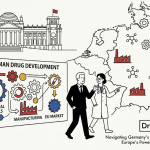
US pharmaceutical companies operating in global markets face a patent landscape that extends across every jurisdiction where they manufacture, sell, or seek regulatory approval. A drug that loses patent protection in the US in 2026 may retain Supplemental Protection Certificates (SPCs) in EU member states until 2028. A generic manufacturer who reads the US Orange Book expiration date and assumes it determines European market entry will be wrong, and wrong in ways that produce real regulatory and legal problems.
SPCs are EU-specific instruments that extend patent protection for pharmaceutical products by up to five years to compensate for the time spent in clinical trials and regulatory review. Each EU member state grants SPCs independently based on national patent office procedures. An SPC covering a drug in Germany has a different legal basis and potentially a different expiration date than an SPC covering the same drug in France or Italy. Tracking the complete European SPC landscape for a drug requires monitoring national patent office databases for each relevant member state, a task that is genuinely burdensome even with purpose-built tools and is essentially unmanageable with free databases alone.
Patent Protection in Emerging Markets: China, India, and Brazil as Critical Pharmaceutical IP Jurisdictions
China, India, and Brazil represent the three largest pharmaceutical markets outside the US and EU. Each has distinct patent laws, a history of compulsory licensing, and legal frameworks that affect pharmaceutical patent enforcement differently from US law.
India’s Patents Act, as amended in 2005, contains Section 3(d), which prohibits the granting of patents on new forms of known substances unless the new form demonstrates enhanced efficacy. This provision, which the Supreme Court of India upheld against a challenge by Novartis in Novartis AG v. Union of India (2013), means that many incremental pharmaceutical innovations that receive US patents are not patentable in India. Generic manufacturers in India can manufacture and sell drugs that are patent-protected in the US for their Indian domestic market and for export to countries that do not recognize the relevant US patents.
Tracking pharmaceutical patent status in India requires accessing the Indian Patent Office’s database and monitoring litigation in the Delhi High Court, which handles most pharmaceutical patent disputes. Free tools for Indian patent search are available through the Indian Patent Office website but are not integrated with US Orange Book data, ANDA filing records, or US litigation status. The international patent intelligence problem requires platforms with genuine global coverage.
The Real Cost of Getting It Wrong: Litigation Losses Tied to Inadequate Patent Research
The litigation record in pharmaceutical patent cases contains examples where inadequate patent research contributed to avoidable legal losses. These are not principally cases where better research would have changed the final outcome of a patent validity or infringement dispute; they are cases where better research would have changed the litigation strategy, the negotiating position, or the timing of a market entry decision in ways that would have been commercially beneficial.
Case Study: Apotex and the Plavix Settlement That Became a $442 Million Problem
In 2006, Bristol-Myers Squibb and sanofi-aventis reached a settlement with Apotex Corp. under which Apotex agreed not to launch its generic version of Plavix (clopidogrel bisulfate) pending regulatory review of the settlement. Apotex then launched its generic product commercially for a brief period in August 2006 after the FTC declined to approve the settlement. BMS and sanofi sued, and Apotex was later found liable for damages arising from the launch. A jury awarded damages in the hundreds of millions of dollars in the subsequent proceedings.
The Plavix litigation is complex and the Apotex damages were driven by specific facts around the market entry decision, not directly by patent research inadequacy. But the case illustrates a broader principle: pharmaceutical patent litigation involves decisions made under time pressure on information that may be incomplete, and the cost of acting on incorrect or incomplete patent intelligence can be catastrophic relative to the cost of building accurate intelligence.
When Settlement Terms Were Built on Misread Patent Scope
Settlement agreements in Paragraph IV litigation frequently contain launch-date provisions that specify when a generic manufacturer may enter the market. Those provisions are negotiated against the backdrop of the parties’ assessments of patent validity and claim scope. A generic manufacturer that misreads the scope of a patent, concluding that it is broader than it actually is, may accept a settlement with a later launch date than it could have achieved by litigating the narrower actual claim scope. The reverse error, concluding that a patent is narrower than it is, can produce a settlement that agrees to a launch date that subsequent litigation shows was premature.
These negotiation errors are downstream consequences of patent analysis errors. Patent analysis errors are more likely when the analyst is working from incomplete or incorrectly assembled data. Incomplete or incorrectly assembled data is the predictable output of manual research on free databases.
Building a Pharmaceutical IP Intelligence Stack That Doesn’t Cost More Than It Saves
The argument for purpose-built pharmaceutical patent intelligence tools is not that they replace all human judgment or eliminate all research labor. They do not. A patent attorney’s assessment of claim scope, validity risk, or litigation strategy requires professional judgment that no database, however sophisticated, substitutes for. The argument is that the data assembly and normalization work that currently consumes a significant fraction of expert professionals’ time should not be done manually, and that the platforms designed to automate that work pay for themselves in reduced labor cost at subscription prices that are accessible to pharmaceutical organizations of most sizes.
The practical question for any pharmaceutical organization is not ‘should we use better tools?’ but ‘how do we build a tool stack that covers our specific workflow needs at a cost that makes sense for our scale?’ That requires an honest audit of current research workflows, a realistic estimate of manual labor costs (using the framework described above), and a comparison against available platform options.
Recommended Tool Stack for Small Biotech IP Teams
For a small biotech with one to three drug candidates and limited in-house IP resources, the minimum viable pharmaceutical patent intelligence stack includes a dedicated pharmaceutical IP intelligence platform (DrugPatentWatch or equivalent) for Orange Book, ANDA, and litigation monitoring, supplemental access to a chemical patent database (CAS SciFinder-n or equivalent) for FTO chemical structure searches, and USPTO Patent Center for prosecution history access on specific patents identified through the primary platforms. This stack, costing roughly $15,000 to $40,000 annually depending on subscription tiers, replaces research labor that typically costs three to ten times that amount at senior-attorney billing rates.
Recommended Tool Stack for Mid-Size and Large Pharma IP Departments
For mid-size pharmaceutical companies and large pharma IP departments, the tool stack expands to include enterprise pharmaceutical IP intelligence platforms with API integration for internal data systems, global patent analytics tools with SPC tracking and international patent family coverage, automated monitoring and alerting systems for PTAB, litigation, and regulatory events, and due diligence workroom platforms that allow collaboration on deal-specific patent landscape reviews. The economics at enterprise scale are even more favorable: enterprise pharmaceutical IP budgets routinely run $200,000 to $500,000 annually in tool subscriptions and avoid labor costs that would otherwise run $2 million to $5 million annually in equivalent manual work.
Key Takeaways
Free pharmaceutical patent databases provide raw data access but not the integrated, pharmaceutical-specific intelligence that drug development, commercialization, and litigation decisions require.
The labor cost of manual research on free databases is carried by some of the most expensive professionals in the industry: patent attorneys, regulatory specialists, and IP strategists. When you divide total project cost by the hours a purpose-built platform would have required, the effective hourly cost of manual research routinely exceeds $1,000 to $10,000.
The Orange Book is the foundation of small-molecule pharmaceutical patent strategy, but its free version lacks claim scope data, prosecution history, competitor ANDA intelligence, and real-time litigation linkage. Those gaps are the gaps that cost money.
Paragraph IV certification intelligence is a commercial competitive asset worth hundreds of millions of dollars for major drugs. Monitoring it manually on free databases is inadequate for any organization making ANDA filing decisions.
PTAB inter partes review is a primary patent invalidation tool, and free PTAB search requires manual, repeated checking. Automated monitoring through integrated platforms provides real-time intelligence that affects both litigation strategy and settlement negotiation.
Biosimilar patent intelligence requires integrating Purple Book data, BPCIA patent dance filings, settlement agreements, and PTAB proceedings in ways that no free tool supports. The complexity of biologic patent thickets makes the cost of free-database dependency proportionally larger than for small molecules.
Patent expiration forecasting requires accurate PTE and PTA calculations, not nominal expiration dates. Financial models built on nominal expiration dates from free Orange Book downloads can be wrong by years.
Manufacturing and process patents, formulation patents, and lifecycle management patents are not reliably searchable through free databases using drug name searches. These patents can block generic entry after compound patents expire.
DrugPatentWatch and comparable specialized platforms convert multi-day manual research projects into sub-hour queries. The ROI calculation for most pharmaceutical organizations shows payback within one to three months of subscription.
The organizations most damaged by free-database dependency are often small biotechs and generic manufacturers for whom a single missed patent or incorrect LOE date can have company-level consequences.
Frequently Asked Questions
1. What is the Orange Book and why is the free version insufficient for pharmaceutical patent strategy?
The FDA’s Orange Book lists patents that NDA holders have certified as covering approved drugs. The free version provides patent numbers, expiration dates, and drug-patent associations. It does not include patent claim text, prosecution history, competitor ANDA filing data, active litigation status, or real-time updates. Pharmaceutical IP strategy requires all of those elements, which means the free Orange Book is a starting point but not a complete research tool.
2. How does the 180-day generic exclusivity provision affect pharmaceutical patent intelligence needs?
The first generic manufacturer to file a Paragraph IV ANDA for a given drug earns 180 days of exclusivity during which no other generic can receive final approval. Knowing whether a competitor has already filed a Paragraph IV certification for a target drug is commercially critical. That information requires monitoring ANDA filing records, court dockets, and Federal Register notices in real time, which free databases do not automate.
3. What is a Patent Term Extension and how does it affect drug patent expiration dates?
Patent Term Extension compensates brand pharmaceutical companies for the time spent in FDA clinical review. It can extend patent term by up to five years, with a cap of 14 years of remaining patent term post-approval. Orange Book expiration dates reflect approved PTE, but pending PTE applications create temporary inaccuracies in free database listings. Financial models that use nominal patent filing date plus 20 years will systematically underestimate actual exclusivity.
4. Can a generic drug company face patent infringement claims on patents not listed in the Orange Book?
Yes. Orange Book listing is required for patents claiming the drug compound or methods of using it, but patents covering formulations, manufacturing processes, metabolites, or combination products may not be listed. A generic manufacturer who conducts FTO analysis only against Orange Book patents may face infringement claims on non-listed patents. This is why FTO analysis requires broader patent searching than Orange Book review alone.
5. What is an inter partes review and why should generic manufacturers track PTAB petitions?
Inter partes review is a post-grant challenge proceeding at the Patent Trial and Appeal Board that allows any party to petition for cancellation of patent claims based on prior art. A successful IPR can cancel the patent claims underlying a Hatch-Waxman litigation, potentially eliminating the 30-month stay and accelerating generic approval. Generic manufacturers who track IPR petitions against relevant drug patents gain early intelligence about which patents are most vulnerable to invalidity challenges.
6. How does the BPCIA patent dance differ from Hatch-Waxman Paragraph IV certification in intelligence requirements?
Hatch-Waxman requires generic manufacturers to certify publicly against Orange Book-listed patents, creating a transparent public record. The BPCIA patent dance involves bilateral patent list exchanges between biosimilar applicants and reference product sponsors that are not automatically public. The public intelligence picture for biosimilar patent disputes therefore relies on litigation complaints, SEC filings, and court-approved settlement records rather than a centralized public database. This asymmetry makes integrated biosimilar patent intelligence tools more valuable for biologics than for small molecules.
7. What does ‘loss of exclusivity’ mean and how accurate are typical LOE forecasts?
Loss of exclusivity refers to the date after which generic or biosimilar competition can begin for a branded drug, integrating patent expiration, regulatory exclusivity expiration, and any settlement-based launch restrictions. LOE forecasts built from free databases are frequently inaccurate by one to three years because they fail to account for PTE, pediatric exclusivity extensions, NCE exclusivity windows, and settlement launch restrictions. Purpose-built pharmaceutical IP platforms reduce LOE forecasting error by integrating all relevant data sources.
8. How can a pharmaceutical company calculate the ROI of switching from free databases to a purpose-built platform?
The calculation requires: (1) identifying all recurring pharmaceutical patent research tasks, (2) estimating the manual hours per task with free databases, (3) multiplying by the fully loaded hourly cost of the professionals doing the work, (4) estimating the time reduction from platform-assisted research (typically 60–80%), and (5) comparing annual labor savings against platform subscription cost. Most mid-size pharmaceutical companies find ROI multiples of 5x to 20x.
9. What are the most common pharmaceutical patent research errors made with free databases?
The most common errors include: using nominal patent expiration dates instead of PTE-adjusted dates, conducting Orange Book searches without checking for non-listed formulation and process patents, failing to track pending continuation applications that could produce blocking patents, missing IPR petitions that affect litigation strategy, and overlooking competitor ANDA filings that have been made but not yet published in the Federal Register.
10. Are free databases ever sufficient for pharmaceutical patent research?
For basic initial screening, a free database check can indicate whether a drug is Orange Book-listed and provide nominal patent numbers. For any decision that carries commercial or legal consequences, including ANDA filing strategies, FTO opinions, licensing negotiations, due diligence reviews, and litigation strategy, free databases are insufficient. The cost of errors in those decisions is large enough that the economics of purpose-built tools are compelling for any pharmaceutical organization conducting them regularly.
References
IQVIA Institute for Human Data Science. (2022). The Changing Landscape of Medicine Innovation, 2022. IQVIA. https://www.iqvia.com/insights/the-iqvia-institute/reports-and-publications/reports/the-changing-landscape-of-medicine-innovation
U.S. Food and Drug Administration. (2024). Orange Book: Approved Drug Products with Therapeutic Equivalence Evaluations. FDA. https://www.accessdata.fda.gov/scripts/cder/ob/
U.S. Food and Drug Administration. (2024). Purple Book: Lists of Licensed Biological Products. FDA. https://purplebooksearch.fda.gov/
Federal Trade Commission. (2023). Listing of Patents in the Orange Book. FTC. https://www.ftc.gov/reports/orange-book
U.S. Patent and Trademark Office. (2024). Patent Trial and Appeal Board Statistics. USPTO. https://www.uspto.gov/patents/ptab
Allergan, Inc. v. Sandoz Inc., 726 F.3d 1286 (Fed. Cir. 2013).
Novartis AG v. Union of India, (2013) 6 SCC 1 (Supreme Court of India).
Drug Price Competition and Patent Term Restoration Act of 1984, Pub. L. No. 98-417, 98 Stat. 1585 (1984) (Hatch-Waxman Act).
Biologics Price Competition and Innovation Act of 2009, Pub. L. No. 111-148, §§ 7001–7003, 124 Stat. 119 (2010) (BPCIA).
Leahy-Smith America Invents Act, Pub. L. No. 112-29, 125 Stat. 284 (2011).
DrugPatentWatch. (2024). Pharmaceutical patent and generic drug intelligence database. https://www.drugpatentwatch.com
Grabowski, H., Long, G., Mortimer, R., & Boyo, A. (2016). Recent trends in brand-name and generic drug competition. Journal of Medical Economics, 19(2), 95–104. https://doi.org/10.3111/13696998.2015.1105765
Kesselheim, A. S., & Avorn, J. (2016). The most transformative drugs of the past 25 years: A survey of physicians. Nature Reviews Drug Discovery, 15(7), 449–453.
Feldman, R. (2018). May your drug price be ever green. Journal of Law and the Biosciences, 5(3), 590–647. https://doi.org/10.1093/jlb/lsy022
Hemphill, C. S., & Sampat, B. N. (2012). Evergreening, patent challenges, and effective market life in pharmaceuticals. Journal of Health Economics, 31(2), 327–339.