Pharmaceutical Licensing Agreements:The Complete IP Valuation, Deal Architecture,and Strategy Guide for Pharma/Biotech Leaders
Pharmaceutical licensing is, at its most fundamental level, a mechanism for allocating IP rights and associated revenue streams between parties who each hold something the other needs. A licensor owns a patent estate, a regulatory exclusivity period, or validated manufacturing know-how. A licensee has capital, commercial infrastructure, geographic reach, or clinical development capacity. The deal converts those complementary assets into cash flows, milestone payments, and royalties, with the specific structure reflecting each party’s leverage, risk tolerance, and strategic priorities.
That framing matters because it strips away the language of “partnership” that dominates industry press releases and forces attention onto the actual economic mechanics. The structure of a deal determines who captures value from a drug’s commercial success. A five-percent royalty on net sales paid to an originator company looks very different when the licensee’s marketing obligations, the royalty base definition, and the stacking provisions are spelled out in the underlying agreement. These details shift hundreds of millions of dollars between parties across the life of a blockbuster program.
The broader market reinforces how central licensing has become to biopharma strategy. The global pharmaceutical licensing market was valued at roughly $350 billion in 2024 and is projected to reach $560 billion by 2030, driven by mounting R&D costs, the complexity of biologics development, and the geographic fragmentation of prescription drug markets. Large-cap pharma companies now source more than 60 percent of their late-stage pipelines through in-licensing or acquisition, not internal discovery. That figure, which has risen steadily since 2010, reflects a structural shift in where drug innovation originates and who pays to develop it.
This guide covers every material dimension of pharmaceutical licensing: deal taxonomy, IP valuation methodology, financial architecture, patent lifecycle management, biologics-specific technology roadmaps, Hatch-Waxman dynamics, biosimilar interchangeability, compulsory licensing risks, and governance design. Each section includes a key takeaways summary and, where relevant, specific guidance for institutional investors analyzing licensing-dependent biopharma companies.
Key TakeawaysLicensing is primarily an IP rights allocation mechanism, not a partnership. Deal economics follow from the specific contractual provisions, not from press release language.Large-cap pharma sources more than 60 percent of its late-stage pipeline through in-licensing. The originating biotechs and academic spinouts that feed this system depend on licensing revenue to fund early-stage work.The global pharmaceutical licensing market is projected to reach $560 billion by 2030. Investors who do not understand deal architecture cannot accurately model royalty streams, milestone triggers, or exclusivity risk.IP valuation, not relationship quality, determines deal economics. Scientific alignment matters operationally; the patent estate determines negotiating leverage.
Section 1: The Deal Taxonomy – Types of Pharmaceutical Licensing Agreements
Pharmaceutical licensing is not a single category. The industry uses at least eight structurally distinct agreement types, each with different risk profiles, exclusivity dynamics, and financial architectures. Conflating them produces analytical errors when modeling revenue, assessing pipeline risk, or evaluating a company’s competitive position.
1.1 Exclusive vs. Non-Exclusive vs. Sole Licensing
An exclusive license gives the licensee the right to commercialize a drug candidate or technology to the complete exclusion of all other parties, including the licensor itself. In a sole license, the licensor retains the right to commercialize independently but grants no further licenses to third parties. A non-exclusive license permits the licensor to grant the same rights to multiple licensees simultaneously, which is common in platform technology deals where the licensor profits from broad adoption rather than a single commercial partnership.
Exclusivity status directly controls IP valuation. An exclusive license to a compound with a strong patent estate and no near-term generic entry dates can justify a much higher upfront payment and lower royalty rate than a non-exclusive license to the same asset, because the licensee captures all the commercial upside. Conversely, a licensor who accepts a lower upfront in exchange for a higher royalty in an exclusive deal is effectively taking a leveraged bet on commercial performance.
One underappreciated clause is the field-of-use restriction. An exclusive license can be exclusive only within a defined therapeutic indication, manufacturing method, or delivery route. AstraZeneca’s 2022 licensing deal structure for Enhertu (trastuzumab deruxtecan) with Daiichi Sankyo included explicit field-of-use provisions that defined the scope of geographic exclusivity and co-promotion rights across HER2-expressing tumor types. These field restrictions create pockets of residual commercialization rights for the licensor that do not appear in deal headline numbers.
1.2 In-Licensing vs. Out-Licensing
From a corporate strategy standpoint, in-licensing is the acquisition of rights to an external compound or technology, while out-licensing is the monetization of internally held rights by granting them to an external party. The same agreement is an in-license from the licensee’s perspective and an out-license from the licensor’s.
The strategic calculus differs sharply between the two. A company in-licensing a Phase II asset takes on development cost, regulatory risk, and commercial execution responsibility. In exchange, it gains potential exclusivity over a differentiated product. The in-licensing company’s due diligence must therefore include Freedom-to-Operate (FTO) analysis, a full patent expiry landscape, and an assessment of blocking patents held by third parties that could constrain manufacturing or formulation. Failure to identify a blocking patent before signing can make the entire license commercially worthless.
Out-licensing is typically driven by one of four situations: insufficient internal development capacity, geographic markets outside core commercial operations, non-core therapeutic areas generated by broad research programs, or near-term capital needs that make future royalty streams preferable to upfront investment. Many mid-cap biotechs out-license ex-US rights to large pharma partners while retaining US commercialization, effectively splitting the revenue opportunity along the axis of commercial infrastructure.
1.3 Co-Development and Co-Commercialization Agreements
A co-development agreement is distinct from a pure license. Under a co-development structure, both parties contribute resources, typically capital and development expertise, to advance a compound through clinical trials. The cost-sharing ratio is negotiated upfront and reflects each party’s comparative advantage. A biotech with strong Phase I/II capabilities might fund early development, with a large pharma partner co-funding from Phase III onward in exchange for co-commercialization rights.
Co-commercialization agreements, which are sometimes called co-promotion agreements, allow both parties to deploy sales forces for the same product in the same market. The economics depend entirely on whether co-promotion is structured as a flat fee per call, a profit-sharing arrangement, or a combination. The Merck-Eisai co-promotion structure for Keytruda in certain oncology settings exemplifies how large companies can deploy co-promotion as a defensive tactic against competitor sales force expansion.
When both co-development and co-commercialization rights appear in the same agreement, IP teams need to pay careful attention to which party holds marketing authorization (MA) ownership. The MA holder controls label language, adverse event reporting obligations, and post-marketing commitments. Loss of MA ownership in a deal restructuring can significantly reduce the non-holder’s commercial leverage.
1.4 Technology Platform Licenses
Platform licenses are agreements that grant rights not to a specific compound but to an enabling technology: a delivery system, a conjugation chemistry, a cell line, a gene editing toolset, or a manufacturing process. The LNP (lipid nanoparticle) technology licensed by Moderna and BioNTech from Alnylam and others during COVID-19 vaccine development illustrates both the value and the complexity of platform licensing. Platform licenses frequently include reach-through royalty provisions, where the licensor receives royalties on products developed using the platform, even when those products are themselves independently patented by the licensee.
Reach-through royalties are among the most contested provisions in platform technology licensing. From a licensor’s standpoint, they represent fair compensation for enabling technology that generates products far more valuable than the platform itself. From a licensee’s standpoint, reach-through royalties stack with product-specific royalties and can create a combined royalty burden that makes commercial development economics unattractive. The National Institutes of Health (NIH) explicitly prohibits reach-through royalties in licenses arising from Bayh-Dole-governed government-funded research, which is one reason many academic spinouts based on NIH-funded platforms offer royalty structures that large commercial licensors would not.
1.5 Sublicensing, Assignment, and Change-of-Control Provisions
Nearly every pharmaceutical license includes sublicensing provisions that govern whether the licensee can grant rights to third parties. Sublicensing rights matter significantly in deals involving multi-territory commercialization, because the licensee may lack direct presence in all covered markets and will need to sublicense to local distribution partners. The licensor’s interest is in receiving a percentage of sublicensing revenue, typically between 20 and 40 percent of upfront fees and between 10 and 20 percent of sublicensee royalties.
Assignment clauses determine what happens when a party is acquired. A typical licensor-protective clause requires consent before the licensee assigns the agreement to a third party, including through change-of-control transactions. This can create M&A friction. When Pfizer acquired Arena Pharmaceuticals in 2022, the pre-existing licensing agreements Arena had with partners required analysis of assignment and change-of-control provisions that had direct implications for which rights transferred to Pfizer and under what conditions. Sophisticated acquirers now conduct licensing agreement assignment analysis as a standard component of pharmaceutical M&A due diligence.
Key TakeawaysField-of-use restrictions in exclusive licenses create residual licensor rights that do not appear in headline deal terms. IP teams should map these restrictions before modeling revenue.FTO analysis must precede any in-licensing decision. Blocking patents held by third parties can render a licensed compound commercially non-viable regardless of the primary patent estate.Co-development agreements differ from licenses because they create ongoing cost-sharing obligations. The party holding marketing authorization controls label language and post-marketing commitments.Reach-through royalties in platform licenses can stack with product royalties to make development economics unattractive. Licensees should model total royalty burden, including stacking effects, before signing.Change-of-control provisions in licensing agreements require analysis before any M&A transaction. Consent requirements can delay or restructure acquisitions.
Section 2: The Patent Estate as the Primary Licensing Asset – IP Valuation Methodology
IP valuation is not an administrative exercise. It is the analytical foundation that determines how much an in-licensee should pay for rights, how much an out-licensor should demand, and whether a given licensing deal creates or destroys value for shareholders. The methods used to value pharmaceutical IP differ depending on the asset stage, the patent architecture, and whether biologics or small molecules are involved.
2.1 Core Patent Valuation Frameworks
Three valuation frameworks dominate pharmaceutical licensing practice: risk-adjusted net present value (rNPV), comparables analysis, and the 25 percent rule (and its variants). Each has specific applications and well-documented limitations.
Risk-Adjusted Net Present Value (rNPV)
rNPV discounts projected cash flows by both a time-based discount rate and probability-of-success (PoS) estimates at each clinical stage. For a compound at Phase II, a typical PoS assumption runs 50 to 60 percent for oncology assets and 25 to 35 percent for CNS compounds, reflecting historical clinical attrition rates. The patent estate directly affects the cash flow projection because it determines the length of the exclusivity window during which the drug generates branded pricing.
A compound with a primary composition-of-matter (CoM) patent expiring in 2030 and no supplementary protection certificates (SPCs) or pediatric exclusivity extensions has a structurally shorter exclusivity runway than a competitor compound with a CoM expiring in 2032 and an SPC adding five years. The difference of potentially seven years of exclusivity can represent several billion dollars in NPV for a drug generating $500 million in annual sales, making patent expiry analysis inseparable from rNPV modeling.
Comparables Analysis
Comparables analysis benchmarks proposed deal terms against publicly disclosed transactions in the same therapeutic area, at the same development stage, and with similar patent estate characteristics. The challenge is that pharmaceutical licensing terms are frequently confidential, particularly for early-stage assets. Several commercial databases, including Citeline’s Pharmaprojects and EvaluatePharma, aggregate disclosed deal structures to enable comparables benchmarking.
A useful proxy metric is the ratio of upfront payment to total deal value (including all potential milestones and royalties). For Phase III-ready oncology assets, this ratio typically ranges from 8 to 15 percent, meaning the upfront payment represents a small fraction of total potential value. For commercial-stage products with cleared regulatory approvals, the upfront can represent 40 to 60 percent of total deal value because milestone risk is eliminated.
The 25 Percent Rule and Royalty Rate Derivation
The 25 percent rule holds that a licensee should pay approximately 25 percent of its anticipated pre-tax profits from a licensed product as a royalty to the licensor. The rule originated in a 1959 Robert Goldscheider paper and was widely applied in pharmaceutical royalty negotiations for decades. The Federal Circuit’s 2011 decision in Uniloc USA, Inc. v. Microsoft Corp. effectively discredited it as a royalty determination method in patent litigation, finding the rule inadmissible as a starting point without independent empirical support.
The practical implication for pharmaceutical licensing teams is that royalty rate negotiations must be anchored in actual industry benchmarks, not the 25 percent formula. Empirical data from disclosed pharmaceutical licenses suggests that royalty rates on net sales for small molecule drugs range from 2 to 5 percent for mature products with near-term patent expiry, 8 to 15 percent for late-stage compounds with strong composition-of-matter protection, and as high as 20 to 25 percent for first-in-class biologics with extensive patent portfolios and orphan drug exclusivity.
2.2 The Patent Estate: What It Actually Includes
Many licensing analysts make the error of equating “the patent” with a single composition-of-matter filing. A mature pharmaceutical patent estate is a layered system of multiple patent families, each covering different aspects of the compound and its commercial use.
Composition-of-Matter Patents
The CoM patent is the foundational asset. It covers the chemical or biological entity itself. For a small molecule, it claims the specific molecular structure or a class of structurally related compounds. For a biologic, the CoM patent may claim the amino acid sequence, the cell line used for manufacturing, or a combination. CoM patents carry the highest value because they block all uses of the compound, not just specific formulations or indications. When a CoM patent expires without a successor exclusivity period, generic or biosimilar entry becomes legally permissible.
Method-of-Use and Formulation Patents
Method-of-use patents cover specific therapeutic indications or dosing regimens. They expire independently of the CoM patent and can create residual exclusivity after CoM expiry for approved uses. Pfizer’s Lyrica (pregabalin) patent landscape illustrates this architecture: after the CoM patent expired, method-of-use patents covering fibromyalgia and diabetic peripheral neuropathy continued to protect specific labeled indications, creating a legal barrier to generic substitution for those uses even when generics were technically available for other indications.
Formulation patents cover specific dosage forms, delivery systems, particle size specifications, and excipient combinations. These are the primary vehicle for pharmaceutical evergreening, the practice of filing successive patents on non-novel aspects of a marketed drug to extend effective exclusivity beyond the CoM patent expiry. A detailed analysis of evergreening tactics appears in Section 6.
Manufacturing Process Patents
Process patents cover the methods used to synthesize or manufacture a drug. They are particularly important for biologics, where the manufacturing process is inseparable from the product’s clinical performance. The “the process is the product” principle in biologics means that process patents held by originator companies create barriers to biosimilar manufacturing that do not exist for small molecule generics. A biosimilar manufacturer who uses a different manufacturing process to achieve a structurally similar biologic avoids infringement of the originator’s process patents but must still demonstrate biosimilarity through clinical data.
2.3 Regulatory Exclusivity as IP Asset
Regulatory exclusivity is distinct from patent exclusivity. It derives from the FDA’s statutory exclusivity programs rather than from patent law and runs concurrently with or independently of the patent estate. Understanding regulatory exclusivity is essential for accurate IP valuation because it can substitute for or extend patent protection.
New Chemical Entity (NCE) exclusivity provides five years of market exclusivity for drugs containing an active moiety never previously approved by FDA. Orphan Drug Designation (ODD) provides seven years of market exclusivity for drugs treating rare diseases affecting fewer than 200,000 US patients. Biologics License Application (BLA) holders receive 12 years of reference product exclusivity under the Biologics Price Competition and Innovation Act (BPCIA), during which the FDA cannot approve a biosimilar referencing the originator product.
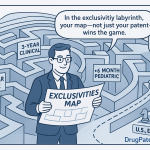
The interaction between patent exclusivity and regulatory exclusivity creates what practitioners call the “exclusivity ladder.” A compound with an NCE exclusivity period ending in 2026, a CoM patent expiring in 2029, and a pediatric exclusivity extension running through 2031 has a multi-rung ladder that a generic manufacturer must climb before entering the market. Each rung has different legal challenge mechanisms and different risk profiles for the innovator company.
Exclusivity Type
Duration
Trigger
Stackable?
NCE Exclusivity
5 years
First FDA approval of new active moiety
Yes, with patent exclusivity
Orphan Drug Exclusivity
7 years
ODD + approval for rare disease indication
Yes
Pediatric Exclusivity
+6 months
Completion of FDA-requested pediatric studies
Adds to NCE, patent, ODD
BLA Reference Product
12 years
First approval of a biologic (BPCIA)
Yes, concurrent with patents
New Formulation NCE
3 years
Approval of new formulation of approved drug
Limited stacking
2.4 IP Valuation in Practice: AbbVie’s Humira Portfolio as a Case Study
AbbVie’s management of the Humira (adalimumab) patent estate is the most-cited example of multi-layered pharmaceutical IP strategy. Humira generated $21.2 billion in global revenues in 2022, the year before biosimilar competition began in the United States. The original CoM patent expired in 2016 in the US, yet AbbVie maintained biosimilar-free exclusivity through 2023 by building a “patent thicket” of more than 130 patents covering manufacturing processes, formulations, methods of use, and delivery devices. Many of these patents were filed years after the original composition patent, specifically to create litigation exposure for biosimilar entrants.
AbbVie monetized this extended exclusivity through authorized biosimilar settlement agreements. By 2023, AbbVie had settled Paragraph IV-equivalent BPCIA litigation with nine biosimilar manufacturers, granting them US market entry starting in January 2023 for some and later dates for others, in exchange for royalty payments. This settlement strategy converted patent litigation exposure into a structured royalty income stream while delaying the full price erosion that unconstrained biosimilar competition would produce. Analysts at the time estimated that AbbVie’s patent thicket and settlement strategy was worth approximately $15 to $20 billion in present value terms compared to a scenario in which biosimilar competition had begun in 2016 when the original patent expired.
Investment Strategy: Analyst NotesWhen analyzing a pharmaceutical company’s IP moat, count the total number of Orange Book-listed patents and their expiry dates across all NDA-approved products. A thin patent estate with few line extensions signals near-term exclusivity risk.Scrutinize whether a company’s pipeline is protected by NCE exclusivity or solely by formulation and method-of-use patents. The latter offer weaker competitive barriers and are more susceptible to challenge.For biologics, model two exclusivity scenarios: one where BPCIA 12-year exclusivity runs its full term, and one where a biosimilar manufacturer obtains early approval under the 4-year data exclusivity provision. The NPV difference quantifies the “exclusivity risk premium.”AbbVie’s Humira strategy demonstrates that a large patent thicket can substitute for CoM protection, but only if the company has the litigation resources and settlement negotiating leverage to enforce it. Smaller companies with the same strategy face asymmetric litigation risk.
Key TakeawaysA pharmaceutical patent estate has at least five distinct layers: CoM, method-of-use, formulation, manufacturing process, and device patents. Each layer has independent expiry and challenge risk.Regulatory exclusivity (NCE, Orphan, BLA reference product, Pediatric) is distinct from patent exclusivity and can extend effective market protection beyond CoM patent expiry.The 25 percent rule is inadmissible in US patent litigation. Royalty rates must be benchmarked against actual pharmaceutical industry transactions.rNPV modeling must incorporate patent expiry architecture. A seven-year difference in exclusivity window can represent multiple billions of dollars in NPV for a blockbuster compound.AbbVie’s Humira demonstrates that a patent thicket of 130+ secondary patents can maintain biosimilar-free exclusivity for seven years after CoM patent expiry, converting that window into a quantifiable asset.
Section 3: Deal Financial Architecture – Upfronts, Milestones, and Royalties
The financial structure of a pharmaceutical license determines how economic risk and reward are distributed between licensor and licensee across the drug development timeline. Deal architects must balance the licensor’s need for near-term capital against the licensee’s need to limit upfront exposure to pre-approval risk. The resulting structures are almost never simple; they reflect negotiated views on clinical probability of success, market size, competitive dynamics, and each party’s financial position.
3.1 Upfront Payments
The upfront payment is the cash the licensee pays at signing, before any development milestones are achieved. It compensates the licensor for the opportunity cost of choosing this licensee over competitors and for any pre-existing development work. Upfronts are non-refundable and non-contingent.
Upfront size is a function of asset stage, competitive interest, and licensor financial strength. A biotech with one clinical asset and limited runway will accept a lower upfront because it needs the capital. A biotech with multiple competing partnership offers can hold out for a higher upfront. The data broadly confirm this: in pharmaceutical licensing transactions announced between 2020 and 2025, median upfronts for Phase I assets ranged from $25 million to $75 million, Phase II assets from $75 million to $300 million, and Phase III assets from $200 million to $600 million, according to aggregated Citeline deal data. These ranges are wide because therapeutic area, competitive class, and clinical read-out recency all affect bidding dynamics.
From a licensor accounting standpoint, upfront payments received are typically recognized as revenue over time rather than immediately, using a proportional performance methodology tied to ongoing development obligations. The specific revenue recognition schedule under ASC 606 requires careful analysis of performance obligations in the contract, particularly when the licensor retains co-development responsibilities.
3.2 Milestone Structures
Development milestones are contingent payments triggered by the achievement of specified clinical or regulatory events. Clinical milestones include IND clearance, Phase II initiation, Phase II proof-of-concept data, Phase III initiation, and New Drug Application (NDA) or BLA submission. Regulatory milestones include FDA approval, EMA approval, and approval in specific additional markets. Commercial milestones are triggered when annual net sales cross defined thresholds.
The total potential value of a pharmaceutical license deal, as reported in press releases, is almost always dominated by milestones that have low probability of payment. A $1 billion deal headline that includes $50 million upfront, $450 million in clinical and regulatory milestones, and $500 million in commercial milestones does not represent $1 billion in expected value. Applying realistic PoS estimates to each milestone, the risk-adjusted value of the entire deal might be $150 to $200 million in present value terms.
Sophisticated licensors structure milestone schedules to ensure that the payments received at each stage are commensurate with the probability-weighted work remaining. A front-loaded milestone schedule, where large payments are received at Phase II completion before Phase III investment begins, shifts risk to the licensee and maximizes the licensor’s risk-adjusted return if the program fails in Phase III.
Milestone Negotiation PrincipleThe ratio of Phase II milestones to Phase III milestones is an implicit signal of each party’s assessment of Phase II/III transition probability. If a licensee proposes a deal with a very large Phase III initiation milestone and a small Phase II completion payment, it may be signaling low confidence in Phase II data quality.
3.3 Royalty Structures
Royalties are the ongoing payments the licensee makes to the licensor as a percentage of product net sales. The royalty rate reflects the relative patent strength, commercial market size, competitive intensity, and each party’s negotiating position. Royalties are paid for as long as the product is covered by a valid, enforceable patent or regulatory exclusivity period in each territory.
Tiered royalty structures are standard in pharmaceutical licensing. Rather than a flat percentage, tiered structures apply different royalty rates at different net sales thresholds. A common structure might specify a 10 percent royalty on net sales below $500 million annually, stepping up to 14 percent between $500 million and $1 billion, and 18 percent above $1 billion. Tiered royalties align licensor and licensee interests: the licensor captures more value if the product becomes a blockbuster, while the licensee faces lower royalty obligations if the product underperforms.
Royalty stacking provisions address situations where the licensee must pay royalties to multiple parties on the same product. This occurs when the product requires licenses to blocking patents held by multiple different licensors. Without a stacking cap, the combined royalty burden can make the product commercially unviable. A typical stacking provision allows the licensee to offset royalties paid to third parties against royalties owed to the primary licensor, up to a specified percentage reduction, often 50 percent. Licensors resist deep stacking caps because they effectively subordinate the primary license royalty to third-party payments.
3.4 Equity Components and Non-Cash Consideration
Many pharmaceutical licensing deals include an equity component, in which the licensee takes an equity stake in the licensor company. This structure aligns interests beyond the contractual term: if the licensed compound succeeds, the licensor’s equity value rises, benefiting the licensee. Equity stakes in licensing deals have become more common in deals involving early-stage biotechs with thin balance sheets, because the equity investment effectively provides working capital that the licensor would otherwise need to raise through dilutive equity offerings.
Merck’s licensing deals with small oncology biotechs frequently include an equity co-investment alongside the licensing upfront, creating a financial alignment that encourages the biotech to continue developing non-licensed assets that might later become additional licensing targets for Merck. This is a deliberate portfolio-building strategy, not a financial necessity.
Deal Stage
Typical Upfront
Total Deal Value
Royalty Range
Key Driver
Preclinical
$5M-$30M
$100M-$500M
3-8%
Target novelty, platform value
Phase I
$25M-$75M
$300M-$800M
6-12%
First-in-class potential, safety data
Phase II
$75M-$300M
$500M-$2B
10-18%
PoC data, market size
Phase III
$200M-$600M
$1B-$5B+
12-22%
Regulatory clarity, commercial infrastructure
Approved Product
$500M-$5B+
Royalty stream only
15-25%
Patent runway, formulary access
Key TakeawaysTotal deal value as reported in press releases is not expected value. Apply stage-specific PoS probabilities to each milestone to calculate risk-adjusted deal value.Tiered royalty structures align licensor and licensee interests by increasing the licensor’s share at higher sales thresholds. Model the step-up levels against realistic peak sales estimates before agreeing to tier thresholds.Royalty stacking caps reduce the effective royalty rate for primary licensors when the licensee holds multiple licenses on the same product. Stacking provisions require detailed analysis of the target company’s existing IP obligations.Equity co-investments in licensing deals serve dual purposes: providing working capital for small biotechs and creating financial alignment beyond the contractual term.
Patent lifecycle management (PLM) is the set of strategies an innovator pharmaceutical company uses to extend effective exclusivity beyond the expiry of the original composition-of-matter patent. PLM generates significant IP licensing value by creating successor patents that can be licensed independently or bundled with the CoM license in deals that extend the royalty runway.
4.1 Continuation Patent Strategy
A continuation patent application claims the same priority date as its parent application but introduces new claims based on new experimental data or prosecution insights. Continuation filings allow an applicant to broaden or refine the claim set after observing how competitors attempt to design around the original claims. A skilled pharmaceutical patent prosecutor uses continuation strategy to create a “claim picket fence” around a successful drug, filing multiple continuation applications at different stages of development and commercial success to cover increasingly specific aspects of the compound’s clinical use.
AstraZeneca’s Crestor (rosuvastatin) patent strategy illustrates this approach. The primary CoM patent expired in 2016 in the US, but AstraZeneca had filed continuation and divisional applications covering specific dosing regimens, crystalline forms, and pediatric indications, some of which were listed in the FDA Orange Book and required generic filers to mount Paragraph IV challenges before entering the market.
4.2 Secondary Patents: Formulation, Device, and Method Patents
Secondary patents cover aspects of the commercial drug product beyond the active molecule. Formulation patents claim specific ratios of excipients, polymorphic forms of the active ingredient, and delivery system characteristics. Device patents, relevant for combination products like inhalers, autoinjectors, and prefilled syringes, cover the physical delivery mechanism and its interface with the drug product. Method-of-use patents claim specific treatment regimens, patient populations, or dosing schedules.
The Orange Book listing of secondary patents is a specific area of regulatory and litigation strategy. Under the Hatch-Waxman Act, the FDA lists patents submitted by the NDA holder in the Orange Book. A generic filer must certify against each listed patent. Paragraph IV certification, the certification that a listed patent is invalid or will not be infringed by the generic product, automatically triggers a 30-month stay of generic approval and invites patent litigation. By listing additional secondary patents in the Orange Book near the time of generic ANDA filing, an innovator company can generate new 30-month stays that delay generic entry independent of the underlying patent’s merits.
The FTC has challenged patent listing practices it views as abusive, and several branded pharmaceutical companies have faced antitrust scrutiny for listing patents that the FTC argued were not properly listable under the Orange Book criteria. The FDA’s 2023 final rule on Orange Book listing disputes, which created a new process for challenging improper listings, reflects regulatory concern about secondary patent listing as a generic delay tactic.
4.3 Supplementary Protection Certificates (SPCs) in Europe
Outside the United States, SPCs are the primary exclusivity extension mechanism available to pharmaceutical patent holders. An SPC is a national right, granted by each EU member state patent office, that extends the term of a basic patent protecting a medicinal product by up to five years, reflecting the time lost during regulatory approval. The maximum combined period of patent plus SPC protection is 15 years from the date of first marketing authorization in the EU.
The EU SPC system is under active reform. The SPC Manufacturing Waiver, introduced in 2019, allows EU-based manufacturers to produce SPC-protected products for export to third countries or for stockpiling ahead of SPC expiry, reducing the competitive advantage of non-EU manufacturers during the SPC period. For pharmaceutical licensing deals covering EU territories, SPC status directly affects the licensed royalty runway in each member state.
4.4 Pediatric Exclusivity and Orphan Drug Designation as Patent Extensions
The FDA’s pediatric exclusivity program adds six months to all existing patents and regulatory exclusivities for drugs that complete FDA-requested pediatric studies under the Best Pharmaceuticals for Children Act. This six-month extension applies to every listed Orange Book patent, potentially adding significant value to a complex multi-patent estate. A drug with five Orange Book patents expiring at different times receives a six-month extension on each, staggering generic entry.
Orphan Drug Designation provides seven years of US market exclusivity for drugs treating diseases affecting fewer than 200,000 US patients. Innovator companies sometimes seek ODD for a subset of a drug’s approved indications to layer orphan exclusivity on top of remaining patent protection. Sarepta Therapeutics’ strategy with its Duchenne muscular dystrophy gene therapy portfolio illustrates how ODD can be used in conjunction with data exclusivity and patent protection to create a layered exclusivity structure that makes competitive entry prohibitively expensive.
Key TakeawaysOrange Book secondary patent listings can generate new 30-month Hatch-Waxman stays independent of the primary CoM patent. Count and analyze listed patents, not just the primary patent, when modeling generic entry timing.SPCs add up to five years of exclusivity in EU member states. SPC status is a territory-specific asset that affects royalty runway in EU licensing agreements.Pediatric exclusivity adds six months to every Orange Book-listed patent. For drugs with complex multi-patent estates, this can generate significant additional royalty income.Orphan Drug Designation provides seven years of US market exclusivity, making it one of the most valuable regulatory mechanisms available to rare disease program developers.
Section 5: Biologics Licensing – Technology Roadmap and BPCIA Dynamics
Biologics licensing is categorically more complex than small molecule licensing because the product, the manufacturing process, and the regulatory exclusivity framework are fundamentally different. A biologic drug is a large molecule, typically a protein, antibody, or nucleic acid-based therapeutic, produced through living cells. Its physical properties cannot be fully characterized analytically, making the “product” inseparable from the process that makes it. This manufacturing dependency shapes every aspect of biologics licensing, from royalty negotiation to biosimilar interchangeability.
5.1 The BPCIA Framework and Its Licensing Implications
The Biologics Price Competition and Innovation Act of 2009 (BPCIA) created the regulatory pathway for biosimilar approvals in the United States, modeled on the Hatch-Waxman framework for small molecule generics but adapted for biologics’ complexity. Under the BPCIA, a biosimilar manufacturer files a 351(k) application referencing an approved originator biologic (the “reference product”). The reference product sponsor holds 12 years of data exclusivity during which the FDA cannot approve a biosimilar referencing the product, regardless of patent status.
The BPCIA also includes a unique multi-step patent information exchange process, sometimes called the “patent dance,” in which the biosimilar applicant and reference product sponsor exchange information about the manufacturing process and patents before litigation. The patent dance is optional for the biosimilar applicant since the 2017 Supreme Court decision in Sandoz Inc. v. Amgen Inc., but participation affects the timing of available litigation remedies. Many biosimilar developers now skip the patent dance, opting instead for early declaratory judgment actions that bypass the sequential exchange requirement.
For licensing purposes, the BPCIA creates a 12-year window during which the originator biologic’s commercial position is protected regardless of the patent estate. This 12-year exclusivity period is the primary licensing asset for biologics, not the patents. A biologic with a weak patent estate but 10 remaining years of BPCIA data exclusivity is a more defensible licensing asset than a biologic with a strong patent estate but only two years of BPCIA exclusivity remaining.
5.2 Biologics Technology Roadmap: From Discovery to Biosimilar Entry
Understanding the biologics development technology roadmap is essential for anyone structuring a biologics license, because the complexity of each development stage creates the milestone and royalty triggers that define deal economics.
Stage 1: Target Identification and Antibody Generation (Years 1-3)
Biologics discovery begins with target identification and antibody or protein engineering. Monoclonal antibody generation uses phage display, transgenic mouse immunization, or single B-cell screening to identify lead candidates. Platform licensing at this stage covers the antibody generation technology itself. Humanization patents, which cover methods for converting non-human antibodies into forms safe for human administration, are often separately licensed from the antibody generation technology.
Stage 2: Cell Line Development and Process Characterization (Years 2-5)
Cell line development is the most IP-dense stage of biologics manufacturing. The Chinese hamster ovary (CHO) cell expression systems used by most biologics manufacturers are covered by a web of process patents. Lonza’s GS Gene Expression System, Catalent’s GPEx technology, and Selexis’ SURE Technology Platform are all licensed manufacturing cell line platforms with independent IP estates. A biologics license that does not account for the manufacturing cell line’s patent status can expose the licensee to infringement claims from cell line platform owners.
Critical Quality Attributes (CQAs), the specific molecular characteristics of the biologic that are clinically relevant, are established during process characterization. CQA specifications become both a regulatory commitment and an IP claim set. The “fingerprint” of a biologic’s CQA profile, including glycosylation pattern, charge variant distribution, and aggregation profile, is documented in the BLA and forms part of the regulatory exclusivity period protection.
Stage 3: Clinical Development (Years 4-10)
Biologics clinical development generates extensive clinical data packages that become the reference for biosimilar comparability exercises. The originator company’s Phase I/II dose-finding data and Phase III pivotal trial results are proprietary until the reference product exclusivity period ends. This data exclusivity is independent of patent protection and cannot be circumvented by a biosimilar developer through independent clinical trials.
Stage 4: Biosimilar Entry and Interchangeability (Years 12-15+)
Biosimilar market entry occurs when BPCIA data exclusivity expires (year 12) and any remaining patent litigation is resolved through Paragraph IV-equivalent BPCIA challenges. At initial entry, biosimilars are approved as “biosimilar” but not necessarily as “interchangeable.” FDA interchangeability designation, which permits pharmacists to substitute the biosimilar for the originator without physician intervention, requires additional switching study data demonstrating that alternating between the originator and biosimilar does not produce greater clinical risk than continued use of either product alone.
Interchangeability designation is the single most commercially important regulatory outcome for biosimilar developers and the event that most directly threatens originator biologics’ pricing power. Coherus Biosciences’ Udenyca (pegfilgrastim-cbqv) received interchangeability designation in 2022, enabling pharmacy-level substitution for Amgen’s Neulasta and accelerating formulary displacement. Once a biosimilar achieves interchangeability, originator pricing typically faces 30 to 80 percent erosion within 24 months in markets with active pharmacy substitution.
5.3 ADC Licensing: A Special Case
Antibody-drug conjugate (ADC) licensing requires analysis of at least four distinct patent estates: the antibody targeting moiety, the cytotoxic payload, the linker chemistry connecting antibody and payload, and the manufacturing process. Each of these is often held by different companies. Pfizer’s acquisition of Seagen in 2023 was partly motivated by Seagen’s proprietary ADC linker technology, which was licensed to multiple biopharmaceutical companies and generated recurring licensing revenue. The acquisition price of $43 billion reflected, in part, the NPV of Seagen’s ADC technology licensing income stream in addition to the pipeline compounds.
When structuring an ADC license, the licensee must perform independent FTO analysis for each of the four IP domains. A license to the antibody and payload that fails to secure rights to the linker chemistry leaves the licensee exposed to infringement claims that can be asserted independently of the primary license. The ImmunoGen MAYTANSINOID payload licensing program, which underpins Roche’s Kadcyla (ado-trastuzumab emtansine) and multiple other ADC programs, illustrates how payload technology licensing can generate royalty income across a portfolio of licensed products built on a single chemical platform.
Investment Strategy: Analyst NotesFor biologics-dependent biopharma companies, the 12-year BPCIA exclusivity clock is the primary revenue protection mechanism, not the patent estate. Model the exclusivity cliff at year 12, not at the CoM patent expiry date.Interchangeability designation is a binary pricing risk event. Before investing in an originator biologic with biosimilar competition pending, assess whether any filed biosimilar applications have completed the additional switching studies required for interchangeability.ADC platform companies (Seagen model pre-Pfizer) generate licensing royalty income from multiple third-party programs simultaneously. The licensing royalty stream is a stable, lower-risk revenue source that warrants a different discount rate than the company’s own pipeline NPV.Cell line platform licensing (Lonza GS system, Selexis SURE) creates royalty obligations for biologics licensees that may not be visible in the primary licensing agreement. Total royalty burden modeling requires identification of all upstream technology licenses.
Key TakeawaysBPCIA 12-year data exclusivity is the primary licensing asset for biologics, not the patent estate. Patent challenges can still proceed, but data exclusivity prevents biosimilar approval regardless of patent outcome.The patent dance under BPCIA is optional since the 2017 Sandoz v. Amgen Supreme Court decision. Most biosimilar developers now skip it, opting for early declaratory judgment actions.Interchangeability designation triggers pharmacy-level substitution and is the event most directly threatening to originator biologic pricing. Monitor FDA interchangeability applications as a leading indicator of pricing risk.ADC licensing requires independent FTO analysis for antibody, payload, linker, and manufacturing process patent estates. A gap in any one domain creates infringement exposure.
Section 6: Hatch-Waxman Dynamics, Paragraph IV Filings, and Authorized Generics
The Drug Price Competition and Patent Term Restoration Act of 1984, universally known as Hatch-Waxman, created the legal and economic framework for generic drug market entry in the United States. It also created the Paragraph IV certification mechanism that allows generic manufacturers to challenge branded drug patents before their expiry, and the 180-day first-filer exclusivity that rewards the first successful generic challenger. This framework shapes the timing and economics of virtually every licensing deal involving a patented small molecule drug with US market exposure.
6.1 The Paragraph IV Filing Mechanism
An ANDA filer seeking to enter the market before a listed Orange Book patent expires must file a Paragraph IV certification asserting that the patent is either invalid or will not be infringed by the generic product. Filing a Paragraph IV certification constitutes a statutory act of patent infringement, automatically giving the NDA holder the right to sue within 45 days. If the NDA holder files suit, a 30-month stay of ANDA approval automatically takes effect, freezing FDA approval regardless of the patent litigation’s merits.
The 30-month stay is a powerful commercial weapon. Even if the generic manufacturer ultimately wins on the merits, the stay prevents market entry for 2.5 years after the Paragraph IV filing. For a drug generating $2 billion annually, a 30-month delay in generic entry represents approximately $5 billion in protected branded revenues. This is precisely why Orange Book patent listing strategy is so commercially important and why the FTC and FDA have focused regulatory attention on improper patent listings.
6.2 First-Filer 180-Day Exclusivity
The first generic company to file a Paragraph IV certification earns 180 days of marketing exclusivity against subsequent ANDA filers. During this 180-day period, no other generic company can receive final approval from the FDA. The 180-day exclusivity period is the primary financial prize in generic pharmaceutical patent challenges, because the first filer captures the market before price competition from additional generics reduces margins from their typical first-entry level of 70 to 80 percent of the branded price to their long-run equilibrium of 20 to 30 percent.
Multiple generic filers who submit Paragraph IV ANDAs on the same day share the 180-day exclusivity period. When multiple filers share exclusivity, the first-day price erosion is greater because multiple generic products compete simultaneously from day one. This dynamic has changed the economics of generic patent challenges: many challenges now involve coordinated entry strategies where multiple generic filers seek to share 180-day exclusivity, reducing per-company revenue but also reducing per-company litigation costs.
6.3 Authorized Generics as a Licensing Strategy
An authorized generic (AG) is a generic version of a branded drug that the NDA holder produces and sells at generic prices, typically through a licensing agreement with a generic partner, during the first-filer’s 180-day exclusivity period. The AG competes directly with the first-filing generic, eroding the first filer’s exclusivity window and reducing the financial reward for challenging the patent.
AG licensing deals are structured as out-licensing agreements from the branded company to a generic partner. The branded company receives either a revenue-sharing payment or a fixed licensing fee. The economic benefit to the branded company is the incremental revenue captured during the 180-day period that would otherwise go entirely to the first-filing generic. AG strategies also serve as a deterrent to future Paragraph IV filings because they reduce the expected financial reward for a successful challenge.
The FTC and generic manufacturers have historically opposed AG strategies on competition grounds, arguing that AGs undermine the Hatch-Waxman statutory incentive for generic patent challenges. The FTC’s 2011 study on AGs found that AG competition reduced first-filer revenues by approximately 50 percent during the 180-day exclusivity period, effectively halving the value of the first-filer exclusivity prize.
6.4 Reverse Payment Settlement Agreements
A reverse payment settlement (also called a “pay-for-delay” settlement) occurs when a branded pharmaceutical company pays a Paragraph IV filer to settle patent litigation and delay generic entry. The payment flows from the party being challenged to the challenger, which is the reverse of the typical settlement dynamic. The economic logic is that the branded company’s expected litigation cost plus the expected value of delayed entry exceeds the settlement payment, making payment rational even with no certainty of winning the litigation.
The Supreme Court’s 2013 decision in FTC v. Actavis established that reverse payment settlements are subject to antitrust scrutiny under the rule of reason and can be challenged by the FTC without a presumption of illegality. Actavis did not ban reverse payments; it required that their competitive effects be weighed case by case. Since Actavis, the frequency of cash reverse payments has declined while non-cash value transfers, including AG rights grants, accelerated patent expiry dates, and co-promotion arrangements, have become more common as settlement vehicles that are harder to quantify under the rule of reason.
Investment Strategy: Analyst NotesWhen modeling generic entry timing for a branded drug, identify all Paragraph IV filers and their filing dates. The 30-month stay clock runs from the NDA holder’s filing date; the earliest possible FDA approval date for the first filer is 30 months plus the ANDA review period.Brands that have authorized generic licensing agreements in place gain a deterrence tool against future Paragraph IV challenges. The presence of an AG provision in a branded company’s strategy is a positive signal for patent life extension.Post-Actavis, settlement agreements use non-cash value transfers. Analyze co-promotion rights, AG licenses, and “accelerated entry” provisions in disclosed litigation settlements as proxies for implied value transfer size.First-filer 180-day exclusivity is only financially meaningful if not shared with multiple co-filers and if the branded company does not launch an AG simultaneously. Both factors require monitoring during ANDA filing windows.
Key TakeawaysParagraph IV certification constitutes statutory patent infringement and triggers a 30-month stay. The 30-month stay is the primary mechanism protecting branded revenue during generic patent challenges, independent of patent merits.AG licensing during 180-day first-filer exclusivity reduces first-filer revenues by approximately 50 percent, according to FTC data. AG strategies are a branded company’s most effective financial deterrent to Paragraph IV filing.Post-Actavis reverse payment settlements use non-cash value transfers because cash payments invite antitrust scrutiny under the rule of reason. AG rights, co-promotion deals, and accelerated entry dates have replaced direct cash payments.Multiple Paragraph IV co-filers sharing 180-day exclusivity face immediate price competition. The first-filer exclusivity prize is worth less when shared.
Section 7: Geographic Licensing Architecture and Cross-Border IP Considerations
Geographic licensing creates territorial carve-outs that allow different commercial partners to operate in different markets under the same underlying IP estate. The commercial logic is straightforward: drug discovery biotechs rarely have the sales force infrastructure or regulatory expertise to commercialize in every major market, so they out-license regional rights to partners who do. The IP logic is more complex, because patents are national rights, regulatory exclusivities are jurisdiction-specific, and pricing and reimbursement systems vary across markets in ways that directly affect royalty income calculations.
7.1 Structuring Territorial Carve-Outs
The most common geographic licensing split in pharmaceutical deals is between the United States and the rest of the world. A biotech discovering a compound in the US might retain US rights and out-license ex-US rights to a partner with established commercial infrastructure in Europe, Japan, and emerging markets. The ex-US licensee typically pays a combination of an upfront fee and royalties on non-US net sales, with milestone payments tied to approvals in major ex-US markets: EMA approval in Europe, PMDA approval in Japan, NMPA approval in China.
Asia-Pacific licensing has become increasingly important as pharma markets in China, Japan, South Korea, and Southeast Asia have grown and as regulatory pathways have matured. China’s NMPA approval pathway now accepts data from global multi-regional clinical trials (MRCTs), reducing the cost of obtaining Chinese approval for compounds already approved by FDA or EMA. This has made Chinese out-licensing more commercially attractive, as the additional regulatory cost has declined significantly relative to the market opportunity.
7.2 Parallel Imports and Reference Pricing Risks
Parallel imports occur when a product sold in a lower-price market is legally reimported and resold in a higher-price market. Within the European Union, the principle of exhaustion of IP rights means that once a drug is placed on the market in any EU member state, the patent holder cannot prevent parallel importation to other member states. This creates pricing pressure for branded drugs in high-price EU markets because parallel imports from lower-price member states undercut the reference price.
Geographic licensing agreements in the EU must account for parallel import risk. Licensors who grant different territorial licenses for different EU member states need to address the possibility that lower royalty rates in lower-price markets will generate parallel import flows that undercut higher-royalty revenues in higher-price markets. The standard approach is to use a single EU-wide license rather than member-state specific licenses, allowing the licensee to manage intra-EU pricing uniformly.
7.3 Compulsory Licensing: Regulatory Risk for Innovators
Compulsory licensing allows a government to authorize the manufacture and sale of a patented drug without the patent holder’s consent. The TRIPS Agreement at the WTO explicitly permits compulsory licensing for public health purposes, particularly for HIV/AIDS treatments and other drugs addressing national health emergencies. Compulsory licenses have been issued by governments in India, Brazil, South Africa, Thailand, and more recently by several developed countries seeking to reduce prices on high-cost drugs.
The United States government itself holds march-in rights under the Bayh-Dole Act, which allows federal agencies to override patent rights for inventions developed with government funding if the patent holder fails to commercialize the invention or if regulatory requirements are not met. The Biden administration’s 2023 framework for exercising Bayh-Dole march-in rights to address high drug prices was the first policy step toward using march-in rights as a pricing intervention tool, though the framework’s legal basis remains contested and no march-in rights action on pricing grounds has yet proceeded to completion.
For licensing purposes, compulsory licensing risk is most material for compounds addressing pandemic threats, high-burden infectious diseases, and rare pediatric diseases. Innovator companies structuring licenses in markets with compulsory licensing histories should include contractual provisions addressing the treatment of compulsory licensing events: whether the licensor or licensee bears the financial impact of a compulsory license that reduces royalty income in a licensed territory.
Key TakeawaysGeographic territorial carve-outs create jurisdiction-specific royalty streams with different expiry dates based on each market’s patent and regulatory exclusivity landscape. Model each territory independently.EU parallel import risk makes member-state-specific licensing impractical for most pharmaceutical products. EU-wide licensing with uniform pricing obligations is the standard approach.Compulsory licensing risk is concentrated in infectious disease, rare disease, and pandemic-related programs. Include compulsory licensing risk allocation provisions in licensing agreements covering markets with histories of government IP override.China out-licensing has become more attractive as NMPA now accepts MRCT data. Model Chinese approval probability independently of US/EU approval because NMPA review timelines and requirements differ materially.
Governance structure is the operational skeleton of a pharmaceutical licensing partnership. It determines who makes decisions, how disputes are resolved before they become litigation, and how the relationship adapts to the changes in clinical, regulatory, and commercial circumstances that are inevitable in any multi-year pharmaceutical program. Governance failures are a primary cause of licensing agreement disputes and early terminations.
8.1 The Joint Steering Committee (JSC) Structure
The Joint Steering Committee is the primary governance body in most pharmaceutical licensing partnerships. It typically comprises three to five senior representatives from each party with cross-functional coverage of R&D, commercial, and legal functions. The JSC meets quarterly or at defined program milestones and has authority over major program decisions including study design modifications, regulatory strategy changes, and major resource allocation decisions.
JSC decision-making authority must be explicitly defined in the agreement. Three governance models are common. In the first, the JSC operates by consensus, and disputes escalate to senior leadership if consensus cannot be reached. In the second, the licensor has tie-breaking authority over specific categories of decisions, typically regulatory and scientific matters. In the third, the licensee has tie-breaking authority over commercialization and market access decisions because it holds the marketing authorization and commercial execution responsibility. The specific allocation of tie-breaking authority reveals the relative negotiating leverage of the parties at the time of signing.
8.2 Alliance Management as a Specialized Function
Major pharmaceutical companies that manage multiple concurrent licensing partnerships have developed dedicated alliance management functions. The alliance manager is responsible for day-to-day relationship management, issue identification and escalation, and program health monitoring. The role requires both scientific literacy and commercial judgment, which makes experienced alliance managers rare and relatively well compensated.
Alliance management software platforms, including those from Sopheon, Planview, and several bespoke pharmaceutical-specific vendors, track milestone schedules, committee meeting obligations, data-sharing commitments, and termination notice periods across multiple concurrent agreements. For large pharma companies managing 50 or more active licensing agreements simultaneously, systematic tracking of contractual obligations is a compliance necessity, not just a convenience.
8.3 Termination Provisions and Tail Obligations
Termination provisions are among the most commercially consequential clauses in a pharmaceutical license. Termination for convenience clauses allow the licensee to exit the agreement without cause by providing a specified notice period, typically 60 to 180 days. The licensor’s protection against premature termination typically includes a termination fee and reversion of all licensed rights, including clinical data generated during the licensed development program.
Data reversion is particularly important when the licensee has generated clinical data that the licensor can use to continue development independently or to support a subsequent licensing deal. Licensing agreements should specify that all clinical trial data, regulatory correspondence, and development know-how generated during the licensed period reverts to the licensor upon termination, without requiring additional payment. Failure to include an explicit data reversion provision has resulted in protracted disputes between terminating licensees and licensors seeking to recover development assets.
8.4 Dispute Resolution Architecture
Most pharmaceutical licensing agreements specify a tiered dispute resolution process: first, good-faith negotiation between designated representatives; second, escalation to senior leadership (often defined as C-suite or EVP level); third, binding arbitration, typically under ICC, AAA, or JAMS rules. International arbitration under ICC rules is preferred for cross-border disputes because it avoids the home court advantage that domestic litigation would give to the party headquartered in the dispute jurisdiction.
Choice of law provisions in pharmaceutical licensing agreements are strategically important. Delaware law governs most US pharmaceutical licensing agreements because Delaware has the most developed body of commercial contract law and the most predictable courts for complex commercial disputes. For EU-facing agreements, English law under the laws of England and Wales is a common choice for the same reasons. Post-Brexit complications for English law governance in EU-based arbitrations have led some parties to shift to Swiss or German law for European-facing agreements.
Key TakeawaysJSC tie-breaking authority allocation reflects negotiating leverage. Licensor tie-breaking over scientific and regulatory decisions protects the originator’s IP rights; licensee tie-breaking over commercialization decisions reflects commercial execution control.Alliance management functions are a compliance necessity for large pharma companies managing 50+ concurrent agreements. The absence of formal alliance management is a risk factor in licensing-heavy companies.Data reversion upon termination must be explicitly addressed in the licensing agreement. Implicit or ambiguous provisions create disputes over the ownership of clinical data generated during the licensed period.International arbitration under ICC rules avoids home court advantage in cross-border pharmaceutical disputes. Delaware law governs most US commercial pharmaceutical agreements for its predictable body of contract law.
For institutional investors, pharmaceutical licensing creates both value and risk in ways that are not always visible in standard financial metrics. A company with 60 percent of its pipeline derived from in-licensed assets has a fundamentally different risk profile than a company with 60 percent internal discovery, even if their pipeline stage distributions are identical. Understanding the licensing structure is essential to correctly modeling revenue, exclusivity duration, earnings quality, and competitive positioning.
9.1 Royalty Income as an Investment Asset Class
Royalty financing has grown into a distinct asset class, with specialist royalty companies like Royalty Pharma, PDL BioPharma, and DRI Healthcare acquiring royalty streams from academic institutions and pharmaceutical companies in exchange for upfront capital. Royalty Pharma, the largest such company, held royalty interests in 35 marketed products generating approximately $2.2 billion in royalty receipts in 2023. The appeal of royalty assets to institutional investors is their combination of patent-protected cash flows, no development-stage capital at risk, and returns driven by commercial performance rather than binary clinical events.
Royalty income streams should be valued differently from pipeline product NPV because they carry different risk profiles. A royalty on an approved product with five remaining years of US patent exclusivity is essentially a structured credit asset: the revenue is predictable, the downside is patent invalidation or unexpected competitive disruption, and the upside is capped by the royalty rate. Pipeline product NPV, by contrast, is a long-dated option on uncertain clinical and commercial outcomes.
9.2 Licensing as a Signal of Pipeline Quality
The terms of a licensing deal are among the most reliable public signals of a drug candidate’s perceived quality. A $100 million upfront payment for a Phase II oncology asset signals that the partner, which has presumably conducted full due diligence including the patent estate, believes the compound has high clinical and commercial value. Conversely, a deal in which the licensor retains US rights while out-licensing ex-US rights for a modest upfront and low royalties may signal limited confidence in the compound’s peak commercial potential.
Analysts should also scrutinize opt-in structures, in which the licensee pays a lower upfront for an option to co-develop or co-commercialize after a specified data readout. If the licensee does not exercise the option, the licensor retains full rights. Frequent option non-exercise by well-resourced partners is a negative signal about the quality of data generated during the option period. Monitoring opt-in exercise rates in platform licensing deals is a useful leading indicator of pipeline quality.
9.3 Red Flags in Pharmaceutical Licensing Agreements
Several structural features of pharmaceutical licensing agreements warrant investor scrutiny. Agreements that include change-of-control provisions giving the licensor termination rights or renegotiation rights upon the licensee’s acquisition can complicate or block M&A transactions, reducing the acquirer’s ability to pay a premium for the licensee. A target company with multiple licensing agreements each containing strong change-of-control provisions faces structural M&A risk.
Agreements with performance-based termination rights give the licensor the right to terminate if the licensee fails to meet specified commercial or development performance milestones within defined timeframes. If a company has in-licensed a significant portion of its pipeline under agreements with aggressive performance requirements, failure to meet those requirements could result in pipeline asset reversions that materially impair the company’s earnings.
Sublicensing revenue-sharing provisions are another area of financial model risk. If a company’s licensing revenue model depends partly on sublicensing income from geographic sub-licenses, the sublicensing revenue-sharing obligation reduces the economic benefit of those sub-licenses. Accurate modeling requires identifying all sublicensing payments owed to primary licensors before projecting licensing revenue.
9.4 Due Diligence Checklist for Licensing-Dependent Companies
Before making a material investment in a company whose valuation depends significantly on in-licensed or out-licensed assets, analysts should verify the patent estate coverage for each key licensed asset, confirm the regulatory exclusivity type and expiry date in each major market, review the royalty stacking structure to identify all upstream IP obligations, assess change-of-control provisions across all material licensing agreements, confirm whether any Paragraph IV challenges have been filed against listed Orange Book patents for key in-licensed products, analyze the sublicensing revenue structure for out-licensed assets generating third-party royalty income, review JSC governance provisions for in-licensed compounds to assess decision-making control, and identify any milestones at risk of being missed that could trigger termination provisions.
Investment Strategy: Analyst NotesRoyalty income on approved products is a structured credit asset, not a pipeline option. Apply a lower discount rate to royalty income than to pipeline NPV when building sum-of-the-parts models.Opt-in exercise rates are a leading indicator of pipeline quality. A platform licensor with a high rate of partner opt-ins is generating consistently positive Phase II data. Frequent non-exercise signals quality problems that precede pipeline write-downs.Change-of-control provisions in licensing agreements are a material M&A risk factor. Identify all such provisions in target company agreements before pricing an acquisition premium.Royalty stacking analysis is a prerequisite for accurate earnings modeling in companies with complex multi-licensed product portfolios. The visible royalty rate is not the effective royalty rate after stacking.Royalty Pharma’s business model of acquiring royalty streams from companies and institutions is a pure-play expression of pharmaceutical IP value. Its royalty receipt growth is a useful market benchmark for the value of approved product royalty streams.
Key TakeawaysRoyalty income on approved products should be valued as structured credit with a lower discount rate than pipeline NPV. The risk profile is patent challenge and competitive disruption, not binary clinical event.Opt-in exercise decisions by well-resourced licensees are among the most reliable signals of Phase II data quality. Monitor opt-in exercise rates as a leading clinical quality indicator.Change-of-control and termination provisions across a company’s licensing portfolio are material M&A risk factors. Analyze them before pricing any acquisition premium.Accurate earnings modeling for licensing-dependent biopharma companies requires a full royalty stacking analysis. The headline royalty rate in a primary license is not the net royalty earned after upstream IP obligations.Patent estate coverage, regulatory exclusivity type and expiry, Paragraph IV challenge status, and sublicensing revenue sharing are the eight most material licensing-specific due diligence items for institutional investors.
Conclusion: Licensing Strategy as a Core Competency
Pharmaceutical licensing is the mechanism through which the industry converts scientific innovation, IP rights, and commercial infrastructure into cash flows distributed across the innovation ecosystem. Getting the structure right, from patent estate architecture to milestone waterfall design to governance provisions, determines whether a licensing deal generates the expected value or destroys it through poorly negotiated royalty stacking, premature termination, or change-of-control complications.
The companies that systematically outperform on licensing economics share several common characteristics. They invest in IP prosecution strategies that build multi-layered patent estates rather than relying on single composition-of-matter claims. They model royalty stacking early in deal negotiations to avoid committing to royalty rates that become economically unworkable once upstream IP obligations are accounted for. They staff alliance management functions with experienced professionals who can identify and resolve partnership tensions before they escalate to dispute resolution.
For R&D and IP teams, the practical imperative is clear: treat IP valuation with the same rigor as clinical program design. A compound entering Phase II with an unanalyzed patent estate and no evergreening strategy is generating far less value than the same compound with a planned continuation filing program, an SPC application strategy for key EU markets, and pediatric exclusivity extension analysis complete. The exclusivity runway is a designed asset, not a given.
For institutional investors, pharmaceutical licensing data, disclosed deal terms, Paragraph IV filings, opt-in exercise decisions, and royalty receipt growth, is a rich source of alternative data on pipeline quality, competitive dynamics, and IP strength that is underutilized relative to its informational value. Companies with strong licensing deal terms and high opt-in exercise rates are signaling real information about the quality of their programs, independent of what management says at investor days.