Part I: Understanding the Terrain: The Unique Landscape of Pharmaceutical Patents
The decision to conduct a drug patent search is the first step into one of the most complex, high-stakes, and strategically challenging intellectual property (IP) landscapes in the world. Before any database is opened or any keyword is entered, it is imperative to understand the terrain. The pharmaceutical patent system is not a simple library of inventions; it is a deliberately constructed, multi-layered fortress of legal and economic instruments designed to protect massive investments and shape global markets. Misunderstanding this context is the first and most critical error a prospective searcher can make. The landscape’s intricacy is not an accident of history but a direct and calculated consequence of the economic pressures that define the biopharmaceutical industry.
1.1 The Grand Bargain: Why Drug Patents Exist
The entire patent system is founded on a grand bargain, a quid pro quo between society and the innovator.1 In the pharmaceutical sector, the terms of this bargain are amplified to an extraordinary degree by the economics of drug development.
The Economic Imperative
Developing a new pharmaceutical product is an undertaking of staggering cost, risk, and duration. Estimates for bringing a single new drug to market range from $300 million to an astonishing $4.5 billion, with development timelines frequently spanning 5 to 15 years.2 This figure is not merely the out-of-pocket expense for one successful project; it is a capitalized cost that accounts for the vast number of failures that pave the way for a single success. Nearly 90% of drug candidates that enter clinical trials ultimately fail, and their development costs, which can run into the billions, must be borne by the rare products that succeed.2
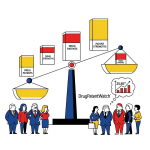
To incentivize any rational entity to undertake such a high-risk venture, the patent system provides a temporary, legally enforceable monopoly. A patent grants the inventor the exclusive right to make, use, sell, and import their invention for a defined period, which under the World Trade Organization’s TRIPS Agreement is a minimum of 20 years from the date of the patent application filing.1 This temporary market exclusivity is the engine of pharmaceutical innovation; it allows companies to set prices that can recover the monumental costs of research and development (R&D) and fund the next wave of discovery.1
The Quid Pro Quo
The other side of this bargain is disclosure. In exchange for this powerful grant of exclusivity, the inventor is required to publicly disclose the invention in their patent application with sufficient detail to enable a “person having ordinary skill in the art” (a PHOSITA) to replicate it.1 This public disclosure enriches the collective knowledge base, allowing other researchers to learn from, build upon, and design around the invention, thereby fueling the cycle of innovation.6
The “20-Year Illusion”
A critical concept for any patent searcher to grasp is the profound difference between the statutory 20-year patent term and what is known as the effective patent life—the actual period during which a drug enjoys market exclusivity free from generic competition.2 This effective period is consistently and significantly shorter than the nominal 20 years.
Pharmaceutical companies must file for patent protection very early in the R&D process, often as soon as a promising molecule is discovered, to secure a priority date and attract investment.2 However, a substantial portion of the 20-year statutory term—frequently 10 to 15 years—is consumed by the subsequent phases of preclinical research, multi-stage clinical trials, and rigorous regulatory review by agencies like the U.S. Food and Drug Administration (FDA).2 Consequently, the average effective market exclusivity a drug enjoys from its launch until generic alternatives become available is typically cited as being only 7 to 10 years.2 This immense time pressure is the primary economic driver behind the complex and aggressive patenting strategies that define the industry.
1.2 More Than One Lock on the Door: Patents vs. FDA Regulatory Exclusivity
The protective fortress around a drug is built upon two distinct but complementary pillars: patents and regulatory exclusivities. Confusing the two is a common and fundamental error for the novice searcher.10
Patents are a form of intellectual property granted by a national patent office, such as the United States Patent and Trademark Office (USPTO). They are a property right awarded to an invention that meets the legal criteria of being novel, non-obvious (or involving an inventive step), and useful (or capable of industrial application).7 A patent can be applied for and granted at any point during a drug’s development lifecycle and can cover a wide range of claims.11
Regulatory Exclusivity is a separate and distinct form of protection granted by a regulatory agency like the FDA upon the approval of a new drug.11 It is a statutory marketing right that prevents the FDA from approving a competitor’s drug (typically a generic) for a specified period, regardless of patent status.10 This protection is not based on the novelty of an invention but on the fulfillment of specific statutory criteria designed to incentivize certain types of drug development.2
These two forms of protection can run concurrently, overlap, or exist independently.12 A drug can have patent protection but no regulatory exclusivity, or vice versa. Key types of FDA regulatory exclusivity in the U.S. include:
New Chemical Entity (NCE) Exclusivity: 5 years of market protection for a drug containing an active ingredient never before approved by the FDA.2
Orphan Drug Exclusivity (ODE): 7 years of market protection for a drug designated to treat a rare disease affecting fewer than 200,000 people in the U.S..2
Biologics Exclusivity: 12 years of market exclusivity for a novel biologic drug, granted under the Biologics Price Competition and Innovation Act (BPCIA).2
The definitive public resource for information on both patents and regulatory exclusivities for approved drugs in the U.S. is the FDA’s publication, Approved Drug Products with Therapeutic Equivalence Evaluations, commonly known as the Orange Book.9
1.3 The Anatomy of Protection: A Fortress of Patent Types
A modern blockbuster drug is rarely protected by a single patent. Instead, it is shielded by a “dense web” or “thicket” of numerous, overlapping patents filed strategically throughout its lifecycle.13 This multi-layered approach is a core component of a drug’s lifecycle management and is designed to create a formidable barrier to generic and biosimilar competition.13 Understanding the different types of patents in this fortress is essential for any meaningful search.
The Crown Jewel: Composition of Matter Patents
Often considered the “gold standard” or “crown jewel” of a drug’s IP portfolio, the composition of matter patent is the most valuable and powerful type of protection.1 This patent claims the active pharmaceutical ingredient (API) or chemical entity itself.18 Its immense power lies in its breadth; if the novel molecule is present in a product, the patent is infringed, regardless of how the molecule was manufactured, what it is formulated with, or for which disease it is being used.1 This is typically the first patent filed and forms the foundation of the drug’s exclusivity period.
Expanding the Moat: Secondary Patents
While the composition of matter patent protects the core molecule, the true strength of a modern drug’s defense comes from the strategic layering of numerous secondary patents.16 These patents protect various aspects of the drug’s formulation, manufacturing, and use, often as part of “evergreening” strategies designed to extend market exclusivity beyond the expiration of the initial patent.9 Key types of secondary patents include:
Method of Use & Method of Treatment Patents: These patents do not claim the drug itself but rather a new and non-obvious method of using a known drug to treat a specific disease or condition.20 This is the legal foundation for drug repurposing. For instance, a company may discover that a drug originally approved for hypertension is also effective for treating migraines and obtain a new method-of-use patent for that new indication, creating a fresh period of exclusivity.1
Formulation Patents: These patents protect the specific combination of the API with inactive ingredients (excipients) or a novel drug delivery system.5 Examples include patents on extended-release tablets that improve patient compliance, transdermal patches, or specific coatings that enhance a drug’s stability or bioavailability. These can provide additional years of market protection even after the core compound patent has expired.1
Process Patents: These patents are focused on protecting a novel and non-obvious method of manufacturing a drug.20 An innovative synthesis pathway that results in higher purity or lower cost can be a valuable and patentable invention.
Polymorph & Chiral Switch Patents: These are more sophisticated types of secondary patents. A polymorph patent covers a specific crystalline form of a drug molecule. Different polymorphs can have distinct physical properties, such as solubility and stability, which can affect a drug’s performance.17 A chiral switch patent applies to drugs that exist as a pair of mirror-image molecules (enantiomers). Often, only one enantiomer is therapeutically active. A company might first market a mixture of both (a racemate) and later obtain a new patent on the isolated, active single-enantiomer version, arguing it has an improved efficacy or side-effect profile.16
The deliberate strategy of building a complex portfolio, moving from a primary composition of matter patent to a dense thicket of secondary patents, is a direct response to the economic pressures of a short effective patent life. This intentional complexity makes the landscape exceptionally difficult for a non-professional to navigate, as a search is not for a single document but for any one of potentially hundreds of interlocking legal rights.
1.4 Reading the Blueprints: A Primer on Interpreting Patent Claims
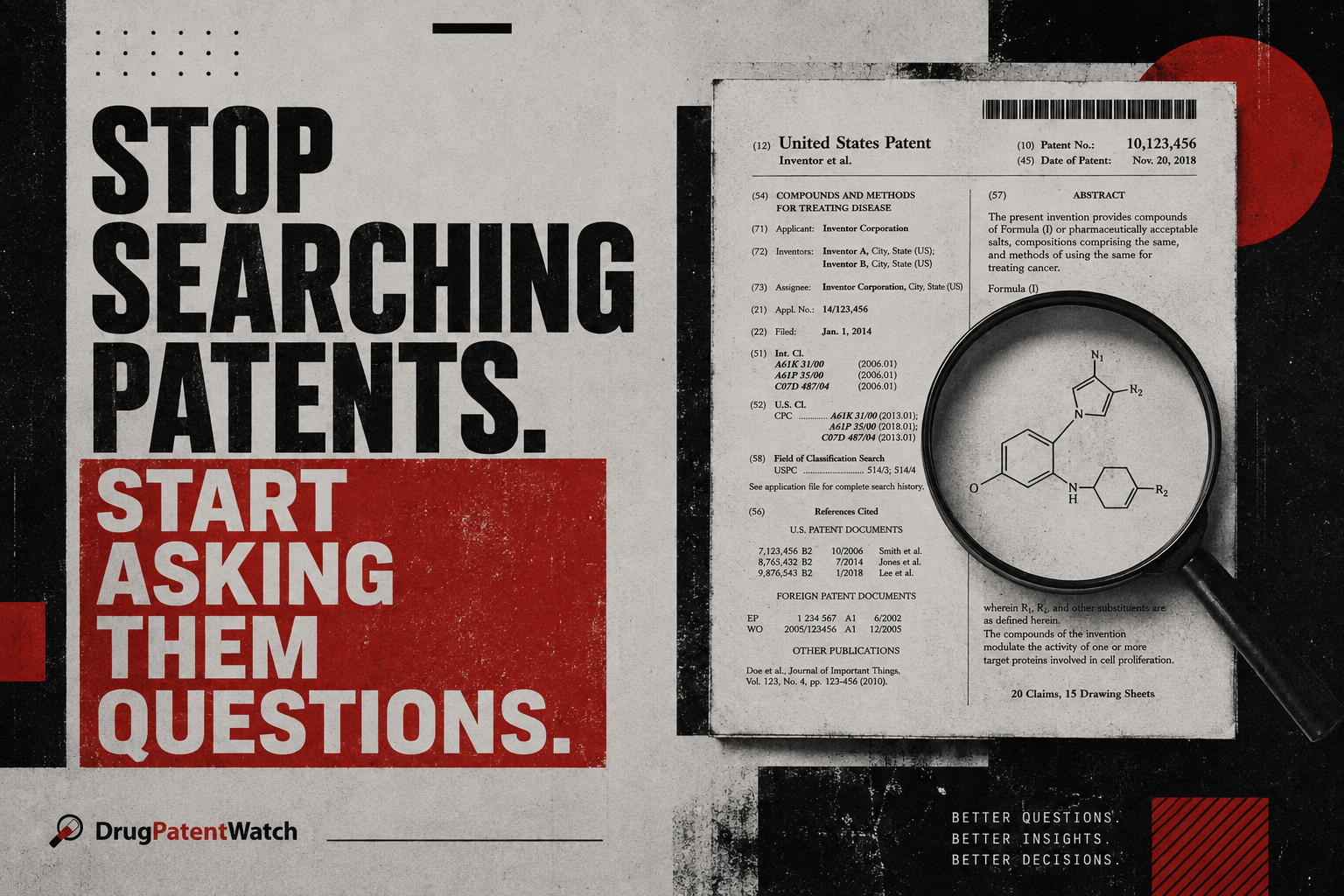
The single most important part of any patent document is the section containing the claims. The claims are the legally operative sentences, typically found at the end of the patent, that define the precise boundaries of the invention for which the patentee is granted exclusive rights.13 An invention does not infringe a patent unless it includes
every element described in at least one of the patent’s claims. Infringement is determined solely by the language of the claims, not by the abstract, the drawings, or the general description in the specification.28 Thus, a superficial reading of a patent’s title or abstract can be dangerously misleading.
A patent claim is a single, often complex, sentence meticulously structured into three distinct parts 13:
The Preamble: This is the introductory phrase that identifies the general category of the invention. Examples in a pharmaceutical context include “A compound of formula I…,” “A pharmaceutical composition…,” or “A method for treating cancer…”.13 While often descriptive, the preamble can be interpreted as a substantive limitation on the claim’s scope.13
The Transitional Phrase: This short but legally potent term connects the preamble to the body of the claim and dictates its breadth.13 The choice of this phrase is one of the most critical decisions in claim drafting, and misunderstanding its meaning can lead to a complete misinterpretation of a patent’s scope.
“Comprising”: This is the most frequently used and preferred transitional phrase in U.S. patent practice. It is an open-ended term meaning “including” or “containing”.13 It signifies that the invention includes the listed elements but is “open” to additional, unrecited elements. For example, a claim for a composition “comprising an active ingredient A and an excipient B” would be infringed by a product that contains A, B, and an additional excipient C.13 This provides the broadest possible scope of protection.
“Consisting of”: This is the most restrictive, closed-ended transitional phrase. It means the invention includes only the explicitly recited elements and nothing more (aside from naturally occurring impurities).13 A claim for a composition “consisting of an active ingredient A and an excipient B” would not be infringed by a product containing A, B, and C.13 This phrase is used strategically when the exclusion of other components is essential to the invention’s novelty or function.
The Body: Following the transitional phrase, the body of the claim enumerates the essential elements, steps, and limitations that define the invention.29 A core principle of drafting is to include the absolute minimum number of elements needed to distinguish the invention from the prior art, as every additional element narrows the claim’s scope and creates a potential avenue for competitors to design around it.13
Patents also contain independent claims, which are broad and stand on their own, and dependent claims, which are narrower and incorporate all the limitations of a previous claim while adding further specifics. Dependent claims serve as important fallback positions if the broader independent claim is later found to be invalid.1
The language of a patent is not merely scientific; it is a carefully constructed legal instrument where every word carries significant weight. A purely technical reading, without an appreciation for the legal doctrines of claim construction, is insufficient and can lead to a dangerously flawed assessment of risk.
Part II: The DIY Patent Searcher’s Toolkit: A Practical Guide
Having established the complexity of the pharmaceutical IP landscape, the focus now shifts to the practical tools and methods available for a do-it-yourself (DIY) search. While professional-grade searches rely on expensive subscription databases, several powerful public databases are available free of charge. Mastering these tools is the first step toward conducting a meaningful preliminary search. However, it is crucial to recognize that an effective search is not a single action but an iterative, multi-platform process. The output from one search on one platform often becomes the input for a more refined search on another, creating a cycle of discovery and refinement.
2.1 Choosing Your Tools: A Comparative Analysis of Free Databases
Three primary public databases form the foundation of any non-professional patent search: the USPTO’s Patent Public Search, Google Patents, and the European Patent Office’s (EPO) Espacenet. Each has distinct strengths and weaknesses, and a comprehensive preliminary search requires using them in concert.30
USPTO Patent Public Search: As the official database of the United States Patent and Trademark Office, this is the most authoritative and accurate source for U.S. patents and published applications, with data stretching back to 1790.31 Its key strength is its data integrity for U.S. documents. However, its interface can be technical and less intuitive for beginners, and its coverage of non-U.S. patents is limited.31
Google Patents: This is often the best starting point for beginners due to its highly user-friendly, Google-like interface.35 It boasts broad international coverage from over 100 patent offices and uniquely integrates its search with Google Scholar and Google Books, allowing for simultaneous searching of non-patent literature (NPL).31 Its major drawbacks, which will be detailed in Part IV, are significant: it can suffer from data lags of weeks or months, its data can be incomplete or inaccurate, and it lacks the specialized search functions (like chemical structure searching) that are essential for pharmaceutical research.38
Espacenet: Maintained by the European Patent Office, Espacenet offers comprehensive worldwide coverage of over 150 million patent documents.30 Its greatest strengths are its powerful classification search tools and its integration with the “Global Dossier” service, which provides access to the prosecution history (the back-and-forth between the applicant and the patent office) for patent families across the world’s major IP offices.40 While its interface is more complex than Google Patents, its robust features make it an indispensable tool for a more thorough international search.41
The following table provides a high-level comparison to guide the selection of the appropriate tool for a given task.
Feature
USPTO Patent Public Search
Google Patents
Espacenet
Primary Coverage
U.S. Patents & Applications
Global (100+ offices)
Global (Worldwide collection)
User Interface
Technical/Complex
Highly User-Friendly
Moderately Complex
Key Strength
Official U.S. data source; In-depth U.S. classification search
Speed; NPL integration; Automatic synonym search
Powerful classification search; Global Dossier access
Key Weakness
Limited non-U.S. data; Less intuitive
Data lag; Inaccuracies; No specialized pharma tools
Can be complex for beginners
Best For
Verifying U.S. patent status; Detailed U.S. searches
Comprehensive international searches; Deep classification-based searches
2.2 The Art of the Query: Mastering Search Strategies
The quality of a patent search is directly proportional to the quality of the search query. A successful searcher must employ a combination of strategies, moving beyond simple keywords to more sophisticated methods used by professionals.
Keyword Searching
This is the foundational technique for any search. The process involves several steps:
Brainstorming: Begin by writing a detailed description of the invention. From this description, extract keywords and concepts related to its purpose, composition, function, and use.42 It is critical to think of synonyms, technical jargon, and broader, more generic terms. For example, a search for a “coffee cup” should also include terms like “beverage,” “container,” “mug,” and “vessel”.45
Using Boolean Operators: These are simple commands that combine keywords to refine a search. The three basic operators are:
AND: Narrows a search by requiring all terms to be present (e.g., (metformin AND “sustained release”)).
OR: Broadens a search by finding documents that contain either term (e.g., (cancer OR oncology OR tumor)).
NOT: Excludes documents containing a specific term (use with caution as it can eliminate relevant results).1
Advanced Syntax: To further increase precision, use advanced operators:
Exact Phrases: Enclose a phrase in quotation marks (” “) to search for those exact words in that specific order (e.g., “method of treatment”).42
Wildcards and Truncation: Use symbols to search for variations of a word root. The asterisk (*) is a common wildcard for zero or more characters (e.g., immuno* finds immunology, immunotherapy, immunomodulatory).1
Proximity Operators: These operators find terms that are near each other. For example, NEAR/n or /n finds terms within ‘n’ words of each other in any order (e.g., (cancer NEAR/5 treatment)).1
Classification Searching: The Professional’s Alternative to Keywords
While keyword searching is intuitive, it is often unreliable. Inventors may use obscure or unique terminology, and translations can be imperfect. To overcome these limitations, patent offices use detailed classification systems to categorize inventions by their technical subject matter.49 The two main systems are the International Patent Classification (IPC) and the more granular Cooperative Patent Classification (CPC), which is used by the USPTO and EPO.
A classification search is often more comprehensive and reliable than a keyword search alone.51 The most effective strategy is to combine the two methods. A common professional technique involves the following steps:
Conduct an initial keyword search to find a handful of highly relevant patents.
Examine these patents to identify the primary CPC/IPC codes assigned to them by the patent examiner.
Use these classification codes to conduct a new, much broader search for all patents within that specific technical area.
This will uncover related patents that may use different keywords, providing a more complete picture of the prior art.43
2.3 Step-by-Step Search Protocols
The following protocols provide a structured approach to conducting preliminary searches using the three main free databases. The objective of these initial searches is not to be exhaustive but to efficiently determine if a “knockout” reference exists—a single piece of prior art that clearly and directly discloses the core inventive concept. Finding such a reference early can save enormous time and expense by indicating that the invention, in its current form, is likely not patentable.
Protocol A: Basic Novelty Search on USPTO Patent Public Search
This protocol follows the USPTO’s recommended seven-step strategy for searching U.S. patents and applications.43
Brainstorm Terms: Create a comprehensive list of keywords and synonyms for the invention.
Initial Keyword Search: Use the “Basic Search” interface in Patent Public Search to conduct initial searches with your primary keywords. Review the results, paying attention to the titles, abstracts, and representative drawings to identify a few highly relevant documents.45
Identify Classifications: For the most relevant documents found, note the CPC codes listed on their front page. Use the “Classification Resources” on the USPTO website to read the definitions of these codes and confirm their relevance.43
Conduct Classification Search: Switch to the “Advanced Search” interface. Use the identified CPC code(s) to perform a search limited to that classification. For example, A61K31/00.cpc. will search for patents in that CPC class.43
In-Depth Review: Thoroughly review the results from the classification search. Read the full specifications and, most importantly, the claims of the most relevant patents.43
Check Cited References: For any highly relevant patent, examine the “References Cited” section on its front page (backward citations) and use the database’s tools to find patents that have cited it (forward citations). This is a powerful way to trace the evolution of a technology.42
Broaden the Search: Use new keywords or classifications discovered during the review process to conduct further searches.
Protocol B: Broad Landscape Search with Google Patents
This protocol leverages Google’s user-friendliness and broad coverage for initial discovery and competitive intelligence.
Start Broad: Begin with simple, two- or three-word keyword phrases. Google Patents automatically searches for close synonyms, which can help uncover alternative terminology.47
Refine with Operators: Narrow the results using quotation marks for exact phrases and the assignee: or inventor: field operators to focus on specific companies or individuals (e.g., assignee:”AbbVie Inc” AND (adalimumab OR “Humira”)).36
Explore the Patent Family and Citations: For each relevant result, Google Patents provides a clear interface to view its global patent family members, its backward citations (“Patent citations”), and its forward citations (“Cited by”).38 Following these citation links is an excellent way to quickly map out a technology area.
Search Non-Patent Literature: Remember to toggle the option to “Include non-patent literature (Google Scholar)” to simultaneously search for relevant academic papers and books, which also constitute prior art.37
Protocol C: International Search with Espacenet
This protocol is essential for a more rigorous search that includes global patent documents and their legal status.
Use Smart and Advanced Search: Start with the “Smart search” box for simple queries. For more precision, use the “Advanced search” page to build queries using specific fields like “Title,” “Applicant,” “Publication date,” or “CPC or IPC”.30 Remember to conduct searches in English, as Espacenet will search across English abstracts of foreign documents.56
Leverage Classification Search: Espacenet’s “Classification search” tool is particularly powerful. One can browse the CPC hierarchy or search for classifications using keywords to identify the most relevant technical areas for a comprehensive search.40
Analyze and Translate: Once a results list is generated, click on a title to view the bibliographic data, abstract, and drawings. Espacenet’s “Patent Translate” feature provides on-the-fly machine translations of patent documents from numerous languages, which is invaluable for reviewing foreign prior art.40
Examine the Global Dossier: For any patent of high interest, click the “Global Dossier” link. This will open a new window showing the complete file history of that patent family across the five largest patent offices (USPTO, EPO, JPO, KIPO, CNIPA). This allows a searcher to see the arguments made and the prior art cited during examination in different countries, offering deep insights into a patent’s potential weaknesses.40
Part III: The Life Sciences Frontier: Advanced Pharmaceutical Search Techniques
The search methodologies described in Part II, while foundational, are often insufficient for the unique challenges posed by modern pharmaceutical and biotechnological inventions. For small-molecule drugs and biologics, the core inventive concept is frequently not a word but a structure—a chemical formula or a biological sequence. This reality renders keyword-based searching an imprecise and unreliable proxy. To properly search this frontier, one must use specialized tools and techniques that can speak the language of chemistry and biology, a capability largely absent from free, general-purpose search platforms.
3.1 Searching by Structure: Chemical and Markush Structure Searching
The Problem with Keywords
A single chemical compound can be identified by numerous names: its formal International Union of Pure and Applied Chemistry (IUPAC) name, a company’s internal compound code, a non-proprietary name (e.g., atorvastatin), and one or more trade names (e.g., Lipitor). A keyword search would need to include all of these synonyms to be even remotely comprehensive, and it is easy to miss an obscure identifier.58
The challenge is magnified exponentially by the use of Markush structures in patent claims. A Markush structure is a chemical representation that uses variables, often denoted as R-groups, to define an entire family of related compounds within a single claim.60 For example, a claim might cover a core chemical scaffold where “
R1” can be selected from a group of ten different chemical moieties and “R2” can be selected from a group of twenty others. Such a claim covers not one, but 200 (10×20) distinct compounds. In practice, Markush claims can encompass thousands, or even millions, of individual molecules, making it impossible to search for them by name.60
The Need for Structure Search
The only reliable way to navigate this landscape is to search by the chemical structure itself. This involves using a specialized chemical drawing interface to sketch the molecule or molecular fragment (substructure) of interest.63 The search system then compares this drawn query against a database of chemical structures extracted from patents. This allows a searcher to find patents that disclose a specific compound, even if it is never mentioned by name, or to find patents with Markush claims that encompass the query structure.
Limitations of Free Tools and the Professional Edge
This is a critical dividing line between DIY and professional searching. Free databases like Google Patents and the standard USPTO search platform do not have robust chemical structure search capabilities.38 While some free resources, such as WIPO’s PATENTSCOPE, offer limited chemical search functions, they lack the comprehensive coverage and advanced features of commercial platforms.58
For this reason, professional patent searchers and pharmaceutical companies rely on subscription-based databases as the industry standard. Platforms such as CAS STNext®, Clarivate’s Derwent Innovation, and Questel’s Orbit Chemistry Module are built around powerful chemical structure search engines. They allow for exact structure, substructure, and complex Markush searching across vast, curated databases of chemical information extracted from global patents and scientific literature.58 The very existence of this multi-billion dollar market for specialized chemical search tools is the most compelling evidence of the inadequacy of generalist platforms for serious pharmaceutical patent analysis.
3.2 Searching by Sequence: The Complexities of Biologics
The challenge of searching for biologic drugs—such as monoclonal antibodies, vaccines, and gene therapies—is analogous to that of small molecules, but with its own set of complexities. The invention is defined not by a chemical structure, but by a biological sequence of nucleotides (for DNA and RNA) or amino acids (for proteins).59
How it Works
A keyword search alone cannot reliably find relevant prior art because the novelty lies in the specific arrangement of the sequence, which may not be described textually in a consistent or searchable way.59 Therefore, specialized
biosequence searching is required. This involves submitting a query sequence, typically in the standard FASTA format, to a database that uses algorithms like BLAST (Basic Local Alignment Search Tool) to compare the query against a library of patented sequences. The results are ranked based on metrics such as “percent identity” (how similar the sequences are) and “query coverage” (how much of the query sequence is matched).59
Data Gaps and the Professional Solution
A significant hurdle in biosequence searching is that patent offices have not always required applicants to submit their sequences in a standardized, machine-readable “Sequence Listing File.” Many older patents, and even some recent ones, disclose critical sequences only within the text or in image-based figures. These sequences are effectively invisible to standard search algorithms that rely on the formal sequence listings.68
While free databases like the National Center for Biotechnology Information (NCBI) BLAST are invaluable for academic research, their patent sequence coverage is often limited and may not capture these “hidden” sequences.59 To address this gap, professional platforms have been developed. Services like Clarivate’s GENESEQ and Questel’s Orbit BioSequence employ proprietary processes, including machine learning and human curation, to identify and index sequences disclosed anywhere in a patent document, regardless of whether a formal listing was filed.67 These curated, comprehensive databases provide a far more reliable foundation for a high-stakes search, such as an FTO analysis for a new biologic therapy.
For the most valuable and innovative areas of modern drug discovery, the core invention is expressed in a language of structures and sequences that keywords simply cannot speak. A DIY searcher, limited to text-based queries, is attempting to map a complex, multi-dimensional space using a one-dimensional tool. This fundamental mismatch between the search methodology and the nature of the intellectual property being searched represents not just a limitation, but a categorical failure that can lead to dangerously incomplete results.
Part IV: Perils of the Path: The High-Stakes Risks of a Flawed DIY Search
The journey of a self-searcher is fraught with peril. The accessibility and user-friendly design of modern search tools can create a powerful and dangerous “illusion of thoroughness,” masking critical data gaps and leading to a false sense of security.38 Relying on a DIY search for any significant business or legal decision—such as investing in R&D, launching a product, or filing a patent application—is not merely a shortcut; it is a gamble with potentially catastrophic financial and legal consequences. This section details the technical flaws inherent in free databases and the severe ramifications of acting on incomplete or inaccurate information.
4.1 The Illusion of Thoroughness: Critical Flaws in Free Databases
While free tools like Google Patents are valuable for initial exploration, their underlying data infrastructure has critical flaws that make them unsuitable for high-stakes analysis.39
Data Lag: A crucial and often-underestimated risk is the time lag in data updates. There is often a considerable delay, ranging from several weeks to a couple of months, between the official publication of a patent document by a national patent office and its discoverability in a free database like Google Patents.38 In the hyper-competitive pharmaceutical industry, where being the “first-to-file” a generic challenge can grant a lucrative 180-day exclusivity period, a delay of even a few weeks is a critical failure.39 A searcher relying on such a tool is perpetually making decisions based on an outdated map of the competitive landscape.
Inaccurate and Incomplete Data: Free databases aggregate information from a multitude of global sources with varying standards and formats. This process is prone to errors. Critical bibliographic data—such as correct assignee (owner) names, priority dates, or family relationships—can be missing or flawed.38 Most dangerously, the legal status information (e.g., whether a patent is active, expired, or abandoned) is notoriously unreliable.38 Making an infringement risk assessment based on data that Google itself disclaims legal responsibility for is a perilous act.39
Jurisdictional Blind Spots: The promise of “global” coverage is often a myth. Even large aggregators like Google Patents admit that they “cannot guarantee complete coverage” of all documents from all offices.39 A search may have significant blind spots in key emerging markets or for certain types of older documents, leaving a searcher unaware of a critical patent in a jurisdiction where they plan to manufacture or sell their product.
4.2 Common Searcher Pitfalls: Errors in Execution
Beyond the flaws in the tools themselves, the execution of the search is a common source of error. An effective patent search is a specialized skill, and novices frequently make critical mistakes that undermine their results. These include:
Inadequate Preparation: Failing to fully understand the scope of the invention and its key features before beginning the search, leading to ambiguous and ineffective queries.50
Over-reliance on Free Databases: Believing that searching across multiple free databases is a substitute for the comprehensive, curated data available in professional platforms.50
Poor Query Formulation: Crafting search queries that are either too broad, resulting in an unmanageable volume of irrelevant results, or too narrow, causing them to miss key prior art that uses different terminology.71
Neglecting Synonyms and Variations: Failing to create a comprehensive list of synonyms, technical terms, and spelling variations (e.g., British “tumour” vs. American “tumor”).70
Ignoring Patent Classifications: Relying exclusively on keyword searching, one of the most common mistakes, which fails to capture conceptually similar inventions categorized under a unified classification code.50
Superficial Review: Searching only the title, abstract, and claims (TAC) of a patent. In pharmaceuticals, crucial information, such as specific chemical examples or formulations, is often disclosed only in the detailed “working examples” within the main body of the specification.70
Misinterpreting Claims: Lacking the legal training to correctly interpret the scope of patent claims, which can lead to a fundamental misjudgment of infringement risk.71
4.3 The Legal Minefield: Catastrophic Consequences of an Inadequate Search
The consequences of these technical and executional flaws are not merely academic. They translate into severe, real-world legal and financial risks.
Consequence 1: Wasted R&D and Patent Rejection
The most immediate consequence of a flawed patentability search is the pursuit of an unpatentable invention. An inventor might spend years and millions of dollars on R&D, only to have their patent application rejected by a USPTO examiner who, using professional tools and methods, easily finds a piece of prior art that the DIY search missed.74 This risk is compounded by the legal
duty of candor, which requires patent applicants to disclose all known information that is “material to patentability” to the USPTO. If a search uncovers relevant prior art and the applicant fails to disclose it, any resulting patent can later be rendered permanently unenforceable due to “inequitable conduct”.77
Consequence 2: Inadvertent Infringement
Launching a product based on an incomplete Freedom-to-Operate (FTO) search is the single greatest risk a company can take. If the product is later found to infringe a competitor’s valid patent, the consequences can be business-ending. A court can issue an injunction, immediately and permanently halting all manufacturing and sales of the infringing product.75 In addition, the court will award
monetary damages, which can be staggering. Pharmaceutical patent litigation is exceptionally expensive; for cases with more than $25 million at stake—a common scenario for a successful drug—the median total cost through trial and appeal can reach $5.5 million in legal fees alone, before any damages are even considered.4
Consequence 3: Willful Infringement and Enhanced Damages
This is the most subtle and legally severe risk, and it illustrates a dangerous paradox: a poorly executed search can be worse than no search at all. Patent infringement can occur without any knowledge of the patent.77 However, if the infringement is found to be
willful, the legal penalties escalate dramatically. Willful infringement is found when the conduct is done deliberately, intentionally, and with knowledge of the patent, or with “objective recklessness”.79
A DIY patent search creates a discoverable digital record. In litigation, opposing counsel can obtain this record. If the search was demonstrably inadequate—for instance, if it relied solely on Google Patents with its known flaws and failed to include a professional structure search for a chemical compound—the patent holder can argue that the infringer was “willfully blind.” They knew they should be checking for patents but proceeded with a search that was so deficient it amounted to objective recklessness. A finding of willfulness gives the judge the discretion to award enhanced damages up to three times (treble) the actual damages assessed by the jury.77 In this scenario, the act of a flawed DIY search is weaponized against the searcher, transforming a tool of inquiry into a piece of evidence that can multiply a multi-million dollar judgment into a multi-billion dollar one.
The table below summarizes the direct line from common DIY errors to their potential legal and business ramifications.
DIY Action / Error
Immediate Consequence
Potential Legal/Business Ramification
Risk Level
Relying solely on Google Patents for legal status
Incorrectly assuming a competitor’s patent has expired due to outdated information.38
Launching an infringing product, leading to a lawsuit, injunction, and damages.75
High
Using only keywords for a new chemical entity search
Missing patents that claim the compound via a Markush structure, as keywords are inadequate.58
Wasting R&D funds on a non-novel compound; patent application is rejected for lack of novelty.74
High
Conducting and documenting a search but failing to analyze claims correctly
Incorrectly concluding non-infringement due to a misunderstanding of legal terms like “comprising”.71
The documented but flawed search is used as evidence of “willful blindness,” leading to a finding of willful infringement and potential treble damages in litigation.77
Severe
Forgetting to search for non-patent literature (e.g., academic papers)
Missing a public disclosure in a scientific journal that predates the invention and invalidates its novelty.70
Patent application is rejected by the examiner; or, if granted, the patent is later invalidated in a post-grant challenge, erasing its value.74
High
Part V: The Professional Compass: When and Why to Hire an Expert
The preceding sections have established a clear dilemma: while the tools for a DIY patent search are readily available, the complexity of the pharmaceutical landscape and the severe risks of a flawed search make relying on such an effort for any serious commercial purpose untenable. The solution lies in understanding the role of professional patent searchers, attorneys, and the specialized services they provide. Engaging an expert is not a procedural formality but a critical risk management investment, analogous to purchasing liability insurance before launching a major enterprise.
5.1 Beyond Novelty: The Three Critical Professional Searches
A common mistake is to think of a “patent search” as a monolithic activity. In reality, professionals conduct distinct types of searches, each with a specific objective, scope, and methodology tailored to a particular business question.28 A DIY search is, at best, a preliminary version of only one of these.
Patentability (or Novelty) Search: This search is conducted before filing a patent application and aims to answer the question, “Can I get a patent for my invention?”.28 The scope is the broadest possible, encompassing all publicly available “prior art”—including granted patents, published applications, scientific journals, and other publications—from any country, in any language, and from any point in time before the invention’s filing date.28 The goal is to determine if the invention meets the legal requirements for novelty and non-obviousness.
Freedom-to-Operate (FTO) Search: This search is conducted before commercializing a product and answers the critical question, “Can I make, use, or sell my product without being sued for infringing a third party’s active patent?”.28 Unlike a patentability search, the scope is narrow and specific. It looks only for the claims of in-force (unexpired) patents in the specific jurisdictions where the product will be manufactured or sold.28 An FTO analysis is a highly complex legal exercise that involves interpreting the scope of patent claims, not just finding documents.86 It is crucial to understand that owning a patent on your own invention does not grant you the freedom to operate; your product could still infringe on a broader, pre-existing patent.28
Validity (or Invalidity) Search: This search is typically performed after an FTO search has identified a potentially blocking patent. It seeks to answer the question, “Is this threatening patent actually valid and enforceable?”.28 A validity search is essentially a deep-dive patentability search conducted after a patent has been granted, with the specific goal of finding “killer” prior art that the patent examiner may have missed during the original examination.28 If successful, the prior art found can be used to challenge and invalidate the competitor’s patent, clearing the path to market.
5.2 The Professional’s Toolkit: The Power of Commercial Databases
For high-stakes searches, professionals do not rely on free public databases. They use sophisticated, subscription-based commercial platforms that are specifically designed for the rigors of IP analysis.41 Key platforms in the pharmaceutical space include DrugPatentWatch, IQVIA’s ARK Patent Intelligence, and Clarivate’s Derwent Innovation.91
The value of these platforms lies not just in their comprehensive data but in their “value-added” features:
Curated and “Clean” Data: They invest heavily in correcting bibliographic errors, standardizing assignee names, and ensuring the accuracy of legal status and patent term data.90
Integrated Intelligence: Their core value proposition is the integration of patent data with other critical datasets. They link patents directly to FDA regulatory data (like the Orange Book), court litigation records, clinical trial information, and company financial reports. This provides a holistic, 360-degree view of a drug’s competitive landscape that is impossible to assemble using free tools.1
Specialized Search Tools: As discussed in Part III, these platforms offer the essential, non-negotiable tools for pharmaceutical searching, including advanced chemical structure, Markush, and biosequence search capabilities.90
5.3 Choosing Your Guide: Patent Agent vs. Patent Attorney
Once the decision is made to seek professional help, it is important to understand the distinction between two types of registered patent practitioners: patent agents and patent attorneys.
Shared Qualifications: To represent inventors before the USPTO, both patent agents and patent attorneys must hold a degree in a recognized technical field (e.g., chemistry, biology, engineering) and must pass the same rigorous USPTO registration examination, commonly known as the “patent bar”.97 Both are qualified to advise on patentability, draft patent applications, and prosecute those applications before the USPTO.
The Critical Difference: A Law Degree: The key distinction is that a patent attorney has also graduated from law school and passed a state bar examination, making them a licensed lawyer. A patent agent has not.97
Scope of Practice Implications: This difference has profound implications for the services they can provide.
A patent agent’s practice is strictly limited to matters before the USPTO. They cannot provide general legal advice (e.g., on contracts, licensing, or infringement liability), nor can they represent a client in a court of law.99
A patent attorney can practice all aspects of law. They can litigate patent infringement cases in federal court, draft and negotiate license agreements and non-disclosure agreements (NDAs), and provide formal legal opinions on matters like patent validity and infringement, which carry significant legal weight.98
For a straightforward patentability search or the drafting of a patent application, an experienced patent agent can be a highly effective and more cost-effective choice. However, for a complex FTO analysis, an infringement risk assessment, or any situation where litigation is a potential outcome, the expertise of a patent attorney is essential.98
5.4 The Final Analysis: The Value of a Formal Legal Opinion
The ultimate output of a professional FTO or validity search is not just a list of patents; it is a formal legal opinion authored by a qualified patent attorney.85 This document is the ultimate shield against the most severe legal risks. It provides a detailed analysis of the relevant patents and concludes with the attorney’s reasoned opinion on whether a proposed product would infringe, or whether a competitor’s patent is likely invalid.
Its value is twofold:
Defense Against Willful Infringement: As discussed in Part IV, this opinion is the primary evidence used to rebut a charge of willful infringement. It demonstrates that the company conducted its due diligence and proceeded based on a good-faith reliance on the advice of competent legal counsel, a fact that can shield it from the threat of treble damages.84
Business Necessity: A formal FTO opinion is often a non-negotiable requirement for securing venture capital funding, entering into a strategic partnership, or executing a merger or acquisition (M&A).28 Investors and partners need this legal assurance that the core technology is not encumbered by infringement risks that could jeopardize their investment.
The search itself is merely the data-gathering phase—the input. The true value, and the service for which companies pay significant fees, is the sophisticated legal analysis and interpretation of that data that constitutes the output. A DIY searcher can attempt the input phase, but they are legally and ethically unqualified to produce the output, which is the only part that has legal weight in mitigating risk.
The following table differentiates the three main types of professional searches to help an innovator understand what service to request from an IP professional.
Search Type
Key Question Answered
Scope of Search
Primary Documents of Interest
Strategic Business Purpose
Patentability
“Can I get a patent for my invention?”
Broadest scope: All public disclosures (patents, NPL), any date, any jurisdiction.
Any document showing the invention is not new or is obvious.
Inform R&D and patent filing strategy; avoid wasting money on unpatentable ideas.
Freedom-to-Operate (FTO)
“Can I launch my product without infringing on someone else’s rights?”
Narrow scope: In-force patent claims only, limited to specific commercial jurisdictions.
Active, unexpired patent claims that read on the product’s features.
Mitigate litigation risk before product launch; essential for investment and M&A due diligence.
Validity/Invalidity
“Is my competitor’s threatening patent actually valid and enforceable?”
Deep-dive historical search: All public disclosures prior to the filing date of the target patent.
“Killer” prior art that the original patent examiner missed.
Invalidate a competitor’s patent to clear the market; defense in an infringement lawsuit; leverage for licensing negotiations.
Conclusion: A Strategic Framework for Your Patent Search Journey
The central question—”Can I do a drug patent search myself?”—requires a nuanced answer that distinguishes between capability and prudence. The modern digital landscape provides unprecedented access to patent information, empowering individuals to conduct preliminary investigations that were once the exclusive domain of specialists. However, in the uniquely complex and high-stakes arena of pharmaceutical intellectual property, the gap between a DIY search and a professional analysis remains a vast and perilous chasm.
6.1 Synthesizing the “Can” and the “Should”: A Final Verdict
The answer to “Can I do a drug patent search myself?” is a qualified yes. An ambitious innovator, armed with the guidance in this report, can use free public databases like the USPTO Patent Public Search, Google Patents, and Espacenet to conduct preliminary, educational searches. One can learn to formulate basic queries, navigate interfaces, and gain a general understanding of the technology landscape surrounding an idea.
However, the answer to “Should I rely on my own search for any significant legal or financial decision?” is an unequivocal no. The confluence of factors detailed in this report—the strategic complexity of pharmaceutical patent “thickets,” the inherent flaws and data gaps in free databases, the necessity of specialized chemical and biological search techniques, and the severe legal and financial ramifications of an incomplete search—makes professional analysis non-negotiable for any serious commercial endeavor. The risk of missing a single critical patent and facing an injunction, multi-million-dollar damages, and a charge of willful infringement is simply too great.
6.2 Recommendations for the Ambitious Innovator
The value of a DIY search lies in its application. The key is to use it for the right purpose at the right time, recognizing its limitations and understanding when to transition to professional services.
For Academic Researchers: A DIY patent search is an excellent tool for literature reviews, understanding the state-of-the-art in a technology field, and identifying potential areas for novel research. In this context, the search is for scientific and technical intelligence, not for making a legal risk assessment. This is a low-risk, high-value activity that can enrich academic work.
For Individual Inventors & Early-Stage Startups: A DIY search should be used as a first-pass “knockout” search. The goal is to spend a limited amount of time (e.g., 10-20 hours) diligently searching for a clear, unambiguous piece of prior art that would block patentability. If such a reference is found, it saves the significant cost of engaging a professional for a project that is not viable. If, after a diligent search, no such reference is found, this should not be interpreted as a green light. Instead, it should be treated as a positive signal that justifies the investment in a professional patentability search conducted by a registered patent agent or attorney.
For Companies Nearing Commercialization: At this stage, a DIY search is wholly inappropriate and constitutes a reckless business practice. A comprehensive Freedom-to-Operate (FTO) analysis and a formal legal opinion from a qualified patent attorney are absolute prerequisites before launching a product. This is not a step in the innovation process; it is a fundamental component of corporate risk management and due diligence.
Ultimately, the most strategic way to approach a DIY patent search is to embrace the Golden Rule: Use your search to become a more informed client, not to replace your legal counsel. A well-executed preliminary search allows an inventor to identify key competitors, understand the relevant terminology, and find the closest known prior art. Armed with this information, the subsequent consultation with a patent attorney will be far more efficient, focused, and cost-effective. The inventor can provide the attorney with a high-quality starting point, saving billable hours and leading to a stronger, more robust patent application and a more accurate assessment of the true legal risks. In the complex world of pharmaceutical patents, knowledge is not just power—it is the best insurance money can buy.