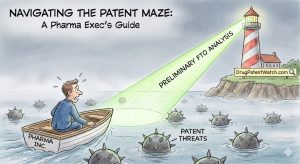
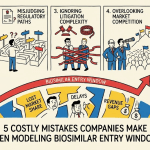
The complete strategic and technical guide to pharmaceutical Freedom-to-Operate analysis: patent thicket architecture, Paragraph IV litigation dynamics, biosimilar entry strategy, exclusivity cliffs, and what Humira, Lipitor, and Sovaldi teach us about IP risk at scale.
What Freedom-to-Operate Actually Means, and Why It Is Not Your Patent
Most IP-related disasters in drug development don’t come from missing a filing deadline. They come from confusing two entirely different legal questions: “Can we protect this?” and “Can we sell this?”
A patent is a negative right. The grant gives the patent holder power to exclude others from making, using, selling, offering for sale, or importing the claimed invention in a given territory. It does not confer any right to practice that invention. Whether you can bring a product to market depends entirely on the patents held by every other party in that space, not the ones you hold yourself.
Freedom-to-Operate analysis answers the commercialization question. It asks whether a specific, defined product or process, as you intend to manufacture and sell it, can reach patients and generate revenue without infringing a valid, in-force patent held by a third party. The answer depends on claim scope, territorial coverage, patent status, and the likelihood a court would find infringement under either literal or doctrine-of-equivalents analysis.
The failure to separate these questions has cost the industry billions. A company can build a brilliant, patentable improvement to a drug delivery system and obtain a valid patent on that improvement, yet remain completely blocked from selling it because a competitor holds an unexpired composition-of-matter patent on the active pharmaceutical ingredient itself. Both things can be true simultaneously, and the patentability search that confirmed the improvement’s novelty will never surface the blocking threat.
The Three IP Searches Every Drug Program Needs, and What Each One Misses
Confusing FTO searches with patentability searches or validity searches is one of the most common and costly errors in pharmaceutical IP strategy. Each search answers a distinct question against a distinct universe of prior art, and substituting one for another produces false confidence. The following matrix clarifies the differences teams frequently conflate.
Table 1. The Pharmaceutical IP Search Matrix
Search Type
Core Question
Universe of Documents
Key Analytical Focus
Common Mistake
FTO / Clearance
Can we commercialize this product without infringing an active patent?
In-force patents and published applications in target commercial jurisdictions
Claim scope vs. product features; patent legal status; territorial coverage
Relying on expired patents as evidence of clearance without checking PTEs or SPCs
Patentability / Novelty
Is this invention new and non-obvious enough to obtain a patent?
All prior art globally, regardless of age, legal status, or jurisdiction
Novelty (35 U.S.C. §102) and non-obviousness (§103) vs. the inventive concept
Treating a clean patentability search as evidence of commercial freedom
Validity / Invalidity
Is a specific blocking patent actually enforceable, or can it be killed?
Prior art predating the target patent’s priority date
Anticipation, obviousness, enablement (post-Amgen v. Sanofi), written description
Assuming a granted patent is valid; failing to check PTAB IPR petition history
An R&D program that runs only a patentability search before advancing a candidate into IND-enabling studies is leaving its most significant commercial risk unexamined. The organizational fix is structural: both searches must run in parallel from the moment of invention disclosure, treated as equally mandatory inputs to any go/no-go decision.
Revenue at Risk: The Numbers Behind the Decision
Average R&D cost per approved drug: $2.6 billion over 10-15 years. Average U.S. patent damages award in 2023: $8.7 million median, with highs exceeding $2 billion. Pharmaceutical companies accounted for 25% of all U.S. patent damages awarded that year. An injunction that halts a commercial launch converts every dollar of sunk development cost into a write-off. A thorough FTO analysis costs a fraction of one percent of those exposures.
How the Patent Thicket Is Built, and What It Costs to Fight Through One
The modern pharmaceutical patent thicket is not an accident of overlapping R&D programs. It is a deliberate construction, assembled layer by layer to extend market exclusivity and create litigation risk that outlasts any single claim.
A single blockbuster drug can accumulate more than 100 individual patents covering every commercially exploitable dimension of the asset: the molecule, its polymorphs, its salts and enantiomers, its formulations, its delivery devices, its manufacturing processes, its synthetic intermediates, its methods of use across each indication, its dosage regimens, and its combination therapies. Each layer adds years of potential coverage and, more importantly, adds cost and uncertainty to any competitor’s FTO analysis.
The goal is not to win every hypothetical infringement suit on the merits. The strategy is to make the aggregate cost, time, and uncertainty of litigating through the portfolio greater than the cost of settling. AbbVie’s Humira fortress demonstrates this with precision. The company amassed at least 136 U.S. patents on adalimumab. A peer-reviewed study found roughly 80% of those patents were duplicative or non-patentably distinct from each other, linked by terminal disclaimers. Yet the portfolio accomplished its commercial purpose: every biosimilar entrant settled and agreed to launch dates years before the last Humira patent expires, yielding AbbVie a U.S. biosimilar exclusivity window that lasted 11 years longer than in Europe.
The Taxonomy of Pharmaceutical Patent Claim Types That Sustain a Thicket
Understanding which claim types competitors use, and in what sequence, is essential to both FTO analysis and lifecycle management strategy. The following table maps the most common claim architectures to their commercial purpose and their relative vulnerability to challenge.
The new chemical entity or biologic sequence itself
Broadest protection; blocks any product using the molecule
20 yrs from filing; PTE up to 5 extra years
Prior art anticipation; obviousness (rare for true NCEs)
Formulation / Composition
Specific combination of API + excipients, delivery system, dosage form
Post-API lifecycle extension; blocks generics from replicating the commercial product
Often filed 5-10 yrs after API patent
Obviousness; lack of unexpected results
Method of Use / Treatment
Treating a specific disease, patient population, or clinical setting
Opens new indications under patent protection after API expiry
Tied to new clinical data generation timeline
Obviousness; written description; induced infringement limits
Dosage Regimen
Specific dose amount and schedule
Blocks competitor from marketing same drug with same efficacious regimen
Highly dependent on clinical trial timing
Obviousness over prior art dosing studies
Polymorph / Crystalline Form
Specific solid-state crystal structure of API
“Evergreening” tool; more stable or bioavailable form extends commercial coverage
Can be filed decades after original API
Obviousness; inherency; lack of unexpected properties
Manufacturing Process
Novel synthesis route, purification step, or production method
Creates cost/quality barrier; competitors must use an inferior or different process
Tied to process development timeline
Prior art; obviousness; written description
Broad Genus / Markush (Biologics)
A functionally defined class of compounds (e.g., any antibody binding site X)
Attempts to block entire therapeutic approach, not just specific molecule
Depends on prosecution timing
Enablement (Amgen v. Sanofi standard); written description
Why Patent Thickets Are Harder to Navigate for Biologics Than Small Molecules
Small-molecule generics enter the market under the Hatch-Waxman Act framework, where an ANDA filer must certify against each Orange Book-listed patent. That process, despite its complexity, has defined procedural rules: Paragraph IV challenges, the 30-month stay, litigation timelines, and first-filer exclusivity create a structured pathway through the thicket. The legal terrain is contested but mapped.
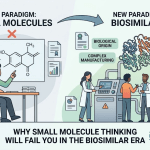
Biologics operate under a different statute. The Biologics Price Competition and Innovation Act (BPCIA) governs biosimilar entry through the 351(k) pathway and requires a patent dance process that can itself take years to complete before litigation even begins. The biologic’s structural complexity means the composition-of-matter claim landscape is harder to design around; you cannot simply swap one polymorph for another when the active substance is a 150-kilodalton monoclonal antibody. Manufacturing differences between the reference product and the proposed biosimilar create additional scientific disputes that compound the legal ones. The result is that patent thickets around biologics like Humira, Keytruda, and Dupixent generate more years of effective exclusivity extension than comparable thickets around small-molecule drugs.
The AbbVie Humira portfolio contained at least 136 U.S. patents, roughly 80% of which a peer-reviewed study characterized as duplicative or non-patentably distinct from each other. The commercial result: 11 additional years of U.S. biosimilar exclusivity compared to Europe. Source: AccessibleMeds / Oxford Journal of Law and the Biosciences
How to Run a Preliminary FTO Analysis: The Phased Playbook
A preliminary FTO is a strategic triage exercise, not a legal opinion. Its purpose is to filter a large patent universe down to the handful of claims that actually require outside counsel’s attention, saving the most expensive resource for the most critical threats.
Phase 1 – Defining the Product: What You Are Actually Clearing
The single most common preliminary FTO failure is inadequate scoping. Teams begin searching before they can precisely describe what they are searching for. Every feature of the commercial product that a competitor could claim must be identified before the first database query runs.
For a small-molecule NCE, this decomposition includes: the precise chemical structure and any relevant salts, polymorphs, enantiomers, or prodrugs; the full formulation with all excipients, their grades, and the delivery mechanism; every synthetic step in the manufacturing route including key intermediates and reagents; and every intended therapeutic indication, patient population, and dosage regimen. For a biologic, the scope expands further: amino acid sequences, host cell line and expression system, purification train, formulation with stabilizers and buffers, delivery device if applicable, and all clinical methods of use.
This information must be captured in a dated Technology Document before the search begins. Products evolve across the development timeline. An FTO conducted on a Phase I formulation may have zero relevance to the Phase III product. Without a formal document capturing what was and was not cleared at each stage, the analysis becomes legally and commercially meaningless.
Phase 1 – Defining Jurisdictional and Temporal Scope
Patent rights are territorial. A U.S. patent does not block a European launch, and vice versa. The FTO scope must match your commercial geography: at minimum, the United States (USPTO), the major European markets (via the EPO), Japan, and, increasingly, China for any product with a significant Asia-Pacific commercial opportunity.
Temporal scope requires extra care in pharmaceutical FTO. The standard rule, searching patents filed in the last 20 years, is insufficient because it ignores Patent Term Extensions and Supplementary Protection Certificates. A U.S. PTE can add up to five years beyond the standard 20-year term; an SPC in Europe can do the same. A blocking composition-of-matter patent filed in 2001 might still be enforceable in 2026 with a PTE. Any pharmaceutical FTO that does not search back at least 25 years from the present date, and that does not independently verify the extended expiry dates of all identified candidates, risks missing a live threat that appears expired on its face.
Phase 2 – Database Selection and Search Strategy
Free government databases, USPTO Patent Public Search, EPO Espacenet, and WIPO PATENTSCOPE, provide essential primary source access and are the right starting point for jurisdictional legal status verification. They are insufficient as the primary search tool for any serious pharmaceutical FTO. Commercial platforms offer more powerful search algorithms, cleaner legal status data, and the ability to run chemical structure or biosequence searches that keyword-based queries cannot replicate.
For small molecules, any FTO that relies solely on keyword searches for an NCE is professionally inadequate. Pharmaceutical patents routinely use Markush structures, generically claiming entire chemical classes rather than named compounds. A keyword search for your specific molecule will not find a Markush claim that covers it. Structure-based searches against databases that index chemical structures are mandatory. For biologics, BLAST-type biosequence searches must run against patent databases indexed for DNA, RNA, and amino acid sequences. A blocking patent on a functionally similar antibody can cover your candidate without mentioning your molecule’s name anywhere in the specification.
Layered on top of structure and sequence searches, citation network analysis accelerates coverage: once you identify a highly relevant patent, mining its backward citations (prior art cited during prosecution) and forward citations (later patents that cite it) can rapidly surface entire patent families that a keyword search might miss entirely.
Phase 3 – Claim Analysis and Risk Stratification
Patent power derives from claims, not from the specification. The numbered paragraphs at the end of the document define the legal boundary of the monopoly. Infringement analysis compares the features of the accused product against the elements of the claims, element by element. A patent’s abstract, title, and technical description are useful for understanding the technology but have no legal significance in an infringement determination.
Two claim construction details matter most at the preliminary FTO stage. First, the transitional phrase. A claim “comprising” elements A and B is open-ended: a product with A, B, and C still infringes. A claim “consisting of” A and B is closed: a product with A, B, and C does not infringe because C is not recited. This single word choice can determine whether a product clears a patent or not. Second, dependent vs. independent claims. Independent claims stand alone and typically have the broadest scope. Dependent claims narrow the independent claim by adding further limitations, providing a narrower option that may or may not be infringed even if the independent claim is. Always read both.
The output of Phase 3 is a risk-stratified list, not a legal conclusion. The three-tier framework below provides the working structure most internal teams can operate without outside counsel for initial triage.
High Risk
Claims appear to clearly read on a core product feature. Patent is in-force in a key commercial jurisdiction. Assignee is an active market participant with a litigation history.
Escalate to patent counsel immediately. Freeze any work that could increase exposure. Begin design-around feasibility scoping in parallel.
Medium Risk
Infringement is ambiguous, depending on claim term interpretation or pending claim amendments. Pending application with claims that could be prosecuted to cover the product.
Set automated monitoring for prosecution status. Brief R&D on design-around options. Targeted counsel consultation on specific ambiguous terms before full opinion.
Low Risk
Claims clearly lack an element present in your product, or require an element your product lacks. Patent expired, abandoned beyond revival period, or enforced only in irrelevant markets.
Document reasoning and archive. No immediate action. Patent may remain useful for landscape intelligence or as prior art in a future validity challenge.
One verification step that teams consistently skip: independently confirming legal status rather than relying on database status flags. Database legal status information can lag behind actual court or patent office decisions by weeks or months. An IPR petition granted at PTAB that invalidates key claims may not be reflected in a commercial database status field for weeks. The patent face may still show as “active.” Call the USPTO Patent Center or check PTAB’s online docket directly for any High Risk candidate before briefing leadership.
Paragraph IV Filings, Hatch-Waxman, and How Generics Navigate the Patent Thicket
For generic drug manufacturers, FTO has a defined statutory structure under Hatch-Waxman, anchored by the Paragraph IV certification, that transforms the patent challenge into an integrated regulatory and litigation strategy.
When a generic manufacturer files an ANDA with the FDA and certifies under Paragraph IV that one or more Orange Book-listed patents are invalid or will not be infringed by the generic product, the filing constitutes a technical act of infringement that automatically gives the brand-name manufacturer the right to sue. If suit is filed within 45 days, the FDA is barred from approving the ANDA for 30 months, effectively buying the innovator time to litigate. The first ANDA filer with a Paragraph IV certification that is ultimately successful earns 180 days of generic exclusivity, a period during which no other generic may enter, making first-filer status worth hundreds of millions of dollars for high-revenue drugs.
For brand manufacturers, the strategic implication is clear: each additional Orange Book-listed patent extends the potential 30-month stay and increases the cost and complexity of the generic challenge. This is precisely why innovators list formulation, polymorph, and method-of-use patents in the Orange Book alongside the core API patent, not because each patent is independently strong, but because each one must be certified against and potentially litigated, adding time and cost to the generic entry process.
Which Orange Book Patent Listings Face the Most Paragraph IV Challenges in 2025-2028
The drugs attracting the most Paragraph IV activity are generally those in the $1 billion+ annual revenue range with approaching exclusivity cliffs. Among the highest-value targets currently in litigation or anticipated for challenge: Keytruda (pembrolizumab) faces biosimilar development rather than traditional generic entry given its biologic status, but its method-of-use patent portfolio covers dozens of approved indications and will face extensive challenge as core patents begin expiring around 2028. Ozempic and Wegovy (semaglutide) are the subject of intense competitor activity as Novo Nordisk’s key GLP-1 patents are mapped for challenge, with Paragraph IV certifications expected from multiple generic and biosimilar developers targeting both the formulation and device patents that form the semaglutide thicket. Entresto (sacubitril/valsartan) saw the first generics settle into launch dates, illustrating how even a combination product’s complex patent landscape ultimately yields to sustained Paragraph IV strategy.
How the 30-Month Stay Creates Commercial Value
Each Paragraph IV-triggering patent in the Orange Book that a generic certifies against, and that the innovator sues on within 45 days, extends the litigation window. Multiple patents certifiable against a single ANDA filing can result in overlapping stays and sequential litigation, even when individual patents are weak. For Lipitor, Pfizer’s multi-patent Orange Book listing contributed to a generic entry timeline that Pfizer managed, with authorized generics, for substantially longer than the core composition-of-matter patent alone would have supported.
Three FTO Outcomes That Defined Pharma IP Strategy
The PCSK9 antibody war, the Lipitor patent cliff management playbook, and the Sovaldi damages verdict collectively illustrate three distinct FTO failure modes and one successful strategic response.
Case Study 01 — Biologics FTO & EnablementAmgen v. Sanofi (Praluent / Repatha)
$0Amgen recovered (claims invalidated)
9-0Supreme Court vote to invalidate
26Antibody examples in Amgen’s patent vs. millions claimed
UpheldJapan Supreme Court for Amgen (2024)
Amgen filed for patents on PCSK9 inhibitors using a broad functional genus strategy, claiming any antibody that bound to a specific PCSK9 epitope and blocked its activity, regardless of the antibody’s structure. The patent disclosed 26 specific antibodies but claimed what could amount to millions of variants sharing the same function. Sanofi’s Praluent (alirocumab) performed the same function, making it a literal infringer under Amgen’s claims, despite having a distinct amino acid sequence developed independently.
The Supreme Court’s 2023 unanimous ruling invalidated Amgen’s claims on enablement grounds under 35 U.S.C. §112. The Court held that to claim the full scope of a genus, the patent must enable a skilled practitioner to make and use every species within that genus without undue experimentation. Disclosing 26 examples and then claiming millions is a “research assignment,” not an enabled invention. The ruling did not categorically prohibit genus claims in biologics; it raised the evidentiary bar for how many representative species must be disclosed and characterized to support a broad functional claim.
The jurisdiction-specific lesson: Japan’s Supreme Court reached the opposite result on the same patents in 2024, finding that Amgen’s patents were valid under Japanese law and issuing an injunction against Praluent sales in Japan. Two courts, same patents, opposite outcomes. The FTO implication is that a biologic cleared for commercial freedom in the U.S. post-Amgen v. Sanofi may face a live injunction risk in Japan, Europe, or other jurisdictions operating under different enablement standards. Separate, jurisdiction-specific FTO analyses are not optional for any multi-market biologic launch.
Case Study 02 — Lifecycle Management & LOE StrategyPfizer Lipitor (atorvastatin) — The Patent Cliff Playbook
$125BLipitor lifetime revenue, 14 years
Nov 2011Core U.S. patent expiry date
~80%Market share erosion within 12 months of LOE
AuthorizedGeneric deployed immediately post-LOE
Pfizer’s response to Lipitor’s 2011 loss of exclusivity illustrates FTO used as an offensive commercial planning tool rather than a defensive legal exercise. Years before expiry, Pfizer was already running continuous FTO monitoring on the competitive generic landscape to understand exactly which formulation, polymorph, and process patents could be enforced to delay entry, which could not, and what the realistic generic entry timeline looked like.
On the commercial side, Pfizer built brand loyalty through sustained direct-to-consumer advertising, negotiated favorable formulary placements with pharmacy benefit managers, and began price adjustments before generics arrived. Critically, Pfizer launched an authorized generic immediately at LOE through Greenstone, its generic subsidiary, capturing a portion of the generic market rather than ceding it entirely to third-party ANDA filers. This strategy blunted the revenue impact of loss of exclusivity by ensuring that some share of units sold post-LOE still carried a Pfizer economic interest.
The monitoring discipline Pfizer applied to Lipitor, tracking every ANDA certification, every Paragraph IV suit, every settlement agreement, and every manufacturing approval on the generic side, is the same continuous FTO intelligence function that sophisticated pharma IP teams apply to their entire late-lifecycle portfolio today. Loss of exclusivity is a known event with a known date. The question is whether you have run the FTO intelligence process continuously enough to have a full commercial and legal response ready at that date.
Case Study 03 — M&A Due Diligence FTO FailureGilead Sovaldi (sofosbuvir) — The $2.54 Billion Due Diligence Gap
$2.54BJury damages verdict (2016)
$11BGilead acquisition of Pharmasset (2011)
$3.5BMerck paid for Idenix (2014)
2016Federal jury verdict against Gilead
The Sovaldi case is the canonical illustration of M&A FTO failure. Gilead acquired Pharmasset in 2011 for $11 billion, largely on the strength of sofosbuvir, the nucleoside analog at the center of a hepatitis C treatment breakthrough. Merck separately acquired Idenix Pharmaceuticals in 2014 for $3.5 billion and, in the process, obtained patents on a class of nucleoside analogs for treating viral infections. Merck successfully argued that Pharmasset’s scientists had worked from foundational patented technology traceable to Idenix’s IP lineage when developing sofosbuvir. A federal jury agreed and awarded $2.54 billion in damages.
The structural FTO lesson is specific: a due diligence FTO that reviews only the target company’s own patent portfolio is insufficient. The analysis must trace the intellectual lineage of the target’s core assets. Who were the founding scientists, where did they train, what prior work did they build on, and who funded the original research? Government grants under Bayh-Dole create march-in rights. Material Transfer Agreements carry reach-through provisions. Prior employer IP agreements can follow scientists to spinout companies. A $2.54 billion verdict reflects what happens when none of those threads are pulled during the due diligence process.
For every in-licensing or acquisition target, FTO due diligence must include: a review of all grant funding agreements and whether NIH or other government funders retained rights; an inventory of all MTAs covering research tools, cell lines, or reagents used in developing the asset; employment agreement reviews for key inventors covering pre-employment IP obligations; and an interview process with founding scientists to reconstruct the invention history, confirming inventorship completeness and identifying any prior art known to the inventors that was not cited during prosecution.
When FTO Finds a Blocking Patent: Four Commercial Response Strategies
A blocking patent identified in an FTO analysis is a business problem, not a legal endpoint. The response depends on the program’s stage, the patent’s likely validity, the company’s risk tolerance, and the competitive alternatives available in the IP white space.
Option 01
Design Around
Modify the product, formulation, or process to fall outside the claim’s literal scope. Most effective when identified early in development, before manufacturing scale-up locks in parameters. A successful design-around may generate independent patentable IP.
Negotiate a license (upfront fee, milestones, royalties) or outright acquisition. Most leverage comes before heavy clinical investment. License terms may include field-of-use restrictions, geographic limits, or change-of-control provisions that affect M&A strategy later.
Cost: High (ongoing royalties) • Timeline: Fast • Risk: Low, but margin-dilutive
Option 03
Challenge Validity (PTAB / IPR)
File an Inter Partes Review at PTAB or a declaratory judgment suit in district court to invalidate the blocking patent. IPR institution rate for pharma patents has historically run high, but the Amgen v. Sanofi standard has narrowed some biologic genus claims that previously seemed unassailable.
Cost: Very high (legal fees) • Timeline: 18-36 months • Risk: Very high (uncertain outcome)
Option 04
At-Risk Launch or Strategic Delay
At-risk launch proceeds despite the known blocking patent, betting on invalidity or non-infringement if sued. Strategic delay waits for the patent to expire. At-risk launch can trigger treble damages for willful infringement absent a formal FTO opinion from qualified counsel. Strategic delay is only viable when remaining patent term is short.
Cost: Low direct cost, high contingent liability • Risk: Existential (at-risk) or opportunity cost (delay)
The willful infringement exposure created by an at-risk launch without a formal FTO opinion deserves particular attention for investor-facing communications. U.S. patent law permits courts to award enhanced damages, up to three times actual damages, when the infringer acted willfully. A well-reasoned formal opinion from qualified patent counsel, obtained before launch and concluding that the claims are either not infringed or invalid with specificity, is the primary defense against a willfulness finding. The absence of such an opinion in discovery is itself evidence that the company chose to ignore a known risk. For any program where an at-risk launch is under consideration, the cost of a formal opinion is trivially small against the potential treble damages exposure on a commercial-stage biologic.
How Amgen v. Sanofi Changed Biologic FTO Analysis in 2023
The Supreme Court’s 2023 unanimous ruling in Amgen v. Sanofi did not eliminate functional genus claims in biologics. It raised the evidentiary threshold for how broadly those claims can be written relative to what the patent discloses.
Before the decision, innovator companies filing broad antibody patents could, in some cases, claim an entire functional class of antibodies, defined by what they bind to and what biological effect they produce, while disclosing only a handful of examples in the specification. This claiming strategy created blocking positions that extended well beyond the specific molecules the innovator had actually synthesized and characterized.
The Amgen v. Sanofi ruling places the following analytical obligations on an FTO team reviewing a broad biologic genus patent. First, how many representative species does the patent actually disclose? If the answer is a small fraction of the claimed genus, the patent faces a materially increased validity risk under the enablement doctrine. Second, does the patent provide a reliable method by which a skilled practitioner can identify additional genus members without extensive trial and error? If the method is essentially “screen antibodies until you find one that works,” the patent approaches the “research assignment” standard the Court identified as fatal to enablement. Third, has the patent been challenged in an IPR or district court proceeding post-2023 with an enablement argument? PTAB and district court decisions since May 2023 are beginning to define the practical limits of the ruling.
For biosimilar developers and competing innovators, the decision converted a class of patents previously treated as high-risk blocking threats into medium-risk candidates worth challenging rather than designing around. For innovator companies building new biologic patent portfolios, it necessitates a shift toward more species disclosure and better structural characterization of claimed antibodies, accepting narrower claim scope in exchange for improved validity defensibility.
What Investors Are Watching: FTO Risk in Pharma Equity Valuation
Patent risk is not a footnote to pharmaceutical equity valuation. For late-stage biotechs and commercial-stage specialty pharma companies, it is frequently the largest single variable in a probability-adjusted DCF model.
Institutional investors and hedge funds conducting diligence on a clinical-stage asset will, at minimum, assess: whether the company has conducted a formal FTO analysis for each key commercial jurisdiction; whether any high-risk blocking patents have been identified and, if so, what the company’s mitigation strategy is; whether the company’s own core patents are at risk of inter partes review or Paragraph IV challenge given the asset’s commercial size; and whether any pending litigation could result in an injunction that halts commercialization.
For M&A transactions, the FTO gap that destroyed value in the Sovaldi case is now a standard diligence item. Acquirers require the target to produce all FTO opinions, all prior art searches, all inventor disclosures, and all grant and MTA agreements as part of the virtual data room. The absence of any FTO documentation for a mid- or late-stage asset is itself a valuation discount, signaling either negligence or a known risk the company chose not to document.
Revenue at Risk: How Patent Expiry Timelines Appear in Equity Research Models
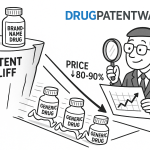
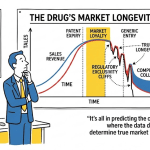
Sell-side equity models for pharma companies typically incorporate a loss-of-exclusivity event as a discrete revenue step-down: in the first year of generic entry for a typical oral small molecule, branded market share can fall 80-90%, translating directly to revenue reduction at the gross margin level. The timing and steepness of that cliff depend on how many generics enter, how quickly, and whether the innovator deploys an authorized generic or a new formulation to compete.
For biologics, the erosion curve is slower. Biosimilar interchangeability designations at the FDA, pharmacy-level substitution laws varying by state, and the complexity of payor contracting mean that reference biologics typically retain 40-60% of volume even two years after biosimilar entry in the U.S., compared to the near-total erosion small-molecule brands face. Humira’s post-biosimilar market trajectory has confirmed this: AbbVie retained meaningful branded Humira volume into 2024, supplemented by its own transition of patients to Skyrizi and Rinvoq.
Key Patent Expiry Dates: High-Revenue Drugs Through 2030
Keytruda (pembrolizumab, Merck): Core U.S. composition-of-matter patents expire around 2028; multiple method-of-use patents covering specific indications extend coverage into the 2030s. Biosimilar development is active, with multiple 351(k) applications filed or anticipated. Dupixent (dupilumab, Sanofi/Regeneron): Core patents provide coverage into the late 2030s; biosimilar entry likely post-2030 in most markets. Ozempic/Wegovy (semaglutide, Novo Nordisk): Core GLP-1 peptide patents have begun expiring; device and formulation patents extend commercial protection. Multiple generic and biosimilar developers are actively challenging the semaglutide patent estate. Eliquis (apixaban, BMS/Pfizer): U.S. LOE expected around 2026-2028 depending on litigation outcomes; already facing generic entry settlements. Jardiance (empagliflozin, Boehringer Ingelheim/Lilly): SGLT-2 class patents are under active challenge from multiple generic filers.
How the Willful Infringement Shield Affects Deal Structuring
In leveraged buyouts and minority growth investments in commercial-stage specialty pharma, the presence or absence of a formal FTO opinion affects both deal structuring and rep-and-warranty insurance coverage. Insurers writing R&W policies for pharma M&A now routinely exclude patent infringement claims that arise from known blocking patents identified during diligence but not formally addressed in a written opinion. The premium for insuring an unaddressed FTO gap, if coverage is available at all, is substantially higher than the cost of obtaining the opinion before signing.
Why Manufacturing Complexity Is an FTO Problem, Not Just an Operations Problem
Manufacturing process patents are the least examined category in most preliminary FTO analyses. They are also the category most likely to create surprise blocking positions for generic manufacturers and biosimilar developers who believe they have cleared the product’s chemical or biological composition.
For small molecules, process patents protect novel synthetic routes, specific reagent combinations, purification steps, and intermediates. A generic manufacturer may successfully design around a formulation patent only to find that every commercially efficient synthesis route to the API is covered by a competitor’s process patent, leaving only an economically non-viable alternative route. This problem is particularly acute for complex small molecules where the API itself has come off patent but the cost-efficient synthesis has not.
For biologics, the manufacturing complexity problem is more fundamental. The expression system, host cell line, fermentation conditions, purification train, and fill-finish process all contribute to the final molecule’s glycosylation pattern, aggregation profile, and immunogenicity characteristics. A biosimilar developer must produce a molecule that is highly similar, but not necessarily identical, to the reference product across all these dimensions. Patents covering cell lines, expression vectors, specific purification chromatography steps, or formulation buffer systems create potential blocking positions that exist entirely in the manufacturing domain rather than the molecular or clinical domain.
The CDMO landscape adds a further layer: a biosimilar developer that licenses a CDMO’s proprietary cell line or expression system to produce its molecule may, depending on the MTA terms, find that the CDMO’s IP creates a reach-through claim on the resulting product. Any FTO conducted without reviewing the specific contractual terms governing the manufacturing relationship is missing a potentially material blocking threat.
FTO Red Flags in University Licensing and Academic Spinouts
Academic spinouts offer some of the most compelling early-stage assets in pharma and biotech. They also carry a specific class of IP risk that does not appear in standard corporate FTO analyses.
University technology transfer offices file patents on limited budgets. The result is frequently a strong U.S. patent with inadequate international coverage, leaving major markets, particularly Europe and Japan, with no patent protection and, potentially, no FTO barrier against competitors. A company licensing an academic asset and assuming that a granted U.S. patent constitutes comprehensive global IP protection will discover the geographic gap when a competitor launches in Germany without infringing anything.
Inventorship is a separate problem. Academic research is inherently collaborative. A PhD student from a collaborating lab who made a conceptual contribution to the claimed invention, even informally during a seminar, may have inventorship rights. If that person is not listed on the patent, the patent is potentially invalid for incorrect inventorship. The only way to identify this risk is to interview all scientists involved in the program, trace the collaboration history, and compare it against the inventor list on the filed applications. Technology transfer offices, under pressure to file quickly and cheaply, do not always conduct this diligence with sufficient rigor.
Bayh-Dole Act rights create a third category of risk. Any invention made with federal funding must be disclosed to the funding agency, and the government retains a non-exclusive license to practice the invention and march-in rights if the company fails to commercialize it adequately. For a company licensing a federally funded academic asset, the government’s retained rights do not block commercialization in most cases, but they do affect the exclusivity analysis and must be disclosed in any subsequent out-licensing or acquisition transaction.
Communicating FTO Risk to the C-Suite and Board: Three Translation Frameworks
A preliminary FTO report written for a patent attorney is not a useful document for a CEO, CFO, or board audit committee. The translation is a distinct skill, and its failure means good analysis goes unheeded and bad decisions get made.
The most effective framing for a board audience treats FTO risk as an enterprise risk item, parallel to financial risk, regulatory risk, and clinical risk. Boards already make decisions about acceptable risk tolerance in each of those categories. Presenting IP risk in the same vocabulary, with quantified exposure ranges, probability estimates, and mitigation options with cost ranges, gives board members the information they need without requiring them to understand claim construction.
For the C-suite, the ROI framing is most persuasive. A comprehensive FTO analysis for a clinical-stage biologic asset might cost $100,000-500,000, covering multiple jurisdictions and claim families. The potential loss it mitigates includes average U.S. patent litigation costs of $3-10 million to even initiate a defense, median damages awards above $8 million, worst-case awards exceeding $2 billion, and the full sunk R&D cost of the program, averaging $2.6 billion per approved drug. The insurance premium analogy is accurate: the cost of the FTO analysis is a small fraction of one percent of the asset it protects.
For investor communications and SEC disclosures, the standard is transparency over minimization. Companies that proactively disclose patent risks in a structured, quantified way, with specific blocking patent identities, expiry timelines, and mitigation strategies, build more durable investor confidence than companies that bury one-paragraph boilerplate about “potential IP challenges” in their risk factors section. When a blocking patent becomes litigation, a company that already disclosed it specifically is in a far stronger position with investors than one that appears to have been caught by surprise.
— • —
Common Investor and Executive Questions on FTO Analysis
If we hold a composition-of-matter patent on the API, the strongest type of protection, why does FTO analysis still matter?
A composition-of-matter patent protects the molecule. It says nothing about whether you can make or sell a finished drug product using that molecule. Your freedom to commercialize depends on whether your full product formulation, manufacturing process, delivery device, and each therapeutic indication infringes any third-party patent. A competitor may hold a broad Markush genus patent that predates your API filing and covers your molecule as a species within that genus. Formulation excipients, extended-release matrices, or auto-injector devices you use may be independently patented. The method of treating a specific indication you are pursuing may already be claimed by a competitor’s method-of-use patent. Each of these represents a potential blocking threat that your API patent does not address.
We are pre-clinical and the final formulation will change significantly. Is it premature to conduct an FTO now?
Pre-clinical is the most valuable stage at which to conduct at least a landscape FTO. At this stage, the product is still scientifically flexible. If a major blocking patent is identified early, the R&D team can design around it while the molecule, formulation, and process are still open questions. The same design-around that takes three months and moderate R&D cost at the IND stage takes two years and tens of millions of dollars to execute at Phase III, when the product is locked into manufacturing and regulatory timelines. The goal of a pre-clinical FTO is not a final commercial clearance opinion. It is a landscape map that identifies the most significant IP threats so that development decisions from day one are informed by the competitive patent terrain.
Our preliminary FTO identified a medium-risk pending patent application. What do we do before spending on outside counsel?
Three cost-effective steps before engaging external counsel: First, set up automated monitoring of the application’s prosecution through the USPTO Patent Center or a commercial docketing service. Any claim amendments during prosecution could convert a medium risk to high, or resolve the concern entirely. Second, brief your technical team on the specific claim language at issue and ask them whether any design-around modifications are feasible without significant commercial impact. Their assessment changes the cost-benefit calculation for a full counsel engagement. Third, run a targeted prior art search focused on the specific claim elements in question. Finding a strong piece of prior art that the examiner missed positions you for a potential IPR petition at a fraction of the cost of district court litigation and gives you negotiating leverage if you decide to approach the applicant about a license.
How does Amgen v. Sanofi change the FTO risk assessment for broad biologic genus patents we currently treat as high-risk blockers?
The decision creates a new analytical step in biologic FTO: before treating a broad functional genus patent as a high-risk blocker, assess its enablement vulnerability under the post-2023 standard. Specifically: how many species examples does the patent disclose relative to the scope of the claimed genus? Does the specification provide a reliable structural or functional method for identifying additional genus members without extensive experimentation? Has the patent been challenged in a post-Amgen PTAB IPR with an enablement argument? If the answers suggest the patent claims a far broader genus than it discloses and enables, the appropriate category may be medium risk, warranting a targeted invalidity analysis, rather than high risk, warranting immediate licensing negotiations. The decision has commercial value for biosimilar developers and competing innovators: patents that previously seemed to foreclose entire biologic target classes are now more challengeable at PTAB without the cost and uncertainty of district court litigation.
We are in due diligence for an in-licensing deal with a university spinout. What are the FTO risks most commonly missed?
Three categories consistently escape standard diligence. First, incomplete inventorship: academic research involves multiple contributors across labs and sometimes institutions. Interview the founding scientists directly to reconstruct the invention history and confirm that every person who made a conceptual contribution to the claims is listed as an inventor. An incorrect inventorship can void the patent. Second, geographic coverage gaps: universities file on limited budgets and frequently have strong U.S. patents with no corresponding coverage in Europe, Japan, or China. Verify the actual international filing strategy rather than assuming PCT entry implies comprehensive global coverage. Third, grant funding reach-through rights under Bayh-Dole and MTA reach-through provisions from research tools, cell lines, or reagents used in development. Review all funding agreements and MTAs for any provisions that grant the funding agency, prior employer, or third-party tool provider rights to the resulting IP or to future commercialization proceeds.
How should biosimilar entry timing affect our financial model for a reference biologic we hold?
Biosimilar launch timing models for reference biologics require a layered analysis: identify all unexpired patents covering the reference product in each key market, including composition-of-matter, formulation, device, and method-of-use patents with their PTEs and SPCs; assess which patents are likely to be challenged by Paragraph IV certification (U.S.) or patent revocation proceedings (Europe); estimate the probability and timeline for successful challenges based on patent strength and the litigation history of the assignee; and then model three scenarios: base case with negotiated settlement entry dates, bull case with delayed biosimilar entry due to successful litigation or sustained patent density, and bear case with earlier entry via successful validity challenges. The Humira precedent is instructive but not universal. AbbVie’s portfolio density and willingness to litigate aggressively is the exception; most biologic patent estates are less fortified, and biosimilar entry timelines in the U.S. have been accelerating as the biosimilar industry builds both legal capacity and PTAB precedent.
— • —
Key Takeaways
A patent grants the right to exclude others. It does not grant the right to sell. FTO analysis answers the commercial question a patentability search cannot.
FTO must begin at the pre-clinical stage when product flexibility is highest. Design-around options that cost three months at IND can cost two years at Phase III. The earlier the search, the cheaper the mitigation.
Pharmaceutical FTO requires chemical structure and biosequence searches, not just keyword queries. A Markush genus claim covering your molecule will never appear in a keyword search for your compound name.
Patent Term Extensions and Supplementary Protection Certificates can add up to five years beyond the standard 20-year patent term. Any FTO that does not search back at least 25 years and independently verify extended expiry dates risks missing an in-force blocking patent.
The Amgen v. Sanofi decision (2023) recalibrated enablement requirements for broad biologic genus claims. Patents previously treated as high-risk blockers may now be more challengeable at PTAB. The same analysis applies inversely: innovators must build more species disclosure into new biologic genus claims to sustain the same scope.
The Sovaldi verdict illustrates that M&A FTO due diligence must trace the full IP lineage of the acquired asset, including funding agreements, MTAs, collaboration histories, and inventor employment backgrounds, not just the target’s patent portfolio.
A formal FTO opinion from qualified patent counsel is the primary defense against willful infringement allegations and the enhanced damages, up to treble damages, that willfulness enables. Any at-risk commercial launch without such an opinion is carrying an unquantified and potentially existential liability.
FTO analysis is not a one-time event. Patent thickets evolve as new patents are filed, old ones expire or are challenged, and product features change across development. Continuous monitoring with automated alerts for prosecution amendments, PTAB filings, and litigation events is the minimum acceptable standard for any commercial-stage asset.
Investment Strategy: How FTO Intelligence Should Affect Portfolio Positioning
For institutional investors evaluating pharma and biotech positions, the FTO intelligence framework translates into several specific portfolio-level assessments.
Companies with proactively documented FTO programs, evidenced by disclosed blocking patent identities, mitigation strategies, and formal opinions in SEC filings, carry lower execution risk than those with generic boilerplate IP risk language. The former demonstrates that management has quantified the risk and is managing it. The latter suggests they either have not looked or chose not to disclose what they found.
The Paragraph IV litigation calendar is a public document. ANDA filings, Paragraph IV certifications, and 30-month stay expirations are all tracked by FDA and available through databases like DrugPatentWatch. For any pharma holding with more than 30% of revenues concentrated in a single product approaching LOE, the litigation calendar tells you the realistic probability-weighted entry date for generics, which feeds directly into the revenue step-down timing in your model. The question is not whether generics will enter, but when, at what price, and with how many competitors, all of which depend on which Paragraph IV certifications survive litigation.
For biotech positions concentrated in late-stage biologic assets, the post-Amgen v. Sanofi patent landscape creates a specific due diligence opportunity: review the key blocking patents in the competitive space to assess their enablement vulnerability under the 2023 standard. A broad genus patent that competitors previously treated as a near-unassailable blocker may now represent a viable IPR target, creating a path to commercial freedom that did not exist pre-2023. That change in risk profile is not always fully reflected in publicly traded biosimilar developer valuations.
Key Entities Covered
Humira (adalimumab)AbbVie; 136 U.S. patents; 11-yr U.S. biosimilar delay vs. EU
This content is provided for pharmaceutical IP, investment strategy, and commercial intelligence purposes. It does not constitute legal advice. Consult qualified patent counsel for jurisdiction-specific FTO opinions and formal infringement analysis.