We stand at the precipice of a revolution in pharmaceutical research, a paradigm shift driven not by a new molecule or a novel biological pathway, but by a new form of intelligence. Artificial intelligence (AI) is rapidly moving from a conceptual novelty to an indispensable engine of innovation, reshaping every stage of the drug development lifecycle.1 For decades, the process of bringing a new medicine to market has been a high-stakes gamble, a war of attrition fought in the lab. It’s a journey characterized by staggering costs, protracted timelines, and a heartbreakingly low probability of success. But what if we could fundamentally change the odds? What if we could move from a process reliant on serendipity, brute-force screening, and educated guesswork to one that is data-driven, predictive, and intelligent? This is the promise of AI, and it is a promise that is rapidly becoming a reality.
This report is designed for the leaders on the front lines of this transformation: the IP, R&D, and business development teams in the pharmaceutical and biotech sectors, along with the law firms, consultants, and investors who guide them. We will cut through the hype to deliver a hard-data, real-world analysis of the most critical challenge and opportunity arising from this new era: how to protect the intellectual property of drug compounds discovered by AI. We will dissect the complex interplay between cutting-edge technology and established patent law, providing a strategic playbook for turning AI-driven innovation into a defensible, monetizable competitive advantage.
From Serendipity to Silicon: A Paradigm Shift in Pharmaceutical R&D
To fully grasp the revolutionary nature of AI, we must first appreciate the intricate, time-honored, and profoundly challenging process it seeks to transform.2 The traditional drug discovery pipeline is a linear, sequential gauntlet. It begins with target identification, moves through hit discovery and lead optimization, and then proceeds into years of preclinical testing before the first human trial even begins.3 The attrition rate is brutal. For every 20,000 to 30,000 compounds that show a glimmer of promise in the earliest stages, only one will ultimately navigate the full course of clinical trials to receive regulatory approval.2 This results in a success rate of approximately 10% for drugs that enter clinical trials, a figure that has remained stubbornly low for decades.3 The entire journey can take over 12 years and cost upwards of $2.8 billion.4 This model of innovation has become, for many, fundamentally unsustainable.2
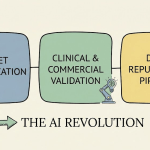
Into this challenging landscape steps AI, representing not just an incremental tool, but a fundamental rewiring of the entire R&D engine.2 AI and its powerful subset, machine learning (ML), can sift through biological and chemical data at a scale and complexity that is simply beyond human cognition.2 This capability enables a fundamental inversion of the traditional workflow. Instead of a “make-then-test” approach, where physical compounds are synthesized and then screened in a labor-intensive, trial-and-error process, AI facilitates a “predict-then-make” paradigm.2
In this new model, hypotheses are generated, molecules are designed, and properties are validated at a massive scale in silico. Precious and expensive laboratory resources are reserved only for confirming the most promising, AI-vetted candidates.2 This isn’t just about doing the same things faster; it’s about doing things that were previously impossible. Generative AI models, for instance, are not limited to screening existing chemical libraries. They can explore the vast, uncharted territory of chemical space—estimated to contain over
1060 possible drug-like molecules—to design entirely novel compounds from scratch (de novo drug design).6
The impact is felt across the entire discovery and development pipeline:
Target Identification: AI algorithms can mine massive multi-omics datasets (genomics, proteomics, transcriptomics) to identify novel genes and proteins that are causally linked to a disease, uncovering targets that might be missed by human researchers.1
De Novo Design and Lead Discovery: Generative models like Variational Autoencoders (VAEs) and Generative Adversarial Networks (GANs) can design novel molecules tailored to bind to a specific target while simultaneously optimizing for desired properties like potency and synthesizability.4
Property Prediction: AI excels at predicting a compound’s ADMET (Absorption, Distribution, Metabolism, Excretion, and Toxicity) profile, helping to identify and eliminate candidates likely to fail for safety or pharmacokinetic reasons long before they enter costly preclinical studies.3 Transformer-based models like ChemBERTa have demonstrated a 2-4% improvement in ROC-AUC over traditional methods for toxicity prediction.3
Clinical Development: AI is even being used to optimize clinical trial design, improve patient recruitment by analyzing electronic health records, and tailor dosing regimens for individual patients.4
The results are already tangible. Companies like Insilico Medicine have demonstrated the ability to move from target identification to a preclinical candidate for idiopathic pulmonary fibrosis in just 18 months—a process that would traditionally take five to six years.14 This dramatic compression of the preclinical timeline is a game-changer, promising to not only accelerate the delivery of new medicines to patients but also to fundamentally alter the economic calculus of pharmaceutical R&D.
The Core Challenge: When the Inventor is an Algorithm, Who Gets the Patent?
Yet, this technological gold rush is fraught with peril. The very power that makes AI so transformative—its ability to learn, reason, and create with increasing autonomy—also exposes a fundamental conflict with the legal frameworks that govern pharmaceutical innovation.1 The entire business model of the research-based pharmaceutical industry is built upon the foundation of robust patent protection. A patent grants a limited monopoly, typically 20 years from the filing date, allowing a company to recoup its massive R&D investments before generic competition enters the market. Without this protection, the incentive to innovate would evaporate.
The most acute IP risk revolves around a deceptively simple question: Who is the inventor? Patent law, globally, is predicated on the concept of a human inventor—an “individual” or “natural person” who conceives of an invention.1 This human-centric principle is deeply embedded in the statutory language of patent acts around the world. But what happens when an AI system moves beyond being a mere tool, like a calculator or a microscope, and becomes a generative partner, capable of identifying a novel target and designing a new molecular entity to address it?
This is not a hypothetical future scenario; it is the central legal challenge of our time. The issue was brought to a head in the landmark legal saga of Dr. Stephen Thaler and his AI system, DABUS (“Device for the Autonomous Bootstrapping of Unified Sentience”). Dr. Thaler filed patent applications in numerous countries listing DABUS as the sole inventor of two creations: a novel food container and a flashing light device.17 The response from the world’s major patent offices was nearly unanimous and unequivocal.
In the United States, the U.S. Patent and Trademark Office (USPTO) rejected the application, a decision that was ultimately upheld by the Federal Circuit in the 2022 case Thaler v. Vidal. The court’s reasoning was straightforward: the Patent Act defines an “inventor” as an “individual,” a term that the Supreme Court has consistently interpreted to mean a human being.18 Similar rulings were issued by the European Patent Office (EPO) and the U.K. Intellectual Property Office.17 The legal precedent is now firmly established in these key jurisdictions: an AI cannot be named an inventor on a patent.15
The commercial implications of this are profound. If an AI system generates a novel, life-saving drug compound, but no human can be said to have “significantly contributed” to its conception, that compound may be deemed unpatentable. It could be left in the public domain, a scientific curiosity with no commercial protection and therefore no viable path to market. This would not only destroy the value of that specific asset but also undermine the very incentive for companies to invest billions of dollars in developing the powerful AI platforms that make such discoveries possible.1 The central task for every innovator in this space, therefore, is to navigate this legal gauntlet—to structure their research, document their processes, and craft their patent strategies in a way that ensures human ingenuity remains at the heart of the inventive act, at least in the eyes of the law.
The Inventorship Gauntlet: Navigating the “Significant Human Contribution” Standard
The Thaler v. Vidal decision closed the door on AI as a named inventor, but it left a much more important one open: are inventions made with the assistance of AI patentable? The answer, fortunately, is yes—but with critical caveats. In the wake of Thaler, the USPTO recognized the urgent need for clarity and, in February 2024, issued its “Inventorship Guidance for AI-assisted Inventions”.22 This guidance does not create new law but rather interprets existing statutes, providing a framework for how examiners will assess inventorship when AI is part of the discovery process. For any company developing AI-discovered drugs, this document is now the essential rulebook.
Deconstructing the USPTO’s 2024 Guidance
The central tenet of the USPTO’s guidance is that AI-assisted inventions are not categorically unpatentable. The use of an AI system, no matter how sophisticated, does not preclude a human from being a valid inventor.24 The focus of the inquiry, however, shifts entirely to the human contribution. To qualify as an inventor, a natural person must have made a “significant contribution” to the conception of the claimed invention.15
To define what constitutes a “significant contribution,” the USPTO turned to established case law, specifically the factors laid out in Pannu v. Iolab Corp. These factors, now applied to the AI context, state that a person must 22:
Contribute in some significant manner to the conception of the invention.
Make a contribution that is not insignificant in quality when measured against the full scope of the invention.
Do more than merely explain well-known concepts or the state of the art to the actual inventors.
The guidance is equally clear about what does not rise to the level of a significant contribution. A human cannot claim inventorship merely by 24:
Presenting a problem to an AI system: Simply identifying a disease target and asking an AI to find a drug for it is insufficient.
Recognizing and appreciating the output of an AI system: If an AI generates a list of 10,000 molecules and a scientist simply recognizes that one of them looks promising, that act of recognition alone is not inventive conception.
Merely owning or overseeing an AI system: The fact that a company owns the supercomputer and the software does not make its executives inventors of the discoveries made by that system.
Reducing the invention to practice: The act of synthesizing a molecule designed by an AI, without contributing to its conceptual design, is generally not enough to confer inventorship.26
This framework places a heavy burden of proof on applicants. It is no longer enough to simply present a novel and useful compound; you must now be prepared to present a detailed narrative of its human-led conception.
Establishing Inventorship: A Practical Framework for R&D Teams
Translating this legal guidance into practice requires a conscious and deliberate structuring of R&D workflows. Companies must create and document human touchpoints at every critical stage of the AI-driven discovery process. This is not about creating make-work; it’s about formalizing the indispensable role that human expertise plays in guiding, interpreting, and refining the powerful outputs of AI.
The Role of Data Curation and Model Training
The inventive contribution can begin long before a single molecule is generated. The USPTO guidance explicitly states that designing, building, or training an AI system “in view of a specific problem to elicit a particular solution” can be a significant contribution.24
This is particularly relevant in drug discovery. An off-the-shelf generative model trained on public data may be a powerful tool, but its use might not confer inventorship. However, if a team of computational biologists and chemists curates a unique, proprietary dataset—perhaps from years of internal high-throughput screening campaigns—and uses that data to train or fine-tune a model specifically to identify inhibitors for a novel kinase family, that act of creating the specialized tool is itself a significant human contribution to the inventions that tool later produces.27 This is the strategy implicitly used by companies like Recursion Pharmaceuticals, whose massive proprietary biological datasets are a core asset that not only steers their AI toward novel discoveries but also solidifies the human contribution to those discoveries.15
The Art of the Prompt: From General Goal to Specific Solution
In the age of generative AI, the prompt is the new interface for creation. The USPTO guidance recognizes that the way a person constructs a prompt can be an inventive act.24 A generic prompt like “design a molecule to inhibit protein X” is likely insufficient. However, a sophisticated prompt crafted by a medicinal chemist that incorporates multiple, complex constraints could be a different story.
Imagine a prompt that asks the AI to generate molecules that not only bind to the active site of protein X with high affinity but also exhibit a specific selectivity profile against related proteins Y and Z, maintain a molecular weight under 500 Daltons, possess a calculated logP within a narrow range for optimal oral bioavailability, and avoid known toxicophores. Crafting such a prompt requires deep domain expertise and a clear conception of the desired final product’s properties. This act of “prompt engineering” is not a simple query; it is the articulation of a specific solution to a multifaceted problem, and it can represent a significant contribution to the conception of the resulting molecule.27
The Indispensable Human in the Loop: Interpretation, Selection, and Modification
This is arguably the most critical and defensible area of human contribution. AI platforms can generate thousands or even millions of potential drug candidates. The raw output of the AI is not the invention; it is a field of possibilities. The inventive act often lies in the human scientist’s role in navigating this field.17
This involves several key steps:
Interpretation and Triage: A human expert must analyze the AI’s suggestions, using their scientific judgment and experience to discard unpromising scaffolds and prioritize a manageable number of candidates for further investigation.
Selection: The decision to synthesize and test a specific molecule from a vast list of AI-generated options is a critical human contribution, especially when that decision is based on subtle structural features or an intuitive understanding of medicinal chemistry principles that the AI may not fully grasp.
Modification and Optimization: This is the strongest form of contribution. When a scientist takes an AI-generated molecular scaffold and, through their own ingenuity, modifies it to improve its properties—enhancing potency, reducing off-target effects, improving metabolic stability, or designing a viable synthetic route—they are unequivocally contributing to the conception of the final, optimized drug candidate.15
For this entire process to stand up to scrutiny, meticulous documentation is non-negotiable. R&D teams must adopt rigorous record-keeping practices, creating an “inventorship file” for each project. This file should include logs of the prompts used, records of the AI’s outputs, detailed notes on the human decisions made to select and refine candidates, and all experimental data from the validation and optimization process.1 This documentation is the primary evidence that will be used to demonstrate to a patent examiner—and potentially a court—that a significant human contribution occurred. In this new paradigm, the lab notebook is as important as the lab itself.
The USPTO guidance forces a paradigm shift. Inventorship is no longer a title bestowed after a discovery is made; it is an outcome that must be proactively designed into the discovery workflow itself. IP counsel must move from being downstream reviewers to upstream architects, collaborating with R&D leaders to build processes that structurally ensure and capture the significant human contributions that are now the price of admission for patent protection.
Deconstructing Patentability in the AI Era: Novelty, Non-Obviousness, and Enablement
Securing inventorship is the first hurdle, but it is not the last. An AI-discovered drug compound, even with a valid human inventor, must still satisfy the three fundamental pillars of patentability: novelty, non-obviousness, and enablement (including written description).15 The use of AI in the discovery process creates unique challenges and opportunities for each of these requirements, forcing companies to adapt their strategies to a new technological reality.
The Novelty Challenge: Avoiding the Ghosts in the Machine
The novelty requirement, codified in 35 U.S.C. § 102, is straightforward in principle: an invention cannot be patented if it was already known to the public.30 However, AI introduces a subtle and dangerous risk to novelty. Many generative AI models are trained on vast datasets of publicly available information, including existing patent databases and scientific literature—the very definition of “prior art”.29
There is a tangible risk that these models could inadvertently regenerate or create a minor variation of a compound that already exists in the prior art, even if that prior art is obscure. This is not a theoretical concern. In 2024, a patent application for an AI-designed kinase inhibitor was reportedly rejected by the USPTO after an examiner identified structural similarities to a compound disclosed in a 1998 scientific paper.15 The AI, in its quest for an optimal solution, had essentially rediscovered something old.
How can companies mitigate this risk? The most effective strategy is to move away from reliance on publicly trained models. By training AI systems on high-quality, proprietary datasets, companies can guide their algorithms to explore genuinely novel chemical spaces.15 When an AI is trained on a unique library of internal compounds and biological data, its outputs are far less likely to overlap with the public domain. This elevates the strategic importance of a company’s internal data assets; they are not just a research resource but a critical tool for ensuring the novelty of future inventions.
The Rising Bar of Non-Obviousness: Out-Inventing the AI-Equipped PHOSITA
Perhaps the most profound long-term challenge AI poses to patentability lies in the doctrine of non-obviousness (or “inventive step” in Europe). Under 35 U.S.C. § 103, an invention is not patentable if the differences between it and the prior art would have been obvious to a “person having ordinary skill in the art” (PHOSITA) at the time the invention was made.30 The PHOSITA is a legal fiction, a hypothetical expert who is presumed to know all the relevant prior art.32
The critical question is: what tools does this hypothetical expert have at their disposal? As AI tools for target identification, molecule design, and property prediction become ubiquitous in the pharmaceutical industry, the legal definition of “ordinary skill” will inevitably evolve to include proficiency with these tools.32
This creates a dangerous paradox: the very technology that accelerates innovation is also raising the bar for what is considered a patentable invention. A new molecule that could be generated with relative ease by a standard AI model, given a known biological target and access to public chemical databases, might be deemed “obvious to try” by a patent examiner and therefore unpatentable.32
A 2024 patent landscape report analyzed 1,087 AI-driven drug discovery patents, highlighting the field’s rapid growth and the increasing density of the prior art landscape. The United States leads with 465 patents, followed by China with 173, underscoring the global race to protect these innovations.34
In this future landscape, securing a patent will require a demonstration of human ingenuity that goes beyond what a standard AI could predictably generate. However, this challenge also presents a unique strategic opportunity. The “black box” nature of many deep learning models, while problematic for other reasons, can be a powerful tool for arguing non-obviousness. If an AI system produces a result that is unpredictable, counterintuitive, or contrary to established structure-activity relationships (SAR), this very unpredictability can serve as strong evidence of an inventive step.
The Federal Circuit’s decision in In re Cyclobenzaprine provides a compelling analogue. In that case, the court upheld a patent for a new formulation of an old drug because an AI model’s prediction of its properties diverged from what a human expert would have expected based on conventional SAR.15 The lesson is clear: when an AI’s output is surprising, companies must not only patent the result but also articulate in the patent application
why it was surprising. The unexpected nature of the discovery becomes a key part of the argument for non-obviousness.
The Enablement and Written Description Dilemma: Disclosing the “Black Box”
The patent system is a bargain with the public: in exchange for a limited monopoly, the inventor must teach the public how to make and use the invention. This is codified in the written description and enablement requirements of 35 U.S.C. § 112. The patent application must describe the invention in sufficient detail to show that the inventor was in possession of it and to enable a PHOSITA to replicate it without “undue experimentation”.29
This presents a major challenge for inventions derived from AI. How does one enable the replication of a process that relies on a stochastic, non-deterministic “black box” algorithm? If the same input can produce different outputs on different runs, how can the process be considered enabled?29
The strategic approach to drafting the patent application is crucial. Rather than attempting to describe the indescribable inner workings of the neural network, the disclosure should focus on the controllable and reproducible elements of the process.29 This includes:
Describing the Training Data: Detailing the specific characteristics of the data used to train the model.
Disclosing the Model Architecture: Providing information on the type of model used (e.g., GAN, VAE, Transformer) and its key architectural features.
Specifying the Prompt: Documenting the exact, detailed prompt used to generate the candidate molecule(s).
Controlling Variability: Disclosing any specific model parameters that were set to control the randomness of the output, such as “temperature,” “top-k,” or “top-p” settings, can help demonstrate that the output is more reproducible.29
Providing Experimental Validation: Crucially, the application must include robust experimental data (the “reduction to practice”) that validates the AI’s prediction and demonstrates the utility of the final compound.
Interestingly, AI may also offer a way to strengthen patent applications, particularly for broad “genus” claims that cover an entire family of related molecules. Historically, securing broad genus claims required providing numerous “species” examples to demonstrate possession of the entire class. However, an AI-equipped PHOSITA may be able to visualize or recognize the members of a broader genus from a smaller subset of examples, given their ability to model and predict properties across a chemical series.33 This could potentially allow companies to secure broader and more valuable patent protection earlier in the development process.
Navigating these requirements demands a delicate balance. The patent application must disclose enough to teach the public how to use the AI as a tool to achieve the invention, while simultaneously highlighting the unpredictable and non-obvious nature of the output to secure the patent in the first place.
The Global IP Chessboard: Contrasting USPTO and EPO Approaches to AI Inventions
In the global pharmaceutical market, intellectual property strategy cannot be confined to a single jurisdiction. Securing robust patent protection in key markets like the United States, Europe, and increasingly, China, is essential for commercial success. However, the world’s major patent offices are not in perfect alignment on how they treat AI-assisted inventions. A “one-size-fits-all” patent application drafted for the USPTO may stumble at the European Patent Office (EPO), and vice versa. Understanding these regional nuances is critical for building a resilient global patent portfolio.
The U.S. Approach: Human-Centricity and Practical Application
As we’ve established, the U.S. patent system, guided by the Thaler decision and the 2024 USPTO guidance, is fundamentally human-centric. The primary focus of an examiner’s inquiry into an AI-assisted invention will be on identifying the “significant human contribution” to conception.15 A patent application filed in the U.S. must therefore be drafted as a compelling narrative of human-led discovery, meticulously documenting the specific roles of the human inventors in data curation, prompt design, output interpretation, and experimental validation.
Beyond inventorship, U.S. applications face the unique hurdle of patentable subject matter under 35 U.S.C. § 101, as interpreted by the Supreme Court in Alice Corp. v. CLS Bank. AI algorithms, being mathematical in nature, run the risk of being classified as unpatentable “abstract ideas”.23 To overcome this, the patent claims must integrate the algorithm into a “practical application.” It’s not enough to claim the algorithm itself; one must claim a concrete application of that algorithm, such as “a method for identifying a therapeutic compound by applying a trained neural network to a library of molecules to predict binding affinity.” The invention must be framed as a technological solution to a technological problem.36
The European Patent Office (EPO) Approach: The “Technical Character” Hurdle
The European Patent Office takes a different, arguably more pragmatic, approach. For the EPO, inventions involving AI are classified as “computer-implemented inventions” (CII).37 The central question is not about the degree of human contribution but whether the invention as a whole provides a
technical solution to a technical problem. This is assessed using a well-established two-hurdle approach.37
Hurdle 1: Technical Character (Article 52 EPC): The invention must not be a computer program “as such.” It must have a “technical character.” This hurdle is generally cleared if the AI is applied to a specific technical purpose.37 For example, using a neural network to identify irregular heartbeats from an electrocardiograph signal is considered a technical application. Similarly, using a generative model to design a small molecule with improved binding affinity to a specific biological target would almost certainly be seen as having technical character.39
Hurdle 2: Inventive Step (Article 56 EPC): Once technical character is established, the invention must involve an inventive step. The EPO uses a formal “problem-solution” approach to assess this.38 The examiner identifies the closest prior art, defines the “objective technical problem” that the invention solves over that prior art, and then asks whether the claimed solution would have been obvious to a skilled person. Crucially, under the EPO’s framework, only the features of the invention that contribute to its technical character are considered when assessing inventive step.39 A clever algorithm that produces a non-technical output (e.g., a better business method) would not be inventive, but the same algorithm applied to produce a technical effect (e.g., a more effective drug) could be.
The EPO’s view is that AI is a tool, much like any other computational method. While the inventor must be human, the EPO is less concerned with dissecting the precise inventive contributions of the human versus the machine. The focus is on the final output: does the claimed invention, which uses AI, provide a non-obvious solution to a real-world technical problem? 37
Strategic Implications for Global Filing
These differing philosophies demand tailored filing strategies. An application drafted for the U.S. should be rich with details about the human inventive process. In contrast, the corresponding European application should place greater emphasis on clearly defining the technical problem being addressed and providing data to demonstrate the technical effect achieved by the AI-driven solution.
For example, for a new AI-discovered cancer drug:
The U.S. application would detail how Dr. Smith conceived of the research plan, curated a specific dataset of tumor cell lines to train the model, crafted a multi-parameter prompt to optimize for both potency and low toxicity, and then modified the AI’s top candidate to improve its solubility.
The European application would focus on the technical problem of designing a kinase inhibitor with high selectivity for a specific mutant protein to avoid off-target toxicity. It would present data showing that the claimed molecule, designed using the AI method, achieves a 100-fold greater selectivity compared to the closest prior art compound, thereby demonstrating a non-obvious technical effect.
Furthermore, companies must monitor other key jurisdictions. China, for instance, is now the world’s most prolific filer of AI-related patents.16 While its patent quality has been questioned, its influence is growing. Notably, revised Chinese guidelines in 2024 have opened the door to naming AI systems as co-inventors in certain circumstances, a radical departure from the U.S. and European positions, though the practical enforcement of this remains to be seen.15 Navigating this fragmented global landscape requires expert counsel and a flexible, region-specific approach to patent prosecution.
Table: USPTO vs. EPO Approaches to AI-Assisted Inventions
Criterion
USPTO Approach
EPO Approach
Inventorship
Strict “natural person” requirement. Focus is on identifying a “significant human contribution” to the conception of each claim. AI is a tool, but its use complicates the inventorship analysis.
Inventor must be a human being. AI is viewed as a tool. The focus is less on dissecting the human-vs-machine contribution and more on the patentability of the invention as a whole.
Patentable Subject Matter
Assessed under 35 U.S.C. § 101 and the Alice/Mayo two-step test. AI algorithms risk being deemed “abstract ideas.” Claims must integrate the AI into a “practical application” that amounts to “significantly more” than the abstract idea itself.
Assessed under Article 52 EPC. AI inventions are “computer-implemented inventions.” They must have “technical character,” which is achieved by applying the AI to a specific technical purpose (e.g., designing a drug).
Non-Obviousness / Inventive Step
Assessed under 35 U.S.C. § 103 from the perspective of a PHOSITA. The standard is rising as AI tools become common. The “unpredictability” of an AI’s output can be a strong argument for non-obviousness.
Assessed under Article 56 EPC using the “problem-solution” approach. Only features that contribute to the technical character of the invention are considered. The invention must provide a non-obvious solution to an objective technical problem.
Key Focus of Application
The narrative of human-led discovery. Meticulous documentation of human input, decision-making, and refinement at all stages.
The technical problem and the technical solution. Clear articulation of the technical effect achieved by the invention (e.g., improved efficacy, reduced toxicity, higher accuracy) supported by comparative data.
The Strategist’s Dilemma: A Decision Framework for Patents vs. Trade Secrets
As companies invest billions in developing sophisticated AI drug discovery platforms, a critical strategic question emerges: what is the most valuable asset to protect? Is it the novel drug compound that the platform discovers, or is it the platform itself—the complex algorithms, the fine-tuned models, and the proprietary training data that represent the company’s “crown jewels”? This question leads directly to one of the most fundamental decisions in intellectual property strategy: the choice between patents and trade secrets. This is not a simple binary choice; for AI-driven pharma, it requires a nuanced, multi-asset approach.
Understanding the Core Trade-Off: Disclosure vs. Secrecy
The two forms of protection operate on opposing principles. A patent is a public bargain: in exchange for fully disclosing your invention to the world, the government grants you a limited-term monopoly (typically 20 years) to exclude others from making, using, or selling it.42 A
trade secret, conversely, protects confidential information that derives its value from not being publicly known. Its protection can last indefinitely, but only as long as the company takes reasonable measures to keep it secret. A trade secret offers no protection against a competitor who independently discovers or reverse-engineers the same information.42
The dilemma for an AI drug discovery company is acute. Patenting a new drug compound is essential, as the molecule’s structure will become public knowledge the moment it is commercialized. However, the patent application’s enablement and written description requirements may force the disclosure of sensitive details about the proprietary AI model, algorithms, or training data used in its discovery.15 Disclosing this “secret sauce” could provide competitors with a roadmap to replicate the company’s core technological advantage, an advantage that may be far more valuable in the long run than a single drug patent.
A Multi-Asset Protection Strategy
The most effective strategy is not to choose one form of protection over the other, but to dissect the innovation into its component parts and apply the most appropriate protection to each. An AI drug discovery enterprise is not a single invention; it is a collection of distinct intellectual assets.
Protecting the AI Model and Algorithms
The source code, specific neural network architectures, and novel algorithms that power the discovery platform are often best protected as trade secrets. These assets are typically used internally (non-public-facing) and are extremely difficult, if not impossible, to reverse-engineer simply by analyzing the drug compounds they produce.44 Attempting to patent them would require disclosing their intricate details, and such patents may face subject matter eligibility challenges as “abstract ideas.” Trade secret protection allows a company to maintain a long-term, durable competitive advantage based on its unique computational methods.
Protecting the Training Data
Proprietary training data is arguably the most valuable and defensible asset for many AI-first biotech companies. A unique, high-quality dataset curated over years from internal experiments is the “digital oil” that fuels the discovery engine. This asset should almost always be protected as a trade secret.44 Publicly disclosing the contents or characteristics of the training data would completely destroy its competitive value. Rigorous data governance, access controls, and confidentiality agreements are paramount.
Protecting the AI-Discovered Compound
The novel chemical entity (NCE) itself, the final drug candidate, is the asset that is most suitable for patent protection. Once the drug enters clinical trials and is eventually marketed, its chemical structure will be known and can be easily analyzed and replicated by competitors. Without patent protection on the composition of matter, there would be nothing to stop a generic manufacturer from synthesizing and selling the exact same molecule.45 A patent is the only effective way to secure market exclusivity for the product.
Protecting the Method of Use
In addition to protecting the compound, it is critical to seek patent protection for its application. Method of use or method of treatment claims—for example, “A method of treating Alzheimer’s disease, comprising administering a therapeutically effective amount of Compound X”—provide a crucial second layer of defense. These claims can protect the drug even if the compound itself was previously known (in the case of drug repurposing) and can extend market exclusivity.
The Hybrid Approach in Practice
Leading companies in the space are already implementing this sophisticated hybrid strategy. Relay Therapeutics, for example, is known to patent its drug candidates while keeping its proprietary molecular dynamics simulation platform, which is central to its discovery process, as a closely guarded trade secret.15
The overarching strategy is to file for patents on the high-level, practical applications of the technology (the drug, its use) while protecting the low-level, hard-to-replicate implementation details (the code, the data, the model fine-tuning) as trade secrets.47 This approach maximizes protection across the entire innovation stack, creating multiple, overlapping layers of intellectual property that are far more difficult for a competitor to overcome than a single patent.
Table: Decision Matrix for Patent vs. Trade Secret Protection
This matrix provides a framework for making strategic decisions about how to protect the different assets generated by an AI drug discovery platform.
Asset
Reverse-Engineerability?
Public-Facing?
Desired Protection Term?
Disclosure Risk?
Recommended Primary Strategy
AI Model / Algorithm
Low to Medium. Difficult to deduce the exact architecture or code from its output.
No (if used internally).
Indefinite. The value persists as long as the model is superior.
High. Patenting would reveal the core computational methods.
Trade Secret
Proprietary Training Data
Not Applicable. The data itself cannot be reverse-engineered.
No.
Indefinite. The value of unique data is long-lasting.
Catastrophic. Disclosure would eliminate the competitive advantage.
Trade Secret
Novel Drug Compound
High. The chemical structure can be determined with standard analytical techniques.
Yes (once marketed).
Finite (20 years + extensions). Aligned with the product lifecycle.
Low. The product itself is the primary disclosure.
Patent
Method of Use / Treatment
Medium. Use can be inferred, but patent claims define the protected scope.
Yes (through clinical trials and marketing).
Finite (20 years). Provides a critical layer of protection for the commercial product.
Low. The disclosure is necessary to define the patented method.
Patent
An Advanced IP Playbook for AI-Discovered Compounds
With a clear understanding of the fundamental challenges and the strategic choice between patents and trade secrets, we can now assemble an advanced playbook for securing strong, defensible, and commercially valuable intellectual property for AI-discovered drugs. This involves sophisticated patent claim drafting, a modernized approach to freedom-to-operate analysis, and a deep integration of IP strategy with the R&D process itself.
Advanced Patent Claim Drafting Techniques
The patent claim is the legally operative part of the patent; it defines the precise boundaries of the intellectual property.32 For AI-discovered compounds, drafting must be a strategic exercise in narrative construction, designed to preemptively address the challenges of inventorship, enablement, and non-obviousness.
Layering Claims for Maximum Protection
A robust patent portfolio is not built on a single claim but on multiple, overlapping layers of protection that create a formidable barrier to competition. This is a well-established practice in pharmaceutical patenting, and it is even more critical in the AI era.30 A comprehensive application should include:
Composition of Matter Claims: This is the “gold standard,” providing the broadest protection.
Species Claims: These are narrow claims directed to a single, specific chemical compound that has been synthesized and tested. They are the strongest and most defensible claims.
Genus Claims (Markush Structures): These are broader claims that cover an entire family of related, inventive molecules. They are essential for preventing competitors from making minor, inconsequential modifications to the lead compound to design around the patent. Supporting a broad genus claim for an AI-discovered series may require showing that the AI can reliably predict activity across the claimed chemical space.
Method of Treatment Claims: These claims cover the use of the compound to treat a specific disease or condition. They are vital for protecting the commercial application of the drug.
Formulation and Dosage Regimen Claims: As the drug moves through development, further patents should be filed on specific formulations (e.g., tablets, injectables, extended-release versions) and optimized dosage regimens. This strategy, often called “lifecycle management,” can extend market exclusivity long after the original composition of matter patent expires.
Drafting to Satisfy Enablement for AI Processes
To overcome the “black box” challenge for enablement, the claims and the supporting specification must focus on the human-directed, reproducible aspects of the discovery process. Instead of claiming the AI’s “thinking,” you claim the method that a human inventor devised and controlled. For example, a method claim could be structured as follows:
“A method for identifying a candidate therapeutic compound, comprising:
(a) providing to a trained generative adversarial network a set of input parameters, wherein the parameters define a desired binding affinity for Target X and a desired molecular weight of less than 500 Daltons;
(b) generating, with the generative adversarial network, a plurality of candidate chemical structures;
(c) selecting a candidate chemical structure based on a predicted synthesizability score; and
(d) synthesizing the selected candidate chemical structure to obtain the candidate therapeutic compound.”
This claim structure frames the invention as a multi-step process orchestrated by a human, where the AI is a sophisticated tool used in a specific, defined step. The specification would then provide the necessary details on the training data, the model type, and the experimental validation to enable a skilled person to practice the invention.29
Defining the Invention to Highlight Human Contribution
The entire patent application, from the background section to the detailed description, should be drafted to tell a compelling story of human-led discovery. This narrative must proactively build the case for inventorship under the USPTO’s guidance. The specification should explain:
The specific technical problem the human inventors set out to solve.
The cleverness and insight involved in designing the AI experiment (e.g., curating the data, constructing the prompt).
The critical scientific judgment applied to interpret the AI’s output and select promising candidates.
The inventive modifications made by the human chemists to the AI-generated scaffold to create the final, superior compound.
By weaving this narrative throughout the application, the drafter provides the patent examiner with a clear and convincing rationale for why the named human inventors meet the “significant contribution” standard.
Freedom-to-Operate (FTO) Analysis in an AI-Saturated Landscape
While patentability is about securing rights to your own invention, Freedom-to-Operate (FTO) analysis is about ensuring you can commercialize your product without infringing on the patent rights of others.48 In the world of AI drug discovery, the FTO landscape has become a dense and treacherous minefield.
The explosion of AI-related patent filings in pharmaceuticals means that for any given target or chemical space, there are likely hundreds, if not thousands, of potentially relevant third-party patents.16 Furthermore, the rise of AI-generated prior art—documents and disclosures created by AI systems that could potentially be cited against a new invention—adds another layer of complexity.31 Manually searching and analyzing this vast landscape is becoming an intractable problem.
The solution, fittingly, is to fight fire with fire. AI itself is becoming an indispensable tool for conducting modern FTO analysis. AI-powered patent intelligence platforms can:
Perform Semantic Searches: Unlike traditional keyword searches, semantic search algorithms understand the concepts and context of an invention, allowing them to uncover relevant patents that might use different terminology but describe a similar technology.48
Automate Analysis and Triage: AI can rapidly analyze thousands of patents, clustering them by technology, classifying them by risk level, and flagging the highest-risk documents for detailed review by human attorneys. This can dramatically accelerate the FTO process and reduce costs.48
Provide Competitive Intelligence: By mapping the patent landscape, these tools can identify “white spaces” with less patent congestion, reveal the R&D strategies of competitors, and uncover potential in-licensing opportunities.48
For companies in this space, leveraging a comprehensive patent intelligence platform is no longer a luxury; it is a strategic necessity. Services like DrugPatentWatch are invaluable because they don’t just provide raw patent data; they provide curated and linked information that connects patents to clinical trials, FDA Orange Book listings, patent litigation outcomes, and expiration forecasts.32 This enriched, contextual data is essential for conducting a robust FTO analysis and transforming it from a defensive, risk-mitigation exercise into a proactive tool for strategic decision-making.
Lessons from the Trenches: Case Studies in AI Drug Discovery IP
The principles of patenting AI-discovered drugs are not merely theoretical. Across the industry, pioneering companies are actively building and defending their intellectual property portfolios, providing real-world case studies in strategy and execution. By examining the approaches of leaders like Insilico Medicine, Recursion Pharmaceuticals, and BenevolentAI, we can see distinct and successful archetypes for IP strategy emerging in this new era.
Insilico Medicine: A Blueprint for End-to-End AI-IP Integration
Insilico Medicine has become one of the most visible players in the AI drug discovery space, largely due to the rapid clinical progression of its lead asset, INS018_055, a potentially first-in-class treatment for idiopathic pulmonary fibrosis.15 Their success is not just a testament to their technology but also to their integrated IP strategy, which serves as a blueprint for an end-to-end approach.
Key Strategies:
Meticulous Documentation of Human-AI Collaboration: At the core of Insilico’s strategy is the rigorous documentation of the iterative feedback loops between their AI platforms and their human medicinal chemists. They maintain detailed records of how AI-generated proposals are analyzed, selected, and refined by human experts, providing the crucial evidence needed to satisfy the “significant human contribution” standard for inventorship.15
Comprehensive Patent Diversification: Insilico has built a broad and deep patent portfolio, with over 45 patents and applications. This portfolio is not limited to just the final drug compounds. They strategically file for protection on their underlying AI platforms for target identification, their generative chemistry algorithms, and specific formulation methods.15 This creates multiple defensive layers, making it much harder for a competitor to replicate their overall process.
Strategic Global Filing: Recognizing the fragmented international legal landscape, Insilico leverages the Patent Cooperation Treaty (PCT) to pursue patent protection in key markets worldwide. This approach allows them to tailor their arguments to the specific requirements of different patent offices, such as the USPTO’s focus on human contribution and the EPO’s emphasis on technical effect.15
Insilico’s approach can be characterized as the “Integrated Process” model. Their IP strategy mirrors their business model, seeking to protect every critical step in their end-to-end, AI-driven R&D engine.
Recursion Pharmaceuticals: The Data-as-a-Moat Strategy
Recursion Pharmaceuticals represents a different but equally powerful strategic archetype: the “Data Moat” model. While they also develop therapeutic candidates, their core competitive advantage and foundational IP asset is arguably their massive, proprietary biological and chemical dataset.52
Key Strategy:
Recursion’s platform automates millions of wet-lab experiments weekly, generating vast amounts of high-dimensional cellular imaging data. This data is used to train their machine learning models to understand disease biology and predict the effects of compounds in a way that is unconstrained by human bias.52 By training their AI on this unique, internally generated data, they achieve two critical IP objectives simultaneously:
Ensuring Novelty and Non-Obviousness: Their AI explores a biological and chemical space that is inaccessible to competitors relying on public data. This dramatically increases the likelihood that their discoveries will be novel and non-obvious.15
Solidifying Human Inventorship: The design and execution of the massive experimental platform that generates this unique data is a monumental human achievement. This provides a strong foundation for arguing that the human scientists who built and directed this “data factory” have made a significant contribution to the inventions it enables.
Their patent filings reflect this strategy, with patents granted for methods of identifying target proteins using their unique ligand-based screening and computational analysis system.54 They are protecting not just the
what (the drug) but the unique how (the data-driven discovery process).
BenevolentAI: Leveraging AI for Target ID and Collaboration
BenevolentAI exemplifies a third archetype: the “Target Engine” model. Their primary strength lies in the upstream phase of drug discovery. Their AI platform excels at mining vast quantities of scientific literature, clinical trial data, and genomic information to identify novel and promising drug targets.55
Key Strategy:
BenevolentAI has successfully monetized this capability through high-value discovery collaborations with major pharmaceutical companies, including AstraZeneca and Merck.55 In these partnerships, BenevolentAI uses its platform to identify novel targets for specific diseases, and their pharma partner then takes on the responsibility for downstream drug development. This model allows them to share the immense cost and risk of clinical development while retaining significant upside through milestones and royalties.
Their IP portfolio is strategically aligned with this business model. It is a balanced mix of:
Technology Patents: Protecting the core AI and machine learning methods that power their knowledge graph and target identification tools. Their patent applications cover innovations like “ranking biological entity pairs by evidence level” and “name entity recognition with deep learning”.58
Drug Discovery Patents: Covering the novel targets and early-stage drug programs that emerge from their platform.55 As of late 2022, their portfolio included 91 tech-related applications and 122 drug discovery applications, demonstrating this dual focus.55
These three case studies reveal that there is no single “right” way to protect AI-driven pharmaceutical innovation. Success depends on aligning the IP strategy with the company’s core technological strengths and business model. Whether a company chooses to integrate the full process, build an unassailable data moat, or become the world’s best engine for target identification, a sophisticated and tailored IP strategy is the critical pillar that translates that technological advantage into durable commercial value.
The Future of Pharma IP: Navigating Legislative Reform and the Evolving Standard of a Skilled Artisan
The current legal framework governing AI-assisted inventions is a snapshot in time, a temporary equilibrium based on applying 20th-century laws to 21st-century technology. The ground beneath our feet is shifting. The rapid evolution of AI capabilities, coupled with the immense economic stakes of pharmaceutical innovation, will inevitably force legislatures and courts to revisit these foundational legal questions. For companies operating in this space, long-term success requires not only mastering the rules of today but also anticipating the rules of tomorrow.
The Shifting Legal Landscape: Potential for Legislative and Judicial Change
The consensus established by Thaler v. Vidal and the subsequent USPTO guidance—that an inventor must be human—is the law of the land for now, but it is far from the final word.23 The debate is already underway in academic, legal, and policy circles about whether this framework is sustainable in the long run. Several potential future scenarios could dramatically alter the strategic landscape:
Legislative Reform to Redefine “Inventor”: As AI systems become more autonomous and their creative contributions more profound, there will be increasing pressure on lawmakers to amend patent statutes. This could involve creating a new legal category for AI-generated inventions, perhaps a sui generis (unique) form of IP protection with different terms or rights, or even taking the radical step of allowing an AI to be named as an inventor or co-inventor.19 While this seems distant today, the pace of technological change may force the issue onto the legislative agenda sooner than many expect.
Re-evaluation of Patent Term and Exclusivity: The primary justification for the long and robust patent protection afforded to pharmaceuticals has been the high cost, long timeline, and immense risk of R&D.60 However, AI promises to dramatically reduce all three of these variables. As AI-driven discovery becomes the norm, policymakers and public interest groups may begin to argue that the traditional 20-year patent term and associated data exclusivity periods are no longer justified.61 This could lead to calls for scaling back IP incentives, potentially shortening exclusivity periods to accelerate the entry of generic competition and lower drug prices. This represents a significant long-term risk to the industry’s established business model.
The AI-Augmented Attorney and the Future of Patent Intelligence
The transformative impact of AI is not limited to the laboratory; it is also reshaping the practice of intellectual property law itself. The role of the patent professional is undergoing a fundamental evolution. Repetitive, data-intensive tasks like prior art searching are being automated, freeing up human experts to focus on higher-level strategic functions.63
The modern patent attorney is becoming an “AI-augmented” expert, whose value lies less in manual drafting and more in the sophisticated skills of strategic prompt engineering and critical output validation.63 They must be able to frame complex legal and technical problems in a way that AI can understand, and then critically evaluate the AI’s output to ensure its accuracy, relevance, and strategic utility.
Furthermore, the use of AI-powered patent intelligence platforms is no longer optional; it is the new standard of care. These tools are essential for navigating the increasingly dense IP landscape. By leveraging AI to analyze global patent databases, clinical trial data, and scientific literature in real-time, companies can move their IP function from a reactive, defensive cost center to a proactive engine of competitive advantage.32 Platforms like
DrugPatentWatch provide the critical infrastructure for this new approach, enabling companies to predict the patentability of their own inventions, monitor the strategies of their competitors, and identify strategic opportunities and risks with a speed and precision that was previously unimaginable.32
Long-Term Implications for the Pharmaceutical Business Model
The convergence of these technological and legal trends points toward a future where the nature of competitive advantage in the pharmaceutical industry will be redefined. The winners will not necessarily be the companies with the biggest R&D budgets or the largest sales forces, but those who can most effectively integrate AI, data, and IP strategy into a cohesive whole.
In the long term, we can expect:
An Even More Crowded IP Landscape: As AI democratizes the ability to generate novel molecular ideas, the volume of patent filings will continue to accelerate, making FTO and “white space” analysis even more critical.
A Shift in Value from Compound to Platform: While patents on individual drugs will remain crucial, a greater share of a company’s enterprise value will be tied to its proprietary AI platform, its unique datasets, and its portfolio of trade secrets.
The Primacy of Human-AI Collaboration: The companies that thrive will be those that master the art of the human-AI partnership. They will design R&D workflows that leverage the scale and speed of AI while ensuring that every discovery is infused with the significant, documented, and inventive contribution of human experts.
The journey from in silico prediction to a new medicine in a patient’s hands remains long and arduous. But for the first time, we have a technology that can fundamentally change the map. Navigating this new world requires not just scientific brilliance, but a new level of strategic sophistication in protecting the fruits of that brilliance.
Conclusion: Turning AI-Driven Innovation into Defensible Market Advantage
The integration of artificial intelligence into drug discovery is not a fleeting trend; it is the dawn of a new scientific and commercial era. AI’s ability to navigate the vastness of chemical space, predict biological interactions with stunning accuracy, and compress development timelines is already delivering on its promise to make the search for new medicines faster, cheaper, and more effective. However, this immense technological potential is tethered to a formidable legal challenge: securing durable and defensible intellectual property within a framework built for a pre-algorithmic age.
The path forward is complex but clear. The era of the lone AI inventor is, for the foreseeable future, a legal fiction. The price of patentability for any AI-assisted discovery is a demonstrable, significant human contribution. This reality mandates a profound shift in strategy and operations. R&D workflows must be consciously redesigned to embed and document human ingenuity at every critical juncture—from the curation of proprietary data and the artful construction of prompts to the indispensable scientific judgment applied in selecting, validating, and optimizing AI-generated candidates.
Success will also require a sophisticated, multi-layered IP strategy that looks beyond the final compound. The true competitive moat in this new landscape is often the proprietary AI platform and the unique data that fuels it. A hybrid approach, leveraging the indefinite secrecy of trade secrets to protect these core assets while using the public monopoly of patents to protect the final commercial products, is becoming the strategic standard.
Finally, as AI reshapes the very definition of “ordinary skill,” companies must continuously innovate not just in the lab, but in their legal and competitive intelligence functions. Leveraging AI-powered tools to navigate the increasingly dense global patent landscape is no longer an option but a necessity for survival and success. The companies that will lead the next generation of pharmaceutical innovation will be those that master this intricate dance between human and machine, between discovery and disclosure, and between technological power and legal strategy. By doing so, they will transform the scientific promise of AI into the durable market advantage required to bring revolutionary new medicines to the patients who need them.
Key Takeaways
Inventorship is Designed, Not Discovered: U.S. patent law requires a “significant human contribution” for any AI-assisted invention. Companies must proactively design R&D workflows that ensure and meticulously document human involvement in data curation, prompt engineering, and the interpretation and modification of AI outputs.
Proprietary Data is a Core IP Asset: In an era of commoditizing AI models, unique, high-quality training data is a primary source of competitive advantage. Using proprietary datasets is the most effective strategy for ensuring the novelty and non-obviousness of AI-discovered compounds.
Adopt a Hybrid Patent/Trade Secret Strategy: The optimal IP approach is not a binary choice. Protect the underlying AI algorithms and proprietary data as trade secrets while seeking robust patent protection for the final drug compounds and their methods of use.
The Bar for Non-Obviousness is Rising: As AI tools become standard, the legal standard for what is considered an “obvious” invention will rise. To secure patents, inventions must demonstrate a leap of ingenuity beyond what a standard AI could predictably generate, or show an unexpected, counterintuitive result.
Global Filing Requires a Tailored Approach: The USPTO and EPO have different standards for AI inventions. U.S. applications must emphasize the human contribution narrative, while European applications must focus on the “technical character” and the specific technical problem being solved.
AI is Essential for IP Intelligence: The patent landscape is becoming too dense to navigate manually. Leveraging AI-powered patent intelligence tools for prior art searches, FTO analysis, and competitive monitoring is now a critical component of a modern IP strategy.
Documentation is a Strategic Asset: The need to document human-AI interactions for patent purposes is converging with regulatory demands (e.g., from the FDA) for AI model transparency and validation. A comprehensive documentation framework de-risks both the patent portfolio and the regulatory pathway.
Frequently Asked Questions (FAQ)
1. If my company uses a third-party AI platform (SaaS) for discovery, who are the inventors?
This is a complex, fact-specific question that hinges on where the “significant contribution” to conception occurs. If your scientists are merely inputting a target into the SaaS platform and selecting from a list of outputs, inventorship could be difficult to establish. However, if your team (1) provides a unique, proprietary dataset to the platform for a specific project, (2) constructs highly detailed, multi-parameter prompts that guide the AI to a specific solution, and (3) takes the AI’s output and performs substantial modifications and optimization based on their own expertise, then your scientists would likely be the proper inventors. It is crucial to have contractual agreements with the SaaS provider that clearly define IP ownership, data rights, and confidentiality to avoid future disputes.
2. How much experimental data is needed to support a patent application for an AI-generated compound?
While there is no “magic number,” the application must satisfy the enablement and written description requirements. This means you need enough data to convince a patent examiner that the invention is real and that you were “in possession” of it. For a lead compound (a “species” claim), this typically requires confirmation of its structure (e.g., via NMR, mass spectrometry) and data demonstrating its utility—for example, in vitro assay data showing its binding affinity or inhibitory activity against the intended target. To support broader “genus” claims covering a family of related compounds, you will likely need data for several representative examples to show that the claimed properties are consistent across the class.
3. What is the single biggest mistake companies make when filing patents for AI-assisted inventions?
The biggest mistake is treating the AI as a simple “black box” and failing to document the human ingenuity that surrounded its use. Many early-stage companies are so focused on the technological output that they neglect to build the “inventorship narrative.” They fail to keep detailed records of the specific prompts used, the rationale for selecting one candidate over thousands of others, and the precise modifications made by their chemists. This leaves their patent applications vulnerable to rejection on inventorship grounds and makes it difficult to defend the patent if challenged later.
4. If an AI identifies a new use for an existing, off-patent drug (drug repurposing), can we patent that new use?
Yes, absolutely. This is a powerful application of AI and a common patent strategy. Even if the drug compound itself is in the public domain, you can obtain a “method of treatment” patent for its new, non-obvious use. For example, if an AI analyzes transcriptomic data and predicts that a 30-year-old cardiovascular drug is effective for treating a rare form of cancer, and you confirm this with experimental data, you can patent “A method of treating [the specific cancer], comprising administering [the old drug].” This new patent can provide a fresh period of market exclusivity for the repurposed drug.
5. How do I protect my confidential compound structures when using a public-facing generative AI tool for idea generation?
You should exercise extreme caution. Using public-facing AI tools like ChatGPT or other open models for sensitive R&D is highly risky. The terms of service for many of these tools may grant the provider rights to use your inputs to train their models, which could constitute a public disclosure and destroy the novelty of your invention. Furthermore, it could expose your confidential information to other users. For any work involving proprietary structures or research plans, companies should use secure, in-house AI systems or work with commercial partners under strict non-disclosure and IP ownership agreements that guarantee the confidentiality and security of their data.
Forecasting Artificial Intelligence Trends in Health Care: Systematic International Patent Analysis – JMIR AI, accessed August 16, 2025, https://ai.jmir.org/2023/1/e47283