Samsung Bioepis launched Benepali, a biosimilar of Amgen’s Enbrel (etanercept), across the European Union on January 16, 2016 [4]. Ten years later, no etanercept biosimilar has launched in the United States. A U.S. district court, then a divided Federal Circuit panel, then the Supreme Court by declining to hear the case, all upheld Amgen’s manufacturing patent through 2029 [1][2][3]. Same molecule, same manufacturer, same reference product. A thirteen-year gap in when competition was legally permitted to enter, driven entirely by the fact that the two patent estates protecting Enbrel were never the same length in the first place.
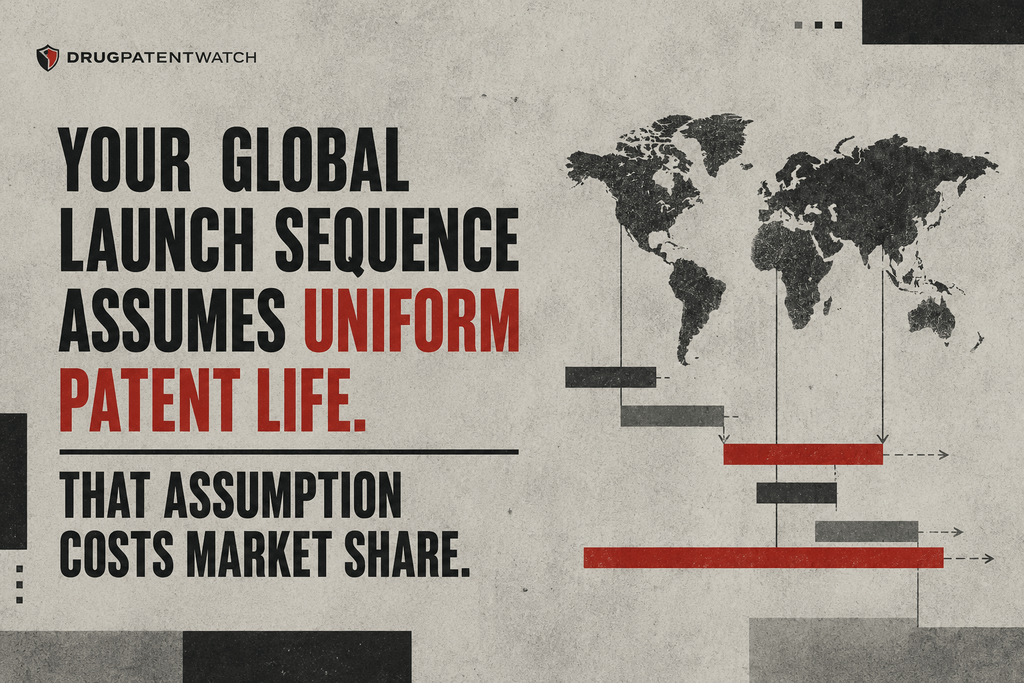
Portfolio teams that build a single global launch date into their forecasting models, then adjust it market by market for reimbursement and pricing, are working from a flawed premise. Patent life is not one number translated into different currencies. It is a set of independent legal outcomes, generated by independent statutory frameworks, independent patent offices, and independent courts, that happen to attach to the same molecule. Below are three real drugs where that independence produced launch-sequence gaps of one to thirteen years, the mechanics that caused each gap, and an original framework for classifying which kind of non-uniformity a portfolio team is actually exposed to.
The Short Answer
Patent and exclusivity protection for the same drug expires on different dates in different countries because four independent variables move separately: the length of statutory exclusivity itself (12 years under the U.S. Biologics Price Competition and Innovation Act versus roughly 10 to 11 years under the EU’s “8+2+1” formula) [22][23][64]; the anchor date used to calculate any patent term extension, which depends on when each country’s regulator approved the product [20][21]; whether corresponding patents in each jurisdiction’s family survive validity challenges, which courts and patent offices decide independently of one another [7][8][9][10]; and whether a settlement, rather than the underlying legal date, is what actually controls when a competitor enters a given market [15][16]. A launch sequence built on a single assumed expiration date will be wrong in at least one major market, and often by years, not months.
Why “Patent Life” Is Not a Single Number for a Global Drug
Exclusivity length itself is not harmonized
For biologics, the starting gap is statutory, not incidental. The U.S. Biologics Price Competition and Innovation Act gives an innovator biologic 12 years of market exclusivity from first FDA licensure, with the FDA barred from approving any biosimilar application during that window regardless of patent status [22][61][62][64]. The European Union’s parallel framework, built around the “8+2+1” formula, runs roughly 10 to 11 years: 8 years of data exclusivity plus up to 2 years of market protection, with a further year available if a new indication is added during the data-exclusivity period [22][64]. Those are not rounding differences. A biologic that reaches the U.S. exclusivity ceiling and the EU exclusivity ceiling on the same worldwide approval date will, on regulatory exclusivity alone, become eligible for biosimilar competition in Europe one to two years before it does in the United States, before a single patent claim is even examined.
Patent term extension runs on a country-specific clock
On the small-molecule and composition-patent side, most major markets offer some form of patent term restoration to compensate for years lost in clinical testing and regulatory review, but each restores time differently. The U.S. mechanism under 35 U.S.C. § 156, created by the 1984 Hatch-Waxman Act, extends a single patent by up to five years, capped so the extended term cannot run more than 14 years past the date of FDA approval [20][21][49][50]. The EU’s Supplementary Protection Certificate regime, created in 1992 and consolidated in Regulation (EC) No. 469/2009, and Japan’s extension system under Article 67-2 of its Patent Act, apply comparable five-year caps but calculate the underlying regulatory-review period from each region’s own approval date, which is rarely identical to the U.S. approval date [53]. DrugPatentWatch has published a detailed side-by-side comparison of the three systems’ calculation mechanics for teams that need the statutory detail [53]. The point for launch sequencing is simpler: because the clock starts at a different approval date in each region, the same drug can carry a patent term extension that ends years apart across Washington, Munich, and Tokyo, even when the underlying patent family shares a single priority date.
The same patent family can be valid in one jurisdiction and dead in another
Even when the statutory framework and the calculation method are held constant, national courts and patent offices reach independent, and sometimes opposite, conclusions about whether a given claim should have issued at all. That divergence is not a hypothetical risk. It is the exact fact pattern playing out in real time around Novo Nordisk’s semaglutide franchise, covered in detail below.
Regulatory approval is not the same event as commercial launch
A fourth variable sits underneath all three of the above: even within a single country, the date a competitor is legally cleared to sell is frequently not the date it actually starts selling. Litigation settlements routinely grant a negotiated entry date that has little relationship to the date printed on the FDA approval letter or the patent’s own expiration. The trastuzumab case study below shows this happening inside the U.S. market alone, between two biosimilars approved months apart.
Case Study One: Enbrel’s Thirteen-Year Transatlantic Gap
Enbrel (etanercept), Amgen’s tumor necrosis factor inhibitor first approved in 1998, is the starkest example of divergent global patent life among major biologics. Samsung Bioepis’s Benepali received European Commission marketing authorization on January 16, 2016, becoming the first subcutaneous anti-TNF biosimilar available in the EU, and Biogen began commercializing it within weeks [4][11]. The same underlying molecule, licensed for the etanercept biosimilar SB4 in Korea, Australia, and Canada under the brand Brenzys, reached those markets the same year [5].
In the United States, Sandoz’s biosimilar Erelzi had FDA approval in hand since 2016 but could not launch. Amgen, holding rights licensed from Hoffmann-La Roche, asserted two patents: U.S. Patent No. 8,063,182, covering the etanercept fusion protein itself, and U.S. Patent No. 8,163,522, covering its manufacturing process [1][3][7][10]. Sandoz did not contest that Erelzi infringed both patents; it argued only that the patents were invalid for lack of written description, obviousness, and obviousness-type double patenting. U.S. District Judge Claire Cecchi rejected every theory in August 2019 [3][7][10]. The Federal Circuit affirmed in a 2-1 decision in July 2020, and the Supreme Court declined to hear Sandoz’s appeal in May 2021, leaving the injunction in place and etanercept’s U.S. patent protection intact through 2029 [1][2]. No comparable infringement action blocked Benepali’s European launch. The EU launch cleared in January 2016; the earliest realistic U.S. entry point, set by the manufacturing patent’s 2029 expiration, sits thirteen years later.
The mechanism here is not a difference in statutory exclusivity length or in the calculation of a patent term extension. It is a difference in enforceable patent portfolio strength by jurisdiction: Amgen built and defended a manufacturing-process patent estate in the U.S. that either does not have an equally durable counterpart in Europe or was not asserted there, and no European court record shows Sandoz, Samsung Bioepis, or any other etanercept biosimilar maker facing an equivalent infringement judgment. A launch-sequencing model that assumed “Enbrel loses exclusivity when the compound patent expires” everywhere would have missed both the EU entry point by years and the U.S. entry point by more than a decade.
Case Study Two: Semaglutide’s Diverging Fate at the EPO and the USPTO
Novo Nordisk’s semaglutide franchise, marketed as Ozempic and Rybelsus for diabetes and Wegovy for obesity, is currently generating the clearest live demonstration of jurisdiction-specific validity outcomes on record. Novo Nordisk’s Orange Book listings show two U.S. compound patents on the same molecule with very different expiration dates: the ‘122 patent, expiring in 2026, and the ‘343 patent, expiring in 2031 [29]. The gap exists because although both patents stem from applications filed around the same time, only the ‘343 patent received a Hatch-Waxman patent term extension, pushing its expiration roughly five years later than a patent with an otherwise similar priority date [29].
Mylan filed an inter partes review petition against the ‘343 patent in March 2023; the Patent Trial and Appeal Board instituted review, Sun Pharmaceutical, Dr. Reddy’s, and Apotex joined, and in October 2024 Novo Nordisk settled with all four petitioners on confidential terms before the case reached a merits hearing [6][24][28]. The ‘343 patent’s validity, and its 2031 expiration, survived intact.
In Europe over the same period, Novo Nordisk lost the equivalent fight repeatedly. The Boards of Appeal of the European Patent Office revoked two Novo Nordisk semaglutide tablet-formulation patents in autumn 2024 on inventive-step grounds [8][27]. In May 2025, the Boards of Appeal revoked a third patent, EP 2866825, covering the use of long-acting GLP-1 peptides including semaglutide for obesity, again for lack of inventive step, following oppositions from Teva, Generics UK, and Galenicum Health (case T 1701/22) [7][9]. The panel found that the closest prior art had already established semaglutide’s suitability for treating obesity, so a claim built around that known use failed the EPO’s non-obviousness bar even though a U.S. tribunal, applying different legal standards to a different but related claim set, reached no such conclusion [7][9][26]. A fourth Novo Nordisk semaglutide patent, covering cardiovascular use, was upheld by the EPO Opposition Division only in amended form, a ruling the opponents have since appealed [22].
“Novo Nordisk have attempted to bolster protection for semaglutide with a number of life cycle patents… in jurisdictions lacking provisions for patent term extension, semaglutide is expected to face generic challenge as early as 2026,” IPKat’s Rose Hughes noted of the EPO proceedings [26].
The practical consequence for launch sequencing: the same molecule, defended by the same company against overlapping legal theories, currently has meaningfully weaker patent protection in Europe than in the United States. A generic or biosimilar-style competitor evaluating entry timing cannot use the U.S. ‘343 patent’s 2031 date as a European proxy, and a competitor using the EPO’s revocation pattern as a global signal would be wrong about the U.S. market, where Novo Nordisk’s negotiated settlement terms with Mylan, Sun, DRL, and Apotex remain confidential and could push effective entry closer to, at, or beyond 2031 [6][24][29].
Case Study Three: Trastuzumab’s Three-Speed, Then Four-Speed, Global Rollout
Roche/Genentech’s Herceptin (trastuzumab) shows how many independent clocks can run on a single molecule once biosimilar competition, rather than small-molecule generics, is involved. The compound patent expired in the European Union on July 28, 2014, roughly five years ahead of its June 2019 U.S. expiration [13][33]. That five-year statutory gap alone should have produced a multi-year head start for European patients. In practice, the actual sequencing was more complicated and involved four distinct entry points across three regions.
South Korea moved first. Celltrion received approval for its trastuzumab biosimilar Herzuma from the Korean Ministry of Food and Drug Safety in January 2014, six months before the EU patent even expired, but the company did not begin commercial marketing in Korea until 2017, well after the regulatory door had opened [11][14][30][31]. Europe moved second on both approval and commercial launch: Samsung Bioepis’s Ontruzant received European Commission marketing authorization on November 20, 2017, and MSD (Merck outside North America) launched it in the UK on March 8, 2018, becoming the first trastuzumab biosimilar actually sold in Europe [18][68][71][73]. Celltrion’s Herzuma followed with EU approval in December 2017 [12].
The United States lagged on both fronts, and then split further within itself. The FDA approved Mylan and Biocon’s Ogivri in December 2017, the same month Celltrion’s Herzuma cleared the EU, but Ogivri did not actually launch in the U.S. until December 2, 2019, almost exactly two years after its approval date, once Mylan and Biocon’s settlement and license with Roche/Genentech took effect [15][16][41][47]. Amgen and Allergan’s Kanjinti, not the earlier-approved Ogivri, became the first trastuzumab biosimilar actually sold in the United States, launching in July 2019 under a separate litigated arrangement [17][45]. Samsung Bioepis’s Ontruzant, despite being the first biosimilar approved in Europe, received FDA approval fourteen months after its EU approval, in January 2019, and launched in the U.S. only afterward [67][70][72].
The compressed version: one molecule, one compound-patent family, and at least six distinct approval-or-launch dates across Korea, the EU, and the U.S. between January 2014 and December 2019. Teams that modeled trastuzumab’s global exposure off the EU or U.S. compound-patent expiration date alone would have missed every one of the actual commercial entry points, several of which were set by private settlement terms that never appear in any patent office record.
What the Data Shows: A Cross-Case Comparison
The table below lines up the three case studies against a single question: what was the effective gap, in years, between the earliest jurisdiction to see biosimilar competition and the latest, and what mechanism produced it.
Drug
Earliest biosimilar market entry
Latest major-market entry
Approximate gap
Primary driver
Enbrel (etanercept)
EU, January 2016 [4]
US, not before 2029 [1][2]
~13 years
Divergent enforceable patent estate by jurisdiction
Herceptin (trastuzumab)
South Korea, approved Jan. 2014 [30]
US (Ontruzant), approved Jan. 2019 [67]
~5 years (approval); ~2 years EU-launch-to-US-launch [18][17]
Statutory patent-expiry gap plus independent settlement timing
Semaglutide (Ozempic/Wegovy)
EU patents revoked 2024–2025 [7][8]
US ‘343 patent survives to 2031 [10][29]
Potentially 5+ years, still unresolved
Divergent validity outcomes on related claims, same technology
An Original Taxonomy: Four Types of Patent-Life Non-Uniformity
The three case studies above do not share one cause. They illustrate four structurally different reasons the same drug can have different effective patent lives in different countries, and each requires a different kind of monitoring to catch.
Type 1: Statutory exclusivity divergence
The exclusivity period itself is a different number by law before any patent is examined. The 12-year BPCIA window against the roughly 10 to 11-year EU “8+2+1” window is the clearest example [22][64]. This type is fully predictable at the moment of first global approval; it requires no litigation monitoring, only a correct read of each region’s statute.
Type 2: PTE/SPC anchor-date divergence
Even where the calculation method is structurally similar, as with U.S. PTE and EU SPCs, the extension attaches to a different regulatory-approval date in each region, so identical five-year caps produce different absolute expiration dates [20][53]. This type is also predictable in advance, provided a team tracks each region’s actual approval date rather than assuming simultaneous worldwide approval.
Type 3: Divergent litigation and validity outcomes
Corresponding claims in the same patent family survive challenge in one jurisdiction and fail in another, as with semaglutide at the EPO versus the USPTO [7][8][9][10]. This type is the least predictable in advance and the only one that requires active litigation and opposition monitoring across multiple patent offices simultaneously, since a favorable outcome in the home jurisdiction provides no assurance about a foreign counterpart.
Type 4: Settlement-date divergence from statutory date
The legal expiration date, wherever it falls, is not necessarily the commercial entry date. Confidential settlements, as with Ogivri’s two-year gap between FDA approval and actual U.S. launch, or Novo Nordisk’s confidential 2024 settlement terms with Mylan, Sun, DRL, and Apotex, can push real-world entry earlier or later than any publicly calculable date [6][15][16][29]. This type requires tracking corporate disclosures, SEC filings, and trade press rather than patent-office records, since the controlling date is frequently never published as a date at all.
What This Means for Launch Sequencing
A global launch sequence built around a single “loss of exclusivity” date, then locally adjusted only for pricing and reimbursement timelines, will misjudge competitive timing in at least one major market for almost any drug with meaningful international patent complexity. The corrective is not a single fix but a per-drug map of which of the four non-uniformity types actually applies. A molecule with a strong single-family patent estate but a simple worldwide approval sequence is mostly exposed to Type 1 and Type 2 risk, both fully calculable from public statutes and approval dates. A molecule facing active opposition proceedings in multiple patent offices, as semaglutide is right now, carries Type 3 risk that no calculation can resolve until the tribunals rule. And any molecule facing first-filer litigation anywhere is exposed to Type 4 risk regardless of how clean the underlying patent picture looks, because the number that ends up controlling market entry may never appear in a public database at all. Patent intelligence platforms such as DrugPatentWatch, which consolidate Orange Book, EPO, and JPO records alongside litigation and settlement tracking, exist specifically to keep those four independent clocks visible in one place rather than reconciled only after a competitor’s launch announcement reveals the gap.
Methodology
The three case studies were selected because each documents a different one of the four non-uniformity types identified above, using primary sources wherever available: U.S. court opinions and the Federal Circuit’s own docket history for Enbrel, Novo Nordisk’s own SEC Form 20-F disclosure and published EPO Board of Appeal decision numbers for semaglutide, and FDA approval letters alongside company launch announcements for trastuzumab. Dates reported as “approval” versus “launch” are distinguished throughout rather than treated as interchangeable, since conflating the two was itself found to be a common source of sequencing error in the underlying record. Where a settlement’s terms are confidential, that is stated explicitly rather than estimated. This piece does not restate the mechanics of U.S., EU, or Japanese patent term extension calculation in full; readers needing that level of statutory detail can consult DrugPatentWatch’s dedicated comparison of the three systems [53].
FAQ
Why does the same drug expire on different patent dates in different countries?
Because patent term extension is calculated from each country’s own regulatory approval date under that country’s own statute, U.S. Hatch-Waxman extension, EU Supplementary Protection Certificates, and Japan’s Article 67-2 extension all apply comparable caps but anchor them to different dates, producing different absolute expiration dates for patents in the same family [20][53].
Is biosimilar exclusivity the same length in the U.S. and EU?
No. The U.S. BPCIA grants 12 years of market exclusivity from first FDA licensure. The EU’s “8+2+1” framework generally runs 10 to 11 years from first EU marketing authorization. That two-year statutory gap exists independent of any patent [22][64].
Why did Enbrel biosimilars launch in Europe a decade before the U.S.?
Amgen successfully defended two U.S. patents, covering the etanercept fusion protein and its manufacturing process, through district court, the Federal Circuit, and a denied Supreme Court petition, keeping U.S. protection intact to 2029. No comparable infringement judgment blocked Samsung Bioepis’s EU biosimilar, which launched in January 2016 [1][2][3][4].
Can the same patent survive in the U.S. and fail in Europe?
Yes. Novo Nordisk’s semaglutide ‘343 patent survived a Mylan-led inter partes review challenge at the USPTO through a 2024 settlement, while the EPO’s Boards of Appeal revoked three separate Novo Nordisk semaglutide patents on inventive-step grounds across 2024 and 2025 [6][7][8][10].
Does FDA approval mean a biosimilar can launch immediately?
Not necessarily. Mylan and Biocon’s Ogivri received FDA approval in December 2017 but did not launch commercially until December 2, 2019, once the terms of its settlement and license with Genentech took effect, a two-year gap between approval and market entry [15][16].
Which trastuzumab biosimilar launched first in the U.S.?
Amgen and Allergan’s Kanjinti, launched in July 2019, not Mylan and Biocon’s Ogivri, which had been FDA-approved earlier (December 2017) but launched later (December 2019) [17][41][45].
How much earlier can a patent term extension push a compound patent’s expiration?
Up to five years under both the U.S. and EU systems, though the U.S. system additionally caps the total post-approval term at 14 years, which can shorten the extension actually granted below the full five-year maximum depending on how much term remained on the base patent at approval [20][21][49][50].
Why did Novo Nordisk’s two U.S. semaglutide compound patents expire five years apart?
Only one of the two patents, the ‘343 patent expiring in 2031, received a Hatch-Waxman patent term extension; the ‘122 patent, expiring in 2026, did not, despite both stemming from applications filed around the same time [29].
Do generic and biosimilar launch dates ever depend on confidential terms rather than a public patent date?
Frequently. Novo Nordisk’s October 2024 settlement with Mylan, Sun Pharmaceutical, Dr. Reddy’s, and Apotex over the ‘343 patent was struck on confidential terms before any merits hearing, meaning the actual U.S. semaglutide entry date is not derivable from any public patent expiration date alone [6][24][29].
What is the fastest way to check whether a drug’s global patent life is actually uniform?
Compare, market by market, the statutory exclusivity length, the patent term extension anchor date, the litigation and opposition status of corresponding claims, and any disclosed or rumored settlement terms, rather than relying on a single compound-patent expiration date pulled from one jurisdiction’s Orange Book or equivalent register.
Key Takeaways
Enbrel’s etanercept biosimilar launched in the EU in January 2016; the earliest realistic U.S. entry point, set by Amgen’s manufacturing patent, is 2029, a roughly thirteen-year gap between the same molecule’s two largest markets [1][2][4].
The BPCIA’s 12-year U.S. biologic exclusivity period and the EU’s roughly 10-to-11-year “8+2+1” framework create a structural, pre-litigation gap between the two markets for any biologic [22][64].
Novo Nordisk’s U.S. semaglutide patent ‘343 survived a Mylan-led IPR challenge to a confidential 2024 settlement and remains listed to 2031, while the EPO revoked three separate Novo Nordisk semaglutide patents on inventive-step grounds across autumn 2024 and May 2025 [6][7][8][10][29].
Trastuzumab biosimilars reached South Korea (approved January 2014), the EU (launched March 2018), and the U.S. (Kanjinti launched July 2019; Ogivri launched December 2019, two years after its own FDA approval) on four distinct timelines from a single compound-patent family [11][15][16][17][18][41].
Four distinct mechanisms, statutory exclusivity length, PTE/SPC anchor-date differences, divergent litigation outcomes, and settlement dates that diverge from statutory dates, each require a different kind of monitoring, and a single global “loss of exclusivity” date will miss at least one of them for most internationally protected drugs.
References
Healio. (2020, July 2). Appeals court upholds Amgen victory in Enbrel fight; Sandoz eyes Supreme Court. https://www.healio.com/news/rheumatology/20200701/appeals-court-upholds-amgen-victory-in-enbrel-fight-sandoz-eyes-supreme-court
Center for Biosimilars. (2021, May 17). Sandoz Is 0-3 in Enbrel Patent Case. https://www.centerforbiosimilars.com/view/sandoz-is-0-3-in-enbrel-patent-case
Amgen. (2019, August 9). Amgen Wins Patent Case On Enbrel® (etanercept). https://www.amgen.com/newsroom/press-releases/2019/08/amgen-wins-patent-case-on-enbrel-etanercept
Biogen. (2016, January 16). BENEPALI®, the First Etanercept Biosimilar Referencing Enbrel®, Approved in the European Union. https://investors.biogen.com/news-releases/news-release-details/benepalir-first-etanercept-biosimilar-referencing-enbrelr
GaBI Online. Benepali gains approval for extra indications. https://www.gabionline.net/biosimilars/news/Benepali-gains-approval-for-extra-indications
Novo Nordisk A/S. (2025). Form 20-F FY2024. U.S. Securities and Exchange Commission. https://www.sec.gov/Archives/edgar/data/353278/000162828025003920/nvo-20241231.htm
JUVE Patent. (2025, May 20). EPO revokes another Novo Nordisk patent behind Ozempic and Wegovy drugs. https://www.juve-patent.com/cases/epo-revokes-another-novo-nordisk-patent-behind-ozempic-and-wegovy-drugs/
JUVE Patent. (2025, January 9). Generic drug companies attack Novo Nordisk’s diabetes and weight-loss drug. https://www.juve-patent.com/cases/generic-drug-companies-attack-novo-nordisks-diabetes-and-weight-loss-drug/
The IPKat. (2025, May 8). Commercial success is a nothing-burger for the EPO in Wegovy patent inventive step analysis (T 1701/22). https://ipkitten.blogspot.com/2025/05/commercial-success-is-nothing-burger.html
Markman Advisors. (2025, February 7). What is the patent landscape for Novo Nordisk’s semaglutide products, Ozempic, Wegovy and Rybelsus? https://www.markmanadvisors.com/blog/2025/2/7/what-is-the-patent-landscape-for-novo-nordisks-semaglutide-products-ozempic-wegovy-and-rybelsus
GaBI Online. (2014, January). Biosimilar trastuzumab approved in Korea. https://gabionline.net/biosimilars/news/Biosimilar-trastuzumab-approved-in-Korea
GaBI Online. Biosimilars of trastuzumab. https://www.gabionline.net/biosimilars/general/Biosimilars-of-trastuzumab
GaBI Online. Celltrion submits trastuzumab biosimilar application to EMA. https://www.gabionline.net/biosimilars/news/Celltrion-submits-trastuzumab-biosimilar-application-to-EMA
BioSpace. (2018, February 14). Celltrion Receives EU Approval for Trastuzumab Biosimilar. https://www.biospace.com/celltrion-receives-eu-approval-for-trastuzumab-biosimilar
Center for Biosimilars. Genentech and Pfizer Reach Settlement Over Biosimilar Trastuzumab. https://www.centerforbiosimilars.com/view/genentech-and-pfizer-reach-settlement-over-biosimilar-trastuzumab
Mylan N.V. & Biocon Ltd. (2019, December 2). Mylan and Biocon Launch Trastuzumab Biosimilar, Ogivri™ (trastuzumab-dkst), in the U.S. PR Newswire. https://www.prnewswire.com/news-releases/mylan-and-biocon-launch-trastuzumab-biosimilar-ogivri-trastuzumab-dkst-in-the-us-300967191.html
Goodwin. (2020, January 2). Year in Review: The Top-Five U.S. Biosimilar Market Developments of 2019. https://www.goodwinlaw.com/en/insights/blogs/2020/01/year-in-review-the-topfive-us-biosimilar-market-developments-of-2019
GaBI Online. (2018). Trastuzumab biosimilar Ontruzant launched in the UK. https://gabionline.net/biosimilars/news/Trastuzumab-biosimilar-Ontruzant-launched-in-the-UK
BioProcess Insider. Trastuzumab triple: FDA approves Merck and Samsung Bioepis biosimilar. https://www.bioprocessintl.com/regulations/trastuzumab-triple-fda-approves-merck-and-samsung-bioepis-biosimilar
Mondaq. Patent Term Extension Under 35 U.S.C. §156. https://www.mondaq.com/unitedstates/patent/379220/patent-term-extension-under-35-usc-156
United States Patent and Trademark Office. MPEP 2758: Notice of Final Determination – Calculation of Patent Term Extension. https://www.uspto.gov/web/offices/pac/mpep/s2758.html
Synapse (PatSnap). (2025, May 9). How Long Is Data Exclusivity for Biologics in the US and EU? https://synapse.patsnap.com/article/how-long-is-data-exclusivity-for-biologics-in-the-us-and-eu
I-MAK. Biologics, Biosimilars, and Patents. https://www.i-mak.org/wp-content/uploads/2024/05/Biologics-Biosimilars-Guide_IMAK.pdf
Lexology / CHIP LAW GROUP. (2025, March 18). Novo Nordisk Settles Ozempic Patent Case. https://www.chiplawgroup.com/novo-nordisk-settles-ozempic-patent-case/
DrugPatentWatch. (2026, May 12). Patent Term Extension U.S. vs. EU SPC vs. Japan: The Complete Strategic Guide for Pharma IP Teams. https://www.drugpatentwatch.com/blog/patent-term-extension-u-s-vs-eu-spc-vs-japan-the-complete-strategic-guide-for-pharma-ip-teams/
DrugPatentWatch. (2026, January 7). Navigating the Exclusivity of Biologics and Small Molecules for Competitive Advantage. https://www.drugpatentwatch.com/blog/navigating-the-exclusivity-of-biologics-and-small-molecules-for-competitive-advantage/