In October 2001, the United States government came within a phone call of doing something it had never done to a major branded drug: breaking the patent. Health and Human Services Secretary Tommy Thompson raised the threat of invoking 28 U.S.C. § 1498, the century-old federal statute that lets Washington use any patent without the owner’s permission, to force Bayer to supply enough ciprofloxacin to treat an anthrax-exposed public. Bayer did not wait to find out whether Thompson meant it. The company cut its government price roughly in half, from $1.77 to $0.95 a tablet, and guaranteed supply.[1][2] No compulsory license was ever issued. None had to be. The threat did the work.
That is the pattern this article documents: compulsory licensing rarely looks like the headline event most patent counsel picture. It is far more often a slow-moving administrative process, a leaked letter, a price cut extracted under threat, or — twenty years after Cipro — a political weapon aimed at a university rather than a price. DrugPatentWatch tracks the Orange Book and FDA exclusivity data that most IP teams watch for expiration risk. Compulsory licensing is the risk that shows up from a completely different direction: a health ministry, a WTO council, or in 2025, a Department of Commerce letter that has nothing to do with pricing at all.
The Five Findings That Matter
Before the mechanics, the numbers:
176 instances, 89 countries, 2001–2016. A peer-reviewed count of every documented use of a TRIPS flexibility during that period found 100 (56.8%) involved compulsory licenses or public non-commercial use licenses, and 152 of the 176 total instances (86.4%) were actually implemented rather than merely announced.[3]
97% price cut, 6% royalty. India’s only compulsory license to date, granted against Bayer’s Nexavar (sorafenib) in March 2012, dropped the monthly price from roughly $5,500 to $175 and set Natco Pharma’s royalty obligation at 6% of net sales (raised to 7% on appeal).[4][5]
Compulsory-license prices beat international procurement in only 11 of 30 cases. A systematic 2015 Health Affairs analysis of antiretroviral compulsory licenses found the resulting prices exceeded the median Global Fund/WHO procurement price in 19 of 30 case studies — nearly two-thirds — often by more than 25%.[6]
One successful export in eighteen years. The WTO’s 2003 Paragraph 6 mechanism, built specifically to let countries with drug-manufacturing capacity export compulsory-licensed medicines to countries without it, has been used to completion exactly once: Canada’s 2007 authorization letting Apotex export a three-drug HIV combination to Rwanda.[7][8]
Four petitions, four denials, one pivot. Xtandi (enzalutamide) has drawn march-in petitions in 2016, 2021, 2022, and 2023, each rejected by the NIH or HHS on the same reasoning — the drug is commercially available, so the statutory trigger is not met.[9][10] In August 2025, the mechanism resurfaced for the first time not as a pricing tool but as compliance leverage against Harvard University.[11][12]
What Counts as a Compulsory License, Exactly?
A compulsory license is a government-granted authorization for a party other than the patent holder to make, use, sell, or import a patented invention without the owner’s consent.[13] It is not patent revocation. The patent survives; the owner keeps title and is entitled to remuneration set by a court, an agency, or statute. What disappears is the exclusivity — the right to say no.
The TRIPS Article 31 Framework
Article 31 of the WTO’s TRIPS Agreement sets the baseline rules every member country’s compulsory-licensing law must fit inside.[14] A license must generally be considered on its individual merits; the proposed user usually must first attempt, unsuccessfully, to negotiate a voluntary license on reasonable commercial terms; the license must be predominantly for the domestic market; and the patent owner is entitled to “adequate remuneration” reflecting the economic value of the authorized use.[15] Two of those conditions evaporate immediately in a genuine national emergency or case of extreme urgency, or for public non-commercial (government) use: no prior negotiation is required, only prompt notice to the patent holder.[16]
The Doha Declaration Removed the Ambiguity
Adopted at the WTO’s Doha ministerial on November 14, 2001 — three weeks after the Cipro standoff began — the Declaration on the TRIPS Agreement and Public Health stated plainly that each member has the right to determine what constitutes a national emergency or circumstance of extreme urgency, explicitly naming HIV/AIDS, tuberculosis, malaria, and other epidemics as qualifying.[17] That single clarification is why the 2001–2007 wave of HIV-drug compulsory licenses in the developing world happened on the timeline it did: countries no longer had to argue over whether they were allowed to act.
Government Use vs. Third-Party Compulsory Licenses
Most national laws distinguish two mechanisms that produce a similar result through different doors. A government-use (or “Crown use”) license lets the state itself, or a contractor working for it, exploit the patent for public non-commercial purposes — the mechanism Thailand, Brazil, and Israel all used.[18] A third-party compulsory license instead authorizes a named commercial competitor — Natco Pharma in India’s Nexavar case — to manufacture and sell in competition with the patent holder, subject to a royalty.[5] The distinction matters commercially: a government-use license typically supplies a single public health system, while a third-party license creates an ongoing generic competitor with its own commercial incentives.
An Original Taxonomy: Four Types of Non-Voluntary Patent Use
Reviewing the documented compulsory-license episodes since 2001 surfaces four distinct mechanisms that get flattened together under one headline phrase but behave very differently in practice:
Type
Mechanism
Representative Case
Commercial Effect
Third-party domestic license
Patent office or court authorizes a named local generic maker, subject to royalty
India / Bayer Nexavar, 2012
Creates a permanent domestic generic competitor
Government-use / Crown-use license
State imports or manufactures for its own health system; no named private competitor required
Brazil / Merck efavirenz, 2007; Israel / AbbVie Kaletra, 2020
Supplies public procurement only; private market untouched
Threat-only leverage
Formal process opened or statute invoked as a negotiating threat; no license ultimately issued
US / Bayer Cipro, 2001; Colombia / Novartis Glivec, 2016
Extracts a price cut or supply guarantee without transferring any rights
Cross-border export license
Paragraph 6 / Article 31bis mechanism lets one country manufacture for another lacking capacity
Canada / Rwanda, 2007–2009
Rarely used; procedural cost has exceeded practical benefit in every case but one
The 2001–2007 Wave: How the HIV Crisis Normalized Compulsory Licensing
Before Doha, only a handful of countries had ever tested Article 31 against a branded HIV drug. Within six years of the declaration, at least seven had: Zimbabwe (April 2003, all antiretrovirals), Malaysia (October 2003, didanosine and zidovudine), Zambia (September 2004), Indonesia (October 2004, March 2007, and again September 2012), Thailand (November 2006 and January 2007), Brazil (May 2007), and Canada, whose 2007 export to Rwanda closed the loop on the system’s newest mechanism.[19][7]
Brazil’s Efavirenz Decree
Brazil’s move against Merck’s efavirenz is the best-documented case in the wave. The government had negotiated with Merck since November 2006, warning that unless Brazil received the same price Thailand had recently obtained, it would issue a compulsory license within seven days.[20] Merck’s final offer cut the price from $1.59 to roughly $1.10–1.11 per pill; Brazil’s Ministry of Health wanted closer to $0.65, the price Indian generic suppliers Cipla, Ranbaxy, and Aurobindo were already offering.[21][22] On May 4, 2007, President Lula signed Presidential Decree No. 6.108, licensing Efavirenz’s patents for public non-commercial use for five years (renewable), with Merck entitled to a royalty of 1.5% of the finished-product price.[21] At the time, 75,000–77,000 patients — roughly 40–42% of Brazil’s HIV treatment program — were on the drug, at an annual program cost the government put at around $40 million.[23][24] Brazil initially imported the generic from India; its own state lab, Farmanguinhos, began domestic production in January 2009 at roughly 45% of Merck’s pre-license price.[21][25]
Thailand’s Three-Drug Government-Use Wave
Thailand’s Ministry of Public Health moved on three separate patents within three months: efavirenz (Merck’s Stocrin) in November 2006, then lopinavir/ritonavir (Abbott’s Kaletra) and clopidogrel (Sanofi-Aventis and Bristol-Myers Squibb’s Plavix) in January 2007.[26][27] The Plavix license was notable for a reason unrelated to HIV politics: it was the first time a developing country had issued a government-use license against a non-infectious-disease medicine, extending the tool’s precedent to heart disease treatment for a claimed 200,000 Thai patients.[26] Abbott’s retaliation was commercial rather than legal — it withdrew marketing applications for seven new drugs from the Thai market in protest — and the U.S. Trade Representative elevated Thailand from its Special 301 Watch List to the more severe Priority Watch List within months.[27][28]
Country
Drug / Company
Date
Mechanism & Royalty
Price Result
Thailand
Efavirenz / Merck
Nov. 2006
Government-use license
Import from Ranbaxy at ~57 baht/day vs. Merck’s list price[28]
Thailand
Lopinavir/ritonavir (Kaletra) / Abbott
Jan. 2007
Government-use license
Distribution capped at 250,000 patients/year through Jan. 2012[29]
Brazil
Efavirenz / Merck
May 2007
Government-use, 1.5% royalty, 5-year term
~45% of Merck’s price by 2009 domestic production[21]
India’s Nexavar Decision: The Compulsory License That Rewrote Global Playbooks
On March 9, 2012, India’s Controller of Patents granted Natco Pharma a compulsory license under Section 84 of the Indian Patents Act to manufacture and sell sorafenib tosylate, Bayer’s kidney- and liver-cancer drug marketed as Nexavar.[4] It remains, as of this writing, India’s only compulsory license ever issued.
The Controller’s Reasoning
Section 84 allows a compulsory license three years after grant if the patented invention is not “worked” in India, reasonable public requirements are unmet, or the price is not reasonably affordable.[30] The Controller found all three satisfied: against an estimated 8,842 patients eligible for treatment in 2011, Bayer had supplied the drug to fewer than 200; Bayer imported rather than manufactured domestically despite having Indian facilities; and the drug’s roughly $5,500 monthly price was, by the Controller’s own arithmetic, unaffordable to nearly the entire eligible population.[4][31] Natco proposed pricing generic sorafenib at roughly $175 a month — a 97% discount — while paying Bayer a 6% royalty on net sales and supplying the drug free to at least 600 needy patients annually.[32][33]
The Appeals That Failed
Bayer contested the ruling at every available level. The Intellectual Property Appellate Board upheld the license in 2013 but raised the royalty to 7%.[34] The Bombay High Court affirmed in July 2014. India’s Supreme Court dismissed Bayer’s final special leave petition in December 2014, closing two and a half years of litigation with the compulsory license fully intact.[4][34]
Why Nexavar Still Shapes Portfolio Strategy
The case established a template other governments have cited ever since: unmet demand plus non-working plus unaffordability is a workable three-part case, and courts will not disturb an agency’s application of it absent a clear procedural defect. It is also the case most often invoked, correctly or not, whenever a company threatens litigation-heavy market exit from a price-sensitive jurisdiction. DrugPatentWatch’s own analysis of India’s broader patent-linkage gap covers the compound-patent side of that risk in more depth; the compulsory-license dimension is the piece that turns a slow-moving generic threat into an immediate one.
Colombia’s Near-Miss: When the Threat Alone Extracted the Concession
Colombia’s fight over Novartis’s Glivec (imatinib) shows the mirror image of Nexavar: a fully documented compulsory-license process that never actually produced a license.
The Declaration of Public Interest Mechanism
Colombian law requires a “declaration of public interest” (DPI) as a formal precondition before a compulsory license can be granted — a technical committee first recommends the declaration to the Minister of Health, who then decides.[35] Colombian public-health NGOs filed the underlying petition on Glivec in November 2014, citing the roughly $15,000–20,000 per-patient annual price against a national income per capita of about $12,600, and noting that generic competition could plausibly cut the price by 68–77%.[36][37]
Novartis’s Pressure Campaign
The Ministry’s technical committee recommended the DPI in February 2016. Novartis responded with a sustained diplomatic and legal pressure campaign: a threatened investment-treaty arbitration claim in spring 2016, and — according to leaked correspondence later published by Public Eye — a direct letter from the Novartis CEO to Colombia’s presidency days before the resolution was finalized.[38][39] Colombia’s own embassy in Washington separately reported pressure from U.S. Senate Finance Committee staff and the USTR, who reportedly warned that a compulsory license could jeopardize Colombia’s free-trade agreement standing and a pending $450 million U.S. peace-process funding package.[40]
Threatened vs. Actual: Why the Threat Often Works Just as Well
On June 14, 2016, Colombia’s Health Ministry issued Resolution 2475, declaring Glivec’s price of public interest and directing the national pricing commission to develop a reduced-price methodology — but stopping short of the compulsory license itself.[38][41] The outcome functioned, for pricing purposes, almost identically to a license: Colombia got a mandated price cut without ever transferring manufacturing rights, and Novartis avoided the precedent of an actual compulsory license on its books. It is the same dynamic Cipro demonstrated fifteen years earlier in a wealthy country instead of a middle-income one: the credible threat of a compulsory license is frequently a more efficient negotiating tool than the license itself, for both sides.
Malaysia’s Sofosbuvir Move: A Middle-Income Country Breaks an $84,000 Drug
Gilead’s hepatitis C cure sofosbuvir (Sovaldi) became internationally notorious for its $84,000 U.S. list price for a full treatment course.[42] Malaysia was excluded from Gilead’s initial 91-country voluntary licensing program covering India-based generic manufacturers, despite an estimated 450,000–500,000 Malaysians living with hepatitis C.[43][44]
The Voluntary License Gap
After unsuccessful price negotiations — Malaysia’s Ministry of Health sought a generic price near RM 1,000 (about $237) per patient against Gilead’s negotiated floor offer reported around $12,000 — the government issued a government-use compulsory license on September 20, 2017, covering sofosbuvir imports from Egypt’s Pharco Corporation.[45][46][47] Only after the compulsory license was announced did Gilead expand its voluntary license to include Malaysia, alongside Thailand, Belarus, and Ukraine — a sequencing that mirrors Colombia’s and Thailand’s experience: the license, once actually issued or credibly imminent, moved the originator’s own commercial terms.[48]
Price Collapse: From a Five-Figure Floor to Roughly $300
Malaysia’s Ministry of Health confirmed the generic version would be procured for public hospitals at roughly RM 1,000 per patient — call it $237 — a collapse of more than 97% from Gilead’s original list price and a substantial reduction even against the company’s own negotiated middle-income offer.[45][49] Malaysia holds a second distinction worth noting for freshness: it was also the first country to issue a compulsory license for an HIV medicine following Doha, in 2003, making the 2017 sofosbuvir case its second, not its first, use of the tool.[50]
Canada, Rwanda, and the Paragraph 6 System’s Only Real-World Test
The Doha Declaration’s Paragraph 6 identified a specific gap: TRIPS required compulsory-licensed production to be predominantly for the domestic market, which meant a country with no pharmaceutical manufacturing capacity of its own — the majority of least-developed countries — had no practical way to use the flexibility at all.[15] The WTO’s 2003 General Council Decision created a waiver mechanism to let a country with manufacturing capacity export compulsory-licensed medicines to one without it, later made permanent through the 2005 Article 31bis amendment.[51][52]
The Apotex–Rwanda Timeline
Canada implemented the waiver domestically through its 2005 Access to Medicines Regime (CAMR). On July 13, 2007, Apotex sent letters seeking voluntary licenses from GlaxoSmithKline, Boehringer Ingelheim, and Shire Biochem for the patents covering TriAvir, a fixed-dose combination of zidovudine, lamivudine, and nevirapine.[53] On July 17, 2007, Rwanda formally notified the WTO of its intent to import 15.6 million tablets. Apotex filed its compulsory-license application on September 4, 2007, and Canada’s Commissioner of Patents granted a two-year license on nine Canadian patents on September 19, 2007 — within two weeks of the formal application.[54][55] Canada notified the WTO on October 4, 2007, becoming the first member to complete both halves of the Paragraph 6 notification cycle.[7][8]
Why the Export License Almost Never Gets Used
The process, while fast once filed, took 25 months from Health Canada’s approval of the underlying generic to the first shipment reaching Rwanda in September 2008 — 13 of those months consumed simply waiting for an eligible importing country to come forward and negotiate with Apotex, and 7 more absorbed by Rwanda’s own procurement tender.[56][57] Apotex ultimately won that tender at 19.5 cents per tablet, priced at cost.[56] No other country has completed the cycle since. A 2025 peer-reviewed analysis of TRIPS compulsory licensing during COVID-19 confirmed the Rwanda shipment remains the system’s only successful export case to date, attributing the gap to the waiver’s dual-notification burden and the vague “insufficient manufacturing capacity” standard it requires importing countries to certify.[58]
COVID-19 Brought Compulsory Licensing Back to Wealthy Countries
The 2001–2007 wave was almost entirely a developing-world phenomenon. COVID-19 reversed that pattern, at least briefly, pulling high-income countries into the same mechanism they had spent two decades watching from a distance.
Israel’s Kaletra License
On March 18–19, 2020, Israel’s Ministry of Health invoked Sections 104 and 105 of its 1967 Patents Law to authorize importer K.S. Kim International to bring in generic lopinavir/ritonavir (AbbVie’s Kaletra) from India’s Hetero Labs, after AbbVie said it could not supply the requested volume in the needed timeframe for COVID-19 treatment trials.[59][60] It was Israel’s first compulsory license on a patented drug in more than two decades.[61] AbbVie’s response was to announce it would not enforce its Kaletra patents anywhere in the world for the duration of the pandemic — even though a clinical trial published the same week found no COVID-19 benefit from the drug.[62]
Hungary, Russia, and Remdesivir
Hungary and Russia both issued compulsory licenses covering Gilead’s remdesivir during the pandemic, and Canada passed Bill C-13, the COVID-19 Emergency Response Act, explicitly streamlining the federal government’s ability to authorize patent use for pandemic-related medical technologies without the ordinary notice-and-negotiation steps.[63][64]
The TRIPS Waiver Was a Consolation Prize, Not a Compulsory License
The India–South Africa proposal that dominated headlines from October 2020 onward sought something categorically larger than a compulsory license: a blanket suspension of TRIPS obligations across patents, trade secrets, industrial designs, and undisclosed test data.[65] What WTO members actually adopted at the 12th Ministerial Conference on June 17, 2022, after nearly two years of negotiation, was far narrower — a single waiver of TRIPS Article 31(f)’s domestic-market requirement, limited to COVID-19 vaccines, for five years, with no coverage of therapeutics or diagnostics.[66][67][68] A follow-on decision to extend the waiver to COVID-19 diagnostics and therapeutics failed to reach consensus at the 13th Ministerial Conference.[69] The waiver did not eliminate the need for compulsory licensing; it merely removed one procedural obstacle — the domestic-market restriction — for the specific case of vaccines, leaving the underlying Article 31 compulsory-licensing machinery exactly as it was.[70]
The US Exception: Why America Has Never Actually Issued One
The United States is simultaneously the country with the broadest compulsory-licensing authority on paper and the country that has used it least on a branded pharmaceutical.
Section 1498’s Narrow Practical Use
28 U.S.C. § 1498 lets the federal government use any patent, by any owner or funder, without permission — the price is a lawsuit against the government for “reasonable and entire compensation,” decided by a judge rather than negotiated in advance.[71][72] The statute has been invoked for decades in areas like defense procurement, but the 2001 Cipro standoff remains the closest it has come to reshaping a branded drug’s price, and even there the government never filed the case — it only raised the possibility.[1][73]
Bayh-Dole March-In Rights: A Narrower, Separate Tool
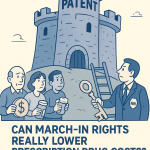
March-in rights under the 1980 Bayh-Dole Act, codified at 35 U.S.C. § 203, are a distinct and narrower mechanism than Section 1498: they apply only to inventions developed with federal research funding, and only a federal funding agency — not any private party — can request them.[74] Xtandi has drawn the pattern’s clearest illustration. Patient advocates and Knowledge Ecology International filed march-in petitions in 2016, 2021, and 2022, each rejected during the Obama and Biden administrations on the grounds that the drug — patented through UCLA’s foundational research, later licensed through Medivation to Pfizer and Astellas — was successfully commercialized and thus outside the statute’s “practical application” trigger.[9][75] The NIH’s March 21, 2023 decision restated that same reasoning, noting Xtandi had treated more than 200,000 patients over a decade; HHS affirmed the denial on appeal in February 2024.[76][10][77] A parallel Biden administration effort — a December 2023 NIST draft framework proposing that high price alone could justify march-in — drew more than 51,000 public comments but was never finalized into binding guidance.[78][79]
The 2025 Pivot: March-In as Compliance Weapon, Not Price Tool
In August 2025, the mechanism resurfaced in a form none of the Xtandi petitioners anticipated. Commerce Secretary Howard Lutnick notified Harvard University that the Department of Commerce was opening a comprehensive Bayh-Dole compliance review of the university’s federally funded patent portfolio — more than 58,000 patents as of mid-2024 — and explicitly invoked march-in authority as a possible consequence, framed not around drug pricing but around Harvard’s broader funding dispute with the administration.[11][12][80] No march-in proceeding has been completed as of this writing, but the episode marks the first time in the statute’s 45-year history that the threat has been aimed at an institution’s entire patent portfolio rather than at a single drug’s price. DrugPatentWatch has covered the mechanics and stakes of march-in rights for pharma IP teams in more detail in a dedicated explainer; the point worth adding here is that Harvard shows march-in’s political-leverage use case now sits alongside its long-dormant pricing use case as a distinct risk category for any institution — university or company — whose patents trace to federal funding.
Does Compulsory Licensing Actually Lower Prices? What the Evidence Shows
The honest answer, based on the best available systematic evidence, is: usually, but less reliably than the headline cases suggest.
The Beall, Kuhn, and Attaran Findings
A 2015 Health Affairs study built a case-study database of 30 antiretroviral compulsory-license episodes and compared the resulting prices against 673 comparable procurement transactions recorded by the WHO’s Global Price Reporting Mechanism and the Global Fund’s Price and Quality Reporting Tool.[6] The result cuts against the simple “compulsory license equals cheapest possible price” assumption: compulsory-license prices exceeded the median international procurement price in 19 of the 30 cases, frequently by a margin greater than 25%.[6] The study’s own conclusion was not that compulsory licensing fails, but that it is often a second-best mechanism compared to well-run pooled international procurement — the Global Fund and UNICEF’s bulk-purchasing leverage can, in a meaningful share of cases, beat what a single country’s compulsory license achieves on its own.
When It Works and When It Doesn’t
The cases in this article suggest the mechanism performs best under three conditions: a clear, well-documented affordability gap the patent holder cannot credibly rebut (Nexavar); a functioning domestic or regional generic manufacturing base that can execute quickly once authorized (Nexavar, Malaysia’s Egyptian-sourced sofosbuvir); and a government willing to absorb the diplomatic and trade-retaliation cost of following through rather than settling for the threat (Brazil, Thailand, India). It performs worst — or simply never gets used — where any of those three is missing, which is the core reason the Paragraph 6 export mechanism has produced one completed case in eighteen years: the countries most likely to need an imported compulsory-licensed drug are also the ones least likely to have a generic manufacturer nearby willing to absorb the litigation risk of exporting it.[58]
Between 2001 and 2016, roughly six in ten documented uses of TRIPS flexibilities worldwide involved a compulsory license or public non-commercial use license — and more than four in five of every flexibility invoked, license or otherwise, was actually carried through rather than left as an unexercised threat.[3]
What This Means for Patent Portfolio Strategy
Signals That Precede a Compulsory-License Threat
Across every case in this article, the same three preconditions recur before a government moves, whether the outcome is an actual license (Nexavar) or a threat that extracts a price concession without one (Cipro, Glivec): a documented gap between eligible patients and treated patients; a price that is a clear multiple of the country’s per-capita income or of prices the same company charges in comparable markets; and a public, organized patient or civil-society campaign that has already made the issue politically visible before the health ministry acts.[4][35][20] None of the cases here involved a government moving first, in secret, without that preceding pressure. Portfolio teams tracking exposure in price-sensitive markets have a genuine early-warning window, typically measured in months to low years, between the first NGO petition or news coverage and any formal government action.
How Multinationals Have Actually Responded
The recorded responses cluster into a narrow set of moves: expand or announce a patient access program only after a compulsory-license process has already started, as Bayer did with Nexavar and Novartis with Glivec — a sequencing critics on both cases pointed out undercut the “we were already being reasonable” defense;[31][39] extend an existing voluntary license to the country in question, as Gilead did for Malaysia within weeks of its sofosbuvir compulsory license;[48] or announce a unilateral non-enforcement pledge covering the disputed patent worldwide, as AbbVie did with Kaletra in 2020.[62] None of the documented cases show a company successfully reversing a compulsory license once a national patent office or court had actually granted one; every reversal in this dataset happened at the threat stage, before the license was issued.
Frequently Asked Questions
What is the difference between a compulsory license and a government-use license?
A third-party compulsory license authorizes a named commercial competitor to manufacture and sell a patented drug, subject to a royalty — India’s Nexavar license to Natco Pharma is the clearest example.[4] A government-use (or Crown-use) license instead lets the state itself, or a contractor acting for it, use the patent to supply its own public health system, without necessarily creating an ongoing private competitor — the mechanism Brazil, Thailand, and Israel each used.[21][26][59]
Has the United States ever issued a compulsory license against a branded drug?
Not against a private party’s drug patent. The closest case remains the 2001 Cipro anthrax standoff, in which HHS Secretary Tommy Thompson raised the threat of invoking 28 U.S.C. § 1498 and secured a 50% price cut and supply guarantee from Bayer without ever filing the underlying action.[1][2] Separately, Bayh-Dole march-in rights have been petitioned four times against Xtandi and denied each time.[9][10]
What triggered India’s Nexavar compulsory license?
India’s Controller of Patents found Bayer had supplied fewer than 200 of an estimated 8,842 eligible patients, had not manufactured the drug domestically despite having Indian facilities, and priced it at a level the Controller found unaffordable to nearly all eligible patients — satisfying all three grounds under Section 84 of the Indian Patents Act.[4][31]
Did Colombia ever actually issue a compulsory license on Glivec?
No. Colombia’s Health Ministry issued a “declaration of public interest” in June 2016 and directed a mandated price-reduction methodology, but stopped short of the compulsory license itself after a sustained pressure campaign from Novartis and, according to leaked correspondence, the U.S. government.[38][40][41]
Do compulsory licenses reliably produce lower prices than other options?
Not as reliably as commonly assumed. A 2015 Health Affairs analysis of 30 antiretroviral compulsory-license cases found the resulting price exceeded the median international procurement price — through the Global Fund or WHO channels — in 19 of the 30 cases, often by more than 25%.[6]
What was the Paragraph 6 mechanism built to fix?
TRIPS originally required compulsory-licensed production to be predominantly for the domestic market, which left countries with no pharmaceutical manufacturing capacity of their own unable to benefit from a compulsory license at all. The WTO’s 2003 waiver, made permanent through the 2005 Article 31bis amendment, let a manufacturing country export compulsory-licensed drugs to one without capacity.[15][51][52]
How many times has the Paragraph 6 export mechanism actually been used?
Once, to completion. Canada authorized Apotex to export 15.6 million tablets of a three-drug HIV combination to Rwanda in 2007, with the first shipment arriving in September 2008 — a process that took roughly 25 months from initial approval to delivery.[56][57] No other country has completed the full cycle since.[58]
What is the difference between the 2022 TRIPS waiver and a compulsory license?
The 2022 WTO decision waived only Article 31(f)’s domestic-market restriction, and only for COVID-19 vaccines, for five years. It did not waive the underlying requirement that a member country still issue a compulsory license under Article 31 to use the patent in the first place — the waiver removed one procedural obstacle, not the licensing requirement itself.[66][68][70]
Can march-in rights be used for reasons other than drug pricing?
Yes, and 2025 provided the first clear example. The Department of Commerce invoked march-in authority against Harvard University’s federally funded patent portfolio as compliance leverage tied to a broader funding dispute, unrelated to any single drug’s price — a use of the mechanism distinct from every prior Xtandi-style petition.[11][12]
What is the most common outcome when a government threatens a compulsory license without issuing one?
A negotiated price cut or expanded access commitment from the patent holder, often within weeks. Bayer’s 50% Cipro discount, Colombia’s Glivec price-cap resolution, and Gilead’s expanded Malaysia voluntary license all followed this pattern — the threat, credibly backed by statutory authority and public pressure, produced most of the commercial effect of an actual license.[2][41][48]
Methodology
This article draws on primary sources wherever available — WTO ministerial decisions and council notifications, national patent-office and court rulings, U.S. federal agency letters, and peer-reviewed journal studies — supplemented by contemporaneous reporting from Knowledge Ecology International, Médecins Sans Frontières’ Access Campaign, and industry and legal-analysis outlets where no primary document was publicly available. Percentage price changes are drawn directly from the cited sources’ own reported figures rather than independently recalculated, except where explicitly marked as this article’s own derived comparison (for example, the four-type taxonomy and the cross-case comparison tables, which organize but do not alter the underlying reported facts). Case selection prioritized episodes with a documented, dated government action or formal legal filing — as distinct from advocacy petitions that never received a ruling — with two intentional exceptions (the Cipro threat and the Colombia declaration of public interest) included specifically because their unresolved, threat-only status is itself the analytically important finding. Currency figures are reported in the units and, where given, the approximate USD conversions used by the original sources; no attempt was made to adjust historical prices for inflation.
Key Takeaways
Between 2001 and 2016, WTO members invoked TRIPS flexibilities 176 times across 89 countries; 100 of those actions were compulsory or government-use licenses, and 152 of the 176 total instances were actually carried through.[3]
India’s only compulsory license, against Bayer’s Nexavar in 2012, cut the price 97% against a 6–7% royalty and survived challenges through India’s Supreme Court.[4][34]
A systematic study found compulsory-license prices exceeded international procurement benchmarks in nearly two-thirds of documented antiretroviral cases.[6]
The WTO’s cross-border export mechanism has produced exactly one completed case in eighteen years: Canada’s 2007–2008 shipment to Rwanda.[7][56]
The United States has never issued a compulsory license against a branded drug patent; its closest approach, the 2001 Cipro standoff, produced a negotiated price cut without one.[1][2]
Xtandi has drawn four rejected march-in petitions since 2016; in 2025 the same statutory mechanism was invoked against Harvard University’s entire patent portfolio for reasons unrelated to drug pricing.[9][11]
In most documented cases, the credible threat of a compulsory license — rather than the license itself — produced the negotiated price or supply outcome a government was seeking.
References
Kapczynski, A., & Kesselheim, A. S. (n.d.). “Government Patent Use”: A Legal Approach to Reducing Drug Spending. Yale Law School. https://law.yale.edu/sites/default/files/documents/faculty/papers/kapcyznski_govpatentuse.pdf
Wikipedia. (n.d.). Government patent use (United States). https://en.wikipedia.org/wiki/Government_patent_use_(United_States)
‘t Hoen, E. F. M., Veraldi, J., Toebes, B., & Hogerzeil, H. V. (2018). Medicine procurement and the use of flexibilities in the Agreement on Trade-Related Aspects of Intellectual Property Rights, 2001–2016. Bulletin of the World Health Organization, 96(3), 185–193. https://pmc.ncbi.nlm.nih.gov/articles/PMC5840629/
MSF Access Campaign. (2024). Background Information on India’s First Compulsory Licence. https://msfaccess.org/background-information-indias-first-compulsory-licence
PharmaTimes. (2014). Bayer loses bid to overturn India’s first compulsory licence. http://www.pharmatimes.com/news/bayer_loses_bid_to_overturn_indias_first_compulsory_licence_1002934
Beall, R. F., Kuhn, R., & Attaran, A. (2015). Compulsory Licensing Often Did Not Produce Lower Prices for Antiretrovirals Compared to International Procurement. Health Affairs, 34(3), 493–501. https://www.healthaffairs.org/doi/10.1377/hlthaff.2014.0658
WTO. (2007). Canada is first to notify compulsory licence to export generic drug. https://www.wto.org/english/news_e/news07_e/trips_health_notif_oct07_e.htm
IPKat. (2007). Canada Notifies Compulsory Licence to Export. https://ipkitten.blogspot.com/2007/10/canada-notifies-compulsory-licence-to.html
Bayh-Dole Coalition. (2023). Bayh-Dole Coalition Statement on NIH Rejection of Xtandi March-in Petition. https://bayhdolecoalition.org/bayh-dole-coalition-statement-on-nih-rejection-of-xtandi-march-in-petition/
Goodwin Law. (2024). Recent Bayh-Dole Act News: Comments on the Draft Framework; HHS Refuses to March-In on Xtandi. https://www.goodwinlaw.com/en/insights/blogs/2024/02/recent-bayhdole-act-news-comments-on-the-draft-framework-hhs-refuses-to-marchin-on-xtandi-and-delaye
Bloomberg Law. (2025). Trump’s Attack on Harvard’s Patents Hits at Decades-Old IP Model. https://news.bloomberglaw.com/ip-law/trumps-attack-on-harvards-patents-hits-at-decades-old-ip-model
Wilson Sonsini. (2025). Department of Commerce Initiates Bayh-Dole Compliance Review and Asserts March-In Proceeding Targeting Harvard University Patents. https://www.wsgr.com/en/insights/department-of-commerce-initiates-bayh-dole-compliance-review-and-asserts-march-in-proceeding-targeting-harvard-university-patents.html
Springer. (2022). Compulsory Licences and Government Use: Challenges and Opportunities. In Access to Medicines and Vaccines. https://link.springer.com/chapter/10.1007/978-3-030-83114-1_3
Vietnam Law Magazine. (2020). Vietnam’s approach to COVID-19 treatment: compulsory licensing as solution in national emergency? https://vietnamlawmagazine.vn/vietnams-approach-to-covid-19-treatment-compulsory-licensing-as-solution-in-national-emergency-27403.html
IATP. (n.d.). Implications of the Doha Declaration on the TRIPS Agreement. https://www.iatp.org/sites/default/files/Implications_of_the_Doha_Declaration_on_the_TR.htm
UNDP. (n.d.). The TRIPS Agreement and Access to ARVs. https://www.undp.org/sites/g/files/zskgke326/files/publications/5.pdf
WTO. (2001). Declaration on the TRIPS Agreement and Public Health. https://www.wto.org/english/thewto_e/minist_e/min01_e/mindecl_trips_e.htm
Kidsforce. (2026). Compulsory Licensing: How Governments Override Patents for Public Health. https://kidsforce.org/compulsory-licensing-how-governments-override-patents-for-public-health
IIPRD. (2023). Compulsory Licensing in Thailand. https://www.iiprd.com/compulsory-licensing-in-thailand/
Aidsmap. (2007). Brazil issues compulsory license on efavirenz. https://www.aidsmap.com/news/may-2007/brazil-issues-compulsory-license-efavirenz
South Centre. (n.d.). The Use of Compulsory Licenses in Latin America. https://www.southcentre.int/question/the-use-of-compulsory-licenses-in-latin-america/
Chemical & Engineering News. (2007). Brazil Breaks Patent on a Merck Drug. https://cen.acs.org/articles/85/web/2007/05/Brazil-Breaks-Patent-Merck-Drug.html
Make Medicines Affordable. (2025). Brazil: 10 years of a Compulsory License on HIV drug Efavirenz. https://makemedicinesaffordable.org/brazil-10-years-of-a-compulsory-license-on-hiv-drug-efavirenz/
Rodrigues, W. C., & Soler, O. (2009). Compulsory licensing of efavirenz in Brazil in 2007: contextualization. Pan American Journal of Public Health, 26(6), 553–559. https://pubmed.ncbi.nlm.nih.gov/20107711/
PMC. (n.d.). Compulsory Licences: Law and Practice in Thailand. https://pmc.ncbi.nlm.nih.gov/articles/PMC7122632/
PMC. (n.d.). Government use licenses in Thailand: The power of evidence, civil movement and political leadership. https://pmc.ncbi.nlm.nih.gov/articles/PMC3180369/
Make Medicines Affordable. (n.d.). The campaign for use of compulsory licensing in Thailand. https://makemedicinesaffordable.org/the-campaign-for-use-of-compulsory-licensing-in-thailand/
Timeline for US-Thailand Compulsory License Dispute, Version 3. (2009). https://infojustice.org/wp-content/uploads/2012/11/pijip-thailand-timeline.pdf
IIPRD. (2025). How Bayer Lost Its Monopoly: The Story Behind India’s First Compulsory License. https://www.iiprd.com/how-bayer-lost-its-monopoly-the-story-behind-indias-first-compulsory-license/
Wharton, Knowledge at. (2012). Sparring Over Sorafenib: How Will Natco’s Move against Bayer Affect Pharma Licensing? https://knowledge.wharton.upenn.edu/article/sparring-over-sorafenib-how-will-natcos-move-against-bayer-affect-pharma-licensing/
Intepat IP. (2026). Natco vs. Bayer: India’s Bold Move on Compulsory Licensing and the Backlash from Foreign Nations. https://www.intepat.com/blog/natco-vs-bayer-indias-bold-move-on-compulsory-licensing-and-the-backlash-from-foreign-nations
Infojustice. (2014). Supreme Court Says No to Bayer, Upholds Compulsory License on Nexavar. https://infojustice.org/archives/33690
Knowledge Ecology International. (n.d.). Background FAQ on Glivec (imatinib) compulsory license in Colombia. https://www.keionline.org/27028
Health Action International. (n.d.). Declaration of Public Interest Regarding Access to Imatinib (Glivec) in Colombia. https://haiweb.org/publication/declaration-of-public-interest-regarding-the-access-to-imatinib-glivec-in-colombia/
ISDS Red Carpet Courts. (n.d.). Novartis vs Colombia. https://10isdsstories.org/archives/case2/
Public Eye. (2018). Glivec in Colombia: new leaked letter from Novartis attests to pressure at highest level. https://www.publiceye.ch/en/news/detail/glivec-in-colombia-new-leaked-letter-from-novartis-attests-to-pressure-at-highest-level
IP-Watch. (2018). Leaked Letter Shows Pressure on Colombia Not to Issue Compulsory Licence for Glivec. https://www.ip-watch.org/2018/02/06/leaked-letter-shows-pressure-colombia-not-issue-compulsory-licence-glivec/
Knowledge Ecology International. (2016). April 27, 2016 Letter from Colombian Embassy regarding Senate Finance, USTR pressure on Novartis compulsory license. https://www.keionline.org/23082
ISDS Platform. (n.d.). Investigation: As Colombia pushes for cancer drug price-cut and considers compulsory licensing, Novartis responds with quiet filing of an investment treaty notice. https://isds.bilaterals.org/?investigation-as-colombia-pushes
IP-Watch. (2019). Malaysia Still Under Pressure to Make Hepatitis C Medicine More Expensive. https://www.ip-watch.org/2019/02/13/malaysia-still-pressure-make-hepatitis-c-medicine-expensive/
Public Citizen. (2019). Compulsory Licensing for Hepatitis C Medication in Malaysia. https://www.citizen.org/news/compulsory-licensing-for-hepatitis-c-medication-in-malaysia/
Treatment Action Group. (2017). TAG Applauds Malaysian Government’s Decision to Make Generic Form of Life-Saving Hep C Cure. https://www.treatmentactiongroup.org/statement/tag-applauds-malaysian-governments-decision-to-make-generic-form-of-life-saving-hep-c-cure/
MSF Access Campaign. (2017). Malaysia’s compulsory license for sofosbuvir is a positive step for public health and innovation. https://msfaccess.org/malaysias-compulsory-license-sofosbuvir-positive-step-public-health-and-innovation
CitizenVox. (2019). Compulsory Licensing for Hepatitis C Medication in Malaysia. https://citizenvox.org/2019/04/10/compulsory-licensing-for-hepatitis-c-medication-in-malaysia/
IP-Watch. (2017). Malaysia Grants Compulsory Licence for Generic Sofosbuvir Despite Gilead Licence. https://www.ip-watch.org/2017/09/15/malaysia-grants-compulsory-licence-generic-sofosbuvir-despite-gilead-licence/
DNDi. (2021). The story of a “political drug” against hepatitis C. https://dndi.org/viewpoints/2021/the-story-of-a-political-drug-against-hepatitis-c/
Make Medicines Affordable. (2017). Malaysia paves the way for compulsory licensing on hepatitis C medicines. https://makemedicinesaffordable.org/malaysia-paves-the-way-for-compulsory-licensing-on-hepatitis-c-medicines/
Public Citizen. (2019). Compulsory Licensing for Hepatitis C Medication in Malaysia [first-country-for-HIV note]. https://www.citizen.org/news/compulsory-licensing-for-hepatitis-c-medication-in-malaysia/
WTO. (2003). Implementation of Paragraph 6 of the Doha Declaration on the TRIPS Agreement and Public Health. https://www.wto.org/english/tratop_e/trips_e/implem_para6_e.htm
WTO. (2005). Amendment of the TRIPS Agreement. https://www.wto.org/english/tratop_e/trips_e/wtl641_e.htm
Knowledge Ecology International. (2010). Canada’s Intervention to TRIPS Council: Experience Using the System (Apotex-Rwanda Case). https://www.keionline.org/21413
ASIL. (2007). Canadian-made Drugs for Rwanda: The First Application of the WTO Waiver on Patents and Medicines. https://www.asil.org/insights/volume/11/issue/28/canadian-made-drugs-rwanda-first-application-wto-waiver-patents-and
IP-Watch. (2016). WTO “Paragraph 6” System for Affordable Medicine: Time for Change? https://www.ip-watch.org/2016/11/14/wto-paragraph-6-system-affordable-medicines-time-change/
PMC. (2007). Canada’s Access to Medicines Regime: Promise or Failure of Humanitarian Effort? https://ncbi.nlm.nih.gov/pmc/articles/PMC2831732
PMC. (2007). Canada’s implementation of the paragraph 6 decision: is it sustainable public policy? https://pmc.ncbi.nlm.nih.gov/articles/PMC2180169/
Li, Z., & Guo, P. (2025). Compulsory licensing of pharmaceuticals during public health crisis: a TRIPS framework analysis. Frontiers in Public Health, 13, 1630586. https://pmc.ncbi.nlm.nih.gov/articles/PMC12463931/
Knowledge Ecology International. (2020). Israel issues compulsory license to allow the government to import generic versions of Kaletra. https://www.keionline.org/32503
Mondaq. (2020). Israel Issuing Compulsory License During the Time of COVID-19 Pandemic – Operational Impacts and Strategy. https://www.mondaq.com/india/operational-impacts-and-strategy/917898/israel-issuing-compulsory-license-during-the-time-of-covid-19-pandemic
Lexology. (2021). IP rights for covid-19 vaccines: worldwide stakes of Israeli compulsory licences. https://www.lexology.com/library/detail.aspx?g=63e3e667-78ab-43fc-94b6-749518a41d36
STAT News. (2020). AbbVie will allow generic copies of its HIV pill in Israel after the government approved a license. https://www.statnews.com/pharmalot/2020/03/20/abbvie-israel-hiv-kaletra-coronavirus-covid19/
PMC. (2025). Compulsory licensing of pharmaceuticals during public health crisis: a TRIPS framework analysis [Hungary/Russia remdesivir; Canada Bill C-13]. https://pmc.ncbi.nlm.nih.gov/articles/PMC12463931/
Parliament of Canada. (2020). Bill C-13: An Act respecting certain measures in response to COVID-19. https://www.parl.ca/DocumentViewer/en/43-1/bill/C-13/third-reading
India, South Africa. (2020). Waiver from Certain Provisions of the TRIPS Agreement for the Prevention, Containment and Treatment of COVID-19. WTO Doc. IP/C/W/669.
Fasken. (2022). Breaking News from the WTO: Limited TRIPS Waiver for COVID-19 Vaccines. https://www.fasken.com/en/knowledge/2022/06/breaking-news-from-the-wto-limited-trips-waiver-for-covid-19-vaccines
Congressional Research Service. (2022). World Trade Organization: “TRIPS Waiver” for COVID-19 Vaccines (R47231). https://www.congress.gov/crs_external_products/R/PDF/R47231/R47231.2.pdf
Cambridge Core. (2022). Ministerial Decision on the TRIPS Agreement (WTO). International Legal Materials, 62(2), 289–294. https://www.cambridge.org/core/journals/international-legal-materials/article/ministerial-decision-on-the-trips-agreement-wto/A0975F6E65289AA2ED3CBC5B21ABAE1C
NBER. (2024). The Feasibility of Using Bayh-Dole March-In Rights (Working Paper 32217). https://www.nber.org/system/files/working_papers/w32217/w32217.pdf
DrugPatentWatch. (2026). March-In Rights: The Dormant Nuclear Option That Could Reshape Drug Pricing and Pharma IP. https://www.drugpatentwatch.com/blog/march-in-rights-explained-can-they-really-lower-prescription-drug-costs/
Knowledge Ecology International. (2023). Thursday webinar on Bayh-Dole safeguards including Xtandi march in and government use petition. https://www.keionline.org/38626
FiercePharma. (2023). US again spurns march-in campaign to slash cost of Pfizer, Astellas’ Xtandi. https://www.fiercepharma.com/pharma/yet-again-us-spurns-march-campaign-slash-cost-pfizer-astellas-xtandi
IPWatchdog. (2024). HHS Denies Appeal of Xtandi March-In Petition as Comments Close on Proposed Framework. https://ipwatchdog.com/2024/02/06/hhs-denies-appeal-xtandi-march-petition-comments-close-proposed-framework/id=172966/
AAMC. (2023). NIH Declines to “March-In” on Cancer Drug, NIST Releases New Bayh-Dole Regulations. https://www.aamc.org/advocacy-policy/washington-highlights/nih-declines-march-cancer-drug-nist-releases-new-bayh-dole-regulations
NIST. (2023). NIST Releases for Public Comment Draft Guidance on March-In Rights. https://www.nist.gov/news-events/news/2023/12/nist-releases-public-comment-draft-guidance-march-rights
Duane Morris LLP. (2023). White House Announces Framework for Use of March-In Rights Under the Bayh-Dole Act to Lower Drug Prices. https://www.duanemorris.com/alerts/white_house_announces_framework_use_march_in_rights_under_bayh_dole_act_lower_drug_prices_1223.html
The Harvard Crimson. (2025). Trump Administration to Investigate Harvard’s Patents. https://www.thecrimson.com/article/2025/8/9/lutnick-patent-investigation/