On November 12, 2003, U.S. Patent 5,736,137 changed hands. The patent covers the chimeric antibody that became Rituxan, and the USPTO assignment record shows it moving from IDEC Pharmaceuticals Corporation to a new entity called Biogen Idec Inc.[1] Nothing was sold that day. IDEC Pharmaceuticals Corporation renamed itself Biogen Idec Inc. as part of its merger with Biogen, Inc., and the patent stayed exactly where it was.[2] A search that stopped at the assignee field would have concluded a transfer took place. The correct read is narrower: a name changed, and the paperwork looks identical to a sale.
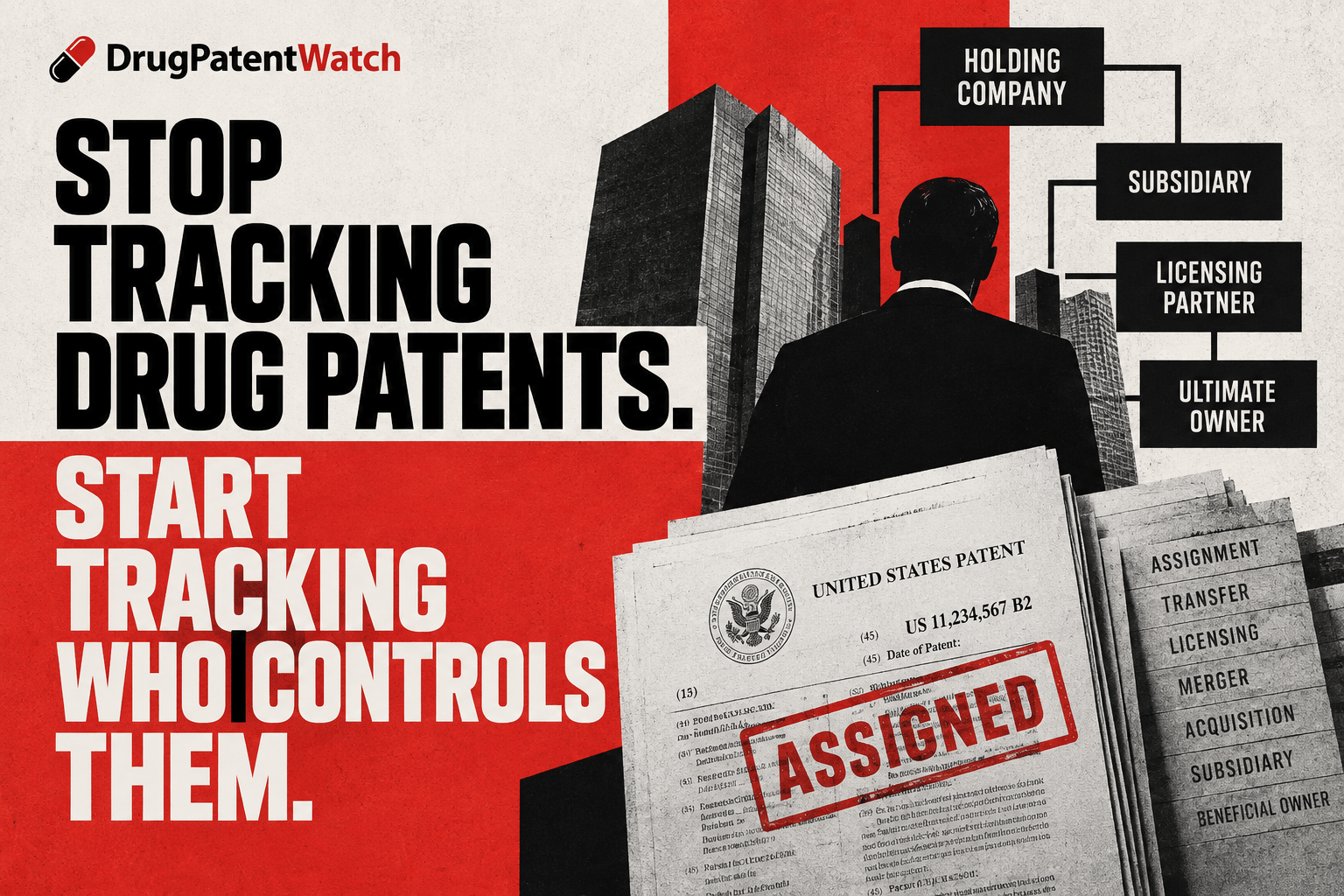
That distinction is the subject of this piece. Most pharmaceutical IP teams treat patent search as the hard problem: finding the claims, mapping the family, checking the Orange Book listing. Ownership gets treated as a lookup. It is not. The assignee field on a patent record reflects whoever last recorded a document, whenever they got around to recording it, under whatever corporate name they used that year. It does not reflect who controls the patent commercially, who co-owns it contractually, or who the current parent company actually is. DrugPatentWatch’s patent and litigation datasets exist partly because the raw USPTO and Orange Book records do not resolve this on their own; the underlying assignee strings still have to be reconciled against corporate family trees, SEC filings, and merger histories by hand.
The Short Answer
A patent’s assignee of record is a legal snapshot from the last time someone filed paperwork, not a live feed of who owns it. Mergers can rename the assignee without moving the patent. Acquisitions can move the parent company without renaming the assignee. Collaboration agreements can split economic control of a drug between two companies that both leave the patent assigned to only one of them. Bankruptcies can move a portfolio through a reorganized entity that keeps the same name and the same patents. In every one of these cases, the assignee field alone gives an incomplete or misleading answer to the question “who owns this.”
Why Patent Search Optimizes for the Wrong Half of the Problem
Ask a patent analyst to find every U.S. patent covering a molecule and they can usually do it in an afternoon. Ask the same analyst who currently controls enforcement, licensing, and litigation decisions over that patent, and the honest answer is often “let me check a few more sources.”
What a Patent Search Actually Returns
A patent search, whether run through Google Patents, USPTO Patent Public Search, or a commercial database, returns the claims, the filing and issue dates, the inventors, and an assignee field. That assignee field is populated from whatever document was last recorded against the patent, which could be the original inventor’s assignment to their employer, filed decades ago, or a reassignment recorded last month. Search tools display this field with total confidence and no caveat, because the field exists and has a value. It does not follow that the value is current.
What It Doesn’t Return: Who Holds Title Today
None of the standard search tools cross-reference the assignee name against a corporate family tree, a merger index, or an SEC EDGAR filing history. A patent assigned to “Pharmacyclics LLC” will keep showing that name whether Pharmacyclics is an independent company or, as has been true since 2015, a wholly owned AbbVie subsidiary.[3] The search result is accurate as a historical record. It is not, by itself, an answer to a present-tense ownership question.
Five Findings That Matter
The reassignment of U.S. Patent 5,736,137 (the foundational Rituxan antibody patent) to “Biogen Idec Inc.” was recorded on November 12, 2003, the exact date IDEC Pharmaceuticals Corporation changed its own name as part of its merger with Biogen, Inc. — no sale occurred.[1][2]
Lipitor’s core composition and crystalline-form patents passed through four corporate names in under 35 years: Warner-Lambert Company (original assignee), Pfizer Inc. (2000 acquisition, roughly $90.2 billion), Pfizer’s Upjohn division, and Viatris Inc. (November 16, 2020 Reverse Morris Trust combination with Mylan).[4][5][6]
AbbVie’s Pharmacyclics subsidiary and Johnson & Johnson’s Janssen Biotech unit co-exclusively commercialize Imbruvica in the United States under a December 2011 agreement, with Janssen funding roughly 60% of collaboration development costs and AbbVie 40%, and both sharing U.S. pretax profits equally — even though the ibrutinib patent estate is assigned only to Pharmacyclics.[7]
Johnson & Johnson paid $28.8 billion to acquire Actelion Ltd, effective June 16, 2017, yet a 2021 Chinese patent invalidation decision covering Opsumit’s underlying compound still names “Actelion Pharmaceuticals Ltd,” not Johnson & Johnson or Janssen, as the patentee.[8][9]
Mallinckrodt bought Acthar Gel by acquiring Questcor Pharmaceuticals for $5.8 billion in 2014, then filed for Chapter 11 bankruptcy twice on the same underlying asset — first on October 12, 2020 (emerging June 16, 2022), then again in August 2023 (emerging November 14, 2023) — with Acthar’s regulatory and IP assets carried through both reorganizations under the same corporate name.[10][11][12]
Under 35 U.S.C. § 261, a patent buyer has three months from the date of assignment to record it at the USPTO or risk losing priority to a later, recorded purchaser — but recordation itself is optional, and the USPTO expressly does not verify that the assigning party actually had the right to make the transfer.[13][14]
Global biopharma M&A deal value reached $133 billion across 50 deals in 2025, the second-highest annual total in five years, according to IQVIA — meaning tens of thousands of active patents changed corporate hands, or had their parent company change hands, in a single year.[15]
The Legal Mechanics of Who Owns a Drug Patent
Ownership questions have a legal answer before they have a database answer. Understanding the rule explains why the assignee field behaves the way it does.
35 U.S.C. § 261 and the Three-Month Recordation Window
Federal patent law treats patents as personal property that can be assigned by a written instrument.[13] The statute does not require recordation to make a transfer valid between the parties to it. What recordation does is protect the new owner against a specific risk: if the same patent were assigned twice, the buyer who records first, or within three months of their assignment’s execution date, wins priority over a later, unrecorded buyer.[14] Miss that window with no subsequent conflicting sale, and nothing bad happens. Miss it while a second sale of the same rights is in progress, and the recorded assignment controls even if it was executed later.
Recordation Is Optional — and the USPTO Doesn’t Verify It
The Patent and Trademark Office is instructed to record any document related to a patent interest upon request, for a fee, and to maintain a public register.[13] That is a filing service, not a title company. The USPTO does not independently confirm that the assignor had clear title, that a prior license does not conflict, or that a corporate merger actually closed on the date stated in the document. Recordation of an assignment, by itself, does not even grant the assignee the ability to take action in a pending application; that requires a separate showing under MPEP § 324 or § 325 depending on filing date.[16]
What “Right to Take Action” Means Under MPEP 324/325
For applications filed before September 16, 2012, an assignee must establish its right to take action under old 37 CFR 3.73 and MPEP § 324. For applications filed on or after that date, the rule moves to 37 CFR 1.46 and 3.81(a), covered by MPEP § 325.[16] Either way, simply appearing in the assignment database is a necessary step, not a sufficient one, for a company to prosecute, license, or litigate on a patent it just acquired.
The USPTO Patent Assignment Search Database
The USPTO’s public assignment database captures every recorded conveyance: sales, mergers, security interests, and name changes, each tagged with an execution date and a recordation date. It is the closest thing to a public chain-of-title record that exists for U.S. patents.
What the Database Captures
Every entry lists the conveying party, the receiving party, the execution date, and the date the USPTO actually recorded it. When the two dates are far apart, that gap is itself informative: it usually means either a corporate transaction closed on paper before the IP-transfer documentation caught up, or a company simply deprioritized recordation because nothing forced its hand.
What It Misses
The database has no field for “this assignee is now a wholly owned subsidiary of a different company.” It has no field for “this patent is subject to a co-exclusive commercial license that splits profits with a party who is not the assignee.” A researcher has to bring that context in separately, from SEC filings, merger announcements, or corporate registries.
How the FDA Orange Book Complicates the Picture
For approved small-molecule drugs, a second record exists alongside the USPTO’s: the FDA’s Orange Book listing under 21 CFR 314.53. The Orange Book records a “patent owner” field, but the form can be completed by the patent owner while only the holder of the approved New Drug Application is permitted to actually submit the listing to FDA.[17] The FDA does not independently verify chain of title either. So a drug can have three different names attached to it at once: the assignee of record at the USPTO, the patent owner named on the Orange Book listing, and the NDA holder who filed it, and none of those three fields is required to match the company that the public associates with the brand.
Form FDA 3542 and Who Is Allowed to List a Patent
Form FDA 3542 is where a patent owner or NDA holder declares patent information for Orange Book listing. Because the form does not require documentary proof of ownership at the time of filing, an outdated or informally described “patent owner” can sit on a public FDA record for years without anyone flagging it, unless a generic challenger’s due diligence catches the mismatch during Paragraph IV litigation.
A Taxonomy of Hidden Ownership: Five Ways the Assignee Field Lies
Across the cases examined for this piece, the gap between the assignee field and actual control falls into five recurring patterns.
Type 1: Merger-Triggered Reassignment
Two companies merge, and the surviving corporate entity changes its own name. Every patent held by the renamed entity is technically “reassigned” in USPTO records, even though no patent actually moved between separate parties. The Rituxan patent’s November 12, 2003 reassignment to Biogen Idec Inc. is a clean example: the recorded event and the corporate name change happened on the identical date.[1][2]
The Recordation Date as a Merger Fingerprint
When an assignment recordation date lines up exactly with a publicly announced merger closing date, that alignment is a strong signal the “reassignment” is really a renaming, not a sale. It is worth checking before assuming a competitive transfer occurred.
Type 2: Assignee-Name Persistence After Acquisition
The opposite pattern is just as common: a parent company buys a subsidiary and deliberately leaves its patents assigned to the subsidiary’s original corporate name, sometimes for years. Opsumit’s compound patent still names “Actelion Pharmaceuticals Ltd” as patentee in a 2021 Chinese ruling, four years after Johnson & Johnson’s 2017 acquisition closed.[8][9] Pharmacyclics LLC likewise remains the named assignee on Imbruvica’s composition-of-matter patent a decade after AbbVie bought the company outright.[3][18]
Type 3: Partial Ownership Through Collaboration Agreements
A patent can be assigned to a single company while a second company holds a contractual right to co-develop, co-commercialize, and share profits on the same asset, without ever appearing in the assignee field. Imbruvica’s AbbVie-Janssen structure and Rituxan’s original Genentech co-promotion arrangement with IDEC both fall into this category.
Profit-Share Agreements vs. Patent Co-Ownership
These are legally distinct. A patent co-owner has an independent right to make, use, and sell the invention absent an agreement to the contrary, and in most circumstances must join any infringement suit. A profit-share or co-promotion partner has none of that; its rights exist purely in contract, are only as strong as the agreement’s terms, and are invisible to anyone reading the patent record alone.
Type 4: Multi-Hop Serial Transfer
Some patents pass through three or more distinct corporate owners over their lifetime through sequential M&A, each transaction adding another link. Lipitor’s chain, Warner-Lambert to Pfizer to Pfizer’s Upjohn division to Viatris, is the clearest example examined here, spanning 34 years and three separate corporate transactions.[4][5][6]
Type 5: Bankruptcy and Reorganization Transfer
Chapter 11 does not typically require a company to rename itself or spin its IP into a new corporate shell; a plan of reorganization can leave the same corporate name in place while restructuring debt underneath it. Mallinckrodt’s Acthar Gel portfolio moved through two separate Chapter 11 proceedings, in 2020-2022 and again in 2023, without ever changing patent assignee names, because the reorganizations restructured Mallinckrodt’s balance sheet rather than transferring its IP to a new owner.[10][11][12]
Case Study: Lipitor’s Four-Name, Four-Decade Chain of Title
Atorvastatin, marketed as Lipitor, was first synthesized in 1985 by Bruce Roth, a chemist at Parke-Davis, then a division of Warner-Lambert Company.[19] The compound and crystalline-form patents that followed, including U.S. Patent 4,681,893 and U.S. Patent 5,273,995, were originally assigned to Warner-Lambert.[20][21]
From Warner-Lambert to Pfizer, 2000
Warner-Lambert entered a co-marketing agreement with Pfizer on Lipitor in 1996.[22] In 2000, Pfizer acquired Warner-Lambert outright in a transaction valued at roughly $90.2 billion, transferring the full atorvastatin patent estate to Pfizer.[4] For the following two decades, “Pfizer” was the correct and complete answer to who owned Lipitor’s IP.
The Four Original Warner-Lambert Patents
The core estate included the basic compound patent (4,681,893), the hemi-calcium salt patent (5,273,995), and later crystalline-form patents (5,959,156 and 6,121,461) covering specific solid-state forms of atorvastatin calcium used in manufacturing.[20][21] All were originally recorded to Warner-Lambert before the 2000 acquisition folded them into Pfizer’s portfolio.
From Pfizer’s Upjohn Division to Viatris, 2020
Lipitor’s basic patent expired in November 2011, ending its market exclusivity, but the brand, trademark, and any residual IP stayed inside Pfizer for another nine years.[23] In 2020, Pfizer separated its Upjohn division, which held mature, largely off-patent brands including Lipitor, Celebrex, and Viagra, and combined it with Mylan N.V. through a Reverse Morris Trust transaction.[5] The combination closed on November 16, 2020, creating Viatris Inc., with former Pfizer shareholders owning approximately 57% of the new company and former Mylan shareholders owning approximately 43%.[6] Lipitor moved with the Upjohn business into Viatris that day.
Why This Matters for Generic Entry Analysis Today
Lipitor’s patents are long expired, so the ownership chain has no live enforcement stakes. It remains a useful teaching case precisely because it is uncomplicated by pending litigation: a researcher who searches “Lipitor patent owner” today and stops at the first authoritative-looking answer risks landing on Pfizer, a company that has not owned Lipitor’s commercial rights since 2020. The same multi-hop pattern applies, with real financial stakes, to any drug currently mid-cycle inside a company that has been through a spinoff.
Entity
Event
Date
Source
Warner-Lambert Company
Original patent assignee; 1996 Pfizer co-marketing deal
1985-1996
[19][22]
Pfizer Inc.
Acquired Warner-Lambert, ~$90.2B, full patent transfer
2000
[4]
Pfizer (Upjohn division)
Held Lipitor as a mature, off-patent brand post-2011 exclusivity loss
2011-2020
[23]
Viatris Inc.
Reverse Morris Trust combination of Upjohn and Mylan
Nov. 16, 2020
[5][6]
Case Study: Rituxan, IDEC, and the Merger That Renamed the Assignee Overnight
Rituximab’s foundational chimeric antibody patents, including U.S. 5,736,137, were originally filed by and assigned to IDEC Pharmaceuticals Corporation, the San Diego biotech that developed the molecule.[24] In 1995, IDEC entered a collaboration agreement with Genentech, under which Genentech financed development costs in exchange for U.S. co-marketing rights, without taking any assignment of the underlying patents.[25]
The November 2003 Reassignment
On November 12, 2003, IDEC Pharmaceuticals Corporation and Biogen, Inc. completed a merger of equals under an agreement dated June 20, 2003.[2] Biogen, Inc. became a wholly owned subsidiary of IDEC Pharmaceuticals Corporation, and in the same transaction IDEC Pharmaceuticals Corporation changed its own corporate name to Biogen Idec Inc.[2] USPTO records for the 5,736,137 patent show a reassignment to “Biogen Idec Inc.” recorded that exact date.[1] No sale occurred between two separate title holders. The owner of record simply adopted a new name as part of closing its own merger.
Roche’s Nineteen-Year Path to Full Ownership of Genentech
Genentech’s side of the Rituxan story is a slower version of the same phenomenon. Roche first acquired a majority stake in Genentech in 1990, then completed a full buyout of the remaining shares in 2009.[26] Genentech kept its own corporate name throughout, operating as “a wholly owned member of the Roche Group” in its own press materials even years after the 2009 deal closed.[27] Anyone checking “who owns Genentech’s interest in Rituxan” in 1995 and never checking again would have missed a change of control that took nineteen years to complete and left no trace in the patent assignee field, because Genentech was never the patent’s assignee in the first place.
Why Genentech’s Profit Share Was Never a Patent Interest
Genentech’s stake in Rituxan was economic and contractual: a co-promotion profit split under the 1995 collaboration agreement, later restructured in 2010 alongside the companies’ ocrelizumab arrangement.[27] Genentech never held title to the core antibody patents. That distinction mattered directly in 2009, when an arbitration panel ruled on Biogen Idec’s contractual right to participate in Joint Development Committee decisions over Rituxan and related anti-CD20 antibodies, a dispute governed entirely by the collaboration contract rather than by patent ownership.[28]
Case Study: Imbruvica’s Co-Exclusive Structure
Ibrutinib, sold as Imbruvica, was originally developed as PCI-32765 by Celera Genomics, then acquired along with other programs by Pharmacyclics in 2006.[29] In December 2011, after Phase II data, Pharmacyclics and Janssen Biotech, Inc. entered a worldwide collaboration and license agreement to co-develop and co-commercialize the drug, with Janssen paying $150 million upfront and up to $975 million in milestones.[29]
One Patent Estate, Two Companies, No Merger
The agreement gives Janssen an exclusive license to commercialize Imbruvica outside the United States and a co-exclusive right inside the United States alongside AbbVie’s Pharmacyclics subsidiary.[7] Janssen is responsible for approximately 60% of collaboration development costs; AbbVie covers the remaining 40%.[7] Inside the U.S., both companies hold co-exclusive commercial rights, AbbVie books the sales as principal, and the two companies split pretax profits and losses equally.[7] None of this shifted patent title. Pharmacyclics remains the recorded assignee of the composition-of-matter patent, which AbbVie’s own June 2023 patent portfolio disclosure lists as expiring in 2027, with pediatric exclusivity extending coverage to May 2028.[18]
What “Co-Exclusive” Means for Competitive Intelligence
A competitor tracking Imbruvica’s IP by assignee search alone sees one company: Pharmacyclics LLC, an AbbVie entity. A competitor reading AbbVie’s SEC filings sees two companies with equal economic stakes and joint control over U.S. commercialization decisions.[7] Pricing strategy, settlement authority in any future patent litigation, and launch-timing decisions for follow-on formulations all run through both companies under the collaboration agreement, a fact invisible to anyone who only checked the patent record.
Case Study: Opsumit and the Assignee That Never Changed Its Name
Macitentan, sold as Opsumit, was developed by Actelion Pharmaceuticals Ltd, a Swiss company, and first approved by FDA on October 18, 2013.[30] Johnson & Johnson announced its acquisition of Actelion for $30 billion in January 2017 and completed the deal through an all-cash tender offer on June 16, 2017, paying $28.8 billion net of cash acquired for 97.86% of tendered shares as of that July.[9] As part of the closing, Actelion spun off its early-stage discovery operations into a new, separately traded Swiss company called Idorsia Ltd, distributed to Actelion’s own shareholders as a stock dividend.[31]
J&J’s $28.8 Billion Purchase, Same Patentee of Record
Four years after that closing, a 2021 Chinese patent invalidation proceeding over Opsumit’s compound patent, filed by a generic challenger, still identified “Actelion Pharmaceuticals Ltd” as the patentee.[8] Separately, patent-tracking services list the drug’s U.S. Orange Book patents as owned by “Actelion Pharmaceuticals US Inc.,” a distinct legal entity from the Swiss parent, while Actelion itself now operates as part of the Janssen Pharmaceutical Companies of Johnson & Johnson.[32][33] Three different corporate names attach to the same drug depending on which record you read: the foreign-filed compound patent’s patentee, the U.S. Orange Book patent owner, and the ultimate parent company the public associates with the brand. None of the three is wrong. None of them alone answers “who owns this.”
Case Study: Acthar Gel’s Two Bankruptcies
Acthar Gel, a repository corticotropin injection, has a corporate history that runs through an acquisition and then two separate Chapter 11 reorganizations of the same buyer, without the underlying IP ever formally changing hands a second time.
Questcor to Mallinckrodt, 2014
Mallinckrodt acquired Questcor Pharmaceuticals, Acthar’s prior owner, for approximately $5.8 billion under a merger agreement dated April 5, 2014.[34][35] That transaction moved Acthar’s regulatory and patent assets into the Mallinckrodt corporate family, where they have remained since, through two subsequent bankruptcies.
The First Chapter 11: October 2020 to June 2022
Mallinckrodt filed for Chapter 11 bankruptcy protection on October 12, 2020, seeking to restructure its debt and resolve opioid-related and Acthar Gel-related litigation, including a Medicaid rebate dispute with the Centers for Medicare and Medicaid Services.[36][37] The Bankruptcy Court confirmed Mallinckrodt’s plan of reorganization on March 2, 2022, and the company formally emerged from Chapter 11 and a parallel Irish examinership proceeding on June 16, 2022.[11]
What Carried Through the Reorganization
Mallinckrodt’s emergence used fresh-start accounting, treating the reorganized company as a new entity for financial reporting purposes, but this is an accounting convention, not a change of patent ownership.[38] Acthar Gel’s Orange Book listings and patent assignments stayed with the same corporate name, Mallinckrodt, throughout.
The Second Chapter 11: August to November 2023
Roughly fourteen months after emerging, Mallinckrodt filed for Chapter 11 a second time in August 2023, after missing a $200 million payment tied to its prior opioid settlement obligations.[39] The Bankruptcy Court confirmed the second plan of reorganization on October 10, 2023; a parallel Irish High Court order followed on November 10, 2023; and the plan became effective on November 14, 2023.[12] Acthar Gel’s IP portfolio, including its patents covering the drug’s SelfJect delivery device approved in 2024, remained with Mallinckrodt through both proceedings.[40]
Global biopharma M&A deal value reached $133 billion across 50 transactions in 2025, the second-highest annual total of the past five years, with nine individual deals exceeding $10 billion, according to IQVIA’s dealmaking analysis.[15]
How to Actually Trace Who Owns a Drug Patent
None of the five cases above required anything exotic to untangle. Each required checking more than one source and reading the dates.
Step One: Read the Assignee Field, Don’t Trust It
Start with the USPTO Patent Public Search or Patent Assignment Search record, but treat the assignee name as a starting point, not a conclusion. Note the execution date and the recordation date for the most recent conveyance.
Step Two: Cross-Reference the Corporate Family
Search the assignee’s name alongside terms like “acquired,” “merger,” or “wholly owned subsidiary.” A company that has not changed its patent-filing name in a decade may still have changed its ultimate parent multiple times, as Pharmacyclics, Actelion, and Genentech all show.
Step Three: Check SEC Filings for Collaboration and License Language
Public companies disclose material collaboration and license agreements in their 10-K and 10-Q filings, including cost-sharing percentages and profit-split terms, as AbbVie does for Imbruvica.[7] This is the only reliable way to find partial-ownership arrangements that never appear in a patent assignee field.
Step Four: Watch the Assignment Recordation Date
When a recordation date lines up precisely with an announced merger or acquisition closing date, that is usually a renaming or an acquisition-driven transfer rather than a competitive, arm’s-length sale. When the recordation date sits years after a known transaction, that gap itself is worth investigating.
Why the Recordation Date Often Reveals the Deal Close Date
Corporate legal teams frequently batch-record IP assignments as part of closing a transaction, which is why the Rituxan patent’s reassignment date matches the IDEC-Biogen merger’s closing date to the day.[1][2] That pattern is a useful diagnostic: a reassignment recorded on a well-publicized transaction date is far more likely to represent a corporate restructuring than a strategic patent sale.
What Happens When Nobody Checks
Standing to Sue
Getting chain of title wrong has real consequences in litigation. In Abraxis Bioscience, Inc. v. Navinta LLC, the Federal Circuit dismissed a patent infringement suit with prejudice because Abraxis had not yet received formal legal title to the asserted Naropin patents from AstraZeneca UK at the moment it filed its complaint; a later, corrective assignment could not retroactively cure the standing defect.[41][42] The court was explicit that a nunc pro tunc assignment cannot manufacture standing after the fact.[41] The underlying transaction was legitimate. The paperwork sequencing was not, and the entire case was lost on a technicality that had nothing to do with infringement.
Diligence in Licensing and M&A
The same gap creates risk on the buy side. A company licensing or acquiring rights to a drug needs to know not just who the assignee of record is, but whether a co-exclusive partner like Janssen in the Imbruvica structure has consent rights, profit-share claims, or veto power over the deal, none of which shows up in a patent database search.
What This Means for Freedom-to-Operate Analysis
A freedom-to-operate opinion that identifies the correct patent claims but the wrong current owner still produces the wrong risk assessment. If a target patent is genuinely co-owned or subject to a co-exclusive commercial license, the number of parties who would need to be part of any resolution, whether through a license, a design-around, or litigation, changes. Imbruvica’s structure means any enforcement decision against a would-be competitor runs through both AbbVie and Janssen’s collaboration governance, not through AbbVie alone.[7]
What This Means for Competitive Intelligence Teams
Tracking “who owns drug X’s patents” as a one-time lookup misses the multi-hop, multi-source reality this piece has walked through. The assignee field, the Orange Book patent-owner field, the NDA holder field, and the ultimate parent company are four separate data points that happen to converge for some drugs and diverge for others, as Opsumit’s three-different-names problem shows directly.[8][32][33] A monitoring process built to catch reassignment events, merger announcements, and SEC collaboration disclosures together, rather than any one of those sources alone, is the only version of this analysis that stays current.
FAQ
Does a change in a patent’s assignee field always mean the patent was sold? No. As the Rituxan patent shows, a reassignment can simply record a company renaming itself as part of a merger, with no change in beneficial ownership at all.[1][2]
Is recording a patent assignment with the USPTO legally required? No. Recordation is optional under 35 U.S.C. § 261, but a buyer who waits more than three months risks losing priority to a later, recorded purchaser of the same rights.[13][14]
Does the USPTO verify that an assignment is legitimate before recording it? No. The Office records documents upon request and maintains a public register, but it does not independently confirm chain of title or the assignor’s authority to convey the interest.[13]
Can two companies both have legitimate rights to the same drug patent without co-owning it? Yes. Collaboration and license agreements, like the AbbVie-Janssen structure covering Imbruvica, can give a second company co-exclusive commercial rights and an equal profit share without any change to the patent’s assignee of record.[7]
Why does a company sometimes keep a subsidiary’s original name on its patents after an acquisition? There is no legal requirement to update the assignee name after a corporate acquisition, and companies often leave it unchanged for administrative simplicity; Actelion Pharmaceuticals Ltd’s name has persisted on Opsumit’s compound patent for years after Johnson & Johnson’s 2017 purchase.[8][9]
Does the FDA verify who owns a patent before it appears in the Orange Book? No. The Orange Book listing process under 21 CFR 314.53 allows the patent owner to complete the listing information, but only the NDA holder can submit it, and FDA does not independently confirm chain of title.[17]
What happens if a company sues for infringement before it formally holds title to the patent? It can lose the case on standing grounds alone, regardless of the underlying merits. The Federal Circuit dismissed Abraxis Bioscience’s infringement suit with prejudice for exactly this reason, holding that a later corrective assignment cannot retroactively create standing that did not exist when the complaint was filed.[41][42]
Does bankruptcy automatically transfer a company’s patents to a new owner? Not necessarily. Mallinckrodt’s two Chapter 11 reorganizations restructured its debt and legal liabilities while the same corporate entity retained the Acthar Gel patent portfolio throughout both proceedings.[10][11][12]
How many corporate names can legitimately be associated with a single approved drug? At least three, in practice: the patent assignee of record, the FDA Orange Book patent owner, and the NDA holder, which are not required to match each other or the parent company most closely associated with the brand, as Opsumit illustrates.[32][33]
Is a drug’s current commercial owner always the same as its patent’s current legal owner? Not always. A patent can remain assigned to a subsidiary’s original name for years while a different parent company makes all commercial and strategic decisions over the product, as is the case with both Pharmacyclics under AbbVie and Actelion under Johnson & Johnson.[3][9]
Key Takeaways
A patent’s assignee field records the last party to file paperwork, not necessarily the current commercial owner. Both merger-driven renamings and deliberate name persistence after an acquisition can leave the field looking unchanged, or changed, in ways that mislead a quick search.
The Rituxan patent’s November 12, 2003 “reassignment” to Biogen Idec Inc. was a corporate renaming tied to the IDEC-Biogen merger, not a sale between separate owners.
Lipitor’s core patents passed through four corporate names across three transactions, Warner-Lambert to Pfizer to Pfizer’s Upjohn division to Viatris, over 34 years.
Imbruvica’s patent estate is assigned solely to Pharmacyclics LLC, an AbbVie subsidiary, while Janssen Biotech holds an equal, contractually defined economic and commercial stake under a 2011 collaboration agreement invisible to a patent-only search.
Opsumit’s compound patent, U.S. Orange Book listing, and ultimate corporate parent can each surface a different company name, none of them incorrect, none of them individually complete.
Recordation under 35 U.S.C. § 261 is optional and unverified by the USPTO; getting the timing or the formal title transfer wrong can cost a company its standing to sue entirely, as it did in Abraxis Bioscience v. Navinta.
Tracing real ownership requires combining the patent record, SEC collaboration disclosures, corporate merger history, and Orange Book listings. No single source answers the question alone.
References
The Lens. (n.d.). US 5736137 A — Therapeutic application of chimeric and radiolabeled antibodies. https://www.lens.org/lens/patent/US_5736137_A
Biogen Idec Inc. (2003). Annual Report on Form 10-K, Note 2: Merger of IDEC Pharmaceuticals Corporation and Biogen, Inc. U.S. Securities and Exchange Commission. https://investors.biogen.com/node/9106/html
Drugs.com. (2025). Who makes Imbruvica? https://www.drugs.com/medical-answers/makes-imbruvica-ibrutinib-3545881/
Patsnap Synapse. (2025). Who holds the patent for Atorvastatin? https://synapse.patsnap.com/article/who-holds-the-patent-for-atorvastatin
The Motley Fool. (2020, October 30). Date is set for merger between Mylan and Pfizer’s Upjohn unit. https://www.fool.com/investing/2020/10/30/pfizer-and-mylan-set-merger-date/
Viatris Inc. (2021). Annual Report on Form 10-K for fiscal year 2020. U.S. Securities and Exchange Commission. https://www.sec.gov/Archives/edgar/data/1792044/000179204421000009/vtrs-20201231.htm
AbbVie Inc. (2021). Quarterly Report on Form 10-Q for the quarter ended March 31, 2021, Note 6: Collaboration with Janssen Biotech, Inc. U.S. Securities and Exchange Commission. https://www.sec.gov/Archives/edgar/data/1551152/000155115221000016/abbv-20210331.htm
Lexology / Top 10 Patent Cases of 2021. (2022, August 3). Actelion’s OPSUMIT pharma patent survived the invalidation. https://www.lexology.com/library/detail.aspx?g=ad0857d1-5cfb-4641-8644-b176a42fc947
Johnson & Johnson. (2017). Quarterly Report on Form 10-Q for the quarterly period ended July 2, 2017. U.S. Securities and Exchange Commission. https://www.sec.gov/Archives/edgar/data/0000200406/000020040617000042/a2q10q07-02×17.htm
KFF Health News. (2020, October 2). Old drug turned “cash cow” as company pumped price to $40K a vial, emails show. https://kffhealthnews.org/news/mallinckrodt-orphan-drug-acthar-turned-cash-cow-as-drugmaker-raised-price-to-40000-per-vial-emails-show/
Mallinckrodt plc. (2022, June 16). Mallinckrodt emerges from Chapter 11 with strengthened balance sheet and enhanced financial flexibility. Form 8-K, Exhibit 99.1. U.S. Securities and Exchange Commission. https://www.sec.gov/Archives/edgar/data/1567892/000119312522178880/d311224dex991.htm
Mallinckrodt plc. (2023). Investor relations disclosure on the 2023 Plan of Reorganization and Scheme of Arrangement. https://mallinckrodt.gcs-web.com/static-files/156a8da4-a71a-4347-89ca-c2a22deb89fe
U.S. Patent and Trademark Office. (2024). MPEP § 301: Ownership/assignability of patents and applications. https://www.uspto.gov/web/offices/pac/mpep/s301.html
IQVIA. (2026, January 19). Biopharma M&A: Outlook for 2026. https://www.iqvia.com/locations/emea/blogs/2026/01/biopharma-m-and-a-outlook-for-2026
BitLaw. (2024). MPEP 301: Ownership/assignability of patents and applications, November 2024. https://www.bitlaw.com/source/mpep/301.html
U.S. Code of Federal Regulations. 21 CFR § 314.53 — Patent information submission requirements.
AbbVie Inc. (2023, June 1). Information about our pharmaceutical patent portfolio. https://s203.q4cdn.com/636242992/files/pipeline-tables/us-patent-expiry-tables.pdf
Macindoe, W. (2023, August 1). Lipitor — A short account of its life cycle. LinkedIn. https://www.linkedin.com/pulse/lipitor-short-account-its-life-cycle-wallace-macindoe-phd-mba
U.S. Patent and Trademark Office. U.S. Patent 7,074,818 (crystalline forms of atorvastatin calcium). https://image-ppubs.uspto.gov/dirsearch-public/print/downloadPdf/7074818
U.S. Patent and Trademark Office. U.S. Patent 7,674,923 (process for preparing forms of atorvastatin calcium). https://image-ppubs.uspto.gov/dirsearch-public/print/downloadPdf/7674923
Pfizer Inc. (n.d.). Warner Lambert. https://www.pfizer.com/about/history/pfizer_warner_lambert
The Scientist. (2011, November 30). Lipitor patent expires. https://www.the-scientist.com/lipitor-patent-expires-41658
U.S. Patent and Trademark Office. U.S. Patent 8,277,810 (antagonist anti-CD40 monoclonal antibodies and methods for their use). https://image-ppubs.uspto.gov/dirsearch-public/print/downloadPdf/8277810
Reichert, J., & Valge-Archer, V. (2014). Rituximab: How approval history is reflected by a corresponding patent filing strategy. PMC. https://pmc.ncbi.nlm.nih.gov/articles/PMC4171018/
Van Cutsem, E., et al. (2013). Rituximab. mAbs, Taylor & Francis. https://www.tandfonline.com/doi/full/10.4161/mabs.29105
Biogen Idec Inc. / Fierce Pharma. (2010, October 21). Biogen Idec and Genentech announce restructuring of anti-CD20 collaboration agreement. https://www.fiercepharma.com/pharma/biogen-idec-and-genentech-announce-restructuring-of-anti-cd20-collaboration-agreement
Biogen Idec Inc. (n.d.). Biogen Idec announces conclusion of arbitration with Genentech. https://investors.biogen.com/news-releases/news-release-details/biogen-idec-announces-conclusion-arbitration-genentech
Drugs.com. (2025, June 27). Who makes Imbruvica? https://www.drugs.com/medical-answers/makes-imbruvica-ibrutinib-3545881/
Drugs.com. (n.d.). Opsumit (macitentan) FDA approval history. https://www.drugs.com/history/opsumit.html
Johnson & Johnson. (2017, June 16). Johnson & Johnson announces completion of acquisition of Actelion. https://www.jnj.com/media-center/press-releases/johnson-johnson-announces-completion-of-acquisition-of-actelion
Mallinckrodt Pharmaceuticals. (2014, August 4). News detail: ISS and Glass Lewis recommend vote for Questcor acquisition. https://mallinckrodt.com/about/news-and-media/news-detail/?id=7476
Questcor Pharmaceuticals Inc. (2014). Form DEFM14A. U.S. Securities and Exchange Commission. https://www.sec.gov/Archives/edgar/data/0000891288/000119312514266719/d708020ddefm14a.htm
The Pharma Letter. (2023, August 27). Mallinckrodt initiates Chapter 11 proceedings. https://www.thepharmaletter.com/article/mallinckrodt-initiates-chapter-11-proceedings
Torys LLP. (2022, June 16). Mallinckrodt emerges from its Chapter 11 and CCAA restructuring proceedings. https://www.torys.com/en/work/2020/12/481c5276-e258-459e-83b1-4a5d1f610af1
Mallinckrodt plc. (2022). Quarterly Report on Form 10-Q for the quarter ended September 2022. U.S. Securities and Exchange Commission. https://www.sec.gov/Archives/edgar/data/1567892/000156789222000046/Financial_Report.xlsx
Financier Worldwide. (2023, August 31). Mallinckrodt files for Chapter 11 bankruptcy protection. https://www.financierworldwide.com/fw-news/2023/8/31/mallinckrodt-files-for-chapter-11-bankruptcy-protection
BioSpace. (2024, March 1). Mallinckrodt announces U.S. FDA approval of supplemental New Drug Application for Acthar Gel Single-Dose Pre-filled SelfJect Injector. https://www.biospace.com/mallinckrodt-announces-u-s-fda-approval-of-supplemental-new-drug-application-for-acthar-gel-repository-corticotropin-injection-single-dose-pre-filled-selfject-injector
Lexology. (2010, December 31). Federal Circuit law governs patent assignment interpretation and nunc pro tunc assignments cannot retroactively confer standing. https://www.lexology.com/library/detail.aspx?g=db40d821-0257-44c2-a269-973186819804
Finnegan, Henderson, Farabow, Garrett & Dunner, LLP. (n.d.). Corporations who fail to properly assign patents as part of corporate sales or restructuring may lose standing to bring a patent infringement suit. https://www.finnegan.com/en/insights/articles/corporations-who-fail-to-properly-assign-patents-as-part-of.html