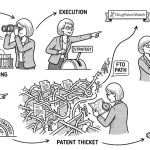
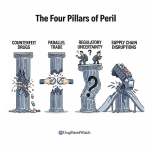
Every drug that reaches Phase III clinical trials carries two price tags: the cost of making it and the cost of defending the right to sell it. The second number is the one that kills companies.
A single patent infringement suit in a case where more than $25 million is at risk costs a median of $5.5 million to litigate through trial, according to data cited by the American Intellectual Property Law Association [1]. In pharmaceutical patent disputes, the money at risk routinely runs into billions. The 312 Hatch-Waxman complaints filed in 2024 — up from 259 the year before — represent billions of dollars of potential generic sales, brand revenue, and litigation spend colliding in the District of Delaware and a handful of other specialized venues [2].
Freedom-to-Operate (FTO) analysis is the systematic legal and scientific process that determines whether your product can be commercialized in a given jurisdiction without infringing a valid, enforceable patent held by someone else. Done right, it keeps those billions out of litigation. Done badly — or not at all — it turns your most promising asset into an injunction waiting to happen.
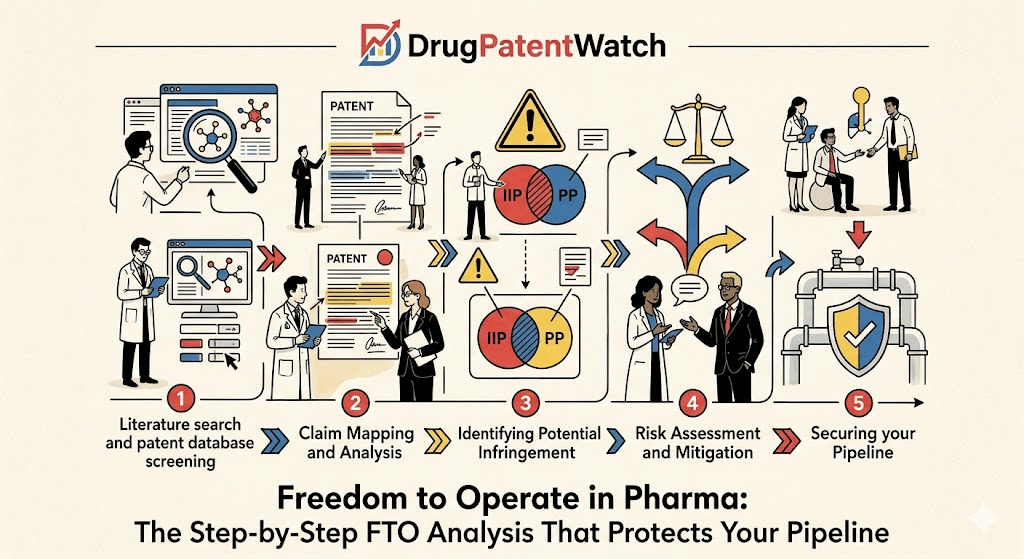
This guide walks through every critical step in a rigorous pharmaceutical FTO analysis. It covers the mechanics, the strategic choices, the known failure points, and the real cases where these decisions made or destroyed commercial value. The focus is on practical execution: what to search, how to read a claim, when to get an opinion, and what to do when you find a blocking patent.
‘The question FTO answers is not whether you can invent something, but whether you can sell it without getting sued.’ — DrugPatentWatch [3]
What FTO Analysis Is — and What It Is Not
Before laying out the steps, it helps to clear up a confusion that costs teams time and money: FTO analysis is not the same as a patentability search, and it is not the same as a patent landscape.
A patentability search asks whether your invention is novel enough to receive a patent. FTO analysis asks whether you can commercially exploit your invention without infringing someone else’s patent. You can have strong FTO and no patent of your own, leaving competitors free to copy you. You can also hold a strong patent and still lack FTO, because a broader pioneer patent held by a competitor covers the underlying technology [3].
A patent landscape maps the competitive patent environment around a technology area — useful for business intelligence, white-space analysis, and tracking competitor R&D trajectories. It is broader and less legally specific than an FTO opinion. A landscape tells you who is filing what and where; an FTO opinion tells you whether a specific, defined product infringes a specific, defined claim in a specific jurisdiction.
The distinction matters operationally because it affects who conducts the work, what it costs, and what legal protection the output provides. A landscape can be drafted by an in-house scientist with good database access. A formal FTO opinion that provides attorney-client privilege and potential protection against willful infringement findings must come from qualified patent counsel.
Why ‘Freedom to Operate’ Is a Jurisdiction-Specific Determination
Patents are national rights. A U.S. patent does not block you from selling in Germany. A European Patent (EP) in Germany does not touch your U.S. sales. When a pharmaceutical company operates globally — manufacturing in Ireland, conducting clinical trials in the U.S., launching in the EU — FTO analysis must be conducted jurisdiction by jurisdiction for each commercially relevant market.
That is not merely a procedural point. The same compound may be off-patent in the U.S. but still under primary patent protection in Japan. Formulation patents may have been granted in Canada but rejected by the EPO as obvious. A method-of-use patent covering an oncology indication in the U.S. may have no equivalent in Brazil. Each of these gaps represents either a market opportunity or an exposure, depending on your position.
Priority is typically given to: the U.S. (largest pharmaceutical market by revenue), the EU-5 (Germany, France, Italy, Spain, UK combined), Japan, Canada, and China, which has grown dramatically as both an innovation market and an enforcement jurisdiction. The specific priority list depends on where you plan to manufacture, where you plan to sell, and where your API supply chain sits.
Step 1: Define the Product and the Claim Scope
FTO analysis cannot start with a search. It must start with a clear, precise technical definition of what you actually plan to commercialize. This sounds obvious and is routinely skipped.
A molecule entering development looks very different at the IND stage than it does at NDA submission. The API structure may be locked, but the formulation, the dose strength, the route of administration, the manufacturing process, and the proposed indications are all in flux. Each of those variables represents a distinct patent exposure category. A standard-release oral tablet and a modified-release oral tablet of the same active ingredient carry completely different formulation patent risks. A compound approved for oncology at 100 mg carries different method-of-use exposure than the same compound approved for a rheumatology indication at 25 mg.
Before a single patent database is queried, the team needs a defined ‘FTO target’: a specific product description that captures the exact commercial embodiment under review. This description should specify:
The active pharmaceutical ingredient (API), including its salt form, polymorph, and stereochemistry
The formulation type (tablet, capsule, injectable, topical, inhaled) and key excipients
The manufacturing process, including synthesis route, purification steps, and any proprietary processes
Dose strength(s) and dosing regimen
The proposed indication(s)
The commercial territories where the product will be made, imported, and sold
This product definition should be reviewed and approved jointly by the lead medicinal chemist, the formulation scientist, the clinical development lead, and the patent attorney before any search begins. The legal team cannot assess infringement risk against a moving scientific target.
The Scope Creep Problem
In practice, product definitions drift during development. A formulation change driven by bioavailability data in Phase II can open new patent exposures that were not present in the Phase I FTO analysis. A new indication pursued after Phase II data suggests efficacy in a second disease area may walk the product directly into a method-of-use patent that the original FTO never considered.
This is why FTO analysis is not a one-time event. It is a process that must be updated each time the product definition changes materially. The mechanisms for triggering an FTO update — and the internal governance process for reviewing FTO status — should be established before development begins, not after a patent issue surfaces in due diligence.
Step 2: Conduct the Patent Search
The patent search is the empirical foundation of FTO analysis. Its quality determines whether the subsequent legal analysis is grounded in reality or built on gaps. A search that misses the relevant prior art — or misses a key pending application — can produce a false-positive FTO opinion that becomes a liability when litigation hits.
Where to Search
Pharmaceutical patent searches require access to multiple databases. No single database covers all jurisdictions with sufficient depth. The major resources include:
USPTO full-text database — covers all U.S. issued patents and published applications back to 1976 in full text, and earlier patents as images. Essential for U.S. FTO work.
Espacenet (EPO) — covers European patents, Patent Cooperation Treaty (PCT) applications, and has partial coverage of national patent offices in more than 100 countries. Good for international breadth but not always current.
Derwent Innovation (Clarivate) — the standard commercial platform for professional pharmaceutical patent searching. Covers 50-plus jurisdictions, includes Derwent’s chemical indexing and curated pharmaceutical patent abstracts, and offers structural chemical search capabilities. Expensive but industry-standard.
STN/CAS SciFinder — particularly useful for chemical structure searching and for identifying patents that claim a compound through structure rather than name. Critical for small-molecule APIs where patent claim scope is often defined by Markush structure.
DrugPatentWatch — a purpose-built pharmaceutical patent intelligence platform that integrates FDA Orange Book data, patent expiration timelines, ANDA filings, and patent challenge histories. Particularly valuable for understanding the Orange Book patent landscape for existing drugs and for tracking the full lifecycle of pharmaceutical patents that have already faced litigation or challenge. It aggregates patent data in a format built specifically for pharmaceutical competitive intelligence, cutting the time required to understand the commercially relevant IP environment around a target compound.
PatSnap — strong for biologic and biosimilar patent analysis, with visual mapping tools useful for understanding protein sequence claims and manufacturing process patent landscapes.
For biologics, protein sequence databases are also necessary. The NCBI patent sequence database and Genbank contain sequence data from patent filings and allow searching by sequence similarity — essential for antibody, protein, and nucleic acid therapeutics where claims are often defined by amino acid or nucleotide sequence.
Search Strategy: Keywords, Classifications, and Structures
A competent pharmaceutical patent search uses three parallel search approaches, then merges and deduplicates the results.
Keyword searching covers synonyms, trade names, International Nonproprietary Names (INNs), Chemical Abstracts Service (CAS) numbers, and known structural aliases. A compound with four different names in patent literature — the IUPAC name, the code name used during development, the INN assigned by WHO, and the trade name — must be searched under all four. Missing one can mean missing a set of relevant patents entirely.
International Patent Classification (IPC) and Cooperative Patent Classification (CPC) codes define technology areas. Pharmaceutical patents cluster in specific classification codes: A61K covers pharmaceutical preparations; A61P covers therapeutic activity. Subclasses within A61P define disease areas. Searching by classification finds patents that claim your technology area without naming your specific compound — important for detecting blocking formulation or method-of-use patents.
Chemical structure searching, using tools like STN’s MARPAT for Markush structure analysis, identifies patents that claim your compound as a member of a broader chemical genus. A pioneer patent on a compound class may have Markush claims that literally read on your specific molecule even if your compound was not disclosed as an example. This is a common and dangerous source of blocking patents in small-molecule pharmaceutical FTO work.
Searching Pending Applications — the Invisible Patent Problem
Patent applications are not published until 18 months after filing. Any application filed in the past 18 months is invisible in public patent databases. This creates an inherent limitation in any FTO analysis: you cannot see what is coming. A competitor who filed a broad continuation patent covering your target molecule six months ago can render your FTO opinion obsolete the day their application publishes.
The standard practice is to note this limitation explicitly in the FTO opinion. Some practitioners attempt to mitigate it by searching prosecution histories for continuation application indicators, by reviewing competitor patent filing behavior to identify likely pending applications, and by establishing monitoring programs that alert when new applications publish in the target technology area. DrugPatentWatch’s monitoring tools can be configured to track new filings in specific drug classes, providing early warning when competitors are prosecuting new claims.
Don’t Forget Non-Patent Literature
Non-patent literature (NPL) does not block FTO directly — you cannot infringe a scientific paper — but it matters in two ways. First, NPL constitutes prior art that can be used to challenge the validity of blocking patents. A compound described in a journal article before a competitor’s patent filing date potentially anticipates or renders obvious the patent’s claims. Finding that NPL early gives you invalidity arguments before you need them in litigation.
Second, regulatory documents — FDA Orange Book listings, FDA drug approval packages, published clinical trial registrations, and ANDA filing records — provide intelligence that pure patent searching misses. The Orange Book tells you exactly which patents a brand drug holder has listed as relevant to their approved product. Those listings are the patents a generic challenger must confront under Hatch-Waxman. For companies developing drugs in competitive classes, reviewing Orange Book listings for approved drugs with similar mechanisms or formulations maps the likely patent obstacles before you run directly into them.
Step 3: Identify Potentially Blocking Patents
A thorough search typically returns hundreds to thousands of patent documents. The job in Step 3 is to triage that list down to patents that could actually block commercialization — patents that are in-force, in the relevant jurisdictions, and whose claims might plausibly cover the product.
Checking Legal Status First
The first cut is legal status. An expired patent cannot be infringed. An abandoned patent cannot be infringed. A patent that has been found invalid by a court or by the PTAB cannot be infringed [4]. Checking the legal status of every potentially relevant patent before conducting a detailed claim analysis saves enormous analytical time.
Legal status is checked through the national patent office databases. USPTO Patent Center provides the prosecution history and maintenance fee status for U.S. patents. Espacenet provides legal status data for European patents and many national filings. Commercial databases like Derwent and PatSnap aggregate legal status across jurisdictions and flag expiration dates, lapses in maintenance fee payments, and post-grant challenge outcomes.
The specific expiration date of a pharmaceutical patent requires more than adding 20 years to the filing date. U.S. pharmaceutical patents are frequently extended by Patent Term Extension (PTE) under 35 U.S.C. § 156 to compensate for time lost during FDA review. PTE can add up to five years to patent term. European Supplementary Protection Certificates (SPCs) function similarly. Calculating the actual expiration date requires accounting for PTE, any terminal disclaimer limitations (which tie the patent’s term to an earlier patent), and any adjustments for USPTO processing delays (Patent Term Adjustment, or PTA).
Categories of Pharmaceutical Patents to Screen
Pharmaceutical products face patent exposure across multiple distinct categories. A systematic FTO analysis considers each separately, because a company may have clear FTO in one category while facing a blocking patent in another.
Compound patents claim the API itself — the molecule’s chemical structure. These are generally the most difficult to design around and the most valuable to hold. A valid compound patent covering your API is a hard block: you either license, invalidate, or wait for expiration.
Formulation patents claim specific pharmaceutical compositions — combinations of the API with specific excipients, in specific ratios, or prepared by specific methods. Humira’s extended market protection is the most documented example of formulation patent strategy in the industry. AbbVie accumulated more than 250 patents related to adalimumab in the United States alone. The first adalimumab patent expired in 2016, yet biosimilar competitors did not actually reach U.S. patients until 2023 — seven years later — because of a thicket of secondary patents covering formulation, manufacturing, and dosing. For a company developing a drug in a formulation that resembles an existing branded product, formulation patent exposure is often more acute than compound patent exposure.
Process patents claim methods of making the API or the finished drug product. These can block a generic manufacturer whose synthesis route uses a patented step, even if the final molecule is identical to the patent-expired API. Process patents are particularly common in the small-molecule generic space, where multiple synthesis routes exist for the same compound.
Method-of-use patents claim therapeutic use — a method of treating a specific disease in a specific patient population, sometimes at a specific dose or in a specific combination. These patents can block an NDA or ANDA covering a patented indication without touching the compound or formulation IP. Skinny labeling — carving out the patented indication from the generic label — is the standard mechanism for avoiding method-of-use patents in the Hatch-Waxman context, but it carries its own induced infringement litigation risk [5].
Dosing and administration patents claim specific dosing regimens, titration schedules, or routes of administration. These are common lifecycle management tools for brand manufacturers and can be thin from a patentability standpoint but still expensive to challenge.
Combination patents claim the co-administration of the API with one or more other active agents. HIV and oncology combination regimens are heavily protected by this category of patent. A company developing a new combination therapy must review not just the compound patents on each individual agent but the combination patents that may cover the specific co-administration being studied.
Step 4: Conduct the Infringement Analysis
The infringement analysis is the heart of FTO work — the step where the legal and scientific analysis intersect most directly. It requires a qualified patent attorney with pharmaceutical expertise, ideally working alongside the scientist who knows the product best.
Reading Pharmaceutical Patent Claims Correctly
Patent claims — not the title, not the abstract, not the examples in the specification — define the legal scope of patent rights. The claims are the metes and bounds of the property. FTO analysis requires reading the claims of every potentially blocking patent with technical precision.
Claims have a specific legal architecture. Independent claims stand alone and define the broadest scope of protection. Dependent claims incorporate the independent claim by reference and narrow it with additional limitations. A product that falls outside an independent claim also falls outside all dependent claims. A product that falls within an independent claim must still be compared to dependent claims to determine whether narrowing limitations provide room to design around.
In pharmaceutical patents, claim scope is frequently governed by what the specification defines as the invention, by the prosecution history (what the applicant told the USPTO the claims do and do not cover during examination), and by the doctrine of equivalents (whether your product performs substantially the same function in substantially the same way to achieve substantially the same result as a claimed element, even if not literally identical).
Claim construction — the formal legal process of determining what a claim means — is a question of law for the court. But at the FTO stage, the patent attorney must perform a preliminary claim construction to identify whether the product falls within the claim’s scope. Errors at this step are the single most common source of FTO opinions that later prove wrong in litigation.
Element-by-Element Comparison
The standard method for infringement analysis is the element-by-element claim chart. Every element (limitation) in the patent claim is listed. Each element is then analyzed to determine whether the product, as defined in the FTO target description, meets that element literally or under the doctrine of equivalents.
Infringement requires that every element of the claim be met. If a single element is not met — literally and under equivalents — there is no infringement of that claim. This is the ‘all elements rule.’ A product that differs from a claim in one limitation, no matter how minor, does not infringe that claim, though it may still infringe other claims in the same patent.
In pharmaceutical practice, this analysis gets complicated quickly. A Markush group claim that covers ‘an alkyl group having 1 to 6 carbons’ covers methyl, ethyl, propyl, butyl, pentyl, and hexyl. Does it cover cyclopropyl? That depends on how the claim term ‘alkyl’ is construed — a question of claim construction that could go either way based on the specification and prosecution history. Does a compound with a 7-carbon alkyl group infringe under the doctrine of equivalents? Possibly, if an equivalents argument can be constructed. These are not simple questions, and experienced pharmaceutical patent litigators disagree on them regularly.
Prosecution History Estoppel
During patent prosecution, applicants frequently narrow their claims in response to USPTO rejections based on prior art or other grounds. When an applicant narrows a claim to avoid prior art, they are generally estopped from later arguing in litigation that the doctrine of equivalents covers the scope they gave up. This is prosecution history estoppel.
For FTO analysis, prosecution history review is mandatory for any potentially blocking patent whose claims are close to the product. The prosecution history — the complete record of all communications between the applicant and the USPTO — is publicly available through the USPTO’s Patent Center and through commercial databases. It often reveals that claim scope is narrower than the claims appear to read on their face, because the applicant disclaimed subject matter during examination.
A patent that reads broadly on the face of its claims but where the applicant narrowed the claim scope substantially during prosecution to avoid prior art may present far less infringement risk than the claims alone suggest. Conversely, a prosecution history in which the applicant successfully argued for broad claim scope — and received examiner acknowledgment of it — strengthens the case that the claims read as broadly as they appear.
Step 5: Assess Patent Validity
FTO analysis does not end at infringement. Even if a claim reads on your product, the claim is only blocking if the patent is valid and enforceable. An invalid claim cannot be infringed. Identifying the validity weaknesses of potentially blocking patents is a core part of every rigorous FTO analysis.
The Presumption of Validity and How to Rebut It
Under U.S. patent law, issued patents carry a presumption of validity. Invalidity must be shown by clear and convincing evidence — a standard that is harder to meet than the preponderance of evidence standard used in most civil litigation. That said, patent litigation statistics show that invalidity challenges succeed regularly, particularly in pharmaceutical cases where secondary patents on formulations and dosing are more vulnerable than pioneer compound patents.
At the PTAB, the standard for institution of an Inter Partes Review (IPR) petition is whether there is a reasonable likelihood that the petitioner would prevail on at least one challenged claim. The PTAB’s threshold is lower than the district court invalidity standard, and IPR proceedings have a strong track record of patent claim cancellation in pharmaceutical cases. The Federal Circuit issued seven Hatch-Waxman decisions in 2024, compared to five in both 2022 and 2023, with several reshaping prosecution strategy, portfolio management, and PTAB practice.
Invalidity on Anticipation and Obviousness Grounds
The two most common invalidity arguments in pharmaceutical patent cases are anticipation (the claimed invention was disclosed in a single prior art reference before the patent’s priority date) and obviousness (the claimed invention would have been obvious to a person of ordinary skill in the art in light of the prior art at the time).
Anticipation in pharmaceutical cases often involves prior art compound disclosures — a compound in a prior patent’s specification or a published paper that discloses the same molecule as your blocking patent claims. Finding that prior art requires deep chemical literature searching using CAS SciFinder and Reaxys, extending well into the non-patent scientific literature.
Obviousness in pharmaceutical cases gets into the structure-activity relationship (SAR) literature and whether a medicinal chemist of ordinary skill would have been motivated to make the specific compound from known precursors with a reasonable expectation of success. The Federal Circuit’s decision in Daiichi Sankyo Co. v. Matrix Laboratories and a long line of follow-on cases address how lead compound selection and structural modification establish or defeat obviousness in drug patent cases. These arguments require a medicinal chemistry expert willing to analyze the state of the art at the priority date — an expensive but potentially decisive input to an FTO analysis that identifies a blocking patent with obviousness vulnerability.
Written Description and Enablement
Section 112 invalidity arguments — written description and enablement — have become increasingly important in biologic patent cases after the U.S. Supreme Court’s 2023 decision in Amgen Inc. v. Sanofi. In that case, the Court unanimously held that Amgen’s patents claiming an entire class of PCSK9-inhibiting antibodies by function were invalid for lack of enablement, because the specification did not teach how to make and use the full scope of the claimed antibodies without undue experimentation [6].
Amgen v. Sanofi has direct implications for FTO analysis of blocking patents on biologic drugs. Broad functional antibody claims — patents that claim all antibodies that bind a particular epitope or perform a particular function — are now substantially more vulnerable to enablement attacks than they were before 2023. An FTO analysis that identifies a broad biologic patent as potentially blocking should include an Amgen-based enablement analysis of whether the specification actually teaches enough to practice the full claim scope.
Double Patenting and Terminal Disclaimers
Obviousness-type double patenting (ODP) — the doctrine that prohibits an inventor from obtaining two patents that are not patentably distinct from each other — is a significant source of invalidity in pharmaceutical portfolios built around lifecycle management. Brand manufacturers routinely file continuation and continuation-in-part applications to extend patent protection on their products, often using terminal disclaimers to overcome ODP rejections. The USPTO proposed rules in May 2024 that would have significantly changed how terminal disclaimers function in pharmaceutical patent portfolios. The proposal would have required that terminally disclaimed patents be invalidated if the patent to which they are disclaimed is found invalid — effectively making terminal disclaimer-linked patents stand or fall together.
Even if the USPTO’s specific 2024 proposal was not finalized, the Federal Circuit’s en banc review in Allergan USA v. MSN Pharmaceuticals in late 2024 addressed the ODP doctrine’s application to continuation applications, a decision with direct implications for how brand manufacturers structure their lifecycle management portfolios and, consequently, for how FTO analysts assess the vulnerability of those patents.
For FTO analysis, this means that a blocking patent connected to an originator patent by a terminal disclaimer may be far more vulnerable to invalidity challenge than it appears when examined in isolation. Identifying terminal disclaimers — visible in the prosecution history — and mapping the connected patent family allows an FTO team to evaluate the full validity risk of a multi-patent blocking position.
Step 6: Evaluate Geographic Scope and Expiration Timing
FTO analysis for a globally commercialized pharmaceutical product requires a jurisdiction-by-jurisdiction matrix of blocking patent status, expiration date, and validity risk. This step is the most labor-intensive part of a comprehensive FTO engagement and is often the point where teams underestimate scope.
Building the Jurisdiction Matrix
A workable jurisdiction matrix lists every commercially relevant country in the rows, and for each country lists: the relevant patents by number, their expiration dates (accounting for SPCs or PTEs), their legal status (in-force, lapsed, expired, challenged), and the current strength assessment of their claims relative to the product.
For new pharmaceutical products, the priority jurisdictions are typically the U.S., EU (including national validations of European patents), Japan, Canada, Australia, South Korea, China, Brazil, and India. Each has distinct patent law, distinct patent office practices, and distinct enforcement realities. A patent that is strong in the U.S. due to favorable claim construction may have weaker claims in the EPO context, where divisional application practices and prosecution strategies differ.
India deserves specific attention for pharmaceutical products. India’s Section 3(d) of the Patents Act — introduced by the 2005 amendment — bars patents on new forms (salts, polymorphs, esters) of known substances unless the applicant demonstrates ‘significantly enhanced efficacy.’ This has resulted in the Indian patent office rejecting many pharmaceutical secondary patents that are granted in the U.S. For companies planning Indian manufacturing or sales, the patent landscape often looks dramatically cleaner than in Western markets.
Patent Term Extensions and Supplementary Protection Certificates
Pharmaceutical Patent Term Extensions in the U.S. are filed with the USPTO under 35 U.S.C. § 156 within 60 days of a product’s first FDA approval. The extension restores patent term lost during FDA regulatory review, up to a maximum of five years and subject to a cap on remaining patent term plus extension of 14 years from FDA approval. A patent that would expire before your product launches may have an active PTE that extends its life well past your expected commercial entry date.
European SPCs function similarly but differ in important respects. SPCs are granted by national patent offices on a country-by-country basis, based on the first EU marketing authorization for the product. SPC term equals the gap between the patent filing date and the first EU marketing authorization date, minus five years, up to a maximum of five additional years. For blockbuster drugs approved after a long development timeline, SPCs routinely add four to five years of market exclusivity beyond base patent term.
Pediatric extensions add six months to an SPC’s term in the EU if the holder has conducted pediatric studies per a Pediatric Investigation Plan. In the U.S., pediatric exclusivity adds six months to all Orange Book patent expiries and to regulatory exclusivity periods for drugs that conduct qualifying pediatric studies under the Best Pharmaceuticals for Children Act. These extensions must be identified and accounted for in any expiration date analysis.
Step 7: Assess Design-Around Feasibility
When the infringement analysis identifies a potentially blocking patent with valid, enforceable claims, the FTO process shifts to: can we change the product to avoid infringement while retaining its commercial utility?
Design-around analysis is an iterative, scientifically intensive process. It requires the IP team and the development scientists to work together to identify which claim limitations are being met by the current product, and whether any of those limitations can be eliminated or replaced without destroying the product’s efficacy, safety, or regulatory pathway.
Design-Around in Small-Molecule APIs
In small-molecule pharmaceuticals, designing around a compound patent is generally impossible — the compound is the compound. But designing around formulation, process, and method-of-use patents is often feasible.
A formulation patent claiming a specific polymer matrix sustained-release system might be avoided by developing an osmotic pump delivery system instead, if both achieve the desired PK profile. A process patent claiming a specific catalytic step in API synthesis might be avoided by developing an alternative synthesis route that achieves the same compound through different chemistry. A method-of-use patent claiming a specific dosing frequency might be avoided by developing a label that covers a different dosing regimen, if clinical data supports it.
Each of these design-around approaches requires validation. Changing the formulation requires formulation development work and potentially new bioequivalence or clinical data. Changing the synthesis route requires process chemistry development and potentially new impurity profiling. Changing the dosing regimen requires clinical data supporting the alternative regimen and FDA agreement that the change is approvable.
The cost-benefit calculation for a design-around is: what is the development cost and timeline to implement the change, weighed against the cost and risk of the alternative paths (licensing, challenge, litigation, waiting for expiration)?
Design-Around in Biologics
Biologic drug design-arounds are more constrained than small-molecule design-arounds. The antibody is the drug; an antibody with meaningfully different CDR sequences is a different drug with different efficacy, potency, and safety profiles that must be demonstrated in new clinical programs. Manufacturing process design-arounds are more realistic — using different cell lines, purification steps, or formulation buffers — but must be validated against comparability to the reference product and may trigger regulatory review.
Post-Amgen v. Sanofi, the design-around space for blocking biologic compound patents has widened somewhat. If a blocking biologic patent has claims that are vulnerable to enablement challenge — because the specification does not actually teach how to make the full claimed class of antibodies — the patent may be challengeable rather than requiring a design-around. The FTO analysis should assess whether an invalidity challenge is a more efficient path than a costly design-around development program.
Step 8: Evaluate Licensing as a Path to FTO
When a design-around is not feasible — technically, economically, or clinically — a license from the patent holder is the next option. Licensing provides FTO by contract: the patent holder authorizes you to practice their patented technology in exchange for royalties, milestone payments, or other consideration.
Voluntary Licensing
Voluntary licensing negotiations in pharmaceutical patent cases are common and range from straightforward royalty agreements to complex cross-licensing arrangements. The leverage in a licensing negotiation depends heavily on the strength of the blocking patent (how clearly valid and infringed), the commercial value of the product to both parties, and whether either party has counterclaims or portfolio leverage to bring to the negotiation.
For a startup developer with a single asset that clearly infringes a strong patent held by a large incumbent, the licensing terms may be onerous. For a large pharma company with its own portfolio of patents that a potential licensor might also need, cross-licensing — where each party licenses the other’s relevant IP — can produce a cost-free or low-cost resolution.
The timing of licensing negotiations matters. Approaching a potential licensor before you have publicly announced clinical results gives you negotiating room — the licensor does not yet know how valuable your product is. Waiting until Phase III data are public, or until you have received regulatory approval, maximizes the licensor’s leverage. Early FTO analysis enables early licensing conversations when your position is stronger.
Compulsory Licensing
In non-U.S. jurisdictions, compulsory licensing — where a government orders a patent holder to license its patent to a third party in exchange for government-set compensation — is a legal reality that FTO analysis must consider. Article 31 of the TRIPS Agreement permits WTO member countries to grant compulsory licenses under specific circumstances, including national emergency, public non-commercial use, and anti-competitive practices.
India, Brazil, Thailand, and South Africa have issued compulsory licenses for pharmaceutical products. These decisions are commercial-reality inputs to FTO analysis for companies planning to sell or manufacture in those markets: if a blocking patent’s holder has faced compulsory licensing in a target market before, the commercial risk of that patent is lower than its face value suggests.
Step 9: Pursue Invalidity — IPR, PGR, and Ex Parte Reexamination
If a blocking patent is valid on its face, not amenable to design-around, and not available for licensing on commercially reasonable terms, the remaining paths are validity challenge and litigation. The USPTO’s post-grant proceedings — particularly Inter Partes Review (IPR) — have become a standard part of the pharmaceutical IP toolkit for both generic challengers and innovators seeking to clear blocking patents.
Inter Partes Review
IPR allows a party to petition the PTAB to cancel one or more claims of an issued patent on the grounds of anticipation or obviousness based on patents and printed publications. The petition must be filed within one year of service of a complaint alleging infringement of the challenged patent in district court. The PTAB decides whether to institute the IPR based on whether there is a reasonable likelihood that at least one challenged claim is unpatentable.
IPR has several features that make it attractive relative to district court invalidity challenges. The burden of proof at institution is lower than the clear-and-convincing standard in district court. IPR is faster — PTAB proceedings must be completed within 12 months of institution. IPR is cheaper than full district court litigation, though still a significant investment. And PTAB decisions are made by technically trained administrative patent judges with pharmaceutical patent expertise, rather than by lay juries.
The downside of IPR is estoppel: a petitioner who conducts an IPR is estopped from arguing in later civil litigation that any patent claim the petitioner raised or reasonably could have raised in the IPR is invalid on the same grounds. This means a badly strategized IPR petition can actually harm the challenger’s position in subsequent district court litigation by foreclosing arguments.
Post-Grant Review
PGR covers all invalidity grounds — not just prior art — but is only available within nine months of the patent’s grant or reissuance. The nine-month window creates a narrow opportunity that requires active patent monitoring to exploit. For a pharmaceutical company that identifies a potentially blocking competitor patent when it issues, a PGR petition filed within nine months of grant can raise Section 112 (written description, enablement) invalidity arguments that IPR cannot — a significant advantage in biologic patent cases where Amgen v. Sanofi enablement arguments are now powerful weapons.
Ex Parte Reexamination
Ex parte reexamination is available at any time after patent grant. A third party submits prior art to the USPTO and requests the Office to reexamine the patent’s claims in light of that prior art. The process is conducted ex parte — only the patent owner participates in examination after institution. For a challenger, ex parte reexamination avoids the estoppel risk of IPR but provides less process control and no ability to cross-examine patent owner submissions. It is most useful as a harassment and delay tactic, or as a way to create prosecution history that weakens a blocking patent’s claims without the full commitment of an IPR.
Step 10: Obtain and Manage the Formal FTO Opinion
All of the analytical work in steps 1 through 9 culminates in a formal FTO opinion — a written legal document prepared by qualified outside patent counsel that states, for each identified potentially blocking patent and each relevant jurisdiction, whether the product infringes valid and enforceable claims.
Why the Opinion Must Be in Writing
Under U.S. patent law, a finding of willful infringement can result in the court awarding up to treble damages and attorney fees. A good-faith, written FTO opinion obtained from qualified patent counsel before commercial launch is a key defense against willful infringement findings. The Supreme Court’s 2007 decision in In re Seagate Technology established that willfulness requires conduct that is objectively reckless, and a competent written FTO opinion — even if the opinion later proves wrong — is strong evidence that the defendant’s infringement was not reckless [7].
The opinion must be in writing and in the attorney’s file. It must reflect genuine legal analysis, not a rubber-stamp conclusion. Courts have found that opinions prepared without adequate analysis, or that ignore obviously relevant patents, do not provide willful infringement protection. The quality of the opinion matters, not just its existence.
Privilege and Waiver
FTO opinions are protected by attorney-client privilege and, where the attorney is acting as a legal advisor rather than a testifying expert, work-product protection. This means the opinion — and the working drafts, the claim charts, the attorney notes — does not have to be produced in litigation unless the client waives privilege.
The decision to waive privilege and introduce the FTO opinion as evidence of good faith in litigation is a strategy call that requires careful analysis. Once privilege is waived for the opinion, it may be waived for related communications, potentially exposing the entire FTO process to discovery. The defendant’s trial counsel and the attorney who drafted the opinion must coordinate carefully on this decision before any waiver is made.
The Opinion Must Be Updated
An FTO opinion dated at IND filing does not cover patent applications that published after its preparation. A product that has changed formulation, indication, or manufacturing process since the opinion was drafted may no longer be accurately covered by it. A blocking patent that was pending at the time of the opinion — and invisible in patent databases — may have since issued with broader claims than anticipated.
Managing FTO opinion currency is an ongoing governance function, not a one-time legal engagement. Many companies establish triggers — NDA filing, technology transfer, change in formulation, publication of competitor patent applications — that automatically initiate an FTO review. The IP management team should maintain a documented record of FTO opinion dates, scope, and update triggers for every product in the pipeline.
Step 11: Apply FTO Analysis to Business Decisions
The formal FTO opinion is an input to business decisions, not the decision itself. The commercial and strategic implications of the FTO analysis determine how the company responds to blocking patents, adjusts development strategy, and manages IP risk across the portfolio.
FTO in Due Diligence
For licensing transactions, acquisitions, and venture financing events, FTO analysis is a standard component of IP due diligence. A licensing partner or acquirer will want to know that the target product can be commercialized without triggering litigation. An FTO opinion that identifies a material blocking patent, without an accompanying strategy to address it, is a transaction risk that will affect deal valuation or structure.
In early-stage deals — where a startup is licensing a compound to a large pharma company or being acquired before clinical proof of concept — the FTO analysis may be preliminary and caveated. As the asset matures and the deal value increases, the FTO work must become more rigorous. A deal to acquire an NDA-stage asset for a multi-billion-dollar consideration requires an FTO analysis of equal rigor to the diligence work on clinical data, regulatory status, and commercial projections.
FTO and Pipeline Portfolio Management
At the portfolio level, FTO analysis enables capital allocation decisions. Two compounds with equivalent clinical profiles may present very different FTO risk profiles — one in a class dominated by a strong pioneer patent, the other in a class where the relevant patents are expired or weak. Directing development resources toward the lower-FTO-risk asset, or toward the asset in the class where the blocking patent is most vulnerable to challenge, is a rational portfolio management decision that FTO analysis makes possible.
The competitive intelligence value of FTO analysis extends beyond risk avoidance. By systematically mapping third-party patent filings in a target technology area, an IP team gains a detailed picture of competitor R&D trajectories, their prosecution strategies, and their likely commercial timelines. A company can identify ‘white space’ — areas with low patent density where new claims can be secured with less litigation risk — and redirect capital toward those opportunities.
Tools like DrugPatentWatch operationalize this kind of patent landscape intelligence at the portfolio level, allowing IP and business development teams to track patent status, ANDA filings, challenge histories, and expiration timelines across entire drug classes, not just for individual compounds under active development.
FTO in the Generic and Biosimilar Context
For generic manufacturers, FTO analysis under Hatch-Waxman is a structured legal exercise with prescribed procedures and statutory timelines. The ANDA applicant certifies under Paragraph IV that the listed Orange Book patents are invalid, unenforceable, or not infringed. The very act of filing an ANDA with a Paragraph IV certification is considered an ‘artificial’ act of patent infringement, allowing the patent dispute to be resolved in court before the generic product ever hits the shelves.
For biosimilar developers operating under the BPCIA’s ‘patent dance,’ the FTO process is more complex. The biosimilar applicant and the reference product sponsor exchange patent lists, propose and counter-propose which patents to litigate in the first wave, and can reserve patents for a second wave of litigation after the biosimilar’s commercial launch. Navigating this process requires FTO analysis of both the reference product sponsor’s patent portfolio and the biosimilar applicant’s own manufacturing patents.
At the portfolio level, use code density functions as a commercial deterrent. When a brand drug has 40 method-of-use patents, each with its own use code covering a specific combination of indication, patient population, and dosing qualifier, the cost to a generic company of conducting FTO analysis across all 40, drafting Paragraph IV invalidity arguments for each, and litigating any subset to judgment is a significant fraction of the expected profits from the product’s launch.
Step 12: Establish Ongoing Patent Monitoring
A completed FTO analysis is a snapshot. The patent landscape changes continuously. Pending applications publish. Patents issue. PTAB proceedings alter claim scope. Litigation outcomes change the legal status of claims. Competitor portfolios expand. Any of these changes can alter the FTO conclusion for your product.
Setting Up Monitoring Alerts
Effective patent monitoring requires automated alerting configured to flag specific types of changes. The monitoring program should watch for:
New applications publishing in the relevant technology classification codes and for the relevant compound or compound class
New patents issuing by competitor assignees in your product’s space
Changes in legal status of identified blocking patents — including new SPCs, PTEs, PTAB proceedings, and litigation outcomes
Orange Book listing changes for competitive reference listed drugs in your product’s class
New ANDA and NDA filings that indicate competitor development activity and potential blocking patent positions
Platforms like DrugPatentWatch provide structured monitoring capabilities specifically calibrated for pharmaceutical patent intelligence, with alert systems tied to Orange Book updates, ANDA filings, and litigation activity. USPTO patent center and Espacenet provide free basic monitoring, though they require more manual configuration. Derwent Innovation and PatSnap provide commercial alerting tools with better filtering and aggregation.
Frequency and Triggers for FTO Updates
The industry standard for pharmaceutical FTO review frequency is roughly annually during active development, with additional triggered reviews at key milestones. Formal FTO reviews are typically conducted at the following stage gates:
Lead optimization / candidate selection (preliminary, scoped FTO)
IND filing (formal FTO opinion for U.S. development)
Major formulation changes or new indications (updated FTO covering the new elements)
Start of Phase III (updated FTO for the final intended commercial product)
NDA/BLA filing or licensing/acquisition transaction (comprehensive, multi-jurisdiction FTO)
FTO Analysis at the Intersection of Regulatory Strategy and Patent Positioning
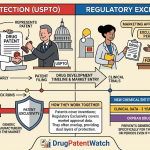
FTO analysis in pharmaceuticals does not operate in a vacuum from the regulatory pathway. The FDA’s drug approval framework, including the Orange Book system, the Hatch-Waxman 30-month stay, the BPCIA patent dance for biologics, and the regulatory exclusivity periods layered on top of patent rights, creates a system where regulatory and patent strategy must be coordinated from the earliest stages of development. An FTO analysis that treats patents as independent of regulatory timelines misses half the picture.
Regulatory Exclusivity vs. Patent Rights: Two Separate Clocks
Pharmaceutical companies benefit from two legally distinct types of market protection: patent rights and regulatory exclusivity. They can overlap, run sequentially, or one can expire while the other is still in force. Understanding the relationship between them is essential to interpreting the commercial relevance of an FTO analysis.
FDA regulatory exclusivity — NCE exclusivity (five years for new chemical entities), orphan drug exclusivity (seven years), pediatric exclusivity (six months added to existing patents and exclusivities), and biologic exclusivity (12 years for reference products under the BPCIA) — bars the FDA from accepting or approving certain competitor applications during the exclusivity period. It does not require any patent. A company with regulatory exclusivity but no patent has blocking power in the market even if its FTO analysis is completely clean.
Patent rights, conversely, run on a different timeline set by filing date and term extensions. A product can have valid, enforceable compound and formulation patents but expired regulatory exclusivity. The FDA can approve a competitor’s ANDA or biosimilar application, but the competitor still cannot launch without resolving the patent issues. This is the standard Hatch-Waxman scenario for established drugs.
For companies evaluating a market opportunity — whether to develop a generic competitor, a biosimilar, or a next-generation product in a class dominated by an incumbent — the FTO analysis must be read alongside the regulatory exclusivity timeline. A product with three years of NCE exclusivity remaining and a strong compound patent expiring in eight years presents a very different commercial opportunity than a product whose NCE exclusivity has expired but whose formulation and dosing patents still have four years to run.
The Orange Book Listing System and FTO Implications
The FDA’s Orange Book (Approved Drug Products with Therapeutic Equivalence Evaluations) lists patents that the NDA holder has submitted as claiming the drug substance, drug product, or a method of using the drug. Generic manufacturers filing ANDAs must certify with respect to each listed patent. The listing system is consequential for FTO in both directions.
For brand manufacturers, Orange Book listing triggers the Paragraph IV process and enables the 30-month litigation stay that delays generic entry. A patent that is listed in the Orange Book carries automatic commercial significance beyond its legal validity: listing creates a structured legal process that forces the generic challenger to litigate or wait.
For generic manufacturers, Orange Book listing defines the minimum set of patents requiring FTO analysis. But as noted above, the Orange Book is not comprehensive. In September 2023, the FTC issued a policy statement warning pharmaceutical companies that improper Orange Book listings — patents that do not legitimately claim the drug substance, drug product, or a method of use for the approved indication — could constitute an antitrust violation. In June 2024, a federal court in New Jersey allowed antitrust claims to proceed against a brand manufacturer over disputed Orange Book listings [8]. This enforcement pressure has made the FTC an active participant in Orange Book analysis: a generic developer with reason to believe that listed patents are improper listings may have both an invalidity argument and an antitrust argument available, both of which should be evaluated during FTO analysis.
FTO and the 30-Month Litigation Stay
When an ANDA applicant files a Paragraph IV certification, the NDA holder has 45 days to file a patent infringement suit. If the NDA holder files suit within 45 days, FDA approval of the ANDA is automatically stayed for 30 months from the date of notice of the Paragraph IV filing — unless the patents at issue are adjudicated before 30 months expires or the 30-month period is shortened or extended by court order.
The 30-month stay is a critical commercial variable for generic FTO strategy. A generic challenger that wins an invalidity judgment at the district court level before the 30-month stay expires can receive final FDA approval and launch before the stay would otherwise expire. A generic challenger who receives a favorable FTO opinion at filing but cannot litigate to judgment within 30 months faces a de facto delay in commercial launch even if the Paragraph IV certification is ultimately validated.
This dynamic shapes how generic FTO analysis is used strategically. Companies with the most robust invalidity arguments — particularly those based on strong prior art that the examiner clearly did not consider during prosecution — are positioned to move for summary judgment of invalidity on a schedule that can produce a court ruling within the 30-month window. FTO analysis that identifies thin, potentially vulnerable Orange Book patents is actionable competitive intelligence, not just a legal clearance exercise.
FTO and New Drug Application Supplemental Submissions
For brand manufacturers, supplemental NDAs — sNDAs — that add new indications, new formulations, or new dosing regimens to an existing approved drug create new patent and FTO dynamics. New Orange Book listings can be added for new patents. New regulatory exclusivity may attach (for example, three years of exclusivity for a new clinical investigation supporting the supplement). But the supplement also creates a new FTO question from the perspective of any generic challenger: a generic that had cleared all existing Orange Book patents may face new patent exposure from supplemental listings added after their ANDA was filed.
Brand manufacturers use supplemental NDA strategies deliberately as lifecycle management tools, coordinating new patent filings with supplemental submissions to create additional Orange Book listing opportunities. A generic company that filed a Paragraph IV certification years before an sNDA may find that new patents listed through the sNDA require additional Paragraph IV certifications — and potentially trigger new 30-month stays — on the original ANDA. Understanding how brand sNDA strategy interacts with Orange Book listings is part of any sophisticated generic FTO program.
FTO Analysis in Specific High-Risk Drug Classes
Some therapeutic classes present systematically higher FTO risk than others, due to the density of the patent landscape, the sophistication of incumbent IP strategies, and the commercial stakes involved. Three classes deserve specific attention: oncology, GLP-1/metabolic disease, and rare/orphan disease.
Oncology: The Most Patent-Dense Therapeutic Area
Oncology is the most patent-active therapeutic area in pharmaceutical development. The FDA approved more than a dozen new cancer therapies annually through 2023 and 2024. Each new approved therapy generates a set of compound, formulation, manufacturing, and method-of-use patents. Combination regimen patents — covering the use of two or more approved agents together — proliferate rapidly as clinical data accumulates on combination efficacy. The result is a patent landscape of extraordinary density, where a new oncology drug faces potential infringement exposure not only from its own mechanism’s patent family but from the combination patents of every other agent being used alongside it in clinical practice.
FTO analysis for oncology drugs is consequently among the most resource-intensive in pharmaceutical development. The combination patent problem is particularly acute: if your kinase inhibitor is being studied in combination with a checkpoint inhibitor that is separately covered by method-of-use combination patents, your Phase III combination regimen may be walking into patent exposure that has nothing to do with your compound’s own IP.
Oncology is also the area where biosimilar FTO has become most commercially significant. Reference biologics in oncology — including major checkpoint inhibitors and ADC therapies — are now facing biosimilar development timelines in the U.S. and globally. The complexity of biologic manufacturing process patents, antibody sequence patents, and combination regimen patents makes biosimilar FTO in oncology a multi-layered challenge requiring dedicated specialist engagement.
GLP-1 and Metabolic Disease: The Hottest FTO Battleground of the Decade
GLP-1 receptor agonists — exemplified by semaglutide (Ozempic, Wegovy) and tirzepatide (Mounjaro, Zepbound) — represent the most commercially consequential pharmaceutical class of the mid-2020s. Novo Nordisk and Eli Lilly have built substantial patent portfolios around these compounds, covering the peptide sequences, formulation systems, dosing devices (auto-injectors and pens), dosing regimens, and multiple indications including type 2 diabetes, obesity, cardiovascular risk reduction, and sleep apnea.
The commercial scale of these drugs — Eli Lilly’s tirzepatide topped global sales charts in early 2025 — means that any competitor attempting to enter this space faces FTO analysis across a dense multi-patent portfolio held by well-resourced incumbents with strong litigation histories. For would-be generic or biosimilar developers, FTO analysis in this class requires evaluating peptide sequence patents, formulation patents on the specific microencapsulation or depot delivery systems, device patents on the pen injectors, and a growing body of method-of-use patents covering specific patient populations and outcomes.
Novo Nordisk’s semaglutide patent protection extends across multiple jurisdictions with varying expiration dates. The core compound patents in some markets expire in the late 2020s; formulation and device patents extend further. For a generic or biosimilar developer planning market entry in this class, the FTO analysis timeline must be built around a patent-by-patent expiration matrix, with simultaneous IPR challenges filed against the most commercially relevant blocking patents.
Orphan and Rare Disease: FTO When the Science is Novel and the Patents Are Few
Rare disease drugs present a different FTO profile. The underlying science — gene therapy, enzyme replacement, RNA-based therapeutics — is often genuinely novel, with a less dense predecessor patent landscape. But the novelty of the science cuts both ways: because the technology is new, the pioneer patents that do exist often have broad claims that cover large swaths of the therapeutic approach.
Gene therapy FTO, for example, requires analysis of patents on viral vector serotypes (particularly AAV capsids), promoter sequences, transgene cassette designs, and manufacturing and purification processes — each of which may be controlled by a small number of academic institutions and early-moving companies. Spark Therapeutics, Genzyme, and University of Pennsylvania have significant AAV patent portfolios that affect FTO for virtually any gene therapy developer using common AAV serotypes.
RNA therapeutic FTO — covering ASOs, siRNA, and mRNA — requires analysis of backbone chemistry patents (phosphorothioate linkages), lipid nanoparticle delivery patents (where Alnylam and Moderna/Arbutus hold significant positions), and sequence patents on specific target molecules. The Moderna-Arbutus lipid nanoparticle patent dispute, which produced substantial litigation and licensing activity through 2022 and 2023, illustrates the degree to which platform technology patents can affect FTO for an entire class of therapeutics.
Regulatory exclusivity takes on outsized importance in orphan disease. Seven years of orphan drug exclusivity provides strong market protection that may matter more than patent protection in a disease area where the patient population is small and the patent landscape is sparse. But exclusivity is condition-specific: a competitor developing the same drug for a different orphan disease is not blocked by the original orphan exclusivity. FTO analysis in orphan disease must include a careful analysis of which diseases and patient populations are covered by existing exclusivities, and whether the proposed new indication falls within or outside those exclusivities.
The Role of Patent Analytics and AI Tools in Modern FTO Practice
Patent analytics has changed materially in the past decade. The tools available to pharmaceutical IP teams — both commercial platforms and AI-assisted applications — can now conduct preliminary claim mapping, generate patent family trees, identify prosecution history patterns, and produce competitive patent landscapes at a speed and scale that was not possible through manual review even five years ago. The question for pharmaceutical FTO practitioners is where these tools genuinely add value and where they introduce risk.
Where Technology Helps
Patent search and retrieval is the most straightforward application of modern patent analytics. Platforms like DrugPatentWatch, PatSnap, and Derwent Innovation allow IP teams to conduct searches across multi-jurisdictional patent databases, filter by assignee, technology classification, legal status, and expiration date, and export structured patent family data in formats that support downstream analysis. These tools replace manual USPTO and Espacenet searching for the bulk of pharmaceutical FTO landscape work.
Patent family tree analysis — identifying all related applications (continuations, divisionals, CIPs, PCT national phase entries) from a single filing — is a task where commercial databases dramatically outperform manual searching. A patent family that might take a researcher a day to map manually can be assembled automatically, with legal status for each member, in minutes using commercial tools. This matters for FTO because the blocking risk of a patent family depends on the status of every member, not just the parent.
Competitive monitoring — tracking new patent filings by competitor assignees, alerting on publication of applications in specified technology classes, and flagging PTAB proceeding outcomes — is a natural fit for automated alerting systems. Human reviewers checking competitor patent databases manually every month will miss publications between reviews. Automated systems that alert within days of a new patent publication in a configured technology area provide coverage that manual monitoring cannot.
AI-assisted claim analysis — using natural language processing to compare product descriptions against claim language — is an emerging capability that some platforms now offer. This technology can be useful for preliminary screening: identifying which of hundreds of retrieved patents are likely to have relevant claims, reducing the set that requires detailed human claim analysis. But AI claim analysis currently cannot replace attorney judgment on claim construction, prosecution history estoppel, and the doctrine of equivalents. These are legal determinations that require human legal expertise applied to specific facts. Teams that use AI screening to prioritize their attorney review — rather than to replace it — are using the technology appropriately.
Where Technology Introduces Risk
The primary risk of AI-assisted FTO tools is false confidence. A platform that reports ‘no blocking patents found’ based on keyword or classification searches may have missed a critical Markush group claim that covers the compound through structural searching. A chemical structure search run on a platform with incomplete Markush indexing may not surface a genus claim that reads literally on your API. A monitoring system that filters by assignee may miss a relevant continuation filed by a subsidiary or a shell entity that holds the patent.
The responsibility for these gaps does not fall on the technology — it falls on the team that accepted the technology’s output as complete. AI and analytics tools are force multipliers for experienced patent attorneys and scientists. They are not substitutes for legal judgment, and they produce outputs that must be reviewed with an understanding of their limitations.
The most dangerous failure mode in technology-assisted FTO is the substitution of analytics for legal opinion. A patent analytics report, however sophisticated, is not an attorney FTO opinion. It does not establish attorney-client privilege, it does not provide the good-faith defense against willful infringement findings that a formal legal opinion provides, and it does not reflect the legally binding analysis of qualified counsel. Companies that present patent analytics reports to management as ‘FTO clearance’ are creating legal exposure, not mitigating it.
International FTO: A Practical Country-by-Country Guide
The practical execution of international pharmaceutical FTO analysis requires country-specific knowledge that generic patent principles do not fully capture. The following overview covers the key jurisdictional differences that affect FTO analysis for the major pharmaceutical markets.
United States
U.S. pharmaceutical FTO centers on the Orange Book and Hatch-Waxman for small molecules, and the BPCIA patent dance for biologics. Claim construction follows the Phillips standard (claims interpreted in light of the specification and prosecution history, from the perspective of a person of ordinary skill in the art). The doctrine of equivalents remains available but is constrained by prosecution history estoppel. The PTAB provides a robust post-grant challenge mechanism through IPR and PGR. PTE is available for up to five years for FDA-regulated products. U.S. patent practice allows very broad continuation application strategies that support lifecycle management, making pending application monitoring critical.
European Union and EPO
European patent prosecution is conducted before the EPO under the European Patent Convention. Granted European patents are validated nationally in each desired EPC member state. Claims are interpreted under the Protocol on the Interpretation of Article 69 EPC, which aims for a balance between literal claim scope and the inventive contribution of the patent. Equivalents doctrine exists in European practice but is generally narrower than in U.S. practice.
EPO opposition proceedings — available within nine months of patent grant — are a powerful patent challenge mechanism, allowing third parties to challenge a European patent centrally rather than in each national court separately. Many pharmaceutical patent challenges in Europe are filed as EPO oppositions before or alongside national court proceedings. EPO oppositions succeed in fully revoking patents at a rate that experienced pharmaceutical patent practitioners find noteworthy compared to U.S. district court invalidity outcomes.
SPCs are the primary patent life extension mechanism in the EU, granted by national patent offices based on EU marketing authorization. The Unitary Patent and the Unified Patent Court (UPC), which became operational in 2023, are changing European pharmaceutical patent litigation. The UPC provides a single court for infringement and validity proceedings across participating EU member states — a significant change from the historically fragmented national litigation landscape that often required parallel proceedings in multiple countries for the same dispute.
Japan
Japan’s pharmaceutical patent system has several distinctive features. The Japanese Patent Office (JPO) has historically allowed broad genus claims, but has narrowed claim scope through prosecution examination that can make Japanese pharmaceutical patents harder to design around in some respects. Japan offers patent term extensions for pharmaceutical products subject to regulatory review, with extensions of up to five years available.
Japanese pharmaceutical patent enforcement is conducted in the Tokyo or Osaka district courts, which have specialized patent divisions with technical expertise. Japan does not have a Hatch-Waxman analog with the same formal patent-regulatory linkage as the U.S. system, though the Japanese regulatory framework for generics includes patent status considerations at the approval stage.
China
China has become an increasingly important pharmaceutical patent jurisdiction over the past decade. China introduced a patent linkage system in 2021 under amendments to the Drug Administration Law, creating a mechanism loosely modeled on Hatch-Waxman that links pharmaceutical marketing approval to patent status. The National Medical Products Administration (NMPA) maintains a patent information registration platform analogous to the U.S. Orange Book.
Chinese pharmaceutical patent enforcement has strengthened considerably. The IP courts established in Beijing, Shanghai, and Guangzhou have specialized competence in pharmaceutical patent disputes, and Chinese courts have issued preliminary injunctions in pharmaceutical cases. Patent term compensation for regulatory delay became available in China in 2021, with extensions of up to five years for qualifying pharmaceutical patents.
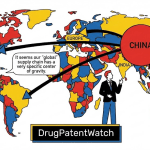
For companies manufacturing in China for export — a common scenario for generic API manufacturing — Chinese patent law applies to the manufacturing activity. A process patent valid in China covers manufacturing steps performed in China, even if the finished product is exported to markets where the process patent has no equivalent. FTO analysis for supply chain decisions must include the manufacturing jurisdiction, not just the commercial sale jurisdiction.
India
India’s patent landscape for pharmaceuticals is shaped by Section 3(d) of the Indian Patents Act, which bars patents on new forms of known substances unless significantly enhanced efficacy is demonstrated. This has resulted in a substantially different secondary patent landscape in India compared to the U.S. Formulation patents, polymorph patents, and salt form patents that are granted in the U.S. frequently do not have Indian counterparts because the applications were rejected under 3(d) or never filed.
For companies that manufacture in India — the world’s largest generic drug manufacturer by volume — the patent landscape is often significantly cleaner than in Western markets. The absence of secondary patent protection in India has been central to India’s role as a global supplier of affordable generic medicines. For FTO analysis, this means that an Indian manufacturing operation frequently enjoys FTO for products where a U.S. or European operation would face blocking secondary patents.
India’s Compulsory Licensing framework under Section 84 of the Patents Act allows the government or private parties to seek compulsory licenses if a patented drug is not reasonably available, not available at a reasonably affordable price, or not worked in India to a sufficient extent. Bayer experienced the first compulsory license granted for a pharmaceutical product in India in 2012 for sorafenib (Nexavar), resulting in a dramatically lower-priced generic version manufactured by Natco Pharma. FTO analysis for high-value drugs in the Indian market should include assessment of compulsory licensing risk.
The Specific Challenge of Biologic and Biosimilar FTO
Biologic drugs — proteins, antibodies, nucleic acid therapeutics — present FTO challenges that differ structurally from small-molecule pharmaceutical FTO. The science is different, the patent claim types are different, the regulatory pathway is different, and the post-Amgen legal landscape is actively shifting.
Antibody Patent Claims: Structural vs. Functional
Monoclonal antibody patents use three basic claim structures: sequence-based claims (defining the antibody by its CDR sequences), epitope-based claims (defining the antibody by the epitope it binds on its target), and functional claims (defining the antibody by what it does — its binding affinity, its neutralization potency, its effector function). Each type carries different FTO implications.
Sequence-based claims are most concrete. If your antibody’s CDR sequences differ from the claimed sequences, and no substantial equivalence argument applies, you do not infringe. Epitope-based and functional claims are broader and harder to avoid — if your antibody binds the same epitope or achieves the same function as the claimed antibody, you may infringe regardless of structural differences.
Post-Amgen v. Sanofi, broad functional antibody claims — claims covering all antibodies that bind a particular epitope or perform a particular function — face serious enablement challenges. The FTO analysis for a blocking functional antibody claim should include an Amgen-based enablement assessment of whether the specification teaches how to make antibodies across the full claimed functional scope [6].
Manufacturing Process Claims for Biologics
Biologic manufacturing process patents — covering cell line engineering, fermentation conditions, purification chromatography steps, and formulation — represent a distinct FTO category from the drug’s therapeutic activity patents. A biosimilar manufacturer who independently develops a similar antibody with different CDR sequences may still infringe manufacturing process patents if their purification process uses the same patented column chemistry or buffer conditions.
Manufacturing process FTO for biologics requires detailed technical disclosure of the proposed manufacturing process and comparison against process patents in the relevant technology space. This is often the most complex and resource-intensive component of a biosimilar FTO, because the manufacturing process itself is a competitive trade secret and technical disclosures for the FTO analysis must be managed carefully.
Building an Internal FTO Governance System
Individual FTO analyses are necessary but not sufficient. What separates pharmaceutical companies with strong IP risk management from those who discover patent problems at the worst possible moments is institutional governance: the policies, processes, roles, and tools that ensure FTO analysis happens at the right time, covers the right scope, reaches the right people, and gets updated when facts change.
Assigning Ownership
FTO governance requires unambiguous ownership. The most common governance failure is the absence of a named person — not a department, a named person — responsible for tracking FTO status across the pipeline. In companies with dedicated IP departments, the portfolio IP lead or pipeline IP counsel is the natural owner. In smaller companies without a dedicated IP team, the VP of R&D or the general counsel must own the function, typically with outside counsel support.
The owner’s responsibilities include: maintaining a pipeline IP register that records the current FTO status, opinion date, jurisdictional coverage, and pending update triggers for every active development asset; coordinating with development project managers to ensure that FTO reviews are on the milestone calendar; reviewing incoming patent monitoring alerts and escalating material new developments to the relevant project teams; and managing outside counsel FTO engagements from scope definition through opinion delivery.
The Pipeline IP Register
A pipeline IP register is a living document — maintained in a searchable, versioned system — that records for every development-stage asset: the product description on which the current FTO analysis is based; the date and scope of the most recent formal FTO opinion; the jurisdictions covered by the current opinion; a summary of the key blocking patents identified and the current assessment of each; the action plan for any unresolved blocking patents; the trigger conditions that will initiate the next FTO review; and the outside counsel lead for the asset’s FTO work.
The register should be reviewed by IP leadership quarterly and should be the primary reference document in IP due diligence for licensing and acquisition transactions. A well-maintained pipeline IP register that has been updated consistently throughout development is itself a commercial asset — it demonstrates to potential licensing partners and acquirers that the company has managed its IP risk systematically, which reduces the risk premium that sophisticated counterparties apply to assets with uncertain FTO status.
Integration with the Stage-Gate Development Process
In companies with formal stage-gate development processes, FTO review should be a documented component of the go/no-go criteria at each stage gate. At the preclinical candidate selection gate, a preliminary internal FTO review is required — not a formal opinion, but a documented search for obviously blocking compound patents and a summary of the patent landscape in the target class. At the IND-enabling gate, a formal FTO opinion from outside counsel covering at least the U.S. is required as a condition of gate approval. At the Phase II/Phase III gate, an updated FTO opinion is required covering any changes to the product definition and reviewing new patents published since the IND opinion. At the NDA/BLA preparation gate, a comprehensive multi-jurisdiction FTO opinion covering all planned commercial markets is required as a condition of NDA submission approval.
Training the Development Team
FTO governance is only as effective as the development team’s understanding of what triggers a required update. If the medicinal chemistry team changes a salt form without realizing that the new form may fall within a different patent family, and no one flags that change to the IP team, the FTO register becomes inaccurate without anyone knowing it. Practical IP literacy training for pharmaceutical development scientists — covering what kinds of product changes trigger FTO review and how to recognize when to escalate — is a governance investment that pays consistent dividends. It does not require training scientists to be patent attorneys. It requires training them to recognize when something potentially relevant has happened and bring it to the right person’s attention.
Crisis Response: When a New Blocking Patent Surfaces Late
Even with rigorous FTO governance, patents publish on timelines that do not respect drug development milestones. A company with a product in Phase III may face a newly published continuation application whose scope was not anticipated in the existing FTO opinion. A product approaching NDA filing may face an Orange Book listing update that adds new patents to an approved competitive product. Every FTO governance system needs a defined crisis response protocol: a documented process for rapidly assessing the commercial significance of a late-surfacing blocking patent and presenting options to the development committee on an accelerated timeline. Companies that have thought through this protocol before a crisis occurs respond faster and with better-coordinated decision-making than those constructing their response under commercial deadline pressure. The difference between a patent issue that is managed successfully and one that becomes a litigation event often comes down to how quickly the affected organization can assess the situation and exercise its available options.
Common FTO Mistakes That End in Litigation
After examining the methodology, it is worth naming the specific failures that appear repeatedly in pharmaceutical patent litigation records — the mistakes that turned manageable IP risk into material litigation events.
Relying on Product Launch Without a Written Opinion
Companies that launch commercial products without a formal written FTO opinion from outside counsel face willful infringement liability without the defenses that a competent opinion provides. This failure is more common in smaller companies and startups, where the cost of a comprehensive FTO engagement is perceived as disproportionate to the development stage. The AIPLA data on median patent litigation costs — which can reach $5.5 million for cases where more than $25 million is at risk — makes the cost calculus clear [1].
Failing to Search Pending Applications Systematically
The 18-month publication gap means that a patent can issue after your commercial launch covering technology that was pending and invisible during your FTO analysis. Companies that limit their FTO searches to issued patents — without tracking competitor prosecution activity and anticipating likely pending claims — are surprised by post-launch patent issuance. Regular monitoring between the initial FTO and commercial launch is the mitigation.
Stopping the Analysis at the U.S. Patent
U.S.-only FTO analysis misses the full picture for globally commercialized drugs. Manufacturing in Ireland while selling in the EU creates patent exposure under European patents that have nothing to do with U.S. Orange Book listings. Companies that treat international FTO as optional until late in development find themselves negotiating licenses under commercial pressure in the most expensive possible negotiating conditions.
Ignoring Continuation Applications from Identified Patents
A patent family with multiple continuation and continuation-in-part applications filed over years can produce a stream of related patents with potentially different claim scopes. An FTO analysis that evaluates the parent patent but ignores the continuation family misses the full patent exposure. Each member of the family must be independently evaluated, because continuation claims are often drafted specifically to cover competing products that have been disclosed since the parent patent’s filing — a well-documented practice known as ‘continuation stalking.’
Treating FTO as a One-Time Legal Exercise
The most systemic FTO failure in pharmaceutical development is treating the initial FTO opinion as a permanent clearance. Drug development timelines are long. Patent landscapes change. The product changes. An FTO opinion that was accurate and complete at IND may be materially incorrect by the time of NDA filing, if no one reviewed it in the intervening years. FTO governance — a documented, calendared review process with clear ownership — is as important as the initial analysis.
The Cost-Benefit Case for Early and Rigorous FTO
Pharmaceutical companies sometimes frame FTO analysis as a cost center — a legal expense that delays development timelines and does not produce a direct commercial return. The data do not support that framing.
In 2024, 312 complaints initiating Hatch-Waxman litigation were filed, a notable increase from 259 in the prior year, with nearly half of all ANDA complaints in 2024 assigned to just five judges. Each of those complaints represents a company — brand or generic — that either could not agree on FTO before launch or made a deliberate decision to litigate. The median cost of patent litigation in a case where more than $25 million is at risk represents a fraction of the commercial value at stake, but it is still a minimum of several million dollars in legal fees before a verdict. For cases involving blockbuster drugs, litigation costs and exposure dwarf the FTO analysis investment.
The positive case for early FTO is simpler: early identification of a blocking patent, before significant development investment has been made, allows a company to design around, seek a license, or redirect resources toward a cleaner opportunity. Late identification — at NDA filing, in due diligence for a billion-dollar transaction, or after commercial launch — collapses the available options and maximizes costs regardless of which path is taken.
A biotech company that runs a comprehensive FTO analysis at candidate selection, identifies a problematic formulation patent, and modifies its formulation strategy in Phase I development has spent perhaps $50,000 to $150,000 on outside counsel fees to avoid a problem that would have cost tens of millions to resolve at commercialization. That return on investment is not marginal. It is the difference between a commercial program and a litigation event.
Key Takeaways
FTO is not optional. For any pharmaceutical product in development, FTO analysis is a core risk management function, not a discretionary legal expense. The cost of a rigorous FTO engagement is a fraction of the cost of the litigation it prevents.
Start early, update often. FTO analysis at candidate selection, with mandatory updates at every major development milestone and whenever the product definition changes, provides the coverage that a single late-stage opinion cannot.
The claim is what matters. Reading patent claims precisely — with prosecution history analysis, claim construction, and the doctrine of equivalents — is the core analytical skill. Analyses based on titles, abstracts, or general impressions of competitor technology are not FTO analysis.
Validity is half the equation. A valid-and-infringed claim blocks commercialization. An infringed-but-invalid claim does not. Every blocking patent identified in FTO analysis should receive a preliminary validity assessment before it is treated as a hard commercial barrier.
Know your options when you find a block. Design-around, licensing, IPR challenge, Paragraph IV certification, and expiration timing are all viable paths depending on the patent’s strength, the product’s commercial value, and the timeline pressure. Identifying those options early keeps the decision in the developer’s hands, not the courts’.
Geographic coverage is mandatory. The patent landscape in Japan, India, Europe, and Canada differs materially from the U.S. landscape for most pharmaceutical products. Multi-jurisdiction FTO analysis must be initiated before significant resources are committed to global commercialization.
The opinion must be written, privileged, and current. A verbal assurance from counsel is not an FTO opinion. A written opinion that was accurate three years ago but has not been updated may not provide willful infringement protection for a current commercial launch. Opinion management is an ongoing process.
Post-Amgen changes biologic FTO. Broad functional antibody patents are materially more vulnerable to enablement attacks after the Supreme Court’s 2023 decision. Biologic FTO analysis should incorporate this legal development for every blocking patent with broad functional claims.
FAQ
Q1: At what stage of pharmaceutical development should a company first conduct an FTO analysis?
The practical answer is as early as the lead compound or candidate selection stage. A preliminary FTO at this point does not need to be a comprehensive formal opinion — it is a targeted search to identify whether any obvious blocking patents cover the compound class, the proposed formulation approach, or the target indication. The purpose is to flag material IP risk before the company commits significant Phase I development spending. If a blocking patent is identified at lead selection, the team still has maximum flexibility to design around, select an alternative compound, or seek an early-stage license. Waiting until NDA filing to conduct the first FTO analysis is a common and expensive mistake — by that point, the product is locked, the formulation is locked, and the options for avoiding a blocking patent are dramatically narrower.
Q2: What is the difference between an FTO analysis and an Orange Book review for a generic drug developer?
An Orange Book review is a subset of the FTO analysis for generic pharmaceutical products operating under Hatch-Waxman. The Orange Book lists the patents that the brand manufacturer has asserted as relevant to the approved drug product, and the generic manufacturer must certify against those listed patents in its ANDA. But the Orange Book does not necessarily include all patents that could affect the generic product. Brand manufacturers list only patents they choose to list — patents on manufacturing processes, unclaimed formulation patents, and patents on related technology not required to be listed may still be relevant to the generic’s FTO. A rigorous generic FTO analysis reviews the Orange Book, then conducts independent patent searching to identify patents outside the Orange Book that might still present infringement risk. The Orange Book is the starting point, not the complete answer.
Q3: Can an FTO opinion be used to defeat a willful infringement finding if the opinion later proves to be wrong?
Generally, yes — provided the opinion was prepared in good faith, by qualified counsel, based on a thorough and competent analysis. The standard for willful infringement is not whether the defendant was right about FTO, but whether the defendant’s conduct was objectively reckless. A thorough written FTO opinion, obtained before commercial launch, that reached a non-infringement or invalidity conclusion based on genuine legal and factual analysis establishes that the defendant did not act recklessly, even if a court later reaches a different conclusion on the merits. What does not work as a willfulness defense is an opinion that was superficial, that ignored obviously relevant patents, that was obtained after the infringing activity began, or that was not actually relied upon in making the commercial decision. The quality of the opinion and the process by which it was obtained both matter.
Q4: How does FTO analysis work for a drug repurposing project where the API is already off-patent?
Drug repurposing projects — using an established, off-patent API in a new therapeutic context — face a specific FTO profile. The compound patent on the API is almost always expired or expiring, which eliminates the most common blocking patent category. But formulation patents for specific new delivery systems developed for the repurposed indication may be new and in-force. Method-of-use patents covering the specific repurposed indication — if a competitor has already patented the use of the compound for the target disease — are the most common blocking patent category in repurposing projects. Additionally, if the repurposing project involves a proprietary new formulation that the company intends to patent, the FTO analysis must confirm that the proposed formulation itself does not infringe existing formulation IP. The relatively cleaner compound patent environment in repurposing does not eliminate the need for FTO — it shifts the focus of analysis from compound claims to use and formulation claims.
Q5: How should a pharmaceutical company prioritize its FTO work when resources are limited?
Prioritization should be driven by the intersection of two variables: commercial value and patent risk. Products with the highest projected commercial value in the most patent-dense technology areas warrant the most rigorous and comprehensive FTO investment. A potential blockbuster in an oncology indication — a space with high patent density, sophisticated competitor IP strategies, and active Paragraph IV litigation — requires comprehensive outside counsel engagement with multi-jurisdiction coverage. An API that has been off-patent for decades, in a low-density formulation space, being developed for a market with limited patent enforcement infrastructure, can be managed with more limited in-house review supported by targeted outside counsel analysis. Most pharmaceutical companies with active pipelines manage FTO at multiple tiers — preliminary internal review for early-stage assets, formal outside counsel opinions for clinical-stage assets, and comprehensive multi-jurisdiction opinions for NDA-stage and commercial assets. This tiered approach allows limited IP budgets to be allocated proportionally to the stage and risk profile of each asset.
Sources
American Intellectual Property Law Association. (2019). Report of the Economic Survey. AIPLA. As cited in: DrugPatentWatch. (2025, August 21). Managing drug patent litigation costs: A strategic playbook for the pharmaceutical C-suite. https://www.drugpatentwatch.com/blog/managing-drug-patent-litigation-costs/
DrugPatentWatch. (2026, April 17). The algorithmic adjudicator: How big data and AI are revolutionizing pharmaceutical patent litigation. https://www.drugpatentwatch.com/blog/the-algorithmic-adjudicator-how-big-data-and-ai-are-revolutionizing-pharmaceutical-patent-litigation/
DrugPatentWatch. (2026, March 22). The definitive pharmaceutical FTO playbook: How to conduct a drug patent freedom to operate search that holds up in court. https://www.drugpatentwatch.com/blog/how-to-conduct-a-drug-patent-fto-search/
DrugPatentWatch. (2026, March 8). Expired and abandoned drug patents: The hidden goldmine everyone ignores. https://www.drugpatentwatch.com/blog/expired-and-abandoned-drug-patents-the-hidden-goldmine-everyone-ignores/
DrugPatentWatch. (2025, April 17). Pharmaceutical patent use codes: The definitive technical and strategic guide to Orange Book method-of-use patents, skinny labeling, and induced infringement risk. https://www.drugpatentwatch.com/blog/patent-use-codes-for-pharmaceutical-products-a-comprehensive-analysis/
Amgen Inc. v. Sanofi, 598 U.S. 594 (2023).
In re Seagate Technology, LLC, 497 F.3d 1360 (Fed. Cir. 2007).
DrugPatentWatch. (2025, December 2). A pharma exec’s guide to preliminary freedom-to-operate analysis. https://www.drugpatentwatch.com/blog/a-pharma-execs-guide-to-preliminary-freedom-to-operate-analysis/
DrugPatentWatch. (2026, February 23). Top Paragraph IV litigation trends and what they mean for pharma. https://www.drugpatentwatch.com/blog/top-paragraph-iv-litigation-trends-and-what-they-mean-for-pharma/
Feldman, R., & Frondorf, E. (2017). Drug wars: A new generation of generic pharmaceutical delay. Harvard Journal on Legislation, 53(2), 398–435.
Sarpatwari, A., Avorn, J., & Kesselheim, A. S. (2022). Biological patent thickets and delayed access to biosimilars: An American problem. Clinical Pharmacology & Therapeutics, 112(3), 519–527. https://pmc.ncbi.nlm.nih.gov/articles/PMC9439849/
DrugPatentWatch. (2026, March 8). De-risk your pipeline: The definitive guide to freedom-to-operate analysis in biopharma. https://www.drugpatentwatch.com/blog/de-risk-your-pipeline-the-definitive-guide-to-freedom-to-operate-analysis-in-biopharma/
World Intellectual Property Organization. (2025). IP and business: Launching a new product — freedom to operate. WIPO Magazine. https://www.wipo.int/en/web/wipo-magazine/articles/ip-and-business-launching-a-new-product-freedom-to-operate-34956
DrugPatentWatch. (2026, March 22). ANDA litigation: The complete playbook for pharmaceutical patent litigators, IP teams, and institutional investors. https://www.drugpatentwatch.com/blog/anda-litigation-strategies-and-tactics-for-pharmaceutical-patent-litigators/
DrugPatentWatch. (2025, July 31). Handling drug patent invalidity claims. https://www.drugpatentwatch.com/blog/handling-drug-patent-invalidity-claims/