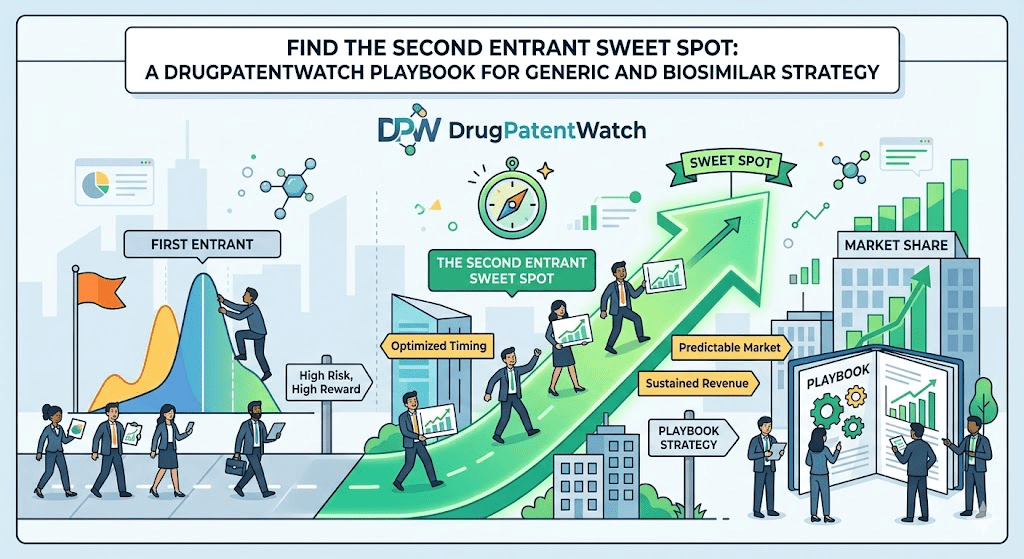
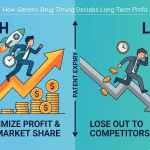
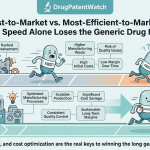
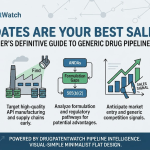
The first generic filer gets the headlines. The second entrant often gets the margin.
In the United States pharmaceutical market, the conventional wisdom runs like this: race to file a Paragraph IV certification, win 180-day exclusivity under Hatch-Waxman, and capture the price premium before the market collapses. It is clean logic. It is also increasingly wrong as a universal strategy, and the evidence sits plainly in the litigation dockets of the District of Delaware and the Southern District of New York.
Between 2015 and 2023, first-filer Paragraph IV challengers faced an average litigation success rate below 30 percent when the branded company chose to defend [1]. Settlements frequently included a negotiated entry date that the first filer could not improve, while subsequent applicants watched, filed their own challenges with updated claim charts, and sometimes entered the market on identical or earlier dates with none of the litigation cost.
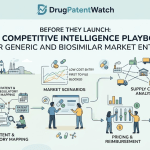
This article is a working guide to identifying that window. It explains the patent intelligence workflow inside DrugPatentWatch, covers how to read Orange Book listings, interpret Paragraph IV certification histories, and model loss-of-exclusivity (LOE) timelines with enough precision to make a credible go/no-go recommendation to a business development committee.
The ‘second entrant sweet spot’ is not a vague concept. It is a specific combination of patent landscape, regulatory exclusivity timing, competitive density, and branded-company litigation posture that makes the second or third ANDA filer more commercially attractive than the first. The analysis requires data. DrugPatentWatch is the fastest way to assemble it.
What Is the Second Entrant Sweet Spot in Generic Drug Markets?
The second entrant sweet spot describes a market entry position where a generic or biosimilar company files after the first Paragraph IV challenger but before the competitive window closes, avoids or shortens the litigation burden of the pioneer, and enters the market close to or simultaneously with the first filer while retaining commercial viability.
It is a function of three overlapping conditions:
The first filer is tied up in active litigation with no settlement in sight, leaving the branded product commercially exposed at patent expiry.
The patent estate is thin enough that a second filer can design around key claims or challenge different patents with new prior art.
The branded company’s litigation resources are stretched, making a favorable settlement or a consent judgment more accessible to a second entrant than to the pioneer who triggered full-scale defense.
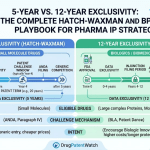
In the biosimilar market the dynamic is slightly different. The Biologics Price Competition and Innovation Act (BPCIA) does not include a 180-day exclusivity provision equivalent to Hatch-Waxman, which means multiple biosimilar entrants can launch simultaneously. The sweet spot in biologics involves timing the entry after the reference product’s 12-year regulatory exclusivity but before the biosimilar market fragments to the point where unit economics collapse.
How DrugPatentWatch Works: A Platform Overview for Strategy Teams
DrugPatentWatch aggregates and cross-references three primary data streams: the FDA Orange Book, United States Patent and Trademark Office (USPTO) patent records, and federal court ANDA litigation dockets. The platform structures this data around individual drugs, active ingredients, and patent numbers so that a user can move from a drug name to a complete patent timeline in a single session.
The core use cases for strategy teams are:
Identifying which patents protect a branded drug and when they expire.
Tracking who has already filed Paragraph IV certifications against those patents.
Monitoring the litigation status of existing challenges.
Modeling the earliest plausible market entry date across all identified IP barriers.
Subscription tiers vary, but the intelligence that matters most for second-entrant analysis—full patent claim data, certification histories, and litigation outcomes—sits behind the paid tiers. Companies running live ANDA or 505(b)(2) programs treat the subscription as a recurring line item in the business development budget, not a discretionary expense.
How to Search DrugPatentWatch by Drug Name, Active Ingredient, or NDA Number
The most direct entry point is a drug name search. Typing ‘Eliquis’ returns patent data for apixaban, Bristol-Myers Squibb’s anticoagulant. The platform displays Orange Book-listed patents, their expiry dates, and any Paragraph IV certification activity filed against the New Drug Application (NDA).
Searching by active ingredient is more useful when you are screening a therapeutic area rather than a specific product. A search for ‘apixaban’ surfaces all NDA-level patent data tied to that molecule. Searching by NDA number (e.g., NDA 202155 for Eliquis) is the most precise method and is the approach recommended when building a formal patent landscape for a portfolio review.
Reading the Orange Book Patent Table: What Each Column Means
The Orange Book lists patents in three categories: drug substance (active ingredient), drug product (formulation), and method of use. Each has different strategic implications for a generic challenger.
Drug substance patents are the hardest to design around and the most consequential to challenge. They typically expire first (filed at or near the IND stage) and carry the highest litigation risk for a Paragraph IV filer. Drug product patents—covering formulations, particle sizes, or delivery mechanisms—often expire later and are more vulnerable to design-around strategies. Method of use patents are the most common target of carve-out labeling strategies, where a generic files for approval only for indications not covered by the patent, so-called ‘skinny label’ filings.
On DrugPatentWatch, each patent entry in the Orange Book table includes:
Patent number and assignee.
Expiration date (including pediatric exclusivity extensions where applicable).
Patent type code (using FDA’s ‘PC’, ‘DP’, ‘MU’, ‘NP’ designations).
Whether a Paragraph IV certification has been filed.
How to Identify the First Paragraph IV Filer and Assess 180-Day Exclusivity Status
When the first ANDA applicant files a Paragraph IV certification, it triggers a 45-day window during which the patent holder can sue. If the branded company files suit within 45 days, a 30-month stay of FDA approval kicks in automatically. The first filer earns 180-day exclusivity from the date of first commercial marketing or a court decision invalidating or finding non-infringement—whichever comes first.
DrugPatentWatch’s Paragraph IV certification tracker shows the applicant names (where disclosed), the filing dates, and the litigation status. For second-entrant analysis, the key question is not merely ‘who filed first’ but ‘has the first filer’s exclusivity been forfeited or converted to a shared exclusivity?’
Forfeiture triggers under 21 U.S.C. § 355(j)(5)(D) include failure to market within 75 days of a court decision or approval, withdrawal of the ANDA, and failure to obtain tentative approval within 30 months. Each forfeiture scenario opens the market to subsequent filers and is one of the first things to check when evaluating a second-entrant opportunity.
The Hatch-Waxman Framework: What Drives First-Filer Advantage—and When It Disappears
Enacted in 1984, the Drug Price Competition and Patent Term Restoration Act (Hatch-Waxman) created the ANDA pathway and established the Paragraph IV certification mechanism. The 180-day exclusivity reward for the first filer was designed to compensate for the litigation risk of challenging a branded patent before expiry.
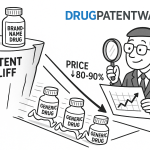
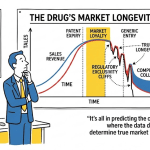
For the first two decades after passage, the first-filer advantage was straightforward. Branded companies had smaller patent estates, litigation was less complex, and the financial model worked. The first generic filer earned a period of duopoly pricing before the full generic market launched, typically capturing 80 percent of the branded volume at roughly 80 percent of the branded price during exclusivity, then watching prices drop to 10 to 20 percent of branded upon multi-generic entry.
That model started fracturing around 2005 to 2008 for several reasons.
Why First-Filer Litigation Risk Has Increased Since 2010
Branded companies systematically expanded their patent portfolios during the 2000s in response to early generic challenges. A drug that had one or two Orange Book patents in 1990 might have eight to fifteen by 2010. Each additional patent requires a separate Paragraph IV certification and, potentially, separate litigation.
The inter partes review (IPR) process at the Patent Trial and Appeal Board (PTAB), introduced under the America Invents Act in 2012, gave generic companies a lower-cost alternative to district court litigation for invalidating patents. But it also created a strategic complexity: an IPR petition filed while district court litigation is pending can be used by the branded company to argue a stay of the district court case, extending the timeline and the branded company’s effective exclusivity.
First filers who filed Paragraph IVs on all listed patents and triggered the full 30-month stay found themselves locked into a litigation posture that consumed resources for three to five years. Second filers who monitored the outcome of that litigation and timed their own certifications accordingly could enter the market at close to the same time with a fraction of the legal spend.
The Authorized Generic Threat: How Branded Companies Neutralize First-Filer Economics
The authorized generic (AG) is a branded company’s own generic product, sold under the same NDA and distributed through a subsidiary or licensing partner during the first filer’s 180-day exclusivity window. The Federal Trade Commission ruled in 2006 that authorized generics do not violate the Hatch-Waxman statute [2]. The economic impact is severe: studies show that authorized generic competition during the exclusivity period reduces first-filer revenues by 40 to 52 percent [3].
For the second entrant, the authorized generic dynamic is a double-edged consideration. On one hand, the first filer’s exclusivity is worth less, which reduces the opportunity cost of not being the first filer. On the other hand, when the second filer enters after the exclusivity period, there are now three products competing (brand, authorized generic, and first filer), compressing margins further.
The second-entrant sweet spot in an AG-heavy market tends to favor products where the branded company has chosen not to deploy an AG—a decision that DrugPatentWatch users can research through public licensing disclosures and prior AG launch patterns at the company level.
Patent Expiry vs. Regulatory Exclusivity: Why the Difference Matters for Entry Timing
One of the most common errors in generic market entry analysis is conflating patent expiry with loss of exclusivity (LOE). They are related but not identical. A drug can have all its patents expire but still be protected by FDA-administered regulatory exclusivity that prevents generic approval.
The regulatory exclusivities to track are:
Five-year new chemical entity (NCE) exclusivity for drugs with no previously approved active moiety.
Three-year new clinical investigation exclusivity for drugs with new indications, formulations, or dosage forms requiring new clinical studies.
Seven-year orphan drug exclusivity for drugs targeting rare diseases (fewer than 200,000 U.S. patients).
Six-month pediatric exclusivity, which attaches to both patent expiry and other exclusivities when the branded company conducts pediatric studies at FDA’s request.
Pediatric exclusivity is particularly important because it is invisible in many patent databases. It adds six months to every Orange Book patent and to NCE exclusivity, and it applies only if the branded company completes the pediatric study and FDA agrees the studies fairly respond to the written request. DrugPatentWatch tracks pediatric exclusivity dates, but users should cross-reference the FDA’s Pediatric Labeling database to confirm whether the studies have been completed.
How Orphan Drug Exclusivity Affects Generic and Biosimilar Entry Timelines
Orphan drug exclusivity blocks FDA from approving a competitor’s application for the same drug, indication, and route of administration for seven years from the date of orphan designation approval. This exclusivity is separate from patent rights and is not subject to Paragraph IV challenge—there is no mechanism to ‘paragraph IV’ an orphan designation.
A second entrant targeting a product with orphan exclusivity has two options: wait for the seven years to elapse, or seek approval for a different indication, formulation, or route. Both strategies are visible in DrugPatentWatch through the exclusivity date fields and cross-referenced with the FDA’s Orphan Drug database.
NCE Exclusivity and the One-Year ANDA Filing Bar: A Timeline Example
Under Hatch-Waxman, no ANDA may be submitted for a drug protected by NCE exclusivity until four years after approval. The first Paragraph IV certification for an NCE-protected drug can be filed no earlier than four years post-approval. If the branded company sues within 45 days, the 30-month stay pushes the effective earliest approval date to roughly 7.5 years post-NDA approval—before any patent expiry considerations.
For second-entrant analysis, this means the clock starts at year four, not year zero. A DrugPatentWatch user modeling entry timing for a recently approved NCE needs to identify: the NDA approval date, the NCE expiry date (four years from approval), and the earliest date a Paragraph IV certification could have been filed (four years from approval) versus when one actually was filed.
How to Build a Patent Expiry Timeline Using DrugPatentWatch: Step-by-Step
Here is a working workflow for building a defensible LOE timeline using DrugPatentWatch as the primary data source.
Step 1: Pull the Orange Book Patent List and Flag Each Patent Type
Start with the drug name or NDA number search. Export or record every listed patent with its expiry date and patent type code. Create a spreadsheet with columns for: patent number, expiry date (pre-pediatric extension), pediatric exclusivity-adjusted expiry, patent type, and Paragraph IV activity.
The goal of step one is to produce an exhaustive list of every formal IP barrier between today and generic entry. At this stage, do not assume any patent is invalid or designable-around—include everything.
Step 2: Identify Which Patents Have Active Paragraph IV Certifications
In DrugPatentWatch, filter for Paragraph IV certifications against the NDA. For each certification, note: the applicant (where disclosed), the filing date, and whether litigation was initiated within 45 days. If a suit was filed, the 30-month stay start date is typically available through the platform’s litigation tracker or through a direct cross-reference to the federal court docket (via PACER).
At this step, you are building the litigation timeline. Note the stay expiry date for each patent under active litigation. The earliest date that FDA could approve any ANDA is the later of: (a) all relevant exclusivity expirations and (b) the end of the 30-month stay on the last patent where litigation was initiated.
Step 3: Check for Patent Term Extensions (PTEs) and Supplemental Protection Certificates
Under 35 U.S.C. § 156, a brand company can seek a patent term extension (PTE) for time lost during FDA regulatory review. The maximum extension is five years, and the extended patent term cannot exceed 14 years from NDA approval. DrugPatentWatch shows PTE-adjusted expiry dates, but users should verify the actual PTE grant in the USPTO database, particularly for patents where the adjustment is large and commercially significant.
Step 4: Model the Three LOE Scenarios
Every LOE analysis should produce three scenarios:
Bear case: All patents upheld, no Paragraph IV success, generic entry at the last patent expiry (including PTEs and pediatric extensions).
Base case: The most legally vulnerable patents are invalidated or found non-infringing, with generic entry at the expiry of the surviving core patent(s).
Bull case: First Paragraph IV filer wins a court decision or reaches a favorable settlement, enabling generic entry before the last patent expiry.
The second entrant’s analysis sits primarily in the base and bull cases. If the bear case is the only plausible scenario, the second-entrant strategy does not exist—you are simply waiting for patent expiry alongside everyone else.
Bear Case Inputs: How to Identify the True Last Patent Expiry Date
The bear case requires identifying the single latest-expiring patent in the Orange Book estate that is both valid and infringed by any reasonable generic formulation of the active ingredient. This is not simply the latest expiry date in the DrugPatentWatch table—it is the latest date on a patent that would actually survive an invalidity challenge and cover the generic product. Identifying that patent requires, at minimum, a preliminary claim review by counsel. A patent with a 2032 expiry date that claims only a specific polymorph not used by any practical generic formulation is not the true bear case ceiling; it is a paper date that does not affect real-world generic entry.
Base Case Construction: Assigning Probability to Patent Invalidation
The base case requires assigning a probability to the invalidation or non-infringement finding for each patent under litigation. A patent with prior art that was not before the examiner and that directly anticipates the claimed invention carries a higher probability of invalidation than a patent where the examiner considered and rejected the same prior art during prosecution. PTAB IPR institution rates—which historically have run at around 60 to 65 percent of petitions filed—provide a rough calibration point. A patent that has been through IPR and survived institution is genuinely stronger than one that has not been reviewed.
Bull Case Assumptions: Settlement Date Ranges Based on Historical Patterns
The bull case typically anchors on a settlement date based on the branded company’s historical settlement pattern relative to base patent expiry. A branded company that has historically settled at 70 to 80 percent of the way through the base compound patent’s remaining life—entering the market three to five years before patent expiry—is a more predictable settlement partner than one with no settled cases or one that has litigated to judgment in multiple cases. DrugPatentWatch’s company-level litigation history, combined with public settlement disclosures in SEC filings, provides the data for this calibration.
Step 5: Assess Competitive Density and Economics
DrugPatentWatch’s applicant tracking shows how many ANDA filers are already in the queue. Combine this with IMS Health (now IQVIA) or Symphony Health unit volume data for the branded product to estimate what the market will look like at LOE.
A product with $500 million in annual U.S. net sales and six ANDA filers already approved will price at roughly 15 to 25 percent of brand within 12 months of multi-generic launch. A product with $2 billion in sales and two filers will sustain higher generic margins longer. The second-entrant opportunity is strongest when the market is large and the certified filer count is low.
Why Tentative Approval Count Is More Predictive Than Total ANDA Filing Count
The number of ANDAs filed against a product—available through DrugPatentWatch and FDA databases—is a leading indicator of competitive density. But it overstates the competition that will actually show up on day one of LOE. Many filed ANDAs never reach approval due to manufacturing deficiencies, formulation failures, Complete Response Letters that the applicant cannot resolve, or commercial decisions to abandon the program. The tentative approval count—which reflects ANDAs that FDA has reviewed and found approvable, pending only patent and exclusivity clearance—is a far more accurate predictor of day-one launch competitors. A product with 12 ANDAs filed but only three tentative approvals will have a very different competitive structure at LOE than its raw filing count suggests.
How to Estimate Post-LOE Generic Pricing Trajectory Using Historical Analogues
The most reliable pricing model for a post-LOE generic market uses historical analogues with similar competitive characteristics. An oral solid dosage form in a primary care indication (hypertension, diabetes management, hyperlipidemia) with five to seven day-one entrants will follow a well-documented curve: approximately 80 to 85 percent price discount from brand within 12 months, reaching 90 to 95 percent discount within 24 months as competition intensifies and volume-based contracting with large chain pharmacy buyers drives further compression. Specialty oral products with three to four day-one entrants typically show a slower curve: 50 to 60 percent discount at 12 months, reaching 75 to 80 percent at 24 months. Applying the correct analogue category to the product under analysis—rather than using a single generic industry average—produces a more defensible revenue model for the business development committee presentation.
Case Study: Eliquis (Apixaban) Patent Cliff and the Second-Entrant Window
Apixaban (Bristol-Myers Squibb and Pfizer’s Eliquis) generated approximately $11.8 billion in U.S. net revenues in 2023 [4]. It is the highest-revenue oral anticoagulant ever marketed in the United States and represents one of the most commercially significant LOE events of the mid-2020s.
The Eliquis Orange Book patent estate is complex. The compound patent, U.S. Patent No. 6,967,208, was set to expire in November 2026, but litigation and pediatric exclusivity pushed the effective date. Multiple generic manufacturers filed Paragraph IV certifications beginning in 2019, triggering lengthy litigation in the District of Delaware.
In 2023 and 2024, courts and settlements began resolving portions of the patent disputes. Several generic manufacturers—including Micro Labs, Aurobindo, and others—reached agreements with Bristol-Myers Squibb and Pfizer. The settlement terms, which are publicly disclosed in SEC filings and court records, established negotiated entry dates.
The second-entrant dynamic in Eliquis illustrates the core thesis: companies that filed after the initial wave of Paragraph IV challengers were able to monitor the evolving litigation, observe which claims were upheld and which were not, and negotiate their own entry dates from a position of better information. Some reportedly settled faster and on comparable terms because BMS and Pfizer’s litigation resources were already committed to the primary litigation track.
What Happened to First-Filers Versus Later Entrants in the Eliquis Litigation?
The Eliquis litigation in the District of Delaware, consolidated under Civil Action No. 17-cv-374 (and related cases), ran across multiple trial phases. Early filers bore the cost and duration of the most complex phases. Later filers in many instances reached consent judgments or settlements that referenced dates established through the primary litigation without independently litigating each patent.
This is a recurring pattern across large-molecule and complex-small-molecule ANDA litigation. The first filer establishes the litigation record. Subsequent filers, particularly those with design-around arguments or narrower patent challenges, often resolve their disputes faster because the branded company has already spent significantly on the primary case and because the legal landscape has been clarified.
Paragraph IV Certification Strategy: How to Time a Second Filing for Maximum Advantage
Filing a Paragraph IV certification as a second entrant is not simply waiting for the first filer to finish. It is a deliberate strategy that begins with a clinical-legal assessment of the patent estate after the first filer’s complaint has been answered and the claim construction process has begun.
Reading a First Filer’s Complaint for Patent Claim Intelligence
When the branded company files suit against the first Paragraph IV filer, the complaint identifies which patents are being asserted and often frames the infringement allegations in ways that reveal the branded company’s own assessment of claim strength. Subsequent Markman hearings (claim construction hearings) produce public records of how courts interpret the asserted claims.
A second filer with access to these records through PACER—or through DrugPatentWatch’s litigation tracking tools—can build a Paragraph IV certification that targets the specific claim constructions most favorable to an invalidity argument, rather than filing a blanket certification and discovering the landscape mid-litigation.
When to File a ‘Me-Too’ Paragraph IV vs. a Distinct Non-Infringement Argument
Second entrants have two basic certification strategies. The first is a ‘me-too’ Paragraph IV that mirrors the first filer’s invalidity arguments, betting that if the first filer wins, the legal landscape is cleared for everyone. The second is a distinct non-infringement argument based on the second filer’s specific formulation or method, which can succeed even if the first filer loses its invalidity challenge.
The second approach is more expensive upfront but provides independent insurance against an adverse outcome in the primary litigation. It is particularly relevant when the second entrant’s product has a different formulation, salt form, or manufacturing process than the first filer’s ANDA, creating genuine non-infringement arguments on product claims.
How 30-Month Stay Timing Affects Second-Entrant Launch Windows
If the branded company sues the second filer within 45 days of the Paragraph IV certification, a separate 30-month stay attaches to the second filer’s ANDA. This stay runs independently of any stay on the first filer’s application. The second filer’s stay may expire before or after the first filer’s stay, depending on when each certification was filed.
A second filer who certifies 12 months after the first filer and receives a 30-month stay ends up with a stay that expires 12 months after the first filer’s stay. If the first filer wins its court case during those 12 months, the second filer’s stay may be mooted by the court decision. If the first filer’s case drags beyond 30 months, both stays may expire around the same time, and both ANDAs become eligible for approval simultaneously—a second-entrant scenario that eliminates the first-filer exclusivity advantage entirely.
How to Use DrugPatentWatch to Map Litigation Posture by Branded Company
Branded companies differ substantially in how aggressively they defend Orange Book patents. Some routinely sue every Paragraph IV filer. Others are selective. A few have a documented history of reaching early settlements to avoid prolonged litigation. Understanding a company’s historical litigation posture is as important as understanding the patent estate itself.
DrugPatentWatch aggregates litigation history at the company level, allowing a user to pull all past ANDA litigation by brand or generic company. Key metrics to calculate from this data are:
Percentage of Paragraph IV certifications that triggered litigation.
Average time from suit filing to settlement or judgment.
Frequency of authorized generic deployment during 180-day exclusivity periods.
Settlement entry date patterns relative to base patent expiry.
AstraZeneca, Pfizer, and Johnson and Johnson: How Big Pharma Litigation Patterns Differ
AstraZeneca has a documented history of aggressive Orange Book litigation, particularly on respiratory and oncology products. The company litigated Nexium (esomeprazole) and Crestor (rosuvastatin) extensively, in both cases sustaining commercial exclusivity beyond the base patent expiry date through litigation-extended timelines.
Pfizer’s posture has evolved. On established cardiovascular products, Pfizer has at times reached relatively early settlements. On oncology products under the Pfizer Oncology portfolio, the company has pursued more aggressive defense strategies.
Johnson and Johnson (through Janssen) has consistently pursued settlements across multiple therapeutic areas that include a negotiated entry date that prevents generic launch before a certain date, in exchange for the generic filer dropping its Paragraph IV certification. The settlement terms are sometimes filed with the FTC under the MMA, which requires disclosure of certain ‘reverse payment’ agreements.
How to Build a Litigation Posture Score for a Target Branded Company
A litigation posture score is a simple quantitative summary of how aggressive a branded company has historically been in defending Paragraph IV challenges. The inputs are: percentage of Paragraph IV certifications that triggered litigation (sue rate), average months from suit filing to resolution, frequency of authorized generic deployment, and settlement date as a percentage of base patent life remaining at settlement. A company with a 90 percent sue rate, 42-month average resolution, frequent AG deployment, and settlements at 85 percent of remaining patent life is systematically more aggressive than one with a 60 percent sue rate, 24-month average resolution, no AG history, and settlements at 50 percent of remaining patent life. Building this score for the 10 to 15 branded companies most relevant to a generic portfolio takes approximately two hours using DrugPatentWatch litigation history data and produces a reference document that shapes every subsequent second-entrant analysis involving those companies.
When to Engage Outside Litigation Counsel Before Filing a Paragraph IV: Timing the Legal Investment
Outside patent litigation counsel should be engaged before, not after, a Paragraph IV certification is filed. The certification itself—which must include a detailed statement of the factual and legal bases for the filer’s contention that the patent is invalid, unenforceable, or will not be infringed—is a legal document that binds the ANDA applicant in subsequent litigation. A certification drafted without outside counsel’s input is a liability in the event of litigation. The cost of pre-filing counsel review, typically $15,000 to $50,000 for a preliminary assessment, is a modest investment relative to the litigation and commercial stakes of a Paragraph IV program.
Reverse Payment Settlements: What They Signal for Second Entrants
A reverse payment settlement (sometimes called a ‘pay-for-delay’ agreement) involves the branded company paying the first Paragraph IV filer, directly or through value transfers such as authorized generic agreements, in exchange for the filer agreeing to delay market entry. The U.S. Supreme Court’s 2013 ruling in FTC v. Actavis established that reverse payment settlements are subject to antitrust scrutiny under the rule of reason [5].
For a second entrant, a reverse payment settlement affecting the first filer is a significant signal. It suggests the branded company believes its patent estate is genuinely at risk (otherwise payment would not be necessary), and it may indicate the first filer will enter at a date earlier than the base patent expiry, which clears the exclusivity timing for second-entrant entry in the immediate aftermath.
DrugPatentWatch’s settlement tracking, combined with FTC settlement filing data, helps identify which products have reverse payment histories and what entry dates were agreed.
Biosimilar Second Entrant Strategy: How BPCIA Exclusivity Changes the Math
The Biologics Price Competition and Innovation Act of 2010 created a separate abbreviated licensure pathway for biosimilars (section 351(k) of the Public Health Service Act). The framework differs from Hatch-Waxman in ways that fundamentally change second-entrant economics.
There is no 180-day first-mover exclusivity in the BPCIA. Multiple biosimilar sponsors can be approved and launch on the same day. The reference biologic (the innovator product) has 12 years of exclusivity from approval during which no biosimilar can be approved—this is ‘data exclusivity,’ not a patent right, and cannot be challenged through a filing mechanism.
The ‘patent dance’ under BPCIA allows, but does not require, a biosimilar applicant to share its manufacturing process information with the reference product sponsor in exchange for a structured patent dispute resolution process. Companies that opt out of the patent dance proceed to litigation directly, and the courts have interpreted the consequences of opting out inconsistently across circuits.
How 12-Year Biologic Exclusivity Affects Biosimilar Market Entry Timing
For a biosimilar sponsor, the 12-year exclusivity clock runs from the date the reference product was first licensed under section 351(a). FDA publishes these dates in the Purple Book (the biologic equivalent of the Orange Book), and DrugPatentWatch cross-references Purple Book listings with biosimilar application status.
The Inflation Reduction Act of 2022 introduced drug price negotiation provisions that interact with exclusivity timelines in ways still being worked out, particularly for biologics subject to Medicare price negotiation in years nine through 12 of exclusivity. Biosimilar sponsors modeling their LOE entry windows need to account for the possibility that a negotiated Medicare price for the reference product reduces the price umbrella under which biosimilars can compete profitably.
Biosimilar Second Entrant Examples: Humira, Remicade, and Enbrel Markets
Adalimumab (AbbVie’s Humira) is the most commercially significant biosimilar market in U.S. history. The 12-year exclusivity expired in 2016 (U.S. approval was in 2002), but AbbVie’s patent estate sustained effective exclusivity until January 2023 through litigation and settlements that included negotiated entry dates.
When biosimilar adalimumab products launched in January 2023, multiple sponsors entered simultaneously. Amgen’s Amjevita, Sandoz’s Hyrimoz, Boehringer Ingelheim’s Cyltezo, and others launched within weeks of each other. The second-entrant dynamic here was not about sequential entry dates but about commercial positioning: interchangeability designations, formulary placement, and pricing relative to the reference product and peer biosimilars.
“By the end of 2023, nine adalimumab biosimilars were approved in the United States. Despite that, Humira retained approximately 80 percent of unit market share through AbbVie’s patient support programs and rebate strategies, illustrating that regulatory approval and commercial success are entirely different outcomes.” — IQVIA Institute for Human Data Science, Medicine Use and Spending in the U.S., 2024 [6]
Infliximab (Johnson and Johnson’s Remicade) presented a different second-entrant pattern. Pfizer’s Inflectra launched in 2016, followed by Merck’s Renflexis in 2017 and Samsung Bioepis/Organon’s Avsola in 2020. The market share dynamics for each successive entrant differed, with hospital and specialty formulary placement being the primary commercial determinant rather than litigation timing.
How DrugPatentWatch Tracks Biosimilar Patent Dance Disclosures and Filing Status
DrugPatentWatch incorporates 351(k) biosimilar application data from FDA’s Purple Book and cross-references with the patent lists that reference product sponsors provide under the patent dance. Users can track which biosimilar applicants have engaged in the patent dance, which patents are on the ‘list of patents’ provided to the FDA, and which disputes have been resolved through litigation or agreement.
For second-entrant biosimilar analysis, the critical data point is the earliest FDA approval date for each applicant, cross-referenced with any court-imposed or settlement-based launch restrictions. A biosimilar applicant who has completed the patent dance without litigation may have a cleaner path to launch than one whose sponsor is mid-litigation on 10 formulation patents.
What the ‘List of Patents’ in a BPCIA Patent Dance Tells Competitors About Reference Product IP Strategy
When a reference product sponsor provides its ‘list of patents’ to the biosimilar applicant under 42 U.S.C. § 262(l)(3)(A), it is effectively disclosing which patents it believes cover the biosimilar product. This list is not public, but when the parties proceed to litigation, the complaint and any publicly filed stipulations reference the listed patents. Second-entrant biosimilar teams can reconstruct the reference product sponsor’s ‘list’ from the litigation record and use it to inform their own patent landscape analysis, identifying which patents the reference sponsor views as relevant to biosimilar products—which is itself informative about where the sponsor perceives its IP to be commercially strongest.
How BPCIA Exclusivity Periods Stack: The 12-Year Cliff and the 4-Year Filing Bar
The BPCIA includes two relevant exclusivity periods: a 12-year period of exclusivity during which no biosimilar can be approved, and a 4-year period during which no 351(k) application for a biosimilar can even be submitted. This means the earliest a biosimilar application can be filed is four years after the reference biologic’s first licensure date, and the earliest it can be approved is 12 years after that date. A biosimilar applicant who files at the four-year mark and completes FDA review in two to three years will still be waiting until year 12 for final approval—making the 12-year date the controlling commercial date in any second-entrant biosimilar timeline model.
What Happens to 180-Day Exclusivity When a First Filer Forfeits? A Practical Guide
Forfeiture of 180-day exclusivity is one of the highest-value scenarios a second-entrant analysis can uncover. When the first filer forfeits, subsequent applicants can receive approval without waiting for the 180-day window to clear. The market opens to all approved ANDAs simultaneously.
The six statutory forfeiture grounds under 21 U.S.C. § 355(j)(5)(D)(i) are:
Failure to market within 75 days of a final court decision or tentative/final approval (whichever comes first).
Withdrawal of the ANDA or the Paragraph IV certification.
Failure to obtain tentative approval within 30 months of filing (unless due to FDA actions).
Entry into a settlement agreement that involves the first filer agreeing not to bring the drug to market for a specified period.
A court determination that the first filer’s ANDA was not filed in good faith (a rarely invoked provision).
A decision by FDA that the first filer’s ANDA was improperly filed.
DrugPatentWatch’s exclusivity tracking module shows the current exclusivity status for first filers and flags where forfeiture triggers may have activated. Cross-referencing this data with FDA’s ANDA approval database and the agency’s public statements on exclusivity determinations is necessary for a legally defensible forfeiture analysis.
Case Studies in 180-Day Exclusivity Forfeiture and the Resulting Market Dynamics
The forfeiture of 180-day exclusivity in the atorvastatin (Lipitor) generic market provided an early example of how the dynamic plays out at scale. Pfizer’s Lipitor was, at the time of its LOE in late 2011, the best-selling drug in history. Ranbaxy Laboratories held first-filer exclusivity, but its ANDA faced FDA import alerts related to manufacturing violations at its Indian facilities, delaying tentative approval.
FDA ultimately allowed Ranbaxy to retain exclusivity after a consent decree resolved the manufacturing issues, but the episode demonstrated the risk inherent in depending on first-filer exclusivity when the filer faces regulatory compliance uncertainty. Second entrants who had obtained tentative approvals were positioned to launch the moment any forfeiture determination was issued—and several had invested accordingly in manufacturing readiness.
Manufacturing and Supply Chain Signals That Predict Successful Generic Launch
Patent and regulatory analysis tells you when entry is possible. Manufacturing and supply chain intelligence tells you who is actually prepared to execute. These are different questions, and conflating them is a common error in second-entrant competitive assessments.
An ANDA approval without a validated manufacturing process, confirmed API supplier, and finished dose capacity is a commercial option, not a commercial reality. The second-entrant opportunity exists only for companies that can actually fill product and ship within weeks of an approval or a stay expiry.
How to Use FDA Warning Letters and Form 483s as Competitive Intelligence
When the FDA issues a Warning Letter to a generic manufacturer’s facility, it creates a manufacturing risk for that company’s ANDA pipeline. A competitor who monitors Warning Letter databases and cross-references affected facilities with ANDA applicants by product can identify where a first or second filer may face launch delays—creating a window for a better-positioned entrant.
FDA’s Warning Letter database is public and searchable. DrugPatentWatch’s facility and applicant cross-referencing tools help users connect a Warning Letter to specific ANDAs that list the affected facility as a manufacturing site.
API Supplier Concentration Risk in Generic Market Entry Timing
Many generic active pharmaceutical ingredients (APIs) are produced by a small number of manufacturers, predominantly in India and China. When a primary API supplier faces FDA regulatory action, it creates supply constraints that affect all downstream finished-dose manufacturers relying on that source.
A second-entrant company with a dual-sourced API supply chain has a structural launch advantage over competitors dependent on a single, potentially restricted supplier. This is a supply chain consideration that does not appear in patent data but is reflected in Drug Master File (DMF) listings, which are tracked in part through DrugPatentWatch and the FDA’s DMF database.
How Pricing Strategy Differs Between First Filers and Second Entrants at LOE
The first filer during 180-day exclusivity typically prices at 20 to 30 percent below the branded price—capturing substantial margin while limiting unit substitution to the point where the branded product retains some revenue. This is a deliberate strategy: aggressive discounting during exclusivity would trigger faster formulary switching, which benefits the first filer during exclusivity but also accelerates the transition to multi-generic pricing that follows.
Second entrants who launch into a market already shaped by first-filer pricing have to decide between competing for volume through deeper discounting or differentiating on reliability, supply chain security, and service levels that are relevant to large retail chains, wholesalers, and hospital group purchasing organizations (GPOs).
Retail vs. Institutional Channel Economics for Second-Entrant Generics
Retail pharmacy chains source through a small number of wholesalers (McKesson, AmerisourceBergen, Cardinal Health) and are generally willing to carry two or three generic sources for a high-volume product. Institutional buyers—hospital systems and GPOs—often sole-source through competitive bidding, which means the second-entrant must offer a compelling price or service advantage to displace an incumbent first filer.
The mail order and specialty pharmacy channels have different dynamics again. Mail order is dominated by PBM-owned pharmacies (CVS/Caremark, Express Scripts, OptumRx) and their own generic sourcing programs. A second-entrant company with existing PBM relationships or a proven track record in specialty channels may find those channels more accessible than retail shelf space dominated by an established first filer.
How Many Generic Filers Are Too Many? Modeling Economic Viability by Applicant Count
Academic and industry research has consistently found that generic drug prices stabilize at roughly 10 to 20 percent of branded price once six or more manufacturers are in the market [7]. The second-entrant opportunity is most economically viable when the total applicant count at the time of launch is two to four. At five or more simultaneous entrants, the marginal economics of adding another player become difficult to justify except on the largest markets (above $500 million annual U.S. sales).
DrugPatentWatch’s applicant count data, combined with tentative and full approval status from FDA’s ANDA database, allows a real-time assessment of how many players will be in the market on day one of LOE. This number is different from the number of ANDA filers—some filers have withdrawn, some face manufacturing holds, and some have not obtained approval despite active filings.
How to Use DrugPatentWatch for Therapeutic Area Screening: Finding Second-Entrant Targets at Scale
Individual drug analysis is useful for evaluating a specific candidate. Therapeutic area screening is the method for generating a pipeline of second-entrant candidates systematically.
Setting Up a DrugPatentWatch Screen for LOE Events in the Next 24 to 48 Months
DrugPatentWatch’s patent expiry alert and screening functions allow users to filter by: therapeutic area, patent expiry date range, annual U.S. sales threshold, number of existing Paragraph IV certifications, and regulatory exclusivity status.
A practical second-entrant screening filter for a mid-sized generic company might look like this:
Patent expiry: 24 to 48 months from today.
U.S. annual net sales (brand): above $200 million.
Paragraph IV certifications filed: one to three (enough for litigation intelligence, not so many that the market is oversaturated).
Regulatory exclusivity status: no active NCE, orphan, or biologic exclusivity blocking approval.
First-filer 180-day exclusivity: active but with at least one forfeiture risk factor (manufacturing, tentative approval delay, or settlement with suspicious entry date).
This filter will not produce a ranked list of guaranteed opportunities. It will produce a shortlist of 10 to 20 products worth deeper analysis. The actual go/no-go decision requires patent claim analysis by IP counsel, a manufacturing feasibility assessment, and a commercial analysis of channel access and competitive positioning.
How to Evaluate Patent Claim Strength Without a Full Freedom-to-Operate Opinion
A full freedom-to-operate (FTO) opinion from outside patent counsel is a significant expense—typically $50,000 to $150,000 for a complex pharmaceutical patent estate. Before commissioning an FTO, a business development team can use DrugPatentWatch and public USPTO data to conduct a preliminary claim assessment that either supports or undermines the investment thesis.
The preliminary assessment focuses on four questions:
Has the patent been cited in prior PTAB or inter partes proceedings, and if so, what was the outcome?
What prior art exists in the public record (other patents, published patent applications, scientific literature) that was not cited during prosecution?
Has the patent assignee granted any licenses that suggest they view the patent as enforceable (licensing revenue suggests they believe it is strong) or that include field-of-use limitations suggesting narrower scope than the claims on their face suggest?
Are the claims genus or species claims? Genus claims on chemical structures are generally stronger against design-around but more vulnerable to obviousness challenges; species claims are the inverse.
ANDA vs. 505(b)(2): When the Second Entrant Uses a Different Regulatory Pathway
Not all second-entrant strategies run through the ANDA pathway. The 505(b)(2) application pathway allows a company to rely partially on published literature or on the FDA’s prior findings of safety and efficacy for a listed drug, while also submitting some of its own clinical data. This pathway is used for new dosage forms, new delivery systems, new combinations, and new indications.
A 505(b)(2) applicant can file a Paragraph IV certification against patents listed for the reference drug, but it is also generating its own intellectual property through the development of the new formulation or delivery system. This creates a hybrid competitive position: the company is acting as a ‘generic’ in the sense of relying on prior approval for safety/efficacy data, but as a ‘branded’ company in the sense of protecting its own formulation IP.
When Does a 505(b)(2) Application Outperform a Standard ANDA for Second Entrants?
The 505(b)(2) approach outperforms a standard ANDA when:
The reference drug’s formulation patents are robust and difficult to design around with a bioequivalent formulation (required for ANDAs).
The second entrant has a genuinely differentiated delivery technology—extended release, abuse-deterrent formulation, novel dosage form—that provides commercial differentiation beyond price.
The therapeutic area values clinical differentiation (e.g., CNS, pain management, oncology supportive care) such that physicians will prescribe by brand rather than by generic substitution.
The tradeoff is development cost and timeline. A 505(b)(2) requiring clinical bridging studies will take longer and cost more than an ANDA. The second-entrant advantage must be large enough to justify that investment relative to simply filing a standard ANDA and competing on price.
Key Patent Statutes, FDA Programs, and Legal Concepts Every Second-Entrant Analyst Must Know
This reference section is designed for business development professionals and analysts who interact with patent counsel and regulatory affairs teams but do not themselves have legal or scientific training.
35 U.S.C. § 271(e)(1): The Bolar Exemption and Why It Enables Pre-Expiry ANDA Filing
The Bolar exemption (35 U.S.C. § 271(e)(1)) provides that it is not patent infringement to make, use, offer to sell, or import a patented invention solely for uses reasonably related to the development and submission of information to the FDA. Without this provision, even manufacturing a small batch of drug for bioequivalence testing would constitute infringement, and generic companies could not file ANDAs before patent expiry.
The exemption’s scope has been the subject of ongoing litigation. It applies to activities directed at obtaining federal regulatory approval—including FDA approval. It does not apply to commercial manufacturing conducted before patent expiry in anticipation of a launch date, which is why timing the actual at-risk launch of a generic product (manufacturing and shipping before a court decision) requires careful legal analysis.
At-Risk Generic Launch: What It Is, When Companies Do It, and What the Consequences Are
An at-risk launch occurs when a generic company begins shipping its product after FDA approval but before the resolution of patent litigation—or before the expiry of a patent that has not been litigated. The company is ‘at risk’ of being found to infringe a valid patent and being subject to an injunction and damages.
At-risk launches are most common when the patent challenger has high confidence in its invalidity or non-infringement position, when the branded product’s sales are so large that the financial benefit of early entry exceeds the risk of injunction and damages, and when the branded company is unlikely to obtain a preliminary injunction (which courts rarely grant unless the patent holder can demonstrate irreparable harm).
For second entrants, at-risk launches by first filers are valuable intelligence. When the first filer launches at risk, it signals that the first filer believes the remaining patents are either invalid or non-infringing. A second filer watching this can accelerate its own timeline, knowing that the patent risk has been, to some degree, tested in the market.
Orange Book Listing Disputes: How Delisting Petitions Affect Second-Entrant Timing
Generic companies can petition the FDA to delist a patent from the Orange Book if they believe the patent does not claim the listed drug or a method of using the listed drug. Successful delisting removes the patent from the certified list, eliminating the need for a Paragraph IV certification and the associated 30-month stay risk.
This strategy has been used effectively against method of use patents on devices and delivery systems that were arguably listed as ‘drug product’ patents but did not claim the active moiety. The FDA’s authority to delist under section 505(b)(1) and the standard for granting petitions has been contested in litigation, most notably in cases involving device-drug combination products.
DrugPatentWatch tracks delisting petitions through FDA docket references and flags products where Orange Book patent counts have changed due to delistings—a signal that the patent estate has weakened and the window for generic entry has narrowed.
How to Model Loss-of-Exclusivity Financial Impact for Board and BD Committee Presentations
Translating patent intelligence into a financial model for a business development committee requires a structured framework. The inputs are: branded product revenue, market share trajectory, pricing assumptions, ANDA development cost, manufacturing cost, and risk-adjusted probability of each LOE scenario.
LOE Revenue Erosion Curves: Historical Benchmarks by Therapeutic Area
Revenue erosion at LOE is not uniform across therapeutic areas. The speed and depth of erosion depend on therapeutic substitutability, physician prescribing behavior, payer formulary strategy, and generic entrant count.
For standard small-molecule oral solid dosage forms in primary care therapeutic areas (e.g., hypertension, diabetes, hyperlipidemia), revenue erosion is typically rapid: 70 to 80 percent of branded volume switches to generic within six to 12 months of multi-generic launch. For specialty products where physician preference matters (e.g., epilepsy, psychiatric conditions), erosion is slower—sometimes 40 to 50 percent over 24 months.
For biologics and biosimilar launches, as the Humira example illustrates, patient support programs, formulary rebate strategies, and interchangeability designations can significantly slow erosion even when multiple biosimilars are available. Second-entrant biosimilar sponsors need to model not just price and volume at launch but the rebate dynamics across Medicare Part D and commercial PBM channels.
Discounted Cash Flow Model Inputs for a Generic ANDA Second-Entrant Opportunity
A standard DCF model for a generic ANDA second-entrant opportunity includes the following input categories:
Development cost: ANDA filing and API sourcing, typically $1 to $5 million for a straightforward small molecule; $5 to $20 million for a complex formulation or NTI drug with reference standard challenges.
Litigation reserve: contingent on whether the company files a Paragraph IV or waits for patent expiry; ranges from $0 (no certification) to $5 to $15 million for active multi-patent litigation.
Revenue ramp: launch price, volume capture, and pricing trajectory over a five-year horizon, probability-weighted across LOE scenarios.
Risk discount: probability of FDA approval (typically 85 to 90 percent for small molecules at ANDA stage), probability of successful litigation outcome (variable, 30 to 70 percent depending on patent quality), and probability of commercial success (channel access, competitive positioning).
The second entrant’s development cost is often lower than the first filer’s because it does not need to generate all bioequivalence data from scratch (though all ANDA applicants must run their own studies), and because it can sometimes source the same API as the first filer once the supply chain is established. The litigation reserve is lower because the second filer frequently benefits from the legal record established by the first filer’s case.
Competitive Intelligence Workflow: Using DrugPatentWatch Alongside Other Data Sources
DrugPatentWatch is the most efficient single source for integrated pharmaceutical patent and regulatory intelligence in the U.S. market, but it works best as part of a broader competitive intelligence stack. Here is how experienced BD teams integrate it with adjacent sources.
Combining DrugPatentWatch with PACER for Litigation Depth
DrugPatentWatch’s litigation tracker provides high-level status information: case number, court, filing date, and disposition. PACER (Public Access to Court Electronic Records) provides the full docket, including claim construction orders, expert witness reports, trial transcripts, and settlement approval motions.
For a second-entrant analysis, the PACER documents that matter most are: the Markman order (which defines the asserted claims), any summary judgment motions on invalidity or non-infringement, and the settlement agreement if the case resolves before trial. The settlement agreement filed with the court (or disclosed in SEC filings) reveals the negotiated entry date, any authorized generic provisions, and any royalty arrangements.
Combining DrugPatentWatch with IQVIA and Symphony Health Commercial Data
IQVIA’s MIDAS database and Symphony Health’s Integrated Dataverse provide prescription volume, net revenue estimates, and channel-level market share data for branded products. These data sources are essential for sizing the commercial opportunity that a patent timeline analysis identifies.
A DrugPatentWatch LOE timeline tells you when generic entry is possible. IQVIA data tells you how big the market is and how quickly it is growing or declining. Combining them allows a second-entrant team to prioritize among multiple opportunities based on both timing and market size.
How to Monitor Competitor ANDA Approvals in Real Time Using FDA Databases
FDA’s Drugs@FDA database and the ANDA approval notifications on the FDA website provide real-time data on ANDA approvals, tentative approvals, and Complete Response Letters (CRLs). DrugPatentWatch ingests this data and presents it in the context of the broader patent landscape, but directly monitoring FDA’s own databases provides faster notification and allows verification of approval status before a competitor’s commercial team is aware.
Setting up email alerts from FDA’s press release system and cross-referencing with DrugPatentWatch patent data is a standard practice for generic and biosimilar BD teams managing live competitive situations.
The Second Entrant in Practice: Five Drugs, Five Strategies, Five Outcomes
The following five case summaries are drawn from public litigation records, FDA databases, and SEC filings. They illustrate how the second-entrant strategy has played out across different therapeutic areas and competitive contexts.
Crestor (Rosuvastatin): How Second Entrants Capitalized on AstraZeneca Patent Losses
Rosuvastatin (AstraZeneca’s Crestor) generated approximately $5.7 billion in U.S. net sales in the year before its LOE. AstraZeneca pursued an aggressive patent defense strategy that ultimately failed at the Federal Circuit. Watson Pharmaceuticals (later Actavis, now Allergan) was among the first Paragraph IV filers and sustained years of litigation before winning.
Subsequent entrants who had filed their own Paragraph IV certifications were able to launch within weeks of the multi-generic market opening in May 2016. By the end of 2016, more than 20 generic versions of rosuvastatin were approved. The speed of generic uptake—rosuvastatin went from near-zero to over 80 percent generic share in under six months—reflected both the size of the market and the highly substitutable nature of statins in primary care formularies.
For second-entrant teams who entered in 2016 without first-filer status, the commercial opportunity was still significant: the sheer volume of the market meant even a three to five percent share represented hundreds of millions of dollars in annual revenue at generic pricing.
Nexium (Esomeprazole): Settlement-Driven LOE and Its Second-Entrant Implications
Esomeprazole (AstraZeneca’s Nexium) had one of the most litigated patent histories in Hatch-Waxman history. The compound patent dispute ran for years, with AstraZeneca defending a series of Orange Book patents that generic challengers argued were obvious variants of the racemic omeprazole compound (Prilosec/AstraZeneca’s own earlier product).
AstraZeneca eventually settled with several Paragraph IV filers, granting entry dates in early 2015—before the last patent expiry. The settlements allowed those companies to launch, but the settlement terms disclosed in court filings revealed that AstraZeneca had granted authorized generic rights to specific partners, which diluted the first-filer exclusivity economics significantly.
Companies that entered the esomeprazole market after the settlement-cleared LOE in early 2015 had access to a still-substantial branded market ($2.5 billion at peak U.S. net sales) and entered a market where the settlement terms had already been litigated and published, eliminating uncertainty about the legal timeline.
Lyrica (Pregabalin): Method-of-Use Patent Strategy and the Skinny Label Controversy
Pregabalin (Pfizer’s Lyrica) carried a compound patent expiring in 2013 and method-of-use patents for pain indications expiring through 2018. Generic companies who had filed Paragraph IV certifications against the compound patent launched in 2013, relying on skinny labels that carved out the patented pain indications.
Pfizer sued several generic manufacturers, alleging induced infringement under the theory that generic prescribing patterns inevitably resulted in off-label use of the skinny-label product for patented indications. The litigation created a second-entrant intelligence question: was the method-of-use patent a real commercial barrier or a paper threat?
The Federal Circuit’s ruling in Teva v. GlaxoSmithKline (involving pregabalin’s labeled indication ‘skinny label’ theory) provided important precedent. Second-entrant companies who monitored the litigation through DrugPatentWatch and PACER had advance notice of the likely legal outcome and could adjust their market entry strategy accordingly.
Revlimid (Lenalidomide): The Negotiated Entry Date as a Second-Entrant Floor
Lenalidomide (Bristol-Myers Squibb’s Revlimid) was among the most commercially significant oncology products in U.S. market history. Bristol-Myers Squibb settled Paragraph IV litigation with multiple generic manufacturers in agreements that included negotiated entry dates beginning in January 2022 for limited volumes, with volume caps that expanded over time.
The volume-limited entry structure—sometimes called a ‘at-risk but capped’ settlement—created an unusual second-entrant dynamic. First filers entered with volume limitations, meaning the market did not immediately commoditize. Later entrants without volume caps were positioned to capture market share that capped first filers could not fully serve.
The Federal Trade Commission filed an antitrust lawsuit challenging the settlement structure, arguing it constituted an unlawful market allocation. The case highlighted the antitrust overlay that second-entrant strategists must consider when evaluating settlement-structured LOE timelines.
Jardiance (Empagliflozin): SGLT-2 Class Litigation and What Comes Next
Empagliflozin (Boehringer Ingelheim and Eli Lilly’s Jardiance) is a Type 2 diabetes and heart failure treatment with U.S. net sales of approximately $4.2 billion in 2023 [8]. Multiple Paragraph IV certifications have been filed, and the product’s Orange Book patent estate includes both compound and formulation patents extending into the late 2020s.
The empagliflozin litigation is ongoing as of 2024, with cases in the District of Delaware and at the Federal Circuit involving various Orange Book patents. Second-entrant teams monitoring the litigation through DrugPatentWatch can track which patents are being asserted, which have been challenged through IPR petitions at the PTAB, and what the preliminary claim construction rulings suggest about patent strength.
The SGLT-2 class (which also includes canagliflozin and dapagliflozin) provides comparative intelligence: Invokana (canagliflozin, Janssen) and Farxiga (dapagliflozin, AstraZeneca) have earlier LOE timelines, and the patent challenge litigation outcomes in those products offer predictive value for the empagliflozin estate.
What the Second Entrant Needs From Legal Counsel That It Does Not Get From Patent Databases
DrugPatentWatch provides the data. Legal counsel provides the judgment. There are specific analytical tasks that patent databases cannot perform and that require attorney analysis.
Freedom-to-Operate vs. Validity Analysis: Why Second Entrants Need Both
A freedom-to-operate (FTO) opinion asks: will this company’s product infringe the claims of the asserted patent? A validity opinion asks: are those claims valid given the prior art? These are different questions that require different analyses.
A second-entrant company that assumes a first filer’s successful invalidity argument also applies to its own product may be wrong. Invalidity arguments are often specific to the first filer’s formulation, manufacturing process, or prior art evidence base. Non-infringement arguments depend on the specific characteristics of each company’s product.
A full commercial-grade entry strategy requires both analyses, separately conducted and formally documented before any at-risk launch decision.
PTAB Inter Partes Review: How Second Entrants Use IPR Petitions as Strategic Intelligence
An IPR petition filed by any party—a first filer, an unrelated generic company, or even a hedge fund (a controversial but historically practiced strategy)—creates a public record at the PTAB that includes detailed prior art analysis and the patent owner’s response. When an IPR is instituted (the PTAB agrees to review the patent), the institution decision includes the PTAB’s preliminary assessment of whether the challenged claims are likely unpatentable.
Second-entrant teams who read PTAB institution decisions on patents in their target portfolio get close to a judicial view of patent validity without bearing any of the IPR cost. If the PTAB institutes on the most commercially important patent, the second entrant’s invalidity argument in a subsequent Paragraph IV certification is substantially supported by the PTAB’s own reasoning.
DrugPatentWatch tracks PTAB IPR petitions and institution decisions by patent number, making it straightforward to identify which Orange Book patents have been through IPR review and with what result.
Risk Factors That Can Eliminate a Second-Entrant Opportunity
The second-entrant sweet spot exists in a specific set of conditions. When those conditions change, the opportunity disappears. Understanding the risk factors that eliminate the opportunity is as important as identifying it.
How a First-Filer Settlement With a Late Entry Date Destroys Second-Entrant Value
If the first Paragraph IV filer settles with the branded company for an entry date at or near the last patent expiry, it largely eliminates the commercial rationale for the second entrant. The second filer would enter on or after the same date as the first filer, with no first-mover advantage and with the first filer already in the market.
The settlement date is the most critical single data point in a second-entrant analysis. When it is early relative to the patent expiry—reflecting a branded company’s decision to monetize the exclusivity through settlement rather than risk a court decision—the second-entrant opportunity is strong. When it is late, it is not.
FDA Complete Response Letters and Manufacturing Hold-Ups That Delay Launch Windows
An FDA Complete Response Letter (CRL) to a generic applicant’s ANDA does not eliminate the application but delays approval, sometimes for years if the issues involve complex chemistry or manufacturing deficiencies. A first filer who receives a CRL may see its 30-month stay expire before it has obtained approval—opening the door for a second filer with a cleaner manufacturing record.
Monitoring the approval status of competing ANDAs through FDA’s public database and through DrugPatentWatch’s application tracker is therefore a continuous competitive intelligence function, not a one-time pre-filing assessment.
Therapeutic Substitution Risk: When a New Branded Drug Eliminates the Generic Market
If a branded company launches a next-generation product that captures prescribing market share from the incumbent branded drug before LOE, the generic market for the original drug may be smaller at LOE than projected. This is the ‘evergreening from a product lifecycle perspective’ risk: not a legal evergreening strategy, but a commercial one, where the branded company’s own pipeline effectively cannibilizes the generic opportunity.
This happened in the proton pump inhibitor (PPI) class when AstraZeneca launched esomeprazole (Nexium) from its own omeprazole (Prilosec) franchise, shifting prescribing to the new molecule before generic omeprazole was fully established. It also happens in oncology when a first-line agent faces a next-generation targeted therapy that displaces prescribing volumes in the years leading up to LOE.
How Branded Companies Extend Effective Exclusivity Beyond Patent Expiry: The Playbook Every Second Entrant Must Anticipate
Branded pharmaceutical companies do not simply wait for their patents to expire and hand the market to generic entrants. They run a systematic set of strategies designed to extend effective commercial exclusivity beyond the last Orange Book patent date. Second-entrant teams who understand these strategies can factor them into their LOE modeling and avoid projecting entry dates that the branded company’s tactics will render unreachable.
Product Switching: How Branded Companies Shift Prescribing Before Generic Entry
Product switching, or ‘evergreening through formulation,’ involves launching a modified version of the existing product—extended release, different salt form, fixed-dose combination, or new delivery device—in the years before the original product’s LOE. The branded company then actively migrates prescribers to the new product, which has its own Orange Book patents with later expiry dates.
The classic case is AstraZeneca’s transition from omeprazole (Prilosec) to esomeprazole (Nexium) in the early 2000s. The company launched Nexium before Prilosec’s LOE and invested heavily in physician detailing and DTC advertising to shift prescribing. When generic omeprazole launched, the branded omeprazole market had already been largely vacated—generics entered a smaller market than they would have entered had no product switch occurred.
For second-entrant analysis, the product switch question is: what percentage of current prescribing for the original product will remain at its LOE versus having migrated to the successor product? A product with 40 percent of its branded prescribing already shifted to a new formulation presents a smaller LOE opportunity than headline annual sales suggest. DrugPatentWatch users can track formulation-level NDA approvals and cross-reference with IQVIA prescribing data to quantify this migration.
Patent Thickets: How Layered Patent Estates Block or Delay Generic Entry
A patent thicket is an overlapping set of patents covering different aspects of the same product—compound, polymorph, formulation, manufacturing process, method of use, dosing regimen, and packaging—that collectively create a web of IP barriers requiring a generic challenger to either design around every element or challenge every patent individually.
The complexity of patent thickets has increased substantially since the early 2000s. A 1990 branded small-molecule drug might have one or two Orange Book patents. A 2015 branded small-molecule drug commonly has six to fifteen. The administrative and litigation cost of challenging a complete thicket can exceed $30 million over the lifetime of a complex ANDA program—a barrier that disadvantages smaller generic companies and creates a natural consolidation dynamic in generic market entry.
For the second entrant, the patent thicket presents both a challenge and an opportunity. The challenge is obvious: more patents mean more litigation exposure. The opportunity is that thickets are often structurally weak in their outer layers. Polymorph patents, process patents, and dosing regimen patents are frequently more vulnerable to invalidity challenges than the core compound patent, and a second filer who challenges selectively—targeting the weaker perimeter patents while designing around or carving out the stronger core—can sometimes achieve a faster path to market than a first filer who challenged everything and got mired in complex claim construction litigation on multiple fronts.
Risk Evaluation and Mitigation Strategies (REMS) Programs as Entry Barriers
Risk Evaluation and Mitigation Strategies (REMS) are FDA-imposed safety programs that restrict how a drug can be distributed, dispensed, or prescribed. Products with REMS programs often require specialized distribution channels, mandatory patient enrollment, or pharmacy certification—all of which create logistical barriers for generic entry that are separate from patent and exclusivity protections.
A notable second-entrant complication arises when the branded company’s REMS program requires shared system elements that the generic applicant must negotiate access to before launch. Section 505-1(i) of the FDCA requires branded and generic companies to develop a single shared REMS where elements to assure safe use (ETASU) are required, but disputes over REMS access and cost-sharing have delayed generic launches in several therapeutic areas, including clozapine and isotretinoin.
For second-entrant teams targeting REMS-protected products, the REMS negotiation timeline—which is separate from the patent timeline and FDA approval timeline—must be factored into the LOE model. A second filer that completes the REMS access negotiation before the first filer has done so can launch simultaneously or earlier, regardless of its Paragraph IV filing sequence.
Pediatric Exclusivity Timing: How to Calculate the True LOE Date When 6-Month Extensions Apply
Pediatric exclusivity under the Best Pharmaceuticals for Children Act attaches six additional months to every unexpired Orange Book patent and to NCE exclusivity when the branded company completes FDA-requested pediatric studies. It applies automatically upon FDA’s acceptance of the study results—it is not a right the branded company must exercise; it is granted by operation of statute when conditions are met.
The practical effect is that every patent expiry date shown in the Orange Book is a floor, not a ceiling, for a product where the branded company has received or may receive pediatric exclusivity. DrugPatentWatch displays pediatric exclusivity dates where they have been granted, but for products where pediatric studies are ongoing or the written request has been issued but not completed, the user must model a ‘pediatric scenario’ that adds six months to every patent and exclusivity date.
How to Check Whether a Branded Company Has a Pending Written Request for Pediatric Studies
FDA publishes all pediatric written requests that have been issued, along with their status (pending, completed, studies deferred). This database is available at FDA’s website under the ‘Pediatric Labeling Information Database’ and the ‘Best Pharmaceuticals for Children Act’ database. Checking both databases before finalizing an LOE model is mandatory for any product with meaningful pediatric use potential.
A product that does not yet have pediatric exclusivity but where the written request has been issued and the branded company is actively pursuing it adds a six-month uncertainty window to the base LOE date. In a market where generic pricing collapses within 90 days of multi-generic entry, a six-month shift in the LOE date can represent hundreds of millions of dollars in foregone revenue across the generic market.
How to Read an Orange Book Patent Type Code: PC, DP, MU, and NP Explained
FDA uses single-letter or two-letter codes in the Orange Book to categorize each listed patent by what it covers. Understanding these codes is essential for determining which patents are challengeable via Paragraph IV, which are candidates for skinny-label carve-outs, and which require full non-infringement analysis versus design-around strategies.
Drug Substance (DS) Patents: The Hardest Patents to Challenge
Drug substance patents claim the active ingredient itself—the chemical entity, its salts, polymorphs, stereoisomers, and prodrugs. Because a generic manufacturer must use the same active ingredient as the branded product to obtain ANDA approval, DS patents are essentially non-designable-around. The only viable challenge strategies are invalidity (attacking the patent’s novelty, non-obviousness, or written description) or non-infringement on narrow grounds such as a patent that claims only a specific polymorph that the generic product does not use.
DS patents filed at the time of the compound’s discovery are typically the earliest-expiring patents in a product’s Orange Book estate—they were filed earliest, often 10 to 15 years before NDA approval, and the 20-year patent term runs from filing date. A patent filed when the compound was discovered in 1998 and approved in 2008 will expire in 2018 regardless of when clinical development occurred.
Drug Product (DP) Patents: Formulation Claims and Their Design-Around Potential
Drug product patents cover the finished formulation—the specific combination of active ingredient, excipients, delivery system, and physical form (tablet, capsule, suspension). These patents are filed later in development (often during Phase 2 or 3 clinical trials), which means they expire later than compound patents, frequently extending Orange Book protection by five to ten years beyond the core compound claim.
DP patents offer more design-around potential because the formulation is not fixed by the pharmacological requirement of the active ingredient. A generic manufacturer who uses different excipients, a different polymer matrix for an extended-release formulation, or a different coating process may have a genuine non-infringement argument against a DP patent even if the active ingredient is identical.
DrugPatentWatch’s listing of DP patents, combined with the patent claims available through the USPTO, gives a second-entrant team the starting point for a formulation design-around analysis. The patent claims define what is protected; anything outside those claims is a potential non-infringing formulation space.
Method of Use (MU) Patents: Skinny Label Opportunities and Induced Infringement Risk
Method of use patents cover how the drug is used—which indication, what dosing schedule, what patient population. These are the primary target of skinny-label filing strategies. A generic manufacturer who seeks approval only for the unpatented indication(s) and includes a carve-out statement in its labeling is not required to certify against the method of use patent for the carved-out indication.
The strategic complication is the induced infringement doctrine. Even if the generic label does not reference the patented indication, if physicians routinely prescribe the generic product for the patented indication (because no other indication-specific prescribing distinction exists in practice), the branded company can argue the generic manufacturer induced that infringement through its marketing activities or labeling that fails to affirmatively discourage off-label use.
Post the Federal Circuit’s ruling in GlaxoSmithKline LLC v. Teva Pharmaceuticals USA, Inc. (2021), which found Teva liable for induced infringement of a method-of-use patent for carvedilol despite a skinny label, the legal risk calculation for skinny-label strategies has shifted. Second-entrant teams pursuing MU patent carve-out strategies need current legal advice on the post-GSK v. Teva landscape before committing to a skinny-label ANDA.
Special Cases: NCE Exclusivity, New Formulation Exclusivity, and Combination Product Patents
When NCE Exclusivity and a Strong Patent Estate Combine: The Worst-Case Second Entrant Scenario
The worst-case scenario for a second-entrant opportunity is a product with unexpired NCE exclusivity (blocking ANDA filing for four years post-approval), a compound patent expiring 20 years after initial filing (potentially extending well beyond NCE expiry), and a series of formulation and method-of-use patents filed during development that extend the coverage further still. Add pediatric exclusivity and you have a product where the first generic approval is 10 to 12 years post-NDA approval as a floor estimate.
For a product in this category, the second-entrant analysis is not about optimizing filing sequence—it is about deciding whether to be in the queue at all and at what point in the timeline. A company that files an ANDA five years before the expected LOE date is making a very different bet than one that files 12 months out. The former carries more development cost and time at risk; the latter risks not having approval in time for a day-one launch.
Fixed-Dose Combinations: How Multiple Active Ingredients Complicate Patent and Exclusivity Analysis
Fixed-dose combination (FDC) products—drugs containing two or more active ingredients in a single dosage form—have particularly complex Orange Book patent estates because they may have separate compound patents for each active moiety, formulation patents covering the combination specifically, and method-of-use patents for indications that require the combined therapy.
Saxagliptin/metformin (AstraZeneca’s Kombiglyze XR), dapagliflozin/metformin (AstraZeneca’s Xigduo XR), and empagliflozin/linagliptin (Boehringer Ingelheim/Lilly’s Glyxambi) are examples of diabetes FDC products where generic entry requires resolving the patent positions on both active ingredients simultaneously. If one active ingredient is off-patent but the other is still under compound patent protection, no ANDA for the FDC can be approved until all relevant patents are cleared.
DrugPatentWatch’s NDA-level patent tracking handles FDC products, listing all patents for the combination product’s NDA separately from the individual moiety NDAs. Users building LOE models for FDC products should run three parallel analyses: the LOE timeline for the combination NDA, the LOE timelines for each component moiety’s reference product NDA, and the earliest date a generic applicant could plausibly have both components approved and combined into a single finished dose product.
Global Patent Strategy vs. U.S.-Specific LOE: Why Second-Entrant Teams Should Focus on the U.S. Market First
Pharmaceutical patent strategy is jurisdiction-specific. A patent that expires in 2026 in the United States may expire in 2024 in Germany, 2028 in Japan, or be entirely absent in India due to Section 3(d) restrictions on patent eligibility for known molecules. Generic market dynamics differ across jurisdictions: the U.S. Hatch-Waxman framework, the EU’s centralized authorization and Article 10 pathway, Japan’s Yakuhin Kisoku system, and Canada’s PM(NOC) regulations each create different patent challenge mechanisms and exclusivity structures.
For second-entrant strategy, the U.S. market deserves primary focus for three reasons. First, it is by far the largest single-country pharmaceutical market—approximately 45 percent of global pharmaceutical revenue—so LOE value is greatest here. Second, the Hatch-Waxman framework creates structured first-mover exclusivity mechanics that produce the specific second-entrant dynamics analyzed in this article. Third, U.S. litigation outcomes are frequently precedential for global patent challenges, with a Federal Circuit or Delaware District Court invalidity ruling providing persuasive authority in European national patent proceedings.
DrugPatentWatch focuses on the U.S. market—Orange Book, FDA ANDA, and federal court litigation. For EU supplementary protection certificates, EP patent data, and national court litigation tracking, users need European-specific databases (Epworth, the EPO’s Espacenet, or national patent office databases) alongside their DrugPatentWatch subscription.
How to Build a Second Entrant Competitive Matrix Across a Therapeutic Area
A competitive matrix maps every relevant product in a therapeutic class against its LOE date, current Paragraph IV filer count, and commercial size. It is the output of a systematic DrugPatentWatch screening exercise and the starting document for a portfolio-level second-entrant strategy conversation with business development leadership.
An SGLT-2 inhibitor LOE matrix would cover: canagliflozin (Janssen/Invokana), dapagliflozin (AstraZeneca/Farxiga), empagliflozin (Boehringer Ingelheim-Lilly/Jardiance), and ertugliflozin (Merck-Pfizer/Steglatro). For each product, the matrix includes:
Current branded U.S. net revenue (most recent fiscal year).
Base compound patent expiry (adjusted for PTE where applicable).
Last formulation patent expiry.
Pediatric exclusivity: granted, pending, or not applicable.
Number of Paragraph IV certifications filed to date.
Litigation status for each certification: stayed (30-month), resolved (judgment or settlement), or pending (post-stay, awaiting trial).
Estimated LOE date under base and bear scenarios.
Total approved ANDA count as of today.
A completed matrix of this type takes two to four hours to build using DrugPatentWatch as the primary source, cross-referenced with FDA Drugs@FDA and PACER for litigation status. It provides a visual representation of where the second-entrant opportunity is greatest within the class and which products are too early, too litigated, or too commoditized to justify further analysis.
Key Takeaways
The second-entrant sweet spot is defined by patent landscape thinness, first-filer litigation burden, branded-company settlement posture, and competitive density—not simply by timing a filing after the first Paragraph IV certification.
DrugPatentWatch is the most efficient tool for building an integrated LOE timeline that combines Orange Book patents, regulatory exclusivities, Paragraph IV certification history, and litigation status into a single actionable view.
First-filer 180-day exclusivity is not guaranteed. Forfeiture triggers under 21 U.S.C. § 355(j)(5)(D) can eliminate the exclusivity entirely, opening the market simultaneously to all approved ANDAs.
Authorized generic deployment during first-filer exclusivity reduces first-mover commercial value by 40 to 52 percent, narrowing the financial gap between first-filer and second-entrant positions.
Reverse payment settlements signal branded-company uncertainty about their patent estate and often establish entry dates that all subsequent filers can reference in their own settlement negotiations.
Biosimilar second-entrant strategy turns on interchangeability, formulary positioning, and payer rebate dynamics rather than 180-day exclusivity mechanics.
Manufacturing readiness, API supply chain diversification, and FDA compliance history are as commercially determinative as patent timing for second-entrant launch success.
PTAB IPR institution decisions provide near-judicial patent validity intelligence at zero direct cost to a second-entrant monitoring the proceeding.
The number of ANDA filers at launch—not just the number who have filed Paragraph IV certifications—determines the post-LOE pricing trajectory and second-entrant margin viability.
A full second-entrant analysis requires patent claim analysis, regulatory exclusivity modeling, competitive density assessment, manufacturing due diligence, and channel economics—no single data source provides all of these, but DrugPatentWatch is the essential starting point.
What Happens After the 30-Month Stay Expires With No Court Decision?
The 30-month stay mechanism was designed to give courts time to resolve patent disputes before a generic could launch. In practice, complex pharmaceutical patent litigation often extends well beyond 30 months. When the stay expires without a final court decision, the ANDA is eligible for final approval from FDA (assuming all non-patent regulatory issues are resolved), but the patent litigation continues in parallel.
At that point, the generic applicant faces a binary commercial decision: launch at risk, accepting the possibility of an injunction and damages if the court ultimately finds infringement, or wait for a court decision, giving up commercial revenue in exchange for legal certainty. This is one of the highest-stakes commercial decisions in generic drug strategy, and it requires real-time intelligence on how the litigation is trending—not just its existence.
Factors That Influence an At-Risk Launch Decision Post-Stay Expiry
The factors that make an at-risk launch more defensible include: a favorable claim construction order (Markman ruling) from the trial court, a strong prior art record that was not before the examiner during prosecution, a PTAB IPR proceeding that has instituted review on the key patents, and a branded company that has not filed a motion for preliminary injunction (or has filed one and been denied).
For the second entrant specifically, an at-risk launch by the first filer is the most powerful signal that the patent landscape has been assessed as manageable. When the first filer launches at risk and the branded company does not immediately seek a temporary restraining order or preliminary injunction, the second filer can draw reasonable inferences about the branded company’s patent confidence level. DrugPatentWatch’s litigation tracker, combined with PACER monitoring, allows second-entrant teams to track the sequence of events in near-real-time.
Interchangeability Designation for Biosimilars: What It Means for Second Entrant Positioning
The FDA’s interchangeability designation for biosimilars is the regulatory equivalent of generic substitutability. An interchangeable biosimilar can be substituted by a pharmacist without additional physician involvement, subject to state law provisions. Products that are not interchangeable must be prescribed by name.
Semglee (insulin glargine-yfgn, Viatris/Biocon) was the first interchangeable biosimilar approved in the United States, in July 2021. Cyltezo (adalimumab-adbm, Boehringer Ingelheim) received interchangeability designation for Humira in October 2021. The interchangeability pathway requires demonstrating that patients can be switched between the reference product and the biosimilar repeatedly without increased safety or efficacy concerns—a higher regulatory standard than basic biosimilarity, adding 12 to 24 months to the development timeline.
Which Biosimilar Channels Reward Interchangeability vs. Physician Prescribing Preference?
For adalimumab’s primarily retail and specialty pharmacy channel, interchangeability carries direct commercial value through automatic substitution. For infliximab’s primarily hospital and infusion center distribution, physician-level prescribing preference is more determinative than pharmacy substitution. Second-entrant biosimilar sponsors who do not distinguish between these channels when modeling the interchangeability ROI will misallocate development resources.
How GDUFA III Timelines and Competitive Generic Therapy Designation Affect Second Entrant Planning
GDUFA III (effective 2022) established a 10-month target review timeline for standard ANDAs and an eight-month target for Competitive Generic Therapy (CGT)-designated applications. CGT designation is available for products with inadequate generic competition—defined as no more than one approved generic or where no generic has been approved. The CGT applicant who first receives approval earns 180 days of first-approval exclusivity, separate from and in addition to Hatch-Waxman first-filer exclusivity.
For second-entrant teams who identify an underserved market with no active Paragraph IV competition, the CGT pathway offers structured market exclusivity with a faster FDA review clock. DrugPatentWatch tracks CGT designations through FDA’s published CGT list, and filtering for products with CGT eligibility is a distinct screening strategy for second-entrant teams targeting markets where the primary Hatch-Waxman dynamics do not apply.
Settlement Agreement Intelligence: What FTC MMA Filings Tell Second Entrant Teams
Under the Medicare Prescription Drug, Improvement, and Modernization Act of 2003 (MMA), brand and generic companies must file certain settlement agreements with the FTC and DOJ within 10 business days of execution. The requirement applies when a settlement includes a payment from brand to generic, or restricts the generic’s commercial activities. The FTC publishes an annual summary of these filings.
For second-entrant teams, two specific settlement patterns are most informative. First, when a settlement entry date is earlier than the base patent expiry and no payment is disclosed, it signals the branded company assessed its patent as genuinely vulnerable—a predictor of pragmatic settlement posture for subsequent challengers. Second, when a settlement includes a large payment and a late entry date, it is a candidate for antitrust scrutiny under FTC v. Actavis, and the uncertainty of that challenge is itself a risk factor for any second filer planning to enter on the same negotiated date.
What This Means for Generic Company Business Development Teams
Screening should not stop at identifying products with pending LOE events. Every product where a Paragraph IV certification has already been filed warrants a second-layer analysis: What is the litigation status? Has the stay expired? Has a settlement been reached, and on what terms? Is there forfeiture risk on the first filer’s exclusivity? Has the branded company deployed authorized generics in past litigation cycles?
Prioritization should weight market size, competitive density, first-filer litigation complexity, and branded-company settlement history simultaneously. A product with $1 billion in annual U.S. sales, two existing Paragraph IV filers mired in complex multi-patent litigation, and a branded company with a history of early settlements is a stronger second-entrant candidate than a $500 million product where the first filer has already settled with a late entry date at base patent expiry.
Resources for DrugPatentWatch-based analysis should be allocated systematically, not episodically. Companies that run quarterly screening exercises across all therapeutic areas where they have manufacturing capabilities maintain a continuously updated opportunity pipeline that gives them first-call advantage when a second-entrant window opens unexpectedly—due to a settlement announcement, a competitor manufacturing crisis, or a PTAB decision invalidating a key patent.
What This Means for Biosimilar Development Teams
Biosimilar development timelines are five to eight years from target identification to commercial launch, with development costs of $100 to $300 million. These economics demand that the commercial opportunity at launch is precisely modeled, not estimated based on the reference product’s current revenue alone.
AbbVie’s authorized biosimilar strategy for adalimumab—licensing Amgen and others to market adalimumab biosimilars while retaining Humira for specific market segments—demonstrated that the reference product sponsor can capture a portion of the biosimilar market’s upside while simultaneously defending the branded product’s position through rebates and patient assistance programs. Second-entrant biosimilar sponsors who did not model this authorized biosimilar scenario overestimated their revenue capture at launch.
DrugPatentWatch’s biosimilar tracking, cross-referenced with FDA’s Purple Book and 351(k) application database, allows biosimilar development teams to monitor the competitive landscape in near-real-time: which sponsors are at which development stage, which have completed the patent dance, which have active litigation, and which have tentative approval pending final patent resolution. The platform’s value scales with the complexity of the biologic patent estate—and biologic patent estates are consistently among the most complex in the industry.
FAQ: Second Entrant Strategy and DrugPatentWatch
Q1: Can a second ANDA filer ever obtain 180-day exclusivity?
Yes, but only through succession. If the first filer forfeits its exclusivity through one of the six statutory forfeiture triggers, the exclusivity does not automatically transfer to the second filer—it is simply eliminated, and all pending ANDAs become eligible for immediate approval. There is no formal mechanism for a second filer to inherit first-filer exclusivity.
Q2: How does DrugPatentWatch handle drugs with multiple Orange Book-listed patents?
DrugPatentWatch displays all Orange Book-listed patents by NDA in a consolidated table, with separate rows for each patent number, expiry date, and patent type code. Users can filter by patent type, sort by expiry date, and cross-reference with Paragraph IV certification history for each patent individually. For complex estates (10 or more patents), exporting the full table and building a custom LOE model in a spreadsheet is the most reliable approach.
Q3: What is the difference between a Paragraph III and Paragraph IV certification?
A Paragraph III certification states that the patent will expire before the generic manufacturer wants to market its drug, and the ANDA will not be approved until that expiry date. A Paragraph IV certification asserts that the listed patent is invalid, unenforceable, or will not be infringed. Only Paragraph IV certifications trigger litigation risk and the 30-month stay mechanism, and only Paragraph IV certifications are eligible for 180-day exclusivity.
Q4: How do I find out if a first filer has received tentative approval on DrugPatentWatch?
DrugPatentWatch cross-references FDA’s public ANDA database, which distinguishes between tentative and full approvals. Tentative approval means the ANDA is scientifically and regulatorily approvable but is blocked from receiving full approval due to patent or exclusivity issues. Monitoring tentative approvals by competing applicants is a key second-entrant tracking task, as tentative approval is a prerequisite for avoiding the failure-to-obtain-approval forfeiture trigger.
Q5: How does the Inflation Reduction Act’s drug price negotiation affect LOE modeling?
The IRA requires Medicare to negotiate prices for high-cost drugs beginning in their ninth year (for small molecules) or thirteenth year (for biologics) of market exclusivity. Negotiated Medicare prices reduce the branded product’s net revenue in the years immediately before LOE, which reduces the total revenue base that generics enter a lower portion of. For second-entrant LOE modeling, IRA negotiation status should be checked for all products with LOE windows in 2027 and beyond, as negotiated prices may be in effect before the generic market launches.
Q6: What is a ‘skinny label’ ANDA and when is it a viable second-entrant strategy?
A skinny label ANDA seeks approval only for indications not protected by active method-of-use patents, thereby carving out the patented indications from the label. It is a viable strategy when: the unprotected indication represents meaningful prescribing volume, the prescribing patterns for that indication are separable from the patented indications, and the branded company’s induced infringement litigation risk is assessed as manageable. Post-Teva v. GSK skinny label litigation, the risk of induced infringement claims has increased, and this strategy requires careful legal analysis before execution.
Q7: How far in advance should a second-entrant company begin its DrugPatentWatch patent analysis?
For a standard oral solid dosage form ANDA with a 36- to 48-month development timeline, the full patent analysis should begin at least 48 to 60 months before the target LOE date. For complex formulations, biologics, or products with extended litigation histories, 60 to 72 months is a more appropriate planning horizon. DrugPatentWatch’s LOE alert systems can automate the initial screening, but formal patent claim analysis and regulatory exclusivity modeling should be initiated as soon as a product clears the initial screening criteria.
Q8: Can I use DrugPatentWatch to monitor competitor pipeline movements in real time?
DrugPatentWatch provides near-real-time updates on Orange Book changes, ANDA approval notifications, and Paragraph IV certification activity as FDA processes them. It does not provide advance notice of filing intentions. The most reliable real-time monitoring approach combines DrugPatentWatch alerts with direct FDA database monitoring (ANDA approval page, Orange Book updates) and PACER litigation docket monitoring for active cases.
Q9: What commercial data sources complement DrugPatentWatch for second-entrant financial modeling?
The primary commercial data sources are: IQVIA MIDAS for prescription volume and revenue estimates, Symphony Health Integrated Dataverse for channel-level market share, SSR Health for net revenue estimates adjusted for rebates and discounts, and company SEC filings (10-K and 10-Q) for product-level revenue disclosure by major brands. Combining these with DrugPatentWatch’s patent timeline data produces the revenue-at-risk model necessary for a go/no-go business case.
Q10: Is it possible to be both a first filer and a second entrant?
Yes, in a multi-patent estate. A company can be the first Paragraph IV filer against Patent A (earning potential 180-day exclusivity on that patent’s claim scope) while filing after another company against Patent B. The resulting commercial position is that the company holds first-filer status on some patents but is a second entrant on others, with the practical consequences depending on which patents actually control market entry. DrugPatentWatch’s patent-level Paragraph IV certification tracking, rather than ANDA-level tracking, is the tool for mapping this kind of complex multi-patent, multi-filer landscape.
References
Hemphill, C. S., & Bhaven, N. S. (2012). Evergreening, patent challenges, and effective market life in pharmaceuticals. Journal of Health Economics, 31(2), 327–339. https://doi.org/10.1016/j.jhealeco.2012.01.004
Federal Trade Commission. (2006). Authorized generic drugs: Short-term effects and long-term impact. FTC. https://www.ftc.gov/reports/authorized-generic-drugs-short-term-effects-long-term-impact
Berndt, E. R., Mortimer, R., Bhattacharjya, A., Parece, A., & Tuttle, E. (2007). Authorized generic drugs, price competition, and consumers’ welfare. Health Affairs, 26(3), 790–799. https://doi.org/10.1377/hlthaff.26.3.790
Bristol-Myers Squibb. (2024). 2023 Annual Report (Form 10-K). U.S. Securities and Exchange Commission. https://www.sec.gov/cgi-bin/browse-edgar?action=getcompany&CIK=0000014272&type=10-K
Federal Trade Commission v. Actavis, Inc., 570 U.S. 136 (2013).
IQVIA Institute for Human Data Science. (2024). Medicine use and spending in the U.S.: A review of 2023 and outlook to 2028. IQVIA. https://www.iqvia.com/insights/the-iqvia-institute/reports/medicine-use-and-spending-in-the-us-2024
Reiffen, D., & Ward, M. R. (2005). Generic drug industry dynamics. Review of Economics and Statistics, 87(1), 37–49. https://doi.org/10.1162/0034653053327694
Eli Lilly and Company. (2024). 2023 Annual Report (Form 10-K). U.S. Securities and Exchange Commission. https://www.sec.gov/cgi-bin/browse-edgar?action=getcompany&CIK=0000059478&type=10-K