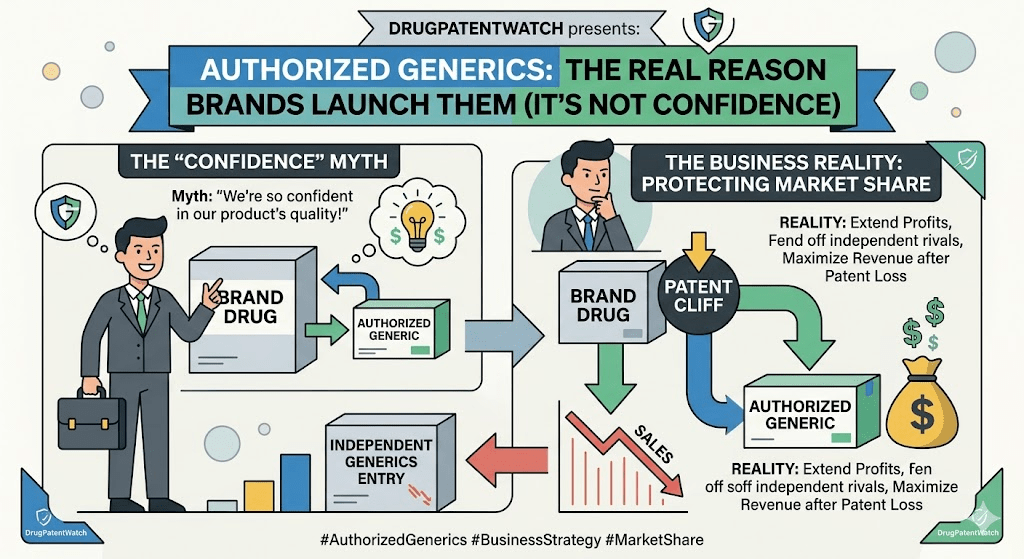
When a pharmaceutical brand launches an authorized generic, the press release typically says something about “patient access” or “expanding options.” What it rarely says is the more accurate version: we’ve exhausted our other options and we’d rather cannibalize ourselves than watch someone else do it.
That reframing isn’t cynical. It’s just correct. The authorized generic (AG) is a specific tool with a specific context — and that context is always loss of exclusivity (LOE). No brand reaches for this strategy while its patents hold. The very act of launching an authorized generic is an announcement, loud and public, that the walls have come down.
What follows is a 15,000-word analysis of that tool: what it is, how it works mechanically under Hatch-Waxman, why it destroys generic competitors’ economics, how regulators and courts have treated it, and what the data actually shows about whether it “saves” the brand or merely softens an inevitable collapse. We’ll cover the case studies — Lipitor, Viagra, Nexium, Prozac, Zocor — and the antitrust litigation that turned “no-AG agreements” into the FTC’s preferred instrument for prosecuting reverse payments after FTC v. Actavis (2013).
Along the way, we’ll use data from DrugPatentWatch, the FTC’s own published studies, and court filings to answer the question that matters most to every commercial strategist, generic developer, PBM analyst, and pharma investor who reads this: what does an AG launch actually signal about a brand’s competitive position?
Short answer: desperation, managed well. Long answer: read on.
What Is an Authorized Generic? A Plain-Language Definition
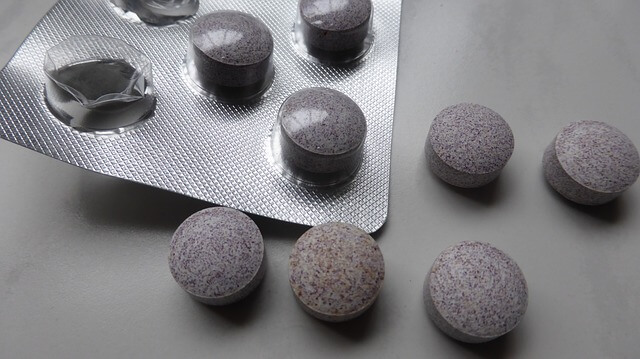
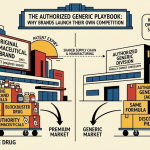
An authorized generic is a prescription drug that a brand manufacturer produces under its existing New Drug Application (NDA) and sells into the generic channel, typically at generic prices, usually through a subsidiary or licensing partner. It is chemically and pharmacologically identical to the branded product — same active ingredient, same inactive ingredients, same manufacturing process, same facility. The only differences are the label, the packaging, and the price.
The legal foundation matters. Because an authorized generic is sold under the brand’s NDA rather than an Abbreviated New Drug Application (ANDA), it is not subject to the 180-day marketing exclusivity the Hatch-Waxman Act grants to the first generic filer — also called the “first filer” or “Paragraph IV filer.” Authorized generics compete with generic products in that they are identical to their brand counterpart in both active and inactive ingredients, and they compete on price, quality, and availability in the generic marketplace, marketed to consumers during and after the 180-day exclusivity period.
This single legal distinction — NDA vs. ANDA — is what makes the authorized generic so commercially powerful and so controversial. The brand can legally launch its own “generic” the exact day the first challenger hits the market, converting what was supposed to be the generic’s exclusive window into a two-player competition before it even begins.
Authorized Generic vs. Independent Generic: Key Differences
The table below clarifies the distinctions that matter for commercial planning:
Characteristic
Authorized Generic
Independent (ANDA) Generic
Regulatory pathway
Brand NDA (no separate ANDA required)
Abbreviated NDA (ANDA) with bioequivalence data
Subject to 180-day exclusivity block?
No
Yes, if not the first filer
Inactive ingredients
Identical to brand
May differ (same active ingredient required)
Who controls launch timing?
Brand manufacturer
Generic filer (after patent challenge or settlement)
Orange Book listing?
Not listed separately as a generic
Listed with “A” therapeutic equivalence rating
Paragraph IV challenge required?
No
Yes, to enter before patent expiry
How Does an Authorized Generic Get to Market?
Three common structures exist. The brand sells through an in-house generic subsidiary — the Pfizer/Greenstone model is the canonical example. The brand licenses a third-party generic manufacturer to sell its product under that manufacturer’s label. Or the brand sells the product under a private label directly to pharmacy chains or PBMs.
Greenstone began in 1993 as a temporary competitive strategy of The Upjohn Company, eventually becoming a wholly owned Pfizer subsidiary following Pfizer’s acquisition of Pharmacia. In 2003, Greenstone became the generic subsidiary of Pfizer Inc, and is considered one of the longest-running and most respected marketers of innovator authorized generics in the United States. Its existence is a standing infrastructure for exactly this purpose: to be ready with an authorized generic the day any Pfizer patent expires.
Other brands follow a licensing model. AstraZeneca, when facing the Nexium LOE, worked with licensed partners. Bristol-Myers Squibb and others have used Prasco Laboratories, a private company whose business model is almost entirely built on manufacturing authorized generics for innovators who want the competitive benefit without the operational overhead of a Greenstone-style subsidiary.
The 180-Day Exclusivity Period: Why Brands Launch AGs on Day One
To understand why brands launch authorized generics, you need to understand what they’re attacking.
The Hatch-Waxman Act of 1984 created the 180-day marketing exclusivity period as the carrot that motivates generic manufacturers to challenge brand patents. Filing a Paragraph IV certification — a legal declaration that the brand’s listed patents are invalid, unenforceable, or not infringed by the proposed generic — triggers automatic 30-month stay of FDA approval if the brand sues. If the generic prevails, or if the brand doesn’t sue within 45 days, the first Paragraph IV filer receives 180 days during which no other ANDA-based generic can enter the market.
That six-month window was designed to be enormously profitable. The first filer gets a near-duopoly with the brand — the brand at full price on the branded side, the generic at a 15-20% discount on the generic side — during which it can recover the cost of litigation, bioequivalence studies, and the risk of patent challenge. For large drugs, the 180-day window has been worth hundreds of millions of dollars.
The authorized generic destroys that economics from the inside.
Revenues of a first-filer generic firm during the 180-day exclusivity period drop substantially after an authorized generic enters the market, with average declines ranging from 47 to 51 percent. The market that was supposed to be a profitable duopoly becomes a triopoly — brand vs. first generic vs. authorized generic — immediately, on day one, before the first-filer has recovered a dollar of its investment.
“The presence of an authorized generic during the 180-day exclusivity period reduces the first-filing generic’s revenues by a staggering 40% to 52%. The report further noted that the first-filer’s revenues remain 53% to 62% lower during the 30 months after the exclusivity period ends.” — FTC Final Report on Authorized Generic Drugs, 2011 [1]
Why the 180-Day Window Is Still Worth Winning (Even with an AG)
Despite the AG threat, the first-filer advantage still holds on a probability-adjusted basis. The revenue decline from an AG is severe, but a 50% reduction of a large prize is still a large prize. A drug generating $2 billion annually in U.S. brand sales might have $800 million in generic-channel revenue up for grabs in the 180-day window. A 50% haircut still leaves $400 million on the table — more than enough to justify the challenge for the right asset.
The commercial calculus changes for smaller drugs. When the prize is only $50 million, a 50% reduction from an AG can make the economics of a Paragraph IV challenge negative after legal costs. This is the market-distortion effect that generic industry groups have highlighted for decades: authorized generics selectively discourage patent challenges against mid-tier drugs, leaving those patents unchallenged and patients paying brand prices for longer.
What the FTC’s Pricing Data Shows About AG Impact
With authorized generic competition during the 180-day marketing exclusivity period, retail drug prices are on average 4.2 percent lower than the pre-generic branded price, and wholesale drug prices are on average 6.5 percent lower than the pre-generic branded price.
Those numbers are modest. They confirm that AGs do reduce prices modestly during the exclusivity window — which is why the brand industry points to them as consumer-friendly. But they also confirm that the price benefit to consumers is small relative to the revenue damage inflicted on the first-filing generic. The AG enriches the brand at the generic’s expense, rather than primarily benefiting patients.
A more recent study published in Health Affairs found an even more pronounced effect, with on-invoice prices paid by pharmacies being 13% to 18% lower when an AG was on the market. That’s a more substantial consumer benefit — but it still doesn’t change the fundamental dynamics of who gains and who loses from an AG launch.
Why Authorized Generics Signal Brand Weakness, Not Brand Strategy
Here is what the industry’s own behavior reveals.
No brand launches an authorized generic while its primary patents are intact and enforceable. None. Not once. The AG is definitionally a post-patent-expiry instrument — or a post-litigation-loss instrument, in the case of a settled Paragraph IV challenge. Before patent expiry, the brand does not need an AG because it has the monopoly. After patent expiry, it needs the AG because the monopoly is gone.
The authorized generic is therefore always evidence of the same thing: the brand has run out of better options. Its patent estate was insufficient to block entry. Its Paragraph IV litigation failed, settled, or was bypassed. Its lifecycle management extensions — new formulations, combination products, new indications — weren’t sufficient to migrate patients before LOE. Now it’s in the generic channel, competing against its own former product with a different label.
That is not strength. That is the management of defeat.
The Hierarchy of Brand Defense: Where the AG Sits
To see why an AG launch signals exhausted options, consider where it sits in the brand’s defensive playbook:
Primary patent protection (composition-of-matter, 20 years from filing). The best defense. No competition possible without a Paragraph IV challenge and litigation victory.
Secondary patent stack (formulation, process, method-of-use patents). Adds years through “evergreening.” Still requires the generic to challenge or design around.
Orange Book listing strategy. Listing all defensible patents to trigger automatic 30-month stays upon ANDA filing.
Paragraph IV litigation. Win and the challenger is blocked for years. Settle with a delayed entry date.
Product hopping / reformulation. Launch a new, patent-protected version and migrate patients before the old molecule loses exclusivity. AstraZeneca did this brilliantly with Prilosec to Nexium.
Line extensions and new indications. New clinical data, new patient populations, new exclusivities.
Authorized generic launch. The brand’s last commercial lever. Everything else has been tried or has failed.
The AG occupies the bottom of this hierarchy. It is the option you reach for when options 1 through 6 have been exhausted, failed, or are unavailable. When the innovator company exhausts legal and IP options, the effect of generic entry on volume can be immediate and severe.
The ‘Cannibalize and Conquer’ Myth
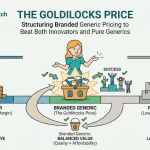
Pharmaceutical strategists sometimes frame the AG as an offensive weapon: “cannibalize and conquer.” The idea is that the brand can extract 70% of the generic market’s revenue by being first with an AG, neutralizing the first-filer’s prize and generating incremental revenue during the transition. The authorized generic strategy is designed to ‘cannibalize and conquer’: by launching an AG the same day the first-to-file generic enters, the innovator captures approximately 70% of the generic market’s revenue and systematically devalues the 180-day exclusivity prize that generic companies have been racing to win.
But notice what this actually says. The brand is now competing in the generic market. It has accepted generic pricing. It is generating “generic market revenue” — which is a fraction of what it generated as a brand. The word “conquer” dignifies a retreat. The brand isn’t conquering anything; it is extracting residual value from an asset it can no longer protect.
Pfizer’s Lipitor defense is the most-cited example of this being done well. But even the best execution of the strategy produced a revenue decline from $9.6 billion in 2011 to $3.9 billion in 2012. Pfizer’s Lipitor saw its annual sales plummet from $9.6 billion in 2011, the year before generic entry, to $3.9 billion in 2012. That’s a 59% drop in one year, even with an authorized generic, a massive direct-to-consumer campaign, co-pay cards, and a preferred pricing agreement with some PBMs. The AG softened the blow. It did not prevent it.
The Lipitor Case Study: Pfizer’s Authorized Generic Playbook Examined
Lipitor (atorvastatin) was the world’s best-selling drug for fourteen consecutive years and generated over $130 billion in global revenue before its primary patent expired in November 2011. Pfizer knew the patent cliff was coming years in advance and built a multi-layered defense. The authorized generic through Greenstone was one element. It was not the only one, and it was not the most important one. That context matters.
How Pfizer Structured the Lipitor AG Defense
Ranbaxy (now Sun Pharma subsidiary) was the first ANDA filer for atorvastatin. After years of patent litigation and a series of settlement negotiations complicated by Ranbaxy’s manufacturing issues with the FDA, atorvastatin’s primary patent expired on November 30, 2011. During this period, Pfizer launched its own authorized generic through Greenstone LLC — a subsidiary — at the same time Ranbaxy launched. The result was that two “generic” atorvastatins entered the market simultaneously, both at prices well below branded Lipitor but above what a fully competitive generic market would produce.
But the Greenstone AG launch was one piece of a four-part commercial strategy:
Direct-to-consumer marketing to maintain physician and patient brand preference.
A $4-per-month co-pay card for insured patients, making branded Lipitor price-competitive with generics at point of sale.
Preferred formulary agreements with large PBMs and insurers.
The Greenstone AG to capture generic channel volume and prevent Ranbaxy from earning its full 180-day prize.
Pfizer’s strategy effectively extracted an additional six months of above-market pricing by using its authorized generic to cannibalize Ranbaxy’s first-filer windfall. The move cost Pfizer very little — Greenstone already existed — and preserved hundreds of millions in revenue during the transition.
Critically, the AG component of this strategy had near-zero incremental cost for Pfizer because Greenstone was already operational. For brands without a pre-existing generic subsidiary infrastructure, the economics of an AG are less favorable — there are setup costs, regulatory submissions, and distribution agreements to negotiate, often on compressed timelines as LOE approaches.
What Lipitor’s Revenue Trajectory Actually Shows
Despite this multi-front defense — arguably the most sophisticated brand defense in pharmaceutical history against generic entry — atorvastatin’s brand revenues still collapsed by nearly 60% in year one. The AG preserved some revenue that would otherwise have gone entirely to Ranbaxy. It did not stop, slow, or even significantly delay the fundamental market disruption. By 2013, atorvastatin’s generic share was above 95%. The brand was a footnote.
What the Lipitor case actually demonstrates is that a well-executed AG strategy, combined with massive consumer marketing and co-pay support, can extract additional value in the 6-18 months post-LOE compared to doing nothing. It cannot protect the brand. It cannot sustain brand-level pricing. It cannot prevent the market from clearing to near-zero margin generics once the 180-day window ends and 20+ generic manufacturers are approved.
Why Not Every Brand Can Do What Pfizer Did
Pfizer had Greenstone already. It had the world’s largest pharmaceutical marketing machine. It had $10 billion in Lipitor annual sales to justify the investment in co-pay programs alone. Most brands facing LOE have none of these advantages at scale.
A mid-tier brand with $400 million in U.S. annual sales, no generic subsidiary, and modest marketing infrastructure cannot replicate the Lipitor defense. For them, the AG option requires building or contracting the infrastructure from scratch, often paying a third party like Prasco a licensing fee plus manufacturing margin, all to compete in a market where the product will be priced at a 70-90% discount to the brand within 18 months regardless.
No-AG Agreements: When Brands Use the AG as Currency, Not a Product
Here the story gets more complicated — and more revealing about what the authorized generic really represents.
Because the AG is so effective at destroying the first-filer’s 180-day economics, it has value as a threat, not just a product. A brand can offer a generic challenger something valuable without writing a check: a promise not to launch an authorized generic during the 180-day exclusivity period. This no-AG commitment allows the generic to enjoy its duopoly pricing for six months without competition from the brand’s own generic.
The FTC recognized this as the functional equivalent of a cash payment — and it has pursued this theory aggressively. A no-AG commitment is a situation in which a brand company agrees not to compete with an authorized generic version of a drug for a period of time.
The courts have split on whether a no-AG commitment is a “reverse payment” subject to antitrust scrutiny under FTC v. Actavis (2013). The key circuit-level development came from the Third Circuit in 2015.
King Drug Co. v. SmithKline Beecham (GlaxoSmithKline): The Lamictal No-AG Case
GSK’s Lamictal (lamotrigine) patent expired in 2008. Teva was the first ANDA filer. GSK and Teva settled their Paragraph IV litigation, and the settlement included an agreement by GSK not to launch an authorized generic during Teva’s 180-day exclusivity window. This effectively gave Teva the full value of its exclusivity prize — something it would not have had if GSK had launched Greenstone-equivalent competition on day one.
On June 26, 2015, the Third Circuit became the first circuit court to interpret the Supreme Court’s decision in FTC v. Actavis to a “pay-for-delay” pharmaceutical patent litigation settlement, and held that a no-AG agreement, when it represents an unexplained large transfer of value from the patent holder to the alleged infringer, may be subject to antitrust scrutiny under the rule of reason.
The Third Circuit’s decision confirmed a principle that antitrust practitioners had long suspected: the authorized generic has quantifiable monetary value. When a brand gives it up as part of a settlement, it is transferring that value to the generic. If that transfer is large and unjustified, it looks like a reverse payment — and reverse payments are precisely what Actavis authorized the FTC to scrutinize.
FTC v. Actavis (2013): The Supreme Court’s Framework
FTC v. Actavis, 570 U.S. 136 (2013), involved AndroGel (testosterone gel), made by Solvay Pharmaceuticals. Solvay settled Paragraph IV litigation with several generic challengers, paying them cash and a no-AG commitment in exchange for delayed entry. The Supreme Court held that the FTC could make an antitrust challenge under the rule of reason against a so-called pay-for-delay agreement, in which a drug patentee pays another company, ordinarily a generic drug manufacturer, to stay out of the market, thus avoiding generic competition and a challenge to patent validity.
The decision restructured how brands negotiate Paragraph IV settlements. Pre-Actavis, cash reverse payments were common and largely unchallenged. Post-Actavis, brands had to be careful about how they structured any transfer of value to a generic challenger. The no-AG commitment became the next battleground because it was non-cash but clearly valuable.
FTC Enforcement: The Endo/Lidoderm Case
Endo Pharmaceuticals and Watson (Allergan) settled Paragraph IV litigation over Lidoderm (lidocaine patch). The settlement included a no-AG commitment — Endo agreed not to compete with an authorized generic during Watson’s exclusivity window. The FTC alleged this was the form of reverse payment. The FTC’s complaint alleges that Endo Pharmaceuticals Inc. and several other drug companies violated antitrust laws by using pay-for-delay settlements to block consumers’ access to lower-cost generic versions of Lidoderm. The agreement not to market an authorized generic — often called a “no-AG commitment” — is the form of reverse payment.
The FTC’s Impax/Endo Opana ER case took the same theory further. The Initial Decision found that, including the No-AG Commitment, Impax received a large and unjustified payment as part of the settlement at issue, and the Commission concluded that the FTC met their burden here.
What No-AG Agreements Reveal About the AG’s Commercial Value
The litigation over no-AG agreements produces an interesting inversion of the standard narrative. When regulators argue that a no-AG commitment has monetary value, they are validating the brand industry’s claim that the AG is a powerful commercial weapon. When brands include no-AG commitments in settlement deals, they are confirming that they view the AG as valuable enough to use as bargaining currency.
But this also confirms the core thesis: the brand would not be offering a no-AG commitment as settlement consideration unless it had already lost the underlying patent dispute, or was confident it would lose. The no-AG only has value in the context of a patent challenge the brand cannot win cleanly. You don’t trade away a weapon unless you’re in a fight you expect to lose.
The Hatch-Waxman Framework: Why the Law Allows AGs at All
Generic industry advocates have long argued that authorized generics should be banned during the 180-day exclusivity period. The argument is straightforward: Congress created the 180-day exclusivity to incentivize Paragraph IV challenges. If brands can launch AGs during that window, they erode the incentive. Fewer patent challenges mean longer brand monopolies mean higher drug prices for longer.
The FDA rejected early industry petitions to ban AGs. The courts upheld the brand’s right to launch them. In June 2005, the District Court of Appeals of the District of Columbia decided against Teva, ruling that nothing in the Hatch-Waxman Act prevented a patent owner from reselling its own product. This decision cleared the legal hurdles for authorized generics under the Hatch-Waxman Act.
The legal basis is clean: the 180-day exclusivity bars the FDA from approving other ANDAs. It does not bar the brand from selling its own product. The brand isn’t filing an ANDA; it already has an NDA. No approval needed.
Should the 180-Day Exclusivity Block Authorized Generics? The Policy Debate
The policy debate has three serious positions.
The generic industry argues that AGs undermine the Hatch-Waxman bargain. The 180-day exclusivity was Congress’s mechanism for generating patent challenges. If brands can neutralize the prize, the mechanism breaks down for mid-tier drugs where the risk-adjusted value of a challenge falls below litigation cost thresholds.
The brand industry argues that AGs benefit consumers by reducing prices during the exclusivity window. When innovator companies launched authorized generics during the 180-day exclusivity period granted to the first generic company to file an ANDA, prices were significantly lower than when there was no authorized generic and no competition, thus benefiting consumers.
The FTC’s position has been nuanced. Its 2011 report documented the consumer price benefits, but also documented the revenue harm to first-filers and the resulting incentive distortion. The Commission has not formally recommended banning AGs during the 180-day window, but it has aggressively prosecuted no-AG commitments as reverse payments — which has the practical effect of making no-AG agreements legally costly to include in settlements.
The Hatch-Waxman Paragraph IV Process: A Timeline
Day 0: Generic filer submits ANDA with Paragraph IV certification, certifying that brand’s Orange Book-listed patents are invalid, unenforceable, or not infringed.
Day 0-45: Brand receives notice and decides whether to sue. If it sues, a 30-month stay of FDA approval is triggered automatically.
30-month stay period: Patent litigation proceeds. Brand wins (generic blocked) or generic wins (generic can launch when stay expires or earlier).
First filer approval: FDA approves first ANDA. 180-day exclusivity clock begins on commercial launch or a forfeiture event, whichever comes first.
Day 1 of 180-day window: Brand may simultaneously launch authorized generic through its NDA. No FDA approval needed — it already exists.
Day 181: All other approved ANDAs can launch. Market becomes fully competitive.
Real-World Authorized Generic Examples: From Viagra to Nexium
Pfizer’s Viagra (Sildenafil) Authorized Generic: A Case Study in Late-Stage Desperation
Viagra (sildenafil citrate) is one of the most recognized pharmaceutical brands in history, generating over $2 billion annually at peak U.S. sales. Its primary patent expired in December 2017. Pfizer will start selling an authorized generic, manufactured by its subsidiary Greenstone LLC, priced at $30 to $35 per pill, roughly half or less of the $65-a-pill cost for Viagra seen on pharmacy websites.
Pfizer’s reasoning was the same as with Lipitor: better to capture generic channel revenue through Greenstone than to watch it go entirely to Teva, Mylan, and a dozen other ANDA filers. The Viagra AG launch also coincided with Pfizer dropping Viagra’s list price significantly and offering $0 co-pay programs — again, all defensive moves that would have been unnecessary if the patent had held.
Viagra’s peak U.S. revenues were roughly $2 billion. By 2019, after generic entry and AG launch, branded Viagra revenues were immaterial. Pfizer’s entire commercial strategy around sildenafil — brand protection litigation, delayed exclusivity agreements, AG launch, co-pay programs — bought time. It did not preserve the franchise.
AstraZeneca and Nexium: Product Hopping Beats Authorized Generics
AstraZeneca’s handling of Prilosec (omeprazole) to Nexium (esomeprazole) is the most instructive counter-example in pharmaceutical IP strategy — instructive precisely because it shows what strong strategy looks like, making the AG-dependent approach look weak by comparison.
AstraZeneca isolated the single, more active enantiomer, patented it, and launched it as a new drug, Nexium. The company then launched a massive marketing campaign, including its famous “purple pill” branding, to position Nexium as a more advanced and effective treatment, successfully migrating a significant portion of the Prilosec market to the new, patent-protected drug before Prilosec’s patent expired.
This strategy — patent a new molecule derived from the original, migrate patients before LOE — is categorically superior to an AG launch. AstraZeneca didn’t have to compete in the generic channel because it had moved the relevant patients to a product still under patent protection. The authorized generic was a fallback AstraZeneca needed less than Pfizer did, because the core patient migration was already complete.
To counter the loss of exclusivity, AstraZeneca also invested in marketing efforts to maintain customer loyalty and introduced authorized generic versions of Nexium at a reduced price — but this was a secondary defensive measure for the residual patient population that hadn’t migrated, not the primary strategy.
The lesson: product hopping, when executed early enough, makes the AG less necessary and less prominent in the revenue defense. Brands that rely primarily on the AG are brands that failed to execute the lifecycle management moves that would have made it unnecessary.
Eli Lilly and Prozac: Reformulation as the Better Answer
Eli Lilly faced Prozac’s (fluoxetine) patent expiry in 2001. Rather than relying primarily on an authorized generic, Lilly developed Prozac Weekly — a new once-weekly, sustained-release formulation that received its own patent protection. This new product offered a tangible benefit of convenience to patients. This strategy allowed Lilly to convert a portion of its patient base to the new, protected product, thereby retaining market share that would have otherwise been lost to daily generic fluoxetine.
Prozac Weekly wasn’t Lilly’s only defense, and it wasn’t entirely successful — Eli Lilly’s antidepressant Prozac lost nearly 70% of its market share and $2.4 billion in annual sales shortly after its patent expired. But the reformulation strategy at least provided a genuine new product with new patent protection and a defensible clinical rationale, rather than just selling the old molecule at a lower price under a different label.
The contrast matters for investors and analysts tracking LOE risk. A brand that launches a reformulated product before LOE retains some control over its commercial future. A brand that launches only an authorized generic has accepted that it cannot.
Bristol-Myers Squibb and Plavix (Clopidogrel): Litigation, Settlement, and the AG Aftermath
Plavix (clopidogrel) generated nearly $7 billion annually in U.S. sales at peak. BMS and Sanofi (co-promoters) fought Paragraph IV litigation aggressively. They prevailed in key litigation against Apotex in 2007, winning an injunction that blocked Apotex’s launch of generic clopidogrel until 2012. When the patents finally expired in 2012, generic entry was swift and comprehensive.
The authorized generic option was less central to BMS’s Plavix strategy because the litigation delay was so successful — the brand had 5+ additional years of monopoly through litigation wins. When LOE finally arrived, the brand was not in a strong enough position to sustain meaningful volume against 10+ ANDA generics, AG or not. Plavix’s brand revenues dropped over 90% in the 18 months following LOE.
This case illustrates a different failure mode: even when patent litigation succeeds in delaying generic entry, the eventual LOE cliff is just as steep. The AG cannot compress a 90% revenue decline into something manageable at that scale.
Authorized Generic Revenue Impact: What the Long-Term Data Shows
The FTC’s 2011 final report remains the most comprehensive quantitative analysis of authorized generics’ market effects. Subsequent academic and industry research has confirmed and refined its findings.
Brand Revenue Trajectory After AG Launch: The 18-Month Window
When a brand launches an authorized generic at LOE, the typical revenue trajectory looks like this:
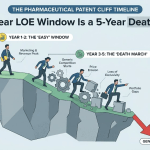
Months 1-6 (180-day exclusivity): The AG and the first-filer generic split the market. Brand-channel prices drop. The AG captures roughly 40-50% of generic-channel volume. Total branded + AG revenue is significantly below prior brand-only revenue.
Months 7-12 (post-exclusivity, multi-generic entry): 10-20+ generic manufacturers enter. Price competition intensifies. The AG loses its pricing advantage since it is now one of many generic-equivalent options. Most PBMs and wholesalers shift to the lowest-cost independent generic. AG market share drops sharply.
Months 13-18: The market reaches equilibrium at 80-90%+ discount to the original brand price. The AG survives only if it has a cost or relationship advantage over independent generics. For most brands, AG revenues become negligible.
The 18-month window is where the AG has its maximum commercial impact. After that, it is just another generic competing on price, manufacturing reliability, and wholesaler contracts — a competition it often loses because independent generic manufacturers, unencumbered by brand overhead, can operate at lower cost structures.
How Authorized Generic Revenue Compares to Brand Peak Revenue
The numbers are unambiguous. Taking Lipitor as the reference case: $9.6 billion in 2011 brand revenues collapsed to $3.9 billion in 2012 even with Pfizer’s comprehensive defense including the Greenstone AG. By 2013, combined atorvastatin revenues (brand + AG + whatever residual brand loyalty remained) were a small fraction of peak.
For drugs without Lipitor’s scale of complementary defenses, the collapse is faster and deeper. Historical trends show that a blockbuster drug can lose up to 80% of its revenue within the first year of facing generic or biosimilar competition. An authorized generic, on its own, does not change that trajectory — it captures a portion of what remains, but it cannot slow the underlying structural erosion.
Why PBMs and Formularies Accelerate the Brand’s Decline Despite an AG
PBMs (pharmacy benefit managers) are the single most important structural factor accelerating LOE erosion, and they are the reason an authorized generic rarely saves a brand’s commercial position. PBMs and health plans are laser-focused on moving patients to lower-cost generics as quickly as possible following a brand’s loss of exclusivity. An AG, being identical to the brand product, eliminates any clinical concerns about switching, making it a seamless and safe substitution for pharmacists and a straightforward addition to formularies.
This cuts both ways. The AG’s clinical equivalence to the brand makes it an easy formulary swap — which helps the AG get listed. But it also means the brand’s only remaining differentiator (perceived clinical superiority) is gone. Once the AG is on formulary, there is no longer any clinical argument for a patient to pay the higher brand co-pay. The brand is finished as a premium product.
The AG accelerates this transition rather than softening it. By providing a seamlessly substitutable option at generic prices from day one, the AG gives PBMs exactly the tool they need to push patients off the brand — which is precisely what undermines any residual brand revenue the manufacturer hoped to sustain.
Authorized Generics vs. Biosimilars: Why the AG Playbook Doesn’t Transfer to Biologics
The AG model was built for small-molecule drugs. Biologics — large, complex protein molecules manufactured in living cell systems — don’t work the same way, and the “authorized generic” concept doesn’t directly translate.
Why Brands Can’t Launch Authorized Biosimilars
A biosimilar is not an exact copy of a biologic; it is “highly similar” and demonstrates no clinically meaningful differences from the reference product in terms of safety, purity, and potency. The regulatory pathway (Section 351(k) of the PHSA) requires biosimilar developers to conduct their own analytical studies, animal studies, and often clinical trials. They cannot simply license the brand’s existing approval and sell under a different label — the NDA equivalent of an authorized generic.
The brand can license its biologic to another manufacturer to produce and sell as a “branded biosimilar” or an authorized version. But the manufacturing complexity of biologics — the requirement to reproduce cell culture conditions, purification processes, and quality systems — means there is no equivalent of Greenstone LLC standing ready to repackage the same pill with a different label. The cost of goods for biologics is orders of magnitude higher, and the regulatory requirements for demonstrating biosimilarity are substantial even for the reference product’s own manufacturer.
AbbVie’s Humira Strategy: What Happens When You Can’t Use the AG Playbook
AbbVie’s Humira (adalimumab) defense illustrates how biologic brands substitute for the AG strategy: patent thickets, not authorized generics. AbbVie built a 250+ patent portfolio around adalimumab, covering formulation, delivery devices, methods of treatment, and manufacturing processes. This “patent fortress” delayed U.S. biosimilar entry until 2023, years after the primary composition-of-matter patent expired.
When biosimilars finally launched — Amgen’s Amjevita leading the field, followed by a cascade of others — the revenue erosion was severe but slower than a typical small-molecule generic cliff. When Amgen launched Amjevita, a Humira biosimilar, it undercut AbbVie’s Humira’s list price by 55%. Humira’s revenue fell sharply from $21.2 billion in 2022 to $9 billion in 2024 following loss of exclusivity.
AbbVie’s response was not an authorized generic — it can’t launch one, structurally. Instead, it is pursuing new assets (Skyrizi, Rinvoq) to replace Humira’s revenue base. This is the biologic analog of the product hopping strategy, and it’s more effective than the AG in the long run because it generates genuinely new revenue from genuinely new products rather than residual value from the dying franchise.
How DrugPatentWatch Tracks Authorized Generic Activity
For commercial teams, generic developers, and IP analysts trying to predict when a brand will launch an authorized generic, the most valuable data sources are patent expiry timelines, Orange Book certifications, and Paragraph IV filing histories. DrugPatentWatch aggregates all three into a searchable database that lets analysts identify drugs approaching LOE, map the existing generic applicant field, and assess whether the brand has signaled AG plans.
DrugPatentWatch’s patent expiry data is particularly useful for identifying drugs in the 12-24 month pre-LOE window where AG decisions are typically made. Brands tend to decide on AG strategy 12-18 months before LOE, which is when they need to engage with licensing partners (if no in-house subsidiary exists), finalize supply chain arrangements, and brief wholesalers. An analysis of ANDA filing activity, combined with the brand’s historical AG behavior (does it have a Greenstone-equivalent subsidiary? has it launched AGs before?), can generate a reasonable probability estimate of AG launch for a given drug.
The commercial intelligence this produces is actionable in two directions. Generic developers can discount their first-filer revenue projections by 40-52% if they assess AG launch probability as high. Investors in generics companies can adjust valuation models accordingly. PBMs and payers can anticipate the pricing dynamics of the 180-day window and position formularies to capture maximum savings regardless of whether the AG launches.
For skeptical generic strategists, modeling a 50% revenue reduction during the 180-day window due to AG entry is now standard operating procedure. DrugPatentWatch provides the patent and ANDA data inputs that make that modeling precise rather than generic.
When Does an Authorized Generic Make Commercial Sense for the Brand?
Given the evidence that AGs signal LOE and don’t prevent revenue collapse, why do brands still launch them? Four scenarios produce a positive expected value calculation for the brand despite the signaling problem:
Scenario 1: Large-Scale Drugs Where Residual Volume Justifies the Overhead
For a drug generating $5 billion+ annually, even 10% of generic-channel volume is $100-200 million per year. If the brand has an existing generic subsidiary with near-zero incremental overhead (like Greenstone), the AG captures that revenue at minimal cost. The AG isn’t saving the franchise; it’s extracting the last commercially significant tranche of revenue before the asset becomes economically trivial.
Scenario 2: Drugs with Supply-Constrained Generic Competition
When a drug requires complex manufacturing and only a few ANDA filers can realistically produce it — certain sterile injectables, complex topicals, specialty formulations — the generic market remains less than fully competitive for longer. An authorized generic can maintain above-commodity pricing in this environment for 2-4 years, not just 6 months, because independent generics can’t flood the market. The AG’s competitive advantage over independent generics persists.
Scenario 3: As a Settlement Bargaining Chip
The no-AG commitment has documented commercial value. A brand entering Paragraph IV settlement negotiations can offer a no-AG promise in lieu of cash, reducing direct out-of-pocket settlement costs while achieving the same delayed-entry objective. Post-Actavis, this tactic carries antitrust risk, but strategically structured settlements can still incorporate no-AG elements if the brand can demonstrate the commitment is proportionate to litigation cost avoidance rather than a naked payment for delay.
Scenario 4: Niche or Specialty Products Where Brand Identity Matters Slightly Longer
For certain specialty drugs — products in therapeutic areas where physician habit, patient support programs, or REMS requirements create inertia — a co-branded AG can maintain higher pricing for slightly longer than a commodity generic. The premium is modest and temporary, but it exists. In these markets, the AG is part of a managed transition rather than an emergency response.
What This Means for Generic Developers: Pricing Your Paragraph IV Challenge
Generic developers need to price AG risk into every Paragraph IV filing decision. The framework is straightforward: estimate the probability of AG launch (based on brand’s history, subsidiary infrastructure, drug scale, and pipeline gaps), apply the 40-52% revenue haircut to 180-day exclusivity projections if AG probability is high, and recalculate whether the risk-adjusted NPV of the challenge still exceeds litigation costs.
For many mid-tier drugs, this analysis produces a negative expected value — the challenge isn’t worth pursuing if an AG is likely. Recognizing this, some generic developers have restructured their Paragraph IV strategies toward drugs where AG launch is structurally difficult: complex formulations, biologics, drugs where the brand lacks generic subsidiary infrastructure and supply chain flexibility.
Pricing Pressure and the AG Spiral: What Happens 6-36 Months Post-LOE
The pricing dynamics after an authorized generic launch follow a predictable trajectory, driven by the mechanics of pharmaceutical distribution rather than brand strategy.
The Price Erosion Curve: How Quickly Generic Prices Fall
During the 180-day window: the AG and first-filer split volume at modest discounts to brand price. Retail prices are 4-8% below brand. Wholesale prices are 7-14% below brand.
At month 7 (multi-generic entry): 5-10 generics enter. Price competition accelerates dramatically. Wholesalers run reverse auctions. The cheapest manufacturer wins volume contracts. Prices fall 40-70% below brand within 60 days of multi-generic entry.
At month 12-18: Markets with 15+ generic entrants see prices fall 80-95% below brand. The AG, now one of many interchangeable options, loses its residual pricing advantage unless it has a specific cost or contract relationship advantage.
For small-molecule oral solids (tablets, capsules) in competitive therapeutic categories, the price decline to near commodity is almost universal. For small molecules like Januvia and Eliquis, price erosion will reach 90% within months of launch. The AG delays this outcome by at most one product cycle — it does not prevent it.
The Supply Chain Implications of an Authorized Generic Launch
Authorized generics have one structural advantage independent generics don’t: supply chain reliability. Because the AG is manufactured on the brand’s validated production line, in the brand’s (or its contract manufacturer’s) facilities, with the brand’s quality systems, it is less likely to experience the supply disruptions that plague generic manufacturers — particularly in the early months of a new ANDA launch when manufacturing scale-up issues are common.
This supply advantage can be commercially meaningful for pharmacies and wholesalers who prioritize supply continuity over marginal price differences. GPOs (group purchasing organizations) and some regional pharmacy chains have historically shown preference for authorized generics over independent generics specifically because of supply reliability. The premium is small, but it exists and it’s real.
For brand manufacturers building their AG commercial proposition, supply reliability is the most defensible argument. “Same quality, same facility, better supply chain” is a legitimate value proposition in the generic market, where stockouts and manufacturing quality issues are endemic. It is not a franchise-saving argument, but it is a real commercial differentiator in the window before full generic market competition arrives.
The Patent Cliff Context: Why AGs Are Becoming More Prevalent Through 2030
The scale of the current LOE wave makes the authorized generic question more commercially urgent than at any prior point.
Between 2025 and 2030, nearly 200 branded drugs, including 69 blockbuster therapies, are set to lose exclusivity. The impact is enormous, with $200-400 billion in global revenue at risk.
That concentration of LOE events across large, high-revenue assets means more brands will be making AG decisions simultaneously. The decisions will be made in a more complex competitive environment: IRA (Inflation Reduction Act) price negotiation pressure is reducing the residual value of some brand assets, biosimilar penetration dynamics are unlike anything the small-molecule AG playbook addresses, and PBM formulary contracting has become more aggressive.
Keytruda, Eliquis, and Opdivo: The AG Question for the Next Patent Cliff Wave
An estimated $200-$230 billion in annual branded revenue will lose exclusivity protection between 2025 and 2030, with drugs like Keytruda ($29B+ in 2024 sales), Eliquis ($13B+ for BMS alone), and Opdivo concentrated in a narrow 2026-2028 window.
For Eliquis (apixaban), a small-molecule oral anticoagulant, the AG question is directly relevant. BMS and Pfizer (co-promoters) face apixaban LOE in 2026. The drug has a relatively straightforward oral solid formulation, and the generic ANDA field is well-developed. Whether BMS or Pfizer launches an authorized generic through existing infrastructure will significantly affect Mylan/Viatris, Teva, and other first-filer dynamics. Analysts tracking DrugPatentWatch’s Paragraph IV certifications for apixaban can see exactly how many ANDA applicants are positioned for 180-day competition.
For Keytruda (pembrolizumab) and Opdivo (nivolumab), the AG concept doesn’t apply directly — these are biologics. The relevant question is biosimilar competition dynamics, not authorized generics. Merck’s and BMS’s defenses will be built around patent thickets, indication-specific method-of-use patents, and pipeline transitions, not the NDA-based AG approach that works for small molecules.
IRA Pricing Pressure and the Shrinking AG Window
The Inflation Reduction Act’s Medicare price negotiation provisions create a new variable in the AG calculation. For drugs selected for IRA price negotiation, the negotiated price applies to Medicare Part D. This reduces the brand’s post-LOE branded channel revenue, which in turn reduces the absolute value of the AG residual. A $10 billion drug under IRA negotiation that sees brand revenue drop to $3 billion before LOE has a smaller AG prize to capture than it would have had under pre-IRA dynamics.
This is another data point confirming the AG’s role as a residual-value capture tool rather than a franchise defense strategy: as the brand’s pre-LOE revenue base shrinks due to IRA pressure, the AG’s addressable value shrinks proportionally.
Authorized Generic Strategy by Company: Who Launches Them and Why
Pfizer/Greenstone: The Most Systematic AG Infrastructure in the Industry
Pfizer built Greenstone as a durable capability, not a one-time tactic. Greenstone began in 1993 as a temporary competitive strategy of The Upjohn Company. It became permanent because the economics consistently justified it. Pfizer faces large-molecule LOE events regularly, and having standing infrastructure to capture generic channel revenue at near-zero incremental cost — versus the alternative of watching Teva and Mylan take it all — produces positive expected value at Pfizer’s scale.
The Greenstone model works because it is genuinely low-cost for Pfizer. The manufacturing is already done; Pfizer makes the pills for the brand. The regulatory submission is the brand’s NDA; no new approval needed. The sales infrastructure is separate but leverages Pfizer’s existing wholesaler relationships. The incremental cost of launching a Greenstone AG for a new product is primarily commercial — building out a distribution agreement, pricing the product, managing the channel — not manufacturing or regulatory.
AstraZeneca: AG as Backup to Primary Product Migration
AstraZeneca’s approach has been to use AGs as a secondary defense, not a primary strategy. Its Nexium/Prilosec product migration, its Crestor lifecycle management (extended-release formulations, pediatric extension), and its oncology pipeline investments are the primary strategies. AstraZeneca invested in marketing efforts to maintain customer loyalty and introduced authorized generic versions at a reduced price as a supplementary measure, not the core response.
Smaller Brands Using Prasco as an AG Partner
Prasco Laboratories (Mason, Ohio) has built a business specifically serving brands that want AG capability without building their own Greenstone. Prasco licenses the right to sell authorized generics from innovator companies, handles the commercial execution (distribution, pricing, wholesaler contracts), and pays the brand a royalty. This model is particularly valuable for mid-tier brands with drugs generating $100-500 million annually — too large to ignore, too small to justify a dedicated generic subsidiary.
The Prasco partnership model has one important limitation: Prasco’s AG often has higher cost of goods than a pure independent generic manufacturer, because Prasco is passing through manufacturing costs plus its own margin plus a royalty to the brand. In markets with aggressive independent generic competition, a Prasco-licensed AG may not survive on price alone. Its advantage is quality signaling and supply reliability — the same advantages the Greenstone model has, just at a smaller scale.
Authorized Generic Litigation: Key Cases and Their Outcomes
Teva v. Crawford: The Foundational Legal Decision
In June 2005, the District Court of Appeals of the District of Columbia decided against Teva, ruling that nothing in the Hatch-Waxman Act prevented a patent owner from reselling its own product. This decision cleared the legal hurdles for authorized generics under the Hatch-Waxman Act.
This ruling set the baseline: AGs are legal during the 180-day exclusivity period. It did not address whether no-AG agreements in patent settlements were permissible — that question came later with Actavis and its progeny.
In re Lamictal Direct Purchaser Antitrust Litigation: The No-AG Narrow Reading
The New Jersey District Court in the Lamictal case initially held that a no-AG promise, standing alone without a cash reverse payment, did not constitute a payment under Actavis. The court ruled that a promise by the branded manufacturer that it will not market its own authorized generic in competition with the generic firm’s product does not, standing alone, constitute a payment.
The Third Circuit’s 2015 decision in King Drug reversed this narrow reading and extended Actavis scrutiny to no-AG agreements when they represent a large, unexplained transfer of value.
King Drug Co. v. SmithKline Beecham: Third Circuit Extends Actavis
As discussed above, the Third Circuit found that a no-AG agreement can constitute a reverse payment subject to antitrust scrutiny. This has been the controlling circuit-level precedent in the pharmaceutical antitrust space since 2015. Brands negotiating Paragraph IV settlements must now carefully evaluate the quantified value of any no-AG commitment, measure it against the litigation cost-avoidance justification, and document the commercial reasoning thoroughly to survive rule-of-reason analysis.
FTC v. Impax / Endo: The Administrative Enforcement Track
The FTC’s administrative case against Impax and Endo over the Opana ER settlement, including a no-AG commitment, was litigated through the Commission’s own ALJ process. The Commission reversed the initial decision dismissing charges and found the no-AG commitment was part of an illegal reverse payment arrangement. The Commission ruled that Impax engaged in an illegal pay-for-delay, or reverse payment settlement to delay the sale of a generic version of Endo Pharmaceuticals’ branded extended-release opioid pain reliever, Opana ER.
The FTC’s willingness to pursue these cases through its own administrative process, in parallel with private antitrust litigation by direct and indirect purchasers, has significantly raised the cost of including no-AG commitments in settlements without careful economic justification.
What Authorized Generics Mean for Patients and Payers
Do AGs Actually Lower Drug Prices?
The honest answer is: modestly, temporarily, and less than the generic industry would achieve on its own.
During the 180-day window, yes — AGs reduce retail prices by 4-8% and wholesale prices by 7-14% compared to a scenario with no AG. That’s real money for payers. For a $5 billion annual drug, a 7% wholesale price reduction during a 6-month exclusivity window represents roughly $175 million in savings to the health system.
But the counterfactual matters. In the absence of an AG, the first-filer generic could price at a 15-20% discount to brand (the standard exclusivity-window discount) and still make its full margin. The patient sees a 15-20% price reduction. With an AG, the patient sees a 4-8% price reduction during the same window. The AG produces less price reduction for patients than the unimpeded generic would have.
Post-180-day: the presence of an AG during the exclusivity window slightly delays full generic market competition because the AG has deterred some generic manufacturers from mounting their own Paragraph IV challenges (if the AG was launched as part of a settlement that delayed independent generic entry). This delay can produce higher prices for longer.
The net effect on patients over a 3-5 year post-LOE horizon is, at best, neutral — and potentially negative if the no-AG dynamic delayed generic entry as part of a reverse payment settlement.
Formulary Impact: How PBMs and Health Plans Treat Authorized Generics
PBMs treat authorized generics the same way they treat independent generics for formulary purposes: as lowest-tier substitutes for the brand. The AG’s therapeutic equivalence to the brand is not in question, so substitution is straightforward. Most PBM contracts allow pharmacists to substitute any generic equivalent at point of dispensing without prescriber authorization.
Where the AG can influence PBM behavior is supply contracting. A PBM negotiating a preferred-generic contract may give the AG preferred status if the brand offers favorable rebate or pricing terms — essentially using the AG as a mechanism to maintain some commercial relationship with the prescriber channel even after LOE. This is another form of the “residual value capture” theme: the brand uses the AG to maintain pharmaceutical distribution relationships that have value beyond the single molecule.
Building a Better LOE Strategy: What Beats the Authorized Generic
Why Product Hopping Is Categorically Superior to an AG
AstraZeneca’s Prilosec-to-Nexium migration remains the benchmark. The brand identified a new patentable molecule (the active enantiomer) before the original molecule’s patents expired, launched it with aggressive marketing, and successfully migrated the majority of the patient base to the new, protected product before the original became generic. The result: AstraZeneca avoided the LOE cliff for Prilosec almost entirely, because the relevant patients were already on Nexium.
Product hopping requires lead time — typically 5-7 years from original LOE to execute successfully. Brands that make this investment early produce genuinely superior LOE outcomes compared to brands that wait until 18 months before LOE and reach for an AG as a last-minute defense.
Reformulation, Indication Expansion, and Combination Products
Each of these lifecycle management strategies shares a common feature with product hopping: they generate new intellectual property that delays competition, rather than managing the decline of expiring IP. A reformulated drug — extended release, new delivery system, co-formulated combination — can receive new patent protection that extends the commercial franchise by 5-10 years.
The AG, by contrast, generates no new IP. It is the commercial monetization of an asset that is already under competitive threat. It is, strictly speaking, a liquidation strategy rather than a growth strategy.
What Strong Pipeline Performance Means for LOE Strategy
The most effective LOE response is a pipeline that replaces lost revenue rather than salvaging it. Merck’s bet on Keytruda was an LOE strategy — it was building the revenue stream that would replace aging franchises. Merck has tripled its late-phase assets in the last 3.5 years, aiming for 20 new launches to replace Keytruda’s $32 billion revenue stream. The strategy for a drug facing LOE is to not be dependent on that drug.
Pfizer’s current pipeline strategy is the same: building obesity and oncology assets to replace Eliquis, Ibrance, and Xtandi as they face LOE through 2028. The Greenstone AG is a tactical instrument; the pipeline is the strategic answer.
The Commercial Intelligence Use Case: How to Predict AG Launches
Four Indicators That a Brand Will Launch an Authorized Generic
Existing generic subsidiary infrastructure. If the brand already has a Greenstone or Prasco relationship, the AG launch cost is near zero. High probability of AG for any large LOE event.
Recent Paragraph IV settlement with no entry date soon. If the brand settled patent litigation and the generic’s agreed entry date is approaching, the brand may use the AG to dilute the generic’s exclusivity prize rather than risk the full 180-day windfall going to the challenger.
No recent product reformulation or line extension for the LOE asset. If the brand has not developed a new formulation or migrated patients to a successor product, the AG is one of the few remaining defensive options available.
Large drug scale with thin secondary patent protection. A $1 billion+ drug with only formulation or method-of-use patents beyond the primary composition-of-matter patent, facing imminent LOE, has the economics to justify an AG and the urgency to implement one.
Using Orange Book Data and ANDA Filing History to Model AG Timing
DrugPatentWatch’s Orange Book data shows which patents are listed for a given drug, their expiration dates, and which have been challenged via Paragraph IV. By mapping the Paragraph IV filing history — when the first ANDA was filed, how many ANDAs are pending, whether there is a 30-month stay active — analysts can identify the likely LOE date with precision and overlay it against the brand’s known AG infrastructure and history.
For a drug with a primary patent expiring in Q3 2026, three Paragraph IV filers, a history of AG launches by the brand, and no reformulated successor product in late-stage development, the commercial intelligence conclusion is clear: model the 180-day window with a 40-52% first-filer revenue reduction, and price your Paragraph IV challenge accordingly. The AG is coming.
Key Takeaways
An authorized generic is a brand’s own molecule, sold under a generic label through the brand’s existing NDA. No new FDA approval required. No ANDA needed. The brand can launch on the exact same day as the first Paragraph IV filer.
The AG destroys the first-filer generic’s 180-day exclusivity economics: average revenue declines ranging from 47 to 51 percent during the exclusivity window, and between 53 and 62 percent during the 30 months after the exclusivity period ends.
The AG is always launched after patent expiry or litigation loss. No brand uses this tool while its patents hold. It is definitionally a post-LOE instrument — evidence that the defensive perimeter has fallen.
The Lipitor/Greenstone case is the most-cited AG success story. Even in that case, atorvastatin revenues fell nearly 60% in the first year after generic entry, despite a comprehensive multi-front defense including the AG, co-pay programs, and heavy consumer marketing.
No-AG agreements — brand promises not to launch an AG as part of Paragraph IV settlements — are subject to antitrust scrutiny after FTC v. Actavis (2013) and the Third Circuit’s 2015 King Drug decision. The no-AG commitment’s monetary value is what makes it a potential reverse payment.
The AG does modestly reduce prices during the 180-day window (4-8% retail, 7-14% wholesale) but produces less price reduction than an unimpeded independent generic would.
Product hopping, reformulation, and indication expansion are categorically superior to the AG as LOE strategies because they generate new IP and new revenue rather than monetizing declining assets.
Between 2025 and 2030, nearly 200 branded drugs, including 69 blockbuster therapies, are set to lose exclusivity, with $200-400 billion in global revenue at risk. This scale of LOE activity will generate the most significant wave of AG decisions in pharmaceutical history.
For biologics, the AG concept doesn’t transfer. Biosimilar competition dynamics are governed by the PHSA’s interchangeability framework, not Hatch-Waxman. AbbVie’s Humira defense (patent thickets, not AGs) is the biologic analog.
The AG is a legitimate commercial instrument for extracting residual value during the LOE transition. It is not a strategy for preserving a franchise. Analysts and investors who mistake the AG launch for a sign of brand strength are misreading the signal. It is a sign of exhausted options, managed competently.
FAQ: Authorized Generics, Patent Strategy, and Pharmaceutical Competition
Q1: Can a brand pharmaceutical company launch an authorized generic before its patent expires?
No. The brand has no reason to launch an AG while its patents hold because it already holds a monopoly. The AG is specifically a post-LOE or post-litigation instrument. The earliest a brand would consider an AG is in the months leading up to expected patent expiry, in preparation for a day-one launch when the first ANDA filer enters.
Q2: Is an authorized generic therapeutically equivalent to the brand drug?
Yes, and then some. An authorized generic contains identical active and inactive ingredients manufactured in the same facility using the same process as the brand. Independent ANDA generics must demonstrate bioequivalence but may use different inactive ingredients. The AG is the closest possible substitute — it is, literally, the same product with a different label.
Q3: Does FDA approval required for an authorized generic launch?
No. Because the authorized generic is sold under the brand’s existing NDA, it already has FDA approval. The brand simply notifies the FDA of its intent to market an AG version, adjusts labeling as needed, and can launch. This is what allows a brand to launch an AG on the exact same day as a first-filer generic without any prior regulatory preparation beyond the existing approval.
Q4: What is a ‘no-AG agreement’ and why is it legally risky post-Actavis?
A no-AG agreement is a brand’s commitment not to launch an authorized generic during a generic company’s 180-day exclusivity period, typically included in a Paragraph IV patent settlement. Post-Actavis, courts and the FTC treat no-AG commitments as potential reverse payments because they transfer the commercial value of the unchallenged AG prize to the generic in exchange for delayed market entry. The Third Circuit confirmed in King Drug (2015) that no-AG agreements can trigger antitrust scrutiny under the rule of reason.
Q5: How long does an authorized generic maintain market share after multi-generic entry?
Typically 12-24 months after the 180-day window ends. Once 10+ independent generics enter, price competition drives manufacturers to the lowest cost of goods. The AG’s only structural advantages — supply reliability and formulation identity with the brand — have diminishing commercial value in a fully competitive generic market. Most AGs lose significant market share within 18 months of multi-generic entry and become commercially marginal within 3 years.
Q6: Can a generic company challenge an authorized generic in court?
The legal challenge route for blocking an AG is narrow. Courts have consistently held that Hatch-Waxman does not prohibit AGs during the 180-day exclusivity period. The available challenges are antitrust-based (if the AG launch is part of a broader scheme to harm competition) or contract-based (if the brand agreed in a settlement not to launch one). A generic cannot simply challenge the existence of an AG under ANDA regulations because the AG doesn’t require an ANDA.
Q7: Does the Inflation Reduction Act change the economics of authorized generics?
Yes, indirectly. IRA price negotiations reduce the pre-LOE branded revenue base for affected drugs, which shrinks the absolute value of the generic-channel opportunity an AG can capture. A drug with $6 billion in brand revenue at LOE has a larger AG prize than the same drug at $4 billion because IRA negotiations compressed its pricing. The IRA also accelerates some payer interest in generics (by giving Medicare independent leverage to reduce brand prices), potentially making the AG’s residual premium above commodity generic prices unsustainable for longer.
Q8: Which pharmaceutical companies have the most developed authorized generic infrastructure?
Pfizer through Greenstone LLC is the most established, with infrastructure dating to 1993 and a portfolio covering dozens of Pfizer LOE products. Prasco Laboratories serves as a third-party AG partner for brands without in-house infrastructure. AstraZeneca, Novartis (through Sandoz, though Sandoz was spun off in 2023), and several specialty pharma companies have also structured AG capability as standing infrastructure. Post-Sandoz spinoff, Novartis’s in-house AG capability is more limited.
Q9: What is the difference between an authorized generic and a brand-name drug sold at a discount?
A brand-name drug sold at a discount (via co-pay card, patient assistance program, or formulary preferred pricing) is still the brand — same label, same list price recorded in the pharmaceutical supply chain, subject to PBM rebate negotiations. An authorized generic is relabeled and sold as a generic, with a different product name (typically the generic INN name plus manufacturer), different NDC code, and generic-tier pricing on formularies. The AG is counted as a generic in market share statistics and qualifies for generic substitution at pharmacy.
Q10: How can investors use authorized generic activity as a signal of brand financial stress?
An AG launch announcement confirms that the brand’s primary patent has expired or will expire imminently, that the brand’s LOE defense (reformulation, indication expansion, product migration) was insufficient to avoid price competition, and that the brand is now competing for residual generic-channel revenue. Investors in the brand company should model 60-80%+ brand revenue decline within 24 months of generic entry regardless of AG launch. Investors in first-filer generic companies should discount 180-day revenue projections by 40-52% if AG probability is high. Both signals suggest that the asset’s commercial life as a premium product is over.
Sources
Federal Trade Commission. (2011). Authorized Generic Drugs: Short-term Effects and Long-term Impact. Federal Trade Commission. https://www.ftc.gov/sites/default/files/documents/reports/authorized-generic-drugs-short-term-effects-and-long-term-impact-report-federal-trade-commission/authorized-generic-drugs-short-term-effects-and-long-term-impact-report-federal-trade-commission.pdf
Federal Trade Commission. (2009, June). FTC Issues Interim Report on “Authorized Generic” Drugs. FTC Press Release. https://www.ftc.gov/news-events/news/press-releases/2009/06/ftc-issues-interim-report-authorized-generic-drugs
Jones Day. (2011, September). Antitrust Alert: FTC Releases Report on Authorized Generic Drugs. Jones Day Insights. https://www.jonesday.com/en/insights/2011/09/antitrust-alert–ftc-releases-report-on-authorized-generic-drugs
DrugPatentWatch. (2025, November). Authorized Generics: Mastering a Controversial Strategy for Pharmaceutical Patent Lifecycle Management. https://www.drugpatentwatch.com/blog/authorized-generics-mastering-a-controversial-strategy-for-pharmaceutical-patent-lifecycle-management/
DrugPatentWatch. (2025, August). Prevalence and Timing of Authorized Generics in the US Market. https://www.drugpatentwatch.com/blog/prevalence-and-timing-of-authorized-generics-in-the-us-market/
DrugPatentWatch. (2025). The Golden Six Months: Mastering 180-Day Exclusivity to Win the Generic Drug Race. https://www.drugpatentwatch.com/blog/the-golden-six-months-mastering-180-day-exclusivity-to-win-the-generic-drug-race/
DrugPatentWatch. (2025). Drug Patent Expiration: The Complete Strategic Guide to Loss of Exclusivity, Lifecycle Management, and the $400 Billion Cliff. https://www.drugpatentwatch.com/blog/the-impact-of-drug-patent-expiration-financial-implications-lifecycle-strategies-and-market-transformations/
DrugPatentWatch. (2025). The Patent Cliff Playbook: Pharmaceutical IP Valuation, Generic Entry Timing, and Biosimilar Strategy. https://www.drugpatentwatch.com/blog/patent-expirations-seizing-opportunities-in-the-generic-drug-market/
FTC v. Actavis, Inc., 570 U.S. 136 (2013).
King Drug Co. of Florence, Inc. v. Smithkline Beecham Corp., 791 F.3d 388 (3d Cir. 2015).
Federal Trade Commission. (2019, February). Last Remaining Defendant Settles FTC Suit that Led to Landmark Supreme Court Ruling on Drug Company “Reverse Payments.” FTC Press Release. https://www.ftc.gov/news-events/news/press-releases/2019/02/last-remaining-defendant-settles-ftc-suit-led-landmark-supreme-court-ruling-drug-company-reverse
Federal Trade Commission. (2019, March). Applying Actavis: The FTC Reverses Initial Decision and Finds Impax Labs Entered Into Illegal Pay-for-Delay Agreement. FTC Opinion and Final Order.
National Law Review. (2015, October). Third Circuit Wades Into Intersection of IP and Antitrust: First Gloss on FTC v. Actavis Focuses on Non-Monetary Branded-Generic Deals. https://natlawreview.com/article/third-circuit-wades-intersection-ip-and-antitrust-first-gloss-ftc-v-actavis-focuses
Drug Store News. (2010). Authorized Generics: Q&A with Greenstone’s Jim Cannon. https://drugstorenews.com/pharmacy/authorized-generics-qa-greenstones-jim-cannon
Pharmacy Times. (2008). Greenstone LLC: A Successful Business Model. https://www.pharmacytimes.com/view/supp_2008-08_006
Pharmaceutical Executive. (Various). Whose Afraid of Authorized Generics. https://www.pharmexec.com/view/whose-afraid-authorized-generics
EY. (2026, February). Navigating Pharma Loss of Exclusivity. https://www.ey.com/en_us/insights/life-sciences/navigating-pharma-loss-of-exclusivity
Medscape Medical News. (2017). Little Blue Pill Goes Generic Today, and Pfizer Joins In. https://www.medscape.com/viewarticle/889846
DrugPatentWatch. (2026, March). The Top 10 Longest-Running Drug Patents. https://www.drugpatentwatch.com/blog/the-top-10-longest-running-drug-patents/
Carrier, M.A. (2015). Payment After Actavis. Iowa Law Review, 100(1). https://ilr.law.uiowa.edu/sites/ilr.law.uiowa.edu/files/2023-02/ILR-100-1-Carrier.pdf
American Bar Association. (Various). A Decade of FTC v. Actavis: The Reverse Payment Framework. ABA Antitrust Law Journal, 86(2). https://www.americanbar.org/content/dam/aba/publications/antitrust/journal/86/issue-2/decade-of-ftc-v-actavis.pdf
DrugPatentWatch. (2025). The ‘Use It or Lose It’ Rule: Decoding 180-Day Generic Exclusivity Forfeiture. https://www.drugpatentwatch.com/blog/the-use-it-or-lose-it-rule-decoding-180-day-generic-exclusivity-forfeiture/
DrugPatentWatch. (2026). Pharma Profitability After Drug Patents Expire: The Complete Strategy Guide. https://www.drugpatentwatch.com/blog/top-strategies-for-pharma-profitability-after-drug-patents-expire/
Alcimed. (2025). Patent Cliff: What Strategies Can Help Biopharma Stay Competitive? https://www.alcimed.com/en/insights/patent-cliff/