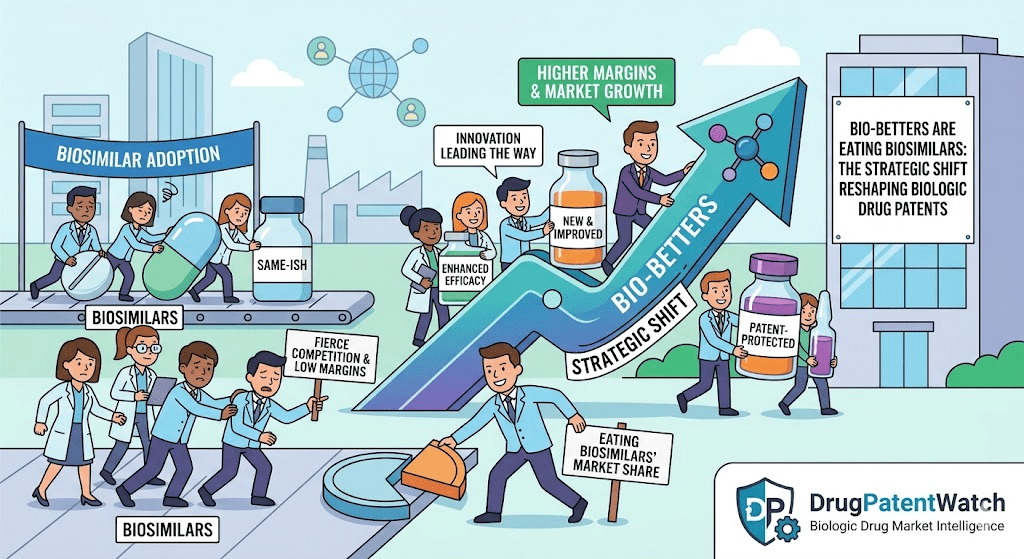
When AbbVie watched its first Humira biosimilar land on the US market in January 2023, the company had already spent a decade preparing for it. Humira’s revenue fell from $21.2 billion in 2022 to roughly $9 billion by 2024—a collapse that validated every warning the biosimilar industry had ever issued. [1] But AbbVie’s two successors, Skyrizi (risankizumab) and Rinvoq (upadacitinib), collectively grew fast enough to absorb most of that loss. That outcome was not luck. It was a deliberate pivot away from the copycat model and toward something more commercially durable: a bio-better.
The biosimilar industry spends an enormous amount of energy tracking the same patent cliffs, building the same analytical packages, and competing for the same 20-to-30 percent price discount that payers now treat as a baseline expectation, not a reward. [2] Meanwhile, a separate and less-publicized cohort of developers is engineering improved versions of existing biologics that need their own clinical data, command their own prices, and arrive with their own 12-year exclusivity clock. The regulatory pathway is harder. The capital requirement is higher. The commercial prize, when it works, is categorically different.
This article covers the mechanics, the economics, and the IP architecture of the bio-better category, why the model is attracting capital that used to flow toward biosimilar programs, and what the shift means for companies across the biologic supply chain—from large-cap originators managing the Keytruda patent cliff to mid-tier developers deciding whether to build a biosimilar pipeline or a next-generation molecule.
“Sales for next-generation biotherapeutics, including cell and gene therapies and RNA therapies, are expected to reach $18 billion by 2028, over 3.5 times the current level.” —IQVIA Use of Medicines in the US 2024 [3]
What Is a Bio-Better, and How Does It Differ from a Biosimilar?
The term ‘bio-better’ is not a regulatory classification. The FDA does not use it on approval letters. It describes a commercial and scientific strategy: take an existing biologic molecule, engineer a meaningful clinical improvement, and submit it as a new molecular entity through a full Biologics License Application (BLA), not the abbreviated 351(k) biosimilar pathway. [4]
The clinical improvement can take several forms. A developer may attach polyethylene glycol chains to a protein—a technique called PEGylation—to slow its clearance from the body and reduce dosing frequency. They may engineer specific amino acid substitutions to improve receptor binding affinity or reduce immunogenicity. They may construct an Fc fusion that extends the molecule’s half-life by piggybacking on the body’s IgG recycling pathway. They may add a second binding domain to create a bispecific antibody that targets two disease mechanisms simultaneously. Each modification produces a molecule that is meaningfully different from the originator, performs better in some clinical dimension, and cannot be substituted at the pharmacy counter by a biosimilar of the original.
A biosimilar, by contrast, aims to prove that it is ‘highly similar’ to a reference product with no clinically meaningful differences in safety, purity, or potency. [5] That standard requires extensive analytical and clinical evidence but produces no new exclusivity and no freedom from the price competition that follows when multiple biosimilar manufacturers enter a market. A biosimilar of Humira launched in January 2023 competes directly with eight other Humira biosimilars launched the same year. A bio-better targeting the same IL-17 or IL-23 pathways as Humira is in a different commercial category entirely.
Bio-Better vs. Biosimilar: A Direct Comparison
Factor
Biosimilar
Bio-Better
Regulatory Pathway
351(k) abbreviated BLA under BPCIA
Full BLA as a new molecular entity
Development Cost
$100M–$250M
$500M–$2B+
Market Exclusivity on Approval
No new exclusivity
12-year reference exclusivity under BPCIA
Pricing Relative to Originator
15%–35% discount at launch
Parity or premium pricing possible
Patent Position
Must design around existing thicket
Generates new, owned patent estate
Pharmacy-Level Substitution
Possible if interchangeable-designated
Not applicable—distinct product
Competition Risk at Launch
Immediate if multiple approved biosimilars
Low; competes on clinical differentiation
Commercial Positioning
Access/cost argument
Efficacy/convenience/outcomes argument
What Counts as a ‘Meaningful’ Clinical Improvement?
The threshold question for bio-better development is straightforward in theory and brutal in practice: does the modification produce an improvement that patients and physicians actually care about?
According to Dr. Gustavo Calvo, writing in Financier Worldwide, ‘there must be changes to the actual active itself that result in improved pharmacodynamic properties. A different formulation of an originator product that perhaps has decreased particle impurities would not be considered a biobetter, but a pegylated form of a protein therapeutic could.’ [6] The modification has to touch the molecule’s function, not just its presentation.
In practice, the clinical improvements that move markets fall into four categories. The first is dosing frequency reduction—from daily injections to weekly, or from weekly to monthly. The second is route-of-administration change, specifically intravenous to subcutaneous, which reduces infusion center visits and the associated costs. The third is improved efficacy at the same dose, measured by a harder clinical endpoint in a head-to-head trial. The fourth is a reduced immunogenicity profile that produces fewer anti-drug antibodies over time and therefore sustains efficacy longer in a real-world patient population.
Not all four are equal commercially. Dosing frequency and route-of-administration changes are visible to patients and influence adherence. Immunogenicity improvements, while scientifically sound, are harder to communicate in a sales conversation and often require years of real-world evidence to crystallize into prescriber behavior change.
How Does the FDA Classify Bio-Betters?
Because bio-betters file full BLAs as new molecular entities, the FDA applies its standard biologic review framework. If the bio-better involves a novel mechanism or target, it may receive Breakthrough Therapy Designation, Priority Review, or Accelerated Approval. [7] If it represents the first therapy in its class, it qualifies as a ‘first-in-class’ drug, which the Center for Drug Evaluation and Research (CDER) tracks separately. First-in-class designations generate significant commercial leverage because they cannot, by definition, be biosimilared at launch—they have no reference product.
The 12-year reference product exclusivity under the Biologics Price Competition and Innovation Act (BPCIA) runs from the approval date of the bio-better, not from any earlier originator filing. A company that launches a bio-better in 2026 has reference product exclusivity through 2038, regardless of when the original molecule it improved was approved. [8] That exclusivity window is independent of and additive to any composition-of-matter, formulation, or method-of-use patents the company holds.
The Patent Economics: Why Bio-Betters Generate More Durable IP Value Than Biosimilars
For any company assessing where to allocate its next $250 million in biologic development capital, the IP economics of bio-betters versus biosimilars are the central analytical variable. The two models generate fundamentally different return profiles, exposure periods, and risk distributions.
The Biosimilar Return Model and Its Structural Limits
A biosimilar program reaches peak commercial value only when it captures market share from the reference product. That process requires first-mover advantage, a favorable formulary position, and continued survival as more biosimilar competitors enter the same market. The global biosimilar market was valued at approximately $26.5 billion in 2024, with IMARC Group projecting it reaches $185.1 billion by 2033 at a CAGR above 24 percent. [9] That growth looks attractive in aggregate. At the individual molecule level, it disguises the severe margin compression that accompanies multi-entrant biosimilar markets.
The Humira adalimumab experience illustrates the structural limit. When biosimilars for Humira launched in the US in January 2023, they entered with list price discounts of up to 85 percent. Their initial market uptake was less than 2 percent in the first year because major pharmacy benefit managers (PBMs) kept Humira in the preferred formulary position, extracting higher rebates from AbbVie rather than switching patients to cheaper biosimilars. [10] Biosimilar manufacturers captured only a thin slice of the savings they had priced in. Not until CVS converted 97 percent of its commercial Humira use to biosimilars by August 2024 did the market dynamic shift meaningfully. [11]
By mid-2025, nine biosimilar products competed for the same adalimumab market share, with some net prices running 90 percent below the original Humira list price. [12] Margins in a nine-way competitive biosimilar market approximate commodity manufacturing economics, not specialty pharmaceutical margins. The companies that developed biosimilars for Stelara (ustekinumab) are experiencing the same dynamic: nine biosimilar products on the market as of July 2025, with prices up to 90 percent below Stelara’s original list price.
The Bio-Better Return Model: New Exclusivity, New Pricing Ceiling
A bio-better that receives its own BLA approval starts a new 12-year exclusivity clock, generates a new composition-of-matter patent estate around its modified structure, and prices into the market as a clinically differentiated product rather than a discount copy. The pricing ceiling is set by clinical outcomes data, not by a percentage discount from an originator list price.
Amgen’s Neulasta (pegfilgrastim) is the canonical bio-better. Amgen’s original product, Neupogen (filgrastim), was a granulocyte colony-stimulating factor that required daily injections to prevent infections in cancer patients undergoing chemotherapy. By applying PEGylation technology, Amgen created Neulasta, a long-acting version requiring only a single injection per chemotherapy cycle. [13] When Neupogen’s patents expired and biosimilars entered the market, Amgen had already transitioned a substantial share of its patient base to Neulasta. The biosimilars could compete with Neupogen on price, but they could not replicate Neulasta’s dosing convenience. Neulasta’s own patents expired later, and its own biosimilars eventually arrived, but Amgen had extracted an additional decade of premium pricing from the PEGylated improvement.
The financial comparison is stark. Neulasta at peak generated $3.8 billion annually at a price premium over Neupogen’s biosimilar-era pricing. A biosimilar of filgrastim might capture 30 to 40 percent market share at a 25 percent discount. A PEGylated bio-better like Neulasta commanded market leadership at full innovation pricing for years after the original molecule entered commodity competition.
How Bio-Better IP Interacts with BPCIA Patent Dance Provisions
The Biologics Price Competition and Innovation Act created the ‘patent dance’—a structured information-exchange and litigation process under 42 U.S.C. §262 that governs how biosimilar applicants and reference product sponsors identify and resolve patent disputes. [14] Bio-better developers, filing as originator BLA holders rather than biosimilar applicants, sit on the other side of this process. Their 12-year exclusivity period under 42 U.S.C. §262(k)(7) runs independently of any patent litigation and cannot be shortened by a successful patent challenge in the way that small-molecule exclusivity periods can interact with Paragraph IV certifications under Hatch-Waxman.
This structural difference matters for the IP valuation of a bio-better versus an original biologic at the same point in its lifecycle. An original biologic facing biosimilar challenges is a fortress under siege: each successful patent dance resolution reduces the effective exclusivity runway. A bio-better facing its own eventual biosimilar challengers has a clean 12-year clock plus whatever patents it holds on its novel structure. Platforms like DrugPatentWatch allow companies to map both the expiration timeline of any bio-better’s composition-of-matter patents and the regulatory exclusivity runway simultaneously, giving a precise picture of the commercial protection window before biosimilar entry becomes feasible.
The Neulasta Playbook: How PEGylation Built a Multi-Billion Dollar Moat
Neulasta remains the most studied example of a bio-better because its commercial logic was so clean. The original molecule (filgrastim) had a known mechanism, an established clinical track record, and predictable patent exposure. PEGylation was a well-understood technology that Amgen applied to produce a quantifiable benefit: one injection instead of daily injections for the same clinical outcome.
The Technical Mechanics of PEGylation as a Bio-Better Strategy
PEGylation attaches polyethylene glycol polymer chains to a therapeutic protein. The attached chains increase the protein’s hydrodynamic volume—its effective size in aqueous solution—which slows glomerular filtration by the kidneys and reduces clearance by the liver. The result is a significantly extended half-life: filgrastim has a serum half-life of approximately 3.5 hours after subcutaneous injection, while pegfilgrastim’s half-life extends to 15 to 80 hours. [15] That pharmacokinetic change is the clinical benefit. The once-per-cycle dosing schedule follows directly from the extended half-life.
PEGylation also produces patentable differentiation at the molecular level. The specific site of PEG attachment, the molecular weight of the PEG chain, and the linker chemistry used to attach PEG to the protein are all patentable elements distinct from the underlying protein sequence. Amgen held composition-of-matter patents on pegfilgrastim’s specific structural configuration that biosimilar manufacturers of the original filgrastim could not use. This is the IP architecture of a bio-better: the modification both improves the clinical product and generates new patent claims that do not depend on the original molecule’s patent estate.
Alternative Half-Life Extension Technologies Beyond PEGylation
PEGylation is one tool in a larger kit. Developers now have access to multiple half-life extension technologies, each generating its own patentable structural territory:
Fc fusion: Fusing a therapeutic protein to the Fc region of an IgG antibody recruits the neonatal Fc receptor (FcRn) recycling pathway, extending half-life to weeks. Etanercept (Enbrel) is a TNF receptor–Fc fusion that outlasted the clinical relevance of pure TNF receptor biologics by decades.
Albumin fusion: Albumin’s 19-day serum half-life can be borrowed by fusing a short-lived protein to albumin or to albumin-binding domains. GSK’s albiglutide (Tanzeum) used this approach, though it eventually lost the GLP-1 market to more potent competitors.
PASylation: Proline-alanine-serine (PAS) polypeptide chains are biopolymers that mimic PEG’s half-life extension effect while being fully biodegradable and genetically encodable, avoiding the accumulated organ deposition concerns associated with non-degradable PEG chains. [16]
Glycoengineering: Modifying the glycan structures attached to a protein can improve FcγRIII binding (for enhanced antibody-dependent cellular cytotoxicity) or FcRn binding (for extended half-life). Roche’s glycoengineered antibody obinutuzumab (Gazyva) illustrates the commercial value of glycan modification: improved anti-CD20 potency versus rituximab in specific B-cell malignancies.
Each technology generates a distinct zone of patentable innovation that a biosimilar of the original molecule cannot access. That is the central strategic logic of bio-better development: the improvement is the moat.
Keytruda Qlex: The $29 Billion Subcutaneous Product Hop
No case study in 2025 illustrates the bio-better strategic calculus more clearly than Merck’s Keytruda Qlex (pembrolizumab and berahyaluronidase alfa-pmph).
Why Keytruda’s 2028 Patent Cliff Changes Oncology IP Strategy
Merck’s pembrolizumab generated $29.5 billion in 2024 revenue, accounting for approximately 46 percent of the company’s total pharmaceutical sales. [17] The primary composition-of-matter patent for pembrolizumab’s intravenous formulation expires in 2028. Multiple biosimilar development programs are underway, with regulatory submissions to the FDA projected as early as 2026 or 2027. [18] Without an active defense strategy, analysts estimate Merck faces 80 percent revenue erosion on its flagship product post-2028. [19]
Merck’s response has four components. The first and most commercially visible was Keytruda Qlex, approved by the FDA on September 19, 2025, as a subcutaneous injection using Halozyme’s ENHANZE technology (recombinant human hyaluronidase PH20). [20] The formulation change is operationally significant: from a 30-minute intravenous infusion every three weeks to a 2-minute subcutaneous injection every six weeks. That convenience differential is the clinical argument for patient retention. It is also the basis for a new patent estate covering the SC formulation, the administration device, and the every-six-weeks dosing regimen, with patents that could extend Keytruda exclusivity to 2042—14 years beyond the original IV formulation’s 2028 expiration. [21]
Is a Subcutaneous Formulation a Bio-Better or Evergreening?
The Keytruda Qlex approval crystallizes a genuine definitional tension in the bio-better category. Strict definitions require modification of the active molecule itself to qualify as a bio-better. A subcutaneous formulation using a co-administered hyaluronidase does not chemically modify pembrolizumab; it changes how the drug is delivered, not the molecule. Under that definition, Keytruda Qlex is a product hop or a lifecycle management strategy rather than a true bio-better.
Critics including Senator Elizabeth Warren have questioned whether an administration route change is a ‘non-obvious’ invention worthy of new patent protection or simply a monopoly extension. [22] That debate will play out in patent challenges and potentially in BPCIA patent dance proceedings when pembrolizumab biosimilar applicants arrive.
Whether one calls Keytruda Qlex a bio-better, a next-generation formulation, or a product hop, its commercial function is identical to a bio-better: it gives Merck CEO Rob Davis’s stated objective of turning the patent cliff into ‘more of a hill, not a cliff,’ with the SC version expected to capture 30 to 40 percent of Keytruda’s US patient base by 2027. [23] For purposes of competitive IP analysis, the distinction between a true molecular bio-better and a formulation-based successor is secondary to the outcome: a new product with independent patent protection that biosimilar versions of the original cannot substitute for at the pharmacy counter.
Keytruda Qlex is one of four distinct pillars in Merck’s next-generation strategy. The others include bispecific antibodies pairing PD-1 blockade with a second immune checkpoint, fixed-dose combination products bundling pembrolizumab with a co-administered VEGF inhibitor or small-molecule kinase inhibitor, and ADC partnerships that use Keytruda’s commercial relationships to anchor combination therapies with novel cytotoxic payloads. [24] Each pillar represents a separate patent-protected product that biosimilar pembrolizumab cannot replicate. This multi-product approach is the institutional response to the structural limit of single-molecule patent protection: build a portfolio of improved versions before the original falls.
Bispecific Antibodies: Where Bio-Better Engineering Meets New Biology
The bispecific antibody category is both a bio-better strategy and a genuinely new therapeutic modality. The first bispecific therapy entered the US market in 2014 when the FDA approved Amgen’s Blincyto (blinatumomab), a bispecific T-cell engager for relapsed/refractory acute lymphoblastic leukemia. [25] More than a dozen additional bispecifics have followed. The broader multispecific antibody (msAb) pipeline now includes nearly 250 candidates in active clinical trials, with 24 at late stage as of mid-2025. [26]
Why Bispecific Antibodies Are Strategically Different from Biosimilar Competition
A bispecific antibody targeting CD3 and CD20, for example, is not an improved version of rituximab. It is a structurally distinct molecule with two binding domains, different manufacturing requirements, and a mechanism of action that cannot be replicated by rituximab biosimilars. From a patent perspective, it is an entirely new composition of matter. From a commercial perspective, it competes for the same patient population as rituximab but on the basis of clinical superiority data, not cost.
Genentech’s Hemlibra (emicizumab) illustrates the model. Hemlibra is a bispecific antibody that mimics the coagulation factor FVIIIa activity missing in hemophilia A. It did not improve an existing hemophilia A biologic—it replaced a far more complex treatment protocol using factor concentrates. Its bispecific architecture required bridging factor IXa and factor X, a dual-binding configuration impossible to replicate with a monospecific antibody. Hemlibra has become a blockbuster, demonstrating that bispecific designs can capture entire therapeutic franchises rather than just defending a single molecule. [27]
Ivonescimab vs. Keytruda: The Bio-Better Head-to-Head
The most commercially watched bispecific-as-bio-better scenario in 2025 involves ivonescimab (AK112/SMT112), a bispecific antibody developed by China-based Akeso and licensed to Summit Therapeutics. Ivonescimab simultaneously targets PD-1 and VEGF—effectively combining the mechanisms of pembrolizumab and bevacizumab in a single molecule. In a head-to-head Phase III trial in non-small cell lung cancer, ivonescimab produced superior progression-free survival versus pembrolizumab as monotherapy, a result that Summit described as the first such head-to-head win over Keytruda. [28]
Ivonescimab’s commercial positioning is explicitly as a bio-better challenger to the world’s highest-revenue oncology drug. If its clinical superiority holds in Phase III and translates to FDA approval, it would enter the market as a new molecular entity with 12-year exclusivity, protected by bispecific architecture patents that neither Merck nor any pembrolizumab biosimilar manufacturer can replicate. The pricing conversation changes entirely: not ‘we cost less than Keytruda’ but ‘we beat Keytruda in a head-to-head trial.’ That is the commercial architecture of a bio-better attack strategy from outside the originator company.
The Bispecific Antibody Investment Surge: Market Data and Forecast
In the first half of 2025, companies developing bispecific and multispecific antibodies for immunology and inflammation indications outraised their oncology-focused counterparts by $269 million. [29] The bispecific antibody market carries a projected CAGR of 24.1 percent over the next nine years, driven by advances in antibody engineering and the accumulating clinical evidence that dual-targeting produces superior outcomes in diseases where single-pathway blockade produces incomplete responses. [30] Transaction volume for msAb-related deals has run roughly even with ADC deals over the past five years (180 versus 192 deals respectively), confirming that both modalities are capturing venture and corporate development capital at similar rates.
Antibody-Drug Conjugates: The Bio-Better Architecture at Scale
Antibody-drug conjugates (ADCs) are the most structurally complex bio-better category and the one attracting the most M&A capital in biopharmaceuticals. An ADC consists of three components: a targeting monoclonal antibody, a cytotoxic small-molecule payload, and a chemical linker that connects them. The antibody guides the payload to cancer cells expressing the target antigen; the linker releases the payload inside the cell; the cytotoxic drug kills the cell from within. [31]
Why ADCs Represent a Structural Bio-Better Advantage Over Naked Antibodies
An ADC targeting HER2, such as Kadcyla (ado-trastuzumab emtansine), is not a biosimilar or an improvement of trastuzumab (Herceptin). It uses trastuzumab as its targeting component, but the finished product is a categorically different molecule with a different mechanism of cytotoxic action, a different safety profile, and a different set of composition-of-matter patents covering the linker chemistry, the payload structure, and the conjugation method. [32] Biosimilar manufacturers who develop trastuzumab biosimilars have no path to market for Kadcyla unless they independently develop the entire ADC platform.
This architectural separation is the commercial logic. The over 100 ADCs in active clinical trials and more than a dozen already FDA-approved represent a body of independently protected products that can target the same antigens as biosimilar-vulnerable reference biologics while occupying separate, patent-protected commercial space. [33] The global ADC market is expected to reach $34.7 billion by 2032. [34]
The Seagen/Pfizer Acquisition: Platform IP as the Real Asset
Pfizer’s $43 billion acquisition of Seagen in 2023 was the largest pharmaceutical deal of that year and the most visible statement of how the industry values ADC platform IP. Seagen’s portfolio included four approved ADCs: Adcetris (brentuximab vedotin), Padcev (enfortumab vedotin), Tukysa (tucatinib, a small molecule HER2 inhibitor, not an ADC), and Tivdak (tisotumab vedotin). Pfizer was not buying peak-sales revenue models. It was buying the ADC manufacturing expertise, the linker and payload patent portfolio, and the clinical and commercial infrastructure to develop the next generation of ADC products. [35] The platform IP—the specific chemistry that makes ADC construction possible at scale—is worth more than any single product in the portfolio.
This is the bio-better platform model at its largest scale: acquire the foundational technology that enables an entire category of next-generation biologics, then use it to produce a series of independently patented, clinically differentiated products that biosimilars of the underlying reference antibodies cannot touch.
ADC Patent Strategy: Protecting the Linker, Not Just the Antibody
Companies operating in the ADC space file patents on multiple stacked layers: the antibody component (often already patented), the linker chemistry, the payload structure, the drug-to-antibody ratio (DAR), the conjugation methodology, and the specific tumor antigen targeted. Each layer generates independent patent claims. A competitor developing an ADC targeting the same antigen must design around each layer or license it. The result is a denser patent thicket than most traditional biologic products, but one that is justified by genuine technical complexity rather than by the pattern of secondary patent filings that drew antitrust scrutiny to the Humira IP estate. The engineering innovation in ADC construction is substantive, not merely formal.
AbbVie’s Skyrizi and Rinvoq: The Template for an Originator-Led Bio-Better Transition
AbbVie’s post-Humira strategy is the most commercially executed example of an originator managing a biosimilar entry through bio-better succession. AbbVie did not merely defend Humira with patent thickets. Alongside the 130-plus patent strategy, it developed Skyrizi (risankizumab) and Rinvoq (upadacitinib)—two next-generation immunology drugs that work through distinct mechanisms from adalimumab and target overlapping but distinct patient populations.
How AbbVie Used the Humira Patent Cliff to Fund Its Bio-Better Pipeline
Humira’s peak revenue of $21.2 billion in 2022 generated cash flows that funded the late-stage development of Skyrizi and Rinvoq. [36] Both drugs entered commercial markets before US Humira biosimilars launched, giving AbbVie time to build prescriber familiarity and payer access agreements. By 2024, Skyrizi had grown to $11.7 billion in annual sales—a 50-plus percent increase—and Rinvoq reached $5.4 billion. [37] Together they offset much of Humira’s $12 billion revenue decline from peak.
Skyrizi targets IL-23, a pathway distinct from the TNF pathway blocked by adalimumab. Clinically, it has shown superior clearance rates versus adalimumab in head-to-head psoriasis trials, which is the hallmark bio-better data package. Rinvoq is a JAK inhibitor rather than a biologic, but its positioning is identical: a more precise, convenient, and in some endpoints more efficacious therapy for the same patient population that previously used Humira. Neither can be biosimilared into the same commercial position as a Humira biosimilar, because neither is Humira.
What AbbVie’s Bio-Better Transition Teaches the Biologic Industry
Three strategic timing points stand out from the AbbVie case. First, the bio-better development program started before the primary patent expiration, not after. AbbVie was building Skyrizi and Rinvoq while Humira was still generating $18 billion-plus in annual revenue. The timing offset between legacy revenue and bio-better investment is only possible if the company starts running the programs concurrently, not sequentially. Companies that wait until biosimilar entry to begin next-generation development will not have approved products available when they need them.
Second, AbbVie established payer and provider relationships for Skyrizi and Rinvoq using Humira’s formulary leverage as a negotiating anchor. Payers who wanted preferred Humira access received Skyrizi and Rinvoq at favorable tier positions in the same negotiation. By the time Humira biosimilars arrived, Skyrizi and Rinvoq already had well-established access. The commercial transition benefited from the legacy drug’s institutional relationships rather than competing against them.
Third, both products target mechanistically distinct pathways, giving them clinical differentiation data that no Humira biosimilar can generate. Biosimilars prove similarity. Bio-betters prove superiority. Those are different regulatory and commercial conversations, and the market prices them differently.
Dupixent and the Dual-Pathway Bio-Better: How Sanofi and Regeneron Defined a New Category
Dupixent (dupilumab) is a monoclonal antibody that simultaneously blocks both IL-4 and IL-13 signaling by targeting the shared IL-4 receptor alpha (IL-4Rα) subunit. This mechanism is genuinely different from earlier biologics in the atopic dermatitis and asthma space, which targeted single cytokines. By blocking two inflammatory signaling pathways simultaneously, dupilumab produced clinical results in moderate-to-severe atopic dermatitis that exceeded what single-pathway antibodies had achieved. [38]
Dupixent’s Revenue Trajectory and Patent Position
Dupixent generated $14 billion in 2024 sales—a 22 percent increase over 2023—making it one of the fastest-growing pharmaceutical products in the world. [39] Its patent estate covers the antibody’s specific variable region sequences, the IL-4Rα binding mechanism, the subcutaneous self-injection device, and multiple method-of-use patents for its growing list of approved indications including atopic dermatitis, asthma, chronic rhinosinusitis with nasal polyps, eosinophilic esophagitis, and prurigo nodularis.
Each new indication filing generates a new method-of-use patent with an independent expiration date. A biosimilar applicant for dupilumab will need to address not just the composition-of-matter patent but the method-of-use patents for each indication it wants to market in. That litigation burden, combined with the 12-year reference product exclusivity running from Dupixent’s 2017 approval, means US biosimilar entry is not commercially feasible before the early 2030s at the earliest.
What Dupixent’s Clinical Expansion Model Means for Bio-Better IP Architecture
Dupixent’s strategy of continuous indication expansion is the method-of-use patent equivalent of a bio-better strategy. Regeneron and Sanofi did not change the molecule; they proved it worked in additional diseases, generating new patents and new exclusivity periods for each indication. By the time a dupilumab biosimilar becomes commercially viable for atopic dermatitis, Dupixent will have patents protecting its use in nine or more distinct indications. A biosimilar that cannot be promoted for most of the reference product’s commercial indications faces severe market access constraints even if it clears the composition-of-matter hurdles.
This method-of-use expansion model is a complementary strategy to molecular bio-better development, not a substitute. For tracking all active patents on a product like dupilumab across composition-of-matter, formulation, and method-of-use claims with their specific expiration dates, DrugPatentWatch provides a consolidated patent landscape view that separates the original Biologics License Application’s exclusivity runway from each additional layer of IP protection. That granular view changes the commercial viability assessment for biosimilar developers who might otherwise model Dupixent as approaching its exclusivity cliff without accounting for the dense method-of-use patent thicket around each of its nine indications.
The Regulatory Gauntlet: Bio-Better Development Costs vs. the Biosimilar Shortcut
The primary financial argument for biosimilar development over bio-better development is cost and timeline. Bringing a biosimilar to market costs $100 million to $250 million, versus $500 million to $2 billion or more for a bio-better requiring full clinical trial packages. [40] FDA median review time for standard biologics sits around 12 months, while biosimilar reviews can sometimes move faster with a sufficiently robust analytical data package. These cost and timing differences explain why biosimilar development attracted substantial capital through the late 2010s and early 2020s.
Why the Biosimilar Margin Compression Alters the Capital Allocation Calculus
The cost comparison only holds if the biosimilar achieves the market share and margin assumptions that justified the initial investment. As the Humira adalimumab market demonstrates, those assumptions are increasingly fragile. Biosimilars launched with list price discounts of up to 85 percent against Humira, only to find that PBMs extracted most of the economic value through increased rebate demands on AbbVie rather than allowing biosimilar manufacturers to capture it. [41] Companies that invested $200 million to develop adalimumab biosimilars and expected to recoup that investment through pharmacy market share found themselves competing in a market where formulary access was being gated by the same PBM economics that had kept Humira profitable.
The same dynamic is already visible in the ustekinumab (Stelara) market. With nine approved biosimilars competing at up to 90 percent below Stelara’s original list price, the margin available for biosimilar manufacturers approximates contract manufacturing economics rather than specialty pharmaceutical margins. [42]
The capital logic is shifting. A $500 million investment in a PEGylated, half-life-extended bio-better that receives its own BLA approval, starts a fresh 12-year exclusivity period, and prices at parity with the reference product returns a different risk-adjusted NPV than a $200 million biosimilar investment in a market already saturated with seven competitors. The break-even calculation favors bio-betters in any market where multiple biosimilars are expected to launch within two to three years of each other.
FDA Expedited Pathways Available to Bio-Better Developers
Bio-better developers can access the full menu of FDA expedited pathways that biosimilar applicants cannot: Breakthrough Therapy Designation, Accelerated Approval (for serious conditions with unmet need and a reasonably likely surrogate endpoint), Priority Review Designation (6-month review versus standard 12-month), and Fast Track Designation for serious or life-threatening conditions. [43] Each designation reduces development timeline and review time while maintaining regulatory standards.
A bio-better targeting an indication with no approved therapy, or showing superiority over an existing standard of care in a head-to-head design, qualifies for multiple expedited designations simultaneously. The FDA’s 2025 regulatory guidance updates accelerated the interplay between these pathways for advanced cell and gene therapies as well as next-generation biologics, creating more efficient development frameworks for novel biologic products than existed two years earlier. [44]
What the Manufacturing Complexity of Bio-Betters Means for CMO Selection
Bio-betters require manufacturing infrastructure that biosimilar manufacturers do not always possess. A PEGylated molecule requires PEGylation chemistry capabilities and analytical methods to characterize the degree of conjugation and the ratio of PEGylated species. A bispecific antibody requires two separate antibody chains with a distinct assembly process. An ADC requires highly potent small-molecule payload synthesis, specialized linker chemistry, and containment facilities for the toxic payloads used. [45]
This manufacturing complexity restricts the field of viable contract manufacturing organizations (CMOs) and increases the cost of entry. It also limits biosimilar competition: a potential biosimilar developer for a bispecific antibody or ADC must replicate the manufacturing process, not merely the molecule. Because ‘the process is the product’ for complex biologics, the manufacturing IP is a second layer of protection beyond composition-of-matter patents. Companies tracking entry risk for bio-betters need to assess not just the patent expiration timeline but whether any potential biosimilar applicant has the manufacturing capability to produce the reference product at commercial scale.
The GLP-1 Bio-Better Race: Semaglutide, Tirzepatide, and What Comes After
The GLP-1 receptor agonist category is the most commercially prominent active example of bio-better competition. Novo Nordisk’s semaglutide (Ozempic/Wegovy) was a bio-better versus earlier GLP-1 agonists like liraglutide (Victoza/Saxenda): same mechanism, superior potency, longer half-life from fatty acid chain conjugation to albumin, and dramatically better weight loss outcomes. Eli Lilly then improved on semaglutide with tirzepatide (Mounjaro/Zepbound), a dual GLP-1/GIP receptor agonist that outperformed semaglutide in head-to-head weight loss trials.
Tirzepatide vs. Semaglutide: A Head-to-Head Bio-Better Analysis
Tirzepatide is a bio-better not of the semaglutide molecule but of the GLP-1 single-receptor mechanism. By adding GIP receptor agonism, Lilly built a molecule that activates an incretin pathway that semaglutide alone does not engage. In the SURMOUNT-5 trial, tirzepatide produced 20.2 percent mean weight loss versus 13.7 percent for semaglutide at 72 weeks in adults with obesity without type 2 diabetes. [46] That 6.5 percentage point difference is not a marginal improvement; it is the kind of clinical differentiation that justifies independent premium pricing and protects against substitution by semaglutide biosimilars. A semaglutide biosimilar that enters the US market sometime in the 2030s will compete with semaglutide on price, but will not have trial data showing it beats tirzepatide. Tirzepatide’s clinical superiority is its IP moat in commercial practice even if its formal patents expire before semaglutide’s.
What Happens When Semaglutide Loses Patent Protection
Semaglutide’s primary composition-of-matter patents expire in the 2030s, and biosimilar applicants are already filing development programs in anticipation. The market that semaglutide biosimilars will enter will be occupied by tirzepatide and a generation of next-generation triple-receptor agonists (GLP-1/GIP/glucagon) already in mid- and late-stage development. The clinical bar for prescribing semaglutide biosimilars will be set not by the original semaglutide label but by clinical comparisons to more potent successors. This is bio-better competition working as designed: the next generation establishes the clinical standard before the original’s patent protection expires, and the original’s biosimilars arrive into a market where they are the lower-efficacy option at any price.
Orange Book vs. Purple Book: Patent Transparency and Bio-Better Monitoring
The FDA’s Orange Book (formally, Approved Drug Products with Therapeutic Equivalence Evaluations) covers small-molecule drugs approved under New Drug Applications. The Purple Book (the FDA Biologics Purple Book database) covers biologic products approved under Biologics License Applications, including both reference biologics and biosimilars. [47] Understanding the difference between these databases is essential for anyone analyzing bio-better patent landscapes.
How the Purple Book Lists Bio-Betters and What Information It Provides
The Purple Book lists each approved biologic product with its BLA number, application type, date of licensure, and the 12-year reference product exclusivity expiration date. For a bio-better, it lists the new BLA and the new 12-year exclusivity period running from the bio-better’s own approval date, independently of the reference product’s listing. A biosimilar applicant looking at the Purple Book for a bio-better reference product will see a 12-year exclusivity runway from the bio-better’s approval, not from the original molecule’s approval. That distinction matters enormously for commercial timing models.
What the Purple Book does not fully capture is the private patent landscape: the composition-of-matter patents, formulation patents, method-of-use patents, and device patents that an originator has filed around a bio-better. For that analysis, tools like DrugPatentWatch aggregate patent expiration data from USPTO, European Patent Office, and international patent databases alongside FDA exclusivity data, creating a consolidated timeline that shows the full exclusivity runway for any biologic or bio-better product. That layered view is the analytical foundation for any credible LOE (loss of exclusivity) model, biosimilar market entry forecast, or bio-better development business case.
Patent Thickets Around Bio-Betters: Are They Defensible?
The Humira adalimumab patent estate drew sustained criticism for its density and the proportion of secondary patents (formulation, device, method-of-use) relative to the core composition-of-matter patent. [48] The AbbVie strategy of constructing 130-plus patents to wall off biosimilar entry has faced legislative scrutiny and antitrust arguments that the secondary patents lacked independent inventive contribution.
Bio-better patent estates are structurally different because each patent in the portfolio is based on genuine engineering work. A PEGylated form of a protein requires new analytical methods to characterize, new manufacturing process steps to produce, and new clinical data to validate. The resulting patent claims reflect real technical investment. This is why bio-better patent thickets are more legally defensible than the accumulated formulation and device patents around a chemically unchanged molecule: the underlying innovation is structural rather than cosmetic. That distinction affects litigation risk, which affects how investors and developers should model the commercial durability of a bio-better’s exclusivity period versus an original biologic defended solely by secondary patents.
Global Bio-Better Competition: Europe, Japan, and China
The bio-better opportunity is not uniformly distributed across regulatory jurisdictions. Approval pathways, intellectual property regimes, and market access structures differ enough to produce materially different strategic outcomes for the same molecule in different geographies.
How the EMA Evaluates Bio-Better Clinical Data Packages
The European Medicines Agency does not use the term ‘bio-better’ in its guidance documents but regulates improved biologics through its standard new marketing authorization procedure. A bio-better filing in Europe requires a full marketing authorization application with a complete clinical data package demonstrating efficacy and safety in the target indication. The EMA’s comparative clinical data requirements for products seeking to position themselves as improvements over existing biologics are specific but not more stringent than FDA requirements. [49]
European reference product exclusivity for biologics runs 10 years from marketing authorization rather than the US 12-year period. Combined with Europe’s compulsory patent licensing provisions and the European Commission’s increasingly aggressive use of health technology assessment (HTA) frameworks to constrain premium pricing, bio-betters face a more compressed exclusivity window and a tighter pricing negotiation environment in Europe than in the US. The commercial return per approved indication is lower; this is why many bio-better developers prioritize US approval and commercialization before pursuing EU marketing authorization.
China’s Bio-Better Development Pipeline and the Akeso/Summit Example
China has emerged as a significant originator of bio-better molecules, particularly in the bispecific antibody category. Akeso, the developer of ivonescimab (the bispecific PD-1/VEGF antibody competing against Keytruda), is a Guangzhou-based company that built its bispecific platform through proprietary tetrameric antibody platform (TETRABODY) technology. [50] Akeso’s out-licensing agreement with Summit Therapeutics for ivonescimab’s US development rights reflects the model: Chinese companies develop the bio-better molecule, Western companies bring it through FDA and EMA trials and commercialize it in established markets.
This licensing model transfers the manufacturing and molecular innovation risk to the Chinese developer while allowing the Western licensee to retain commercial rights in high-price markets. For biosimilar developers considering the shift to bio-betters, the Chinese development ecosystem provides an alternative to in-house molecular engineering: access to validated bio-better candidates at the licensing stage rather than starting from first principles in a discovery program.
Japan’s PMDA Bio-Better Framework and Domestic Innovation
Japan’s Pharmaceuticals and Medical Devices Agency (PMDA) evaluates improved biologics under its standard new drug application framework with specific guidance for biologics. Japan has strong domestic biologic innovation from companies including Chugai (a Roche subsidiary), Astellas, and Takeda, each of which operates active bio-better development programs as part of their global R&D portfolios. Japan’s national health insurance pricing system applies premium pricing for products with proven clinical superiority over existing standards, creating a direct financial incentive for the head-to-head trial designs that are the foundation of bio-better commercial differentiation. [51]
Bio-Better vs. New Biological Entity: Where the Line Falls for IP Strategy
Not every improved biologic is a bio-better. The category requires a structural relationship to an existing reference molecule. A drug that targets an entirely new biological pathway with no predecessor is a new biological entity (NBE), which carries its own distinct IP and commercial profile. Understanding where bio-betters end and NBEs begin is essential for IP portfolio planning.
How Courts Have Interpreted ‘Reference Product’ in BPCIA Patent Dance Disputes
The US Court of Appeals for the Federal Circuit has addressed what constitutes a ‘reference product’ under BPCIA in several contexts. The core question for bio-better developers is whether their product could be designated as a biosimilar of the reference biologic or must file as an independent BLA. In practice, a bio-better that modifies the active molecule substantially enough to produce different pharmacokinetics and pharmacodynamics than the reference biologic is unlikely to qualify as a biosimilar of that reference. The FDA’s totality-of-evidence standard for biosimilarity requires no clinically meaningful differences; a bio-better specifically demonstrates clinically meaningful improvements, which disqualifies it from the biosimilar pathway. [52]
This legal point has a practical implication: a bio-better developer filing a full BLA does not need to navigate the patent dance obligations of the BPCIA that apply to 351(k) biosimilar applicants. The 60-day post-BLA-acceptance patent dance initiation requirement does not apply to new BLA applications. The bio-better developer interacts with the patent system through standard infringement litigation and Freedom to Operate analysis rather than through the BPCIA’s structured disclosure process.
Method-of-Use Patents: Can a Bio-Better Developer Use the Originator’s Approved Indications?
When a bio-better targets the same disease indication as its reference biologic, it must address any method-of-use patents the originator holds for that indication. Unlike a biosimilar applicant, who must certify non-infringement or invalidity for each listed patent in the Purple Book, a bio-better applicant may find that its improved molecule is sufficiently different structurally that the originator’s method-of-use patents do not reach it. PEGylated pegfilgrastim, for example, uses a modified method of treating febrile neutropenia (once per cycle rather than daily); Amgen could and did obtain method-of-use patents on the modified dosing schedule that competitors could not infringe without also developing the pegylated molecule itself.
This mutual reinforcement of structural and use patents is what makes bio-better IP portfolios so durable. The modification generates both new composition-of-matter claims and new method-of-use claims. Together they cover not just what the drug is but how it is administered and what it treats, stacking exclusivity layers that take years for any follow-on developer to design around.
The Loss-of-Exclusivity Timeline: When Do Major Bio-Betters Face Biosimilar Entry?
The following timeline covers the major bio-better products currently on the market and their estimated LOE (loss of exclusivity) windows, accounting for both 12-year reference product exclusivity under BPCIA and primary composition-of-matter patents. These estimates are the starting point for biosimilar development business cases and should be verified against current patent data via DrugPatentWatch for any specific commercial analysis.
Bio-Better LOE Timeline and Biosimilar Entry Risk: 2025–2040
Product (INN)
Bio-Better Type
Originator
US BLA Approval
12-Yr Exclusivity Expiry
Key Patents
First Plausible US Biosimilar Entry
Pegfilgrastim (Neulasta)
PEGylated G-CSF
Amgen
2002
2014 (expired)
Some expiring 2025+
Multiple biosimilars already on market
Dupilumab (Dupixent)
IL-4Rα dual blocker
Regeneron/Sanofi
2017
2029
CoM patents 2033+
2029–2034
Risankizumab (Skyrizi)
Anti-IL-23p19
AbbVie
2019
2031
Various 2035+
2031–2036
Tirzepatide (Mounjaro/Zepbound)
Dual GLP-1/GIP agonist
Eli Lilly
2022
2034
CoM patents 2036+
2034–2038
Pembrolizumab SC (Keytruda Qlex)
SC formulation
Merck
2025
2037
SC/device patents 2042
2037–2042
Emicizumab (Hemlibra)
Bispecific FIXa/FX engager
Genentech/Roche
2017
2029
Bispecific patents 2034+
2029–2035+
Note: Patent expiry dates are approximate and subject to patent term extensions, term adjustments, supplementary protection certificates, and ongoing litigation outcomes. Verify current data via DrugPatentWatch for any investment or development decision.
What the Bio-Better Shift Means for Biosimilar Developers
The rise of bio-betters does not kill the biosimilar market. It changes which biosimilar programs are worth building and what the market will look like when the biosimilar launches.
Which Biosimilar Programs Still Make Sense in a Bio-Better World?
Biosimilar programs retain commercial logic in three scenarios. First, where no credible bio-better successor exists or is likely to exist for the reference product’s primary indication, biosimilar-level competition will determine the market. Many therapeutic proteins in lower-complexity categories (human growth hormone, erythropoietin, certain insulin analogs) do not have active bio-better development programs because the clinical differentiation opportunities are limited by the biology.
Second, where the bio-better successor targets a different patient segment than the reference product, the reference product’s patient population remains addressable by biosimilars. If a bispecific antibody improvement on trastuzumab is indicated only for HER2-positive breast cancer with specific mutation profiles, trastuzumab biosimilars still serve the broader HER2-positive breast cancer population that does not meet the bispecific’s label criteria.
Third, in markets where payer pressure creates a structural preference for the lowest-cost biologic regardless of clinical differentiation, biosimilars have a durable role. Hospital oncology formularies with tendering systems that select on price, and government payer systems in lower-income markets, will use biosimilars even when bio-better alternatives exist, because the incremental clinical benefit cannot justify the premium cost differential at a population level.
The Biosimilar Development Gap: What the Pipeline Data Shows
The FDA had approved 84 biosimilars for 21 reference products as of July 2025, with 67 available on the market. [53] But analysis by the Center for Biosimilars identified a growing development gap: the number of new biosimilar development programs entering the pipeline has not kept pace with the rate at which earlier biosimilar programs are reaching LOE of their own. As the market for the most commercially obvious reference products (Humira, Herceptin, Rituxan, Enbrel) becomes saturated with multiple biosimilar entrants, the commercial case for new entrants in those same markets weakens. The next generation of reference products approaching patent expiry—dupilumab, risankizumab, tirzepatide—are, without exception, bio-betters or next-generation molecules. This means biosimilar developers looking at the 2030s pipeline are looking at a reference product landscape that is structurally more complex to biosimilar than the 2020s landscape was, with larger development budgets required and potentially more aggressive originator lifecycle management strategies already in place.
How Biosimilar Companies Are Responding: Diversification Into Bio-Better Development
Major biosimilar developers including Sandoz, Samsung Bioepis, and Celltrion have been adding next-generation biologic programs alongside their core biosimilar pipelines. Sandoz reported strong Q1 2025 earnings driven by denosumab biosimilars and expanding portfolios, but its R&D investment has also moved toward novel biologics that it can develop with its manufacturing infrastructure without entering pure commodity biosimilar competition. [54] The manufacturing capabilities required for biosimilar production—large-scale mammalian cell culture, protein characterization, regulatory submission expertise—are also the foundation required for bio-better development. The capital reinvestment path from biosimilar profits into bio-better development is one of the cleaner uses of the cash flows that biosimilar programs generate in their peak commercial years.
Investor Risk Scenarios: Modeling Bio-Better Returns vs. Biosimilar Returns
For institutional investors and corporate development teams, the shift toward bio-betters creates distinct valuation challenges. Traditional biosimilar NPV models assume known market share capture curves, known price discounts from reference list price, and a relatively predictable competitive entry timeline. Bio-better models require different inputs and different risk frameworks.
Key Assumptions That Differ Between Biosimilar and Bio-Better NPV Models
In a biosimilar NPV model, the critical variables are market share capture speed, pricing relative to reference and to other biosimilar entrants, development cost, and probability of FDA approval (which for biosimilars with adequate analytical packages is relatively high). The terminal value assumes erosion as additional biosimilar entrants arrive.
In a bio-better NPV model, the critical variables are clinical trial success probability (lower than biosimilar approval probability), the magnitude of clinical differentiation demonstrated (which drives pricing power), the probability of receiving premium pricing from payers based on that differentiation, and the length of the exclusivity runway before the bio-better itself faces follow-on competition. The terminal value reflects a much slower erosion profile because no generic substitution is available, and the first bio-better biosimilar must overcome the same 12-year exclusivity and patent thicket barriers that the original bio-better developer navigated.
The risk-adjusted comparison favors bio-betters under conditions where: clinical differentiation is substantial and measurable in Phase III endpoints, the reference molecule’s market is large enough to absorb the development costs, the biosimilar competition for the reference molecule is already or will soon be intense, and the company has manufacturing capabilities that support the more complex bio-better structure. It favors biosimilars where the reference molecule has few approved biosimilars, clinical differentiation opportunities in the target disease are limited, and the company’s manufacturing infrastructure is optimized for biosimilar-level complexity.
Why Patent Intelligence Platforms Change the Investment Calculus
The investment decision between a biosimilar and a bio-better program targeting the same therapeutic area depends on a detailed understanding of the reference product’s patent landscape. If the reference product is a bio-better with 8 remaining years of reference product exclusivity and a dense composition-of-matter patent estate, the biosimilar development timeline extends by 8 years minimum, changing the NPV calculation fundamentally. If the bio-better’s primary patents expire in 3 years and it has no defensive secondary patent filing program, the NPV of a biosimilar program against that reference looks markedly more attractive.
DrugPatentWatch’s patent expiry tracking across both USPTO-granted patents and foreign counterparts, combined with Orange Book and Purple Book exclusivity data, provides the granular patent landscape intelligence needed to run credible LOE timing models. For bio-better developers assessing the competitive threat window for a potential new molecule, the same data shows how long a field is clear before any follow-on developer can realistically challenge the bio-better’s exclusivity. For biosimilar developers evaluating which reference products remain commercially viable targets, it shows the full exclusivity runway, including secondary patents, method-of-use filings, and pediatric exclusivity extensions, that stand between the current date and first plausible market entry.
The Pricing Landscape: Can Bio-Betters Maintain Premiums Against IRA Pressure?
The Inflation Reduction Act introduced direct Medicare drug price negotiation for biologics, beginning with drugs with the highest Medicare spending and no generic or biosimilar competition. The IRA creates a specific pressure on the highest-priced, most commercially successful biologics—exactly the category that bio-betters aspire to join.
How IRA Drug Price Negotiation Affects Bio-Better Commercial Models
The IRA’s negotiation framework applies to small-molecule drugs after 9 years of market entry and to biologics after 13 years. The 13-year mark for biologics aligns roughly with the end of the 12-year reference product exclusivity period plus one additional year of market maturity. [55] A bio-better approved today will face potential Medicare price negotiation in 2038 or later. The 13-year window is long enough to support the full commercial development of the bio-better’s revenue trajectory and patient base before negotiated pricing constrains gross-to-net economics.
For bio-betters competing against molecules that have already entered IRA negotiation, the dynamic creates a significant advantage. If the reference biologic enters Medicare price negotiation and the net price falls by 20 to 30 percent, the bio-better with clinical differentiation data can maintain its premium over the negotiated price by proving that its improved outcomes justify the differential. This is precisely the conversation that biosimilar manufacturers cannot have: they have no clinical differentiation to argue, only a price discount from a list price that the IRA has already compressed.
What Payers Will and Won’t Pay a Premium For
Commercial payer acceptance of bio-better premium pricing depends on the nature and visibility of the clinical improvement. In 2025, biosimilars held approximately 20 percent average market share of the total biologics market in the US, up from less than 5 percent in 2020. [56] That shift reflects a substantial increase in payer willingness to use formulary levers to push lower-cost options, which makes the commercial access pathway for bio-betters more competitive than it was five years ago.
Payers will pay a premium for demonstrated superior efficacy in a hard clinical endpoint, meaningful reduction in administration burden (infusion center visits eliminated, injection frequency reduced), or meaningful safety improvement (reduced immunogenicity leading to fewer treatment failures over multi-year use). They will not pay a premium for improvements that are visible only in laboratory parameters without clinical endpoint correlation, or for incremental dose convenience changes that do not materially affect treatment costs at the payer level. The head-to-head trial is the bio-better developer’s commercial infrastructure, not just its regulatory package.
Case Study: Obinutuzumab vs. Rituximab—When Glycoengineering Justifies the Premium
Roche’s obinutuzumab (Gazyva/Gazyvaro) is an anti-CD20 monoclonal antibody, the same target as rituximab (Rituxan/MabThera). Obinutuzumab differs from rituximab in its glycoengineering: the Fc region of obinutuzumab has been modified by removing a fucose residue from the N-glycan structure, a modification called afucosylation that enhances binding to FcγRIII receptors on immune effector cells and increases antibody-dependent cellular cytotoxicity (ADCC) by three to 100 times. [57]
This is a textbook bio-better: same target, same therapeutic class, structurally modified to improve a specific effector function, demonstrated to be clinically superior in head-to-head randomized trials. The CLL11 trial showed obinutuzumab plus chlorambucil produced superior progression-free survival compared to rituximab plus chlorambucil in previously untreated chronic lymphocytic leukemia (CLL). [58] That head-to-head superiority data is the commercial and patent foundation of obinutuzumab’s market position: it prices at a premium to rituximab, it holds a separate BLA, and it has its own patent estate covering the specific glycoengineering process.
When Glycoengineered Bio-Betters Face Biosimilar Challenges
Rituximab biosimilars have been on the US market since 2019. They compete with rituximab on price but cannot be prescribed in place of obinutuzumab, which is a distinct product on the formulary. Obinutuzumab’s biosimilars, when they eventually arrive, will face the same analytical challenges in demonstrating that their glycoengineering replicates Roche’s specific afucosylation pattern at sufficient scale and consistency—a more technically demanding biosimilar development program than rituximab biosimilar development was. The technical difficulty of replicating the glycoengineering is itself a form of commercial protection that extends beyond the formal patent estate.
Supply Chain and Manufacturing Differentiation: The Hidden Bio-Better Competitive Advantage
Manufacturing complexity is not just a cost consideration in bio-better development. It is a competitive advantage that operates independently of formal patent protection. For regulators, biosimilar applicants, and investors, the manufacturing barrier is the third pillar of bio-better exclusivity, alongside formal IP and clinical differentiation.
How Manufacturing Process Patents Protect Bio-Betters Beyond Molecule Patents
The biologics industry’s defining principle—’the process is the product’—applies with greater force to bio-betters than to conventional monoclonal antibodies. A bio-better that uses a glycoengineered antibody with a specific afucosylation profile requires cell lines that have been genetically modified to suppress fucosylation enzymes. The specific genetic modification, the cell line selection, and the bioprocess parameters that consistently produce the target glycan profile are all patentable process claims. A biosimilar developer must not only design around these process patents but must independently develop a manufacturing system that achieves the same glycan profile at commercial scale—a task that Roche’s development team for obinutuzumab described as requiring years of process development work even with full knowledge of the target molecular specification. [57]
For ADC bio-betters, the manufacturing complexity is even greater. The cytotoxic payloads used in ADCs—including maytansinoids (DM1, DM4), auristatins (MMAE, MMAF), and calicheamicins—are among the most potent small molecules in pharmaceutical manufacturing. They require dedicated containment facilities, specialized handling protocols, and regulatory oversight under highly potent active pharmaceutical ingredient (HPAPI) guidelines. A biosimilar developer who has cleared the patent landscape for a complex ADC still needs to build or contract access to HPAPI manufacturing capacity, which represents a capital investment of $50 million to $200 million for a dedicated facility. That investment barrier limits the pool of potential biosimilar entrants to companies with existing HPAPI infrastructure, which is a small subset of the global biosimilar developer community.
CMO Market Dynamics for Bio-Better Platforms
The contract manufacturing organization (CMO) market for bio-better production reflects the complexity premium. Standard monoclonal antibody biosimilar manufacturing is available from dozens of CMOs globally at increasingly competitive pricing, with Chinese CMOs such as WuXi Biologics, JOINN Biologics, and Samsung Biologics offering large-scale mammalian cell culture capacity at lower costs than Western facilities. [45]
By contrast, ADC manufacturing at clinical and commercial scale is available from a much smaller group of CMOs including Lonza, Catalent (now a Novo Nordisk subsidiary), AbbVie Contract Manufacturing, and a handful of specialized smaller-scale providers. Bispecific antibody production—particularly bispecifics that use asymmetric heavy chain designs or knob-into-hole Fc engineering to enforce correct chain pairing—requires process development expertise that is not commodity capability. This supply chain concentration gives bio-better developers more stable CMO relationships and less capacity competition than biosimilar developers face, at the cost of higher per-batch manufacturing expenses.
For investors evaluating bio-better development companies, the manufacturing partnership and facility access situation is a due diligence item that directly affects the probability of commercial-scale launch on schedule. A bio-better with promising Phase III data but no secured CMO relationship for commercial manufacturing is not worth the same NPV as one with a multi-year commercial supply agreement in place.
Analytical Methods as Proprietary Assets: The Characterization Barrier
Beyond manufacturing, the analytical methods used to characterize a complex bio-better molecule are themselves potentially proprietary. For a glycoengineered antibody, the methods used to map the glycan distribution across the molecule’s N-glycosylation sites require mass spectrometry techniques and reference standards that are specific to the molecular architecture. For a PEGylated protein, the methods used to determine the distribution of PEG attachment sites and the ratio of mono- versus poly-PEGylated species are not standardized across the industry. A biosimilar developer must validate their own analytical platform against the reference bio-better’s specification, a process that often requires access to the reference product at sufficient quantity and in a form suitable for comparative analytical studies.
The FDA’s ‘totality of evidence’ standard for biosimilarity requires the applicant to demonstrate analytical similarity, and for complex bio-betters the analytical similarity demonstration is itself a substantial technical undertaking. This characterization burden extends the timeline from bio-better LOE to first biosimilar approval by one to three years relative to a simple monoclonal antibody, adding to the effective commercial exclusivity window without requiring any additional patent filing.
Patent Strategy for Bio-Better Developers: How to Build a Durable IP Estate
For a company taking a candidate from molecular engineering through to clinical development and commercial launch, the IP strategy decisions made in the first 18 months of a bio-better program have commercial consequences that persist for 20 years. The foundational choices—what to patent, when to file, in which jurisdictions, and how to structure the claims—determine the defensibility of the exclusivity period that justifies the development investment.
Composition-of-Matter vs. Process Claims: What Bio-Better Developers Should Prioritize
For a bio-better, the highest-value patent claims are composition-of-matter claims covering the novel structural modification—the specific PEGylation chemistry, the bispecific binding domains, the glycan profile, the Fc fusion construct. These are the claims that cover the molecule regardless of how it is made or used, and they are the hardest for competitors to design around. A competitor who develops a different PEGylation approach targeting the same protein must demonstrate that their molecule is structurally distinct from the patented composition; if the functional result (extended half-life through PEGylation) is the same, the novelty argument centers on the specific molecular structure.
Process claims cover the manufacturing method: the specific cell line modifications, fermentation conditions, purification steps, and conjugation chemistry. These are valuable as defensive assets but are less commercially powerful than composition claims because a competitor who discovers an alternative manufacturing process that achieves the same structural result without infringing the process patents can market a functionally identical product without license.
Method-of-use claims covering the novel dosing regimen enabled by the bio-better improvement (monthly versus weekly dosing, for example) are the third layer. These are the claims that directly protect the commercial differentiation argument: even if a competitor develops a structurally different molecule with the same extended half-life, they cannot market it with the specific method-of-use claim that the bio-better’s patents cover unless they design a non-infringing dosing protocol or challenge the claim’s validity.
Filing Strategy: PCT Applications, Continuation Practice, and Patent Term Extension
Bio-better developers benefit from the same Patent Cooperation Treaty (PCT) filing strategy used by innovative drug developers broadly. A single PCT application filed at the time of the initial composition-of-matter discovery secures an international filing date that establishes priority over any subsequent filer, while allowing up to 30 months before national phase entry in individual jurisdictions. [8] This two-and-a-half-year window allows the company to assess clinical data and refine its understanding of the most commercially important markets before incurring the costs of national phase prosecution.
Continuation practice in the US allows a developer to file new claims covering improvements, manufacturing variations, and additional clinical uses discovered after the original application, while retaining the priority date of the parent application. A bio-better developer who discovers a more potent variant of its molecular modification during Phase II development can file a continuation covering that variant under the parent application’s priority date, preventing a competitor who has seen the Phase II data from filing earlier on the same improvement.
Patent term extension under 35 U.S.C. §156 (US) and Supplementary Protection Certificates (SPCs) in European jurisdictions allow innovators to extend patent term to compensate for the time lost during regulatory review. For a bio-better with a five-year clinical development program that delays commercial launch after the composition-of-matter patent was filed, a patent term extension of up to five years in the US can materially extend the effective exclusivity period. Tracking these extension applications and their grant status is a standard component of LOE modeling for any biologic product, including bio-betters, and is part of the data maintained by pharmaceutical patent intelligence platforms.
Orange Book and Purple Book Strategy: What Bio-Better Developers Should List and When
Unlike small-molecule drugs, whose sponsors are required to list patents in the FDA Orange Book at the time of NDA approval (or within 30 days of a patent grant post-approval), biologic products are listed in the FDA Purple Book with information about the product’s reference product exclusivity period but without the patent-specific listing that creates the Hatch-Waxman Paragraph IV certification framework. [47] For bio-betters, this means there is no mandatory Orange Book-equivalent patent listing requirement that would automatically trigger a patent challenge from a biosimilar applicant upon BPCIA patent dance initiation.
The bio-better developer’s patents are disclosed during the patent dance only when the developer receives notice of a biosimilar BLA filing and discloses its relevant patents to the biosimilar applicant under the structured exchange process of 42 U.S.C. §262(l). Strategic timing of that disclosure—including which patents to disclose in the initial list versus the second list—is a material competitive decision that patent counsel makes in consultation with commercial strategy teams. Getting that timing and selection wrong in the initial dance round can limit the developer’s ability to pursue claims in the subsequent litigation phases.
The Competitive Intelligence Case for Monitoring Bio-Better Development Programs
For any company operating in a therapeutic area where bio-better development is active, competitive intelligence on competing programs is a commercial necessity rather than a nice-to-have. A biosimilar developer who spends three years building an analytical package for a reference biologic that will be displaced by an FDA-approved bio-better before the biosimilar’s launch date has wasted its development investment. A bio-better developer who reaches Phase III without knowing that a competitor is 18 months ahead with a structurally similar improvement faces a first-mover disadvantage that may be insurmountable in a winner-take-most indication.
How Patent Filings Reveal Bio-Better Development Timelines
Patent applications typically publish 18 months after filing under WIPO procedures. A company developing a PEGylated version of a reference biologic will file composition-of-matter patents at the preclinical candidate selection stage, which is often three to five years before Phase III data readout. A competitor or biosimilar developer monitoring the patent landscape for the reference biologic’s therapeutic area via DrugPatentWatch will see those applications 18 months after filing—two to four years before the bio-better’s clinical data becomes public. That early visibility window is sufficient to redirect biosimilar development investment toward a different reference product before sunk costs make the pivot expensive.
The inverse analysis also holds. A bio-better developer monitoring the patent filings of competitors in the same molecular engineering space can identify potential conflicts with in-house programs early enough to adjust claim scope, design around competing applications, or initiate an interference or derivation proceeding at the USPTO if the competitor’s filing date postdates the developer’s own discovery documentation. This real-time patent monitoring is the early warning system for technology collisions in active bio-better development categories, and it is the specific use case that pharmaceutical intelligence platforms are built to support.
How to Use Patent Landscape Analysis to Identify Bio-Better White Space
White space analysis—identifying biological targets, therapeutic indications, or engineering approaches that lack dense patent coverage—is one of the most valuable outputs of systematic patent landscape review for bio-better program selection. A therapeutic protein with an established clinical track record in one indication may have no patent coverage in a second indication, leaving a bio-better developer free to pursue method-of-use patents in that indication without infringing any existing IP. Similarly, a protein that has been PEGylated by one developer may lack patents covering albumin fusion or FcRn-based half-life extension approaches, leaving those engineering routes open for a second developer to claim.
DrugPatentWatch’s structured patent database, which covers both US and international patent families for biologic drugs, enables this white space mapping by allowing developers to enumerate all existing patents for a specific molecule or target across all claim types—composition, process, formulation, and use—and identify the gaps. That gap analysis is the starting point for bio-better program design decisions: not ‘what can we improve?’ but ‘what can we improve that no one else has already patented?’
The Future of Bio-Betters: What the 2025–2035 Pipeline Tells Us
The bio-better category will grow substantially over the next decade for structural reasons that are independent of any specific company’s strategy. The biologics approaching patent expiry in the 2030s—dupilumab, risankizumab, tirzepatide, emicizumab, Keytruda Qlex—are themselves bio-betters of earlier molecules. Their successors, already in development or in early clinical trials, will be bio-betters of those molecules. Each generation of biologic innovation produces a reference product that the next generation can improve upon.
Cell and Gene Therapies as the Next Bio-Better Frontier
CAR-T cell therapies represent the next frontier of bio-better competition. First-generation autologous CAR-T products—Novartis’s Kymriah (tisagenlecleucel) and Kite/Gilead’s Yescarta (axicabtagene ciloleucel)—are approaching the period when bio-better successors will define the competitive landscape. Allogeneic (‘off-the-shelf’) CAR-T candidates and armored CAR-T constructs that add cytokine-secreting cassettes to the original CAR architecture are both in active late-stage development. [59] The FDA’s 2025 regulatory update specified that for CAR-T traditional approval, new products will need to establish superiority over already-approved CAR-T products. That requirement is the regulator formally defining the bio-better standard within the cell therapy space: superiority data versus the existing approved therapy is the admission ticket to market, not just clinical efficacy in a new patient population.
RNA Therapeutics as a Bio-Better Platform
IQVIA projects that next-generation biotherapeutics including cell and gene therapies and RNA therapeutics will reach $18 billion in annual sales by 2028, more than 3.5 times their level at the time of the 2024 report. [60] RNA-based therapeutics—siRNA, mRNA, antisense oligonucleotides—are not biologics in the traditional protein sense, but they operate on the same clinical rationale as bio-betters in many therapeutic contexts: target a disease at the genetic expression level rather than the protein level, producing durability and specificity advantages over protein-based therapies. Alnylam’s inclisiran, which uses RNA interference to reduce PCSK9 protein expression and thereby lower LDL cholesterol, can be dosed twice yearly versus daily oral statins or biweekly PCSK9 monoclonal antibody injections. That dosing advantage is the bio-better commercial logic applied to the RNA modality.
Artificial Intelligence in Bio-Better Molecular Design
AI-assisted protein structure prediction and antibody engineering are reducing the discovery-to-candidate timeline for bio-better programs. Where traditional bio-better development required experimental screening of hundreds of variants to identify a PEGylation site or a bispecific linker configuration, AI-driven design allows developers to predict which structural modifications will improve target binding affinity, reduce immunogenicity, or extend half-life before conducting laboratory experiments. This computational compression of the early discovery phase reduces the time and cost required to identify a bio-better candidate with credible Phase I data, which is the most capital-intensive and speculative phase of bio-better development. The AI integration is accelerating the rate at which bio-better candidates enter clinical development, meaning the pipeline in 2028 will be substantially larger than the pipeline today.
Key Takeaways
Bio-betters are engineered improvements to existing biologics that require full BLA approval, generate new 12-year reference product exclusivity, and price as clinically differentiated products rather than cost alternatives. They are not a regulatory category but a commercial and scientific strategy.
The canonical bio-better model—Amgen’s Neulasta (pegfilgrastim) as a PEGylated improvement over Neupogen (filgrastim)—shows that half-life extension through structural modification can generate multi-billion-dollar market leadership that persists for decades after the original molecule enters biosimilar competition.
Biosimilar economics are under structural pressure in multi-entrant markets. Nine Humira biosimilars and nine Stelara biosimilars competing at 85 to 90 percent list price discounts produce commodity margins, not specialty pharmaceutical margins. The NPV case for biosimilar programs in already-crowded markets has deteriorated substantially since 2020.
Merck’s Keytruda Qlex (approved September 2025) illustrates how a subcutaneous formulation with a new dosing schedule and independent patent estate can extend the commercial life of a $29 billion molecule by up to 14 years beyond the primary patent expiration, regardless of whether one classifies the change as a true bio-better or a product hop.
Bispecific antibodies, ADCs, and glycoengineered antibodies are the three most commercially active bio-better categories, each generating independent composition-of-matter patents around structural modifications that biosimilars of the underlying reference antibody cannot replicate.
The IRA’s 13-year buffer before Medicare price negotiation for biologics gives bio-betters approved today until the late 2030s before experiencing government-mandated price pressure, a longer commercial window than the effective exclusivity period for many biosimilar-vulnerable reference products.
For LOE timing, patent estate mapping, and biosimilar entry risk modeling of specific bio-better products, DrugPatentWatch provides the consolidated patent expiry and regulatory exclusivity data needed for credible commercial planning.
AI-assisted molecular design is compressing the bio-better discovery timeline, increasing the number of bio-better candidates entering clinical development and accelerating the rate at which the next generation of biologics replaces the current generation in commercial markets.
Frequently Asked Questions
1. What is the legal definition of a bio-better under FDA regulations?
The FDA does not have a formal legal category called ‘bio-better.’ A bio-better is an improved biologic that files a full Biologics License Application (BLA) as a new molecular entity under Section 351(a) of the Public Health Service Act, rather than as a biosimilar under the abbreviated 351(k) pathway created by BPCIA. Its regulatory status is identical to any other innovator biologic upon approval. The ‘bio-better’ designation is a commercial and scientific description, not a regulatory classification.
2. How does bio-better exclusivity differ from 12-year biosimilar exclusivity?
A bio-better approved as a new BLA receives its own 12-year reference product exclusivity period running from its own approval date. A biosimilar of the reference product that the bio-better improved is blocked from 351(k) approval during the reference product’s own 12-year exclusivity period, not the bio-better’s. The two 12-year clocks run separately. A biosimilar of the bio-better itself cannot be approved for 12 years after the bio-better’s BLA approval date, providing a fresh exclusivity window that is independent of the original molecule’s regulatory history.
3. Can a biosimilar manufacturer develop a biosimilar of a bio-better product?
Yes, but only after the bio-better’s 12-year reference product exclusivity expires and any relevant composition-of-matter patents are either expired or successfully challenged. The biosimilar of a bio-better must use the bio-better as its reference product in the 351(k) application, not the original molecule that the bio-better improved. It must also replicate the specific structural modification that constitutes the bio-better—the PEGylation, glycoengineering, or bispecific architecture—which is typically more technically complex than developing a biosimilar of a conventional monoclonal antibody.
4. What is the difference between a ‘product hop’ and a genuine bio-better?
A product hop typically involves switching patients from an older formulation to a newer one—for example, from intravenous to subcutaneous delivery—without modifying the active molecule. The goal is to establish a new patent estate around the delivery change before the original formulation loses exclusivity. A genuine bio-better involves engineering the active molecule itself to produce improved pharmacodynamic or pharmacokinetic properties. The Keytruda Qlex debate illustrates the gray area: it modifies the administration route but not the pembrolizumab molecule itself. Courts and patent challengers will determine whether the product hop’s patent claims survive scrutiny as non-obvious inventions.
5. Which therapeutic areas have the most active bio-better development pipelines in 2025?
Oncology and immunology together account for the majority of bio-better development activity, reflecting the fact that these therapeutic areas have the most commercially significant reference biologics approaching or already past patent expiry. Bispecific antibodies are most active in oncology (T-cell engagers, checkpoint combination bispecifics). PEGylated and half-life-extended proteins are most active in hematology. ADCs are broadly active across solid and hematologic oncology. GLP-1 incretin bio-betters dominate the metabolic disease category. Glycoengineered antibodies appear across oncology, autoimmune disease, and transplantation medicine.
6. How does the BPCIA patent dance apply to bio-better developers?
Bio-better developers filing full BLAs under Section 351(a) are not biosimilar applicants and do not initiate the BPCIA patent dance process. They are potential reference product sponsors for future biosimilar applications of their bio-better. Once a biosimilar applicant files a 351(k) application referencing the bio-better, the bio-better developer becomes the reference product sponsor in a patent dance proceeding and must respond to the biosimilar applicant’s initial patent disclosure within 60 days of receiving notice of the biosimilar BLA acceptance.
7. What makes ADC patents more defensible than traditional biologic patents?
ADC patents cover multiple independent technical elements: the antibody component, the linker chemistry, the cytotoxic payload, the drug-to-antibody ratio, and the conjugation methodology. Each element has its own patent family with independent claims and expiration dates. A potential ADC biosimilar developer must design around or challenge each patent layer separately, and must also develop manufacturing capabilities for the highly potent payload components, which are subject to controlled substance and containment regulations that add regulatory complexity beyond the patent barrier. The combination of dense IP coverage and technical manufacturing barriers makes ADC biosimilar development materially more difficult than biosimilar development for a conventional monoclonal antibody.
8. What is the earliest plausible US market entry for a dupilumab (Dupixent) biosimilar?
Dupixent received FDA approval in March 2017, making its 12-year reference product exclusivity expiry 2029. Regeneron and Sanofi hold composition-of-matter patents on the dupilumab antibody sequence and the IL-4Rα binding mechanism with expirations extending into the early 2030s, plus method-of-use patents for each approved indication that run independently. Accounting for the full patent landscape, the earliest plausible US commercial entry for a dupilumab biosimilar is likely between 2029 and 2034, depending on the outcome of any patent litigation and the pace of regulatory review for the first biosimilar applicant. For real-time patent expiry tracking, DrugPatentWatch provides the consolidated view needed to model this timeline accurately.
9. How does the Inflation Reduction Act affect bio-better pricing strategy?
The IRA exempts biologics from Medicare price negotiation for the first 13 years following market entry. A bio-better approved today has until approximately 2038 before it faces potential Medicare price negotiation—a commercial window long enough to recoup development costs and generate returns on the clinical differentiation investments. For bio-betters with strong clinical differentiation data, the negotiation conversation (when it comes) can be conducted on the basis of superior outcomes versus the alternative therapy, rather than being purely a price reduction exercise. Bio-betters also benefit indirectly when the reference product they improve enters Medicare negotiation, because the originator’s negotiated price reduction creates margin space for the bio-better to maintain a price premium at the net price level.
10. How should biosimilar developers decide whether to develop a biosimilar or a bio-better targeting the same therapeutic area?
The decision hinges on four factors: the stage of biosimilar competition for the reference product (earlier is better for biosimilars; a nine-entrant market is not), the availability of a credible molecular modification that produces measurable clinical improvement (without this, a bio-better program cannot be differentiated), the company’s manufacturing capabilities (bio-betters require more complex manufacturing infrastructure), and the capital available for clinical development (bio-better programs require Phase III trials with hard clinical endpoints). Companies with existing biosimilar manufacturing capabilities and access to bio-better candidates through licensing should model both options at the program-initiation stage using current patent landscape data rather than assuming one model is categorically superior to the other.
References
DrugPatentWatch. (2026, February 25). Beyond the drug patent cliff: How procurement can drive immediate savings with generics and biosimilars. https://www.drugpatentwatch.com/blog/beyond-the-drug-patent-cliff-how-procurement-can-drive-immediate-savings-with-generics-and-biosimilars/
Syenza News. (2025, September 26). Biosimilars market trends 2025: Understanding erosion and growth. https://news.syenza.com/biosimilars-market-trends-2025-erosion-growth/
IQVIA. (2024). Use of medicines in the United States 2024. IQVIA Institute for Human Data Science.
DrugPatentWatch. (2025, August 27). The future of biologics and bio-betters: A strategic deep dive into next-generation therapies. https://www.drugpatentwatch.com/blog/the-future-of-biologics-bio-betters-and-the-dawn-of-next-generation-therapies/
U.S. Food and Drug Administration. (2024). Biosimilar product information. https://www.fda.gov/drugs/biosimilars
Financier Worldwide. (n.d.). Competitive strategies in life sciences: Biobetters versus biosimilars. https://www.financierworldwide.com/competitive-strategies-in-life-sciences-biobetters-versus-biosimilars
U.S. Food and Drug Administration. (2025). Year in review: How FDA guidances defined the 2025 biopharma landscape. BioPharm International. https://www.biopharminternational.com/view/year-in-review-how-fda-guidances-defined-the-2025-biopharma-landscape
Biologics Price Competition and Innovation Act, 42 U.S.C. §262(k)(7) (2009).
DrugPatentWatch. (2026, March 23). The biosimilar reimbursement revolution: Navigating disruption and seizing competitive advantage. https://www.drugpatentwatch.com/blog/the-impact-of-biosimilars-on-biologic-drug-reimbursement-models/
DrugPatentWatch. (2026, February 25). Beyond the drug patent cliff. (CVS Health/Cordavis data.) https://www.drugpatentwatch.com/blog/beyond-the-drug-patent-cliff-how-procurement-can-drive-immediate-savings-with-generics-and-biosimilars/
Center for Biosimilars. (2025, July). Biosimilars drive savings and access, yet looming development gap threatens future. https://www.centerforbiosimilars.com/view/biosimilars-drive-savings-and-access-yet-looming-development-gap-threatens-future
DrugPatentWatch. (2025, August 27). The future of biologics and bio-betters. (Neulasta/Neupogen case study.) https://www.drugpatentwatch.com/blog/the-future-of-biologics-bio-betters-and-the-dawn-of-next-generation-therapies/
Biologics Price Competition and Innovation Act, 42 U.S.C. §262 (2009).
van Witteloostuijn, S. B., Pedersen, S. L., & Jensen, K. J. (2016). Half-life extension of biopharmaceuticals using chemical methods: Alternatives to PEGylation. ChemMedChem, 11(17), 2474–2495. https://doi.org/10.1002/cmdc.201600374
Schlapschy, M., Binder, U., Borger, C., Theobald, I., Wachinger, K., Kisling, S., … Skerra, A. (2013). PASylation: A biological alternative to PEGylation for extending the plasma half-life of pharmaceutically active proteins. Protein Engineering, Design and Selection, 26(8), 489–501. https://www.ncbi.nlm.nih.gov/pmc/articles/PMC3715784/
Pharmacy Times. (2026, February 20). Soaring off the patent cliff: Preparing for the next wave of oncology biosimilars. https://www.pharmacytimes.com/view/soaring-off-the-patent-cliff-preparing-for-the-next-wave-of-oncology-biosimilars
DeepCeutix. (2026, February 2). $300 billion in pharma revenue loses patent protection by 2030. https://deepceutix.com/insights/patent-cliff-reformulation
U.S. Food and Drug Administration. (2025, September 19). FDA approves Keytruda Qlex (pembrolizumab and berahyaluronidase alfa-pmph). https://www.fda.gov
DeepCeutix. (2026, February 2). $300 billion in pharma revenue loses patent protection by 2030. (Patent timeline to 2042.) https://deepceutix.com/insights/patent-cliff-reformulation
DrugPatentWatch. (2025, November 20). A strategic guide to biologic patent exclusivity and competitive advantage. (Keytruda product hop discussion.) https://www.drugpatentwatch.com/blog/a-strategic-guide-to-biologic-patent-exclusivity-and-competitive-advantage/
Davis, R., as cited in DeepCeutix. (2026, February 2). https://deepceutix.com/insights/patent-cliff-reformulation
BioPharma Dive. (2025, September 24). Pharma’s next generation of antibodies takes a ‘more is better’ approach. https://www.biopharmadive.com/news/pharma-drug-antibody-blockbuster-genentech-cancer-amgen/761075/
Back Bay Life Science Advisors. (2025). Multispecific antibody market report, H1 2025, cited in BioPharma Dive.
Summit Therapeutics. (2025). Ivonescimab Phase III data in non-small cell lung cancer. Press release.
BioPharma Dive. (2025, September 24). (Immunology/inflammation msAb fundraising data.)
Techspert. (2025, July 16). Harnessing the power of advanced biologics: The next frontier in biopharma. (Bispecific CAGR 24.1%.) https://techspert.com/blog/biologics-bio-future
DrugPatentWatch. (2025, August 27). The future of biologics and bio-betters. (ADC mechanism description.) https://www.drugpatentwatch.com/blog/the-future-of-biologics-bio-betters-and-the-dawn-of-next-generation-therapies/
DrugPatentWatch. (2025, August 27). The future of biologics and bio-betters. (100+ ADCs in trials.) https://www.drugpatentwatch.com/blog/the-future-of-biologics-bio-betters-and-the-dawn-of-next-generation-therapies/
Techspert. (2025, July 16). ($34.7 billion ADC market 2032.)
Pfizer. (2023). Pfizer completes acquisition of Seagen. Press release. https://www.pfizer.com
DrugPatentWatch. (2025, August 27). The future of biologics and bio-betters. (Biosimilar development cost $100M–$250M.) https://www.drugpatentwatch.com/blog/the-future-of-biologics-bio-betters-and-the-dawn-of-next-generation-therapies/
DrugPatentWatch. (2026, March 23). The biosimilar reimbursement revolution. (Humira biosimilar PBM dynamics.)
Center for Biosimilars. (2025, July). Biosimilars drive savings and access. (Stelara nine biosimilars.)
BioSpace. (2025, December 22). FDA policy tracker: 2025 was a year of change. https://www.biospace.com/fda/fda-policy-tracker-2025-was-a-year-of-change
BioPharm International. (2025). Year in review: How FDA guidances defined the 2025 biopharma landscape.
Lonza. (2024). ADC manufacturing: Challenges and solutions.
Eli Lilly. (2025). SURMOUNT-5 trial results: Tirzepatide vs. semaglutide. Press release.
U.S. Food and Drug Administration. (2024). Purple Book: Database of licensed biological products. https://purplebooksearch.fda.gov
I-MAK. (2024). Biologics, biosimilars, and patents. https://www.i-mak.org/wp-content/uploads/2024/05/Biologics-Biosimilars-Guide_IMAK.pdf
European Medicines Agency. (2024). Guidelines on similar biological medicinal products. EMA/CHMP/BMWP/42832/2005.
Pharmaceuticals and Medical Devices Agency. (2024). Guidance on evaluation of biological products. PMDA Japan.
Amgen, Inc. v. Sandoz, Inc., 794 F.3d 1347 (Fed. Cir. 2015).
Center for Biosimilars. (2025, July). Biosimilars drive savings and access. (84 approved biosimilars, 67 on market as of July 2025.)
Center for Biosimilars. (2025, May 22). Biosimilars account for 23% market share, with wide uptake disparities across molecules. https://www.centerforbiosimilars.com/view/biosimilars-account-for-23-market-share-with-wide-uptake-disparities-across-molecules
Inflation Reduction Act of 2022, Pub. L. No. 117-169, 136 Stat. 1818 (2022).
Syenza News. (2025, September 26). Biosimilars market trends 2025. (20% average market share.)
Goede, V., Fischer, K., Busch, R., Engelke, A., Eichhorst, B., Wendtner, C. M., … Hallek, M. (2014). Obinutuzumab plus chlorambucil in patients with CLL and coexisting conditions. New England Journal of Medicine, 370(12), 1101–1110.
BioSpace. (2025, December 22). FDA policy tracker. (CAR-T superiority requirement.)
IQVIA. (2024). Use of medicines in the United States 2024. (Next-gen biotherapeutics $18B by 2028.)