Last Updated: May 10, 2026

ACETAMINOPHEN - Generic Drug Details


✉ Email this page to a colleague

« Back to Dashboard


What are the generic drug sources for acetaminophen and what is the scope of freedom to operate?

Acetaminophen is the generic ingredient in one hundred and eight branded drugs marketed by Ortho Mcneil Pharm, Rising, Aspiro, B Braun Medical, Baxter Hlthcare Corp, Caplin, Eugia Pharma, Fresenius Kabi Usa, Gland, Hikma, Inforlife, Mylan, Sandoz, Wockhardt Bio Ag, Zydus Pharms, Mallinckrodt Hosp, Cosette, Able, Acino Prods, Perrigo New York, Taro, Polymedica, J And J Consumer Inc, Aurobindo Pharma, Granules, Heritage, Marksans Pharma, Ohm Labs, Perrigo, Sun Pharm Inds Ltd, Kenvue Brands, Aurobindo Pharma Ltd, Haleon Us Holdings, Mikart, Scherer Labs, Zevra Therap, Forest Pharms, Mallinckrodt, Dr Reddys Labs Sa, Valeant, Dunhall, Pharmobedient, Alvogen, Anda Repository, Halsey, Lgm Pharma, Ne Rx Pharma, Quagen, Senores Pharms, Watson Labs, Mayrand, Shire, Aurolife Pharma Llc, Gilbert Labs, Graham Dm, Ingenus Pharms Llc, Key Therap, Lannett Co Inc, Nuvo Pharms Inc, Us Chem, Genus, Abhai Llc, Actavis Labs Ut Inc, Hikma Pharms, Mirror Pharms Llc, Nesher Pharms, Specgx Llc, Strides Pharma, Strides Pharma Intl, Sun Pharm Industries, Vintage Pharms, Hikma Intl Pharms, Wraser Pharms Llc, Pharm Res Assoc, Leitner Pharms, Boca Pharma Llc, West-ward Pharm Corp, Novartis, Teva, Robins Ah, Solvay, Actavis Mid Atlantic, Chartwell, Chartwell Molecular, Dava Pharms Inc, Genus Lifesciences, Pai Holdings, Valeant Pharms Llc, Am Therap, Amneal Pharms Ny, Ani Pharms, Duramed Pharms Barr, Elite Labs Inc, Everylife, Fosun Pharma, Hibrow Hlthcare, Kv Pharm, Lederle, Mutual Pharm, Puracap Pharm, Purepac Pharm, Rhodes Pharms, Roxane, Superpharm, Usl Pharma, Valeant Pharm Intl, Vitarine, Warner Chilcott, Watson Labs Florida, Whiteworth Town Plsn, Carnrick, Glaxosmithkline, Vangard, Janssen Pharms, Schering Plough, Cent Pharms, Ivax Pharms, Mallinckrodt Inc, Pharm Assoc, Tris Pharma Inc, Wes Pharma Inc, Cypress Pharm Inc, Ucb Inc, Ascher, Actavis Labs Fl Inc, Amneal Pharms, Apil, Ascent Pharms Inc, Barr, Caraco, Epic Pharma Llc, Novel Labs Inc, Ph Health, Prinston Inc, Ranbaxy, Ranbaxy Labs Ltd, Sanaluz, Sun Pharm Inds Inc, Upsher Smith Labs, Vintage Pharms Llc, Abana, Abbott, Abbvie, Bionpharma, Dr Reddys, Glenmark Pharms Ltd, L Perrigo Co, Lnk Intl Inc, Aft Pharms Us, Actavis Elizabeth, Sankalp Lifecare, Bristol Myers Squibb, Endo Operations, Gavis Pharms, Sanofi Aventis Us, Aaipharma Llc, Xanodyne Pharm, Cornerstone, Ivax Sub Teva Pharms, Mirror Pharms, Mylan Pharms Inc, Wockhardt Ltd, Alkem Labs Ltd, Chartwell Rx, Graviti Pharms, Macleods Pharms Ltd, Micro Labs Ltd India, Mpp Pharma, and Zydus Pharms Usa Inc, and is included in five hundred and thirty-three NDAs. There are thirty-one patents protecting this compound and one Paragraph IV challenge. Additional information is available in the individual branded drug profile pages.

Acetaminophen has twenty-one patent family members in thirteen countries.

There are sixty-six drug master file entries for acetaminophen. Ninety-two suppliers are listed for this compound. There is one tentative approval for this compound.

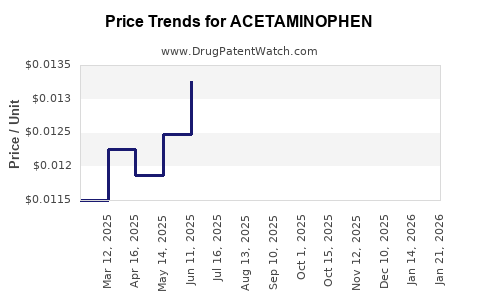
Drug Prices for ACETAMINOPHEN

See drug prices for ACETAMINOPHEN

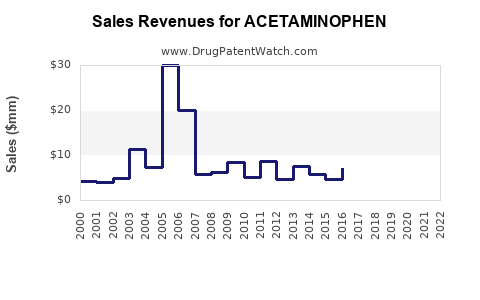
Drug Sales Revenue Trends for ACETAMINOPHEN

See drug sales revenues for ACETAMINOPHEN

Recent Clinical Trials for ACETAMINOPHEN

Identify potential brand extensions & 505(b)(2) entrants

SponsorPhase
Brigham and Women's HospitalPHASE1
National Institutes of Health (NIH)PHASE1
AdventHealthPHASE3

See all ACETAMINOPHEN clinical trials

Generic filers with tentative approvals for ACETAMINOPHEN
Applicant Application No. Strength Dosage Form
⤷  Start Trial⤷  Start Trial325MG; 7.5MGTABLET, EXTENDED RELEASE;ORAL

The 'tentative' approval signifies that the product meets all FDA standards for marketing, and, but for the patents / regulatory protections, it would approved.

Medical Subject Heading (MeSH) Categories for ACETAMINOPHEN
Paragraph IV (Patent) Challenges for ACETAMINOPHEN
Tradename Dosage Ingredient Strength NDA ANDAs Submitted Submissiondate
OFIRMEV Injection acetaminophen 650 mg/65 mL (10 mg/mL) 022450 1 2024-07-31
OFIRMEV Injection acetaminophen 1000 mg/100 mL (10 mg/mL) 022450 1 2011-04-07

US Patents and Regulatory Information for ACETAMINOPHEN

Applicant Tradename Generic Name Dosage NDA Approval Date TE Type RLD RS Patent No. Patent Expiration Product Substance Delist Req. Exclusivity Expiration
Actavis Labs Fl Inc HYDROCODONE BITARTRATE AND ACETAMINOPHEN acetaminophen; hydrocodone bitartrate TABLET;ORAL 206470-002 Jun 2, 2016 DISCN No No ⤷  Start Trial ⤷  Start Trial ⤷  Start Trial
Amneal Pharms TRAMADOL HYDROCHLORIDE AND ACETAMINOPHEN acetaminophen; tramadol hydrochloride TABLET;ORAL 090485-001 Dec 9, 2009 AB RX No Yes ⤷  Start Trial ⤷  Start Trial ⤷  Start Trial
Mutual Pharm HYDROCODONE BITARTRATE AND ACETAMINOPHEN acetaminophen; hydrocodone bitartrate TABLET;ORAL 040236-001 Sep 25, 1997 DISCN No No ⤷  Start Trial ⤷  Start Trial ⤷  Start Trial
Aurobindo Pharma ACETAMINOPHEN acetaminophen TABLET, EXTENDED RELEASE;ORAL 207229-001 Nov 9, 2016 OTC No No ⤷  Start Trial ⤷  Start Trial ⤷  Start Trial
>Applicant >Tradename >Generic Name >Dosage >NDA >Approval Date >TE >Type >RLD >RS >Patent No. >Patent Expiration >Product >Substance >Delist Req. >Exclusivity Expiration

Expired US Patents for ACETAMINOPHEN

Applicant Tradename Generic Name Dosage NDA Approval Date Patent No. Patent Expiration
Kenvue Brands TYLENOL acetaminophen TABLET, EXTENDED RELEASE;ORAL 019872-001 Jun 8, 1994 5,004,613 ⤷  Start Trial
Kenvue Brands TYLENOL acetaminophen TABLET, EXTENDED RELEASE;ORAL 019872-001 Jun 8, 1994 4,820,522 ⤷  Start Trial
Kenvue Brands TYLENOL acetaminophen TABLET, EXTENDED RELEASE;ORAL 019872-001 Jun 8, 1994 4,968,509 ⤷  Start Trial
>Applicant >Tradename >Generic Name >Dosage >NDA >Approval Date >Patent No. >Patent Expiration

Acetaminophen: Market Dynamics and Financial Trajectory

Last updated: April 24, 2026

What drives the acetaminophen market today?

Acetaminophen (paracetamol) is a mature, high-volume analgesic and antipyretic with pricing and demand shaped by three forces: (1) broad over-the-counter (OTC) access, (2) the long safety record and entrenched substitution across pain and fever, and (3) supply-side scale from large generics manufacturers and branded-household brands.

Demand structure

  • Use cases: fever and mild-to-moderate pain (headache, cold/flu symptoms, minor aches).
  • Channel reality: most volume is OTC, often sold as standalone tablets/caplets and as combination products (e.g., cold and flu formulations).
  • Substitution behavior: acetaminophen competes directly with ibuprofen and other analgesics in OTC shelves; in many geographies it retains share because it is perceived as easier to tolerate for certain patient groups and because it is deeply embedded in combination products.

Competitive landscape

  • Generic dominance: acetaminophen is widely generic; pricing tends toward low, stable levels.
  • Brand endurance: branded and “household” products persist, but their financial impact is typically limited by generic penetration and retailer private-labeling.
  • Combination products: a meaningful share of revenue comes indirectly through multi-symptom products. Those formulations can support revenue resilience when single-ingredient pricing compresses.

Cost and supply dynamics

  • Input and manufacturing scale: scale manufacturing favors large generic players, supporting stable supply and limiting margin expansion.
  • Regulatory and labeling: acetaminophen-related safety guidance (notably liver injury risk from overdose) affects consumer dosing behavior and can influence pack sizes and marketing claims, but it does not materially disrupt the core market due to established risk-minimization practices.
  • Patent status: the molecule is off-patent in major markets; product differentiation is mostly formulation, branding, and channel placement.

Demand risk factors that matter financially

  • Overuse and substitution: shifts toward ibuprofen or other OTC analgesics can change mix even when overall OTC category demand stays stable.
  • Seasonality: cold and flu seasons drive spikes in sales of fever reducers and combination products.
  • Retail and promo cycles: price and promotion actions by major retailers can drive short-run volume swings.

How does pricing typically behave for acetaminophen?

Acetaminophen pricing is structurally constrained by generics and OTC competition. Financially, the market tends to show:

  • Low unit margins relative to prescription specialty drugs.
  • Revenue stability via volume and pack mix rather than unit price growth.
  • Volatility tied to retailer pricing and promotional intensity, not drug-lifecycle events.

In markets with high generic penetration, price increases are usually limited to:

  • packaging changes and dosing convenience,
  • selective brand premium products,
  • and periods of supply disruption or commodity inflation.

What is the financial trajectory implied by market structure and data?

Acetaminophen does not follow the typical “ramp to launch to peak to decline” pattern of new drugs. Its financial trajectory behaves more like a mature mass-market OTC and generics portfolio.

Trajectory pattern

  • Steady baseline growth: driven by population growth and persistent OTC usage.
  • Cyclicality: seasonality in respiratory season and temporary demand spikes.
  • Margin pressure: recurring generic and private-label competition compresses realized pricing.
  • Revenue resilience from mix: combination products and branded legacy lines can slow the rate of revenue erosion.

Practical financial read-through for investors

For companies with manufacturing exposure:

  • Volume is king; capacity utilization and procurement scale dominate results.
  • Pricing discipline matters; sustained price competition can suppress earnings even when volumes hold.

For brands/marketers:

  • Brand and channel execution determine whether revenue holds up when generic prices reset.
  • Formulation and combination mix can protect top-line growth even when standalone unit prices flatten.

What regulatory and safety dynamics shape commercialization economics?

Acetaminophen’s commercialization economics are influenced by decades of safety guidance and dosing limits. The core impact is not a major market exit risk, but ongoing operational and marketing discipline.

Safety constraint that affects product strategy

  • Overdose risk management pushes manufacturers toward labeling, packaging, and consumer-dose clarity.
  • Combination-product scrutiny matters because multiple-ingredient formulations can raise the risk of unintentional overdosing.
  • Dose limiting affects pack formats, retailer placement strategy, and consumer messaging.

This environment supports a stable market, but it reduces the scope for aggressive product differentiation that would otherwise support higher pricing.

Where does acetaminophen financial performance concentrate: standalone vs combination?

Financially, revenue concentration is typically split between:

  • Standalone acetaminophen (tablets/caplets, liquid gels in some markets).
  • Combination cold and flu products, where acetaminophen is a co-active ingredient.

Because combination products are more tightly tied to seasonal respiratory demand, they can contribute to quarter-to-quarter earnings variance, with stronger performance during peak respiratory periods.

How do major company financials typically reflect acetaminophen exposure?

Public financial statements often reflect acetaminophen as part of broader:

  • OTC analgesics,
  • consumer health,
  • respiratory symptom platforms,
  • and generic manufacturing portfolios.

As a result, company-level acetaminophen “standalone” performance is usually not isolated in reporting; the molecule’s economic impact typically shows up through segment results, product-family sales, and generics volume and pricing dynamics.

What do market dynamics imply for future financial outcomes?

Near-to-medium-term, the acetaminophen market is likely to remain:

  • volume-led with modest topline growth,
  • price-pressured due to generic competition,
  • mix-shifting toward convenience and combination products in many markets.

Key drivers likely to steer financial outcomes include:

  • retailer promotional strategy,
  • changes in private-label share,
  • seasonal severity (respiratory season),
  • and competitive intensity among large generic manufacturers.

Outlook by scenario (directional)

  • Base case: stable demand, modest revenue growth from volume and mix, limited margin expansion.
  • Downside: increased promotional intensity and further private-label capture reduce realized pricing faster than volumes can offset.
  • Upside: stronger-than-average respiratory seasons and better combo-product mix improve revenue per unit sold, with some mitigation of margin compression.

How should R&D and portfolio decisions be evaluated for acetaminophen?

Given the mature status of the molecule, R&D value tends to concentrate in:

  • reformulation (improved onset, palatability, dosing convenience),
  • combination optimization (dose clarity and adherence design),
  • and manufacturing/process improvements for cost-of-goods advantage.

For portfolio strategy:

  • The highest financial upside typically comes from operational excellence and channel execution rather than new clinical differentiation, because the molecule’s clinical baseline is already well-established.

Key Takeaways

  • Acetaminophen is a mature, high-volume OTC and generics market where financial outcomes are driven by volume, mix (standalone vs combination), and realized pricing, not drug-lifecycle events.
  • Generic and private-label competition caps sustained price increases, so revenue resilience comes from combination products, convenience formats, and seasonal demand.
  • Safety and labeling guidance constrain some differentiation but do not structurally disrupt market access; commercialization remains stable with ongoing risk-minimization practices.
  • Future financial trajectory is likely steady topline with margin pressure, unless a producer wins through channel execution and cost leadership.

FAQs

  1. Is acetaminophen growth expected to be driven by prescription adoption?
    No. The core economics are OTC-driven with limited reliance on new prescription-driven demand.

  2. What most affects acetaminophen quarterly financials?
    Seasonality tied to respiratory illness demand and retailer promo intensity, especially for combination cold and flu products.

  3. Why does acetaminophen pricing rarely sustain long-term increases?
    Extensive generic supply and private-label competition reset realized prices toward low, stable levels.

  4. What product mix changes matter most commercially?
    The mix between standalone acetaminophen and combination symptom products, plus convenience formats that can support incremental revenue per unit.

  5. Where can financial upside still be created in acetaminophen?
    Manufacturing cost leadership, distribution and retailer execution, and winning formulation or combination placement within OTC shelves.


References

[1] US Food and Drug Administration. “Acetaminophen: Safety and Dosing Information.” FDA. https://www.fda.gov/ (accessed via FDA acetaminophen safety pages).
[2] World Health Organization. “Paracetamol (acetaminophen).” WHO. https://www.who.int/ (accessed via WHO paracetamol resources).
[3] NHS. “Paracetamol.” National Health Service. https://www.nhs.uk/ (accessed via NHS guidance pages).

More… ↓

⤷  Start Trial

Make Better Decisions: Try a trial or see plans & pricing

Drugs may be covered by multiple patents or regulatory protections. All trademarks and applicant names are the property of their respective owners or licensors. Although great care is taken in the proper and correct provision of this service, thinkBiotech LLC does not accept any responsibility for possible consequences of errors or omissions in the provided data. The data presented herein is for information purposes only. There is no warranty that the data contained herein is error free. We do not provide individual investment advice. This service is not registered with any financial regulatory agency. The information we publish is educational only and based on our opinions plus our models. By using DrugPatentWatch you acknowledge that we do not provide personalized recommendations or advice. thinkBiotech performs no independent verification of facts as provided by public sources nor are attempts made to provide legal or investing advice. Any reliance on data provided herein is done solely at the discretion of the user. Users of this service are advised to seek professional advice and independent confirmation before considering acting on any of the provided information. thinkBiotech LLC reserves the right to amend, extend or withdraw any part or all of the offered service without notice.