B Braun Medical Company Profile
✉ Email this page to a colleague
What is the competitive landscape for B BRAUN MEDICAL
B BRAUN MEDICAL has sixteen approved drugs.
There are three US patents protecting B BRAUN MEDICAL drugs.
Summary for B Braun Medical
| US Patents: | 3 |
| Tradenames: | 16 |
| Ingredients: | 15 |
| NDAs: | 16 |
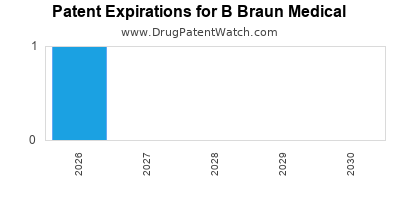
Drugs and US Patents for B Braun Medical
| Applicant | Tradename | Generic Name | Dosage | NDA | Approval Date | TE | Type | RLD | RS | Patent No. | Patent Expiration | Product | Substance | Delist Req. | Exclusivity Expiration |
|---|---|---|---|---|---|---|---|---|---|---|---|---|---|---|---|
| B Braun Medical | LEVETIRACETAM IN SODIUM CHLORIDE | levetiracetam | INJECTABLE;INTRAVENOUS | 209705-003 | Feb 27, 2024 | AP | RX | No | No | ⤷ Start Trial | ⤷ Start Trial | ||||
| B Braun Medical | LEVETIRACETAM IN SODIUM CHLORIDE | levetiracetam | INJECTABLE;INTRAVENOUS | 209705-001 | Feb 27, 2024 | AP | RX | No | No | ⤷ Start Trial | ⤷ Start Trial | ||||
| B Braun Medical | CLOROTEKAL | chloroprocaine hydrochloride | SOLUTION;INTRATHECAL | 208791-001 | Sep 26, 2017 | DISCN | Yes | No | 8,969,412 | ⤷ Start Trial | Y | ⤷ Start Trial | |||
| B Braun Medical | PIPERACILLIN AND TAZOBACTAM AND SODIUM CHLORIDE IN DUPLEX CONTAINER | piperacillin sodium; tazobactam sodium | POWDER;INTRAVENOUS | 206056-001 | Apr 3, 2025 | RX | Yes | Yes | ⤷ Start Trial | ⤷ Start Trial | |||||
| B Braun Medical | LIDOCAINE HYDROCHLORIDE | lidocaine hydrochloride | INJECTABLE;INJECTION | 208474-001 | Aug 3, 2018 | AP | RX | No | No | ⤷ Start Trial | ⤷ Start Trial | ||||
| B Braun Medical | MAGNESIUM SULFATE | magnesium sulfate | INJECTABLE;INJECTION | 207967-001 | Apr 26, 2021 | AP | RX | No | No | ⤷ Start Trial | ⤷ Start Trial | ||||
| >Applicant | >Tradename | >Generic Name | >Dosage | >NDA | >Approval Date | >TE | >Type | >RLD | >RS | >Patent No. | >Patent Expiration | >Product | >Substance | >Delist Req. | >Exclusivity Expiration |
Expired US Patents for B Braun Medical
| Applicant | Tradename | Generic Name | Dosage | NDA | Approval Date | Patent No. | Patent Expiration |
|---|---|---|---|---|---|---|---|
| B Braun Medical | CLOROTEKAL | chloroprocaine hydrochloride | SOLUTION;INTRATHECAL | 208791-001 | Sep 26, 2017 | 8,969,412 | ⤷ Start Trial |
| >Applicant | >Tradename | >Generic Name | >Dosage | >NDA | >Approval Date | >Patent No. | >Patent Expiration |
International Patents for B Braun Medical Drugs
| Country | Patent Number | Estimated Expiration |
|---|---|---|
| European Patent Office | 1931304 | ⤷ Start Trial |
| European Patent Office | 2712611 | ⤷ Start Trial |
| Russian Federation | 2015128024 | ⤷ Start Trial |
| South Korea | 20150085131 | ⤷ Start Trial |
| Brazil | PI0615702 | ⤷ Start Trial |
| Portugal | 1931304 | ⤷ Start Trial |
| >Country | >Patent Number | >Estimated Expiration |
Supplementary Protection Certificates for B Braun Medical Drugs
| Patent Number | Supplementary Protection Certificate | SPC Country | SPC Expiration | SPC Description |
|---|---|---|---|---|
| 3752510 | PA2025542 | Lithuania | ⤷ Start Trial | PRODUCT NAME: VANZACAFTOR, OR A PHARMACEUTICALLY ACCEPTABLE SALT THEREOF, PREFERABLY ACALCIUM SALT THEREOF; REGISTRATION NO/DATE: EU/1/25/1943 20250630 |
| 1411900 | 2011C/016 | Belgium | ⤷ Start Trial | PRODUCT NAME: NAPROXENE ET ESOMEPRAZOLE (SOUS LA FORME D'ESOMEPRAZOLE MAGNESIUM TRIHYDRATE); AUTHORISATION NUMBER AND DATE: BE382505 20101214 |
| 0933372 | SPC/GB08/018 | United Kingdom | ⤷ Start Trial | PRODUCT NAME: FOSAMPRENAVIR CALCIUM: ((1S,2R)-3-(((4-AMINOPHENYL)SULFONYL)(2-METHYLPROPYL)AMINO)-1-(PHENYLMETHYL)-2(PHOSPHONOOXY)PROPYL)-CARBABAMIC ACID C-((3S)-TETRAHYDRO-3-FURANYL) ESTER CALCIUM SALT; REGISTERED: UK EU/1/04/282/001 20040712; UK EU/1/04/282/002 20040712 |
| 3412676 | PA2020519 | Lithuania | ⤷ Start Trial | PRODUCT NAME: VABORBAKTAMO IR (ARBA) JO DRUSKOS, IR (ARBA) HIDRATO BEI MEROPENEMO IR (ARBA) JO DRUSKOS, IR (ARBA) HIDRATO, YPAC MEROPENEMO TRIHIDRATO, DERINYS; REGISTRATION NO/DATE: EU/1/18/1334 20181120 |
| 2957286 | 132019000000021 | Italy | ⤷ Start Trial | PRODUCT NAME: PATIROMER SORBITEX CALCIUM E QUALSIASI SUO SALE O DERIVATO(VELTASSA); AUTHORISATION NUMBER(S) AND DATE(S): EU/1/17/1179, 20170721 |
| 1259550 | 122008000068 | Germany | ⤷ Start Trial | PRODUCT NAME: SUGAMMADEX ODER EIN PHARMAZEUTISCH VERTRAEGLICHES SALZ DAVON; REGISTRATION NO/DATE: EU/1/08/466/001-002 20080725 |
| >Patent Number | >Supplementary Protection Certificate | >SPC Country | >SPC Expiration | >SPC Description |
Similar Applicant Names
Applicants may be listed under multiple names.
Here is a list of applicants with similar names.
Here is a list of applicants with similar names.
