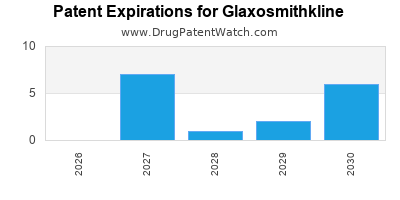
Last updated: July 24, 2026
How does GlaxoSmithKline (GSK) rank in branded pharma versus Merck, Pfizer, and AbbVie?
GSK is a diversified branded pharma and vaccines leader, with a market position that is structurally different from fully concentrated oncology peers. Its competitive edge is defined by (1) differentiated specialty franchises in immunology and respiratory, (2) a vaccines base, and (3) a commercialization model that is heavily partnership-driven in certain late-stage assets.
Commercial footprint (high-level structural indicators)
- Branded pharma mix: GSK is weighted toward specialty and respiratory/immunology, with reduced exposure to blockbuster-only models relative to legacy Pfizer/Merck oncology dominance.
- Vaccines: GSK’s vaccines platform adds multi-year demand stability and reduces cyclicality risk versus pure-play pharma.
- Partnership dependence: Several late-stage and high-impact development programs rely on co-development or commercialization arrangements, which changes negotiating power in licensing and in cost-sharing dynamics.
What strengths does GSK have in immunology, respiratory, and oncology-adjacent specialty?
Immunology and respiratory: where GSK can outcompete
GSK’s specialty profile tends to favor:
- Long treatment-duration indications.
- Clinical differentiation through safety/tolerability and dosing convenience.
- IP stacks built around formulations, device delivery, and method-of-use.
Oncology: what is the strategic posture
GSK is not a “dominant oncology-first” operator at the same scale as Merck (Keytruda-led) or Bristol Myers Squibb (Opdivo-led), but it maintains credible immuno-oncology inputs and biology-led discovery. For competitive advantage, GSK’s oncology posture is tied to:
- Translational biomarker programs that can support label expansion.
- Combination strategies that can extend exclusivity windows and reduce substitution risk.
Which GSK products drive revenue and how does that shape competitive strategy?
Core revenue engine patterns
GSK revenue is concentrated in:
- Respiratory/Immunology franchises where competitor substitution is difficult when inhaler/device ecosystem and dosing schedules are integrated into patient workflows.
- Vaccines, where GSK’s manufacturing scale, regulatory approvals, and supply reliability can act as non-IP barriers.
Competition implications
- Competitors win share by either (1) incremental clinical advantage, (2) device or adherence improvements, or (3) payer-driven formulary positioning through price or outcomes-linked contracts.
- GSK strategy typically emphasizes differentiation where payer substitutes are less flexible.
How strong is GSK’s patent estate for its top brands?
GSK’s patent durability typically comes from a multi-layer structure:
- Composition of matter for active ingredients (base protection).
- Formulation and solid-state or device delivery improvements for inhaled and other delivery modes.
- Method-of-use for specific patient subsets, combinations, dosing regimens, or maintenance/indication expansions.
- Manufacturing/process patents in certain manufacturing platforms.
Practical effect on competition
- Generic entry is delayed not only by drug substance expiration but also by reformulation/device and method-of-use coverage that blocks “non-infringing” routes.
- Settlement leverage in Paragraph IV disputes often increases when GSK can identify one or more bottleneck patents covering the narrowest defensible claim sets.
What patents protect GSK’s key brands and how do they influence generic or biosimilar risk?
Small molecule and inhaled delivery: patent stack dynamics
For respiratory and immunology medicines, the competitive risk to generics is usually higher when:
- The composition-of-matter patent expires but formulation/device patents remain in-force.
- Method-of-use patents still cover core labeled regimens.
Common bottleneck patent types
- Formulation patents tied to particle size distribution, excipient selection, or stability profiles.
- Device patents controlling delivery performance characteristics.
- Method-of-use patents covering dosing intervals and combination regimens.
Biologics and biosimilars: IP and data exclusivity interaction
Where GSK has biologic exposure, competitive pressure is shaped by:
- Data exclusivity for biologic indications and regulatory filing pathways.
- Biosimilar development constraints due to process similarity requirements and potential claim triggers tied to manufacturing methods or specific formulation presentations.
When does GSK lose exclusivity on major products?
Exclusivity timing is product-specific and depends on:
- Patent expiration.
- Pediatric exclusivity adjustments.
- Orphan drug exclusivity (if applicable).
- Data exclusivity and regulatory exclusivity tied to approval date and jurisdiction.
Competitive insight
- In competitive forecasting, the exclusivity loss “event” is not a single date. It is a window defined by staggered expiration of: drug substance patents, formulation patents, and any method-of-use claims that still map to the labeled regimen.
How does GSK’s patent strength compare with Pfizer, Merck, and AbbVie?
Relative profile
- Merck and Pfizer: typically have high concentration in oncology or multi-blockbuster architectures with very large “early life cycle” value at scale.
- AbbVie: often features thick IP stacks around immunology and oncology-adjacent assets with aggressive litigation and settlement structures.
- GSK: generally has a steadier specialty/vaccines mix and can sustain competitive defense via diversified claim types spanning formulations/device and method-of-use, often limiting “design-around” options for generics.
Competitive effect
- GSK’s advantage often comes from the defensibility of localized claim sets for inhaled and immunology regimens and the non-IP barrier effect of manufacturing and regulatory compliance for vaccines and complex delivery.
Which companies are challenging GSK’s brands with generics or biosimilars?
Competitor types:
- Generic entrants targeting small-molecule and inhaled products through Paragraph IV tactics after patent cliffs.
- Specialty generics and “authorized generics” for controlled and settlement-driven market openings.
- Biosimilar developers where biologic exclusivity expires, focused on claim-scope design and regulatory path alignment.
Market behavior pattern
- When multiple GSK patents remain active, challengers tend to file strategically to provoke settlement or to test claim coverage via narrow court claim constructions.
What Paragraph IV litigation risks exist for GSK?
Paragraph IV risk is elevated when:
- GSK has one or more patents that a generic must “work around” to avoid infringement.
- GSK’s method-of-use or formulation patents align closely with the labeled regimen.
Business implication
- Strong patent stacks increase settlement leverage and can delay market entry, even when composition-of-matter has expired.
What is the Orange Book status of GSK’s key small-molecule and inhaled products?
Orange Book listings reflect:
- Approved drug entries.
- Patent numbers, submission holders, and listed expiration dates.
Competitive use
- Market participants use Orange Book data to map:
- Likely Paragraph IV triggers.
- Which claims are most critical.
- Settlement likelihood based on the number and hierarchy of active patents.
How does GSK’s regulatory strategy affect competitive entry timing?
FDA pathway management and label scope
Competitive timing is shaped by:
- Label breadth, which can preserve method-of-use coverage.
- Supplemental approvals that extend or re-anchor coverage to narrower regimens tied to existing patents.
- Changes in formulation or device that create additional patent layers.
Competitive implication
- If GSK maintains tight control over device and dosing labeling, competitors face more difficult design-around paths.
How do GSK’s licensing and collaboration deals impact its competitive position?
GSK’s model often includes:
- Partner co-development that shares R&D risk.
- Commercial licensing that can extend market presence beyond internal capacity.
- IP-sharing structures that affect who controls enforcement.
Strategic impact
- Licensing can accelerate development but can reduce unilateral enforcement leverage if rights are split across partners.
What commercialization and payer strategies help GSK defend share when patents near expiration?
Switching friction as a competitive moat
GSK can defend through:
- Coverage strategies that favor branded continuation where clinical outcomes are payer-relevant.
- Patient support and adherence programs, especially for chronic respiratory regimens.
- Contracting structures that tie reimbursement to treatment persistence or outcomes.
How does GSK’s pipeline compare with Pfizer, Merck, and Sanofi in immunology and respiratory?
Pipeline competition is typically decided by:
- Speed to Phase 3 and label expansions.
- Success rates in immunology and inflammation biology.
- Regulatory differentiation and durability of endpoints.
Strategic positioning
- GSK’s pipeline strength is less about mass blockbuster replication and more about targeted specialty progression that can extend franchise life cycles.
Which GSK franchises are most exposed to generic entry risk?
Exposure tends to concentrate where:
- Composition-of-matter expires or is close.
- Formulation/device patents are fewer or easier to design around.
- Method-of-use claims are narrow or have been weakened by claim construction.
Risk reduction mechanisms
- Staggered filing strategy (formulation/device and method-of-use).
- Product lifecycle management via incremental improvements and labeling.
What manufacturing and supply chain barriers protect GSK’s brands?
Beyond IP, GSK can defend via:
- Vaccines manufacturing scale and multi-plant validation processes.
- Complex-device manufacturing for inhalation and multi-component formulations.
- Regulatory and quality systems that limit rapid “scale-up” for challengers.
How do GSK’s competitors compare on IP defensibility?
Merck
- Often strong where oncology immunotherapy is core and where patent estates are deep and long-running.
Pfizer
- Strength typically comes from dense IP around key franchises and large-scale settlement capacity.
AbbVie
- Strong in immunology with thick claim estates and a history of aggressive defense.
GSK
- Strength often comes from diversified specialty coverage, formulation/device claim density, and the resilience created by vaccines and multi-category presence.
Key Takeaways
- GSK’s competitive position is defined by specialty immunology/respiratory plus vaccines, reducing reliance on a single oncology blockbuster model.
- Its patent strength is typically built through layered coverage: composition, formulation/device, and method-of-use. This structure increases generic design-around difficulty.
- Competitive threats rise most sharply at exclusivity cliffs where method-of-use and formulation/device patents are thin or vulnerable.
- Regulatory and labeling strategy affects how long method-of-use coverage remains tethered to real-world use, which in turn impacts settlement and generic entry probability.
- Licensing and partnership structures change enforcement leverage and can influence who bears litigation and who captures settlement value.
FAQs
-
How do device and formulation patents delay generic entry for inhaled GSK products?
By forcing challengers to match not just active ingredient identity but also delivery performance parameters tied to the labeled regimen.
-
What strategy do generic filers use against GSK when method-of-use patents remain active?
They attempt narrow non-infringing design-around by changing dosing regimens, combinations, or patient-selection labeling implications.
-
How do label expansions after exclusivity cliffs affect GSK patent leverage?
They can re-anchor use claims and create new hooks for method-of-use coverage tied to supplemental indications.
-
Do GSK vaccines face biosimilar-style substitution risk?
Vaccines do not follow biosimilar frameworks the same way as biologics, but supply reliability, regulatory approvals, and manufacturing validation act as substitution barriers.
-
What are the most value-accretive levers for GSK during the late lifecycle of a specialty brand?
Tight label control, lifecycle formulation/device improvements, and payer contracting that preserves branded persistence.
References
- U.S. Food and Drug Administration. Orange Book: Approved Drug Products with Therapeutic Equivalence Evaluations. FDA.
- U.S. Food and Drug Administration. Drugs@FDA. FDA.
- U.S. Patent and Trademark Office. Patent Public Search System. USPTO.
- FDA. Guidance for Industry: Scientific Considerations in Demonstrating Biosimilarity to a Reference Product. FDA.