Apil Company Profile
✉ Email this page to a colleague
What is the competitive landscape for APIL
APIL has fifteen approved drugs.
There are four US patents protecting APIL drugs.
Summary for Apil
| US Patents: | 4 |
| Tradenames: | 16 |
| Ingredients: | 8 |
| NDAs: | 15 |
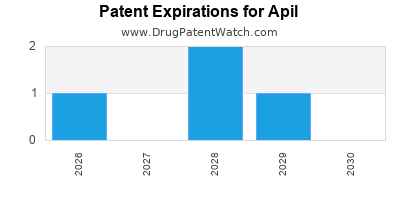
Drugs and US Patents for Apil
| Applicant | Tradename | Generic Name | Dosage | NDA | Approval Date | TE | Type | RLD | RS | Patent No. | Patent Expiration | Product | Substance | Delist Req. | Exclusivity Expiration |
|---|---|---|---|---|---|---|---|---|---|---|---|---|---|---|---|
| Apil | ACTONEL | risedronate sodium | TABLET;ORAL | 020835-004 | Apr 16, 2007 | DISCN | Yes | No | ⤷ Start Trial | ⤷ Start Trial | |||||
| Apil | ESTROSTEP 21 | ethinyl estradiol; norethindrone acetate | TABLET;ORAL-21 | 020130-001 | Oct 9, 1996 | DISCN | Yes | No | ⤷ Start Trial | ⤷ Start Trial | |||||
| Apil | ACTONEL | risedronate sodium | TABLET;ORAL | 020835-001 | Mar 27, 1998 | DISCN | Yes | No | ⤷ Start Trial | ⤷ Start Trial | |||||
| Apil | FEMTRACE | estradiol acetate | TABLET;ORAL | 021633-002 | Aug 20, 2004 | DISCN | Yes | No | ⤷ Start Trial | ⤷ Start Trial | |||||
| Apil | FEMCON FE | ethinyl estradiol; norethindrone | TABLET;ORAL | 021490-001 | Nov 14, 2003 | DISCN | Yes | No | ⤷ Start Trial | ⤷ Start Trial | |||||
| Apil | LO MINASTRIN FE | ethinyl estradiol; norethindrone acetate | TABLET, CHEWABLE, TABLET;ORAL | 204654-001 | Jul 24, 2013 | DISCN | Yes | No | 7,704,984 | ⤷ Start Trial | ⤷ Start Trial | ||||
| >Applicant | >Tradename | >Generic Name | >Dosage | >NDA | >Approval Date | >TE | >Type | >RLD | >RS | >Patent No. | >Patent Expiration | >Product | >Substance | >Delist Req. | >Exclusivity Expiration |
Expired US Patents for Apil
| Applicant | Tradename | Generic Name | Dosage | NDA | Approval Date | Patent No. | Patent Expiration |
|---|---|---|---|---|---|---|---|
| Apil | ESTROSTEP 21 | ethinyl estradiol; norethindrone acetate | TABLET;ORAL-21 | 020130-001 | Oct 9, 1996 | 5,010,070 | ⤷ Start Trial |
| Apil | ESTROSTEP FE | ethinyl estradiol; norethindrone acetate | TABLET;ORAL-28 | 020130-002 | Oct 9, 1996 | 4,962,098 | ⤷ Start Trial |
| Apil | FEMTRACE | estradiol acetate | TABLET;ORAL | 021633-002 | Aug 20, 2004 | 6,962,908 | ⤷ Start Trial |
| Apil | DIDRONEL | etidronate disodium | TABLET;ORAL | 017831-002 | Approved Prior to Jan 1, 1982 | 3,524,844 | ⤷ Start Trial |
| Apil | ACTONEL | risedronate sodium | TABLET;ORAL | 020835-002 | Apr 14, 2000 | 6,015,801 | ⤷ Start Trial |
| Apil | TAYTULLA | ethinyl estradiol; norethindrone acetate | CAPSULE;ORAL | 204426-001 | Apr 19, 2013 | 5,552,394 | ⤷ Start Trial |
| >Applicant | >Tradename | >Generic Name | >Dosage | >NDA | >Approval Date | >Patent No. | >Patent Expiration |
Paragraph IV (Patent) Challenges for APIL drugs
| Drugname | Dosage | Strength | Tradename | Submissiondate |
|---|---|---|---|---|
| ➤ Subscribe | Delayed-release Tablets | 35 mg | ➤ Subscribe | 2011-07-19 |
| ➤ Subscribe | Tablets | 75 mg | ➤ Subscribe | 2007-09-10 |
| ➤ Subscribe | Chewable Tablets | 0.4 mg/0.035 mg | ➤ Subscribe | 2007-04-27 |
| ➤ Subscribe | Delayed-release Tablets | 400 mg | ➤ Subscribe | 2007-06-22 |
| ➤ Subscribe | Tablets | 5 mg, 30 mg and 35 mg | ➤ Subscribe | 2004-04-23 |
| ➤ Subscribe | Tablets | 150 mg | ➤ Subscribe | 2008-08-12 |
| ➤ Subscribe | Chewable Tablets | 1 mg/0.02 mg and 75 mg | ➤ Subscribe | 2014-04-23 |
International Patents for Apil Drugs
| Country | Patent Number | Estimated Expiration |
|---|---|---|
| Poland | 2283825 | ⤷ Start Trial |
| Hong Kong | 1161130 | ⤷ Start Trial |
| World Intellectual Property Organization (WIPO) | 2010014766 | ⤷ Start Trial |
| Brazil | PI0511530 | ⤷ Start Trial |
| Morocco | 28657 | ⤷ Start Trial |
| South Korea | 20070111551 | ⤷ Start Trial |
| >Country | >Patent Number | >Estimated Expiration |
Supplementary Protection Certificates for Apil Drugs
| Patent Number | Supplementary Protection Certificate | SPC Country | SPC Expiration | SPC Description |
|---|---|---|---|---|
| 2782584 | 122021000080 | Germany | ⤷ Start Trial | PRODUCT NAME: ZUSAMMENSETZUNG, DIE SOWOHL ESTRADIOL (17SS-ESTRADIOL), GEGEBENENFALLS IN FORM EINES PHARMAZEUTISCH ANNEHMBAREN SALZES, HYDRATS ODER SOLVATS DAVON (EINSCHLIESSLICH IN FORM EINES HEMIHYDRATS), ALS AUCH PROGESTERON ENTHAELT; AUTHORISATION NO/DATE: 2205034.00.00 20210924; BE582231 20210406 |
| 1214076 | C01214076/01 | Switzerland | ⤷ Start Trial | PRODUCT NAME: DROSPIRENONE + ETHINYLESTRADIOL; REGISTRATION NUMBER/DATE: SWISSMEDIC 57946 13.06.2008 |
| 1453521 | C201630040 | Spain | ⤷ Start Trial | PRODUCT NAME: ETINILESTRADIOL Y MEZCLA DE LEVONORGESTREL Y ETINILESTRADIOL; NATIONAL AUTHORISATION NUMBER: 80340; DATE OF AUTHORISATION: 20160122; NUMBER OF FIRST AUTHORISATION IN EUROPEAN ECONOMIC AREA (EEA): 17/0017/15-S; DATE OF FIRST AUTHORISATION IN EEA: 20150211 |
| 1453521 | C 2015 029 | Romania | ⤷ Start Trial | PRODUCT NAME: LEVONORGESTREL SI ETINILESTRADIOL; NATIONAL AUTHORISATION NUMBER: RO 7793/2015/001; DATE OF NATIONAL AUTHORISATION: 20150612; NUMBER OF FIRST AUTHORISATION IN EUROPEAN ECONOMIC AREA (EEA): SK. 17/0017/15-S; DATE OF FIRST AUTHORISATION IN EEA: 20150129 |
| 2782584 | 301153 | Netherlands | ⤷ Start Trial | PRODUCT NAME: COMPOSITION CONTAINING BOTH ESTRADIOL (17SS-ESTRADIOL), OPTIONALLY IN THE FORM OF A PHARMACEUTICALLY ACCEPTABLE SALT, HYDRATE OR SOLVATE THEREOF (INCLUDING IN HEMIHYDRATE FORM), AND PROGESTERONE; NATIONAL REGISTRATION NO/DATE: RVG 125821 20210611; FIRST REGISTRATION: BE BE582231 20210406 |
| 0334429 | 97C0002 | Belgium | ⤷ Start Trial | PRODUCT NAME: ESTRADIOL; NAT. REGISTRATION NO/DATE: NL 18978 19960731; FIRST REGISTRATION: SE - 11783 19930305 |
| >Patent Number | >Supplementary Protection Certificate | >SPC Country | >SPC Expiration | >SPC Description |
Similar Applicant Names
Applicants may be listed under multiple names.
Here is a list of applicants with similar names.
Here is a list of applicants with similar names.
