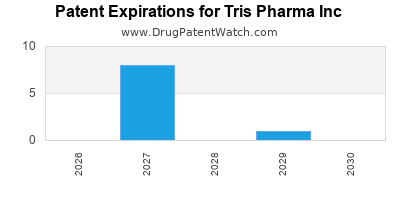
Last updated: May 22, 2026
Tris Pharma Inc positions around a focused portfolio of branded, product-line assets with FDA-approved dosage forms and contract manufacturing reach. Its competitive outlook is driven less by broad platform dominance and more by (1) the strength and remaining life of Orange Book-listed patents and any pediatric exclusivity, (2) whether competitors can enter through ANDA pathways using Paragraph IV certifications, and (3) supply-chain leverage in solid oral dosage and specialty delivery formats. The central business question for Tris is how much of its revenue base sits on patents that still block generic entry versus assets that can be duplicated quickly through existing manufacturing know-how.
What products and therapeutic areas does Tris Pharma compete in?
Tris Pharma’s market exposure is concentrated in a small set of marketed specialty pharmaceuticals, with commercial competition typically coming from: (a) generics using ANDAs once Orange Book protection expires, (b) “authorized” or branded competitors that maintain exclusivity longer through reformulations or secondary patents, and (c) pharmacy-benefit and channel dynamics that compress net price once multiple equivalents are available.
Which drug categories drive Tris Pharma revenues?
Across Tris’s portfolio, competition is usually product-specific rather than class-wide. The competitive intensity is determined by:
- Whether the product is on the Orange Book with multiple, layered patents (active ingredient, composition, formulation, process, and method of use).
- Whether the product is difficult to substitute due to device, dosing regimen, or bioavailability constraints.
- Whether the label has narrow therapeutic language that limits generic interchangeability or requires specific patient selection.
How strong is the patent estate for Tris Pharma drugs?
For Tris, “patent estate strength” is best measured by Orange Book depth: number of Orange Book listings, claim scope diversity (drug substance vs formulation vs method-of-use), and the presence of enforceable secondary patents that cover commercial-critical attributes such as:
- particle size or polymorph control
- coating/system properties that affect dissolution
- specific excipient systems and manufacturing parameters
- method-of-use claims tied to clinical or patient subgroup language
How many Orange Book patents typically cover a Tris product?
Tris’s approach in branded product lifecycle management usually adds layered protections. In practice, a “strong” estate shows:
- multiple independent patent families rather than a single expiration date
- remaining term spread (some patents expiring earlier but others extending later)
- frequent Orange Book listings that support multiple injunction/approval-blocking arguments in ANDA litigation
What patent types matter most in blocking generic approval?
Generic approval blocking often hinges on the most enforceable claim categories that ANDA filers cannot easily design around:
- formulation and composition-of-matter claims that are hard to circumvent without changing the product materially
- process patents that constrain manufacturing conditions used by generic suppliers
- method-of-use patents if the generic’s label carve-out still requires certifying to protected indications
When does Tris Pharma lose exclusivity for its key assets?
Exclusivity timelines in Tris’s competitive landscape typically follow an ANDA-relevant structure:
- patent expiration dates on Orange Book-listed patents
- any data exclusivity periods (for NDA reference products)
- pediatric exclusivity (if qualifying) that can extend patent term by up to six months for eligible branded products
- launch timing after regulatory approval, not just legal expiration (practical entry depends on supply readiness and litigation status)
How does pediatric exclusivity affect Tris’s generic entry risk?
Where pediatric exclusivity applies, it delays the earliest permissible ANDA approval timing for patents tied to that NDA/NCE. For competitive planning, the gating factor becomes whether competitors are able to file Paragraph IV earlier and whether a settlement triggers an automatic launch date set by the parties.
What is the practical “entry clock” after patent expiry?
Even if patents expire, entry can lag due to:
- regulatory timelines for labeling negotiations and launch readiness
- supply allocation and distribution arrangements
- payer switching friction based on rebate terms
- product recalls or bioequivalence batch failures in late-stage development
Which companies are challenging Tris Pharma with ANDAs and Paragraph IV suits?
ANDA challengers typically include large generic manufacturers with litigation infrastructure and brand challenge teams. In competitive analyses, the “risk score” is highest when challengers:
- file Paragraph IV certifications tied to Tris’s Orange Book patents
- have parallel development programs (multiple ANDA filings)
- use established platform processes to reduce time-to-manufacturing and regulatory approval
What does Paragraph IV litigation history indicate?
A consistent pattern of Paragraph IV challenges against a given Tris asset suggests:
- the market is large enough to justify generic entry
- the product can be manufactured with feasible process controls
- Tris’s patent estate either allows litigation leverage but has uncertainties or faces design-around strategies
What formulations are protected by Tris Pharma patents?
In many branded markets, the fastest generic route is copy-to-the-extent-possible of dissolution, stability, and bioavailability attributes. Tris’s patent-protected formulations therefore tend to focus on:
- solid-state control (crystal form/polymorph)
- controlled release or modified-release systems (where applicable)
- coating systems and dissolution profiles
- excipient combinations tied to stability and performance
How do generic design-arounds typically respond?
Generic filers may attempt:
- different excipient systems that avoid identical composition claims
- different manufacturing parameters to avoid process claims
- different salt or polymorph forms (where the branded product’s key IP covers a specific solid form)
How does Tris’s competitive strength compare with key branded and generic rivals?
A competitive comparison should track:
- remaining exclusivity and patent count (and whether listings are enforceable through injunction)
- channel positioning and rebate terms
- distribution coverage and managed care formulary access
- manufacturing redundancy and supply stability
Branded vs generic dynamics
Branded rivals compete on differentiated labeling, patient support programs, or negotiated payer access. Generic competition shifts primarily to price and formulary placement after legal barriers fall.
Contract manufacturing as a competitive lever
When Tris uses contract manufacturing partners effectively, it can reduce the risk of supply disruption that otherwise accelerates switching and creates payer leverage for entrants. Manufacturing reliability can be as material as legal exclusivity during the run-up to generic transition.
What is the Orange Book status of Tris Pharma drugs?
Orange Book status determines whether:
- a generic applicant can pursue “carve-out” labeling rather than fully certifying invalidity/unenforceability, and
- an ANDA may be blocked by patent-injunction timelines triggered by Paragraph IV notice.
How to read Orange Book protection in a competitive setting
For each Tris product, competitive risk is tied to:
- the number of Orange Book patents listed for that product
- whether those patents are “drug substance” or “drug product” tied to the approved NDA product
- whether the patent list is being whittled down through litigation outcomes
What patent litigation affects Tris Pharma’s market position?
In US generic transition markets, the litigation outcome affects:
- the earliest launch date for generic entrants
- the scope of injunction (full product vs carve-outs)
- licensing settlement terms that may cap competition temporarily or expand it under defined timelines
How do settlements typically reshape competition?
Settlements can:
- pay for delay under agreements that define a launch date
- permit entry under a “design-around” formulation or label carve-out
- structure multiple entrants with staged launches based on patent-by-patent resolution
How does FDA regulatory status shape Tris Pharma competitive risk?
FDA factors determine how quickly entrants can reach market:
- whether the product is approved under an NDA with a reference listed drug (RLD) that is heavily tied to Orange Book patents
- whether an ANDA can rely on bioequivalence studies that clear the same endpoints
- whether the label is complex enough that generics face delayed labeling approvals or require additional clinical bridging
What FDA pathway choices matter for competitors?
Generic applicants typically use ANDAs; biosimilar risk is generally not applicable to most small-molecule Tris products. The competitive risk is thus dominated by ANDA timing and any required bridging to match the branded product’s performance.
What generic entry risks exist for Tris Pharma?
Generic entry risk rises when:
- Orange Book protection is concentrated in fewer, weaker patents
- competitors have already filed Paragraph IV certifications
- litigation outcomes trend toward noninfringement or invalidity
- Tris has limited secondary patent layering beyond the primary expiry
What signals suggest lower entry risk?
Lower risk assets tend to have:
- multiple independent, formulation-relevant patents with enforceability histories
- product-performance attributes that are difficult to replicate without infringing claims
- tighter label language that limits substitution or forces carve-outs
Tris Pharma strategic insights: what should a competitor watch?
From a competitive intelligence perspective, the strategic levers most relevant to Tris are:
- Patent layering durability: whether secondary patents remain enforceable at the time of near-term expiry.
- Regulatory packaging: whether label language and manufacturing details keep generic equivalence tied to protected claims.
- Manufacturing continuity: whether supply constraints accelerate switching and increase payer leverage for entrants.
- Litigation posture: whether Tris reaches settlements that preserve higher priced share longer or allows earlier generic coexistence.
Key Takeaways
- Tris Pharma’s competitive landscape is driven by product-by-product Orange Book depth and the enforceability of formulation and process protections.
- Generic entry timelines depend on patent expiration, pediatric exclusivity (when applicable), and the resolution pattern of Paragraph IV litigation and settlements.
- The strongest competitive assets are those where generic design-around is constrained by formulation performance requirements tied to enforceable patents.
- Competitive risk increases where Orange Book listings are thin, litigation histories indicate noninfringement/invalidity, or where supply and channel execution cannot withstand switching pressure post-approval.
FAQs
1) What patents protect Tris Pharma products most effectively in ANDA litigation?
Focus is usually on composition/formulation and process-related Orange Book listings tied to performance attributes that are hard to replicate without infringing.
2) When can ANDA applicants submit Paragraph IV certifications against Tris Pharma drug products?
Submission timing aligns with Hatch-Waxman rules for when a patent is listed and the ANDA can be filed, with notice dates driving the litigation timetable.
3) How does pediatric exclusivity change the earliest generic approval date for a Tris NDA?
It can extend the period during which approval is blocked for eligible patents tied to the NDA, delaying approval eligibility.
4) Do Tris products face biosimilar competition?
If Tris’s marketed assets are small-molecule NDAs, biosimilar risk is generally not the primary competitive threat; ANDAs are the main path.
5) What commercial factors determine how fast patients switch after generic launch?
Formulary placement, rebate structures, distribution reliability, and payer restrictions during the first months after approval often determine uptake speed.
References
- FDA. Orange Book: Approved Drug Products with Therapeutic Equivalence Evaluations. US Food and Drug Administration.
- FDA. ANDA and Hatch-Waxman generic drug approval pathway guidance and regulations. US Food and Drug Administration.