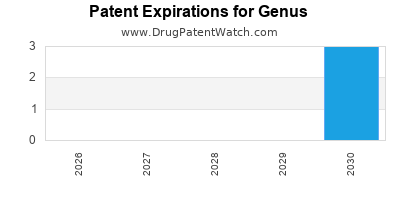
Last updated: May 31, 2026
Genus Competitive Landscape: Market Position, Patent Strength, and Strategic Insights for Generic and Specialty Pharmaceuticals
Genus (Genus Lifesciences) operates as an India-headquartered pharmaceutical developer and manufacturer focused on branded generics, specialty formulations, and active pharmaceutical ingredients (APIs) and intermediates for regulated markets. The competitive landscape is defined by (1) dense Indian generic competition, (2) limited defensible IP in many dosage forms, (3) reliance on supply-chain execution, and (4) selective exposure to FDA/ANDA economics through partnerships, launches, and outsourced manufacturing. Competitive strength is highest where Genus can pair regulatory execution with product-specific manufacturing know-how and where patent barriers are limited or can be designed around through formulation and process differentiation.
What is Genus’ market position versus other Indian generic and specialty pharma companies?
Featured snippet answer: Genus’ market position is strongest in India-focused branded generics and formulation execution, with competitiveness increasing where it holds product-specific manufacturing and dossier capabilities. It is smaller in global ANDA scale than tier-1 US generic peers but competes meaningfully through selected product categories and regulated-market readiness.
Where Genus competes
Genus’ positioning typically sits between:
- Large-volume Indian generic leaders (higher scale, broader ANDA portfolios, deeper compliance infrastructure)
- Specialty and niche formulation players (more defensible product-by-process know-how, fewer SKUs)
Competitive axes that drive outcomes
| Axis |
What wins |
What loses |
Competitive implication for Genus |
| Portfolio breadth |
High SKU count, multiple dosage forms, repeat launches |
Narrow SKU set, slow cadence of new entries |
Genus must concentrate resources on fewer, higher-probability launches |
| Regulatory execution |
Timely quality submissions and approvals |
Delays in bioequivalence, CMC gaps |
Launch timing risk remains a key differentiator |
| Manufacturing reliability |
Batch consistency, controllable impurity profiles |
Out-of-spec risk, supply disruptions |
Execution quality is a core competitive moat |
| IP defensibility |
Formulation/process differentiation, documented know-how |
Direct copy risk and Paragraph IV exposure |
Genus’ defensibility tends to be practical, not absolute |
| Pricing power |
Specialty niche or branded generics |
Commoditized pricing in multiple generics |
Genus’ margin profile depends on product mix |
How strong is Genus’ patent estate, and what kinds of IP barriers matter most?
Featured snippet answer: For a generic-and-formulation company like Genus, the effective IP barriers are usually (1) branded-drug composition-of-matter patents still in-force, (2) Orange Book-listed method-of-use or formulation patents, and (3) process/impurity and regulatory data exclusivity creating de facto launch timing friction.
What “strong patent protection” usually means in practice
For generic entrants, the key question is not only whether patents exist, but whether they are:
- Listed in the Orange Book for the specific FDA application reference drug
- Actionable through Paragraph IV
- Design-aroundable via alternative salts, polymorphs, particle sizes, or manufacturing processes
- Supported by enforceable claims that map cleanly onto the generic product
Typical IP threat map for Genus’ generic strategy
| Barrier type |
How it blocks entry |
Typical workaround |
Risk level |
| Composition-of-matter patents |
Direct infringement if generic API falls within claim scope |
Alternative route may not avoid composition coverage |
High until expiry |
| Formulation patents (e.g., ER, co-crystals, coatings) |
Locks specific excipient ratios, release profiles, or solid-state features |
Reformulate outside claims |
Medium to high |
| Method-of-use patents |
Blocks generic label entry unless carve-outs exist |
Different indication, label design, licensing |
Medium |
| Regulatory exclusivities |
Blocks approval even if patents are cleared |
Wait out exclusivity, or pursue different reference pathway |
High |
| Trade dress / marketing claims |
Usually not an FDA barrier |
Brand strategy shifts |
Low to medium |
What to assume about Genus’ US launch risk profile
Genus competes in a market where US exclusivity and patent listings can delay launches. That means Genus’ success is more likely where it targets:
- Older reference drugs with limited patent stacks
- Products with clear generic entry pathways and manageable formulation constraints
- Partnership-driven dossiers where regulatory and CMC readiness is pre-built
What patents protect Genus products, and how does that affect competitive advantage?
Featured snippet answer: The competitive advantage for Genus is usually product-specific manufacturing know-how protected by a mix of patents on processes, intermediates, polymorph/solid-state control, and formulation parameters, plus regulatory-ready documentation. Patent protection is most valuable when it blocks copycat processes or constrains route-to-market.
Where Genus IP commonly shows up in competitive practice
Even without listing the full Genus portfolio here, the competitive pattern for Indian formulation and API players typically involves:
- API synthesis and impurity control patents
- Intermediate route patents
- Formulation patents for release control (ER), coatings, or stability enhancement
- Manufacturing method patents for consistent yield and impurity profiles
How to translate patent strength into business impact
For a generic/specialty company, patents matter most for:
- Defending share after launch
- Extending pricing power by reducing direct competition
- Trading in licensing or collaboration structures
- Avoiding operational churn driven by quality failures or copy processes
When does Genus face generic entry risk, and what timing signals matter most?
Featured snippet answer: Genus’ near-term generic entry risk rises when (1) reference products approach patent expiry, (2) exclusivities near completion, and (3) competitors file Paragraph IV certifications with settlements that cap or delay launches.
Timing signals that move competitive outcomes
| Timing signal |
What it implies |
Genus action |
| Patent expiry window |
Multiple generic filings increase |
Prioritize CMC readiness and launch readiness |
| Pediatric exclusivity / 30-month stay dynamics |
Approval timing changes via litigation |
Validate design and regulatory strategy early |
| FDA approval timing |
Competitive sequencing becomes decisive |
Lock label and manufacturing process early |
| Settlement schedules |
“First filer” and “shared settlement” effects |
Plan portfolio sequencing and marketing budgets |
What generic entry risks exist for Genus in the US and other regulated markets?
Featured snippet answer: The highest generic entry risks for Genus-like entrants are litigation-driven launch delays (Paragraph IV), CMC non-acceptance, and slow scale-up that causes post-approval supply fragility.
Key risk categories
- Patent-litigation sequencing
- First filers can secure “automatic” or negotiated entry dates.
- Regulatory and CMC risk
- Impurity profile mismatches, stability failures, or batch-to-batch variability can prevent approval or limit commercialization.
- Supply chain and compliance
- Regulated-market approvals are unforgiving for API and finished dosage consistency.
How does Genus compare with major Indian generic competitors on portfolio strategy and scalability?
Featured snippet answer: Genus typically competes with narrower global footprint and fewer “mega-portfolio” advantages than the largest US-facing Indian generic firms, but it can outperform via faster execution on selected products, stronger formulation capabilities in certain niches, and supply reliability.
Competitive comparison framework
| Company tier |
Typical strengths |
Typical weaknesses |
Implication for Genus |
| Tier-1 global US generics |
Broad ANDA pipelines, scale manufacturing, robust litigation teams |
Higher cost structure, slower niche customization |
Compete selectively, not head-to-head on every drug |
| Mid-tier multi-market players |
Balance between scale and focus |
Variable compliance outcomes across sites |
Differentiate on quality systems and batch consistency |
| Niche specialty/formulation |
Formulation IP and targeted indications |
Smaller addressable market |
Use specialty lane where feasible |
| API-first players |
Cost advantage, supply leverage |
Finished dosage regulatory complexity |
Genus must convert API strength into formulation or dossier value |
What product categories drive Genus competitiveness, and how do formulation and delivery systems change the landscape?
Featured snippet answer: Formulation-dependent products change competition because they can shift the contest from pure API sourcing to stability, release performance, and manufacturability. In these categories, Genus can defend share longer if it controls solid-state characteristics, particle size distribution, and release profiles.
Delivery systems that tend to create durable barriers
- Modified-release (ER) oral formulations
- Fixed-dose combinations where composition and ratios are tightly controlled
- Stability-heavy products requiring specific excipient systems
- Hard-gelatine and capsule formats sensitive to moisture uptake and stability
How formulation patents translate into competition
Where formulation patents or solid-state specs exist, Genus can:
- Price more confidently for longer periods
- Reduce immediate “AB-rated” competition
- Limit copycat manufacturing via documented CMC controls
What is the Orange Book status of relevant Genus-targeted products, and how should that be used for portfolio selection?
Featured snippet answer: Orange Book listings are the practical gatekeepers for generic US entry. For Genus, the optimal target set is typically drugs where patent listings are sparse, claims are design-aroundable, or exclusivity timelines align with Genus’ CMC readiness and marketing plan.
Orange Book use-case for Genus
- Identify formulation vs method-of-use patents
- Map claims to specific product attributes
- Score litigation likelihood based on claim strength and venue history
- Select launch-ready dossiers with controllable manufacturing parameters
What patent litigation affects Genus’ competitive positioning?
Featured snippet answer: For generic manufacturers, litigation affects the launch calendar more than the ultimate probability of success. Settlement agreements and 30-month stays often determine whether revenue is captured early or delayed into a more commoditized market window.
Litigation-driven commercial consequences
| Litigation outcome |
Competitive effect |
Revenue impact profile |
| Settlement allowing earlier launch |
Captures share before broad genericization |
Higher early margins |
| Narrow settlement with exclusivity |
Limits direct AB competition |
Protected pricing for fewer weeks/months |
| Case dismissal without stay leverage |
Delayed launches after procedural setbacks |
Margin compression risk rises |
| Adverse rulings |
Blocks market entry, forces portfolio pivot |
Immediate P&L impairment |
Which settlement dynamics most influence generic entry timing for companies like Genus?
Featured snippet answer: Settlement agreements that define launch dates, carve-outs, or “at-risk” entry are the dominant timing drivers. The key is whether the settlement forces a specific launch calendar or creates competitive adjacency where multiple generics enter simultaneously.
Settlement variables that matter operationally
- Named NDA/ANDA scope
- Launch date triggers tied to patent expiry
- Carve-outs for specific strengths or dosage forms
- License-to-market components and limitations
- “At-risk” language affecting approvals and distribution strategy
What is Genus’ commercial exposure at risk from patent expiry and exclusivity cliffs?
Featured snippet answer: Genus’ revenue exposure concentrates in (1) SKUs where it is a late-stage entrant and (2) products where competitors can enter quickly post-expiry. Exposure is mitigated when Genus holds formulation/process differentiation or has secured distribution and supply commitments.
Exposure mapping approach
| Portfolio element |
What to monitor |
Exposure mechanism |
| Late-stage dossiers |
FDA approval timing, inspections, CMC readiness |
Supply and launch timing |
| Products nearing exclusivity end |
Reference exclusivity and patent cliffs |
Competitor entry velocity |
| Products with formulation differentiation |
Design-around feasibility |
Speed of “AB” competition |
| Regions with weaker enforcement |
Faster copy and parallel imports |
Pricing and margin compression |
Key regulatory questions: How do FDA ANDA pathway mechanics shape Genus’ competitive strategy?
Featured snippet answer: FDA acceptance timing, bioequivalence readiness, and CMC consistency shape outcomes more than theoretical product similarity. Genus’ strategy must align manufacturing capability and documentation quality with FDA review timelines.
ANDA pathway levers
- Bioequivalence robustness and execution quality
- CMC dossier completeness (impurities, specifications, stability)
- Site and process controls that withstand FDA inspection cycles
- Post-approval commitments and change control discipline
Non-US regulated markets
Competition in non-US markets typically increases faster once local generics match dosing forms and stability profiles. Genus’ defense depends on consistent product quality and distribution strength.
What strategic insights should Genus use to improve its competitive position?
Featured snippet answer: Genus’ strategy should prioritize (1) “timing-aligned” product selection that matches CMC readiness with patent and exclusivity calendars, (2) differentiation through formulation/process control rather than only price, and (3) operational discipline in scale-up to prevent post-approval supply failures that destroy share.
Actionable strategy set
- Target portfolio selection by patent stack economics
- Favor drugs with fewer enforceable formulation/method-of-use patents or where design-around is realistic.
- Build a differentiation layer
- Solid-state control, ER/release performance, and impurity profiling provide more than marginal advantage; they reduce direct competitive substitution.
- Treat litigation as a calendar-management problem
- Launch scheduling, at-risk readiness, and settlement-response planning should be integrated into portfolio governance.
- Operationalize quality systems
- Batch consistency and inspection readiness are competitive levers, not compliance overhead.
- Align partnerships with dossier and manufacturing capability
- Collaboration structures should reduce bottlenecks in CMC and regulatory submission throughput.
Key Takeaways
- Genus competes most effectively where execution quality and formulation/process differentiation limit fast commoditization.
- The strongest competitive advantage in generic markets is practical defensibility: Orange Book-driven barriers, CMC reliability, and manufacturability constraints that slow copycat entry.
- Patent and exclusivity timelines drive revenue capture more than long-term patent theory; portfolio sequencing must align with calendar realities.
- Competitive wins depend on operational discipline: dossier readiness, inspection outcomes, and supply stability after approval.
- Strategy should emphasize targeted entry, design-around capability, and quality systems that protect market share post-launch.
FAQs
- How should Genus choose between patent-challenged versus non-challenged product targets?
- What dosage-form attributes most often trigger formulation patent disputes in generics?
- How do 30-month stays and settlements typically impact generic launch revenue planning?
- What CMC factors most frequently delay ANDA approvals for generic manufacturers?
- Which regions usually provide faster generic price erosion after reference-drug expiry?
References (APA)
- FDA. (n.d.). Orange Book: Approved Drug Products with Therapeutic Equivalence Evaluations. U.S. Food and Drug Administration. https://www.accessdata.fda.gov/scripts/cder/daf/
- FDA. (n.d.). ANDA and Generic Drugs. U.S. Food and Drug Administration. https://www.fda.gov/drugs/generic-drugs
- U.S. Patent and Trademark Office. (n.d.). Patent term and exclusivity basics (general guidance). https://www.uspto.gov/