Taro Company Profile
✉ Email this page to a colleague
What is the competitive landscape for TARO
TARO has one hundred and twenty-eight approved drugs.
There are two US patents protecting TARO drugs. There is one tentative approval on TARO drugs.
Summary for Taro
| US Patents: | 2 |
| Tradenames: | 90 |
| Ingredients: | 79 |
| NDAs: | 128 |
| Patent Litigation for Taro: | See patent lawsuits for Taro |
| PTAB Cases with Taro as petitioner: | See PTAB cases with Taro as petitioner |
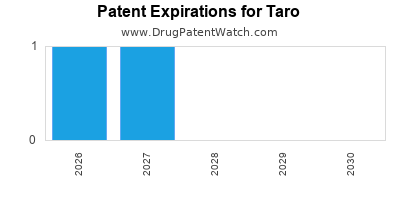
Drugs and US Patents for Taro
| Applicant | Tradename | Generic Name | Dosage | NDA | Approval Date | TE | Type | RLD | RS | Patent No. | Patent Expiration | Product | Substance | Delist Req. | Exclusivity Expiration |
|---|---|---|---|---|---|---|---|---|---|---|---|---|---|---|---|
| Taro | AMIODARONE HYDROCHLORIDE | amiodarone hydrochloride | TABLET;ORAL | 076362-001 | Nov 29, 2002 | DISCN | No | No | ⤷ Start Trial | ⤷ Start Trial | |||||
| Taro | HYDROCORTISONE AND ACETIC ACID | acetic acid, glacial; hydrocortisone | SOLUTION/DROPS;OTIC | 088759-001 | Mar 4, 1985 | AT | RX | Yes | Yes | ⤷ Start Trial | ⤷ Start Trial | ||||
| Taro | ONDANSETRON HYDROCHLORIDE | ondansetron hydrochloride | SOLUTION;ORAL | 077009-001 | Nov 30, 2007 | DISCN | No | No | ⤷ Start Trial | ⤷ Start Trial | |||||
| Taro | ONDANSETRON HYDROCHLORIDE | ondansetron hydrochloride | TABLET;ORAL | 077729-001 | Mar 28, 2011 | DISCN | No | No | ⤷ Start Trial | ⤷ Start Trial | |||||
| >Applicant | >Tradename | >Generic Name | >Dosage | >NDA | >Approval Date | >TE | >Type | >RLD | >RS | >Patent No. | >Patent Expiration | >Product | >Substance | >Delist Req. | >Exclusivity Expiration |
Expired US Patents for Taro
| Applicant | Tradename | Generic Name | Dosage | NDA | Approval Date | Patent No. | Patent Expiration |
|---|---|---|---|---|---|---|---|
| Taro | OVIDE | malathion | LOTION;TOPICAL | 018613-001 | Aug 2, 1982 | 7,977,324 | ⤷ Start Trial |
| >Applicant | >Tradename | >Generic Name | >Dosage | >NDA | >Approval Date | >Patent No. | >Patent Expiration |
Paragraph IV (Patent) Challenges for TARO drugs
| Drugname | Dosage | Strength | Tradename | Submissiondate |
|---|---|---|---|---|
| ➤ Subscribe | Topical Spray | 0.25% | ➤ Subscribe | 2013-12-18 |
| ➤ Subscribe | Topical Lotion | 0.5% | ➤ Subscribe | 2011-03-16 |
International Patents for Taro Drugs
| Country | Patent Number | Estimated Expiration |
|---|---|---|
| Japan | 2013032405 | ⤷ Start Trial |
| Canada | 2612578 | ⤷ Start Trial |
| Japan | 5474347 | ⤷ Start Trial |
| World Intellectual Property Organization (WIPO) | 2007005988 | ⤷ Start Trial |
| >Country | >Patent Number | >Estimated Expiration |
Supplementary Protection Certificates for Taro Drugs
| Patent Number | Supplementary Protection Certificate | SPC Country | SPC Expiration | SPC Description |
|---|---|---|---|---|
| 1020461 | 300482 | Netherlands | ⤷ Start Trial | PRODUCT NAME: NAXOPREN EN ESOMEPRAZOL ALS MAGNESIUMZOUT; NATIONAL REGISTRATION NO/DATE: RVG 106235 20101118; FIRST REGISTRATION: GB PL 17091/0263 - 0001 20101105 |
| 0463756 | C990005 | Netherlands | ⤷ Start Trial | PRODUCT NAME: SILDENAFIL, DESGEWENST IN DE VORM VAN EEN FARMACEUTISCH AAN- VAARDBAAR ZOUT, IN HET BIJZONDER SILDENAFIL CITRAAT; NATL REGISTRATION NO/DATE: EU/1/98/077/001-012 19980914; FIRST REGISTRATION: CH 54642 19980622 |
| 0480717 | 98C0025 | Belgium | ⤷ Start Trial | PRODUCT NAME: LOSARTAN POTASSIUM; HYDROCHLOROTHIAZIDE; NAT. REGISTRATION NO/DATE: NL 20 037 19950215; FIRST REGISTRATION: FR - NL 20 037 19950215 |
| 2435024 | 21C1020 | France | ⤷ Start Trial | PRODUCT NAME: COMBINAISON DE FORMOTEROL (Y COMPRIS LES SELS, ESTERS, SOLVATES OU ENANTIOMERES PHARMACEUTIQUEMENT ACCEPTABLES DE CELUI-CI), GLYCOPYRROLATE (Y COMPRIS LES SELS, ESTERS, SOLVATES OU ENANTIOMERES PHARMACEUTIQUEMENT ACCEPTABLES DE CELUI-CI) ET BUDESONIDE (Y COMPRIS LES SELS, ESTERS, SOLVATES OU ENANTIOMERES PHARMACEUTIQUEMENT ACCEPTABLES DE CELUI-CI); REGISTRATION NO/DATE: EU/1/20/1498 20201210 |
| >Patent Number | >Supplementary Protection Certificate | >SPC Country | >SPC Expiration | >SPC Description |
Similar Applicant Names
Applicants may be listed under multiple names.
Here is a list of applicants with similar names.
Here is a list of applicants with similar names.
