Last updated: June 22, 2026
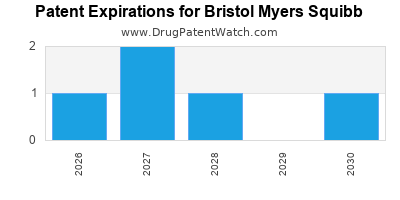
Bristol Myers Squibb (BMS) competes across oncology, immunology, hematology, and cardiovascular disease. Its near-term competitive position hinges on (1) patent and exclusivity timing for key brands, (2) biosimilar and generic entry risk, (3) portfolio depth in immunology and oncology combinations, and (4) whether line-extensions, new dosing/regimens, and new targets protect revenue through the 2026 to 2030 window.
Which BMS drugs drive revenue and how strong is its market position vs competitors?
BMS’s competitive footprint is dominated by specialty medicines in oncology and immunology, with additional contribution from cardiovascular and hematology franchises. The company’s market power is strongest where it holds durable mechanism-of-action leadership and where combination regimens or line-extensions expand clinician use.
What portfolio pillars differentiate BMS in oncology?
Key BMS oncology franchises compete on clinical evidence, sequencing in treatment guidelines, and the ability to pair targeted therapies with immunotherapy or chemoimmunotherapy:
- Opdivo (nivolumab): multi-cancer immunotherapy backbone facing PD-1 class competition (other checkpoint inhibitors in multiple tumor types).
- Yervoy (ipilimumab): combination driver with nivolumab in melanoma and other settings.
- Reblozyl (luspatercept) and Empliciti (elotuzumab): hematology franchises that compete in their class niches and in line sequencing.
- Revlimid (lenalidomide): historically core for multiple myeloma franchise competition, but maturity and competitor/biosimilar pressure affect positioning.
What portfolio pillars differentiate BMS in immunology?
In immunology, BMS competes in immune-mediated inflammation using targeted biologics and oral small molecules. Competitive advantage is typically tied to safety profile, durability of response, and breadth of approved indications.
How does BMS compete on manufacturing and access?
For specialty brands, BMS competes on:
- payer contracting and formulary placement,
- administration model (hospital vs clinic and infusion capacity constraints),
- real-world evidence adoption in treatment pathways.
How strong is the BMS patent estate and what filings protect its blockbuster products?
BMS competitive durability is constrained by the patent calendars of its flagship products and by the breadth of secondary protection. In practice, strength is measured through:
- time-to-expiry for primary composition patents,
- coverage of salts, polymorphs, formulations, dosing regimens, and combination use,
- whether exclusivity is extended through method-of-use patents and manufacturing process claims,
- whether Orange Book listings are dense enough to deter easy generic entry.
What patents protect BMS’s key oncology and immunology brands?
BMS uses a layered protection strategy:
- composition-of-matter claims on active pharmaceutical ingredients (API),
- formulation patents (including controlled release, solid forms, and excipients),
- method-of-treatment and patient stratification claims,
- combination patents for regimen-level exclusivity.
How many patents cover BMS drug products across Orange Book and related filings?
The competitive risk is generally higher where Orange Book coverage is sparse, where only narrow formulation claims exist, or where existing patents expire without meaningful secondary coverage. Conversely, low generic risk correlates with:
- multiple listed patents per NDA,
- multiple jurisdictions with active litigation or prosecution history,
- patent claims that map to the generic’s intended label and manufacturing approach.
Where the estate is typically strongest for brand defense
BMS’s strongest brand defense usually appears where there is:
- combination therapy usage that supports method-of-use claims,
- consistent label expansion that creates new patent “surface area,”
- long-term clinical adoption that strengthens injunction and settlement leverage.
When does BMS lose exclusivity and what expiration dates drive generic and biosimilar pressure?
The exclusivity loss timeline is the core driver of competitive entry risk. For BMS, exclusivity and patent expiration are measured as overlapping milestones:
- regulatory exclusivity: non-patent exclusivity (NCE, pediatric exclusivity, orphan-related exclusivities where applicable),
- patent expiration: composition, formulation, and method claims,
- biosimilar exclusivity: for biologics, the reference product pathway and interchangeability dynamics.
How do exclusivity timelines typically map to entry?
- Patent expiration of primary composition claims does not always enable immediate generic launch if formulation or method-of-use patents block entry or if FDA approval is tied to label carve-outs.
- If secondary patents remain listed and unexpired, a Paragraph IV challenge can still be followed by “authorized or delayed entry” via settlement.
What matters between 2026 and 2030 for competition?
For BMS, the 2026 to 2030 competitive question usually resolves around:
- whether the company has sufficient next-generation assets to offset declines,
- whether biosimilar/generic entrants can secure label and market share with carve-outs,
- whether BMS’s newer indications and new combination regimens extend effective market exclusivity.
What Orange Book status applies to BMS drugs and how does it affect generic entry risk?
Orange Book status is the practical map for whether ANDA filers can pursue Paragraph IV certifications and whether they can match the reference product label.
What is the Orange Book listing pattern for BMS brands?
In competitive terms, Orange Book risk rises when:
- fewer listed patents exist per NDA,
- patents are narrow and easy to design around,
- listed patents expire earlier than clinical peak demand.
Risk falls when:
- multiple listed patents are aligned to product form and use,
- patents cover core dosing and regimen elements used in standard-of-care,
- litigation history indicates strong enforcement or favorable settlements.
How does Orange Book status interact with litigation?
Even when patents are listed, litigation and settlement outcomes control the timing of actual market entry. BMS’s competitive leverage is highest when:
- infringement arguments cover the ANDA’s intended label,
- courts find reasonable likelihood of success,
- settlement terms impose delayed launch or market share carve-outs.
How do Paragraph IV challenges and ANDA litigation affect BMS competitive timelines?
Paragraph IV challenges are the principal catalyst for accelerated or delayed generic entry under 21 U.S.C. §355(j). For BMS, competitive outcomes depend on:
- whether ANDAs target the most commercially important formulation and label,
- whether patent claims are enforced successfully or settled with license terms,
- whether “at-risk” launch occurs prior to final resolution.
What litigation outcomes shape BMS market share defense?
In practice, the following outcomes matter most:
- court rulings on claim validity and infringement,
- consent judgments and injunction scope,
- settlement agreements that delay generic launch dates or limit product labeling.
How do settlement agreements change the competitive landscape?
Settlement agreements often replace uncertain trial outcomes with predictable entry timing. For BMS, competitive exposure depends on:
- whether settlements allow early entry with partial label,
- whether license fees scale with sales,
- whether authorized generics or launch calendars reduce market disruption.
What biosimilar risks exist for BMS biologics and who are the likely entrants?
Biosimilar competition is structurally different from small-molecule generics. For biologics, competitive risk is driven by:
- biosimilar approval pathway timing (351(k)),
- any exclusivity period tied to the reference biologic,
- interchangeability or switching policies (not required for biosimilar launch, but affects adoption).
How does biosimilar entry typically impact BMS pricing and volume?
Where biosimilars enter:
- pricing discounts accelerate,
- payers increase utilization of lower-cost alternatives,
- treatment switching depends on guideline acceptance and clinician confidence.
What determines which competitors win the share battle?
The share winner usually combines:
- stable supply and contract terms,
- clinical equivalence evidence and post-approval data,
- payer formularies and patient assistance alignment.
How does BMS compare with Merck, AbbVie, Roche, and Novartis in oncology and immunology?
Competitive comparison depends on which endpoint matters: survival benefit leadership, combination breadth, dosing convenience, safety management, and payer acceptance.
Where BMS tends to compete most directly
- PD-1 and immune checkpoint-driven oncology: competes with Merck’s Keytruda (pembrolizumab) and other checkpoint assets by tumor type.
- Combination immunotherapy: competes with checkpoint-based combination strategies across melanoma and multiple solid tumors.
- Hematology: competes with peers that offer alternative mechanisms in multiple myeloma and related indications.
How BMS’s positioning can differ by line of therapy
Competitiveness is not uniform across first-line, second-line, and later-line settings. BMS advantage can be highest where:
- regimens are preferred by clinicians,
- response durability aligns with payer outcomes,
- safety supports broader patient eligibility.
What formulations and delivery systems are protected by BMS patents and how do they block generics?
Formulation patents are a practical barrier when they cover:
- solid-state form, polymorphs, and crystallinity,
- particle size, dissolution profile, and stability,
- controlled release or modified administration mechanisms,
- manufacturing process features that are hard to replicate without infringement risk.
Which formulation and manufacturing barriers matter most?
Generic entry can be delayed even if composition claims expire when:
- formulation patents are still listed,
- the generic must match a specific dissolution profile or solid form,
- process patents cover critical manufacturing steps.
How do BMS formulation strategies show up in competitive practice?
In competitive settlements, generic delays often align with:
- disputes over whether the ANDA product infringes formulation or method-of-use claims,
- design-around attempts that fail under claim construction.
What licensing deals and collaboration strategies shape BMS competitive access to future assets?
BMS improves its competitive position by acquiring or partnering for:
- late-stage oncology and immunology candidates,
- platform technologies that generate next-generation molecules,
- geographic market access through distribution and commercialization agreements.
What deal types usually impact competitive advantage?
- co-development and co-commercialization agreements that expand indications,
- in-licensing late-stage assets with near-term regulatory timelines,
- optionality deals that create future pipeline density.
What generic entry risks exist for BMS drugs and what launch scenarios are most plausible?
Generic risk for BMS is not a binary event. Real-world launch scenarios include:
- full-label generic substitution if patents and exclusivity are cleared,
- partial-label entry with carve-outs (if method-of-use or formulation patents remain),
- “delayed launch” due to injunction or settlement terms,
- at-risk launches if court stay or timeline allows.
What is the most common practical outcome in BMS cases?
Most frequently, generic entry timing is shaped by settlement structures that:
- delay entry until a defined date,
- restrict label scope to avoid infringing claims,
- sometimes include supply or authorized generic arrangements.
Which countries outside the US pose the biggest competitive threat to BMS products?
Global exclusivity depends on:
- country-specific patent term adjustments,
- local regulatory exclusivity,
- biosimilar/generic landscape and court speed for PI/injunctions.
How do geographic factors change competitive timing?
- In markets with faster generic approvals and strong court injunctions, timing can compress.
- In markets with weaker enforcement, competitors can enter earlier via design-around.
What are the key business metrics investors use to judge BMS competitive resilience?
Competitive resilience is judged by:
- revenue concentration by brand and indication,
- payer contracting and net price trends,
- pipeline conversion rates and regulatory approvals,
- net sales exposure to exclusivity loss events,
- market share changes after biosimilar or generic entry.
Key Takeaways
- BMS’s competitive position is strongest where it holds layered IP protection: composition, formulation, and method-of-use claims that map to real prescribing behavior.
- The primary determinant of near-term market disruption is the overlap of FDA pathway timing with Orange Book patent listing density and the resulting Paragraph IV or biosimilar risk.
- Competitive outcomes in practice follow litigation and settlement calendars, not just statutory expiration dates.
- BMS’s ability to offset declines depends on pipeline replacement speed and the strength of line extensions that extend regimen-level market exclusivity.
FAQs
- How can I estimate generic launch timing for BMS drugs using Orange Book patent lists?
- What biosimilar adoption factors most strongly affect BMS biologics after 351(k) approval?
- Which BMS oncology regimens create the highest method-of-use patent leverage for brand defense?
- How do settlement agreements with ANDA filers typically limit generic labeling for BMS products?
- What country-by-country patent term adjustments most frequently shift BMS exclusivity outside the US?
References
- U.S. Food and Drug Administration. “Orange Book: Approved Drug Products with Therapeutic Equivalence Evaluations.” FDA.
- U.S. Food and Drug Administration. “Biosimilar Biological Products.” FDA.
- 21 U.S.C. §355(j). “Approval of supplemental applications and abbreviated new drug applications.” Legal Information Institute.
- 21 U.S.C. §355(k). “Approval of biosimilar biological products.” Legal Information Institute.