I-MAK counts 257 U.S. patent applications and 130 granted U.S. patents on Humira (adalimumab) [1]. In its 2016 BPCIA suit against Amgen, AbbVie asserted 10 patents [2]. In its 2017 suit against Boehringer Ingelheim, AbbVie asserted 8, and 2 of those 8 were also in the Amgen case [3]. The two first-wave suits therefore named 16 distinct patents.
That gap is the subject of this article. A database that holds all 130 patents has coverage. A database that shows which 16 shaped the first litigation, and which settlement date set U.S. biosimilar entry, has resolution. Amgen said it expected to launch in the United States on January 31, 2023, under a license from its settlement [2]. No patent count produced that date.
We use two terms in this article. Coverage means how many records a database holds. Resolution means how well each record ties to a product, a claim, a legal status, and the date that governs market entry. These are our working definitions. They are not industry standards.
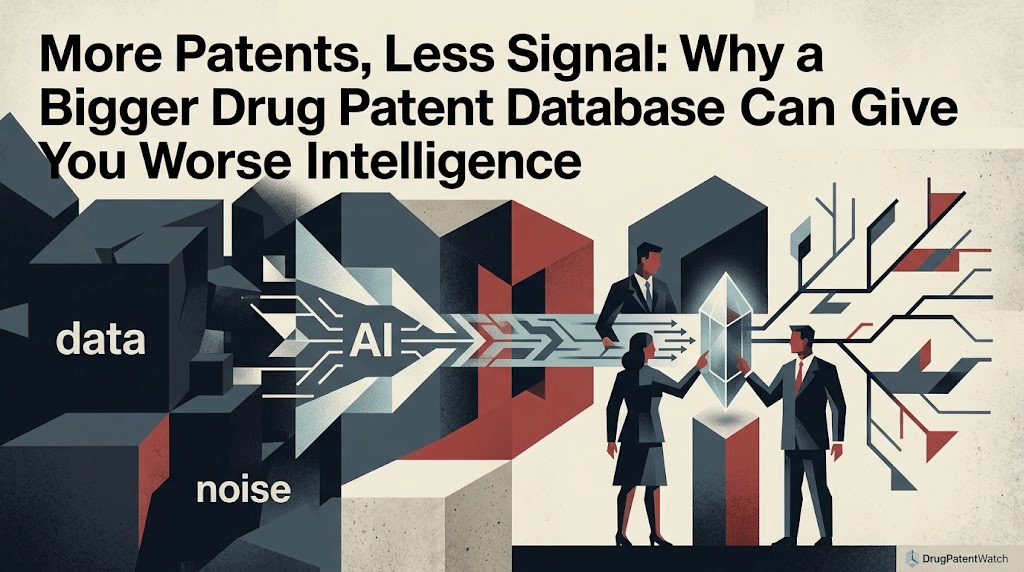
Most buyers compare databases on coverage. Most pharma decisions depend on resolution. When a vendor adds records faster than it adds links between them, the database gets bigger and the answer gets harder to find. The sections below test that idea with public numbers. DrugPatentWatch appears where its data design applies. We use it for context. We do not use it as proof [18].
What Is the Short Answer: Does a Bigger Patent Database Give Better Pharma Intelligence?
No, not by itself. A bigger database raises recall, which is the share of relevant patents you find. It often lowers precision, which is the share of your results that matter to your decision. A drug decision needs precision. You need to know which patents claim the product, which are listed, which are linked by terminal disclaimers, which are in litigation, and which date governs entry.
The USPTO and FDA reached a related conclusion in a 2024 study of 25 new drug applications. They wrote that raw counts of patents and exclusivities are an imprecise measure of the IP landscape, because patents differ in scope [10].
The Five Findings That Matter
Humira has 130 granted U.S. patents [1]. The first-wave biosimilar suits against Amgen and Boehringer Ingelheim named 16 distinct patents [2][3]. Analysis (our calculation): 16 is 12.3% of 130.
U.S. rules limit Orange Book listing to drug substance, drug product, and method-of-use patents [4]. In May 2025, the FTC disputed more than 200 listings across 17 brand-name products [5]. Analysis (our calculation): that is about 12 or more disputed listings per product.
Of 271 litigated biologic patents from 2010 to 2023, 129 (48%) carried a terminal disclaimer [6]. One analysis found that a proposed congressional cap would allow enforcement of 24 of Humira’s 105 litigated patents and 12 of Revlimid’s 30 Orange Book patents [7]. Analysis (our calculation): 22.9% and 40.0%.
Of 1,936 litigated patents on drugs approved from 2000 to 2015, 951 (49%) were continuations [8]. Long-delay continuations are 8.3% of applications but 23% of litigated patents [9]. Analysis (our calculation): about 2.7 times over-represented in court.
For Eliquis, two patents, US 6,967,208 and US 9,326,945, support an earliest U.S. generic launch date of April 1, 2028, subject to further challenges [11].
How We Built the Numbers: Methodology
This article does not report a new database query. It assembles published counts from named sources and calculates simple ratios from them. We label every calculated figure as analysis.
What Data Did We Use and From Which Period?
We used counts from I-MAK, Goodwin Procter’s Big Molecule Watch, two JAMA studies, a University of Pittsburgh Law Review study, an abstract reproduced by the West Virginia University law library, WIPO, the USPTO, the FTC, and the Federal Circuit. The sources run from 2016 to 2026.
We selected cases where a published source gives both a large count and a narrower count, such as granted versus litigated, or listed versus enforceable. We counted each patent once. For Humira, the two patents that appear in both first-wave suits count once [3].
How Did We Calculate Derived Figures?
Percentages
A share equals the narrower count divided by the broader count. We round to one decimal place.
Time intervals
We counted months between calendar dates that a source states. We round to the nearest month.
Ratios
The over-representation ratio divides the litigated share (9,836 of 43,220) by the application share (639,308 of 7,692,046) [9].
What Are the Limits of This Analysis?
Four limits apply. First, denominators differ in time. I-MAK’s 130 patents is a current count [1]. The 10 and 8 patents belong to 2016 and 2017 suits [2][3]. The share of 12.3% therefore compares a past event with a present total. The 2017 share was probably higher, because the portfolio was smaller then. That is an inference, not a documented figure.
Second, I-MAK is an advocacy organization. It counts patents by its own method [1]. Third, the Humira and Revlimid enforceability numbers come from an abstract, not from the full paper [7]. One JAMA author reported consulting for purchasers of lenalidomide products outside the submitted work [6]. Fourth, we did not confirm the current status of the congressional bill in October 2026.
What Does “Bigger” Mean in a Patent Database? Definitions
What Are Recall and Precision in Patent Search?
Recall is the share of all relevant documents that a search finds. Precision is the share of found documents that are relevant. A survey-based study of professional searchers found that patent and healthcare professionals rate recall and coverage as especially important. Legal and recruitment professionals rate precision and recency higher [12].
That finding is fair. A missed reference in a freedom-to-operate search can cost more than extra reading. The argument of this article is narrower. Recall-oriented tools suit discovery tasks. Decision tasks need a different property, which is resolution.
What Is a Continuation Patent?
A continuation application lets a company create more patents from an earlier family member without disclosing new information [9]. Long continuation patents come from continuation applications filed more than five years after the original priority date [9].
What Is a Terminal Disclaimer?
A terminal disclaimer is a stipulation that a follow-on patent will expire at the same time as the original patent [6]. Under current practice, the later patent is also enforceable only while it stays commonly owned with the earlier one [13]. A terminal disclaimer makes a portfolio thicker. It does not make it longer.
What Is an Orange Book Listing?
An Orange Book listing is a patent that an NDA holder submits because it claims the approved drug substance, the approved drug product, or an approved method of use [4]. Listing matters because each ANDA filer must address every listed patent through a certification [17].
How Big Is the Raw Patent Universe?
How Many Patent Applications Do Offices Receive Each Year?
Innovators filed 3.7 million patent applications worldwide in 2024, up 4.9% from 2023 [14]. Analysis (our calculation): that is about 10,000 applications per calendar day.
How Many Patents Are in Force Worldwide?
“Patents in force worldwide grew 6% in 2024 to reach an estimated 19.7 million.” (World Intellectual Property Organization, 2025) [15]
Why Does Raw Scale Not Help With a Single Drug Decision?
China’s office received 1.8 million applications in 2024, which is 49.1% of the world total [14]. For a U.S. generic-entry question, that growth sits outside the U.S. system. Adding it to a database does not change the answer. For a global launch plan, foreign coverage does matter. The right size depends on the question.
The drug question is narrow. It asks which patents claim a specific approved product. A database that adds records without adding product links raises the number of items a team must sort.
What Does the Orange Book List, and What Does It Leave Out?
Which Three Patent Types Can an NDA Holder List?
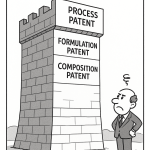
The FDA rule names three types: drug substance (active ingredient) patents, drug product (formulation and composition) patents, and method-of-use patents [4].
Which Four Patent Types Must Not Be Listed?
The same rule says that process patents, packaging patents, metabolite patents, and intermediate patents are not covered, and that information on them must not be submitted to FDA [4].
Patent type
Listed in Orange Book?
Source
Drug substance (active ingredient)
Yes
[4]
Drug product (formulation, composition)
Yes
[4]
Method of use
Yes
[4]
Product-by-process that claims the approved product
Yes
[16]
Process
No
[4]
Packaging
No
[4][16]
Metabolite
No
[4]
Intermediate
No
[4]
What Are the Edge Cases?
Two edge cases cause errors. Product-by-process patents define a product by its process steps. A sponsor should list them if they claim the approved drug product [16]. Packaging patents may not be listed even though packaging information is part of the NDA, because FDA does not approve packaging itself [16].
Why Does the Listing Boundary Matter for Database Design?
The listed set is the set that drives the Hatch-Waxman process. A database that merges listed and unlisted patents into one count blurs that boundary. The Orange Book itself shows a patent number and an expiration date. It does not show claim scope, ANDA filing activity, or litigation status [18]. A good database adds those fields. A bigger one may add only more patent numbers.
Case Study: Humira Has 130 Granted Patents. The First Wave Named 16.
What Does the Humira Funnel Look Like?
The funnel narrows at each stage. I-MAK reported 247 U.S. applications in 2018, with 89% filed after the 2002 approval [19]. Its current page lists 257 applications and 130 granted patents [1]. In the Amgen patent exchange, AbbVie and Amgen identified 61 patents, and the first-wave suit asserted 10 of them [21]. In the Boehringer exchange, AbbVie identified 74 patents, and the suit asserted 8 [3].
How to Read the Funnel
Each number measures a different thing. The 247 and 257 count applications. The 130 counts granted patents. The 61 and 74 count patents that AbbVie named as potentially infringed. The 10 and 8 count patents that AbbVie asserted in the first wave.
Why Do Eight Humira Patent Counts Disagree?
Number
What it counts
Source
247
U.S. patent applications on Humira, 2018 I-MAK report
[19]
257
U.S. patent applications, current I-MAK page
[1]
130
Granted U.S. patents, current I-MAK page
[1]
61
Patents identified in the AbbVie and Amgen exchange
[21]
74
Patents AbbVie identified to Boehringer Ingelheim
[3]
10
Patents asserted against Amgen in the first wave
[2]
8
Patents asserted against Boehringer Ingelheim in the first wave
[3]
105
Litigated Humira patents in the Chao et al. analysis
[7]
A reader who cites “the number of Humira patents” without a definition can pick any of these. All eight are correct for what they measure. Only one or two matter for a given decision.
Analysis (our calculation): 130 of 257 is 50.6%. The Amgen suit asserted 10 of 61 identified patents (16.4%). The Boehringer suit asserted 8 of 74 (10.8%). AbbVie held back 51 of the 61 for a possible second wave against Amgen [2]. That is 83.6%.
What Did the Patent Exchange Do to the Count?
Under the BPCIA exchange, Boehringer Ingelheim agreed to be sued on only five patents of its choosing. Each side then listed five. Two patents appeared on both lists, which left eight patents in suit [3]. AbbVie had proposed to litigate all 74 [3]. The procedure, not the portfolio size, set the size of the first case.
When Did Biosimilar Entry Actually Happen?
Date
Event
Source
Aug. 4, 2016
AbbVie files BPCIA complaint against Amgen. First wave: 10 patents. Second wave: 51 other patents identified.
[2]
Sept. 23, 2016
FDA approves Amgen’s biosimilar, Amjevita
[2]
Aug. 2, 2017
AbbVie sues Boehringer Ingelheim on 8 patents. AbbVie had identified 74.
[3]
Sept. 28, 2017
Amgen settles. Amgen says it expects to launch in Europe on Oct. 16, 2018, and in the United States on Jan. 31, 2023.
[2]
Analysis (our calculation): the Amgen suit took about 14 months from complaint to settlement. The settlement came about 64 months before the agreed U.S. date. The European date and the U.S. date differ by about 51 months. Amgen said it would take a license country by country [2]. The entry date is a negotiated fact. A patent database cannot derive it from claims.
I-MAK also reported far fewer Humira applications abroad in 2018, with 76 at the European Patent Office and 63 in Japan, against 247 in the United States [19]. We do not claim that the application counts caused the entry gap. We note that both differ by region.
Case Study: Which Patents Set the Eliquis Generic Entry Date?
Which Two Eliquis Patents Mattered?
On September 3, 2021, the Bristol Myers Squibb and Pfizer alliance said the Federal Circuit had affirmed a 2020 district court decision. The district court found the composition of matter patent (US 6,967,208) and the formulation patent (US 9,326,945) valid and infringed [11]. The alliance said the earliest date for generic apixaban launch was April 1, 2028, subject to additional appeals and challenges [11]. Bristol Myers Squibb repeated that statement in its 2021 Form 10-K [22].
Analysis (our calculation): the statement was made about 6.6 years before the date it protects.
What Does a Count-Based Model Miss on Eliquis?
A model that counts Eliquis patents and takes the latest expiry date would answer a different question from the one the court answered. The court decision turned on two named patents [11]. The entry date reflects that decision and the settlements that the companies reported [22]. A database must carry the decision and the settlement terms next to the patent. Otherwise, a user sees only a list of numbers and dates.
This case record is from 2021. Newer disputes may exist. Check current litigation records before you use any entry date in a forecast. The 2021 statement itself says the date is subject to further challenges [11].
Why Do Terminal Disclaimers Make Patent Counts Misleading?
How Common Are Terminal Disclaimers in Litigated Biologic Patents?
A JAMA study of biologic patents involved in litigation from 2010 to 2023 found that 129 of 271 patents (48%) contained terminal disclaimers [6]. Almost half of the patents that blocked biosimilars were therefore tied to an earlier patent by a shared expiry date.
What Do Humira and Revlimid Look Like Under a One-Patent-Per-Group Rule?
An abstract by Chao, Whalen, Kesselheim, and Tu tested two reform ideas on Humira and Revlimid. One was a 2024 USPTO proposal. The other was a congressional bill that would let patent owners enforce only one patent per group connected by terminal disclaimers [7]. The abstract reports that the bill would allow enforcement of 24 of Humira’s 105 litigated patents. For Revlimid, it would allow 12 of 30 Orange Book patents [7]. It also reports that the USPTO rule could shrink Humira’s thicket by up to 43% and Revlimid’s by up to 70% [7].
Drug
Patents counted
Enforceable under congressional bill
Share enforceable (analysis)
Source
Humira (adalimumab)
105 litigated
24
22.9%
[7]
Revlimid (lenalidomide)
30 in Orange Book
12
40.0%
[7]
Scenario: Two Analysts, One Revlimid File
Analyst A counts the Orange Book patents on Revlimid and gets 30. Analyst B groups the patents by terminal disclaimer links and counts independent groups. Under the proposed bill, 12 of the 30 could be enforced [7]. Analyst A plans for 30 challenges. Analyst B plans for as few as 12 enforceable patents.
The assumption is that the bill passes in the form the abstract describes. We did not confirm that it has. Neither analyst has a wrong database. They use different units. Only Analyst B’s unit follows the legal logic of the linked patents.
What Happened to the USPTO Proposal?
The USPTO proposed a terminal disclaimer rule on May 10, 2024. After criticism from some stakeholders, it withdrew the rule on December 4, 2024 [23]. The practice that inflates counts therefore continues. Patents linked by terminal disclaimers will keep adding to patent counts without adding independent expiry dates.
Do Continuation Patents Distort the Count?
What Do the JAMA Continuation Data Show?
JAMA researchers extracted Orange Book patents for drugs approved from 2000 to 2015. They used Google Patents Public Data on BigQuery to label each patent as original or continuation [8]. Of 1,936 litigated patents, 985 (51%) were original and 951 (49%) were continuations [8]. They found that brand manufacturers listed more continuation patents over the study period [8].
Why Do Long CON Patents Matter in Court?
A University of Pittsburgh Law Review study looked at continuation applications from 2000 to 2022. Long CON patents are 8.3% of all patent applications (639,308 of 7,692,046) but 23% of litigated patents (9,836 of 43,220) [9]. Analysis (our calculation): litigated patents contain about 2.7 times more Long CONs than the application base would predict.
The same study reports that the number of patents per active ingredient rose from 1.86 in 2001 to almost six in 2019 [9]. A larger database will show that growth faithfully. It will also show a larger list for each drug. The list tells you less about independent protection than it did 20 years ago.
What Happens When the Listing Itself Is Wrong?
What Did the Federal Circuit Decide in Teva v. Amneal?
On December 20, 2024, the Federal Circuit decided Teva Branded Pharmaceutical Products R&D, Inc. v. Amneal Pharmaceuticals of New York, LLC, No. 24-1936 [24]. The court affirmed an order that Teva delist inhaler patents. The patents contained no claim for the active ingredient, albuterol sulfate, and were directed to components of a metered inhaler device [25]. Commentators summarized the rule this way: a listed patent must claim at least the active ingredient that made the product approvable [26].
What Did the FTC Do Next?
The FTC issued a third round of warning letters on May 21, 2025. It disputed more than 200 patents across 17 brand-name products. Earlier letters went out in November 2023 and April 2024 [5]. The targets included Teva’s Qvar inhalers and Viatris’ EpiPen [27]. The FTC later said that Teva asked FDA to remove more than 200 improper listings, and that other companies withdrew most of the disputed listings [28].
What a Database Should Carry
A database that imports Orange Book listings as ground truth imports these errors. It should show the listing status of each patent and whether a regulator or court has disputed it. A user who sorts a drug’s patents by count needs to know that some of the count was never listable.
What Does the USPTO’s Own Drug Study Say About Raw Patent Counts?
The USPTO completed its Drug Patent and Exclusivity Study with FDA, in response to a request from Congress. It applies a baseline method to 25 NDAs. For each one, it maps the scope and duration of Orange Book patents and FDA exclusivities, and it identifies the first generic launch as of September 18, 2023 [10].
The study found that in some products, a generic launch occurred before all Orange Book patents had expired. It states that raw counts are an imprecise measure, because not every patent or exclusivity has the same scope. The authors also note that the small sample limits what anyone can generalize [10].
This is the closest primary source to our thesis. The government’s own drug study did not rank products by patent count. It examined scope and duration for each product.
The Four Failure Modes of an Oversized Patent Database
We group the evidence above into four failure modes. This is an original classification. It is not an established industry taxonomy.
Failure mode
What goes wrong
Evidence in this article
Count inflation
Linked or related patents count as separate protection
[6][7][9]
Scope blindness
Records do not tie to the claims that cover a product
[4][10][24]
Docket blindness
A date appears without the litigation or settlement that governs it
[2][11]
Listing-error import
The database repeats a listing that a court or regulator disputes
[5][24][28]
Failure Mode 1: Count Inflation
Evidence
Forty-eight percent of litigated biologic patents carried a terminal disclaimer [6]. Humira had 105 litigated patents, and a one-per-group rule would reduce enforceable patents to 24 [7].
Test Question
Does the database show terminal disclaimer links and shared expiry dates, so that you can count independent groups?
Failure Mode 2: Scope Blindness
Evidence
The FDA rule limits listing to three patent types [4]. The USPTO study says that patents differ in scope, so counts mislead [10]. Teva’s inhaler patents did not claim the active ingredient [25].
Test Question
Does each patent record show what it claims, and does it link to the approved product?
Failure Mode 3: Docket Blindness
Evidence
Two Eliquis patents set an earliest generic date of April 1, 2028 [11]. Humira’s U.S. biosimilar date came from a settlement license [2].
Test Question
Does the database show litigation status, settlement entry dates, and the source of each date?
Failure Mode 4: Listing-Error Import
Evidence
The FTC disputed more than 200 listings across 17 products in 2025 [5]. The Federal Circuit affirmed a delisting order on inhaler patents [24].
Test Question
Does the database show which listings are disputed, and does it update when a patent leaves the Orange Book?
When Does a Bigger Database Help?
Do Prior-Art and Freedom-to-Operate Searches Need Wide Coverage?
Yes. Patent professionals rate recall and coverage as especially important [12]. If you search for prior art, a narrow database can miss the reference that matters. This article does not argue against coverage for that task.
Do Landscape and Trend Studies Need Wide Coverage?
Yes. The JAMA continuation study used a large public dataset to classify patents as original or continuation [8]. The Pittsburgh study analyzed more than 7.5 million applications [9]. No one can measure thicket growth from a small database.
The distinction is the task. Discovery and measurement reward coverage. A decision about a specific drug rewards resolution. Teams get into trouble when they use a discovery tool for a decision and read the size of the result as a measure of risk.
How Can You Test a Patent Database Before You Trust It?
What Are the Eight Questions to Ask?
Pick a drug you know well. Ask the vendor to answer these questions with records, not descriptions.
#
Question
Why it matters
1
Does each patent link to an approved product, and how?
Listing is limited to three patent types [4]
2
Does the record show listing status and any listing dispute?
The FTC disputed more than 200 listings [5]
3
Does it show terminal disclaimer links?
48% of litigated biologic patents had one [6]
4
Does it separate original patents from continuations?
49% of litigated patents were continuations [8]
5
Does it show litigation status and settlement entry dates?
Entry dates come from settlements [2][11]
6
Does it separate ANDA, BPCIA, and PTAB events?
Each event type leads to a different outcome [3]
7
Does it name the date that governs entry, with a source?
The Orange Book shows expiry dates, not the entry date [18]
8
Does it show when each record last changed?
Listings and rules change, as the Teva ruling shows [24]
Where Does DrugPatentWatch Fit?
DrugPatentWatch says that the Orange Book lists a patent number and expiry date but not claim scope, ANDA filing activity, or litigation status, and that its platform adds those layers [18]. It also says that Google Patents has no structured link between a patent number and an approved drug product [29]. Those are the vendor’s own descriptions. Test any vendor, including DrugPatentWatch, against the eight questions above with a drug where you already know the answer.
What Does This Mean for Different Teams?
What This Means for Generic Entry Planning
Start from the listed patents and the certification each requires [17]. Then track which patents the brand actually asserts. The Eliquis record shows that two named patents drove the court outcome [11]. Treat the full patent count as background, not as a risk score.
What This Means for Biosimilar Developers
Plan for two sets of patents. The first is the list that the brand names in the exchange, which was 61 for Amgen and 74 for Boehringer Ingelheim on Humira [21][3]. The second is the subset in the first-wave suit, which was 10 and 8 [2][3]. The procedure sets the second set, and the second set can change.
What This Means for Brand Manufacturers
A large listed portfolio carries its own risk. Courts and the FTC now test whether each listing meets the statutory criteria [24][5]. Brand teams that track their own listings with the same questions as a generic filer will find weak listings before a challenger does.
What This Means for Investors and Business Development Teams
A high patent count does not predict an entry date. The USPTO study states that raw counts mislead [10]. Ask for the governing date and its source, as in the Eliquis statement [11]. Ask which patents a court has already tested.
What Happens Next?
Will Terminal Disclaimer Reform Return?
The USPTO withdrew its 2024 proposal [23]. The congressional bill described in the abstract would limit enforcement to one patent per terminal-disclaimer group [7]. We did not confirm its status in October 2026. Treat any model that depends on it as a scenario, not a forecast.
Will Orange Book Scrutiny Continue?
The FTC pursued three rounds of letters between November 2023 and May 2025 [5]. It reported removals by Teva and other companies after the 2025 round [28]. We found no source in this research that ends the campaign. Expect listing status to stay a live field in any drug patent record.
Key Takeaways
Coverage is the number of records. Resolution is how well records tie to a product, claim, status, and entry date. These are our working terms.
Humira has 130 granted U.S. patents [1]. The first-wave suits against Amgen and Boehringer Ingelheim named 16 distinct patents [2][3].
Orange Book listing covers three patent types. Process, packaging, metabolite, and intermediate patents must not be listed [4].
The FTC disputed more than 200 listings on 17 products in May 2025 [5].
48% of litigated biologic patents carried a terminal disclaimer [6].
49% of litigated patents on drugs approved from 2000 to 2015 were continuations [8].
Two patents support the April 1, 2028 earliest generic date for Eliquis [11].
The USPTO and FDA drug study says raw patent counts are imprecise [10].
Wide coverage helps discovery and measurement. Decisions on one drug need resolution.
FAQ
What does a terminal disclaimer do to a patent’s term and enforceability?
It stops the later patent from expiring after the earlier one. Under current practice, the later patent is also enforceable only while it stays commonly owned with the earlier one [13].
Did the USPTO adopt its 2024 terminal disclaimer rule?
No. The USPTO issued a notice of proposed rulemaking on May 10, 2024, and withdrew it on December 4, 2024 [23].
Which edge-case patents can an NDA holder list?
A product-by-process patent can be listed if it claims the approved drug product. A patent on packaging may not be listed, even though packaging information is part of the NDA [16].
Why did the FTC target inhaler and autoinjector patents?
The disputed patents were device patents. The 2025 targets included Qvar inhalers and EpiPen [27]. The Federal Circuit had affirmed that inhaler patents with no claim to albuterol sulfate must be delisted [25].
How was Humira’s U.S. biosimilar entry date set?
Amgen’s settlement gave it a license to sell its biosimilar, country by country. Amgen said it expected U.S. launch on January 31, 2023 [2]. The date came from the settlement terms.
Does Humira have the same patent footprint outside the United States?
I-MAK’s 2018 report counted 76 applications at the European Patent Office and 63 in Japan, against 247 in the United States [19].
Do patent professionals prefer recall or precision?
A survey-based study found that patent and healthcare professionals rate recall and coverage as especially important [12]. That fits search tasks. Decision tasks need links and status data in addition.
How many patents does a top-selling drug have?
I-MAK’s 2018 report on 12 top-selling U.S. drugs found that sponsors attempted an average of 125 patents per product, with a range of 48 to 247. The United States granted an average of 71, with a range of 27 to 132 [20].
How fast has patenting around one active ingredient grown?
The Pittsburgh study reports growth from 1.86 patents per active ingredient in 2001 to almost six in 2019 [9].
How many identified Humira patents stayed outside the first wave?
AbbVie identified 51 other patents for a possible second wave against Amgen, beyond the 10 in the first wave [2]. Analysis (our calculation): that is 83.6% of 61. For Boehringer Ingelheim, 66 of 74 identified patents (89.2%) were not in the initial suit [3].
References
I-MAK. (n.d.). Overpatented, overpriced special edition: Humira. https://www.i-mak.org/humira/
Goodwin Procter. (2017, September 28). Amgen and AbbVie settle adalimumab BPCIA litigation. Big Molecule Watch. https://www.bigmoleculewatch.com/2017/09/28/amgen-abbvie-settle-adalimumab-bpcia-litigation/
Goodwin Procter. (2017, August 2). New BPCIA litigation: AbbVie sues Boehringer Ingelheim regarding proposed biosimilar to Humira (adalimumab). Big Molecule Watch. https://www.bigmoleculewatch.com/2017/08/02/new-bpcia-litigaton-abbvie-sues-boehringer-ingelheim-regarding-proposed-biosimilar-humira-adalimumab/
Legal Information Institute, Cornell Law School. (n.d.). 21 CFR 314.53: Submission of patent information. https://www.law.cornell.edu/cfr/text/21/314.53
McDermott Will & Schulte. (2025, June 4). FTC revives Orange Book listing challenges. National Law Review. https://natlawreview.com/article/ftc-revives-orange-book-listing-challenges
Tu, S. S., Goode, R., & Feldman, W. B. (2024). Biologic patent thickets and terminal disclaimers. JAMA, 331. https://pmc.ncbi.nlm.nih.gov/articles/PMC10722383/
West Virginia University College of Law Library. (2024, December 13). Professor Sean Tu publishes new research in the New England Journal of Medicine [Abstract of “Clearing Dense Drug-Patent Thickets”]. https://lawlibraryblog.wvu.edu/home/2024/12/13/professor-sean-tu-publishes-new-research-in-em-new-england-journal-of-medicine-em
Tu, S. S., et al. (2023). Number of continuation patents on drugs approved by the FDA. JAMA, 330, 469. https://pmc.ncbi.nlm.nih.gov/articles/PMC10394575
University of Pittsburgh Law Review. (n.d.). The Long CON: An empirical analysis of pharmaceutical patent thickets. https://lawreview.law.pitt.edu/ojs/lawreview/article/view/1049
U.S. Patent and Trademark Office. (2024, June 12). Drug Patent and Exclusivity Study available. https://www.uspto.gov/initiatives/fda-collaboration/drug-patent-and-exclusivity-study-available
Bristol-Myers Squibb-Pfizer Alliance. (2021, September 3). The Bristol-Myers Squibb-Pfizer Alliance is pleased with the decision by the U.S. Court of Appeals for the Federal Circuit upholding the Eliquis patents [Press release]. Pfizer. https://www.pfizer.com/news/press-release/press-release-detail/bristol-myers-squibb-pfizer-alliance-pleased-decision-us
Russell-Rose, T., Chamberlain, J., & Azzopardi, L. (2018). Information retrieval in the workplace: A comparison of professional search practices. Information Processing & Management, 54(6), 1042-1057. https://strathprints.strath.ac.uk/64935
World Intellectual Property Organization. (2025). World Intellectual Property Indicators 2025: Highlights, patents. https://www.wipo.int/web-publications/world-intellectual-property-indicators-2025-highlights/en/patents-highlights.html
World Intellectual Property Organization. (2025). WIPO IP facts and figures 2025. https://www.wipo.int/edocs/pubdocs/en/wipo-pub-943-2025-en-wipo-ip-facts-and-figures-2025.pdf
Finnegan. (2018, July 3). Requirements, benefits, and possible consequences of listing patents in FDA’s Orange Book. https://www.finnegan.com/en/insights/requirements-benefits-and-possible-consequences-of-listing-patents-in-fdas-orange-book.html
Congressional Research Service. (2024). Patent listing in FDA’s Orange Book (IF12644). https://sgp.fas.org/crs/misc/IF12644.pdf
DrugPatentWatch. (n.d.). Read the Orange Book, then ignore it: How smart supply chains use patent intelligence. https://www.drugpatentwatch.com/blog/read-the-orange-book-then-ignore-it-how-smart-supply-chains-use-patent-intelligence/
I-MAK. (2018, December 18). Report finds 89% of total U.S. patent applications on Humira were filed after FDA approval, pointing to a deliberate strategy to delay competition. https://www.i-mak.org/2018/12/18/report-finds-89-of-total-u-s-patent-applications-on-humira-were-filed-after-fda-approval-pointing-to-a-deliberate-strategy-to-delay-competition/
Center for Biosimilars. (n.d.). I-MAK report calls AbbVie “the worst patent offender” in pharma. https://www.centerforbiosimilars.com/news/imak-report-calls-abbvie-the-worst-patent-offender-in-pharma
Williams, A. (2017, September 28). Humira biosimilar update: Settlement in AbbVie v. Amgen case announced and AbbVie v. Boehringer Ingelheim litigation begins. Patent Docs. https://patentdocs.org/2017/09/28/humira-biosimilar-update-settlement-in-abbvie-v-amgen-case-announced-and-abbvie-v-boehringer-ingelhe/
Bristol Myers Squibb. (2022). Form 10-K for the fiscal year ended December 31, 2021. U.S. Securities and Exchange Commission. https://www.sec.gov/Archives/edgar/data/14272/000001427222000051/bmy-20211231.htm
Congressional Research Service. (n.d.). Terminal disclaimers of patent rights: Background and issues for Congress (LSB11209). https://www.everycrsreport.com/reports/LSB11209.html
Teva Branded Pharmaceutical Products R&D, Inc. v. Amneal Pharmaceuticals of New York, LLC, No. 24-1936 (Fed. Cir. Dec. 20, 2024). https://cafc.uscourts.gov/opinions-orders/24-1936.OPINION.12-20-2024_2439730.pdf
FDA Law Blog. (2025, June 9). Here FTC goes again on its own. https://www.thefdalawblog.com/2025/06/here-ftc-goes-again-on-its-own/
Bloomberg Law. (2025, May 21). FTC renews attacks on “improper” drug-device patent listings. https://news.bloomberglaw.com/ip-law/ftc-renews-crackdown-on-improperly-listed-drug-device-patents
Federal Trade Commission. (n.d.). Press release on Teva’s request to remove more than 200 improper Orange Book patent listings. https://www.ftc.gov/node/326986
DrugPatentWatch. (n.d.). Google Patents wasn’t built for pharma: Here’s what it misses every time you search a drug name. https://www.drugpatentwatch.com/blog/google-patents-wasnt-built-for-pharma-heres-what-it-misses-every-time-you-search-a-drug-name/