1. Why This Analysis Exists: The $234 Billion Question Nobody Is Answering Precisely
Between 2025 and 2034, 118 biologic medicines with a combined pre-expiry annual revenue base of roughly $234 billion will lose their primary patent protection. That figure comes from the IQVIA Institute, and it is the single most cited number in biosimilar investment decks circulating right now.
The problem is that the number encourages a false precision. It implies that $234 billion in originator revenue is up for grabs by biosimilar manufacturers. It is not. Of those 118 biologics, 106 have no publicly disclosed biosimilar development program. The market opportunity that actually exists, in the near term, is concentrated in a narrow set of first-wave monoclonal antibodies where the technical barriers are surmountable and the addressable patient populations are large enough to justify a $100 million to $300 million development investment. For the rest, the biosimilar opportunity is either too technically hard, too commercially thin, or both.
This analysis is built for professionals who already know the headline and need the granularity beneath it. That means IP teams stress-testing a patent estate before a Paragraph IV filing, R&D leads deciding which molecule to put into a development queue, and institutional investors trying to separate durable biosimilar revenue from the kind that gets crushed by PBM rebate walls or originator evergreening within 18 months of launch.
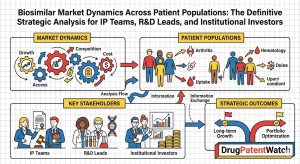
The core argument is this: the biosimilar market is not one market. It is a collection of indication-level, population-level, and reimbursement-channel-level micro-markets, each with a distinct set of competitive dynamics. A strategy calibrated only at the molecule level will consistently produce forecast errors and missed revenue projections. What follows is a framework for building the molecule-level analysis into something accurate enough to act on.
Key Takeaways: Section 1
The IQVIA $234 billion patent cliff figure is a ceiling, not a floor. Real addressable opportunity requires filtering by development feasibility, reimbursement channel, competitive intensity, and originator IP posture. Analysts who skip this filtering step will consistently overestimate launch revenue.
2. The Molecular Truth: Why Biosimilars Are Not Generics and Why That Distinction Costs $300 Million
The Process Is the Product
Small-molecule drugs are synthesized through defined chemical reactions. Their active ingredient is a discrete, fully characterizable compound. A generic manufacturer obtains the chemical formula, replicates the synthesis, and demonstrates bioequivalence in a relatively modest clinical program. The FDA’s abbreviated new drug application (ANDA) pathway costs between $1 million and $4 million and takes roughly two years. The result is a product that is, for all regulatory and clinical purposes, identical to the reference drug.
Biologics operate under entirely different physics. A monoclonal antibody like adalimumab has a molecular weight approximately 1,000 times greater than a small molecule like ibuprofen. It is produced not through chemical synthesis but through living cell cultures, where the originator’s proprietary cell line, fermentation conditions, purification sequence, and formulation each contribute to the final product’s safety and efficacy profile. The phrase the industry uses to describe this relationship, ‘the process is the product,’ captures something precise. Two companies can target the same amino acid sequence and end up with meaningfully different glycosylation patterns, charge variants, and aggregation profiles depending on their cell line and upstream process choices.
This is why a biosimilar developer cannot simply copy an originator biologic. The originator’s cell line and manufacturing process are trade secrets. A biosimilar developer starts with the approved originator product on the market, works backward through analytical characterization, and then builds an entirely new manufacturing process designed to produce a molecule that is ‘highly similar’ to the originator. This reverse-engineering effort is technically demanding, time-consuming, and expensive. Development programs typically span seven to nine years and cost between $100 million and $300 million. A more complex molecule, such as a glycoprotein with multiple post-translational modification sites, sits at the upper end of that range.
Why ‘Highly Similar’ Is Not ‘Identical,’ and Why the Gap Matters Commercially
The FDA defines biosimilarity as ‘no clinically meaningful differences in terms of safety, purity, and potency.’ The EMA uses functionally equivalent language. Both agencies accept that minor structural differences, particularly in clinically inactive components like the specific distribution of glycan structures on the antibody Fc region, are acceptable as long as they do not affect pharmacodynamics or immunogenicity in a clinically detectable way.
This scientific nuance, entirely defensible from a regulatory and clinical standpoint, creates a persistent perception problem. Physicians who have prescribed an originator biologic for years understand that they are moving their patient to a product that is similar rather than identical. The ‘confidence gap,’ the psychological space between ‘approved and demonstrated to be highly similar’ and ‘identical,’ does not exist in the generics world. It does in biosimilars, and it is the primary non-price barrier to adoption.
The commercial implication is direct: closing the confidence gap requires investment that is entirely absent from a generic drug launch. That means generating real-world evidence studies in the specific patient populations being targeted, building relationships with key opinion leaders in each therapeutic specialty, and deploying patient support infrastructure that reduces the experiential friction of switching. Manufacturers who treat a biosimilar launch as a scaled-down version of a small-molecule generic launch tend to achieve 15-25% lower market share than those who invest adequately in these activities.
The Economic Architecture of Biosimilar Competition
The development cost differential between generics and biosimilars is not merely a data point about R&D budgets. It is the economic foundation on which the entire competitive structure of the biosimilar market rests.
When development costs are $1-4 million, as with generics, a large number of manufacturers can profitably enter the market. The result is commodity-level competition, with originator revenues falling 80-85% within 12 months of first generic entry. The model is volume at thin margin.
When development costs are $100-300 million, as with biosimilars, the number of manufacturers capable of entering profitably is naturally limited. A biosimilar targeting a $2 billion originator market with three or four competitors in the pipeline will experience price erosion, but not commodity-level price erosion. The equilibrium settles at a price discount substantial enough to win formulary access, but not so deep that it destroys the return on investment.
This cost-to-discount ratio is a modifiable variable in competitive analysis. For any given originator biologic, a strategist can estimate: the molecule’s structural complexity, which drives development cost; the addressable market at various price points; the number of credible competitors with disclosed development programs; and the likely reimbursement channel, which drives the pace of uptake. The output is a probability-weighted revenue forecast significantly more accurate than a simple ‘percentage of market’ assumption.
The Totality of Evidence Standard: What Regulators Actually Review
Both the FDA and EMA require a ‘totality of the evidence’ submission, which is a stepwise comparative package rather than a single definitive trial. The sequence proceeds as follows.
Analytical characterization is the foundation. Manufacturers deploy an array of orthogonal techniques, including mass spectrometry for primary structure confirmation, size-exclusion chromatography for aggregate quantification, surface plasmon resonance for binding kinetics, and cell-based assays for functional activity. This analytical data must demonstrate structural and functional similarity within tight predefined margins before the regulatory package proceeds to the clinical components.
If analytical similarity is well-established, it can reduce the burden of animal and clinical testing. The clinical program is not designed to re-demonstrate efficacy from scratch but to address ‘residual uncertainty’ not resolved by the analytical package. This typically includes a comparative pharmacokinetic study, often in healthy volunteers, to confirm equivalent exposure profiles, a pharmacodynamic component where a relevant biomarker is available, and an immunogenicity assessment comparing anti-drug antibody rates and titers between the biosimilar and originator.
The key regulatory leverage point here is the analytical package. A biosimilar developer who invests in exceptionally rigorous analytical characterization, using the most sensitive and discriminating techniques available, can credibly argue for a reduced clinical program. This accelerates the development timeline and lowers cost. Conversely, a biosimilar developer who rushes or underinvests in the analytical work faces requests for additional clinical data that can add 18-24 months and tens of millions of dollars to the program.
Investment Strategy: Section 2
For analysts evaluating biosimilar manufacturers, the development cost estimate is the first filter. A company with a $150 million program targeting a $3 billion originator in a market likely to support three competitors is in a fundamentally different risk-reward position than a company with a $280 million program targeting a $1.2 billion originator with five other biosimilar developers already in the pipeline. The cost-per-addressable-market-dollar ratio, adjusted for competitive density, is the core profitability driver and should be modeled explicitly rather than assumed.
3. IP Valuation Deep Dive: The Patent Estates That Control Biologic Markets
How Originator Companies Build IP as a Strategic Asset
In the biologic space, intellectual property is not simply defensive protection for a single invention. For the largest biologic franchises, the patent estate is an offensive economic weapon, deliberately constructed over decades to extend market exclusivity well beyond the initial composition-of-matter patent expiration.
The architecture of a modern biologic patent estate follows a predictable pattern. The primary patent, covering the active biologic molecule itself, provides the foundational exclusivity period and typically expires within 12-20 years of filing. Long before that expiration, originator companies file secondary and tertiary patents covering formulations, manufacturing processes, dosing regimens, specific patient populations, devices, and methods of use. These secondary patents are strategically timed to mature later than the composition-of-matter patent, creating a staggered wall of exclusivity that a biosimilar developer must navigate entirely before launching commercially.
AbbVie and Humira: The Definitive Patent Thicket Case Study
No analysis of biosimilar IP dynamics is complete without a detailed examination of AbbVie’s patent strategy around adalimumab (Humira). The numbers are extraordinary: AbbVie filed or obtained approximately 250 patent applications related to Humira, of which 165 were granted. According to I-MAK analysis, those granted patents collectively provide 43.3 years of effective patent protection. The original 20-year patent term intended by the U.S. patent system was stretched, through secondary and tertiary filings, into an exclusivity period more than twice as long.
The composition-of-matter patent covering adalimumab’s core antibody structure expired in the United States in 2016. Had that been the only relevant patent, biosimilar competition would have entered the U.S. market in 2016 or 2017. Instead, because the BPCIA places no statutory cap on the number of patents an originator can assert against a biosimilar challenger, AbbVie was able to assert as many as 63 patents against a single biosimilar company and a total estate of at least 136 patents in litigation. The result was that biosimilars were blocked from the U.S. market until 2023, a full seven years after the primary patent expired.
The economic consequence of those seven years is staggering. Humira reached annual revenue of $20.7 billion in 2021, making it the best-selling drug of all time to that point. Each year of delayed competition represented, at prevailing pricing, roughly $20 billion in protected originator revenue. The total value extracted by the patent thicket strategy, from 2016 to 2023, exceeds $130 billion in cumulative U.S. sales that faced no biosimilar competition.
AbbVie did not win this time through court victories. The resolution came through settlement agreements. AbbVie granted biosimilar manufacturers licenses to launch in Europe in October 2018, but secured commitments from them to delay U.S. market entry until 2023, with royalty obligations on their U.S. sales once competition began. This settlement structure was, for AbbVie, rational: it avoided the risk of losing key patents in court, preserved the royalty revenue stream, and maintained maximum U.S. exclusivity. For biosimilar challengers, a 2023 U.S. entry was still 11 years earlier than AbbVie’s longest-dated patents, and the royalty payments were manageable against the revenue they could earn in the world’s largest market.
The Citrate-Free Formulation: Evergreening as IP Architecture
Perhaps the most tactically sophisticated component of AbbVie’s strategy was the migration of the market to a citrate-free, low-concentration formulation of Humira before the primary patent expired. The clinical value proposition was straightforward: the citrate-free formulation causes less injection-site pain, which is a real and meaningful benefit for patients administering a subcutaneous injection every other week. From a patent strategy perspective, the move was equally deliberate.
AbbVie secured patents on the citrate-free formulation well in advance, then systematically transitioned patients and prescribers to the new version. Biosimilar developers who had spent years and hundreds of millions of dollars designing products to match the original citrate-containing formulation now faced a choice: launch a product that physicians and patients increasingly perceived as the ‘old’ version of Humira, or redesign their manufacturing process and formulation to match the new standard, at considerable additional cost and time. Several chose the former and paid a market adoption penalty; others chose the latter and suffered significant program delays.
This formulation evergreening tactic is generalizable. Originators facing biosimilar competition for any subcutaneously administered biologic now routinely assess whether a formulation change, device redesign, or change in concentration can create a new patent estate layer while also delivering a genuine patient experience improvement. The dual benefit, IP extension plus clinical differentiation, makes this approach a near-default element of biologic lifecycle management strategy.
IP Valuation Framework for Biosimilar Target Selection
When evaluating a target biologic for biosimilar development, the IP estate analysis should precede the market sizing analysis. A molecule with attractive revenue does not present an attractive opportunity if the patent estate is dense, if multiple high-quality patents remain in force well beyond the composition-of-matter expiration, and if the originator has demonstrated willingness to assert patents aggressively in litigation.
The valuation framework has four components.
First, assess the composition-of-matter patent expiration date and any granted patent term extensions, which in the United States can add up to five years and in the EU can provide up to five additional years through Supplementary Protection Certificates.
Second, count and quality-score the secondary patent estate. Patent quality here is a technical assessment: Is the claimed invention genuinely novel and non-obvious relative to the prior art? Does the patent cover something that a biosimilar developer can design around without materially affecting their product? Academic analysis of Humira’s secondary patent portfolio found that approximately 80% of the patents were non-patentably distinct, meaning they covered obvious variations linked through terminal disclaimers rather than genuine inventive steps. A patent estate with this profile is more vulnerable to PTAB inter partes review than one with fewer, stronger secondary patents.
Third, analyze the litigation history of the originator. Companies that have litigated aggressively in the past will do so again. The relevant question is not whether they will assert their patents but how many and which ones, and what the precedent from prior settlements suggests about the likely resolution timeline and royalty terms.
Fourth, model the settlement probability and timing. For blockbuster biologics, full-scale litigation rarely runs to a final court verdict. The expected resolution is a negotiated settlement granting biosimilar entry at some date before the last relevant patent expires, with royalty obligations. The settlement terms from comparable prior cases, including the Humira settlements, the Remicade (infliximab) settlements, and the Avastin (bevacizumab) settlements, provide data points for modeling the expected U.S. entry date under various scenarios.
Stelara (Ustekinumab) and Eylea (Aflibercept): The Next Iteration
The principles established in the Humira litigation are now being applied to the next cohort of patent cliffs. Ustekinumab (Stelara, Johnson & Johnson) and aflibercept (Eylea, Regeneron) are two of the highest-revenue biologics now facing biosimilar competition, and both follow the same general IP playbook.
For Eylea, I-MAK identified 134 patent applications filed by Regeneron, 91 granted, providing 44.3 years of effective protection on what is intended as a 20-year term. As with Humira, Regeneron has developed a higher-dose, reformulated version of Eylea (Eylea HD, 8 mg versus the original 2 mg) with its own patent coverage and a clinical differentiation story around injection interval extension. Biosimilar developers targeting the original Eylea formulation now face the same dynamic AbbVie executed with the citrate-free Humira migration: the reference market is actively shifting beneath them.
For biosimilar manufacturers already in development programs for these molecules, the IP analysis is not a one-time exercise. It requires ongoing monitoring of new patent filings by the originator and regular reassessment of which patents are most likely to be asserted, which are most vulnerable to PTAB challenge, and how the originator’s formulation strategy is shifting the commercial center of gravity.
Key Takeaways: Section 3
AbbVie’s Humira patent estate, spanning roughly 250 applications and 43+ years of granted protection, is the best-documented case study in biologic IP construction. The pattern, primary composition-of-matter patent expiry followed by a dense secondary estate of formulation, process, and method-of-use patents, is now standard practice for any biologic generating more than $2 billion annually. Biosimilar target selection that does not begin with a rigorous IP quality score of the secondary estate is not credible due diligence.
Investment Strategy: Section 3
The practical investment implication is that the Humira settlement structure, specifically a U.S. entry date well before the last patent expires, with royalties, should be modeled as the base-case scenario for any major biologic biosimilar program. That means forecasting U.S. launch 5-8 years after the composition-of-matter expiration, with a royalty drag on gross margin of 5-15% depending on the specific patent estate and settlement terms. Programs that assume a royalty-free launch immediately following the composition-of-matter expiration tend to have materially overstated NPV projections.
4. The Global Regulatory Architecture: FDA, EMA, and the Rules That Built Two Different Markets
The BPCIA Framework: Twelve Years, One Legal Pathway, Two Tiers of Approval
The U.S. biosimilar pathway was created by the Biologics Price Competition and Innovation Act of 2010, enacted as part of the Affordable Care Act. The BPCIA established the 351(k) abbreviated licensure pathway for biosimilars, which provides regulatory approval based on a demonstration of biosimilarity to an already-approved reference product rather than requiring a full standalone clinical development program.
The BPCIA’s exclusivity structure reflects a political negotiation between the branded biologic industry and biosimilar advocates. Originator biologics receive 12 years of data exclusivity from the date of first approval, a period during which the FDA cannot approve a 351(k) application referencing that product. This is a generous term: small-molecule drugs receive only 5 years of data exclusivity. For the most valuable biologic franchises, which tend to be approved and then steadily expanded across new indications over time, the 12-year clock often runs in parallel with an accumulating secondary patent estate, making the statutory exclusivity period something of a floor rather than a ceiling on actual market protection.
The BPCIA also created two tiers of biosimilar approval: ‘biosimilar’ and ‘interchangeable biosimilar.’ The implications of this two-tier structure for market dynamics deserve close attention, which is why they are covered in their own section below.
The ‘Patent Dance’: BPCIA’s Litigation Architecture
The BPCIA includes a mandatory patent information exchange process, colloquially called the ‘patent dance,’ that governs the disclosure and resolution of patent disputes between originator companies and biosimilar applicants. Once a biosimilar application is accepted by the FDA, the applicant must provide the originator with a detailed description of their manufacturing process. The originator then identifies which of its patents it believes would be infringed by the biosimilar’s manufacture, and the two parties are supposed to negotiate and then litigate a defined list of patents.
In practice, the ‘patent dance’ has created as much strategic complexity as it resolves. The BPCIA imposes no cap on the number of patents the originator can list, enabling the kind of patent thicket assertion that defined the Humira litigation. A biosimilar challenger who receives a list of 63 or 136 patents to adjudicate is looking at years of litigation regardless of the ultimate merits of any individual patent claim. The asymmetry of resources between originator companies, which have large litigation war chests and institutional incentives to delay competition, and biosimilar developers, which have sunk hundreds of millions into development and need revenue to justify continued investment, creates pressure toward settlement even when a biosimilar challenger might prevail on the merits.
The Patent Trial and Appeal Board has emerged as a meaningful counterweight. PTAB inter partes review proceedings offer a faster and less expensive pathway to challenge the validity of individual patents in the originator’s thicket. Several biosimilar developers have successfully used IPR to invalidate key patents before commencing full district court litigation. A comprehensive litigation strategy for any major biologic biosimilar program now incorporates a PTAB component as a standard element, not an afterthought.
The European Model: Fifteen Years of Real-World Data on What Works
The EMA approved its first biosimilar, Omnitrope (somatropin), in 2006, nearly a decade before the first FDA approval of a biosimilar under the BPCIA pathway. That head start matters because the European market now has 15 years of robust real-world experience with biosimilar penetration, pricing dynamics, and switching outcomes across multiple therapeutic categories.
The EMA’s scientific framework for biosimilarity is built on the same foundational principles as the FDA’s, but its evolution has been more aggressive. A 2025 EMA draft reflection paper proposes that large, expensive comparative efficacy studies may be waived in many cases when robust analytical characterization and pharmacokinetic data adequately resolve residual uncertainty. This is a significant shift: it directly reduces the clinical development burden and cost for biosimilar applicants, particularly for molecules where analytical comparability can be established with high confidence.
The EU framework does not have a separate interchangeability designation. Instead, the EMA and the Heads of Medicines Agencies issued a joint scientific statement affirming that any biosimilar approved in the EU is scientifically interchangeable with its reference product at the prescriber level. Automatic pharmacy-level substitution, whether a pharmacist can dispense the biosimilar without specific physician authorization, is left to individual member state regulation. But the scientific foundation is clear: an EU-approved biosimilar is not a second-tier product. That single policy decision has profoundly shaped prescriber confidence and, by extension, the pace of market penetration.
Regulatory Technology Roadmap: Where FDA and EMA Are Headed Through 2030
Both agencies are moving in the same direction, though at different speeds.
The FDA’s June 2024 draft guidance proposing to eliminate the routine requirement for dedicated switching studies to achieve interchangeable status removes one of the most expensive and time-consuming elements of the U.S.-specific regulatory burden. The change aligns the FDA with the global scientific consensus, supported by large-scale real-world data and meta-analyses showing no increased clinical risk from a single, managed biosimilar switch. The practical effect is that interchangeability may shift from a high-cost optional designation to a standard feature of the biosimilar approval package, obtainable without dedicated switching studies in most cases.
The EMA’s 2025 streamlining proposal, allowing waiver of comparative efficacy studies for well-characterized molecules, will reduce European development costs and approval timelines. For molecules where the analytical similarity data is robust, the EMA pathway may compress development from the typical 7-9 years to something closer to 5-6 years, which has material NPV implications.
Both agencies are also actively developing guidance frameworks for biosimilars of more complex molecules, including biosimilars of antibody-drug conjugates and fusion proteins, where the analytical characterization challenge is more demanding than for first-generation monoclonal antibodies.
Key Takeaways: Section 4
The regulatory convergence between FDA and EMA is reducing the cost differential between the two pathways. For the next cohort of biosimilar programs entering development now, the regulatory premium of pursuing FDA approval, historically justified by the U.S. market’s revenue potential, will narrow as the EMA pathway becomes more streamlined. Programs should model reduced development timelines and costs under both frameworks.
5. The Interchangeability Conundrum: A Legal Fiction With Real Market Consequences
What ‘Interchangeable’ Actually Means in the U.S. System
The FDA’s interchangeable biosimilar designation allows a pharmacist to substitute an approved interchangeable biosimilar for its reference product without requiring specific physician authorization, subject to individual state pharmacy laws that may impose notification or consent requirements. As of early 2026, roughly 15 biosimilars carry the interchangeable designation in the United States.
The critical point that market analyses frequently obscure is that interchangeability is a legal and logistical designation, not a clinical one. The FDA has been explicit that a non-interchangeable biosimilar is not less safe, less effective, or less well-characterized than an interchangeable biosimilar. Both must meet the same rigorous biosimilarity standard to receive any approval. The interchangeable designation adds the specific evidence base needed to satisfy the legal requirements for pharmacy-level substitution under the BPCIA.
The clinical-regulatory distinction should matter to prescribers, but it has not reliably been communicated to them. Multiple physician surveys show persistent confusion on this point, with a measurable share of physicians incorrectly believing that non-interchangeable biosimilars are clinically inferior products. This misconception has created a de facto market access barrier that the FDA’s 2024 guidance change is designed, in part, to dismantle.
The FDA’s 2024 Pivot and Its Strategic Implications
By proposing to eliminate the routine requirement for dedicated switching studies, the FDA has signaled that the real-world evidence base accumulated over a decade, including the NOR-SWITCH trial’s 52-week randomized data on infliximab switching, subsequent meta-analyses, and population-level registry data from European markets, is sufficient to establish that a single, managed switch from an originator to its approved biosimilar does not increase clinical risk.
For biosimilar manufacturers, this change has three specific strategic implications.
First, the cost of achieving interchangeability falls materially. Dedicated switching studies, typically randomized controlled trials alternating patients between the originator and biosimilar multiple times, can cost $20-50 million and add 18-24 months to a development timeline. Eliminating this requirement as a routine element captures a significant portion of those costs.
Second, if interchangeability becomes broadly accessible and standard, its value as a competitive differentiator diminishes. The first interchangeable biosimilars in a category had a specific marketing advantage with PBMs who managed pharmacy benefit formularies: they could promise automatic substitution as a cost-management tool. As interchangeability becomes the norm rather than the exception, payers will compete on price and access rather than on designations.
Third, the narrative of a two-tiered system, which has slowed non-interchangeable biosimilar adoption, will gradually erode. Prescribers who understand that all approved biosimilars are now treated as clinically equivalent to their reference products, regardless of interchangeability status, should be more willing to prescribe and approve switches to whichever product the formulary prefers.
State-Level Pharmacy Substitution Laws
Even with FDA interchangeability in hand, biosimilar manufacturers must navigate a patchwork of 50 different state pharmacy substitution laws. Requirements vary from state to state on questions including whether the pharmacist must notify the prescriber of a substitution, whether notification must happen before or after the substitution, whether the patient’s consent is required, and what documentation must be retained. This regulatory complexity has practical consequences for the pharmacy-level uptake of interchangeable biosimilars and should be part of any market access launch planning.
Key Takeaways: Section 5
The interchangeability designation is transitioning from a high-cost competitive differentiator to a commodity feature of biosimilar approval. Manufacturers who built their U.S. market access strategy around being ‘the only interchangeable’ in a category should reassess that competitive moat. It is narrowing faster than many market access plans have accounted for.
6. Sizing the Opportunity: What the $175 Billion Consensus Forecast Actually Means
The Market Projection Landscape
Market research firms have produced a wide range of global biosimilar market size projections for 2034. The range spans from roughly $72 billion at the conservative end (Global Market Insights, using 7.5% CAGR from the 2025 base of approximately $35 billion) to $357 billion at the optimistic end. The consensus forecast, reflected in multiple independent analyses, places the market at approximately $175 billion by 2034, implying a CAGR in the 17-18% range from the 2024 base of roughly $32-35 billion.
The $175 billion figure is a useful anchor for total market sizing conversations. It reflects a scenario where: the current cohort of first-wave monoclonal antibody biosimilars continues to penetrate their respective markets; the 2025-2030 patent cliff supercycle generates the development programs and approvals needed to address a substantial share of the $234 billion in at-risk originator revenue; and the regulatory and reimbursement barriers in the U.S. market gradually reduce, allowing uptake rates to move closer to European levels.
The Biosimilar Void: The Opportunity That Does Not Exist Yet
The IQVIA Institute’s ‘biosimilar void’ analysis is the most strategically relevant piece of market research for serious biosimilar developers. Of the 118 biologics facing patent expiration through 2034, 106 have no publicly disclosed biosimilar in development. This is not an accident of insufficient awareness. It is the market’s rational response to the cost-benefit calculus of biosimilar development.
The majority of these 106 biologics fall into categories where development is either technically prohibitive, commercially marginal, or both. Technically prohibitive molecules include those with complex multi-chain structures, extensive glycosylation requirements, or manufacturing processes so specialized that building a biosimilar program would require entirely new analytical and production infrastructure. Commercially marginal molecules include those with orphan drug designations serving small patient populations, or products with annual originator revenues below $500 million where the $100-300 million development investment cannot generate adequate return even with a 50% price discount.
The void creates a structural polarization in the biosimilar market. The commercially attractive first-wave targets are crowded, with five to eight developers chasing the same blockbuster monoclonal antibodies. The vast middle tier, biologics with $500 million to $1.5 billion in annual revenue and manageable molecular complexity, is largely unaddressed. A manufacturer that can bring development costs below $75 million through process innovation, AI-assisted analytical development, or adaptive clinical trial designs, can make this middle tier profitable and face limited competition.
Key Takeaways: Section 6
The $175 billion consensus forecast assumes a level of biosimilar void resolution that the current development pipeline does not support. Investors building market models should discount the total addressable market for the next patent cliff cohort by the proportion of molecules that genuinely lack viable development programs, rather than assuming the void will fill itself in time.
7. The Geographic Divide: Three Markets, Three Playbooks
Europe: What Fifteen Years of Tender-Driven Competition Looks Like
Europe is the biosimilar market that works, at least from the perspective of payers and health technology assessment bodies. The mechanisms that drive this success are not subtle. Most EU member states reimburse biologics through centralized purchasing systems, hospital formularies, or competitive tenders, where manufacturers submit bids for the right to supply a given biologic to a defined patient population over a contract period. The lowest credible bidder typically wins. Price erosion in these tender-driven markets can reach 50-80% below originator list price, and market share transitions of 70-90% within the first year of a biosimilar launch are not unusual.
The volume-to-price tradeoff in European tender markets is a critical structural feature. A biosimilar manufacturer who wins a national tender in Germany or the Netherlands can achieve rapid, high-volume market penetration. The downside is that the margin per unit is thin, and losing a subsequent tender cycle can eliminate that revenue entirely. Supply chain reliability, consistent manufacturing quality, and the ability to offer competitive rebids are operational capabilities that are as strategically important as regulatory approval in the European competitive environment.
Nordic markets, including Norway, Denmark, and Sweden, have produced some of the most cited examples of rapid biosimilar penetration. Norwegian biosimilar infliximab achieved over 90% market share within two years of launch, driven by mandatory hospital switching policies and competitive tendering. These markets serve as proof-of-concept for what is achievable when the policy environment actively drives adoption.
United States: The Market With the Most Revenue and the Most Friction
The U.S. market has a structural contradiction at its center. It is the largest biologics market in the world, with originator list prices that are often two to five times higher than European reference prices for the same molecule. This price premium should theoretically make biosimilar price discounts more impactful, generating larger absolute savings and stronger payer incentives to drive adoption. In practice, the U.S. biosimilar adoption rate has lagged behind Europe’s by 10-15 percentage points or more for comparable molecules, for reasons that are almost entirely about the reimbursement architecture rather than the science.
The PBM rebate system is the central structural barrier. Under the pharmacy benefit, PBMs negotiate rebates from manufacturers in exchange for preferred formulary placement. The economics of rebate contracting systematically favor high-list-price, high-rebate originator products over lower-list-price biosimilars. A PBM receiving a 60% rebate on a $70,000 per year originator product nets a cost of $28,000 per patient. A biosimilar at a 40% list price discount, with no rebate, costs $42,000 per patient. In that scenario, the ‘cheaper’ drug is more expensive to the plan. This perverse arithmetic is the rebate wall, and it has been the defining commercial challenge for immunology biosimilars in the U.S. market since the first adalimumab biosimilar launched in 2023.
The medical benefit channel operates under entirely different economics. Providers who purchase, administer, and then bill for physician-administered drugs earn a margin on the difference between what they pay for the drug and the reimbursement rate they receive, typically Average Sales Price plus a statutory percentage. Under this model, lower-cost biosimilars can generate equal or higher absolute margin dollars compared to higher-priced originators, depending on the specific ASP dynamics. This is why oncology biosimilars have achieved much faster U.S. adoption than immunology biosimilars: the channel economics directly incentivize the prescriber to choose the lower-cost product.
The APAC region is growing faster than any other geography in biosimilar development, manufacturing, and consumption. South Korea, through companies like Samsung Bioepis and Celltrion, has established itself as a globally competitive biosimilar development and manufacturing hub, with products approved in both the FDA and EMA regulatory environments. India’s large-scale biologics manufacturing capacity makes it a critical contract manufacturing source for biosimilar programs worldwide. China’s regulatory reforms, most notably the National Medical Products Administration’s growing alignment with ICH guidelines, are opening a large domestic market to both domestic and imported biosimilars.
The demand side of the APAC equation is driven by the same forces that drive the global market: aging populations with rising rates of cancer and autoimmune disease, and government payers under severe cost pressure. China’s national drug procurement program, which runs competitive volume-based purchasing tenders for selected medicines at the national level, has already been extended to biologics and is driving rapid price erosion in categories where multiple biosimilar suppliers compete. The CAGR for APAC biosimilar markets is projected at approximately 28-30% through 2030, roughly double the global average.
Key Takeaways: Section 7
Europe, the U.S., and APAC each require a genuinely distinct market access strategy. European tender competitiveness is an operational and supply chain capability as much as a commercial one. U.S. success in the pharmacy benefit channel requires PBM contracting sophistication and willingness to accept thin margins on rebate-free contracts. APAC requires regulatory expertise across fragmented national frameworks and manufacturing cost-competitiveness at scale. Companies that attempt to export one region’s playbook to another without localization consistently underperform.
Comparative Market Analysis: U.S. vs. EU Biosimilar Dynamics
Key Market Characteristic
United States
European Union
Regulatory Framework
Two-tier approval: biosimilar and interchangeable biosimilar designations under BPCIA
Single-tier: all approved biosimilars considered interchangeable at prescriber level by EMA/HMA
Tender competitiveness; supply chain reliability; national HTA engagement
8. Therapeutic Battlegrounds: Oncology vs. Immunology and the Reimbursement Channel That Decides Everything
Why Oncology Biosimilars Succeed in the U.S. and Immunology Biosimilars Struggle
The contrast between oncology biosimilar adoption and immunology biosimilar adoption in the United States is the most instructive data point in the entire biosimilar market. It cannot be explained by clinical factors, because the biosimilarity evidence base is comparable across both categories. It cannot be explained by the complexity of the underlying molecules, because first-generation monoclonal antibody oncology agents like trastuzumab and bevacizumab are no less complex than adalimumab or infliximab. The explanation is entirely structural: it is the reimbursement channel.
Trastuzumab (reference product: Herceptin), bevacizumab (Avastin), and rituximab (Rituxan) are physician-administered biologics. They are infused in oncology clinics, hospital outpatient departments, or infusion centers, and they are reimbursed under the medical benefit. Under the buy-and-bill model, the administering provider purchases the drug and receives reimbursement at ASP plus a fixed add-on percentage, currently 6% for most Medicare Part B reimbursement. The economic incentive for the provider is to purchase the lowest-cost equivalent product and bill at the reimbursement rate tied to the brand’s ASP, which tends to follow the market more slowly than actual purchase prices. This creates a margin expansion opportunity for providers who adopt biosimilars aggressively, and the market responded accordingly: oncology biosimilars in the United States routinely capture 70-90% of volume within two to three years of launch.
Adalimumab and infliximab are self-injected or infused products managed through specialty pharmacies and covered predominantly under the pharmacy benefit. The PBM sits between the manufacturer and the patient, and the PBM’s economics favor rebates over low list prices. When adalimumab biosimilars launched in January 2023, they arrived with list price discounts of up to 85% below Humira’s then-current list price of approximately $6,900 per two-week course. Despite that discount, most major PBMs continued to give Humira preferred formulary status for the first 12-18 months, because the rebate revenue from AbbVie exceeded the net cost savings from covering the biosimilar. The ‘rebate wall’ held.
The CVS Caremark Break: What Happens When a Major PBM Dismantles the Wall
The CVS Caremark formulary decision in 2024, which excluded Humira from major commercial formularies and gave exclusive preferred status to Sandoz’s biosimilar Hyrimoz, demonstrated what is achievable when a large payer chooses to use its formulary power to drive biosimilar adoption rather than to capture originator rebates. Hyrimoz prescriptions grew sharply following the formulary change, providing real-world evidence that payer-driven switching at scale can work quickly.
The CVS decision reflects a broader reassessment underway at major PBMs. The net cost math is shifting as originator rebate offers become less generous in response to biosimilar price competition, and as payers begin to face political and regulatory pressure to demonstrate that biosimilar savings are reaching the plan level. Express Scripts announced similar formulary exclusions for Humira on its largest commercial books in 2025. These decisions collectively represent a structural shift in the rebate wall dynamic, though the wall has not been uniformly dismantled and is still intact for many commercial plan formularies.
Infliximab’s Market Trajectory: A Decade-Long Case Study
Infliximab (Remicade, Janssen) was the first major anti-TNF to face biosimilar competition in the United States, with biosimilar entry beginning in 2016 through settlement agreements. Eight years of market data make infliximab the best longitudinal case study available for U.S. biosimilar dynamics in the immunology space.
The pattern is instructive. Despite early availability at meaningful price discounts, infliximab biosimilar market share grew slowly in the first two years, constrained by PBM rebate contracts and physician hesitancy around switching stable patients. Market share acceleration came primarily when large hospital systems and integrated health networks began implementing mandatory biosimilar first prescribing policies for new infliximab starts, and when payer contracts began to differentially incentivize biosimilar use. By 2024, infliximab biosimilars collectively held approximately 55-60% of U.S. volume, a respectable outcome but one that took nearly eight years to achieve. The European infliximab biosimilar market reached equivalent penetration in two years.
The Biosimilar Market Share Concentration Problem
A structural feature of U.S. biosimilar markets that receives insufficient analytical attention is market share concentration. In categories with multiple biosimilar entrants, the market share does not distribute evenly. Typically, one or two biosimilars, usually those with the most favorable formulary placement secured through aggressive payer contracting, capture the large majority of biosimilar volume, while the remaining entrants compete for the residual. This winner-take-most dynamic means that having regulatory approval is necessary but far from sufficient for commercial success. The contracting strategy, which determines formulary tier and cost-sharing differential, is the actual driver of volume.
Key Takeaways: Section 8
The reimbursement channel is the single most predictive variable for U.S. biosimilar uptake speed. Medical benefit (buy-and-bill) products achieve rapid adoption driven by provider economics. Pharmacy benefit products face PBM rebate wall friction that requires sophisticated formulary contracting to overcome. Market share projection models that apply a uniform uptake curve across both channels will systematically misforecast pharmacy benefit category performance.
Investment Strategy: Section 8
For analysts evaluating biosimilar companies, the product portfolio’s reimbursement channel mix is a leading indicator of near-term revenue visibility. A pipeline heavily weighted toward medical benefit products carries lower market access risk and shorter expected time-to-market-share than one dominated by pharmacy benefit products. Investors should ask specifically: what is the payer contracting strategy for pharmacy benefit products, what formulary positions have been secured, and what is the net price after expected contracting concessions?
9. The Patient Population Puzzle: Indication-Level Dynamics Where Macro Forecasts Break Down
Why One Biosimilar Has Multiple Markets
A biosimilar approved for multiple indications is not participating in one market. It is participating in as many markets as it has approved indications, each with its own clinical culture, prescriber behavior, patient characteristics, and uptake dynamics. Revenue forecasts built at the molecule level, without indication-level decomposition, consistently produce forecast errors because the average performance across indications masks the variation within them.
The most detailed real-world evidence for this phenomenon comes from the anti-TNF category, where both infliximab and adalimumab are approved across rheumatology, gastroenterology, and dermatology. The data show consistent indication-level divergence in biosimilar uptake.
Case Study: Infliximab Biosimilar Uptake by Indication
A Canadian study examining infliximab biosimilar adoption found that after several years of market availability, biosimilar uptake in rheumatologic indications reached 26.6% of infliximab prescriptions, while uptake in inflammatory bowel disease lagged at 6.9%. U.S. data showed a similar divergence, with gastroenterologists prescribing a smaller proportion of biosimilar versus reference infliximab compared to rheumatologists and dermatologists.
The IBD hesitancy has multiple plausible drivers. Crohn’s disease, particularly fistulizing and penetrating disease, is notoriously difficult to control. A gastroenterologist who has worked for months to achieve mucosal healing for a severely ill patient using originator infliximab has a strong clinical and emotional stake in not disrupting that regimen for a non-medical reason. The perceived risk is not symmetric: the downside of a disease flare is hospitalization, surgery, or irreversible bowel damage. The upside of switching is a cost saving that accrues primarily to the payer, not the patient.
The extrapolation issue compounds this hesitancy. The first infliximab biosimilars conducted their pivotal clinical trials in rheumatoid arthritis and ankylosing spondylitis populations. IBD indications were granted through regulatory extrapolation, a scientifically defensible approach but one that left gastroenterologists without direct trial data in their specific patient population. Early in the market evolution, this evidence gap fed prescriber caution. The gap has since narrowed substantially through real-world evidence studies, but the initial adoption curve suffered from it.
Case Study: Adalimumab Biosimilar Uptake in RA vs. Crohn’s Disease
Real-world prescribing data from Spherix Global Insights, tracking adalimumab market dynamics over the first year after U.S. biosimilar launch, shows parallel but asymmetric displacement of the originator across indications. In advanced rheumatoid arthritis, Humira’s market share fell from 22% to 16%, while biosimilars collectively grew from 3% to 10%. In advanced Crohn’s disease, Humira’s share fell from 19% to 14%, but biosimilar growth was roughly half as strong, moving from 3% to 6%.
The magnitude of the gap, a 7-percentage-point share shift in RA versus approximately 3 points in CD, in the same time period, for the same molecule class, reflects the clinical culture differences described above and the added factor that IBD biological therapy management has increasingly incorporated therapeutic drug monitoring (TDM) of drug levels and anti-drug antibodies. Some IBD specialists with stable patients at therapeutic drug concentrations on the originator are reluctant to introduce even a theoretical variable by switching to a biosimilar, even when the clinical evidence suggests the risk is minimal.
Dermatology: The Underanalyzed Indication
Dermatology represents an indication-level market dynamic that is often underweighted in biosimilar market analyses. Adalimumab is approved for moderate-to-severe plaque psoriasis, psoriatic arthritis, and hidradenitis suppurativa. The prescribing culture in dermatology differs from both rheumatology and gastroenterology in ways that affect biosimilar adoption.
Dermatologists have been among the most active prescribers of biologic therapies for psoriasis but also have a history of being skeptical of forced switching. Patient advocacy groups for psoriasis, including the National Psoriasis Foundation, have taken a position supporting biosimilar safety and efficacy but insisting on shared decision-making between the patient and physician before any switch, particularly for patients who are well-controlled on the originator. The NPF’s position explicitly opposes non-medical switching without patient and physician consent, which creates friction with payer-driven formulary exclusion policies.
Key Takeaways: Section 9
Indication-level revenue forecasting is not optional for a credible biosimilar market model. The spread between the most receptive and least receptive indication for the same molecule can be 2-4x in terms of market share capture speed in the first two years post-launch. Commercial investment in real-world evidence generation, medical affairs engagement, and key opinion leader programs must be allocated by indication, not pooled at the molecule level.
10. The Pediatric Frontier: Why Extrapolation-Based Approvals Are Both the Solution and the Problem
Children Are Not Small Adults: Pharmacological Considerations
The pediatric population presents a distinct set of pharmacological considerations that complicate the straightforward application of adult biosimilar data. Children, particularly those in the early years of life and in early adolescence, exhibit faster drug clearance rates per kilogram of body weight than adults for many biologic agents, including anti-TNF therapies. The practical consequence is that dosing strategies optimized for adults may not achieve therapeutic drug concentrations in pediatric patients, and vice versa.
For biosimilar development, these pharmacokinetic differences matter most at the stage of extrapolation. When a biosimilar gains approval in adults and then seeks to extend the label to pediatric populations without dedicated pediatric trials, the extrapolation assumes that the similarity demonstrated in adults translates to the pediatric population. This assumption is scientifically defensible in most cases, particularly for molecules where the mechanism of action is the same across age groups and where the pharmacokinetics can be modeled from adult data using physiologically-based pharmacokinetic models. But it leaves a real-world evidence gap that pediatric specialists feel acutely.
Pediatric-onset inflammatory bowel disease, particularly Crohn’s disease with onset before age 18, frequently presents as more extensive and more aggressive disease than adult-onset IBD. The stakes of treatment failure are high: inadequate disease control in a growing child can compromise development, nutritional status, bone density, and educational outcomes. This clinical gravity explains why pediatric IBD specialists have been consistently more conservative in adopting biosimilars than their adult counterparts.
The Evidence Gap Is Closing, But Slowly
Real-world evidence from pediatric IBD cohorts is accumulating. A study tracking pediatric IBD new starts at a large academic center found that infliximab biosimilar initiation increased from 1% of new biologics starts in 2018 to approximately 42% by 2023, a 40-fold relative increase driven primarily by institutional formulary policy changes and growing comfort with biosimilar safety data. Critically, outcome data from these early adopter pediatric cohorts show no significant differences in disease activity scores, laboratory markers of inflammation, or adverse event rates compared to historical originator cohorts.
The Crohn’s and Colitis Foundation has endorsed the safety and efficacy of approved biosimilars in pediatric populations, while continuing to advocate for dedicated pediatric-specific long-term data, particularly for multi-switch scenarios where a patient may move from originator to biosimilar A and then to biosimilar B over their treatment lifetime. The multiple-switch evidence base is thinner than the single-switch evidence base, and pediatric patients who start biologic therapy in childhood may face three or four switch decisions over the course of their treatment lifetime. This is a legitimate evidence gap that biosimilar manufacturers would benefit from addressing through prospective registry studies.
Regulatory Considerations for Pediatric Populations
The FDA’s Pediatric Research Equity Act and the Best Pharmaceuticals for Children Act create regulatory incentives, including six-month patent term extensions, for sponsors who conduct pediatric studies on already-approved biologics. For a biosimilar developer, the question of whether to voluntarily pursue pediatric-specific data involves weighing the cost of the study, the patent term extension benefit, the competitive differentiation value in the pediatric prescribing community, and the potential to accelerate indication-specific adoption.
Given the evidence gap in the pediatric prescribing community, a biosimilar developer who invests in a well-designed pediatric real-world evidence program has a meaningful medical affairs differentiation opportunity in a market segment that competitors who rely solely on extrapolation cannot easily match.
Key Takeaways: Section 10
Pediatric biosimilar adoption is tracking 3-5 years behind adult adoption for the same molecules, driven by the evidence gap from extrapolation-based label extensions. Manufacturers who invest in pediatric real-world evidence programs can accelerate adoption in this segment and create medical affairs differentiation that is difficult to replicate without the data investment.
11. The Switch-Back Signal: Demographic Data That Rewrites Launch Strategy
The 13.2% Problem
Truveta, which aggregates real-time electronic health record data from a consortium of major U.S. health systems, published an analysis of adalimumab biosimilar adoption that identified a finding with direct strategic implications: of the patients who switched from originator Humira to an adalimumab biosimilar, 13.2% subsequently switched back to the originator within the observation period.
This is not a trivial number. A 13.2% switch-back rate represents patients who were prescribed the biosimilar, filled it, but then reverted to Humira. Each of those patients is a failed biosimilar adoption event. From a market share perspective, the switch-back rate acts as a direct drag on net retention, meaning that a biosimilar needs to not just capture patients from the originator but hold them. A switch-back rate above 10-15% is a signal that there is a patient experience or support gap that clinical similarity data alone cannot close.
The Demographic Pattern: Who Is Switching Back and Why
The Truveta data shows that switch-back is not demographically uniform. The rate rises to 20.2% among patients over 65, compared to 12-13% for patients in the 18-64 age range. Female patients switch back at a rate of 14.3%, compared to 11.4% for male patients. Patients with rheumatoid arthritis or ankylosing spondylitis show higher switch-back rates than those with psoriasis or other indications.
The temporal pattern adds another dimension. Among patients over 65 who switch back, more than half do so within the first 30 days of starting the biosimilar. This rapid reversion suggests the driver is not slow efficacy loss, which would take weeks to months to manifest clinically, but rather an immediate negative experience with the product. The most plausible mechanisms include the nocebo effect, where a patient who expects the biosimilar to feel different experiences a negative symptom that is attributable to the switch regardless of causation; formulation-related sensory differences, such as the temperature of the injection, the viscosity of the solution, or the force required to depress the autoinjector; and a higher baseline anxiety in older female patients about treatment changes, which amplifies nocebo susceptibility.
Device Design as a Commercial Differentiator
AbbVie’s migration to a citrate-free formulation for Humira created two real competitive dynamics: an IP protection layer through formulation patents, and a genuine reduction in injection-site pain. Biosimilar manufacturers who developed their products against the original citrate-containing formulation launched a product that was, for the subset of patients sensitive to injection-site discomfort, experientially different from the version of Humira their patients had been using for years.
The device is inseparable from the product in the subcutaneous biologics market. Patients who self-administer an autoinjector develop a functional familiarity with that device. The force required, the sound of the injection mechanism, the size of the needle, and the speed of delivery all become part of the treatment experience. A biosimilar that uses a different autoinjector design, even if clinically equivalent, creates a new tactile and experiential reference point that some patients will interpret negatively.
The commercial implication is clear: biosimilar manufacturers targeting subcutaneous products should invest in device design comparability studies and user experience testing, particularly with the demographic segments most prone to switch-back. Older female patients with rheumatoid arthritis need devices that are easy to grip, require minimal force, and are designed for hands with reduced dexterity. Getting this wrong is not a minor commercial inefficiency; it is a direct contributor to the switch-back rate and therefore to net market share retention.
The 30-Day Critical Window
The pattern of rapid early switch-back, concentrated in the first 30 days, has a specific commercial implication for patient support program design. The first four weeks following a biosimilar switch are the highest-risk period for patient abandonment. This is when the nocebo effect is strongest, when the patient is most uncertain about their new treatment, and when any injection-site discomfort or perceived difference is most likely to prompt a call to the physician requesting a return to the originator.
A proactive outreach program that contacts patients at day 7 and day 21 post-switch, addresses questions and concerns in real time, and provides clear reinforcement of the clinical evidence for biosimilar equivalence can materially reduce the 30-day switch-back rate. The cost of running a structured patient support program for the first 90 days post-switch is modest relative to the revenue value of retaining each patient on the biosimilar.
Key Takeaways: Section 11
The switch-back rate is the most actionable KPI available for biosimilar commercial teams in the first 90 days post-launch. A rate above 12% is a signal for immediate intervention. Older female patients with RA or AS in the pharmacy benefit channel represent the highest switch-back risk segment and should receive prioritized patient support resources. Device design should be a first-order commercial consideration, not an afterthought, for any subcutaneous product targeting populations with high baseline switch-back risk.
12. The Stakeholder Ecosystem: Physicians, Patients, and PBMs in Structural Tension
The Prescriber’s Position: Confident About Science, Resistant to Mandate
Physician surveys across oncology, rheumatology, and gastroenterology consistently show a high base rate of confidence in biosimilar science. Approximately 90-92% of physicians surveyed report confidence in the safety and efficacy of FDA-approved biosimilars. An only slightly lower proportion, 87-89%, indicate comfort prescribing a biosimilar to a biologic-naive patient.
The confidence collapses at the point of non-medical switching. Between 58% and 73% of physicians, depending on the survey and specialty, oppose or express significant discomfort with payer-mandated switching of stable patients for economic reasons rather than clinical ones. The objection is not primarily clinical. It is about authority. Physicians view the decision to change a stable chronic disease patient’s medication as belonging to the physician and patient, not to an insurance administrator. The fact that the clinical evidence supporting single, managed switches is robust does not resolve this authority question.
The practical consequence for biosimilar manufacturers is that a launch strategy that relies on payer formulary mandates to drive volume, without parallel physician education and buy-in, will generate physician backlash that can undermine market access even when formulary access is technically in place. Physicians who are strongly opposed to a switch can document clinical exceptions, write letters of medical necessity for the originator, and advise patients to fight formulary restrictions. These actions reduce the effective coverage of even an aggressive formulary exclusion policy.
The physician engagement model for a successful biosimilar launch in a payer-driven switching environment requires transparent communication about the evidence base for switching, acknowledgment of physician authority in the switching decision, and practical support including tools that make the administrative process of a biosimilar switch as frictionless as possible. Physicians who are hostile to a switch because they feel it is being imposed on them become allies when they are brought into the process as decision-makers who choose to switch, with the evidence and tools to do so confidently.
The Patient Voice: Understanding the Informed Minority
Patient surveys on biosimilar awareness consistently reveal that the majority of patients on biologic therapy know relatively little about biosimilars. A significant proportion of surveyed patients are unaware that biosimilars exist, do not know whether they are currently on an originator or biosimilar, or believe, incorrectly, that biosimilars are identical copies of the originator (a confusion analogous to equating biosimilars with generics).
The subset of patients who are aware of biosimilars and informed about the science is disproportionately active in disease-specific advocacy communities: online patient forums, disease foundation programs, and social media groups organized around specific conditions. This informed minority has an outsized influence on broader patient attitudes because their commentary, published in forums where newly diagnosed patients research their conditions, shapes the information environment in which other patients form their opinions about biosimilars.
The leading patient advocacy organizations have taken positions that share a common structure: they affirm the safety and efficacy of approved biosimilars, endorse their role in improving access to affordable therapies, and insist that treatment decisions should involve shared decision-making between the patient and their physician. The Arthritis Foundation, Crohn’s and Colitis Foundation, and National Psoriasis Foundation all hold versions of this position. The critical qualifier in each position statement is the opposition to non-medical switching, where a payer drives a change in therapy without meaningful physician and patient participation.
Biosimilar manufacturers who build patient education programs that align with, rather than work against, this shared decision-making framework tend to generate better patient acceptance of switches. Framing the biosimilar transition as ‘a decision you and your doctor are making together, with the support of a company committed to your experience’ is more effective than framing it as ‘your plan is moving you to a different product.’
The PBM Trilemma: Three Levers and a Structural Constraint
PBMs have three primary levers for managing biologic costs: formulary placement, which determines whether a drug is covered and at what cost-sharing tier; utilization management, including step therapy and prior authorization requirements; and rebate contracting, which negotiates the net cost of originator products down from their list price in exchange for preferred formulary status.
The structural constraint is that these levers interact with each other and with the contracts PBMs have with health plans, specialty pharmacies, and manufacturers in ways that create competing incentives. A PBM that maximizes rebate revenue from an originator may not be minimizing net drug cost for the health plan. A PBM that drives rapid biosimilar adoption through formulary exclusions may generate patient and physician complaints that the health plan must manage politically, even if the clinical and economic case for the switch is sound.
The secular trend toward value-based contracts, where biosimilar manufacturers offer rebates tied to outcomes or adherence metrics rather than simply to formulary placement, is an attempt to resolve this structural tension. A biosimilar manufacturer who can offer a payer a contract structured as ‘pay the list price, and we will rebate you if patients who switch to our product achieve equivalent disease control outcomes’ changes the conversation from price-only to value. This is a more sophisticated contracting model, but it also requires the manufacturer to have confidence in their real-world outcome data, which is itself a function of how robust their real-world evidence program is.
Key Takeaways: Section 12
The U.S. biosimilar market is an arena of structural tension among three stakeholder groups with genuinely different incentives. Physicians want clinical autonomy. Patients want cost savings and treatment stability simultaneously. PBMs want net cost management that maximizes plan profitability, which is not always the same as minimizing gross drug spend. Biosimilar manufacturers who treat these as separate problems, to be addressed by separate commercial teams without a coherent integrated narrative, will experience fragmented market access.
13. The Evergreening Technology Roadmap: How Originators Fight Back, Move by Move
Originator companies facing biosimilar competition do not simply accept market erosion. They deploy a systematic lifecycle management strategy, often called evergreening, that is designed to extend the commercial life of a biologic franchise through a sequence of patentable improvements, regulatory actions, and commercial tactics. Understanding this roadmap is essential for biosimilar developers forecasting the commercial opportunity for a given target molecule.
Phase 1: Pre-Expiry Patent Estate Construction
The first phase of evergreening begins five to eight years before the composition-of-matter patent expires. During this period, the originator files secondary patents on every credibly patentable aspect of the product: specific formulations, including concentration changes and excipient substitutions; manufacturing process innovations, including new cell culture media components or purification techniques; device improvements for self-administered products; new routes of administration, such as a subcutaneous formulation for a product originally approved for intravenous use; and new indications, which generate both new use patents and potential data exclusivity extensions.
The citrate-free adalimumab migration is the best-documented example of a Phase 1 evergreening move. AbbVie developed and patented the citrate-free, high-concentration formulation, then invested substantial commercial resources in transitioning the market to the new version before biosimilar entry. The result was that biosimilar developers who had designed their products against the original formulation entered a market where the reference product had materially changed, creating both a technical problem (their formulation now differed from the market-leading product) and a commercial one (prescribers and patients were already familiar with a different injection experience).
Phase 2: Post-Entry Biosimilar Counterprogramming
Once biosimilars enter the market, the originator shifts to active counterprogramming. This includes patient loyalty programs, such as copay assistance cards that eliminate out-of-pocket costs for commercially insured patients on the originator, making it economically irrational for a price-sensitive patient to switch to the biosimilar when the originator is effectively free at the point of care. The AbbVie Humira copay assistance program has been widely cited as a significant barrier to pharmacy benefit biosimilar adoption, because a patient paying $0 out of pocket for Humira has no financial incentive to switch even if the payer’s net cost is lower on the biosimilar.
Originator companies also conduct aggressive key opinion leader programs that emphasize the clinical value of the established therapy’s long-term safety record and argue for caution in switching stable patients, particularly in high-risk populations. These programs are not scientifically dishonest, they do reflect genuine clinical uncertainty for some patient segments, but they are also strategically motivated.
Phase 3: The ‘Bio-Better’ Pivot
The most consequential long-term evergreening strategy is the development of a ‘bio-better,’ a next-generation version of the biologic that offers a genuine, patentable clinical improvement. Bio-betters are not a formal FDA or EMA regulatory category; they are approved through the full biologics license application or marketing authorization pathway and must demonstrate clinical benefit as standalone therapies, not as copies of the original.
Successful bio-better strategies include extended half-life modifications that reduce dosing frequency (highly relevant for self-administered products where injection burden affects patient quality of life), improved subcutaneous formulations of drugs originally administered intravenously, and co-formulations that combine the biologic with a second therapeutic in a single injection. The objective is to create a product sufficiently differentiated from the original biologic that prescribers have a credible clinical reason to prefer the bio-better over either the originator or its biosimilars, and that the new product carries its own protected patent estate beginning fresh from approval.
For biosimilar developers, a bio-better in development against the target molecule is a threat that requires explicit modeling. The question is not whether the bio-better will exist but when it will be approved, how compelling the clinical differentiation will be, what proportion of the originator market will convert to the bio-better before the biosimilar achieves significant penetration, and what proportion of those converted patients will remain available to the biosimilar. A bio-better with a once-monthly subcutaneous dosing profile, competing against a biosimilar requiring fortnightly injections, is a genuine clinical differentiation that can shift prescribing at a material scale.
Phase 4: Manufacturing and Supply Chain Barriers
A less-discussed but increasingly relevant evergreening tactic involves the originator’s relationship with the drug supply chain. For products administered through specialty pharmacy, the originator can negotiate preferred hub pharmacy arrangements and co-pay card programs that create a parallel access pathway that is extremely difficult for biosimilar competitors to replicate at equivalent scale. The operational infrastructure of patient enrollment, insurance verification, prior authorization navigation, and specialty pharmacy distribution that major biologic manufacturers have built over years represents a commercial moat that is not captured in patent analysis but is very real in terms of market access friction for competitors.
Key Takeaways: Section 13
The evergreening roadmap is a sequential, multi-phase strategy that begins years before biosimilar entry and continues throughout the competitive period. Biosimilar developers who analyze only the patent estate without mapping the full lifecycle management strategy will be surprised by formulation migrations, bio-better launches, and commercial counterprogramming that erode the addressable market faster than their models project. A comprehensive target analysis requires a lifecycle management assessment as well as a patent assessment.
Investment Strategy: Section 13
Investors evaluating originator companies with major biosimilar exposure should assess the strength of the lifecycle management portfolio as a forward revenue defense mechanism. An originator with a credible bio-better in Phase 3 development against its most exposed biologic has a materially better revenue outlook than one relying primarily on patent litigation and copay assistance. Conversely, investors evaluating biosimilar developers should model the probability and timing of a successful bio-better launch as a downside scenario that reduces the addressable market for their target molecule.
14. Strategic Imperatives for Biosimilar Developers and Institutional Investors
Target Selection: The Cost-to-Market Ratio as the Primary Screen
The first strategic imperative for any biosimilar development organization is a rigorous target selection process that weights commercial viability as heavily as scientific feasibility. The biosimilar market is littered with programs that were technically achievable but commercially marginal, or that entered overcrowded markets where price erosion exceeded the development investment’s payback threshold.
An actionable target selection screen uses five inputs. The addressable market size at a reasonable price discount, typically 20-50% below the originator’s net price after rebates, not the list price, provides the revenue ceiling. The expected number of credible biosimilar competitors, derived from disclosed development programs tracked through platforms like DrugPatentWatch, determines the degree of price competition and therefore the likely equilibrium price. The development cost estimate, driven by molecular complexity, manufacturing challenges, and the required clinical program, determines the investment base. The expected time to launch, shaped by development timeline and patent litigation outcomes, determines when cash flows begin. The reimbursement channel, medical benefit versus pharmacy benefit, determines how quickly market penetration can be expected to build.
Programs that survive all five screens with positive NPV under conservative assumptions are genuinely actionable targets. Programs that require optimistic assumptions about price, competitive density, or litigation outcomes to generate positive NPV should be avoided or structured as risk-shared partnerships where the capital commitment is bounded.
Manufacturing as Competitive Advantage
The conventional view treats manufacturing as a cost-center function in the biosimilar business model. That framing is increasingly obsolete. For biosimilar developers competing in markets with thin margins and price-sensitive payer contracts, manufacturing efficiency is a primary profit driver. A manufacturer producing a key biologic at $50 per gram of product has a structurally different competitive position than one producing at $120 per gram, and this cost differential is not closed by commercial negotiation.
The long-term competitive advantage in biosimilar manufacturing will belong to organizations that invest in: continuous bioprocessing, which reduces batch failure risk and increases throughput relative to traditional fed-batch processes; AI-driven process optimization, which reduces the time and number of experiments required to define an optimal cell culture and purification process; and global manufacturing network flexibility, which allows production to be allocated across sites in response to regional regulatory approvals, capacity constraints, and currency fluctuations.
Real-World Evidence as a Commercial Asset
The generation of real-world evidence is not a regulatory luxury. It is a commercial necessity. Prescribers who are uncertain about switching stable patients respond to data from actual patients in actual clinical practice, particularly data from populations and indications that are directly relevant to their practice. A rheumatologist managing elderly female patients with RA is more persuaded by a real-world study in that specific population than by a randomized controlled trial conducted primarily in younger male patients.
Biosimilar manufacturers who invest in post-marketing registries, retrospective claims analyses, and prospective real-world cohort studies generate proprietary data assets that their medical affairs teams can use to close the confidence gap systematically. These data cannot be replicated by competitors without conducting the same studies, which take years. The RWE investment is also a long-term brand-building exercise: manufacturers with strong real-world track records become the preferred choice for payers who are designing outcomes-based contracts and need a partner with credible real-world evidence on which to base the contract terms.
Patient Support Infrastructure as Retention Strategy
The switch-back rate data make the commercial logic of patient support investment clear. Reducing the switch-back rate from 13% to 7% over the first 90 days post-switch is mathematically equivalent to achieving a 7% higher net market share capture, and the cost of a structured patient outreach program is a fraction of the revenue value of those retained patients over the duration of their biosimilar therapy.
The key design elements of an effective patient support program for biosimilar switches in the pharmacy benefit channel include: proactive outreach at days 7, 21, and 45 post-switch, not just at the time of the switch; clinical educator availability, meaning a nurse or pharmacist accessible to patients with questions about the new product; clear, plain-language materials explaining what the biosimilar is, how it was approved, and what to expect during the transition; and rapid escalation pathways that connect a patient raising a concern about the biosimilar back to their prescriber without friction.
Key Takeaways: Section 14
Strategic discipline in target selection, manufacturing investment, real-world evidence generation, and patient support infrastructure are the four operational competencies that differentiate sustainable biosimilar businesses from one-cycle competitors. Companies that excel at all four build a cumulative competitive advantage across their portfolio that compounds over time; those that treat any of these as secondary functions tend to underperform.
15. The Next Frontier: Complex Biologics, AI-Assisted Development, and the Biosimilar Void
Beyond First-Generation Monoclonal Antibodies
The biosimilar market through 2025 has been primarily a monoclonal antibody market. Adalimumab, infliximab, trastuzumab, bevacizumab, rituximab, and their respective follow-on molecules account for the large majority of approved biosimilars and of total biosimilar revenue. These molecules, while technically complex relative to small-molecule generics, are relatively tractable by the standards of the full biologic drug universe.
The next tier of biosimilar targets includes fusion proteins like etanercept (Enbrel) and aflibercept, which present more complex analytical characterization challenges than standard monoclonal antibodies due to their multi-domain structures. Beyond that are enzyme replacement therapies, where the glycosylation pattern is critical to biodistribution and activity; antibody-drug conjugates, where the linker chemistry and drug-to-antibody ratio add additional complexity layers; and biologics involving non-standard formats like bispecific antibodies or Fc-engineered antibodies with modified effector function profiles.
Each step up in molecular complexity multiplies the analytical challenge, extends the development timeline, and increases development cost. Biosimilars for these more complex molecules are possible, but they require investment in specialized analytical capabilities that not all biosimilar developers possess, including structural mass spectrometry for complex protein characterization, advanced glycan analysis, and cell-based potency assays for multi-functional molecules.
The companies that build these capabilities now will be positioned to address the segment of the biosimilar void occupied by commercially attractive but technically demanding molecules that the current field of biosimilar developers cannot credibly pursue. This represents a durable competitive moat for organizations willing to make the upfront investment.
AI in Biosimilar Development: Specific Applications and Realistic Timelines
Artificial intelligence applications in biosimilar development are moving from exploratory to operationally relevant across several specific domains.
Cell line development has historically been one of the most time-consuming phases of a biosimilar program. Identifying a host cell line and clone that produces the target protein at adequate yield with the correct glycosylation profile typically involves hundreds of parallel experiments across weeks or months. Machine learning models trained on historical cell line development datasets can substantially reduce the number of experiments required by predicting which culture condition combinations are most likely to produce a favorable profile, compressing this phase from six to twelve months toward two to four months in programs where robust training data are available.
Analytical method development, specifically the selection and optimization of the orthogonal analytical techniques needed to characterize structural and functional similarity, can similarly be accelerated. AI-assisted design of experiment approaches can identify the minimum set of analytical methods with maximum discriminating power for a specific molecule class, reducing the time and cost of building the analytical comparability package.
In the regulatory space, natural language processing tools are being used to mine FDA and EMA review documents for precedent on what analytical evidence has been sufficient to support biosimilarity claims for specific molecule types. This precedent mining produces more targeted development strategies and reduces the risk of an incomplete regulatory package.
The honest caveat on AI in biosimilar development is that none of these applications eliminates the need for wet-lab experimentation. They reduce the number of experiments, improve the hit rate on productive experiments, and compress timelines, but the biological reality of protein structure and cell culture still requires physical validation. Programs that have applied AI-assisted development report 20-35% reductions in specific phase durations; full program compression from 9 years to 5 years through AI alone is not yet demonstrated at scale.
The Regulatory Future: What FDA and EMA Will Require for Complex Molecule Biosimilars
Both the FDA and EMA are actively developing regulatory frameworks for biosimilars of more complex biological molecules. The FDA’s draft guidance for biosimilars of monoclonal antibody bispecific antibodies, expected in 2026, will provide the first specific regulatory roadmap for this important class. The EMA’s reflection paper process for complex biologics is similarly advancing.
The regulatory trend is toward accepting higher-quality analytical data as a substitute for clinical data, not just for simple monoclonal antibodies but across the complexity spectrum. As analytical technology, particularly high-resolution mass spectrometry and cryo-electron microscopy, advances to the point where structural equivalence at the molecular level can be demonstrated with extraordinary precision, the regulatory expectation of confirmatory clinical data will recede further. The long-term implication is that the most analytically sophisticated developers will be able to bring biosimilars of even complex molecules to market faster and at lower cost than competitors relying on traditional clinical-heavy development approaches.
Key Takeaways: Section 15
The first-wave monoclonal antibody biosimilar market is mature and crowded. The next decade’s competitive advantage will be won by companies that can address the biosimilar void through superior analytical capabilities for complex molecules and AI-assisted development efficiency for mid-market biologics. Neither capability can be acquired quickly; both require sustained investment beginning now.
Investment Strategy: Section 15
Investors evaluating biosimilar development companies should assess not just the current pipeline but the platform capabilities underlying it. A company with a validated AI-assisted cell line development process and an internal advanced analytics group for complex protein characterization is building a platform moat. A company that is acquiring this capability through contract research organizations has an operational advantage in the near term but no proprietary platform barrier against competitors over time.
16. Master Key Takeaways and Consolidated Investment Strategy
Master Key Takeaways
The biosimilar market is structurally unlike the small-molecule generics market, and strategy imported from the generics world will consistently fail. The $100-300 million development cost, the ‘highly similar but not identical’ scientific standard, and the resulting physician and patient confidence gap require a fundamentally different commercial approach than price competition alone.
Reimbursement channel is the single best predictor of U.S. biosimilar uptake speed. Medical benefit products with buy-and-bill economics achieve rapid adoption. Pharmacy benefit products face PBM rebate walls that require sophisticated contracting to overcome and can delay meaningful market share capture for 2-4 years post-launch.
The $234 billion patent cliff opportunity is concentrated in the 12 of 118 expiring molecules that have active biosimilar development programs. The remaining 106 molecules represent a ‘biosimilar void’ that will not fill itself without deliberate investment in development cost reduction and platform capability building for complex molecules.
Patient population analysis at the indication level produces materially different forecasts than molecule-level analysis. The spread between the fastest-adopting and slowest-adopting indication for the same molecule can be 2-4x in market share capture speed over the first two years post-launch.
The switch-back rate, specifically the 13.2% Truveta finding for adalimumab with concentration in older female patients within the first 30 days, is the most actionable commercial intelligence currently available for pharmacy benefit biosimilar launches. A proactive patient support program calibrated to the highest-risk demographic segments is the highest-ROI commercial investment in the first 90 days post-launch.
Originator evergreening strategy, particularly formulation migration and bio-better development, must be modeled as an explicit downside scenario in any biosimilar development program. AbbVie’s citrate-free Humira migration and Regeneron’s Eylea HD development are the canonical recent examples of strategies that materially reduced the addressable market for biosimilar developers who did not account for them.
Consolidated Investment Strategy for Institutional Analysts
The following framework integrates the analysis across all sections into a set of specific portfolio-level screening criteria for biosimilar sector exposure.
For biosimilar developer equity evaluation, the primary screens are: development cost-to-addressable-market ratio, where programs below $120 million per $2 billion of addressable market are in attractive territory; patent estate quality score for the target molecule, specifically the proportion of secondary patents assessed as genuinely novel versus terminally disclaimed duplicates; reimbursement channel mix, with a preference for at least 40% of pipeline value in medical benefit channel products given their faster uptake profile; real-world evidence program maturity, assessed by the number of active post-marketing registries and prospective RWE studies relative to portfolio size; and platform capability for complex molecules, assessed by the proportion of R&D budget allocated to analytical capability development versus standard development operations.
For originator company evaluation, the primary biosimilar exposure screens are: the proportion of revenue from products within three years of composition-of-matter patent expiration; the quality and commercial maturity of the lifecycle management pipeline, specifically whether bio-better programs are in Phase 2 or later; the strength of the secondary patent estate for key products, with attention to whether the estate is primarily quality patents or a thicket of low-quality duplicates vulnerable to PTAB challenge; and the geographic revenue distribution, with heavier U.S. concentration representing higher vulnerability given the structure of the U.S. patent thicket system.
For payer and pharmacy benefit manager dynamics, investors in managed care companies should assess the formulary biosimilar penetration rate as a leading indicator of medical cost trend management effectiveness, and the degree to which the organization has dismantled rebate wall structures in favor of net cost-based biosimilar promotion. PBMs that have made the CVS-style transition to biosimilar-preferred formulary structures are managing drug trend more effectively and carry lower long-term medical loss ratio risk than those maintaining rebate-maximizing originator-preferred structures.
The next five years will determine which biosimilar developers build durable businesses and which exhaust their capital chasing crowded first-wave molecules without the manufacturing efficiency or analytical platform needed to compete on price. The analytical framework for making that distinction is available now, in the patent databases, the clinical registries, the real-world evidence literature, and the payer contracting signals that intelligent biosimilar market participants track continuously. What the market rewards, consistently and reliably, is the discipline to use all of it.
This analysis was produced for pharmaceutical IP teams, R&D leads, and institutional investors. All market data cited reflects information. Patent analysis references DrugPatentWatch, I-MAK, Association for Accessible Medicines, and PMC-indexed peer-reviewed literature. Clinical data references IQVIA Institute, Truveta, Spherix Global Insights, Samsung Bioepis Biosimilar Market Reports, and peer-reviewed publications in JMCP, RMD Open, and the Journal of Crohn’s and Colitis.