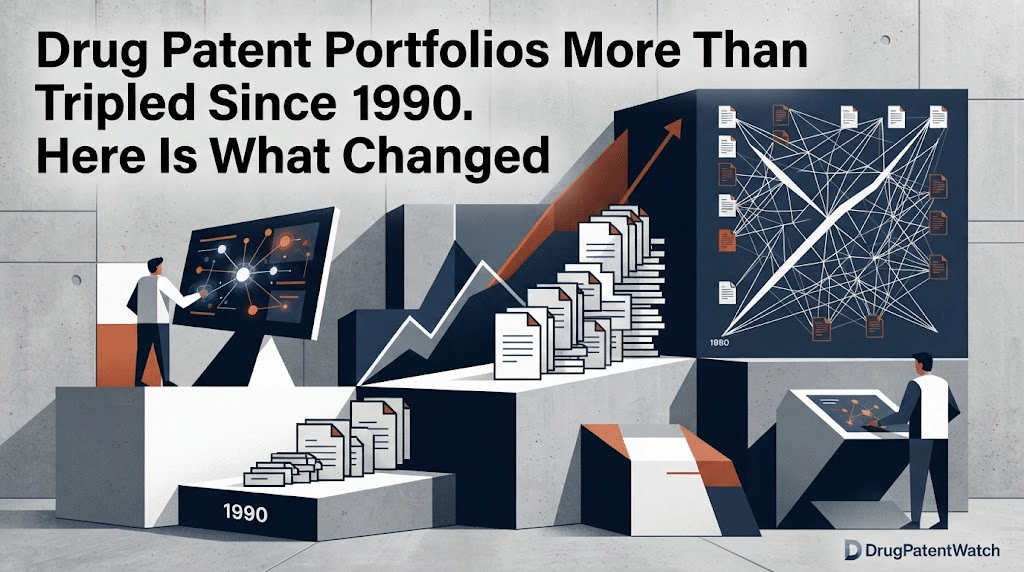
A small-molecule drug approved in 1990 had 2.1 FDA-listed patents on average. A drug approved in 2019 had 6.9 [1]. Most of that growth came from patents that do not claim the active ingredient.
This article follows that change in four steps. It starts with the numbers. It then links the numbers to the laws, court decisions, and regulator actions that shaped them. It uses Humira, Keytruda, Eliquis, and Stelara as test cases. It ends with what the trend means for generic and biosimilar makers and for brand manufacturers.
The Short Answer: How Have Pharmaceutical Patent Portfolios Evolved?
Pharmaceutical patent portfolios grew larger and moved toward nonprimary patents between 1990 and 2019. Mean FDA-listed patents per small-molecule drug rose from 2.1 to 6.9. Mean nonprimary patents per drug rose from 1.2 to 5.6 [1].
Biologics show the same pattern at a larger scale. AbbVie filed 247 US patent applications on Humira, and 89% of them came after the drug reached the market in 2002 [2]. Courts have not treated that kind of portfolio as illegal in itself [3].
Portfolios roughly tripled in size over 29 years (calculated from [1]).
Nonprimary patents caused about 92% of the increase (calculated from [1]).
Patents listed after approval extended nominal exclusivity by a mean of 6.1 years [1].
Researchers disagree on how much this delays generic entry. Section 9 shows both sides.
Methodology and Definitions: How Were These Figures Built?
What data does this article analyze?
This article does not run a new database query. It reorganizes and recalculates published figures from peer-reviewed studies, court opinions, regulator actions, and advocacy-group patent counts. The main data source is Tu et al. (2026). That study examined 1,981 small-molecule drugs the FDA approved from 1990 to 2019 and the 10,940 patents manufacturers listed on them [1].
How were derived figures calculated?
Every figure marked “calculated” is simple arithmetic on published numbers. Examples are ratios, differences, and percentages. I did not adjust for duplicates, because the source studies handle duplicates in their own methods. The source for each input is in the text or the table. A reader can repeat each calculation with a calculator.
What are the limits of this method?
Four limits apply. First, the sources count different things. Tu et al. count Orange Book listings. I-MAK counts patent applications and granted patents from a broader search. Second, snapshot dates differ. Third, a listed or granted patent can be invalid or not infringed. Fourth, I use abstract-level figures for some studies, and the full papers may hold more detail.
What do the key terms mean?
What is a primary drug patent?
A primary patent claims the active ingredient of the drug [1].
What is a nonprimary drug patent?
A nonprimary patent claims a formulation, a method of use, or a delivery device [1].
What is a tertiary patent?
Some researchers split nonprimary patents in two. They call formulation and method-of-use patents secondary. They call delivery-device patents tertiary [4].
What is a patent thicket?
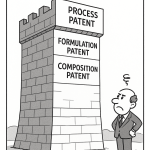
A patent thicket is a dense web of overlapping rights around one product [3]. In pharma, it usually means many nonprimary patents on one drug.
What is effective patent life?
Effective patent life is the time a patent actually blocks generic entry. Nominal patent life is the time between approval and the last patent expiration date. The two can differ by years.
Original classification: four portfolio size bands
This article uses an original classification, not an industry standard. It sorts a drug by the number of US patents granted, as counted by I-MAK. The bands are compact (under 25), moderate (25 to 50), large (51 to 100), and wall (over 100). The bands help compare drugs in Section 11. They do not measure legal strength.
Patent Timeline: Which Laws and Rulings Shaped Portfolio Growth?
“Generic drugs account for more than 90% of prescriptions filled in the U.S.” (FDA, Center for Drug Evaluation and Research, 2024) [5]
Generic share was 19% of prescription purchases in 1984 and more than 53% by 2004 [5]. The same FDA source puts it above 90% today. That is about a 4.7-fold increase from 1984 (calculated from [5]). Brand manufacturers built larger portfolios in that same period.
Date
Event
Effect on portfolios
Source
1984
Hatch-Waxman Act enacted
Created the generic pathway, 180-day first-filer exclusivity, and patent term extension for one patent per product
[6][7]
March 23, 2010
Biologics Price Competition and Innovation Act (BPCIA) enacted
Created the biosimilar pathway, 12-year reference product exclusivity, and the patent dance
[8]
December 2020
Purple Book Continuity Act signed
Requires reference product sponsors to give FDA copies of patent lists shared in the patent dance
[9]
October 16, 2018
European start of Amgen’s Humira biosimilar license
Set a European date more than four years before the US date
[20]
January 31, 2023
US start of Amgen’s Humira biosimilar license
First US adalimumab biosimilar entry date under the settlement
[20]
August 1, 2022
Seventh Circuit decides In re Humira
Held that a large patent portfolio is not an antitrust violation without fraud or sham litigation
[10][11]
November 7, 2023
FTC sends first Orange Book warning letters
Disputed more than 100 listings
[12]
April 30, 2024
FTC sends second round of letters
Disputed more than 300 listings for 20 products
[12][13]
December 20, 2024
Federal Circuit decides Teva v. Amneal
Required delisting of five inhaler device patents
[14][15]
Table 1. Timeline of events that shaped US drug patent portfolios. The first row appears in order of law enactment, and the Humira rows follow the order of the settlement and ruling.
What did Hatch-Waxman change for patent strategy?
Hatch-Waxman gave brand firms a patent term extension. The extension applies to one patent per product. The remaining term after extension cannot exceed 14 years from approval, and the brand firm must apply within 60 days of approval [7]. The Act also gave the first generic filer to successfully challenge a patent a 180-day exclusivity period [6].
What did the BPCIA change for biologics?
The BPCIA gives a reference biologic 12 years of marketing exclusivity from first licensure. A biosimilar applicant cannot file until 4 years after that date [8]. The BPCIA has no Orange Book. The Purple Book lists licensed biologics, and since the Purple Book Continuity Act, sponsors must give FDA the patent lists they share in the patent dance [9].
The Six Findings That Matter
Finding 1: Mean listed patents per small-molecule drug rose from 2.1 to 6.9
The mean number of FDA-listed patents per small-molecule drug was 2.1 in 1990 and 6.9 in 2019 [1]. That is a 3.3-fold increase, or 229% (calculated from [1]).
Finding 2: Nonprimary patents caused about 92% of the increase
Mean nonprimary patents per drug rose from 1.2 to 5.6 [1]. Subtracting these from the totals gives a mean of 0.9 primary patents per drug in 1990 and 1.3 in 2019 (calculated from [1]). Of the 4.8-patent increase, 4.4 patents were nonprimary. That is about 92% (calculated from [1]).
Finding 3: Patents listed after approval extended exclusivity by a mean of 6.1 years
Manufacturers listed 5,064 patents after drug approval. Of these, 96% were nonprimary. They extended market exclusivity by a mean of 6.1 years and a median of 4.7 years [1]. The 5,064 patents are 46% of all 10,940 listed patents (calculated from [1]).
Finding 4: Nonprimary patents are litigated more often than primary patents
Nonprimary patents were 84% of listed patents (9,236 of 10,940) and 87% of litigated patents (4,586 of 5,253) [1]. I calculated litigation rates from those counts. About 49.7% of nonprimary patents were litigated, against about 39.1% of primary patents (calculated from [1]). This is a rate of litigation, not a rate of winning.
Finding 5: Humira had 247 US applications but 132 granted patents
I-MAK counted 247 US patent applications on Humira, with 89% filed after the drug reached the market [2]. A court summary and a law-firm presentation put the granted total at 132 patents [3][10]. The grant rate is about 53% (calculated from [2][3]).
Finding 6: A larger portfolio did not always mean longer effective patent life
A George Mason University study found a mean effective patent life of 13.35 years. It also found no significant correlation between the number of patents on a brand drug and effective patent life [16]. Section 9 explains why this result and Finding 3 can both hold.
How Many Patents Does a Drug Have Today? The Data From 1990 to 2019
What did Tu et al. find across 1,981 small-molecule drugs?
Tu et al. analyzed all small-molecule drugs approved from 1990 to 2019. The mean across the whole period was 5.5 listed patents per drug (calculated: 10,940 patents divided by 1,981 drugs, from [1]). The 1990 mean was 2.1 and the 2019 mean was 6.9. The authors conclude that portfolios have grown over the last two decades and are built largely on nonprimary patents [1].
Metric
1990
2019
Change
Basis
Mean listed patents per drug
2.1
6.9
3.3x (+229%)
Reported [1]; change calculated
Mean nonprimary patents per drug
1.2
5.6
4.7x (+367%)
Reported [1]; change calculated
Mean primary patents per drug
0.9
1.3
+0.4 (+44%)
Calculated from [1]
Nonprimary share of mean portfolio
57%
81%
+24 points
Calculated from [1]
Table 2. Small-molecule patent portfolio metrics, drugs approved in 1990 and 2019.
Did continuation patents drive the rise for drugs approved from 2000 to 2015?
An earlier JAMA research letter looked at drugs approved from 2000 to 2015. It found that FDA-listed patents per drug rose from 1.9 for 2000 approvals to 3.2 for 2015 approvals, a 68% relative increase. The authors attribute the growth to continuation patents [17].
Why do the 3.2 and 6.9 figures differ?
The studies use different drug sets, years, and definitions. The research letter counted patents per drug approval during each year from data extracted through 2021 [17]. The 2026 study classifies patents by type [1]. Do not compare the two numbers directly.
What is a continuation patent?
A continuation patent comes from a continuation application. It builds on an earlier application in the same family. Because it shares the original filing date for priority, a sponsor can add claims later, for example after approval.
Why Do Drug Patents Arrive After Approval?
When do secondary patents get filed?
A 2012 study read the claims of 1,304 Orange Book patents on new molecular entities. It found that independent secondary patents tend to be filed and issued later than compound patents. It also found they are more likely to be filed after approval [18]. Tu et al. later reported that 96% of patents listed after approval were nonprimary [1]. The two results agree.
Do higher-selling drugs get more late patents?
The 2012 study found that late-filed independent secondary patents are more common for higher-sales drugs [18]. That is an association. The study does not show that sales cause the filings.
Why did early effective-patent-life estimates miss this?
Earlier work by Grabowski and Vernon estimated effective patent terms of about ten or eleven years. The 2012 study says those estimates used the primary patents and generally ignored secondary patents [18]. If late patents add term, the older estimates can understate patent life.
Humira Patent Portfolio Case Study: What Does a Patent Thicket Look Like?
How many patents did AbbVie file on Humira?
I-MAK reports 247 US patent applications on Humira. It says 89% were filed after the drug was approved and on the market in 2002. It also says nearly half were filed after 2014 [19]. A separate I-MAK analysis counts 122 of the 247 applications (49%, calculated) in a four-year window, and says that rate is unusual [2].
Granted patents were fewer. Court coverage and a law-firm presentation cite 132 patents [3][10]. The grant rate was about 53% (calculated: 132 divided by 247).
Was the US portfolio larger than the European one?
Yes, by I-MAK’s count. I-MAK found 76 Humira applications at the European Patent Office and 63 in Japan, against 247 in the US [19]. The US count was about 3.2 times the European count (calculated: 247 divided by 76).
When did Humira biosimilars enter the US versus Europe?
The 2017 Amgen settlement gave Amgen a license from October 16, 2018 in most European countries and from January 31, 2023 in the US [20]. The gap is about 4.3 years (calculated). The original core Humira patents expired in 2016 [3]. The US entry date was therefore about six years after core patent expiration (calculated from year-level dates).
What did the Seventh Circuit decide in In re Humira?
What was the holding?
On August 1, 2022, the Seventh Circuit affirmed dismissal of the antitrust claims. It rejected the argument that obtaining a large number of patents is anticompetitive by itself [10]. It also found that the Humira settlements were traditional resolutions of patent litigation under the Sherman Act [11].
What did the court leave open?
The court did not clear every portfolio. Without allegations of fraud on the patent office or sham litigation, there was no antitrust problem with assembling and enforcing many patents [11]. A claim that rests on invalid patents obtained by fraud, or on baseless suits, could still proceed.
How Do Biologic Patent Portfolios Differ From Small-Molecule Portfolios?
What is the BPCIA patent dance?
The patent dance is an exchange of patent information between the reference product sponsor and the biosimilar applicant. The sponsor can start the first wave of litigation from the resulting patent list. The dance is not mandatory [8].
How many patents do top-selling drugs have on average?
I-MAK examined the 12 top-selling US drugs. Sponsors attempted a mean of 125 patents per product (range 48 to 247). The US granted a mean of 71 (range 27 to 132). I-MAK says this yielded a mean of 38 additional years of attempted exclusivity [21]. In February 2024 testimony, I-MAK’s Tahir Amin gave top-10 averages of more than 140 applications and 74 granted patents per drug. He said 66% of filed patents came after first approval [22].
How did the Keytruda portfolio grow?
I-MAK’s May 2021 report counted 129 Keytruda applications and 53 granted patents [23]. I-MAK’s 2025 database page counts 180 applications and 78 granted patents, which it says provide 37.3 years of protection [24]. Applications rose by 51 (+40%) and grants by 25 (+47%) between the two reports (calculated; snapshot dates differ).
Why do Keytruda counts differ across sources?
A Senate HELP Committee report, citing I-MAK’s Drug Patent Book, counted 168 filed Keytruda patents, 64 active and 51 pending [25]. The three counts use different dates and definitions. Cite a count together with its source and date.
Source
Keytruda filed
Granted / active
Date basis
I-MAK report [23]
129
53 granted
May 2021 report
Senate HELP Committee report [25]
168
64 active, 51 pending
2024 report
I-MAK database page [24]
180
78 granted
2025 page
Table 3. Three published Keytruda patent counts. The counts are not directly comparable.
Do Larger Patent Portfolios Delay Generic Entry? The Evidence on Both Sides
What is the evidence that they do?
Tu et al. found that patents listed after approval extended nominal exclusivity by a mean of 6.1 years. They concluded that large portfolios can complicate routine generic competition and prolong high drug prices [1]. Humira is a concrete case. US entry came about six years after the core patents expired, under settlements that rested on a portfolio of more than 100 patents [3][20].
What is the evidence that they do not?
The George Mason study found a mean effective patent life of 13.35 years. It reported that patents and exclusivities added to the Orange Book after market entry do little to extend effective patent life, and that patent count does not correlate significantly with effective life [16]. A Health Affairs commentary states that effective exclusivity, measured as time from approval to first generic entry, has stayed fairly stable over time [26].
How can both findings be true?
This is my analysis, not a finding from the sources. The studies measure different things. Tu et al. measure the nominal protection that late patents add. The George Mason and Health Affairs sources measure the time to actual generic entry. Generic firms challenge and settle many patents, so the last-to-expire patent often does not set the entry date. A late patent adds nominal term. It changes the entry date only if it survives challenge or shapes a settlement.
Orange Book Listing: Where Regulators and Courts Pushed Back
What did the FTC do about Orange Book listings?
The FTC issued a policy statement on September 14, 2023. On November 7, 2023 it sent notice letters to ten companies challenging more than 100 listings [12]. On April 30, 2024 it sent a second round to ten companies. That round disputed more than 300 patents for 20 drug products, including treatments for diabetes, asthma, COPD, and weight loss [12][13]. The two rounds total more than 400 challenged listings (calculated from [12]).
Did companies delist after the second round?
According to a Crowell analysis of FDA’s database, none of the manufacturers removed patents after the second round. They recertified the listings instead [13]. The FTC’s first round did lead to some delistings [12].
What did Teva v. Amneal decide?
On December 20, 2024, the Federal Circuit affirmed an order that Teva delist five patents for ProAir HFA. The patents claimed inhaler device parts, such as the dose counter and canister, and did not claim albuterol sulfate [14]. The court held that a listed patent must claim the drug for which the application was approved [14]. Teva had listed nine non-expired patents for the product [15]. The five delisted patents were 56% of that group (calculated: 5 divided by 9).
What does the ruling mean for device patents?
A patent that claims only a device component, with no claim to the active ingredient, cannot stay in the Orange Book. A brand firm can still hold and assert such patents. The ruling limits listing, not ownership. A device-only patent that leaves the Orange Book no longer triggers the Hatch-Waxman litigation process.
Drug Patent Portfolio Comparison: Humira vs. Keytruda vs. Eliquis vs. Stelara vs. Imbruvica
Drug
Sponsor
US applications filed
US patents granted
Grant rate (calculated)
Band (original)
Source
Humira (adalimumab)
AbbVie
247
132
53%
Wall
[2][3]
Imbruvica (ibrutinib)
AbbVie
165
88
53%
Large
[3]
Keytruda (pembrolizumab), 2025 count
Merck
180
78
43%
Large
[24]
Keytruda, May 2021 count
Merck
129
53
41%
Large
[23]
Stelara (ustekinumab)
Johnson & Johnson
76
39
51%
Moderate
[24]
Eliquis (apixaban)
Bristol Myers Squibb / Pfizer
43
22
51%
Compact
[24]
Table 4. Published patent counts for five drugs. Snapshot dates differ by row. The Imbruvica count comes from a law-firm presentation and may be older than the others. Grant rates and bands are my calculations and classification.
Grant rates sit in a narrow range, from 41% to 53%. A drug that attracts more applications also collects more grants. The count of granted patents, not the grant rate, separates a compact portfolio from a wall.
What Happens to a Large Portfolio at Loss of Exclusivity? Three Cases
Stelara: what did biosimilar entry do to sales?
DrugPatentWatch’s patent-cliff analysis lists several US Stelara biosimilar launches in 2025. It reports a 41.3% sales decline for Stelara and 2025 revenue of $6.08 billion, or 6.5% of Johnson & Johnson’s $94.2 billion total [27]. Treat these as secondary figures. Check them against Johnson & Johnson’s SEC filings before you rely on them.
Eliquis: when is the earliest generic launch?
The same analysis gives April 1, 2028 as the earliest expected US generic launch for Eliquis. It says court rulings and settlements set that date [27]. I-MAK counts 43 Eliquis applications and 22 granted patents, the smallest portfolio in Table 4 [24]. A compact portfolio can still support a firm entry date.
Keytruda: how far could the portfolio push protection?
The DrugPatentWatch analysis reports Keytruda revenue of $31.68 billion in 2025, or 48.7% of Merck’s sales. It says a key US patent is expected to expire at the end of 2028 and that European expiry is expected in 2031 [27]. BioSpace reports that Keytruda’s patent thicket could theoretically push protection into 2036 [28].
Scenario analysis: the upper bound
This scenario uses identifiable assumptions. It is not a forecast. If the key patent expires at the end of 2028 and every later patent is valid, infringed, and enforced, protection would run to 2036. That is up to 8 years of extra exclusivity (calculated). No source establishes that all those patents would hold. Each assumption is uncertain, so treat 8 years as a ceiling.
What This Means for Generic Makers, Biosimilar Developers, and Brand Manufacturers
What this means for generic entry
A generic filer faces a longer list of patents than in 1990. Nonprimary patents are litigated at a higher rate than primary patents (49.7% against 39.1%, calculated from [1]). A freedom-to-operate review should sort patents by type. It should also check whether each Orange Book listing claims the active ingredient, because Teva v. Amneal makes improper listings challengeable [14].
What this means for biosimilars
The BPCIA has no Orange Book listing test. Patent lists come through the patent dance and, since 2020, reach the Purple Book [8][9]. Humira shows the schedule risk. European entry came in 2018. US entry came in 2023 under settlements [20]. A biosimilar developer should plan for settlement-set entry dates, not only patent expiration dates.
What this means for brand manufacturers
A large portfolio is legal under In re Humira, absent fraud or sham litigation [10][11]. It is also under review. The FTC challenged more than 400 listings, and the Federal Circuit has ruled on device patents [12][14]. A brand team should audit each listing against the active-ingredient test now. Delisting on its own terms looks different from delisting by court order.
How to Track a Drug Patent Portfolio With DrugPatentWatch
DrugPatentWatch compiles patent, exclusivity, and litigation information by drug. Its analyses give timelines with sources and labeled calculations [27]. Use it to build a first list of patents and dates for a drug.
Then verify each item against primary records. For small molecules, check the FDA Orange Book. For biologics, check the Purple Book. For validity and entry-date questions, read the court docket and the USPTO record. A database count is a starting point. As Table 3 shows, even careful counts differ.
Limits of the Evidence
The Tu et al. figures cover small-molecule drugs approved from 1990 to 2019. They do not cover biologics or approvals after 2019.
I-MAK is an advocacy organization. Its counts include applications, not only issued patents, and its method differs from Orange Book analysis.
Patent count does not measure patent strength. A granted patent can be narrow or invalid.
I used study abstracts and secondary summaries for some sources. Read the full papers before quoting detailed results.
The DrugPatentWatch figures in Section 12 are secondary. Verify them against SEC filings and court records.
Key Takeaways
Mean FDA-listed patents per small-molecule drug rose from 2.1 (1990) to 6.9 (2019) [1].
Nonprimary patents caused about 92% of that increase (calculated from [1]).
Patents listed after approval extended nominal exclusivity by a mean of 6.1 years [1].
Nonprimary patents were litigated at about 49.7% against 39.1% for primary patents (calculated from [1]).
Humira had 247 US applications and 132 granted patents. US biosimilar entry was set for January 31, 2023, about 4.3 years after the European date [2][3][20].
The Seventh Circuit held in 2022 that a large portfolio is not an antitrust violation without fraud or sham litigation [10][11].
The Federal Circuit held in December 2024 that a listed patent must claim the active ingredient [14].
Studies disagree on the effect on effective patent life, because they measure nominal and effective exclusivity differently [1][16][26].
FAQ: Pharmaceutical Patent Portfolios
How many patents does the average new small-molecule drug have?
For drugs approved in 2019, manufacturers listed a mean of 6.9 patents per drug with the FDA. The 1990 figure was 2.1 [1].
What is the difference between a primary and a nonprimary drug patent?
A primary patent claims the active ingredient. A nonprimary patent claims a formulation, a method of use, or a delivery device [1].
Do biologics have bigger patent portfolios than small-molecule drugs?
The published counts for Humira (132 granted) and Keytruda (78 granted) are far above the small-molecule mean of 6.9 [1][24]. The counts use different methods, so the comparison is only rough.
What is a patent thicket?
A patent thicket is a dense web of overlapping rights around one product [3]. In pharma, it usually means many nonprimary patents around one drug.
Is a pharmaceutical patent thicket illegal?
Not by itself. In 2022, the Seventh Circuit held that assembling and enforcing a large portfolio is not an antitrust violation without fraud or sham litigation [10][11].
When did Humira biosimilars enter the US market?
The 2017 Amgen settlement set a US license start of January 31, 2023. The European start was October 16, 2018 [20].
Can a patent be removed from the Orange Book?
Yes. On December 20, 2024, the Federal Circuit affirmed that Teva must delist five inhaler device patents that did not claim albuterol sulfate [14]. The FTC also disputes listings through the FDA’s process [12].
How long is biologic exclusivity under the BPCIA?
A reference biologic gets 12 years of marketing exclusivity. A biosimilar application cannot be filed until 4 years after first licensure [8].
Does a bigger patent portfolio always mean a longer monopoly?
No. One study found no significant correlation between patent count and effective patent life [16]. Another found that late-listed patents extend nominal protection by a mean of 6.1 years [1]. Effective entry depends on challenges and settlements.
How should I verify a patent portfolio count?
Check the count against the Orange Book or Purple Book, USPTO records, and court dockets. Third-party databases, including DrugPatentWatch, give a fast start but are not primary sources [27].
References
Tu, S. S., Freeman, N., Teng, T. W., Feldman, W. B., Kesselheim, A. S., Parton, J., & Wouters, O. J. (2026). Patents on small-molecule drugs approved by the US Food and Drug Administration, 1990-2019. JAMA. https://doi.org/10.1001/jama.2026.16139
Proskauer Rose LLP. (n.d.). The evolving jurisprudence of patent thickets [Presentation slides]. https://www.proskauer.com/uploads/the-evolving-jurisprudence-of-patent-thickets
Feldman, W., et al. (n.d.). Tertiary patents on drugs approved by the FDA. LSE Research Online. https://researchonline.lse.ac.uk/id/eprint/136989
U.S. Food and Drug Administration, Center for Drug Evaluation and Research. (2024, September 23). 40th anniversary of the generic drug approval pathway [CDER Conversations]. https://www.fda.gov/drugs/cder-conversations/40th-anniversary-generic-drug-approval-pathway
Association for Accessible Medicines. (n.d.). 180-day rule supports generic competition. Here’s how. https://accessiblemeds.org/resources/blog/180-day-rule-supports-generic-competition-heres-how/
DrugPatentWatch. (n.d.). Hatch-Waxman at 40: The patent war manual that built a $445B savings machine, and a drug shortage crisis. https://www.drugpatentwatch.com/blog/development-of-the-generic-drug-industry-in-the-us-after-the-hatch-waxman-act-of-1984/
Cooley LLP. (2025, June 12). Intro to biosimilars litigation [Presentation slides]. https://www.cooley.com/-/media/cooley/event-material/cooley-rx—life-sciences-litigation—intro-to-biosimilars-litigation—june-12-2025.pdf
Barbri. (2023). Biologics Price Competition and Innovation Act: Purple Book, dispute resolution, exclusivities, and court treatment [CLE course description]. https://www.barbri.com/course/professional-development/cle/biologics-price-competition-and-innovation-act-purple-book-d_2023-01-05
Goodwin Procter LLP. (2022, August 3). The Seventh Circuit affirms dismissal of the HUMIRA antitrust litigation. Big Molecule Watch. https://www.goodwinlaw.com/en/insights/blogs/2022/08/the-seventh-circuit-affirms-dismissal-of-the-humira-antitrust-litigation
O’Melveny & Myers LLP. (2022, December 15). Antitrust & life sciences year in review: 2022. https://omm.com/insights/alerts-publications/antitrust-life-sciences-year-in-review-2022
Locke Lord LLP. (2024, May). QuickStudy: FTC challenging patents in FDA’s Orange Book. https://lockelord.com/newsandevents/publications/2024/05/quickstudy-ftc-challenging-patents-in-fda
Crowell & Moring LLP. (2024). The FTC strikes out: Drug manufacturers refuse to play ball and delist Orange Book patents in response to FTC warning letters. https://crowell.com/en/insights/client-alerts/the-ftc-strikes-out-drug-manufacturers-refuse-to-play-ball-and-delist-orange-book-patents-in-response-to-ftc-warning-letters
Alston & Bird LLP. (2024, December 23). Patent case summaries: Week ending December 20, 2024. https://www.alston.com/en/insights/publications/2024/12/patent-case-summaries-week-ending-december-20-2024
American Bar Association, Antitrust Law Section. (n.d.). Federal Circuit affirms device patent delisting in Teva v. Amneal. https://www.americanbar.org/groups/antitrust_law/resources/newsletters/federal-circuit-affirms-teva-amneal/
George Mason University, Antonin Scalia Law School, Center for Intellectual Property x Innovation Policy. (n.d.). Pharmaceutical “nominal patent life” versus “effective patent life,” revisited. https://cip2.gmu.edu/?p=12751
Tu, S. S., Kesselheim, A. S., Feldman, W. B., et al. (2023). Continuation patents on brand-name drugs approved by the FDA, 2000-2015 [Research letter]. JAMA. https://pmc.ncbi.nlm.nih.gov/articles/PMC10394575
Kapczynski, A., Park, C., & Sampat, B. (2012). Polymorphs and prodrugs and salts (oh my!): An empirical analysis of “secondary” pharmaceutical patents. PLoS ONE. https://www.ncbi.nlm.nih.gov/pmc/articles/PMC3515607/
Initiative for Medicines, Access & Knowledge. (n.d.). Report finds 89% of total U.S. patent applications on Humira were filed after FDA approval. https://i-mak.org/?p=1863
Taylor, P. (2017, September 29). AbbVie deal with Amgen sets biosimilar Humira launch dates. PMLiVE. https://pmlive.com/pharma_news/abbvie_deal_with_amgen_sets_biosimilar_humira_launch_dates_1206579/
The Center for Biosimilars. (n.d.). I-MAK report calls AbbVie “the worst patent offender” in pharma. https://www.centerforbiosimilars.com/news/imak-report-calls-abbvie-the-worst-patent-offender-in-pharma
Amin, T. (2024, February 8). Statement before the U.S. Senate Committee on Health, Education, Labor and Pensions. https://www.help.senate.gov/download/02/08/2024/statement-of-tahir-amin-senate-help-committtee-final-8-feb
Initiative for Medicines, Access & Knowledge. (2025, February 21). Investigating the pharmaceutical industry’s drug patenting practices. https://www.i-mak.org/2025/02/21/investigating-the-pharmaceutical-industrys-drug-patenting-practices/
U.S. Senate Committee on Health, Education, Labor and Pensions. (2024). Big Pharma’s business model report. https://www.help.senate.gov/imo/media/doc/big_pharmas_business_model_report.pdf
Health Affairs. (n.d.). Fixing the FDA’s Orange Book [Commentary]. https://www.healthaffairs.org/doi/pdf/10.1377/hlthaff.2022.00369
DrugPatentWatch. (2026). The patent cliff portfolio: Who is exposed before 2029. https://www.drugpatentwatch.com/blog/the-drug-patent-cliff-portfolio-a-strategic-guide-to-identifying-and-investing-in-companies-facing-major-expiries/
BioSpace. (n.d.). Just how steep is the drug patent cliff? Ask these pharmas. https://www.biospace.com/business/just-how-steep-is-the-drug-patent-cliff-ask-these-pharmas