Biopharma companies announced $130 billion of acquisitions in the first half of 2026. That is about 98% of the $133 billion announced in all of 2025 (calculated from [1]). The same period produced $92 billion of licensing deals for assets that came from China [1]. Both numbers have one cause. A group of large drugs will lose exclusivity before 2030, and the companies that own them need new revenue.
This article gives a practical framework for that problem. It uses published deal data, patent-cliff forecasts, and one live patent dispute. It separates documented facts from our own calculations. Calculated figures carry the label “analysis.”
The Short Answer: What a Patent Cliff Partnership Strategy Is
What does “patent cliff to partnership pipeline” mean?
A patent cliff is a period when several large drugs lose market exclusivity close together. A partnership pipeline is a planned set of deals that replaces the lost revenue. The deals include acquisitions, licenses, multi-program alliances, and new companies built around licensed assets. The plan works only if each deal fits the year in which revenue will fall.
The five findings that matter
Nine of the 42 acquisitions in H1 2026 were worth $5 billion or more. Together they made up $73.2 billion, or 56% of the $130 billion total (analysis of [1]).
Four multi-program licensing deals signed with Chinese companies in 2026 had a combined headline value of $53.0 billion. Their combined upfront payments were $2.8 billion, or 5.3% (analysis of [1]).
Pfizer’s 2025 license for one asset from 3SBio paid 20.8% of its headline value upfront. The four 2026 platform alliances paid between 3.9% and 6.5% (analysis of [1]).
Chinese-originated assets made up 40% of all assets that large pharma companies in-licensed in 2025 [1].
A Dutch court blocked Merck’s subcutaneous Keytruda in eight European markets on a Halozyme patent. In the US, the patent office has found every challenged claim unpatentable in four reviews of other Halozyme patents [8][10][11]. One patent family, two continents, different results.
How Big Is the 2026-2030 Patent Cliff?
What do the main forecasts say?
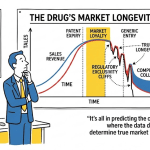
Forecasts agree on direction. They differ on size. Each forecaster counts different drugs and different regions.
“Over $230Bn of biopharma industry revenue will face LoE exposure by 2030” (IQVIA, 2026) [2]
GlobalData projects that the US drug market will lose more than $230 billion between 2025 and 2030 [6]. Evaluate counts more than 400 brands that face patent expiry or loss of exclusivity in its window. Of these, 68 will be blockbusters at the time of expiry. The ten largest expiries share $126 billion of at-risk revenue [5].
Evaluate also estimates a growth gap for large pharma. It puts the gap at $94 billion of 2030 revenue [5]. This is the number that deal teams try to close.
Which drugs sit in the cliff window?
Drug
Owner
Documented exposure
Source
Keytruda (pembrolizumab)
Merck
US exclusivity ends by 2029. 2024 sales above $29 billion.
[6]
Darzalex / Darzalex Faspro
Johnson & Johnson
US exclusivity ends by 2029.
[6]
Eliquis (apixaban)
Bristol Myers Squibb, Pfizer
Loses exclusivity in the window. Listed by Pfizer as an LOE product.
[6][7]
Opdivo (nivolumab)
Bristol Myers Squibb
Loses exclusivity in the window.
[6]
Ibrance, Xtandi, Xeljanz
Pfizer (Xtandi with Astellas)
Patent expiry between 2026 and 2030.
[7]
Keytruda: the largest single exposure
Keytruda made $8 billion in Q1 2026, up 8% from a year earlier. It accounts for about half of Merck’s pharmaceutical sales [7]. A simple annualization of the Q1 figure gives about $32 billion a year (analysis). That figure is a run-rate, not a forecast.
Eliquis and Opdivo at Bristol Myers Squibb
GlobalData expects Bristol Myers Squibb to be the large company most affected by the cliff. Two of its main products, Eliquis and Opdivo, both lose exclusivity in the window [6]. DrugPatentWatch lists the patents and Paragraph IV records behind both products. Teams can use those records to date the loss of exclusivity by docket events, not by nominal expiry dates.
Darzalex at Johnson & Johnson
GlobalData expects Darzalex and Keytruda to stay in the top ten selling drugs in 2030, with lower revenue [6]. Revenue falls first, then rank.
Why do cliff estimates differ?
Forecasters use different scopes. IQVIA counts industry revenue exposed by 2030 [2]. GlobalData counts the US market over 2025 to 2030 [6]. Evaluate counts named brands and ranks the top ten [5]. A reader should compare the scope before comparing the dollar figure.
What Does the Deal Data Show for 2025 and 2026?
How much M&A happened in H1 2026?
IQVIA counted $130 billion across 42 acquisitions in H1 2026. The average deal was $3.1 billion. That compares with $2.7 billion in 2025 [1]. Our check of the arithmetic agrees: $130 billion divided by 42 is $3.1 billion (analysis). IQVIA counts only majority-stake acquisitions of biopharma targets worth $250 million or more [1].
Which were the largest H1 2026 deals?
Acquirer / Target
Value ($B)
Source
Sun Pharma / Organon
11.8
[1]
AbbVie / Apogee
10.9
[1]
GSK / Nuvalent
10.6
[1]
Gilead / Arcellx
7.8
[1]
Eli Lilly / Centessa
7.8
[1]
Eli Lilly / Kelonia
7.0
[1]
Merck / Terns
6.7
[1]
Biogen / Apellis
5.6
[1]
Gilead / Tubulis
5.0
[1]
Total, nine deals (analysis)
73.2
Sum of [1]
Nine deals are 21% of the deal count and 56% of the value (analysis). Oncology held 41% of H1 2026 M&A value. Immunology held 19% [1]. IQVIA reports no deal above $30 billion in 2026 so far [1].
How much of licensing now comes from China?
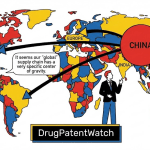
Chinese companies are now a main source of licensed assets. They supplied 40% of the assets that big pharma in-licensed in 2025 [1]. Gibson Dunn reports that about 38% of major global biopharma deals through Q3 2025 came from Chinese companies. Those deals carried about 30% of total upfront payments [4].
The trend grew in 2026. IQVIA counts $92 billion of therapeutic in-licensing value for Chinese-originated assets in H1 2026. That is 88% of the 2025 total [1]. From those two numbers, the implied 2025 total is about $104.5 billion (analysis).
Why do published totals disagree?
Measure
Figure
Scope
Source
2025 biopharma M&A
$133B
Majority-stake deals of $250M or more
[1]
2025 biopharma M&A
More than $143B
A&M definition
[12]
2025 China out-licensing
$135.6B, 157 transactions
PwC count of outbound licensing
[3]
2025 China-origin in-licensing (implied)
About $104.5B
IQVIA, therapeutic deals, AI partnerships excluded (analysis)
[1]
2025 global licensing, all origins
$232B
IQVIA licensing total
[2]
The gaps are definition gaps. IQVIA says it excludes AI-focused partnerships in its China figure [1]. The PwC text we reviewed does not state the same filter [3]. A citation should always name the source and scope.
How much money can buyers spend?
IQVIA estimates big pharma deal capacity at about $1.3 trillion [2]. Public markets also improved. The XBI biotech index rose about 30% in H1 2026. Thirteen biotech companies listed in the US in H1 2026, compared with 11 in all of 2025 [1]. Kailera raised $625 million in April 2026. Parabilis raised $670 million in June 2026 [1].
Venture funding stayed weak for early-stage companies. IQVIA says this pushes private biotechs toward partnerships or sales [1]. The supply of assets and the supply of cash both favor buyers.
Methodology: How We Calculated the Figures
What data did we use?
We used published figures from the sources in the reference list. We did not use private databases. The time period is January 2025 to October 9, 2026. We included only deals that a cited source named, with a stated value. We did not combine deals across sources, so no deal is counted twice.
How did we calculate derived numbers?
Upfront ratio: stated upfront payment divided by stated headline value.
Share of value: sum of listed deal values divided by IQVIA’s H1 2026 total of $130 billion.
Implied 2025 China total: $92 billion divided by 0.88.
Time windows: calendar months from October 9, 2026 to the stated exclusivity date.
What are the limits?
Headline deal values include milestones that may never be paid. They are not cash. Upfront ratios therefore show deal structure, not final value. Exclusivity dates in the sources are “by” dates. Real dates depend on litigation, settlements, and pediatric exclusivity. We label every forecast as a forecast.
The Partnership Pipeline Framework: Seven Steps
This framework is our own. It is not an industry standard. It turns the cliff problem into seven decisions.
Step 1: Build a revenue-at-risk calendar
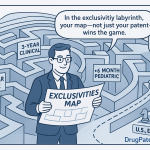
List each product that loses exclusivity before 2031. Give each one a year, a revenue figure, and a confidence level. Use docket events, not only listed expiry dates. DrugPatentWatch tracks Orange Book listings, Paragraph IV filings, and PTAB records. A team can use these records to move a date up or back.
Step 2: Classify the gap
Each gap needs a different partner. We use four types.
Time gap
Revenue falls before any new asset can reach market. Late-stage or marketed assets fit this gap.
Size gap
The asset can launch in time but is too small to replace the lost revenue. A company needs several assets or a large acquisition.
Platform gap
The company lacks a modality or technology for the next decade. Platform alliances and new-company structures fit this gap.
Defense gap
The brand can stay in market if the company changes the product or its delivery. Lifecycle partnerships fit this gap. The Keytruda subcutaneous case below is an example.
Step 3: Match the gap to the deal vehicle
Gap type
Common vehicle
2025-2026 example
Source
Time
Acquisition of a late-stage company
GSK / Nuvalent, $10.6B
[1]
Size
Multi-program license
Pfizer / Innovent, 12 oncology programs, $10.5B
[1]
Platform
Platform alliance or new company
Kailera, built on assets licensed from Hengrui
[1]
Defense
Enabling-technology license and reformulation
Merck’s subcutaneous Keytruda
[8][11]
Step 4: Set the upfront-to-total ratio
The ratio shows who carries the risk. A high ratio means the buyer pays early and the seller takes less risk. The next section shows the ratios in recent deals.
Step 5: Run the IP and enabling-technology check
Check chain of title for every licensed patent. Check the freedom to operate for every technology that the product needs, including delivery technology. The Keytruda case shows what happens when a partner platform carries its own patents.
Step 6: Screen for policy and geopolitical risk
Draft US legislation could affect licensing with Chinese companies. The Biotech Investment National Security Act would amend the COINS Act of 2025. It would add biotechnology to the sectors under outbound investment screening. Licensing deals, joint ventures, and equity investments would go to Treasury for review [1]. The bill is a proposal. A deal team should model delay and restriction.
Step 7: Track the docket after signing
A signed deal does not end the work. Track PTAB decisions, district court schedules, and foreign proceedings for every licensed patent and every competitor patent. Set an alert for each date that changes the revenue calendar from Step 1.
How Do Large Deals Pay? Upfront Ratios in 2025 and 2026
Deal
Headline value ($B)
Upfront ($B)
Upfront ratio (analysis)
Source
Pfizer / 3SBio (2025, one asset)
Up to 6.0
1.25
20.8%
[1]
GSK / Hengrui (2025, 12 programs)
Up to 12.0
0.5
4.2%
[2]
AstraZeneca / CSPC (2026, 8 programs)
18.5
1.2
6.5%
[1]
BMS / Hengrui (2026, 13 programs)
15.2
0.6
3.9%
[1]
Pfizer / Innovent (2026, 12 programs)
10.5
0.65
6.2%
[1]
Lilly / Innovent (2026)
8.8
0.35
4.0%
[1]
What does a 20.8% upfront ratio tell a seller?
It shows that a buyer paid early for one specific asset. 3SBio’s PD-1/VEGF bispecific antibody was the subject. The $1.25 billion upfront was a record for a China-sourced license at the time [2]. A single, defined asset lets a buyer price risk more precisely.
Why do platform alliances pay less upfront?
Platform alliances cover many programs. Most are early. IQVIA describes the BMS and Hengrui programs as early-stage [1]. The buyer pays little now and more as each program succeeds. Across the four 2026 deals, upfront payments were $2.8 billion against $53.0 billion of headline value, or 5.3% (analysis). PwC’s count of all China outbound deals in 2025 gives a similar ratio: $7.0 billion upfront against $135.6 billion total, or 5.2% (analysis of [3]).
Who Is Exposed? Cliff Exposure and Deal Response by Company
Pfizer expects 2026 revenue of $59.5 billion to $62.5 billion. Revenue in 2025 was $62.6 billion. Pfizer expects the cliff to cut about $1.5 billion from 2026 sales. It expects high single-digit revenue growth per year for five years starting in 2029 [7]. Pfizer’s licensed assets are mostly in oncology, and Ibrance and Xtandi are oncology products (analysis of [1][7]). That is a match between exposed franchise and new pipeline.
How is Bristol Myers Squibb matching its cliff?
BMS licensed 13 early-stage programs from Hengrui in oncology, hematology, and immunology [1]. Early-stage programs can fill a size gap or a platform gap. They cannot fill a time gap before 2029 or 2030 (analysis). BMS needs other deals for the near years.
Why is Lilly a buyer without a cliff?
GlobalData forecasts that Lilly’s revenue will rise 165% by 2030 [6]. IQVIA calls Lilly the most active dealmaker of 2026. Lilly paid $26 billion for acquisitions and signed licensing deals worth a combined $28 billion in headline value [1]. The two figures are not additive as cash, because licensing totals include milestones (analysis). Lilly’s case shows that growth companies also use partnerships.
Case Study: Keytruda SC, Halozyme, and the Enabling-Technology Risk
What is the dispute?
Merck makes a subcutaneous form of Keytruda. Halozyme says the product infringes patents on its MDASE technology. MDASE uses modified human hyaluronidase to make infused drugs injectable [11]. Halozyme sued Merck in federal court in New Jersey [10]. The product matters because it can limit biosimilar impact when the original Keytruda formulation starts to lose protection in 2028 [11].
Timeline of documented events
Date
Event
Source
Nov 2024
Merck starts filing post-grant review petitions against Halozyme patents
[8]
Jun 2025
PTAB institutes the first petition, then 13 more
[8]
Dec 2025
German court grants Halozyme a preliminary injunction against launch in Germany
[11]
May 12, 2026
PTAB finds all challenged claims of US 11,952,600 unpatentable for lack of written description and enablement
[9]
May 18, 2026
PTAB finds all challenged claims of US 12,152,262 unpatentable on the same grounds
[9]
By Q2 2026 10-Q
Four final decisions find every challenged claim unpatentable
[8]
Oct 7, 2026
Dutch court grants an injunction against Keytruda SC in eight markets
[10][11]
The eight markets are Belgium, Denmark, France, Ireland, Italy, Sweden, Switzerland, and the Netherlands [11]. The Dutch court rejected Merck’s argument that European patent EP 2,797,622 is invalid [10].
What happens if a lifecycle product depends on a disputed platform?
Launch timing then depends on court calendars in each country. The US and European outcomes can differ because the patents differ. The US decisions concern US patents and the Dutch decision concerns a European patent (analysis). Halozyme states that patients still have access to the intravenous product and that the outcome should not affect its ENHANZE licensing revenue [10]. The cliff defense and the cliff exposure are linked: the intravenous product is the one that loses protection from 2028.
What this means for the Step 5 check
A freedom-to-operate review must cover the delivery technology and its supplier, not only the drug. A partnership plan should include a fallback date if an injunction applies.
What Happens If US Rules Restrict Licensing From China?
Scenario analysis: three paths
The exposure base is $92 billion of China-origin in-licensing value in H1 2026 [1]. The bill is a draft [1]. Our scenarios use identifiable assumptions and no forecast numbers.
Scenario A: no passage
Deal flow continues. IQVIA’s mid-year report expects 2026 to be another record year for China-origin licensing [1].
Scenario B: screening with delay
Treasury review adds time to each deal. Time gaps become harder to close. Buyers shift toward assets that can launch sooner, or toward US and European sellers (analysis).
Scenario C: broad restriction
Buyers lose a source that supplied 40% of in-licensed assets in 2025 [1]. Prices for non-Chinese assets would likely rise (analysis). New-company structures would also face review, because the bill covers joint ventures and equity investments [1].
How should a deal team plan for all three?
Sign time-gap deals first. Add closing conditions and long-stop dates for any deal that may need review. Keep a second candidate for each critical program.
How Much Time Is Left? A Window Calculation
Months from today to a 2029 loss of exclusivity
GlobalData expects Keytruda and Darzalex to lose US exclusivity by 2029 [6]. From October 9, 2026, about 27 months remain until January 1, 2029. About 39 months remain until December 31, 2029 (analysis). A program that must reach the market and build sales in that window needs to be far along already.
What this means for early-stage deals
Early-stage programs can support the years after 2030. They cannot offset a 2029 loss (analysis). A balanced pipeline has one set of deals for each year in the Step 1 calendar.
What This Means for Each Group
What this means for brand manufacturers
Build the calendar first. Then match each gap to a vehicle. Use the upfront ratio as a risk tool. Review enabling-technology patents before signing, not after launch.
What this means for biotech sellers
Buyers have capacity of about $1.3 trillion [2]. They pay more, and earlier, for a single asset with clear data (analysis of the 20.8% ratio against 3.9% to 6.5%). A seller with a platform should expect a lower upfront payment and more milestones.
What this means for generic and biosimilar developers
Brands will defend with reformulations and delivery changes. Biosimilar developers should read the full patent record, including delivery-technology patents and their PTAB history. A subcutaneous product that is delayed by an injunction may extend the time in which the intravenous product is the only version at risk (analysis).
What this means for investors and analysts
Headline deal values overstate cash. Compare upfront payments and stage of the assets. Check each cited total against its definition, as the comparison table above shows.
What Happens Next: Events to Watch
Timeline of announced and expected events
Item
Status
Source
Keytruda original formulation loses protection
Starts 2028 (reported); US by 2029 (forecast)
[11][6]
Halozyme v. Merck, New Jersey case
Pending
[10][11]
BINSA
Proposed legislation
[1]
2026 M&A total
IQVIA says a result above its earlier best case of $180-200B is possible
[1]
What changed in 2026?
Three things changed. Deals got larger. Chinese assets moved from single licenses to multi-program alliances. Public markets reopened for biotech, with two record IPOs in two months [1].
Key Takeaways
H1 2026 M&A reached $130 billion across 42 deals. Nine deals made up 56% of the value (analysis of [1]).
China-origin assets made up 40% of big pharma in-licensing in 2025 [1].
Platform alliances paid 3.9% to 6.5% upfront. A single-asset license paid 20.8% (analysis of [1][2]).
The time to a 2029 loss of exclusivity is 27 to 39 months from today (analysis of [6]).
Four PTAB decisions found every challenged claim unpatentable in Halozyme patents, while a Dutch court enjoined Keytruda SC in eight markets [8][10][11].
A draft US bill could subject licensing with Chinese companies to Treasury review [1].
FAQ
How much revenue is at risk from the 2026-2030 patent cliff?
Estimates exceed $230 billion. IQVIA reports more than $230 billion of industry revenue with loss-of-exclusivity exposure by 2030 [2]. GlobalData reports more than $230 billion of US market loss from 2025 to 2030 [6]. Evaluate puts $126 billion in the ten largest expiries [5].
Which drugs lose exclusivity first?
Keytruda and Darzalex lose US exclusivity by 2029 [6]. Pfizer lists Eliquis, Ibrance, Xtandi, and Xeljanz as products that face expiry between 2026 and 2030 [7].
Is licensing replacing M&A?
No. Both grew. Licensing value reached a 10-year high of $232 billion in 2025 [2]. M&A reached $130 billion in H1 2026 [1].
What share of licensing comes from China?
Chinese companies supplied 40% of assets that large pharma in-licensed in 2025 [1]. Through Q3 2025, about 38% of major global deals came from Chinese companies [4].
What is a NewCo deal?
A NewCo deal forms a new Western company around an asset licensed from a Chinese company. Kailera, built on assets licensed from Hengrui, is an example [1]. PwC reports that the number of such deals rose from six to nine in 2025 [3].
How much do platform alliances pay upfront?
Four 2026 alliances paid 3.9% to 6.5% of headline value upfront (analysis of [1]).
Can a partnership fix a cliff before 2029?
Only a late-stage or marketed asset can. About 27 months remain to January 2029 (analysis). Early-stage programs support later years.
What is the Biotech Investment National Security Act?
It is proposed legislation that would add biotechnology to outbound investment screening under the COINS Act of 2025. Licensing deals, joint ventures, and equity investments would go to Treasury for review [1].
Why do deal-value totals differ between reports?
Each report uses its own definition. IQVIA reports $133 billion of 2025 M&A with a $250 million minimum and majority-stake rule [1]. A&M reports more than $143 billion [12].
Can a technology partner block a lifecycle product?
Yes. A Dutch court enjoined Merck’s subcutaneous Keytruda in eight markets on a Halozyme patent [10][11]. US reviews of other Halozyme patents went the other way [8][9].
References
Gores, M., & House, T. (2026, July 8). Biopharma M&A: Mid-year 2026 update. IQVIA. https://www.iqvia.com/locations/emea/blogs/2026/07/biopharma-ma-mid-year-2026-update
IQVIA. (2026, January). Biopharma M&A: Outlook for 2026. https://www.iqvia.com/locations/emea/blogs/2026/01/biopharma-m-and-a-outlook-for-2026
PwC Switzerland. (2026). M&A trends in the health industry: 2026 outlook. https://www.pwc.ch/en/insights/strategy/m-and-a-trends-health-industry-2026-outlook.html
Gibson Dunn. (2026). 2026 life sciences industry outlook: Collaborations and licensing. https://biotechbriefings.gibsondunn.com/?p=6831
Evaluate / Citeline. (2025). Portfolio tactics to scale the $300bn patent cliff. https://citeline.turtl.co/story/portfolio-tactics-to-scale-the-dollar300bn-patent-cliff/page/4
GlobalData. (2025). Big pharma braces for revenue headwinds as patent expiries loom. Pharmaceutical Technology. https://www.pharmaceutical-technology.com/news/big-pharma-braces-for-revenue-headwinds-as-patent-expiries-loom/
Zacks Investment Research. (2026). Pfizer bets on new and acquired drugs to offset its LOE pressure? Nasdaq. https://www.nasdaq.com/articles/pfizer-bets-new-acquired-drugs-offset-its-loe-pressure
Merck & Co., Inc. (2026). Form 10-Q for the quarterly period ended June 30, 2026. U.S. Securities and Exchange Commission. https://www.sec.gov/Archives/edgar/data/0000310158/000031015826000212/mrk-20260630.htm
Venable LLP. (2026). Keytruda Qlex updates: Final written decisions find two Halozyme PH20 patents unpatentable while institution is denied for third patent. JD Supra. https://www.jdsupra.com/legalnews/keytruda-qlex-tm-updates-final-written-6644057/
Halozyme Therapeutics, Inc. (2026, October 7). Halozyme wins injunction stopping manufacture and sale of Merck’s Keytruda SC in multiple European markets [Press release]. PR Newswire. https://www.placera.se/pressmeddelanden/halozyme-therapeutics-halozyme-wins-injunction-stopping-manufacture-and-sale-of-merck-s-keytruda-sc-in-multiple-european-markets-20261007
pharmaphorum. (2026). MSD ordered to pull injectable Keytruda from sale in Europe. https://pharmaphorum.com/news/msd-ordered-pull-injectable-keytruda-sale-europe
Alvarez & Marsal. (2026, January 9). 2026 global biopharmaceutical M&A and VC insights. https://www.alvarezandmarsal.com/node/90796