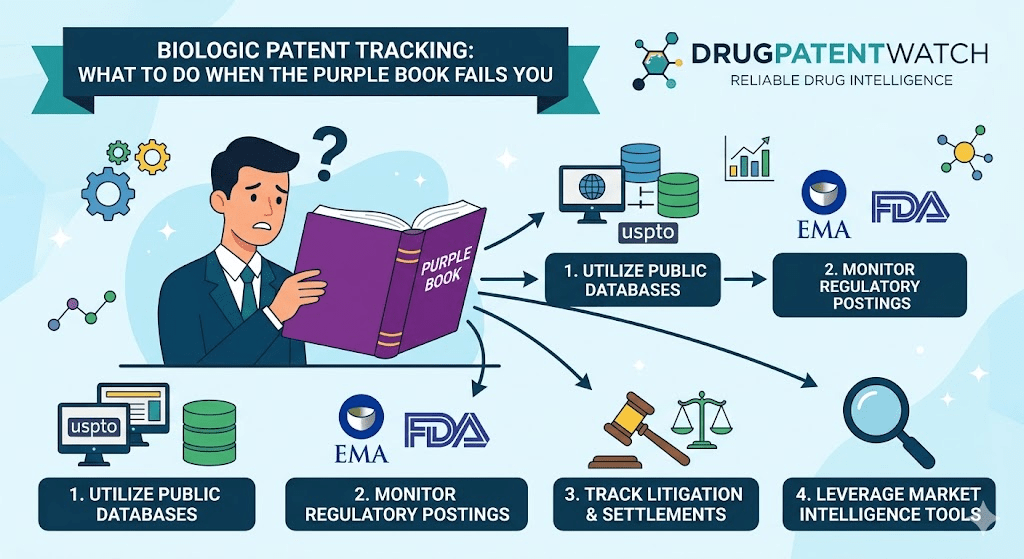
The FDA’s Purple Book is supposed to be the authoritative public registry for biologic drug patents in the United States. It is not. As of November 2023, the Purple Book contained 1,966 entries covering 563 unique prescription brand biologics. Of those 563 products, only 11 disclosed any patent information at all. That is approximately 2%.
If you are a biosimilar developer, an IP analyst, a pharma investor, or a payer negotiating contracts, that 2% figure is not a footnote. It is the core problem you face when trying to assess the competitive landscape around any biologic drug. You cannot plan a biosimilar program, model a loss-of-exclusivity timeline, or negotiate a licensing deal when the primary public registry for the relevant intellectual property is 98% empty.
This article explains why the Purple Book is structurally hollow, what actually creates the patent intelligence gap, and how experienced practitioners build a complete biologic patent picture from the sources that do work. This is not a theoretical overview of the regulatory framework. It is a working guide to the data sources, analytical tools, and methodologies that generate actionable intelligence when the Purple Book gives you nothing to work with.
“Based on the most recent data available, biologics accounted for 37% of all drug spending in the United States while accounting for only 2% of all US prescriptions.” — Robin Feldman, UC College of the Law San Francisco, PLOS Medicine, April 2024 [1]
Why the Purple Book Has Almost No Patent Data
The contrast with the Orange Book is not subtle. Small-molecule drug sponsors are required by the Hatch-Waxman Act to disclose the patents covering their drugs as a condition of NDA approval. That disclosure obligation is hard law. Sponsors who fail to list a relevant patent can lose the right to assert it in later Paragraph IV litigation. The Orange Book’s patent data is therefore reasonably complete because the listing obligation is tied to a legal consequence that matters to the brand company.
The Purple Book operates under no equivalent obligation. US law imposes no patent-disclosure requirement on any application for approval of a large-molecule biological drug. A sponsor applying for a Biologics License Application (BLA) under Section 351(a) of the Public Health Service Act does not have to disclose a single patent to the FDA. The Purple Book was created in 2014 without any mandatory patent-listing provision, and it remained that way for six years.
The Consolidated Appropriations Act of 2021, signed into law on December 27, 2020, added a limited patent transparency provision to the Purple Book through the Biological Product Patent Transparency (BPPT) section. Under that provision, a reference product sponsor (RPS) must provide the FDA with the list of patents it discloses to a biosimilar applicant during the BPCIA patent dance under 42 U.S.C. § 262(l)(3)(A) or (l)(7), within 30 days of that disclosure. The FDA must then list those patents in the Purple Book.
That sounds like progress. It is less than it appears.
Why the 2021 BPPT Provision Did Not Solve the Problem
The 2021 amendment is event-triggered. A patent only gets listed in the Purple Book after an RPS has already entered the patent dance with a specific biosimilar applicant and provided that applicant with its Section 262(l)(3)(A) list. That means a biosimilar developer who has not yet filed an aBLA sees no patent information before committing capital to a development program. The disclosure that was supposed to reduce investment risk only arrives after a competitor has already made that investment and entered the dance.
There are additional structural gaps. Parties can reach a settlement before the RPS provides its 3A patent list, cutting off the disclosure trigger entirely. The FDA may decline to request retroactive disclosure of patents from earlier biosimilar litigations. RPS entities have also been noted to have a strategic incentive to avoid entering the dance in the first place, or to enter and settle quickly before the disclosure obligation matures, in order to keep the full patent portfolio away from follow-on developers who have not yet filed. And even when disclosure does occur, analysts at Rothwell Figg’s Biosimilars Law Bulletin have observed that a reference product sponsor may choose to limit the patents it asserts in order to avoid revealing expiration dates to future competitors.
The result is that even with the 2021 amendment in place, the Purple Book identifies patents for only the ten biologic products that have been through enough patent dance exchanges to generate mandatory disclosures. Those products are Actemra (tocilizumab), Avastin (bevacizumab), Eylea (aflibercept), Herceptin (trastuzumab), Humira (adalimumab), Lucentis (ranibizumab), Neulasta (pegfilgrastim), Prolia/Xgeva (denosumab), Stelara (ustekinumab), and Tysabri (natalizumab). Every other approved biologic has zero disclosed patents in the Purple Book.
What the Orange Book vs. Purple Book Disclosure Gap Means for Biosimilar Investment Risk
Under the Hatch-Waxman framework, a generic developer can look at the Orange Book, identify every asserted patent, read the claims, model the litigation risk, and decide whether to file a Paragraph IV certification with reasonable visibility into the legal exposure. That process is not cheap or fast, but the inputs are complete. The generic developer knows the full universe of patents the brand company might assert.
A biosimilar developer has no equivalent starting point for most biologics. They must commit to multi-year clinical programs costing hundreds of millions of dollars without knowing which patents they will face. The Purple Book, for most products, tells them the FDA approval date and the 12-year reference product exclusivity window. That is useful but incomplete. It does not tell them whether the RPS has filed 30 manufacturing process patents, 20 formulation patents, or 50 method-of-use patents on top of the sequence patent they already know about.
That information asymmetry is not accidental. It is the structural design of the BPCIA, and understanding it is the prerequisite for building any real biologic IP intelligence practice.
The BPCIA Patent Dance: What It Reveals and What It Hides
The Biologics Price Competition and Innovation Act of 2009 created a structured pre-litigation negotiation process for patent disputes between RPS holders and biosimilar applicants. That process is colloquially known as the patent dance, and it has become the primary mechanism through which biologic patent disputes are defined, narrowed, and resolved before and during litigation.
How the Patent Dance Works Step by Step
The dance begins when a biosimilar applicant files an aBLA under Section 351(k) and notifies the RPS that an application has been submitted. The RPS then has 60 days to request access to the aBLA for the purpose of patent analysis. Under the 3A exchange, the RPS provides the biosimilar applicant with a list of patents it believes the biosimilar would infringe, along with claim charts for each patent. The biosimilar applicant then has 60 days to provide a response identifying which patents it believes are invalid, unenforceable, or not infringed.
The 3B exchange follows, in which the biosimilar applicant provides its own list of patents it is willing to license. The parties then negotiate to select the number of patents to be litigated immediately, typically within a defined ceiling. The RPS files suit on the selected patents within 30 days. Patents not selected in the first-wave litigation are reserved for a second phase after the biosimilar applicant provides commercial launch notice.
The dance was designed to create a structured, discovery-light path to patent resolution. In practice, it created a mechanism through which a well-resourced RPS with a large patent portfolio can generate overwhelming litigation complexity and settlement pressure.
How AbbVie’s Humira Patent Thicket Weaponized the Dance
No case illustrates the gap between the patent dance’s design intent and its operational effect more clearly than AbbVie’s management of the Humira (adalimumab) patent portfolio. AbbVie built a portfolio of over 250 patents around adalimumab, with many filed late in the product’s lifecycle covering incremental aspects of formulation, manufacturing process, and dosing regimen. When biosimilar applicants began filing 351(k) applications starting in 2015, AbbVie’s 3A list for Amgen included 61 patents. For Alvotech, AbbVie initially identified 63 patents as potentially infringed.
The BPCIA, unlike Hatch-Waxman, places no statutory cap on the number of patents an RPS can assert in litigation. That absence created the asymmetric leverage AbbVie exploited. Even if many of those patents were of questionable validity or limited relevance, the cost of challenging them individually in inter partes review (IPR) proceedings and litigation was prohibitive for any single biosimilar challenger. Every major biosimilar applicant, including Amgen, Sandoz, Boehringer Ingelheim, and Alvotech, ultimately settled with AbbVie rather than litigate to judgment. The settlements contained confidential launch date provisions that effectively delayed US biosimilar competition until January 2023, nearly seven years after the first biosimilar (Amgen’s Amjevita) received FDA approval in September 2016.
The antitrust challenge to AbbVie’s conduct, In Re Humira (Adalimumab) Antitrust Litigation, No. 19-cv-1873, was dismissed by Judge Shah of the Northern District of Illinois. The court held that AbbVie’s patent accumulation and enforcement strategy was protected under the Noerr-Pennington doctrine as objectively reasonable petitioning of the government, provided the underlying patent filings and litigation were not sham proceedings.
What the Patent Dance Does Not Reveal to Third Parties
Even when the dance proceeds to a 3A disclosure, the published patent list in the Purple Book reflects only the patents the RPS chose to assert against that specific applicant in that specific exchange. It does not reflect the complete patent portfolio around the reference product. An RPS managing a 100-patent portfolio around a biologic may assert 60 of those patents against biosimilar applicant A and 40 different patents against biosimilar applicant B, depending on the specific manufacturing process each biosimilar uses. A third party monitoring the Purple Book will see the union of those disclosures, but they will not know how many unasserted patents remain in reserve.
For a biosimilar developer who has not yet filed and who is trying to assess the patent landscape before committing to a program, this is the fundamental intelligence problem. The dance reveals what was asserted. It does not reveal what exists.
Building a Biologic Patent Map Without the Purple Book
Because the Purple Book is structurally inadequate, experienced practitioners build biologic IP maps from primary sources that the Purple Book either cannot access or is not designed to aggregate. The methodology below reflects the standard approach used by biosimilar IP teams, patent analytics firms, and specialized intelligence platforms.
Step 1: Start With the Sequence Patent at the USPTO
Every biologic’s IP story begins with the sequence patent. For monoclonal antibodies, the primary patent typically covers the complementarity-determining region (CDR) sequences, the variable domain sequences, and the full-length heavy and light chain amino acid sequences. This patent is usually filed at or near the time of the original IND application, often a decade or more before FDA approval. Its term runs 20 years from the filing date, with potential patent term extension (PTE) of up to 5 years under 35 U.S.C. § 156 to compensate for time lost during regulatory review.
The USPTO full-text search at patents.google.com, USPTO Patent Center, and the commercial database USPTO Patent Full-Text and Image Database (PatFT) are the starting points. For a known biologic, the search is straightforward: use the international nonproprietary name (INN) of the drug, the assignee name of the innovator company, and the relevant CPC classification codes. For monoclonal antibodies, the relevant CPC hierarchy runs through C07K 16/00 (immunoglobulins) and A61K 39/395 (antibody therapeutics). For recombinant proteins, the relevant codes are in A61K 38 and C07K 14.
Step 2: Run a Protein Sequence Search
For biologics, keyword searches alone are insufficient. A patent covering adalimumab’s CDR sequences may not use the word “adalimumab” anywhere in the claims, because the INN did not exist when the patent was filed. Comprehensive biologic patent coverage requires protein sequence searching against patent databases.
The USPTO maintains a Protein and Nucleotide Sequence Listing database (SEQLIST) that contains all sequences from US patent applications and grants. The European Patent Office’s ESPACENET provides similar sequence data for EP filings. WIPO’s PATENTSCOPE covers PCT applications globally. The practical tool for most practitioners is BLAST (Basic Local Alignment Search Tool) run against patent sequence databases. NCBI’s patent database, PatentLens (a free public resource from the Lens.org platform), and commercial tools including Derwent Sequence Search (covering 58 patent authorities) and PatSnap Bio allow sequence-homology searches that identify patents covering structurally related sequences even when no common text string exists.
For a biosimilar developer conducting freedom-to-operate (FTO) analysis, a sequence search is mandatory. The amino acid sequences of the reference biologic must be run against the global patent databases to identify any issued or pending patent that claims sequences with high homology to the target molecule. A 95% sequence identity threshold is a common starting point, but the relevant legal standard is claim scope, not identity percentage, so any hit above 85-90% identity deserves individual analysis.
Step 3: Map the Secondary Patent Fortification Strategy
After identifying the primary sequence patent, the analysis moves to the four standard secondary patent categories that RPS entities use to build patent thickets around approved biologics:
Manufacturing process patents cover the host cell line (most commonly Chinese Hamster Ovary cells for monoclonal antibodies), cell culture medium composition, purification process steps including protein A affinity chromatography conditions and viral inactivation procedures, and upstream bioprocessing parameters. These patents are particularly important for biosimilar developers because biosimilars must independently develop manufacturing processes, meaning that even if the product patent does not pose an infringement risk, the process patents may. Manufacturing process patents are not listed in the Orange Book and are not reliably disclosed in the Purple Book. They must be located through direct USPTO searches using assignee name combined with CPC codes in the C12N and C12P classification hierarchy (fermentation and preparation of organic compounds using microorganisms).
Formulation patents cover the excipient composition, buffer system (citrate vs. non-citrate formulations have been the subject of extensive patent disputes in the adalimumab space), pH range, surfactant identity and concentration, and stabilizer composition. The shift from Humira’s original citrate-containing formulation to the citrate-free 100 mg/mL formulation, protected by its own patent estate, is the canonical formulation patent strategy in the biologic space. AbbVie’s ‘081 and ‘619 patents (US 8,420,081 and 9,085,619), directed to self-buffering formulations, were among the four patents Alvotech selected for its 3C litigation in 2021.
Device and delivery system patents cover autoinjectors, prefilled syringes, pen devices, and any other drug-device combination used to administer the biologic. These patents are classified under CPC A61M, and they present a distinct challenge for biosimilar developers because the device patent landscape is maintained separately from the drug patent landscape and is populated by device manufacturers as well as pharmaceutical companies. FDA device patents have been the subject of FTC enforcement action in the Orange Book context; the same scrutiny has not yet been systematically applied to BPCIA proceedings.
Method-of-use and dosing regimen patents cover the specific clinical indications and dosing protocols established in clinical trials. These patents are filed as data from Phase II and Phase III trials becomes available, often 10-15 years into the product’s commercial life. The relevant CPC code ranges run through A61P for therapeutic indications and A61K 31 combined with specific disease area codes. Method-of-use patents are typically the weakest category for litigation purposes but are routinely listed by RPS holders in patent dance disclosures to maximize settlement leverage.
Step 4: Search Court Records Systematically
Every BPCIA patent lawsuit is a public document. The complaints, counterclaims, claim charts, and expert reports filed in federal district courts contain more detailed information about the contested patent landscape than any regulatory database. PACER (Public Access to Court Electronic Records) at pacer.gov provides access to all federal district court filings for a per-page fee. Docket Alarm, CourtListener, and Lex Machina provide structured PACER alternatives with better search interfaces and analytics overlays.
For any biologic with active or resolved biosimilar litigation, the court record provides: the specific patents asserted (including US patent numbers and claims at issue), the validity arguments made by the biosimilar challenger, any claim construction rulings, summary judgment decisions on non-infringement or invalidity, settlement terms (where disclosed), and post-litigation patent term status. The Delaware District Court, the Northern District of Illinois, and the Eastern District of Virginia are the most common BPCIA litigation venues and have well-organized electronic docket systems.
Important limitation: asserted patents in litigation represent a subset of the total portfolio. AbbVie asserted approximately 60 patents against Amgen in litigation but held over 250 patents total around adalimumab. Tracking litigation patents is necessary but not sufficient for a complete landscape map.
Step 5: Monitor FDA BLA Approval Letters and Package Inserts
The FDA’s Drugs@FDA database and the FDA BLA approval action letters are underused intelligence sources for biologic patent work. Approval letters identify the specific indication, route of administration, formulation, and device combination covered by the approval. Package inserts contain the complete clinical and safety database disclosed to FDA. Neither source lists patents, but both provide the factual substrate for determining which patent categories are likely relevant: a formulation changed from IV-only to SC/IV dual-route suggests new device and formulation patents; a new indication added through a supplemental BLA suggests new method-of-use patent filings timed to that supplemental approval.
The Role of BPCIA Reference Product Exclusivity vs. Patent Protection
The patent map is only half the picture for biologics. Unlike small molecules, where patent protection is the primary competitive barrier, biologics benefit from a separate and independent exclusivity grant under the BPCIA: the 12-year reference product exclusivity period.
How the 12-Year Exclusivity Window Works
Under 42 U.S.C. § 262(k)(7), the FDA cannot approve a biosimilar application until 12 years after the date the reference product was first approved under Section 351(a). There is also a 4-year exclusivity period during which a biosimilar applicant cannot even file an aBLA (the “4-year bar”). These exclusivity periods run from the date of first licensure of the reference product and are independent of any patent. They are mandatory FDA administrative bars that apply regardless of patent status.
For a biologic approved in 2010, the 12-year exclusivity expired in 2022. A biosimilar approved before the 12-year expiry cannot launch commercially even if it prevails in all patent litigation. This creates the unusual situation where a biosimilar can be FDA-approved but commercially blocked until the exclusivity window closes, at which point any remaining patent disputes must be resolved before commercial launch.
Stelara (ustekinumab, first approved September 2009) illustrates this layering. The 12-year exclusivity expired in September 2021. The primary composition-of-matter patent expired in September 2023. But Janssen held additional patents with stated expiry dates extending from 2032 to 2039, disclosed in the Purple Book and in litigation. Amgen settled its litigation with Janssen in a confidential agreement that set a commercial launch date of no earlier than January 1, 2025. Wezlana (ustekinumab-auub) launched on that date, distributed exclusively through Nuvaila. As of May 2026, seven ustekinumab biosimilars have received FDA approval, with commercial launch dates staggered according to individual settlement terms.
Effective Exclusivity vs. Legal Patent Expiry: Why the Dates Don’t Match
Analysts who model generic or biosimilar market entry based solely on primary patent expiration consistently overestimate competition and understate brand protection. The Humira example makes this concrete. The core composition-of-matter patent on adalimumab expired in 2016. Meaningful biosimilar competition in the US did not begin until January 2023. A seven-year gap between primary patent expiry and effective competitive entry is not an anomaly. It is the designed outcome of a patent thicket strategy executed with full legal compliance.
Platforms like DrugPatentWatch track the entire patent portfolio around biologics, not just the primary patents, and build LOE models that account for the full secondary patent landscape, BPCIA exclusivity windows, and settlement-derived launch date agreements published in court records. That kind of multi-layer analysis is the minimum standard for commercial planning in the biologic space.
How to Track Biologic Patents for Specific Therapeutic Categories
Tracking Immunology Biologic Patents: TNF Inhibitors, IL-Inhibitors, and Integrin Blockers
The immunology biologic class, anchored by TNF inhibitors (adalimumab, etanercept, infliximab), IL-12/23 inhibitors (ustekinumab), IL-17 inhibitors (secukinumab, ixekizumab), and IL-23-specific inhibitors (guselkumab, risankizumab, tildrakizumab), has the most developed biosimilar patent landscape of any therapeutic category. The relevant patent databases for this class are well-populated with litigation history, PTAB IPR decisions, and published settlement terms.
For TNF inhibitors, the key patent categories beyond the sequence patent include: Fc region modification patents covering the IgG1 subtype and hinge region; glycosylation pattern patents covering the specific glycoform distribution at Asn297 of the Fc region; high-concentration formulation patents covering the shift from 50 mg/mL to 100 mg/mL formulations; and autoinjector device patents covering specific injection force, needle length, and needle shield mechanisms. All of these categories have been asserted in TNF inhibitor BPCIA litigation and are now well-documented in public court records.
Tracking Oncology Biologic Patents: Checkpoint Inhibitors and ADCs
The next major biosimilar patent battle is forming around PD-1 and PD-L1 checkpoint inhibitors. Keytruda (pembrolizumab), developed by Merck and generating approximately $29.5 billion in 2023 revenue, faces a primary composition-of-matter patent expiry in 2028. Biosimilar aBLA submissions are expected as early as 2026 or 2027 (the 4-year bar from Keytruda’s September 2014 approval cleared in September 2018, and 12-year reference product exclusivity expires in September 2026).
The pembrolizumab patent landscape is materially more complex than the primary patent expiry date suggests. As of October 2021, Merck had filed 129 additional patent applications beyond its core registered patents, more than half filed after initial approval, with formulation-related patents (unrelated to the core antibody) accounting for approximately 74% of those applications. A more recent analysis found that Merck had filed over 100 additional patent applications and secured almost 30 more granted patents since 2022, bringing the total application count to nearly 300. The strategic objective is a product hop to a subcutaneous formulation of pembrolizumab, developed using Halozyme’s ENHANZE hyaluronidase technology (recombinant human hyaluronidase PH20, rHuPH20). An approved SC formulation, protected by its own patent estate extending well beyond 2028, combined with patient and prescriber switching programs, is designed to move the majority of the patient population to a formulation not covered by the 2028 biosimilar approvals before those biosimilars can launch. This is the same product-hop playbook applied to Revlimid, Nexium, and other blockbusters in the small-molecule space, now adapted for the biologic patent architecture.
Samsung Bioepis, Celltrion, and Chong Kun Dang in Korea, along with programs at Organon, Biocon Biologics, and Formycon in other markets, are active in pembrolizumab biosimilar development. Each of those developers is conducting its own patent landscape analysis independently, without any public Purple Book patent data to work from.
Eylea (aflibercept) and Lucentis (ranibizumab) are the two anti-VEGF biologics with Purple Book patent disclosures. Both have substantial biosimilar pipelines and active patent litigation. Eylea’s patent landscape includes VEGF-binding domain sequence patents, formulation patents covering the specific excipient composition used in the intravitreal injection presentation, and device patents covering the prefilled syringe configuration. The Purple Book’s November 2023 version contained a disclosure error that erroneously attributed five Eylea patents (US 11505593, 11548932, 11555176, 11577025, 11559564) to four BLA numbers, illustrating that even the limited Purple Book data that does exist requires verification against primary USPTO records.
Regeneron’s Eylea HD (higher-concentration 8 mg/0.07 mL aflibercept, approved 2023), covered by its own new patent estate, exemplifies the product-hop lifecycle management strategy in the ophthalmology space.
Commercial Patent Intelligence Tools for Biologic IP Tracking
DrugPatentWatch: Comprehensive Biologic Patent and LOE Tracking
DrugPatentWatch, operated by thinkBiotech LLC, aggregates primary source data from the USPTO, FDA biologics databases, ANDA filings, court litigation records, and patent registers across 134 countries into a daily-updated platform. Its biologics section tracks loss-of-exclusivity dates, reference product exclusivity windows, aBLA filing activity, and the patent landscape around specific reference products. For practitioners who track biosimilar entry timing across multiple products and markets simultaneously, DrugPatentWatch provides the structured data environment that manual primary-source searches do not. The platform’s alert functionality notifies users when new aBLA filings appear, when patent litigation is initiated, and when Purple Book disclosures are updated. Academic citations for DrugPatentWatch as a primary source appear in peer-reviewed pharmaceutical, supply chain, and patent research publications, reflecting its adoption as a reference standard for patent expiry and LOE data.
Derwent Innovation and Clarivate Derwent Sequence Search
Derwent Innovation, part of Clarivate, provides the Derwent World Patents Index (DWPI) combined with the Derwent Sequence Search for biological sequence patent work. DWPI covers patents from over 50 patent authorities, with enhanced abstracts written by subject-matter specialists in chemistry, pharma, and biotech. The Derwent Sequence Search (covering 58 patent authorities, including all sequences patented since 1981) combines the GENESEQ, USGENE, WOGENE, and GENBANK databases. The practical use case is running BLAST-based similarity searches against the patent sequence corpus to identify all patents covering sequences with significant homology to a target biologic molecule. Data is available within 24 hours of publication from major patent authorities, including WIPO PCT publications.
PatSnap Bio, launched specifically for life sciences patent work, provides AI-assisted patent search, sequence searching, claim analysis, and competitive intelligence functions built on PatSnap’s broader patent database infrastructure. Its AI-assisted claim analysis tools attempt to identify the most probable claim scope of a biologic patent, which is useful for FTO analysis where claim construction questions dominate the risk assessment. PatSnap also publishes analyst commentary on pending patent cliffs, including structured coverage of the Keytruda patent cliff and its strategic implications.
Lens.org and Patent Lens: Free Public Sequence Search
The Lens.org platform, built by the Cambia organization, provides open access to the global patent corpus combined with patent sequence data. PatentLens specifically supports nucleotide and protein sequence searches against patent databases. For practitioners at biosimilar companies, academic institutions, or smaller biotech firms who cannot access premium commercial databases, PatentLens provides a free starting point for sequence-based FTO work. Coverage is less comprehensive than Clarivate or PatSnap commercial tools, but it is adequate for initial landscape scoping.
Lex Machina: Biologic Patent Litigation Analytics
Lex Machina (a LexisNexis product) provides structured analytics on patent litigation outcomes, judge assignment data, and case timing for US federal district courts. For BPCIA litigation specifically, Lex Machina allows users to identify: all cases filed under specific patent numbers, historical outcomes for a specific judge or panel on biologic patent issues, median time to trial and claim construction in specific venues, and the identity of opposing law firms and their win/loss records. This is the tool biosimilar litigation teams use to assess venue risk, judge behavior on Markman claims construction, and expected litigation duration before making a “litigate vs. settle” decision.
Building a Biologic Patent Thicket Map: Step-by-Step Methodology
Phase 1: Anchor Patent Identification (Weeks 1-2)
Begin with the FDA BLA approval letter and the product label. Identify the first approval date (sets the 12-year exclusivity expiry), the approved indication(s), the route of administration, the formulation description, and any device combination. Pull the BLA number from FDA’s Drugs@FDA database.
Run a USPTO assignee search for the innovator company across all patent filing dates. Filter results by the CPC codes most relevant to the product type (C07K 16/00 for mAbs, A61K 38 for recombinant proteins, C07K 14 for peptides and proteins). Sort results by filing date to identify the generational structure of the portfolio: early-generation sequence patents, mid-cycle manufacturing patents, late-cycle formulation and device patents.
Cross-reference the assignee search with a sequence search using the reference product’s published amino acid sequences (available in the FDA package insert, the RCSB Protein Data Bank for crystallized structures, and the NCBI protein database). Merge the two hit lists and remove duplicates.
For each patent identified in Phase 1, categorize it into: sequence/composition, manufacturing process, formulation, device, or method-of-use. Build a spreadsheet with patent number, filing date, expected expiry (accounting for PTE), CPC codes, claims summary, and category. This forms the portfolio map.
Add a litigation column. Search PACER for district court filings citing each patent number. Record: docket number, court, filing date, parties, case status, and outcome if resolved. Lex Machina automates most of this step for users with access.
Search the PTAB electronic filing system (ptab.uspto.gov) for any IPR or Post-Grant Review (PGR) petitions that have been filed against each patent. Record institution decisions, final written decisions, and any Federal Circuit appeals. Patents that have survived PTAB challenge with claims intact are materially stronger for infringement assertion purposes than patents that have not been challenged.
Phase 3: LOE Date Modeling (Week 5)
Build the LOE model: the earliest commercially realistic date on which a biosimilar can launch. The inputs are: (a) the 12-year reference product exclusivity expiry, (b) the expiry dates of the patents the RPS is most likely to assert, accounting for secondary portfolio depth, (c) the likely settlement range based on precedent in the same or comparable therapeutic class, and (d) any manufacturing or interchangeability exclusivity awarded to the first biosimilar applicant under BPCIA.
The first interchangeable biosimilar receives a period of exclusivity under 42 U.S.C. § 262(k)(6) during which no other biosimilar can be designated interchangeable. For Stelara, the first interchangeable biosimilar exclusivity held by Wezlana expired on April 30, 2025, after which other approved ustekinumab biosimilars could obtain interchangeable status. This exclusivity period is the secondary barrier that separates the commercial launch date of a first interchangeable biosimilar from subsequent interchangeable entrants and has direct consequences for pharmacy-level substitution and market share capture rates.
Phase 4: Monitoring and Alert Configuration (Ongoing)
Set USPTO assignment search alerts for the innovator assignee to detect new patent filings. Configure PACER alerts or use Docket Alarm for new litigation filings in the relevant dockets. Subscribe to FDA Purple Book 30-day update notifications. Monitor PTAB filing activity via the PTAB API or alert services. Set Google Scholar alerts for the biologic’s INN combined with terms “patent,” “biosimilar,” and “litigation.”
For high-priority products with near-term LOE events, daily monitoring is standard. For products with 5-7 year LOE horizons, quarterly landscape reviews suffice until the 4-year bar from reference product approval clears, after which aBLA filing activity signals that patent dance procedures will begin and more intensive monitoring is warranted.
Biologic Patent Thicket Case Studies: How the Gap Between Purple Book and Reality Plays Out
Case Study 1: Humira (Adalimumab) — The Thicket That Delayed $9 Billion in Savings
AbbVie’s adalimumab portfolio is the reference case for biologic patent thicket strategy. The primary composition-of-matter patent (US 6,090,382) expired in 2016. AbbVie had accumulated over 250 patents across sequence, manufacturing, formulation, and device categories by the time the first biosimilar applicants entered the dance. The Purple Book disclosed the patents asserted in the dance, but by the time that disclosure was available, the commercial outcome was already determined by settlement. Every biosimilar challenger agreed to delayed US launch terms.
Amjevita (adalimumab-atto, Amgen) launched January 31, 2023. Cyltezo (adalimumab-adbm, Boehringer Ingelheim), Hadlima (adalimumab-bwwd, Samsung Bioepis), Hyrimoz (adalimumab-adaz, Sandoz), Hulio (adalimumab-fkjp, Mylan/Fujifilm Diosynth Biotechnologies), and multiple other biosimilars followed under their respective settlement dates. As of 2025, nine FDA-approved adalimumab biosimilars compete in the US market, and the combined biosimilar market share in adalimumab has grown but remains constrained by payer and pharmacy benefit manager formulary decisions favoring rebate arrangements with AbbVie.
The Humira case demonstrates a pattern replicated across the biologic patent landscape: the patent thicket does not primarily function to win litigation. It functions to make litigation so expensive and uncertain that settlement on the innovator’s terms is the rational choice for any single biosimilar challenger, even one with a strong invalidity case.
Case Study 2: Stelara (Ustekinumab) — Seven Biosimilars, Staggered Settlement Dates, Continued Patent Complexity
Stelara’s primary composition-of-matter patent (US 6,902,734) expired September 25, 2023. J&J/Janssen listed five additional patents in the Purple Book with expiry dates between 2032 and 2039. The 12-year reference product exclusivity expired in 2021.
Amgen’s settlement set a launch date of January 1, 2025. Alvotech/Teva (Selarsdi, ustekinumab-aekn) settled with J&J in June 2023. Samsung Bioepis/Sandoz (Pyzchiva, ustekinumab-ttwe) settled and launched February 22, 2025. The first interchangeable biosimilar exclusivity, held by Wezlana, expired April 30, 2025, opening the field for interchangeable designations for subsequent entrants. By early 2026, seven approved ustekinumab biosimilars were on the US market under staggered launch dates negotiated in confidential settlement agreements.
Stelara generated over $10.8 billion annually at peak, making it J&J’s second-largest pharmaceutical product. The combination of 12-year exclusivity, ongoing secondary patent litigation, and confidential settlement terms delayed the effective competitive entry by approximately 14 months from the first biosimilar approval (Wezlana, October 2023) to the first commercial launch (January 2025). The seven-biosimilar competitive field now entering its first full year of competition is expected to produce substantial price erosion, though Stelara is also one of the 10 drugs selected for Medicare Part D price negotiation under the Inflation Reduction Act, with negotiated prices effective 2026.
Case Study 3: Keytruda (Pembrolizumab) — The Thicket in Formation
Pembrolizumab’s primary patent expiry in 2028 will be the most commercially consequential LOE event in oncology history, with over $29.5 billion in 2023 annual revenue at risk. The 12-year reference product exclusivity from Keytruda’s September 2014 FDA approval expired in September 2026. As of early 2026, biosimilar aBLA filings were anticipated within months, with Samsung Bioepis, Celltrion, and Formycon among the disclosed development programs.
Merck has filed nearly 300 patent applications and holds over 100 granted patents around pembrolizumab, with formulation and delivery system patents comprising the majority of the secondary portfolio. The strategic centerpiece is the subcutaneous pembrolizumab program using Halozyme’s rHuPH20 hyaluronidase technology. An approved SC formulation, if launched and commercially adopted before IV biosimilars enter in 2028, shifts the competitive battleground to a new product with independent patent protection extending well beyond the IV formulation’s 2028 expiry. Merck has studied this play in detail: AbbVie’s product hop from Humira (citrate-containing, 50 mg/0.8 mL) to Humira’s citrate-free, high-concentration formulation succeeded commercially even after biosimilars launched against the original formulation.
For the biosimilar developers who have committed capital to pembrolizumab programs, the 2028 expiry date on the IV formulation is the operative planning horizon. The product-hop scenario is a risk factor, not a certainty. Its success depends on whether payers and prescribers are incentivized to switch patients to the SC formulation before IV biosimilar pricing makes the IV route the formulary-preferred option. That is a commercial question as much as a patent question, and it will not be resolved until 2027 or 2028 at the earliest.
Biologic Patent Tracking for Investors: What the Data Tells You About Revenue Risk
How to Build a Biologic LOE Risk Model for Equity Analysis
Institutional investors holding pharma equity positions use biologic patent timelines as direct inputs to revenue discount models. The analytical framework has four layers: the legal expiry date of the primary patent (the nominal cliff), the effective exclusivity date accounting for the full secondary patent portfolio (the operational cliff), the probable settlement range based on comparable transactions (the commercial cliff), and the biosimilar market penetration rate accounting for formulary dynamics and interchangeability status (the revenue cliff).
Each layer adds time and uncertainty. AbbVie stock held its value through the 2016 primary patent expiration because investors who had done the four-layer analysis understood that effective exclusivity on adalimumab would persist. AbbVie’s 2023 position, when US adalimumab biosimilars finally launched, was understood by the market years in advance precisely because the patent dance disclosures, litigation filings, and settlement announcements were publicly available to anyone conducting the analysis. The Purple Book disclosed the asserted patents. PACER disclosed the litigation dockets. Settlement announcements provided the commercial launch dates. The market priced those data points as they became available.
Biologic Revenue at Risk from LOE Waves 2025-2030
The current LOE pipeline for biologics involves revenue figures that dwarf any prior generic erosion wave. Johnson & Johnson’s Stelara ($10.8 billion peak), Merck’s Keytruda ($29.5 billion in 2023), Bristol-Myers Squibb’s Opdivo (nivolumab, ~$9 billion), Regeneron’s Eylea ($10+ billion combined US and global), and Roche’s Avastin (bevacizumab) and Herceptin (trastuzumab) franchises have all entered or are approaching their effective LOE windows.
The cumulative biologics LOE wave between 2025 and 2030 puts an estimated $200-400 billion in global branded pharmaceutical revenue in the path of biosimilar competition. The actual revenue erosion in each case depends on the variables described above: secondary patent portfolio depth, settlement-driven launch timing, formulary dynamics, and interchangeability designation penetration.
For investors, the practical implication is that the headline patent expiry date disclosed by a company in its investor filings is the least informative data point about competitive timing. The actionable data is in the USPTO portfolio depth, the PTAB challenge history, the BPCIA litigation dockets, and the biosimilar developer pipeline. Those sources are all public. They require methodology to access and synthesize, but they require no proprietary information and no access to confidential documents.
What Biosimilar Penetration Rates Look Like After LOE: Benchmark Data
Biosimilar adoption does not follow generic drug adoption curves. For small-molecule generics, market share erosion for the brand is typically 80-90% within the first year of generic entry, driven by pharmacy-level substitution and formulary tier changes. For biologics, the adoption curve is substantially slower and more variable.
Products with interchangeable biosimilar designations approach generic-like substitution dynamics at the pharmacy level, particularly for self-administered injectables with high volume. DrugPatentWatch data on adalimumab market dynamics suggest that interchangeability is the difference between 10% and 40% market share within 24 months of launch for high-volume self-injectable products. Products without interchangeable designations require physician-driven prescribing changes or payer-mandated non-medical switching protocols, which take longer to drive adoption. In the EU, where tender-based procurement and automatic substitution policies apply in many member states, biosimilar penetration is faster and price erosion deeper than in the US for equivalent products.
Biologic Patent Challenges: IPR Petitions and PTAB Strategy Against Biologic Patents
Can You Challenge Biologic Patents at the PTAB Before Filing an aBLA?
Yes. IPR petitions at the PTAB are available to any third party with standing, and they can be filed against any granted US patent regardless of whether the petitioner has filed an aBLA. The BPCIA does not restrict a potential biosimilar developer’s ability to challenge RPS patents at PTAB before entering the patent dance. This creates a pre-filing patent clearance strategy: identify the patents most likely to pose infringement risk, challenge the weakest of those patents at PTAB before or concurrent with aBLA filing, and use the IPR timeline (typically 12-18 months from petition to final written decision) to generate claim narrowing or invalidity rulings that improve the biosimilar’s litigation position before the dance formally begins.
The PTAB processed 1,737 IPR petitions in fiscal year 2024. Institution rates have varied between 56% and 67% over the past five years across all technology fields. For pharmaceutical patents, institution rates and final written decision outcomes vary significantly by claim type: claim-broadening amendments made during prosecution are vulnerable to obviousness challenges, formulation patents based on standard excipient combinations are vulnerable to prior art challenges, and method-of-use patents based on clinical trial data disclosed in publications before the patent filing date are vulnerable to §102 anticipation arguments.
PTAB Invalidity Risk Assessment for Biologic Patent Categories
Sequence patents covering novel antibody CDR sequences with demonstrated therapeutic activity are generally the strongest biologic patents. Antibody sequence claims that emerged from genuine discovery work, filed before comparable sequences were in the public domain, typically survive IPR challenges unless the petitioner can demonstrate that the prior art taught the specific claimed sequences or suggested them with reasonable expectation of success. The Federal Circuit’s enablement requirements under Amgen Inc. v. Sanofi (Fed. Cir. 2021, affirmed by Supreme Court 2023) impose additional constraints: broad genus claims covering all antibodies that bind a target with therapeutic effect require an enabling disclosure proportional to the claim scope.
Manufacturing process patents and formulation patents are more vulnerable to IPR challenge. Prior art in process patents often comes from academic publications describing similar fermentation conditions, purification methods, or excipient combinations. Formulation patents covering citrate-free buffers or high-concentration antibody formulations have faced successful challenges based on publications predating the patent’s priority date. Device patents, particularly those covering standard injection force parameters or needle geometries, are frequently challenged on obviousness grounds by reference to prior art in the drug delivery device literature.
International Biologic Patent Tracking: EU, Japan, and Emerging Markets
European Patent Office Biologic Patent Surveillance
EU patent protection for biologics runs through the European Patent Convention (EPC) and the EU Supplementary Protection Certificate (SPC) system. The SPC functions as the EU equivalent of the US patent term extension under 35 U.S.C. § 156, extending a granted European patent by up to 5 years to compensate for regulatory review time, with a maximum total protection period of 15 years from first EU marketing authorization. The EU SPC manufacturing waiver, introduced in 2019, allows EU-based manufacturers to produce and export biosimilars for non-EU markets during the SPC period (for export purposes only) and to stockpile product for launch on the day the SPC expires.
ESPACENET at the EPO is the primary free public database for European patent searching. Supplementary SPC data is maintained in national patent office registers (UKIPO, DPMA, INPI, etc.) rather than centrally, which means EU SPC tracking requires querying multiple national databases for a complete picture. The EPO’s EP Full-Text database is comprehensive for granted EP patents but does not aggregate national SPC data.
Japanese Patent Tracking for Biologics
Japan’s biologic patent system operates through the Japan Patent Office (JPO), with a separate 8-year data exclusivity period for new biological drugs under Japan’s Pharmaceuticals and Medical Devices Act. Patent term extension in Japan allows up to 5 years of additional protection, but the extension can only be applied once per patent and only for the specific indication covered by the extension application. Japanese biosimilar approval is regulated by the PMDA under guidelines that align generally with ICH Q11 and ICH Q5E comparability standards.
J-PlatPat, the JPO’s free public patent database, is the primary starting point for Japan patent searching. It provides full-text search of JP applications and grants with English language abstracts. Patent sequence data for Japan is included in the Derwent Sequence Search WOGENE database.
Why EU Biosimilar Launches Consistently Precede US Launches for the Same Product
EU biosimilar market entry consistently precedes US entry for most comparable products. The reasons are structural. The EU has no equivalent to the BPCIA patent dance and no statutory mechanism equivalent to the 30-month stay that delays biosimilar approval pending patent litigation under Hatch-Waxman. In the EU, patent disputes are litigated in national courts after the biosimilar’s marketing authorization is granted; the MA is not delayed by the litigation itself. EU SPCs can be challenged at national patent offices and in courts, but they do not prevent approval. The EMA approval timeline for biosimilars is also comparable to or faster than FDA review.
For the Stelara biosimilars, Samsung Bioepis’ Pyzchiva was approved in the EU months before its US approval. For adalimumab biosimilars, European launch of Amgen’s Amgevita occurred in October 2018, nearly five years before the US launch date of January 2023. This EU-US launch gap is a consistent pattern across therapeutic categories and reflects the structural difference between the EU market entry framework and the BPCIA patent dance regime.
What Payers and PBMs Need From Biologic Patent Intelligence
How Pharmacy Benefit Managers Use Patent Expiry Data in Formulary Negotiations
Pharmacy benefit managers (PBMs) negotiate rebate contracts with brand biologics manufacturers years in advance of patent expiry, using projected LOE timelines as leverage. A PBM that accurately forecasts the commercial launch date of a biosimilar can use that forecast to extract larger rebates from the reference product sponsor in exchange for preferred formulary placement before the biosimilar market opens. When the biosimilar launches, the PBM’s formulary positioning decision determines whether patients are automatically moved to the biosimilar (driving adoption and price competition) or kept on the reference product (preserving the existing rebate relationship).
The patent intelligence inputs that matter to PBMs are: the realistic commercial launch date range for competing biosimilars, the interchangeability designation status of those biosimilars, the number of biosimilar entrants expected within the first two years of launch, and the price discount trajectory based on competitive precedent. All of these inputs require the multi-source patent tracking methodology described in this article because none of them are reliably derivable from the Purple Book alone.
State Pharmacy Substitution Laws and Interchangeability: The Patent-Adjacent Policy Layer
As of 2025, all 50 US states have enacted biosimilar substitution laws, though the notification requirements and specific conditions for pharmacist-level substitution vary by state. Interchangeability designation from the FDA is the threshold condition for pharmacy-level substitution in most state frameworks. A biosimilar without interchangeability must be prescribed by name or requires prescriber authorization for substitution; a biosimilar with interchangeability can be dispensed in place of the reference product without additional prescriber action.
The FDA’s movement in 2024-2025 toward eliminating the separate interchangeability designation, on the grounds that all approved biosimilars meeting current analytical standards are adequately characterized for substitution purposes, lowers the barrier to pharmacy-level substitution for products approved under the revised framework. This policy shift, if implemented broadly, changes the commercial calculus for biosimilar developers: the first-mover interchangeability exclusivity period under BPCIA becomes less critical if all approved biosimilars receive de facto interchangeability.
Biologic Patent Tracking for Drug Pricing and IRA Implications
How the Inflation Reduction Act’s Drug Price Negotiation Changes the LOE Calculation
The Inflation Reduction Act’s Medicare Drug Price Negotiation program adds a new policy variable to biologic LOE timing that did not exist before 2022. CMS selected its first 10 drugs for negotiation in 2023-2024, including Stelara (ustekinumab), with negotiated Maximum Fair Prices effective for 2026. For biologics on the negotiation list, the negotiated price creates a price floor for Medicare Part D and Part B that may be below the price at which biosimilar competitors can profitably operate.
The IRA price negotiation timeline is directly linked to patent status: biologics with fewer than 12 years from first approval are eligible for “small molecule” treatment (negotiation eligible after 7 years without a generic/biosimilar), while biologics with 12 or more years post-approval are eligible for “biologic” negotiation timing. For drugs approaching LOE, the IRA negotiation creates a scenario where the brand price is reduced to near biosimilar parity by government negotiation before market competition achieves the same result. This changes the financial model for biosimilar entry into negotiated products: if the brand price is already 40-60% below its pre-negotiation level, the biosimilar must offer further price reduction on an already-reduced base to justify switching, which compresses the biosimilar revenue opportunity and may discourage some development programs.
How to Read a BPCIA Court Complaint for Patent Intelligence
What a Federal Complaint Tells You That the Purple Book Does Not
A BPCIA patent infringement complaint filed in federal district court contains, at minimum: the list of patents asserted by count (each count corresponding to one patent), the patent numbers and brief claim descriptions, the factual allegations establishing why the biosimilar applicant’s product infringes each patent, and the requested relief. In practice, complaints often include attached claim charts that provide claim-by-claim analysis of how specific product attributes map to specific claim limitations.
Reading the complaint gives you: (a) the specific patents the RPS considers its strongest (they lead with their best assets), (b) the legal theories of infringement for each category of patent, (c) the identity of the FDA-approved biosimilar applicant and the specific product they filed on, and (d) the requested injunction scope. Cross-referencing the complaint’s patent list with a full USPTO assignee search tells you the ratio of asserted patents to total portfolio patents, which is a proxy for the litigation intensity the RPS is deploying against this specific challenger.
The answer filed by the biosimilar applicant adds: the invalidity theories the challenger considers most credible, any affirmative defenses including prosecution history estoppel or inequitable conduct allegations, and counterclaims seeking declaratory judgment of invalidity or non-infringement. Experienced patent practitioners treat the answer and counterclaims as a map of the biosimilar developer’s litigation strategy.
AbbVie vs. Alvotech Litigation: A Reading Example
In the AbbVie v. Alvotech matter (N.D. Ill. 1:21-cv-02258), AbbVie’s initial 3C statement identified 63 patents as potentially infringed by Alvotech’s AVT02 (the high-concentration citrate-free adalimumab biosimilar). Alvotech exercised its BPCIA right to select 4 patents for first-phase litigation under 42 U.S.C. § 262(l)(6): US 8,420,081 (self-buffering formulations), 8,926,975 (treatment of ankylosing spondylitis), 8,961,973 (treatment of Crohn’s disease), and 9,085,619 (self-buffering formulations, second patent). Alvotech’s position was that invalidation of these four patents would clear the path to market entry for AVT02.
Reading the publicly available PACER docket for this case, without any Purple Book data, gives a complete picture of the specific patents under contention, the legal theories in play, and the case timeline. The Purple Book disclosed the same patents after the 3A exchange, but the court record provides the claim-level analysis that the Purple Book does not.
The following biologics have entered or will enter effective LOE windows between 2025 and 2030, based on primary patent expiry, reference product exclusivity expiry, and publicly known biosimilar program timelines:
Stelara (ustekinumab, Janssen): Primary patent expired September 2023. 12-year exclusivity expired September 2021. Multiple biosimilars launched from January 2025. IRA negotiated price effective 2026. Current market: seven approved biosimilars with staggered launch dates.
Eylea (aflibercept, Regeneron): Multiple formulation and sequence patents, with biosimilar approvals from 2023 (FDA approved Byooviz, ranibizumab biosimilar, in 2022; Yesafili and other aflibercept biosimilars followed in 2023-2024). Regeneron’s Eylea HD (high-concentration formulation) launched as a product hop defense.
Keytruda (pembrolizumab, Merck): Primary US patent expiry 2028. 12-year exclusivity expired September 2026. Biosimilar aBLA filings anticipated 2026-2027. Commercial launch contingent on patent dance outcomes or settlements. Near-300-patent secondary portfolio and SC formulation product hop in development.
Opdivo (nivolumab, Bristol-Myers Squibb): Primary patent expiry approximately 2026-2028 depending on patent term extension. Similar secondary portfolio and product hop dynamics anticipated as for pembrolizumab. Both PD-1 inhibitors share comparable patent architecture challenges.
Prolia/Xgeva (denosumab, Amgen): Primary patents and biosimilar programs active. Multiple denosumab biosimilars approved or in late-stage development across global markets.
Entyvio (vedolizumab, Takeda): Patent expiry windows approaching. Biosimilar development programs disclosed by Samsung Bioepis, Celltrion, and Fresenius Kabi among others.
What Happens After LOE: Biosimilar Market Share Trajectories
The adalimumab biosimilar market, now in its third year of active competition in the US, provides the best empirical data for modeling future biologic LOE trajectories. Early market share data has shown slower uptake than European models predicted, driven by PBM formulary exclusivity arrangements, manufacturer co-pay assistance programs that reduce patient out-of-pocket costs on reference products, and prescriber inertia in high-risk patient populations where physicians are cautious about non-medical switching. Price erosion at the list price level has been substantial (40-60% discounts are available for payers who commit biosimilar formulary placements), but net realized savings for health systems have been partially offset by the retained rebate arrangements that PBMs maintain with AbbVie on the reference product.
The pattern is consistent with pre-LOE analyst forecasts: US biosimilar markets for self-injectable immunology products converge toward 40-60% biosimilar penetration over 24-36 months, with 15-25% price erosion on a net realized basis during the first year. IV-administered biologics in oncology settings may see faster payer-driven adoption if hospital formulary committees move aggressively, as oncology drug procurement is concentrated in institutional formularies rather than retail pharmacy channels.
Regulatory Reform Proposals: Would a Mandatory Patent Listing Fix the Purple Book?
The Case for Mandatory Biologic Patent Disclosure at BLA Filing
The structural argument for mandatory patent disclosure at BLA filing is straightforward: require biologic sponsors to list all relevant patents in the Purple Book at the time of BLA approval, with ongoing disclosure obligations for newly issued patents, identical to the Orange Book mechanism for small molecules. This would give prospective biosimilar developers the same pre-investment patent visibility that generic developers have for small molecules, reducing the information asymmetry that discourages biosimilar development and artificially preserves high biologic prices.
Robin Feldman’s 2024 analysis in PLOS Medicine documents the consequences of the current system. Of 275 BLAs approved in or after 2012, only one listed a patent in the Purple Book as of November 2023. Average remaining patent life at BLA approval is approximately 12 years. At least some of those 275 products almost certainly have unexpired, commercially relevant patents. Their absence from the Purple Book is not evidence that no patents exist. It is evidence that no mandatory disclosure mechanism exists.
Why Reform Faces Industry Resistance and What Has Changed Since 2020
Mandatory patent listing at BLA filing faces resistance from innovator manufacturers who argue that the specific patent-listing obligation was the bargain struck in Hatch-Waxman (for small molecules) in exchange for the 30-month stay mechanism, and that no equivalent deal was struck for biologics. Adding mandatory patent disclosure without an equivalent benefit would shift the system’s balance against innovators who invested in biologic development under the BPCIA framework’s existing rules.
Biosimilar developers counter that the current asymmetry deters investment, reduces competition, and sustains price levels that the BPCIA was designed to erode. The empirical record supports that concern: biologics represent 37% of drug spending at 2% of prescriptions, with prices that remain orders of magnitude above cost of goods in most cases.
Post-2020, the 2021 BPPT provision was Congress’s incremental response. Multiple analysts consider it necessary but insufficient. Additional legislative proposals have circulated requiring broader and earlier patent disclosure, but none have advanced to enactment as of May 2026.
Key Takeaways
The Purple Book’s patent data covers approximately 2% of approved prescription brand biologics. For 98% of the market, the Purple Book provides the approval date and the 12-year exclusivity window, and nothing about the patent estate.
The 2021 BPPT amendment improved transparency marginally. It triggers disclosure only after an RPS enters the patent dance with a specific biosimilar applicant, meaning early-stage biosimilar developers receive no patent visibility before committing development capital.
A complete biologic patent map requires four sources: USPTO direct patent searches by assignee name and CPC classification, protein sequence searches against global patent databases, federal court records (PACER and commercial docket services), and PTAB IPR/PGR petition records. The Purple Book is a fifth source, useful only for the ten products that have active patent dance disclosures.
The effective exclusivity date for a biologic is not the primary patent expiry date. It is the later of: the 12-year reference product exclusivity, the secondary patent portfolio’s expiry distribution, and the settlement-derived commercial launch dates negotiated in BPCIA litigation. Modeling all three layers is the minimum standard for commercial LOE forecasting.
Patent thickets around biologics function primarily as settlement pressure mechanisms, not litigation-to-judgment strategies. The outcome of a patent thicket is not typically a court ruling that the biosimilar infringes or that the patents are valid. The outcome is a confidential settlement with an agreed launch date. The patent litigation record is the evidence trail for those outcomes.
Platforms like DrugPatentWatch aggregate the USPTO, FDA biologics, litigation, and settlement data that practitioners need to build a complete biologic patent picture, daily-updated from primary sources, across 134 countries. That kind of aggregated primary-source intelligence is what fills the gap the Purple Book leaves open.
The Keytruda patent cliff in 2028 is the most commercially consequential biologic LOE event in history. With nearly 300 patent applications and a subcutaneous formulation product-hop strategy in development, the gap between the headline 2028 expiry date and the effective commercial entry date for IV pembrolizumab biosimilars is not yet determined. Monitoring that portfolio is already the core IP task for every biosimilar developer with a pembrolizumab program.
Frequently Asked Questions
1. Why does the FDA’s Purple Book list patents for so few biologics?
US law imposes no patent-disclosure obligation on BLA sponsors at the time of biologic approval, unlike the mandatory Orange Book listing requirement under Hatch-Waxman for small molecules. The Purple Book’s 2021 amendment requires patent disclosure only after a specific biosimilar applicant has triggered the BPCIA patent dance with a given RPS, meaning the vast majority of approved biologics have no associated patent data in the Purple Book at any given time.
2. What is the difference between the 12-year reference product exclusivity and biologic patent protection?
The 12-year reference product exclusivity is a mandatory FDA administrative bar that prevents biosimilar approval for 12 years after the reference product’s first BLA licensure date, regardless of patent status. Patent protection is a separate IP right that prevents commercial use of the patented invention regardless of FDA approval status. Both protections can apply simultaneously, but they are independently governed by different legal frameworks (PHS Act vs. US patent law) and can have different effective durations.
3. Can a biosimilar developer challenge biologic patents at PTAB before filing an aBLA?
Yes. IPR petitions at the PTAB are available to any third party and can be filed independently of aBLA filing. Pre-filing PTAB challenges are a standard element of biosimilar launch strategy, used to weaken or narrow the RPS’s patent portfolio before the BPCIA patent dance begins and to generate litigation leverage in subsequent negotiation.
4. What commercial tools are available for tracking biologic patent portfolios?
DrugPatentWatch aggregates primary source data from USPTO, FDA biologics databases, and litigation records across 134 countries, updated daily. Clarivate’s Derwent Innovation and Derwent Sequence Search provide comprehensive patent database access with sequence-searching capability. PatSnap Bio provides AI-assisted biologic patent analysis. Lex Machina provides BPCIA litigation analytics. Lens.org/PatentLens provides free public sequence searching as a starting point.
5. How do biosimilar settlement terms typically affect commercial launch timing?
Settlement terms in BPCIA litigation typically specify a commercial launch date that both parties agree not to dispute. That date is usually later than the primary patent expiry date and earlier than the latest-expiring secondary patent. The settlement window often includes confidential royalty terms. For adalimumab biosimilars, settlements resulted in US commercial entry approximately seven years after primary patent expiry. For ustekinumab biosimilars, settlements resulted in launch approximately 14-16 months after first biosimilar approval.
6. What is product hopping and how does it affect biosimilar market entry?
Product hopping is a lifecycle management strategy in which an innovator transitions the patient population from an existing formulation (approaching patent expiry) to a new formulation with independent patent protection, before biosimilars can enter the market for the original formulation. If prescribers and payers adopt the new formulation, biosimilars approved against the original formulation have a diminished patient population to compete for. Merck’s subcutaneous pembrolizumab program is the primary active example of this strategy in biologics.
7. How do EU and US biologic patent timelines differ?
EU biosimilar market entry consistently precedes US entry for the same product by months to years. The EU has no equivalent to the BPCIA patent dance or the 30-month stay mechanism, meaning patent disputes are litigated after marketing authorization is granted rather than blocking it. EU SPCs extend patent protection up to 5 years from first EU marketing authorization, with a maximum total protection period of 15 years. Biosimilar penetration in the EU tends to be faster and price erosion deeper than in comparable US markets, particularly in tender-driven national formulary systems.
8. How does the Inflation Reduction Act’s drug price negotiation interact with biologic LOE timing?
The IRA allows CMS to negotiate prices for drugs with no generic or biosimilar competition, with biologics eligible for negotiation after 13 years from first approval (12-year exclusivity plus a 1-year delay). Negotiated prices for the first ten selected drugs, including Stelara, took effect in 2026. Negotiated prices reduce the brand reference price floor, compressing the margin available to biosimilar entrants and potentially reducing the financial incentive for biosimilar development into negotiated products if the brand-biosimilar price differential narrows before market competition achieves parity.
9. What is the BPCIA first interchangeable biosimilar exclusivity and how long does it last?
Under 42 U.S.C. § 262(k)(6), the first biosimilar to receive an interchangeability designation from the FDA earns a period of exclusivity during which no other biosimilar can be designated interchangeable for the same reference product. The exclusivity period is typically 12-18 months (the exact period is calculated based on the timing of the first interchangeable product’s approval and commercial launch). During this period, subsequent approved biosimilars can compete commercially but cannot be automatically substituted at the pharmacy level. For ustekinumab, Wezlana held first interchangeable exclusivity until April 30, 2025.
10. How many biologic patents does a typical blockbuster product have, and where are they located?
There is no typical number. Humira accumulated over 250 patents by 2023. Keytruda has nearly 300 patent applications filed as of early 2025. More modest biologics may have 20-50 total patents across sequence, manufacturing, formulation, and device categories. The patents are distributed across the USPTO, EPO, and national patent offices of major pharmaceutical markets. They are not comprehensively compiled in any single public database, which is why multi-source methodology, supported by platforms such as DrugPatentWatch and commercial patent databases, is required for complete portfolio mapping.
References
Feldman, R. (2024, April 25). Paucity of intellectual property rights information in the US biologics system a decade after passage of the Biosimilars Act. PLOS Medicine, 21(4). https://doi.org/10.1371/journal.pmed.1004381
FDA Purple Book Search. (n.d.). Biological Product Patent Transparency. US Food and Drug Administration. https://purplebooksearch.fda.gov/patent-list
FDA Purple Book. (n.d.). List of Licensed Biological Products. US Food and Drug Administration. https://purplebooksearch.fda.gov/
Morgan Lewis. (2021, April 26). Taking advantage of the new Purple Book patent requirements for biologics. https://www.morganlewis.com/pubs/2021/04/taking-advantage-of-the-new-purple-book-patent-requirements-for-biologics
Center for Biosimilars. (2021, May 8). Opinion: Purple Book patent listings are only a first step. https://www.centerforbiosimilars.com/view/opinion-purple-book-patent-listings-are-only-a-first-step
Rothwell Figg Biosimilars Law Bulletin. (2021, August 2). Changes to the Purple Book: Progress in transparency. https://www.biosimilarsip.com/2021/08/02/changes-to-the-purple-book-progress-in-transparency/
Mintz. (2020, June 18). AbbVie’s enforcement of its ‘patent thicket’ for Humira under the BPCIA does not provide cognizable basis for an antitrust violation. https://www.mintz.com/insights-center/viewpoints/2231/2020-06-18-abbvies-enforcement-its-patent-thicket-humira-under
DrugPatentWatch. (2026, January 8). Mastering the dance: A strategic guide to the BPCIA biosimilar patent timeline and litigation. https://www.drugpatentwatch.com/blog/mastering-the-dance-a-strategic-guide-to-the-bpcia-biosimilar-patent-timeline-and-litigation/
Rothwell Figg Biosimilars Law Bulletin. (2021, June 24). Getting lost in the thicket: AbbVie wields its expansive Humira patent portfolio against Alvotech’s adalimumab biosimilar. https://www.biosimilarsip.com/2021/06/24/getting-lost-in-the-thicket-abbvie-wields-its-expansive-humira-patent-portfolio-against-alvotechs-adalimumab-biosimilar/
Wolf Greenfield. (2023, January 6). Unqualified antitrust immunity: The In re Humira decision. https://wolfgreenfield.com/articles/unqualified-antitrust-immunity-the-in-re-humira-decision
DrugPatentWatch. (2025, July 24). Exploring biosimilars as a drug patent strategy. https://www.drugpatentwatch.com/blog/exploring-biosimilars-as-a-drug-patent-strategy-navigating-the-complexities-of-biologic-innovation-and-market-access/
Pharmacy Times. (2026, May 19). A pharmacist’s guide to blockbuster patent expirations: 2025 and beyond. https://www.pharmacytimes.com/view/a-pharmacist-s-guide-to-blockbuster-patent-expirations-2025-and-beyond
AJMC. (2026, April). FDA approves seventh ustekinumab biosimilar to reference Stelara. https://www.ajmc.com/view/fda-approves-seventh-ustekinumab-biosimilar-to-reference-stelara
Center for Biosimilars. (2023, May 31). Amgen’s Stelara biosimilar delayed until 2025 after settling with J&J. https://www.centerforbiosimilars.com/view/amgen-s-stelara-biosimilar-delayed-until-2025-after-settling-with-j-j
DrugPatentWatch. (2026, March 22). Drug patent expiration: The complete strategic guide to loss of exclusivity, lifecycle management, and the $400 billion cliff. https://www.drugpatentwatch.com/blog/the-impact-of-drug-patent-expiration-financial-implications-lifecycle-strategies-and-market-transformations/
Pharmacy Times. (2026, February 20). Soaring off the patent cliff: Preparing for the next wave of oncology biosimilars. https://www.pharmacytimes.com/view/soaring-off-the-patent-cliff-preparing-for-the-next-wave-of-oncology-biosimilars
Korea Biomedical Review. (2023, November 23). Korean biotech firms spearhead biosimilar race for MSD’s Keytruda as patent expiry looms. https://www.koreabiomed.com/news/articleView.html?idxno=22602
I-MAK. (2025, May 5). Merck’s scheme to product hop Keytruda. https://www.i-mak.org/2025/05/05/mercks-scheme-to-product-hop-keytruda/
DrugPatentWatch. (2026, March 13). The future of patent intelligence tools: How AI is revolutionizing the landscape. https://www.drugpatentwatch.com/blog/the-future-of-patent-intelligence-tools-how-ai-is-revolutionizing-the-landscape/
DrugPatentWatch. (2026, April 18). Biologic drug patent applications: The complete IP playbook for a post-Amgen world. https://www.drugpatentwatch.com/blog/drafting-drug-patent-applications-for-biologic-drugs/
DrugPatentWatch. (2025, November 20). A strategic guide to biologic patent exclusivity and competitive advantage. https://www.drugpatentwatch.com/blog/a-strategic-guide-to-biologic-patent-exclusivity-and-competitive-advantage/
Journal of Law and the Biosciences. (2022). Biological patent thickets and delayed access to biosimilars, an American problem. Oxford Academic. https://academic.oup.com/jlb/article/9/2/lsac022/6680093