The Biologics Price Competition and Innovation Act turned fifteen years old in March, and the procedural ritual it created keeps producing outcomes nobody predicted when Congress drafted it. Biosimilar developers walked into 2025 facing 118 biologics set to lose patent protection by 2034, representing a $234 billion savings opportunity for the U.S. healthcare system [1]. Yet only 12 of those molecules have biosimilars in active development. The ‘patent dance’ is one reason why.
The dance is not litigation. It is the thing that happens before litigation, and what happens during those exchanges often decides whether a biosimilar reaches the market in 2027 or 2034. The decisions made in the first 60 days after FDA accepts an abbreviated Biologics License Application (aBLA) cascade through years of strategy, hundreds of millions in capital deployment, and, for some developers, the difference between a viable product and a write-off.
This analysis is written for the people making those decisions: in-house counsel at biosimilar developers, investment committees pricing risk on biologic patent cliffs, regulatory teams weighing pre-launch disclosure against trade secret protection, and the brand-side strategists building the patent estates that biosimilar applicants must navigate. The technical structure of the dance is documented. What gets less attention is the actual financial logic, the litigation patterns that have emerged since Sandoz v. Amgen, and the gap between how the dance was supposed to work and how it actually does.
What the Patent Dance Actually Is
The Biologics Price Competition and Innovation Act, enacted in 2010 as part of the Affordable Care Act, created an abbreviated pathway for biological products. It also created something the statute itself does not name: a pre-litigation information exchange that practitioners labeled the ‘patent dance’ [2]. The dance lives in 42 U.S.C. § 262(l), and it runs through a series of disclosures, counter-disclosures, negotiations, and elections that, if followed to completion, take roughly 230 days from start to first lawsuit.
The architecture addresses a specific information asymmetry. The reference product sponsor (RPS) owns the patents but does not know the manufacturing details of the proposed biosimilar. The biosimilar applicant knows its own product but does not know which patents the RPS believes it infringes, particularly given that biologic patent estates routinely run to dozens or hundreds of patents covering composition, methods of treatment, formulations, manufacturing processes, dosing regimens, and devices.
The dance attempts to resolve that asymmetry through structured disclosure. Within 20 days of FDA accepting the aBLA, the applicant gives the RPS its application and manufacturing information. The RPS then has 60 days to list patents it believes are infringed. The applicant responds with claim-by-claim contentions. The RPS responds to those. The two sides negotiate a list of patents for immediate litigation. Patents not selected go into a second wave, triggered when the applicant gives notice of commercial marketing 180 days before launch.
The Information Exchange Sequence
The exchange has a logic that rewards careful reading. The biosimilar applicant’s initial disclosure under § 262(l)(2)(A) is a one-way street: the RPS receives the aBLA and manufacturing information under a confidentiality structure defined in the statute. The RPS cannot use the information for any purpose other than evaluating patent infringement [3]. That confidentiality is real, and it is the single most contested element of the dance.
After the RPS produces its patent list under § 262(l)(3)(A), the applicant responds under § 262(l)(3)(B) with a detailed, claim-by-claim statement of why each patent is invalid, unenforceable, or not infringed, or a statement that the applicant does not intend to market the product before patent expiry. The RPS responds within 60 days under § 262(l)(3)(C) with its own detailed, claim-by-claim positions [4].
This stage is where the strategic core sits. The applicant has now committed, in writing, to specific non-infringement and invalidity theories. The RPS has committed to its infringement and validity positions. Both sides know what patents matter and roughly what arguments will be made. The next stages, in theory, narrow the dispute.
The Two Waves of Litigation
BPCIA divides litigation into two waves by design. Wave one covers patents on the negotiated list. The RPS must file suit within 30 days after the parties agree on the list (or after the applicant’s election under § 262(l)(5) if they cannot agree) [5]. Wave two covers patents not in the first wave and is triggered by the 180-day notice of commercial marketing. At wave two, the RPS may seek a preliminary injunction to block launch.
The structure was designed to do two things: narrow the patents actually litigated at the front of the process, and force resolution before launch rather than years afterward. The structure works some of the time. When parties dance fully, the first wave often involves five to twelve patents instead of the hundreds in the brand’s portfolio. When parties skip the dance, all of that filtering disappears.
Sandoz v. Amgen and the Optionality Problem
The most important fact about the patent dance is that it does not have to happen. In Sandoz Inc. v. Amgen Inc., 137 S. Ct. 1664 (2017), the Supreme Court unanimously held that the patent dance is optional under federal law [6]. Sandoz had declined to provide Amgen with the aBLA and manufacturing information for Zarxio, a biosimilar to Neupogen (filgrastim). Amgen sued to force compliance.
The Court read the statute’s interlocking provisions and concluded that Congress had already specified a remedy when an applicant refused to dance: § 262(l)(9)(C) allows the RPS to bring an immediate declaratory judgment action on any patent that claims the biological product or its use. Because Congress had spelled out the consequence, the Court reasoned, it had not also authorized a federal injunction compelling the dance [7].
The decision also rewrote the timing of the 180-day commercial marketing notice. The Federal Circuit had held that the notice could only be given after FDA approval. The Supreme Court reversed, holding that the notice can be given before approval [8]. That ruling collapsed timelines: a biosimilar applicant can now provide its 180-day notice years before the FDA acts, meaning the 180 days runs concurrently with the back end of regulatory review.
The Strategic Calculus Post-Sandoz
Sandoz created a fork in the road at the very outset of the BPCIA process. The applicant decides. As DrugPatentWatch’s analysis of the post-Sandoz environment puts it, the biosimilar applicant ‘can choose to dance fully, adhering to every step. It can dance partially, engaging in some steps but not others. Or, like Sandoz, it can refuse to step onto the dance floor at all’ [9]. The RPS is reactive. Whatever the applicant decides, the RPS has to respond inside the constraints Congress wrote.
The choice is not simple. Dancing exposes manufacturing trade secrets to the RPS. Not dancing exposes the applicant to a declaratory judgment action on every patent in the RPS’s portfolio that arguably reads on the biological product. Dancing locks the applicant into specific patent positions. Not dancing keeps options open but eliminates the procedural protections the BPCIA provides to dancers, including the limit on patents that can be litigated in wave one.
One observation from the litigation record cuts against the assumption that companies pick a single strategy. Sandoz danced with Amgen on Enbrel (etanercept) while refusing to dance on Neupogen. Different products, different calculations [10]. The choice is product-specific, dictated by the structure of the patent estate, the applicant’s manufacturing posture, and the commercial value at stake.
Why Companies Dance: The Case For Engagement
The structured exchange offers genuine benefits to the biosimilar applicant who plays it well. The first is procedural narrowing. Under § 262(l)(4) and § 262(l)(5), the parties negotiate or elect a final list of patents for wave one litigation. If the applicant performs all the dance steps, the RPS can only sue on patents in that final list. Wave two is reserved for patents that did not make the cut and is constrained by the 180-day notice.
The second benefit is timing predictability. When the dance is followed, wave one filing happens within 30 days after the patent list is finalized. The applicant knows when litigation begins and which patents are involved. That predictability allows financial and operational planning, supply chain commitments, and capital allocation that would otherwise sit in limbo.
The third benefit is information. The dance forces the RPS to commit to claim-by-claim positions on infringement and validity. Those commitments anchor the litigation. The RPS cannot easily pivot to new theories or new patents mid-litigation without procedural cost. For a biosimilar applicant with a defensible product, that lock-in is valuable.
Damages Limitations Tied to Dancing
A fourth, less appreciated benefit is the damages cap. Under 35 U.S.C. § 271(e)(6)(B), if the RPS does not sue on a listed patent within the BPCIA’s timeline, the only available remedy for infringement of that patent is a reasonable royalty. Lost profits and treble damages are off the table [11]. The protection only attaches if the applicant follows the dance, including the requirement to provide its aBLA and manufacturing information. For a high-value reference product where the RPS could otherwise claim hundreds of millions in lost profits, this is meaningful.
The Federal Circuit reinforced the importance of timing in Amgen Inc. v. Hospira, Inc., 944 F.3d 1327 (Fed. Cir. 2019), holding that pre-launch infringing activities such as commercial-scale manufacturing and stockpiling can themselves generate damages [12]. The damages safe harbor under 35 U.S.C. § 271(e)(1) covers activities ‘reasonably related’ to obtaining FDA approval; commercial-scale manufacturing after FDA approval but before launch falls outside that protection.
Why Companies Skip the Dance: The Case Against Engagement
The optionality is exercised, regularly. The most cited reason is trade secret protection. The § 262(l)(2)(A) disclosure requires the applicant to hand the RPS its aBLA and ‘such other information that describes the process or processes used to manufacture the biological product.’ Biologic manufacturing processes are the core competitive asset of the biosimilar developer. Cell line development, expression optimization, purification protocols, formulation work, and analytical methods are typically protected as trade secrets, often more aggressively than the underlying product is protected by patents.
The BPCIA’s confidentiality provisions are statutory, but they are not absolute. Information disclosed under the dance can be used in litigation. It can be inspected by outside counsel and inside personnel under protective orders. The disclosure is permanent: once given, the information is in the RPS’s litigation infrastructure. For applicants who believe their manufacturing process is the most defensible part of their product, that exposure is a price not worth paying.
The Patent Portfolio Problem
A second reason to skip the dance is the math of large patent portfolios. AbbVie’s Humira (adalimumab) portfolio reached approximately 136 patents by the time biosimilar developers were navigating it [13]. Dancing through that estate means producing detailed, claim-by-claim non-infringement and invalidity contentions for every patent the RPS lists. The drafting cost is substantial, the litigation positioning risk is substantial, and the narrowing benefit is uncertain when the brand has a deep bench.
Some applicants conclude that the better path is to force the RPS into a declaratory judgment action and litigate on terms the applicant defines. Skipping the dance does not eliminate litigation; it changes who controls the timing and scope of it. For applicants with a strong invalidity case on the lead patents, going straight to DJ can be faster.
Strategic Use of PTAB Challenges
A third reason is that the dance does not synchronize well with parallel post-grant challenges. Inter partes review (IPR) at the Patent Trial and Appeal Board has its own timeline, its own evidentiary standards, and its own stakes. Biosimilar applicants increasingly use IPR as a parallel track, attacking the validity of brand patents in the PTAB while the BPCIA process plays out in district court [14].
The PTAB does not require BPCIA standing, and IPR proceedings often resolve faster than district court patent cases. When an applicant has strong prior art on key patents, an IPR victory can collapse the brand’s litigation posture entirely. Dancing under BPCIA while running IPRs in parallel can work; in some configurations, however, the dance disclosures complicate the IPR strategy by locking in positions early.
Humira: The Definitive Case Study in Dance Strategy
No drug has done more to shape biosimilar developer thinking about the patent dance than Humira. AbbVie’s adalimumab product reached approximately $20 billion in global sales at peak and accumulated a patent estate of around 136 U.S. patents over its lifecycle [15]. The composition-of-matter patent expired in 2016, but the surrounding portfolio extended exclusivity in the U.S. market until 2023.
Every U.S. biosimilar applicant for adalimumab settled with AbbVie. Eight developers in total. Amgen settled first and got a January 31, 2023 launch date for Amjevita. Other settlements clustered around mid-to-late 2023. Boehringer Ingelheim held out longest, mounting an antitrust ‘unclean hands’ defense alleging that AbbVie’s portfolio amounted to an illegitimate patent thicket. Boehringer ultimately settled too, on the same 2023 timeline [16].
The Settlement Pattern
The settlements followed a consistent structure: European market entry in October 2018, U.S. market entry no earlier than designated 2023 dates, and royalty payments to AbbVie on U.S. biosimilar sales. The geographic split reflected the underlying patent reality, with European patents weaker than U.S. patents on key formulation and method claims [17]. Critics described the structure as a market allocation; the Seventh Circuit, in In re Humira (Adalimumab) Antitrust Litigation, found that it did not violate Section 1 or Section 2 of the Sherman Act because AbbVie granted licenses rather than making reverse payments [18].
The Humira experience taught biosimilar developers two lessons. The first is that large brand portfolios deliver real exclusivity extension even when the core composition patent has expired. The second is that the settlement endgame, not the litigation endgame, is what most biosimilar applicants pursue. The dance is then a negotiation framework, not a path to court victory.
What the Humira Settlements Actually Bought
The Association for Accessible Medicines characterizes the Humira settlements as enabling launch ’11 years prior to brand patent expiration’ [19]. That is the optimistic framing. The pessimistic framing is that biosimilars launched in the U.S. five years after they entered Europe, and the U.S. market kept Humira at peak revenue through 2022.
Both framings are accurate. Settlements that delay U.S. entry while permitting earlier ex-U.S. entry are common because they reflect the relative strength of brand patents in different jurisdictions. The U.S. settlement timing is set by the weakest link in the brand’s portfolio: when the weakest assertable patent expires, that anchors the settlement date. For biosimilar developers, the dance is the mechanism for testing the weakest link.
Stelara: The Pattern Continues
Johnson & Johnson’s Stelara (ustekinumab) followed a similar pattern at a smaller scale. The composition-of-matter patent expired in September 2023, with additional patents extending into the 2030s. J&J’s primary defensive patents covered methods of treatment and formulations. Stelara generated $9.7 billion in 2022 revenue, about 10% of J&J’s total [20].
Amgen settled with J&J in May 2023, agreeing to delay launch of Wezlana until ‘no later than January 1, 2025’ [21]. Alvotech and Teva reached a similar settlement in June 2023 with a slightly later launch date. By the time Wezlana actually launched on January 1, 2025, six other ustekinumab biosimilars had FDA approval and were positioned to enter [22]. The market opened with multiple competitors arriving in coordinated sequence, a structure that reflects the negotiated nature of biosimilar entry rather than open competition.
Interchangeability and Settlement Leverage
Wezlana entered the market as the first interchangeable ustekinumab biosimilar. Interchangeability matters because it allows pharmacist-level substitution without prescriber approval, subject to state pharmacy law. Of 26 interchangeable biosimilars approved by the FDA since 2020, 19 were approved between January 2024 and September 2025 [23]. The FDA’s June 2024 draft guidance moved toward analytical rather than clinical demonstration of interchangeability, accelerating the pace.
The interchangeability designation changes the dance calculus. An interchangeable biosimilar is expected to capture market share faster than a non-interchangeable biosimilar, increasing both the upside for the applicant and the threat to the RPS. As DrugPatentWatch noted in its analysis, ‘the threat is more acute, making them more likely to litigate aggressively to prevent the launch of an interchangeable competitor’ [24]. The RPS faces a larger lost-sales exposure, which pushes negotiated settlement dates later and royalty rates higher.
Eylea: The Live Test Case
The active aflibercept litigation is the most informative ongoing example of how the BPCIA framework plays out under contemporary conditions. Regeneron’s Eylea reached $9.4 billion in global sales at peak. Its primary patents are weaker than Humira’s, but the litigation strategy has been more aggressive.
Regeneron sued six biosimilar developers for aflibercept biosimilars: Amgen, Mylan/Biocon, Celltrion, Formycon, Samsung Bioepis, and Sandoz. The litigation is consolidated in the Northern District of West Virginia under MDL No. 1:24-md-3103-TSK, before Chief Judge Thomas S. Kleeh [25]. The procedural pattern shows the BPCIA framework operating in its current form.
The Preliminary Injunction Pattern
Regeneron secured preliminary injunctions against Samsung Bioepis (Opuviz), Formycon (Ahzantive), and Celltrion. The Federal Circuit affirmed the Samsung Bioepis and Formycon injunctions on January 29, 2025, and the Celltrion injunction on March 5, 2025 [26]. In the Amgen action, the district court denied Regeneron’s motion for a preliminary injunction because Amgen’s biosimilar product does not have a buffer as claimed in the asserted ‘865 Patent. Regeneron cannot show likelihood of success on infringement against Amgen on that patent [27].
Amgen launched Pavblu in October 2024 as the first aflibercept biosimilar on the U.S. market. The launch happened because Amgen’s product design successfully avoided the formulation claims that gave Regeneron leverage over other biosimilar developers. The dance, in this configuration, was less important than the underlying product design choice made years earlier.
The ‘099 Patent and Late-Issuing Patents
The Eylea litigation also illustrates a recurring challenge: late-issuing patents. On June 17, 2025, Regeneron filed a new BPCIA complaint against Amgen asserting U.S. Patent No. 12,331,099, which issued on the same day the complaint was filed [28]. The ‘099 patent claims an ophthalmic formulation of aflibercept that does not require a buffer, addressing the precise design choice that defeated Regeneron’s earlier preliminary injunction.
Amgen’s counterclaim alleges prosecution laches, citing Regeneron’s 18-year delay between the 2006 provisional application and the 2025 issuance [29]. The dispute raises a structural problem with the BPCIA framework: patent applications pending during the dance can issue later as patents that did not exist at the time of the original information exchange. The negotiated patent list does not include them, but they become assertable upon issuance. The dance does not solve the problem of brand-side patent prosecution running parallel to biosimilar litigation.
The Denosumab Pattern: Multiple Settlements in Sequence
Amgen’s Prolia and Xgeva (both denosumab) generated combined annual sales over $5 billion. The composition patent expired February 19, 2025. The litigation pattern around denosumab biosimilars shows how the dance functions when multiple developers approach the market simultaneously.
Amgen sued Sandoz, Celltrion, Samsung Bioepis, Accord Biopharma, and Fresenius Kabi over their denosumab biosimilars [30]. The litigation initially fragmented across districts; Amgen moved to consolidate in New Jersey through the Judicial Panel on Multidistrict Litigation. The denosumab cases ended through a sequence of consent judgments and settlements, with launch dates clustered around mid-2025.
Sandoz’s Jubbonti and Wyost (denosumab-bbdz and denosumab-bbgn) launched May 31, 2025 under a settlement with Amgen. Celltrion’s Stoboclo and Osenvelt (denosumab-bmwo) were approved February 28, 2025 and launched July 7, 2025 after a consent judgment enjoined Celltrion’s denosumab activity until June 1, 2025 [31]. Samsung Bioepis’s Ospomyv and Xbryk (denosumab-bexm and denosumab-bkzt) cleared a similar settlement path.
The Cluster Launch Phenomenon
The denosumab pattern produced a cluster of biosimilar launches in a narrow window. This is now typical for high-value biologics. Brand sponsors negotiate launch dates that bunch competitors together, which has two consequences. It limits any single biosimilar’s first-mover advantage. It also creates concentrated price competition at the moment of entry, accelerating the slope of price decline once the market opens.
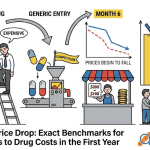
IQVIA’s analysis of infused biosimilars shows average sales price decline of approximately 50% within the first 12 quarters on market [32]. The slope is steeper when multiple biosimilars launch close together. For the brand, cluster launches under settlements are preferable to staggered entries because they reduce the duration of single-biosimilar competition periods that often deliver higher biosimilar margins.
The Patent Thicket Problem and BPCIA Strategy
The Humira and Stelara experiences crystallized a strategic challenge that the BPCIA was not designed to solve: the patent thicket. A biologic with composition-of-matter patents that have expired or are about to expire can still be defended through dozens of secondary patents covering manufacturing processes, formulations, methods of treatment, dosing schedules, and devices. Each patent in the thicket may have weak claims individually, but the cost of clearing all of them through litigation or settlement is the actual barrier to entry.
DrugPatentWatch’s analysis of the thicket strategy in pharmaceutical IP describes the legal mechanics. Brand sponsors use terminal disclaimers to overcome non-statutory double patenting, allowing them to obtain multiple non-patentably distinct patents covering related inventions [33]. Studies of Humira’s portfolio found that approximately 80% of the patents were not patentably distinct from each other but were linked through terminal disclaimers, a structure permitted under USPTO rules.
BPCIA’s Inadequate Response
The dance was designed for a different patent landscape. When the BPCIA was drafted, drafters envisioned a small number of patents per biologic. The reality is that biologic patent counts are roughly nine to twelve times higher in the United States than in Canada or the United Kingdom for the same molecules [34]. The dance’s narrowing function helps, but it does not solve the underlying portfolio problem.
The Seventh Circuit’s ruling in the Humira antitrust cases effectively immunized large patent portfolios from antitrust challenge as long as the patents were legally obtained and the resulting settlements involved licenses rather than reverse payments [35]. That ruling stabilized the legal environment but did not change the economics. Biosimilar developers facing thickets continue to settle on delayed launch dates because litigating through dozens of patents is uneconomic relative to a negotiated outcome.
Resources for Mapping Brand Patent Portfolios
The first task in any biosimilar development decision is mapping the patent estate around the reference product. Resources like DrugPatentWatch provide structured data on patent portfolios, expiration timelines, and litigation history that biosimilar developers use to evaluate whether a target is worth pursuing. The decision of whether to develop a biosimilar at all is increasingly driven by patent landscape analysis, not just market sales potential.
‘Generic and biosimilar medicines saved America’s patients and the U.S. healthcare system $467 billion in 2024, with biosimilar savings alone reaching $20.2 billion that year and $56.2 billion since the first biosimilar entry in 2015. Yet of the 118 biologics expected to lose patent exclusivity from 2025 to 2034 representing a $234 billion savings opportunity, only 12 molecules have biosimilars in active development.’ — Association for Accessible Medicines and IQVIA Institute, 2025 U.S. Generic & Biosimilar Medicines Savings Report [36]
The gap between savings potential and active development pipelines is the structural failure that brand-side patent strategy, regulatory complexity, and uncertain reimbursement dynamics have produced. The dance is one variable in that equation, but it is a variable that biosimilar developers can control.
The Manufacturing Information Disclosure Calculation
The single most consequential element of the dance is the § 262(l)(2)(A) disclosure of manufacturing information. The statute requires the applicant to provide ‘such other information that describes the process or processes used to manufacture the biological product that is the subject of the application.’ The breadth of that requirement is contested, and the practical scope of what gets disclosed varies considerably across cases.
For complex biologics, the manufacturing process is often the most differentiating element of the biosimilar. Producing a monoclonal antibody at commercial scale requires a cell line, expression system, fermentation parameters, harvest protocol, multi-step purification chain, formulation development, fill-finish operations, and analytical characterization at every step. Each of these can be the subject of trade secret protection, and each can be the subject of process patents held by the brand.
The Confidentiality Structure
BPCIA’s confidentiality provisions limit who can see the disclosed information. Under § 262(l)(1), only specifically identified outside counsel and a limited number of in-house representatives can review the information, and only for purposes of evaluating the patent infringement analysis. Information cannot be shared with the RPS’s research, manufacturing, or business teams [37].
The protection is real, but it has limits. Once the dance ends and litigation begins, the information enters the discovery record under court-supervised protective orders. The original BPCIA confidentiality structure remains in effect, but the litigation itself may require broader disclosure depending on the patents asserted. For applicants whose manufacturing process is their core competitive asset, the disclosure cascade is something to model carefully before entering the dance.
What Brand Sponsors Do With Manufacturing Information
RPS use of dance-disclosed manufacturing information for patent infringement analysis is permitted; use for any other purpose is prohibited. Verification of the prohibition is structurally difficult. The information has been transferred into the RPS’s litigation infrastructure, and there is no practical way for the applicant to audit whether the information has influenced the RPS’s own R&D, manufacturing improvements, or patent prosecution decisions.
Some applicants have concluded that the disclosure risk outweighs the procedural benefits. The Sandoz position on Neupogen reflected exactly this calculus. Sandoz had developed filgrastim manufacturing infrastructure that it considered competitively valuable and chose to litigate without the dance’s protections rather than disclose [38].
The Notice of Commercial Marketing
The 180-day notice of commercial marketing under § 262(l)(8)(A) is the trigger for wave two litigation. The notice must be given at least 180 days before the date of first commercial marketing. After Sandoz, the notice can be given before FDA approval, which changes the practical timeline.
The notice does two things. It establishes the date after which the RPS can file wave two litigation on any patent not in the wave one list. It also establishes the window during which the RPS can seek a preliminary injunction to block commercial launch. The 180-day period gives the court time to address validity, infringement, and enforceability before launch.
Pre-Approval Notice Strategy
Giving the 180-day notice before FDA approval can collapse the overall timeline. If the applicant believes FDA approval is six months away, providing the notice now means the 180-day clock runs concurrently with the back end of the FDA review. By the time FDA approves the product, the 180 days has elapsed and the applicant can launch immediately.
The strategy carries risk. The RPS receives the notice and immediately has standing to seek a preliminary injunction. The injunction can issue before the applicant’s product is even approved, which would result in a blocked product that the FDA has not yet declined to license. Courts navigating this configuration have had to address whether the imminence of harm required for a preliminary injunction exists when the product is not yet approved.
The Skinny Label Problem
The 180-day notice also triggers questions about labeling. Biosimilars often launch with labels carved to exclude methods of treatment still covered by brand method patents. The ‘skinny label’ approach, familiar from generic small molecule litigation, has carried over to biosimilars with adjustments for the biologic regulatory framework. The strategy works when the carved-out indication is a small share of total use and when the carve-out can survive induced infringement claims.
For complex biologics with multiple indications, the labeling decision interacts with the patent dance. Methods of treatment listed in the dance establish what the applicant has committed to defending. If the applicant carves an indication out of its label, the related method patents become less relevant. If the applicant pursues a full label, those patents are squarely in the litigation [39].
The PTAB Track and Its Interaction With the Dance
Inter partes review at the PTAB has become a parallel and sometimes superseding venue for biosimilar patent challenges. Filing an IPR does not require BPCIA standing. Petitioners can challenge brand patents in the PTAB before, during, or after the dance, with their own timeline and evidentiary standards.
The PTAB applies a ‘preponderance of the evidence’ standard for invalidity, lower than the ‘clear and convincing evidence’ standard applied in district court. Petitioners with strong prior art frequently prefer the PTAB venue. The biosimilar litigation record shows extensive use of IPRs to invalidate brand patents, sometimes resolving entire blocks of the brand’s portfolio before district court litigation reaches dispositive motions [40].
Sequencing Decisions
The decision of when to file IPRs is closely tied to the dance. Filing IPRs early signals which patents the applicant intends to challenge and may influence the brand’s patent list under § 262(l)(3)(A). Filing later may preserve options. Filing during the dance can complicate the BPCIA negotiation because the parties are simultaneously contesting validity in two venues with different rules.
Estoppel under 35 U.S.C. § 315(e) is the most significant downside. A petitioner who reaches a final written decision in an IPR is estopped from raising in subsequent litigation any ground that could reasonably have been raised in the IPR. The estoppel applies in district court, in the ITC, and in PTO proceedings. Biosimilar developers running IPRs while dancing must coordinate carefully to avoid losing district court arguments through IPR sequencing [41].
Settlements: How the Endgame Actually Works
The vast majority of BPCIA litigation ends in settlement, not adjudication. The Humira and Stelara patterns are typical. The litigation creates leverage that translates into negotiated launch dates, royalty structures, and geographic allocations. Trial is the exception, not the norm.
Settlement structures vary, but several patterns recur. License-based settlements grant the biosimilar a license to launch on a specified date, often with royalty payments back to the brand. Walk-away settlements involve no royalty payment but include launch date commitments. Geographic settlements split markets, with the biosimilar launching earlier in lower-revenue markets and later in higher-revenue markets [42].
The FTC and Antitrust Scrutiny
The FTC has scrutinized biosimilar settlements for reverse payment characteristics under FTC v. Actavis, 570 U.S. 136 (2013). The reverse payment doctrine targets brand-to-generic payments structured to delay generic entry. In the biosimilar context, license-based settlements do not typically include direct cash payments to the biosimilar, which has insulated them from antitrust challenge.
The Seventh Circuit’s Humira ruling rejected plaintiffs’ ‘opportunity cost’ theory that would have treated earlier European entry plus delayed U.S. entry as a disguised reverse payment [43]. The court read Actavis to require an actual payment or its equivalent, not foregone profits in another market. The ruling stabilized the settlement landscape; biosimilar developers and brand sponsors can negotiate geographic splits without significant antitrust risk.
Royalty Structures and Net Economics
Settlement royalty rates vary by product and developer. Reported rates range from low single digits to mid-teens depending on the strength of the brand’s patent position and the negotiating leverage of the parties. The royalty is paid on biosimilar sales after launch, which means the brand continues to benefit from biosimilar sales rather than purely losing share.
For biosimilar developers, the royalty must be modeled into the pricing strategy. A 10% royalty on a biosimilar priced 50% below the brand reference effectively yields the brand a margin on the biosimilar that may exceed the brand’s own incremental margin on additional brand sales. The settlement economics often favor the brand at the margin even when the launch date is meaningfully earlier than patent expiry [44].
The Biosimilar Void: When Development Does Not Happen
The IQVIA Institute’s 2024 analysis of the biosimilar pipeline identified what it called the ‘biosimilar void’: 118 biologics expected to lose patent protection between 2025 and 2034, with only 12 of those molecules having biosimilars in active development [45]. The void is structural and reflects the cumulative effect of patent thickets, regulatory complexity, manufacturing investment requirements, and uncertain reimbursement.
The void’s distribution by therapeutic area is revealing. Of the 118 biologics, 64% have orphan indications, and orphan-only biologics rarely attract biosimilar development because the patient populations are too small to support the development investment [46]. The patent dance, in this context, is a downstream factor. The upstream factor is the underlying economics of biosimilar development for low-revenue indications.
Investment Decisions Pre-Development
Biosimilar developers conducting target selection now incorporate patent landscape analysis at the earliest stages. The patent dance affects the timeline, but the underlying patent count is what determines whether a biosimilar program is viable. A biologic with 100+ U.S. patents in the active enforcement window is a different proposition than one with 10. The first requires substantial litigation and settlement budgeting; the second may not.
Resources that aggregate patent expiration data, litigation history, and biosimilar pipeline information have become standard tooling for biosimilar developers’ target selection. DrugPatentWatch and similar platforms provide the structured data that internal patent landscape analysis is built on. The dance becomes one variable in a much larger commercial analysis that determines whether to invest the $150-300 million needed for biosimilar development in the first place [47].
Process Patents and Manufacturing Defense
One element of the dance that biosimilar applicants often underestimate is the role of manufacturing process patents. Brand sponsors with sophisticated patent estates increasingly hold patents not just on the biologic itself, but on processes for producing the biologic. Cell line patents, expression system patents, purification process patents, and formulation patents all play roles in the dance.
The applicant’s § 262(l)(2)(A) disclosure of manufacturing information feeds directly into the RPS’s evaluation of process patent infringement. The disclosure tells the RPS what the biosimilar applicant is doing, which the RPS then maps against its process patent portfolio. For biosimilar applicants whose manufacturing approach inadvertently overlaps with brand process patents, the disclosure creates a roadmap for infringement claims that might not have been visible otherwise.
Design-Around Strategies
Biosimilar developers with strong patent counsel design their manufacturing around brand process patents from the earliest development stages. The Pavblu/Eylea outcome illustrates the value of this approach: Amgen’s product avoided the buffer claims of Regeneron’s ‘865 patent, which defeated Regeneron’s preliminary injunction motion and allowed Pavblu to launch [48]. The design choice was made years before the dance happened.
Design-around strategies have to balance freedom-to-operate with biosimilarity requirements. The FDA requires biosimilars to be ‘highly similar’ to the reference product in structural and functional characteristics. Major manufacturing changes that affect the product can compromise biosimilarity. The design-around space is therefore narrower for biosimilars than for traditional generic drugs, and the patent-driven design choices have to be made in conjunction with the biosimilarity development plan.
State Law and the Sandoz Remand
The Supreme Court in Sandoz remanded the state-law question to the Federal Circuit. Amgen had argued that California’s unfair competition law could supply an independent remedy for Sandoz’s failure to dance even if federal law did not. The Federal Circuit held on remand that the BPCIA preempts state-law remedies, eliminating state law as a backdoor enforcement mechanism for the dance [49].
The preemption ruling closed an important door. Without state law as a backstop, the brand sponsor’s only remedy for an applicant’s refusal to dance is the federal declaratory judgment action under § 262(l)(9)(C). That remedy is real but limited: it requires the brand to assert patents and prove infringement, without the procedural narrowing benefits of the dance.
The Practical Consequence
The combined effect of Sandoz and the Federal Circuit’s preemption ruling is that biosimilar applicants have full control over whether the dance happens. The brand sponsor has no enforcement mechanism beyond the declaratory judgment action, which itself requires the brand to commit to specific patents and theories before learning what the biosimilar applicant intends to argue. The information asymmetry that the BPCIA was designed to resolve is therefore preserved when the applicant declines to dance.
Some brand sponsors have responded by building patent portfolios specifically optimized for declaratory judgment posture: patents with clear claim language, well-documented infringement evidence, and strong validity records. The portfolio is designed to make the brand effective even when the dance does not happen [50].
Interchangeability’s Effect on Dance Strategy
The FDA’s evolving approach to interchangeability is changing the dance calculus. The 2024 draft guidance moved toward analytical demonstration of interchangeability without requiring dedicated switching studies, which lowers the cost of pursuing interchangeable status and has accelerated approvals [51]. The 2025 ERCI study commissioned by HHS found that automatically designating approved biosimilars as interchangeable would materially increase expected net present value for biosimilar developers.
Interchangeable biosimilars capture market share faster than non-interchangeable biosimilars because pharmacist-level substitution does not require prescriber engagement. Semglee, an insulin glargine biosimilar that received interchangeability designation in 2021, saw market share increase by 3.7 percentage points in Medicaid and 19.25 percentage points in employer-sponsored insurance after coverage improvements coincided with its interchangeability designation [52].
Higher Stakes, Sharper Litigation
Higher expected market share translates into higher at-risk launch damages and higher RPS motivation to enforce. The dance strategy for an interchangeable biosimilar is different from the strategy for a non-interchangeable biosimilar. The RPS will fight harder, settle on later dates, or demand higher royalties. The applicant’s dance approach must account for the elevated stakes.
First-interchangeable exclusivity adds another dimension. The BPCIA grants exclusivity to the first biosimilar to achieve interchangeable status for a given reference product. This creates a race among applicants and can influence dance strategy: the first applicant to file for interchangeability may dance differently than later applicants because the first applicant is racing for exclusivity while later applicants are racing for any launch date at all [53].
BPCIA and the Inflation Reduction Act Interaction
The Inflation Reduction Act’s Medicare drug price negotiation program interacts with biosimilar entry in ways that affect the dance calculus. Under the IRA, biologics selected for negotiation can be removed from the selected list if a biosimilar achieves ‘bona fide marketing’ before specified dates. The mechanism creates an additional commercial incentive for the brand sponsor to delay biosimilar entry and an additional commercial incentive for the biosimilar applicant to launch quickly [54].
For Stelara, CMS made a determination on bona fide marketing of Wezlana that affected the negotiated price’s applicability. The interaction between IRA timing and BPCIA timing has become a live consideration in dance strategy: timing the 180-day notice of commercial marketing now requires modeling not just FDA approval and patent litigation but also CMS price negotiation milestones [55].
Negotiation Dynamics Post-IRA
The IRA changes the brand’s downside if a biosimilar launches. Without IRA negotiation, brand revenue declines through normal biosimilar competition. With IRA negotiation, the brand may face a separately negotiated price that applies even before biosimilar entry, and the negotiation itself is influenced by biosimilar timing. Settlement negotiations between brand and biosimilar are now factoring in the brand’s IRA exposure as well as direct competitive exposure.
The full effects are still working through. The first IRA negotiated prices took effect in 2026, and the interaction patterns with biosimilar timing will become clearer as more biologics enter the negotiation process while facing biosimilar competition simultaneously [56].
How Capital Allocators Think About Dance Risk
Biosimilar development investments run $150-300 million per program, with development timelines of 7-9 years. The patent dance affects launch timing, which affects net present value. Investment committees model the dance as a discrete decision tree with branches for full dance, partial dance, and no dance, each with associated probabilities of various litigation outcomes and settlement structures.
The base case for most high-value biosimilars assumes settlement on the brand’s preferred or near-preferred timeline. The bull case assumes either a litigation victory or a settlement materially earlier than the brand’s preferred timeline. The bear case assumes a delayed settlement that pushes launch close to natural patent expiry. The dance strategy influences the probability distribution across these cases but rarely shifts the base case substantially [57].
Risk-Adjusted Pricing Models
Sophisticated capital allocators apply litigation discount factors to biosimilar program valuations. The discount factor reflects the probability and timing distribution of launch dates, the expected royalty rate if settlement is reached, and the litigation cost itself. Programs with strong dance positions, including clean manufacturing design-arounds and defensible non-infringement positions, receive smaller discounts than programs with weaker positions [58].
Public-market valuations of biosimilar developers reflect these factors. Companies with deep biosimilar pipelines targeting biologics with weaker patent estates trade at premiums to companies targeting biologics with stronger estates. The dance is one component of that calculation, but it is a component that the company can influence through strategy.
Practical Decision Framework for Dance Participation
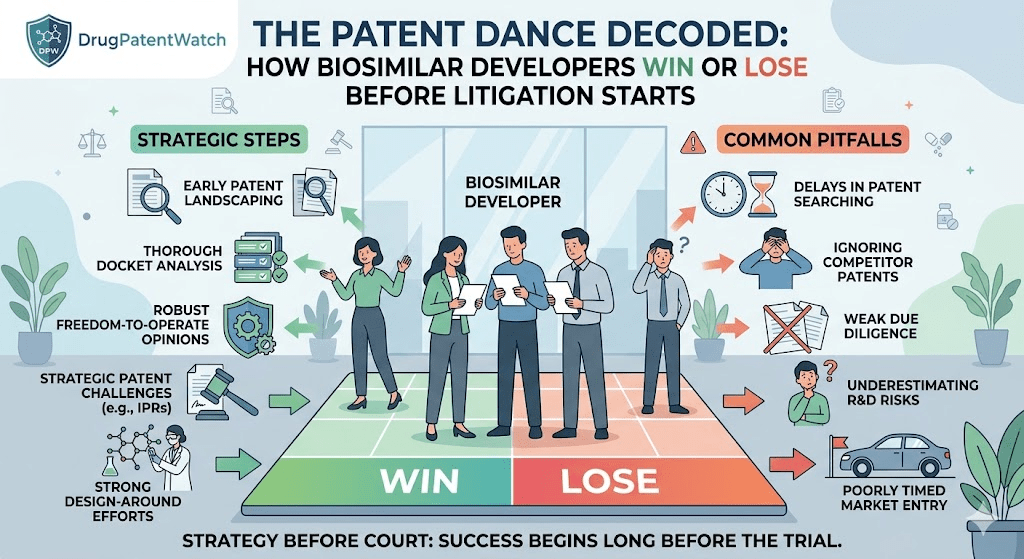
The decision of whether and how much to dance is product-specific. A framework that biosimilar developers have used considers four factors. The first is the brand’s patent estate: depth, breadth, age, and litigation history. Brands with shallow, narrow, or weak estates favor dancing because dance-driven narrowing produces a manageable wave one. Brands with deep, broad, strong estates may favor not dancing because the narrowing benefit is overwhelmed by disclosure costs.
The second factor is the applicant’s manufacturing posture. Applicants whose manufacturing process is highly differentiated and core to competitive positioning are more reluctant to disclose. Applicants whose manufacturing process is conventional and less differentiating are more comfortable disclosing.
The third factor is the applicant’s patent invalidity position. Strong prior art on lead brand patents favors aggressive litigation through IPR plus declaratory judgment, often without dancing. Weaker invalidity positions favor dance-mediated settlement, which provides predictability without requiring litigation victory.
The Fourth Factor: Commercial Timeline
The fourth factor is the applicant’s commercial timeline. Applicants targeting first-to-launch or first-interchangeable status have different optimal strategies than applicants entering a market with multiple biosimilars already settled. First movers often dance to maximize procedural certainty and lock in early launch dates. Later movers may have settlement templates from earlier biosimilars that simplify their analysis.
The factors interact. A weak patent estate combined with a differentiated manufacturing posture and strong invalidity argues against dancing. A strong patent estate combined with conventional manufacturing and weak invalidity argues for dancing. Most real-world configurations fall between these extremes, and the decision becomes a judgment call informed by the specific facts [59].
Litigation Cost and Duration Patterns
BPCIA litigation costs vary widely. First-wave litigation, with a narrowed patent list and pre-defined positions from the dance, can resolve in 18-24 months for $5-15 million in fees. Litigation without the dance, involving more patents and broader discovery, can run 24-36 months for $15-40 million in fees. Cases with multiple biosimilar defendants or with parallel IPRs and antitrust counterclaims can cost more and last longer [60].
The aflibercept MDL is consuming several years and has involved coordinated discovery across six biosimilar defendants. The denosumab consolidated litigation involved similar coordination. The trend toward multi-biosimilar litigation for high-value reference products is increasing the complexity and cost of BPCIA cases.
Expert Witness and Discovery Costs
A significant portion of BPCIA litigation cost goes to expert witnesses. Biologic patent cases typically involve experts on molecular biology, manufacturing processes, formulation chemistry, clinical efficacy, and patent law. Each expert generates report costs, deposition costs, and trial preparation costs. Major BPCIA cases routinely involve dozens of experts.
Discovery in BPCIA litigation is intensive because the underlying technology is complex. Brand sponsors typically have decades of internal documents related to the biologic’s development, manufacturing, and patent prosecution. Biosimilar applicants have their own internal documents on development and manufacturing. The volume of discoverable material is substantial, and document review costs scale accordingly [61].
Future Directions: Legislative and Regulatory Pressure
The patent dance framework is under pressure from multiple directions. Congressional proposals have targeted patent thickets, with several bills considered in recent sessions that would limit terminal disclaimer use, require greater PTO scrutiny of secondary patents, and modify the BPCIA litigation framework. None of these have passed, but the pressure is sustained.
The FTC has expanded its scrutiny of patent listing practices, including in 2023-2025 actions targeting Orange Book listings for combination products. The biologic equivalent of these challenges is developing, with the Purple Book listing system under review. The interaction between patent listing reform and the BPCIA dance is unclear but is being debated [62].
FDA Guidance Evolution
The FDA’s 2024 draft guidance on interchangeability and broader signals about streamlining biosimilar development are changing the regulatory side of the equation. Faster regulatory review and lower development costs would increase the supply of biosimilars and reduce the per-program importance of any single dance decision. The aggregate effect on dance strategy is to make it less critical at the margin and more important as a portfolio-level discipline [63].
What the Dance Looks Like in Practice: A Synthesis
The patent dance as practiced in 2025-2026 is not the dance Congress drafted. It is optional, frequently bypassed, and when conducted, often serves as a structured negotiation framework rather than a path to litigation victory. The dance’s procedural benefits are real but bounded, and the disclosure costs are sometimes prohibitive for applicants with differentiated manufacturing.
The outcomes that matter for biosimilar developers are settlement timing, royalty rates, and product clearance. The dance influences each of these but does not determine any of them. The underlying patent landscape, the applicant’s product design, the brand’s portfolio depth, and the commercial value at stake are the larger forces.
The biosimilar developers who win in this environment are those who treat the dance as one variable in a multi-year strategic plan that begins at molecule selection and runs through commercial launch. The dance is not a moment; it is a phase. Decisions made years before the dance, including manufacturing design, freedom-to-operate analysis, and patent landscape mapping using tools like DrugPatentWatch, often matter more than dance tactics themselves.
Key Takeaways
The BPCIA patent dance is optional after Sandoz, and the applicant controls whether and how much to dance. The choice is product-specific, not company-specific; the same developer may dance on one product and decline on another.
Dancing offers procedural narrowing, timing predictability, and damages limitations under 35 U.S.C. § 271(e)(6)(B). It costs trade secret exposure through § 262(l)(2)(A) manufacturing disclosures.
The Humira and Stelara experiences show that most BPCIA litigation ends in settlement. The settlement structures cluster around license-plus-royalty arrangements with negotiated launch dates that often delay U.S. entry relative to ex-U.S. launches.
The aflibercept litigation demonstrates current BPCIA practice: multiple parallel actions, MDL consolidation, preliminary injunctions on formulation patents, and late-issuing patents creating new litigation rounds after launch.
Interchangeability designation increases biosimilar market share velocity and elevates the stakes of dance strategy. The 2024 FDA draft guidance has accelerated interchangeability approvals, with 19 of 26 interchangeable designations issued between January 2024 and September 2025.
The 118 biologics losing patent protection from 2025 to 2034 represent $234 billion in potential savings, but only 12 have active biosimilar development. Patent thickets, manufacturing complexity, and orphan indication concentration are the main barriers to closing that gap.
The PTAB IPR track runs parallel to the BPCIA dance and is used aggressively by biosimilar developers to attack brand patents at lower evidentiary standards. Sequencing IPRs with dance disclosures requires careful coordination to manage estoppel risk under 35 U.S.C. § 315(e).
Brand sponsors have responded to Sandoz by building patent portfolios optimized for declaratory judgment posture, with clear claim language and robust validity records. The portfolio strategy works whether or not the applicant chooses to dance.
Frequently Asked Questions
If the patent dance is optional, why do any biosimilar applicants participate?
Three reasons. First, dancing locks in a damages limitation under 35 U.S.C. § 271(e)(6)(B), capping the brand’s recovery at a reasonable royalty for listed patents the brand fails to sue on within the BPCIA’s timeline. Second, dancing narrows the patents the brand can assert in wave one to the negotiated list, which can shrink a 100-patent portfolio to a manageable handful. Third, dancing creates timing predictability that supports commercial planning, supply chain commitments, and capital allocation. Applicants without these needs, or applicants with manufacturing trade secrets they cannot risk disclosing, often choose to skip.
How do biosimilar developers map a brand’s patent portfolio before deciding whether to dance?
Patent landscape analysis starts well before the aBLA is submitted. Developers use commercial databases, including DrugPatentWatch, the FDA Purple Book, USPTO records, and litigation tracking services to identify every patent the brand has asserted or could plausibly assert. The analysis evaluates claim scope, prosecution history, terminal disclaimer relationships, family connections, and prior art positions. The output is a patent risk map that informs both the manufacturing design and the dance decision. Companies that skip this analysis make dance decisions blind, which is rarely successful.
What happens to a biosimilar developer that misses a BPCIA deadline mid-dance?
Missing a deadline has consequences but is not catastrophic. If the applicant fails to make the § 262(l)(2)(A) disclosure, the brand can immediately file a declaratory judgment action. If the applicant misses the § 262(l)(3)(B) response deadline, the brand’s contention controls and the negotiating leverage shifts. If the applicant misses later deadlines, similar shifts apply. The applicant loses procedural protections incrementally rather than all at once. Strategically, this means that applicants who choose to dance partially can do so by selectively missing deadlines, though the practice creates complications that are hard to manage in real-time.
How do settlements with multiple biosimilar developers get coordinated?
They typically do not get coordinated formally. Each biosimilar developer settles bilaterally with the brand, and the settlement terms are confidential. The brand structures the settlements to produce a desired pattern of cluster launches that limits any single biosimilar’s first-mover advantage. Antitrust concerns about market allocation are managed by structuring the agreements as licenses rather than reverse payments, which the Seventh Circuit’s Humira ruling endorsed as legitimate. Developers often learn the launch dates of competitors only when those dates become public through filings or announcements.
Does the patent dance work the same way for interchangeable biosimilars?
The procedural mechanics are identical. The commercial stakes are different. Interchangeable biosimilars capture market share faster because pharmacists can substitute without prescriber engagement, which means brand revenue at risk is greater and brand willingness to settle on early launch dates is lower. The dance strategy for interchangeable biosimilars therefore tends toward more aggressive litigation posture, including more IPR filings, more invalidity arguments, and tighter manufacturing design-arounds. The first-interchangeable exclusivity provision under the BPCIA adds a race element: the first applicant to secure interchangeability gets a year of exclusivity, which influences dance strategy for early movers in a way it does not influence later movers.
References
Association for Accessible Medicines. (2025). 2025 U.S. Generic & Biosimilar Medicines Savings Report. Retrieved from https://accessiblemeds.org/resources/blog/2025-savings-report/
DrugPatentWatch. (2026). Mastering the dance: A strategic guide to the BPCIA biosimilar patent timeline and litigation. Retrieved from https://www.drugpatentwatch.com/blog/mastering-the-dance-a-strategic-guide-to-the-bpcia-biosimilar-patent-timeline-and-litigation/
DrugPatentWatch. (2025). Biosimilar patent dance: Leveraging PTAB challenges for strategic advantage. Retrieved from https://www.drugpatentwatch.com/blog/biosimilar-patent-dance-leveraging-ptab-challenges-for-strategic-advantage/
Fish & Richardson. (2020). How biosimilars are approved and litigated: Patent dance timeline. Retrieved from https://www.fr.com/insights/ip-law-essentials/how-biosimilars-approved-litigated-patent-dance-timeline/
Sandoz Inc. v. Amgen Inc., 137 S. Ct. 1664 (2017).
Mintz. (2017). Amgen v. Sandoz: The Supreme Court’s first biosimilars ruling. Retrieved from https://www.mintz.com/insights-center/viewpoints/2017-06-14-amgen-v-sandoz-supreme-courts-first-biosimilars-ruling
National Law Review. (2017). Sandoz v. Amgen – Biosimilars at the U.S. Supreme Court. Retrieved from https://natlawreview.com/article/sandoz-v-amgen-biosimilars-us-supreme-court
DrugPatentWatch. (2026). Mastering the dance: A strategic guide to the BPCIA biosimilar patent timeline and litigation.
Finnegan. (2018). The patent dance. Retrieved from https://www.finnegan.com/en/insights/articles/the-patent-dance-article.html
35 U.S.C. § 271(e)(6)(B).
Amgen Inc. v. Hospira, Inc., 944 F.3d 1327 (Fed. Cir. 2019).
Silverman, E. (2018, November 7). Behind the patent thicket: Tactics AbbVie allegedly used to thwart biosimilar versions of Humira. STAT News. Retrieved from https://www.statnews.com/pharmalot/2018/11/07/abbvie-biosimilars-humira-patents/
Association for Accessible Medicines. (2025). Patent settlements are necessary to help combat patent thickets. Retrieved from https://accessiblemeds.org/resources/blog/patent-settlements-are-necessary-to-help-combat-patent-thickets/
BioPharma Dive. (2019, May 14). With Boehringer settlement, AbbVie completes Humira sweep. Retrieved from https://www.biopharmadive.com/news/abbvie-boehringer-ingelheim-settle-humira-patent-biosimilar/554729/
Price, W. N., & Rai, A. K. (2022). Biological patent thickets and delayed access to biosimilars, an American problem. Journal of Law and the Biosciences. Retrieved from https://pmc.ncbi.nlm.nih.gov/articles/PMC9439849/
DrugPatentWatch. (2025). The thicket maze: A strategic guide to navigating and dismantling drug patent fortresses. Retrieved from https://www.drugpatentwatch.com/blog/the-thicket-maze-a-strategic-guide-to-navigating-and-dismantling-drug-patent-fortresses/
Association for Accessible Medicines. (2025). Patent settlements are necessary to help combat patent thickets.
BioSpace. (2023). Amgen, J&J settle patent dispute over Stelara biosimilar. Retrieved from https://www.biospace.com/amgen-j-and-j-settle-patent-dispute-over-stelara-biosimilar
Fierce Pharma. (2023). After patent settlement, Amgen scores FDA nod for its biosimilar version of J&J’s Stelara. Retrieved from https://www.fiercepharma.com/pharma/amgen-scores-fda-nod-its-biosimilar-version-johnson-johnsons-stelara
The Center for Biosimilars. (2025). Welcome Wezlana: The first Stelara biosimilar to launch in the US. Retrieved from https://www.centerforbiosimilars.com/view/welcome-wezlana-the-first-stelara-biosimilar-to-launch-in-the-us
Springer Nature. (2025). Regulatory requirements for interchangeable biosimilar designation. Therapeutic Innovation & Regulatory Science. Retrieved from https://link.springer.com/article/10.1007/s43441-025-00897-6
DrugPatentWatch. (2026). Mastering the dance: A strategic guide to the BPCIA biosimilar patent timeline and litigation.
Big Molecule Watch. (2025). Regeneron files another complaint against Amgen in aflibercept BPCIA litigation. Retrieved from https://www.bigmoleculewatch.com/2025/06/20/regeneron-files-another-complaint-against-amgen-in-aflibercept-bpcia-litigation/
Loeb & Loeb. (2025). The landscape of Regeneron’s Eylea litigation after the Federal Circuit affirmed two preliminary injunction orders blocking biosimilar market entry. Retrieved from https://quicktakes.loeb.com/post/102k069/the-landscape-of-regenerons-eylea-litigation-after-the-federal-circuit-affirmed
Loeb & Loeb. (2025). The landscape of Regeneron’s Eylea litigation.
Pearce IP. (2025). Regeneron files new US BPCIA complaint against Amgen for Pavblu, Eylea biosimilar. Retrieved from https://www.pearceip.law/2025/06/17/regeneron-files-new-us-bpcia-complaint-against-amgen-for-pavblu-eylea-biosimilar/
Goodwin. (2025). Amgen fires back with counterclaims in aflibercept BPCIA litigation. Retrieved from https://www.goodwinlaw.com/en/insights/blogs/2025/09/amgen-fires-back-with-counterclaims-in-aflibercept-bpcia-litigation
Big Molecule Watch. (2026). BPCIA litigations. Retrieved from https://www.bigmoleculewatch.com/bpcia-patent-litigations/
Pharmacy Times. (2026). A pharmacist’s guide to blockbuster patent expirations: 2025 and beyond. Retrieved from https://www.pharmacytimes.com/view/a-pharmacist-s-guide-to-blockbuster-patent-expirations-2025-and-beyond
IQVIA Institute. (2024). Long-term market sustainability for infused biosimilars in the U.S. Retrieved from https://www.iqvia.com/insights/the-iqvia-institute/reports-and-publications/reports/long-term-market-sustainability-for-infused-biosimilars-in-the-us
DrugPatentWatch. (2025). The thicket maze: A strategic guide to navigating and dismantling drug patent fortresses.
Price, W. N., & Rai, A. K. (2022). Biological patent thickets and delayed access to biosimilars, an American problem.
DrugPatentWatch. (2025). The thicket maze: A strategic guide.
Association for Accessible Medicines & Biosimilars Council. (2025). Generic and biosimilar medicines save $467 billion in 2024. Retrieved from https://biosimilarscouncil.org/news/generic-and-biosimilar-medicines-save-467-billion-in-2024/
42 U.S.C. § 262(l)(1).
Health Affairs. (2017). Manufacturers of biosimilar drugs sit out the ‘patent dance’. Retrieved from https://www.healthaffairs.org/content/forefront/manufacturers-biosimilar-drugs-sit-out-patent-dance
Biosimilar Development. (2018). Shall we (patent) dance? Key considerations for biosimilar applicants. Retrieved from https://www.biosimilardevelopment.com/doc/shall-we-patent-dance-key-considerations-for-biosimilar-applicants-0001
IQVIA Institute. (2024). The impact of biosimilar competition in Europe 2024. Retrieved from https://www.iqvia.com/library/white-papers/the-impact-of-biosimilar-competition-in-europe-2024
DrugPatentWatch. (2025). The thicket maze.
IQVIA Institute. (2024). Long-term market sustainability for infused biosimilars in the U.S.
IQVIA Institute. (2024). Assessing the biosimilar void in the U.S. Retrieved from https://www.iqvia.com/insights/the-iqvia-institute/reports-and-publications/reports/assessing-the-biosimilar-void-in-the-us
IQVIA Institute. (2024). Assessing the biosimilar void in the U.S.
IQVIA Institute. (2024). Impact of biosimilar competition report 2024. Retrieved from https://health.ec.europa.eu/document/download/ea8d61fa-be26-4bd9-8b82-fd4d42d19dc6_en
Loeb & Loeb. (2025). The landscape of Regeneron’s Eylea litigation.
NYU Journal of Intellectual Property & Entertainment Law. (2020). Does it still take two to tango? A modern interpretation of the BPCIA’s patent dance. Retrieved from https://jipel.law.nyu.edu/vol-9-no-1-4-li/
Finnegan. (2018). The patent dance.
Jones Day. (2025). FDA’s biosimilar playbook: Merging biosimilarity with interchangeability. Retrieved from https://www.jonesday.com/en/insights/2025/12/fda-biosimilar-playbook-merging-biosimilarity-with-interchangeability
Kakani, P., Katcher, B. A., & Maini, L. (2025). Improved insurance coverage increased biosimilar Semglee’s market share after the FDA’s interchangeability designation. Health Affairs, 44(11), 1417-1425.
DrugPatentWatch. (2026). Mastering the dance.
Big Molecule Watch. (2023). FDA approves Amgen’s Wezlana as biosimilar to and interchangeable with Janssen’s Stelara. Retrieved from https://www.bigmoleculewatch.com/2023/11/06/fda-approves-amgens-wezlana-as-biosimilar-to-and-interchangeable-with-janssens-stelara-ustekinumab/
Big Molecule Watch. (2023). FDA approves Amgen’s Wezlana.
Jones Day. (2025). FDA’s biosimilar playbook.
IQVIA Institute. (2024). Assessing the biosimilar void in the U.S.
IQVIA Institute. (2024). Long-term market sustainability for infused biosimilars in the U.S.
Biosimilar Development. (2018). Shall we (patent) dance?
The Center for Biosimilars. (2017). The uncertainty of BPCIA litigation strategies and the ‘patent dance’. Retrieved from https://www.centerforbiosimilars.com/view/the-uncertainty-of-bpcia-litigation-strategies-and-the-patent-dance
Goodwin. (2024). Updates on aflibercept biosimilar approvals and BPCIA litigation. Retrieved from https://www.goodwinlaw.com/en/insights/blogs/2024/06/updates-on-aflibercept-biosimilar-approvals-and-bpcia-litigation
Federal Trade Commission. (2024). Statements on patent listing practices.