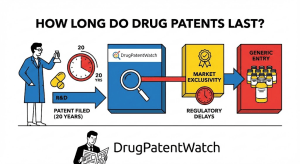
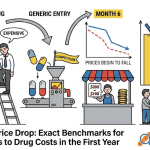
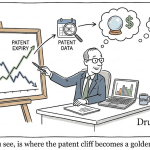
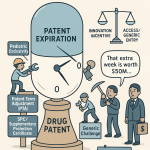
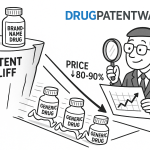
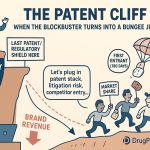
In the pharmaceutical sector, time is a tangible asset with a valuation that often exceeds the capitalization of mid-sized technology firms. For a blockbuster drug—defined traditionally as generating $1 billion annually, though modern blockbusters often exceed $10 billion—the arithmetic of exclusivity is unforgiving. A single day of market exclusivity for a product generating $3 billion in annual revenue is worth approximately $8.2 million.1 Conversely, the arrival of generic competition does not result in a gradual erosion of market share; it precipitates a collapse. Revenue typically plummets by 80 percent to 90 percent within the first year of generic entry, a phenomenon the industry refers to as the “patent cliff”.2
This financial singularity drives the strategic behavior of the entire sector. The average cost to bring a new molecular entity (NME) to market ranges from $2.2 billion to $2.6 billion, a figure that accounts for the high attrition rate of clinical candidates.4 While returns on research and development (R&D) have shown signs of recovery—rebounding to 5.9 percent in 2024 from a nadir of 1.2 percent in 2022—the window to recoup this investment is structurally compressed.6 Although a patent grants a 20-year monopoly, the effective commercial life of a drug is often fewer than 10 years due to the decade-long regulatory review process that consumes the patent term before the first sale is ever made.7
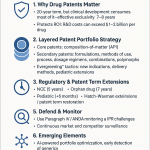
Consequently, the management of intellectual property (IP) cannot be relegated to the legal department. It is a core function of corporate strategy, requiring the synchronization of R&D, regulatory affairs, and commercial teams. This report analyzes the mechanisms available to innovators to restore lost time and fortify their market position. We examine the statutory levers of Patent Term Extension (PTE), the construction of “patent thickets” through secondary filings, the divergent pathways for biologics under the Biologics Price Competition and Innovation Act (BPCIA), and the utilization of competitive intelligence platforms like DrugPatentWatch to navigate an increasingly hostile regulatory environment.
Statutory Restoration: The Mechanics of Patent Term Extension
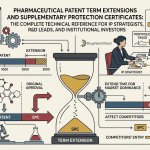
The Drug Price Competition and Patent Term Restoration Act of 1984, commonly known as Hatch-Waxman, established the fundamental compromise of the modern US pharmaceutical market: innovators receive an extension of their patent term to compensate for FDA review delays, while generics receive a streamlined approval pathway (the Abbreviated New Drug Application, or ANDA).8 Mastering the calculation of this extension is the first line of defense against premature loss of exclusivity (LOE).
The Calculus of Restoration
Patent Term Extension (PTE) is not a discretionary grant; it is a calculated entitlement derived from the regulatory timeline. The statute divides the regulatory review into two distinct phases: the “Testing Period” and the “Approval Period”.10
Testing Period: Begins on the effective date of the Investigational New Drug (IND) application and ends on the date the New Drug Application (NDA) or Biologics License Application (BLA) is submitted.
Approval Period: Begins on the date of NDA/BLA submission and ends on the date of FDA approval.
Crucially, the law allows for the recovery of 100 percent of the Approval Period but only 50 percent of the Testing Period.10 This weighting incentivizes rapid clinical development while compensating fully for bureaucratic delays at the FDA.
The Three Statutory Constraints
The calculated extension is subject to three rigid caps that frequently reduce the actual days restored. Strategists must model these constraints years in advance.
The Five-Year Cap: The maximum extension granted to any patent is five years. Regardless of how long the regulatory delay was, the restoration cannot exceed this ceiling.8
The Fourteen-Year Cap: This is often the most restrictive constraint for modern drugs. The statute dictates that the total remaining patent term plus the granted extension cannot exceed 14 years from the date of FDA approval.8
Example: If a drug is approved and the primary patent still has 12 years of life remaining, the maximum PTE granted will be 2 years (12 + 2 = 14), even if the formula yields 5 years.
Strategic Implication: Speed to market can paradoxically reduce the PTE benefit. Drugs with long, arduous clinical trials (leaving little original patent term) benefit most from PTE, provided they do not breach the 5-year limit.
Original Term Limitation: The extension extends the original expiration date. It does not create a new patent term from scratch but appends time to the existing grant.13
Table 1: Impact of Statutory Caps on Theoretical Scenarios
Scenario
Original Term Remaining at Approval
Calculated Formula PTE
5-Year Cap Applied
14-Year Cap Applied
Final PTE Granted
Rapid Approval
13 Years
3 Years
3 Years
1 Year (13+1=14)
1 Year
Standard Delays
9 Years
4 Years
4 Years
5 Years (9+5=14)
4 Years
Extended Review
4 Years
6 Years
5 Years
10 Years (4+10=14)
5 Years
Strategic Eligibility Nuances
The application of PTE is fraught with technical pitfalls.
One Patent Per Product: An innovator can extend only one patent for a specific regulatory review period.8 This forces a critical choice: extend the composition-of-matter patent (the strongest shield) or a method-of-use patent (which might have a later natural expiration). Usually, the composition patent is preferred due to its broad exclusionary power.
First Commercial Marketing: PTE is available only for the first commercial marketing of the active ingredient.8 This provision blocks “evergreening” via minor modifications. If the active moiety (or a salt/ester thereof) has been approved previously, the new product is generally ineligible for PTE, even if it targets a novel indication or uses a new formulation.
Deadline Discipline: The application must be filed within 60 days of FDA approval.8 Missing this deadline is fatal to the extension, a clerical error that can cost billions.
The Regulatory Shield: Non-Patent Exclusivities
Distinct from patent rights, regulatory exclusivities are statutory monopolies granted directly by the FDA. They run concurrently with patents but are independent of them—meaning they remain in force even if the underlying patents are invalidated in court.15 For strategists, these serve as a redundant safety net.
The Hierarchy of Exclusivity
Orphan Drug Exclusivity (ODE):
Duration: 7 years.
Scope: Granted for drugs treating rare diseases (fewer than 200,000 patients in the US). It bars the FDA from approving the “same drug” for the “same indication”.17
The “Same Drug” Nuance: For small molecules, “sameness” is defined by chemical structure. For macromolecules (biologics), the FDA’s interpretation is stricter. Minor differences in amino acid sequence or post-translational modifications may not be sufficient to bypass ODE, giving biologics a robust shield against “bio-betters” during this period.18
Carve-Outs: ODE is indication-specific. A generic can launch for a non-orphan indication of the same drug, provided they “carve out” the protected orphan use from their label.17
New Chemical Entity (NCE) Exclusivity:
Duration: 5 years.
Mechanism: This is a “data exclusivity” shield. It prohibits the FDA from even accepting an ANDA filing for 5 years.15
The NCE-1 Exception: If a generic applicant files a Paragraph IV certification (challenging the patents), they may submit their ANDA after 4 years (the “NCE-1” date).15 This effectively triggers the patent litigation process one year early.
New Clinical Investigation (NCI) Exclusivity:
Duration: 3 years.
Scope: Granted for changes to approved drugs (new dosage forms, new regimens, new indications) that required new clinical trials. It blocks approval of generics for that specific change but does not block the original product.9
Pediatric Exclusivity:
Duration: +6 months.
Mechanism: This is not a standalone period; it attaches to all existing patents and regulatory exclusivities.17 If a sponsor conducts requested pediatric studies, every patent and exclusivity listed in the Orange Book gets an additional six months.
ROI: On a blockbuster drug, this six-month add-on can be worth billions.
Constructing the Fortress: Secondary Patent Strategies
When the primary composition-of-matter patent approaches expiration, the defense shifts to the “patent thicket”—a dense portfolio of secondary patents covering formulations, manufacturing processes, polymorphs, and devices. The goal is to create a “thicket” so dense that a challenger cannot clear it without prohibitive time and expense.19
The Humira Archetype
AbbVie’s management of Humira (adalimumab) serves as the definitive case study for this strategy. The primary patent for Humira expired in 2016. Yet, biosimilars did not enter the US market until 2023. This seven-year extension generated approximately $75 billion in additional US revenue.20
The Layers of the Fortress:
Polymorph Patents: AbbVie patented specific crystalline forms of the antibody. While the active ingredient is the same, different crystal structures (polymorphs) can have different stability or solubility profiles. Patents on these forms can extend exclusivity if the generic cannot replicate the drug without producing the patented polymorph.21
Formulation Patents: Patents covering the liquid buffer system, pH stabilizers, and excipients used in the injection. These are often filed years after the original drug, adding 6.5 years of patent life on average.23
Method of Use Patents: Patents covering the treatment of specific conditions (e.g., Crohn’s disease vs. Rheumatoid Arthritis) or specific dosing regimens (e.g., every two weeks).22
Manufacturing Process Patents: Covering the temperature, cell culture media, and purification steps. Since biologics are defined by their process, these are exceptionally difficult to design around.
The Settlement Endgame:
The sheer volume of patents—AbbVie asserted 61 patents against Amgen alone—creates a “litigation attrition” model. Even if many patents are weak, the cost to litigate them all is prohibitive for the challenger.19 Consequently, every major biosimilar competitor (Amgen, Sandoz, Samsung Bioepis) chose to settle, accepting a licensed entry date of 2023.
Vulnerabilities: The “Skinny Label”
The primary threat to secondary patents, particularly method-of-use patents, is the “skinny label” (Section viii carve-out). A generic can seek approval for the drug’s unpatented indications (e.g., the original use) while “carving out” the patented new use from their label.25
However, the legal viability of this strategy is currently volatile.
GSK v. Teva (2022): The Federal Circuit ruled that even with a skinny label, a generic could be liable for “induced infringement” if its marketing materials or press releases implied the drug was equivalent to the brand for all uses. Teva’s press release describing its product as an “AB-rated generic equivalent” (without qualification) was cited as evidence of inducement.26
Amarin v. Hikma (2024): This case further tightened the noose. The court found that Hikma’s public statements—citing the total sales revenue of the branded drug Vascepa (which included the patented cardiovascular indication) as the market opportunity—could induce doctors to prescribe the generic for the protected use.28
Strategic Implication: Brand companies must rigorously monitor generic competitors’ investor presentations and press releases. Any claim of “full equivalence” or reference to the total market size (including protected indications) is now potential ammunition for an induced infringement lawsuit.
The Biologic Paradigm: BPCIA and the “Patent Dance”
Biologics represent the future of the industry’s revenue, and their IP defense is governed by the Biologics Price Competition and Innovation Act (BPCIA), which differs fundamentally from the Hatch-Waxman rules for small molecules.
The “Patent Dance”
Unlike the “artificial infringement” trigger of an ANDA filing, the BPCIA mandates a phased information exchange known as the “patent dance.”
Disclosure: The biosimilar applicant provides their application and manufacturing information to the Reference Product Sponsor (RPS).
Exchange: The parties exchange lists of patents they believe are infringed or invalid.
Litigation: This process determines which patents will be litigated immediately and which will be litigated later (upon notice of commercial marketing).
Key Differences:
No Automatic Stay: Unlike Hatch-Waxman, which grants a 30-month stay of FDA approval upon the filing of a lawsuit, the BPCIA has no automatic stay.30 This seemingly favors the biosimilar, but the risk of launching “at risk” (and facing treble damages) usually deters entry until litigation is resolved.
Manufacturing Patents: The Orange Book does not list manufacturing process patents. The BPCIA process, however, forces the disclosure of these patents. Given the complexity of biologic manufacturing, these patents are often the strongest component of a biologic’s defense.32
The End of Interchangeability?
A significant shift occurred in 2024/2025 regarding “Interchangeability.” Previously, biosimilars had to undergo additional switching studies to be deemed “interchangeable” (allowing automatic substitution at the pharmacy counter).
Policy Shift: The FDA has moved to eliminate the separate interchangeability designation, arguing that modern analytical science proves that all approved biosimilars are safe to switch.33
Impact: This lowers the barrier to entry for biosimilars. Brands can no longer rely on the “not interchangeable” status to protect market share. Defense must pivot to device differentiation (e.g., easier-to-use injectors) and competitive pricing contracts.
Regulatory Headwinds: The IRA and FTC
The strategic environment is being reshaped by aggressive regulatory intervention.
The Inflation Reduction Act (IRA)
The IRA empowers Medicare to negotiate prices for top-spending drugs. This effectively creates a new LOE event—a “statutory cliff”—that operates independently of patents.
Small Molecules: Negotiable 7 years after approval.
Biologics: Negotiable 11 years after approval.
This 4-year disparity is termed the “Small Molecule Penalty.” It fundamentally alters investment incentives. Why invest $2 billion in a small molecule with a 7-year protected window when a biologic gets 11 years?
Indication Sequencing: Historically, companies launched drugs in niche indications and expanded to broader ones. The IRA’s clock starts at the first approval. This encourages “indication stacking”—launching in the largest possible indication first to maximize revenue before the 7-year clock runs out.35
R&D Flight: There is evidence of capital shifting away from small molecule oncology programs (which often rely on post-approval indication expansion) toward biologics.36
FTC Orange Book Scrutiny
The Federal Trade Commission has launched a crackdown on “improper” Orange Book listings.
Target: Device patents (e.g., inhaler mechanics) and REMS patents that do not explicitly claim the drug or its method of use.38
Action: In 2024 and 2025, the FTC challenged over 300 patent listings, arguing they delay generic competition illegally.39
Risk: Listing a marginal patent is no longer a “no-lose” tactic. It invites antitrust scrutiny and potential delisting, which removes the 30-month stay protection.
Operationalizing Intelligence: The Role of DrugPatentWatch
In this labyrinthine environment, static data is a liability. Platforms like DrugPatentWatch provide the real-time intelligence necessary to navigate global IP landscapes.
Strategic Workflows
Predicting Paragraph IV Challenges: By tracking the “NCE-1” date (4 years post-approval), companies can predict exactly when generic challengers will file. DrugPatentWatch integrates these regulatory dates with patent expiration data to forecast litigation triggers.15
Pipeline Espionage: Analyzing a competitor’s patent applications reveals their R&D focus years before clinical trials surface. A flurry of formulation patents indicates a defensive lifecycle management play; a new composition patent signals a next-generation asset.41
White Space Analysis: For 505(b)(2) developers, identifying gaps in patent coverage (indications not claimed by use codes) is critical. DrugPatentWatch allows users to search by “use code” to find unpatented therapeutic niches.42
Global Family Tracking: Unlike the US-centric Orange Book, DrugPatentWatch tracks global patent families. This is vital for assessing risks in jurisdictions like the EU (where manufacturing waivers apply) or Japan (where term extensions are more generous).44
Table 2: Comparative Utility of Data Sources
Feature
FDA Orange Book
FDA Purple Book
DrugPatentWatch
Scope
US Small Molecules
US Biologics
Global (US, EU, Asia)
Patents Listed
Drug, Use, Formulation
Drug, Use (Limited)
All (incl. Manufacturing/Process)
Manufacturing Patents
No
No (unless litigated)
Yes
Litigation Status
No
No
Yes (P-IV filings, Cases)
Expire Date
Yes
Yes
Yes (Calculated + Extensions)
Source: 32
Global Strategic Variance
IP strategy cannot be uniform; it must adapt to the specific incentives of major markets.
Japan: The Innovator’s Paradise?
Japan offers a significantly more favorable environment for PTE than the US or EU.
Multiple Extensions: While the US allows only one patent to be extended per product, Japan allows multiple patents to be extended for the same product.14
No Total Cap: Japan does not impose the 14-year total exclusivity cap found in the US.
New Uses: Japan grants extensions for new indications of existing drugs, incentivizing lifecycle R&D that the US system penalizes.14
European Union: The Manufacturing Waiver
The EU’s Supplementary Protection Certificate (SPC) extends protection by up to 5 years. However, the recent “Manufacturing Waiver” (Regulation 2019/933) allows generics to manufacture drugs within the EU during the SPC period for the purpose of export to non-EU markets.47 This erodes the global value of the EU exclusivity, as it allows competitors to stockpile and launch immediately upon expiry (“Day 1 launch”).
Financial Modeling: The Economics of Defense
The decision to litigate or settle is governed by the asymmetry of stakes.
Innovator Stake: The average brand firm defends $4.3 billion in revenue.
Generic Stake: The average generic challenger fights for $204.3 million in profit.49
This disparity creates a strong incentive for settlement. Even a “strong” patent might be settled to avoid the catastrophic 2% risk of a generic win at trial.50 The cost of litigation—often running into millions—is negligible compared to the daily revenue of the drug ($8.2 million/day). Thus, litigation budgets are effectively unlimited for blockbusters; the constraint is not cost, but risk management.
Secondary Patents (delayed entry by 2 years): Worth $2 billion.
The return on investment for legal and regulatory maneuvering dwarfs that of R&D. A $10 million legal strategy that secures 6 months of exclusivity yields a 50x return.
Key Takeaways
The 14-Year Hard Stop: Regardless of the length of FDA review, Patent Term Extension (PTE) in the US cannot extend the effective patent life beyond 14 years post-approval. Strategic planning must account for this ceiling; rapid approval can paradoxically reduce the extension benefit.
The Biologic Advantage: Between the IRA’s 11-year negotiation buffer and the difficulty of “skinny labeling” complex biologics, large molecules offer a structurally superior defensive position compared to small molecules.
The Thicket is Essential but Fragile: Secondary patents (formulation, polymorph) are the primary tool for extending life beyond 14 years. However, they are increasingly vulnerable to “skinny label” carve-outs and FTC antitrust actions against “improper” listings.
Global Asymmetry: IP rights are not consistent. Innovators should maximize extensions in Japan (where caps are loose) while preparing for earlier manufacturing competition in Europe due to the SPC waiver.
Intelligence is Defense: Using tools like DrugPatentWatch to monitor the “NCE-1” date and global patent families is essential to anticipate the precise timing of generic challenges and to identify “white space” for lifecycle extension.
FAQ: Strategic Nuances
Q1: How has the GSK v. Teva ruling altered the risk profile for generic “skinny labels”?
A1: The GSK v. Teva decision fundamentally increased the risk for generics attempting to use Section viii carve-outs. The court ruled that even if a generic label omits a patented indication (“skinny label”), the manufacturer can still be liable for “induced infringement” if their marketing materials, press releases, or even past regulatory statements imply that the generic is fully substitutable for the brand drug. This empowers brand companies to litigate based on the generic’s commercial behavior rather than just their label text.25
Q2: Why does the Inflation Reduction Act (IRA) create a “penalty” for small molecule drugs?
A2: The IRA makes small molecule drugs eligible for Medicare price negotiation 7 years after approval, whereas biologics are protected for 11 years. This 4-year difference creates a massive financial disparity. It disincentivizes investment in small molecules, particularly for indications that require long-term post-approval research (like early-stage cancer), because the revenue window is cut short before those secondary indications can pay off. Companies are pivoting toward biologics to capture the longer protected term.36
Q3: What is the “Patent Dance” and how does it differ from standard patent litigation?
A3: The “Patent Dance” is the unique litigation process for biologics under the BPCIA. Unlike small molecule litigation, which starts with a public notice (Paragraph IV), the “dance” is a private, phased exchange of patent lists and contentions between the biosimilar and the brand. It forces the disclosure of manufacturing patents (which aren’t in the Orange Book) and does not provide an automatic 30-month stay of FDA approval. This structure creates high uncertainty and often forces settlements.30
Q4: Can Patent Term Extension (PTE) be applied to a new formulation of an old drug?
A4: Generally, no. PTE is reserved for the first commercial marketing of an active ingredient. If the active moiety (or a salt/ester of it) has been approved previously, a new formulation, dosage form, or combination product containing that moiety is typically ineligible for PTE. This strict “first approval” rule is designed to prevent infinite evergreening of the same molecule.8
Q5: Why is the FTC targeting “improper” Orange Book listings?
A5: The FTC argues that pharmaceutical companies are listing patents in the Orange Book that do not meet the statutory criteria—specifically patents that cover only a device (like an inhaler part) or a REMS distribution system, rather than the drug itself. By listing these patents, brands trigger an automatic 30-month stay of generic approval if sued. The FTC views this as an illegal anticompetitive tactic to delay generics and has begun issuing warning letters and challenging these listings to force their removal.38