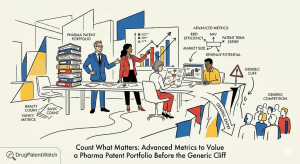
A patent that has been cited 400 times sounds impressive. An IP manager can drop that number in a board presentation, watch eyes widen across the table, and spend the next twenty minutes answering questions about licensing potential. The number is real. What it means for the actual dollar value of the portfolio is another matter entirely.
Citation counts – both forward citations a patent receives from later filings, and backward citations it makes to prior art – have been the go-to proxy for patent quality since the landmark work of Trajtenberg in 1990 [1], when he demonstrated that patents for more socially valuable innovations received more citations. For three decades, the pharmaceutical industry, its bankers, and its litigation counsel have leaned on this metric as a shorthand for portfolio strength. The problem is that the shorthand has become the analysis.
This matters enormously as the industry faces what analysts at Evaluate Pharma estimate will be $236 billion in branded drug revenue exposed to generic competition between 2022 and 2028 [2]. The companies sitting inside that exposure window need to know – with precision, not vague optimism – which patents in their portfolios can actually defend revenue, which ones are litigation traps waiting to spring, and which ones carry zero practical value despite towering citation counts. <blockquote> “The pharmaceutical industry faces a period of unprecedented patent cliff exposure. According to IQVIA’s 2024 Global Use of Medicines report, more than 190 product patent expirations for top-selling drugs are projected between 2024 and 2028, covering drugs with combined annual sales exceeding $180 billion.” [3] </blockquote>
Citation counts do not tell you how broad a patent’s claims actually are. They do not tell you whether a key compound patent has a divisional sibling that closes an obvious design-around. They do not tell you whether the patent survived a post-grant review challenge, or how its regulatory exclusivity stacks against its statutory term. They do not tell you whether the original assignee still holds it, or whether it has changed hands twice in four years through distressed asset sales that might signal internal doubts about its enforceability.
This article is for the professionals who need answers to those questions before they are standing in front of a generic manufacturer’s Paragraph IV certification, or before they are advising on an acquisition where the target’s IP is the principal asset. It covers eight families of advanced metrics, explains what each actually measures, and shows how to deploy them together in a defensible valuation model. Tools like DrugPatentWatch, which aggregates and structures pharmaceutical patent and exclusivity data from the FDA’s Orange Book, patent office records, and litigation databases, appear throughout because the raw inputs for these metrics have to come from somewhere reliable and structured.
Why Citation Counts Fail at the Cliff
Before examining what works better, it is worth being precise about exactly why citation counts break down in the pharmaceutical context.
The Technology Spillover Problem
The academic literature that validated citation counts as a quality proxy was largely built on industrial and electronics patents, where forward citations genuinely track how many subsequent inventors built on a foundational idea. A semiconductor patent cited 300 times might genuinely represent a broad enabling technology whose influence extended across the industry for decades.
Pharmaceutical patents work differently. A compound patent on a small molecule drug does not usually enable a cascade of follow-on inventions the way a transistor design does. Competitors cite it primarily to distinguish their own filings from it – to establish that their chemical entity is structurally distinct. The citation is a legal maneuver, not a measure of technological importance. A blockbuster drug may actually receive fewer forward citations than a failed research compound precisely because the blockbuster’s broad claims scared competitors away from adjacent chemical space entirely.
Research by Lanjouw and Schankerman [4] documented this distortion as early as 2001, showing that citation-based quality indices performed poorly when applied to pharmaceutical portfolios specifically, and that the drugs generating the most forward citations were disproportionately those whose claims had been successfully designed around.
The Family Size Blind Spot
A single pharmaceutical product typically protects its revenue through a web of related patents – the primary compound patent, separate patents on specific formulations, methods of treatment, dosage regimens, manufacturing processes, and polymorphic crystalline forms. These patents form a family, and they are not created equal.
A citation count analysis that treats each family member as an independent data point produces a fundamentally misleading picture of portfolio strength. What you actually need to know is whether the family contains redundant coverage across multiple independent claims bases, or whether all the revenue-relevant claims trace back through a single parent that one successful inter partes review (IPR) petition could invalidate.
DrugPatentWatch’s patent family tracking, which links Orange Book-listed patents to their related applications and international counterparts, gives analysts the raw material to map this structure properly. But the mapping itself – understanding which family members provide independent protection versus derivative coverage – requires claim-level analysis, not citation counting.
The Expiration Calendar Mismatch
Perhaps the most dangerous limitation of citation-count analysis at the generic cliff is that it is inherently backward-looking. A heavily-cited patent from the late 1990s may have been commercially critical for fifteen years, but what matters now is what protection remains in the next five to seven years – the window during which generic manufacturers are making their investment decisions.
A portfolio can carry dozens of highly-cited expired patents alongside a small cluster of low-citation-count secondary patents that are actually doing all the defensive work right now. Citation count analysis applied without rigorous attention to the remaining term structure will consistently overvalue legacy portfolios and undervalue young ones.
Metric Family 1: Claims Architecture Analysis
The claims in a patent are the legal boundaries of protection. Everything else – the title, the abstract, the lengthy specification – exists to support and contextualize the claims. Evaluating a patent portfolio without analyzing the claims architecture is like evaluating a real estate portfolio by reading property descriptions without looking at the deeds.
Independent vs. Dependent Claim Structure
Every patent has at least one independent claim, and most have a set of dependent claims that narrow the independent claims by adding further limitations. The commercial value of a patent for revenue defense purposes depends heavily on how broad the independent claims are and how many layers of narrower claims exist below them.
A compound patent with a single independent claim covering a genus of thousands of related molecules is structurally different from one with an independent claim narrow enough that a competitor can step around it with a single functional group substitution. Counting either patent as a single unit in a citation-count analysis obscures the difference entirely.
For pharmaceutical portfolio valuation, analysts should calculate at minimum:
The independent claim count per patent – more independent claims generally means more distinct lines of attack are required to invalidate the patent as a whole.
The functional scope of the broadest independent claim – assessed by mapping claim language against the closest prior art and any pending or decided IPR petitions, which are publicly available through the USPTO’s PTAB portal.
The dependent claim depth – a long chain of dependent claims narrowing to a specific commercially-practiced embodiment provides a fallback position if the broader claims are invalidated, which is analytically distinct from a patent where the commercially-relevant embodiment IS the broadest claim.
Claim Scope Mapping Against Marketed Products
For pharmaceuticals specifically, the question that determines commercial relevance is always: does this patent, as written, actually cover the marketed drug? This sounds obvious, but the relationship between patent claims and marketed products is frequently less direct than it appears.
Orange Book listing practices in the United States require manufacturers to certify that listed patents “claim the approved drug product or an approved method of using the drug product” [5], but this self-certification standard has produced a well-documented history of over-listing, in which manufacturers list patents with marginal or speculative coverage. The FTC’s 2002 study of pharmaceutical patent listing practices [6] identified systematic inflation in Orange Book filings, and subsequent litigation, including FTC v. AbbVie [7] involving branded testosterone replacement products, demonstrated the competitive consequences.
Analysts evaluating a portfolio need to go beyond the fact of Orange Book listing to assess whether the claims, read under standard claim construction principles, would actually be infringed by the marketed product. This requires comparing claim language against the new drug application (NDA) or abbreviated new drug application (ANDA) specifications – a task that is part chemical analysis, part legal interpretation, and entirely impossible to complete through citation count review.
Method-of-Treatment Claims: A Separate Valuation Problem
Method-of-treatment (MoT) claims protect a specific therapeutic use of a compound rather than the compound itself. They sit lower in the hierarchy than compound claims – once a compound patent expires, a generic manufacturer can potentially launch a product that does not literally infringe the MoT claim by selling it for a different labeled indication – but they can provide meaningful protection in specific circumstances.
A proper claims architecture analysis values MoT claims separately from composition claims, using a framework that accounts for the likelihood of label carving by generic filers and the legal status of induced infringement doctrine under Allergan v. Teva Pharmaceuticals USA [8]. The key variables are: whether the patented indication represents the dominant market for the drug, and whether label carving can realistically extract the patented use from a generic label without making the product clinically or commercially unviable.
Metric Family 2: Patent Term Remaining and Regulatory Exclusivity Stacking
The statutory term of a U.S. patent runs 20 years from the earliest effective filing date. For pharmaceutical patents, two adjustments can extend that term materially – Patent Term Adjustment (PTA) for USPTO delays during prosecution, and Patent Term Extension (PTE) for the time spent in regulatory review after the patent issued [9]. Both are granted by the USPTO and both appear in patent records, but they are frequently overlooked in summary portfolio analyses.
Patent Term Adjustment: The Prosecution Timeline Premium
PTA compensates patent owners for delays caused by the USPTO during examination. The calculation is complex – the Hatch-Waxman Act and subsequent amendments created a formula that accounts for examiner delays, applicant delays, and administrative periods – but the bottom line is that patents on pharmaceutical compounds are frequently entitled to PTA of months to years.
For valuation purposes, PTA is relevant because it is frequently contested. Generic manufacturers have standing to challenge PTA calculations, and courts have repeatedly invalidated patent term adjustments on technical grounds. A portfolio analysis that treats PTA as a fixed, reliable extension is more optimistic than the legal reality warrants. The correct approach applies a probability-weighted haircut to PTA-dependent term extensions based on the strength of the underlying PTA calculation and the likelihood that a well-funded generic challenger would contest it.
Patent Term Extension: The Regulatory Review Credit
PTE under 35 U.S.C. § 156 compensates patent holders for time lost while the FDA reviewed the drug application. The maximum extension is five years, and the resulting patent term cannot exceed 14 years from the date of FDA approval [10]. Only one patent per drug product is eligible for PTE, which means the choice of which patent to extend is itself a strategic decision.
In a portfolio valuation context, PTE analysis requires mapping the eligible patents, confirming which one received the extension, verifying the calculation, and assessing the probability of challenge. The USPTO’s PTE records are publicly accessible and tools like DrugPatentWatch organize this data in a format that allows rapid cross-referencing of PTE status across a large portfolio. What those records do not do automatically is assess whether the extension was calculated correctly, which requires independent verification against the FDA approval timeline and any relevant court decisions on PTE eligibility.
Regulatory Exclusivity: The Non-Patent Revenue Shield
Regulatory exclusivity is distinct from patent protection and frequently misunderstood in its relationship to patent term. The FDA grants various types of market exclusivity that prevent the agency from approving competing applications for defined periods, independent of patent status:
New Chemical Entity (NCE) exclusivity runs five years from approval and prevents ANDA filers from even submitting applications during that window (with a four-year submission right for Paragraph IV filers) [11]. Orphan Drug Designation provides seven years of exclusivity for rare disease treatments [12]. Pediatric Exclusivity adds six months to existing patent and exclusivity periods. New Clinical Investigation exclusivity (also called 3-year exclusivity) protects specific formulations or new indications supported by new clinical studies.
The sophisticated portfolio valuation stacks all these layers against each other. A drug with an NCE exclusivity expiring in three years, a compound patent expiring in seven years with PTE, and a formulation patent expiring in ten years presents a very different competitive defense profile from a drug that has only its compound patent standing between it and generic competition. The generic cliff for the first drug does not truly begin until the NCE exclusivity falls – that is when ANDA submissions become possible, and a complex Paragraph IV litigation process begins.
DrugPatentWatch’s exclusivity tracking provides the layered view of all FDA exclusivity periods for marketed products, allowing analysts to build accurate timelines of when each protective layer expires and which ones overlap with which patents. This data transformation – from raw exclusivity records to a stacked, chronological protection timeline – is precisely the kind of structured analysis that citation counts cannot perform.
Metric Family 3: Litigation History and Post-Grant Challenge Record
A patent that has survived challenge is not the same as a patent that has never been challenged. Both may have identical citation counts. Their actual enforceability profiles are radically different.
IPR and Post-Grant Review: The PTAB Record
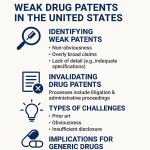
The America Invents Act of 2011 created inter partes review (IPR) and post-grant review (PGR) proceedings before the Patent Trial and Appeal Board (PTAB) [13]. These proceedings have become the default attack route for generic manufacturers facing pharmaceutical patents, because they are faster, cheaper, and historically more favorable to petitioners than district court litigation.
Between 2012 and 2023, the PTAB received over 11,000 IPR petitions, and institution rates for pharmaceutical patents have generally run between 55 and 70 percent [14]. Of those that reach final written decision, the PTAB has cancelled all challenged claims in roughly 40 percent of cases and found at least some claims unpatentable in another 25 percent. These are not statistics about weak patents – these are statistics about the general population of pharmaceutical patents that well-resourced challengers believed were worth attacking.
For portfolio valuation purposes, a patent’s PTAB history has to be understood along several dimensions:
Whether it has ever been the subject of a petition, and if so, whether the petition was denied at institution or decided on the merits – a denial at institution is a positive signal, but a substantive institution that the patent owner survived is a stronger one.
Whether any claims were cancelled or amended during PTAB proceedings, because amended claims have a different scope than the originally-issued claims and the prosecution history created during PTAB proceedings can affect infringement analysis.
Whether the PTAB proceedings involved any estoppel-triggering decisions, since petitioners who participate in a final IPR decision are estopped from raising the same prior art in subsequent district court proceedings, which affects the litigation calculus for both parties.
The PTAB’s public docket is searchable, and databases like DrugPatentWatch integrate PTAB petition data with Orange Book patent information, allowing analysts to rapidly assess the challenge history of listed pharmaceutical patents without manually cross-referencing multiple federal databases.
Paragraph IV Litigation: The Hatch-Waxman Battlefield
Under the Hatch-Waxman Act, a generic manufacturer that files an ANDA with a Paragraph IV certification – asserting that listed patents are invalid or will not be infringed – must notify the patent holder, who then has 45 days to file an infringement suit and trigger an automatic 30-month stay of FDA approval [15]. This framework means that pharmaceutical patent litigation has a structured, predictable starting point, and every Paragraph IV suit is a matter of public record.
A portfolio patent’s Paragraph IV litigation history tells analysts several things that citation counts cannot:
Whether generic manufacturers considered the patent worth challenging at all – patents that have never attracted a Paragraph IV filing may be strong deterrents, or they may be so clearly invalid or non-infringed that no challenger bothered.
Whether the brand manufacturer has successfully defended the patent in Hatch-Waxman litigation, and if so, through claim construction victories, summary judgment, or full trial – the procedural route to victory matters, because different types of victories create different amounts of legal precedent.
Whether the patent was licensed as part of a settlement, and under what terms – while pay-for-delay settlements have been under scrutiny since the Supreme Court’s FTC v. Actavis decision [16], legitimate settlements with authorized generic rights still represent a form of partial competitive defeat that affects the patent’s value as a market exclusion tool.
The consent judgment or settlement terms in Hatch-Waxman cases are often partially disclosed in court records, and their economic terms – entry date, royalty terms, authorized generic provisions – are commercially material information for portfolio valuation.
District Court Claim Construction Rulings
Markman hearings, in which district courts construe disputed patent claims, create another layer of legally significant patent history that citation counts entirely ignore. A claim construction ruling that narrowed the scope of an independent claim represents a partial defeat for the patent holder even if the litigation ultimately settled. Future infringement analyses will operate against the construed scope, not the originally-filed language.
Conversely, a favorable claim construction ruling – particularly one that has survived Federal Circuit review – represents a substantial positive signal about the patent’s enforceability and scope. Analysts should flag any patent that has received Federal Circuit claim construction review, both as a quality signal and as a factor that would constrain future litigation strategy.
Metric Family 4: Geographic Portfolio Coverage and Filing Strategy Analysis
Patents are national rights. A compound patent issued by the USPTO protects the drug product only in the United States. Equivalent protection in European, Japanese, Chinese, Brazilian, and other markets requires separate national or regional patent filings, each with its own prosecution history, claim scope, and validity status.
Coverage Map vs. Revenue Map
The fundamental question in geographic portfolio analysis is whether the patent family covers the markets where the revenue actually is. A pharmaceutical company with 95 percent of its branded drug revenue concentrated in the United States and Europe but geographic patent coverage only in the United States is significantly more vulnerable than its U.S. patent position alone would suggest.
Mapping patent coverage against geographic revenue concentration requires two data sets: the company’s geographic revenue breakdown by product (generally available in SEC filings for public companies), and the patent family structure showing which jurisdictions have granted or have pending protection. For non-public companies, estimating geographic revenue requires using market share data from sources like IQVIA or Evaluate Pharma.
The gaps between coverage maps and revenue maps reveal exactly where generic manufacturers can launch first – in markets where patent protection has expired, been invalidated, or never been obtained.
PCT Application Analysis as a Quality Proxy
When a pharmaceutical company files a Patent Cooperation Treaty (PCT) application, it is preserving the right to pursue national phase applications in more than 150 countries. The cost of nationalizing a PCT application across all major markets runs into hundreds of thousands of dollars in official fees, translation costs, and attorney fees per patent family. Companies do not spend that money on patents they do not believe in.
Analysts can use PCT filing patterns as a coarse quality filter. A compound patent with PCT filings nationalized in the United States, Europe, Japan, China, Canada, Australia, Brazil, and India signals that the assignee considered the underlying technology valuable enough to invest significantly in global protection. A patent that was filed nationally in the United States only, with no PCT application and no foreign counterparts, suggests lower perceived value.
More subtle analysis examines the trajectory of PCT nationalization over time. When a company begins allowing foreign counterparts to lapse by not paying maintenance fees, this signals a reassessment of the patent’s commercial value – possibly because the drug failed in development, possibly because a superior follow-on compound was identified, or possibly because management concluded the patent would not survive validity challenges in those jurisdictions.
European Patent Office Opposition Proceedings
The European Patent Office (EPO) grants a single patent valid across its member states, but the patent is then validated separately in each member state and can be opposed centrally at the EPO within nine months of grant [17]. A successful central opposition proceeding can revoke the patent across all EPO member states simultaneously, making EPO oppositions a particularly powerful attack tool.
Opposition proceedings create a public record analogous to, though distinct from, IPR proceedings at the USPTO. A patent that survived a fully-contested EPO opposition carries substantially more presumptive validity than one that has never been challenged. Conversely, a patent that was revoked by the EPO raises serious questions about the sustainability of its U.S. counterpart, since U.S. patent validity is determined under different legal standards but often involves overlapping prior art.
DrugPatentWatch and related tools that aggregate international patent family data can identify EPO opposition proceedings by cross-referencing USPTO patent records with EPO register data. The integration is imperfect – manual verification against EPO’s online register is often necessary for high-value patents – but the initial screening can be conducted programmatically across a large portfolio.
Metric Family 5: Assignee and Ownership Chain Analysis
Who owns a patent, and how it came to be owned, contains commercially material information that citation counts cannot surface.
Ownership Changes as Distress Signals
When a patent changes hands multiple times over a short period, it warrants scrutiny. In a healthy pharmaceutical portfolio, patents on commercial products typically stay with the original developer or an acquiring company that paid strategic value for the product. Repeated transfers, especially to non-practicing entities (NPEs) or holding companies with no associated product, often indicate that the original assignee had doubts about the patent’s enforceability or commercial relevance.
This is not a universal rule. Legitimate patent transactions include licensing arrangements, spin-offs, divestitures of non-core assets, and bankruptcy proceedings. But the fact of transfer, and the identity of the acquirer, is a useful screening variable. A portfolio that includes patents acquired from a bankrupt generic-turned-brand company, licensed from an NPE, or transferred from a failed startup may carry hidden problems that a clean internal development history does not.
Assignment records are maintained by the USPTO and are publicly searchable. They reveal the date of transfer, the names of assignor and assignee, and the reel and frame of the recorded assignment. Tools like DrugPatentWatch link these assignment records to the product context – showing which marketed drug a transferred patent covers, and when the transfer occurred relative to the product’s commercial life cycle.
Inventor Assignment Agreement Gaps
In the United States, patents must be assigned from the inventors (who receive them by default under 35 U.S.C. § 111) to the corporate owner for the corporate owner to have standing to sue. Failed or incomplete inventor assignment agreements have invalidated corporate patent positions in otherwise strong portfolios. The gap occurs most often at the interfaces between companies – when a startup is acquired and its employment agreements did not contain mandatory assignment clauses that met the legal standards of the relevant jurisdiction.
For portfolio valuation purposes, analysts should verify that complete assignment chains from inventors to current owner are properly recorded for any patent material to the valuation. This is particularly critical for patents acquired through M&A transactions involving startup companies, where the IP diligence in the original deal may have been rushed or incomplete.
Co-Ownership Complications
Jointly-owned patents – those where two or more entities hold ownership interests – present a distinct valuation problem under U.S. law. Under 35 U.S.C. § 262, each co-owner of a patent can exploit the patent without the consent of and without accounting to the other co-owner, and can grant non-exclusive licenses without consent [18]. This means a jointly-owned patent can be unilaterally licensed to a generic manufacturer by one co-owner, effectively destroying its revenue-protecting function.
Joint ownership arises most commonly from collaborative research agreements, where both parties contribute inventive content. Portfolio analysts should identify jointly-owned patents, determine the identity and commercial interests of co-owners, and assess whether co-owners might have incentives to license or otherwise compromise the patent’s exclusionary function. A jointly-owned patent on a blockbuster drug where one co-owner has subsequently entered the generic manufacturing business is a specific and material risk.
Metric Family 6: Prosecution History and Disclaimer Analysis
The prosecution history of a patent – the written record of arguments made to the USPTO during examination – is legally binding as a tool of claim interpretation. Under the doctrine of prosecution history estoppel, a patent owner who narrows a claim to overcome a prior art rejection cannot later assert that the claim covers the surrendered subject matter [19]. This doctrine is well-established but systematically underweighted in portfolio analyses that focus on claim language in isolation.
Prosecution Disclaimer Mapping
Prosecution disclaimers occur when an applicant makes clear and unmistakable statements during prosecution that limit the scope of a claim. The statement does not have to be a formal claim amendment – arguments made to distinguish prior art can constitute disclaimer even if the claim language itself was not changed.
For portfolio valuation purposes, identifying prosecution disclaimers requires reading the complete prosecution history of each material patent, including all office actions, responses, and examiner interview summaries. This is time-intensive work that is frequently shortchanged in portfolio analyses conducted under time pressure. The commercially consequential question is whether a prosecution disclaimer has narrowed the commercially relevant independent claims to a scope that a generic manufacturer can design around with a modified compound or formulation.
Competitive intelligence services like DrugPatentWatch link Orange Book patents to prosecution history records, making it possible to identify the filing history of each listed patent without separately searching the USPTO database. The link alone does not interpret the disclaimers – that requires attorney review – but it provides the starting point.
Continuation Application Strategy Analysis
Pharmaceutical companies often file continuation applications from an original patent application, claiming different aspects of the same invention supported by the original specification. A robust continuation strategy can maintain pending applications past the time when competitors have launched products, allowing the patent holder to amend claims to specifically cover competing products in a tactic known as “continuation prosecution targeting” or, more critically, “submarine patenting” (though the latter term properly applies to pre-1995 applications under the old term calculation rules).
For portfolio valuation, the existence of pending continuation applications is a material forward-looking variable that citation counts and static portfolio analyses miss entirely. A portfolio that includes pending applications with unexamined claims potentially covering competitor products represents significantly different economics than a portfolio of only issued patents. DrugPatentWatch’s tracking of pending applications linked to marketed drug products enables analysts to identify where patent families remain open and subject to continuation prosecution.
Metric Family 7: Economic Value Estimation Models
Having assembled rigorous qualitative data about claims architecture, term structure, litigation history, geographic coverage, and prosecution history, analysts can apply several quantitative frameworks to translate this information into dollar-value estimates.
Discounted Cash Flow with Patent-Specific Probability Weighting
The most common approach to patent portfolio valuation is a discounted cash flow (DCF) model that projects the revenue protected by each patent, estimates the probability that the patent will survive challenges, and discounts the resulting probability-weighted revenue stream to present value.
The standard formula is:
Patent Value = Σ [Annual Revenue Protected × (1 – Probability of Invalidation) × (1 – Probability of Design-Around) × Discount Factor]
The critical inputs that distinguish a rigorous DCF from a naive one are:
Revenue protected per patent: This requires determining not just total product revenue, but the marginal revenue attributable to each specific patent – accounting for the fact that if any one patent falls, others may still maintain exclusivity.
Probability of invalidation: Derived from the litigation history, PTAB petition record, and strength of the prior art cited against the patent. A patent with no prior PTAB challenge and no Paragraph IV litigation history has a very different invalidation probability than one that survived a contested IPR by a 5-4 PTAB panel decision.
Probability of design-around: Derived from claims architecture analysis. A patent whose independent claims are narrow enough to be circumvented with a predictable chemical modification has a higher design-around probability than one with broad functional claims.
Discount rate: Typically the company’s weighted average cost of capital for branded pharmaceutical operations, often in the 8-12 percent range for major pharma companies, though venture-backed assets warrant higher rates.
The Real Options Approach
For pharmaceutical patent portfolios that include patents covering drugs still in development – or continuation applications covering potential future products – the DCF framework undervalues optionality. The real options approach, pioneered in pharmaceutical valuation by Kellogg and Charnes [20], treats each patent as a financial option on the underlying revenue stream.
The intuition is that a pending continuation application covering a molecule in Phase II clinical trials has value as an option even if the probability of successful commercialization is only 15 percent – the option value reflects the right, but not the obligation, to pursue exclusivity if the clinical program succeeds.
Real options models are more appropriate for early-stage portfolio components than DCF models because they capture the asymmetric payoff structure – you can lose at most your patent prosecution costs, but can gain exclusivity over a blockbuster drug. The Black-Scholes-Merton framework can be adapted for pharmaceutical patents, though the input parameters (particularly the variance of underlying asset value) require careful calibration against historical volatility data for drugs at comparable development stages.
Monte Carlo Simulation for Portfolio-Level Analysis
For a portfolio of twenty or more patents covering multiple drugs at different stages of commercial life, Monte Carlo simulation provides more information than either single-point DCF or individual options pricing. The approach runs thousands of scenarios in which each patent’s validity, enforcement, and design-around outcomes are drawn probabilistically from calibrated distributions, producing a portfolio-level value distribution rather than a single point estimate.
The distribution shape is commercially important. A portfolio whose Monte Carlo simulation shows a narrow distribution around its expected value (low variance) behaves differently from one with a wide distribution (high variance, reflecting concentration risk or correlated risks across patents). A management team making capital allocation decisions between two portfolios with the same expected value but different variances should prefer the lower-variance portfolio if the company cannot tolerate the downside scenarios.
Monte Carlo inputs should reflect the full range of qualitative factors described in this article: The probability distribution of PTAB IPR outcomes for patents that have been petitioned or are likely targets. The correlation structure between patents in the same family – a PTAB decision that invalidates key claims of a parent patent affects related continuation patents through disclaimer and prosecution history estoppel. The timing distribution of FDA approval for ANDA filers, which affects the revenue loss timeline once exclusivity breaks.
Metric Family 8: Competitive Landscape and Freedom-to-Operate Analysis
Patent valuation is not a unilateral exercise. The value of a patent depends partly on what it prevents competitors from doing, which in turn depends on the competitive landscape it operates within. A compound patent on a drug with three therapeutically equivalent, unpatented generic alternatives is worth less than one where the drug occupies a therapeutic class without close substitutes.
Therapeutic Substitutability and Demand Elasticity
The economic value of a patent’s exclusionary rights depends on whether the excluded drug faces close therapeutic competition. In highly competitive therapeutic classes – proton pump inhibitors, statins, ACE inhibitors – the loss of exclusivity on any one agent produces rapid price erosion because insurers and pharmacy benefit managers can substitute therapeutic equivalents even before generic entry on the specific compound.
In orphan disease segments with no alternative treatment options, the same patent’s exclusionary value is dramatically higher because there is no therapeutic substitute to which patients can be switched. The value calculation for an Orphan Drug Designation-protected pharmaceutical must account for this inelastic demand structure – the patent is not just protecting market share against a generic version of the same molecule, it is protecting against any pharmacological alternative.
Analysts should assess the therapeutic landscape using clinical guideline data, formulary status, and published comparative effectiveness research to estimate the demand elasticity facing the patented drug. This analysis, combined with the patent term remaining, produces a more accurate picture of protected revenue than financial projections that assume stable market share regardless of competitive dynamics.
Orange Book Paragraph IV Filing Activity as a Leading Indicator
Generic manufacturers allocate substantial legal and regulatory resources to Paragraph IV certifications. The decision to file a Paragraph IV certification against a specific patent reflects an internal assessment that the patent is weak enough to invalidate or avoid, and that the resulting first-filer 180-day exclusivity makes the investment worthwhile.
Tracking Paragraph IV certification filings against a portfolio – which DrugPatentWatch systematically compiles from FDA sources – provides a real-time intelligence stream about which patents the generic industry has specifically concluded are worth attacking. A wave of Paragraph IV filings against a single compound patent from multiple generic filers is a strong leading indicator of heightened invalidity risk, regardless of what that patent’s citation count or formal status might suggest.
Conversely, the absence of Paragraph IV filings against a patent despite the drug’s commercial significance can signal either genuine deterrence (the patent is considered too strong to challenge) or oversight (the drug is approaching the end of its commercial life with patent expiration coming soon enough that Paragraph IV certification economics are marginal). Distinguishing these cases requires mapping the absence of filings against the patent’s remaining term and the drug’s revenue trajectory.
Competitive Intelligence on Generic Pipeline
ANDA filing activity, accessible through FDA databases and organized by product through DrugPatentWatch, provides forward visibility into which generic manufacturers are building supply capabilities for specific drugs. The time from ANDA filing to approval runs roughly 12-36 months for most applications, with complex products (extended-release formulations, drug-device combinations, injectables) taking longer.
A portfolio analysis that incorporates ANDA pipeline data can model the realistic competitive entry timeline more precisely than one that uses only statutory patent expiration dates. A drug whose compound patent expires in three years but for which no ANDAs have been filed faces a different competitive cliff than one with five pending ANDAs at various stages of review.
This is the kind of temporal, multi-source analysis where structured pharmaceutical IP databases earn their cost of subscription. Manually tracking ANDA filings across the FDA’s public database, cross-referencing them with Orange Book patent status, and mapping both against patent term and litigation status is a weeks-long project without structured data tools. With them, the initial pass can be completed in hours.
How the Metrics Work Together: The Integrated Valuation Framework
The eight metric families described above do not operate independently. They interact in ways that can compound or cancel each other’s effects on portfolio value. The integrated valuation framework assembles them into a coherent analytical sequence.
Step 1: Portfolio Segmentation
Before applying any metrics, segment the portfolio into three categories:
Active revenue defense patents: Patents currently listed in the Orange Book for marketed products generating material revenue. These receive the full analytical treatment across all eight metric families.
Pipeline defense patents: Patents covering compounds in clinical development, where the relevant analysis focuses on option value and continuation prosecution strategy rather than current revenue protection.
Legacy and non-core patents: Expired patents, patents on discontinued products, and patents whose coverage bears no direct relationship to current or pipeline revenue. These receive a minimal screen for potential licensing or litigation value, but do not justify full-scale analysis.
This segmentation prevents analytical resources from being wasted on patents that will not affect the valuation materially.
Step 2: Term and Exclusivity Timeline Construction
For each active revenue defense patent, build a complete chronological timeline showing:
The statutory expiration date, adjusted for PTA and PTE where applicable.
All applicable FDA regulatory exclusivity periods, stacked against the patent timeline.
The dates on which each layer of protection expires, creating a sequential “cliff schedule” that shows when generic ANDA submissions become possible, when 30-month stays would expire under Paragraph IV litigation, and when competitive entry is legally possible.
DrugPatentWatch’s product-level patent and exclusivity views provide the foundational data for this timeline construction.
Step 3: Claims Strength Assessment
For each active revenue defense patent in the portfolio, conduct a claims architecture analysis producing three binary assessments:
Whether the broadest independent claims are commercially covering the marketed product as manufactured – a “yes” answer is a threshold requirement for the patent to provide any protection.
Whether the claims have survived litigation or challenge – prior survival is a positive indicator but not dispositive, since new challengers bring new prior art.
Whether the claims can be designed around with commercially feasible modifications – a “no” answer identifies patents that would require generic manufacturers to develop genuinely different products, representing the highest class of protection.
Step 4: Litigation Risk Scoring
Assign each active patent a litigation risk score from 1 to 5 based on:
PTAB petition history (petitioned and lost = 5, petitioned and survived on merits = 2, never petitioned = 3)
Paragraph IV certification history (multiple certifications from major filers = 5, single certification that was resolved by consent judgment = 3, no certifications = 2)
Prior art landscape (dense crowded prior art with close prior disclosures = 5, clean landscape with no pending IPR art = 1)
This scoring system is necessarily judgmental, but it produces a relative ranking that guides further analysis. The highest-scoring patents (those at most litigation risk) receive the deepest scrutiny.
Step 5: Economic Value Estimation
Apply the probability-weighted DCF model to active revenue defense patents, using:
Base case revenue projections from SEC filings or analyst consensus for public companies.
Probability of invalidation derived from the litigation risk score, calibrated against empirical IPR outcomes data for comparable pharmaceutical patents.
Revenue loss timeline derived from the ANDA pipeline analysis, which projects how quickly generic competition would erode pricing power once exclusivity breaks.
For pipeline assets, apply the real options framework using development-stage-adjusted probability of technical success data from sources like Biotechnology Innovation Organization’s annual clinical development success rates.
Step 6: Competitive Landscape Adjustment
Apply therapeutic substitutability discounts to the base-case economic values. Drugs in highly competitive therapeutic classes, where PBM formulary management can drive rapid substitution even before technical generic entry, should have their patent value discounted to reflect the demand elasticity risk. Drugs in orphan or highly specialized segments receive a premium reflecting the relative inelasticity of demand.
Case Study 1: AbbVie’s Humira Defense Strategy
Humira (adalimumab) offers what is arguably the most studied example of comprehensive patent portfolio strategy in pharmaceutical history. AbbVie built a portfolio of over 130 U.S. patents covering the antibody, its formulations, manufacturing processes, dosage regimens, and combinations – a structure that delayed biosimilar competition in the United States until 2023 despite the original compound patent expiring in 2016 [21].
From a metrics-based valuation standpoint, Humira’s portfolio demonstrated several features that citation-count analysis would have missed entirely:
The strategic filing of continuation applications that issued after biosimilar competitors began their development programs, creating legal uncertainty about whether the biosimilar products infringed the continuation claims – a tactic that proved commercially decisive even though it generated intensive regulatory and political criticism.
The use of formulation patents covering the high-concentration citrate-free formulation approved in 2015 – a genuine pharmaceutical improvement that also extended the meaningful exclusivity period, because biosimilar manufacturers faced pressure to match the preferred formulation’s tolerability profile.
The global patent stratification that kept European biosimilar entry earlier than U.S. entry, which analysts tracking patent coverage geographically could have anticipated years ahead of the actual competitive events.
The integrated metrics framework would have projected U.S. biosimilar delay with substantially greater accuracy than any analysis based on Humira’s compound patent alone, though predicting the full seven-year delay between European and U.S. biosimilar entry would have required tracking the entire continuation portfolio’s prosecution status over several years.
Case Study 2: Gilead’s Sovaldi and Harvoni Exclusivity Architecture
Gilead Sciences’ hepatitis C franchise – built on sofosbuvir (Sovaldi) and the sofosbuvir/ledipasvir combination (Harvoni) – generated peak annual revenues exceeding $12 billion in 2015 before facing successive challenges to its intellectual property foundation [22].
The case is analytically instructive because sofosbuvir’s core chemistry patents faced serious validity challenges at the IPR stage. In 2016, the PTAB instituted review of key sofosbuvir process patents on petitions filed by Merck, which was engaged in separate litigation with Gilead over who had invented the relevant nucleotide chemistry first [23].
A portfolio valuation conducted using only citation counts in 2015, when Sovaldi and Harvoni were generating peak revenues, would have reflected massive forward citation traffic to the sofosbuvir composition patents from subsequent nucleotide prodrug research. The citation signal would have suggested very high patent quality.
An integrated metrics analysis, by contrast, would have flagged:
The active Merck inventorship dispute, which created both invalidity risk and unanticipated prior art arguments.
The narrow claim scope of certain process patents relative to the potential design-around space, given that multiple research groups were approaching nucleotide prodrug technology from different chemical directions.
The fact that the primary revenue was concentrated in a specific compound (sofosbuvir) with limited formulation patent protection in early years, creating a cleaner generic entry path than the breadth of Gilead’s broader nucleotide platform might suggest.
The actual outcomes – Gilead prevailed in most major sofosbuvir validity challenges, but the litigation process itself extracted significant resources and created settlement pressure – were consistent with a medium-risk classification under the integrated framework, not the low-risk classification that pure citation analysis would have generated.
Case Study 3: The Secondary Patent Problem in Small-Molecule Drugs
The concept of “secondary patents” – those covering formulations, dosage forms, methods of treatment, and manufacturing processes rather than the original compound – has been extensively debated in pharmaceutical policy literature. Critics, including the WHO and Médecins Sans Frontières, argue that secondary patents extend monopolies unjustifiably [24]. Brand manufacturers argue they represent genuine innovation.
For portfolio valuation purposes, the question is more specific: what is the actual defensive value of a secondary patent in a Paragraph IV challenge?
Empirical research by Hemphill and Sampat [25] analyzed the outcome of Paragraph IV litigation involving secondary patents and found that generic manufacturers prevailed significantly more often against secondary patents than against compound patents. Formulation patents, in particular, showed a higher invalidation rate, driven partly by obviousness findings where the formulation improvement was predictable from the prior art.
This empirical data provides calibration inputs for the probability-of-invalidation parameter in the DCF model. A portfolio heavily reliant on formulation patent coverage with limited or no compound patent remaining should discount those formulation patent values substantially relative to a portfolio with strong compound patent coverage still intact.
The integrated framework captures this by requiring separate litigation risk scoring for each category of secondary patent, rather than treating the portfolio as a homogeneous bundle of IP rights.
Deploying These Metrics in M&A Due Diligence
Mergers and acquisitions involving pharmaceutical assets rarely succeed or fail based on the clinical profiles of the acquired drugs alone. The IP foundation underlying those drugs determines how long the economic life of the asset will run – and in pharmaceutical transactions, the difference between five years of protected revenue and ten years is often the difference between a value-accretive deal and a writedown.
The 30-Day IP Diligence Protocol
A compressed M&A timeline typically allows 30-45 days for IP due diligence on a pharmaceutical acquisition. Within that window, a prioritized metrics-based approach allocates analysis time proportionally to revenue materiality:
For the top three revenue-generating products, conduct full-depth analysis across all eight metric families. Engage patent counsel for claims architecture review and prosecution history disclaimer analysis. Map all pending continuation applications. Verify PTA and PTE calculations independently.
For the next tier of products (those representing 10-40 percent of portfolio revenue), conduct metrics-based screening to identify red flags warranting deeper analysis – active PTAB petitions, recent Paragraph IV certifications, and ownership chain gaps are the primary screens.
For all remaining products, conduct the patent term and exclusivity timeline analysis, which is fast and scalable, and flag any products where generic entry is legally possible within 36 months regardless of patent status.
This triage-based approach ensures that analytical resources focus where they generate the most decision-relevant information.
Escrow and Representation Structuring
The output of IP due diligence directly informs how to structure deal terms. Specific IP risk factors identified through the advanced metrics analysis should be reflected in:
Representations and warranties: The seller’s representation of patent validity and enforceability should be specific enough to cover the material risk factors identified – pending Paragraph IV litigations, known prosecution disclaimers, and co-ownership arrangements are specific items that general IP reps may not fully capture.
Indemnification provisions: Where specific invalidity risks are identified but cannot be fully evaluated within the diligence timeline, negotiating IP-specific indemnification caps and survival periods provides post-closing protection.
Milestone structures: In deals where patent term and exclusivity timelines directly determine revenue duration, milestone payments tied to patent survival events (surviving PTAB decision, entering 30-month stay period on Paragraph IV challenge) align acquisition pricing with actual IP performance.
Technology Tools and Data Infrastructure
The metrics described in this article require structured, reliable patent data as input. While sophisticated analysis ultimately requires human judgment, the data infrastructure determines how quickly and completely analysts can complete the work.
Patent Databases and Their Limitations
The USPTO’s own search tools (Patent Full-Text Database, Patent Application Full-Text Database) contain the complete text of U.S. patents and applications but require significant technical proficiency to query efficiently. They do not integrate regulatory exclusivity data, ANDA filing records, or Paragraph IV litigation history.
The European Patent Office’s Espacenet provides international patent family data and opposition proceeding records, but requires separate querying from U.S. sources and has limited pharmaceutical-specific structuring.
Commercial patent database providers like Derwent Innovation, PatSnap, and Orbit Intelligence offer integrated international patent search with analytics capabilities, including citation network analysis, assignee mapping, and technology classification. These tools are powerful for broad portfolio landscape analysis but generally lack the deep pharmaceutical-specific integration of FDA exclusivity data.
DrugPatentWatch occupies a specific and valuable niche by aggregating FDA Orange Book data, patent records, Paragraph IV litigation filings, exclusivity expiration dates, and ANDA approval records in a pharmaceutical-specific structure. The commercial intelligence value comes precisely from the integration – being able to see, on a single product page, the full stack of patents and exclusivities covering a drug, the ANDA filers who have targeted it, the Paragraph IV certification history, and the patent expiration timeline. This is exactly the data infrastructure that the term and exclusivity timeline construction step of the integrated framework requires.
Building Internal IP Analytics Capability
Large pharmaceutical companies with significant IP portfolios increasingly build internal IP analytics functions that go beyond what any external database provides. These functions typically combine:
Patent analytics software for claim scope mapping and prosecution history review.
Custom-built databases that link product revenue data to patent coverage, allowing real-time monitoring of coverage gaps and expiration timelines.
Competitive intelligence workflows that monitor competitor patent filings, ANDA submissions, and PTAB petition activity.
The infrastructure investment is substantial but justified for companies with $500 million or more in revenue from patent-protected products. The cost of a single misjudged patent expiration – lost revenue from failing to file a continuation covering a commercially-critical embodiment, or failure to identify an invalidation risk before a Paragraph IV challenge arrives – can easily exceed the entire annual budget of an IP analytics function.
Automated Alert Systems
Dynamic monitoring – real-time or near-real-time alerts when specific IP events occur – is the operational extension of the static portfolio analysis described in this article. Events worth monitoring automatically include:
New ANDA filings against Orange Book patents in the portfolio (available through FDA’s Orange Book update feeds).
New PTAB petitions naming portfolio patents (available through PTAB’s docket system).
New Paragraph IV certification notices (disclosed in periodic FDA publication and in litigation filings).
Patent assignment record updates (available through USPTO assignment database).
DrugPatentWatch provides alert functionality that notifies subscribers of Orange Book changes, new ANDA filings, and patent litigation activity. Internal teams building on this data infrastructure can layer additional monitoring for PTAB petitions and EPO opposition proceedings using PTAB’s API and EPO’s public data access interfaces.
Regulatory and Policy Considerations
The framework presented in this article operates within a regulatory and legal environment that is itself subject to change. Several ongoing policy developments affect how these metrics should be interpreted.
Post-Braidwood Orange Book Reform
Following the FTC’s aggressive public positions on Orange Book over-listing, and the litigation in FTC v. Sanofi-Aventis U.S. (2023) regarding insulin device patents, the pharmaceutical industry faces heightened scrutiny of which patents qualify for Orange Book listing [26]. Patents on drug delivery devices (autoinjectors, inhalers, prefilled syringes) have been specifically targeted.
For portfolio valuation purposes, patents that are candidates for Orange Book delisting represent a specific risk category: their enforceability against Paragraph IV challengers, and their ability to trigger 30-month stays, depends on continued Orange Book listing. A patent that the FTC or a court determines should not have been listed loses its Hatch-Waxman procedural advantages even if it remains valid and enforceable outside that framework.
Analysts should flag device and combination product patents in pharmaceutical portfolios as potentially subject to this regulatory risk, and apply an additional discount to their value under the integrated framework.
Inflation Reduction Act and Patent Term Interactions
The Inflation Reduction Act of 2022 established a Medicare drug price negotiation mechanism that targets drugs meeting specific revenue and patent criteria [27]. Drugs with high gross revenue from Medicare, no generic or biosimilar competition, and no therapeutic alternatives are prioritized for negotiation. The program is explicitly designed to reduce the economic benefit of extended patent-based market exclusivity.
For small-molecule drugs, the program can begin price negotiations nine years after initial FDA approval; for biologics, thirteen years. This regulatory pricing ceiling interacts with patent term analysis in a specific way: for drugs where IRA negotiations are probable, the patent’s value as an exclusivity vehicle is partially eroded because the federal government will set a price ceiling before the patent fully expires.
Integrated portfolio valuation models need to identify drugs likely to be subject to IRA negotiations – those with high Medicare revenue and no near-term competitive entry – and model the revenue impact of negotiated pricing against the patent-protected revenue stream.
Biosimilar Patent Dance Reform
For biological products, the patent resolution process is governed not by Hatch-Waxman but by the Biologics Price Competition and Innovation Act (BPCIA), which established a complex “patent dance” process for exchanging patent information between reference product sponsors and biosimilar applicants [28]. This process has been extensively litigated and repeatedly modified by judicial interpretation.
The BPCIA framework differs from Hatch-Waxman in ways that affect portfolio valuation. There is no automatic 30-month stay for biologics. The negotiation and litigation sequence is more complex. The 180-day first-filer exclusivity that creates economic incentive for Paragraph IV ANDA filing does not exist for biosimilars. All of these differences affect both the litigation risk profile and the competitive entry timeline for biological product portfolios.
Building the Valuation Report
The output of the integrated metrics framework should be a structured valuation report that presents findings in a format usable by non-specialist decision-makers – board members, transaction committees, and strategic planning functions.
The One-Page Executive Summary
Every portfolio valuation report should begin with a one-page summary that presents:
Total portfolio value estimate, expressed as a range rather than a point estimate, reflecting the uncertainty in the underlying models.
Top three value drivers – the patents or patent families contributing the most to total portfolio value.
Top three risk factors – the specific IP vulnerabilities most likely to reduce portfolio value from the base case.
The near-term action items – pending proceedings, approaching deadlines, or specific strategic decisions that require attention within the next twelve months.
This format forces clarity about what actually matters in the portfolio, rather than producing comprehensive-but-actionable-free documentation.
The Patent-by-Patent Risk Register
Below the executive summary, the valuation report should include a risk register with one line per material patent. Each line records: patent number, remaining term (adjusted for PTA/PTE), claims coverage assessment (strong/moderate/narrow), litigation risk score, PTAB status, Paragraph IV history, and the contribution to total portfolio value under the base case DCF model.
The risk register is the working document that drives ongoing portfolio management. It should be updated when material events occur – new PTAB petitions, Paragraph IV certifications, claim construction rulings, or Orange Book delisting challenges. A risk register that is refreshed annually at most is providing comfort documentation, not active management support.
Stress Testing and Scenario Analysis
The valuation report should include a section presenting three scenarios in addition to the base case:
The “bear case” – in which the portfolio’s highest-risk patents are invalidated through IPR proceedings and the resulting revenue losses accelerate.
The “bull case” – in which pending continuation applications issue with claims broad enough to extend exclusivity beyond the base case timeline.
The “regulatory stress” scenario – in which the IRA or similar pricing mechanism applies to the portfolio’s highest-revenue products, reducing the economic benefit of patent exclusivity.
Presenting the portfolio value range across these scenarios gives decision-makers a meaningful picture of the dispersion of outcomes, rather than a false-precision point estimate that cannot reflect the genuine uncertainty in pharmaceutical patent valuation.
Conclusion: What Actually Predicts Portfolio Value
The evidence from both academic research and practical pharmaceutical IP experience consistently supports one conclusion: the metrics that most accurately predict pharmaceutical patent portfolio value are those that measure enforceability and durability of specific claims, not those that measure how much attention the patent received in the scientific or patent literature.
Citation counts measure influence. Claims architecture analysis, term structure, litigation history, prosecution disclaimer mapping, and geographic coverage analysis measure protection. For a pharmaceutical company sitting six years from its largest compound patent expiration, what matters is protection.
The integrated framework presented here is not quick to apply. It requires attorney-level claims analysis, multi-database data assembly, and quantitative modeling. It cannot be completed in an afternoon. But a single correctly-identified vulnerability in a revenue-material patent – one that allows a generic manufacturer to launch three years ahead of when the portfolio analysis suggested – represents revenue loss that dwarfs the cost of thorough analysis many times over.
The generic cliff is not a metaphor. It is a specific, calendar-driven event that arrives whether or not the company’s IP analytics function has been doing its job. The question is whether you know it is coming, which patent specifically controls the timing, whether that patent has vulnerabilities you have not yet surfaced, and what strategic options remain to either address those vulnerabilities or prepare for the competitive consequences of their exploitation.
Citation counts cannot answer any of those questions. The eight metric families can.
Key Takeaways
The pharmaceutical patent cliff is defined by specific, identifiable patents – not by a portfolio’s aggregate statistics. Identifying which patents control the competitive entry timeline requires product-level mapping, not summary metrics.
Citation counts measure technological influence, not commercial protection durability. The two are poorly correlated for pharmaceutical compound patents, where competitors cite patents primarily to distinguish, not to build on them.
Claims architecture analysis – the breadth of independent claims, the presence of prosecution disclaimers, and the factual alignment of claim language with the marketed product – is the single most important analytical input for assessing a patent’s actual defensive value.
Patent term remaining must account for PTA, PTE, and all stacked regulatory exclusivity periods. The correct cliff date is when the last layer of statutory protection expires, not when the first patent expires.
PTAB petition history and Paragraph IV certification activity are leading indicators of invalidity risk that are more timely and specific than any backward-looking quality metric.
Geographic patent coverage should be mapped against geographic revenue concentration. Coverage gaps in revenue-material markets represent unprotected revenue the moment patent protection is absent.
Prosecution disclaimer analysis requires reading the full file history of each material patent. Arguments made to distinguish prior art create enforceable scope limitations that are not visible in the claim language itself.
A probability-weighted DCF model, calibrated against empirical IPR and Hatch-Waxman litigation outcomes and adjusted for therapeutic substitutability, provides a more accurate and more defensible portfolio value estimate than approaches based on citation counts or unadjusted revenue projections.
Tools like DrugPatentWatch, which integrate FDA exclusivity data, ANDA filing records, patent term information, and Paragraph IV litigation history into a pharmaceutical-specific structure, are foundational infrastructure for any serious patent portfolio analysis.
The M&A context demands a prioritized, tiered approach to IP diligence that allocates analysis depth in proportion to revenue materiality, with full-depth analysis reserved for the top revenue-generating products.
Secondary patents – formulation, dosage, method-of-treatment – carry measurably higher invalidation risk than compound patents in Paragraph IV litigation, and their contribution to portfolio value should be discounted accordingly.
The Inflation Reduction Act’s price negotiation mechanism partially erodes the economic value of patent exclusivity for high-revenue Medicare drugs. Portfolio valuations conducted without modeling this regulatory pricing overlay will overstate value for affected products.
FAQ
Q1: How do you determine which patents are actually “covering” a marketed drug versus which are over-listed in the Orange Book?
A1: The starting point is reading the claims of each Orange Book-listed patent against the drug product’s label, NDA, and manufacturing specifications. A patent “covers” a drug product if the drug product, as manufactured and sold, would infringe at least one claim of the patent under standard claim construction principles applied to the claims’ actual language. Over-listing occurs when claims are too narrow to cover the commercial product, or when a process patent does not meet the “used in the manufacture” standard that justifies listing under 21 C.F.R. § 314.53. For high-value patents where coverage is questionable, you need outside counsel with Hatch-Waxman experience to provide a written freedom-to-operate opinion. The FTC’s increased scrutiny of device combination patents post-2023 has made this assessment particularly urgent for autoinjector and inhaler patents.
Q2: What is the single most important factor that determines whether an IPR petition will succeed against a pharmaceutical patent?
A2: The strength and proximity of the prior art that the petitioner presents in the petition itself. PTAB institution decisions turn heavily on whether the petition presents a “reasonable likelihood” that the petitioner will prevail on at least one challenged claim, and the most common reason petitions succeed at that threshold is a close prior art reference – preferably a published scientific paper, a prior patent, or a prior drug approval – that the petitioner can map substantially onto the challenged claims. Pharmaceutical compound patents are most often challenged on obviousness grounds using prior art that disclosed structurally related compounds with similar activities. The petitioner’s winning formula is a skilled-in-the-art declaration linking the structural similarity to a motivation to modify, which is why the choice of expert witness is itself a critical variable in IPR petition outcomes.
Q3: How should analysts value a continuation application that has not yet issued but covers the exact commercial embodiment of a drug?
A3: Pending continuation applications are valued using a real options approach, not a DCF model, because the commercial relevance of the application depends on whether the applicant can successfully prosecute claims broad enough to cover the commercial product and survive prior art challenges. The option value is: (probability of issuance with commercially relevant claims) × (economic value of the coverage period those claims would provide) × (probability of survival if challenged) – (remaining prosecution cost). Each of these inputs requires estimation. Probability of issuance with relevant claims is best estimated by reviewing the prosecution history of already-issued family members and the applicant’s track record in similar prosecution contexts. Economic value uses the same DCF framework as for issued patents, but the coverage period is modeled against the likely issuance date and the statutory 20-year-from-filing term.
Q4: How do you model the revenue impact of a patent cliff when a drug faces both generic small-molecule competition and biosimilar competition from a reference biologic?
A4: These scenarios require separate models for each competitive pathway. Generic small-molecule entry follows the Hatch-Waxman Paragraph IV pathway, and the historical revenue erosion curves following generic entry for oral solid dosage drugs show roughly 80-90 percent volume loss within two years of first generic launch [29]. Biosimilar competition for reference biologics follows different erosion patterns that depend on the number of biosimilar competitors, the interchangeability designations received, and the payer and formulary dynamics in the specific therapeutic area. The modeling approach segments total product revenue by indication or formulation, applies separate competitive entry timelines to each segment (small molecule generic vs. biosimilar), uses empirically calibrated erosion curves appropriate to each pathway, and sums the projected revenue trajectories. Where a reference biologic is also competing with unrelated small-molecule therapies in the same indication, the demand elasticity adjustment from Metric Family 8 applies to the combined competitive set.
Q5: How do pharmaceutical companies use advanced patent portfolio metrics to make filing strategy decisions, not just valuation decisions?
A5: The same framework that values existing patents can guide prospective filing strategy. Claims architecture analysis applied to pipeline compounds identifies where existing claims in pending applications may be too narrow – if the commercial embodiment is near the edge of claim scope, filing continuation applications with modified claim sets that more squarely cover the commercial product is a proactive response. Geographic coverage analysis identifies jurisdictions where filing additional national phase applications is justified by the commercial revenue potential. Prosecution history review of competitor patents identifies where competitors have made disclaimer arguments that constrain their own freedom to operate, which can be used offensively in licensing negotiations or defensively in planning around their IP. The most sophisticated pharmaceutical IP teams run rolling portfolio analysis that feeds directly back into filing and prosecution strategy on a quarterly basis, using real-time ANDA pipeline data and competitor patent filings to identify both risks and opportunities in the competitive IP landscape.
Sources
[1] Trajtenberg, M. (1990). A penny for your quotes: Patent citations and the value of innovations. RAND Journal of Economics, 21(1), 172-187.
[2] Evaluate Pharma. (2023). World Preview 2023: Outlook to 2028. Evaluate Ltd.
[3] IQVIA Institute for Human Data Science. (2024). Global use of medicines 2024: Outlook to 2028. IQVIA.
[4] Lanjouw, J. O., & Schankerman, M. (2001). Characteristics of patent litigation: A window on competition. RAND Journal of Economics, 32(1), 129-151.
[5] 21 C.F.R. § 314.53(b). (2024). Code of Federal Regulations: Submission of patent information. U.S. Government Publishing Office.
[6] Federal Trade Commission. (2002). Generic drug entry prior to patent expiration: An FTC study. Federal Trade Commission.
[8] Allergan, Inc. v. Teva Pharmaceuticals USA, Inc., No. 2:15-CV-1455-WCB (E.D. Tex. 2017).
[9] 35 U.S.C. §§ 154, 156. (2024). Patent term; extension of patent term. United States Code.
[10] 35 U.S.C. § 156(c). (2024). Extension of patent term: Limitations. United States Code.
[11] 21 U.S.C. § 355(j)(5)(F)(ii). (2024). New chemical entity exclusivity. United States Code.
[12] 21 U.S.C. § 360cc. (2024). Orphan drug exclusivity. United States Code.
[13] Leahy-Smith America Invents Act, Pub. L. No. 112-29, 125 Stat. 284 (2011).
[14] United States Patent and Trademark Office. (2023). PTAB trial statistics: IPR, PGR, CBM through fiscal year 2023. USPTO.
[15] 21 U.S.C. § 355(j)(5)(B)(iii). (2024). Thirty-month stay of ANDA approval. United States Code.
[16] FTC v. Actavis, Inc., 570 U.S. 136 (2013).
[17] European Patent Convention, Art. 99. (2000). Opposition. European Patent Office.
[18] 35 U.S.C. § 262. (2024). Joint owners. United States Code.
[19] Festo Corp. v. Shoketsu Kinzoku Kogyo Kabushiki Co., 535 U.S. 722 (2002).
[20] Kellogg, D., & Charnes, J. M. (2000). Real-options valuation for a biotechnology company. Financial Analysts Journal, 56(3), 76-84.
[21] Feldman, R. (2018). May your drug price be ever green. Journal of Law and the Biosciences, 5(3), 590-647. https://doi.org/10.1093/jlb/lsy022
[22] Gilead Sciences, Inc. (2016). Annual Report 2015 (Form 10-K). U.S. Securities and Exchange Commission.
[23] Merck & Co., Inc. v. Gilead Sciences, Inc., IPR2015-01067 (P.T.A.B. 2015).
[24] Médecins Sans Frontières. (2016). Overpatented, overpriced: How excessive pharmaceutical patenting is extending monopolies and driving up drug prices. MSF Access Campaign.
[25] Hemphill, C. S., & Sampat, B. N. (2012). Evergreening, patent challenges, and effective market life in pharmaceuticals. Journal of Health Economics, 31(2), 327-339.
[26] Federal Trade Commission. (2023). Policy statement on improper listing of patents in the Orange Book. Federal Trade Commission. https://www.ftc.gov/policy/advocacy-research/tech-at-ftc/2023/09/ftc-takes-action-against-manufacturers-improperly-listing-patents-fda-orange-book
[27] Inflation Reduction Act of 2022, Pub. L. No. 117-169, 136 Stat. 1818 (2022).
[28] Biologics Price Competition and Innovation Act of 2009, 42 U.S.C. § 262 (2010).
[29] Grabowski, H., Long, G., Mortimer, R., & Boyo, A. (2016). Updated trends in US brand-name and generic drug competition. Journal of Medical Economics, 19(9), 836-844.