Business Intelligence on Biologic and Small Molecule Drugs
Pharmaceutical Patent Use Codes: The Definitive Technical and Strategic Guide to Orange Book Method-of-Use Patents, Skinny Labeling, and Induced Infringement Risk
1. What Patent Use Codes Are and Why They Cost the Healthcare System $3.5 Billion per Year
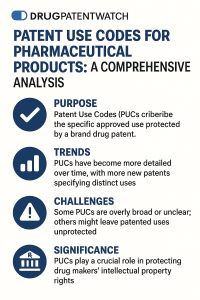
A patent use code is an alphanumeric identifier, always prefixed with ‘U-‘ and always unique per submission, that links a method-of-use patent to a specific FDA-approved indication for a drug product. It lives inside the Orange Book’s patent listing table and is the formal legal bridge between a patent’s claims and the drug label language that describes how the product is used clinically.
That description sounds administrative. The economic reality is not. The strategic manipulation of use codes costs the U.S. healthcare system an estimated $3.5 billion annually in excess drug expenditures, driven by generic entry delays attributable to overreaching, ambiguous, or improperly listed codes. That figure, which comes from a 2022 analysis by the Campaign for Sustainable Rx Pricing, is conservative; it does not account for the system-wide deterrent effect on companies that simply decline to challenge a patent rather than spend years in Hatch-Waxman litigation.
The mechanism through which a four-to-six-word code descriptor translates into billions in delayed competition runs as follows. When a generic company files an Abbreviated New Drug Application (ANDA) for a drug with one or more method-of-use patents listed in the Orange Book, it must either certify that it will not seek approval for the patented use (a Section viii statement, also called a skinny label) or certify that the patent is invalid or not infringed (a Paragraph IV certification). The skinny label route is cheaper and faster. Whether it is available depends entirely on whether the use code’s language creates a clean boundary between the patented indication and the indications the generic wants to cover. A vague code, one that describes a mechanism rather than a specific approved use, or one that is drafted more broadly than the patent claims actually support, makes that boundary impossible to draw. The generic is effectively forced into Paragraph IV litigation or delay.
Use codes are not merely regulatory housekeeping. They are the first line of offense in pharmaceutical lifecycle management and the first line of defense for generic entry strategy. Every IP team, every ANDA developer, and every investor modeling generic entry timelines needs to treat use code analysis as primary work, not a footnote to patent expiry date lookups.
Key Takeaways: Section 1
A patent use code’s text directly determines whether a Section viii skinny-label carve-out is legally available to a generic applicant. Improperly broad or vague use codes impose $3.5 billion per year in estimated excess healthcare costs through delayed competition. Use code analysis is a primary IP intelligence task, not a secondary screen.
2. The Hatch-Waxman Compromise: Legislative Architecture and Its Unintended Incentives
2a. The Pre-1984 Status Quo and the Problem Congress Was Solving
Before the Drug Price Competition and Patent Term Restoration Act of 1984 took effect, a generic drug manufacturer could not legally conduct development activities on a patented drug because doing so constituted patent infringement. There was no safe harbor for pre-expiry development work. Even after a patent expired, the generic company had to conduct its own full clinical trials, duplicating the innovator’s safety and efficacy demonstrations at a cost of hundreds of millions of dollars and a timeline measured in years. The practical effect was a de facto monopoly extension that persisted years past the nominal patent term. Generic drugs accounted for less than 20% of U.S. prescription volume in 1984.
Congress needed to simultaneously satisfy the innovator industry, which was watching its post-expiry monopolies erode in prospect, and the consumer interest in affordable drugs. The resulting compromise had six structural elements that remain the architecture of the system today.
The first element was the ANDA pathway, which let generic manufacturers piggyback on the innovator’s clinical safety and efficacy data and demonstrate only bioequivalence. The second was the safe harbor allowing generic companies to conduct pre-expiry development activities without incurring infringement liability. The third was Patent Term Extension (PTE), giving innovators the ability to restore up to five years of patent life lost during FDA regulatory review. The fourth was the five-year New Chemical Entity (NCE) exclusivity, a non-patent data protection right that runs from NDA approval regardless of patent status. The fifth was the three-year new clinical investigation exclusivity for supplements. The sixth, and the one that created the use code apparatus, was the Orange Book patent listing requirement with its Paragraph IV certification mechanism, which formalized patent disputes as a condition of the regulatory approval process.
2b. The Incentive Structure Hatch-Waxman Created
Congress’s compromise worked, in aggregate. Generic drug dispensing now accounts for approximately 92% of U.S. prescription volume. But the Act’s mechanics created incentive structures that were not fully anticipated in 1984 and that have driven much of the strategic behavior the Orange Book system is now associated with.
The 30-month automatic stay is the most important of these. When a brand manufacturer receives notice of a Paragraph IV certification and files an infringement suit within 45 days, the FDA cannot grant final ANDA approval for 30 months. This stay is automatic; it requires no judicial finding on the merits of the infringement claim. The commercial benefit to the innovator is immediate and enormous. The cost of listing a patent and filing suit is modest relative to the $500 million to $2 billion in quarterly revenues that a major brand drug can generate. The result: innovators have every financial incentive to list any patent that could plausibly be asserted against a generic’s ANDA, regardless of whether that patent would survive litigation.
The 180-day first-filer exclusivity created the inverse incentive on the generic side. The first company to file a substantially complete ANDA with a Paragraph IV certification against a listed patent wins six months of marketing exclusivity, during which no other generic can receive final FDA approval. For a drug with $2 billion in annual U.S. revenues, the 180-day exclusivity period generates hundreds of millions in generic revenue at prices that are still considerably above the competitive floor that develops with five or more entrants. The first-filer exclusivity makes Paragraph IV challenges commercially rational even for relatively thin invalidity arguments, because the expected value of winning the prize exceeds the cost of the litigation.
The interaction of these two incentives, the innovator’s incentive to list every defensible patent and the generic’s incentive to file the earliest possible challenge, created the patent arms race that defines modern Hatch-Waxman practice. Use codes sit at the center of that arms race because they govern whether the Section viii pathway is available as an alternative to Paragraph IV confrontation.
2c. Secondary Patents and the Rise of Method-of-Use as a Strategic Instrument
At the time of Hatch-Waxman’s passage, pharmaceutical patent strategy centered on the composition-of-matter patent covering the active pharmaceutical ingredient. That primary patent typically expired 7 to 12 years after FDA approval, and the Act’s new exclusivities supplemented it. But the Act’s creation of the Orange Book listing system, and its linkage of that system to the 30-month stay, made every listed patent commercially valuable, not just the primary patent. This shifted investment toward secondary patents, particularly method-of-use patents, because they could be filed late in the product lifecycle (after additional clinical trials generated new indication approvals), could multiply in number across multiple indications, and could survive the expiry of the primary patent to continue triggering stays against generic challengers.
The result, over four decades, was a systematic shift in the pharmaceutical patent portfolio from a primary-patent-centric model to a secondary-patent-dense model in which method-of-use patents, each described by its own use code, became the primary vehicle for lifecycle management. A 2021 study in JAMA Internal Medicine documented this shift: between 2005 and 2015, the number of Orange Book-listed patents per drug increased by 53%, driven almost entirely by secondary formulation and method-of-use patents filed after initial NDA approval.
Key Takeaways: Section 2
The 30-month automatic stay created by Hatch-Waxman does not require any judicial finding on patent merits, which gives innovators strong financial incentives to list every defensible patent regardless of its strength. The 180-day first-filer exclusivity creates parallel incentives for generic manufacturers to file the earliest possible challenge. The combination drove a 53% increase in Orange Book patent listings per drug between 2005 and 2015, with method-of-use patents as the primary driver.
3. Orange Book Mechanics: Structure, Filing Obligations, and the FDA’s Ministerial Stance
3a. What the Orange Book Contains and What It Explicitly Excludes
The FDA’s ‘Approved Drug Products with Therapeutic Equivalence Evaluations’ is organized around five primary data components. The drug listing file contains active ingredient, dosage form, route of administration, strength, applicant name, application type (NDA or ANDA), and approval date. The therapeutic equivalence (TE) rating file assigns each approved product a two-letter code, most importantly ‘AB,’ signifying bioequivalent and eligible for automatic pharmacy substitution. The patent file lists each patent the NDA holder has certified covers the drug, along with its expiration date and its category: drug substance (DS), drug product (DP), or method of use (MU, described by the use code). The exclusivity file tracks all non-patent market exclusivities. The product file links drugs to their application numbers, allowing cross-referencing across all components.
The regulations at 21 CFR §314.53 specify exactly which types of patents are eligible for Orange Book listing. Drug substance patents, drug product patents, and method-of-use patents for FDA-approved indications qualify. Manufacturing process patents, packaging patents, metabolite patents, and intermediate compound patents explicitly do not qualify. This exclusion list is more commercially consequential for biologics than for small molecules, because biologic process patents are a major component of innovator patent portfolios but fall outside Orange Book listing eligibility. For BPCIA purposes, they are handled entirely separately through the patent dance mechanism.
The importance of the exclusion list is not merely theoretical. The FTC’s November 2023 challenge to more than 100 improperly listed patents targeted exactly this boundary. Several of the challenged patents covered delivery device components (auto-injector mechanisms, inhaler housing designs) for drugs including EpiPen-class epinephrine autoinjectors and asthma inhalers. The FTC asserted that device patents covering the delivery mechanism do not patent the drug itself, the drug’s formulation, or a method of using the drug to treat disease, and therefore do not meet the statutory listing criteria. This enforcement action brought the classification question out of the realm of occasional private litigation and into active federal enforcement.
3b. The Filing Obligation: Timing, Form, and Consequence of Delay
An NDA holder must submit patent information for any patent it believes covers the approved drug within 30 days of the drug’s approval or within 30 days of a patent’s issuance, whichever creates the obligation. The submission is made on FDA Form 3542 (for patents submitted with the original NDA) or Form 3542a (for patents submitted after approval). The 30-day window is not aspirational; it determines whether a patent is considered ‘timely filed’ for purposes of Hatch-Waxman litigation.
A late-filed patent, one submitted more than 30 days after its issuance, can still be listed in the Orange Book. However, it cannot generate a 30-month automatic stay against any ANDA that was already on file when the patent was submitted. This timing asymmetry creates a powerful incentive to file Form 3542 submissions promptly, and it also means that generic companies whose ANDAs are already pending before a new patent is listed are partially shielded from that patent’s stay-triggering power.
The reverse side of this timing dynamic is that innovators sometimes engage in strategic timing of patent prosecution to maximize stay coverage. An innovator that has a method-of-use patent application pending at the USPTO, knows that one or more ANDAs are on file, and prosecutes that application to issuance before the generic launches can capture a new 30-month stay window if the ANDA had not yet received final approval. Post-approval patent prosecution strategy and Orange Book listing strategy are therefore intertwined, and IP teams should manage them as a coordinated program rather than as separate workstreams.
3c. The Ministerial Role: What It Means and Why It Matters
The FDA’s legal position is that its role in patent listing is ‘ministerial.’ The agency reviews Form 3542 submissions for administrative completeness, meaning it checks that required fields are populated and that the patent number and expiry date are internally consistent, but it does not evaluate whether the patent actually claims what the submitter says it claims, whether the use code accurately describes the patent’s claims, or whether the patent is valid. If the form is technically complete, the patent is listed.
This approach has a defensible rationale. Patent scope determination requires claim construction under Markman, which is a legal exercise that federal judges apply imperfectly even with the benefit of full briefing and expert testimony. The FDA has neither the statutory authority, the staff expertise, nor the practical capacity to adjudicate patent scope for the approximately 600 new patent submissions it receives annually. Assigning the FDA a substantive gating role would either create a massive new regulatory bottleneck or require Congress to fund a parallel patent adjudication body within the agency.
The practical consequence, however, is that the incentives created by the 30-month stay run entirely through self-reported information whose accuracy the FDA cannot check. The GAO’s 2023 report on Orange Book patent listings documented that the FDA received ‘thousands of requests to correct or remove patents’ from generic applicants over the preceding five years, the substantial majority of which the FDA declined to act on because they raised substantive patent questions beyond its ministerial scope. The burden of policing the Orange Book falls on generic challengers through the dispute process established by the Orange Book Transparency Act of 2020 and, increasingly, on the FTC through its antitrust enforcement authority.
Investment Strategy: Orange Book Filing Dates as Intelligence Signals
Institutional investors tracking upcoming LOE events should monitor Orange Book patent submission dates alongside PTAB petition activity. A pattern of post-ANDA patent submissions for a major brand drug, in which new method-of-use patents are listed after one or more ANDAs have been filed, is a signal that the innovator is attempting to create new stay coverage mid-litigation. The commercial interpretation depends on the stage: new late submissions against already-approved generics generate no stay, but new submissions against ANDAs still under review can reset the litigation clock. Parse the timing carefully using FDA ANDA submission dates, which are publicly disclosed in the Orange Book’s application status file.
Key Takeaways: Section 3
Orange Book listing eligibility excludes process patents, packaging patents, metabolite patents, and device patents, a boundary that the FTC’s 2023 enforcement action tested directly. Late-filed patents (more than 30 days after issuance) cannot trigger a 30-month stay against ANDAs already on file. The FDA’s ministerial role means every Orange Book patent listing is self-certified by the entity with the strongest commercial interest in overstating patent coverage.
4. Anatomy of a Use Code: 21 CFR §314.53, Form 3542, and Drafting Standards
4a. Regulatory Requirements Under 21 CFR §314.53
The specific regulatory requirements for method-of-use patent descriptions are found at 21 CFR §314.53(b)(1). The regulation requires the NDA holder to ‘describe only the specific approved method of use claimed by the patent for which it seeks listing’ and to ‘identify with specificity the section(s) and subsection(s) of the approved labeling that correspond to the method of use claimed by the patent.’ Both requirements have proven commercially significant in litigation.
The ‘only the specific approved method’ requirement means use codes must be grounded in FDA-approved labeling language, not in the patent claims themselves. A patent may claim a method of treating a disease through a mechanism, but if the label describes the approved use in purely clinical terms (treatment of condition X in patient population Y), the use code must track the label, not the mechanism claim. This requirement is what makes the FDA’s 2021 guidance prohibition on mechanism-of-action use codes a meaningful constraint: an innovator cannot write a use code that says ‘inhibits PD-1/PD-L1 interaction’ when the label says ‘treatment of unresectable or metastatic melanoma.’ The code must follow the clinical description.
The ‘identify with specificity’ requirement, the one that mandates citation of specific label sections and subsections, creates a paper trail that litigants use extensively. When a generic company challenges a use code’s accuracy in a Paragraph IV counterclaim, it compares the use code text to the cited label sections. If the use code’s language sweeps in more than the cited sections say, the code is overbroad relative to the label, which is the factual predicate for a successful Caraco counterclaim.
4b. Form 3542 and the Use Code Text Field
FDA Form 3542 has a specific field for the use code text, labeled ‘Description of Patent’ in the method-of-use section. This field is where the strategic drafting work actually occurs. The form also requires the submitter to check a box confirming that the ‘patent claims one or more methods of using the drug for which the applicant has obtained approval.’ It requires a separate free-text field identifying the specific labeling sections and subsections that the use code covers.
The free-text nature of the use code description field has historically been the source of most of the system’s strategic vulnerability. Unlike, for example, a claims summary that must track a patent’s actual claim language, the use code field has no external reference against which it is validated before listing. The submitter writes what they write, and the FDA lists it. Post-Caraco, that text becomes the primary battleground for counterclaim litigation, but the listing itself requires no pre-screening.
The 2021 FDA guidance issued in response to years of litigation abuse added a requirement that the use code text mirror, as closely as practicable, the actual approved labeling language rather than drafting a novel description. This mirroring requirement reduces the gap between label text, use code text, and patent claim language, making it harder to craft a use code that appears to cover more than the label describes.
4c. Drafting Principles: Precision, Claim-Label Alignment, and Common Failure Modes
The use code drafting decision is made at the intersection of patent law, regulatory compliance, and commercial strategy. The drafting attorney must balance three competing interests: breadth sufficient to block skinny-label carve-outs by competitors, precision sufficient to survive a Caraco-style counterclaim challenge, and accuracy sufficient to avoid FTC scrutiny as an improper listing.
The most common drafting failure mode is using mechanism-of-action language in place of the indication and patient population language that appears in the label. A use code that says a patent covers ‘methods of treating cardiovascular disease through ACE inhibition’ when the label says ‘treatment of heart failure in adults with reduced ejection fraction’ creates immediate vulnerability. The label is specific; the use code is not. A generic applicant seeking to carve out all uses except hypertension treatment, for example, could argue that the ambiguous mechanism-of-action code improperly sweeps in the non-patented hypertension indication.
A second failure mode involves ‘umbrella’ drafting, in which a single use code is written to cover multiple distinct FDA-approved indications or patient subpopulations when the underlying patent claims only one of them. If a drug has four approved indications and the patent actually covers only the third, a use code drafted broadly enough to appear to encompass all four can block skinny-label carve-outs for the unpatented first, second, and fourth indications. This is precisely the conduct Novo Nordisk engaged in with its Prandin/repaglinide use code revision in the Caraco case.
A third failure mode is late revision of existing use codes during active litigation. The record in Caraco showed that Novo Nordisk revised its use code after Caraco had already filed its ANDA and proposed skinny label, expanding the code’s scope to sweep in Caraco’s proposed label. Post-Caraco, such revisions are legally exposed; they are exactly what the counterclaim provision was designed to remedy. Nevertheless, the temptation to revise remains, and data from 2015 to 2022 shows that 37% of all Orange Book patent listings were revised after initial submission.
Key Takeaways: Section 4
21 CFR §314.53(b)(1) requires use code text to track label language, not patent claim language or mechanism-of-action descriptions. The 2021 FDA guidance prohibiting mechanism-of-action codes and requiring label-mirroring text meaningfully constrained the most common drafting tactic for creating scope ambiguity. Late use code revisions during active litigation are the factual predicate for a Caraco counterclaim; a 37% post-submission revision rate between 2015 and 2022 suggests this tactic remains common despite its legal exposure.
5. IP Valuation of Method-of-Use Patent Portfolios: A Quantitative Framework
5a. Why Method-of-Use Patents Are Valued Differently Than Composition-of-Matter Patents
A composition-of-matter patent claims the molecular structure of the active pharmaceutical ingredient. Its commercial value is relatively straightforward to model: it defines the period during which no generic can market the identical active ingredient without infringing, and its expiry is the terminal date for the highest-margin revenue. The patent’s value is approximately equal to the NPV of the revenue stream it protects.
Method-of-use patents have a more complex valuation because their commercial value is contingent and indirect. A method-of-use patent does not block a generic from selling the identical molecule; it blocks only the specific approved method of use described by the patent’s claims. If the drug has multiple approved indications and the method-of-use patent covers only one, a generic can sell the drug with a skinny label carving out the patented indication and still access the revenue associated with all other indications. The method-of-use patent’s commercial value therefore depends on the revenue contribution of the specific covered indication relative to total drug revenues, the difficulty of executing a skinny-label carve-out for that indication, and the post-GSK v. Teva induced-infringement risk that a skinny-labeled generic faces even after carving out the indication.
For a drug where the patented indication accounts for 15% of total revenues, the method-of-use patent’s commercial value in isolation is modest. For a drug where the patented indication is the primary approved use and accounts for 85% of revenues, the method-of-use patent is nearly as valuable as a composition-of-matter patent. The valuation calculation must start with the indication-specific revenue split, which requires analysis of market research data, claims databases, or published epidemiological data where direct revenue allocation is unavailable.
5b. The Litigation-Adjusted Value of the Use Code
A method-of-use patent’s commercial value also depends on the quality of its associated use code. A well-drafted use code that accurately and specifically covers the patented indication while leaving other indications cleanly unambiguous forces a generic into a binary choice: Paragraph IV litigation or full delay until patent expiry. That binary adds the entire litigation probability and timeline to the patent’s expected value. A poorly drafted use code that can be successfully challenged through a Caraco counterclaim reduces the patent’s practical value to whatever the generic can extract through the counterclaim process, potentially collapsing the effective protection period.
Quantitatively, the litigation-adjusted value of a method-of-use patent’s use code can be modeled as:
Patent Use Code Value = (Revenue at Risk for Covered Indication) x (Probability That No Clean Skinny-Label Exists) x (Probability of Surviving Paragraph IV Litigation) x (Probability of Surviving PTAB IPR Petition) x (Discount Factor for Time-to-Resolution)
Each of these probability terms is separately estimable from public information. The probability that no clean skinny label exists can be approximated from the use code text quality analysis described in Section 4. The probability of surviving Paragraph IV litigation can be estimated from the PTAB petition institution rate for analogous method-of-use patents, historical Federal Circuit win rates by patent type, and the specific claim language. The PTAB institution rate for method-of-use pharmaceutical patents has averaged approximately 55% over the past five years, with final written decisions invalidating the challenged claims in about 70% of instituted cases.
5c. Portfolio Density as an IP Asset Multiplier: The Cycloset and Imbruvica Case Studies
At the portfolio level, use code density functions as a commercial deterrent that cannot be priced using single-patent valuation methods. When a brand drug has 40 method-of-use patents, each with its own use code covering a specific combination of indication, patient population, and dosing qualifier, the cost to a generic company of conducting freedom-to-operate analysis across all 40, drafting Paragraph IV invalidity arguments for each, and litigating any subset to judgment is a significant fraction of the expected profits from the product’s launch. This deterrence effect is what makes the portfolio-level valuation of a patent thicket higher than the sum of its individual patent valuations.
Cycloset (bromocriptine mesylate), a treatment for type 2 diabetes, had 116 use codes filed 122 times across 12 patents as of 2024. Each use code covers a different combination of dosing timing (specifically the morning administration requirement that defines Cycloset’s mechanism), patient subpopulation, and glycemic outcome target. A generic seeking a skinny label must navigate use codes covering each permutation. A generic pursuing Paragraph IV on all 12 patents faces litigation costs that dwarf the expected revenue from a diabetes drug with a modest market share. The result: Cycloset maintained its exclusivity for years beyond what any individual patent’s strength would predict.
Imbruvica (ibrutinib), the Bruton’s tyrosine kinase (BTK) inhibitor co-developed by AbbVie and Johnson & Johnson, had 41 active patents linked to 407 use codes as of mid-2025. Ibrutinib’s approved indications span chronic lymphocytic leukemia (CLL), mantle cell lymphoma (MCL), Waldenstrom’s macroglobulinemia, marginal zone lymphoma, and chronic graft-versus-host disease, among others. Each indication has multiple patient-population refinements based on prior therapy status, cytogenetic risk factors, and combination regimen requirements. Every one of these combinations has a use code, and the use code density makes a clean skinny-label carve-out analytically impossible for any generic seeking to avoid all 407 descriptions. The only practical path to market is Paragraph IV challenges against the key composition-of-matter and formulation patents, with litigation expected to run years beyond the primary patent expiry.
Investment Strategy: Method-of-Use Portfolio as a LOE Delay Signal
Analysts modeling generic entry timelines for drugs with large method-of-use patent portfolios should add a density-based delay premium to the composition-of-matter expiry date. The correlation between use code count and generic entry delay has been measured by multiple academic groups. A JAMA 2023 analysis found that drugs with four or more use codes delayed generic entry by an average of 4.2 years beyond the composition-of-matter patent expiry. This 4.2-year figure, applied probability-weighted to the covered indication’s revenue, converts directly to an NPV premium on the brand company’s equity valuation that most models understate. For Imbruvica, the 407 use code portfolio translates, at that coefficient, to an expected entry delay well in excess of any single patent’s term extension capacity.
Key Takeaways: Section 5
Method-of-use patent valuation requires indication-specific revenue allocation, not blended product revenue. The litigation-adjusted value of a use code is a product of covered indication revenue, skinny-label feasibility probability, Paragraph IV survival probability, and PTAB invalidity risk. Portfolio density creates a deterrence value that exceeds the sum of individual patent NPVs. The documented 4.2-year average generic entry delay for drugs with four or more use codes converts to a quantifiable NPV premium that standard LOE models understate.
6. The Innovator’s Playbook: Strategic Use Code Deployment and Evergreening Technology Roadmap
6a. What ‘Evergreening’ Actually Encompasses
‘Evergreening’ is applied to practices ranging from legitimate clinical development work with genuine patentable inventions at one end to near-fraudulent listing of irrelevant patents at the other. The term is used so broadly in policy discussions that it has lost analytical precision. For IP and investment work, it is more useful to categorize the specific tactics by their legal vulnerability and commercial durability.
The most legally durable lifecycle extension involves genuine new clinical work. When a drug earns a new FDA-approved indication through a Phase III trial, the new indication generates its own method-of-use patent (assuming the innovation is patentable), its own three-year new clinical investigation exclusivity, and its own use code. This is not a gaming of the system; it is the system working as designed. The commercial benefit is real and legally defensible.
The next tier involves secondary formulation patents, isomer patents, and polymorphic form patents. These are legitimate subjects of patent protection under USPTO standards, though they are more vulnerable to PTAB invalidity challenges and Paragraph IV attacks than composition-of-matter patents. Their use codes, when drafted for a method-of-use patent associated with a specific formulation (e.g., a method of treating condition X with an extended-release formulation administering Y mg once daily), are more difficult to challenge than umbrella codes because the use code’s specificity to the formulation limits the skinny-label options for a generic without the same formulation.
The least defensible tier involves listing patents whose relationship to the drug’s approved method of use is tenuous, drafting use codes that describe broader claims than the patent actually supports, and revising existing use codes mid-litigation to expand scope after a generic has filed an ANDA. This is the tier that the FTC’s 2023 enforcement actions targeted.
6b. The Evergreening Technology Roadmap: Eight Tactical Vectors
Across the pharmaceutical industry, innovator lifecycle management through the patent and use code system follows a documented set of tactical vectors. Each vector has a different risk-return profile, a different vulnerability to PTAB and Paragraph IV challenge, and a different use code drafting challenge.
The first vector is indication expansion. Filing new Phase III trials for additional indications generates new method-of-use patents with independent legal standing and their own three-year exclusivity. This vector produces the most legally robust use codes because the patent, the FDA-approved label, and the clinical evidence are all tightly aligned.
The second vector is dosing regimen optimization. A patent covering a specific dosing schedule, for example once-daily dosing of a drug that was originally approved for twice-daily administration, can generate a use code that covers ‘once-daily administration of X mg for treatment of condition Y.’ If the once-daily regimen becomes the standard of care, generics must either accept this restriction on their label or challenge the patent.
The third vector is patient population stratification. As a drug accumulates clinical data, subgroup analyses often identify patient populations where the drug performs particularly well or where specific dosing protocols are optimal. Patents on these refined patient populations generate use codes with fine-grained restrictions (e.g., ‘in adults with prior inadequate response to two or more DMARDs’) that force generics to mirror the restriction or fight it.
The fourth vector is combination therapy. If clinical data supports a method-of-use patent for using the drug in combination with a specific co-therapy, a use code for that combination provides protection against generics seeking to market the product with combination therapy indications.
The fifth vector is chiral switch patenting. When a drug is a racemic mixture, patenting the active enantiomer and its method of use generates a new composition-of-matter patent alongside new use codes, effectively creating a next-generation product from the same molecule.
The sixth vector is formulation-specific method patents. A patent claiming a method of treating a disease using a specific polymer-coated tablet or a specific nano-particle formulation combines a drug product patent with a method-of-use element, creating use codes that are inseparable from the formulation.
The seventh vector involves new salt or polymorph form patents associated with specific indications. If a different crystalline form of the API is approved in a new indication, both the drug product patent and the method-of-use patent apply, creating use codes tied to that form-indication combination.
The eighth vector is device-method patents. This is the most legally exposed vector, the one the FTC targeted directly. When a delivery device (auto-injector, inhaler, transdermal patch) embodies a specific method of administration that is claimed in a patent, the innovator may attempt to list a device-linked method-of-use patent in the Orange Book. The FTC’s 2023 challenges assert that device patents do not cover the drug itself and therefore fail the listing eligibility test.
Key Takeaways: Section 6
The eight tactical vectors of use code-based lifecycle management range from legally robust (indication expansion, dosing regimen patents) to legally exposed (device-method patents, umbrella code drafting). The most commercially durable lifecycle management programs combine multiple vectors in sequence, timing new indication approvals and patent issuances to maintain a continuous stream of use codes across a product’s commercial life.
7. Case Study: Cycloset and Imbruvica as Quantitative Benchmarks for Use Code Proliferation
7a. Cycloset (Bromocriptine Mesylate): The Use Code Density Record
Cycloset is a quick-release formulation of bromocriptine mesylate, approved by the FDA in 2009 for improving glycemic control in adults with type 2 diabetes as an adjunct to diet and exercise. The drug’s mechanism, which involves dopaminergic stimulation as a pathway to improved insulin sensitivity, was itself a patentable innovation distinct from existing bromocriptine applications.
As of mid-2025, Cycloset’s Orange Book listing records 116 distinct use code descriptions filed 122 times across 12 method-of-use patents. This density is not the result of 116 separately approved indications. Bromocriptine for type 2 diabetes remains a single approved indication. The 116 use codes represent 116 different permutations of how the core method can be described: varying by exact timing of administration (within 2 hours of waking, with the first morning meal), specific glycemic parameters (fasting plasma glucose targets, HbA1c thresholds), patient subpopulations defined by cardiovascular risk factors, and combinations with specific co-therapies.
The commercial effect of this density on generic entry planning is severe. A generic company seeking to launch a bromocriptine quick-release tablet for type 2 diabetes faces use codes that collectively cover nearly every clinically reasonable way a physician might prescribe the drug. A skinny label for the diabetic indication that does not implicate any of the 116 use code descriptions is essentially impossible to draft. The generic is left with two options: challenge all relevant patents via Paragraph IV with litigation costs that likely exceed any realistic revenue projection for a relatively modest-market drug, or wait for all patents to expire naturally.
7b. Imbruvica (Ibrutinib): IP Valuation of a 407-Use-Code Portfolio
Ibrutinib, launched in 2013 for mantle cell lymphoma and subsequently approved across seven additional hematologic malignancies, is the most commercially significant example of use code proliferation in the current pipeline. Its $10.5 billion in global 2023 revenues (split between AbbVie and Johnson & Johnson per their 2015 partnership terms) make the commercial stakes of its use code portfolio among the highest in the industry.
The 407 use codes linked to Imbruvica’s Orange Book listings map to an extraordinarily granular matrix of indication, treatment line, cytogenetic risk category, and combination regimen. For CLL alone, use codes cover: first-line CLL in treatment-naive patients; first-line CLL with del(17p) or TP53 mutation; relapsed/refractory CLL after at least one prior therapy; CLL in combination with rituximab; CLL in combination with obinutuzumab; CLL after prior BTK-inhibitor-based therapy; and CLL in patients with cardiovascular comorbidities requiring specific dose modification protocols. This granularity repeats across MCL, Waldenstrom’s, marginal zone lymphoma, and the graft-versus-host disease indication.
The IP valuation of this portfolio requires indication-by-indication revenue allocation and probability-weighted delay modeling. The key insight for investment analysis: the composition-of-matter patent for ibrutinib (U.S. Patent No. 7,514,444) expired in 2026. Generic entry without navigating the use code thicket would immediately trigger automatic pharmacy substitution. But the 407 use codes, backed by the associated method-of-use patents, mean that a generic launching with a skinny label that carves out all patented methods of use would arrive with a label so restricted that it would be commercially unmarketable for most of ibrutinib’s actual clinical applications. The use code portfolio effectively extends commercial exclusivity years past the composition-of-matter expiry.
Key Takeaways: Section 7
Cycloset’s 116 use codes across a single indication represent the most extreme documented case of single-indication use code density, demonstrating that use code proliferation can block generic entry without requiring multiple separate indications. Imbruvica’s 407 use codes are a commercially rational response to a multi-billion-dollar, multi-indication franchise, but they create a label truncation problem for any generic seeking a skinny-label route: the resulting label would be too restricted to compete commercially, forcing Paragraph IV confrontation or delay.
8. The Generic’s Gambit: Section VIII Carve-Outs, Skinny Labeling, and Operational Mechanics
8a. What Section VIII Actually Is and How It Works
A Section viii statement is a declaration, submitted as part of an ANDA, that the generic applicant is not seeking approval for the specific method of use that a listed patent claims. It is an administrative certification, not a legal challenge. Unlike a Paragraph IV certification, a Section viii statement does not trigger a 30-month automatic stay and does not initiate infringement litigation. It is, in theory, a fast and cheap pathway to early generic market entry for a portion of a drug’s indications.
The mechanics are straightforward on paper. The generic applicant reviews the Orange Book listings for the reference listed drug (RLD). For each method-of-use patent with a use code, it must decide whether to submit a Section viii statement (not seeking approval for that use) or a Paragraph IV certification (challenging the patent). If the generic submits a Section viii statement for a given patent’s use code, it simultaneously submits a proposed product labeling from which all information pertaining to the patented use has been removed. This ‘carved out’ label, which is shorter than the brand’s label and omits specific indication language, is the ‘skinny label.’
The FDA then compares the proposed skinny label against the use code text. If the agency determines that the carved-out label does not overlap with the use code’s description, and that the removal of the patented indication language does not create a safety or efficacy concern for the remaining indications, it can approve the ANDA on that basis. The generic can then market the drug for the non-patented indications while the method-of-use patent for the carved-out indication remains in force.
This pathway, when it works, dramatically reduces the time and cost of generic market entry. A generic that can launch via Section viii three to five years before all patents expire, capturing revenue from the non-patented indications, may earn revenues approaching the value of the 180-day first-filer exclusivity without the litigation cost or the induced-infringement risk, provided the use code’s boundaries are clean.
8b. Frequency of Use: Pre- and Post-GSK v. Teva Data
The scale of skinny labeling as a generic market entry strategy has been directly measurable in ANDA approval data. From 2015 to 2019, approximately 50% of all new generic drugs launched for products with multiple indications and existing method-of-use patents entered the market via a skinny label. This was a mainstream pathway, not an edge case.
The 2021 GSK v. Teva Federal Circuit decision began shifting that figure. A 2025 study in the Journal of Managed Care & Specialty Pharmacy tracked first generic entrants for susceptible products from 2021 through 2023. The skinny label rate dropped from 56% in 2021 to 43% in 2022 and then to 20% in 2023. That 36-percentage-point decline over three years, coinciding with the period during which GSK v. Teva’s chilling effect was most acutely felt by industry counsel, represents a measurable shift in the competitive behavior of the generic drug market. Fewer generics are using skinny labels; more are either waiting for all patents to expire or filing Paragraph IV certifications and accepting the litigation cost and delay.
8c. The FDA’s Role in Evaluating the Proposed Skinny Label
The FDA’s evaluation of a proposed skinny label is more substantive than its review of Orange Book listings, but it still has important limits. The agency compares the generic’s proposed label text against the use code text to determine whether any overlap exists. If the use code description and the proposed label language share no clinical territory, the FDA proceeds with ANDA review.
If overlap is possible, the FDA considers whether the carve-out is ‘appropriate,’ meaning whether it removes information needed for safe and effective use of the drug for the remaining indications. A carve-out that removes a warning applicable to all uses, not just the patented one, could be deemed inappropriate on safety grounds even if it correctly excludes the patented indication. This safety analysis creates an additional constraint on skinny label drafting: the generic must carve out the patented indication in a way that does not compromise the safety profile of the remaining label.
Key Takeaways: Section 8
The Section viii skinny-label pathway, which accounted for roughly 50% of multi-indication generic drug launches before 2021, fell to 20% by 2023, a direct consequence of GSK v. Teva’s induced-infringement risk. The FDA’s label overlap analysis depends entirely on the precision of the innovator’s use code text: a specific, label-mirroring code enables clean carve-outs; a mechanism-based or umbrella code makes clean carve-outs impossible.
9. Paragraph IV Certification: Mechanics, 30-Month Stay, and 180-Day Exclusivity Economics
9a. Paragraph IV as the Confrontational Pathway
When a Section viii carve-out is not viable because the use codes are too ambiguous, the patented indication generates too large a revenue share for a skinny label to produce a commercially viable product, or the post-GSK v. Teva induced-infringement risk makes a skinny label commercially dangerous, the generic manufacturer’s only pathway to pre-expiry market entry is a Paragraph IV certification. This certification asserts that the patent in question is invalid, unenforceable, or will not be infringed by the generic product.
The Paragraph IV notice letter is the formal trigger. The ANDA filer sends written notice to the NDA holder and patent owner, typically within 20 days of FDA acknowledgment of the ANDA’s receipt, containing a ‘detailed statement of the factual and legal basis’ for the invalidity or non-infringement assertion. These notice letters, which are not public documents but frequently enter the public record through litigation, are often dozens of pages of technical claim construction and prior art analysis. They represent a substantial investment of legal and scientific resources before the first court filing.
The 45-day response window is the critical commercial decision point for the innovator. Filing suit triggers the 30-month stay automatically. Not filing forfeits the stay. The decision turns on whether the innovator’s assessment of its patent’s litigation prospects justifies the cost of a multiyear case and the risk of a final judgment of invalidity, which would eliminate the Orange Book listing entirely. Most innovators file; the stay’s commercial value is typically greater than the litigation cost even for patents of moderate quality.
9b. Economics of the 180-Day First-Filer Exclusivity
The financial model for the 180-day first-filer exclusivity is a standard expected value calculation, but with several non-obvious inputs that analysts frequently underweight. The gross revenue opportunity is the product of: the brand drug’s total U.S. revenue base, the expected generic market share during the exclusivity period (typically 60-80% of prescription volume, given that payers actively steer patients to generics), the price at which the generic is likely to be marketed during the exclusivity period (typically 20-35% below the brand’s list price, because only one generic is competing), and the 180-day time frame.
For a drug with $3 billion in annual U.S. revenues, this calculation typically produces a gross revenue opportunity of $350 million to $600 million during the exclusivity period. Against that, the generic must subtract development costs (ANDA preparation, bioequivalence study, process scale-up: approximately $2-15 million for simple small molecules), litigation costs (Paragraph IV litigation through Federal Circuit appeal for a contested case: $10-40 million), and any at-risk launch exposure if the generic launches before final judgment. The net expected value, probability-weighted by the likelihood of litigation success, is what makes first-filer challenges commercially rational for major branded drugs even when the patent challenge is legally difficult.
The probability-weighting is driven primarily by patent quality. Method-of-use patents, particularly those covering secondary indications rather than the primary approved use, have historically lower survival rates in Paragraph IV litigation than composition-of-matter patents. Published data from the FTC and academic researchers puts the rate of generic success in Paragraph IV challenges for method-of-use patents at approximately 55-65%, substantially higher than the 40-45% success rate for composition-of-matter patents. This difference in litigation risk makes method-of-use patents better targets for first-filer challenges, holding other factors constant.
9c. Forfeiture Provisions and Pay-for-Delay Settlements
The Medicare Modernization Act of 2003 added forfeiture provisions to the 180-day exclusivity that strip the first-filer of its prize in specific circumstances. Forfeiture occurs if the first-filer fails to market within 75 days of a court decision finding the patent invalid or not infringed, fails to market within 30 months of ANDA filing if no lawsuit was filed, amends its Paragraph IV to a Paragraph III (agreeing to wait), or enters an agreement with the brand company that delays entry beyond the forfeiture trigger dates.
That last provision connects directly to the reverse payment settlement, or ‘pay-for-delay,’ problem. In FTC v. Actavis (2013), the Supreme Court held that reverse payment settlements, in which the brand company pays the generic challenger to drop its challenge and delay entry, are subject to antitrust scrutiny under the rule of reason rather than being categorically permissible. Post-Actavis, the FTC has actively pursued settlements it views as anticompetitive, and the risk of FTC enforcement has changed the settlement calculus for both sides. Settlements that include compensation to the generic in the form of authorized generic rights, co-promotion rights, or branded product supply agreements have replaced outright cash payments in many cases, but the antitrust exposure remains.
Key Takeaways: Section 9
Method-of-use patents are better targets for Paragraph IV challenges than composition-of-matter patents based on historical success rates, but their commercial value during the 180-day exclusivity period depends on how much of the brand’s revenue base is attributable to the challenged indication. Post-Actavis, reverse payment settlements carry antitrust risk that has shifted deal structures but not eliminated the practice of compensating generic challengers to delay entry.
10. Landmark Litigation I: Caraco v. Novo Nordisk and the Counterclaim Weapon
10a. The Facts and the Strategic Situation
Caraco Pharmaceutical Laboratories v. Novo Nordisk A/S, decided unanimously by the Supreme Court in 2012, resolved a question that the Hatch-Waxman Act’s text left ambiguous: can a generic company use the statute’s counterclaim provision not only to challenge the validity or infringement status of a patent, but to challenge the accuracy of the use code itself?
Novo Nordisk’s repaglinide, sold as Prandin, had three FDA-approved indications: use as monotherapy, use in combination with metformin, and use in combination with thiazolidinediones. Novo Nordisk held a patent covering only the metformin combination use. Initially, its use code accurately tracked that narrow scope, describing a method of treating type 2 diabetes using repaglinide in combination with metformin.
After Caraco filed an ANDA with a Section viii carve-out for the monotherapy and thiazolidinedione combination uses, Novo Nordisk revised its use code submission. The new code described the patent as covering ‘a method for improving glycemic control in adults with type 2 diabetes.’ That language encompasses all three approved indications, not just the metformin combination. The FDA, operating in its ministerial capacity, listed the revised code. The result: Caraco’s proposed skinny label now overlapped with the broader use code, and the FDA could not approve the carve-out.
Caraco sued under the Hatch-Waxman counterclaim provision, 21 U.S.C. §355(j)(5)(C)(ii)(I), which allows a generic to assert that a patent is ‘invalid or unenforceable or not infringed’ as a counterclaim to an infringement suit. Novo Nordisk argued that this provision applied only to the underlying patent and not to the use code text. The Supreme Court disagreed.
10b. The Supreme Court’s Holding and Its Legal Architecture
Justice Kagan’s unanimous opinion held that the counterclaim provision encompasses challenges to use code accuracy because use codes are a form of ‘patent information’ under the statute. The Court’s reasoning turned on the function use codes perform in the regulatory process. Use codes are not peripheral administrative data; they are the mechanism by which the FDA determines whether a skinny label is viable. An inaccurate use code ‘throws a wrench into the FDA’s ability to approve generic drugs as the statute contemplates.’ Congress intended the counterclaim provision to protect that process.
The Court held that when a use code inaccurately describes a patent as covering a method it does not actually claim, a generic manufacturer can file a counterclaim asserting that the code should be ‘corrected to indicate that the patent does not claim such approved method.’ The available remedy includes a court order directing the brand company to change its Orange Book submission.
The practical consequence is a legal feedback loop that corrects the most egregious use code overreach. A brand company that drafts an umbrella code covering non-patented indications faces the risk that a generic, once sued for Paragraph IV infringement, will file a Caraco counterclaim. If the counterclaim succeeds, the corrected use code may then enable the skinny-label carve-out that the brand was trying to prevent. The counterclaim converts what was a purely defensive tactic for the generic into an offensive opportunity.
10c. What Caraco Did Not Resolve
Caraco’s holding is powerful but limited. It addresses only deliberate use code overreach, the scenario where the use code describes the patent as covering more than its claims support. It does not address the post-GSK v. Teva scenario where the use code is accurate, the skinny label correctly excludes the patented indication, and yet the generic is still found to have induced infringement through its marketing activities. Caraco opened one door; GSK v. Teva shut another.
Key Takeaways: Section 10
Caraco v. Novo Nordisk established that use code accuracy is subject to judicial review through the Hatch-Waxman counterclaim provision. The available remedy is a court order directing the brand to correct the Orange Book submission. The decision created a legal constraint on deliberate use code overreach but did not address the separate induced infringement risk for accurately-labeled skinny-label generics.
11. Landmark Litigation II: GSK v. Teva, Induced Infringement, and the Chilling Effect
11a. The Factual Background
GlaxoSmithKline v. Teva Pharmaceuticals USA originated in the District of Delaware and was finally resolved by the Federal Circuit in August 2021. The drug at issue was carvedilol, GSK’s beta blocker sold as Coreg, which had three approved indications: mild-to-severe congestive heart failure (CHF), left ventricular dysfunction (LVD) following myocardial infarction, and hypertension.
GSK held a patent, U.S. Patent No. RE40,000 (a reissue patent), covering a method of decreasing mortality or hospitalization in patients with chronic CHF using carvedilol. Teva filed an ANDA with a Section viii carve-out for the CHF indication, seeking approval for the LVD and hypertension indications, which were not covered by the re-issued patent. The FDA approved Teva’s skinny-labeled generic.
GSK then sued for induced infringement. The theory: even though Teva’s label did not mention the CHF indication by name, the clinical overlap between LVD following heart attack and CHF made it inevitable that physicians treating LVD patients with Teva’s generic would be using it to treat what is functionally a form of CHF, the patented use. GSK also introduced evidence that Teva had described its product as ‘the generic version of Coreg’ in press releases and marketing materials, used in generic substitution contexts where pharmacists would automatically substitute Teva’s product for GSK’s Coreg for all cardiovascular indications, including CHF.
11b. The Federal Circuit’s Analysis and the Totality Standard
A jury awarded GSK $234 million in damages. A divided Federal Circuit panel affirmed in August 2021. The majority opinion conducted a two-step analysis. First, it found sufficient evidence that Teva’s product would in fact be used to treat CHF, both because of the LVD-CHF clinical overlap and because automatic substitution would direct it to CHF patients whose prescriptions were written for branded Coreg. Second, it found sufficient evidence that Teva knew this would occur and took actions that encouraged it. The key evidence in that second step was Teva’s marketing communications describing the product as a generic Coreg equivalent and Teva’s reliance on the FDA-required AB therapeutic equivalence rating.
The majority’s use of the AB rating as evidence of inducement was the decision’s most commercially consequential element. The AB rating is not optional for a generic that wants to compete commercially. Without it, pharmacists cannot automatically substitute the generic for the brand. A generic company cannot obtain meaningful market share without the AB rating; without market share, the generic launch has no commercial purpose. But if using the AB rating, or communicating its existence to pharmacists and payers, constitutes evidence of intent to induce infringement of the patented use, then every commercially viable generic launch for a drug with a carved-out method-of-use patent carries induced infringement risk by definition.
The dissent, written by Judge Chen, argued that this analysis converts a regulatory requirement for market viability into a liability trap. The majority’s standard requires a generic to either forgo marketing its product as therapeutically equivalent, commercially impossible, or accept the risk of an induced infringement finding each time a physician prescribes it for a use that was never included on the generic’s label.
11c. The Chilling Effect: From Legal Theory to Market Data
The chilling effect of GSK v. Teva is observable in ANDA filing behavior and skinny label adoption rates. As documented in Section 8b, the skinny label rate among eligible new generic launches dropped from 56% in 2021 to 20% in 2023. That decline has a direct dollar cost to the U.S. healthcare system.
A rough quantification: if 200 eligible drugs per year would have launched with a skinny label at a 56% rate, approximately 112 drugs per year would have entered the market via skinny label absent GSK v. Teva. At the post-ruling 20% rate, only 40 drugs per year do. For each of the 72 drugs that no longer launch via skinny label, the weighted average additional delay in generic competition is the time from the first non-patented indication’s LOE to the last method-of-use patent’s expiry, typically two to five years. The revenue impact at the healthcare system level, multiplied across a large drug portfolio, runs into the billions.
Key Takeaways: Section 11
GSK v. Teva held that a generic’s use of its FDA-required AB therapeutic equivalence rating in commercial communications constitutes circumstantial evidence of intent to induce infringement of a carved-out method-of-use patent. This created a structural catch-22: a commercially viable generic launch requires the AB rating, but using the AB rating creates inducement liability risk. The measurable consequence is a 36-percentage-point decline in skinny label adoption rates between 2021 and 2023.
12. Amarin v. Hikma and the ‘Totality of Circumstances’ Doctrine
12a. Facts and Procedural History
Amarin Pharma v. Hikma Pharmaceuticals USA concerned icosapentaenoic acid (EPA), sold by Amarin as Vascepa. Vascepa has two approved indications. The first, approved in 2012, is treatment of severe hypertriglyceridemia (TG levels above 500 mg/dL). The second, approved in 2019 after the REDUCE-IT cardiovascular outcomes trial, covers reduction of cardiovascular risk in patients with elevated triglycerides also taking statins, a much larger patient population and the source of most of Vascepa’s commercial revenue.
Amarin has a patent covering the cardiovascular risk reduction indication. Hikma filed an ANDA with a Section viii carve-out for the cardiovascular indication, seeking approval only for severe hypertriglyceridemia. Hikma’s proposed label accurately excluded the cardiovascular indication. The FDA approved it.
Amarin then sued for inducement, arguing that Hikma’s description of its product as a ‘generic version of Vascepa’ and Hikma’s reference in a press release to Vascepa’s $1 billion in annual revenues for the cardiovascular indication created sufficient evidence of intent to induce infringement of the cardiovascular use patent. The district court dismissed Amarin’s complaint, finding that Hikma’s accurately carved-out label was inconsistent with inducement intent. The Federal Circuit reversed.
12b. The Federal Circuit’s Reversal and Its Implications
The Federal Circuit’s reversal, issued in 2021, extended the GSK v. Teva logic. The panel held that Amarin had plausibly alleged inducement because Hikma’s communications, taken as a whole, pointed to the cardiovascular use as the commercial target of the launch even though that indication was carved out of the label. The Federal Circuit’s standard: the question is not whether the label carved out the patented use, but whether the ‘totality of the circumstances,’ including marketing materials, press releases, website content, and any reference to the brand drug’s commercial profile, supports an inference of intent to encourage the patented use.
The Amarin decision extended GSK v. Teva’s reach in an important direction. In GSK, the inducement evidence included clinical overlap between the skinny-labeled indication and the patented indication, which made it harder to argue the carved-out use would not be practiced. In Amarin, there was no clinical overlap: severe hypertriglyceridemia and cardiovascular risk reduction in statin users are distinct patient populations with distinct risk profiles. The inducement evidence came entirely from Hikma’s communications about Vascepa’s commercial context, not from any inherent overlap in who would actually receive the drug. This means the ‘totality of circumstances’ test can find inducement risk even when the clinical boundary between the patented and non-patented uses is clear.
12c. Practical Consequences for Generic Launch Strategy
Post-Amarin, generic legal counsel advises clients to audit every document that will be publicly associated with a skinny-labeled product launch. Press releases should not reference the brand drug’s commercial revenues, particularly if those revenues are disproportionately attributable to the carved-out indication. Marketing materials should not describe the product as a ‘generic equivalent’ of the brand without qualification. Website content should be scrubbed of references that connect the product to the brand’s commercial identity in the patented indication space.
This creates a peculiar commercial constraint. The regulatory system, through the AB rating and automatic substitution policies, actively promotes the concept that the generic is functionally identical to the brand. Commercial reality requires communicating that equivalence to pharmacies, payers, and healthcare systems. The induced infringement doctrine, as applied by the Federal Circuit in Amarin, treats that very communication as potential evidence of infringing intent. The tension between regulatory reality and legal risk is the defining operational challenge of skinny label launches in the current environment.
Key Takeaways: Section 12
Amarin v. Hikma extended the totality-of-circumstances inducement standard to cases where the clinical overlap between the patented and non-patented uses is minimal, basing the inducement inference on commercial communications rather than on clinical proximity. Post-Amarin, every publicly associated document for a skinny-labeled product launch, including press releases, website content, and trade marketing materials, is potential discovery evidence in an induced infringement action.
13. Post-GSK v. Teva Risk Calculus: Quantifying the Chilling Effect
13a. Structuring the Decision Tree for a Skinny Label Launch
The decision whether to launch with a skinny label versus pursuing Paragraph IV confrontation requires a formal expected value analysis incorporating the post-GSK v. Teva induced infringement risk. The decision tree has five branches for the skinny label option: launch approved (FDA accepts carve-out), no infringement suit filed (brand elects not to sue), infringement suit filed, suit filed and dismissed on motion (strong label carve-out, weak inducement evidence), suit filed and proceeds to verdict, verdict finding inducement, and damages award. Each branch has a probability and a financial outcome.
The most important probability to calibrate is the probability that a suit, once filed, proceeds to a finding of inducement rather than being dismissed. The pre-2021 dismissal rate on motions to dismiss or for summary judgment in skinny label inducement cases was relatively high, because courts scrutinized whether inducement allegations were plausible given a fully carved-out label. Post-GSK v. Teva and Amarin, the dismissal rate has dropped substantially. When the Federal Circuit twice reversed district court dismissals that were based on the adequacy of the label carve-out, it signaled that carve-out quality alone is insufficient to defeat inducement claims; the totality-of-circumstances analysis must go further.
A 2024 survey of pharmaceutical patent litigators conducted by Lex Machina found that the probability of an inducement suit surviving a motion to dismiss in the current environment, for a drug where the non-patented indication accounts for less than 40% of total revenues, is approximately 65 to 75%. This is a meaningful increase from the pre-GSK environment and substantially changes the expected value calculation for skinny label launches in drugs with concentrated indication revenue profiles.
13b. The Safe Harbor Proposal as Risk Mitigation
The proposed ‘Skinny Labels, Big Savings Act,’ introduced in the House of Representatives in 2025 with bipartisan co-sponsorship, addresses the chilling effect through a statutory safe harbor. The proposal would amend 35 U.S.C. §271 to provide that an FDA-approved skinny label, standing alone, cannot constitute evidence of induced infringement and cannot be used as the basis for an infringement finding against a generic applicant that has correctly excluded the patented indication from its proposed labeling.
The operative text, in summary: a generic applicant is not liable for infringement of a method-of-use patent if its product label, as approved by the FDA, does not include any indication covered by that patent. The legislative history explicitly identifies GSK v. Teva and Amarin v. Hikma as the judicial decisions the safe harbor is intended to reverse.
The pharmaceutical industry is divided sharply on this proposal. Generic manufacturers, PBMs, and consumer groups support it as a necessary correction to a judicial overreach that has materially reduced generic competition. Innovator manufacturers and their trade organizations oppose it, arguing that GSK v. Teva and Amarin were correctly decided, that induced infringement is a real harm when generics benefit commercially from patented uses they claim not to seek, and that a statutory safe harbor would allow generics to free-ride on patented indications under a legal fiction of non-participation. A subset of patent academics occupy a middle position, supporting clarification of the totality-of-circumstances standard without eliminating inducement liability entirely.
As of March 2026, the bill has cleared the House Judiciary Committee with bipartisan support but has not received a Senate floor vote. Its passage is not assured.
Key Takeaways: Section 13
The post-GSK v. Teva risk calculus for skinny label launches must incorporate a 65-to-75% probability that an inducement suit will survive a motion to dismiss in the current environment for drugs with concentrated indication revenue. The proposed ‘Skinny Labels, Big Savings Act’ would reverse GSK v. Teva and Amarin legislatively, but its Senate passage is uncertain. Until it passes, generic companies face a structural liability risk in skinny label launches that did not exist before 2021.
14. The Skinny Label Safe Harbor Proposal: Legislative History and Controversy
14a. Legislative History: From FDA Budget Request to Congressional Bill
The skinny label safe harbor concept entered the formal policy process through the FDA’s Fiscal Year 2025 budget request, submitted to Congress in March 2024. The FDA’s legislative proposal asked Congress to amend the patent laws to provide that an applicant who ‘relies on a labeling carve-out to avoid seeking approval for a patented indication is not liable for induced infringement based on the approved labeling.’
The proposal drew on arguments advanced by the FDA’s Office of Generic Drugs, which had documented the post-GSK v. Teva decline in skinny label applications and had commissioned an internal analysis concluding that the decline was responsible for delayed generic approvals for drugs with estimated combined annual revenues of approximately $28 billion. The FDA’s position: the judicial interpretation in GSK v. Teva was inconsistent with Congress’s intent in creating the Section viii pathway.
The ‘Skinny Labels, Big Savings Act,’ introduced in the House in early 2025 by a bipartisan group of co-sponsors, is the legislative vehicle for implementing the FDA’s proposal. The bill’s co-sponsors include members from both parties, and the Senate companion bill has attracted support from senators focused on drug pricing legislation, including those involved in the Inflation Reduction Act’s drug pricing provisions.
14b. The Opposition Case: Why Innovators Argue the Status Quo Is Correct
The opposition to the safe harbor is not trivially dismissable. Critics include pharmaceutical patent attorneys with direct experience in both GSK v. Teva and subsequent cases, several academic patent law scholars, and the trade organizations representing innovator manufacturers.
Their core argument: induced infringement is a real, independently cognizable harm that does not disappear because a label carve-out was FDA-approved. When Teva marketed a carvedilol generic as ‘the generic version of Coreg,’ knowing that automatic substitution would direct it to CHF patients for whom Coreg was prescribed, Teva was in fact benefiting commercially from a patented indication it had claimed not to seek. The fact that the label did not name the patented indication does not alter the real-world outcome. A statutory safe harbor that insulates this conduct from liability converts a genuine harm into a protected commercial free-ride.
The critics also argue that the empirical evidence of a ‘chilling effect’ is overstated. The drop in skinny label rates, they contend, reflects rational generic company risk assessment of genuinely complex legal situations, not a systemic failure of the pathway. Cases like GSK v. Teva and Amarin v. Hikma are fact-specific; a generic that launches with a properly drafted label and appropriately limited marketing communications still has viable safe harbor arguments under the current case law without needing a statutory fix.
The empirical record is not yet definitive enough to resolve this debate. What is clear is that generic companies’ behavior has changed, and the most direct evidence of that change is the decline in skinny label adoption rates.
Key Takeaways: Section 14
The proposed skinny label safe harbor has bipartisan legislative support but faces substantive opposition based on the argument that induced infringement represents a genuine commercial harm, not a judicial misinterpretation. The bill’s outcome will be the most consequential single piece of pharmaceutical patent legislation since the Medicare Modernization Act of 2003 for the economics of generic drug market entry.
15. Biologics and the BPCIA: Purple Book Deficiencies and Patent Dance Mechanics
15a. The Purple Book’s Structural Deficiencies Relative to the Orange Book
The FDA’s Purple Book is the statutory counterpart to the Orange Book for biological products approved under a Biologics License Application (BLA). It lists licensed biologics, their biosimilar counterparts, and any interchangeable biosimilar designations. It does not, as a matter of standard practice, list the patents that cover each reference biological product.
This is not an oversight. The BPCIA does not require reference product sponsors (RPS) to proactively list their patents in the Purple Book upon BLA approval. A patent list for a reference biologic is generated only through the patent dance mechanism, and only after a biosimilar applicant has filed a 351(k) application and initiated the exchange process. A prospective biosimilar developer conducting due diligence before committing to a multi-year, $100-to-$250 million development program has no centralized public source for the patent landscape it will face.
A 2024 study published in JAMA Internal Medicine, based on FDA Purple Book data, found that approximately 2% of reference biologic listings contained any patent information. This figure is particularly striking given that the BPCIA’s patent transparency provisions have been in effect since 2010, supplemented by the Biologics Price Competition and Innovation Act of 2009 and later refined by administrative guidance. Fifteen years of statutory operation produced a public patent registry that is 98% empty. The information asymmetry this creates, with reference product sponsors fully aware of their own patent portfolios while prospective biosimilar developers work in near-complete ignorance, is a structural deterrent to biosimilar competition that operates before any litigation begins.
15b. The Patent Dance: A Step-by-Step Technical Analysis
The BPCIA’s patent dispute resolution process, the ‘patent dance’ of 42 U.S.C. §262(l), is a private, multi-step information exchange that occurs after a biosimilar applicant files its 351(k) application. The dance has six principal stages.
In the first stage, the biosimilar applicant ‘may’ (not must) provide the reference product sponsor with a copy of the 351(k) application and information describing the manufacturing process. The voluntary nature of this step was resolved by the Supreme Court in Sandoz v. Amgen (2017): the patent dance is optional. A biosimilar applicant can decline to provide its application and bypass the exchange entirely.
If the applicant provides its application, the second stage requires the reference product sponsor to provide, within 60 days, a list of patents it believes ‘could reasonably be asserted’ against the biosimilar and a list of patents it would license. In the third stage, the biosimilar applicant has 60 days to respond with its own analysis of each listed patent: invalidity, non-infringement, or both. In the fourth stage, the reference product sponsor has another 60 days to respond to the biosimilar applicant’s analysis. In the fifth stage, the parties negotiate in good faith to identify a subset of patents to litigate in a first wave, with the balance deferred to a second wave that is initiated after commercial marketing begins. In the sixth stage, the biosimilar applicant must provide 180 days of notice before the date of first commercial marketing, which gives the reference product sponsor another opportunity to seek a preliminary injunction.
The contrast with Hatch-Waxman’s Paragraph IV framework is stark. Under Hatch-Waxman, the triggering event (ANDA filing with Paragraph IV certification), the stay mechanism (automatic 30-month stay), and the litigation timeline (30-month window for resolution) are all predictable and symmetric. Under the BPCIA patent dance, there is no automatic stay, the process depends on voluntary participation by the biosimilar applicant, the patent lists are generated privately rather than from a public registry, and the litigation is divided into potentially two separate waves with no automatic temporal ceiling on the first wave.
15c. Sandoz v. Amgen (2017): The Optional Dance and Its Consequences
Sandoz’s decision in its filgrastim biosimilar litigation to bypass the patent dance was the most significant strategic choice in early BPCIA practice. Sandoz declined to provide its application to Amgen, which had the effect of forcing all patent disputes into a single litigation initiated by Amgen after Sandoz provided its 180-day commercial marketing notice. The Supreme Court’s 2017 ruling that the dance is optional confirmed this strategy is legally permissible.
For biosimilar developers, opting out of the dance has advantages and disadvantages. The advantage is speed: the biosimilar company avoids months of private exchange and can accelerate its commercial timeline. The disadvantage is informational: without the dance’s structured exchange, the biosimilar company goes into litigation without having seen the reference product sponsor’s full patent list or its invalidity/non-infringement analysis. This creates a more unpredictable litigation exposure.
For reference product sponsors, a biosimilar that opts out of the dance creates a different litigation preparation challenge: without the patent list exchange, the sponsor must decide which patents to assert in a preliminary injunction motion without the benefit of the biosimilar applicant’s non-infringement positions. This can lead to broader assertion of patents, increasing the scope and cost of litigation for both sides.
Key Takeaways: Section 15
The Purple Book contains patent information for approximately 2% of reference biologic listings, an information deficiency that deters biosimilar investment before any litigation occurs. The BPCIA patent dance is optional for biosimilar applicants, as confirmed by the Supreme Court in Sandoz v. Amgen (2017). The absence of an automatic stay under the BPCIA, which superficially favors biosimilar entry, is offset by the much larger and less predictable patent portfolios that biologics carry compared to small molecule drugs.
16. Patent Thickets in the Biologics Landscape: Humira, Stelara, and Quantitative Assessment
16a. What Constitutes a Biologic Patent Thicket and Why It Differs From Small Molecule Thickets
A patent thicket in the biologic context is qualitatively different from a small molecule thicket in two dimensions. First, the categories of patents that compose it are broader. For a small molecule, the thicket covers the active ingredient, its formulations, its dosage forms, and its methods of use. For a biologic, it covers all of those plus the cell lines used in production, fermentation and cell culture parameters, purification and downstream processing methods, lyophilization protocols, formulation excipient systems, delivery device designs, and any proprietary analytical methods used in characterization. This last category, process and analytical patents, is not Orange Book-listable for small molecules but is fully litigable in BPCIA proceedings.
Second, the scale is categorically different. A well-defended small molecule blockbuster might have 15 to 25 Orange Book-listed patents. AbbVie listed more than 130 patents in connection with Humira’s biosimilar litigation. Johnson & Johnson’s biosimilar litigation around Stelara (ustekinumab) involved more than 40 patents. Amgen’s Enbrel (etanercept) patent portfolio has more than 70 patents asserted in various biosimilar disputes.
16b. Humira: IP Valuation of the Patent Thicket as AbbVie’s Core Asset
The Humira (adalimumab) patent thicket is the most commercially consequential pharmaceutical patent portfolio in history by any quantitative measure. AbbVie’s U.S. composition-of-matter patents on adalimumab expired in December 2016. The first U.S. adalimumab biosimilar launched in January 2023, seven years later. That seven-year gap, held open by a combination of patent assertions and settlement agreements that deferred biosimilar commercial launch, protected approximately $130 billion in U.S. branded Humira revenues.
The structure of AbbVie’s protection strategy: over 250 patents were listed or asserted in connection with Humira in the U.S. market. These patents covered the adalimumab molecule’s secondary structural characteristics, three specific formulation concentrations (including the high-concentration citrate-free formulation approved in 2018, which generated its own use codes for specific indications), auto-injector device designs, manufacturing cell line characteristics, and more than 90 method-of-use patents covering each of Humira’s nine FDA-approved indications across multiple patient-population subsets and dosing regimens.
AbbVie’s settlement strategy was as important as its patent quality. Rather than litigating every challenge to a final judgment, which would have risked adverse PTAB decisions on weaker patents, AbbVie negotiated settlement agreements with every major U.S. biosimilar developer that deferred commercial launch to January 2023 in exchange for licenses to the patent portfolio and in some cases for authorized biosimilar rights. This approach converted litigation uncertainty into a predictable exclusivity extension while leaving the patent portfolio’s validity untested.
For investors, the valuation question for AbbVie post-Humira LOE was whether Skyrizi (risankizumab) and Rinvoq (upadacitinib) could absorb the revenue displacement. AbbVie had guided that the combined peak sales of Skyrizi and Rinvoq would exceed Humira’s peak; by 2025, those products were tracking toward $30 billion combined by 2027, confirming the succession planning thesis.
16c. Stelara: The Second Major Biologic LOE Event
Ustekinumab (Stelara), Johnson & Johnson’s IL-12/23 biologic, began its U.S. biosimilar competition in January 2024 following multiple settlement agreements with biosimilar developers. Stelara’s patent landscape involved more than 40 patents covering the antibody, its formulations, manufacturing processes, and methods of use across four approved indications (plaque psoriasis, psoriatic arthritis, Crohn’s disease, and ulcerative colitis). The biosimilar entry timeline, delayed from the composition-of-matter patent expiry by several years through this thicket, followed the Humira template.
The market’s initial response to Stelara biosimilar entry differed from the Humira experience in one measurable way: PBM formulary transitions happened faster. Several major PBMs moved ustekinumab biosimilars to preferred formulary positions within the first two quarters of biosimilar availability, possibly because the PBM community’s experience with the Humira rebate-wall dynamics had generated internal institutional pressure to move more aggressively on the next wave of biologic LOE events.
Key Takeaways: Section 16
Biologic patent thickets cover six categories of patents (molecule, formulation, manufacturing process, delivery device, analytical methods, method of use) versus the three that apply to small molecules. AbbVie’s Humira thicket, which preserved approximately $130 billion in U.S. branded revenues in the seven-year gap between composition-of-matter expiry and first biosimilar entry, is the quantitative benchmark for biologic IP asset valuation. Stelara’s faster biosimilar uptake relative to Humira’s first year suggests PBM formulary behavior is evolving, which has implications for how analysts should model biologic LOE events going forward.
17. The FTC-FDA-USPTO Enforcement Triangle: The New Regulatory Reality
17a. President Biden’s Competition Executive Order and the Agency Coordination Mandate
President Biden’s July 2021 Executive Order on Promoting Competition in the American Economy explicitly directed the FDA, the FTC, and the USPTO to coordinate efforts to prevent the pharmaceutical patent system from being used to delay generic and biosimilar competition. This was the first formal presidential directive requiring multi-agency pharmaceutical patent coordination and is the proximate political cause of the enforcement actions that followed.
The order’s pharmaceutical-specific provisions included: FDA direction to establish a process for reviewing Orange Book patent listings; USPTO direction to review its practices for granting pharmaceutical patents, particularly secondary patents; and FTC direction to use its Section 5 authority to challenge anti-competitive patent listing practices. Each agency subsequently published implementation plans and timelines.
The inter-agency working group that emerged, though informal in structure, has produced a qualitatively different regulatory environment than existed before 2021. The USPTO issued new guidance on disclosure requirements for pharmaceutical patent applications, requiring applicants to disclose prior FDA approval status for related compounds to improve examiner access to prior art. The FDA issued its 2021 use code guidance mandating label-mirroring text. The FTC pursued its 100+ patent challenge in late 2023.
17b. The FTC’s November 2023 Orange Book Challenge: Technical Analysis
The FTC’s November 2023 formal challenge to more than 100 Orange Book patent listings was the most direct regulatory intervention in Orange Book content in the system’s 45-year history. The challenged patents fell into two primary categories: delivery device patents for drug-device combination products (primarily asthma inhalers and epinephrine autoinjectors) and formulation patents for products where the patent’s claims covered a dosage form rather than the active ingredient or its approved method of use.
The FTC’s legal theory: improperly listed Orange Book patents, patents that do not meet the statutory listing criteria, can constitute ‘unfair methods of competition’ under Section 5 of the FTC Act when they are used to trigger 30-month stays that delay generic competition. The FTC framed the challenged listings as unfair precisely because the automatic stay mechanism gives them commercial value, regardless of their legal merit, and because the FDA’s ministerial role means they cannot be screened out at the listing stage.
Companies holding the challenged patents had two options: voluntarily withdraw the listings, which several did within 90 days of the challenge, or contest the FTC’s position. For the listings that were not withdrawn, the FTC indicated it would pursue enforcement through the Section 5 process. By mid-2025, approximately 60% of the originally challenged listings had been voluntarily withdrawn by the submitting companies, representing a substantial validation of the FTC’s legal theory.
The FTC’s enforcement actions also triggered a secondary review process within the FDA. Under the Orange Book Transparency Act of 2020, generic applicants can file formal dispute requests with the FDA challenging specific patent listings. The FTC challenge prompted a wave of generic company dispute filings for patents in the same categories as the FTC targets, allowing the FDA to add its own ministerial review to the FTC enforcement pressure.
17c. USPTO Initiatives: Cross-Referencing FDA Approval Status
The USPTO’s primary contribution to the inter-agency coordination effort has been procedural improvements to pharmaceutical patent examination. The agency published revised examination guidelines in 2023 that instruct examiners to search the FDA Orange Book and Purple Book as part of prior art searches for pharmaceutical method-of-use patent applications, treating FDA approval of a compound for a related use as potentially establishing that the claimed method was obvious in view of the approved use.
This guidance is more significant than it appears. Method-of-use patents for secondary indications have historically been vulnerable to obviousness challenges based on the argument that a skilled clinician would have reasonably expected the approved compound to work for the claimed condition. The USPTO guidance formalizes the use of FDA approval data in that analysis, which should, at the margins, reduce the allowance rate for weaker secondary method-of-use patents. Fewer allowed patents mean fewer Orange Book listings and fewer potential 30-month stays.
Key Takeaways: Section 17
The FTC-FDA-USPTO enforcement triangle, initiated by President Biden’s 2021 competition executive order, produced the most significant multi-agency pharmaceutical patent reform effort in a generation. The FTC’s November 2023 challenge to 100+ Orange Book listings resulted in voluntary withdrawal of approximately 60% of challenged patents by mid-2025, validating the legal theory that improperly listed patents constitute unfair competition under the FTC Act. The USPTO’s updated examination guidelines formalize FDA approval data as prior art in secondary pharmaceutical patent applications.
18. Global Comparative Framework: EU SmPC, Canadian Patent Register, and India’s Section 3(d)
18a. European Union: The Summary of Product Characteristics and Decentralized Litigation
The European Union does not operate an Orange Book equivalent. Information about a drug’s approved indications, dosing, and safety profile appears in the Summary of Product Characteristics (SmPC), a regulatory document maintained by the European Medicines Agency (EMA) for centrally authorized products and by national competent authorities for nationally authorized products. The SmPC is analogous to the U.S. package insert but carries no patent information and is not integrated with the patent system through a linkage mechanism comparable to the Orange Book.
Patent disputes in Europe proceed through national court systems in each member state, not through a centralized EU mechanism. A biosimilar or generic manufacturer seeking European market entry must assess the patent landscape in each of the 27 EU member states individually, because patent enforcement is national. This creates geographic complexity but avoids the automatic stay mechanism that the Orange Book linkage creates in the U.S. There is no European equivalent of the 30-month stay: a generic company’s MA application proceeds on its own regulatory timeline regardless of any patent dispute underway.
The practical consequence for comparison is that European generic and biosimilar uptake, particularly for biologics, has been faster than U.S. uptake for the same reference products, a point documented extensively in the Humira biosimilar experience. European Humira biosimilars launched in 2018, five years before the U.S., and captured above 50% market share within 18 months in major EU markets. The absence of a rebate wall comparable to the U.S. PBM system, combined with national tendering processes that actively drive toward lowest net price, produced an outcome that the Orange Book/30-month-stay/PBM combination has prevented in the U.S.
18b. Canada: Patent Register with Stricter Listing Criteria
Health Canada maintains a Patent Register for drugs that is conceptually similar to the Orange Book but with tighter eligibility criteria for patent listings. Canada’s Patented Medicines (Notice of Compliance) Regulations require that a patent be listed in the Patent Register only if it was issued before the NOC (Notice of Compliance, the Canadian equivalent of NDA approval) for the drug was granted or within 30 days thereafter. Late-filed patents, a significant source of Orange Book gaming in the U.S., cannot be listed in Canada’s Patent Register.
Canada’s system also has a more explicit scope limitation: only patents that ‘pertain to’ the drug as approved for sale, defined as patents claiming the medicine itself, the formulation, or a use approved in the NOC, are eligible. Patents claiming manufacturing processes, which are a major component of biologic patent portfolios, are not listable. This narrower scope reduces the number of patents that can trigger Canada’s equivalent of the 30-month stay (called a 24-month automatic stay under Canadian regulations) and reduces the total litigation burden on Canadian generic manufacturers.
18c. India’s Section 3(d): The Patentability Standard as the First Line of Defense
India’s approach to pharmaceutical evergreening is structurally different from both the U.S. and Canada because it operates at the patentability stage rather than the post-grant enforcement stage. Section 3(d) of India’s Patent Act, introduced in the 2005 amendments that brought India into compliance with the TRIPS Agreement, provides that a new form of a known substance, including a new salt, ester, ether, polymorph, metabolite, pure form, particle size, isomer, or mixture of isomers, is not patentable unless it ‘differs significantly in properties with regard to efficacy.’
This provision directly attacks the most common evergreening tactics at their root. A chiral switch that produces the active enantiomer of a known racemic drug, which would receive patent protection in the U.S. and EU, is presumptively non-patentable in India unless the enantiomer demonstrates materially improved therapeutic efficacy over the racemate. An extended-release formulation that improves dosing convenience but does not change clinical outcomes would similarly be non-patentable under Section 3(d).
The Novartis v. Union of India (2013) decision by India’s Supreme Court, upholding the Section 3(d) rejection of Novartis’s imatinib (Gleevec) beta crystalline form patent application, was the most visible application of this doctrine. The Court held that improved bioavailability without proven therapeutic efficacy improvement does not satisfy Section 3(d)’s ‘efficacy’ threshold. This decision effectively blocked the most common formulation-based evergreening tactic for the Indian market.
From a comparative policy perspective, India’s approach is the most aggressive available remedy for secondary patent proliferation because it prevents weak secondary patents from being granted in the first place rather than relying on post-grant litigation to invalidate them. The tradeoff is reduced incentive for genuine incremental pharmaceutical innovation, though the empirical evidence on whether Section 3(d) has in fact reduced innovation investment in India is mixed.
Key Takeaways: Section 18
The EU’s decentralized, non-linked patent system produces faster generic and biosimilar uptake than the U.S. Orange Book system because it lacks automatic stays and a PBM rebate structure. Canada’s Patent Register has tighter listing eligibility criteria than the Orange Book, blocking late-filed patents and process patents from the register. India’s Section 3(d) addresses evergreening at the patentability stage, preventing weak secondary patents from being granted rather than relying on post-grant challenge.
19. Investment Strategy: Use Code Analysis as a Due Diligence and Alpha-Generation Tool
19a. Building a Use Code Intelligence Workflow
For institutional investors in pharmaceutical equities, use code data is a publicly available, systematically underanalyzed source of LOE-timing intelligence. The Orange Book’s patent file, downloadable as a flat database from the FDA’s website, contains every listed patent with its expiry date, category (DS/DP/MU), and use code text. The Purple Book’s patent lists, though sparse, contain what has been submitted through the patent dance process. Court PACER dockets contain Paragraph IV notice letter timelines and litigation milestones. USPTO Patent Center contains PTAB petition filings and institution decisions.
Synthesizing these sources into a coherent LOE timeline model requires four analytical steps. The first is patent categorization: sort Orange Book listings by category and identify the composition-of-matter patents (the terminal clock) versus the method-of-use and formulation patents (potential extending layers). The second is use code quality assessment: analyze each method-of-use patent’s use code against the drug label to determine whether clean skinny-label carve-outs are feasible. A code that mirrors label language precisely is more carve-out-resistant and therefore more commercially durable; a vague mechanism-based code is more vulnerable to Caraco counterclaim. The third is Paragraph IV activity mapping: identify which patents have been challenged, the challenge outcomes, and any pending PTAB petitions. The fourth is litigation probability weighting: apply historical win rates for the relevant patent category and claim type to derive probability-weighted LOE dates.
The output is a probability-weighted LOE distribution, not a single date. The difference between the 25th percentile LOE date (if most patents fall quickly to challenge) and the 75th percentile LOE date (if the thicket holds) often spans three to seven years for major branded drugs. The revenue implications of that spread, applied to consensus revenue forecasts, can produce significant valuation differences that are not reflected in most sell-side models.
19b. Due Diligence Questions for Innovator and Generic Companies
When analyzing an innovator company’s drug portfolio for IP durability, the key questions for each major product are: how many method-of-use patents does it hold beyond the composition-of-matter patent expiry, what is the quality and specificity of the associated use codes, have any Caraco counterclaims been filed against those use codes, has the FTC challenged any Orange Book listings for this product, what is the history of PTAB petitions against secondary patents, and has the company disclosed any settlement agreements with generic challengers that contain deferred launch dates.
For a generic company’s pipeline, the key diligence questions are: for each targeted product, how many method-of-use patents require navigation or challenge, do the use codes allow clean skinny-label carve-outs, what is the indication-specific revenue split between patented and non-patented uses, what is the post-GSK v. Teva induced infringement risk profile for any skinny-label strategies under consideration, and has the company obtained legal opinions on the safe harbor proposal’s status and its timeline to passage.
19c. Orange Book Data Anomalies as Trading Signals
Several Orange Book data patterns function as tradeable signals when identified in real time. A cluster of new method-of-use patent submissions for a major brand drug in the same quarter that multiple ANDAs are listed as filed against that drug suggests the innovator is attempting to capture new stay coverage mid-wave; this is a modestly bullish signal for the brand’s near-term revenue durability and a bearish signal for the timeline of generic entry. A use code revision for an existing patent during active Paragraph IV litigation suggests potential Caraco counterclaim exposure; this is a bearish signal for the brand’s litigation position. A PTAB institution decision against a method-of-use patent that is the only remaining barrier to a major generic’s launch, with no other method-of-use patents in the Orange Book for that indication, is a strong bearish signal with a concrete timeline attached.
Investment Strategy: Synthesizing Use Code Data with Financial Models
Use code density and quality data should be an explicit input in pharmaceutical LOE models, not a qualitative footnote. Quantitatively: add the 4.2-year average delay coefficient for drugs with four or more use codes to the composition-of-matter expiry date as the baseline LOE assumption. Then adjust: upward (longer delay) for a large number of high-quality, label-mirroring use codes across multiple indication categories; downward (shorter delay) for use codes that are broad, vague, or that have already been subject to Caraco challenges; downward for active PTAB petitions against the associated patents at a 70% invalidation rate for instituted cases; downward for products where the FTC has formally challenged specific listings. The resulting probability-weighted LOE date drives a revenue erosion schedule that is meaningfully more accurate than the raw patent expiry lookup.
Key Takeaways: Section 19
A four-step Orange Book analysis workflow (patent categorization, use code quality assessment, Paragraph IV activity mapping, litigation probability weighting) produces a probability-weighted LOE distribution that is more analytically useful than a single patent expiry date. The 4.2-year average delay for drugs with four or more use codes is a quantitative LOE extension coefficient that should appear explicitly in financial models. FTC challenge activity, PTAB petition institution decisions, and mid-litigation use code revisions are discrete, publicly observable events that function as LOE timing signals.
20. Master Key Takeaways and Actionable Checklist
Use codes are not administrative filings; they are IP enforcement instruments. The text of a method-of-use patent’s use code determines whether a skinny-label carve-out is legally available, which directly controls whether a generic can enter the market years before all patents expire.
The FDA’s ministerial role is the system’s primary structural vulnerability. No agency validates use code accuracy before listing. The FTC’s November 2023 challenge to 100+ patents, 60% of which were subsequently withdrawn, confirms that improperly listed patents are common and that self-certification incentives produce predictable Orange Book inflation.
21 CFR §314.53’s label-mirroring requirement is the most important regulatory constraint on use code drafting since the statute’s passage. The 2021 guidance prohibiting mechanism-of-action use codes closed the most commonly exploited drafting loophole. Innovators who have not updated their use code text to comply with the 2021 guidance carry Caraco counterclaim exposure.
GSK v. Teva created a structural catch-22 for skinny label launches. A commercially viable generic launch requires the FDA’s AB rating; communicating the AB rating constitutes potential evidence of induced infringement of carved-out method-of-use patents. This drove skinny label adoption from 56% to 20% of eligible launches between 2021 and 2023, with measurable healthcare cost consequences.
The JAMA 2023 four-or-more use code delay coefficient (4.2 years) is a quantitative input for financial models, not a qualitative observation. Apply it as a baseline LOE extension premium, then probability-adjust using PTAB petition data and Paragraph IV challenge history.
The BPCIA’s Purple Book contains patent information for approximately 2% of reference biologic listings. The information asymmetry this creates functions as a pre-litigation deterrent to biosimilar investment. A prospective biosimilar developer committing $100-$250 million to development without any public patent registry to consult is making a decision under conditions of extreme uncertainty.
Biologic patent thickets are qualitatively different from small molecule thickets. They cover six categories of patents versus three and involve 100-to-250 patents per product rather than 15-to-25. AbbVie’s Humira thicket protected an estimated $130 billion in U.S. revenues in the seven-year gap between composition-of-matter patent expiry and first biosimilar entry.
The FTC-FDA-USPTO enforcement triangle is the most significant regulatory development in pharmaceutical patent policy since the Medicare Modernization Act of 2003. The 60% voluntary withdrawal rate from the November 2023 FTC challenge demonstrates both the scale of prior improper listings and the credibility of the FTC’s legal theory under Section 5 of the FTC Act.
The skinny label safe harbor proposal is the most commercially consequential pending piece of pharmaceutical patent legislation. Its passage would reverse GSK v. Teva and Amarin v. Hikma legislatively, potentially restoring skinny label adoption rates toward pre-2021 levels and accelerating generic competition for drugs with multiple method-of-use patents covering secondary indications.
India’s Section 3(d) addresses the evergreening problem at the patentability stage, before any patent is granted. The U.S. and EU systems address it through post-grant challenges. The comparative policy evidence suggests that pre-grant patentability screening is more efficient at reducing secondary patent proliferation, though it trades off some incentive for genuine incremental innovation.
Appendix A: Orange Book Use Code Analysis Checklist for IP and Legal Teams
Use Code Drafting Review (Innovator Teams)
Does the use code text mirror the specific indication and patient population language from the drug’s FDA-approved label? (Required under 2021 FDA guidance)
Does the use code cite specific label sections and subsections as required by 21 CFR §314.53(b)(1)?
Does the use code use any mechanism-of-action language rather than clinical indication language? (Prohibited under 2021 guidance; correct immediately)
Does the use code’s scope extend beyond what the associated patent’s claims actually support? (Caraco counterclaim risk)
Has the use code been revised during the pendency of any active ANDA litigation? (Caraco risk; document the business reason)
Has the FTC formally challenged any Orange Book listing for this product? (Withdrawal may be advisable)
Have any generic applicants filed formal patent listing dispute requests with the FDA for this product? (Track resolution timeline)
Use Code Analysis for Generic Applicants
For each method-of-use patent listed in the Orange Book for the target RLD, does the use code’s text create clean clinical boundaries around the patented indication?
Does the proposed skinny label’s indication-specific text overlap with the use code description in any reading?
What percentage of the RLD’s total U.S. revenue is attributable to the carved-out indication? (If above 60%, assess whether a commercially viable skinny label product remains)
Has a Caraco counterclaim been filed against any use code for this product? What was the outcome?
What marketing communications will accompany the launch? Do any reference the brand drug’s commercial revenues or describe the product as a ‘generic version of’ the brand? (GSK v. Teva/Amarin risk; audit every document)
Has legal counsel analyzed the induced infringement risk profile under the totality-of-circumstances standard?
Is the ‘Skinny Labels, Big Savings Act’ expected to pass before the anticipated launch date? (Monitor the Senate vote timeline)
Investment Due Diligence Checklist
Count the total method-of-use use codes in the Orange Book for each major product in the analysis. Apply the 4.2-year delay coefficient for products with four or more codes.
Assess use code quality: are codes label-mirroring (more durable) or mechanism-based (more vulnerable)?
Identify active PTAB petitions against method-of-use patents. Weight by 70% invalidation rate for instituted cases.
Check whether any Orange Book listings for the product have been challenged by the FTC or through formal FDA dispute requests.
For generic pipeline companies, assess the skinny label viability of key ANDA targets and the post-GSK v. Teva induced infringement risk profile.
For biologic products, quantify the patent thicket density (number of patents asserted in BPCIA patent dance exchange or disclosed in litigation) and compare to the Humira benchmark (250+ patents, seven-year delay).
Model a probability-weighted LOE distribution rather than a single expiry date, using the four-step workflow described in Section 19a.
Appendix B: Glossary of Key Technical Terms
ANDA (Abbreviated New Drug Application): The regulatory submission used by generic manufacturers to obtain FDA approval by referencing the innovator’s safety and efficacy data; requires bioequivalence demonstration, not duplicative clinical trials.
BPCIA (Biologics Price Competition and Innovation Act): The 2009 statute establishing the 351(k) biosimilar approval pathway and the 12-year reference product exclusivity period; includes the patent dance dispute resolution process.
Caraco Counterclaim: The legal mechanism, established by the Supreme Court in Caraco v. Novo Nordisk (2012), allowing a generic ANDA filer to compel correction of an inaccurate use code through a counterclaim in Hatch-Waxman infringement litigation.
Form 3542/3542a: The FDA forms on which NDA holders submit patent information, including use code text, for Orange Book listing; must be filed within 30 days of drug approval or patent issuance.
Induced Infringement: A theory of patent liability under 35 U.S.C. §271(b) holding a party liable when it actively encourages another party to infringe a patent; applied to generic manufacturers in GSK v. Teva and Amarin v. Hikma when marketing communications were found to encourage use of a skinny-labeled product for a carved-out patented indication.
Interchangeability (Biosimilar): A designation from the FDA indicating that a biosimilar meets a higher evidentiary standard on switching studies, enabling automatic pharmacy-level substitution without prescriber notification; distinct from standard biosimilar approval.
Method-of-Use Patent: A patent claiming a specific method of using a drug to treat a disease or condition; described in the Orange Book by a use code; the subject of Section viii statements and the central focus of skinny-labeling litigation.
Ministerial Role (FDA): The FDA’s administrative posture toward Orange Book patent listings, in which it reviews submissions for formal completeness but does not evaluate patent validity, claim scope, or the accuracy of use code descriptions.
Orange Book Transparency Act (2020): Legislation establishing a formal dispute resolution process through which generic applicants can challenge specific Orange Book patent listings as improperly listed, supplementing the Caraco counterclaim route.
Paragraph IV Certification: A certification by an ANDA filer asserting that an Orange Book-listed patent is invalid, unenforceable, or will not be infringed; the formal trigger for Hatch-Waxman infringement litigation and the 30-month automatic FDA stay.
Patent Dance (BPCIA): The voluntary, multi-step private information exchange process under 42 U.S.C. §262(l) for identifying and litigating biologic patents between a biosimilar applicant and a reference product sponsor; declared optional by the Supreme Court in Sandoz v. Amgen (2017).
Patent Thicket: A dense web of overlapping patents, often in the hundreds for major biologics, covering multiple aspects of a drug product and its manufacture; used to deter competition through litigation cost and complexity rather than through the merit of any individual patent.
Purple Book: The FDA’s registry of licensed biological products and their biosimilars; equivalent to the Orange Book for biologics but without proactive patent listing requirements, containing patent information for approximately 2% of reference biologic listings.
Section 3(d) (India): A provision of India’s Patent Act preventing the grant of secondary pharmaceutical patents for new forms of known substances unless they demonstrate a ‘significant enhancement in efficacy’; the primary legislative tool used to prevent evergreening in the Indian market.
Section viii Statement: A declaration by an ANDA filer that it is not seeking approval for a specific patented method of use; the administrative mechanism for a skinny label carve-out; does not trigger the 30-month automatic stay.
Skinny Label: A generic drug product label from which the specific indication language covering a patented method of use has been removed (carved out); enables generic market entry for non-patented indications before method-of-use patent expiry.
Skinny Labels, Big Savings Act: Proposed legislation that would amend 35 U.S.C. §271 to provide a statutory safe harbor protecting FDA-approved skinny labels from induced infringement liability; introduced in 2025 with bipartisan support, Senate vote pending as of March 2026.
Therapeutic Equivalence (AB Rating): The FDA’s designation that a generic drug is bioequivalent to the reference listed drug and eligible for automatic pharmacy substitution; used by the Federal Circuit in GSK v. Teva as circumstantial evidence of induced infringement intent.
30-Month Automatic Stay: The FDA’s mandatory delay in granting final ANDA approval, triggered when an innovator files an infringement suit within 45 days of receiving a Paragraph IV certification notice; does not require any judicial finding on patent merit.
Totality of Circumstances Standard: The Federal Circuit’s induced infringement analysis framework, established in GSK v. Teva and reinforced in Amarin v. Hikma, requiring courts to consider all evidence of the generic company’s intent, including marketing materials, press releases, and AB rating communications, when determining whether induced infringement occurred.
Use Code (U- Code): An alphanumeric identifier, prefixed with ‘U-,’ assigned by the FDA to describe a method-of-use patent’s specific approved clinical application; must mirror FDA-approved label language under 21 CFR §314.53 and the FDA’s 2021 guidance.
This analysis covers regulatory and legal developments through March 2026. All case law citations, regulatory guidance references, and market data reflect publicly available information through that date. Patent expiry dates, Orange Book listings, and Purple Book entries are dynamic and should be verified against current FDA databases. Nothing in this document constitutes legal advice.