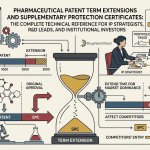
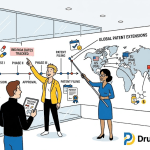
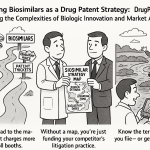
The $236 billion Loss of Exclusivity wave hitting between 2025 and 2030 is the most concentrated revenue erosion event in the industry’s history. Keytruda, Eliquis, Stelara, Jardiance, and Ozempic are all on the clock. For IP teams, portfolio managers, and institutional investors, the question is no longer whether to build a patent-expiry forecasting capability — it is whether the one you have can handle the velocity, jurisdictional complexity, and litigation volatility of what is coming.
This guide covers the full institutional architecture: governance structure, data systems, PTA and SPC calculation mechanics, evergreening tactics and their regulatory exposure, biosimilar interchangeability timelines, litigation probability modeling, and the financial integration of Loss of Exclusivity (LOE) dates into NPV models and IP valuation frameworks. Every section is written for pharma and biotech IP teams, R&D leads, portfolio managers, and the business development professionals who need operational precision, not broad summaries.
I. The $236 Billion Patent Cliff: What the Revenue-at-Risk Number Actually Means
A. Quantifying the Collision: Revenue, Velocity, and Concentration Risk
The headline figure — $236 billion in brand revenue exposed to generic and biosimilar competition between 2025 and 2030 — is widely cited, but it obscures a structural problem more dangerous than the aggregate total. The risk is concentrated. Most of that exposure lands in a five-year corridor when the largest-ever cohort of biologics and small-molecule blockbusters hits simultaneous LOE. That compression creates a compounding execution problem: the same legal teams that track PTA calculations must also run Paragraph IV defense strategy, the same commercial teams executing brand wind-down must simultaneously prepare successor product launches, and financial models require real-time certification of LOE dates that are moving targets.
The specific drugs defining this wave matter because their patent architecture differs fundamentally from the small-molecule cliff of 2011–2015, when atorvastatin, clopidogrel, and esomeprazole drove generic launches that were technically straightforward and legally well-mapped. The current wave involves biologics such as Merck’s pembrolizumab (Keytruda), Johnson & Johnson’s ustekinumab (Stelara), and AbbVie’s adalimumab (Humira, now well into its biosimilar transition), where the concept of ‘expiration’ is not a single date but a layered legal event involving biological product exclusivities under the Biologics Price Competition and Innovation Act (BPCIA), Orange Book and Purple Book patent listings, and interchangeability designation timelines.
For institutional investors, this concentration risk does not distribute evenly across the pharma universe. Merck derives roughly 40% of its 2025 revenue from Keytruda, whose core composition of matter patent expires in 2028, though the full portfolio of formulation and method-of-use patents extends defensible exclusivity into the early 2030s depending on jurisdiction. AbbVie, by contrast, is already past the Humira cliff and executing its Skyrizi and Rinvoq succession strategy — a live case study in what institutionalized LOE planning looks like when it works. Companies without an equivalent pipeline-switching strategy entering the 2025-2030 window face revenue exposure that will not be absorbed by organic growth.
B. IP Valuation as a Core Portfolio Asset: How LOE Dates Drive Enterprise Valuation
The patent estate is not an accounting abstraction. For a research-based manufacturer, the patent portfolio is the primary balance sheet asset that justifies the gap between a company’s book value and its market capitalization. The commercial lifespan defined by the LOE date is the single most important input to the Free Cash Flow models that underpin discounted cash flow (DCF) valuations.
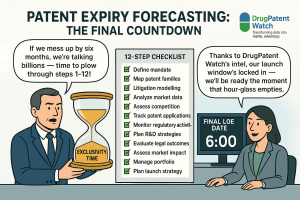
A working IP valuation model for a pharmaceutical asset requires the LOE date to be treated as a ‘known unknown’: legally deterministic within a probability range, but subject to adjustment based on litigation outcomes, regulatory exclusivity decisions, and extension filings. Patent-backed financing transactions — including royalty monetization structures, patent-collateralized debt, and IP securitization — price this uncertainty into spread and covenant structures. A six-month error in the certified LOE date on a $5 billion-per-year asset translates to roughly $2.5 billion in mismapped cash flow, which flows directly into mispriced debt and equity instruments.
The practical IP valuation framework that flows from a certified LOE date uses three components: the ‘monopoly period NPV’ (discounted cash flows from today to the Final Date), the ‘erosion curve NPV’ (the post-LOE period modeled with generic entry assumptions), and the ‘extension option value’ (probabilistic value of PTE, SPC, pediatric exclusivity, or litigation-derived delay). Specialized patent intelligence platforms that provide granular extension and litigation data directly feed the third component, which is where most valuations are materially wrong.
C. The Cost of Decentralized Forecasting
Most pharma companies do not have a single, institutionalized LOE forecasting system. What they have are fragmented processes: IP counsel tracking prosecution files, regulatory affairs maintaining exclusivity records, commercial teams working from approximations, and finance modeling whatever date Legal last communicated months ago. This decentralization has predictable consequences.
When Pfizer’s atorvastatin lost exclusivity in November 2011, generic manufacturers who had precisely modeled the 180-day exclusivity window for the first Paragraph IV filer captured the bulk of the immediate post-LOE volume. Ranbaxy (now Sun Pharma) had certified its first-filer status years in advance, secured its ANDA approval, and executed at scale on day one. That level of precision requires the kind of institutionalized data infrastructure this guide details. For the brand side, Pfizer’s residual market strategy — retaining a ‘sticky’ patient segment through authorized generics and co-pay assistance — worked precisely because it had been planned years ahead of the LOE date, not scrambled in the final months.
II. Phase I: Building the Forecasting Foundation (Steps 1-4)
Step 1: The Executive Mandate and the LOE Steering Committee
No cross-functional forecasting process survives without C-suite enforcement. The mandate must be formal: a charter, a defined cadence, and functional heads with direct accountability. The mechanism is an LOE Steering Committee that meets quarterly at minimum and monthly in the 18-month window before any major LOE date.
Functional Composition and Accountability
The committee requires five functional seats, not four. Legal/IP retains ownership of patent prosecution data, PTE and SPC filing status, and litigation tracking. Regulatory Affairs owns first Marketing Authorization dates, orphan drug designations, and pediatric study submissions — the inputs that Legal cannot self-generate. R&D provides pipeline readiness timelines: when the next-generation molecule or biologic is phase-complete, what its own IP architecture looks like, and whether patient-switching infrastructure (REMS programs, delivery device patents) will be ready before the brand LOE. Commercial and Business Development integrates the Final Date into market strategy, brand ‘stickiness’ execution, and authorized generic decision frameworks. Finance certifies the Final Date into NPV models, manages IP valuation for any financing or M&A transactions, and owns scenario planning.
The fifth seat — not present in most existing frameworks — belongs to a dedicated competitive intelligence function. This seat tracks Paragraph IV activity, ANDA and biosimilar BLA filings, 505(b)(2) submissions against the brand’s formulation patents, and competitor pipeline activity that could redefine the market before the LOE date even arrives.
The ‘Sunset Value Trap’ and Why Early Integration Prevents It
The Sunset Value Trap occurs when IP defense is disconnected from commercial planning. Legal obtains a PTE and defends three formulation patents through litigation, extending the effective LOE date by 18 months. Meanwhile, R&D’s next-generation molecule is 24 months away from approval, and Commercial has no patient-switching strategy for the gap. The extended IP defense created a 24-month dead zone: brand revenues already eroding from competitive therapy switching, no successor product ready, and no authorized generic to capture volume. The mandate exists to force the integration that prevents this.
Key Takeaways: Step 1
The LOE Steering Committee is most valuable not as a reporting mechanism but as an integration mechanism. Its job is to ensure that every decision made by Legal about IP extension or litigation has a corresponding R&D and Commercial readiness check, and that Finance is certifying Final Dates that Legal has already stress-tested against known litigation risk. Without this committee, the organization is managing IP defense and commercial strategy on separate tracks that collide at the worst possible moment.
Investment Strategy Note
Portfolio managers evaluating pharma equities should ask whether a company has an institutionalized LOE committee with cross-functional composition and a documented Final Date certification process. The absence of this structure in companies facing major 2026-2030 LOEs is a material governance gap, particularly relevant for biosimilar-exposed biologics where the BPCIA patent dance introduces additional variables that manual tracking cannot handle.
Step 2: Data Governance and the Single Source of Truth
Patent-expiry forecasting fails most often at the data layer. The IP team tracks prosecution files. Regulatory Affairs maintains marketing authorization records in a separate system. Finance uses a spreadsheet last updated when someone remembered to ask Legal. The result is three different LOE dates for the same drug circulating simultaneously within the organization, with no mechanism for adjudicating which is correct.
The Single Source of Truth Architecture
The SSOT for LOE forecasting requires seven data fields with defined functional owners and a documented audit trail:
The patent filing date (priority date in multi-jurisdiction families) sets the 20-year baseline term and is owned by IP Counsel with quarterly verification against USPTO, EPO, and national office records. The first Marketing Authorization date in the EEA (for SPC calculation) and the FDA approval date (for PTE calculation) are owned by Regulatory Affairs and must be stored with the source document attached — not just the date, because SPC examination in multiple jurisdictions will require the original MA certificate. The regulatory exclusivity status covers New Chemical Entity (NCE) five-year exclusivity, Orphan Drug seven-year exclusivity, and Pediatric six-month add-on; all are owned jointly by Legal and Regulatory Affairs. Active litigation status covers Paragraph IV certifications, inter partes review (IPR) petitions, and any district court proceedings, owned by Litigation Support with real-time updates from specialized patent databases. The PTE/SPC filing status — whether an application has been filed, granted, or is under review — is owned by IP Counsel and updated on each new regulatory action. Patent expiry dates across all key commercial jurisdictions (US, EU-27, UK, JP, CN, KR, CA, AU) must account for national-level variation in extension mechanisms and are owned collectively by the IP team and outside counsel in each jurisdiction.
Global Patent Family Mapping
Every commercial drug asset sits atop a multi-layered patent family structure that spans these jurisdictions. Mapping this structure requires moving beyond the initial Composition of Matter (CoM) patent, which in most cases expires well before the commercially relevant LOE date, to catalogue the full family: CoM filed preclinical (the 20-year baseline clock), Method of Use patents filed during Phase II that protect individual indications and enable secondary indication expansion, Formulation and Dosage Form patents filed during Phase III that cover the specific commercial product and are the primary target of 505(b)(2) and Paragraph IV challenges, Process Chemistry patents that protect manufacturing know-how and are particularly relevant for biologic production, and Device and Delivery patents that protect auto-injectors, inhalers, and combination products.
For biologics, the Purple Book listing structure adds a layer of complexity absent from small-molecule Orange Book tracking. A biologic may have four or five patents listed in the Purple Book, each requiring separate tracking against biosimilar BLA submissions and the BPCIA ‘(l)(3)(A)’ notice provisions that trigger the patent dance. The data governance framework must accommodate both Orange Book and Purple Book records with field-level attribution.
Key Takeaways: Step 2
A SSOT built on seven defined data fields with clear functional ownership transforms LOE forecasting from a best-effort legal opinion into a certifiable financial input. The most common failure mode is assigning ownership of the first Marketing Authorization date to IP Counsel rather than Regulatory Affairs — the team that actually holds the document and understands its jurisdictional nuances.
Step 3: Deploying Specialized Pharmaceutical Patent Intelligence Systems
Google Patents and Espacenet are research tools. They index patent documents but do not track the dynamic legal and regulatory status of individual drug patents across jurisdictions in real time. They have no litigation layer, no exclusivity registry integration, and no competitive filing intelligence. Using them as the primary data source for LOE forecasting is the data governance equivalent of valuing a drug using list price instead of net price.
What Specialized Platforms Track That General Databases Do Not
Platforms designed specifically for pharmaceutical patent intelligence — DrugPatentWatch is the benchmark example — provide data structures that general patent databases cannot replicate. The coverage includes 60,000+ patent families across 130 countries with drug-specific classification, 2,500+ small molecule and 8,500+ litigated case records, and 34,000+ tracked patent extensions and SPCs. More valuably for active forecasting, these platforms track ANDA submission dates, Paragraph IV certification filing dates, tentative approval timelines, and the litigation outcomes against specific patent claims within a patent family — not just whether litigation occurred, but which claims were found valid, which were invalidated, and which settled under confidential consent agreements.
This granularity matters because the financial value of the LOE forecast does not sit in knowing the statutory expiration date of a composition of matter patent. It sits in knowing whether the formulation patent that extends effective exclusivity by three years has survived prior art challenges, whether the method of use patent for the highest-revenue indication has already been invalidated by IPR, and whether a first Paragraph IV filer has a tentative ANDA approval sitting on file awaiting only the LOE date. All of these inputs require drug-specific litigation and regulatory data that general patent search tools do not provide.
Integration with Competitive Intelligence
Specialized platforms also feed the competitive intelligence function described in Step 1. Analyzing the Paragraph IV challenge history against specific secondary patents — formulation patents in particular — reveals the litigation durability of the brand’s defensive moat. A formulation patent that has already survived three IPR petitions and one district court obviousness challenge carries substantially more forecasting weight than one that has never been tested. Conversely, a formulation patent where the IPR institution rate by PTAB has been high signals a weaker defensive position that should push the probability-weighted LOE date earlier.
API Supply Chain Intelligence as a Forecasting Input
For generic and biosimilar manufacturers, specialized platforms provide a capability that pure patent intelligence databases miss entirely: API supplier identification. Knowing the theoretical LOE date matters less if the supply chain for the active pharmaceutical ingredient cannot support commercial-scale launch. Platforms that cross-reference patent expiry data with known API manufacturer registrations — particularly for complex molecules sourced from a limited number of Chinese or Indian facilities — allow generic launch planners to identify supply chain constraints well ahead of the LOE date and secure manufacturing capacity before competitors do.
Key Takeaways: Step 3
The ROI on specialized patent intelligence platforms is measurable: one avoided Paragraph IV litigation surprise on a major asset, or one successfully identified first-filer window, typically exceeds the multi-year platform cost. The platforms are infrastructure, not optional research tools.
Investment Strategy Note
Institutional investors should recognize that pharma companies using specialized IP intelligence infrastructure have a demonstrably lower rate of ‘LOE surprise’ — defined as a generic entering the market earlier than the company’s financial guidance had indicated. These surprises are the primary mechanism by which pharma stocks experience sharp single-day drawdowns on earnings calls. The absence of institutional-grade IP intelligence is a quantifiable governance risk factor.
Step 4: Building the Global Patent Family Master Record and Identifying the Pivotal Patent
The ‘Final Date’ — the LOE date that enters the financial model — is the last defensible date across all patent, exclusivity, and extension mechanisms across all key commercial jurisdictions. It is not the expiration date of any single patent. It is the expiration date of the last surviving legal barrier to unrestricted generic or biosimilar competition.
The Lifecycle Architecture of a Patent Family
Understanding which patent is the Pivotal Patent — the one defining the Final Date — requires mapping the full lifecycle architecture. A typical small-molecule blockbuster launched in 2008 might have a CoM patent filed in 1997 (expiring 2017 before extension), a method of use patent for the primary indication filed in 2001 (expiring 2021), an extended-release formulation patent filed in 2004 (expiring 2024), a pediatric formulation patent filed in 2007 (expiring 2027), and a co-crystal form patent filed in 2009 (expiring 2029). If the co-crystal form patent covers the commercially marketed product and has survived challenges, the Pivotal Patent is the 2029-expiring co-crystal patent — twelve years after the CoM expiration.
Evergreening, the practice of filing successive secondary patents to extend effective market exclusivity beyond the CoM term, is the IP strategy that makes identifying the Pivotal Patent the core analytical challenge. The Yale Law and Policy Review has estimated that secondary patent evergreening strategies have imposed an estimated $53.6 billion in cost on the healthcare system through extended monopoly periods. The policy response is intensifying: the FTC’s 2023 report on pharmaceutical patent listing abuses, ongoing IRA-related price negotiation provisions, and the EU’s proposed pharmaceutical legislation reforming data and market exclusivity timelines all signal a regulatory environment becoming less tolerant of the most aggressive forms of patent stacking.
Evergreening Tactics: A Technical Taxonomy
Forecasters and IP teams need a precise taxonomy of evergreening tactics to identify the Pivotal Patent and assess its litigation durability:
Polymorphic form patents cover crystalline or amorphous forms of a compound. These are highly litigated because the novelty threshold is contested: courts have increasingly required proof that a polymorphic form produces a meaningful clinical benefit to survive obviousness challenges. The Indian Supreme Court’s 2013 ruling in Novartis v. Union of India — rejecting a polymorph patent for imatinib (Glivec) under Section 3(d) of the Indian Patents Act — set a precedent that has influenced generic challenge strategy globally.
Salt and ester form patents cover pharmacologically acceptable salt forms of the active molecule. These are standard lifecycle tools but are relatively weak in litigation because the pharmacokinetic advantages of a specific salt over the free base are rarely clinically substantial enough to support non-obviousness arguments.
Metabolite patents cover the active metabolite of a prodrug. These can be highly durable because the metabolite is chemically distinct from the parent compound, but they require robust prior art analysis to establish that the metabolite itself was not previously known.
Combination product patents cover fixed-dose combinations of the active ingredient with another approved agent. When the combination has demonstrated clinical superiority — improved outcomes, not merely administrative convenience — these patents are substantially harder to challenge and can define the Pivotal Patent for the commercial product even when the individual components are off-patent.
Formulation patents covering modified-release systems, abuse-deterrent technologies, or novel delivery mechanisms (auto-injectors, pre-filled syringes) are the most commercially relevant category for many current assets because the commercial product is the formulation. The brand’s authorized generic and 505(b)(2) strategy depends entirely on whether competitors can design around the formulation patent.
The Biosimilar-Specific Pivotal Patent Problem
For biologics, the Pivotal Patent concept intersects with the BPCIA patent dance in a way that has no small-molecule equivalent. Under 42 U.S.C. 262(l), a biosimilar applicant must provide the reference product sponsor with its abbreviated Biologics License Application (aBLA) within 20 days of the FDA accepting the filing. The sponsor then has 60 days to identify patents it believes could be infringed. The parties negotiate the patent list, select patents for immediate litigation, and defer others for post-approval enforcement. The result is a structured litigation sequence where the brand’s ability to define the Pivotal Patent for BPCIA purposes directly shapes the timing and cost of biosimilar entry.
AbbVie’s management of the Humira (adalimumab) patent estate offers the most instructive case in the biologics space. AbbVie’s patent portfolio around adalimumab expanded to more than 130 U.S. patents across composition, formulation, dosage regimen, and manufacturing. The sheer volume of patents — many filed years after the original biologic approval — delayed U.S. biosimilar entry by more than eight years relative to when the first CoM patent expired. The FTC’s 2023 report specifically called out this strategy as a mechanism of harm to competition.
Key Takeaways: Step 4
The Pivotal Patent is almost always a secondary patent, and its identification requires patent-by-patent analysis of the commercial product rather than the molecule alone. For biologics, the BPCIA patent dance structure means the Pivotal Patent is a moving target determined partly by litigation negotiation, not just by prosecution dates. Both IP teams and portfolio managers need to treat Pivotal Patent identification as an ongoing activity, not a one-time mapping exercise.
III. Phase II: Granular Expiry Calculation and Risk Modeling (Steps 5-8)
Step 5: Calculating U.S. Patent Term Adjustment (PTA) and Patent Term Extension (PTE)
The 20-year patent term from filing date is not the ceiling — it is the floor for pharmaceutical patents with approved products. Two mechanisms extend the term, and both require precise calculation against documented inputs. Getting either wrong produces an incorrect Final Date.
Patent Term Adjustment: The Prosecution Delay Mechanism
PTA compensates for administrative delays caused by the USPTO during patent prosecution. The calculation uses three delay categories: A delays occur when the USPTO fails to issue a first Office Action within 14 months of filing; B delays occur when the USPTO fails to respond to an applicant reply within four months; C delays occur when the patent does not issue within 36 months of the filing date. Each day of delay in any category adds one day to the patent term, with an important constraint: days where the applicant caused delay — defined as taking more than three months to respond to an Office Action — are subtracted from the total.
The USPTO’s own PTA dashboard shows the current average PTA for pharmaceutical patents running between 1.5 and 2.8 years, depending on art unit and examination load. Patents in crowded art units with high examination backlogs consistently accumulate larger PTAs. This means that two patents with identical filing dates and similar priority claims can carry substantially different LOE dates based on USPTO processing speed — a variable entirely outside the applicant’s control but entirely within the forecaster’s ability to model using historical art unit data.
The calculation formula itself is deceptively straightforward:
PTA = (A delay + B delay + C delay) – applicant delay – overlap days
The complexity lies in documentation. Every A, B, and C delay must be verified against the USPTO’s prosecution history record. Applicants have historically found PTA calculation errors in USPTO determinations and filed requests for reconsideration that added months to the final term. Building this reconsideration analysis into the forecasting workflow — particularly for high-value assets — is standard practice at companies with institutionalized LOE programs.
For a drug generating $4 billion annually, a successfully contested PTA reconsideration that adds eight months to the patent term is worth approximately $2.7 billion in protected revenue. The legal cost of the reconsideration filing is measured in thousands of dollars.
Patent Term Extension: The Regulatory Review Compensation Mechanism
PTE operates on a different principle and different constraints. Under 35 U.S.C. 156, the Hatch-Waxman Act grants the patent owner a term extension equal to half the time consumed by IND clinical testing plus the full time consumed by FDA regulatory review, capped at five years of extension with the stipulation that the total period of exclusivity following market approval cannot exceed 14 years.
The five-year cap and 14-year post-approval ceiling operate independently. A drug approved quickly after a short clinical program may hit the 14-year ceiling before the five-year cap matters. A drug with a long NDA review but quick clinical development may approach the five-year extension cap. The LOE forecasting team must model both constraints simultaneously.
PTE applies to exactly one patent per approved product, and the patent holder selects which patent to extend. For lifecycle management purposes, the selection decision is strategic: extending the CoM patent extends blanket protection, but it may already be expiring. Extending a formulation patent that covers the commercial product and has more years remaining on its base term can yield more absolute monopoly time. This selection analysis is a significant IP strategy decision that directly affects the Final Date and must be coordinated between IP Counsel and the commercial team before the PTE application deadline (within 60 days of approval).
Key Takeaways: Step 5
PTA and PTE are not administrative formalities — they are value creation mechanisms. Companies that audit their PTA calculations against USPTO prosecution records, and that conduct rigorous patent selection analysis before filing PTE applications, systematically generate more protected revenue than those that treat both as routine filings. Finance teams should require documented PTA and PTE calculations before certifying any Final Date for an asset generating above $500 million annually.
Investment Strategy Note
For investors, the PTE selection decision is publicly observable via the Orange Book. A company that selects its most commercially significant formulation patent for PTE extension, rather than the expiring CoM, is demonstrating sophisticated lifecycle management. A company that allows the PTE window to lapse without filing — or that selects a weak secondary patent for extension — is leaving protected revenue on the table.
Step 6: Modeling European Supplementary Protection Certificates
The EU’s Supplementary Protection Certificate mechanism compensates the patent holder for time consumed by the EMA regulatory review process. The formula is straightforward:
SPC Term = Date of first MA in the EEA – Date of corresponding patent filing – 5 years
The result is capped at five years. An additional six months is available through the Paediatric Investigation Plan (PIP) extension under Regulation 1901/2006, bringing the theoretical maximum to 5.5 years. For a drug with a 10-year EMA review period and a patent filed 12 years before MA, the SPC term calculation yields: 12 years – 5 years = 7 years, capped at 5 years. A drug with a 6-year review period and an 8-year gap between patent filing and MA yields: 8 years – 5 years = 3 years. If the SPC term calculates to zero or negative, no SPC is granted.
The Fragmentation Problem in European SPC Forecasting
The SPC’s structural complexity does not come from the formula — it comes from the execution. SPCs are national rights filed separately with the patent office of each EU member state. This means a single drug may have up to 27 separate SPC applications proceeding simultaneously, with each national office conducting its own examination under its own procedural standards and timeline. National inconsistencies — in how courts interpret the ‘product protected by the patent’ requirement from Neurim, Teva v. Gilead, Actavis v. Sanofi, and the subsequent CJEU rulings on SPC eligibility — have historically produced situations where an SPC is granted in Germany and refused in France for the same patent and the same MA.
The estimated cost of filing and maintaining a five-year SPC across the EU is approximately €192,000 per product. This cost is manageable for a blockbuster biologic but is a real constraint for specialty drugs with smaller European commercial footprints. Forecasters must assess whether the company has actually filed SPCs in all key revenue markets, not assume that European SPC coverage is comprehensive simply because the product is EU-approved.
The Unitary SPC Proposal and Its Forecasting Implications
The European Commission’s proposed unitary SPC regulation — part of the broader pharmaceutical legislation reform package initiated in 2023 — would centralize SPC examination at the EUIPO, eliminating national fragmentation and creating a single instrument valid across all EU member states. If enacted in its current form, the unitary SPC would reduce administrative costs substantially, eliminate the national inconsistency risk, and make European LOE dates more predictable for both brand and biosimilar forecasters. The legislation was still moving through the European Parliament and Council as of early 2026, meaning forecasters must continue to model the fragmented national system for the near term while tracking the reform timeline for assets with MA dates beyond the expected implementation window.
UK SPC Post-Brexit
Post-Brexit UK SPCs operate independently under retained EU law as modified by the Intellectual Property (Amendment etc.) (EU Exit) Regulations 2020. UK SPC applications are filed with the UKIPO, examinated against UK-specific case law that has diverged on certain points from CJEU precedent since 2020. For drugs with significant UK commercial revenue, the UK SPC status must be tracked as a separate jurisdiction, not assumed to mirror the EU position.
Key Takeaways: Step 6
European SPC forecasting requires a country-by-country status check, not a formula calculation. The LOE date for European markets is only accurate if the forecaster has confirmed which specific national SPCs were actually filed, granted, and maintained — not which SPCs could theoretically have been obtained.
The LOE date is the last date from any source: patent, SPC, PTE, regulatory exclusivity, or biologic product exclusivity. Assembling the correct Final Date requires all of these inputs in a single model with the max() function, not additive stacking.
Regulatory Exclusivity Stacking
New Chemical Entity (NCE) exclusivity grants five years of protection from ANDA or 505(b)(2) submission in the US, running from the date of first NDA approval. Orphan Drug Exclusivity (ODE) grants seven years of market exclusivity for drugs approved for diseases affecting fewer than 200,000 US patients annually, and can apply to specific indications even when the molecule has broader commercial uses — creating an indication-level exclusivity that is product-wide in scope. Pediatric exclusivity under Best Pharmaceuticals for Children Act (BPCA) adds six months to any existing patent or exclusivity, but it is not automatic: it requires that the company conduct FDA-requested pediatric studies and that the FDA accept the study reports as responsive to the Pediatric Written Request.
For biologics, the BPCIA provides 12 years of reference product exclusivity from the date of first licensure under 42 U.S.C. 262(k)(7), plus four years of data exclusivity during which no biosimilar BLA may be accepted by FDA. This 12-year exclusivity period is the operational floor for U.S. biologic LOE modeling, regardless of when the underlying patents expire. The interplay between BPCIA exclusivity and the patent dance means that biosimilar launch timing is determined by whichever protection lasts longer: the 12-year exclusivity or the Pivotal Patent. For Humira, the 12-year exclusivity expired in 2023, the same window in which the first interchangeable biosimilar designations were issued — making the exclusivity expiration, not any individual patent, the binding constraint.
Biosimilar Interchangeability Designation as a LOE Accelerant
A biosimilar approved by the FDA as ‘interchangeable’ can be substituted for the reference biologic at the pharmacy level without physician intervention, subject to state pharmacy substitution laws. This distinction is critical for the revenue erosion model: a biosimilar that is not interchangeable requires a new prescription or an active physician switch, meaning uptake is slower and formulary displacement of the reference biologic is less automatic. An interchangeable biosimilar, by contrast, can be substituted immediately upon generic substitution policies, accelerating the revenue erosion curve by 12-24 months compared to a non-interchangeable biosimilar.
Insulin products (glargine, lispro) and adalimumab biosimilars have driven most of the early interchangeability designation experience in the U.S. market. The LOE model for any biologic reference product must explicitly flag whether interchangeability has been sought, whether it has been granted, and whether the state formulary substitution laws in the top-10 revenue states permit automatic substitution for the specific product class.
China Patent Term Restoration
China implemented Patent Term Restoration (PTR) for pharmaceutical patents in 2021, allowing extensions of up to five years for patent term consumed by the NMPA regulatory review process, capped at a total patent term of 14 years from approval. This mechanism directly mirrors the U.S. PTE structure and was part of the IP reform commitments in the Phase One trade agreement with the United States. PTR applications in China require submission within three months of NMPA approval, and early case experience through 2025 shows the CNIPA granting extensions in the 2-4 year range for innovative pharmaceuticals with lengthy review periods. For global LOE forecasting, China must now be treated as a PTE-eligible jurisdiction, not a market where the CoM expiry date is the final word.
Key Takeaways: Step 7
The regulatory exclusivity layer — particularly the BPCIA 12-year reference product exclusivity and the pediatric add-on — is frequently the binding constraint for biologic LOE dates, not the patent portfolio. Forecasters who model only the patent estate will systematically underestimate effective biologic exclusivity, while those who model only the 12-year BPCIA exclusivity without checking the patent dance outcome will underestimate the delay that late-stage BPCIA litigation can add.
Step 8: Quantifying Litigation Risk and Paragraph IV Probability Modeling
Litigation is the primary source of variance in the LOE forecast. Every certified Final Date carries a probability distribution, not a point estimate, and that distribution is shaped primarily by the litigation history of the specific patents and the brand’s defense strategy.
The Paragraph IV Framework and Its Financial Mechanics
Under the Hatch-Waxman Act, a generic manufacturer filing an ANDA containing a Paragraph IV certification — asserting that a listed Orange Book patent is invalid or would not be infringed by the generic product — triggers a 45-day window during which the brand may sue the generic. Filing suit automatically triggers a 30-month stay on FDA approval of the ANDA, giving the brand 30 months to win or settle the litigation before the generic can launch. If the brand fails to file suit within 45 days, the ANDA may proceed immediately.
The 30-month stay is the single most valuable litigation tool in the brand’s arsenal because it delays generic launch regardless of the underlying merits of the patent claims. A brand with a weak formulation patent can still capture 30 months of additional protected revenue simply by suing the first Paragraph IV filer. The forecasting implication: every Paragraph IV filing against a listed Orange Book patent should be modeled as having a 30-month stay probability of roughly 90% (conditional on the brand filing suit) plus a probability-weighted litigation outcome based on the specific patent’s documented vulnerability.
Litigation Outcome Probability Modeling
Modeling the probability that a specific patent survives a Paragraph IV challenge requires five inputs. The patent’s IPR institution rate at PTAB is the first filter: patents where PTAB has instituted multiple IPR reviews face substantially higher invalidity risk than patents where institution has been denied on all petitions. The prior art density around the specific patent claims — particularly for formulation and method-of-use patents — is the second input, assessable through patent citation analysis and prior art search. The litigation track record of the specific generic challenger matters: Teva, Mylan (now Viatris), and Sun Pharma each have different historical win rates against different categories of secondary pharmaceutical patents. The judge assignment in the likely venue (District of Delaware and New Jersey are the dominant forums for pharmaceutical patent litigation) introduces variance based on individual jurist tendencies on claim construction and obviousness. Finally, any prior consent decrees, settlement structures, or authorized generic agreements in the brand’s Paragraph IV litigation history reveal the brand’s actual willingness to litigate versus settle — a behavioral input that significantly affects the probability distribution.
Non-Practicing Entity Activity in Late-Term Patent Enforcement
The Penn Law Review’s empirical analysis of patent litigation timing found that Non-Practicing Entities initiate more than two-thirds of all infringement suits litigated in the final three years of a patent’s term, with NPE activity concentrated precisely in the window when the patent is least commercially significant to a practicing entity but still legally valid. For pharmaceutical patent forecasters, this creates a specific risk that is poorly handled by most existing models.
An NPE holding a process patent — covering a manufacturing method used to produce the API — may assert that patent in the 18 months before expiry, seeking royalties or an injunction against both the brand manufacturer (for current production) and the generic manufacturer (for anticipated launch). This late-term assertion creates unexpected legal costs and potential supply disruption precisely when the brand is managing its wind-down and the generic is ramping production for launch. The financial provision for NPE risk in the LOE model should be a function of the patent age, the technology category (process patents attract more NPE activity than formulation patents), and whether the API manufacturing process is known to overlap with patents held by NPE aggregators active in the pharma space.
The 180-Day First-Filer Exclusivity Window
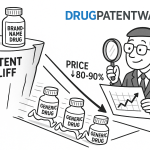
The first generic manufacturer to file a Paragraph IV certification against a specific Orange Book patent earns 180 days of market exclusivity from the date of commercial launch. During this period, no other ANDA with Paragraph IV certification against that patent can receive final FDA approval. This exclusivity window is worth, on average, 80-90% of the post-LOE generic market revenue during those 180 days, because the first filer typically prices at 80-85% of brand WAC and faces no generic competition.
For the brand, the 180-day window creates a counter-intuitive strategic opportunity. Entering an authorized generic agreement with the first filer — where the brand licenses its own product to the generic at a preferential price in exchange for revenue sharing during the 180-day exclusivity — captures a portion of the generic market that would otherwise flow entirely to a competitor. This authorized generic strategy has been used by Pfizer (Lipitor/atorvastatin), AstraZeneca (Nexium/esomeprazole), and multiple other brands, and must be modeled explicitly in the revenue forecasting for the post-LOE period.
Key Takeaways: Step 8
Every LOE forecast requires an explicit litigation probability adjustment to the Final Date. The adjustment should be built from documented inputs — IPR history, prior art density, challenger track record, venue tendencies — not from generic industry averages. NPE late-term activity is a tail risk that justifies a financial provision in the LOE model for any patent with more than $1 billion in annual protected revenue and a remaining term under three years.
IV. Phase III: Commercializing the Forecast (Steps 9-12)
Step 9: Integrating LOE Dates into Financial Models and NPV Frameworks
The Final Date from Phase II enters the financial model in a specific technical way that most non-specialist finance teams get wrong. The LOE date is not when revenue drops to zero — it is when the first generic can legally launch. The revenue erosion model begins at that date, not before, and follows a decline curve shaped by the number of generic entrants, the 180-day first-filer exclusivity structure, payer formulary dynamics, and the authorized generic strategy.
Building the Revenue Erosion Curve
Empirical data on post-LOE revenue erosion shows significant variation by therapeutic category, market structure, and payer concentration. For small-molecule oral solids, originator volume losses of 70-90% in the first 12 months post-generic launch are standard in the U.S. market. European markets show faster volume erosion but also faster price erosion, with German and UK originator prices falling an average of 25% within the first year post-expiry in markets with mandatory substitution or INN prescribing requirements.
The U.S. market exhibits the Generics Paradox more acutely than any other major market: originator prices often remain stable or increase post-LOE in the U.S. as the brand narrows its patient base to those covered by co-pay assistance programs, manages through specialty pharmacy channels, or retains prescriber loyalty through clinical inertia. The financial model must separate volume and price trajectories rather than applying a single blended revenue decline percentage. A drug with 85% volume erosion but flat pricing retains 15% of its pre-LOE revenue base indefinitely, which is not captured in a simple ‘generic discount’ model.
Scenario Planning Architecture
The LOE financial model must run at minimum four scenarios in parallel. The base case uses the Final Date as calculated in Phase II with probability-weighted litigation adjustments. The early entry scenario accelerates the Final Date by 18-30 months to model a successful Paragraph IV challenge or IPR invalidation of the Pivotal Patent. The extended exclusivity scenario delays the Final Date by 12-18 months to model a successful injunction against a Paragraph IV filer, a late PTE approval, or pediatric exclusivity acceptance. The authorized generic scenario models the brand capturing first-filer revenue-sharing during the 180-day window. Each scenario carries a probability weight derived from Step 8 litigation modeling, and the probability-weighted expected value across all four scenarios is the LOE financial forecast.
IP Valuation and Patent-Backed Financing
The LOE forecast feeds directly into formal IP valuation for financing transactions. Patent-collateralized debt — a growing instrument in pharma financing — requires a certified LOE date as the ‘maturity event’ that determines the useful life of the collateral. Royalty monetization structures, where a company sells its right to future royalties from a licensed patent in exchange for immediate capital, price the LOE date directly into the cash flow multiple. IP securitization transactions backed by patent royalty streams require third-party IP valuation reports, which in turn require a certified LOE date with documented methodology.
The three-component IP valuation framework: Monopoly Period NPV (discounted cash flows from today to the Final Date at a pharma-appropriate WACC of typically 8-12%), Erosion Period NPV (post-LOE cash flows assuming a modeled generic erosion curve over 5-7 years), and Extension Option Value (probabilistic value of any pending PTE, SPC, or pediatric exclusivity applications) — converts the LOE date into a single number suitable for balance sheet treatment and financing transactions.
Key Takeaways: Step 9
The U.S. Generics Paradox requires the financial model to disaggregate volume and price projections post-LOE rather than applying a single revenue decline percentage. The four-scenario LOE model — base, early entry, extended exclusivity, authorized generic — with probability-weighted expected values is the minimum standard for a certifiable financial forecast used in IP valuation or patent-backed financing.
Investment Strategy Note
Sell-side analysts modeling pharmaceutical earnings should build the four-scenario LOE structure into coverage models for any company with more than 20% revenue concentration in a single asset facing LOE within five years. Single-scenario LOE models — the most common approach in sell-side research — systematically understate the probability distribution around the forecast date and should carry an explicit uncertainty haircut.
Step 10: Executing the Commercial Defense Strategy
The certified Final Date triggers a commercial defense timeline with defined milestones. The standard timeline for a major LOE runs 36-48 months of commercial preparation following the Final Date certification.
Lifecycle Management Tactics: Technical Depth
The commercial defense strategy for an innovator facing LOE draws from a defined toolkit of lifecycle management tactics, each with specific patent, regulatory, and commercial requirements.
Extended-release formulation switching — converting patients from an immediate-release formulation to an extended-release version protected by a separate formulation patent — requires the extended-release patent to be Orange Book-listed, the new formulation to have demonstrated clinical differentiation (not merely administrative convenience, which is increasingly challenged by FDA’s citizen petition responses), and a commercial switch program beginning at minimum 24 months before the IR formulation’s Final Date. Nexium/Prilosec at AstraZeneca and Wellbutrin XL at GlaxoSmithKline are the canonical examples of extended-release switching with varying degrees of success.
Fixed-dose combination switching protects the combination formulation in a separate Orange Book-listed patent and requires the FDC to demonstrate either clinical superiority (through a dedicated outcome or PK trial) or regulatory simplification (reduced pill burden). If the FDC is protected and the original formulation loses exclusivity, the prescriber base can be transitioned to the FDC before generic versions of the single-agent formulation enter the market. This strategy worked effectively for olmesartan medoxomil combinations (Azor, Tribenzor) in the antihypertensive space.
Abuse-deterrent formulation (ADF) technologies — applied primarily to Schedule II opioids and certain CNS medications — create formulation patents that are both technically difficult to design around and clinically differentiated under FDA’s abuse-deterrent guidances. ADF patents have survived Paragraph IV challenges more frequently than other secondary formulation patents because the clinical differentiation criteria are explicitly recognized by FDA’s approval framework.
New indication expansion through Method of Use patents — filing secondary method patents for new therapeutic indications identified through post-approval clinical programs — extends patent protection for specific patient populations even when the primary indication loses exclusivity. This approach requires coordinated R&D investment in new indication clinical trials and is most viable when the drug’s mechanism supports scientifically credible expansion into adjacent indications.
The OTC Switch Option
For drugs where consumer self-diagnosis and self-treatment are clinically appropriate, an OTC switch preserves brand equity through a new consumer market while the Rx formulation faces generic competition. Successful OTC switches require an FDA-approved OTC monograph or a separate OTC NDA filing, a consumer packaging and labeling program, and a commercial infrastructure that operates through mass-market retail channels rather than pharmacy dispensing. The strategy works most effectively when the OTC market is large enough to offset the Rx revenue loss — loratadine (Claritin), omeprazole (Prilosec OTC), and orlistat (Alli) are the benchmark cases.
Key Takeaways: Step 10
Commercial defense strategy must begin 36-48 months before the Final Date, not in the final year. The most common failure mode is initiating the extended-release or FDC switch program too late to accumulate sufficient prescriber conversion before generic IR versions enter the market. The LOE Steering Committee’s quarterly cadence exists to enforce this timeline.
Step 11: Building the Generic and Biosimilar Market Entry Strategy
For generic and biosimilar manufacturers, the Final Date is not a threat — it is a market entry signal. The strategy for capturing maximum value from a patent cliff requires preparation that begins 4-6 years before the Final Date for small molecules and 6-8 years for biosimilars.
Generic Entry: ANDA Strategy and First-Filer Targeting
The optimal ANDA strategy for a Paragraph IV first-filer requires identifying the target drug’s Orange Book patent list, assessing which patents are most vulnerable to invalidity or non-infringement claims, and calibrating the filing to maximize the probability of securing first-filer status while minimizing litigation risk. Patents with prior art density in academic literature, patents where related compounds have been publicly described before the priority date, and method patents where the proposed generic labeling can be crafted to avoid literal infringement (label carve-outs) are the highest-value targets for Paragraph IV certification.
The financial prize justifies the investment. The 180-day first-filer exclusivity on a major brand — a drug with $3-5 billion in annual U.S. sales — generates $300-600 million in incremental generic revenue during the exclusivity window alone. This ROI calculation is why the specialized pharmaceutical patent intelligence infrastructure described in Step 3 is cost-justified even for mid-sized generic manufacturers.
Biosimilar Development: The BPCIA Dance and Interchangeability Investment Decision
Biosimilar development economics differ fundamentally from small-molecule generics. The regulatory investment required for an aBLA approval — including analytical characterization, non-clinical studies, and Phase III immunogenicity and pharmacokinetic bridging studies — typically costs $100-250 million, versus $1-5 million for a typical small-molecule ANDA. The investment thesis requires a market entry window large enough and a market size sufficient to recover that development cost.
The interchangeability designation decision is the pivotal strategic choice in biosimilar development. FDA’s interchangeability requirements include a switching study demonstrating that alternating between the reference biologic and the biosimilar produces no greater safety or efficacy risk than continuing on the reference product. The switching study adds cost and time — typically 12-18 months and $20-40 million in additional clinical investment — but the revenue premium from formulary substitution rights can be substantial. For adalimumab biosimilars, Organon’s Hadlima and Boehringer Ingelheim’s Cyltezo both pursued interchangeability designations in the U.S. market specifically to access the formulary substitution channel that payers were activating aggressively from 2023 onwards.
Payer Formulary Strategy as the True Market Access Lever
Payer strategy is, for biosimilars, at least as important as regulatory approval. The Humira case demonstrated this with precision: payers who acted on the biosimilar LOE through proactive formulary exclusion of the reference biologic achieved savings in the hundreds of millions within the first formulary year. The mechanism requires the biosimilar manufacturer to provide sufficient rebate economics to make the formulary exclusion worthwhile for the PBM or health plan, which in turn requires the biosimilar price to be set at a level that still generates adequate margin after the rebate.
The biosimilar pricing and contracting strategy must therefore model the rebate economics backward from the payer’s required savings threshold to the minimum biosimilar price that makes formulary exclusion viable. This is not a public market pricing exercise — it is a structured negotiation that begins 12-18 months before launch. Generic and biosimilar manufacturers who fail to build the payer economics model before filing their aBLA arrive at formulary negotiations without the data needed to close contracts.
API Supply Chain: The Execution Risk Most Models Miss
Patent expiry models for generic entry almost universally focus on IP and regulatory timelines. The variable that causes the most market entry failures is manufacturing execution: the inability to produce API at commercial scale in the required regulatory timeline. For complex molecules with difficult synthesis pathways, small-molecule generics depending on a limited number of qualified API sources in China or India face supply constraints that the LOE date model does not capture.
Specialized patent intelligence databases that cross-reference patent expiry data with registered API manufacturer databases allow generic manufacturers to identify supply chain bottlenecks years ahead of the LOE date and to take equity positions, long-term supply agreements, or technology transfer arrangements with qualified API suppliers. This supply chain foresight is particularly acute for targeted oncology drugs (complex synthesis, limited API suppliers) and complex natural product-derived APIs.
Key Takeaways: Step 11
The 180-day first-filer exclusivity on major brands is worth hundreds of millions in incremental revenue — the calculation is simple and the prize is large enough to justify significant legal and analytical investment in Paragraph IV filing strategy. For biosimilars, the interchangeability decision must be modeled against the specific payer formulary dynamics of the target market, not against a generic industry assumption.
Investment Strategy Note
Generic and biosimilar manufacturers with institutionalized first-filer pipeline strategies — documented Paragraph IV filing calendars aligned to specific Orange Book patents and LOE dates — represent structurally more valuable assets than those operating opportunistically. Investors evaluating generic manufacturers should examine the company’s first-filer history, the proportion of ANDA filings that carry Paragraph IV certifications, and the win rate in subsequent Paragraph IV litigation as direct indicators of IP intelligence quality.
Step 12: Continuous Monitoring, Early Warning Systems, and Quarterly LOE Audit
The Final Date is not static. It is a legal position that can change on the day a court issues a validity ruling, the day FDA accepts a pediatric Written Request, or the day a new Paragraph IV certification is filed by an ANDA applicant not previously identified. Treating the LOE forecast as a quarterly certification — with formal re-examination by Legal, Regulatory, and Finance — is the mechanism that prevents ‘LOE surprise.’
The Early Warning System: What to Monitor Weekly
The continuous monitoring function requires a weekly scan of seven categories of dynamic information:
New ANDA filings and Paragraph IV certifications against any Orange Book-listed patent for the monitored asset. USPTO PTAB docket activity for any IPR petition against the Pivotal Patent. Federal Register notices and FDA Center for Drug Evaluation and Research (CDER) approval actions that could modify a competitor’s tentative ANDA approval status. EMA product information updates and national competent authority decisions that could affect SPC validity in specific EU markets. New patent applications filed by the brand in continuation or divisional prosecution chains that might add to the Orange Book list. Competitor pipeline filings — Phase III completion reports, NDA submissions for next-generation molecules in the same therapeutic class — that could redefine the competitive market before the LOE date. Policy and legislative developments affecting exclusivity periods, evergreening constraints, or reference product exclusivity for biologics.
The weekly monitoring output should be a structured intelligence digest distributed to the LOE Steering Committee, flagging any development that requires a Final Date recalculation or a scenario weight adjustment.
The Quarterly LOE Audit
The quarterly audit is the formal certification mechanism. In the audit, IP Counsel confirms that the Pivotal Patent remains valid and enforceable, that no new litigation developments have altered the probability weighting from Step 8, and that all PTE and SPC applications remain on track. Regulatory Affairs confirms that no new pediatric Written Request has been issued, that no competing product has received an approval that could trigger a 180-day window on a first-filer exclusivity claim, and that the first MA dates used in SPC calculations have not been disputed by a national office. Finance re-certifies the Final Date in the NPV model and updates scenario weights based on any litigation or regulatory developments since the prior quarter.
The audit produces a certified LOE Date document with a version number, a documented methodology, and functional sign-off from IP, Regulatory, and Finance. This document is the authoritative input for earnings guidance, IP valuation transactions, and strategic planning.
AI-Assisted LOE Monitoring: The Emerging Infrastructure
Machine learning tools trained on pharmaceutical patent litigation data are now commercially deployed for LOE risk monitoring. These tools track PTAB petitions, court docket filings, and FDA approval actions in real time, flagging high-probability early generic entry signals with lead times measured in days rather than the months that quarterly audits provide. The most sophisticated implementations use natural language processing to analyze new patent applications filed in continuation chains, identifying claim amendments that may expand or narrow the Pivotal Patent’s scope in ways that affect litigation durability.
For companies managing large LOE portfolios — 15+ assets with major LOE events across a five-year horizon — AI-assisted monitoring is moving from a capability differentiator to a basic operational requirement. Manual monitoring at the required granularity and speed is not scalable at that portfolio size.
Key Takeaways: Step 12
The quarterly LOE audit with formal cross-functional sign-off is the single governance mechanism that prevents surprise LOE events from hitting earnings guidance. The investment required — four meetings per year with structured reporting templates and a documented certification output — is trivial relative to the financial exposure of a single undisclosed LOE date error on a major asset.
V. Deep Case Studies: Keytruda, Humira, and Atorvastatin
A. Keytruda (Pembrolizumab): The Patent Architecture of a $25 Billion Franchise
Merck’s pembrolizumab generated approximately $25 billion in global revenue in 2024, making it the world’s best-selling drug and the most closely watched LOE event in pharmaceutical history. The core CoM patent covering pembrolizumab as a humanized antibody filed in 2010 expires in 2028 in the United States under its base term plus PTA. The Orange Book and Purple Book listings for Keytruda include multiple additional patents covering specific dosing regimens, formulations, and treatment protocols for individual approved indications.
The IP architecture of pembrolizumab illustrates both the power and the limits of secondary patent layering for a biologic. Unlike small-molecule drugs where formulation patents can be designed around through particle engineering or different delivery mechanisms, biologic patents covering dosing regimens and treatment protocols require biosimilar manufacturers to either design around the specific regimens (using different dosing schedules not covered by the method patent) or litigate the patent’s validity. Samsung Bioepis, Fresenius Kabi, and other biosimilar developers filed biosimilar BLAs for pembrolizumab beginning in 2024, initiating the BPCIA patent dance.
The BPCIA 12-year reference product exclusivity for Keytruda runs until 2026, the date of first FDA licensure. The patent estate extends defensible exclusivity for specific indications well beyond 2028. Merck’s succession strategy — Keytruda’s pipeline expansion into new cancer types, combination regimens, and subcutaneous formulation protected by separate device and formulation patents — is designed to maintain revenue capture through a prolonged biosimilar transition rather than a sharp LOE cliff. The subcutaneous pembrolizumab formulation received FDA approval in 2024, creating a new formulation patent-protected revenue stream that biosimilar manufacturers of the IV formulation cannot automatically access.
For institutional investors, the Keytruda LOE represents the clearest example of why a single-date LOE model produces the wrong answer. The financial model requires indication-level LOE dates, a distinction between IV and SC formulation exclusivities, a BPCIA patent dance outcome scenario tree, and an interchangeability timeline model — none of which fit into a simple spreadsheet row.
B. Humira (Adalimumab): The Evergreening Limit Case and Payer Capture
The Humira patent story is the most extensively documented evergreening case in pharmaceutical history. AbbVie’s adalimumab franchise generated peak revenues exceeding $20 billion annually. The CoM patent expired in 2016. The first U.S. biosimilar approved — Amgen’s Amjevita — received FDA approval in 2016 but did not launch until 2023, a seven-year gap explained primarily by AbbVie’s patent licensing strategy: settling BPCIA litigation with each biosimilar developer in exchange for a licensed U.S. launch date of no earlier than January 1, 2023.
The settlement strategy was only possible because of the depth of AbbVie’s secondary patent portfolio, which exceeded 130 issued U.S. patents covering formulation concentration (the high-concentration 100 mg/mL citrate-free formulation protected by a separate patent from the original 50 mg/mL formulation), dosing syringe and auto-injector device patents, manufacturing process patents, and method patents for specific dosing regimens across all approved indications. No single biosimilar developer had sufficient confidence in invalidating the full patent portfolio to risk a contested launch — at-risk launch against 130 patents on a $15+ billion U.S. revenue base creates potential damages exposure exceeding what most biosimilar developers could survive. The settlement structure was rational for every party.
The FTC’s 2023 report on AbbVie’s patent listing practices concluded that the secondary patent strategy imposed a substantial harm on competition and consumers. The policy trajectory points toward increased scrutiny of biologic secondary patent listings under the Inflation Reduction Act’s provisions on drug patent transparency and the FDA’s proposed reforms to BPCIA patent listing requirements.
For payers who executed proactive formulary strategies in 2023, the Humira LOE delivered the savings that the system had been expecting for years. Blue Shield of California’s decision to exclude branded Humira from its formulary entirely and cover only biosimilars generated immediate savings that were publicly disclosed. Express Scripts and CVS Caremark both implemented aggressive biosimilar-preferencing strategies that, combined with the arrival of high-concentration citrate-free biosimilars with interchangeability designations, have driven a formulary transition that by 2025 has captured a substantial portion of the U.S. adalimumab market for biosimilar products.
C. Atorvastatin: The Brand Defense Playbook and the Generics Paradox in Practice
Pfizer’s atorvastatin lost U.S. exclusivity in November 2011 with generic launch by Ranbaxy on Day One. Total atorvastatin prescriptions increased by approximately 20% in the 12 months following generic launch as price-sensitive patients who had been unable or unwilling to afford Lipitor switched to the generic. Aggregate atorvastatin spending fell by approximately 23% over that period despite the volume increase, reflecting the generic price discount.
Pfizer’s brand defense strategy had three components. An authorized generic agreement with Watson Pharmaceuticals — launched simultaneously with Ranbaxy’s Day One entry — captured a share of the first-filer exclusivity period revenue that would otherwise have gone entirely to the generic. Brand Lipitor pricing was held near its pre-LOE level, focused on the segment of patients covered by co-pay assistance programs and those prescribers with strong brand loyalty, generating higher-than-expected per-unit margins on a sharply reduced volume base. The Caduet combination product (atorvastatin plus amlodipine), protected by a separate combination patent, provided a secondary revenue stream for patients in whom both drugs were indicated.
The atorvastatin case confirmed what has since become standard in U.S. brand defense economics: the Generics Paradox is real, predictable, and plannable. The segment of patients who remain on brand after generic entry is commercially distinct from the volume that shifts to generics, and the brand’s value in that residual segment depends on price stability, not volume. Financial models that project uniform price erosion post-LOE for U.S. brand assets are using the wrong framework.
VI. Global Patent Term Extension Mechanisms: Technical Comparison
The following reference framework covers the four most commercially significant jurisdictions for pharmaceutical LOE forecasting:
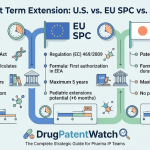
In the United States, PTE under 35 U.S.C. 156 provides up to five years of extension with a 14-year post-approval exclusivity ceiling. The PTA calculation under 35 U.S.C. 154(b) adds prosecution delay compensation on top of PTE, running through different calculation algorithms for different delay types. The 30-month stay triggered by Paragraph IV litigation is the primary tool for extending effective exclusivity past the statutory Final Date.
In the European Economic Area, SPCs are national instruments filed separately in each member state under Regulation (EC) 469/2009 for medicinal products and applied for in the national patent office. The SPC term = first EEA MA date – patent filing date – 5 years, capped at five years. Pediatric extension adds six months under Regulation (EC) 1901/2006. The proposed unitary SPC regulation would centralize examination at EUIPO, with implementation timing remaining subject to legislative progress.
In the United Kingdom, post-Brexit SPCs are national instruments filed with UKIPO under retained UK law. UK SPC case law has diverged on specific points from CJEU precedent since December 2020, requiring separate legal analysis from EU positions.
In China, PTR under the amended Patent Law (2021) provides up to five years of extension, capped at 14 years total post-approval term, for patents compensating for NMPA regulatory review time. Applications must be filed within three months of NMPA approval. Early PTR grants by CNIPA show extension awards of 2-4 years in most cases.
Japan, South Korea, Canada, and Australia each maintain pharmaceutical patent term extension mechanisms with distinct calculation rules and caps, requiring jurisdiction-specific analysis for any drug with significant revenue exposure in those markets.
VII. Key Takeaways: The Complete LOE Forecasting Mandate
Patent expiry is a financial event with legal inputs, not a legal event with financial consequences. The distinction matters for organizational design: the forecasting function must be owned jointly by Finance, IP, and Regulatory Affairs, not delegated exclusively to IP counsel.
The Final Date is determined by the last surviving protection — patent, SPC, PTE, regulatory exclusivity, or biologic product exclusivity — across all key commercial jurisdictions. It is almost never the CoM patent expiration date. For biologics, the BPCIA 12-year reference product exclusivity frequently defines the U.S. Final Date, while the patent dance determines whether biosimilar launch is delayed further.
The Pivotal Patent is a secondary patent, and it carries higher litigation risk than the CoM. The LOE forecast must include a probability-weighted adjustment for Paragraph IV challenge success, IPR invalidation, and late-term NPE activity. These are not tail risks for large-revenue assets — they are base-case planning inputs.
Specialized pharmaceutical patent intelligence platforms are operational infrastructure, not optional research tools. The granularity they provide — 34,000+ tracked extensions, 8,500+ litigated cases, real-time Paragraph IV filings — is the input quality required to produce a certifiable Final Date for IP valuation, patent-backed financing, and earnings guidance.
The U.S. Generics Paradox requires financial models to separate volume and price trajectories post-LOE rather than applying a blended revenue decline rate. The residual brand volume after generic entry is commercially distinct and economically significant for high-brand-loyalty assets.
Payer strategy is a first-order forecasting input for biosimilar LOE events. The Humira case demonstrated that prepared payers acting on formulary strategy at LOE capture savings measured in hundreds of millions within the first formulary year. Generic and biosimilar manufacturers who do not model payer formulary economics before filing their ANDA or aBLA arrive at their most important commercial negotiation without the data needed to close.
The quarterly LOE audit — with formal cross-functional sign-off from IP, Regulatory, and Finance — is the governance mechanism that eliminates LOE surprise from earnings guidance. The operational cost is four structured meetings per year. The financial exposure of a single undisclosed Final Date error on a major asset can exceed $1 billion in mismapped NPV.
AI-assisted monitoring is transitioning from a differentiation capability to a baseline operational requirement for companies managing portfolios of 15+ LOE events over a five-year horizon. Real-time PTAB, court docket, and FDA approval tracking provides early warning lead times that quarterly human audits structurally cannot match.
VIII. Frequently Asked Questions
What is the difference between Loss of Exclusivity (LOE) and patent expiration?
Patent expiration refers to the end of a specific patent’s legal term. LOE is the date on which unrestricted generic or biosimilar competition becomes legally permissible — which may come from patent expiration, the end of regulatory exclusivity (NCE, ODE, pediatric, or BPCIA reference product exclusivity), or the outcome of Paragraph IV litigation. For most commercial drugs, LOE occurs later than the expiration of the core CoM patent because secondary patents, SPCs/PTEs, and regulatory exclusivities extend the effective exclusivity period. The financial model requires the LOE date, not the CoM expiration date.
How does a Paragraph IV filing affect the LOE forecast timeline?
A Paragraph IV certification filed by an ANDA applicant triggers a 45-day window for the brand to file an infringement suit. If the brand sues, a 30-month automatic stay prevents FDA from granting final ANDA approval until the stay expires or litigation concludes, whichever comes first. If the brand wins the litigation, the LOE date remains the Final Date. If the generic wins, or if the brand fails to sue within 45 days, the LOE date moves forward to the date of ANDA final approval, which can be 18-30 months before the Final Date. The LOE forecast must explicitly model both outcomes with probability weights derived from the Pivotal Patent’s documented litigation vulnerability.
What is evergreening, and which secondary patent categories are most legally durable?
Evergreening is the practice of filing secondary patents on non-core aspects of a drug — formulation, dosing regimen, delivery device, new indication, polymorphic form, or salt — to extend effective market exclusivity beyond the CoM term. The most legally durable secondary patents are those tied to documented clinical differentiation: abuse-deterrent formulations with FDA-approved labeling, fixed-dose combinations with clinical superiority data, and method patents for indications where the secondary indication’s clinical evidence is substantially different from the primary indication. Polymorphic form patents and enantiomer patents are the most frequently challenged and have the lowest survival rate in inter partes review at PTAB.
Why is biosimilar interchangeability designation commercially significant?
An FDA-designated interchangeable biosimilar can be substituted for the reference biologic at the pharmacy level without a new prescription, subject to state substitution laws. This directly enables payer formulary strategies that exclude the reference biologic and cover only the interchangeable biosimilar, compressing the revenue erosion curve for the reference product significantly faster than a non-interchangeable biosimilar substitute. For biosimilar manufacturers, interchangeability designation is the primary mechanism for accessing formulary substitution revenue that PBMs and health plans control. The clinical investment required for the switching study is typically recovered within the first 6-12 months of formulary-driven volume uptake.
How should the BPCIA patent dance affect the biosimilar LOE financial model?
The BPCIA patent dance determines which patents are subject to immediate litigation and which are deferred. The outcome of immediate litigation defines whether biosimilar launch is delayed beyond the 12-year reference product exclusivity period. AbbVie’s Humira settlement strategy — licensing individual biosimilar developers to launch no earlier than January 2023 — demonstrates that the patent dance can result in a negotiated LOE date rather than a litigated one. The biosimilar LOE model must include a settlement probability scenario that models a negotiated launch date as an alternative to both brand win (later LOE) and biosimilar win (earlier LOE) outcomes.
What financial provisions should be built into the LOE model for NPE litigation risk?
For assets with annual revenue above $1 billion and a remaining patent term under three years, an explicit NPE litigation provision should be incorporated into the LOE model. The provision should be sized based on the technology category of the remaining patent claims (process patents attract more NPE activity than formulation patents), the NPE aggregation activity in the specific patent sub-class, and the brand’s historical exposure to NPE assertions. A baseline provision of $25-75 million in legal costs for a major asset in the final three years of its patent term is a reasonable starting point, with scenario analysis for injunction risk if the NPE holds a process patent covering the API manufacturing method.