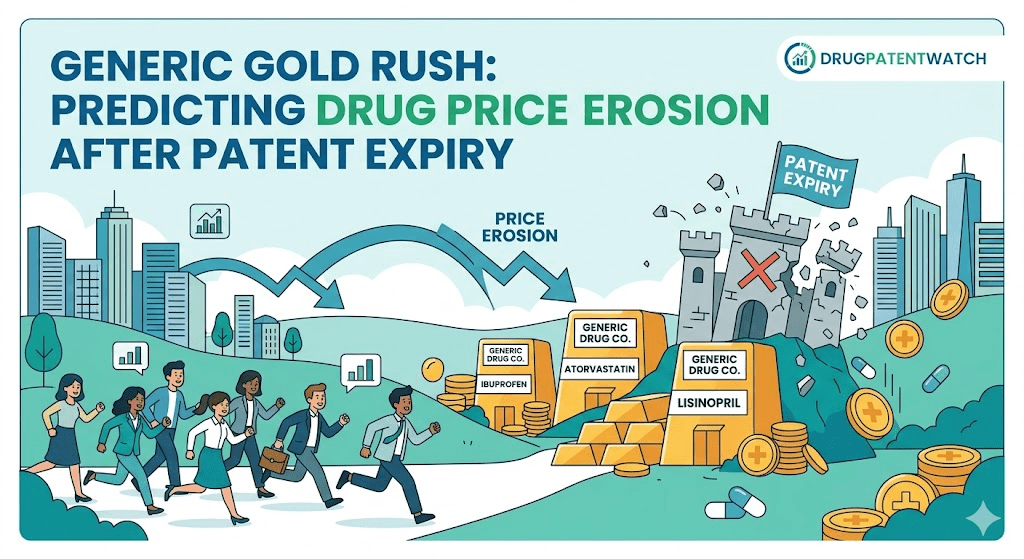
When a blockbuster drug loses patent protection, the resulting price war follows a predictable arc — but the speed, depth, and commercial damage vary enormously depending on molecule complexity, generic entrant count, FDA exclusivity status, and litigation history. Getting this forecast wrong costs brand manufacturers billions and leaves generic investors holding inventory at the wrong price point.
This guide maps the mechanics of loss of exclusivity (LOE) with the granularity that analysts, formulary managers, and portfolio planners actually need.
What Is Loss of Exclusivity and Why Does It Trigger Price Collapse?
Loss of exclusivity (LOE) is the moment a branded drug can no longer rely on patent protection or regulatory exclusivity to block generic entry. From that date forward, any FDA-approved Abbreviated New Drug Application (ANDA) filer can launch a competing product at a fraction of the brand price.
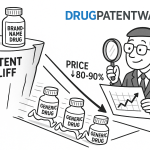
Price collapse does not happen uniformly. The rate depends on how many generics enter, how quickly they enter, whether the brand holds any remaining formulation or method-of-use patents, and whether payers move aggressively to substitute. In competitive categories, brand revenue can fall 80–90% within 12 months of the first generic launch. In less competitive categories with complex manufacturing requirements, price erosion is slower and the brand can retain 30–40% share for years.
The intuition behind the collapse is simple: generic manufacturers have no R&D cost to recoup. They only need to cover synthesis, formulation, testing, and the filing fee for the ANDA. This structural cost advantage lets them price at 20–30% of the brand price and still earn a margin. Payers, pharmacy benefit managers (PBMs), and retail pharmacies immediately route prescriptions to the lowest-cost substitutable product once it becomes available.
How Orange Book Patents and FDA Exclusivity Periods Work Together
The FDA’s Orange Book lists all patents covering an approved drug product and all regulatory exclusivity periods that independently block generic entry. A patent and an exclusivity period are different legal instruments. A patent gives the holder the right to exclude competitors in court. An exclusivity period is an administrative block that the FDA enforces regardless of patent status.
The most commercially important exclusivities are:
New Chemical Entity (NCE) exclusivity: five years from first approval, prevents ANDA filing entirely
New Clinical Investigation exclusivity: three years, awarded for new formulations or new indications supported by new clinical trials
Pediatric exclusivity: six-month add-on to any patent or exclusivity period, awarded for conducting FDA-requested pediatric studies
Orphan drug exclusivity: seven years for drugs approved for rare diseases, blocks approval (not filing) of applications for the same indication
A brand drug with stacked exclusivities — NCE exclusivity plus pediatric exclusivity plus a cluster of Orange Book patents — can have an effective protection window that extends a decade or more beyond the original composition-of-matter patent expiry. This stacking strategy is one of the primary tools brand manufacturers use to delay generic entry, and understanding it is essential to any LOE forecast.
What Is a Paragraph IV Certification and How Does It Accelerate Generic Entry?
When a generic applicant files an ANDA and believes an Orange Book patent is invalid, unenforceable, or would not be infringed by the generic product, it can file a Paragraph IV certification challenging that patent. This immediately triggers a 30-month stay on FDA approval, during which the brand manufacturer can sue for patent infringement.
The Paragraph IV pathway — created by the Hatch-Waxman Act of 1984 — is one of the most commercially consequential mechanisms in pharmaceutical IP. The first generic filer to file a Paragraph IV certification earns 180 days of marketing exclusivity against other generics (not against the brand). This exclusivity period is the prize that motivates generic manufacturers to invest in costly patent challenges.
A successful Paragraph IV challenge that results in patent invalidation or a non-infringement finding can accelerate LOE by years. Unsuccessful challenges leave the brand’s patents intact, and the generic must wait. Negotiated settlements that allow early generic entry — known as authorized generics or “at-risk” launch agreements — create a third path that often produces a de facto LOE date earlier than the court-determined or patent-expiry date.
The Price Erosion Curve: What the Data Actually Shows
Generic price erosion follows a well-documented pattern, but the slope and floor depend on market structure. The IMS Health (now IQVIA) data compiled over multiple LOE cycles shows a consistent S-curve of erosion that accelerates as generic entrant count rises.
“Within the first six months of generic entry, brand drugs typically lose 44% of their unit volume. With six or more generic competitors, average brand prices settle at 10–20% of the pre-LOE brand price within 24 months.” — IQVIA Institute for Human Data Science, The Use of Medicines in the United States 2023
Generic Entrant Count vs. Price Erosion: The Core Relationship
The relationship between the number of generic entrants and the price floor is not linear — it’s concave. Moving from one generic entrant to two produces a much larger price drop than moving from five entrants to six. This compression dynamic has important implications for generic manufacturers deciding whether to enter a market late.
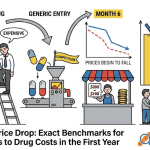
The approximate price levels by entrant count (as a percentage of pre-LOE brand price), based on FDA and IQVIA historical data:
6+ generic entrants: 10–20% of brand price, sometimes lower for oral solids
Oral solid dosage forms (tablets, capsules) reach their floor fastest because manufacturing complexity is low and entrant barriers are minimal. Injectable generics, complex formulations, and products with controlled substance handling requirements erode more slowly because fewer manufacturers have the capacity and DEA scheduling compliance infrastructure to produce them.
How the 180-Day Exclusivity Period Shapes the Erosion Timeline
The first generic’s 180-day exclusivity period does not prevent the brand from launching an authorized generic (AG). An AG is the brand product sold under the generic label, often through a subsidiary or a licensing arrangement with a generic partner. The AG competes directly with the first filer’s product during the 180-day window, cutting into the first filer’s exclusivity revenue.
Brand manufacturers use the AG strategy for two reasons. First, it captures some of the generic revenue rather than losing all of it. Second, it compresses the first filer’s margin during the exclusivity period, reducing the financial incentive for future Paragraph IV challenges in other product categories.
The FTC studied AG behavior after the Medicare Modernization Act of 2003 and found that AG entry during the 180-day exclusivity period reduced the first filer’s revenue from that period by roughly 40–52%. This has led some generic manufacturers to negotiate exclusivity-sharing agreements with brand companies as part of patent challenge settlements, effectively monetizing the exclusivity period jointly.
Authorized Generic Launches: When Does the Brand Deploy One?
Brand manufacturers are most likely to launch an AG when:
The product is a high-volume commodity oral solid where generic substitution will be near-total
The brand manufacturer has an existing generic arm (e.g., Pfizer’s Upjohn/Viatris, Novartis’s Sandoz, Lilly’s partnership structures)
The first Paragraph IV filer is a large generic company unlikely to be deterred by AG competition
The brand has already begun transitioning its commercial infrastructure to next-generation products
Why Some Drugs Defy the Standard Erosion Curve
Several structural factors allow certain drugs to maintain above-average prices and brand volume share post-LOE:
Complex formulation barriers are the most common. Extended-release formulations, abuse-deterrent formulations, transdermal delivery systems, and combination products require additional manufacturing expertise and often carry their own patents and exclusivities that are independent of the original NCE patent. Purdue Pharma’s OxyContin reformulation to abuse-deterrent technology (Reformulated OxyContin, approved 2010) and the subsequent Orange Book listing of the reformulation patents created a new exclusivity layer even as the original oxycodone patents expired.
Biosimilar dynamics for biologics represent an entirely separate erosion pattern discussed later in this article. Small-molecule generics and biosimilars follow fundamentally different competitive curves because biologic manufacturing complexity and regulatory requirements are categorically different.
Physician prescribing inertia also matters. In specialty categories where physicians have strong clinical familiarity with the brand, where patient assistance programs are robust, or where payer formulary tier placement is not automatic upon generic entry, brand retention can be meaningfully higher than in primary care categories where pharmacist substitution is automatic.
Key LOE Case Studies: Lipitor, Humira, Nexium, and Revlimid
Four drugs illustrate the range of LOE outcomes across molecule types, competitive environments, and litigation histories.
Lipitor (Atorvastatin): The Benchmark LOE Event
Pfizer’s Lipitor (atorvastatin calcium) lost its core composition-of-matter patent in November 2011. At the time it was the world’s best-selling drug, generating approximately $9.6 billion in U.S. sales annually. Within 12 months of generic entry, Lipitor’s U.S. brand revenue fell by roughly 70%. Within 24 months, the brand had lost more than 90% of unit volume to generic atorvastatin.
The Lipitor LOE is the canonical case study for several reasons. The molecule is a simple oral solid. Pfizer had extensive litigation with generic challengers — most notably Ranbaxy (now Sun Pharma) — that ultimately settled with Ranbaxy receiving a November 30, 2011 launch date, six months before other generics could enter. Pfizer launched an authorized generic simultaneously with Ranbaxy to compete during the 180-day window.
The Lipitor case also illustrates “at-risk” launch dynamics. Ranbaxy had launched atorvastatin at-risk in some international markets before the U.S. settlement was finalized, demonstrating the financial pressure generic manufacturers face to monetize first-filer status as quickly as possible.
For payer and manufacturer modeling purposes, Lipitor’s post-LOE trajectory is the calibration point for oral solid primary care drugs with high generic competition: 80–90% revenue loss within 24 months.
Humira (Adalimumab): Biologic Patent Thicket and Biosimilar Entry
AbbVie’s Humira (adalimumab) is the world’s highest-grossing drug over a sustained period, generating peak U.S. revenues exceeding $21 billion annually. Its LOE story is not about patent expiry of a single molecule — it’s about a patent thicket of more than 130 U.S. patents covering the antibody, manufacturing processes, formulations, dosing devices, and methods of use.
The composition-of-matter patents on adalimumab began expiring in 2016. AbbVie’s patent thicket strategy, combined with litigation against virtually every biosimilar developer, delayed U.S. biosimilar entry until January 2023 — more than six years after the first relevant patent expiry. AbbVie settled with every major biosimilar developer (Amgen, Samsung Bioepis, Sandoz, Boehringer Ingelheim, Coherus, and others) under confidential terms that almost certainly included launch date restrictions and royalty payments.
The biosimilar erosion curve for Humira has been slower than analysts initially expected. As of early 2024, multiple adalimumab biosimilars had launched, but combined biosimilar market share in the U.S. remained below 30% by volume — far behind the 60–80% market share that biosimilars typically achieve in European markets within 12 months of entry. The reasons include PBM formulary design, rebate contracting practices, and the continued preferential placement of branded Humira on some commercial formularies.
What Does the Humira LOE Mean for Future Biologic Patent Disputes?
AbbVie’s success in delaying U.S. biosimilar entry has become the model that other biologic manufacturers study. Companies with approaching patent cliffs on biologic drugs are now building systematic patent thickets from launch — accumulating formulation, device, and manufacturing patents with the explicit goal of replicating AbbVie’s seven-year delay. The Humira litigation archive, which researchers can examine using tools like DrugPatentWatch to map AbbVie’s 130+ patent portfolio, is now required reading for biosimilar IP teams.
Nexium (Esomeprazole): The “Evergreening” Litigation Playbook
AstraZeneca’s Nexium (esomeprazole magnesium) lost NCE exclusivity in 2001 but maintained market exclusivity through a combination of patent litigation, formulation patents, and pediatric exclusivity until 2014, when the first generic entered the market. The brand’s journey from the original omeprazole (Prilosec) to the esomeprazole isomer is the textbook case of evergreening — developing a closely related molecule with a new patent life before the original drug faces generic competition.
The proton pump inhibitor (PPI) category, where Nexium competed, saw aggressive formulary management once generics entered. Within 18 months of generic esomeprazole launch, brand Nexium’s prescription volume fell by approximately 75%. The brand’s price remained nominally high because the remaining patients on brand were typically those with manufacturer copay cards or specific coverage gaps where the brand was paradoxically cheaper than the generic copay tier for some patients.
Revlimid (Lenalidomide): Negotiated Entry and Orphan Drug Complexity
Bristol-Myers Squibb’s (formerly Celgene’s) Revlimid (lenalidomide) is the most commercially significant LOE event in oncology for the 2022–2026 window. Peak U.S. revenues exceeded $12 billion annually. BMS negotiated license agreements with generic manufacturers — including generic arms of major players — that allowed entry beginning in March 2022 on a volume-limited basis, expanding to full competition by January 2026.
The volume-limited entry structure means generic erosion is deliberately staged. Generic lenalidomide manufacturers could enter the market but were contractually limited in the volume they could sell. This arrangement, the subject of FTC scrutiny, allowed BMS to extend effective brand exclusivity while technically permitting generic entry. The FTC filed a complaint alleging the settlement structure was anticompetitive.
For analysts forecasting Revlimid’s post-2026 revenue trajectory, the key variable is whether full generic competition in 2026 produces standard oral solid erosion dynamics (80%+ revenue loss within 24 months) or whether the specialty oncology prescribing environment and REMS program requirements slow substitution. Early evidence from 2022–2024 suggested slower-than-typical erosion during the volume-limited phase, consistent with BMS’s design.
How to Build a Drug LOE Forecast Model
A credible LOE forecast requires integrating at least four data streams: patent expiry dates, regulatory exclusivity end dates, ANDA filing history, and litigation status. Combining these inputs into a probabilistic LOE timeline is the foundation of any serious pharmaceutical competitive intelligence or portfolio planning exercise.
Step 1: Map All Orange Book Patents and Their Expiry Dates
The FDA’s Orange Book (Approved Drug Products with Therapeutic Equivalence Evaluations) lists all patents for each approved drug product. Each patent entry includes the patent number and expiry date. The Orange Book is publicly accessible, but interpreting it requires understanding which patents are composition-of-matter (covering the molecule itself), which are formulation patents, which are process patents, and which are method-of-use patents.
Composition-of-matter patents are the most valuable because they block any generic formulation of the same molecule. When a composition-of-matter patent expires, formulation and method-of-use patents may remain but can often be designed around. A generic manufacturer producing the same molecule in a different formulation may not infringe a formulation patent. Method-of-use patents only block use for the patented indication, not for other FDA-approved uses.
Tools like DrugPatentWatch provide structured access to Orange Book data alongside ANDA filing histories, litigation records, and exclusivity status — significantly reducing the time required to build a complete patent map for a target drug. Analysts who manually reconstruct this data from the FDA’s Orange Book database and PACER (the federal court filing system) typically spend 20–40 hours per drug; organized databases compress this to hours.
Step 2: Identify All Active FDA Exclusivity Periods
Exclusivity periods are listed in the Orange Book separately from patents. An analyst must check whether any exclusivity period extends beyond the last relevant patent expiry. If a pediatric exclusivity period ends two years after the last Orange Book patent expires, that pediatric exclusivity (not the patent) is the binding constraint on generic ANDA approval.
Common errors in LOE forecasting include:
Overlooking three-year new clinical investigation exclusivity for new formulations or combinations
Failing to account for pediatric exclusivity extensions that were granted after initial patent analysis was completed
Treating orphan drug exclusivity as blocking ANDA filing rather than ANDA approval (a distinction that affects the timing of competitive intelligence on ANDA filers)
Step 3: Analyze ANDA Filing History and Paragraph IV Challenges
The FDA publishes information on Paragraph IV certifications in the Federal Register. When a generic manufacturer files an ANDA with a Paragraph IV certification, the FDA notifies the brand and publishes the generic filer’s identity. This public record is the starting point for understanding how many generic companies are positioned to enter a market.
The number of ANDA filers is a leading indicator of post-LOE price erosion depth. Categories with 10 or more ANDA filers will see rapid and deep price erosion regardless of the initial brand response. Categories with 2–3 ANDA filers may see more moderate erosion, particularly if the category has complex manufacturing requirements that limit late entrants.
Reading ANDA Paragraph IV Data: What the Federal Register Tells You
The Federal Register notice for a Paragraph IV filing includes the ANDA applicant’s name, the reference listed drug (RLD) being challenged, and a description of the patents being challenged. It does not disclose the specific patent invalidity or non-infringement arguments the generic manufacturer is making — those are revealed only in the subsequent patent infringement litigation if the brand sues within 45 days.
Brand manufacturers who do not sue within 45 days of receiving notice of a Paragraph IV certification waive the 30-month stay. This failure to sue can occur when the brand’s legal team concludes the challenged patents cannot be defended, when the economics of litigation don’t justify the cost, or in rare cases when the brand intends to negotiate a licensing agreement directly.
Step 4: Assess Litigation Status and Expected Court Timelines
Paragraph IV patent litigation in the District of Delaware and the District of New Jersey — the two most common venues for Hatch-Waxman cases — typically takes 24–36 months from complaint filing to trial, with additional time for appeal. The 30-month stay imposed by the Paragraph IV filing runs concurrently with the litigation timeline, meaning that in many cases the stay expires before the district court issues a decision.
When the 30-month stay expires before a final judgment, the generic manufacturer faces a decision: launch at-risk (before final patent resolution) or wait for the court. At-risk launch exposes the generic manufacturer to a permanent injunction and damages if the patent is ultimately upheld. The financial calculus depends on the revenue at stake, the strength of the patent, and the generic manufacturer’s risk appetite.
Notable at-risk launches include Apotex’s launch of generic clopidogrel (Plavix) in 2006 — a catastrophic outcome for Apotex when the court ultimately upheld Bristol-Myers Squibb’s patent and awarded substantial damages — and Teva’s at-risk launch of generic aripiprazole (Abilify) in 2015, which was ultimately resolved favorably for Teva. The contrast illustrates why at-risk launches require careful patent strength assessment.
Step 5: Model Revenue Erosion Scenarios by Entrant Count
With patent expiry dates, exclusivity end dates, ANDA filer count, and litigation timeline in hand, an analyst can construct three scenarios:
Base case: LOE occurs at the last exclusivity or patent date, with the expected number of ANDA filers converting to market entrants
Bear case (for the brand): Successful Paragraph IV challenge accelerates LOE by 12–36 months; full generic competition begins immediately
Bull case (for the brand): Remaining formulation patents successfully defended in litigation; only 1–2 generics enter initially, and price erosion is slower than category average
Revenue erosion curves should be calibrated against category-specific historical data, not generic average curves. An oral solid in the primary care category should be calibrated against Lipitor, Zocor, and Zoloft LOE events. A specialty injectable should be calibrated against injectable LOE events in the same therapeutic class.
Patent Cliff Timing: Which Major Drugs Face LOE Between 2024 and 2030
The U.S. pharmaceutical patent cliff over the 2024–2030 window is one of the most significant in the industry’s history, covering drugs with combined U.S. revenues exceeding $150 billion annually at peak.
2024–2025 LOE Events: Eliquis, Stelara, and Enbrel
Eliquis (apixaban, Bristol-Myers Squibb/Pfizer) faces its primary U.S. patent expiry in 2026 for the composition-of-matter patent, with a pediatric exclusivity extension pushing the effective ANDA approval date to late 2026 for most filers. Multiple generic manufacturers have filed ANDAs and Paragraph IV certifications. BMS and Pfizer have aggressively litigated these challenges. Eliquis generated approximately $12 billion in U.S. revenue in 2023, making its LOE one of the highest-stakes generic entry events of the decade.
Stelara (ustekinumab, Johnson & Johnson) is a biologic IL-12/IL-23 inhibitor approved for psoriasis and Crohn’s disease. Its core biologic patents expired in late 2023, and multiple biosimilar developers (Amgen, Samsung Bioepis, Alvotech, Formycon, and others) received FDA approval or were in the approval pipeline for 2023–2024 launch. J&J settled with biosimilar developers under licensing agreements that allowed launch beginning January 2025, replicating the AbbVie Humira settlement strategy.
Enbrel (etanercept, Amgen/Pfizer) presents a uniquely complex LOE picture. The etanercept molecule’s patents have long since expired in most jurisdictions, but Amgen holds a cluster of manufacturing and formulation patents in the U.S. that it has successfully defended against biosimilar entry. Pfizer’s biosimilar etanercept (Eticovo) is approved in the U.S. but has not been commercially launched — a situation driven by the complex patent and commercial relationship between Pfizer and Amgen as Enbrel co-commercialization partners.
2026–2028 LOE Events: Keytruda, Ozempic, and Dupixent
Keytruda (pembrolizumab, Merck) is a programmed death-1 (PD-1) checkpoint inhibitor and the world’s current best-selling drug, with U.S. revenues approaching $25 billion annually. Its composition-of-matter patents begin expiring around 2028 in the U.S., though Merck has filed extensive additional patents on dosing, formulations, and manufacturing. Multiple companies have biosimilar development programs. The Keytruda LOE will be the largest single LOE event in pharmaceutical history when it occurs.
Ozempic and Wegovy (semaglutide, Novo Nordisk) are GLP-1 receptor agonists in the massive weight management and diabetes categories. The composition-of-matter patent on semaglutide expires in the U.S. around 2032, but Novo Nordisk has built a substantial portfolio of device, formulation, and method-of-use patents. Compounding pharmacies have already begun producing semaglutide under FDA oversight during drug shortage periods — a preview of the generic competitive pressure that will emerge as patents approach expiry.
Dupixent (dupilumab, Sanofi/Regeneron) is a biologic IL-4/IL-13 receptor antagonist approved for atopic dermatitis, asthma, and other indications. Its key patents extend into the 2030s, placing it outside the immediate LOE window but well within the range of biosimilar companies’ current development planning cycles.
LOE Forecast Table: Selected Drugs, Estimated U.S. LOE Dates, and Revenue at Risk
Drug
Manufacturer
Active Ingredient
Est. U.S. LOE
2023 U.S. Revenue (approx.)
Eliquis
BMS/Pfizer
Apixaban
2026–2027
$12.2B
Stelara
J&J
Ustekinumab
2025 (biosimilar)
$9.7B
Xarelto
J&J/Bayer
Rivaroxaban
2024–2025
$4.5B (U.S.)
Skyrizi
AbbVie
Risankizumab
2031+
$5.1B
Keytruda
Merck
Pembrolizumab
2028–2030
~$24B
Revlimid
BMS
Lenalidomide
Full competition 2026
$8.5B (declining)
Ozempic/Wegovy
Novo Nordisk
Semaglutide
~2032 (core patent)
$14B+ combined
Revenue figures are approximate 2023 U.S. estimates. LOE dates are based on Orange Book data and public litigation records; actual dates subject to litigation outcomes.
Biosimilar vs. Small-Molecule Generic: Why the Price Erosion Curves Are Different
The most consequential distinction in LOE forecasting is between small-molecule drugs subject to the Hatch-Waxman ANDA pathway and biologics subject to the Biologics Price Competition and Innovation Act (BPCIA) biosimilar pathway.
Why Biosimilar Price Erosion Is Slower Than Generic Drug Price Erosion
Biosimilars are not identical copies of the reference biologic — they are highly similar, with no clinically meaningful differences in safety, purity, or potency. But because biologics are large, complex protein molecules produced in living cells, the manufacturing process is inherently variable. This variability creates legitimate clinical questions about interchangeability that do not exist for small molecules, where generic bioequivalence establishes substitutability with certainty.
The FDA’s interchangeability designation — which allows pharmacists to substitute a biosimilar for the reference biologic without prescriber intervention, just as they substitute generic for brand small-molecule drugs — was slow to be implemented and required clinical switching studies. The first interchangeable biosimilar designation in the U.S. was granted to Viatris’s biosimilar insulin glargine (Semglee) in July 2021. Interchangeable biosimilars for adalimumab (Hadlima, Cyltezo, and others) received designation through 2023.
Prescriber inertia, payer formulary decisions, and patient reluctance to switch established biologic therapy all contribute to slower biosimilar uptake than small-molecule generic uptake. In European markets, where tendering systems and mandatory substitution policies exist in many countries, biosimilar market share can reach 80–90% within 12–24 months. In the U.S., without mandatory substitution and with complex rebate dynamics, biosimilar share often plateaus below 50% for years after launch.
The Rebate Wall Problem: How PBM Contracting Slows Biosimilar Uptake
One of the primary reasons U.S. biosimilar penetration lags European markets is the rebate wall. Brand manufacturers — particularly AbbVie with Humira — offer very large rebates to PBMs in exchange for exclusive or preferred formulary placement that excludes biosimilars. These rebates, which are confidential and typically expressed as a percentage of list price, can be so substantial that the net cost of the branded product after rebates is lower than the biosimilar’s net cost.
This dynamic inverts the expected price competition logic. A biosimilar with a 20% list price discount may not be the preferred formulary product if the brand is offering a 35–40% rebate. PBMs, who capture a portion of rebate revenue, have historically had an incentive to prefer high-rebate branded products over lower-list biosimilars. This incentive structure is the subject of ongoing Congressional scrutiny and FTC investigation.
Biosimilar manufacturers have begun offering their own rebate structures, and some PBMs have shifted to exclusive biosimilar formulary positions. Express Scripts, OptumRx, and CVS Caremark have each implemented biosimilar-preferred strategies for specific biologic categories, with varying results on market share acceleration.
What the Humira Biosimilar Launch Tells Us About Future Biologic LOE Events
The adalimumab biosimilar launch in January 2023 — with eight biosimilars entering the market simultaneously — produced less price competition than expected in the first 12 months, but more than AbbVie’s management guidance suggested. By late 2023, combined biosimilar volume share had reached approximately 25–30% depending on the market segment. AbbVie responded by lowering its list price and restructuring its rebate contracts.
The Humira case suggests that biologic LOE events will be characterized by a slower erosion curve than small-molecule LOEs, but that the erosion is real and accelerates as interchangeable designations become more common, formulary management becomes more aggressive, and biosimilar manufacturers develop more competitive commercial infrastructure.
Patent Litigation Strategy: How Brand Manufacturers Delay Generic Entry
Brand pharmaceutical manufacturers have developed a sophisticated set of patent strategies to extend effective market exclusivity beyond the nominal patent expiry date. Understanding these strategies is essential for anyone trying to forecast actual LOE timing.
The Secondary Patent Strategy: Formulation, Process, and Method-of-Use Patents
When the primary composition-of-matter patent on a drug is approaching expiry, brand manufacturers file for secondary patents covering:
New formulations (extended-release, controlled-release, abuse-deterrent)
New dosage forms (tablet to patch, oral to injectable)
Specific salt forms or polymorphs of the active ingredient
Manufacturing processes that produce the active ingredient or formulation
Methods of use for specific patient populations or dosing regimens
These secondary patents are listed in the Orange Book and can extend the effective exclusivity period by 2–7 years. Generic manufacturers must challenge each patent separately. A drug with 15 Orange Book patents requires a generic manufacturer to address all 15 in its ANDA, either by designing around each one or by filing Paragraph IV certifications against each one.
Product Hopping: Switching Patients to a New Formulation Before LOE
Product hopping involves introducing a new formulation of the existing drug — with a new patent life — shortly before the original formulation’s patent expires. The brand then discontinues the original formulation or shifts marketing and formulary support to the new formulation. When generics enter for the original formulation, many patients have already been switched to the new formulation, which has no generic competition yet.
Abbott’s cholesterol drug Tricor (fenofibrate) is the often-cited case. Abbott introduced successively reformulated versions of fenofibrate — changing tablet size, then transitioning to nanoparticle formulation — each time generics were approaching market entry for the previous formulation. The FTC and state attorneys general filed antitrust actions alleging the reformulation strategy was designed to foreclose generic competition. The case was ultimately settled.
AstraZeneca’s conversion of omeprazole (Prilosec) to esomeprazole (Nexium), discussed earlier, was the most commercially successful product hop in pharmaceutical history. The company introduced the S-enantiomer of omeprazole with a new patent life and successfully transitioned a large portion of the patient base from the generic-vulnerable omeprazole franchise to the newly patented esomeprazole.
Risk-Evaluation and Mitigation Strategies (REMS) as a Competitive Barrier
For drugs with serious safety concerns, the FDA requires a Risk Evaluation and Mitigation Strategy (REMS). Some REMS programs include Elements to Assure Safe Use (ETASU) that restrict distribution to certified pharmacies or require patient enrollment in monitoring programs. These requirements apply equally to generic manufacturers, meaning the REMS program itself is not an exclusivity barrier.
However, brand manufacturers have been accused of using shared REMS programs as a delay mechanism by refusing to give generic manufacturers access to the samples they need to conduct bioequivalence studies, citing safety concerns about providing the drug outside the controlled REMS distribution system. The FDA and FTC have addressed this practice through the CREATES Act (Creating and Restoring Equal Access to Equivalent Samples Act), signed into law in 2019, which allows generic manufacturers to sue brand manufacturers who refuse to provide REMS-restricted samples.
How the CREATES Act Changed Generic Access to REMS Samples
The CREATES Act established a private right of action for generic manufacturers who cannot obtain drug samples necessary for bioequivalence testing. Before the Act, brand manufacturers could indefinitely delay generic development by refusing to sell samples and citing safety concerns. The Act requires brand manufacturers to provide samples within a specified timeframe under a safety protocol, with judicial oversight if the parties cannot agree on terms.
Several generic manufacturers have used the CREATES Act to obtain samples for drugs with REMS programs, including isotretinoin, thalidomide analogs, and certain opioid formulations. The litigation under the Act is still developing, but it has meaningfully reduced the utility of REMS programs as a generic delay tool for drugs with established commercial markets.
How Paragraph IV Settlements Shape LOE Timelines
The vast majority of Paragraph IV patent challenges — perhaps 75–80% — are resolved through negotiated settlements rather than court decisions. These settlements almost always include a negotiated generic launch date and often include royalty payments, authorized generic arrangements, or other commercial terms that define the practical LOE event.
Reverse Payment Settlements: What FTC v. Actavis Changed
For many years, brand manufacturers settled Paragraph IV litigation by paying generic manufacturers to not launch for a period of time — a “reverse payment” or “pay-for-delay” settlement. The logic from the brand’s perspective was clear: the expected cost of losing patent exclusivity for several years was worth a one-time settlement payment to the generic challenger.
In FTC v. Actavis, decided by the Supreme Court in 2013, the Court held that reverse payment settlements are not automatically lawful simply because they fall within the scope of the patent. Instead, they must be evaluated under the rule of reason antitrust standard. A settlement is potentially unlawful if the payment exceeds the generic manufacturer’s expected litigation costs and is plausibly explained as paying the generic to delay entry rather than as legitimate compensation for some valuable service.
After Actavis, reverse payment settlements declined significantly, but they did not disappear. Settlements now more often involve the brand granting a royalty-bearing license for an authorized generic or providing other non-cash compensation (such as co-promotion rights or licensing of other drugs) in exchange for the generic manufacturer accepting a future launch date. These non-cash reverse payments are still subject to antitrust scrutiny, as the FTC has argued in subsequent cases.
Authorized Generic Licensing as a Settlement Tool
When a brand settles with a Paragraph IV first filer, one common term is an authorized generic (AG) license. The brand agrees to supply or license the first filer to sell an AG version of the brand product — essentially giving the first filer a product to sell alongside its own generic formulation during and after the 180-day exclusivity period. This structure gives the first filer reliable revenue and a head start in building generic market share, while giving the brand some revenue stream from the generic segment.
Critics of AG licensing in settlements argue it creates a de facto market-sharing arrangement that limits competition. When a first filer holds both its own generic ANDA and an AG license from the brand, later generic entrants face a market where the first filer is already established with two products and a head start. The practical effect can be to suppress the price erosion that Congress intended from robust generic competition.
The Generic Manufacturer’s LOE Playbook: Entry Timing and Portfolio Strategy
Generic manufacturers approach LOE events with a well-defined playbook. The strategy differs substantially between first-filer positioning, at-risk launch decisions, and later competitive market entry.
First-to-File Strategy: Why 180-Day Exclusivity Is Worth Aggressive Litigation
The financial value of the 180-day first-filer exclusivity period is enormous for high-revenue drugs. For a drug with $5 billion in U.S. annual revenue, a successful Paragraph IV challenge that results in 180-day exclusivity with a 70–80% brand price discount could generate $200–400 million in generic revenue during that period — even before other generic entrants force further price erosion.
This prize motivates generic manufacturers to invest heavily in patent challenge litigation. Large generic companies — Teva, Sandoz, Mylan (now Viatris), and Amneal among them — maintain substantial patent litigation teams specifically to pursue Paragraph IV first-filer positions. The litigation investment is a calculated risk against the exclusivity revenue opportunity.
At-Risk Launch Decisions: When Generic Manufacturers Jump Before the Courts Rule
An at-risk launch occurs when a generic manufacturer launches its product after the 30-month stay expires but before the patent infringement litigation is resolved. The generic manufacturer risks being found liable for patent infringement and faces potential permanent injunction (removing the product from the market) and damages (paying the brand a reasonable royalty on all at-risk sales).
The decision calculus requires estimating the probability that the challenged patent will be upheld, the revenue opportunity during the at-risk period, and the potential damages exposure. Generic manufacturers typically conduct rigorous freedom-to-operate analysis before committing to at-risk launch, and they often seek declaratory judgment actions in parallel to resolve patent validity independently of the infringement litigation.
Later-Entrant Generic Strategy: How to Compete After the 180-Day Exclusivity Ends
Generic manufacturers who are not first filers face a market where the 180-day exclusivity has expired and multiple generics are competing. The competitive strategy in this environment shifts from litigation to manufacturing efficiency and supply chain reliability. Price competition intensifies, and manufacturers with the lowest cost of goods and most reliable supply chains retain market share while competitors with quality or supply issues lose shelf space.
Supply chain disruptions — particularly active pharmaceutical ingredient (API) sourcing disruptions from Indian and Chinese API manufacturers — have created recurring opportunities for second- and third-wave generic entrants to take market share from first-wave entrants experiencing supply constraints. Retailers and wholesalers increasingly maintain multiple generic supplier relationships specifically to hedge against supply disruption risk.
The Role of Indian and Chinese API Manufacturers in Generic Price Competition
The majority of APIs for U.S. generic drugs are manufactured in India or China. The concentration of API production in these geographies creates systemic supply chain risk and, in some cases, quality risk. FDA Warning Letters and Import Alerts directed at Indian API manufacturers — notably Ranbaxy’s now-remediated quality failures and the ongoing scrutiny of multiple Aurobindo, Dr. Reddy’s, and Hetero facilities — demonstrate the regulatory exposure inherent in API supply concentration.
For LOE forecasting purposes, API supply chain health affects the number of generic entrants who can actually launch on time. A generic manufacturer with an approved ANDA but a constrained API supplier may delay commercial launch or be unable to supply at scale, effectively reducing the number of market entrants and slowing price erosion in the early post-LOE period.
What Payers and PBMs Do at LOE: Formulary Management and Generic Substitution
Payer and PBM behavior at LOE is the demand-side driver of price erosion. The speed at which payers move prescriptions to generic products and the aggressiveness of formulary management largely determine how quickly brand revenue falls after generic entry.
Step Therapy, Prior Authorization, and Formulary Tier Changes at LOE
Commercial health plans and PBMs typically implement formulary changes at LOE in one of three ways. Preferred generic placement means the plan moves the generic to the lowest-cost tier and increases the brand copay or coinsurance to push patients toward generic. Non-coverage of the brand means the plan removes the brand from formulary entirely (for non-medically necessary brand use) once a generic is available. Step therapy for remaining brand patients requires patients to demonstrate a trial of the generic before brand coverage is authorized.
Medicare Part D formulary rules require plans to cover at least two drugs in each drug category, but plans have broad discretion to tier branded drugs when generics are available. The formulary leverage that Part D plans exercise at LOE is substantial — Medicare Part D covers approximately 48 million beneficiaries, and formulary placement decisions affect a large share of total U.S. prescription volume for most major drugs.
How Long Does Brand-to-Generic Transition Take Under Different Payer Scenarios?
The transition timeline varies by payer type. Commercial plans with aggressive PBM management can complete 80–90% transition to generic within 3–6 months of generic availability. Medicare Part D plans, which must allow formulary exceptions and have open enrollment constraints, typically take 12–18 months to reach equivalent generic penetration. Medicaid programs, which use mandatory generic substitution, can transition within days of generic availability depending on state policies.
The fastest transitions occur for drugs dispensed at retail pharmacies where pharmacist substitution is automatic (same molecule, therapeutically equivalent generic, no prescriber consent required). The slowest transitions occur for specialty drugs dispensed through specialty pharmacies, where patient-specific titration, monitoring requirements, and physician prescribing habits create friction.
Manufacturing Exclusivity and Supply Chain Advantages After LOE
After the initial wave of generic entry and price erosion, the competitive dynamics shift to manufacturing economics and supply chain positioning. Not all generic manufacturers can profitably supply a drug at the floor price established by competition, and some exit the market, creating periodic supply shortages.
Why Drug Shortages Occur After Generic Entry — and Who Benefits
Drug shortages in the post-LOE generic market are a recurring problem documented by the FDA and ASHP (American Society of Health-System Pharmacists). They occur when the economics of a deeply eroded generic market no longer support the manufacturing investment required to maintain capacity. When margins approach or fall below the cost of maintaining FDA compliance at a manufacturing facility, manufacturers exit the market. If the market is concentrated in two or three suppliers, exit of one can create a shortage affecting the entire country.
Manufacturers who remain in the shortage market benefit from temporary price recovery as supply constraints give them pricing power. This boom-bust cycle is particularly common in generic injectable markets, where manufacturing complexity limits the number of eligible producers.
The U.S. government has increasingly recognized this dynamic as a national security concern, particularly for generic antibiotics and other critical medicines where supply chain concentration in foreign manufacturers creates vulnerability. The CARES Act’s drug shortage provisions and subsequent executive orders directing increased domestic API production are policy responses to this structural problem.
Domestic API Manufacturing Incentives and the Future of Generic Supply Security
The COVID-19 pandemic exposed the fragility of U.S. generic drug supply chains and accelerated policy interest in domestic API manufacturing. Programs like the Biomedical Advanced Research and Development Authority (BARDA) contracts for domestic antibiotic API production and the Rosalynn Carter Humanitarian Award for domestic manufacturing investment represent early efforts to create incentives for domestic API production.
Reshoring API manufacturing is economically challenging because Indian and Chinese manufacturers have cost advantages of 50–70% over U.S. manufacturers for many molecules. Without sustained procurement commitments at above-market prices, domestic manufacturers cannot compete on cost alone. The policy debate about how to structure such commitments — through long-term government contracts, production subsidies, or domestic manufacturing requirements for government programs — is unresolved.
Using Data and Technology to Monitor LOE Risk in Real Time
Pharmaceutical competitive intelligence has become increasingly data-intensive. Analysts who relied on manual Orange Book searches and PACER filings a decade ago now have access to integrated platforms that synthesize patent data, ANDA filings, litigation records, and exclusivity status.
How DrugPatentWatch Aggregates LOE Intelligence
DrugPatentWatch is a widely used pharmaceutical patent intelligence platform that aggregates data from the FDA’s Orange Book, USPTO patent records, PACER litigation filings, and FDA drug approval databases. It provides structured access to patent expiry dates, ANDA filer histories, Paragraph IV notification records, and litigation status in a format designed for commercial intelligence rather than legal research.
Analysts at pharmaceutical companies, generic manufacturers, investment banks, and managed care organizations use DrugPatentWatch to monitor competitive threats, identify first-filer positioning, and estimate LOE timing for target drugs. The platform’s alert functionality allows users to receive notifications when new ANDAs are filed, when patents are challenged, when litigation outcomes are recorded, or when exclusivity periods are updated.
For generic manufacturers evaluating ANDA filing opportunities, DrugPatentWatch provides a consolidated view of how many competitors have already filed for a target drug — a critical input to the LOE revenue forecast and the decision of whether to invest in development and regulatory costs.
Machine Learning Approaches to Patent Expiry Prediction
Several analytics firms have applied machine learning models to pharmaceutical patent data to improve LOE timing predictions. These models typically incorporate patent filing date, claim structure, prosecution history, Orange Book listing status, prior litigation outcomes for similar patents, and assessments of patent strength to produce probabilistic LOE timelines.
The challenge for machine learning approaches is that patent litigation outcomes are driven by specific technical and legal facts that are difficult to reduce to features predictable from public data. A model trained on historical litigation outcomes may not generalize well to novel patent types (e.g., the first generation of CRISPR-based drug patents) where there is no historical precedent.
What Analysts Get Wrong When Forecasting Generic Entry Timing
The most common LOE forecasting errors include:
Assuming that the patent expiry date in the Orange Book is the actual LOE date without checking exclusivity periods
Ignoring pediatric exclusivity extensions that were granted after the drug’s approval
Treating all generic ANDA filers as equally likely to reach market — many face their own manufacturing or regulatory delays
Using category-average erosion curves for specialty drugs where prescriber inertia and formulary dynamics are materially different from primary care
Failing to model the authorized generic impact on first-filer revenue during the 180-day exclusivity period
Underestimating the time between ANDA approval and commercial launch for drugs with complex manufacturing or supply chain requirements
Financial Impact of LOE on Brand Manufacturer Valuation and Pipeline Strategy
LOE events are among the most significant financial events in a pharmaceutical company’s lifecycle. Analysts covering pharmaceutical equities model LOE impact years in advance, and the actual LOE date — relative to consensus expectations — is often a substantial driver of short-term stock price movements.
How Wall Street Models Drug Patent Cliffs in Pharmaceutical Valuations
Equity analysts at banks covering pharmaceutical companies build discounted cash flow (DCF) models that explicitly project post-LOE revenue trajectories for each product in the portfolio. The LOE date, the erosion curve assumption, and the pipeline replacement revenue are the three variables that most sensitively affect the DCF output.
For a company like AbbVie, where Humira represented more than 50% of total revenue at its peak, the LOE event required a complete re-rating of the company’s earnings power and a reassessment of whether the pipeline (Skyrizi, Rinvoq, Venclexta) could offset the Humira decline. AbbVie’s stock price, which had priced in a severe Humira decline, recovered as management demonstrated that Skyrizi and Rinvoq were ramping faster than expected.
Pipeline Investment as a LOE Mitigation Strategy
The pharmaceutical industry’s response to the patent cliff problem is straightforward in principle: invest in next-generation products that can generate revenue before and after the LOE event. In practice, the timing mismatch between drug development cycles (10–15 years) and patent expiry events (often predictable 10+ years in advance) means that well-managed companies can anticipate and plan for their patent cliffs.
Pfizer’s pipeline investment following the Lipitor and Celebrex patent cliffs, AbbVie’s development of Skyrizi and Rinvoq before the Humira biosimilar era, and BMS’s oncology pipeline development ahead of Revlimid LOE all illustrate managed patent cliff navigation. Companies that fail to execute this transition — as Actavis (now Allergan/AbbVie) found with its generics-heavy portfolio — face structural revenue decline without the brand pipeline to compensate.
M&A Driven by LOE Pressure: Acquisitions to Fill Pipeline Gaps
When internal pipeline development cannot fill the post-LOE revenue gap, companies turn to acquisitions. The pharmaceutical M&A market is substantially driven by patent cliff pressure. Companies with approaching LOE events and insufficient internal pipeline acquire companies with late-stage assets at prices that can only be justified by the acquirer’s revenue replacement need.
Bristol-Myers Squibb’s $74 billion acquisition of Celgene in 2019 was partly driven by BMS’s need for late-stage oncology pipeline to offset LOE risk on existing products. Pfizer’s acquisition of Seagen for $43 billion in 2023 was driven by Pfizer’s need to replace declining revenue from products facing generics and the GLP-1 competition threat. Each of these transactions was, in part, a patent cliff mitigation strategy executed through M&A rather than internal development.
Regulatory Pathways That Affect LOE Timing: FDA Exclusivity Programs and Generic Approval
Beyond the Hatch-Waxman framework for small molecules and the BPCIA for biologics, several FDA programs affect the timing of generic and biosimilar entry.
Priority Review, Breakthrough Therapy Designation, and Their Effect on LOE Protection
FDA expedited programs — Priority Review, Breakthrough Therapy Designation, Fast Track, and Accelerated Approval — affect how quickly a drug reaches market but do not themselves extend the exclusivity period. However, drugs that receive these designations often have shorter clinical development timelines, meaning the composition-of-matter patent may still have 10–12 years of remaining life at the time of approval, providing a longer effective commercial exclusivity window than average.
Drugs approved through Accelerated Approval based on surrogate endpoints must complete confirmatory trials. If a confirmatory trial fails, the FDA may withdraw approval — a scenario that represents a non-standard LOE event (market exit rather than generic entry). Accelerated withdrawal of approval before generic entry means there is no generic market to develop, which affects the generic manufacturer’s investment calculus during the brand’s approval period.
Patent Term Restoration: How Manufacturers Recover Time Lost in FDA Review
Patent term extension under the Hatch-Waxman Act compensates patent holders for patent life consumed during the FDA review process. The extension covers half the time spent in human clinical trials plus the full time spent in FDA regulatory review, capped at five years and limited to a maximum of 14 years of effective patent protection from the date of drug approval.
Patent term restoration is granted automatically for qualifying patents and is listed in the Orange Book. Analysts must account for term restoration when calculating the actual patent expiry date — the nominal patent expiry date from the USPTO’s records may understate the effective Orange Book expiry by several years.
How Pediatric Exclusivity Extensions Are Awarded and How They Affect LOE Dates
Pediatric exclusivity is awarded when a drug manufacturer completes FDA-requested pediatric studies under the Pediatric Research Equity Act (PREA) or the Best Pharmaceuticals for Children Act (BPCA). The six-month extension attaches to any existing patent or exclusivity period — it does not create a new exclusivity period, but extends whatever protection period is in force at the time the studies are completed.
Brand manufacturers systematically request pediatric exclusivity for high-revenue drugs even when pediatric use is not a primary commercial opportunity. The six-month extension on a drug generating $10 billion annually is worth $5 billion in additional protected revenue at a fixed cost of the pediatric study program, which typically runs $20–100 million. This is one of the most consistently cost-effective LOE delay mechanisms available under current law.
International LOE Dynamics: Why Global Patent Expiry Dates Differ from U.S. Dates
U.S. patent expiry dates frequently differ from European or Japanese expiry dates for the same drug because of differences in patent application filing dates, national patent term extension programs, and regulatory exclusivity structures. This creates situations where generic competition is intense in Europe years before U.S. generic entry, providing manufacturers with previews of the erosion dynamics they will face domestically.
European Generic Entry as a Leading Indicator for U.S. LOE Price Erosion
European generic markets are often more competitive and faster-eroding than the U.S. market for the same drug because European health systems use tendering systems that explicitly award contracts based on price competition. In Germany, the reference pricing system and Festbetrag (fixed maximum reimbursement) policies drive rapid generic substitution. In England, the NHS negotiates aggressively for generic pricing.
When a drug faces generic competition in Europe 2–3 years before U.S. generic entry, the European experience provides a useful data point for calibrating U.S. erosion forecasts — with the important caveat that U.S. market dynamics (rebate contracting, PBM formulary management, and brand loyalty programs) typically produce slower initial erosion than European markets.
Supplementary Protection Certificates in Europe: The Equivalent of U.S. Patent Term Extensions
European patent law provides Supplementary Protection Certificates (SPCs) as the equivalent of U.S. Hatch-Waxman patent term extensions. SPCs can extend patent protection for up to five years beyond the base patent expiry for drugs that obtained marketing authorization after their patent was filed. Europe also provides six-month pediatric extensions to SPCs, analogous to the U.S. pediatric exclusivity extension.
Differences in SPC grant dates, pediatric extension awards, and national implementation (SPCs are national rights despite EU-level legislation) mean that the patent cliff for the same molecule can fall on different dates in Germany, France, Italy, and Spain. Multinational pharmaceutical companies and generic challengers must track LOE dates country-by-country in Europe, creating substantial patent monitoring complexity.
Scenario Analysis: What Happens If Eliquis Patent Litigation Goes Against BMS?
Eliquis (apixaban) is the highest-value upcoming LOE event for a small-molecule drug in the U.S. market. Multiple generic manufacturers have filed Paragraph IV certifications against BMS and Pfizer’s Eliquis patents, and litigation is ongoing. Analyzing the LOE scenarios for Eliquis illustrates the practical application of the forecasting framework described throughout this article.
Scenario A: Core Patents Upheld, LOE in Late 2026
If BMS and Pfizer successfully defend the core apixaban patents, generic entry is delayed to the patent expiry date in late 2026 (adjusted for any pediatric exclusivity). In this scenario, BMS and Pfizer have approximately two more full commercial years of Eliquis exclusivity. Revenue erosion begins in Q4 2026, with multiple generic entrants (10+ ANDAs filed) driving rapid erosion. By 2028, brand Eliquis retains 15–25% of volume at a significant price discount, with generic apixaban capturing the remainder.
Scenario B: Paragraph IV Challenge Succeeds, LOE Accelerates to 2024–2025
If a generic manufacturer successfully invalidates key Eliquis patents — whether through trial or settlement — LOE could accelerate by 18–24 months. At $12 billion in annual U.S. revenue, each month of accelerated LOE represents approximately $1 billion in revenue at risk. BMS and Pfizer’s combined LOE-related revenue loss in a bear case accelerated scenario would approach $15–20 billion in cumulative lost revenue compared to the base case.
Scenario C: Negotiated Settlement With Staged Entry
A negotiated settlement granting the first Paragraph IV filer a launch date of 2025, with a volume-limited structure or royalty-bearing license, would produce intermediate erosion. The first generic entrant captures a portion of the market under the 180-day exclusivity. BMS and Pfizer retain a meaningful brand share during the settlement period. Full generic competition — with 10+ entrants — arrives at the patent expiry date in 2026.
This scenario is the most likely outcome given historical Paragraph IV settlement rates and the incentives on both sides. BMS and Pfizer avoid the binary risk of patent invalidation, while the first filer monetizes its patent challenge with an earlier launch date than litigation would produce.
What LOE Means for Healthcare Costs and Generic Drug Savings
From the perspective of healthcare payers, employers, and patients, LOE events are among the most powerful cost-reduction mechanisms in the U.S. healthcare system. The Association for Accessible Medicines estimates that generic and biosimilar drugs saved the U.S. healthcare system $373 billion in 2022 alone.
How Generic Drug Savings Are Distributed: Who Actually Benefits
The distribution of generic drug savings is not straightforward. Patients with fixed copays may see minimal benefit from generic entry if their plan design charges a flat copay for generics that is the same as their pre-LOE brand copay. Patients paying coinsurance (a percentage of drug cost) benefit directly as the drug price falls. Payers and PBMs capture a significant portion of the savings through reduced drug spend and retained rebates during the transition period.
The FTC’s ongoing investigation into pharmacy benefit manager practices includes scrutiny of how PBM rebate structures affect the pass-through of generic savings to plan sponsors and patients. This policy debate will shape the distribution of LOE-driven savings for the next decade.
Pricing Pressure on Specialty Generics: The Access Problem After LOE
A paradox of the post-LOE generic market is that some specialty drugs become more expensive after LOE than they were during the brand’s commercial life if generic entry is so limited that manufacturers can price without competition. The FDA tracks drug shortages and market withdrawals in specialty generic categories and has highlighted cases where the collapse of a brand’s commercial infrastructure (copay cards, patient support programs, specialty pharmacy networks) after LOE leaves some patients worse off than they were during the brand’s protected period.
This problem is most acute for rare disease drugs that convert to generic. When an orphan drug’s seven-year exclusivity expires, the patient population may be too small to attract generic manufacturer investment. The resulting single-manufacturer generic market can sustain near-brand prices indefinitely, defeating the cost-reduction purpose of the Hatch-Waxman framework for small patient populations.
Key Takeaways
LOE date is not the same as patent expiry date. Regulatory exclusivities — especially pediatric and NCE exclusivity — can extend effective market protection years beyond the last patent in the Orange Book. Any LOE forecast must check both.
Generic entrant count is the primary driver of erosion depth and speed. Oral solid drugs with 10+ generic entrants reach 80–90% brand revenue loss within 24 months. Products with 2–3 entrants and complex manufacturing may retain 30–40% brand share for years.
Biosimilar erosion is structurally slower than small-molecule generic erosion. PBM rebate contracting, prescriber inertia, and interchangeability designation timing all slow U.S. biosimilar penetration compared to Europe.
Paragraph IV litigation outcomes — or negotiated settlements — are the most important variable in LOE timing uncertainty. Most Paragraph IV cases settle before trial, with the settlement terms defining the actual practical LOE date.
Authorized generics are the brand’s primary revenue capture tool during the first-filer 180-day exclusivity period. AG competition reduces first-filer exclusivity revenue by 40–52% and changes the financial incentives for Paragraph IV challenges.
Product hopping, secondary patent filing, and pediatric exclusivity extension are systematic brand strategies to delay LOE. Each must be factored into the LOE forecast independently.
The CREATES Act reduced the utility of REMS programs as a generic delay tool, but complex molecules and biologics still face substantial non-patent barriers to generic and biosimilar entry.
Integrated patent intelligence platforms — including DrugPatentWatch — are now essential tools for building accurate LOE forecasts in reasonable time, given the volume of Orange Book, ANDA, and litigation data that must be synthesized.
The post-LOE generic market is not permanently competitive. Drug shortages from market exit create periodic pricing recoveries that benefit remaining generic manufacturers, particularly in injectable and other complex formulation markets.
Wall Street models LOE events years in advance. The actual LOE date, relative to consensus expectations, drives significant pharmaceutical equity price movements — creating both risk and opportunity for investors with superior LOE timing intelligence.
Frequently Asked Questions
What is the typical price drop for a generic drug compared to the brand at LOE?
The first generic entrant typically enters at 60–80% of the brand price. With two generic entrants, average pricing falls to 40–60% of brand. With six or more competitors, the generic price floor reaches 10–20% of the pre-LOE brand price within 24 months. Oral solids reach the floor fastest; complex injectables and specialty drugs erode more slowly.
How do I find the actual LOE date for a drug, including all exclusivities?
Start with the FDA’s Orange Book to identify all listed patents and their expiry dates. Then check the Orange Book’s exclusivity section separately — exclusivity periods are listed independently of patents. Both patent expiry and exclusivity end dates are required to determine the binding LOE date. Platforms like DrugPatentWatch consolidate both sources and add ANDA filing data in a single interface.
What is the difference between a generic drug and a biosimilar?
Generic drugs are small-molecule chemical compounds that are chemically identical to the reference listed drug. FDA approval requires demonstrating bioequivalence — that the generic produces the same blood levels as the brand. Biosimilars are large, complex biologics produced in living cells. FDA approval requires demonstrating high similarity with no clinically meaningful differences in safety, purity, or potency. Biosimilars are not generics; they go through the BPCIA pathway, not the ANDA pathway, and face different substitution rules.
Can a brand manufacturer extend exclusivity after the patent expires?
Not through the patent itself — a patent cannot be extended beyond its granted term (with the exception of patent term restoration under Hatch-Waxman). But brand manufacturers can extend effective market exclusivity by obtaining new patents on new formulations, launching a product-hopped reformulation, obtaining pediatric exclusivity extensions, and litigating Paragraph IV challenges. Each of these is a legitimate legal mechanism, not a patent extension per se.
What is an at-risk generic launch and what are the consequences if the brand wins the patent case?
An at-risk launch is when a generic manufacturer begins selling its product after the 30-month Hatch-Waxman stay expires, before the patent infringement case is decided. If the brand subsequently wins the patent litigation, the court can issue a permanent injunction forcing the generic off the market and award damages calculated as a reasonable royalty on all at-risk sales, or in some cases lost profits if the brand can demonstrate it lost specific sales due to the generic’s entry.
How does the 180-day first-filer exclusivity work if there are multiple first filers?
When multiple ANDAs with Paragraph IV certifications are filed on the same day, all of those filers share the 180-day exclusivity period. All first filers can enter the market simultaneously, and none can be blocked by the others during the 180-day window. This scenario reduces the first-filer revenue opportunity by sharing the exclusivity period market among multiple competitors rather than one.
What is a “patent thicket” in pharmaceuticals and how does it delay generic entry?
A patent thicket is a dense cluster of overlapping patents covering a single drug product — including patents on the molecule, its salt forms, formulations, dosing devices, manufacturing processes, and methods of use. Each patent in the thicket must be addressed by a generic or biosimilar developer, either by designing around it or by challenging it via Paragraph IV certification. A thick patent portfolio multiplies litigation costs and complexity, deterring some generic challengers and delaying others. Humira’s 130+ U.S. patents are the most cited example of a successful patent thicket strategy.
How does pediatric exclusivity affect generic entry timing?
Pediatric exclusivity adds six months to whatever patent or exclusivity period is in force at the time the pediatric studies are approved by the FDA. This means generic manufacturers cannot receive ANDA approval — and therefore cannot launch — until six months after the last patent or exclusivity period expires. For high-revenue drugs, brand manufacturers routinely pursue pediatric exclusivity even for adult-primary drugs because the revenue value of six additional months of exclusivity far exceeds the cost of the pediatric study program.
What does the FTC v. Actavis Supreme Court decision mean for patent settlements today?
After Actavis, reverse payment patent settlements — where the brand pays the generic challenger to delay entry — must be evaluated under antitrust rule-of-reason analysis. Settlements that include a large unexplained payment from the brand to the generic may be challenged as anticompetitive. This has driven the pharmaceutical industry toward non-cash settlement terms (AG licenses, royalty arrangements, co-promotion rights), which are still subject to antitrust scrutiny but are harder to characterize as simple payments for delay.
What tools do investment analysts use to forecast pharmaceutical patent cliffs?
Investment analysts combine Orange Book patent data, FDA exclusivity records, ANDA filing histories from FDA announcements, PACER litigation filings, and commercial intelligence databases — including DrugPatentWatch, Evaluate Pharma, and IQVIA — to build LOE timelines and revenue erosion models. Patent cliff analysis is a specialized field requiring integration of legal, regulatory, and financial data, and banks with dedicated pharmaceutical equity teams typically employ both patent analysts and financial modelers working together on these forecasts.
References
IQVIA Institute for Human Data Science. (2023). The use of medicines in the United States 2023. IQVIA Institute. https://www.iqvia.com/insights/the-iqvia-institute/reports/the-use-of-medicines-in-the-united-states-2023
Federal Trade Commission. (2002). Generic drug entry prior to patent expiration: An FTC study. FTC. https://www.ftc.gov/reports/generic-drug-entry-prior-patent-expiration-ftc-study
FTC v. Actavis, Inc., 570 U.S. 136 (2013).
U.S. Food and Drug Administration. (2024). Orange Book: Approved drug products with therapeutic equivalence evaluations. FDA. https://www.accessdata.fda.gov/scripts/cder/ob/
Hatch-Waxman Act, Drug Price Competition and Patent Term Restoration Act of 1984, Pub. L. No. 98-417, 98 Stat. 1585 (1984).
Biologics Price Competition and Innovation Act of 2009, Pub. L. No. 111-148, 124 Stat. 804 (2010).
Federal Trade Commission. (2011). Authorized generic drugs: Short-term effects and long-term impact. FTC. https://www.ftc.gov/sites/default/files/documents/reports/authorized-generic-drugs-short-term-effects-and-long-term-impact-report-federal-trade-commission/authgenericdrugs.pdf
Association for Accessible Medicines. (2023). 2023 generic drug and biosimilar access and savings in the U.S. report. AAM. https://accessiblemeds.org/resources/reports/2023-generic-drug-and-biosimilar-access-and-savings-us-report
CREATES Act, Creating and Restoring Equal Access to Equivalent Samples Act of 2019, Pub. L. No. 116-94, 133 Stat. 3082 (2019).
Berndt, E. R., & Newhouse, J. P. (2012). Pricing and reimbursement in U.S. pharmaceutical markets. In P. Danzon & S. Nicholson (Eds.), The Oxford Handbook of the Economics of the Biopharmaceutical Industry. Oxford University Press.
Grabowski, H., Long, G., Mortimer, R., & Boyo, A. (2016). Updated trends in US brand-name and generic drug competition. Journal of Medical Economics, 19(9), 836–844. https://doi.org/10.1080/13696998.2016.1176578
U.S. Food and Drug Administration. (2023). Biosimilar product information. FDA. https://www.fda.gov/drugs/biosimilars/biosimilar-product-information
DrugPatentWatch. (2024). Pharmaceutical patent and exclusivity data. DrugPatentWatch. https://www.drugpatentwatch.com
Federal Trade Commission. (2023). In the matter of Celgene Corporation (Bristol-Myers Squibb) [FTC Docket No. 9429]. FTC. https://www.ftc.gov/legal-library/browse/cases-proceedings/celgene-corporation
U.S. Food and Drug Administration. (2020). Drug shortages: Root causes and potential solutions. FDA. https://www.fda.gov/media/131130/download
Carrier, M. A. (2009). Innovation for the 21st century: Harnessing the power of intellectual property and antitrust law. Oxford University Press.
Congressional Budget Office. (2021). Research and development in the pharmaceutical industry. CBO. https://www.cbo.gov/publication/57025
Bulow, J. (2004). The gaming of pharmaceutical patents. In A. B. Jaffe, J. Lerner, & S. Stern (Eds.), Innovation Policy and the Economy, Volume 4. MIT Press.