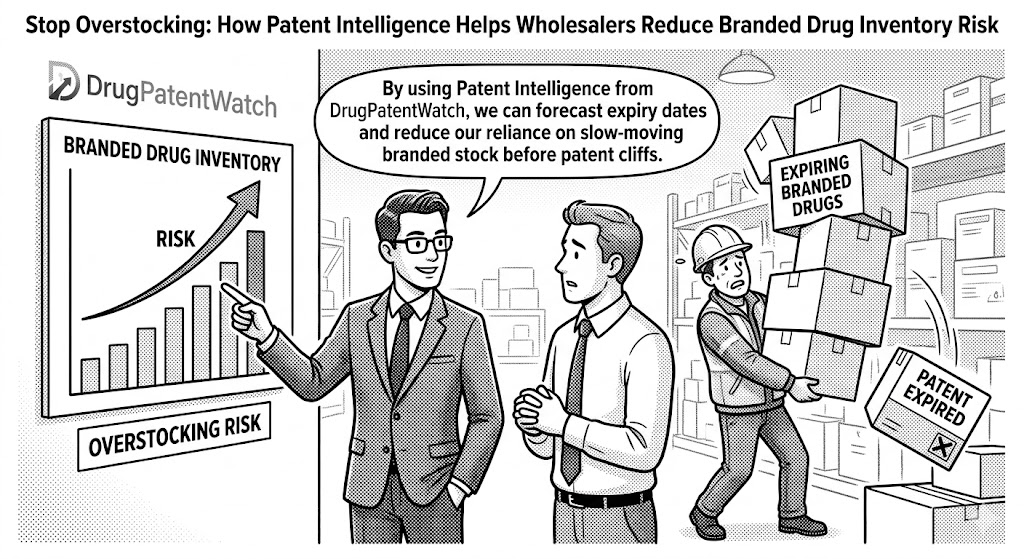
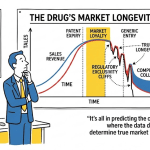
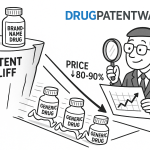
You probably already know the number: 80 to 90 percent. That’s how much of a branded small-molecule drug’s revenue can evaporate within the first twelve months after generic entry. What the industry talks about less is that the wholesaler — sitting between the manufacturer and the pharmacy shelf — takes a disproportionate share of that hit when they’re holding the wrong inventory at the wrong time.
The Big Three U.S. distributors — McKesson, Cencora (formerly AmerisourceBergen), and Cardinal Health — collectively control roughly 90% of U.S. drug distribution. They are sophisticated operations with treasury teams, demand forecasting software, and entire divisions dedicated to managing product transitions. Yet every major patent cliff still generates a period of misaligned inventory somewhere in the channel. Product purchased at full branded wholesale acquisition cost (WAC) sits in regional distribution centers as generic manufacturers launch. Price protection credits get filed. Shelf stock adjustments get negotiated. Returns accumulate. Every day of excess branded inventory after generic entry is a direct cost event.
The problem is not that wholesalers lack data. It’s that they’re using the wrong data at the wrong stage of the decision cycle. Volume history, prescriber demand forecasts, and manufacturer stocking incentives all arrive after the critical inventory decisions have already been made. Patent intelligence — systematically reading Orange Book filings, Paragraph IV certifications, litigation dockets, and authorized generic announcements — arrives earlier and is more actionable. Used correctly, it tells you which branded drugs to stop loading six months before the cliff, which ones have an 18-month litigation buffer you can use, and which are in a gray zone where “patent-protected” is being actively contested in federal court right now.
This article works through the mechanics. It covers how wholesale inventory risk around branded drugs actually accumulates, the specific patent intelligence signals that predict loss of exclusivity (LOE) timing with enough precision to matter operationally, the current drug classes where that intelligence is most urgent given what’s coming in 2026-2028, and how to build a monitoring process that reduces exposure without creating supply disruption risk on the other side.
How Branded Drug Inventory Risk Accumulates at the Wholesale Level
The Economic Structure of Wholesale Drug Distribution
Pharmaceutical wholesalers do not primarily earn revenue from branded drugs in the way most outsiders assume. The USC Schaeffer Center’s analysis of pharmaceutical distribution economics found that wholesalers make roughly eleven times more per dollar on generic drugs than on branded drugs. The margin structure inverts at LOE: a drug that was a modest-margin, high-volume branded product becomes a higher-margin, still-high-volume generic product once exclusivity breaks. This creates a powerful financial incentive for wholesalers to embrace generic transitions — but it also means that any inventory of the branded version purchased after generic launch has essentially zero remaining value to a wholesaler whose customers will immediately substitute to generic on price.
Wholesalers purchase branded drugs from manufacturers at WAC minus a confidential negotiated discount — typically WAC minus 2-5% for large-volume accounts. They sell to pharmacies at WAC minus a separate negotiated discount, which is often similar. The margin on brand distribution is thin enough that it’s largely covered by fee-for-service distribution agreements rather than the buy-sell spread. Forward buying — purchasing additional inventory ahead of expected manufacturer price increases and holding it for higher sale prices — historically accounted for as much as 40% of wholesalers’ branded drug revenues, according to the Commonwealth Fund’s 2022 analysis. As manufacturers have moderated price increase rates under political and regulatory pressure, forward-buying economics have weakened considerably.
What has not weakened is the price protection risk at LOE. When a brand manufacturer formally launches a generic competitor — its own authorized generic or the first independent generic — and simultaneously reduces WAC for the branded product (which most do), the wholesaler holding branded inventory at the old, higher WAC gets hit with a shelf stock adjustment. The manufacturer issues a credit for the inventory on hand, but that credit represents real money that was already committed. The cost is not hypothetical; it flows through as a debit to gross margin in the period the adjustment is made.
For smaller specialty distributors, or for large wholesalers in specific product categories where they’ve built inventory ahead of expected demand, these adjustments can be material. The Rutgers Business School’s LOE case study analysis documented the phenomenon clearly: distributors that failed to communicate proactively with manufacturer partners about LOE timing held excess branded inventory precisely when shelf stock adjustment claims were being settled at depressed values.
The Forward-Buying Trap at LOE
Forward buying creates a specific failure mode at patent cliffs. The same behavior that generates revenue when branded prices are rising — loading extra inventory at today’s price to sell at tomorrow’s higher price — generates losses when patent expiry approaches, because tomorrow’s price is not higher. It’s 85% lower.
Wholesalers who have successfully forward-bought a branded blockbuster for years develop institutional confidence in the strategy for that product. A procurement team that has reliably generated margin from, say, loading sacubitril/valsartan (Entresto) every January ahead of Novartis’s annual WAC increase may not have recalibrated that playbook when the Orange Book showed a patent expiry in July 2025 and multiple Paragraph IV ANDAs under litigation. The behavioral inertia of a profitable historical strategy collides with a forward-looking patent event that the historical data doesn’t capture.
The Entresto situation in 2024-2025 was precisely this scenario. The core U.S. patent expired in July 2025, and the FDA approved the first generic version of sacubitril — the novel component of the combination — in May 2024, a full 14 months before the nominal expiry date. Multiple manufacturers, including Novadoz Pharmaceuticals, Camber, Ascend, and Macleods Pharma, began production. A wholesaler who recognized the May 2024 FDA approval as a trigger to reduce Entresto stocking targets had 14 months to manage the transition carefully. One who was still loading inventory based on historical prescribing patterns in Q1 2025 had almost no runway.
Price Protection Mechanics and Their Limits
Manufacturers typically offer wholesalers price protection clauses covering branded inventory on hand at the moment of a WAC reduction. The mechanics involve a shelf stock adjustment: the manufacturer issues a credit for the difference between the old WAC and the new WAC, multiplied by the units on hand at the distribution center level. These credits are real and they do offset some of the inventory devaluation risk.
The limits of price protection matter for a precise understanding of the risk. Price protection typically covers the formal WAC reduction associated with a branded product losing exclusivity. It does not cover the carrying cost of holding that inventory during the period before the credit is issued. It does not cover the operational disruption of transitioning order management systems, pricing databases, and customer contracts from brand to generic simultaneously. It does not compensate for the downstream pharmacy customer who — rightly — expects their wholesaler to have the generic in stock on day one and may switch sourcing temporarily if it isn’t available. And it does not cover scenarios where an at-risk generic launch precedes the official WAC reduction, leaving a window where the branded WAC is unchanged but pharmacy demand has already shifted to the competing product.
At-risk launches — where a generic manufacturer begins commercial distribution before patent litigation is resolved, accepting the risk of a court ruling against them — have become more common since 2020. They create the most abrupt inventory dislocation for wholesalers: demand for the branded product drops sharply while WAC and price protection terms remain at pre-LOE levels, because the manufacturer has not formally reduced WAC in response to a contested competitor entry.
The Patent Intelligence Stack: What to Read and When
The Orange Book as Expiry Calendar
The FDA’s Approved Drug Products with Therapeutic Equivalence Evaluations — universally called the Orange Book — is the foundational document of pharmaceutical patent intelligence. It lists every patent a brand manufacturer has registered as covering an FDA-approved drug, along with the patent expiration date for each. It also lists regulatory exclusivity periods — market exclusivity granted by statute rather than patent, including five-year new chemical entity (NCE) exclusivity, three-year clinical investigation exclusivity, pediatric exclusivity extensions, and orphan drug exclusivity.
The Orange Book is public, updated regularly, and available for direct download from the FDA website. Every ANDA filer must address each patent listed in the Orange Book for their target drug, meaning the Orange Book defines the patent estate that a generic entrant must navigate. For wholesalers, the most basic use of Orange Book data is reading the nominal expiry dates: the latest-expiring patent for each drug gives you the earliest date at which a generic manufacturer could launch without patent exposure, assuming all listed patents are valid.
That nominal date is necessary but not sufficient. Real LOE timing depends on four additional factors that the Orange Book does not capture directly: whether any of the listed patents have been challenged under Paragraph IV, what the status of any resulting litigation is, whether a first-filer 180-day generic exclusivity period applies, and whether the brand manufacturer has launched or announced plans for an authorized generic. Each of these factors can move the effective LOE date earlier or later by months to years relative to the nominal patent expiry.
Paragraph IV Certifications: The Earliest Generic Entry Signal
When a generic manufacturer files an Abbreviated New Drug Application (ANDA) with a Paragraph IV (PIV) certification, it is asserting that a listed Orange Book patent is invalid, unenforceable, or will not be infringed by its product. The FDA publishes a list of accepted Paragraph IV certification ANDAs. This public list is the earliest legally documented signal that a generic manufacturer considers a specific branded drug’s patent protection vulnerable enough to challenge.
The sequence after a Paragraph IV ANDA filing is structured and therefore forecastable. The brand manufacturer has 45 days from receiving notice of the PIV certification to decide whether to file a patent infringement suit. If it does file suit, a 30-month automatic stay triggers — blocking FDA final approval of the ANDA for 30 months from the date of the notice letter (not from the filing date), unless a court rules earlier on the patent validity. If the brand manufacturer does not file suit within 45 days, the stay does not trigger and the ANDA can receive final approval as soon as regulatory requirements are met.
The first filer of a Paragraph IV ANDA for a given drug gets 180 days of generic market exclusivity if their challenge succeeds — no other approved generic may enter the market during those 180 days. This exclusivity is valuable enough that generic manufacturers race to be first filer on high-revenue targets. A peak in eligible ANDA submissions was observed in 2023 per PubMed analysis of FDA data, driven by the concentration of blockbuster patent cliffs in the 2025-2028 window. Litigation trends confirm Teva, Apotex, and Actavis as the most active Paragraph IV challengers over the 2020-2024 period.
For a wholesaler’s inventory planning team, the Paragraph IV certification list is operationally actionable in a specific way: it identifies which branded drugs have generic entry attempts underway right now, the expected 30-month litigation timeline from each notice date, and therefore the probabilistic window when commercial generic launch could occur. DrugPatentWatch tracks Paragraph IV certifications, ANDA filing statuses, litigation docket status, and first-filer exclusivity periods across the branded drug universe — providing the integrated view that the raw FDA databases require manual assembly to produce.
The 30-Month Stay and What Litigation Outcomes Mean for Inventory
The 30-month stay after a patent infringement suit gives brand manufacturers a legally guaranteed period of generic market exclusivity — even if the challenged patent would ultimately be found invalid at trial. This stay is the source of the “patent cliff with a buffer” phenomenon that makes inventory planning easier when it’s documented and harder when it’s ignored.
A drug with a single listed patent expiring in November 2026 and an ANDA with Paragraph IV certification filed in January 2025 (triggering a notice letter in, say, March 2025) has a 30-month stay that runs to approximately September 2027. If the brand manufacturer files suit within 45 days of the notice letter, the generic cannot receive final FDA approval until September 2027 at the earliest — unless the court rules on the patent before then. From a wholesaler’s perspective, this is a 10-month buffer beyond the nominal November 2026 patent expiry. Branded inventory purchased with that buffer in mind is less exposed than inventory purchased based on the nominal date alone.
Eliquis (apixaban) illustrates the importance of tracking litigation status rather than just nominal expiry. Eliquis’s key U.S. patent nominally expires in November 2026, and multiple Paragraph IV ANDAs have been filed by generic manufacturers. Bristol Myers Squibb and Pfizer mounted an aggressive litigation campaign, and court rulings have delayed effective generic entry until at least April 1, 2028 — BMS has confirmed this date explicitly. A wholesaler planning Eliquis inventory drawdown based on the November 2026 nominal expiry date was working with incorrect information. The correct date, derivable from litigation dockets, is 17 months later. That’s 17 months of revenue from continued branded Eliquis distribution that poor patent intelligence would cause a wholesaler to miss by drawing inventory down too early.
The inverse error matters equally. When court outcomes weaken the stay — when a district court rules a challenged patent invalid, or when both parties settle with an agreed entry date earlier than the stay expiration — generic entry can accelerate beyond what the nominal stay timeline suggests. Tracking court ruling dates and settlement announcements is as critical as tracking the initial litigation timeline.
Authorized Generics: The Signal Most Wholesalers Miss
An authorized generic (AG) is a version of a branded drug that the brand manufacturer produces itself (or licenses to another company) and sells under the generic drug’s active ingredient name at a generic price point. AGs allow the brand manufacturer to participate in the generic market during the first-filer’s 180-day exclusivity period — when no independent generic can enter but the first filer’s 180-day clock is running. From a market access standpoint, an authorized generic is equivalent to a standard generic from the pharmacy’s perspective.
The significance for wholesalers is that authorized generic announcements are public, usually made in advance of the generic launch date, and represent one of the clearest signals of when the brand manufacturer itself expects LOE to occur. A manufacturer does not announce an authorized generic unless it has concluded that generic entry is imminent and has made the business decision to participate in that market rather than simply ceding it to independent generics.
DrugPatentWatch analysis of 2024-2025 patterns noted that it has become increasingly common for brand manufacturers to launch their authorized generic on the exact same day as the independent generic — eliminating the period when the first filer’s 180-day exclusivity creates any pricing advantage for the first filer and maximizing the brand company’s remaining revenue. When this happens, the authorized generic announcement date is essentially the launch date. Wholesalers monitoring authorized generic filings in the FDA’s database and manufacturer press releases have a specific, actionable date to work toward in their inventory wind-down planning.
The Litigation Complexity Discount
Not all Paragraph IV challenges carry equal probability of success. Patent litigation in pharmaceuticals is a probabilistic enterprise. Data from 2024 suggested an even starker split in court outcomes than historical averages: innovator companies prevailed in court decisions approximately 20% of the time, compared to 2% for generic challengers. Taken at face value, that implies generic challengers win the vast majority of contested cases — but that framing misses the selection effect. The cases that go to full trial are typically those where neither party was willing to settle, which skews toward cases where the brand manufacturer believes it has strong patent coverage. Many challenges settle before trial with negotiated entry dates.
For inventory planning, the practical question is not “who wins” but “what is the realistic earliest possible entry date given the current state of litigation.” A first-filer with an ANDA that has received tentative approval from the FDA — meaning the FDA has reviewed it and concluded it is approvable, pending only patent/exclusivity resolution — can launch commercially the moment the patent barrier lifts. A first-filer without tentative approval still needs regulatory review time after the patent barrier clears. The tentative approval status is public in FDA’s ANDA database and provides a more precise read on how quickly generic supply would actually become available at any given litigation outcome.
DrugPatentWatch consolidates Orange Book data, Paragraph IV certification status, tentative approval status, and litigation outcome tracking into a unified view by drug. Cross-referencing this data against a wholesaler’s current inventory levels and forward purchase commitments produces the most precise picture of where branded inventory exposure actually sits — and which risk positions can be reduced most efficiently without disrupting downstream supply.
The 2026-2028 Cliff: Where Wholesaler Exposure Is Concentrated Right Now
Between 2025 and 2030, the global pharmaceutical industry faces a loss of exclusivity wave that puts an estimated $200 billion to $400 billion in branded drug revenue at direct risk. That range reflects genuine uncertainty about litigation outcomes, biosimilar entry timelines, and IRA price negotiation schedules — not analytical imprecision.DrugPatentWatch, ‘Drug Patent Expiration: The Complete Strategic Guide,’ March 2026 [1]
Small-Molecule Oral Drugs: The Fastest-Moving Exposure
Small-molecule oral drugs represent the highest-velocity inventory risk at LOE events. When a tablet or capsule product loses exclusivity and multiple generics launch simultaneously, the price collapse happens within days rather than weeks. Generic substitution rates in oral solid dose products exceed 90% within the first year of multi-source entry. A wholesaler holding 45-day supply of a branded oral solid product at the date of generic launch will spend most of that 45 days selling below replacement cost on the branded product while competing sourcing through their generic network for the same drug.
The 2026-2028 window contains an extraordinary concentration of oral small-molecule blockbuster events. Eliquis (apixaban), with 2024 global sales exceeding $13.2 billion between Bristol Myers Squibb and Pfizer, has a litigated entry date of approximately April 2028 in the U.S. given current court posture. Januvia (sitagliptin) from Merck faces LOE in 2026, though the company has used PIV litigation settlements to manage staggered entry timing. Keytruda (pembrolizumab) from Merck generated $29.3 billion in 2024 sales but is a biologic, with a different LOE trajectory. Opdivo (nivolumab), another checkpoint inhibitor from Bristol Myers Squibb, is similarly biologic.
Entresto (sacubitril/valsartan) already crossed the cliff in July 2025, and the post-LOE supply picture validated the inventory risk scenario. Multiple manufacturers received FDA approval and began production, but achieving full production capacity takes months. During this ramp period, some pharmacies had branded Entresto in stock but not the generic; others had generics from some but not all available manufacturers; supply was inconsistent across the channel. This is the operational reality of every major small-molecule LOE — a period of supply fragmentation that wholesalers who pre-positioned correctly (reduced branded inventory, established generic sourcing relationships before day one) navigated with minimal disruption, while those who didn’t experienced a parallel pressure of excess branded inventory and insufficient generic supply.
The Biologic Slope: Different Dynamics, Still Manageable
Biologic drugs behave differently from small molecules at LOE events, and that difference matters for inventory planning. The revenue erosion following biosimilar entry is more gradual — a slope rather than a cliff — because several structural factors slow substitution. First, biosimilars require physician and patient education; the therapeutic equivalence narrative that drives rapid oral generic substitution at the pharmacy level doesn’t apply automatically. Second, payer formulary dynamics lag; PBMs and health plans take time to update formularies to favor biosimilar alternatives, even when interchangeability status has been granted. Third, the brand manufacturer’s rebate relationships with PBMs can maintain brand formulary position for months or years post-biosimilar entry.
AbbVie’s Humira (adalimumab) is the most documented large-scale case. Biosimilar competition launched in January 2023, and Humira’s sales declined from $21.24 billion in 2022 to $14.04 billion in 2023 and then to $8.99 billion in 2024. That’s a 58% decline over two years — substantial, but far slower than the 80-90% first-year collapse typical of small molecules. The inventory implication for wholesalers was that Humira inventory drawdown could be managed much more gradually than a small-molecule patent cliff, using biosimilar launch timing as a leading indicator of shifting demand rather than a binary switch point.
For the coming biologic LOE events, Stelara (ustekinumab) from Johnson & Johnson has faced biosimilar competition since late 2023. Eylea (aflibercept) from Regeneron has biosimilar entrants working through regulatory and commercial launch preparation. Keytruda’s patent cliff, expected in the 2028-2029 window, will represent the largest single biologic LOE event in pharmaceutical history given its $29+ billion revenue base. Understanding the slope rather than cliff dynamic for these products gives wholesalers the right framework: the exposure window is longer, the urgency less acute, but the total revenue at risk over a 24-36 month transition period is comparable to a sharp small-molecule event.
The IRA Dimension: Medicare Price Negotiation as a Parallel Devaluation
The Inflation Reduction Act of 2022 introduced Medicare drug price negotiation, and its commercial implications extend well beyond the 10 initial drugs negotiated in 2023-2024. The negotiated Maximum Fair Prices (MFPs) published in August 2024 reflected discounts of 38-79% from the drugs’ WAC list prices. The drugs in the first negotiation tranche included Eliquis, Jardiance, Xarelto, Januvia, Farxiga, Entresto, Enbrel, Imbruvica, Stelara, and insulin products — all high-revenue branded products with significant wholesaler channel volume.
The inventory implications of IRA pricing differ from LOE events but deserve tracking on the same monitoring infrastructure. When an MFP takes effect for Medicare Part D, the commercial market pricing dynamics shift in ways that don’t require a formal WAC reduction to impact wholesaler economics. Commercial payers and PBMs now have a publicly available government-negotiated reference price that they use in rebate negotiations. Products with MFPs face accelerated rebate pressure that compresses net realized revenue relative to WAC — meaning the effective margin available to the wholesaler on those products erodes even without a formal WAC change.
A wholesaler carrying inventory of an IRA-negotiated drug faces a subtler version of the LOE inventory risk: the nominal WAC doesn’t change dramatically, but the downstream pricing environment compresses net realization, making high inventory levels at WAC less economically rational. Patent intelligence that identifies MFP negotiation candidates — correlated with high-revenue branded drugs that face expiring exclusivity — is therefore a composite of LOE timing and IRA trajectory analysis.
Building the Patent Intelligence Monitoring Process
Categorizing Your Branded Inventory by LOE Risk
The first operational step is segmenting your current branded inventory universe by LOE risk category. This is not the same as segmenting by sales volume or margin. A $50 million product with a clear, uncontested patent expiry in 18 months and four Paragraph IV ANDAs under active 30-month stays is a well-defined risk. A $200 million product with no active Paragraph IV challenges and a patent stack extending to 2032 is minimal near-term risk despite its larger revenue footprint.
A workable four-tier risk framework looks like this:
Tier
Criteria
Planning Action
Monitoring Frequency
Tier 1 — Active Cliff
Patent expiry within 12 months OR tentative generic ANDA approval already granted OR authorized generic announced
Active 30-month stay in place; Paragraph IV ANDAs filed; patent expiry in 12-36 months
Track litigation docket for court ruling dates and settlement announcements; hold reduced branded inventory; prepare generic sourcing contingencies
Bi-weekly
Tier 3 — Horizon Watch
Patent expiry in 36-60 months; no active Paragraph IV challenges yet, but generic manufacturer IP activity detectable
Monitor ANDA filing lists monthly; establish LOE event in financial forecasting models; no immediate inventory action required
Monthly
Tier 4 — Long-Dated
No patent expiry within 5 years; no active challenges; clean Orange Book
Standard inventory management; annual review
Quarterly
The categorization is dynamic. A Tier 3 drug moves to Tier 2 the day an ANDA with a Paragraph IV certification is accepted by the FDA. A Tier 2 drug moves to Tier 1 the day a court rules the challenged patent invalid or the parties announce an LOE settlement date. The monitoring system has to be designed to capture these categorical transitions in near-real-time, not via quarterly category review cycles.
Reading the ANDA Database for Entry Timing Intelligence
The FDA’s ANDA database, combined with the Orange Book and the Paragraph IV certification list, provides the raw data for LOE timing analysis. The practical challenge is that this data is spread across multiple FDA systems and requires integration to produce a coherent picture for any specific drug. The Orange Book gives you the patent estate. The ANDA database gives you the applications pending, including their current status (under review, tentative approval, final approval, withdrawn). The Paragraph IV certification list gives you which of those ANDAs are challenging listed patents. The litigation docket, accessed through PACER, gives you the current status of any resulting lawsuits.
Integrating these four sources for a single drug is manageable manually for a handful of products. Doing it across a portfolio of 50-100 branded products on a weekly monitoring cycle is a different undertaking. This is where pharmaceutical patent intelligence platforms provide structural value. DrugPatentWatch cross-references all four data sources and provides integrated LOE date estimates that account for patent layering, active litigation status, first-filer exclusivity periods, and authorized generic filings. Its database covers estimated key patent expiration dates for branded drugs at the NDC level and flags products where active generic challenges are underway — turning a four-source manual research process into a queryable structured dataset.
The specific data points a wholesaler’s procurement team should be pulling from this kind of integrated source are: the expected first possible generic launch date accounting for 30-month stays, tentative approval status of the leading ANDA filer, whether a 180-day first-filer exclusivity applies and which company holds it, any announced authorized generic plans, and court ruling dates on appeal if the district court has already ruled on the challenged patent. These six data points, maintained on a weekly basis for Tier 1 and Tier 2 products, give a procurement team the information it needs to set inventory targets with real LOE event precision rather than nominal patent expiry approximation.
The 180-Day Exclusivity Window: Using It Rather Than Being Caught by It
The 180-day first-filer generic exclusivity period creates a specific inventory management opportunity that most wholesaler procurement teams don’t exploit as deliberately as they should. During this 180-day window, only one generic — the first filer — can be commercially sold. That means supply is constrained relative to what will eventually be available, competition among generic suppliers is minimal, and prices tend to be higher than the multi-source generic market that follows.
A wholesaler who has accurately identified the first filer and the expected launch date has a 180-day window to be the preferred distributor for that specific generic — a role with meaningfully better margins than commodity generic distribution in the multi-source phase that follows. Establishing distribution agreements with first-filer generic manufacturers before their 180-day exclusivity launches requires the same lead time as the patent monitoring itself. Companies like Teva, Mylan (now Viatris), and Sandoz — the most active Paragraph IV filers — maintain distribution relationships with all three major wholesalers, but preferential treatment for specific product launches is negotiated separately and rewards the wholesaler who has tracked the launch timeline closely.
The inverse of this opportunity is the failure mode of sourcing a first-day generic through secondary channels rather than the primary wholesaler relationship. DrugPatentWatch noted that a single decision to buy a new generic from a secondary wholesaler to save a modest amount on invoice price can cause a pharmacy’s generic compliance rate to drop fractionally — and for an average pharmacy, that fractional drop in compliance can translate to thousands of dollars in lost wholesaler rebates per month. The financial logic of generic compliance tiers reinforces exactly the behavior that patent monitoring enables: being ready to source the right generic through the right channel on the first available day.
When Patent Intelligence Gets Complicated: Patent Thickets
Not every LOE event is readable from a single Orange Book patent expiry. The Celgene case around Revlimid (lenalidomide) is the most documented example of patent thicket complexity — 206 additional patent filings around the core molecule, with a WAC that rose from approximately $6,000 to $24,000 per month over the drug’s commercial life. The patent estate was so dense that generic entry happened through a series of negotiated volume-cap agreements rather than a clean cliff, with generic manufacturers accepting contractual limits on how much product they could sell during the initial post-LOE period in exchange for agreed entry dates.
For wholesalers, patent thicket complexity doesn’t eliminate the need for LOE planning — it changes the shape of the planning model. A drug with a negotiated volume-cap generic entry structure doesn’t create a sudden demand shift from brand to generic; it creates a gradual coexistence period where branded and generic product share the market in proportions determined by the volume caps. Inventory management in this scenario requires understanding the cap structure, which is typically disclosed as part of the settlement approval process in the relevant court filings.
The analytical question is whether the apparent complexity of a patent thicket actually delays generic entry in practice. The FTC and DOJ have increased scrutiny of pay-for-delay settlements — the arrangements under which brand manufacturers pay generic challengers to delay market entry in exchange for dropping their patent challenges. In 2024 and 2025, authorized generic launches on the day of independent generic entry became more common as brand manufacturers adapted to regulatory pressure on pay-for-delay structures. That trend, if it continues, reduces the degree to which patent thicket complexity actually extends the effective LOE window — and therefore reduces the degree to which complex patent estates provide a reliable inventory buffer.
The Operational Integration: Getting Patent Intelligence Into Procurement Decisions
Why LOE Date Tracking Failures Are Organizational, Not Analytical
The most important obstacle to patent-informed inventory management in pharmaceutical distribution is not data availability. It’s organizational structure. In most large wholesalers, the data required for accurate LOE forecasting is distributed across functions that don’t routinely communicate with each other on a forward-looking basis. The legal or compliance team may track litigation developments for liability reasons. The category management team tracks product transitions reactively, responding when manufacturers announce pricing changes. The procurement team manages inventory levels based on demand signals from the prior period and volume incentives from manufacturer contracts.
No single function owns the synthesis of Orange Book data, ANDA litigation status, authorized generic announcements, and inventory position into a unified LOE risk picture. The result, documented in the Rutgers Business School LOE case study analysis, is that drug LOE events consistently produce worse inventory outcomes than they should for a supply chain participant with full access to all relevant public data.
The organizational fix is not complex, but it requires explicit assignment of responsibility. Someone — a category manager, a business intelligence analyst, a specialty distribution lead — needs to own a LOE watch list for the top 50-100 branded drugs in the portfolio by revenue and flag Tier 1 and Tier 2 events on a weekly basis to procurement decision-makers. That person needs access to a patent intelligence data source that integrates Orange Book, ANDA, and litigation data (DrugPatentWatch provides this at the drug level), and needs a direct line to the procurement team’s weekly planning cycle.
At the other end of the organizational problem, manufacturer communication matters. The Rutgers case study found that larger companies with dedicated LOE planning teams were better positioned to prepare for product transitions because they were already receiving advance communication from manufacturers about expected LOE timelines and authorized generic plans. Formalizing this communication — establishing a specific point of contact at each major manufacturer for LOE transition planning — is an underutilized source of early warning. Manufacturers have strong incentives to manage the channel inventory transition carefully; excess branded inventory at wholesale leads to shelf stock adjustment costs that the manufacturer ultimately bears. The interests are aligned; the communication just needs to be structured.
Surge Pricing Intelligence: The Pre-LOE Price Increase Trap
Brand manufacturers frequently increase WAC systematically in the 12-18 months leading up to a patent cliff, a pattern known as surge pricing. The logic is straightforward: maximize revenue while exclusivity lasts. One common historical pattern involved graduated WAC increases of 5-8% every six months in the final two years before an anticipated LOE event. As long as price increases stay below approximately 9%, they tend not to produce meaningful demand destruction, according to PharmExec analysis of LOE pricing strategies.
For a wholesaler practicing forward buying, surge pricing in the pre-LOE period creates a compounded risk position. The wholesaler loads additional branded inventory to capture the margin from expected price increases, which works as planned through the first two or three cycles. Then the LOE event occurs, and the wholesaler is holding a large inventory of a product purchased at a peak pre-LOE WAC that will be immediately devalued. The forward-buying profit from the previous six months is effectively unwound by the shelf stock adjustment at LOE.
Recognizing surge pricing patterns as a LOE proximity signal — not just a margin opportunity — is the behavioral change that patent intelligence enables. When a drug’s WAC starts increasing at a rate above historical norms and the Orange Book shows patent expiry within 24 months, the surge pricing pattern is a signal to slow inventory loading, not to accelerate it. The price increase is real; the inventory risk behind it is also real.
Generic Compliance Tiers and the Patent Intelligence Link
Wholesaler rebate and fee-for-service structures tie pharmacy customers to generic compliance tiers: thresholds for what percentage of a pharmacy’s generic purchases come through the primary wholesaler, which directly determines the rebate tier the pharmacy qualifies for. Managing pharmacy customers’ transition from brand to generic on high-revenue LOE products is the single biggest lever wholesalers have on their own rebate economics with those customers.
A pharmacy that switches to generic sacubitril/valsartan on day one of its availability through the primary wholesaler maintains or improves its generic compliance rate. One that buys the generic from a secondary distributor to save a few dollars on invoice price sees its compliance rate drop — and that drop triggers rebate tier penalties from the primary wholesaler that dwarf the invoice savings. The wholesaler’s economic interest in keeping pharmacy customers compliant aligns precisely with the interest in having the right generic in stock on day one of availability.
Getting the generic in stock on day one requires knowing the launch date in advance. That requires tracking tentative ANDA approvals, authorized generic announcements, and 180-day exclusivity start dates — all patent intelligence data points. The wholesaler who has monitored Eliquis’s (eventual) generic launch preparation, identified the first-filer tentative approval status, and pre-positioned its generic inventory will be able to fill pharmacy orders on day one. The one relying on reactive ordering will face a 3-7 day sourcing lag during which its pharmacy customers will find the generic elsewhere — and the generic compliance statistics will show it.
The Biosimilar Case: A Slower Signal, But Equally Readable
Biosimilar Patent Litigation and Its Specific Signals
Biologic drug patent protection doesn’t operate under the same Hatch-Waxman framework as small-molecule drugs. The Biologics Price Competition and Innovation Act (BPCIA), which created the biosimilar approval pathway, has its own “patent dance” process — a series of mandatory information exchanges between the reference biologic manufacturer and the biosimilar applicant that defines the scope of patent disputes before any litigation is filed. This process is less transparent to outsiders than the Orange Book/Paragraph IV system for small molecules, but it generates public signals at specific stages.
Biosimilar applications that receive FDA approval are publicly announced. Interchangeability designations — the higher standard that allows pharmacists to automatically substitute a biosimilar for the reference biologic without prescriber intervention — are also publicly listed by the FDA. Tracking FDA biosimilar approvals and interchangeability designations for drugs in a wholesaler’s brand portfolio provides the equivalent of the Paragraph IV certification signal for biologics: documented proof that a competitor has cleared the regulatory barrier and can commercially launch once patent issues are resolved.
The Humira biosimilar wave of 2023 was clearly visible at least 18 months before the first commercial launches. AbbVie had reached settlement agreements with multiple biosimilar manufacturers, the settlement terms (including agreed entry dates) were filed with the FTC as required, and multiple biosimilar manufacturers had received FDA approval with interchangeability designations in 2021-2022. A wholesaler who tracked FDA biosimilar approval announcements, settlement filing disclosures, and manufacturer press releases had an 18-month window to manage Humira branded inventory drawdown. The biosimilar slope rather than cliff dynamic meant the inventory transition could be more gradual — but it didn’t mean it should be unplanned.
The Interchangeability Threshold and Substitution Rate Forecasting
Interchangeability status is the critical variable that determines how quickly biosimilar substitution occurs at the pharmacy level. Without interchangeability, a pharmacy must receive a new prescription or prescriber authorization to dispense a biosimilar instead of the reference biologic. With interchangeability, automatic substitution is permitted in states that allow it — and most now do. The commercial substitution rate is not identical to the interchangeability status; formulary positioning, copay structures, and physician communication all intermediate between the regulatory designation and actual dispensing patterns.
For inventory planning, the practical implication is that biologic LOE events with interchangeable biosimilars should be treated as faster-moving than those without interchangeability. Tracking which biosimilar manufacturers have filed for and received interchangeability designation — available from FDA’s Purple Book — provides a calibration input for how rapidly branded biologic inventory should be reduced as biosimilar launch approaches.
Eylea (aflibercept) from Regeneron is a current example worth tracking. Biosimilar manufacturers including Amgen, Samsung Bioepis, and Pfizer have received FDA approval for aflibercept biosimilars, with interchangeability designations at various stages of the approval process. The reference product’s ophthalmology indication — age-related macular degeneration, diabetic macular edema — involves a patient population with high brand loyalty and physician prescribing inertia. Substitution rates are likely to be slower than for a high-volume oral chronic condition drug. That translates to a slower inventory drawdown pace for branded Eylea — but not to the absence of an eventual drawdown requirement.
Risk Mitigation in Practice: Four Operational Levers
Lever 1: Purchase Order Commitment Timing
The most direct inventory risk reduction lever is adjusting the forward purchase commitment horizon for Tier 1 branded drugs. Most branded drug purchase agreements operate on 30-90 day forward commitment windows, with flexibility to adjust order quantities within manufacturer-specified floors. As a drug moves into Tier 1 — first possible generic launch within 12 months — systematically reducing the forward commitment horizon reduces the amount of branded inventory at risk of devaluation.
Reducing commitment horizon from 60 days to 30 days for a Tier 1 product cuts the volume at risk at LOE event by roughly half (assuming steady underlying demand). For a $100 million annual product, that’s approximately $8 million in branded inventory risk reduction per month of horizon compression. At scale across a portfolio of 10-15 Tier 1 products, the cumulative inventory risk reduction is material.
The countervailing risk — supply disruption if demand forecasts are wrong or if the generic launch is delayed by litigation — argues for maintaining some branded inventory buffer even in the final approach to LOE. Getting the balance right requires the same patent intelligence input: if the 30-month stay has 4 months left but a court ruling is pending that could accelerate entry, that’s different from 4 months left on the stay with no pending motions. The precision of the risk reduction depends on the precision of the litigation monitoring.
Lever 2: Pre-LOE Generic Sourcing Contracts
Establishing distribution agreements with generic manufacturers before their products launch gives a wholesaler preferential access to generic supply during the transition period. For first-filer generic exclusivity drugs, this is especially important: only one generic can be sold during the 180-day window, supply ramp-up takes time, and allocation among competing wholesalers is determined by pre-existing relationship depth.
Generic sourcing teams who track Paragraph IV certifications and monitor tentative ANDA approval status for Tier 1 and Tier 2 products can initiate sourcing conversations 12-18 months before the expected launch date. Generic manufacturers value these advance conversations because they reduce commercial launch uncertainty and allow better production planning. The wholesaler who approaches Teva or Mylan or Sandoz 18 months before a high-revenue Paragraph IV launch date gets better commercial terms and better supply access than the one who calls on day one of commercial availability.
Lever 3: Shelf Stock Adjustment Claim Optimization
When LOE does hit and a WAC reduction occurs, the shelf stock adjustment credit from the manufacturer represents a recovery of the inventory devaluation. Maximizing this recovery requires accurate real-time inventory data at the distribution center level — something that is operationally achievable but requires deliberate investment in inventory tracking granularity.
Shelf stock adjustment claims are negotiated based on inventory on hand at specific points in time. Wholesalers with more granular DC-level inventory data can submit larger, more precise claims. Those relying on aggregate inventory estimates may leave credit on the table. The documentation requirements for shelf stock adjustment claims vary by manufacturer contract — understanding these requirements in advance of LOE events, not in the scramble of the event itself, prevents claim disputes that delay credit issuance.
Lever 4: Customer Transition Communication
The downstream pharmacy customer’s transition from branded to generic is partly within the wholesaler’s influence. Proactive communication from the wholesaler’s account management team — flagging upcoming LOE events to pharmacy customers, confirming generic stocking plans, and adjusting reorder point recommendations before the LOE date — reduces the probability of the pharmacy customer sourcing the new generic elsewhere on day one.
This communication requires the wholesaler’s account management team to have accurate LOE timing information, which again depends on patent intelligence inputs. An account manager who confidently tells a pharmacy customer “generic sacubitril/valsartan will be available from us starting July 2025, here’s the expected pricing range, here’s how to update your reorder points” is providing a service that the customer values. The alternative — the pharmacy finds out the generic launched from the generic manufacturer’s press release and starts calling secondary distributors — is avoidable.
Patent Thickets, Pay-for-Delay Settlements, and the Contracts That Hide LOE Dates
How Brand Manufacturers Obscure Real LOE Timing
Brand pharmaceutical manufacturers spend considerable legal and regulatory effort making generic entry harder to predict. The industry calls these strategies lifecycle management; critics call some of them gaming. For a wholesaler trying to plan inventory, they represent a set of tactics that systematically inflate the apparent certainty of branded drug exclusivity beyond what the underlying patent quality would justify.
The most consequential tactic is the patent thicket: filing a large number of secondary patents covering not the core active ingredient but peripheral aspects of the drug — specific polymorphic crystal forms of the API, particular dosage regimens, stabilizing excipients, delivery mechanisms, combination formulations, and method-of-treatment claims. Each individual patent in a thicket may be narrow and potentially vulnerable to challenge, but the combined mass creates a legal barrier that generic manufacturers must navigate or challenge one patent at a time. Celgene’s Revlimid (lenalidomide) accumulated over 206 additional patent filings. The cancer drug’s WAC rose from approximately $6,000 per month to $24,000 over its commercial life, protected by layer upon layer of secondary patents that extended effective exclusivity well beyond the core molecule patent.
For inventory management, patent thickets create a specific analytical problem: the latest expiry date in the Orange Book may be from a secondary patent of uncertain validity that a determined generic manufacturer could challenge and potentially invalidate, meaning the effective LOE could be earlier than the Orange Book suggests. Conversely, a thicket might sustain effective exclusivity longer than the nominal dates indicate if generic challengers settle for negotiated entry dates rather than litigating the entire thicket to resolution. The Orange Book date range for a heavily thicketed drug — from the earliest-expiring patent to the latest — might span eight to ten years, with the actual LOE date depending on legal outcomes that are genuinely uncertain.
The operational response to thicket complexity is not to assume the earliest or latest possible date but to focus on the litigation status of the most commercially significant challenged patents. Generic challengers are rational actors; they target the patents most likely to block their entry first. If multiple Paragraph IV certifications are filed for a thicketed drug, examine which patents are being challenged, not just how many. The patents under active Paragraph IV challenge are the ones generic manufacturers believe are most vulnerable — and their litigation timeline determines the realistic LOE window.
Pay-for-Delay Settlements and the FTC’s Increasing Scrutiny
A pay-for-delay settlement — formally called a reverse payment settlement — occurs when a brand manufacturer pays a generic challenger (in cash, in product, or in the form of business concessions) to delay its market entry in exchange for dropping its patent challenge. The financial logic is straightforward for the brand manufacturer: Eliquis generates over $13 billion annually. Paying a generic company $300 million to stay out of the market for two additional years is a rational trade if it preserves $26 billion in branded revenue during those two years. The FTC has argued for decades that this behavior is anticompetitive, and the Supreme Court’s 2013 FTC v. Actavis ruling established that such settlements could violate antitrust law depending on their specific terms.
For wholesaler inventory planning, pay-for-delay settlements produce the most frustrating LOE timing problem: a drug that appeared to be approaching LOE based on patent expiry analysis suddenly has an extended exclusivity period via settlement, and the settlement terms — which determine the agreed generic entry date — may not be publicly disclosed in detail. The FTC requires notification of settlement terms for antitrust review, and the material terms eventually become visible through regulatory filings or court approval processes. But the disclosure lag between settlement execution and public visibility can be months.
Since 2020, the DOJ and FTC have increased their scrutiny of pay-for-delay settlements, and the trend in 2024-2025 was toward brand manufacturers launching authorized generics on the same day as the independent generic rather than paying the independent to stay out. This shift reduces the frequency of settlements that purely delay entry, but it doesn’t eliminate the practice. Monitoring FTC settlement notifications — which the agency publishes — and court approval orders for settlement agreements in active pharmaceutical patent litigation is a specialized but achievable addition to the standard LOE intelligence process.
FDA Citizen Petitions as Delay Tactics
Brand manufacturers can file citizen petitions with the FDA requesting that the agency take regulatory actions — or decline to take them — that would affect generic drug approvals. A well-timed citizen petition can trigger an FDA review obligation that delays final ANDA approval by weeks to months, even if the petition is ultimately denied. The FDA has become increasingly alert to petitions filed primarily for delay purposes and has policies to prevent delaying generic approvals based solely on citizen petition content. But the filing itself is public, and its timing — typically filed shortly before an expected generic approval — is itself a signal.
For inventory planning, a citizen petition filed against a Paragraph IV ANDA for a Tier 1 drug is a signal that the brand manufacturer is using every available procedural tool to delay generic entry. This is useful information because it suggests the brand manufacturer believes the generic challenge is likely to succeed on the merits — otherwise, the procedural delay mechanisms would not be worth deploying. It also suggests the brand manufacturer’s internal LOE planning is well advanced, which means its authorized generic preparations may also be further along than public disclosures indicate.
Tracking citizen petition filings from FDA’s docket management system for drugs in a Tier 1 or Tier 2 watch list takes 30 minutes per week. Petitions filed against pending ANDAs for specific drugs appear in the docket under the drug’s NDA number and are publicly searchable. The existence of a citizen petition doesn’t change the fundamental LOE timeline analysis, but it adds a contextual data point that calibrates how aggressively the brand manufacturer is defending its exclusivity — and therefore how likely it is that the manufacturer has contingency plans already prepared.
Specialty Drug Inventory: A Different Risk Profile
Why Specialty Brands Require a Separate Framework
Specialty drugs — broadly defined as high-cost, often biologically complex medications requiring special handling, administration, or monitoring — follow a different inventory risk profile than standard branded pharmaceuticals. The major wholesalers have recognized this distinction commercially; all three have built or acquired specialty distribution capabilities separate from their core drug distribution businesses. The inventory risk at LOE for specialty drugs differs from standard branded drugs in three specific ways that the standard LOE analysis framework doesn’t fully capture.
First, specialty drug supply chains are more concentrated. Specialty biologics are frequently distributed through a small number of specialty distributors or directly through manufacturer-affiliated specialty pharmacies rather than the full wholesale channel. A wholesaler who participates in the specialty channel for a specific product has more concentrated inventory exposure than the equivalent dollar value would represent in the standard channel. When a specialty biologic faces biosimilar entry, the concentrated distributor structure means the inventory transition is more visible and more negotiable — but the stakes per product are higher.
Second, payer dynamics for specialty drugs are slower-moving. Specialty drug formulary decisions are made at the health plan and PBM level by pharmacy and therapeutics committees that meet quarterly. Biosimilar substitution in specialty settings depends on these committee decisions changing formulary positioning, which typically happens 6-12 months after biosimilar commercial launch at the earliest. This lag makes the revenue erosion slope even more gradual than biologic LOE events in the standard channel — and extends the inventory wind-down timeline accordingly.
Third, specialty drug return and price protection agreements are often structured differently from standard channel contracts. Some specialty manufacturers maintain buy-back arrangements or specific pricing structures for specialty distributor inventory that don’t apply to the standard wholesale channel. Understanding these specific contractual terms for specialty drugs in a LOE approach is necessary to model the actual financial exposure accurately.
The Oncology Channel and Buy-and-Bill Inventory Dynamics
Oncology drugs distributed through the buy-and-bill channel — where physicians purchase directly from wholesalers and administer in office, then bill insurers for the drug itself — create a distinct inventory dynamic. All three major wholesalers have expanded into oncology practice management service organizations: Cencora’s $4.6 billion acquisition of Retina Consultants of America and Cardinal’s $1.9 billion Solaris Health deal reflect this strategic pivot. As wholesalers become more deeply integrated with the prescribing practices that drive oncology drug volume, their inventory exposure in the buy-and-bill channel becomes more direct and more concentrated than traditional wholesale inventory.
Oncology branded drugs facing LOE events — and there are many in the 2025-2030 window — create inventory risk in the buy-and-bill channel that is harder to manage than standard pharmacy distribution. Oncologists who have established treatment protocols around a specific branded drug don’t automatically switch to generic on day one, particularly for intravenous oncology drugs where bioequivalence demonstration is more complex and physician confidence requires building. The revenue erosion is slower, but the inventory commitment at the physician-practice level is deeper and less liquid than pharmacy-level inventory.
Patent intelligence for buy-and-bill oncology products requires the same underlying inputs — Orange Book, ANDA filings, litigation status — but the inventory management response needs to account for the longer switch lag at the practice level. Reducing buy-and-bill inventory commitment for an oncology branded drug should start 18-24 months before expected LOE, not 6-12 months, because the alternative channel adjustment (building generic inventory and physician relationships around the generic) takes longer in this setting.
Financial Modeling the Inventory Risk: Putting Numbers to the Exposure
Calculating the Inventory Devaluation Cost of an Unmanaged LOE Event
The financial exposure from branded drug inventory held past LOE is calculable with three inputs: the average daily sales volume (in dollars) for the branded drug, the average days of inventory held at the distribution center level, and the price decline percentage expected at generic entry (80-90% for small molecules, calibrated to the number of expected generic entrants).
Take a representative example. A wholesaler holds 35 days of supply for a branded oral solid drug with annual sales of $400 million — approximately $38 million in inventory at WAC. The drug enters generic competition with 8 approved ANDA filers, which historical data suggests will produce a price decline of approximately 85% within 90 days. If the wholesaler reduces its inventory to 15 days of supply by the LOE date through the purchase commitment timing lever, it holds $16 million at LOE instead of $38 million. The shelf stock adjustment covers most of the WAC reduction on the remaining inventory, but carrying cost, return processing cost, and the 2-5 week lag in receiving the shelf stock adjustment credit represent real financial drag on the $16 million position. On the $38 million position with no proactive drawdown, those carrying and transition costs are 2.4 times larger, and the operational disruption of managing excess returns is commensurate.
Scaled across a portfolio with 5 Tier 1 events per year — a reasonable estimate for a large wholesaler given the 2025-2030 cliff — the aggregate inventory at risk on unmanaged events runs into the hundreds of millions of dollars annually. The cost of the monitoring infrastructure described in this article is a fraction of the savings from even one well-managed transition per year.
The Revenue Opportunity of First-to-Generic Sourcing
The financial modeling of LOE events for wholesalers typically focuses on the risk side — the inventory devaluation exposure. The revenue opportunity side is equally real. During the 180-day first-filer generic exclusivity period, the generic version of a drug is typically priced at 20-40% below branded WAC (compared to the 70-90% decline once multi-source competition fully arrives). A wholesaler who has established sourcing relationships with the first-filer generic manufacturer and can fill pharmacy customer demand from day one captures this transitional margin advantage.
For a drug with $400 million in annual branded sales, the 180-day generic exclusivity period represents approximately $200 million in revenue. If generic pricing during this period averages 25% below branded WAC, and the wholesaler maintains its market share through proactive supply commitment, the generic distribution revenue during the exclusivity period is approximately $150 million. Against a wholesaler margin on generic drugs that is meaningfully higher than on branded drugs (the USC Schaeffer Center documented that wholesalers make eleven times more per dollar on generics than on brands), this represents a margin event as significant as the shelf stock adjustment risk — just positive rather than negative. Patent intelligence that positions the wholesaler to capture this first-filer distribution window is active revenue optimization, not just defensive risk management.
IDA: Inventory Devaluation Analysis as a Standard Financial Metric
Most pharmaceutical wholesalers track days-on-hand inventory, inventory turnover rates, and return levels as standard financial metrics. Very few track what could be called inventory devaluation analysis (IDA) — a forward-looking metric that calculates the total branded drug inventory at risk of LOE-driven price collapse within a specified time horizon (typically 12-24 months), weighted by the probability and magnitude of the expected price decline.
An IDA calculation for a month-end inventory snapshot might look like: for each branded product in inventory, multiply the current inventory value by the probability of generic entry within 24 months (derived from patent intelligence), then multiply by the expected price decline percentage (calibrated by therapeutic category, number of expected ANDA filers, and biologic vs. small-molecule classification). Sum across all products to get a forward-looking, probability-weighted inventory devaluation risk estimate.
This metric, refreshed monthly alongside the standard inventory reporting, gives finance leadership a forward view of LOE-related financial exposure that the standard backward-looking metrics don’t provide. It creates the organizational link between the patent intelligence process and the financial planning process — making the output of the LOE watch list legible to a CFO or treasurer who may not be tracking Paragraph IV filings but absolutely cares about the financial exposure they represent.
The IDA approach also enables better manufacturer contract negotiation. A wholesaler who can quantify its forward LOE exposure for a specific brand has a data-based argument for adjusting price protection terms, return policy periods, and shelf stock adjustment credit timelines — making the financial terms of the wholesale agreement better calibrated to the actual risk the wholesaler is carrying as the drug approaches LOE.
The Data Integration Challenge: What DrugPatentWatch Provides and What You Still Build
What Integrated Patent Intelligence Platforms Actually Deliver
DrugPatentWatch is explicit about its coverage and its value proposition for supply chain intelligence. The platform allows users to accurately predict branded drug patent expiration dates, identify potential generic suppliers, and proactively manage inventory to prevent overstocking of off-patent drugs. Its database provides intelligence on patent litigation, tentative approvals, clinical trials, Paragraph IV challenges, and information on top patent holders — giving users the ability to assess past successes of patent challengers and gain insights into the research paths of competitors.
For a wholesaler specifically, the most actionable outputs are: the consolidated LOE date estimate per drug (accounting for the full patent estate and active litigation, not just the latest Orange Book expiry), the list of Paragraph IV ANDA filers with their current FDA review status, the identification of which filer holds first-filer 180-day exclusivity rights, and any authorized generic disclosures. These outputs address the specific gaps in the raw FDA database approach — they require no legal or regulatory expertise to interpret and are maintained with the update frequency that weekly inventory planning cycles require.
The platform’s coverage of the biologic side deserves separate mention. For drugs transitioning from reference biologic to biosimilar competition, DrugPatentWatch tracks FDA Purple Book data on biosimilar approvals and interchangeability designations, patent dance disclosures where available, and settlement agreement disclosures filed with the FTC. Combined with its core small-molecule Orange Book and ANDA coverage, this gives wholesalers a unified view of both the Hatch-Waxman drug universe and the BPCIA biologic universe — the two regulatory systems that govern virtually all pharmaceutical LOE events.
What integrated platforms don’t replace is the internal organizational infrastructure to act on the information. The data can be excellent; if the procurement team’s planning cycle reviews it quarterly rather than weekly, if account management has no mechanism to relay LOE timing to pharmacy customers proactively, or if the financial modeling team isn’t incorporating Tier 1 LOE events into cash flow projections, the value of the intelligence is unrealized. The technology is the easier problem to solve. The process design and ownership structure take deliberate organizational work.
Building the Internal LOE Watch Process
A practical internal LOE watch process for a mid-to-large pharmaceutical distributor has four components that need to work together.
The first is a monthly LOE database refresh. Someone designated as the LOE intelligence owner pulls updated data from an integrated patent intelligence source, re-categorizes all monitored drugs by tier (Tier 1 through 4 as described above), and distributes the updated tier list to procurement, category management, account management, and financial planning. Any drugs that moved tiers — particularly any that moved to Tier 1 — get flagged as requiring immediate procurement team review.
The second is a weekly Tier 1 and Tier 2 litigation monitoring review. LOE events move on news schedules — court rulings, settlement announcements, authorized generic press releases — not monthly planning cycles. Tier 1 and Tier 2 drugs need monitoring that matches the pace at which relevant information can arrive. A weekly 30-minute review of any news or database updates for Tier 1 and Tier 2 drugs is the minimum that provides adequate lead time for procurement responses.
The third is a quarterly supply chain scenario review. For each Tier 1 drug, procurement, category management, and finance should run through two scenarios: early generic entry (worst case for branded inventory) and delayed generic entry (opportunity cost of reducing inventory too early). Having these scenarios quantified in advance of the LOE event prevents reactive decision-making under pressure when a court ruling or authorized generic announcement changes the timeline.
The fourth is a manufacturer communication calendar. For each Tier 1 drug, identify the manufacturer’s LOE planning team contact and establish a quarterly touchpoint to exchange information on expected timelines, authorized generic plans, and price protection terms. Manufacturers who have committed resources to LOE planning are often more forthcoming with advance information than their official communications suggest — particularly for large wholesalers whose inventory transition efficiency directly affects the manufacturer’s shelf stock adjustment expense. Both parties benefit from a managed transition, and the communication infrastructure to enable it just needs to be established deliberately.
Patent intelligence platforms like DrugPatentWatch provide the LOE timing input to the inventory process. Several adjacent technology tools complement that input and complete the operational picture.
Demand sensing platforms — tools that analyze real-time pharmacy dispensing data, prescriber activity, and payer claims to detect early shifts in branded-to-generic substitution — provide a leading indicator that complements patent-based LOE timing. When a court ruling invalidates a challenged patent and an at-risk generic launch becomes imminent, prescriber and payer behavior often shifts before commercial generic supply is fully available. A demand sensing signal that branded Entresto prescriptions are declining faster than expected — even before official generic launch — tells the wholesaler that the generic entry event is effectively already occurring in the market, regardless of the nominal FDA approval status.
ERP integration is the other critical infrastructure element. The LOE tier list and inventory drawdown schedule need to connect to the systems that generate purchase orders. A manually maintained LOE risk list that isn’t integrated with the ERP purchasing system requires a human to translate the intelligence into adjusted purchase orders every week. In a high-volume distribution environment, that manual translation is a bottleneck that consistently fails during the most time-sensitive periods — precisely when a court ruling or authorized generic announcement requires immediate procurement response. Building the data connection between the LOE risk tier classification and the ERP’s reorder point and days-of-supply parameters is an infrastructure investment that multiplies the value of the upstream patent intelligence significantly.
Returns management systems also need to be integrated with the LOE monitoring process. The moment a Tier 1 drug’s LOE event actually occurs, the returns management workflow should trigger automatically. Return authorization requests to the manufacturer should be prepared in advance. The inventory tracking data that supports shelf stock adjustment claims should be assembled and submitted promptly. None of this happens efficiently if the returns team is learning about the LOE event from an invoice discrepancy rather than from a planned transition calendar.
Communicating LOE Risk to Pharmacy Customers: The Account Management Opportunity
Why Proactive Communication Creates Competitive Advantage
Pharmaceutical wholesaling is a relationship business built on thin margins and volume. The large wholesalers compete for pharmacy customer contracts on price, service reliability, and value-added services — clinical programs, data analytics, compliance support. LOE transition support is an underutilized value-added service that the wholesaler is uniquely positioned to provide, given its visibility into patent timelines and generic sourcing pipelines.
A pharmacy independent or small chain does not have a dedicated team monitoring Orange Book data, Paragraph IV filings, and generic ANDA approval status. It is focused on dispensing prescriptions, managing cash flow, dealing with reimbursement complexity, and running a small business. The wholesaler who provides timely, accurate LOE transition guidance — here is when generic sacubitril/valsartan becomes available, here is the expected price range, here is how to update your reorder points — is providing a service the pharmacy genuinely values and cannot easily replicate internally.
The competitive advantage compounds through the rebate compliance dynamic. A pharmacy that successfully transitions all its high-volume generics through the primary wholesaler on the first day of availability improves its generic compliance rate, which protects its rebate tier. The wholesaler’s account team that made that transition happen — by providing advance notice and having the generic in stock — gets credit for protecting the pharmacy’s economics. That relationship durability is worth more than the invoice-level pricing savings the pharmacy might get from a secondary distributor on any given transaction.
The Communication Calendar for LOE Transition Support
A structured communication calendar for LOE transition support starts at the point when a drug moves to Tier 2 (active litigation, generic entry likely within 36 months) and runs through post-LOE generic consolidation. The specific communications a proactive wholesaler account team provides are straightforward in content but require the patent intelligence input to be accurate.
At T-18 months (18 months before expected LOE): Initial notification to pharmacy accounts that a high-volume branded drug is approaching LOE within 18-24 months. Provide the patent expiry timeline, the expected generic entry window, and the expected number of generic manufacturers. Recommend that the pharmacy’s reorder points and days-on-hand targets for this drug be reviewed in the 12-month planning horizon.
At T-6 months: Detailed LOE preparation communication. Confirm the current litigation status and whether it has changed the entry window. Provide the list of tentatively approved ANDA filers, which are public from the FDA database. Identify the first-filer (if determined). Confirm the wholesaler’s sourcing plan for the generic on day one of launch. Recommend the pharmacy reduce its branded inventory reorder point by 30% starting at T-3 months.
At T-30 days: Final launch preparation. If launch date is known, confirm it. Confirm generic pricing range and the wholesaler’s committed stock position. Walk the pharmacy through automated substitution protocols in their dispensing software. Provide the recommended branded inventory wind-down schedule for the final 30 days before entry.
At T+0 (launch day): Confirm generic product availability in the wholesaler’s system with NDC and pricing loaded correctly. Follow up with any pharmacy accounts that placed a branded order in the past week and redirect to generic. Submit shelf stock adjustment claims based on confirmed inventory data from the distribution centers.
At T+60 days: Review transition performance. What percentage of the pharmacy’s prescriptions for this drug are now filled with generic? Is the pharmacy’s compliance rate maintained or improved? Are there ordering anomalies suggesting the pharmacy is sourcing the generic elsewhere?
The entire communication sequence requires the patent intelligence inputs to be accurate. Every date in the calendar depends on LOE timing data that comes from Orange Book analysis, litigation monitoring, and authorized generic tracking. Without the upstream intelligence, the communication calendar collapses into generic quarterly updates that don’t provide the pharmacy with actionable guidance at the moments it matters most.
Measuring the Value of LOE Transition Support to the Pharmacy Relationship
The relationship value of proactive LOE transition support is measurable, even if the attribution is imprecise. The most direct metric is pharmacy generic compliance rate in the 90 days after a major LOE event: did the pharmacy source the new generic through the primary wholesaler on day one, or did it scatter across secondary suppliers? A wholesaler that consistently achieves same-day generic adoption through its network on major LOE events will see higher generic compliance rates, which flow directly to rebate tier maintenance for pharmacy customers and to the wholesaler’s own generic acquisition economics.
A secondary metric is pharmacy contract renewal rates among accounts that received structured LOE transition support versus those that did not. If proactive LOE communication reduces the probability of a pharmacy customer switching wholesalers during a volatile generic transition period — a switching moment that often drives contract changes — the financial value of the communication program is the expected revenue preservation from lower churn, multiplied by the probability that the LOE transition was the relevant retention factor.
Neither metric requires complex attribution modeling to implement at the category level. Tracking generic compliance by pharmacy account during the 60 days following each major LOE event, and comparing compliance rates between accounts that received structured transition communication and those that didn’t, gives a data foundation for building the case internally for investing in the LOE communication program as a formal account management service.
Key Takeaways
1. The LOE cliff arrives faster than the nominal Orange Book date suggests — or slower. The patent expiry date in the Orange Book is a starting point, not an answer. Paragraph IV litigation, 30-month stays, authorized generic announcements, and court ruling dates all determine the actual day generic supply hits the market. Eliquis’s 17-month difference between its nominal 2026 patent expiry and its court-ordered 2028 entry date illustrates the magnitude of this gap.
2. Forward buying around LOE events compounds inventory risk. The same behavior — loading inventory ahead of expected WAC increases — that generates margin during a product’s growth phase generates shelf stock adjustment exposure in the final 12-24 months before LOE. Surge pricing patterns in the pre-LOE window are a proximity signal, not an inventory loading opportunity.
3. Paragraph IV certifications are the earliest public signal of generic entry intent. When the FDA accepts an ANDA with a Paragraph IV certification, the clock for LOE scenario planning should start. That certification, combined with litigation status monitoring, provides the 12-24 month lead time that inventory drawdown management requires.
4. The 180-day first-filer exclusivity is a sourcing opportunity, not just a delay.. Identifying first-filer status early and establishing distribution agreements before generic launch day gives wholesalers better supply access and better commercial terms during the period when generic supply is constrained.
5. Biologics follow a slope, not a cliff — but the slope is steep enough to require the same planning discipline. Humira lost 58% of its revenue value over two years post-biosimilar entry. The timeline is more forgiving than small-molecule LOE, but the total inventory at risk over the transition period is comparable. Interchangeability designation is the key calibration variable for substitution speed.
6. The organizational problem is harder than the data problem. Patent intelligence is public, integrated platforms make it accessible, and the analytical work is manageable. The gap is process ownership: who is responsible for converting patent intelligence into weekly procurement recommendations? Assigning that role explicitly, and giving it direct access to planning cycles, is the operational prerequisite for everything else.
7. Forward-looking inventory devaluation analysis gives finance the language it needs. Standard inventory metrics are backward-looking. Building a probability-weighted forward metric — total branded inventory at risk of LOE-driven price collapse within 24 months — translates the patent intelligence output into language that CFOs and treasurers can act on. That metric, refreshed monthly, links the patent monitoring process to capital allocation decisions rather than leaving it isolated in a procurement function that may lack the organizational leverage to change purchasing behavior unilaterally.
8. Pharmacy customer communication is the downstream multiplier. The wholesaler who provides structured LOE transition guidance to pharmacy accounts — accurate timing, stocking recommendations, reorder point adjustments — captures generic compliance benefits that persist beyond the individual LOE event. The communication requires the patent intelligence input to be accurate and timely; without it, the service collapses into imprecise general guidance that pharmacies can ignore. With it, the wholesaler is providing irreplaceable forward visibility that strengthens the customer relationship precisely when it’s most likely to be tested.
FAQ
Q1: How can a wholesaler use the Paragraph IV certification list to set a concrete inventory reduction trigger, not just a general warning?
The Paragraph IV certification list, combined with the notice letter date and the brand manufacturer’s litigation decision, gives you a concrete trigger point: the expected 30-month stay expiration date. Calculate the notice letter date from FDA’s ANDA database (30 days after ANDA acceptance, the applicant typically sends the required notice to the brand manufacturer and patent holder). If the brand company files suit within 45 days, the 30-month stay runs from that notice letter date. Add 30 months and you have the earliest possible date for final FDA approval of the generic — which is the earliest possible date for commercial launch. Set an inventory reduction schedule that brings branded stock to 20-day supply by 60 days before that date, accounting for expected demand and the likely ramp-up lag in generic supply. This gives you a specific, date-anchored drawdown plan rather than a general directive to ‘reduce inventory before LOE.’ It also explicitly accounts for scenarios where a court ruling accelerates the timeline: if a district court ruling on the challenged patent comes in before the stay expires, update the trigger date immediately.
Q2: How does the IRA Medicare price negotiation interact with patent intelligence for inventory management, and which current drugs require both lenses?
The IRA’s Maximum Fair Prices create a parallel devaluation risk distinct from patent LOE. When an MFP takes effect for a Part D-reimbursed drug, commercial payers use it as a reference point in rebate negotiations, which compresses net realized revenue from the branded drug without necessarily triggering a formal WAC reduction. This means the brand drug’s nominal WAC on your purchase invoice stays the same, but downstream realization erodes — making your effective inventory carrying cost higher relative to the revenue the product generates. The drugs most exposed to this dual risk are those negotiated in CMS’s first two tranches: Eliquis, Jardiance, Xarelto, Januvia, Farxiga, Entresto, Enbrel, Imbruvica, and Stelara. Of these, Eliquis, Entresto, and Januvia also have near-term LOE events in the 2025-2028 window. For these drugs specifically, inventory management requires modeling both the MFP-driven net realization erosion in Medicare channels and the LOE-driven shelf stock adjustment risk in the commercial channel. The operational response is essentially the same — reduce forward purchase commitments and accelerate generic sourcing preparation — but the triggers and timing differ.
Q3: What’s the most common error wholesalers make when managing the biologic-to-biosimilar transition differently from small-molecule LOE?
The most common error is using the ‘slope, not cliff’ characterization of biologic LOE as a reason to delay planning rather than as a description of how the revenue erosion will unfold once it starts. Biosimilar entry for a high-volume biologic like Humira is slower than small-molecule generic entry, but it starts at a known date and follows a predictable trajectory once interchangeability is granted and formularies update. A wholesaler who waits for the first signs of branded biologic demand decline before adjusting inventory targets will always be too late — the demand signal lags the formulary decision, which lags the biosimilar launch, which lags the FDA approval. The correct planning horizon for a biologic with an FDA-approved interchangeable biosimilar is 18-24 months before expected biosimilar commercial launch, not 3-6 months after the first prescription share data shows erosion. The slope just means you have more time to manage the drawdown gracefully — it doesn’t mean you have time to wait for confirmation before starting.
Q4: How should a regional or specialty distributor with limited analytical capacity approach patent intelligence monitoring without the resources of a McKesson or Cencora?
The resource constraint argument often overstates the investment required. For a regional distributor with 50-100 branded products that matter to their business, the LOE monitoring task is manageable with one analyst, a subscription to an integrated patent intelligence platform like DrugPatentWatch, and a structured weekly review process. The analyst needs to maintain the four-tier risk categorization described in this article, update it monthly using the platform data, and flag Tier 1 events to procurement on a weekly basis. The analytical output — a one-page list of Tier 1 and Tier 2 drugs with their LOE timing, generic filing status, and recommended inventory action — is the deliverable. It doesn’t require a legal or regulatory background; it requires being able to read the platform’s consolidated data outputs and translate them into inventory calendar decisions. The investment is an analyst’s time (20-30% of one FTE for a 100-product portfolio) and a platform subscription. The cost of not making this investment is inventory devaluation on every major LOE event — which, at the current pace of the patent cliff, means multiple events per year through 2030.
Q5: What signals indicate that a brand manufacturer is planning an authorized generic launch on day one of generic entry, versus a delayed or no AG strategy?
Four signals point toward a day-one authorized generic launch. First, prior behavior: brand manufacturers who launched AGs on day one for previous LOE events in their portfolio are likely to do so again. Checking the historical pattern for a specific company is the simplest predictor. Second, settlement agreement structure: when a brand manufacturer and a Paragraph IV challenger settle their litigation with an agreed entry date, the settlement often specifies whether an authorized generic will be launched and under what conditions. These settlements require FTC notification and the key commercial terms frequently become public in court approval documents. Third, manufacturer public statements and investor communications: companies managing investor expectations around upcoming LOE events often disclose AG plans in earnings calls or investor presentations, typically 12-18 months before the expected launch date. Fourth, the FDA’s ANDA database: manufacturers can file their own ANDA or NDA supplement to establish an authorized generic product. Monitoring the FDA’s drug application database for filings by the brand manufacturer itself — or by a company clearly identified as the manufacturer’s licensing partner — for the same active ingredient as an expiring brand product is a direct signal of AG preparation. The combination of historical behavior and settlement document monitoring catches the majority of day-one AG launches 6-12 months in advance.
What the Next Five Years Require: Integrating Patent Intelligence Into Distribution Strategy
The Structural Shift in Wholesale Distribution Economics
The 2025-2030 patent cliff is not a temporary disruption to pharmaceutical wholesale distribution economics. It’s an accelerant of a structural shift that was already underway: the progressive compression of margins on branded drug distribution as price increases moderate, and the increasing concentration of wholesale economics around generic drug volume, specialty product services, and value-added distribution capabilities. The three major wholesalers have all recognized this shift and are responding with vertical integration moves — into specialty physician management, into cell and gene therapy logistics, into data and analytics services — that reduce their dependence on branded drug distribution margins.
Against this backdrop, LOE events in the 2025-2030 window represent both a risk and a transition accelerant. Each major branded drug that loses exclusivity converts from a thin-margin branded distribution product to a higher-margin generic distribution product. Wholesalers who execute the transition well — reducing branded inventory before the cliff, establishing generic sourcing relationships ahead of launch, maintaining pharmacy customer compliance through the transition — convert LOE events into margin improvement opportunities rather than margin disruption events. Wholesalers who don’t execute the transition well take the inventory devaluation hit, lose market share on the new generic to better-prepared competitors during the first-filer exclusivity period, and damage pharmacy customer relationships through supply disruptions and inaccurate guidance.
Patent intelligence is the input that distinguishes the two outcomes. It doesn’t require technical legal expertise to use effectively at the procurement level; it requires a systematic commitment to reading and acting on publicly available data on a schedule that matches the pace of LOE events. Given that the intelligence is available, the data platforms that consolidate it are accessible, and the organizational process to act on it is straightforward to design, the question for any distribution leadership team is not whether patent intelligence is useful for inventory management. It’s why they haven’t already built the process to use it routinely.
The Regulatory Tailwinds Behind Faster Generic Entry
The regulatory environment for generic drug entry has been getting faster, not slower. The FDA’s Generic Drug User Fee Amendments (GDUFA), first enacted in 2012 and reauthorized multiple times since, gave the FDA resources to accelerate ANDA review. As a result, ANDA approval timelines have shortened substantially since 2012, and the lag between patent expiry and first generic availability has compressed. That compression benefits patients and payers. For wholesalers relying on a comfortable transition window between patent expiry and actual generic launch to manage inventory, it shrinks the margin for error.
The FTC’s increased enforcement activity against anticompetitive practices — pay-for-delay settlements, citizen petition abuse, and product hopping (launching reformulated products to shift prescribers away from the soon-to-be-genericized original) — has the same directional effect: it reduces the barriers that brand manufacturers can deploy to slow generic entry. A competitive pharmaceutical market where generics enter faster and more predictably is better for payers and patients. It also means LOE events arrive on or ahead of their patent-derived schedule more consistently, which increases the penalty for wholesalers who rely on anticompetitive delays to extend their planning windows.
The practical implication is that patent intelligence needs to be calibrated to the current regulatory environment, not the historical one. Assumptions about typical delay periods between patent expiry and generic entry that were derived from pre-GDUFA or pre-FTC-enforcement historical data will systematically underestimate the speed of current generic entry. DrugPatentWatch’s current data reflects current approval timelines and litigation outcomes, which is precisely why real-time platform data is more reliable than internal historical analyses built on older datasets.
Building Patent Intelligence Into Contract Negotiations
The final underutilized application of patent intelligence for wholesalers is in the negotiation of branded drug distribution agreements with manufacturers. Wholesalers negotiate the terms of their branded drug distribution relationships — WAC discounts, price protection terms, return policy windows, shelf stock adjustment mechanics — typically at contract renewal on multi-year cycles. These negotiations happen without either party explicitly discussing the LOE timeline and its inventory implications, even when both parties know the LOE date is approaching and the contract terms will determine how the inventory devaluation risk is allocated between them.
A wholesaler that enters a contract renewal for a Tier 1 drug — one with expected LOE within 12 months — armed with a detailed patent intelligence analysis of the LOE timeline, the litigation status of challenged patents, the authorized generic probability assessment, and the expected shelf stock adjustment exposure can negotiate more effectively. The terms that matter most at LOE — price protection window (how long before WAC reduction does coverage apply?), return policy terms (how much branded inventory can be returned and at what credit rate?), and shelf stock adjustment calculation methodology (based on what inventory snapshot?) — are all negotiable, and they are all more negotiable before the contract is signed than after the LOE event occurs.
A wholesaler who has modeled the expected LOE inventory exposure at the current contract terms versus the exposure under improved terms can quantify the value of each term change. That quantification — derived from patent intelligence inputs — gives the negotiation a data foundation that generic contract discussions rarely have. The manufacturer’s LOE planning team, which is typically the counterpart in these discussions for large accounts, benefits from a well-informed wholesaler who understands the timeline and is proposing specific term adjustments rather than generic demands for better economics. The negotiation is more productive, the outcomes are better for both parties, and the execution of the LOE event is smoother.
The sum of these applications — inventory drawdown planning, generic sourcing pre-positioning, pharmacy customer communication, financial modeling, and manufacturer contract negotiation — represents a comprehensive operating model for managing branded drug inventory risk at LOE events. None of it requires capabilities that a mid-sized or large pharmaceutical distributor does not already have. What it requires is organizing those capabilities around a patent intelligence input that is already publicly available and increasingly accessible through integrated platforms. The distributors who build that operating model now will enter the most concentrated patent cliff in pharmaceutical history — 2026 through 2028, with Eliquis, Keytruda, and Opdivo all in the queue — better positioned than those who are still learning how to read an Orange Book when the first generic Eliquis hits the shelf.
References
[1] DrugPatentWatch. (2026, March 22). Drug patent expiration: The complete strategic guide to loss of exclusivity, lifecycle management, and the $400 billion cliff. https://www.drugpatentwatch.com/blog/the-impact-of-drug-patent-expiration-financial-implications-lifecycle-strategies-and-market-transformations/
[2] DrugPatentWatch. (2026, February 5). Master the patent cliff for better pharmacy margins. https://www.drugpatentwatch.com/blog/master-the-patent-cliff-for-better-pharmacy-margins/
[3] DrugPatentWatch. (2025, July 16). Strategies to maximize product value amid loss of exclusivity in the pharmaceutical industry. https://www.drugpatentwatch.com/blog/strategies-to-maximize-product-value-amid-loss-of-exclusivity-in-the-pharmaceutical-industry/
[4] DrugPatentWatch. (2026, March 12). The patent cliff’s shadow: Impact on branded competitor drug sales. https://www.drugpatentwatch.com/blog/the-effect-of-patent-expiration-on-sales-of-branded-competitor-drugs-in-a-therapeutic-class/
[5] DrugPatentWatch. (2026, March 10). The patent cliff playbook: Pharmaceutical IP valuation, generic entry timing, and biosimilar strategy. https://www.drugpatentwatch.com/blog/patent-expirations-seizing-opportunities-in-the-generic-drug-market/
[6] DrugPatentWatch. (2025, August 29). The returns imperative: Why accurate forecasting is the linchpin of pharmaceutical financial fitness. https://www.drugpatentwatch.com/blog/accurate-forecasting-product-returns/
[7] DrugPatentWatch. (2026, March 3). ‘We missed the LOE date’: How pharma vendors lose millions by tracking expiry wrong. https://www.drugpatentwatch.com/blog/we-missed-the-loe-date-how-pharma-vendors-lose-millions-by-tracking-expiry-wrong/
[8] Commonwealth Fund. (2022, July). The impact of pharmaceutical wholesalers on U.S. drug spending. https://www.commonwealthfund.org/publications/issue-briefs/2022/jul/impact-pharmaceutical-wholesalers-drug-spending
[9] Healthcare Distribution Alliance. (2013). Loss of exclusivity: An inventory management case study. Arlington, VA: HDA.
[10] Reynolds, J., Fezza, T., & Glazier, F. (n.d.). Loss of exclusivity: Strategies to maximize product value. PharmExec. https://www.pharmexec.com/view/loss-exclusivity-strategies-maximize-product-value
[11] EY. (2026). Navigating pharma loss of exclusivity. https://www.ey.com/en_us/insights/life-sciences/navigating-pharma-loss-of-exclusivity
[12] DrugPatentWatch. (2026, January 28). Navigating Paragraph IV challenges, the biologic super-cliff, and AI-driven IP valorization. https://www.drugpatentwatch.com/blog/what-every-pharma-executive-needs-to-know-about-paragraph-iv-challenges/
[13] DrugPatentWatch. (2025, November 20). Landmark Paragraph IV patent challenge decisions: A strategic playbook for generic manufacturers. https://www.drugpatentwatch.com/blog/landmark-paragraph-iv-patent-challenge-decisions-a-strategic-playbook-for-generic-manufacturers/
[14] Pharmacy Times. (2026, May). A pharmacist’s guide to blockbuster patent expirations: 2025 and beyond. https://www.pharmacytimes.com/view/a-pharmacist-s-guide-to-blockbuster-patent-expirations-2025-and-beyond
[15] Pharmaceutical Commerce. (2026, March 20). Pharma wholesalers: Looking for growth. https://www.pharmaceuticalcommerce.com/view/pharma-wholesalers-looking-for-growth
[16] Intuition Labs. (2026, March 12). US drug wholesalers: How McKesson, Cencora & Cardinal control 90%+ of distribution. https://intuitionlabs.ai/articles/drug-wholesaler-market-concentration
[17] Association for Accessible Medicines. (2025). 2025 U.S. generic and biosimilar medicines savings report. As cited in DrugPatentWatch (2026) [1].
[18] Medfinder. (2026). Why is Entresto hard to find? 2026 guide. https://www.medfinder.com/blog/why-is-entresto-sacubitril-valsartan-hard-to-find-2026
[19] USC Schaeffer Center. (2017, June 6). Flow of money through the pharmaceutical distribution system. https://schaeffer.usc.edu/research/flow-of-money-through-the-pharmaceutical-distribution-system/
[20] DrugPatentWatch. (2025, July 26). Using patent filings to model branded pharmaceutical post-expiration strategies. https://www.drugpatentwatch.com/blog/using-patent-filings-to-model-branded-pharmaceutical-post-expiration-strategies/
[21] PubMed. (2025). Unlocking generic market access: A retrospective analysis of USFDA Paragraph IV filings (2020–2024). https://pubmed.ncbi.nlm.nih.gov/40660052/
[22] Cencora (AmerisourceBergen). (2023). Form 10-K Annual Report. https://investor.amerisourcebergen.com/files/doc_earnings/2023/q4/Form-10K/3c2275a6-fd58-470a-bc42-e594f74ea9a6.pdf
[23] WilkinGuttenplan. (2021). An introduction to drug pricing terms. https://www.wgcpas.com/an-introduction-to-drug-pricing-terms/
[24] StockMeds. (2026, February 12). How to turn overstock medication into revenue through a pharmacy marketplace. https://stockmeds.com/turn-overstock-medication-into-revenue/
[25] Drug Channels Institute. (2024, October 9). Five crucial trends facing U.S. drug wholesalers in 2024 and beyond. https://www.drugchannels.net/2024/10/five-crucial-trends-facing-us-drug.html
[26] DrugPatentWatch. (2026, March 23). 6 ways to maximize product value as loss of exclusivity approaches. https://www.drugpatentwatch.com/blog/6-ways-to-maximize-product-value-as-loss-of-exclusivity-approaches/
[27] FDA. (2026). Patent certifications and suitability petitions. https://www.fda.gov/drugs/abbreviated-new-drug-application-anda/patent-certifications-and-suitability-petitions
[28] Financier Worldwide. Forum: Paragraph IV filings and patent protection. https://www.financierworldwide.com/forum-paragraph-iv-filings-and-patent-protection