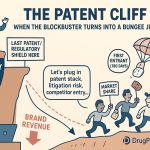
In the pharmaceutical industry, the expiration of a primary patent is not merely a regulatory milestone; it is a financial event of seismic proportions. For a blockbuster drug generating $10 million to $50 million in daily revenue, the “Loss of Exclusivity” (LOE) represents a potential revenue collapse of 80% to 90% within months of generic entry.1 Consequently, the management of this cliff is not a matter of legal compliance but of capital preservation. Litigation in this sector has evolved from a mechanism for dispute resolution into a primary asset class, where the return on investment (ROI) is measured not in damages collected, but in days of monopoly preserved.
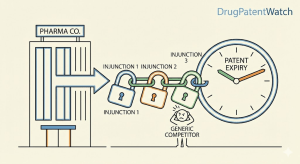
The concept of “chaining injunctions” has shifted. In the pre-2003 era, it referred to a specific statutory loophole that allowed companies to trigger consecutive 30-month stays of FDA approval. Today, following the Medicare Modernization Act (MMA), “chaining” refers to a far more sophisticated, multi-layered strategy. It involves the construction of “patent thickets,” the weaponization of the “at-risk” launch calculus, and the use of serial petitioning to create a “cloud” of liability that functions as a de facto injunction.
The economic logic is irrefutable. If a litigation campaign costs $20 million but delays generic entry for a single week for a drug like Revlimid or Humira, the return on legal spend exceeds 1,000%. This report analyzes the mechanics of these strategies, the legal precedents that govern them, and the counter-strategies employed by generic challengers. It is a guide for business development teams and investors who must distinguish between a patent’s technical expiration date and the commercial reality of market entry.
1.1 The ROI of Delay: A Quantitative Imperative
To understand the tenacity of pharmaceutical litigation, one must quantify the “burn rate” of exclusivity. Blockbuster drugs operate on a scale where time is the most expensive commodity.
Humira (Adalimumab): At its peak, AbbVie’s biologic generated approximately $21.2 billion annually.2 This equates to roughly $58 million in revenue per day.
Revlimid (Lenalidomide): Prior to generic entry, Bristol Myers Squibb (BMS) reported annual sales exceeding $12.8 billion3, or roughly $35 million per day.
Eliquis (Apixaban): The BMS/Pfizer anticoagulant continues to generate over $12 billion annually in the U.S. alone.4
In this high-velocity environment, a legal strategy that delays competition by even one month preserves over $1 billion in shareholder value for a top-tier asset. Conversely, for a generic challenger, the “first-to-file” exclusivity (180 days) can represent the bulk of a product’s lifetime profit. This asymmetry creates a “war of attrition” dynamic where the innovator is incentivized to spend virtually unlimited funds on legal defense, while the generic must carefully weigh the cost of litigation against the probability of success.
1.2 The Shift from Statutory to Functional Chaining
The modern landscape is defined by the transition from statutory entitlement to strategic complexity.
Table 1: The Evolution of Exclusivity Extension Strategies
Era
Primary Mechanism
Legal Basis
Key Characteristic
Pre-2003
Multiple 30-Month Stays
Original Hatch-Waxman Act
Automatic. Filing a new patent triggered a new stay. “Evergreening” was statutory.
2003-2010
Reverse Payments
Pre-Actavis Settlements
Contractual. Brands paid cash to generics to delay entry (“Pay-for-Delay”).
2011-2016
Product Hopping
“Hard Switch” Tactics
Operational. Withdrawing the old drug to force patients to a new patent-protected version.
2017-Present
Patent Thickets & Clouding
Portfolio Density
Structural. Filing 100+ patents to create overwhelming litigation risk and “at-risk” deterrence.
The current era is characterized by “Clouding.” Innovators no longer rely on a single silver bullet. Instead, they generate a “cloud” of legal risk using hundreds of patents, citizen petitions, and regulatory maneuvers. Even if no single action stops the generic, the cumulative weight of the risk prevents a rational Board of Directors from authorizing a launch.
2. The Historical Framework: How the “Chain” Was Forged
The strategies observed today are the evolutionary descendants of the original legislative compromises of the 1984 Hatch-Waxman Act. Understanding the loopholes of the past is essential to recognizing the sophisticated adaptations of the present.
2.1 The Original Loophole: Multiple 30-Month Stays
The Hatch-Waxman Act established a linkage between patent disputes and FDA approval. When a generic manufacturer files an Abbreviated New Drug Application (ANDA) with a “Paragraph IV” certification—claiming a patent is invalid or not infringed—the brand company has 45 days to sue. If they sue, the FDA is statutorily barred from approving the generic for 30 months, or until the litigation is resolved.5
In the 1990s, innovators discovered a flaw in the drafting: the statute did not limit the number of stays per ANDA.
The Tactic: A brand would list Patent A. The generic would certify against it, triggering a 30-month stay. As that stay approached expiration, the brand would obtain and list Patent B (often a minor formulation tweak or metabolite). The generic would be forced to certify against Patent B. The brand would sue again, triggering another 30-month stay.6
The Paxil Case: SmithKline Beecham (now GSK) utilized this loophole masterfully for Paxil (paroxetine). By listing patents in a staggered manner, they triggered five separate 30-month stays, effectively locking generics out of the market for years beyond the intended patent term.7
2.2 The Medicare Modernization Act (MMA) of 2003
Congress responded to these abuses with the Medicare Prescription Drug, Improvement, and Modernization Act (MMA) of 2003. This legislation was designed to break the statutory chain.
The Fix: The MMA amended the FD&C Act to stipulate that only patents listed in the Orange Book before the generic files its ANDA can trigger a 30-month stay.8
Late-Listed Patents: Patents listed after the ANDA filing (“late-listed patents”) can still be litigated, but they do not trigger a stay.9
Single Stay: A generic applicant is now subject to only one 30-month stay per ANDA application.10
2.3 Post-MMA Reality: The Rise of Litigation Volume
While the MMA closed the door on automatic administrative delays, it did not shorten the duration of patent exclusivity. It merely shifted the battleground from the FDA docket to the federal court docket. Deprived of the ability to chain statutory stays, companies realized they needed to chain litigation events.
If the FDA would no longer stop the generic automatically, the brand had to ensure that the risk of launching was so high that the generic would stop itself. This required a massive increase in the volume of patents asserted. If a generic faced one patent, they might gamble on a launch. If they faced 50 patents, each requiring a separate legal battle and carrying the threat of treble damages, the gamble became untenable. Thus, the “Patent Thicket” was born.
3. The Patent Thicket: Construction of the Fortress
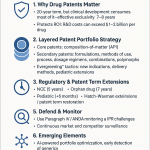
A patent thicket is a dense web of overlapping intellectual property rights that a company must hack its way through to commercialize a new product. In the pharmaceutical context, this involves surrounding the core active pharmaceutical ingredient (API) with hundreds of secondary patents covering formulations, methods of use, manufacturing processes, and delivery devices.
3.1 The Humira (Adalimumab) Paradigm
AbbVie’s management of Humira (adalimumab) is widely regarded as the masterclass in modern patent thicketing. The primary composition-of-matter patent for adalimumab expired in 2016. Yet, through a deliberate strategy of portfolio expansion, AbbVie prevented biosimilar competition in the U.S. market until 2023. This seven-year extension generated over $100 billion in additional revenue.
The Scale of the Thicket:
AbbVie filed approximately 247 patent applications related to Humira and successfully secured over 130 granted patents.11 This volume was not accidental; it was a strategic barrier.
The Composition of the Thicket:
Upstream Patents: These cover the manufacturing process, such as the specific cell lines used to express the protein or the temperature at which the fermentation occurs. These are notoriously difficult for biosimilars to challenge because the manufacturing process of the innovator is often a trade secret until discovery.13
Downstream Patents: These cover formulations (e.g., a specific buffer to reduce pain on injection) and devices (e.g., the autoinjector mechanism).
Method of Treatment: AbbVie secured patents for using adalimumab to treat specific conditions like hidradenitis suppurativa, separate from the original rheumatoid arthritis indication.
The “Patent Dance” and Litigation Strategy:
Under the Biologics Price Competition and Innovation Act (BPCIA), biosimilars must engage in a “patent dance”—a complex information exchange where the parties identify which patents will be litigated.14 AbbVie used the sheer size of its thicket to overwhelm competitors. In litigation against Amgen, AbbVie asserted 61 patents. Amgen, despite having the resources to fight, ultimately settled.
3.2 The Settlement Arbitrage
The Humira strategy culminated in a series of global settlements that demonstrated the power of the thicket. AbbVie agreed to allow biosimilars to launch in Europe in October 2018, but delayed their U.S. entry until January 2023.11
The Trade-off: By conceding the European market (where prices are lower and singular patents are harder to defend), AbbVie secured the sanctity of the U.S. market (where prices are highest) for five additional years.
Antitrust Scrutiny: This “split-market” settlement avoided the “reverse payment” label because no cash changed hands. The “payment” was the early entry in Europe. The FTC and courts have struggled to categorize this as anticompetitive, as it technically allows competition earlier than the expiration of the last patent in the thicket (which ran into the 2030s).15
3.3 The Role of Terminal Disclaimers
A critical tool in building these thickets is the Terminal Disclaimer. When a patent examiner rejects a new application on the grounds of “obviousness-type double patenting” (i.e., it is too similar to the company’s existing patent), the company can file a terminal disclaimer. This document states that the new patent will expire on the same date as the original patent and will be commonly owned.
While this does not extend the term of exclusivity, it increases the density of the thicket.
Tactical Advantage: Terminal disclaimers allow a company to slice a single invention into dozens of slightly differently worded claims. In litigation, the generic must invalidate all of them. If the generic knocks out the broad parent patent, a narrower child patent (linked by terminal disclaimer) might still survive, sustaining the injunction.
2024 Regulatory Shift: In May 2024, the USPTO proposed a rule change that would have weakened this strategy. The proposal stated that if a patent linked by a terminal disclaimer is invalidated, all other patents linked to it would also become unenforceable. This would have allowed generics to topple entire thickets by winning a single case. However, following intense industry opposition, the USPTO withdrew this proposal in December 2024.16 The survival of the terminal disclaimer practice ensures that thickets remain a viable strategy for the foreseeable future.
4. The 30-Month Stay and Paragraph IV: The Mechanics of Delay
While the thicket provides the ammunition, the Hatch-Waxman framework provides the battlefield. The “30-month stay” remains the most powerful procedural weapon in the pharmaceutical arsenal.
4.1 The Paragraph IV Trigger
When a generic applicant files an ANDA, they must certify the status of the patents listed in the Orange Book.
Paragraph I & II: No patent information or patent expired. (Generic can launch immediately).
Paragraph III: Generic will wait until patent expires.
Paragraph IV (PIV): Generic asserts the patent is invalid, unenforceable, or not infringed.18
The PIV certification is the declaration of war. It notifies the brand that the generic intends to enter before patent expiration.
4.2 The Automatic Injunction
Upon receiving a PIV notice, the brand has 45 days to file a lawsuit. If they do, FDA approval is automatically stayed for 30 months.
No Burden of Proof: Unlike a standard Preliminary Injunction (PI), the brand does not need to prove they are likely to win or that they will suffer irreparable harm. The stay is statutory and automatic.5
Strategic Timing: Brands often time their patent listings and lawsuits to maximize this window. While the MMA limits this to one stay per ANDA, the timeline often aligns such that the 30 months covers the crucial period of generic readiness, effectively acting as an exclusivity extension without a court order.
4.3 The “Tentative Approval” Limbo
If the 30-month stay expires and the litigation is still ongoing, the FDA may grant “Tentative Approval” (TA). This indicates the generic is scientifically ready but legally blocked.
Significance: A TA is a critical signal to the market. It confirms the generic’s quality and manufacturing capacity. It is the precursor to an “at-risk” launch decision.19
5. Preliminary Injunctions (PI): The Critical Battleground
Once the 30-month stay expires, the “automatic” protection vanishes. If the patent litigation is still pending (which is common, as complex patent trials can take 3-5 years), the brand must seek a Preliminary Injunction (PI) to stop the generic from launching.
5.1 The Four-Factor Test
Obtaining a PI is difficult. Following the Supreme Court’s eBay decision, courts apply a strict four-factor test 20:
Likelihood of Success on the Merits: The brand must show it is likely to prove the patent is valid and infringed.
Irreparable Harm: The brand must show that money damages alone cannot compensate for the injury.
Balance of Hardships: The harm to the brand if the generic launches must outweigh the harm to the generic if they are blocked.
Public Interest: Does the public benefit from lower prices (generic launch) or patent enforcement (innovation)?
5.2 The “Irreparable Harm” Argument: Price Erosion
The central argument in pharmaceutical PI hearings is “Price Erosion.”
The Argument: Brands argue that once a generic launches, the price of the drug collapses. Even if the brand later wins the trial and kicks the generic off the market, the price structure is destroyed. They cannot simply raise the price back to monopoly levels because insurers and PBMs will have adjusted their formularies.
Court Reception: Courts have generally accepted that structural market destruction constitutes irreparable harm. However, if the generic can show that the brand has already licensed the drug or that the market is already fragmented, this argument weakens.1
Statistics: In 2023, the success rate for preliminary injunctions in pharmaceutical patent cases was approximately 40%.21 This is significantly lower than in other IP sectors, reflecting the judicial hesitancy to block lower-cost medicines without strong evidence.
5.3 The Injunction Bond
If a court grants a PI, the brand must post a bond to cover the generic’s potential losses if the injunction is later found to be wrongful.
Novartis v. HEC (Gilenya): This case highlighted the procedural traps of bonds. Novartis posted a $50 million bond to block HEC’s launch of generic Gilenya. Years later, the Federal Circuit invalidated the Gilenya patent. HEC sought to collect the $50 million as compensation for the wrongful delay.
The Twist: The court denied HEC’s request because HEC had failed to appeal the bond order itself, only the patent ruling. This legal technicality allowed Novartis to enforce a wrongful injunction effectively for free.22 This precedent incentivizes brands to pursue PIs aggressively, knowing the financial penalty for being wrong may be avoidable.
6. The “At-Risk” Launch: The Ultimate Counter-Move
The “At-Risk” launch is the most dramatic event in the pharmaceutical lifecycle. It occurs when a generic manufacturer launches its product after the 30-month stay has expired but before a final appellate court decision on the patent’s validity.
6.1 The Calculus of Risk
The decision to launch at risk is a high-stakes fiduciary gamble. The generic company weighs the “First-Mover Advantage” against the risk of “Treble Damages.”
Upside: The first generic to market (especially with 180-day exclusivity) can capture hundreds of millions in profit.
Downside: If the generic loses the patent case later, they are liable for the Brand’s Lost Profits, not just the generic’s revenue. Since the brand sells at a high margin and the generic at a low margin, the damages can exceed the generic’s total revenue by a factor of 10.
Willfulness: If the court finds the infringement was “willful” (i.e., the generic knew the patent was valid but launched anyway), the damages can be tripled.23
6.2 Case Study: The Plavix (Clopidogrel) Disaster
The industry’s caution regarding at-risk launches is largely due to the Plavix case involving Apotex.
The Scenario: In 2006, Apotex launched a generic version of the blood thinner Plavix (clopidogrel), a $4 billion drug marketed by Bristol Myers Squibb (BMS) and Sanofi. Apotex believed the patent was invalid.
The Launch: Apotex flooded the market for just 23 days before a court granted an injunction halting further shipments.
The Outcome: Years later, the court upheld the validity of the Plavix patent.
The Bill: Apotex was ordered to pay $442 million in damages.24 This figure was calculated based on 50% of Apotex’s net sales, a settlement percentage agreed upon if they lost. Had they not settled the damages percentage, the liability could have been the full lost profits of BMS/Sanofi, potentially billions.
Legacy: The Plavix case demonstrated that a failed at-risk launch is a company-killing event. It empowered brands to use the threat of damages to deter launches even without a preliminary injunction.
6.3 Successful At-Risk Launches
Despite the risks, bold companies continue to use this strategy when the patent is weak.
Oxymorphone (Impax): Impax launched generic Opana ER at risk. The launch forced Endo (the brand) to the negotiating table. While this later attracted FTC scrutiny for “pay-for-delay” elements, the initial launch was a strategic lever to force a settlement.25
Fexofenadine (Teva/Barr): Teva and Barr launched generic Allegra at risk. They utilized a partnership to spread the liability. By launching, they forced the brand (Aventis) to compete on price immediately, destroying the brand premium before the court case concluded.27
7. Serial Petitioning and the “Sham” Defense
Beyond patent litigation, innovators use the FDA’s own safety protocols to delay competition. This is known as “serial petitioning” or “citizen petition abuse.”
7.1 The Citizen Petition Loophole
The FDA allows any interested party to file a “Citizen Petition” raising concerns about a pending drug application. While intended to protect public health, these are frequently used by brands to freeze generic approval.
The Mechanism: The FDA must review and respond to the petition. Even if the petition is frivolous, the administrative time required to review it can delay the final approval of the generic ANDA.
Section 505(q): Congress attempted to fix this by requiring the FDA to respond within 150 days and stating that approval should not be delayed unless necessary for public health. However, brands continue to file petitions raising complex scientific questions (e.g., bioequivalence of device mechanisms) that force lengthy reviews.28
7.2 Sanofi and the Lantus (Insulin Glargine) Defense
The case of Mylan v. Sanofi illustrates the aggressive use of this tactic. Sanofi marketed Lantus, a blockbuster insulin. When Mylan sought to launch a generic (Semglee), Sanofi filed multiple patent suits and citizen petitions.
The Device Argument: Sanofi argued that the Mylan injector pen was not equivalent to the Lantus SoloSTAR pen. They filed petitions questioning the safety of the button mechanism.
The Antitrust Claim: Mylan sued, arguing this was “Serial Petitioning” designed solely to delay entry. Mylan claimed Sanofi’s actions constituted an antitrust violation under Section 2 of the Sherman Act.29
The “Sham” Standard: To win, Mylan had to overcome the Noerr-Pennington doctrine, which immunizes petitioning activity. Mylan had to prove the petitions were a “sham.”
Objective Baselessness: The petition must be so meritless that no reasonable person could expect it to succeed.
Subjective Intent: The intent must be to interfere with the competitor’s business through the process of petitioning, not the outcome.
Outcome: The First Circuit Court of Appeals upheld Sanofi’s defense in part, noting that while the petitions were rejected, they were not “objectively baseless” because the device differences were factually true, even if they didn’t ultimately stop approval.31 This high bar makes serial petitioning a low-risk, high-reward strategy for brands.
8. Product Hopping: The “Hard Switch”
When litigation and petitions fail, brands may alter the market itself. “Product Hopping” involves tweaking the drug (e.g., tablet to capsule) and moving patients to the new version before the generic for the old version arrives.
8.1 Hard Switch vs. Soft Switch
Soft Switch: The brand introduces the New Drug and markets it, but leaves the Old Drug on the market. This is generally legal competition.
Hard Switch: The brand withdraws the Old Drug from the market entirely, often citing “safety concerns,” forcing patients to switch to the New Drug. Because the generic is only bioequivalent to the Old Drug, pharmacists cannot automatically substitute it for the New Drug. The market for the generic evaporates.
8.2 The Suboxone Case
Reckitt Benckiser (Indivior) executed a hard switch with Suboxone (buprenorphine/naloxone).
The Move: Just before generic tablets were approved, Reckitt introduced a sublingual film version. They then withdrew the tablets, claiming they were a pediatric safety hazard (accidental ingestion).
The Impact: When generic tablets launched, there were no brand tablets left to substitute against. Patients were already on film.
The Fallout: The FTC and private plaintiffs sued. Reckitt eventually paid hundreds of millions in settlements, and executives faced criminal charges. This case established that “hard switches” with pretextual safety justifications are antitrust violations.32
9. Settlement Dynamics: The Shift from Cash to “Value”
Litigation often ends in settlement. However, the nature of these settlements has evolved in response to Supreme Court scrutiny.
9.1 Pay-for-Delay and FTC v. Actavis
Historically, brands paid generics cash to delay their launch. In 2013, the Supreme Court ruled in FTC v. Actavis that these “reverse payment” settlements could be illegal if the payment was large and unjustified.33
The Consequence: Bags of cash disappeared from settlement agreements.
9.2 The “No-AG” Clause
In their place, the “No Authorized Generic” (No-AG) clause emerged.
The Concept: An Authorized Generic (AG) is the brand’s own product sold as a generic. It competes directly with the generic company during its 180-day exclusivity period.
The Deal: The brand agrees not to launch an AG. This gives the generic company a monopoly on the generic market for 6 months.
The Value: Estimates suggest that a No-AG clause is worth hundreds of millions of dollars to the generic—often more than a cash payment.
FTC Stance: The FTC views No-AG clauses as “payments” and actively investigates them. However, proving they are anticompetitive is harder than proving a cash bribe, as it involves complex economic modeling of “forgone revenues”.34
10. The Sovereign Immunity Gambit
In 2017, Allergan attempted one of the most audacious strategies in IP history: renting sovereign immunity.
10.1 The Restasis Maneuver
Allergan was facing Inter Partes Review (IPR) challenges to its patents for Restasis (cyclosporine ophthalmic emulsion) at the USPTO. IPRs are faster and harder to defend than district court cases.
The Transfer: Allergan transferred the patents to the Saint Regis Mohawk Tribe, a sovereign nation. The Tribe then licensed the patents back to Allergan.
The Argument: Allergan argued that as a sovereign entity, the Tribe was immune from administrative proceedings like IPRs unless it waived immunity. Therefore, the USPTO had to dismiss the case.35
10.2 The Judicial Rejection
The strategy failed. The Federal Circuit and the Supreme Court rejected the argument.
The Ruling: The courts held that IPR is not a private lawsuit but a government enforcement action to reconsider a public franchise (the patent). Sovereign immunity does not apply to such federal agency actions.
Significance: While this specific tactic failed, it highlights the lengths to which companies will go to shield “thicket” patents from scrutiny outside of the slow-moving federal courts.37
11. Data & Intelligence: The Counter-Measure
For generics and investors, the only defense against these strategies is superior intelligence. The sheer volume of filings in a patent thicket makes manual tracking impossible.
11.1 Leveraging Platforms like DrugPatentWatch
Strategic decision-making relies on aggregating disparate data points—Orange Book listings, court dockets (PACER), and USPTO filings.
Litigation Outcome Probability: Platforms like DrugPatentWatch are essential for modeling the “P(Win)” variable in the at-risk launch equation. By tracking which judges grant PIs, or which patent claims survive IPRs at high rates, companies can quantify their risk.18
Tracking “Quiet” Filings: A critical risk is the “submarine” patent or the late-listed patent. Automated monitoring of new patent grants that reference key parent applications allows generics to anticipate the next link in the injunction chain before it is asserted.39
Formulary Intelligence: Beyond the law, knowing when patents expire allows payers to model budget impact. API data feeds from patent databases are now integrated into PBM algorithms to automate the switch to generics the moment exclusivity lifts.40
12. Future Outlook: The 2025 Legislative Landscape
As of 2025, the regulatory environment is tightening around chaining practices.
12.1 The Affordable Prescriptions for Patients Act
Bipartisan bills, such as the Affordable Prescriptions for Patients Act (sponsored by Senators Cornyn and Blumenthal), are advancing in Congress.
The Proposal: The bill aims to limit the number of patents a biologic manufacturer can assert in the “patent dance.” It proposes a cap (e.g., 20 patents) on the number of late-filed or “thicket” patents that can be litigated, forcing brands to select their strongest arguments rather than drowning the generic in paper.41
Status: As of April 2025, the bill has been reported favorably out of the Senate Judiciary Committee. If passed, it would structurally dismantle the “volume” strategy of thicketing.
12.2 The USPTO Terminal Disclaimer Battle
While the USPTO withdrew its aggressive 2024 rule on terminal disclaimers, the agency continues to look for ways to reduce “patent clutter.” The focus has shifted to increasing fees for excessive continuation filings and tightening the requirements for “restriction requirements,” making it more expensive to build a thicket.17
13. Key Takeaways
Exclusivity is Manufactured: Market exclusivity is rarely defined solely by the expiration of the primary compound patent. It is an engineered outcome resulting from the interplay of secondary patents, litigation delays, and regulatory maneuvers.
The Thicket is the New Stay: With the statutory 30-month stay limited to one per ANDA, brands use patent thickets (volume) to create an “injunction cloud” that effectively replicates the old multiple-stay system.
Litigation is an Asset: For a blockbuster drug, the daily revenue is so high that litigation expenses are negligible. Delaying entry by days justifies millions in legal fees.
At-Risk Launch is the Nuclear Option: Generics launch at risk only when the “P(Win)” is high and the “Damages(Loss)” are survivable. The Plavix case remains the primary deterrent against reckless launching.
Data is Defense: In a landscape defined by 100+ patent portfolios, using intelligence tools like DrugPatentWatch to identify the “weak links” in a patent chain is the only way to formulate a viable launch strategy.
FAQ: Strategic Nuances of Patent Litigation
Q1: How does the “Safe Harbor” (Bolar Exemption) interact with patent thickets?
A: The Bolar Exemption (35 U.S.C. § 271(e)(1)) allows generics to use patented inventions solely for purposes reasonably related to obtaining FDA approval (e.g., manufacturing batches for bioequivalence testing) without infringing. However, this safe harbor ends the moment the generic submits the ANDA with a Paragraph IV certification. At that point, the filing is deemed an “artificial act of infringement” (35 U.S.C. § 271(e)(2)), and the thicket comes into play immediately. The safe harbor protects the development, not the commercialization.
Q2: What is the difference between a “skinny label” and a full generic launch?
A: A “skinny label” (Section viii carve-out) allows a generic to seek approval for only the unpatented indications of a brand drug. For example, if a drug is approved for heart failure (patent expired) and diabetic neuropathy (patent active), the generic can launch a label mentioning only heart failure. This attempts to bypass the method-of-use patents in the chain. Brands counter this by suing for “induced infringement,” arguing that the generic knows doctors will prescribe it for the patented use anyway (off-label).
Q3: Why did the “Sovereign Immunity” strategy (Allergan/Mohawk) fail?
A: It failed because the Supreme Court and Federal Circuit viewed the patent system as a public franchise, not a purely private right. They ruled that Inter Partes Review (IPR) is an agency enforcement action to correct government errors, not a civil suit between private parties. Therefore, tribal sovereign immunity does not apply to IPR proceedings. This closed off a potential “shield” strategy for protecting weak patents in a thicket.
Q4: What is a “Terminal Disclaimer” and why is it central to chaining?
A: A Terminal Disclaimer is filed when a patent examiner rejects a new patent application because it is too similar to the company’s existing patent (“obviousness-type double patenting”). The company agrees that the new patent will expire on the same day as the old one. While this doesn’t extend the time of exclusivity, it increases the volume of patents. It allows the brand to have 10 patents covering the same concept with slightly different wording. If a generic knocks out Patent A, Patent B (linked by terminal disclaimer) might still survive, sustaining the injunction.
Q5: How does the “No Authorized Generic” (No-AG) clause function as a payment?
A: In a “Pay-for-Delay” deal, giving cash is illegal/suspect. Instead, the brand agrees not to launch its own “Authorized Generic” during the generic company’s 180-day exclusivity period. An Authorized Generic is the brand’s exact product sold as a generic. If the brand launches an AG, the generic competitor’s price and market share plummet. By agreeing not to compete, the brand effectively transfers millions of dollars in value (forgone revenue) to the generic without writing a check. The FTC views this as a “payment” that can violate antitrust laws.