Section 1: The Strategic Landscape: Why Patent Intelligence Has Become a Core Payer Competency
The Formulary Has Become a Battlefield
The pharmaceutical formulary has evolved into the central instrument of cost control, patient access, and clinical quality management for any health plan, hospital system, or Pharmacy Benefit Manager. It is no longer a back-office administrative function. It is where data science, predictive analytics, and value-based contracting principles collide with $400 billion in annual U.S. drug spend.
The formulary’s dual mandate has not changed in principle: provide members with access to clinically appropriate therapies while sustaining the organization’s financial solvency in an era of compounding drug costs. What has changed is the complexity of achieving both goals simultaneously. Between 2023 and 2030, an estimated $200 billion to $300 billion in annual branded drug sales sit at risk globally as their patent protection lapses. That figure encompasses some of the highest-revenue molecules in the history of the industry, from immunology blockbusters to precision oncology agents to GLP-1 receptor agonists.
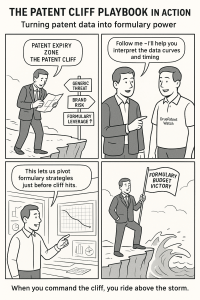
For the manufacturers holding those revenue streams, the loss of exclusivity (LOE) triggers a cascade that can erase 80% to 90% of a drug’s revenue within 12 to 24 months. For payers, that same event is the single greatest predictable opportunity to recalibrate drug spend in the entire budget cycle. But capturing those savings requires a level of technical precision and forward planning that goes far beyond circling a calendar date.
The core problem: a drug’s market monopoly is not a single wall that crumbles on a predictable date. It is a fortress. It is constructed from multiple overlapping patents of varying strength, layered regulatory exclusivity grants from the FDA, and an active litigation environment where brand manufacturers fight to delay generic and biosimilar entry through every legal mechanism available to them. Dismantling that fortress requires a deep understanding of each of its components.
The Pharmacy and Therapeutics Committee: From Clinical Gatekeeper to Quantitative Decision Body
The P&T committee is the formal decision-making body responsible for developing, managing, and administering the formulary system for a managed care organization or health system. Traditionally composed of practicing physicians, pharmacists, and nurses, its primary function has always been to appraise drugs based on safety and efficacy data. When two or more medications prove clinically equivalent, the decision shifts to cost. The goal is to identify the safest and most effective medications that achieve desired outcomes at the lowest net cost to the system.
That mandate is still intact, but the analytical infrastructure supporting it has grown dramatically more sophisticated. Modern P&T committees now include health economics and outcomes research professionals, pharmacoeconomists, legal experts, and, at the largest payers, quants who run probabilistic models as a standard part of the drug review process. This compositional shift signals a change in the decision-making calculus. Formulary decisions are no longer anchored to clinical data and acquisition cost alone. They are driven by complex pharmacoeconomic modeling, including formal cost-effectiveness analyses and budget impact analyses.
This has a direct implication for anyone building budget impact models: the audience for that work now includes the primary clinical and economic decision-makers in the organization. A model that only shows a change in drug spend without providing context around clinical value, patient population dynamics, and litigation timeline carries no weight at this level.
Formulary Design as Strategic Infrastructure: The Leverage Problem
The structure of a drug formulary determines a payer’s ability to negotiate. Open formularies provide coverage for nearly all available drug products. That comprehensiveness eliminates leverage. Since coverage is essentially guaranteed, manufacturers have no incentive to offer price concessions or rebates. The result is an administratively simple system that typically generates the highest relative costs.
Closed formularies flip this dynamic. By selecting only one or two preferred agents within a therapeutic class, the formulary creates competition for a coveted tier placement. Manufacturers of clinically similar drugs must bid against each other for the preferred position. This competition is the primary mechanism through which payers extract rebates.
The credible threat of exclusion is the most powerful tool in any formulary negotiation. Patent data activates that tool. When a P-IV certification signals that a generic challenger is pursuing early entry into a brand drug’s market, the payer can approach the brand manufacturer with a concrete alternative: provide a rebate that closes the cost gap with the incoming generic, or we will designate the generic our preferred agent on day one of its launch. Without a closed formulary, that threat has no teeth. With one, it is worth hundreds of millions of dollars annually across a large formulary portfolio.
The formulary structure is therefore the foundational strategic choice that determines whether patent intelligence translates into savings or remains an interesting data point.
Key Takeaways: Section 1
Patent intelligence has moved from a specialty research function to a core payer competency because the LOE pipeline is large, predictable, and monetizable. The P&T committee now demands quantitative sophistication, not just clinical argument. Closed formulary design is the essential infrastructure that converts patent expiry data into negotiating leverage. Every dollar of savings from a patent cliff starts with knowing, months or years in advance, exactly when and how that cliff will arrive.
Section 2: Deconstructing the Exclusivity Stack: Every Layer of Pharmaceutical IP Protection
The 20-Year Patent Myth and Effective Commercial Life
A U.S. utility patent runs for 20 years from the date of application filing. In pharmaceuticals, that figure is deeply misleading from a commercial standpoint. The path from molecular discovery to regulatory approval typically consumes 10 to 15 years of preclinical research, Phase I through Phase III clinical trials, and FDA review. A drug entering the market may have as few as five to eight years of effective patent life remaining before generic competition becomes legally possible.
That reality is the primary economic driver behind everything the industry calls ‘lifecycle management.’ Every additional month of protected revenue for a blockbuster drug can be worth tens of millions of dollars. Maximizing that period is not an afterthought; it is a core commercial strategy executed by dedicated IP management teams at every major pharmaceutical company.
What emerges from that effort is what we call the Exclusivity Stack: the full collection of patents, regulatory protections, and procedural mechanisms that collectively define the date when a generic or biosimilar can legally enter the market.
Layer One: The Patent Thicket
Innovator companies do not rely on a single patent to protect a drug. They construct a deliberate multi-patent portfolio, each component serving a specific defensive purpose.
Composition of Matter Patents protect the active pharmaceutical ingredient itself, the core chemical compound responsible for the drug’s therapeutic effect. These are filed earliest and provide the broadest scope of protection. They are also the most commercially critical: their expiration is typically the primary event that opens the door to generic competition. For small molecules, a composition of matter patent that covers the API structure makes it effectively impossible for a generic to launch the same drug without infringing.
Formulation and Delivery Patents cover improvements in how the drug is administered or formulated. An extended-release capsule taken once daily instead of twice, a pre-filled auto-injector device, a sublingual film formulation, a nanoparticle delivery system with improved bioavailability: all are patentable innovations. These patents extend protection on a specific version of the product even after the API patent expires, and they are the most common mechanism for what critics call evergreening. The brand manufacturer discontinues the older formulation and transitions marketing to the new, patent-protected version before the original API patent lapses.
Method of Use Patents protect the use of a compound for a specific therapeutic indication. If a drug approved for rheumatoid arthritis is later found effective for psoriasis, that new indication can be patented. A generic company may be blocked from marketing its version for the patented indication even if the API patent has expired. This is why generic labels sometimes carry what is called a ‘skinny label,’ listing only the unpatented indications.
Process and Polymorph Patents add further granularity. Process patents protect specific manufacturing methods. Polymorph patents cover different crystalline structures of the same API, which can differ in stability, solubility, or bioavailability. While generally considered weaker than composition of matter patents, they create additional legal friction for generic challengers.
The cumulative effect of filing for new patents on secondary features as earlier patents approach expiry is evergreening. Product hopping is a related tactic: the brand company heavily markets the new patented formulation and then discontinues the original product just before its patent expires, frustrating generic substitution at the pharmacy counter even when a generic of the original formulation is available.
Layer Two: FDA Regulatory Exclusivities
Operating entirely independently of the patent system is a parallel set of protections: regulatory exclusivities granted by the FDA upon drug approval when specified statutory criteria are met. These are critical because they can block the FDA from accepting or approving a generic or biosimilar application even if all of the brand’s patents have expired or been invalidated in court.
New Chemical Entity (NCE) Exclusivity provides five years of market protection for drugs containing an active ingredient never previously approved by the FDA. Practically, this means the FDA cannot accept an ANDA filing for the first four years of this period, and cannot approve one until the full five years have elapsed.
Orphan Drug Exclusivity grants seven years of protection for drugs developed to treat rare diseases, defined as conditions affecting fewer than 200,000 Americans. This is the longest regulatory exclusivity period, and it applies only to the specific orphan indication. Critically, it does not block a generic from marketing the drug for a different, non-orphan indication.
New Clinical Investigation Exclusivity provides three years for applications that required new clinical studies to support approval. This applies frequently to new formulations, new dosage strengths, or new indications for previously approved drugs, and is commonly layered on top of NCE exclusivity to extend the protected period.
Pediatric Exclusivity is among the most powerful stacking tools in the lifecycle management toolkit. If a company conducts the pediatric studies requested by the FDA, it receives an additional six months of exclusivity that attaches to every existing patent and regulatory exclusivity for that drug. For a drug generating $3 billion annually, six months of additional protection is worth $1.5 billion in gross revenue.
Biologics Exclusivity under the BPCIA provides 12 years of market exclusivity from the date of first licensure for a new reference biologic product. This is followed by a four-year period during which the FDA cannot even accept a biosimilar application. The 12-year figure is the single most important planning input for any biologic LOE model.
180-Day Generic Exclusivity is the incentive that drives patent challenges. The first generic company to file a substantially complete ANDA with a Paragraph IV certification is rewarded with 180 days during which the FDA cannot approve any other generic versions of the same drug. This creates a commercially lucrative six-month duopoly between the brand and the first-filer, providing a massive financial incentive to challenge patents aggressively.
Layer Three: The Orange Book and the Purple Book as Intelligence Sources
The FDA’s Orange Book, formally titled ‘Approved Drug Products with Therapeutic Equivalence Evaluations,’ is the definitive reference for small-molecule drugs. It lists every FDA-approved drug, its therapeutic equivalence ratings, and, most importantly, the patents and regulatory exclusivities the brand manufacturer claims for the product. For each patent, the Orange Book provides the patent number, expiration date, and use codes describing the covered methods of use.
The Purple Book, formally the ‘Lists of Licensed Biological Products with Reference Product Exclusivity and Biosimilarity or Interchangeability Evaluations,’ covers biologics. It provides licensure dates and exclusivity periods, but it has a meaningful limitation relative to the Orange Book: its patent information is less comprehensive. Patents listed in the Purple Book derive primarily from disclosures made during the BPCIA patent dance process rather than from a proactive, systematic listing requirement.
Both sources carry a structural caveat that sophisticated analysts internalize immediately. The FDA’s role in listing Orange Book patents is ministerial, not evaluative. The agency publishes what manufacturers submit without independently verifying the accuracy, scope, or relevance of listed patents. This creates a systematic information asymmetry. Brand companies have every incentive to list numerous patents, including late-filed secondary patents covering minor variations, to construct the most imposing-looking thicket possible. The goal is deterrence: make the legal landscape look expensive and uncertain enough that generic companies delay or abandon their challenge.
A naive analyst reading the Orange Book at face value will forecast late generic entry based on a list that includes weak, legally vulnerable patents alongside strong ones. A sophisticated analyst recognizes the Orange Book as the brand’s opening strategic position and invests time assessing the quality and vulnerability of individual patents, not just their expiration dates. Platforms like DrugPatentWatch provide the integrated patent, litigation, and regulatory data needed to make those quality assessments efficiently.
The Complete Exclusivity Stack: Reference Table
Type of Protection
Granting Body
Duration
Strategic Role
Composition of Matter Patent
USPTO
20 years from filing
Primary barrier; protects the API itself
Formulation/Delivery Patent
USPTO
20 years from filing
Evergreening tool; extends protection past API expiry
Method of Use Patent
USPTO
20 years from filing
Blocks generics from marketing specific indications
Process Patent
USPTO
20 years from filing
Manufacturing protection; secondary deterrent
Polymorph Patent
USPTO
20 years from filing
Covers alternative crystalline forms
NCE Exclusivity
FDA
5 years
Blocks ANDA acceptance for 4 years
Orphan Drug Exclusivity
FDA
7 years
Protects specific orphan indication
New Clinical Investigation Exclusivity
FDA
3 years
Covers new indications, formulations, dosages
Pediatric Exclusivity
FDA
+6 months
Stacks on all existing patents and exclusivities
Biologics Exclusivity (BPCIA)
FDA
12 years
Primary biosimilar barrier for reference products
180-Day Generic Exclusivity
FDA
180 days
Awarded to first successful P-IV filer
First Interchangeable Biosimilar Exclusivity
FDA
1 year
Awarded to first interchangeable biosimilar
Key Takeaways: Section 2
No single patent defines a drug’s monopoly. The Exclusivity Stack layers multiple patent types and regulatory exclusivities, each with distinct legal strength and expiration dates. The most commercially critical is the composition of matter patent; its expiration sets the ceiling for the ‘worst case scenario’ in any LOE model. Secondary patents, filed later and covering formulations or methods of use, are the primary targets of generic litigation because they are often more legally vulnerable. The FDA Orange Book lists what manufacturers claim, not what courts will ultimately uphold. Assessing patent quality, not just quantity, separates rudimentary LOE forecasting from genuinely predictive analysis.
Section 3: The Anatomy of a Patent Cliff: Quantifying the Economic Shockwave
What ‘Patent Cliff’ Actually Means in Revenue Terms
The patent cliff describes the revenue collapse a brand-name drug experiences upon LOE. During exclusivity, manufacturers command premium prices with gross margins that can exceed 90%. A single generic competitor can capture 40% to 50% of prescription volume within months. With five or more competitors, the brand’s market share typically falls below 10%, and generic prices settle near the marginal cost of manufacturing.
The arithmetic is blunt. Pfizer’s Lipitor generated approximately $13 billion in global annual revenue before its key patent expired in 2011. Within two years of generic atorvastatin entry, Lipitor’s annual sales dropped below $3 billion and continued falling. That is not unusual; it is the standard pattern. The aggregate savings potential embedded in the current LOE pipeline is proportionally enormous: the Association for Accessible Medicines reports that generic and biosimilar drugs saved the U.S. healthcare system $445 billion in 2023 alone, representing more than a decade of cumulative savings exceeding $3 trillion.
Price Erosion Dynamics: The Competition Curve
The variable that best predicts the speed and depth of post-LOE price erosion is the number of generic competitors. This relationship is nonlinear: the transition from one to two generic competitors produces a much larger price drop than the transition from five to six. The data are consistent across multiple decades of market observation.
The first generic to enter, typically protected by 180-day exclusivity, launches at a modest discount to the brand and operates in a commercially attractive duopoly. The real collapse arrives when the exclusivity period expires and the second, third, and fourth generics launch simultaneously. Each new entrant compresses margins further as manufacturers compete for formulary placement and pharmacy shelf space.
Post-LOE Price Erosion by Number of Generic Competitors
Generic Competitors
Average Price Reduction vs. Brand
Typical Generic Market Share (Year 1)
1 (180-day period)
~30%
40-50%
2
~54%
60-70%
3
~65%
70-80%
4
~79%
>80%
6 or more
>95%
>90%
Sources: HHS ASPE, FDA Office of Generic Drugs, academic literature on pharmaceutical market competition.
This table is the quantitative engine of any small-molecule LOE budget impact model. The number of P-IV filers tracked in real time through platforms like DrugPatentWatch maps directly to the price erosion column, which maps directly to the savings calculation.
Timing Variables That Determine Actual LOE Date
The printed patent expiration date is a ceiling, not a floor. The actual date of generic entry can be earlier, later, or surprisingly variable depending on several specific factors.
Patent Term Extensions (PTEs) allow manufacturers to recapture a portion of the patent life lost during FDA regulatory review. Under Hatch-Waxman, the extension can reach up to five years, but the total patent life post-approval cannot exceed 14 years. The application process is distinct from the patent itself and must be specifically tracked.
Patent Term Adjustments (PTAs) compensate for delays attributable to the USPTO rather than the FDA. These are different from PTEs and are calculated based on specific periods of examiner inactivity or procedural delay during prosecution. PTAs can meaningfully extend a patent’s expiration date beyond its nominal 20-year term.
At-Risk Launches occur when a generic company launches after winning at the district court level but before appeals are exhausted. If the brand ultimately prevails on appeal, the generic faces potentially massive damages. Several high-profile at-risk launches have materially shifted the competitive dynamics of major drug markets before any appellate court rendered a final decision.
Consent Decrees and Settlement Entry Dates are binding contractual milestones. When brand and generic companies settle patent litigation, they agree to a specific entry date. This date is often disclosed publicly and replaces probabilistic forecasts with high-certainty planning inputs.
Key Takeaways: Section 3
The patent cliff is not a gradual decline. Revenue erosion of 80% to 90% within 12 to 24 months of LOE is the historical norm for small-molecule drugs facing multiple generic competitors. The number of competitors entering the market is the single most predictive variable for price erosion magnitude. Payers who track generic filer counts in real time can forecast their savings potential with substantially greater accuracy than those relying on manufacturer-provided timelines or single patent expiration dates.
Section 4: Biologics vs. Small Molecules: Two Entirely Different LOE Playbooks
One of the most common and costly errors in pharmaceutical budget modeling is applying small-molecule generic assumptions to biologic LOE events. Biosimilars operate under a different regulatory framework, face different market adoption dynamics, and deliver savings through a mechanism that is structurally unlike generic competition.
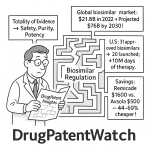
Manufacturing Complexity. Biologics are large, complex molecules produced in living cells. Unlike small-molecule drugs, which can be chemically synthesized and precisely replicated, a biosimilar can only be demonstrated to be ‘highly similar’ to its reference product, not structurally identical. No two biologic manufacturing processes produce exactly the same molecule at the molecular level. This biological variability is the basis of the biosimilar regulatory distinction and the primary source of physician and patient hesitancy to switch from a stable reference product.
Development and Approval Costs. Developing a biosimilar costs between $100 million and $250 million, compared to a few million dollars for a generic small molecule. FDA approval requires clinical immunogenicity data and, in most cases, pharmacokinetic and pharmacodynamic comparative studies. This cost structure limits the number of biosimilar entrants and reduces competitive pressure relative to the generic small-molecule market.
Biosimilar Interchangeability. Most biosimilars receive standard FDA biosimilar designation, not interchangeability designation. An interchangeable biosimilar can be substituted by a pharmacist without prescriber intervention, analogous to generic substitution for small molecules. Standard biosimilars require active prescriber or health plan management to drive adoption. As of 2024, interchangeable biosimilar designations have been granted to only a subset of approved biosimilars, and achieving the designation requires additional switching studies demonstrating consistent safety across multiple transitions.
12-Year BPCIA Exclusivity. The 12-year exclusivity period for reference biologic products under the Biologics Price Competition and Innovation Act is the dominant planning horizon for any biologic LOE model. No biosimilar application can be approved during the first 12 years from the reference product’s first licensure date, making this the firm anchor of the worst-case scenario in a BPCIA LOE analysis.
The Humira Case: Net Price Erosion Precedes Market Share Erosion
The 2023 LOE of AbbVie’s Humira (adalimumab) is the most instructive biologic patent cliff case study in history. Humira had exceeded $200 billion in cumulative global sales before biosimilar entry. In the first year of competition, despite the launch of approximately ten adalimumab biosimilars by multiple manufacturers, some carrying list price discounts exceeding 85%, the combined biosimilar market share reached less than 2% of total adalimumab prescriptions in the U.S.
A surface reading of those numbers suggests biosimilars failed. The correct reading reveals that biosimilars succeeded in a different way. The mechanism of savings was not patient-level switching; it was rebate extraction at the formulary level.
AbbVie responded to credible biosimilar competition by dramatically increasing the rebates it offered to PBMs and health plans to protect Humira’s preferred formulary position. Humira’s list price continued to rise. Its net price collapsed. In Q1 2023, AbbVie’s U.S. Humira net revenues fell approximately 30% year-over-year, driven almost entirely by higher rebates rather than volume loss. By Q4 2023, the quarterly revenue decline had deepened further as rebate concessions intensified.
The implication for payers is direct and actionable: for high-revenue biologics, the most immediate and significant financial benefit from biosimilar entry arrives as net price erosion on the reference product, not as savings from switching patients to the biosimilar. A BIA model that only measures the financial impact of biosimilar adoption will substantially underestimate total savings.
A complete biologic LOE model must capture two distinct financial effects operating simultaneously:
First, a slow, gradual shift in market share from the reference product to biosimilars over three to five years, driven by formulary exclusion decisions, step therapy protocols, and physician education programs.
Second, a rapid and significant reduction in the net price of the reference brand itself, beginning at or before the first biosimilar launch, driven by rebate competition for formulary access.
Biosimilar Formulary Strategy: Exclusion as a Negotiating Instrument
The formulary tool most effective at driving biosimilar savings is biosimilar exclusion of the reference product. By committing to make a biosimilar the preferred or exclusive agent for new prescriptions and step therapy requirements, a payer can credibly threaten to cut off the reference product’s access to a large patient population. This threat is powerful enough to produce substantial net price reductions from the reference product manufacturer even when actual biosimilar market share remains modest.
Some of the largest PBMs in the U.S. have excluded reference adalimumab from standard formularies in favor of high-WAC/high-rebate biosimilars, creating structured contracts that generate net cost parity or better relative to the biosimilar list price. The mechanism is counterintuitive but financially sound: the reference product with a very large rebate and the biosimilar at a lower list price can arrive at equivalent or very similar net costs, giving the payer savings regardless of which product the physician prescribes.
Interchangeability as the Key Biosimilar Market Accelerant
Biosimilar interchangeability designation changes the competitive landscape materially. An interchangeable biosimilar enables pharmacist-level substitution, removes the need for prescriber-driven switching decisions, and dramatically reduces the friction that currently limits biosimilar uptake. The first interchangeable biosimilar for a given reference product also receives one year of exclusivity against other interchangeable biosimilars for that molecule.
For payers, tracking which biosimilars have applied for or received interchangeability designation should be a standard component of any biologic LOE monitoring protocol. The arrival of an interchangeable biosimilar is the single event most likely to accelerate market share erosion of the reference product and shift the LOE dynamic from ‘net price competition’ toward the more conventional ‘market share competition’ observed in small-molecule markets.
Key Takeaways: Section 4
Biosimilar LOE economics are not analogous to generic small-molecule economics. Slower uptake, higher development costs, incomplete interchangeability coverage, and a 12-year BPCIA exclusivity period create a fundamentally different competitive timeline. For the largest biologics, net price erosion on the reference product driven by rebate competition is the primary early savings mechanism, preceding meaningful market share migration to biosimilars. BIA models for biologic LOE events must capture both the direct savings from biosimilar adoption and the indirect savings from reference product net price compression. Interchangeability designation is the key catalytic event to monitor for any biologic facing biosimilar competition.
Section 5: From Courtroom to Calculator: Reading Litigation as a Financial Signal
The Hatch-Waxman Framework: How Generic Challenges Work
The generic pharmaceutical industry’s legal pathway was established by the Drug Price Competition and Patent Term Restoration Act of 1984, universally called the Hatch-Waxman Act. Its mechanisms are the most important legal framework any payer-side analyst needs to understand, because they determine both the timeline and the probability of generic entry.
The ANDA Pathway allows generic manufacturers to seek FDA approval by demonstrating bioequivalence to the reference listed drug, without repeating the brand’s clinical trials. This dramatically reduces the cost and time of generic development and is the foundational mechanism enabling the generic industry.
Paragraph IV Certification is the legal trigger for patent litigation. When a generic company files an ANDA, it must certify its position relative to each patent listed in the Orange Book for the brand drug. A Paragraph IV (P-IV) certification is the most aggressive: the generic company asserts that the brand’s patent is invalid, unenforceable, or will not be infringed by its product. Filing a P-IV is a declaratory act of legal hostility toward the brand’s IP portfolio, and it is the single earliest, most reliable signal available to a payer that generic entry may occur years before the patent’s nominal expiration.
The 30-Month Stay is triggered automatically when the brand company files a patent infringement lawsuit within 45 days of receiving P-IV notification. The stay blocks the FDA from granting final ANDA approval for 30 months from the date of the notice, creating a structured litigation window. For forecasting purposes, the 30-month stay defines the earliest plausible date for generic market entry under a contested litigation scenario: approximately 30 to 36 months from the date of the P-IV notice letter.
180-Day First-Filer Exclusivity creates the competitive race to be first. The first generic to file a substantially complete P-IV ANDA earns six months of market exclusivity against all other generic competitors if it successfully challenges the patent. This exclusivity period is the primary commercial incentive driving generic companies to mount expensive, risky patent challenges against blockbuster brands.
Critical Litigation Signals and What They Mean for Your Model
Every litigation event in a pharmaceutical patent dispute carries information that updates the probability distribution of generic entry dates. A formulary team tracking these events systematically can maintain a continuously updated LOE forecast rather than relying on static, point-in-time analyses.
P-IV Filing: The trigger. Immediately update your model to include a scenario reflecting 30-month-stay-driven entry. Calculate the implied earliest possible launch date.
Additional P-IV Filers: Each subsequent generic company that files a P-IV for the same brand drug adds to the competitive cohort and updates the price erosion forecast. Track total P-IV filer count as a leading indicator of post-LOE pricing.
Lawsuit Filed or Not Filed: If the brand does not file suit within 45 days of P-IV notice, no 30-month stay attaches. Generic entry could occur as soon as FDA approval is granted. This is a major model-updating event.
District Court Decision: A decision invalidating or finding non-infringement of a key patent substantially increases the probability of early generic entry. A decision upholding the patent significantly reduces it. Both events require immediate model revision.
Appeal Filed: A brand appeal after a generic win introduces uncertainty about whether an at-risk launch will proceed and whether the district court decision will stand. Historical Federal Circuit reversal rates for pharmaceutical patent cases run in the 25% to 35% range, providing a baseline for appeal probability inputs.
Settlement Announcement: A settlement converts a probabilistic range of outcomes into a high-certainty single date. When parties announce a patent settlement in pharmaceutical litigation, the generic entry date is typically disclosed. This is the most valuable model-updating event in the entire litigation lifecycle. Replace probability-weighted scenarios with the contractually defined date immediately.
The BPCIA Patent Dance: Forecasting Biosimilar Entry
The Biologics Price Competition and Innovation Act of 2010 established the regulatory pathway for biosimilars and a distinct mechanism for resolving patent disputes. The central process, informally called the ‘patent dance,’ is a multi-step, choreographed exchange of proprietary information between the biosimilar applicant and the reference product sponsor.
The dance involves sequential exchange of the biosimilar’s manufacturing details, a list of patents the reference sponsor believes could be infringed, and detailed position papers on infringement and validity from both parties. The goal is to narrow the patent universe before litigation begins and create two distinct waves of potential lawsuits.
Several features of the BPCIA framework make biosimilar LOE forecasting materially more uncertain than Hatch-Waxman forecasting.
First, participation in the patent dance is optional for the biosimilar applicant. Opting out triggers different legal consequences but does not eliminate all dispute resolution pathways.
Second, there is no automatic 30-month stay in BPCIA litigation. A patent infringement lawsuit filed by the reference sponsor does not automatically block FDA approval of the biosimilar. This absence of a structured stay makes at-risk biosimilar launches legally possible in ways that have no parallel in Hatch-Waxman.
Third, there is no comprehensive central patent listing analogous to the Orange Book. The patents at issue are identified during the patent dance itself, not from a publicly maintained, pre-defined list.
These differences mean BPCIA LOE models carry inherently wider uncertainty bands than Hatch-Waxman models. The practical response is to anchor the worst-case scenario to the 12-year BPCIA exclusivity expiration, monitor aBLA filing dates as the first signal of biosimilar development activity, and update the model aggressively when settlement terms are disclosed.
Pay-for-Delay: History, Antitrust Risk, and What Survives Today
Pay-for-delay settlements, also called reverse payment settlements, were for decades the brand industry’s most effective tool for managing P-IV litigation risk. In these arrangements, the brand manufacturer paid the generic challenger to drop its lawsuit and agree to delay market entry until a specified future date, effectively sharing monopoly profits in exchange for preserving the monopoly.
The 2013 Supreme Court decision in FTC v. Actavis established that reverse payment settlements are subject to antitrust scrutiny under a rule-of-reason standard. The FTC does not need to prove that the settlement was per se anticompetitive, only that it has anticompetitive effects that outweigh procompetitive justifications. This decision substantially increased the legal risk of explicit cash payments to generic challengers in exchange for delayed entry.
Pay-for-delay has not disappeared. It has become more sophisticated. Modern settlements frequently include arrangements that courts and regulators have examined closely: no-authorized-generic commitments by the brand (which is itself a form of value transfer), co-promotion agreements, supply agreements, and most-favored-entry clauses that link the generic’s agreed entry date to the earliest entry by any other competitor.
For payers, the practical implication is that settlements remain far more common than actual trial verdicts in pharmaceutical patent litigation. And every settlement that discloses a specific generic entry date converts a wide range of probabilistic scenarios into a plannable, high-certainty event. Monitor all settlement announcements for drugs with material formulary impact and update BIA models immediately upon disclosure.
Key Takeaways: Section 5
The P-IV certification filing is the earliest detectable signal of a generic patent challenge and the most important LOE trigger for payers to monitor systematically. The 30-month stay defines the near-term floor for generic entry in Hatch-Waxman litigation. Total P-IV filer count is the most predictive leading indicator of post-LOE price erosion depth. BPCIA biosimilar litigation carries inherently greater uncertainty due to the absence of an automatic stay and incomplete patent listing. Settlement announcements are the highest-value intelligence events in the entire LOE monitoring workflow, replacing probabilistic ranges with high-confidence dates. Track all of these events in real time using an integrated intelligence platform.
Section 6: Building the Dynamic Budget Impact Model: A Step-by-Step Technical Guide
The Paradigm Shift: From Static to Dynamic BIA
Traditional budget impact models treat patent expiration as a binary event occurring on a single, fixed date. The brand drug costs a known amount today; the generic arrives on a specific future date at a predictable discount; the model calculates the savings. This approach is operationally convenient and analytically inadequate.
Real LOE events are probabilistic, subject to litigation outcomes, settlement negotiations, at-risk launch decisions, and regulatory timelines that can shift by months or years. A static model that fixes a single entry date cannot capture this complexity. Worse, it gives decision-makers false confidence in a point estimate that may bear little resemblance to actual market events.
The dynamic BIA replaces a single deterministic forecast with a scenario-weighted, continuously updated analysis that reflects the evolving probability distribution of generic or biosimilar entry. The goal is to answer not just ‘what is our expected budget impact’ but ‘what is the range of credible outcomes, what probability does each carry, and how should our strategy adapt as new information arrives?’
Step 1: Map the Complete Exclusivity Stack
Begin by identifying every patent and regulatory exclusivity listed in the Orange Book or Purple Book for the target drug. For each listed patent, record the patent number, expiration date including any PTE or PTA adjustments, and the use code. The latest expiration date in this set defines your worst-case scenario: the scenario in which no patent is successfully challenged and the brand retains full monopoly until the last protection expires.
Go further. Use an integrated intelligence platform to identify patents not listed in the Orange Book that nonetheless cover the drug, including formulation patents filed after the original composition of matter patent, method of use patents for secondary indications, and manufacturing process patents. These may be asserted in litigation even if not centrally listed.
The resulting map of all relevant IP, with expiration dates and an initial assessment of relative strength (composition of matter versus secondary formulation patent), is the foundational input for every scenario in the model.
Step 2: Identify the Litigation Landscape and Build LOE Scenarios
Monitor all P-IV certifications filed against the target drug. Note the filing date of the first P-IV and calculate the implied earliest possible entry date under a 30-month stay: add 30 months to the date of the P-IV notice letter to the brand.
Count all P-IV filers. This count determines the price erosion curve applicable to your savings forecast. If three generic companies have filed P-IVs, the post-LOE price erosion table indicates approximately 65% generic price reduction versus the brand, with more than 70% generic market share in year one.
Build three core scenarios:
Worst-Case Scenario (Payer): No successful patent challenge. Generic entry occurs at the latest patent expiration in the Exclusivity Stack. Apply the price erosion curve based on the expected number of competitors at that future date.
Base-Case Scenario: Litigation proceeds, the 30-month stay runs to completion without a court decision, and parties settle. The entry date is the end of the 30-month period or a known settlement date if one has been announced. Apply the price erosion curve based on current P-IV filer count.
Aggressive-Case Scenario: The generic wins at the district court level and chooses to launch at risk during the appeal period. Entry date is the district court decision date. Price erosion depth is at the high end of the competitive range given the number of at-risk entrants.
Assign probabilities to each scenario based on base rates. Historical data on Hatch-Waxman litigation shows that roughly 75% to 80% of cases that go to trial result in a generic win, reflecting brand manufacturers’ tendency to settle cases where patent validity is weakest. Settlement rates exceed 70% of all filed P-IV cases. At-risk launches occur in a meaningful but smaller subset of generic wins, typically where the financial upside is large enough to justify the litigation risk.
Step 3: Characterize the Affected Population
Following ISPOR BIA guidelines, define the patient population that will be directly affected by the LOE event. Whenever possible, use the health plan’s own claims data to count current users of the brand drug within the covered population. Supplement with published prevalence and incidence data for the target condition to project population growth or contraction over the model’s time horizon.
Apply plan-specific adherence patterns and average days of supply to convert patient count into a projected total prescription volume. This is the denominator for all cost calculations.
Step 4: Build the Cost Structure
The primary cost input is net drug acquisition cost, not list price. Net cost equals the Wholesale Acquisition Cost minus all negotiated rebates, performance fees, and administrative fees. For brand drugs with active rebate contracts, obtain the current contracted net cost from the PBM. For generics or biosimilars not yet on the market, use proxy pricing from therapeutically equivalent products already in the competitive market, adjusted for the number of expected competitors at launch.
Model annual net cost as:
Annual LOE Savings = (Current Brand Net Cost - Post-LOE Blended Net Cost) x Patient Volume x Days of Supply Adjustments
The post-LOE blended net cost should be calculated as the market-share-weighted average across the brand drug at its new, competition-driven net cost and each generic or biosimilar product at its projected net cost.
Step 5: Build the Market Share Transition Model
Model market share migration from the brand to generic or biosimilar products as a function of time, beginning at the LOE date in each scenario. For small-molecule generics with multiple competitors, market share migration is rapid: apply the Year 1 market share column from the price erosion table as the generic market share in the first full year after LOE, with continued erosion toward the 90%+ ceiling in subsequent years.
For biologics, apply a much slower ramp. Absent formulary exclusion of the reference product, biosimilar market share growth in Year 1 is typically in the single digits to low teens in percentage terms. With active formulary management (preferred biosimilar placement, reference product step therapy, or non-preferred tier assignment for the reference product), Year 1 biosimilar share can reach 20% to 40% depending on the therapeutic area and the degree of physician resistance.
Step 6: Run Scenario Calculations and Compute Expected Value
Calculate the annual and cumulative budget impact for each scenario over the model’s time horizon (typically three to five years for BIA purposes, consistent with ISPOR guidance).
Multiply each scenario’s savings figure by its assigned probability. Sum the probability-weighted savings across all scenarios to compute the expected value of the LOE event. This is the risk-adjusted forecast that most accurately represents the central estimate of future savings.
Report results annually and disaggregated by cost component: drug acquisition cost savings, administrative cost changes, changes in utilization management costs associated with the formulary transition. Include sensitivity analyses showing how the expected value changes when key assumptions shift, particularly the probability of settlement, the post-LOE price reduction, and the speed of market share migration.
Key Takeaways: Section 6
The ISPOR BIA framework provides the methodological structure. Patent intelligence fills it with accurate, litigation-aware inputs. The core innovation is replacing a single LOE date with a probability-weighted distribution of scenarios, each grounded in specific legal and regulatory events that can be monitored in real time. Expected value calculations, built from scenario probabilities and financial outcomes, provide a single, risk-adjusted forecast that is more useful for budget planning than any static, point-in-time estimate.
Section 7: Advanced Probabilistic Forecasting: Decision Trees, Monte Carlo, and Real Options
Decision Tree Analysis: Mapping the Litigation Probability Tree
For high-spend drugs facing active P-IV litigation, decision tree analysis provides a structured way to model the sequential, probabilistic nature of the litigation process and compute a risk-adjusted expected value.
A typical Hatch-Waxman decision tree proceeds as follows. At the first decision node, the model branches on whether the parties settle before trial. Historical settlement rates for pharmaceutical P-IV cases run between 70% and 80% of filed cases. If settlement occurs, the tree terminates at a node whose payoff is the savings calculated using the negotiated generic entry date. If litigation continues, the tree branches again on the district court outcome: a generic win or a brand win, each carrying a probability derived from historical litigation data for comparable patent types.
Each subsequent node adds further branching: appeal filing probability, Federal Circuit reversal rate, at-risk launch decision probability. Each terminal node carries a specific savings calculation based on the entry date implied by that path through the tree. The expected value of the LOE event equals the sum of each terminal node’s savings multiplied by the cumulative probability of the path leading to it.
Example Decision Tree Inputs for a Hatch-Waxman P-IV Scenario
Variable
Description
Typical Input Range
P(Settlement before trial)
Probability parties reach agreement before district court decision
70-80%
P(Generic wins at district court
given no settlement)
55-75%
P(Brand wins on appeal
given generic district court win)
25-35%
P(At-risk launch
given generic district court win and appeal pending)
20-40%
Savings (early generic entry)
BIA-calculated savings if generic launches early
Calculate from model
Savings (late entry at natural patent expiry)
BIA-calculated savings at worst-case entry date
Calculate from model
These inputs can be refined using drug-specific factors. Composition of matter patents have historically higher survival rates in litigation than formulation or method of use patents. A patent facing multiple invalidity arguments across claim construction and prior art is more vulnerable than one with a narrow, well-defined claim scope. Legal analysis of the specific patents at issue can sharpen the generic win probability beyond the historical baseline.
Monte Carlo Simulation: Modeling Continuous Uncertainty
Decision trees handle sequential binary events well. They are less suited to modeling continuous uncertainty across multiple simultaneous variables. Monte Carlo simulation fills that gap.
Rather than assigning a single point estimate to each uncertain input (a specific post-LOE price reduction, a specific rate of biosimilar market share uptake), Monte Carlo replaces each point estimate with a probability distribution. The price reduction might be modeled as a triangular distribution with a minimum of 40%, a most likely value of 65%, and a maximum of 85%. The biosimilar market share in year two might be modeled as a normal distribution with a mean of 25% and a standard deviation of 10%.
The simulation runs the BIA model thousands of times, drawing a random value from each input distribution in each iteration. The result is a distribution of possible budget impact outcomes rather than a single number. This distribution allows for statements with specific probabilistic content: ‘there is a 90% probability that savings will exceed $50 million over three years, and a 10% probability they could reach $95 million or more.’
For organizations managing large formulary portfolios with multiple concurrent LOE events, Monte Carlo simulation run across the entire portfolio provides a consolidated risk-adjusted savings forecast that accounts for correlation between LOE events in overlapping therapeutic areas.
Real Options Analysis: Valuing Strategic Flexibility
For the most analytically sophisticated organizations, Real Options Analysis provides a framework for valuing the strategic flexibility created by an approaching LOE event. Borrowed from financial derivatives theory, ROA treats strategic investments under uncertainty as options rather than one-time commitments.
The approaching expiration of a major drug’s patents creates a real option for the payer: the option to fundamentally restructure the formulary for that therapeutic class. This option has value before it is exercised. Understanding that value helps prioritize which LOE events warrant the most intensive analytical investment and proactive negotiation activity.
In practice, full ROA valuation for formulary management is complex to implement and requires more modeling infrastructure than most payer organizations maintain. Its primary value at the practical level is conceptual: it frames patent cliff events not as one-time budget adjustments but as sequences of strategic choices, each with its own optionality. The decision to initiate step therapy for a biologic competitor two years before LOE, or to begin building provider relationships for formulary transitions, represents the exercise of real options that have compounding value over time.
Key Takeaways: Section 7
Decision tree analysis is the appropriate quantitative tool for modeling sequential, binary litigation outcomes and computing risk-adjusted LOE savings estimates. Monte Carlo simulation extends this capability to continuous input uncertainty across multiple variables simultaneously, producing a probability distribution of outcomes that is far more informative for risk management than any point estimate. Real Options Analysis provides the conceptual framework for recognizing that the strategic choices enabled by an approaching LOE event have independent value that accrues before the LOE date arrives.
Section 8: Weaponizing the Model: Formulary Strategy, Rebate Negotiation, and PBM Oversight
The Proactive Formulary Posture: Planning Months Before LOE
The difference between a reactive and a proactive formulary management posture is measured in millions of dollars per major LOE event. A reactive organization waits for a generic to appear on the market and then determines coverage. A proactive organization designs the optimal formulary structure for the post-LOE environment months or years in advance, using patent and litigation intelligence to time the transition precisely.
Concrete pre-LOE actions include establishing generic tier placement before the drug is available, so that payer systems, member communications, and provider education are all ready on day one of launch. The first-day formulary transition is the point of maximum savings capture rate. Every week of delayed implementation represents a period where the brand drug remains at its full pre-LOE net cost instead of the dramatically lower post-LOE competitive price.
Step therapy and prior authorization protocols for the brand drug in the period before LOE are also warranted when patent litigation signals a likely delay in generic entry. If the model indicates a 60% probability that generic entry will occur 18 months from now but a 40% probability of a further 24-month delay, implementing step therapy on the brand immediately reduces spend in either scenario.
Rebate Negotiation: Turning Patent Intelligence into Contractual Leverage
This is the highest-value application of the dynamic BIA. A detailed, litigation-aware, probability-weighted budget impact model quantifies the exact financial risk a brand manufacturer faces as its LOE approaches. That quantification is the most powerful negotiating instrument a payer can bring to a rebate discussion.
The negotiation logic follows directly from the competitive threat the model documents. As a brand drug’s patent cliff approaches with active generic challenges underway, the manufacturer’s leverage deteriorates with each new P-IV filing and each adverse litigation event. The payer’s leverage grows correspondingly.
A well-prepared negotiation position includes: the current branded drug’s net cost; the price erosion forecast for the post-LOE market based on competitor count; the probability-weighted expected value of savings under the current formulary structure; and the enhanced savings achievable if the brand provides a larger immediate rebate to reduce net cost now, in exchange for maintaining preferred formulary status in the pre-LOE period.
The brand manufacturer’s rational response is to evaluate whether paying a larger rebate today generates enough volume retention to offset the loss of margin per unit. For drugs where the payer represents a large share of the drug’s covered lives, this calculus often favors the payer, particularly when the LOE event is clearly imminent and the competitive pipeline is large.
PBM Oversight: Using Your BIA to Audit Savings Pass-Through
PBMs negotiate rebates on behalf of plan sponsors using the plan’s patient volume as leverage. The savings generated by those negotiations may or may not be fully passed through to the plan, depending on the terms of the PBM contract. The Humira biosimilar launch illustrated this dynamic in high relief: PBMs captured enormous rebates from AbbVie in exchange for maintaining Humira’s formulary access, but the degree to which those rebates reached plan sponsors varied significantly across different contract structures.
A plan sponsor with its own independent BIA model for the adalimumab LOE has a critical advantage: it knows, within a calculable range, what the competitive market for adalimumab should produce in net cost savings. It can set contractual performance benchmarks for the PBM and audit actual net cost against those benchmarks annually.
The accountability mechanism requires contract provisions mandating disclosure of actual net costs (list price minus rebates, price protection payments, and administrative fees) for the specific drugs at issue. Without those provisions, the BIA model’s output is a planning tool with no accountability link. With them, the model becomes the measurement standard that determines whether the PBM is delivering the savings it was engaged to produce.
Key Takeaways: Section 8
Proactive formulary management requires acting on LOE intelligence months or years before the generic or biosimilar arrives. First-day formulary transitions capture the maximum savings rate from the moment competition becomes available. Rebate negotiations grounded in quantitative BIA outputs are more effective than qualitative arguments because they present the brand manufacturer with a specific, data-backed alternative to the current pricing arrangement. PBM accountability for LOE savings pass-through requires explicit contractual benchmarks derived from independent BIA analysis.
Section 9: IP Valuation as a Core Asset: Drug-by-Drug Analysis for Portfolio Managers
Why Patent Estate Valuation Belongs in Equity Analysis
For institutional investors analyzing pharmaceutical companies, the patent estate is not a legal abstraction. It is the primary determinant of future revenue durability and the single most important variable separating a drug that trades at a premium multiple from one that trades at a discount. A drug generating $5 billion in annual revenue with seven years of residual patent life on its core composition of matter patent is a fundamentally different asset from one with the same revenue but only three years of protected life and four pending P-IV challenges.
Patent estate valuation requires integrating the same Exclusivity Stack analysis described in Section 2 with forward-looking revenue forecasts and probability-weighted LOE discounting. The result is a risk-adjusted net present value for the IP portfolio that can be compared across companies and between specific drug assets.
Framework: Risk-Adjusted Patent Estate NPV
For each drug in a company’s portfolio:
Identify the full Exclusivity Stack and the worst-case protected life (last patent/exclusivity expiration date).
Apply litigation probability adjustments. If active P-IV challenges are underway, reduce the expected protected life by the probability-weighted years of potential early entry. A drug with a worst-case protection date of 2032 but a 60% probability of early generic entry in 2028 has a risk-adjusted protected life of approximately 2029 to 2030.
Apply revenue erosion curves to the post-LOE period. A drug retaining any branded market presence post-LOE contributes diminishing revenue; model that trajectory explicitly rather than assuming a cliff to zero.
Discount all cash flows at an appropriate risk-adjusted rate. For large-cap innovators with stable pipelines, a rate in the 8% to 12% range is common. For smaller companies with concentrated revenue exposure, higher rates apply.
Sum the risk-adjusted NPVs across the full portfolio to arrive at a total patent estate valuation.
Case Study: AbbVie’s Patent Estate Pre- and Post-Humira LOE
AbbVie’s Humira represented approximately 35% to 40% of total revenue at peak, creating extreme concentration risk in a single patent estate. The company’s IP strategy around Humira involved filing more than 130 patents related to the molecule, its formulations, and its manufacturing processes over the product’s life, creating one of the most aggressively constructed patent thickets in biologic history. Legal challenges to this thicket, and eventual settlements with most biosimilar manufacturers granting entry in 2023, determined the LOE timeline.
AbbVie’s strategic response before LOE was to build out a replacement revenue base primarily through its JAK inhibitor upadacitinib (Rinvoq) and its IL-23 inhibitor risankizumab (Skyrizi), both carrying fresh composition of matter patent protection into the early 2030s and new 12-year BPCIA exclusivity periods from their licensure dates. For an analyst building a patent estate NPV model, these pipeline assets, their current revenue trajectories, and their distinct exclusivity profiles represent the replacement value that offsets the impending Humira LOE in the equity valuation.
Eli Lilly: The GLP-1 Patent Estate and the Next Cliff to Watch
The GLP-1 receptor agonist class, led by Lilly’s tirzepatide (Mounjaro, Zepbound) and Novo Nordisk’s semaglutide (Ozempic, Wegovy), represents one of the most commercially significant patent estates in the current pharmaceutical market. Lilly’s composition of matter patent for tirzepatide runs into the early 2030s. The complexity of peptide manufacturing, the formulation IP surrounding its weekly auto-injector device, and the clinical data requirements for generic peptide products create a more robust Exclusivity Stack than a typical small molecule.
For payers, the GLP-1 LOE events in the mid-2030s represent one of the largest future savings opportunities in the current formulary budget cycle. For investors, tirzepatide’s patent estate duration and the competitive landscape it faces from both originator follow-on molecules and eventual generic/biosimilar entry are the primary valuation variables.
Investment Strategy for Analysts
Companies with the most durable franchise value in the current environment share three characteristics. First, their primary revenue-generating drugs have composition of matter patent protection extending at least eight years from today. Second, their lifecycle management strategies go beyond formulation evergreening and include genuine clinical differentiation in new indications or patient populations. Third, they have demonstrated the ability to build replacement revenue through pipeline programs with distinct, non-overlapping IP before their core assets face LOE.
Companies with concentrated revenue in drugs facing LOE within three to five years, active P-IV challenges, and limited pipeline assets with comparable revenue potential carry structurally higher earnings risk than their headline earnings multiples may suggest. The Exclusivity Stack analysis described in this report provides the analytical tool for making that distinction with precision rather than relying on management guidance or consensus analyst forecasts that may not fully account for litigation probability.
Specifically, portfolio managers should:
Stress-test each major holding’s revenue forecast for the scenario in which LOE occurs 24 months earlier than the nominal patent expiration date, using base-rate litigation success rates for the specific patent types at issue.
Track P-IV filer counts for portfolio companies’ key drugs as leading indicators of LOE timing and revenue risk.
Evaluate the quality of each company’s lifecycle management pipeline not just for revenue potential but for IP runway: a follow-on molecule with a new composition of matter patent is more valuable than an incremental formulation change with a secondary patent.
Monitor biosimilar interchangeability application filings as the leading indicator of the most commercially disruptive stage of biologic competition.
Key Takeaways: Section 9
Patent estate valuation is a core input for pharmaceutical equity analysis, not a peripheral legal consideration. Risk-adjusted NPV models that incorporate LOE probability distributions provide substantially more accurate forward revenue estimates than models that simply use the nominal last patent expiration date. Companies with concentrated revenue in near-LOE assets and limited pipeline IP are systematically underweighted for earnings risk. P-IV filer count and biosimilar interchangeability application filings are the most actionable leading indicators for investors tracking LOE risk across large-cap pharmaceutical holdings.
Section 10: Key Takeaways: Master Reference
Patent Intelligence as Competitive Infrastructure. Payers who invest in real-time patent, regulatory, and litigation data monitoring consistently outperform those relying on static manufacturer-provided LOE dates. The information asymmetry between brand companies, who know exactly where their IP weaknesses are, and payers, who often lack the tools to identify those weaknesses independently, is the primary gap that specialized intelligence platforms exist to close.
The Exclusivity Stack Demands Comprehensive Mapping. A single patent expiration date is not an LOE forecast. It is a starting point. Accurately forecasting the LOE event requires mapping every layer of the Exclusivity Stack, assessing the relative strength of each component, and identifying which layers are most likely to be challenged and invalidated.
The P-IV Certification is the Most Important Signal. No single event in the pharmaceutical competitive intelligence universe carries more forecasting value for payers than a Paragraph IV certification filing. It announces, years in advance, that a competitor believes the brand’s IP is vulnerable. It triggers the litigation clock and defines the earliest plausible generic entry date.
Biosimilar LOE Economics are Distinct. Applying small-molecule generic assumptions to biologic LOE events produces systematically inaccurate forecasts. Net price compression on the reference product is the primary near-term savings mechanism for major biologics under biosimilar competition. Market share migration follows later, and it is accelerated most effectively by interchangeability designation and formulary exclusion strategy.
Dynamic, Probabilistic Models are the Analytical Standard. Static BIAs are obsolete for any drug with active litigation, pending P-IV challenges, or BPCIA proceedings. The relevant analytical standard is a continuously updated, scenario-weighted model that reflects the current probability distribution of LOE outcomes and is revised with every material litigation event.
Settlement Announcements Are Gifts. A settlement converting a wide range of probabilistic scenarios into a single, high-certainty date is the most valuable intelligence event in the LOE monitoring workflow. Process it immediately: close out the probabilistic scenarios and rebuild the model around the disclosed entry date.
BIA Models Are Negotiating Weapons. The purpose of building a sophisticated BIA is not to produce an accurate budget forecast in isolation. It is to generate a quantitative instrument that can be used in rebate negotiations to extract contractually binding price concessions from brand manufacturers who need formulary access to protect their revenue before LOE arrives.
Section 11: Investment Strategy for Analysts
Institutional investors and portfolio managers focused on the pharmaceutical sector should treat the Exclusivity Stack framework as an essential screening tool applied to each major holding.
Screen One: Patent Runway. For the top five revenue drugs in each portfolio company’s portfolio, map the full Exclusivity Stack and calculate risk-adjusted protected life using current P-IV filer data. Flag any drug where risk-adjusted protected life falls below five years and where the company has not demonstrated a credible revenue replacement strategy.
Screen Two: Litigation Activity. Track P-IV certification filings in real time for portfolio company drugs. A sudden increase in P-IV filings against a key asset, particularly by multiple generic manufacturers simultaneously, is a leading indicator of revenue risk that may not yet be reflected in consensus estimates or management guidance.
Screen Three: Pipeline IP Quality. Evaluate the IP runway of each clinical-stage asset in the pipeline. A Phase III asset with a composition of matter patent filed in 2023 and no prior art challenges has a different risk profile than one whose patent overlaps significantly with prior published literature or whose claims are narrow enough to design around easily.
Screen Four: Biosimilar Interchangeability Monitoring. For any holding with a large biologic franchise, track FDA interchangeability application filings and approval dates. Interchangeability approval is the event most likely to accelerate biosimilar market share migration and compress reference product net pricing at a faster rate than historical biologic LOE patterns would suggest.
Screen Five: PBM Contract Structure Visibility. For companies whose revenues are heavily influenced by PBM formulary placement (which is most branded pharmaceutical companies), the terms of PBM contracts with respect to rebates and formulary access are material to revenue predictability. Transparency around net price trends, specifically whether gross-to-net spreads are expanding or contracting, is a key indicator of competitive formulary position.
Section 12: Frequently Asked Questions
How do we build a meaningful BIA without a dedicated HEOR team?
Start with three actions that require no specialized staff. First, subscribe to a patent intelligence platform that provides real-time P-IV filing alerts for your top-spend drugs. Second, build a simple Excel-based scenario model for each drug: one tab for the worst-case LOE date based on the full Exclusivity Stack, one tab for the litigation-adjusted base-case using the 30-month stay calculation, and one tab for the aggressive-case at-risk entry scenario. Third, assign probability weights to each scenario based on the historical rates in this report. That three-scenario, probability-weighted output is already materially more accurate than any static model. Probabilistic Monte Carlo modeling can be outsourced to consultants for your one or two highest-spend drugs, where the ROI on more precise forecasting is largest.
How do we handle evergreening in a BIA model? We cannot predict which new patents a brand will file.
You cannot predict future inventions, but you can assess the vulnerability of existing secondary patents. The composition of matter patent is the strongest barrier. Late-filed formulation or method of use patents are more legally vulnerable and are the primary targets of generic P-IV challenges. In your decision tree model, assign higher generic win probabilities to scenarios where the litigation is focused on secondary patents rather than the core composition of matter patent. This reflects the empirical reality that courts invalidate formulation and method of use patents more frequently than composition of matter patents.
For biologics where the patent dance is opaque, how do we anchor our LOE forecast?
Use the 12-year BPCIA exclusivity expiration as the worst-case anchor. It is the one date the FDA cannot move. From there, monitor aBLA filing dates, patent dance exchange timelines when disclosed, and settlement announcements. Settlements in biologic patent disputes have become more frequent as both parties recognize the cost of full BPCIA litigation. Each settlement disclosure provides a specific contractual entry date that updates the model. Given the inherent uncertainty, place greater analytical weight on the net price impact component of the model than on the market share migration component for the near term.
Our PBM handles negotiations. How do we verify that LOE savings are being passed through?
Demand transparent net cost disclosure by specific drug in your PBM contract. Benchmark the reported net cost against the range produced by your BIA model for each major LOE event. If the PBM’s reported net cost for the post-LOE period falls materially above the lower bound of your model’s savings range, it warrants a detailed explanation of why the contract is not delivering the savings the competitive market should produce. This accountability mechanism is only possible if you maintain an independent BIA model. Without it, you cannot distinguish between a PBM that is appropriately managing a complex market and one that is retaining savings that contractually belong to the plan.
Is real options analysis practically useful for formulary management, or is it purely theoretical?
In its full mathematical form, ROA requires option pricing models and volatility estimates that most formulary teams do not maintain. Its practical value is conceptual: it clarifies that the strategic choices enabled by an approaching LOE event have value before the event occurs, and that investing in earlier preparation (pre-LOE step therapy, provider education, biosimilar preferred-placement negotiation) creates optionality that compounds over time. Use it as a framing tool for prioritization decisions rather than as a quantitative model.
Data references: HHS ASPE generic drug competition analysis; Association for Accessible Medicines 2024 Savings Report; ISPOR BIA Good Practice Guidelines; FDA Orange Book and Purple Book; published Federal Circuit pharmaceutical patent appeal reversal rate literature; IQVIA biologic LOE analysis; AbbVie quarterly earnings filings FY2023; academic literature on Hatch-Waxman litigation outcomes.