Why Pharma M&A Is Really a Patent Acquisition Business
When AstraZeneca paid $39 billion for Alexion in 2021, it wasn’t buying a manufacturing footprint or a sales force. It was buying eculizumab’s patent estate and the rare disease pricing power that came with it. When Pfizer acquired Arena Pharmaceuticals for $6.7 billion in 2022, the commercial logic rested almost entirely on etrasimod’s regulatory exclusivity runway. In both cases, the IP was the deal.
This concentration of value in a single asset class, patents and regulatory exclusivities, is what makes pharmaceutical M&A structurally different from any other sector. A factory can be rebuilt. A patent estate, once invalidated or circumvented, cannot. The loss of exclusivity on a blockbuster drug is not a manageable revenue headwind. It is frequently a 70–90% price collapse within 18 months of generic entry, as Pfizer learned with Lipitor, AbbVie is still processing with Humira, and Merck is about to confront with Keytruda.
For acquirers, that asymmetry demands something more than standard IP review. It requires treating patent due diligence as the primary analytical exercise, not a checkbox legal function executed in the final sprint before signing.
What Intangible Asset Concentration Actually Means for Deal Risk
The numbers are stark. Merck’s enterprise value is 93.5% intangibles. Johnson & Johnson sits at 87.9%. Procter & Gamble, a consumer goods company with physical products everywhere, is at 88.5%. Those figures reflect a broad economic shift, but for pharma specifically, the mechanism is different. In most industries, intangible value includes brand equity, customer relationships, and software. In pharma, it is predominantly the patent-backed right to charge monopoly prices on a molecule for a defined period.
That makes the risk profile of any pharma acquisition unusually binary. If the core patent holds, the asset generates forecast cash flows. If it doesn’t, it frequently generates nothing and inherits an indemnification obligation. There is limited middle ground. The Merck/Idenix situation is the textbook illustration: a $2.54 billion jury verdict that looked like an asset turned into a zero when the Federal Circuit invalidated the underlying patent for lack of written description and enablement. The deal looked sound until it wasn’t, and the difference came down to a technical legal question about whether the patent specification was sufficient to teach a person skilled in the art to practice the claimed invention without undue experimentation.
Company
Intangible % of EV
Primary Intangible Driver
LOE Exposure Window
Merck
93.5%
Keytruda (pembrolizumab) patent estate
2028–2031
Johnson & Johnson
87.9%
Multiple therapeutic franchises
Ongoing
AbbVie
~85%
Post-Humira pipeline (Skyrizi, Rinvoq)
2034–2038
Bristol Myers Squibb
~82%
Opdivo + Eliquis patent estate
2026–2028
Gilead Sciences
~79%
HIV franchise + oncology pipeline
Mid-2030s
The $400B Patent Cliff: Which Drugs Face the Biggest Revenue Drop Through 2030
EY estimates that dozens of blockbuster drugs will lose exclusivity before 2030, with cumulative branded revenue exposure exceeding $400 billion across the major pharmaceutical companies. The cliff is not evenly distributed. Several companies face outsized exposure concentrated in single assets.
Why Keytruda’s Patent Expiry Matters More Than Any Other LOE Event This Decade
Merck’s pembrolizumab (Keytruda) generated $25 billion in revenue in 2023 and has expanded into more than 40 indications across solid tumor oncology. The composition-of-matter patent on the pembrolizumab antibody itself faces expiry around 2028 in the United States, with European protection expiring somewhat earlier depending on supplementary protection certificate (SPC) status by country. What makes this loss of exclusivity event distinct from prior pharmaceutical patent cliffs is the combination of revenue concentration, biologic manufacturing complexity, and the regulatory approval burden for biosimilar entry.
Unlike a small molecule like atorvastatin, where generic manufacturers need only demonstrate bioequivalence through a standard ANDA pathway, biosimilar developers pursuing a pembrolizumab follow-on must complete extensive analytical and clinical comparability packages under the 351(k) pathway. The FDA requires data showing no clinically meaningful differences in safety, purity, and potency. That is a materially higher barrier than Paragraph IV small-molecule litigation, which is why Keytruda’s exclusivity runway likely extends beyond the composition-of-matter patent date through a combination of formulation patents, method-of-use patents, and the practical lag in biosimilar development timelines.
For investors modeling Merck’s post-Keytruda revenue trajectory, the actual inflection point for meaningful price erosion is more likely 2031–2033, assuming the first biosimilar approvals around 2029–2030 and typical ramp curves. AbbVie’s Humira biosimilar experience, where U.S. entry was blocked until 2023 despite European biosimilar entry in 2018, suggests the domestic market can sustain premium pricing even after international LOE.
How AbbVie’s Humira Patent Strategy Became the Template for Biologic Evergreening
AbbVie’s construction of a patent thicket around adalimumab (Humira) is the most studied example of biologic IP strategy in the industry. By the time the composition-of-matter patent expired, AbbVie had accumulated more than 250 patents covering everything from the formulation concentration, to the autoinjector device, to the manufacturing process, to specific dosing regimens. That portfolio, combined with settlements with biosimilar developers that included royalty-bearing licenses and delayed U.S. entry dates, kept Humira biosimilars off the U.S. market until January 2023, approximately five years after the first European biosimilars launched.
The commercial outcome was dramatic. In 2022, Humira still generated $21.2 billion globally. By 2024, U.S. market share erosion was underway but slower than many forecasters predicted, partly because formulary contracting and rebate structures built around the branded product created switching costs that biosimilar manufacturers had to price through. For acquirers modeling biologic assets, the Humira experience argues that the economic life of a biologic franchise frequently extends 5–7 years beyond the composition-of-matter patent expiry, but only where the originator has proactively built a defensible patent thicket and the commercial infrastructure to maintain formulary access.
What Investors Are Watching The sequence of events post-LOE determines deal model accuracy far more than the patent expiry date itself. The key variables are: number of biosimilar entrants at launch, formulary switching rates, rebate contract terms, and whether the originator launches an authorized biosimilar. AbbVie launched Hyrimoz (its own adalimumab biosimilar) in 2023, allowing it to capture share on both sides of the price curve.
Which Drugs Face the Largest Revenue Cliff in 2026–2028
2026
Eliquis (apixaban, Bristol Myers Squibb/Pfizer) — compound patent expiry contested; generics filed Paragraph IV. Revenue at risk: ~$12B annually in the U.S.
2026
Stelara (ustekinumab, J&J) — first U.S. biosimilars entered January 2025 following settlement agreements. Price erosion accelerating through 2026.
2027
Imbruvica (ibrutinib, AbbVie/J&J) — generic entry expected. Revenue at risk: approximately $4.8B combined. Multiple Paragraph IV filers.
2028
Keytruda (pembrolizumab, Merck) — composition-of-matter patent expiry. Biosimilar development underway at Samsung Bioepis, Celltrion, Teva/Alvotech consortium.
2028
Ozempic/Wegovy (semaglutide, Novo Nordisk) — core composition patents expiring in multiple markets. Generic GLP-1 entry dependent on manufacturing scale-up capability.
2029
Dupixent (dupilumab, Sanofi/Regeneron) — early patent expiry dates in some formulations. Biologic patent thicket being built; biosimilar filings expected from 2027.
How Patent Thickets Delay Biosimilar Entry and What That’s Worth to an Acquirer
A patent thicket is a dense cluster of overlapping patents covering a single biologic product across multiple dimensions: the molecule itself, its formulation, its manufacturing process, its delivery device, its dosing regimen, and each of its approved indications. No single patent in the thicket is individually impenetrable. The strategy works because a biosimilar developer must either design around each patent in the cluster or challenge them individually through IPR petitions and district court litigation, creating cost and delay even if the underlying composition-of-matter patent has expired.
AbbVie’s adalimumab thicket, Genentech’s ranibizumab (Lucentis) estate, and Amgen’s etanercept (Enbrel) portfolio are the canonical examples. Roche deployed a similar strategy around trastuzumab (Herceptin), filing secondary patents through its European operations that extended commercial exclusivity in key markets despite U.S. LOE. In each case, the economic life extension generated by the patent thicket was worth several billion dollars in incremental revenue.
How IPR Petitions Are Changing the Economics of Biosimilar Entry
The Inter Partes Review process at the USPTO has changed the calculus for biosimilar developers. Where a Paragraph IV challenge in district court requires full Hatch-Waxman litigation, an IPR petition can invalidate individual thicket patents more efficiently, at an average cost of $350,000–$500,000 per petition compared to $2–4 million per district court litigation. The Patent Trial and Appeal Board has been receptive to IPR challenges on secondary patents, with invalidation rates historically above 60% for challenged claims.
For acquirers evaluating a biologic asset, the relevant question is not simply “how many patents protect this drug” but “how many of those patents are IPR-vulnerable, and at what pace could a well-financed biosimilar consortium erode the thicket.” Samsung Bioepis, Celltrion, Sandoz, Amgen, and Teva’s biosimilar operation each have dedicated IP challenge capabilities. A patent thicket with 150 patents of which 80 have obvious IPR vulnerability looks different from one with 150 tightly drafted, technically complex patents that would each require expert testimony and extensive prior art searches to challenge.
“A patent thicket’s value is not the number of patents. It’s the cost and time burden it imposes on challengers.”
What Makes GLP-1 Manufacturing Difficult Enough to Create a Natural Moat
Semaglutide and tirzepatide illustrate a category of drug where manufacturing complexity provides a durable competitive advantage that partially substitutes for patent protection. GLP-1 receptor agonists are synthetic peptides, not small molecules and not full biologics, which creates an unusual regulatory and manufacturing situation. Generic peptide manufacturing requires solid-phase peptide synthesis at commercial scale, a specialized capability that most generic API manufacturers don’t have. The FDA has not established an abbreviated pathway for complex peptides equivalent to either the standard ANDA or the 351(k) biosimilar route, which adds regulatory uncertainty on top of manufacturing complexity.
Novo Nordisk and Eli Lilly hold substantial patent estates around semaglutide and tirzepatide respectively, covering formulations, delivery devices, and dosing methods. But the manufacturing moat may outlast the patent protection. Establishing GLP-1 synthesis capability at commercial scale requires substantial capital investment in specialized peptide synthesis capacity, purification infrastructure, and regulatory validation. Few CDMOs have this at scale, and the existing generic manufacturers who tried to launch compounded semaglutide during the 2023–2024 shortage period faced FDA enforcement actions that further demonstrated the regulatory risk. For acquirers considering assets in the GLP-1 class, the manufacturing moat analysis is as important as the patent analysis.
Paragraph IV Litigation: How ANDA Challenges Drive M&A Pricing
The Hatch-Waxman Act created a specific litigation pathway, the Paragraph IV certification, that allows generic manufacturers to challenge innovator patents as part of an ANDA filing. A Paragraph IV filing triggers automatic 30-month stay of FDA approval and initiates patent infringement litigation in district court. The first ANDA filer to successfully challenge a patent receives 180 days of generic exclusivity, a financial reward that can be worth hundreds of millions of dollars for a high-revenue product.
For M&A purposes, an undisclosed or underestimated Paragraph IV filing against a target’s key asset is one of the highest-risk discovery failures in IP due diligence. The ANDA litigation database is publicly searchable, but acquirers frequently perform only surface-level reviews, missing filings against formulation or method-of-use patents that could effectively hollow out the exclusivity period on the acquired asset.
Key Humira Biosimilar Settlement Terms and What They Mean for Future Deal Structures
AbbVie’s settlements with Amgen, Samsung Bioepis, Sandoz, and eight other biosimilar developers between 2018 and 2020 established a settlement architecture that has since become a reference model for biologic IP disputes. The core terms involved royalty-bearing licenses, staggered U.S. entry dates (with European entry permitted immediately), and cross-licensing provisions that gave AbbVie strategic intelligence about the biosimilar developers’ capabilities.
The settlements were not free from legal scrutiny. The FTC investigated whether the coordinated entry dates constituted anticompetitive behavior, and AbbVie subsequently agreed to a consent decree restricting certain future settlement terms. The key structural lesson for deal teams: settlement agreements on a target’s flagship biologic are not simple contracts but multi-party arrangements with FTC visibility, potential most-favored-nation provisions, and change-of-control clauses that may require renegotiation on acquisition. Failure to identify and analyze these settlements in diligence can leave an acquirer holding a biologic asset with royalty obligations and entry date commitments that materially reduce the asset’s net present value.
How Bristol Myers Squared Its Opdivo Patent Defense Against Paragraph IV Filers
Nivolumab (Opdivo) has faced patent challenges across its expanding indication portfolio. Bristol Myers Squibb’s strategy has combined litigation, secondary patent prosecution, and combination therapy co-development with Exelixis, Ono Pharmaceutical, and others that generates additional patent protection layered on top of the core antibody estate. The anti-PD-1 mechanism itself has been the subject of significant patent interference proceedings involving Merck, with disputes over who invented key checkpoint inhibitor technologies first, a question that has multi-billion-dollar royalty implications given Keytruda and Opdivo’s combined market.
The Opdivo-Keytruda IP dispute, rooted in foundational anti-PD-1 work at Medarex (acquired by BMS) and early clinical development collaborations, is one of the most complex patent valuation problems in contemporary oncology. For any acquirer evaluating either company’s PD-1 assets, the royalty obligations embedded in the patent-sharing arrangements between BMS, Merck, and Ono Pharmaceutical represent a material cash flow consideration that does not appear cleanly on the income statement.
Drug
Innovator
Paragraph IV / Biosimilar Status
Key Patent Expiry
Revenue at Risk
Eliquis (apixaban)
BMS / Pfizer
Multiple Para IV filers; litigation ongoing
2026–2027
~$12B/year (U.S.)
Stelara (ustekinumab)
J&J
Biosimilars launched Jan 2025
Expired
~$5B/year eroding
Keytruda (pembrolizumab)
Merck
Biosimilar programs at Samsung Bioepis, Celltrion
2028 (COM)
~$26B/year
Opdivo (nivolumab)
BMS / Ono
Biosimilar development early stage
2028–2030
~$9B/year
Semaglutide (Ozempic/Wegovy)
Novo Nordisk
Complex peptide; no approved generic pathway
2026–2032 (range)
~$21B/year
Dupixent (dupilumab)
Sanofi / Regeneron
Biosimilar filings anticipated 2027+
2031+
~$14B/year
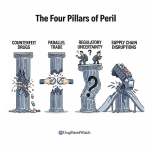
The Four Patent Risks That Actually Kill Deal Value
Most due diligence failures trace back to one of four structural problems. They are distinct, require different analytical responses, and tend to be discovered at different stages of a deal process. The worst outcomes occur when any of these surfaces post-closing.
When Invalidity Turns a $2.54B Asset Into Zero: The Merck/Idenix Lesson
Merck’s acquisition of Idenix Pharmaceuticals, which held a patent covering nucleotide analogs used in developing sofosbuvir-based hepatitis C therapies, resulted in a 2016 jury award of $2.54 billion against Gilead Sciences for infringement. The verdict was the largest patent damages award in U.S. history at the time. The Federal Circuit reversed it in 2019, finding the Idenix patent invalid because it failed the enablement requirement: the specification did not provide sufficient guidance for a person of ordinary skill in the art to make and use the full scope of the claimed invention without undue experimentation.
A separate but related case also went against Merck. A court found that Merck had engaged in litigation misconduct, specifically lying under oath during depositions and trial, resulting in an “unclean hands” finding that barred Merck from asserting its patents against Gilead in that litigation. The combined outcome — invalidity on enablement grounds and unenforceability from inequitable conduct — eliminated the multi-billion-dollar patent position entirely. No settlement, no license revenue, no damages award.
For deal teams, the lesson is that enablement analysis of a patent is not optional even when a drug is already on the market. A commercially successful drug does not prove that the patent covering it is valid; it merely proves the drug works. The patent’s validity depends entirely on whether the specification teaches the claimed invention with sufficient detail. Merck’s experience is a direct argument for pre-acquisition claim construction analysis and expert review of the written description by a scientist who can evaluate whether the specification’s experimental examples support the claim breadth.
Freedom to Operate Failures: How a Blocking Patent Stops a Drug Dead
Freedom to operate analysis determines whether a company can commercialize its product without infringing third-party patents. It is categorically distinct from a validity analysis of the company’s own IP. A company might hold valid, enforceable patents on its product and still lack the freedom to sell it because a broader, earlier patent held by a competitor covers the same mechanism or molecule.
Blocking patents are particularly common in oncology signal transduction pathways, CRISPR-based gene editing (where the UC Berkeley vs. Broad Institute interference proceeding produced a fractured freedom-to-operate landscape for all developers), RNA therapeutics, and monoclonal antibody engineering. In any of these fields, an acquirer who fails to map the third-party patent landscape before closing may find itself in licensing negotiations from a position of complete dependence. The Broad Institute’s CRISPR patent portfolio, for example, has created a situation where multiple therapeutic developers must negotiate licenses to practice foundational gene-editing technology, and those license terms are not standardized.
In pharma M&A specifically, a freedom-to-operate gap is rarely disclosed voluntarily by the target. Startups and early-stage biotechs often have not commissioned comprehensive FTO analysis, either because they lacked the budget or because they preferred not to create documented evidence of known infringement risk. Diligence teams must assume the FTO work has not been done and perform it independently.
Chain of Title Defects in Biotech Startups: Why Founder Assignment Matters
The most common ownership defect in venture-backed biotech acquisitions involves a broken chain of title between the university or research institution where the science was developed and the company commercializing it. Many biotech founders begin developing their core technology as university employees or contractors. If the invention assignment agreement between the founder and the institution is unclear, if the founder’s employment agreement at the university pre-dated or overlapped with the spin-out period, or if a co-inventor who was never named on the patent later emerges, the entire chain of title can be thrown into dispute.
A related problem specific to early-stage companies is the failure to obtain proper work-for-hire agreements from contractors who contributed to early platform development. In software, this is commonly understood. In biotech, it is often overlooked. If an early CRO or contract scientist contributed inventive work that ended up in a filed patent without a proper assignment, the company does not own that patent regardless of what the patent says on its face. Post-acquisition, the acquirer inherits both the asset and the title defect.
A clean chain of title audit requires independent review of all inventor agreements, university licensing agreements, employment contracts from the founding period, and any sponsored research agreements under which early technology was developed. This is not glamorous work. It is frequently the work that prevents an acquirer from discovering two years post-close that a $500 million acquisition target was built on IP to which a former university partner retains rights.
Undisclosed Litigation and the ‘Deeper Pockets’ Effect
The announcement of a major pharmaceutical acquisition creates a specific litigation incentive for any party with a pending or potential IP claim against the target. A privately held biotech with $50 million in assets is not an attractive defendant. The same company, once announced as the target of a $5 billion acquisition by a major pharma company, becomes substantially more interesting to a patent assertion entity or a competitor with dormant infringement claims. The 30-day window between announcement and close is a known window for pre-litigation positioning.
Adequate diligence requires not just a review of disclosed litigation but an independent search of PACER records, USPTO PTAB dockets, and European patent opposition registries. It also requires direct inquiry with the target’s legal counsel about any cease-and-desist letters, licensing solicitations, or informal notices of potential infringement received in the preceding 36 months. These are not always captured in standard representations and warranties schedules unless the diligence team explicitly asks for them.
Most Important Ongoing Litigation The Amgen vs. Sanofi/Regeneron biosimilar litigation over PCSK9 inhibitors established that antibody patents with broad functional claims and limited structural disclosure are vulnerable to invalidation under the enablement doctrine — the same doctrine that killed the Merck/Idenix position. Any deal involving monoclonal antibody assets with broad claim construction deserves expert enablement analysis before close.
How the FDA Could Affect M&A Timeline and Asset Valuation
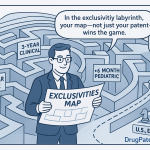
FDA regulatory exclusivity is a parallel system to patent protection and, in many cases, is the more commercially relevant protection period. A drug covered by an expired patent can still be protected from generic entry if it retains New Chemical Entity (NCE) exclusivity (5 years), Orphan Drug exclusivity (7 years), Pediatric exclusivity (6-month extension), or Biologics exclusivity (12 years under the BPCIA). For acquirers, the regulatory exclusivity calendar is as important as the patent expiry calendar, and the two frequently diverge.
How Biologics Price Competition and Innovation Act Exclusivity Affects Biosimilar Launch Timing
The Biologics Price Competition and Innovation Act (BPCIA) provides reference product sponsors with 12 years of data exclusivity from the date of first approval, during which no biosimilar can receive FDA approval regardless of patent status. For biologics approved after the BPCIA’s 2010 enactment, this means the regulatory exclusivity period may extend further than the composition-of-matter patent. For older biologics like Humira (approved 2002), the 12-year exclusivity period ran out in 2014, leaving patents as the primary barrier to biosimilar entry.
The practical implication for deal modeling is that an acquirer must track both the patent expiry date and the BPCIA exclusivity date independently. A drug approaching patent expiry but still within its 12-year BPCIA exclusivity window retains meaningful protection. Conversely, a drug that has exited BPCIA exclusivity but still holds a dense patent thicket may face biosimilar entry sooner than the patent dates suggest, because biosimilar developers can file applications and complete development work during the exclusivity period, with approval pending only the expiry of the exclusivity.
How Supplementary Protection Certificates in Europe Change the LOE Calculation
European markets present a materially different exclusivity calculation because of the Supplementary Protection Certificate (SPC) regime, which can extend patent protection by up to five years beyond the basic patent expiry date to compensate for the time lost during regulatory approval. Countries implement SPCs differently, and the grant process is managed at the national level, which means a drug can have varying effective exclusivity dates across Germany, France, the UK, and Italy. Post-Brexit, the UK SPC regime diverged further from the EU, creating an additional variable for deal teams modeling European revenue.
For large deals with significant European revenue contribution, the SPC analysis requires country-by-country review. The EU Unitary Patent system, operational since June 2023, adds another layer: drugs granted unitary patent protection and a unitary SPC will have a single pan-European exclusivity date (excluding Spain and Croatia), potentially simplifying the analysis for future products but creating a parallel regime that now runs alongside the national SPC systems for existing products.
FDA Orange Book Delisting and Its Effect on Paragraph IV Strategy
The FDA Orange Book lists patents that innovators have certified as covering an approved drug. A generic filer must certify against each listed patent, either that the patent is invalid (Paragraph IV) or that its product won’t infringe. Delisting a patent from the Orange Book, whether voluntarily or through an FTC delisting petition, eliminates the automatic 30-month stay for that patent. Recent FTC enforcement activity has focused on branded manufacturers listing patents in the Orange Book that do not properly cover the listed drug product, including device patents and process patents that don’t meet the statutory listing criteria.
For acquirers, an Orange Book listing review is mandatory. Patents improperly listed generate exposure: the FTC has initiated enforcement proceedings requiring delisting, and a successful challenge by a generic filer can accelerate entry for all generics in the queue. Understanding exactly which patents are properly listable, and which might be challenged, is part of accurate LOE timeline modeling.
How Royalty Structures and Licensing Economics Affect Drug Asset Valuation in M&A
A patent is only as valuable as the cash flows it enables. For any pharmaceutical asset, that means understanding not just the patent itself but every licensing arrangement, royalty obligation, and sub-license that affects what the acquirer will actually receive. Several structural factors consistently reduce net royalty realization below the headline rates that appear in deal presentations.
Stacked Royalties in Biologic Drug Manufacturing and Their Impact on Deal Economics
A biologic drug commercialized under multiple licensed technologies can accumulate royalty obligations from several independent licensors. An antibody product might carry royalties to a hybridoma or phage display platform provider, to a humanization technology licensor, to a cell culture media patent holder, and to an upstream manufacturing process patent owner. Each obligation is typically calculated on net sales, and the aggregate “royalty stack” can reach 15–25% of net sales for heavily encumbered biologics.
Acquirers who model the target’s royalty obligations solely from the income statement are frequently misled, because royalty payments to third-party licensors are often embedded in cost of goods rather than disclosed as a separate line item in management accounts. A complete royalty stack analysis requires reviewing every license agreement in the target’s IP file, identifying any royalty-bearing technology, calculating the rate and base, and assessing whether the agreements contain change-of-control provisions that trigger renegotiation or termination on acquisition.
How Paragraph IV Settlements Create Hidden Revenue-Sharing Obligations
When an innovator settles a Paragraph IV challenge by granting the generic filer a license to enter at a specific future date, that settlement converts what would have been a litigation risk into a certain revenue cliff. The settlement date becomes the effective LOE date for revenue modeling purposes, which may be earlier or later than the patent expiry date itself. Multiple settlements with different entry dates for different generic filers create a tiered erosion schedule that requires the acquirer to model multiple scenarios.
Settlement terms involving “at-risk launch” provisions are particularly complex: a generic manufacturer may retain the right to launch before the settlement date if the innovator takes certain actions (such as filing a second lawsuit) or if the settlement’s antitrust validity is successfully challenged. These contingent provisions, which are standard in sophisticated Hatch-Waxman settlements, can trigger unexpected early generic entry and must be identified and analyzed before close.
The Mylan/Meda FTC Precedent: When IP Due Diligence Misses Antitrust Exposure
Mylan’s $7.2 billion acquisition of Swedish drug maker Meda in 2016 illustrates a failure mode that sits at the intersection of IP review and antitrust analysis. The FTC found that the combined entity would eliminate competition in two generic pharmaceutical markets where Mylan was positioned as an imminent entrant to Meda’s existing products. The resolution required Mylan to divest rights and assets in the affected products before the deal could close.
IP due diligence focused exclusively on validity, FTO, and ownership would have identified no problem: the patents were sound and Mylan had a clear right to commercialize. The failure was in the competitive overlap analysis, which required mapping Mylan’s ANDA pipeline against Meda’s marketed generic products. That analysis needed the IP team and the antitrust team to work together, not in separate workstreams.
The practical implication for large pharmaceutical M&A: any deal with significant generic overlap between the acquirer’s ANDA pipeline and the target’s marketed products requires coordinated IP and antitrust diligence. The FTC’s analysis of generic drug competition is product-specific, not therapeutic-class-specific, which means products that appear unrelated at the class level can create antitrust exposure at the specific-molecule level.
Building the Diligence Framework: What a Real IP Due Diligence Process Looks Like
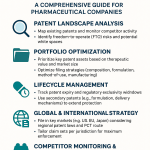
A standard approach to pharmaceutical IP due diligence follows four analytical pillars in sequence, with each pillar informing the next. The sequence matters because it determines resource allocation: a patent landscape analysis informs which patents deserve deep validity scrutiny; a validity analysis informs the FTO scope; the FTO analysis shapes the ownership and title verification priorities.
What a Patent Landscape Analysis Should Actually Reveal
A patent landscape analysis is the foundation, not the endpoint, of pharmaceutical IP due diligence. At minimum, it should identify all active patents in the target’s portfolio by expiry date, claim type, and jurisdiction. It should also identify the competitive patent landscape: who else holds patents in the same therapeutic area, with what claim scope, and what those patents mean for the target’s freedom to operate.
The output of a good landscape analysis is a map that shows white space — areas where the target has patent coverage competitors lack, creating durable commercial advantages — and crowded space, where multiple players hold overlapping patents and the FTO situation is complex. For early-stage biotechs, the landscape analysis frequently reveals that the target’s core mechanism is covered by a foundational patent held by an academic institution or a larger competitor, and the target is building on a licensed or potentially infringing base without fully appreciating the royalty exposure.
How to Conduct a Validity Analysis That Survives Merck-Level Scrutiny
A patent validity analysis for a core pharmaceutical asset must go beyond claim construction and prior art searching. The minimum required components are: claim construction mapping across the full independent and dependent claim set; prior art search covering at least the 10 years preceding the priority date; review of the prosecution history (file wrapper) to identify any statements made to the USPTO that limit claim scope; evaluation of the written description requirement against the full scope of the claims; and an enablement assessment conducted by a scientist with relevant technical expertise who can evaluate whether the specification’s examples support the claimed breadth.
The Merck/Idenix case, the Amgen vs. Sanofi PCSK9 case, and the earlier Ariad vs. Eli Lilly written description dispute all turned on enablement or written description failures that a proper validity analysis would have identified. The legal standard requires that a patent enable a person skilled in the art to make and use the full scope of the claimed invention without undue experimentation. Broad functional claims with limited working examples are the most common vulnerability. Any claim that reads on a structural class defined by function (as opposed to specific chemical structure) deserves particular scrutiny under this standard.
Why the Due Diligence Team Structure Determines the Quality of the Analysis
IP due diligence in pharmaceutical M&A requires a hybrid team that most law firms and most in-house legal departments are not structured to provide independently. The legal component — claim construction, FTO analysis, litigation history review — requires patent attorneys with pharmaceutical prosecution and litigation backgrounds. The technical component — validity assessment, enablement evaluation, manufacturing moat analysis — requires scientists with relevant biology or chemistry expertise who understand what level of experimental detail is needed to support broad claims. The business component — LOE timeline modeling, royalty stack analysis, FTO gap commercial implications — requires people who understand how pharmaceutical markets actually work.
These three functions are rarely housed in the same team. Law firms have patent attorneys who may lack deep commercial context. Management consultants and investment banks have commercial analysts who lack patent prosecution expertise. The most effective diligence teams are purpose-built hybrids, often combining outside patent counsel, internal scientific advisors, and commercial forecasting resources, coordinated by a deal team that has performed this exercise enough times to know which findings are material and which are standard background noise.
How AI-Driven Patent Analytics Platforms Change the Speed and Scope of Due Diligence
Platforms like DrugPatentWatch, LexisNexis PatentSight+, and Clarivate Derwent Innovation have changed what’s achievable in the compressed timelines typical of pharmaceutical M&A. A patent portfolio that previously required weeks of manual review to map across jurisdictions, expiry dates, and claim types can now be analyzed in days. More practically, these tools enable rapid identification of the 20–30 patents in a portfolio of 200 that are most commercially significant, allowing the human expert team to focus its time on the patents that actually matter.
The Patent Asset Index and similar quantitative portfolio scoring tools provide a first-pass quality assessment that helps prioritize review queues. They don’t replace expert analysis but they direct it efficiently. In competitive deal processes where multiple bidders are working under the same tight timeline, the ability to complete a rigorous first-pass landscape analysis in 48–72 hours rather than two weeks is a real competitive advantage.
Deal Structuring to Allocate IP Risk: The Clauses That Actually Matter
The acquisition agreement is the final mechanism for allocating IP risks that couldn’t be fully resolved during diligence. How that agreement is structured determines whether undiscovered or known-but-unquantified risks stay with the seller or transfer to the buyer at close.
How Representations and Warranties Insurance Has Changed IP Risk Transfer
Representations and warranties (R&W) insurance has become standard in pharmaceutical M&A, particularly for private company targets. R&W insurance allows an acquirer to buy a policy that covers losses from breaches of the seller’s representations, replacing or supplementing the traditional indemnification escrow. For IP-heavy deals, R&W policies require the insurer to assess IP-specific representations — ownership, no known infringement, no undisclosed litigation — and the underwriting process functions as an independent quality check on the diligence findings.
Underwriters will frequently exclude known or suspected IP risks from coverage, which means the diligence team needs to document clearly what is known and unknown about the IP portfolio. An exclusion from R&W coverage for a specific patent challenge or an identified FTO gap signals that the market views that risk as material and uninsured, which is valuable information for purchase price adjustment negotiations. R&W policies don’t replace indemnification provisions but they do change the seller’s willingness to negotiate clean break terms.
Change-of-Control Provisions in License Agreements: The Hidden Deal Risk
Many pharmaceutical licenses contain change-of-control provisions that trigger on acquisition, allowing the licensor to terminate the license, require consent, or renegotiate terms. These provisions are most common in platform technology licenses granted by academic institutions, technology licenses granted by larger pharmaceutical companies to smaller biotechs, and government-funded research licenses where the Bayh-Dole Act imposes specific commercialization requirements. A change-of-control termination of a key license can eliminate the commercial basis for the acquisition entirely.
Identification of change-of-control provisions requires reviewing every material license agreement in the target’s portfolio, not just the headline licenses disclosed in the data room index. Private biotechs frequently have multiple upstream technology licenses from different providers, with varying change-of-control terms. The diligence checklist should require disclosure of every agreement containing any IP assignment restriction, change-of-control trigger, anti-assignment provision, or termination right, including agreements that the target may classify as routine or immaterial.
Escrow Structuring for Known IP Litigation and How to Size the Reserve
When diligence identifies a pending or probable IP claim that cannot be resolved before close — an active Paragraph IV litigation, a threatened IPR petition, or a known third-party infringement dispute — the deal team must decide how to reflect that risk in the deal structure. The standard tools are purchase price reduction, indemnification carve-out with an escrow or holdback reserve, and specific litigation indemnification with a defined cap.
Sizing an escrow reserve for patent litigation requires a realistic probability-weighted damages analysis. For Paragraph IV litigation where the target is the innovator defendant, the damages are typically $0 (the generic enters or doesn’t), but the legal costs and the possibility of an at-risk generic launch need to be modeled. For situations where the target holds patents being challenged by a competitor who has at-risk inventories, the downside includes both potential invalidity and potential lost revenue from accelerated entry. Escrow sizing should reflect the expected value of the worst credible outcome, not the average.
Pipeline Replacement Risk: How LOE Drives M&A and Why It Often Fails
The patent cliff is supposed to drive rational M&A behavior: a company facing LOE on its flagship product acquires a late-stage asset to replace the lost revenue. In practice, the urgency to replace revenue creates acquisition premiums that rarely reflect the actual risk-adjusted value of the pipeline asset, and the diligence process suffers from pressure to close rather than pressure to get it right.
What Happens Financially After Loss of Exclusivity: The Revenue Erosion Curve
Generic entry typically triggers a 70–90% price decline for the branded product within 18 months of first generic availability. The erosion rate depends on the number of generic entrants, formulary switching policies among major PBMs (Express Scripts, CVS Caremark, OptumRx), the existence of an authorized generic, and whether the drug has a narrow therapeutic index that might slow formulary substitution for clinical reasons. Small molecules with broad therapeutic index and multiple generic entrants typically experience the fastest erosion. Brands that maintain a significant patient base with clinical familiarity, or that have pay-for-performance formulary positions, can maintain 10–20% of peak revenue for several years post-LOE.
The biologic LOE erosion curve is structurally different. Biosimilar penetration rates in the U.S. have historically been slower than European markets, reaching 30–50% of prescriptions within 3 years of first biosimilar launch, compared to 80–90%+ for small molecule generics in the same timeframe. For acquirers modeling post-LOE revenue from biologic assets, European biosimilar experience (adalimumab, infliximab, trastuzumab) provides the best available data on penetration rates, and U.S. rates appear to be converging toward European levels as PBM formulary management of biosimilars matures.
Roche/InterMune: What a Clean IP Estate Actually Looks Like in a Deal
Roche’s $8.3 billion acquisition of InterMune in 2014 proceeded without the IP entanglements that characterized the Merck/Gilead litigation or the FTC complications of Mylan/Meda. The deal was centered on pirfenidone (Esbriet), an antifibrotic for idiopathic pulmonary fibrosis. InterMune held a relatively clean patent portfolio around the pirfenidone formulation and the specific indication with clear chain of title and no disclosed blocking patents or pending challenges that materially threatened the asset.
The absence of public IP dispute in that deal reflects what proper IP hygiene looks like in a development-stage company: clear inventor assignments, a focused patent portfolio built around the commercial product and indication rather than broad platform claims, and a regulatory exclusivity strategy that captured Orphan Drug and NCE exclusivity in key markets. Roche inherited an indemnification obligation related to a pre-acquisition legal dispute involving InterMune’s former CEO, but that was a disclosure control matter unrelated to the core IP position.
The InterMune deal is not a boring outcome. It is the target that every acquirer should want: an asset where the patent position is defensible, the chain of title is clean, and the regulatory exclusivity runway is clear enough to support the acquisition model without excessive sensitivity to litigation outcomes.
Post-Acquisition IP Integration: The Work That Determines Whether the Deal Value Holds
The diligence process identifies risks and informs the deal price and structure. Post-acquisition integration determines whether the value identified during diligence is actually realized. IP integration in pharmaceutical M&A involves several discrete activities that, if delayed or mismanaged, can create value erosion that the due diligence process never anticipated.
Why Patent Maintenance Failures Post-Close Can Destroy Acquired Value
Pharmaceutical patents require active maintenance: periodic annuity payments to national patent offices to keep issued patents in force, continuation prosecution to extend coverage through the patent family, and responses to ongoing examination or opposition proceedings. When an acquisition closes, the responsibility for maintenance transfers to the acquirer, but the knowledge of exactly which payments are due when and which prosecution deadlines are pending remains in the target’s IP department.
Maintenance fee payment failures have permanently abandoned patents that were part of the basis for a deal’s valuation. Missed USPTO maintenance fee deadlines result in patent expiry after a 6-month grace period. European patent annuity failures can be more immediate. For deals where the acquisition is followed by IP department integration or downsizing, the risk of missed deadlines increases precisely when it is most consequential.
How IP Tax Structure Determines Whether Acquired Patents Generate Expected Returns
The jurisdiction in which an acquired patent is held determines the tax rate on royalties and licensing income derived from it. A patent held in an Irish holding company, a Dutch IP box entity, or a UK patent box structure generates royalty income at preferential tax rates compared to a patent held directly by a U.S. parent. Post-acquisition IP restructuring, moving patents into low-tax jurisdictions or establishing a new IP holding structure, can generate significant after-tax value but requires planning before close because certain restructuring transactions must occur within specific windows relative to the acquisition to achieve the intended tax treatment.
Conversely, acquiring a company that holds patents in a structure that doesn’t align with the acquirer’s tax strategy may require restructuring that triggers transfer pricing obligations and stamp duties. The Mayer Brown IP tax analysis referenced in pharmaceutical M&A literature identifies this as a category of post-acquisition risk that is “often overlooked, but can easily derail” the economics of an investment. Involving IP tax counsel in the diligence process, not just during post-close integration, allows the acquirer to model the full after-tax economics of the IP portfolio before committing to a price.
Revenue at Risk: Which Competitors Could Benefit From Your Target’s LOE
Every LOE event in pharmaceutical markets creates a redistribution of revenue. Understanding who benefits from a target’s patent cliff is as important as modeling the revenue loss, because it identifies the competitive landscape post-acquisition and informs the strategic case for the deal.
LOE Event
Primary Beneficiaries
Therapeutic Class Dynamics
M&A Implication
Eliquis LOE (2026–27)
Torrent, Apotex, Aurobindo ANDA filers; Xarelto (rivaroxaban) in competitive class
Oral anticoagulant class; switching risk from NOAC class to generic apixaban
Acquirer of generic apixaban ANDA secures first-day-launch economics
GLP-1/GIP class expanding; manufacturing barriers limit immediate generic entry
Acquirers of GLP-1 manufacturing capability gain durable strategic position
Common Investor Questions on Pharma IP and M&A
What is the difference between a patent expiry date and a loss of exclusivity date?
Patent expiry is the date on which a specific patent ceases to be in force. Loss of exclusivity (LOE) is the broader commercial event that includes patent expiry but also accounts for regulatory exclusivities (NCE, biologic exclusivity, orphan drug), ongoing litigation that delays generic entry, and settlement agreements that specify a permitted entry date. LOE is the commercially relevant date for revenue modeling. It is frequently later than the base patent expiry because secondary patents, SPCs, or regulatory exclusivities extend the protected period.
How does a Paragraph IV filing affect the value of a branded drug asset?
A Paragraph IV filing signals that a generic manufacturer believes the innovator’s patents are invalid or that its product won’t infringe those patents. The filing triggers the 30-month litigation stay and begins the clock on the first-filer 180-day exclusivity. For the branded asset, the filing creates litigation cost, a defined end date for exclusivity if the challenge succeeds, and settlement pressure. Deal models for branded drug acquisitions must reflect the probability-weighted outcome of pending Paragraph IV litigation in the NPV calculation.
What is biosimilar interchangeability and why does it matter for market share erosion?
Biosimilar interchangeability is an FDA designation indicating that a biosimilar can be substituted for the reference product at the pharmacy level without prescriber intervention, the same way a generic is substituted for a small molecule brand. It requires additional switching studies demonstrating that alternating between the biologic and the biosimilar doesn’t produce greater risk than using only one product. Interchangeability is expected to accelerate biosimilar market share capture by enabling automatic pharmacy substitution, removing the prescriber inertia that has slowed non-interchangeable biosimilar uptake.
How should acquirers handle a target company with an undisclosed FDA warning letter?
An FDA warning letter related to manufacturing quality creates several deal risks: the potential for import alert that stops product from entering the U.S., the cost and timeline of remediation (frequently 18–36 months for serious issues), and reputational damage with payers and prescribers. Warning letters must be discovered through independent FDA database search and verified with the target’s regulatory team. If discovered, the deal structure should include escrow provisions covering remediation costs and revenue impact during the shutdown period, with seller indemnification tied to the pre-close conduct.
What does ‘unclean hands’ mean in the Merck vs. Gilead context?
In the Gilead Sciences v. Merck case, the Federal Circuit found that Merck’s predecessor had engaged in litigation misconduct during earlier patent proceedings, including presenting false testimony. The “unclean hands” doctrine is an equitable defense that bars a party from obtaining judicial relief when that party has acted in bad faith or engaged in unconscionable conduct related to the matter in dispute. In practical M&A terms, this means an acquirer can inherit not just an invalid patent but a patent that has been rendered unenforceable by the prior owner’s conduct, with no mechanism to cure the unenforceability post-acquisition.
How does an at-risk generic launch change deal economics?
An at-risk launch occurs when a generic manufacturer launches before final resolution of patent litigation, accepting the risk that it may owe damages if the court ultimately upholds the innovator’s patent. For the branded asset acquirer, an at-risk launch is a catastrophic event: it can create immediate market share loss before LOE was modeled, at a time when the litigation was expected to provide a runway. Acquirers must assess the likelihood of at-risk launch by evaluating the financial strength of the generic filers, the perceived strength of the patent being litigated, and any existing history of at-risk behavior by the specific generic manufacturers involved.
Investment Strategy: How to Apply IP Due Diligence Findings to Deal Decisions
IP due diligence outputs should feed directly into deal decisions, not just legal documentation. The findings from a validity analysis, FTO review, and ownership audit each have specific deal implications that determine whether to proceed, at what price, and with what structural protections.
Finding
Risk Level
Deal Impact
Recommended Action
Core patent has broad functional claims with limited working examples
High
Enablement invalidation risk; value could go to zero
Expert enablement analysis before price lock; probability-adjust NPV; escrow for litigation outcome
Blocking third-party patent identified in FTO analysis
High
Commercialization may require license on unknown terms
Pre-sign license negotiation attempt; walk away if licensor is uncooperative at reasonable rates
Inventor assignment gap from university co-inventor
Medium
Title dispute risk; potential post-close challenge
Require cure before close; obtain university acknowledgment or quitclaim assignment; escrow if uncurable before close
Active Paragraph IV litigation by credible generic filer
Medium
LOE earlier than modeled; litigation cost obligation
Probability-weight LOE date in model; seller indemnification for pre-close conduct; litigation budget in post-close plan
Change-of-control termination right in key platform license
High
License terminates at close; no product to acquire
Pre-close consent from licensor required; structure deal conditioned on consent; negotiate new license as part of signing
Dense biosimilar patent thicket with IPR-vulnerable secondary patents
Medium
Thicket erosion faster than modeled; effective LOE earlier
Model accelerated thicket erosion scenario; identify which patents are IPR-robust; value accordingly
Royalty stack totaling 18–22% of net sales
Medium
Gross margin structurally lower than headline suggests
Remodel economics on actual net royalty basis; assess renegotiation potential post-close; adjust purchase price
No Orange Book listing issues; clean chain of title; no pending challenges
Low
IP estate supports deal model
Standard R&W protection; proceed with confidence on IP basis
How to Use Patent Expiry Analysis to Set a Maximum Acquisition Price
The core financial application of IP due diligence is constraining the deal model with realistic exclusivity timelines. A discounted cash flow model for a pharmaceutical asset should have separate cash flow scenarios tied to: (1) the base patent expiry date with no successful challenges, (2) the probability-weighted LOE date accounting for pending litigation and thicket vulnerability, and (3) an accelerated entry scenario reflecting at-risk launch or settlement. The probability-weighted NPV of these scenarios, not the optimistic single-case model, is the basis for a rational maximum purchase price.
For biologics specifically, the LOE analysis must account for biosimilar development timelines from the current date, the regulatory pathway requirements, and the manufacturing scale-up reality. A biosimilar program that hasn’t started clinical comparability studies today is unlikely to be on the market before 2029–2030, which provides genuine runway even for products with near-term patent expiry. That manufacturing and regulatory lag is a real economic asset that should be valued in the deal model, not discounted because the base patent expires soon.
Key Takeaways
IP due diligence in pharmaceutical M&A is the primary analytical exercise, not a legal formality. For most pharma assets, the IP estate is the deal.
The Merck/Idenix case proved that a multi-billion-dollar jury verdict can still produce a zero-value asset if the underlying patent lacks enablement. Validity analysis must include expert scientific review of written description and enablement, not just prior art searching.
Loss of exclusivity modeling requires tracking both patent expiry dates and regulatory exclusivity dates (BPCIA, NCE, Orphan Drug) independently. These frequently diverge, and the regulatory date often controls the commercial timeline.
Biosimilar interchangeability designations, ANDA settlement terms, and at-risk launch history are each specific data inputs that should feed directly into the LOE scenario model.
Freedom to operate analysis is outward-facing and categorically distinct from validity analysis. A valid patent on your own product does not grant freedom to sell it. Blocking patents must be identified before close.
Change-of-control provisions in platform technology licenses can terminate the commercial basis for an acquisition at close. Every material license agreement in the target’s IP file requires review for these provisions.
Stacked royalty obligations embedded in COGS can reduce effective gross margins significantly below the headline figures in management accounts. Complete royalty stack analysis requires reviewing every license agreement, not just the headline deals.
Post-close integration failures, particularly missed patent maintenance deadlines and deferred IP tax restructuring, can destroy value that the diligence process identified. IP integration planning should begin during the diligence phase, not after close.
The patent cliff is real, concentrated in a small number of mega-assets (Keytruda, Eliquis, semaglutide, dupilumab), and will drive M&A activity through 2030. Acquirers who can accurately model the post-LOE revenue trajectory have a durable analytical advantage over those relying on single-scenario optimistic assumptions.
This analysis is provided for informational purposes for pharma IP teams, institutional investors, M&A counsel, and commercial strategy teams. Drug patent expiry dates, regulatory exclusivity periods, and litigation status are subject to change. Verify all data with primary sources including the FDA Orange Book, USPTO Patent Center, and PTAB PRPS before making commercial or investment decisions.
All entities, patent families, and litigation references are used for analytical purposes. Patent dates cited reflect publicly available information as of publication; SPC extensions, continuation filings, and settlement agreements may affect effective exclusivity dates in specific jurisdictions.